
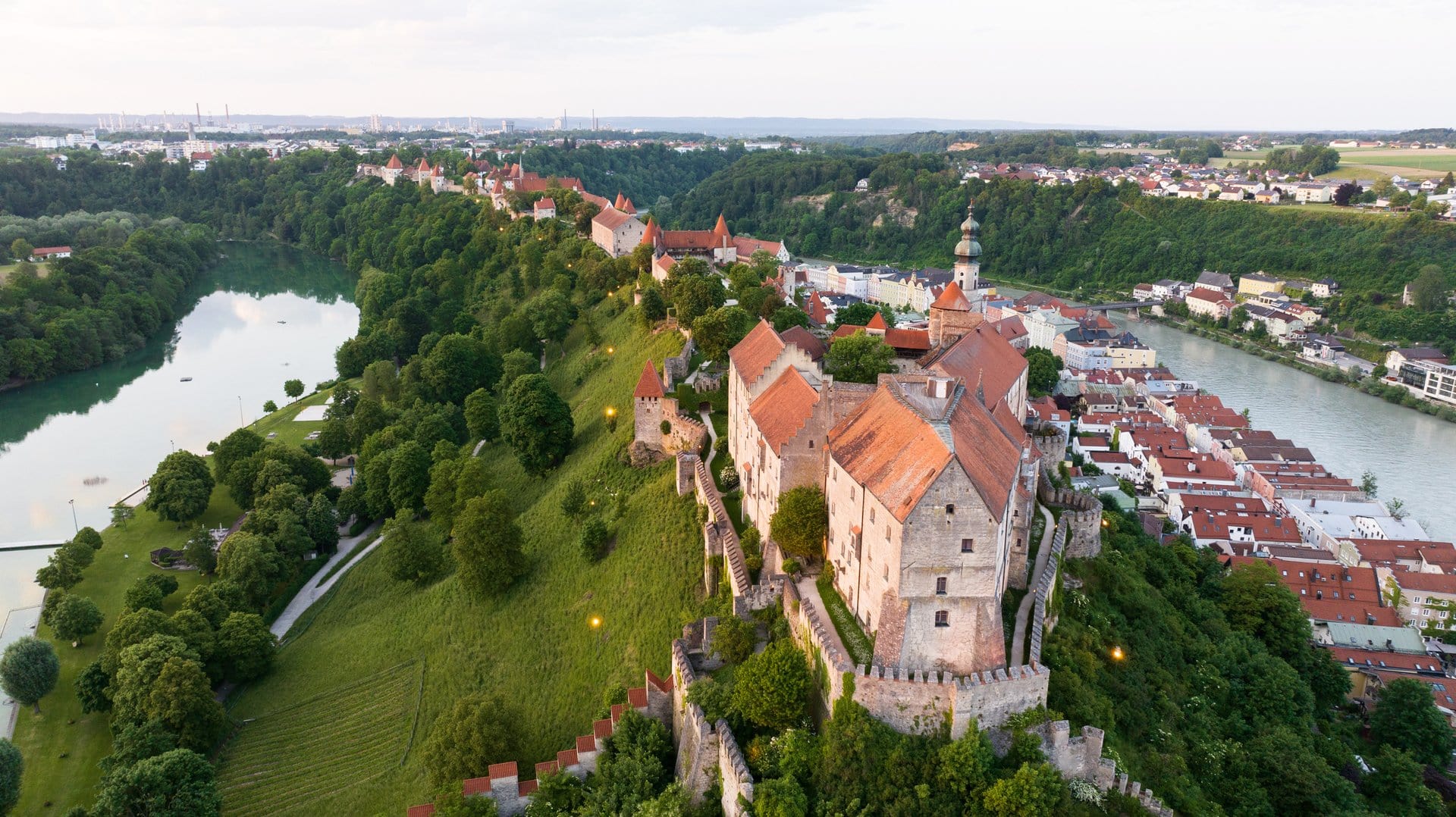
Burghausen Castle
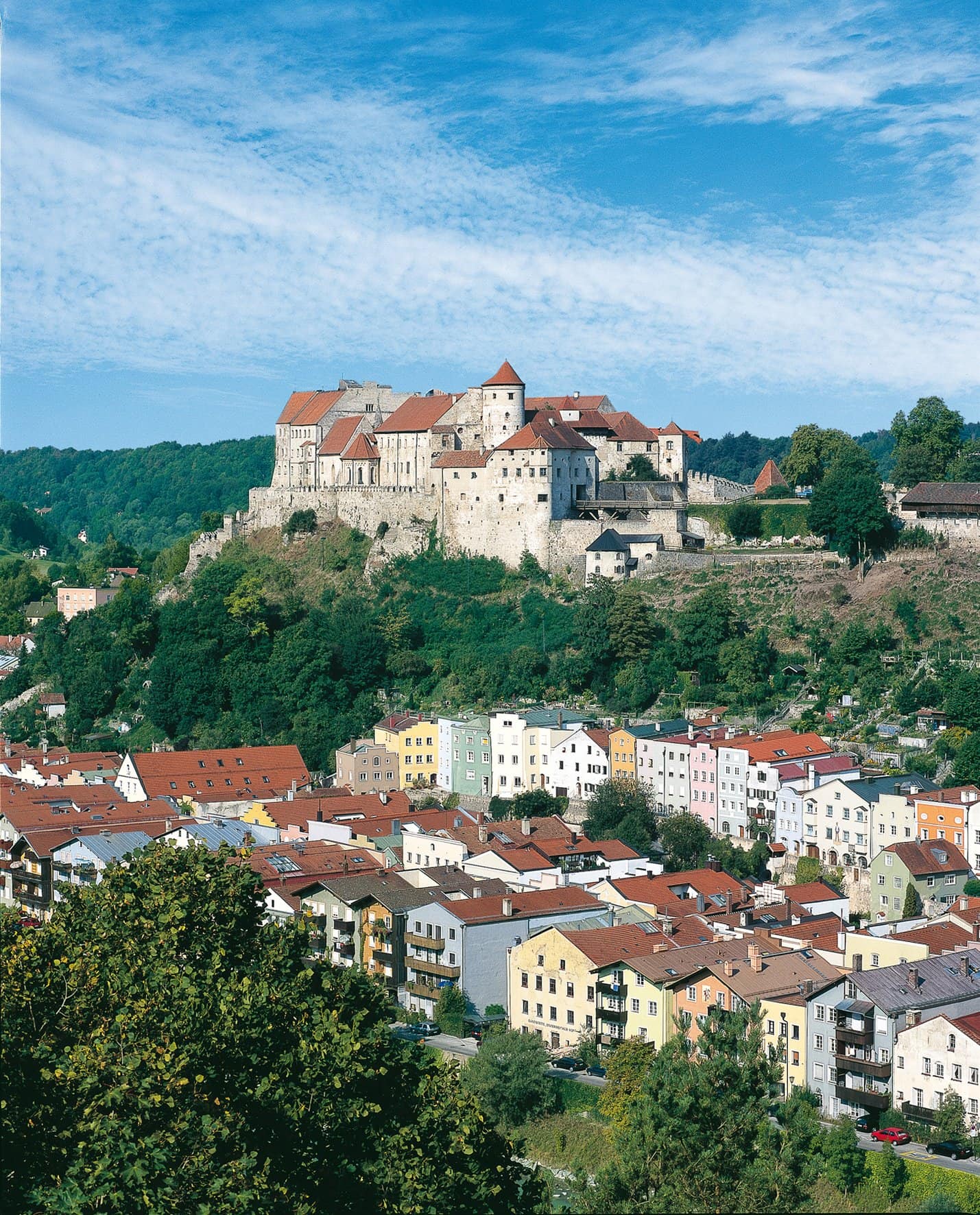
Salzach curves north out of the Alps and slows. On its western bank a narrow, conglomerate-capped ridge rises sixty meters above the water, runs more than a kilometer downstream, and ends only where the river turns and drops away into Austria. Along the entire length of that ridge (1,051.02 meters confirmed by Guinness World Records in 2008) runs Burghausen Castle. Five outer courtyards march northward from a Hauptburg of treasury, Palas, and seven-story keep, every one a working room of a Bavarian state that ceased to exist in 1505. Castle is what remained when the duchy was gone.
Quick Facts
| Country | Germany |
| Region / State | Bavaria (Oberbayern / Upper Bavaria, Landkreis Altötting) |
| Nearest Town | Burghausen, on the Salzach river facing Austria; München approximately one hundred fifteen kilometers west |
| Construction Period | Pre-1025 comital phase on the southern ridge; Hauptburg begun by Heinrich XIII of Lower Bavaria from 1255; ridge fortified to its full extent by 1387; late-Gothic completion under Duke George the Rich, 1479–1503 |
| Founder | Sieghardinger Counts of Burghausen, 1027 imperial enfeoffment; Wittelsbach inheritance from 1180; Lower-Bavarian and Bayern-Landshut ducal seat from 1255 to 1505 |
| Architectural Style | Multiple periods (Romanesque core, late-Gothic peak); Inn-Salzach Donaustil in the outer chapels; sixteenth-century Renaissance and seventeenth-century bastioned overlays |
| Building Type | Höhenburg / Kammburg — ridge castle of one inner Hauptburg and five outer courtyards on a conglomerate-capped spine above the Salzach; inner-courtyard walls of cut tuff ashlar |
| Length | 1,051.02 meters — certified by Guinness World Records on September 18, 2008 as the world’s longest castle |
| Current Condition | Intact; State Castle Museum and State Gallery in the Hauptburg; Stadtmuseum Burghausen in the Bower; in continuous administrative use since 1255 |
| Operator / Ownership | Bayerische Schlösserverwaltung since 1939; owned by the Free State of Bavaria |
| UNESCO Status | Not a UNESCO World Heritage site; protected as a Baudenkmal under Bavarian state heritage law |
| Visitor Access | Castle grounds open year-round and free; museums daily 9:00–18:00 (March 28 to end of September) and 10:00–16:00 (October to March 27, 2026) |
| Official site | burg-burghausen.de |
From comital seat to Wittelsbach hands, 1025–1387
Ridge was already settled in the Bronze Age, but the documentary history begins in 1025, when Empress Kunigunde tried to give Burghausen and Altötting to the Archbishop of Salzburg from her widow’s estate and Konrad II revoked the gift as imperial property. Two years later he installed the Sieghardinger Counts of Burghausen as administrators of the imperial fiscal estate. They built the first stone complex on the southern tip (a ring wall and a church) and held the castle for a century and a half.
When the comital line ended in 1164, Burghausen passed briefly to the Welf duke Henry the Lion, then in 1180, after Henry’s imperial ban, to Otto I of Wittelsbach with the rest of Bavaria. Wittelsbachs would hold it for the next eight centuries.
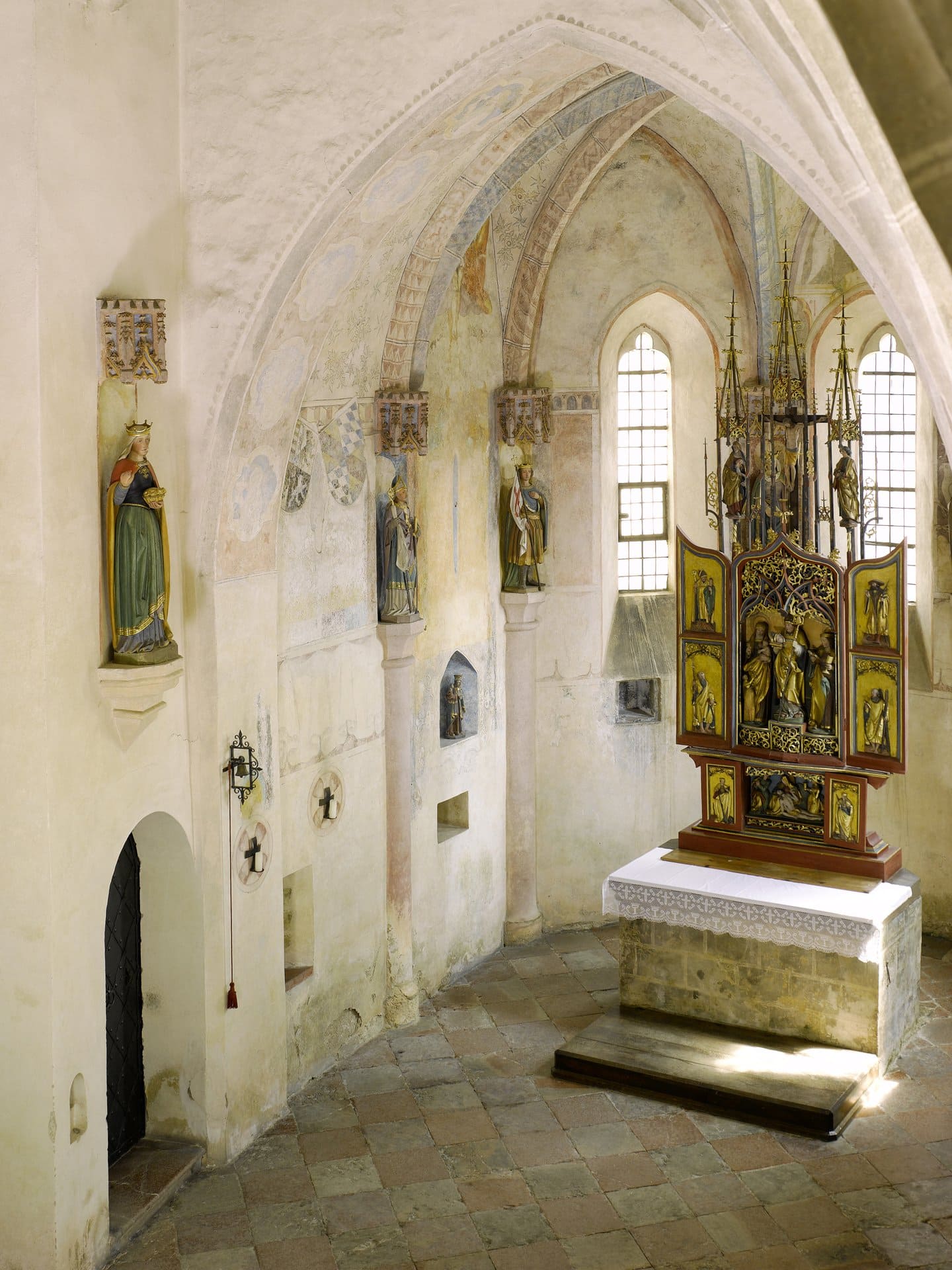
In 1255 Bavaria was first divided into Upper and Lower duchies. Lower-Bavarian dukes, residing primarily at Burg Trausnitz in Landshut, designated Burghausen their second residence, and Heinrich XIII (r. 1255–1290) began the Hauptburg essentially as it stands today: Palas with the ducal apartments, Dürnitz with its two vaulted halls, Kemenate (the Bower) for the duchess and her ladies, and the inner Burgkapelle of St. Elisabeth, dedicated to Heinrich’s wife’s aunt, the recently canonized landgravine of Thuringia. Through the fourteenth century the ridge was progressively walled northward. A document of 1387 records the full extent of the complex along the ridge, already the kilometer-long fortress that visitors recognize today, though more than a century of construction still lay ahead under the Rich Dukes.
The Landshut Wedding and Hedwig’s court
George the Rich was born at Burghausen on August 15, 1455, an unusual detail, since the formal court sat at Landshut, but a telling one. The Hauptburg was the dynastic strongroom of Bayern-Landshut: where the duchess held her own Frauenhof, where the gold and silver of the Rich Dukes were kept, where heirs were born. By the time George inherited the duchy in 1479, the institution was at its peak.
Four years before that succession, on 14 and November 15, 1475, George had married Hedwig Jagiellon, daughter of King Casimir IV of Poland, in the Landshuter Hochzeit, one of the largest dynastic festivals of the late medieval Empire, attended by Emperor Frederick III and the future Maximilian I. Hedwig’s permanent residence after the wedding was Burghausen. Whether this constituted banishment, as some later sources suggest, or normal court life befitting a duchess (the Bavarian Palace Administration’s current view, citing a 1471 Hofordnung that documents an extensive Frauenhof at the castle), is disputed. What is not disputed is that Hedwig’s twenty-seven years at Burghausen left their architectural mark across the entire complex.
She and George had five children: three sons who all predeceased their father, and two daughters. The elder, Elisabeth, would inherit. The younger, Margarete, became an abbess and outlived her sister by twenty-seven years, dying in 1531 as the last surviving member of the Bayern-Landshut line. Hedwig herself died at Burghausen on February 18, 1502 and was buried at the Cistercian abbey of Raitenhaslach, an hour upriver.
George the Rich and the late-Gothic completion
George inherited a strong castle and made it stronger. The fortifications on the Eggenberg promontory above the ridge were rebuilt under his court master mason, Ulrich Pesnitzer, against the renewed Turkish threat that pushed every late-fifteenth-century Bavarian prince to modernize his defenses. In 1482 the old Romanesque keep collapsed and was rebuilt as the seven-story Bergfried that still anchors the Hauptburg. A new treasury was built adjoining the Knights’ Hall in 1484, the inner chapel received its late-Gothic net vault, and the Palas and Bower were enlarged to accommodate Hedwig’s permanent court.
The two architectural set-pieces of the reign survive in the outer courtyards. Hedwig’s Chapel (the outer castle chapel of St. Mary, in the fourth outer courtyard) was built between 1479 and 1489. Current scholarship attributes it to the master mason Wolfgang Wiser, who worked from 1493 onward at Stift Nonnberg in Salzburg; older guides credit Pesnitzer. The chapel’s curving ground plan and rib-vaulted interior place it firmly within the Inn-Salzach late-Gothic tradition, the so-called Donaustil that connected Burghausen to Salzburg, Passau, and Braunau across the river. It was George’s and Hedwig’s joint commission, consecrated to Mary but bearing Hedwig’s name in popular usage from at least the sixteenth century.
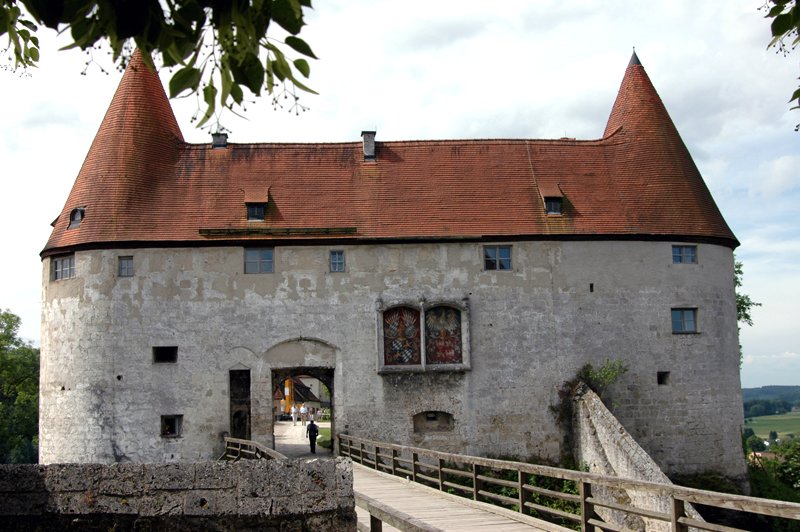
Other set-piece is the Georgstor (St. George’s Gate), built in 1494 between the first and second outer courtyards. On its northern face it carries the Bavarian-Polish Allianzwappen: Wittelsbach lozenges paired with the Polish white eagle. Gate is in effect a diplomatic document in stone, the dynastic alliance of the Landshut Wedding made permanent on the masonry. By the time it was finished, George was nearly fifty and his three sons were dead. Duchy had no male heir.
1503–1505: the duchy ends, the castle stops
In 1496 George had drawn up a testament naming his elder daughter Elisabeth heir to the duchy. The 1392 Wittelsbach house treaty forbade female succession, so the act was a declaration that George intended the Landshut line to survive through his daughter and her husband, Ruprecht of the Palatinate, rather than revert to the Munich Wittelsbachs. When George died at Ingolstadt on December 1, 1503, en route to a spa in Württemberg, the testament took effect; so did the war it had guaranteed.
Albrecht IV of Bavaria-Munich pressed his claim under the 1392 treaty. Emperor Maximilian I, after extracting from Albrecht the cession of Kufstein, Kitzbühel, and Rattenberg in the Tyrol, enfeoffed him with Lower Bavaria on April 23, 1504 and placed Ruprecht under imperial ban. Palatine troops occupied Burghausen, Landshut, and Straubing. On September 12, 1504, near Regensburg, Maximilian’s forces (including Georg von Frundsberg’s Landsknechte) annihilated a Bohemian Wagenburg fighting for the Palatinate at the Battle of Wenzenbach. Roughly 1,600 Bohemians died; Maximilian himself nearly fell. Three days later, Elisabeth died of dysentery at Landshut, eight months after Ruprecht had succumbed to the same disease.
On July 30, 1505 the war ended with Maximilian’s arbitration at the Reichstag of Cologne. The bulk of Bayern-Landshut, Burghausen included, passed to Bavaria-Munich. The Tyrolean districts went to Habsburg Austria. A new small duchy (Palatinate-Neuburg, the Junge Pfalz) was created for George’s grandsons Ottheinrich and Philipp. Bavaria was reunified the following year under primogeniture. Burghausen, the architectural high-water mark of the dissolved duchy, became a Prinzenwohnsitz and the seat of a fiscal Rentamt. Court was gone. Castle stopped growing.
Five centuries as a frozen monument
The five centuries after 1505 left Burghausen with a strange double identity: a sovereign capital that was no longer sovereign, and a fortress that was no longer the strongest in the country. It served as the seat of the Rentamt Burghausen, one of Bavaria’s four fiscal districts, until 1802. It housed Bavarian princes, never reigning dukes again. And it functioned, intermittently, as a state prison: Louis VII the Bearded had died there in 1447 as Heinrich XVI’s prisoner, and after the Battle of Nördlingen in 1634, the Swedish Field Marshal Gustav Horn was held in the main-castle dungeon for seven years before being exchanged for three imperial generals. The Hexenturm in the third outer courtyard saw its last accused witch imprisoned in 1751.
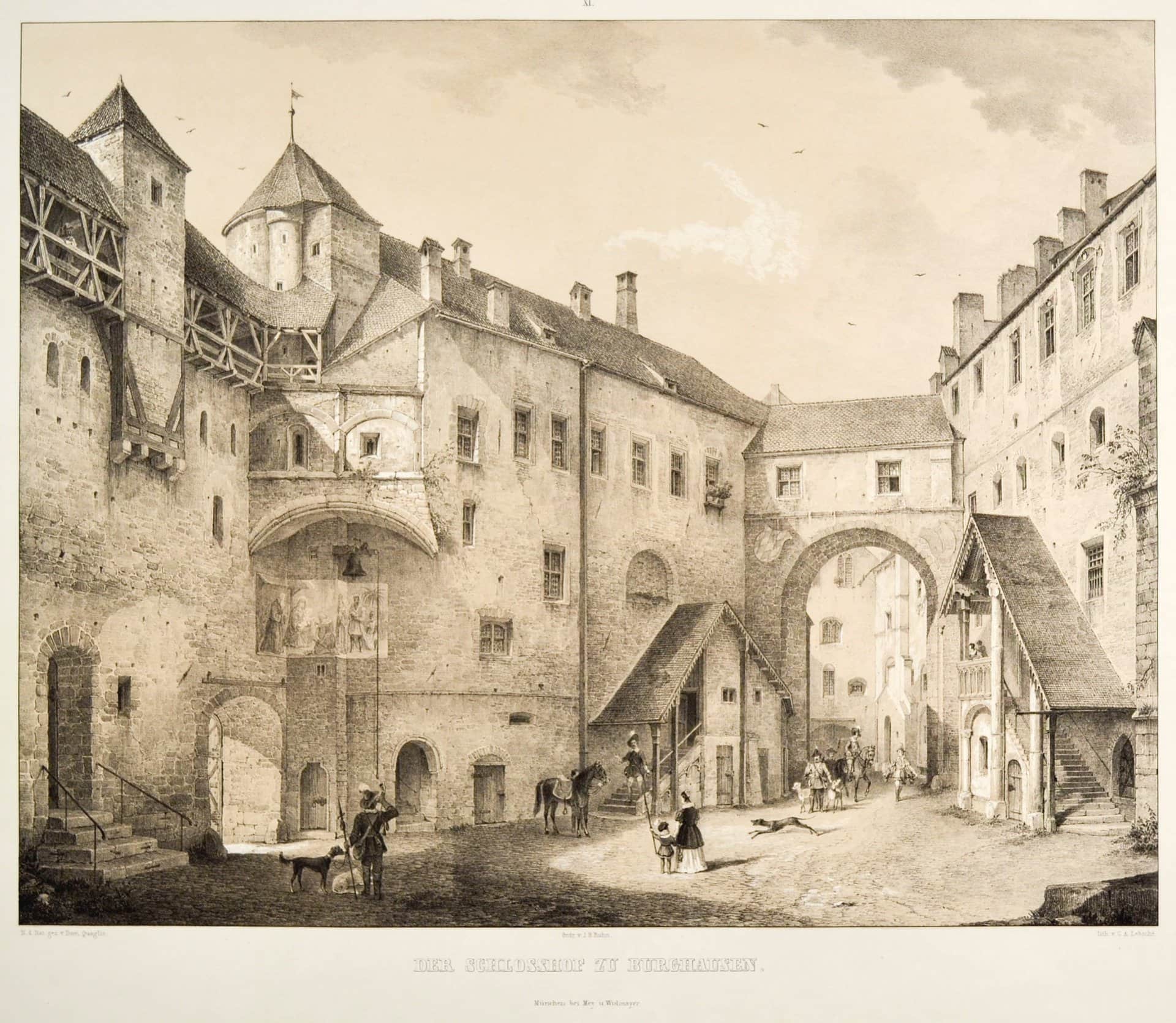
Fortifications continued to develop while the residential core stood still. Elector Maximilian I added bastions during the Thirty Years’ War; eighteenth-century Vauban-style outworks followed; in 1763 Burghausen was formally designated a garrison town. 1779 Treaty of Teschen, which gave the Innviertel across the Salzach to Habsburg Austria, made it a frontier town again, for the first time since 1505. Twenty years later, French troops under Marshal Michel Ney demolished most of the northern outer works during the Napoleonic occupation of 1800–1801; Napoleon himself inspected the castle in 1809 and pronounced its fortifications obsolete.
When the garrison was dissolved in 1893, the city of Burghausen prevented the planned demolition of the castle. Restoration began in 1896 with the founding of the State Painting Gallery in the Palas. The Vienna Secession painter Maximilian Liebenwein moved into the largest tower in the fifth outer courtyard in 1899 and decorated it as a Jugendstil Gesamtkunstwerk; he died there in 1926. In 1939 the Bayerische Schlösserverwaltung took over administration and has held it since. In 2008 Guinness World Records certified the castle’s length at 1,051.02 meters. In 2025 it celebrated the millennium of its first documentary mention.
Visiting Burghausen Castle in 2026
The castle grounds are open year-round and free to enter; the State Castle Museum and State Gallery in the Hauptburg’s Palas charge admission. Hours run from 9:00 to 18:00 daily between March 28 and the end of September, and 10:00 to 16:00 daily through the winter. Museum closes only on January 1, Faschingsdienstag (Shrove Tuesday, February 17 in 2026), and 24, 25, and December 31. Allow at least three to four hours to walk the full kilometer of courtyards and visit both the State Gallery, with fifty-six paintings including six monumental canvases by Hans Werl from a Hercules-Hall cycle painted for the Munich Residenz after 1600, and the Stadtmuseum Burghausen, housed in the Bower opposite the Palas. Entry tickets and local tours can also be booked in advance through GetYourGuide.
| Ticket | Adult | Reduced |
|---|---|---|
| State Castle Museum + State Gallery | €6.00 | €5.00 |
| Museum Pass (Burgmuseum + Stadtmuseum + Haus der Fotografie) | €10.00 | €8.00 |
| Children & youth under 18 | Free | — |
| “Geheime Pfade” guided tour (90 min, Sat & Sun 10:30 + 13:00) | €6.00 + entry | €4.00 (under 18) |
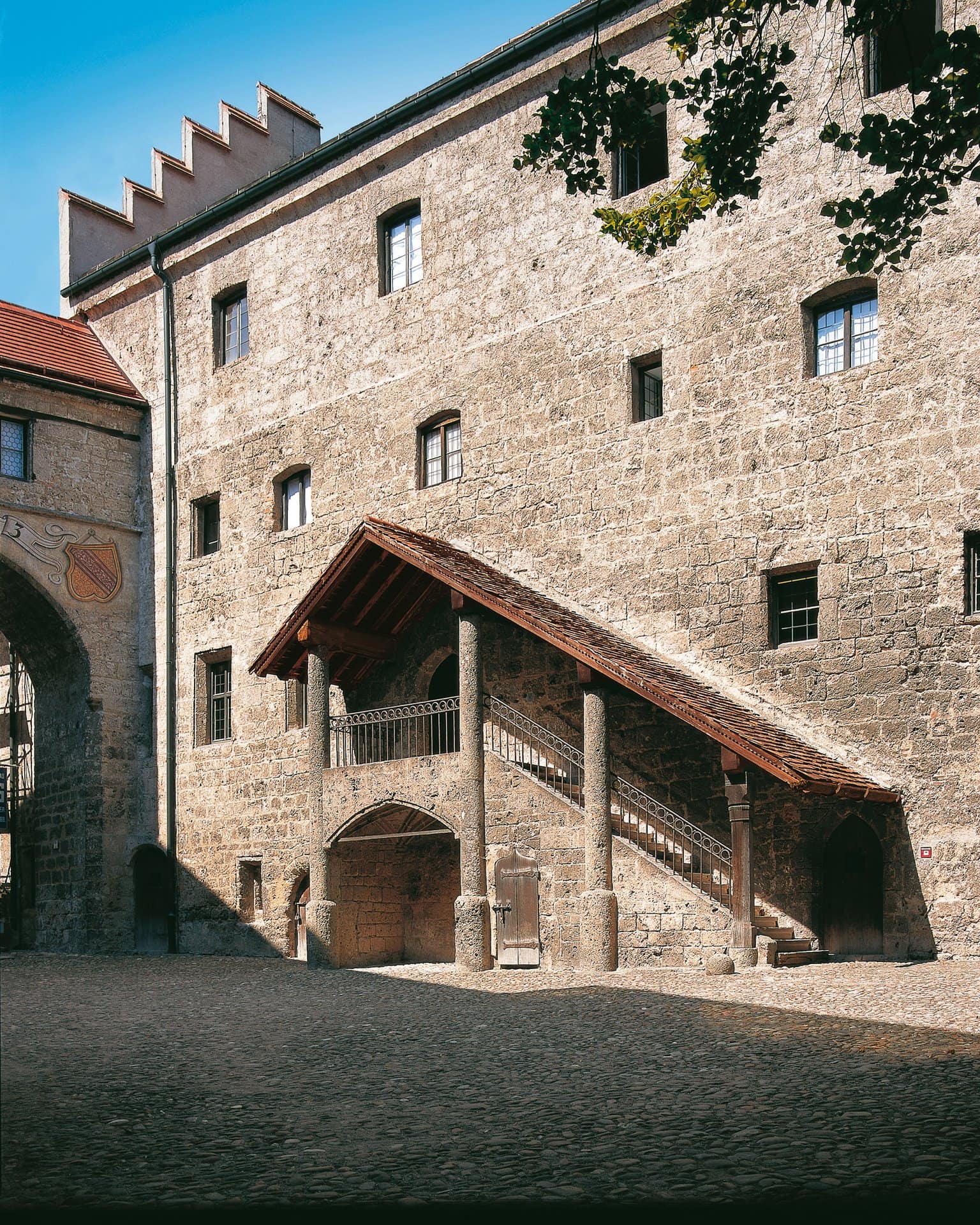
The BSV’s Geheime Pfade (Secret Paths) tour runs through the old treasury, the shield wall, the cellars, the Gothic Hall, and the seven-story keep; booking required on +49 8677 4659. The 2026 special exhibition, Frauenzimmer – Frauenhof, on the women who held court at Burghausen, runs through October 27. The town’s Burgfest Burghausen Historisch, organized not by the BSV but by the Verein Herzogstadt Burghausen, is held July 10–12, 2026 and uses the courtyards as its stage. The castle is reachable on the A94 from Munich in roughly an hour and a half, on the Burghausen branch line from Mühldorf, and by car from Salzburg in about an hour. Free parking sits below the ridge at Curaplatz. Anyone staying overnight can compare hotels in and around Burghausen.
Some links on this page are affiliate links, which means StoneKeep Atlas may earn a small commission, at no extra cost to you, if you book through them.
Beyond Burghausen Castle
Marienberg Fortress in Würzburg, Lower Franconia, peaked in the same late-Gothic decades and survives in similar condition above its city, a useful sister read collected with the others in the Best Castles in Bavaria survey. For a different mode of medieval continuity, Wartburg Castle in Thuringia froze at a different historical moment, Luther’s translation of the New Testament in 1521–22, and was then reanimated by Romantic reconstruction in the nineteenth century. The natural pair to Burghausen, however, is Burg Trausnitz at Landshut: the Bayern-Landshut primary residence, where the formal court sat while the treasury and the duchess’s permanent court remained at Burghausen. Trausnitz is administered today by the same BSV office. Together the two castles map a duchy that lasted two and a half centuries and ended in three weeks of summer war.
Conclusion
Burghausen is not a long castle so much as a long state. The 1,051 meters measure the operational reach of Bayern-Landshut at the moment, in the 1480s, when George the Rich completed its machinery: Hauptburg, treasury, courtly residence, ducal chapel, gates, garrison, granary, arsenal, the works of a sovereign capital concentrated on a single ridge. When the duchy was absorbed into Munich in 1505, the machinery lost its function. Five centuries of state prisons, garrisons, and Napoleonic demolitions altered the fortifications; they did not displace the late-Gothic ducal capital frozen at the duchy’s death. What stretches above the Salzach today is the architecture of a vanished state, preserved by the very thing that ended it.
Principal Sources
- Czerny, Helga. Der Tod der bayerischen Herzöge im Späten Mittelalter und in der Frühen Neuzeit 1347–1579. Schriftenreihe zur bayerischen Landesgeschichte 146. München: C. H. Beck, 2005.
- Dehio Vereinigung e.V., ed. Dehio – Handbuch der deutschen Kunstdenkmäler. Bayern IV: München und Oberbayern. 3rd revised edition. München: Deutscher Kunstverlag, 2006.
- Dorner, Johann. Herzogin Hedwig und ihr Hofstaat. Das Alltagsleben auf der Burg Burghausen nach Originalquellen des 15. Jahrhunderts. Burghauser Geschichtsblätter 53. Burghausen: Stadt Burghausen, 2002.
- Hoppe, Stephan. “Die Residenzen der Reichen Herzöge von Bayern in Ingolstadt und Burghausen. Funktionale Aspekte ihrer Architektur um 1480 im europäischen Kontext.” In Wittelsbacher-Studien. Festgabe für Herzog Franz von Bayern zum 80. Geburtstag, 173–200. Schriftenreihe zur bayerischen Landesgeschichte 166. München: C. H. Beck, 2013.
- Langer, Brigitte. Burg zu Burghausen. Amtlicher Führer. 2nd updated edition. München: Bayerische Schlösserverwaltung, 2011.
- Langer, Brigitte. “Burghausen, Burg.” historisches-lexikon-bayerns.de.
- Pretterebner, Gertrud. “Baumeister Wolf Wiser.” Burghauser Geschichtsblätter 30 (1970): 5–43.
- Stauber, Reinhard. Herzog Georg von Bayern-Landshut und seine Reichspolitik. Kallmünz: Lassleben, 1993.
- The Bayerische Schlösserverwaltung publishes parallel German and English microsites for the castle at burg-burghausen.de — including the Entstehungsgeschichte, Bedeutung, courtyard, Hauptburg, and visitor-information sections — and an umbrella object page at schloesser.bayern.de. Current ticket prices, opening hours, and special-exhibition schedules are canonical at the BSV German Eintritt and Öffnungszeiten pages.
Image credits. Featured image — aerial view from the south showing the full kilometer-long ridge: © Bayerische Schlösserverwaltung (Photo: www.kreativ-instinkt.de). The inner Burgkapelle of St. Elisabeth: © Bayerische Schlösserverwaltung (Photo: Maria Scherf / Andrea Gruber). The Georgstor of 1494 with the Bavarian-Polish alliance arms: Gehweider, Public Domain, via Wikimedia Commons. Der Schlosshof zu Burghausen, drawn by Domenico Quaglio the Younger and lithographed by Carl August Lebschée: Public Domain, via Wikimedia Commons. The inner Hauptburg courtyard with the 1573 gate: © Bayerische Schlösserverwaltung (Photo: Ulrich Pfeuffer). Burghausen Castle and the Altstadt from the Burgblick viewpoint: © Bayerische Schlösserverwaltung. Freely licensed images are resized to fit; otherwise unaltered.