
The Castles of King Ludwig II
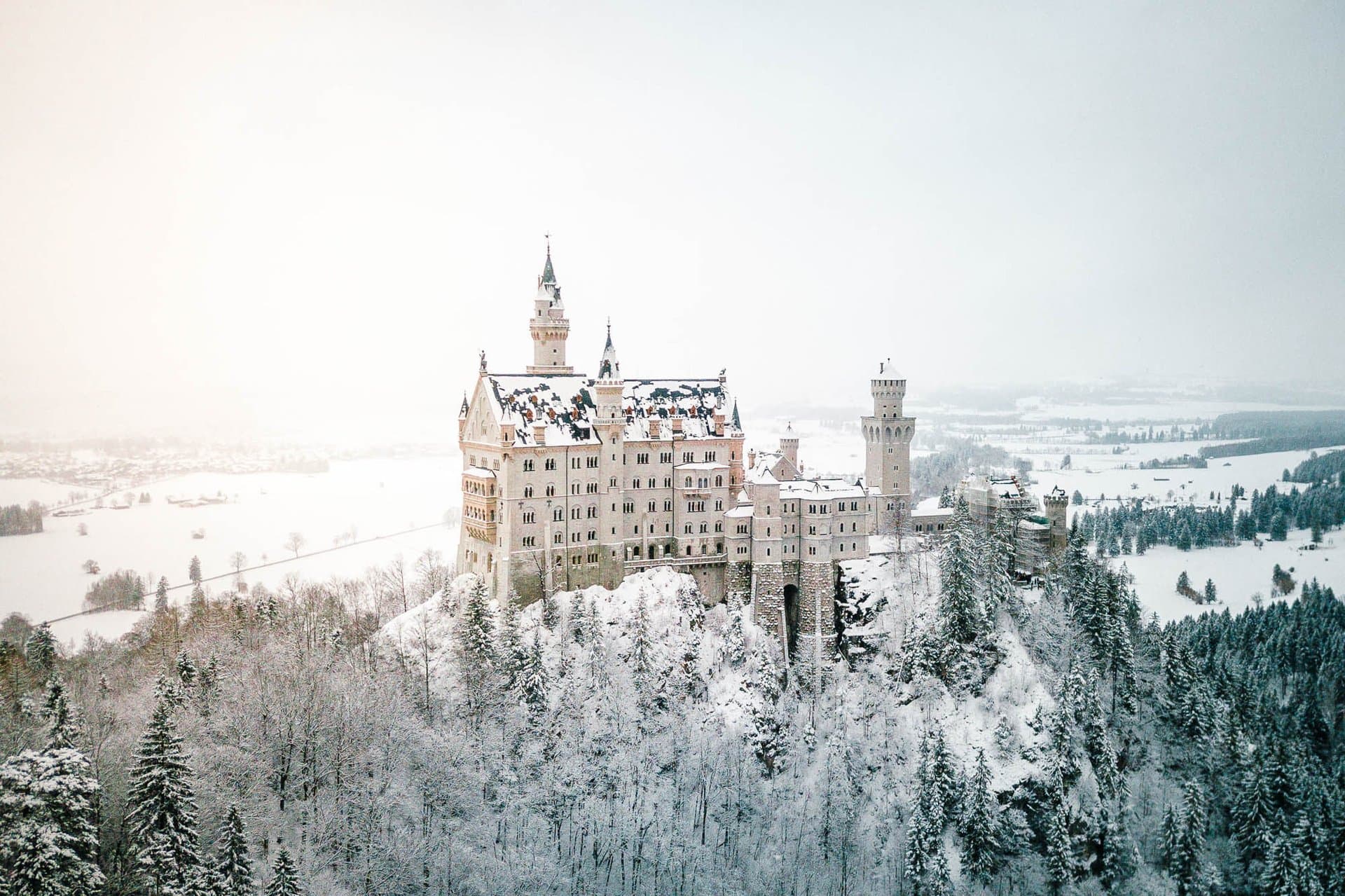
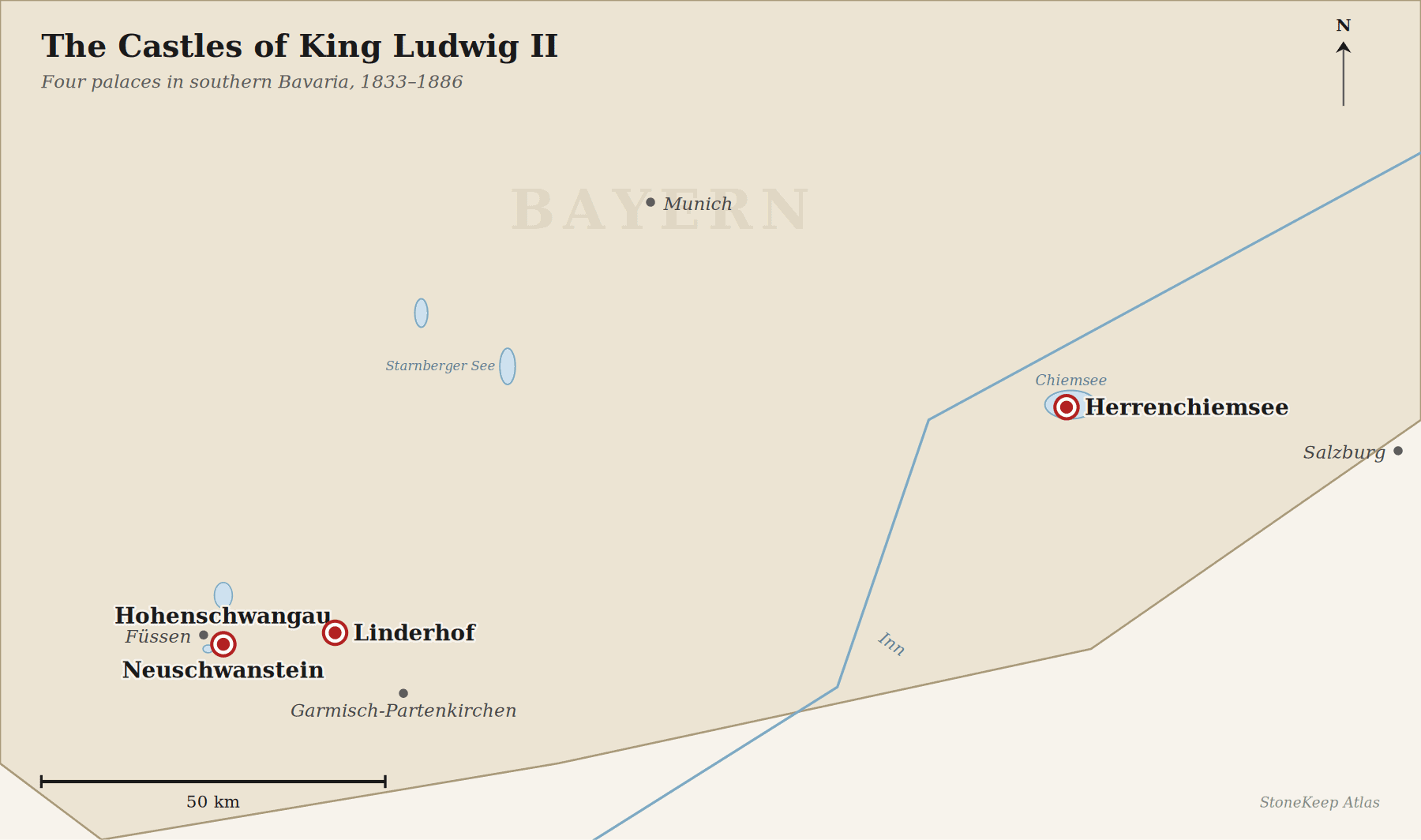
Between 1869 and 1886, King Ludwig II of Bavaria commissioned three of the most ambitious and idiosyncratic palaces in nineteenth-century Europe. He used a fourth, the boyhood home he had inherited from his father, as the imaginative template for all of them. UNESCO inscribed three of the four as a single World Heritage ensemble in 2025, recognizing what visitors had long understood: Neuschwanstein, Linderhof, and Herrenchiemsee read as a single coherent project, with Hohenschwangau as their indispensable prologue. This article treats all four together: the trilogy and the world that produced it.
A King Without a Kingdom
Ludwig II of Bavaria came to the throne in March 1864, eighteen years old, six feet four, and entirely unprepared for the catastrophe that was about to engulf the kingdom he had been crowned to govern. Two years into his reign, the Austro-Prussian War of 1866 ended the military sovereignty of Bavaria, a kingdom of nearly five million people and the second-largest German state. Bavaria had backed Austria; Prussia won at Königgrätz; and the peace terms required Bavaria to enter a secret defensive and offensive alliance that placed its army under Prussian command in the event of war. Its diplomatic sovereignty lasted four years longer. When the next war came, in 1870, Bavaria fought as a Prussian auxiliary. By the proclamation of the German Empire at Versailles in January 1871, Ludwig had signed the Kaiserbrief (drafted in Berlin and accompanied by an annual subsidy from Bismarck’s discretionary fund), which offered the imperial crown to Wilhelm of Prussia. The king of Bavaria had signed away his own primacy in writing, in his own hand.
What remained was form without substance. Ludwig retained the throne, the title, the right to be addressed as Sa Majesté, the trappings of sovereignty without its content. Foreign policy was now made in Berlin. Military command had moved to Berlin. The kingly impulse (to be the center of an event, to make decisions that mattered) had nowhere to go.
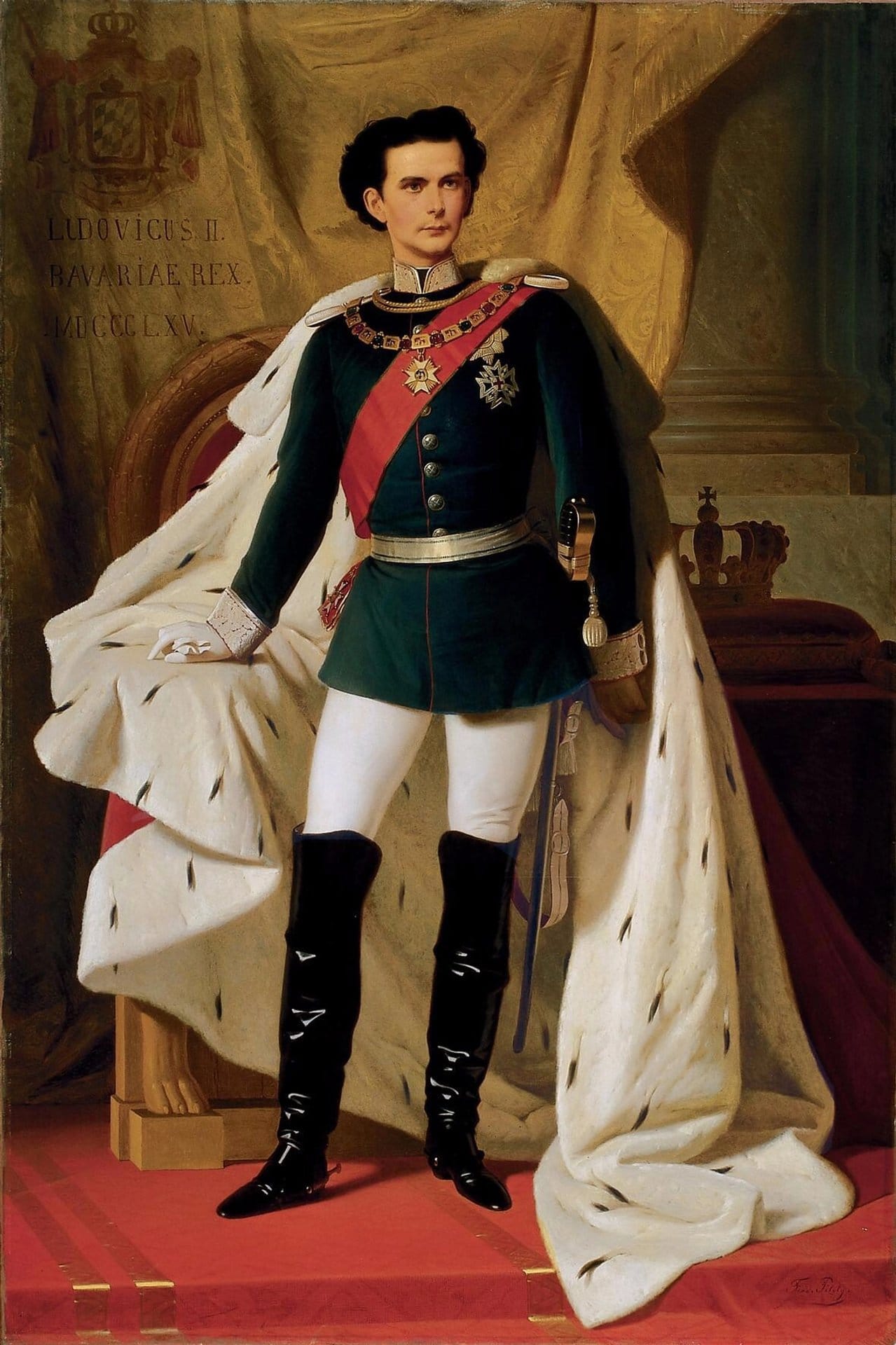
The personality at the center of all this was unusual even by the standards of nineteenth-century European royalty. Ludwig was solitary by nature, fluent in French and German Romantic literature, and physically beautiful in a way contemporaries kept noticing in their letters. He never married. He preferred night to day, mountain to court, the company of one or two trusted servants to the great rooms of the Munich Residence. The retreat into private architecture was not entirely a response to political defeat. It was the same temperament that had always preferred libretto to legislation, now given an effectively unlimited budget. From 1869 onwards Ludwig poured first his personal income, then borrowed credit, then public money he had no legal right to draw, into a building program that had no political purpose at all.
The three castles he commissioned over the following seventeen years were not seats of government, not summer residences for a court that scarcely existed, not military strongpoints of any kind. They were stages: meticulously researched, exquisitely built dream-environments in which Ludwig could occupy the role of a kind of king the nineteenth century would no longer permit. Wagner is part of this story; the Ring cycle’s grail world maps onto Neuschwanstein with very little distortion, and the friendship between the king and the composer is one of the great oddities of nineteenth-century artistic patronage. But Wagner is only part. The deeper context is the loss of meaningful royal function in an age of Prussian unification, and the wider Romantic movement (covered in StoneKeep Atlas’s 19th-Century Romantic Revival of German Castles) had taught Germans, from Heine to the Brothers Grimm, that the medieval German past was the only authentic past worth recovering.
This article covers all four of the castles that defined Ludwig’s reign. Three of them (Neuschwanstein, Linderhof, and Herrenchiemsee) were Ludwig’s own commissions, all begun within fourteen years of his accession, all to varying degrees unfinished at his death in June 1886. A fourth, Hohenschwangau, was the work of his father Maximilian II, completed in 1837. Ludwig grew up there, knew every painted wall and Romantic-revival mural in it, and the building’s combination of medieval-legend iconography and theatrical interior is the template he would expand for the rest of his life. Hohenschwangau is treated here as the prologue: the world that formed Ludwig before he had a building program of his own. Those three later castles are the trilogy proper.
The four at a glance
Four castles, fifty-three years of building, all four sites within ninety minutes of Munich. Three of the four are inscribed in 2025 as a single UNESCO World Heritage ensemble.
| Castle | Location | Built | Status at Ludwig’s death | UNESCO |
|---|---|---|---|---|
| Hohenschwangau | Schwangau (Allgäu) | 1833–1837 | Inherited; in regular use as summer residence | — |
| Neuschwanstein | Schwangau (Allgäu) | 1869–still unfinished | Partially habitable; throne never installed | 2025 (Ludwig II ensemble) |
| Linderhof | Graswang Valley (Ammergau Alps) | 1869–1880 (palace); parkland 1869–1886 | Complete and in active use | 2025 (Ludwig II ensemble) |
| Herrenchiemsee | Herreninsel, Lake Chiemsee | 1878–still unfinished | Central wing only; side wings unbuilt | 2025 (Ludwig II ensemble) |
Hohenschwangau Castle — where the dream began
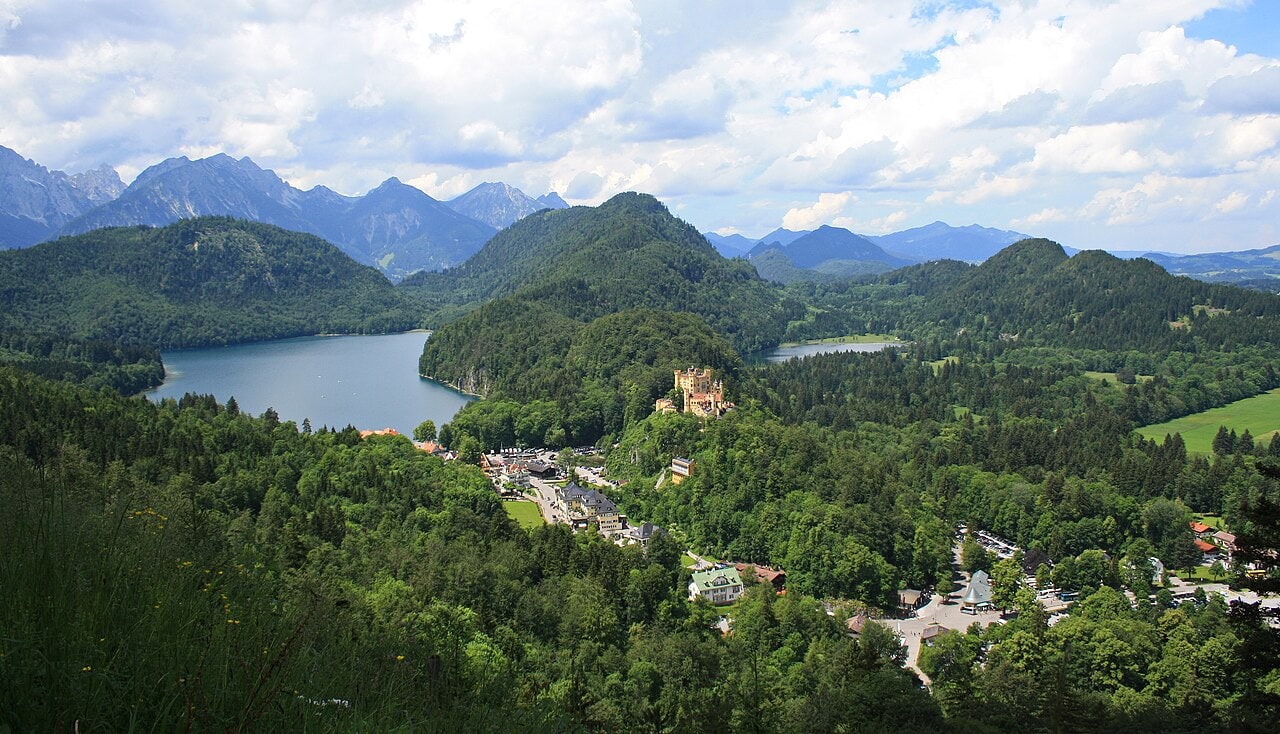
Maximilian II of Bavaria, then crown prince and not yet king, bought the ruins of a medieval Burg in the Allgäu in 1832 and rebuilt it in neo-Gothic style as a summer residence for his young family. The Munich theater painter Domenico Quaglio II gave the schloss its distinctive ochre walls and crenellated towers, working until his death in 1837, after which the architects Joseph Daniel Ohlmüller and Georg Friedrich Ziebland completed it. Its rooms carry extensive mural cycles, among them the Lohengrin legend of the swan knight and the Wilkina saga of Dietrich von Bern. Hohenschwangau was the visual world in which Ludwig spent every summer of his childhood.
Ludwig inherited the building in 1864 and continued to use it throughout his reign, often retreating there in the months while each of his three new castles was still uninhabitable. From the rooms his father had occupied, he could look across the Pöllatschlucht ravine to the ruins of Vorderhohenschwangau and Hinterhohenschwangau, the cliffside ruins he had decided, by 1868, to clear and replace with Neuschwanstein. For nearly twenty years, the building of the larger castle on the opposing crag was a daily view from his childhood home.
Hohenschwangau is the only one of the four buildings discussed here that Ludwig did not commission, but it is also the one without which the others are unintelligible. The medieval-legend wall paintings (Lohengrin’s swan, Siegfried’s forge, Tannhäuser at the Wartburg), the Romantic mountain setting, the conviction that a building could be both home and stage at once: Ludwig encountered all of these as a boy at Hohenschwangau, and he spent the rest of his life trying to make them larger, finer, and more complete. It is also the only one of the four not operated by the Bayerische Schlösserverwaltung. Since 1923 it has been held by the Wittelsbacher Ausgleichsfonds, the foundation managing the residual assets of the former Bavarian royal family, and it is ticketed independently through the Ticket Center Hohenschwangau in the village below, typically as a same-day pairing with Neuschwanstein.
For the full account, see the Hohenschwangau Castle guide.
Neuschwanstein Castle — Wagner made stone
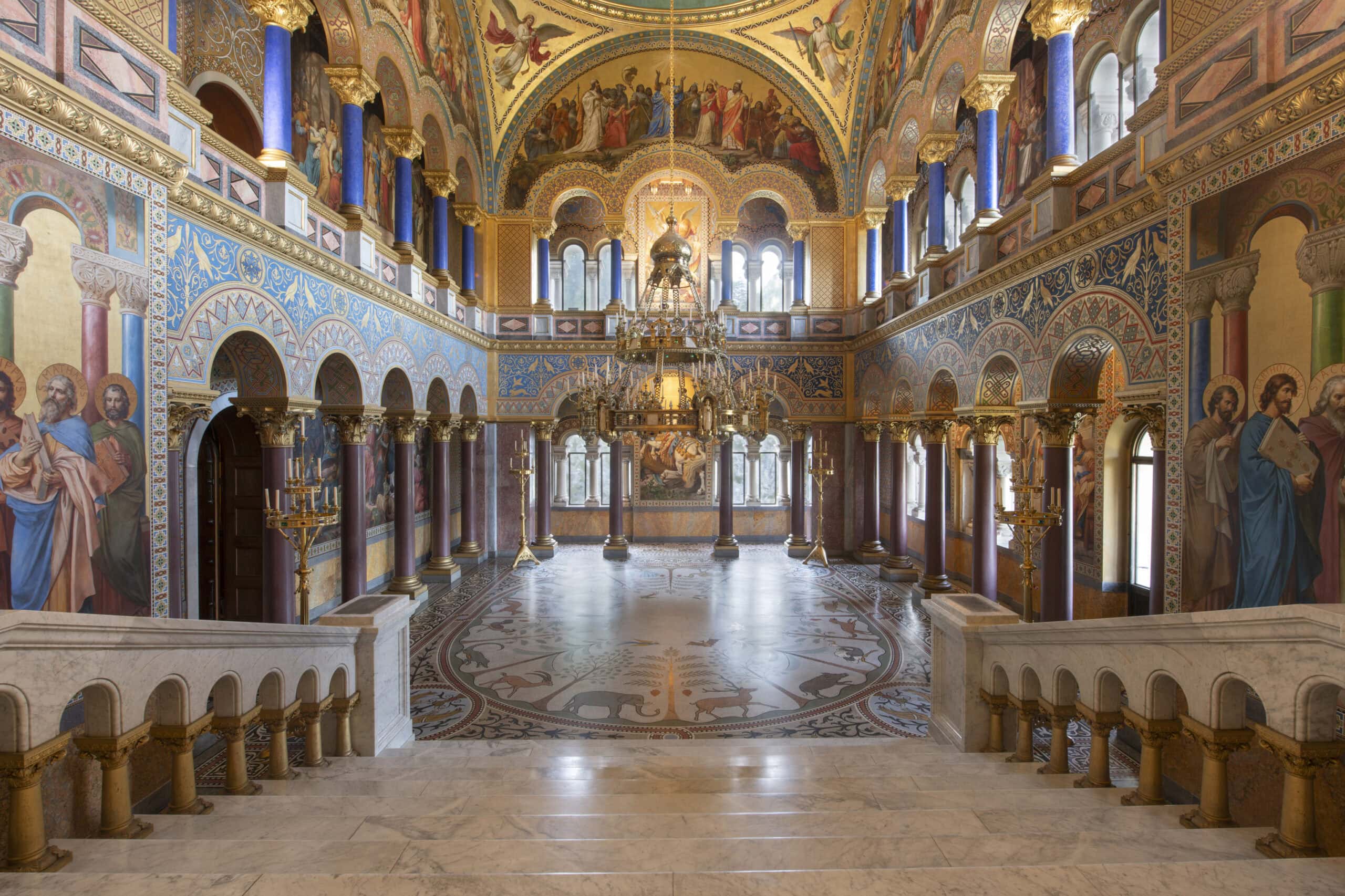
Ludwig commissioned Neuschwanstein in 1868, two years after Königgrätz. He told the stage designer Christian Jank, not an architect, to draw the first sketches; the brief specified medieval German style, towers visible from miles away, interior chambers themed to Wagnerian opera, and a setting on the ridge directly across the valley from Hohenschwangau, so that the new castle would face his childhood home. The professional architects who realized the design (Eduard Riedel, then Georg von Dollmann, then Julius Hofmann) followed Jank’s stage-set conception and the king’s painted-cardboard models more than any conventional architectural plan.
Construction began in 1869 and continued for the rest of Ludwig’s life. He moved into the unfinished palace in 1884 and was last there in early June 1886, the only king of Bavaria ever to inhabit the building. The Throne Hall (Byzantine-Romanesque in conception, a cosmology of kingship laid out in mosaics) was never given a throne; the throne dais survives empty to this day. Several of the planned wings, including a square keep at the center of the upper courtyard and a bower for an unmarried queen who would never exist, were never built at all. The Wagner cycle painted across every interior chamber, from Tannhäuser through Lohengrin to Parsifal, is now thoroughly forgotten by the millions who visit each year.
UNESCO inscribed Neuschwanstein in 2025 as the centerpiece of the serial property The Palaces of King Ludwig II of Bavaria. It is now the most-visited fortress in southern Germany. Its silhouette has become an artefact almost separate from the castle Ludwig built, supplying the visual template for Walt Disney’s Sleeping Beauty Castle in 1955 and, through Disney, the global popular idea of a fairytale castle. Ludwig would have been astonished by the audience and unsurprised by the misunderstanding: he had built the place to be looked at, never to be deciphered.
For the full account, see the Neuschwanstein Castle guide.
Linderhof Palace — the only one he completed
Linderhof was the smallest, the most personal, and the only palace Ludwig finished. Begun in 1870 around an existing royal hunting lodge in the remote Graswang Valley west of Garmisch-Partenkirchen, the project expanded under his obsessive attention into a French rococo Schlösschen: a private answer to the Versailles of Louis XIV, the absolutist king Ludwig studied with envy and tried, throughout his reign, to imagine himself as. The architect Georg von Dollmann executed the conception in stages from 1870 through 1880, with each campaign elaborating on what had come before.
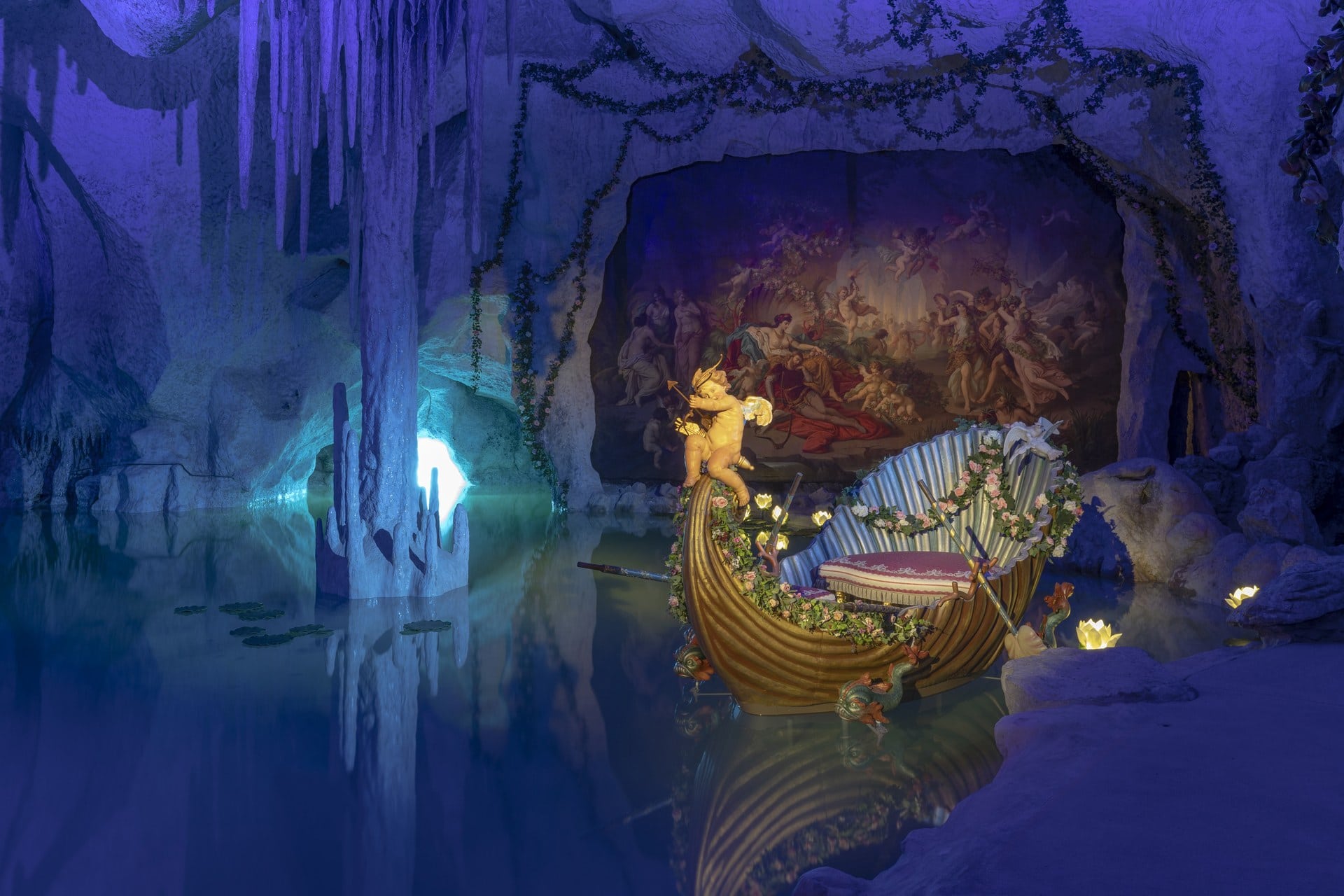
Linderhof itself is small: ten rooms, no hall capable of hosting a court, a bedroom built around an enormous gilded bed of state in which Ludwig slept alone. Its grounds are theatrical and vast. The Venus Grotto (an artificial cavern with one of the earliest electric lighting installations in Europe, capable of shifting between blue, green, and red to evoke the Hörselberg of Tannhäuser, with a swan boat on which Ludwig was rowed by liveried servants) was built so that the king could experience the opera personally, as audience and singer at once. The Moroccan House, the Moorish Kiosk, the Hundinghütte from Die Walküre: Linderhof’s parkland is the most explicit catalog of Ludwig’s imagination anywhere on earth, and the most intimate.
Linderhof was inscribed by UNESCO in 2025 as part of the serial property covering Ludwig’s three commissioned palaces. Of the three, it is the only one Ludwig saw substantially complete in his lifetime (the main building was finished in 1880 and the parkland additions continued through the rest of his reign), and the only one that gives a present-day visitor an honest sense of what one of his palaces was meant to feel like when fully inhabited.
For the full account, see the Linderhof Palace guide.
Herrenchiemsee New Palace — the unfinished Versailles
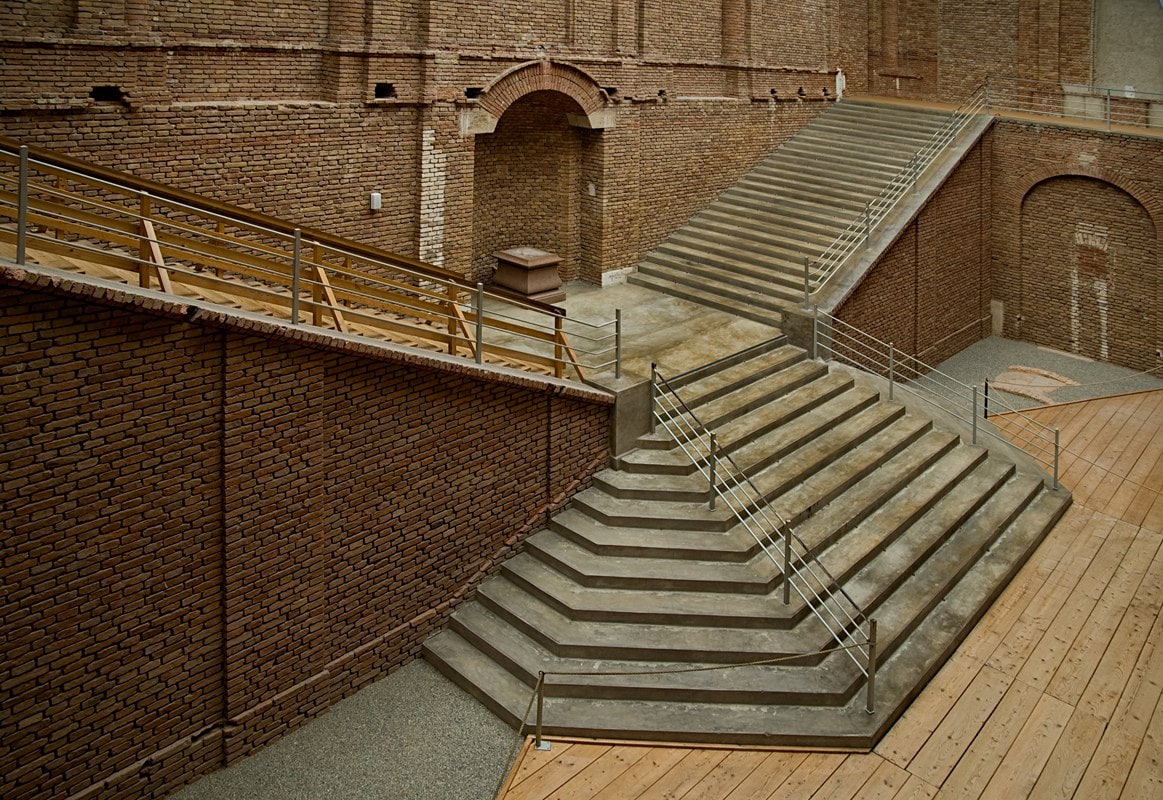
Of the three palaces Ludwig commissioned, Herrenchiemsee was the most ambitious and the most ruinous. In 1873 he bought the entire Herreninsel (the larger of the two islands in the Chiemsee, ninety kilometers east of Munich) for the sole purpose of building an exact replica of the Palace of Versailles on it. The Hall of Mirrors was to exceed the Galerie des Glaces in length; the Bedroom of State was to be a more accurate Louis XIV pastiche than anything that had survived the upheavals of the French Revolution. Christian Jank again drew the first conceptions; Georg von Dollmann executed the plans.
Construction began in 1878 and consumed funds at a rate that alarmed the Bavarian state council from the first season. By 1885, with only the central wing complete, the project had effectively bankrupted Ludwig’s personal fortune and was beginning to draw on credit that the state would have to repay. Two side wings were never built. Ludwig spent only ten days in the palace, in September 1885, the only time he ever saw it. The half-finished result (the central wing of Versailles, alone on a wooded island in a Bavarian lake, with no use except as monument to a building Ludwig never lived to inhabit) is the truest summary of his reign that survives.
UNESCO inscribed Herrenchiemsee in 2025 as the third element of the Ludwig II ensemble. Herrenchiemsee is reached by Chiemseeschifffahrt ferry from the lakeside towns of Prien or Gstadt; the Herreninsel is otherwise unreachable. The crossing (and the walk through woodland from the landing stage to the palace) is part of the experience the BSV deliberately preserves. Ludwig had wanted his palace on an island; visitors still arrive there as he intended.
For the full account, see the Herrenchiemsee New Palace guide.
After Ludwig
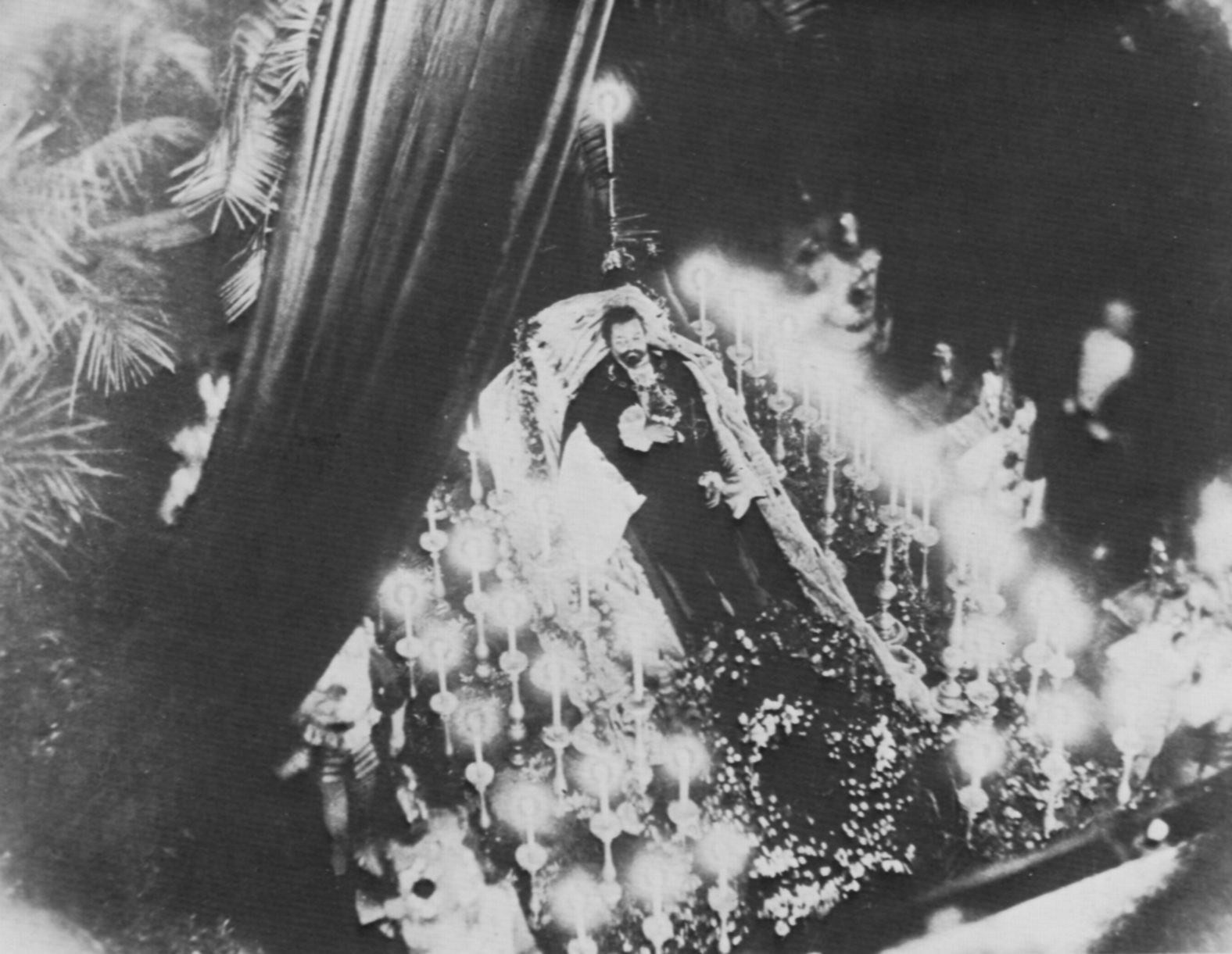
Ludwig was declared insane on June 9, 1886, deposed in absentia, and committed to Berg Castle on the shore of Lake Starnberg under the medical care of the psychiatrist Bernhard von Gudden. Four days later, on the evening of June 13, Ludwig and Gudden walked into the gardens at Berg and never returned. Their bodies were recovered from the shallow water at the lake’s edge that night, in circumstances that have been disputed by every generation since. The official verdict (accidental drowning during a struggle) has been challenged in print, with greater and lesser plausibility, by suicide and assassination theories that remain in circulation to this day. The truth is unrecoverable.
What is not in dispute is what stopped at Berg. Construction halted at all three of Ludwig’s castles within weeks. Falkenstein (the fourth great castle Ludwig had been planning, designed by Christian Jank to crown a remote crag in the Allgäu and intended as a Holy Grail castle of the kind imagined in Parsifal) was abandoned at foundation level and never resumed. The mountain retreat at Königshaus am Schachen, with its astonishing Moorish hall above the Bavarian Alps, was preserved as Ludwig had used it: an extension of the same imagination, on a smaller scale, that the great castles had been built to house.
Bavarian authorities took possession of all three completed buildings within weeks of Ludwig’s death and opened them to paying visitors that summer. The funding model the king had bankrupted himself trying to escape became, with very little ceremony, the source of the buildings’ preservation. Today the Bayerische Schlösserverwaltung manages all four sites (Hohenschwangau, in cooperation with the Wittelsbacher Ausgleichsfonds; Neuschwanstein, Linderhof, and Herrenchiemsee under direct state administration), among the most-visited cultural attractions anywhere in Germany.
Planning a Ludwig II castle visit
All four castles sit within ninety minutes of Munich and can be visited in two long days or, more comfortably, three. Hohenschwangau and Neuschwanstein share a single ridge above the village of Hohenschwangau in the Allgäu; the two are visited together in a half-day and are best seen in that order, since Hohenschwangau is the building Ludwig grew up in and Neuschwanstein the one he built in answer to it. Linderhof (in the Graswang Valley west of Garmisch-Partenkirchen, eighty kilometers east of Schwangau) fills a separate half-day and pairs naturally with the Schwangau pair on a single Allgäu trip if the schedule allows. Herrenchiemsee, on its island in the Chiemsee ninety kilometers east of Munich, needs a full day on its own, including the lake crossing.
The single most useful instrument for these palaces is the BSV’s Königsschlösser-Ticket (a combination pass valid at Linderhof, Neuschwanstein, and Herrenchiemsee) at a discounted rate over a six-month window (€31 in 2026). An annual Mehrtagesticket (€40) and Jahreskarte (€55 single, €100 family) extend that to the wider BSV portfolio of more than forty sites. Hohenschwangau, as the only one not operated by the BSV, is ticketed separately through the Ticket Center Hohenschwangau in the village below and is not covered by any BSV pass; reservations for both Hohenschwangau and Neuschwanstein are essentially mandatory in the May–October peak. Guided day tours from Munich, including combined Neuschwanstein and Linderhof itineraries, can be booked in advance through GetYourGuide.
If three days is the budget, the natural shape is two nights at Füssen for the Schwangau pair plus a Linderhof day-trip, then one night at Prien am Chiemsee for the Herrenchiemsee crossing, with Munich as the hub between. If only two days are available, the cleanest compression is a single day for Hohenschwangau and Neuschwanstein together and a second day for Herrenchiemsee, with Linderhof saved for a return visit; Linderhof rewards an unhurried half-day and is the worst of the four to compress. Ludwig himself never traveled the four-castle circuit in two days; visitors with a schedule that admits three are seeing his world more nearly in his own rhythm.
Readers interested in why Ludwig built these castles (the political collapse of 1866-1871 that turned a public Wagnerian-medievalist royal program into a private architectural withdrawal) will find the analytical companion at Ludwig II and the Architecture of Dreams. Anyone staying overnight can compare hotels in and around Munich.
Some links on this page are affiliate links, which means StoneKeep Atlas may earn a small commission, at no extra cost to you, if you book through them.
Conclusion
Four castles, fifty-three years, one extraordinary temperament, and the ruin of a personal fortune in the service of an imagination that never reconciled itself to the modern century. Ludwig II’s Bavaria was already gone before he started building; the palaces are what remained when the kingdom no longer would. Beyond Bavaria, Neuschwanstein supplied the silhouette for Walt Disney’s Sleeping Beauty Castle and, through it, the visual idea of “a fairytale castle” as it now exists in popular culture worldwide. Ludwig himself appears regularly in films, novels, and operas, the half-mad king who built his own dream and drowned in a shallow lake at forty. None of this would have surprised him. He had always preferred to be the subject of a story than the author of a treaty, and the buildings have become, in the end, exactly the kind of monument he hoped they would be, though to a king the world remembers very differently from the way he saw himself.
This hub is one thematic chapter in StoneKeep Atlas’s broader survey of Germany’s castles. Readers focused on the wider Bavarian context (the prince-bishop residences in Franconia, the Reichsstadt seat at Nuremberg, the imperial-knight residence at Mespelbrunn) can continue at Best Castles in Bavaria. Readers drawn to the wider stylistic moment Hohenschwangau and Neuschwanstein belong to can continue at The 19th-Century Romantic Revival of German Castles.
Common Questions
Which castles did Ludwig II build?
Between 1869 and 1886 he commissioned three palaces, Neuschwanstein, Linderhof, and Herrenchiemsee, and used a fourth, Hohenschwangau, the boyhood home inherited from his father, as the imaginative template for them all.
Which of them did he finish?
Only Linderhof was completed in his lifetime. Neuschwanstein and the Herrenchiemsee New Palace were both left unfinished when he died in 1886.
Can you visit them, and are they UNESCO-listed?
Yes, all four are open to visitors, and in 2025 UNESCO inscribed the Ludwig II palaces, Neuschwanstein, Linderhof, Herrenchiemsee, and the King’s House on Schachen, as a single World Heritage property.
Principal Sources
- Blunt, Wilfrid. The Dream King: Ludwig II of Bavaria. London: Hamish Hamilton, 1970.
- Hojer, Gerhard. Die Schlösser König Ludwigs II. Munich: Bayerische Verwaltung der staatlichen Schlösser, Gärten und Seen — successive editions.
- McIntosh, Christopher. The Swan King: Ludwig II of Bavaria. London: I. B. Tauris, 1982 (revised 2012).
- Petzet, Michael. König Ludwig II. und die Kunst. Munich: Hirmer, 1968.
- UNESCO World Heritage Centre. “The Palaces of King Ludwig II of Bavaria” (Ref. 1726, inscribed 2025). whc.unesco.org.
Operator and institutional sources for this article include the Bayerische Schlösserverwaltung at schloesser.bayern.de (with dedicated pages for Neuschwanstein, Linderhof, and Herrenchiemsee at neuschwanstein.de, schlosslinderhof.de, and herrenchiemsee.de respectively); the Wittelsbacher Ausgleichsfonds via the Ticket Center Hohenschwangau at hohenschwangau.de; and the Chiemsee ferry operator Chiemseeschifffahrt at chiemsee-schifffahrt.de.
Image credits. Ludwig II in coronation robes (1865): Ferdinand von Piloty, King Ludwig II Museum, Public domain, via Wikimedia Commons. Map (the four Ludwig II castles): StoneKeep Atlas (own work, rendered from coordinates via cairosvg). Hohenschwangau Castle from the Neuschwanstein ridge: Kora27, CC BY-SA 4.0, via Wikimedia Commons. Throne Hall of Neuschwanstein: © Bayerische Schlösserverwaltung (photo: Veronika Freudling), used by permission via schloesser.bayern.de. Venus Grotto at Linderhof: © Bayerische Schlösserverwaltung, used by permission via schlosslinderhof.de. Unfinished northern staircase at Herrenchiemsee: digital cat, CC BY 2.0, via Wikimedia Commons. Ludwig II lying in state, June 1886: unknown German photographer, Public domain, via Wikimedia Commons. Freely licensed images are resized to fit; otherwise unaltered.