
Linderhof Palace
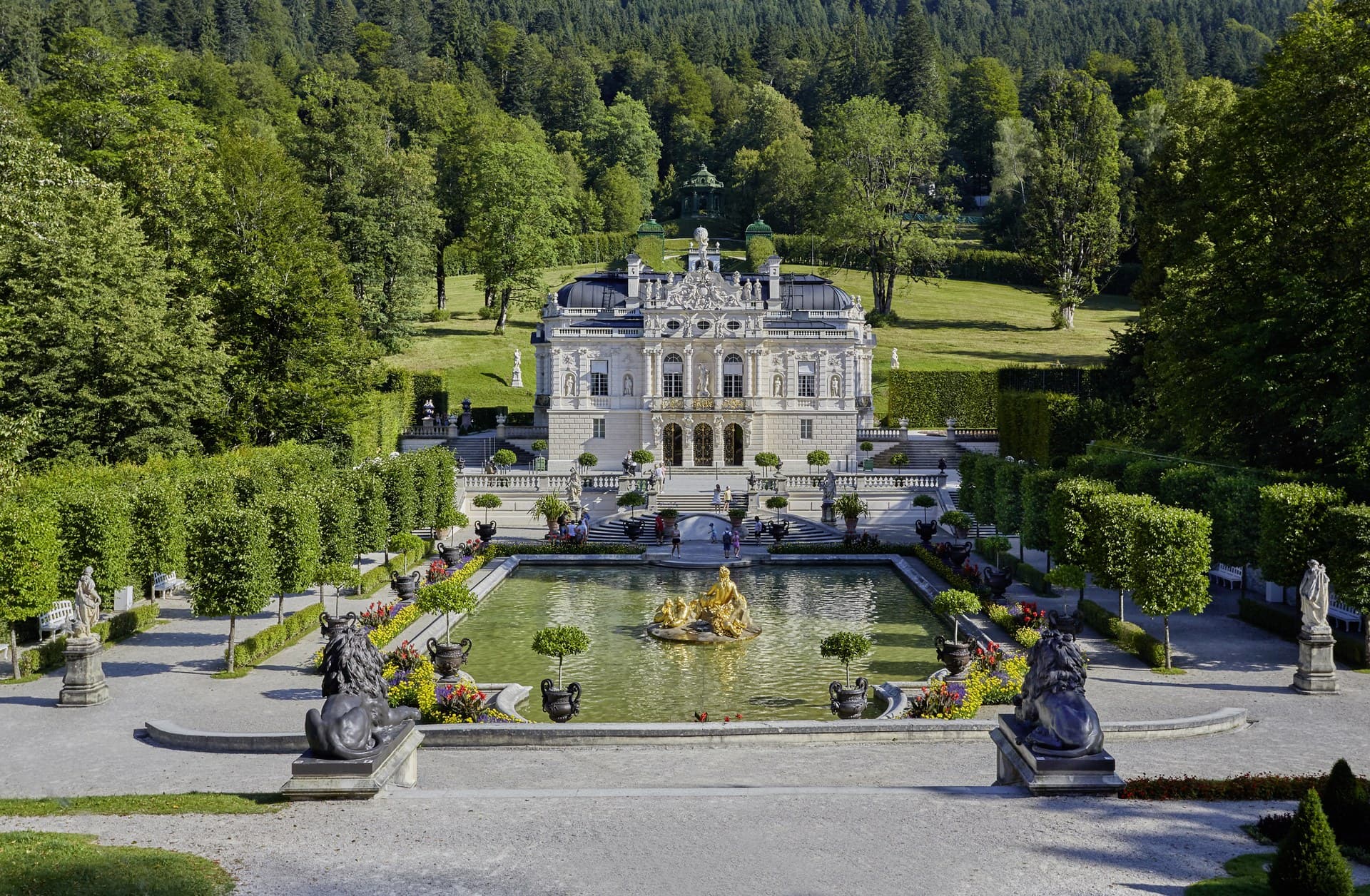
Linderhof Palace (Schloss Linderhof) is the only large palace King Ludwig II of Bavaria lived to see finished. Tucked into the Graswang Valley of the Ammergau Alps, it is the smallest of his three great building projects: a Neo-Rococo pavilion set within a staged landscape of terraces, cascades, an artificial grotto, and a scatter of Oriental and Wagnerian follies. Neuschwanstein Castle, his most famous creation, and Herrenchiemsee Palace, his answer to Versailles, both stood unfinished at his death in 1886. It is at Linderhof that he spent more of his later life than in any other royal residence.
Quick Facts
| Country | Germany |
| Region / State | Bavaria (Oberbayern), Landkreis Garmisch-Partenkirchen |
| Nearest Town | Ettal |
| Construction Period | 19th Century Romantic (1869–1886, in six building phases) |
| Founder | King Ludwig II of Bavaria |
| Architect | Georg von Dollmann (lead); Julius Hofmann (later works) |
| Architectural Style | Neo-Rococo interior behind a late-Baroque façade |
| Building Type | Royal villa / pleasure palace |
| German Term | Schloss (originally a Königshäuschen) |
| Current Condition | Fully preserved; operating museum |
| Open to Visitors | Yes (guided tours only) |
| UNESCO Status | World Heritage Site (inscribed 2025, ref. 1726) |
| Heritage designation | Baudenkmal, Bavarian Denkmalliste (Bayerisches Landesamt für Denkmalpflege), Aktennummer D-1-80-115-25 |
| Official website | schlosslinderhof.de |
Overview
In July 2025 the palace and its park were inscribed on the UNESCO World Heritage List as part of the serial property The Palaces of King Ludwig II of Bavaria, together with Neuschwanstein, the King’s House on the Schachen and Herrenchiemsee. The palace itself is compact (a single Neo-Rococo pavilion of a dozen or so rooms), but the park around it carries a distributed architectural program that extends the building into its alpine setting. Interior and exterior operate together as a single composition, and it is this doubled conception, as much as the palace on its own, that the UNESCO inscription recognizes.
Location and Setting
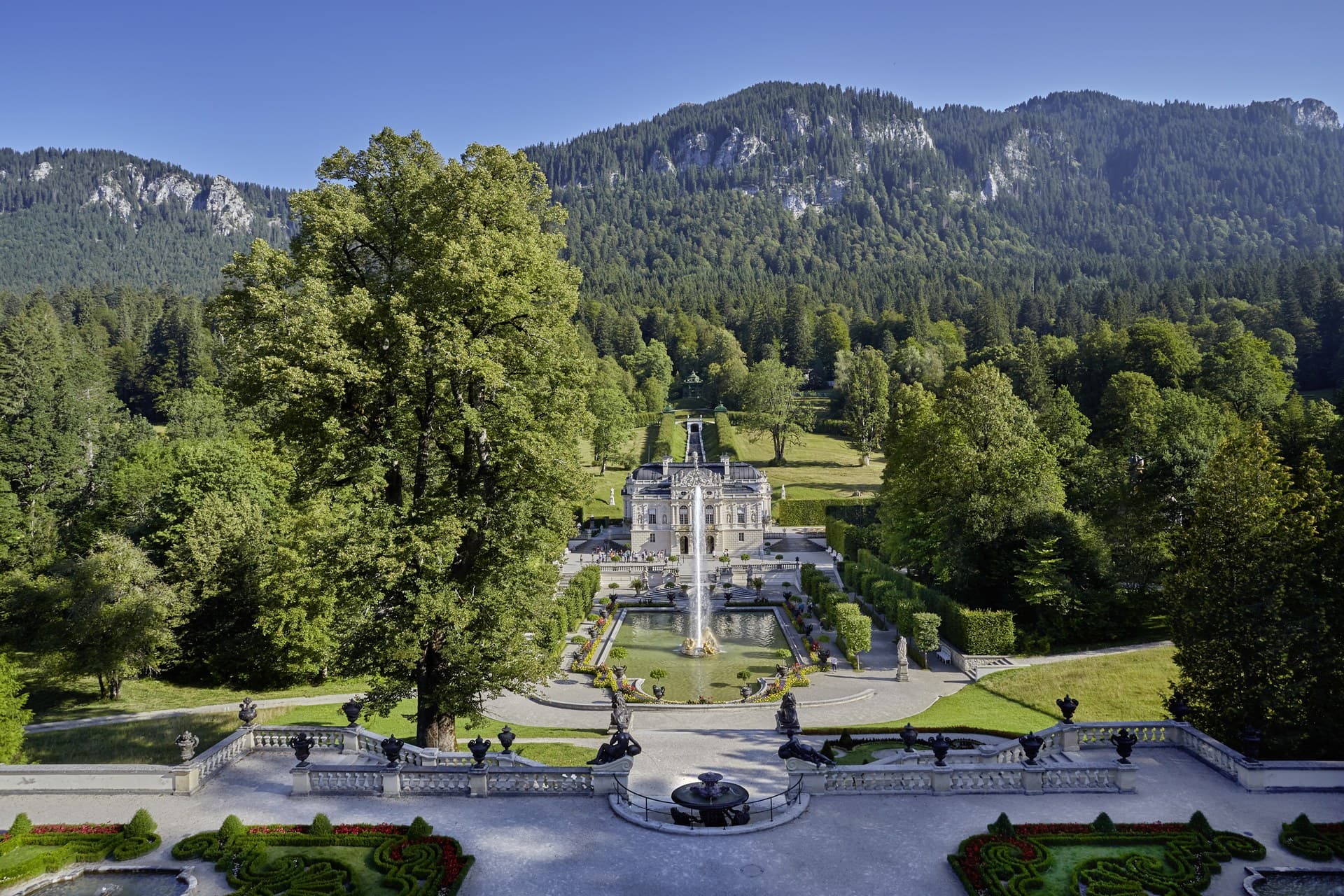
Linderhof lies deep within the Graswangtal, a narrow east–west valley on the Bavarian flank of the Ammergau Alps, roughly ten kilometers west of Ettal Abbey and about thirteen kilometers south-west of Oberammergau. Linderhof stands at about 950 meters above sea level within the Ammergebirge nature reserve, ringed by spruce-clad peaks that rise on every side. This seclusion was part of the appeal: Ludwig wanted to be out of sight of Munich, beyond the reach of ministers and protocol, and the valley’s single road gave him a kind of natural privacy that no urban residence could match.
Its grounds unfold along a strict north–south axis. On the south front, a broad water parterre terminates in a gilt sculptural group of Flora and Puttos, from which a fountain jet rises around twenty-five meters into the mountain air; beyond it, three terraced gardens climb the Linderbichl hillside to a circular Temple of Venus. On the north side, a thirty-step marble cascade descends from a Music Pavilion to the Neptune Fountain at its foot. Side parterres carry Baroque fountains and busts of Louis XIV and Louis XVI. It is a French formal plan transplanted into alpine topography, and the geometric discipline of the parterres set against the wild geology behind them is the first thing most visitors notice.
Historical Background
From farmhouse to royal hunting lodge
Its name derives from the Linder family, whose mountain farm is documented at this site as early as 1479 under the ownership of Ettal Abbey. Farmed for over three centuries, the property passed to the Bavarian state in 1815 and served as a foal farm for the Schwaiganger royal stud. King Maximilian II of Bavaria first visited the valley in 1841 as a young hiker, and after his accession in 1848 he converted the eighteenth-century farmhouse into a simple hunting lodge (the Königshäuschen), which his son, the young Crown Prince Ludwig, came to know well on hunting expeditions with his father.
Ludwig’s transformation
On May 19, 1869, five years after his accession to the Bavarian throne in 1864, Ludwig II purchased the estate and large tracts of the surrounding Graswangtal as private property. He commissioned the court architect Georg von Dollmann, a pupil of Leo von Klenze, to enlarge the existing lodge, and the earliest wing of the present palace was complete by late 1870. Over the following years he repeatedly revised the design. His initial ambition had been a full-scale Versailles-style residence on the Linderhof site, but in 1873 he acquired the island of Herreninsel on the Chiemsee and moved the Versailles project there, leaving Linderhof to evolve in a more intimate direction.
On November 30, 1870, at Hohenschwangau, Ludwig copied out and signed the so-called Kaiserbrief, a letter initiated and drafted by Bismarck in which he asked King Wilhelm I of Prussia to take the hereditary title of German Emperor; he soon regretted it, and he stayed away from the proclamation in the Hall of Mirrors at Versailles on January 18, 1871, where his brother Otto was to represent him. From the middle of 1871 Bismarck paid him in secret out of the Welfenfonds, the fortune of Hanover’s former royal house: 300,000 marks a year at first and later considerably more, about five million marks in all by 1885, and separately a single payment of one million in February 1884. His biographer in the Neue Deutsche Biographie, Dieter Albrecht, judges that the money was certainly not Ludwig’s condition for Bavaria’s entry into the Empire, and that whether he made money an ultimatum for the letter cannot be stated with final certainty; but in November 1870 he had his great financial embarrassment conveyed emphatically to Bismarck, in a connection with the imperial question and the letter that was unmistakable to everyone involved.
In 1874 the original Königshäuschen was physically dismantled and re-erected around a hundred meters to the west, clearing the site for the stone-clad Neo-Rococo palace that stands today. The Hall of Mirrors and the full southern suite were finished by 1877; the Historisches Lexikon Bayerns gives 1870 to 1880 for the construction, while the operator places the palace’s final outward form with that southern wing. A final enlargement of the King’s Bedroom began in 1884 and was structurally complete when Ludwig died in 1886. Interior collaborators included Julius Hofmann, who would succeed Dollmann on Ludwig’s final commissions, and the decorator Joseph de la Paix, who worked with Dollmann on the Hall of Mirrors in 1874.
After 1886
Ludwig was deposed on June 9, 1886, transferred to Berg Castle on Lake Starnberg, and found dead in the shallows of the lake on the evening of June 13 under circumstances that remain disputed. Just seven weeks later, on August 1, 1886, Linderhof opened to the public as a museum, the earliest step in what would become more than a century of visitor access, driven initially by the new government’s need to repay the late king’s considerable personal debts. The palace has remained in Bavarian state custody since 1918, administered by the Bavarian Palace Administration, which has carried that official name since 1932.
Architectural Highlights
A French interior in a Bavarian body
Linderhof’s architectural logic is doubled. Behind a late-Baroque exterior inspired by French maisons de plaisance (the Neue Deutsche Biographie names the Petit Trianon at Versailles as its model) unfolds an interior program of Neo-Rococo, or Neurokoko. For that interior, Dollmann and his collaborators took their models chiefly from the Wittelsbach inheritance on Ludwig’s doorstep: the Amalienburg at Nymphenburg and the Rich Rooms of the Munich Residence, both designed in the 1730s by François de Cuvilliés the Elder. Its plasterwork is denser, more three-dimensional, and more theatrical than any French eighteenth-century original would permit.
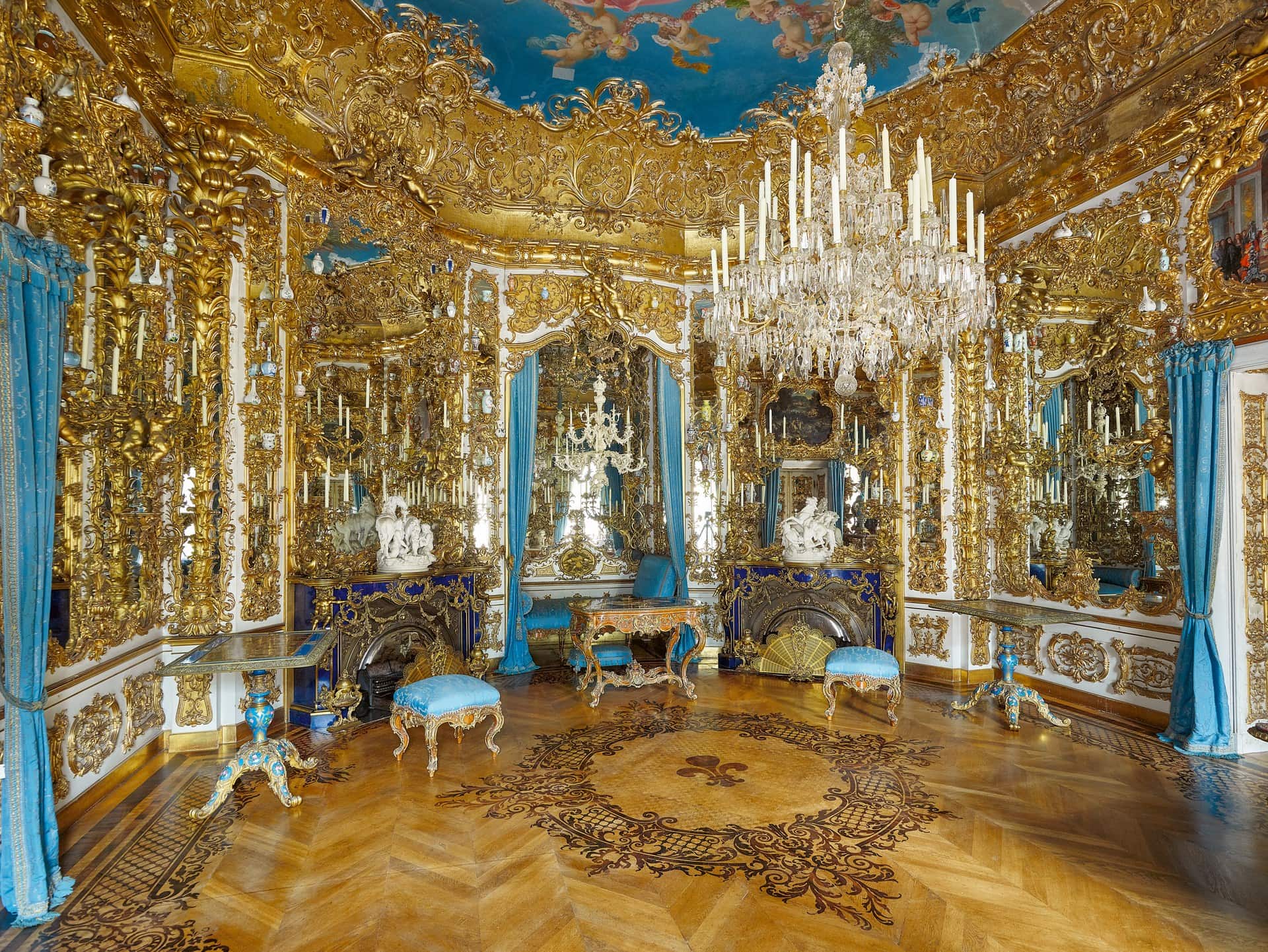
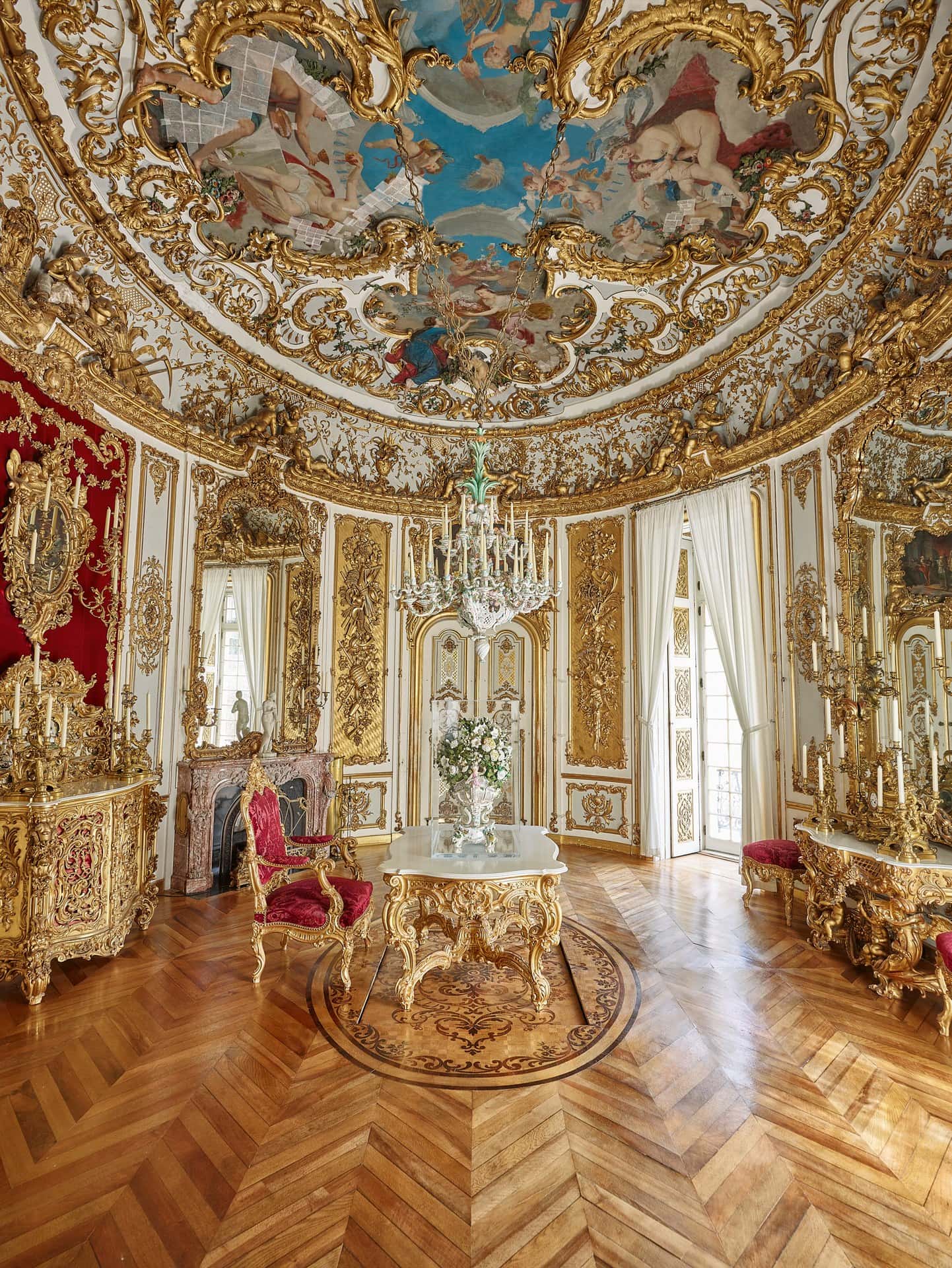
The principal rooms unfold as an enfilade: the Hall of Mirrors (Spiegelsaal) at the center of the south suite, the King’s Bedroom on the north front, and the oval Dining Room to the east, matched by an oval Audience Room to the west. Its Spiegelsaal is modeled on the Mirror Cabinet of the Munich Residence rather than on Versailles, as is often assumed; parallel mirrors multiply its space into an infinite corridor of candlelit gilding, and it was here that Ludwig spent long nocturnal hours reading.
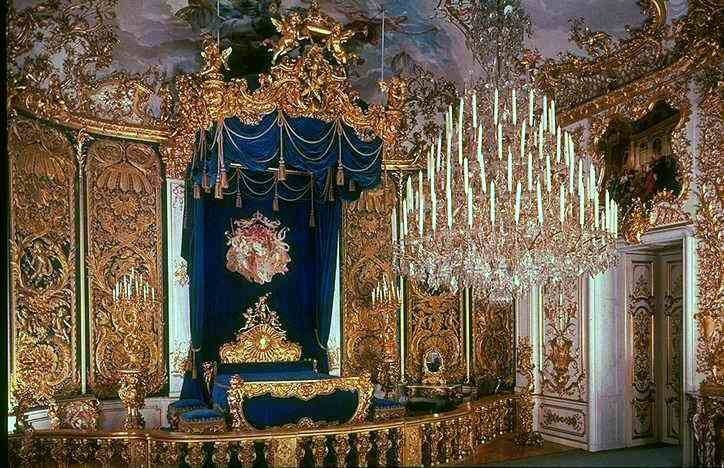
The King’s Bedroom, the largest chamber in the palace, is arranged like a Baroque altar, with the bed raised on a stepped platform within an alcove closed by a gilded balustrade. A crystal candelabrum of one hundred and eight candles hangs above it. That room was enlarged in 1884 to create the palace’s pronounced north risalit, and its scale signals the liturgical weight it carries within the building’s program.
The Dining Room houses the mechanical dining table known as the Tischlein-deck-dich, named for the Grimm fairy tale: the table descended on a lift to the kitchen below, was laid for the next course, and rose again, allowing the king to dine entirely alone. The mechanism revives an eighteenth-century French tradition of the table volante, used at Choisy under Louis XV and in several other Bourbon residences, another expression of Ludwig’s lifelong identification with the old French monarchy.
The Wagnerian landscape
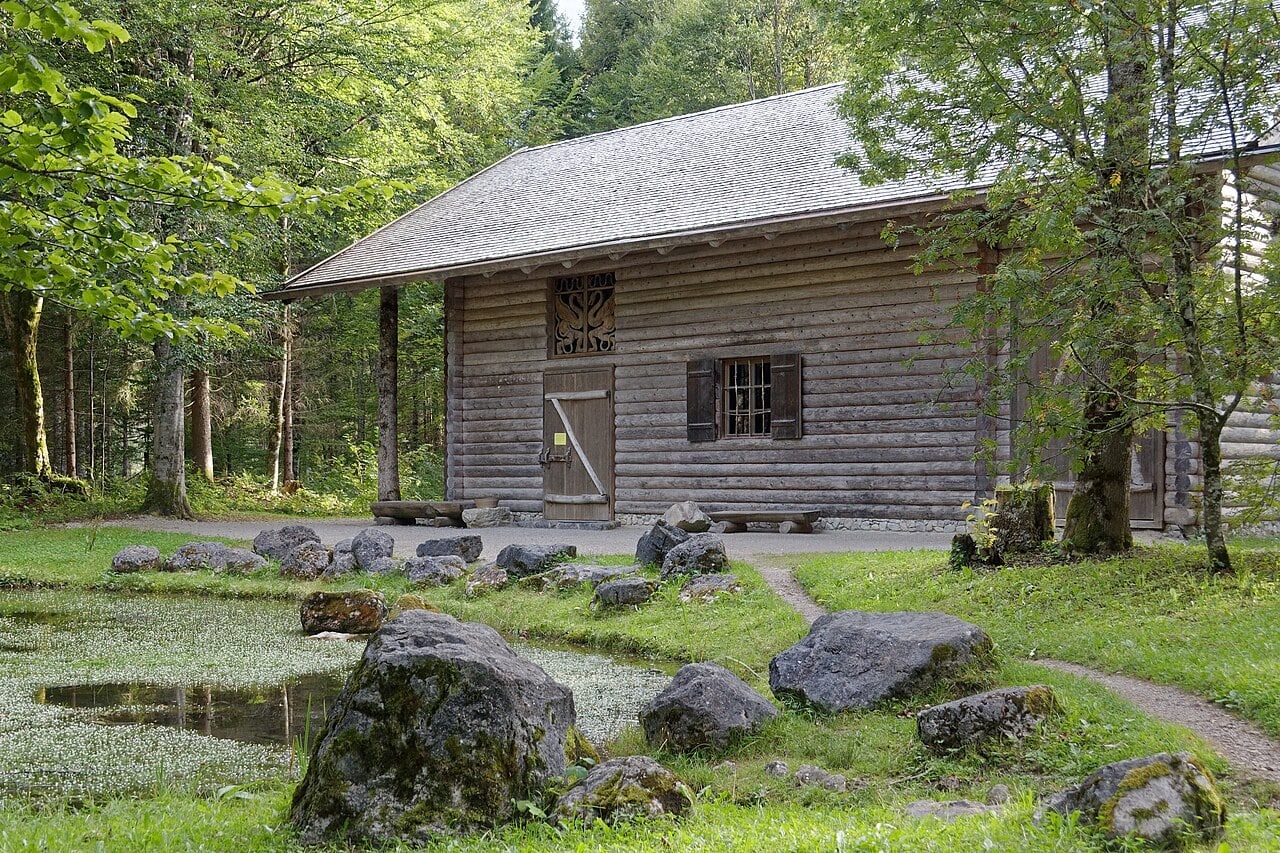
Beyond the palace, the park reveals Linderhof’s defining ambition. Scattered across its grounds are a sequence of built fantasies drawn from Richard Wagner’s operas: the Venus Grotto (Venusgrotte) evoking the Venusberg of Tannhäuser; Hunding’s Hut (Hundinghütte), the rough timber dwelling of Act 1 of Die Walküre; and the Gurnemanz Hermitage (Einsiedelei des Gurnemanz) from Parsifal, alongside two Oriental pavilions, the Moorish Kiosk (Maurischer Kiosk) acquired from Bethel Henry Strousberg’s bankruptcy sale in 1876, and the Moroccan House (Marokkanisches Haus) bought at the Paris World Exhibition of 1878.
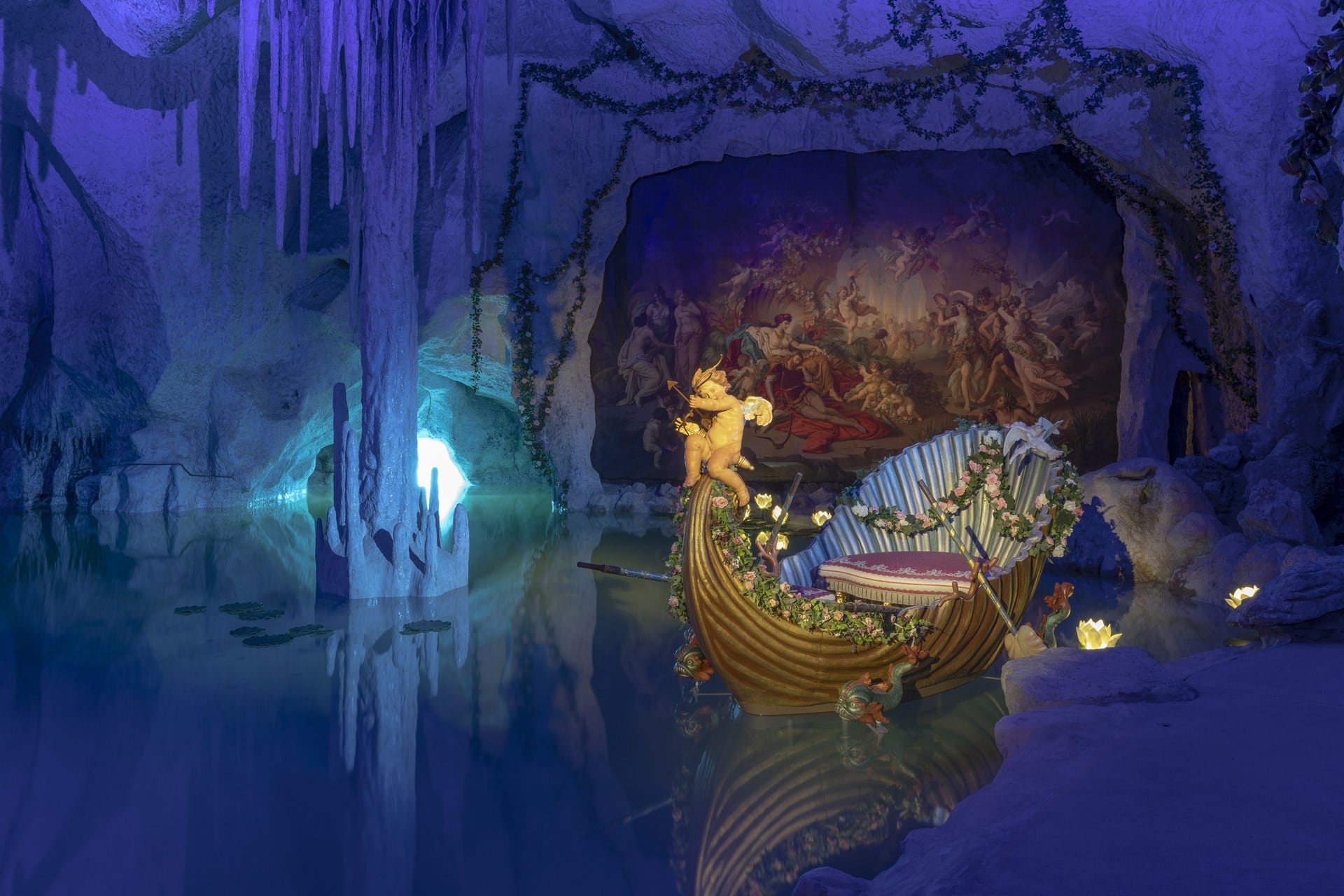
The Venus Grotto is the most ambitious of them. Its iron armature supports a shell of iron mesh and Roman cement shaped into some thirty thousand stalactites; it contains an artificial lake with a gilded shell boat, a wave machine, and a painted Tannhäuser backdrop by August von Heckel. Among them, the Venus Grotto was one of the earliest electrical installations in Bavaria, illuminated by dynamos driven by one of the region’s first permanent electric-power stations, built on site in 1878 under the direction of Johann Sigmund Schuckert. Colored glass discs shifted the light from the blue of Capri to the red of the Venusberg.
Hunding’s Hut, originally built at the foot of the Kreuzspitze in 1876, was reconstructed inside the park in 1990 after earlier fires and wartime arson; the Gurnemanz Hermitage, lost to decay in the 1960s, was rebuilt from private donations in 2000.
Read together, the park buildings compose a Wagnerian landscape distributed across the valley, interlocked with the French interior of the palace. Interior and exterior become two acts of a single Gesamtkunstwerk: the total artwork Wagner theorised, here realized in stone, water, canvas, and electricity.
Visiting the Castle
Its interior can be seen only on a guided tour, led by a live guide in German or English, lasting around twenty-five minutes and capped at forty people per departure. The palace website also offers a downloadable leaflet on Ludwig II and his palaces in French and Italian, as well as German and English. Tours leave every five to ten minutes during opening hours. Photography is prohibited inside the palace and inside the Venus Grotto. Outside, private photography needs no permit, but drones and model aircraft are banned, because the palace grounds lie within the Ammergebirge nature reserve. For third-party tours of the area, you can search GetYourGuide.
Closed for almost ten years of restoration, the Venus Grotto reopened on April 10, 2025 and is once again accessible on a dedicated guided visit. Tickets for the grotto (and the combined palace-and-grotto ticket) are sold only at the on-site cash desk; they cannot be booked online. Palace-only tickets can now be reserved through the Bavarian Palace Administration’s online shop, bypassing the queue. The Moorish Kiosk is closed for its own major restoration; the notice in the Admission table below gives the expected reopening.
Linderhof is open year-round, closing only on January 1, Shrove Tuesday, and December 24, 25 and 31. The park buildings operate on a shorter calendar: the Venusgrotte and the Marokkanisches Haus open in the summer season only, and the Hundinghütte and Einsiedelei des Gurnemanz open on the same seasonal window with slightly later daily hours. The Königsschlösser combination ticket (which pairs Linderhof with Neuschwanstein and Herrenchiemsee over a six-month window) is no longer offered in the operator’s ticket range; the Bavarian Palace Administration’s multi-day and annual passes remain valid here.
Prices in the Admission table below are the operator’s 2026 tariff; opening dates and access rules should be re-checked on the official Schloss Linderhof website (schlosslinderhof.de), since the palace publishes annual admissions, tour times, and seasonal closures there. For food, the operator lists Ludwig’s Bistro & Geschenke, which its access page places near the ticket office. Anyone staying overnight can compare hotels in and around Oberammergau.
Admission
| Ticket | Price |
|---|---|
| Palace | 11.00 euros / 10.00 reduced |
| Palace, online ticket shop | 11.00 euros / 10.00 reduced, as at the cash desk |
| Venus Grotto | 9.00 euros / 8.00 reduced, sold only in the summer season |
| Combined palace and Venus Grotto | 18.00 euros / 16.00 reduced, summer season only |
| Königshäuschen | 2.00 euros / 1.00 reduced, sold only at the Königshäuschen itself |
| Moroccan House, Hunding’s Hut, Gurnemanz Hermitage (and the Moorish Kiosk once it reopens) | No ticket needed; closed in winter |
| Children and young people under 18 | Free |
| Group reservation, 15+ people | 1.50 euros per person |
| Ticket sales | April 15 to October 15, 8:30am to 5:30pm; October 16 to April 14, 9:30am to 4pm |
| Palace opening hours | April 15 to October 15, 9am to 6pm; October 16 to April 14, 10am to 4:30pm |
| Venus Grotto and Moroccan House | April 15 to October 15, 9am to 6pm; closed October 16 to April 14 (the park buildings’ season can start or end a little earlier or later with the weather) |
| Hunding’s Hut and Gurnemanz Hermitage | April 15 to October 15, 11am to 6pm; closed October 16 to April 14 |
| Königshäuschen exhibition | April 15 to October 15, 11am to 6pm; October 16 to April 14, Sundays, public holidays and Bavarian school holidays only, noon to 4:30pm |
| Closed | January 1, Shrove Tuesday and December 24, 25 and 31 |
| Notice | The Moorish Kiosk is under restoration and covered in scaffolding, so it cannot be seen from outside or inside; the operator hopes to reopen its interior at the start of the 2028 season |
Some links on this page are affiliate links, which means StoneKeep Atlas may earn a small commission, at no extra cost to you, if you book through them.
Nearby Attractions
Ettal Abbey, about ten kilometers east along the valley road, offers a Baroque counterpoint to Linderhof’s Neo-Rococo: its circular abbey church is one of the great monastic churches of southern Bavaria. A further short drive brings visitors to Oberammergau, famous for the Passion Play its residents vowed in 1633 to stage every tenth year and first performed in 1634. West of Oberammergau, Hohenschwangau Castle (the castle of Ludwig’s childhood) and Neuschwanstein form the other half of any Ludwig II itinerary, reachable on a scenic alpine drive of around an hour and a half. The King’s House on Schachen, Ludwig’s high-altitude Swiss-chalet retreat above Garmisch-Partenkirchen, is a fellow component of the 2025 UNESCO inscription and a more remote experience for walkers. Around it, the Ammergau Alps nature reserve offers an extensive network of hiking trails directly from the palace car park.
Travel Tips
- Visit between mid-April and mid-October to find the park buildings open; the palace is worth a winter visit, but most of the Wagnerian follies and the Venusgrotte itself are closed in the off-season.
- Arrive early: tours depart on a timed, capacity-capped rota, and the Venus Grotto’s on-site-only ticketing means queuing in person is unavoidable.
- Expect a strict photography ban inside the palace and the grotto; pack for note-taking rather than camera work.
- Consider pairing Linderhof with Neuschwanstein on the same trip via the Alpine road through the Ammergau: the two palaces are under two hours apart and tell contrasting chapters of the Ludwig II story.
- In winter, come for the palace interior and the valley atmosphere, but plan for closed park buildings and shorter daylight.
- Access by car is simplest; a regional bus service connects Oberammergau to the palace car park for those arriving by train.
- The ticket office has an induction loop for hearing aids, and reading texts are offered on request for the palace tours; the Venusgrotte entrance and its internal paths are barrier-free, though the exit tunnel rises at more than 6 percent and the 600-meter approach from the ticket office climbs at up to 12 percent, with a companion recommended for wheelchair users.
Linderhof’s place in Ludwig II’s larger architectural argument (the Rococo counterpart to Neuschwanstein’s Wagnerian medievalism, in the intimate idiom of Louis XV’s France rather than the grand axial Versailles, and modeled, in the Neue Deutsche Biographie’s account, on the Petit Trianon) is traced in a longer essay on the building projects of Ludwig II.
This film is one episode in our series of castle documentaries.
Common Questions
Is Linderhof Palace worth visiting?
For the grounds as much as the house, yes. A palace tour is brief, but the gardens and park cover about 58 hectares, more than half of it woodland, and some 45,000 summer flowers for the beds are raised in Linderhof’s own small nursery. In the operator’s words, the Venus Grotto, 90 meters long and up to 14 meters high, was the largest artificial grotto of the nineteenth century, and it was built for King Ludwig II’s use alone.
How long do you need at Linderhof Palace?
Plan on much more than the palace tour, which lasts about 25 minutes. The ticket shop asks visitors to allow at least 30 minutes for the walk from the car park to the palace, a route the operator’s accessibility page puts at about 260 meters to the cash desk and 400 beyond it. In season, Venus Grotto tours leave every 20 minutes and last about 15, and the paths between the park buildings are often steep, with gradients up to 20 percent: the grotto lies 50 meters above the palace.
Do you need to book Linderhof Palace tickets in advance?
Not usually. Only part of Linderhof’s tickets are sold online, through the ticket shop linked from the official website, schlosslinderhof.de, and the operator says that even when those are gone, tickets can as a rule still be bought at the palace cash desk. An online ticket is tied to a tour time and cannot be exchanged, rebooked or returned, and a visitor who misses the booked tour cannot join a later one. Reduced and free tickets need original proof on site.
Are dogs and bags allowed in Linderhof Palace?
Dogs may go into the palace only if they are carried, staff cannot look after animals, and in the park every dog must be kept on a leash. Bulky items cannot be taken into the palace: large lockers for bags, backpacks and camera gear stand opposite the palace hotel, smaller ones by the toilets near the palace, and strollers and child carriers can be left at the palace entrance, though the operator accepts no liability for anything left there.
Where can you park at Linderhof Palace, and is there a bus?
Linderhof’s car park has 550 spaces for cars and 14 for coaches, with a parking charge that holders of a severely disabled pass do not pay, and ten charging points for electric cars. From Oberammergau, the nearest railway station, a regional bus runs to the palace; from May to September, a second line links Linderhof with Reutte in Tyrol and Oberau on weekends and public holidays. The Historisches Lexikon Bayerns credits the railway to Oberammergau, opened in 1900, with a marked rise in visitors.
Is Linderhof Palace worth visiting in winter?
For the rooms, yes, but the park is put to bed. In winter the water features are turned off, the statues and vases are protected by wooden casings, and the Venus Grotto and every park building except the Königshäuschen close; in snow and ice, parts of the park may be shut for safety. The operator recommends winter equipment for the drive from October to April, and the Plansee road between Linderhof and Reutte in Tyrol is sometimes closed in winter, wholly or in part, for avalanche danger.
What is in the Hall of Mirrors at Linderhof Palace?
Mirrors cover almost every surface of the walls, and the operator says simply that everything in the room is precious: the large mirror panes, the centrally heated fireplaces of lapis lazuli, rosewood-veneered furniture with figural bronze mounts, a carpet of ostrich down in front of the alcove and sculptures of Carrara marble. A Viennese crystal chandelier and an ivory chandelier hang there too. It is the last room on the guided tour, which begins in the vestibule. As a night person, Ludwig probably used it only rarely by day.
Who lived in Linderhof Palace?
It was built for King Ludwig II, whose palaces, the operator writes, no stranger was ever to enter. From about 1875 he lived by night and slept by day. A royal cook, Theodor Hierneis, recalled that dinners and suppers had to serve at least three or four although the king always sat down alone, believing himself among Louis XIV, Louis XV, Madame de Pompadour and Madame de Maintenon. From 1886 Prince Regent Luitpold used the Königshäuschen as a hunting retreat during his stays, while the palace stayed open to visitors.
Conclusion
Linderhof rewards a slower visit than its modest footprint suggests. The palace itself can be seen in under half an hour, but the valley and its scatter of follies (the grotto, the hermitages, the Oriental pavilions, the terraced gardens) together compose something larger and stranger than any single building. It is here, more than at any of the three palaces built by King Ludwig II, that his imaginative project reached completion: a private world of opera and Bourbon memory laid out across an alpine valley.
For the broader regional context, see Best Castles in Bavaria, a survey of nine castles across four castle traditions.
Principal Sources
- Albrecht, Dieter. “Ludwig II.” Neue Deutsche Biographie 15 (1987), 374-379. deutsche-biographie.de.
- Ammergauer Alpen GmbH. “Neue Busverbindung schafft Ringschluss um das Ammergebirge.” ammergauer-alpen.de/ringbus.
- Bayerische Schlösserverwaltung. “Allgemeine Informationen.” schlosslinderhof.de/deutsch/tourist/index.htm.
- Bayerische Schlösserverwaltung. “Anfahrt.” schlosslinderhof.de/deutsch/tourist/anfahrt.htm.
- Bayerische Schlösserverwaltung. “Biographie.” schlosslinderhof.de/deutsch/ludwig/biograph.htm.
- Bayerische Schlösserverwaltung. “Eintrittspreise.” schlosslinderhof.de/deutsch/tourist/eintritt.htm.
- Bayerische Schlösserverwaltung. “How to get there.” schlosslinderhof.de/englisch/tourist/howtoget.htm.
- Bayerische Schlösserverwaltung. “Linderhof Palace.” schloesser.bayern.de/englisch/palace/objects/li_schl.htm.
- Bayerische Schlösserverwaltung. “Öffnungszeiten und regelmäßige Führungen.” schlosslinderhof.de/deutsch/tourist/oeffnung.htm.
- Bayerische Schlösserverwaltung. “Parkpflege heute.” schlosslinderhof.de/deutsch/park/betreu.htm.
- Bayerische Schlösserverwaltung. “Plan und Parkbauten.” schlosslinderhof.de/deutsch/park/bauten.htm.
- Bayerische Schlösserverwaltung. “Service für Menschen mit Behinderung.” schlosslinderhof.de/deutsch/tourist/mobilitaet.htm.
- Bayerische Schlösserverwaltung. “Speisezimmer.” schlosslinderhof.de/deutsch/schloss/speisezimmer.htm.
- Bayerische Schlösserverwaltung. “Spiegelsaal.” schlosslinderhof.de/deutsch/schloss/spiegelsaal.htm.
- Bayerische Schlösserverwaltung. “Ticketshop Schloss Linderhof.” ticketshop-schlosslinderhof.de/de.
- Bayerische Schlösserverwaltung. “Venusgrotte.” schlosslinderhof.de/deutsch/grotte/index.htm.
- Bayerisches Landesamt für Denkmalpflege. Denkmalliste Gemeinde Ettal, Baudenkmäler, Aktennummer D-1-80-115-25. geodaten.bayern.de.
- Haus der Bayerischen Geschichte. “Bayern und die Gründung des Deutschen Kaiserreichs 1871” (teaching materials). archiv.hdbg.de.
- Schatz, Uwe Gerd. “Linderhof Palace.” Historisches Lexikon Bayerns, February 26, 2025. historisches-lexikon-bayerns.de/Lexikon/EN:Linderhof_Palace.
- UNESCO World Heritage Centre. “The Palaces of King Ludwig II of Bavaria: Neuschwanstein, Linderhof, Schachen and Herrenchiemsee.” Inscribed July 12, 2025. whc.unesco.org/en/list/1726/.
Image credits. Featured image — The south façade of Linderhof Palace, seen across the Flora water parterre: © Bayerische Schlösserverwaltung. Photo: Maria Scherf / Andrea Gruber. www.schlosslinderhof.de. The palace viewed from the terrace gardens, with the Ammergau Alps rising behind the cascade: © Bayerische Schlösserverwaltung. Photo: Maria Scherf / Andrea Gruber. www.schlosslinderhof.de. The Hall of Mirrors (Spiegelsaal), modeled on the Mirror Cabinet of the Munich Residence rather than on Versailles: © Bayerische Schlösserverwaltung. Photo: Maria Scherf / Andrea Gruber. www.schlosslinderhof.de. The King’s Bedroom, arranged like a Baroque altar, with the canopy bed raised within an alcove and lit by a crystal candelabrum of 108 candles: Daniel71953, CC BY-SA 3.0, via Wikimedia Commons. The oval Dining Room, with the mechanical dining table (Tischlein-deck-dich) that rose from the kitchen below: © Bayerische Schlösserverwaltung. Photo: Maria Scherf / Andrea Gruber. www.schlosslinderhof.de. The Venus Grotto with its gilded shell boat and August von Heckel’s Tannhäuser backdrop: © Bayerische Schlösserverwaltung. Photo: Maria Scherf / Veronika Freudling. www.schlosslinderhof.de. Hunding’s Hut (Hundinghütte), rebuilt in 1990; its staging recalls Act 1 of Wagner’s Die Walküre: Bjs, CC0, via Wikimedia Commons. Freely licensed images are resized to fit; any other change, such as a crop, is named in the credit.