
How Castle Moats Worked
A castle moat, in the picture nearly everyone carries, is a ring of green water with a drawbridge over it and something unpleasant swimming below. That picture is the exception. Many ditches cut around medieval castles held no water at all, and on hilltop and spur sites almost none of them could; the ones that did hold water were doing a job more particular than drowning anybody. A ditch answered several problems at once: it held siege engines and rams at arm’s length, forced an attacker onto ground the defenders already covered, and, hardest of all to solve, stood between him and the miner’s work at the foot of the wall.
This page is about the ditch itself, wet or dry. Its crossing, and the machinery that raised and dropped it, belong to the castle gatehouse. The wall standing behind it, and the fighting platform along the top, belong to castle walls and battlements. Covering fire, which is what made a ditch dangerous to stand in, belongs to castle defenses. Each gets named once here and handed on.
Ditch, Fosse, Moat: What the Words Actually Mean
French settles the question inside the definition. Viollet-le-Duc opens his article Fosse with a long trench cut in the ground to put an obstacle around a camp, a castle or a town, then divides it in his second sentence: “Il y a des fossés secs et des fossés pleins d’eau.” There are dry ditches and ditches full of water, and nothing about water is built into the word.
His four-way classification is still the clearest thing on the subject. Dry ditches are cut around a place “situés en des lieux trop élevés pour pouvoir y amener et y conserver l’eau”, sited too high to bring water up and keep it there. Wet ditches are those a watercourse is led through, or flooded from the sea, a lake or a pond. Sloped ditches, dug in loose soil, carry turfed sides at forty-five degrees. Flat-bottomed ditches, the fossés à fond de cuve, have walls faced in stone and a level floor, allowing openings to be pierced low in the scarp, the ditch wall at the foot of the fortification itself. English is looser, and legitimately so: Newcastle Castle’s own operator writes of “the dry moat surrounding the gatehouse”, and calling a dry ditch a moat is not modern sloppiness.
French douve leans wetter, though not reliably. In medieval French it meant a water-filled ditch, and the Académie française still gives “fossé rempli d’eau ou destiné à l’être”, a ditch filled with water or intended to be. Modern usage does not hold that line: Château de Brézé advertises its douves sèches, and the Centre des monuments nationaux writes of Angers’ douves sèches too. Today the word means a castle ditch, wet or dry.
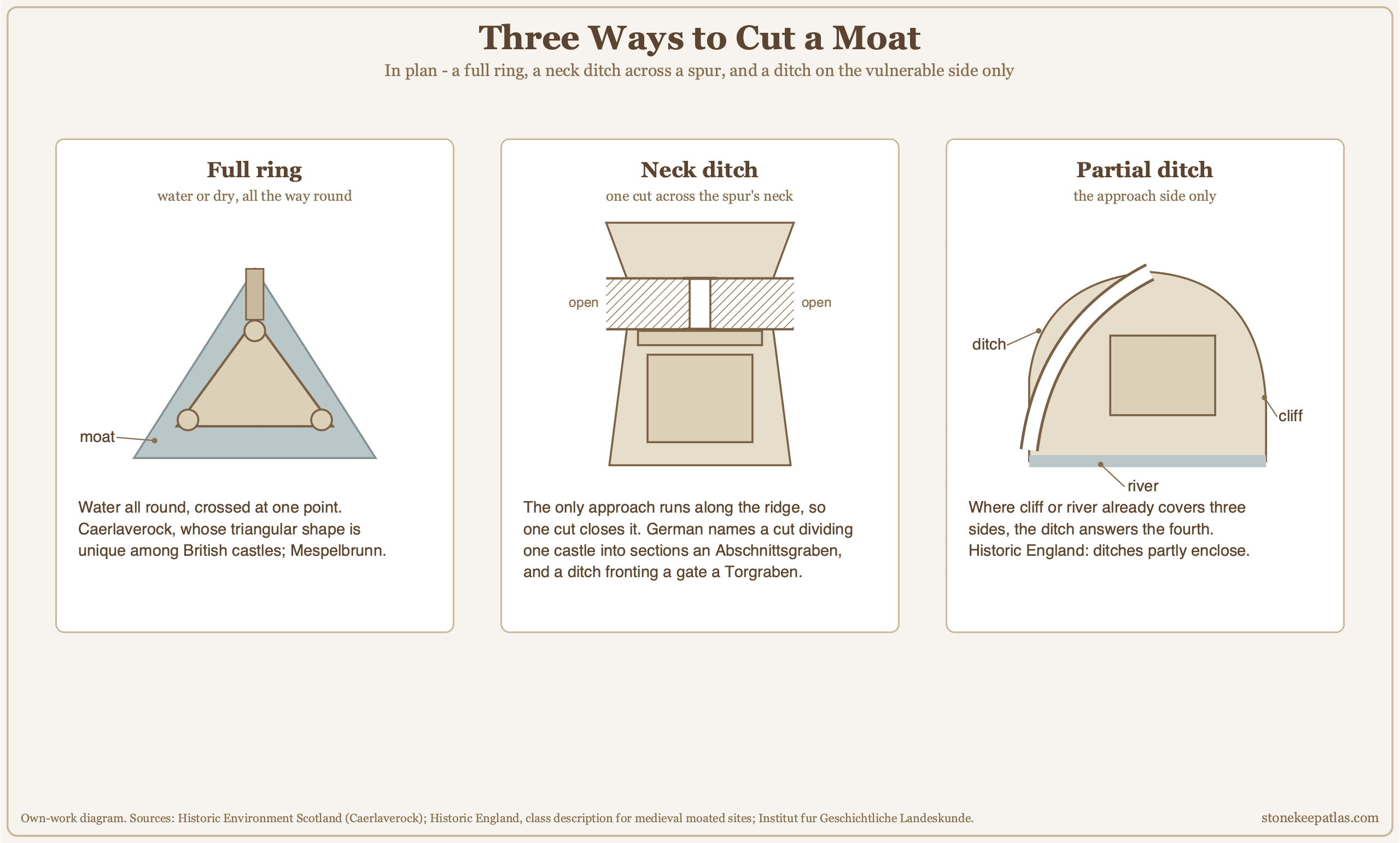
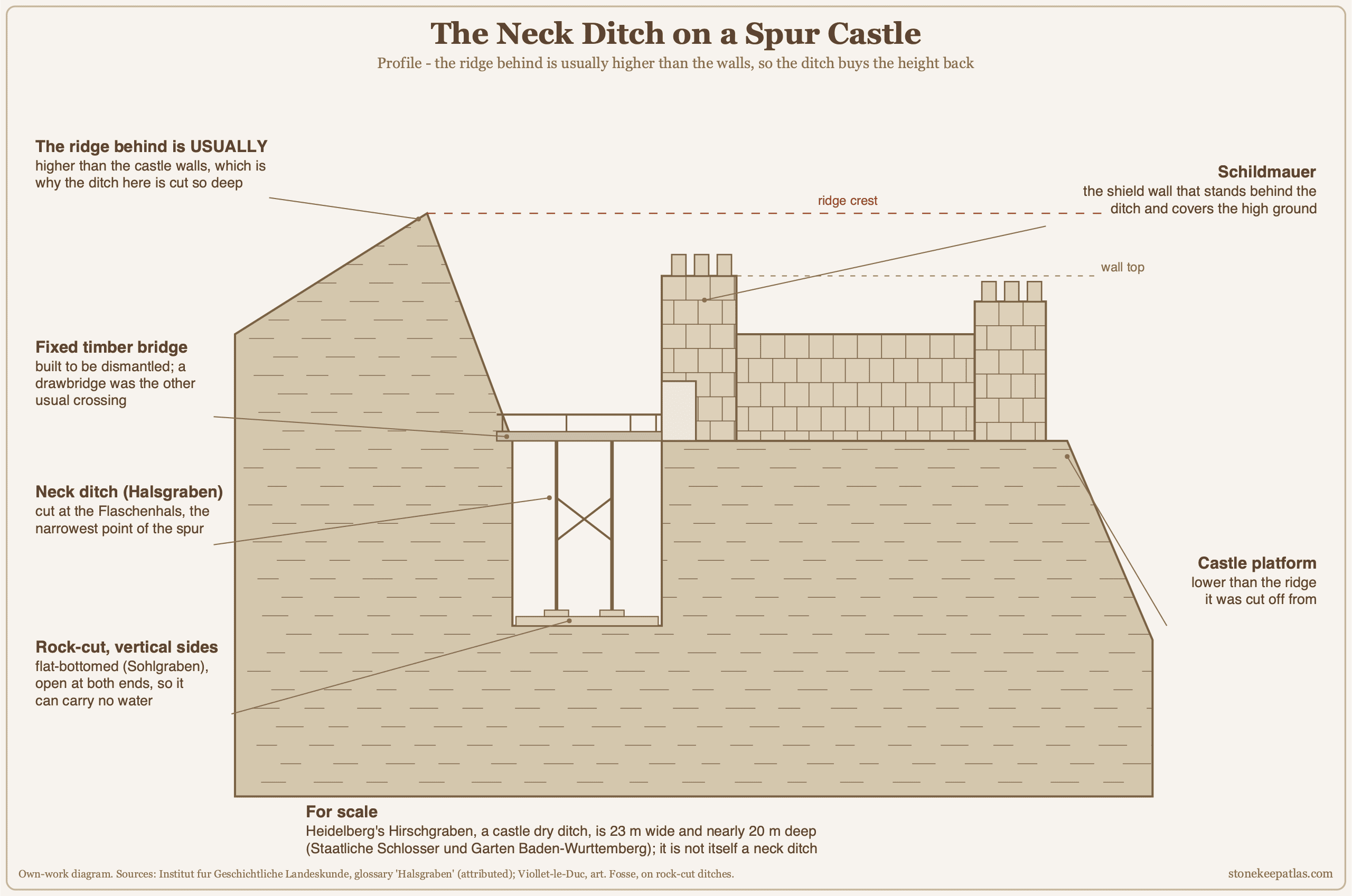
German is the most precise of the three. Burggraben and Stadtgraben, castle ditch and town ditch, are unambiguous; Wassergraben is not, since it does duty for agricultural drainage. A Halsgraben, a neck ditch, is a strict term: the deep artificial cut separating a hilltop castle’s approach from the rest of the ridge, named for the Flaschenhals, the bottleneck, where it is usually driven. German also separates Burg, a stronghold, from Schloss, a residence, so a Wasserburg is a moated fortress and a Wasserschloss a moated residence.
The English word itself came in sideways. French motte means the mound, and the standard dictionaries of Old French record no ditch sense for it; the Anglo-Norman Dictionary records no ditch sense either. English mote meant a mound too, from before 1272, and the earliest recorded use of the word for the ditch is English, in Langland’s Piers Plowman in 1362, though the Oxford English Dictionary notes the switch may in fact have happened first in Norman dialect.
The sources do not supply one term the reader will expect. English writing calls the flat strip between wall foot and ditch a berm; no medieval authority names it that. Viollet-le-Duc describes it instead as what a braie leaves behind. The braie is a palisaded outwork raised in front of the main wall, and at its foot it leaves “une circulation plus ou moins large, servant de chemin de ronde”, a patrol walk at ground level. Its stated purpose is the next argument in miniature: the braie is “destiné à empêcher l’assaillant d’attacher le mineur”, meant to stop the attacker setting his miner to work.
Dry Moats and Wet Moats
Whether a ditch held water was mostly decided before anyone dug it. Viollet-le-Duc’s definition makes altitude the criterion, and the modern heritage authorities agree with him. Water had to be led in from a river, a spring, a lake or a pond, at or above the level of the ditch, so a castle on a spur or a crag had no realistic way to fill one.
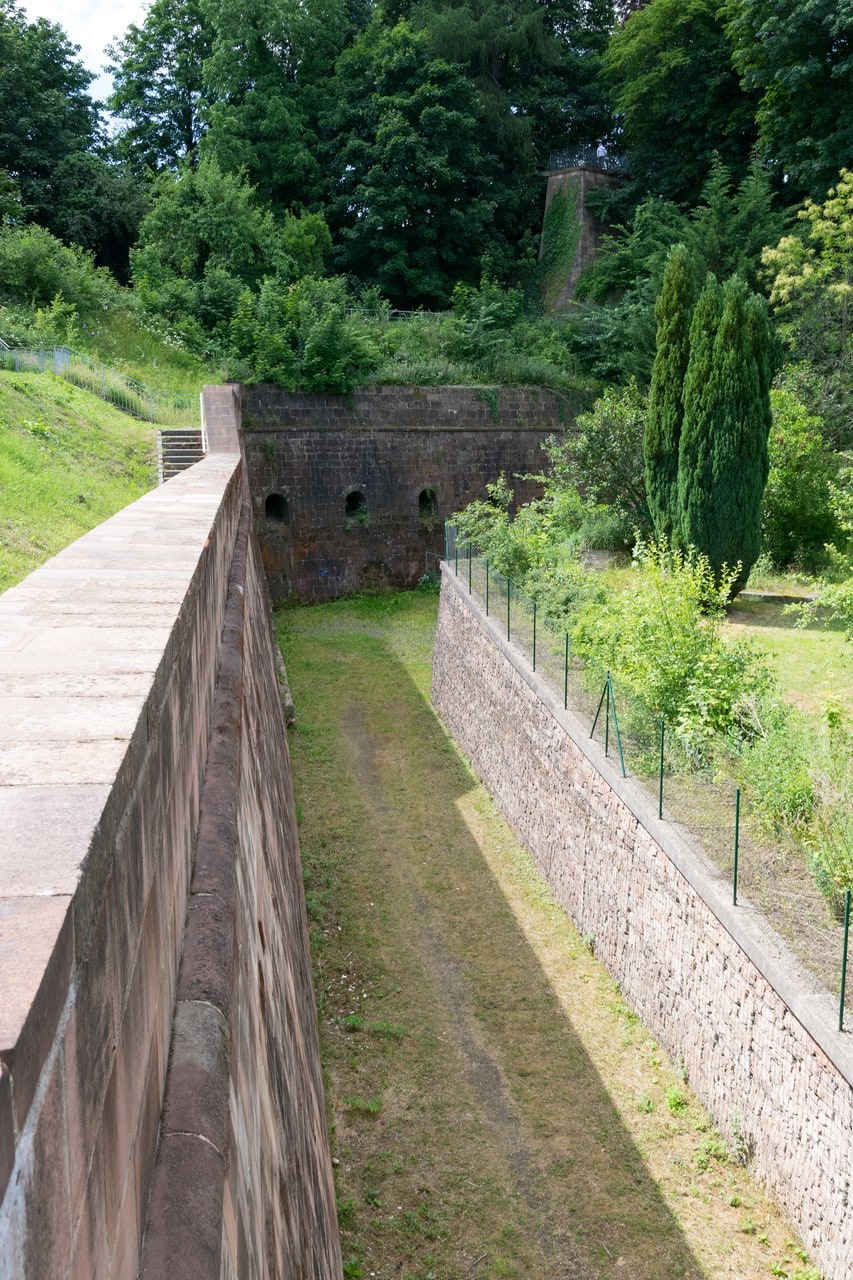
Heidelberg’s palace administration states the argument in its own voice. Of the Hirschgraben, the great ditch that forms an approach obstacle between the castle’s inner and outer defensive walls, twenty-three meters across and nearly twenty deep, the operator writes that it “war nicht mit Wasser gefüllt, was bei Bergburgen auch ungewöhnlich wäre”: it was not filled with water, which for a hill castle would be unusual anyway. A brook does run through it and can be dammed, which may be how it once froze hard enough to skate on.
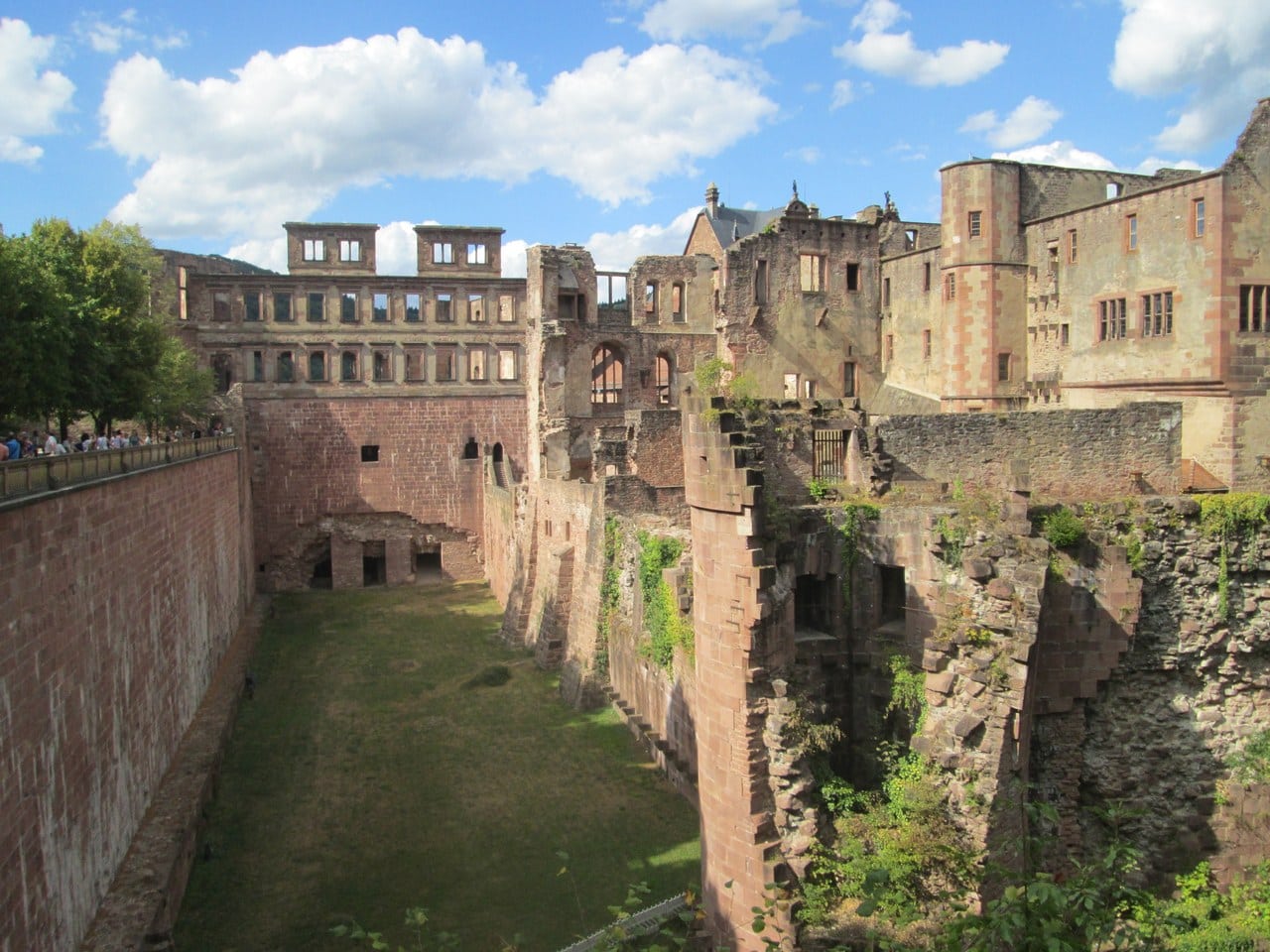
Height also explains why the hilltop ditch is so nearly universal. A German heritage glossary puts it flatly: scarcely any Höhenburg lacks its neck ditch. That is a claim about a whole population of castles, and it holds for the same reason Viollet-le-Duc’s does, since the ground those castles chose ruled water out from the start.
England complicates this, and the complication belongs inside the argument rather than outside it. Around six thousand moated sites are known in England, and Historic England’s standard description calls their ditches “often or seasonally water-filled” and says the majority “served as prestigious aristocratic and seigneurial residences with the provision of a moat intended as a status symbol rather than a practical military defence.” They peak between about 1250 and 1350, concentrated in central and eastern England. Most of them were not castles at all. So the defensible claim is a typological one and never a percentage: the ditches of hilltop and spur castles were dry almost by definition, and most of England’s moated sites were not castle ditches at all.
How a Moat Was Dug, Lined, and Fed
Digging a ditch produced two things a builder wanted. At Vincennes the earth taken out went straight back into the site: the Centre des monuments nationaux records that the platform had to be raised and leveled, and that “les terres extraites lors du creusement des fossés” were used for it, inside the castle and out. Its scarp crest varies by only forty centimeters over more than a kilometer of wall.
Core samples turned up something better. The Centre des monuments nationaux reports that analysis of cores from the tour du Village showed a close match between the lime mortars and “les sables et calcaires extraits lors du creusement des fossés”, the sand and limestone dug out when the ditches were cut. The ditch supplied the mortar for the walls it defends. Only the mortar: the building stone came up the Marne from the right bank.
Lining came later than the digging, and one authority dates it. Viollet-le-Duc recorded that he had never seen a revetted counterscarp, the ditch’s outer wall on the field side, faced in stone earlier than the thirteenth century, and that from that date ditches were almost always revetted around important fortresses, their floors even paved at carefully built castles. His examples run from Coucy’s paved donjon ditch early in that century to the fragments of counterscarp revetment surviving on the east side of Carcassonne at its end. Paving is not always defensive: at Avignon the counterscarp was left unrevetted, but the floor was laid in large ashlar to stop the Rhone’s floods from scouring it out.
A wet moat, once you follow the sources, is a dam-and-sluice problem rather than a digging one. Avignon’s ditches were kept full in ordinary times by the Rhone, the Sorgue and an arm of the Durance. Kenilworth’s mere was impounded behind a dam that, English Heritage records, King John spent about eleven hundred pounds improving, alongside the curtain walls and towers. Historic England’s description of medieval fishponds lists the hardware: inlet and outlet channels from a river or stream, sluices set into the dam and along the leats, and an overflow leat. Andrew Boorde in 1542 gives the instruction from inside the period: “Yf there be a moote made aboute it, there should be some fresshe sprynge come to it.”
Keeping a ditch working was somebody’s written duty. An undated Gascon town-fortification ordinance, which Viollet-le-Duc judged from the defenses it describes to be of the late fourteenth century, requires ditches all around, wide and “si profonds qu’il y sorte de l’eau”, so deep that water comes out of them, with an alternative prescribed where water cannot be had. It goes on to require them “bien netoyes et cures, du pied du mur jusqu’au fond”, well cleaned and dredged from the foot of the wall to the bottom, of weeds and branches. Silting is not something later observers noticed about ruins; it is what a medieval ordinance was written to prevent.
What a Moat Was Really For
Kenilworth in 1266 is the clearest case on record of a water defense doing its job. Supporters of the late Simon de Montfort held the castle against Henry III from 25 June to 13 December, 172 days of constant attack. English Heritage describes what the water did and what it cost: “The water defences were preventing the royal forces from undermining the castle walls, so the king had barges hauled overland from Chester for a waterborne assault across the mere. But the defenders managed to repel them.” A king dragged boats across England because he could not get at the foundations, and it still failed. The garrison of over twelve hundred came out at the end with two days’ food left, severely weakened by dysentery.
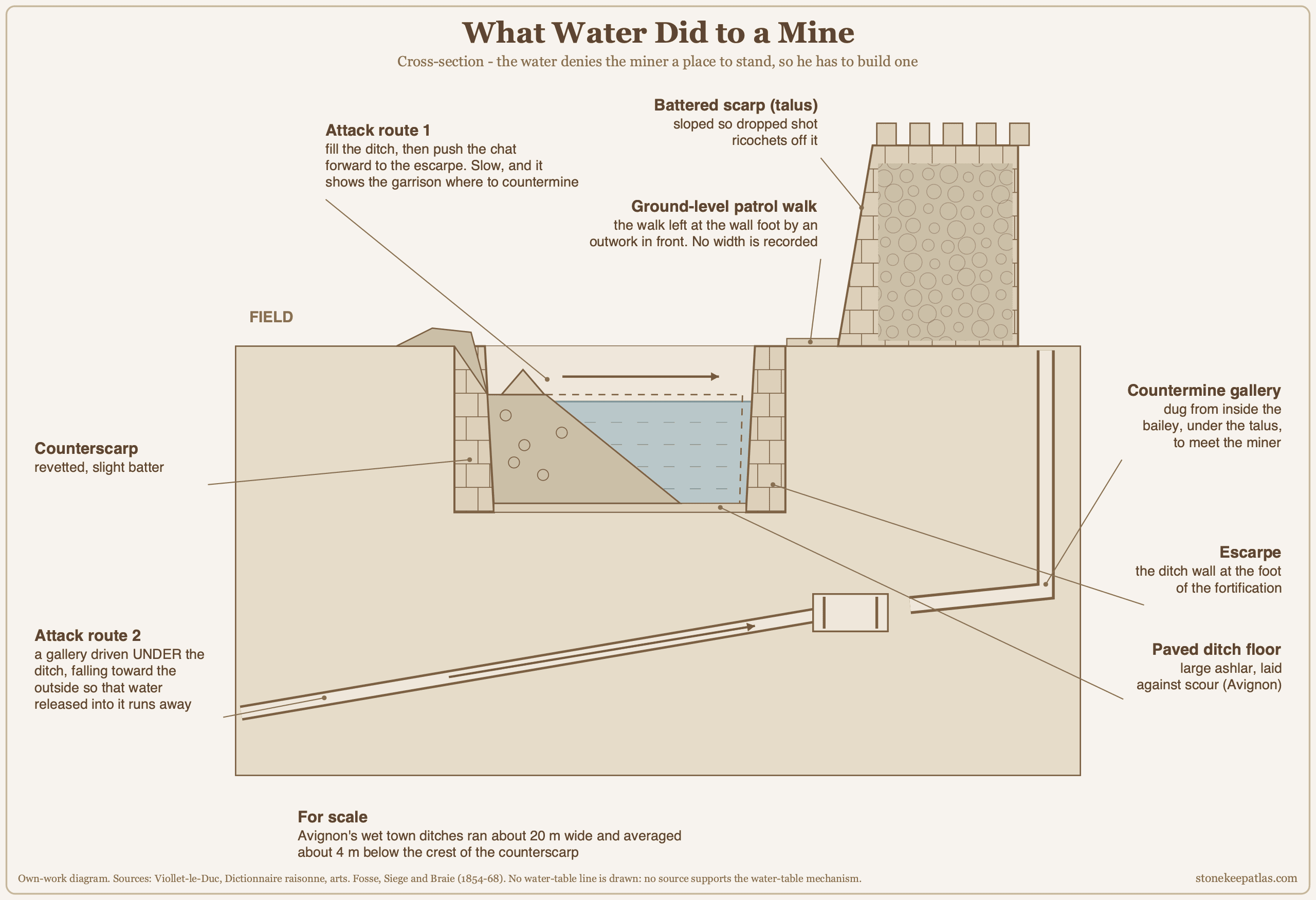
Undermining is the thing to hold on to, because mining is what a moat was really answering. Viollet-le-Duc says outright that the miner’s work changed with the ground, and treats the two cases separately.
Against a dry ditch, the miner went underneath. Besiegers opened their galleries at a distance, in suburban houses or behind walls and folds of ground, then “allaient chercher le sol sous le fossé, le traversaient en tunnel, arrivaient sous les fondations des remparts”: they went looking for the ground beneath the ditch, crossed under it in a tunnel, and arrived below the foundations of the ramparts. A dry ditch is not even an inconvenience to a mine. Worse, it hides one: the defenders, in his words, “pouvaient ignorer si on les minait, et sur quels points étaient dirigés les mineurs”, could remain unaware that they were being mined at all, or where the miners were working.
That is the problem the strangest detail in the sources was invented to solve. Garrisons set small bowls of water along the wall-walk and watched the surface. When it rippled, somebody was digging beneath that point, and they countermined there. The bowls matter more once you see where Viollet-le-Duc puts them, in the same paragraph as the dry ditch, as the direct answer to the blindness it created.
Water changed the arithmetic by denying the miner a place to stand. If a place was ringed by water, the besiegers had to fill the ditch first, feeding material forward through trenches until a causeway reached the scarp, then advancing a chat, a mobile shed, along it. Building that causeway took days, in the open, and it announced exactly what it was: the method, he writes, “désignait à l’assiégé le point où l’on sapait ses murailles”, showing the defenders where their walls were being undermined.
Defenders with water in hand had one more move, an active one rather than anything the ditch did by itself: they would try to fill the enemy’s gallery. Miners answered by driving the gallery under the ditch on a falling grade toward the outside, so that water released into it ran away instead of drowning them.
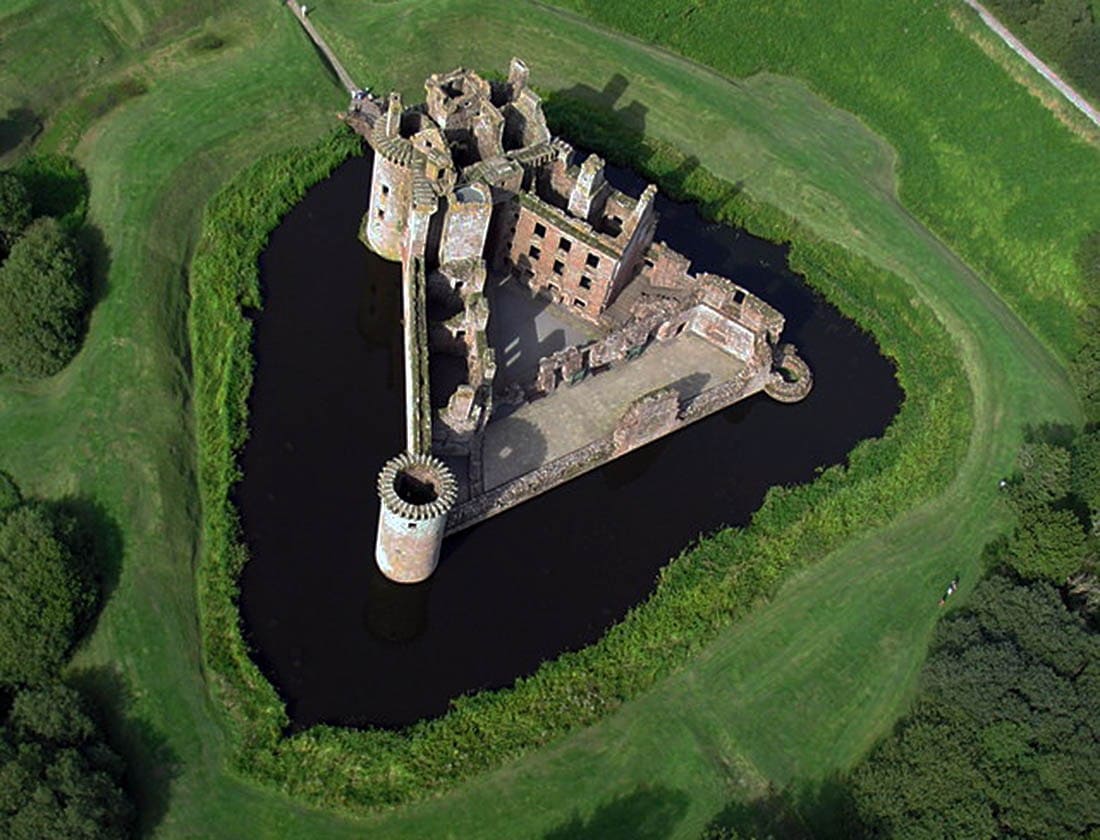
None of this made a wet moat proof against mining. At Caerlaverock in 1300, a castle whose ditches the Roll of Caerlaverock, a herald’s account written at the siege, describes as good ditches filled to the edge with water, the walls were mined to considerable effect by Sir Adam de la Forde. Water denied the miner his working position and made him expose himself to get one. It did not make him go away.
Castles fought back at ditch level too. Tunnels cut inside the Norman rock-cut castles run down to the floor of their own ditches, so the garrison could come out and attack miners at the wall foot. At Coucy a countermine gallery was carried right around the masonry under the talus, into which enemy miners emerged and, as Viollet-le-Duc dryly puts it, were received as one may imagine.
The ditch’s second job was to hold things at arm’s length. A neck ditch, the German glossary notes, kept attackers “und ihr Wurfzeug”, and their throwing engines, at a distance. From the besieger’s side the same point reads as a work order: a whole day of an assault spent “à combler les fossés, à pousser les beffrois… à faire agir les béliers contre les remparts”, filling the ditches, pushing up the siege towers, and bringing the rams to bear on the walls. Filling the ditch comes first in that list, because nothing else can begin until it is done. Townsmen at Guingamp fill theirs with fascines, bundles of brushwood.
A ditch, though, is not a wall. On one night in his narratives more than twenty miners climb down into the ditch and bring down three toises of masonry, some six meters of it, from inside it. Where a ditch was not commanded by fire from above, men got into it and worked, which is why the covering fire from the wall-head is what made the obstacle real.
Ditches shaped the approach as well. That same Gascon ordinance requires every road to the gates to be cut across by great ditches in five or six places, leaving one narrow passage that is itself to be broken when needed, so nobody can reach the gates on foot or on horseback or bring fire up in a cart. Viollet-le-Duc found the traces in the field: roads ran alongside the ditch so they could be enfiladed from the towers, and the cuts across them drained into the ring ditch so that besiegers could not shelter in them.
Crossing It
Three kinds of crossing show up in the sources, and only one of them is the drawbridge everyone pictures. At Vincennes the approach is “un pont dormant en pierre (inamovible) complété par un pont-levis”, a fixed stone bridge finished by a drawbridge at the inner end. A German heritage glossary notes that alongside drawbridges, fixed timber bridges built to be easily dismantled were also usual. Historic England’s record for Bodiam describes the third kind, a causeway with a later bridge on it.
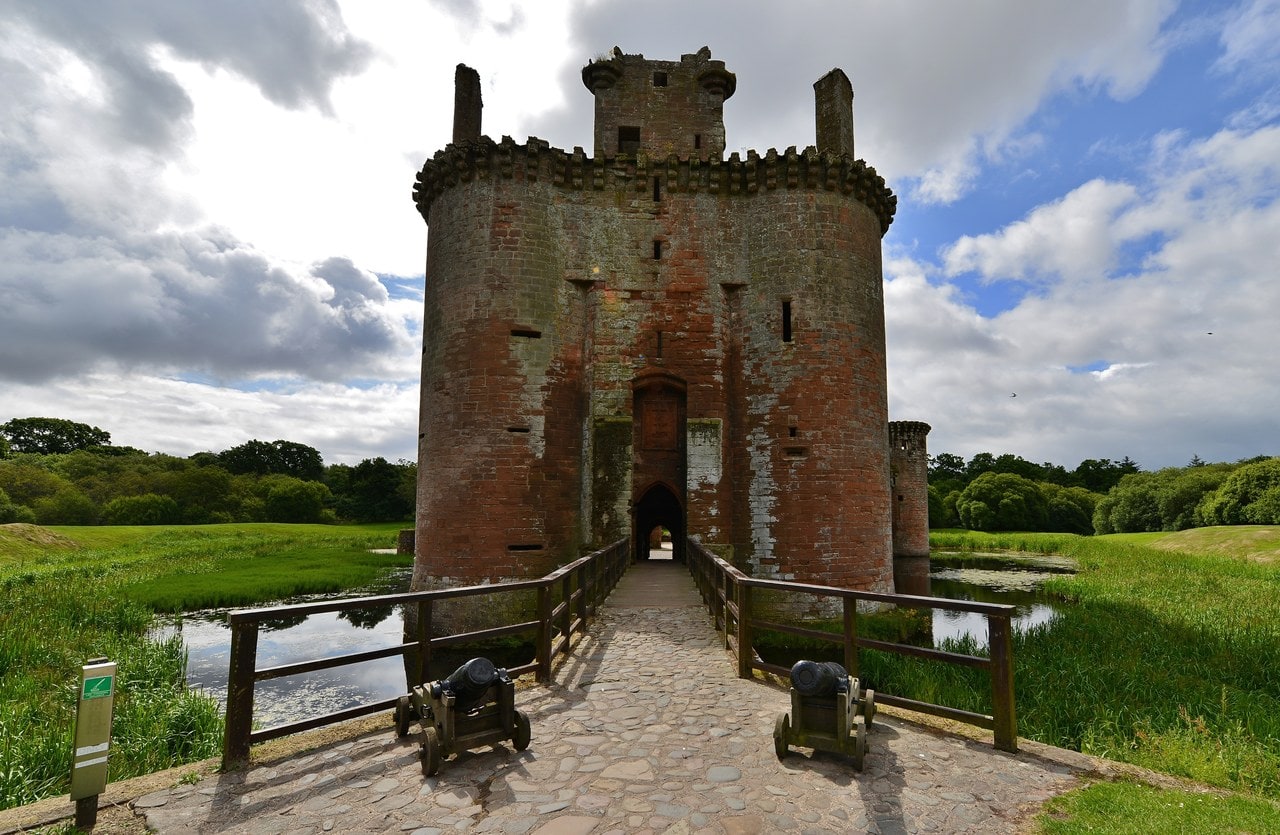
That middle case is the interesting one. A crossing designed to be cut is a crossing designed as the disposable part of the system, which is why so many surviving castle approaches are a modern deck sitting on medieval piers. Its mechanism, and the portcullis behind it, belong to the drawbridge and the machinery that worked it.
Operators describe the whole thing as one machine. The Centre des monuments nationaux calls Vincennes’ gate tower “le point de fermeture du système défensif” formed around the keep by its chemise, its deep ditches and its drawbridge: the ditch, the wall and the gate are a single defensive system, and the gate is its lock.
What Was Actually In the Water
Something did live in castle ditches, and the documented cases are not reptiles. At Angers in the fifteenth century, under King René, “les fossés abritent une partie de la ménagerie princière”: the ditches held part of the princely menagerie. Deer were still kept in the northern ditch there until 1999, when they were removed for health reasons. Heidelberg’s great dry ditch is the Hirschgraben, the deer ditch, after the roe deer kept in it for the hunt.
Europe’s most famous crocodile story turns out not to be about a moat at all. At Castel Nuovo in Naples, Benedetto Croce records a legend attached to “una fossa sottoposta al livello del mare”, a dark, damp pit below sea level into which prisoners meant for harsher punishment were thrown. Croce is not repeating the story but dismantling it: following the folklorist Gaetano Amalfi, he identifies it as a motif found widely in popular tales, of prisoners devoured by a crocodile, a serpent or some other monster, localized onto that one castle.
The sewage question needs a distinction rather than a denial. Newcastle Castle’s operator says the Black Gate’s garderobe chutes “empty into the dry moat surrounding the gatehouse, which was also used for general waste disposal”, and at Vincennes the medieval collector sewer discharged into the eastern ditches, the water then led off to a pond at Saint-Mandé. Set against that, Boorde in 1542 wanted a fresh spring feeding any moat, and a sluiced moat is a managed system rather than a standing cesspit. Waste did go into ditches, which is one of the arguments that so many of them were dry, since a dry ditch can be shoveled out.
Fish are a real use, though less often in the moat than the popular version suggests. Heritage records schedule fishponds alongside moated sites far more often than they show the moat serving as one, and a moat was one element in a water economy of ponds, leats, sluices, a dam and sometimes a mill. Even so, an English statute of 1539 made it a felony to fish “in any seuerall ponde stewe or mot with an intent to steale fishe out of the same”, a Tudor parliament treating a moat as a fishery.
From Defense to Display
Moats became status objects far earlier than the Renaissance framing suggests, as England’s six thousand moated sites show at their peak in the century after 1250. Ditches spread well beyond castles and towns too: Viollet-le-Duc notes abbeys outside towns ringed with them, and sometimes even parish churches.
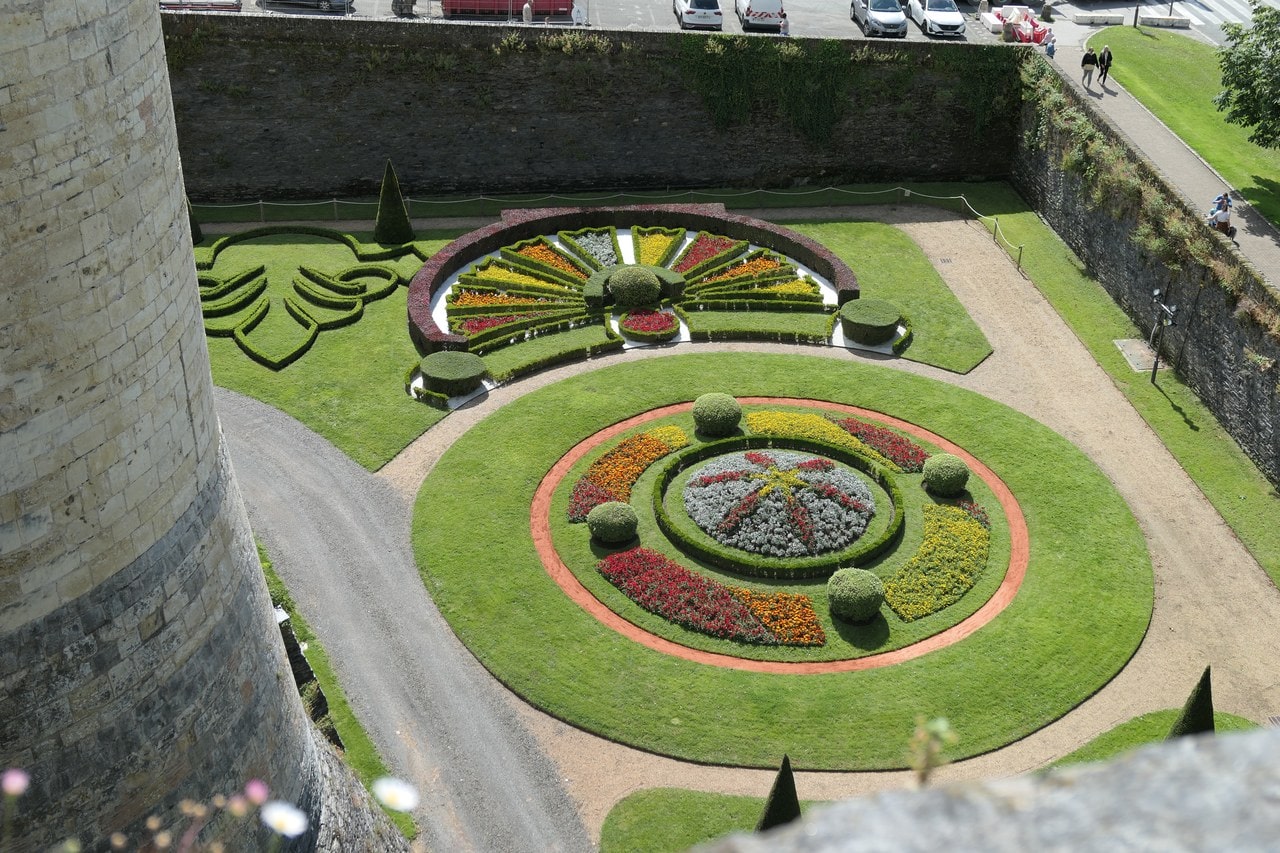
Angers carries the whole arc by itself. Ditches cut in the 1230s for the defense of a fortress held a royal menagerie two centuries later, and hold formal parterres now. A ditch dug to keep an army out has spent longer as a garden than it ever spent as a defense.
Ownership tells the same story from another angle. Viollet-le-Duc’s summary is that the overlord regulated a ditch’s extent and width, in certain cases required it filled in, and that upkeep fell on the lord or, by special agreement, on his vassals. Edward I’s 1283 privileges for Sauveterre, granted as duke of Aquitaine rather than as king of England, bind the lord to make the town’s first enclosure under the commune’s supervision. A ditch you need permission to dig is a jurisdictional object as much as a military one.
Gunpowder did not end the ditch. It widened it. Once artillery was used against fortified places, Viollet-le-Duc writes, “on élargit encore les fossés”, and defenders added works low enough to sweep the floor with grazing fire, channels to carry off rainwater, and sluices to flood the ditch where a neighboring watercourse or pond allowed.
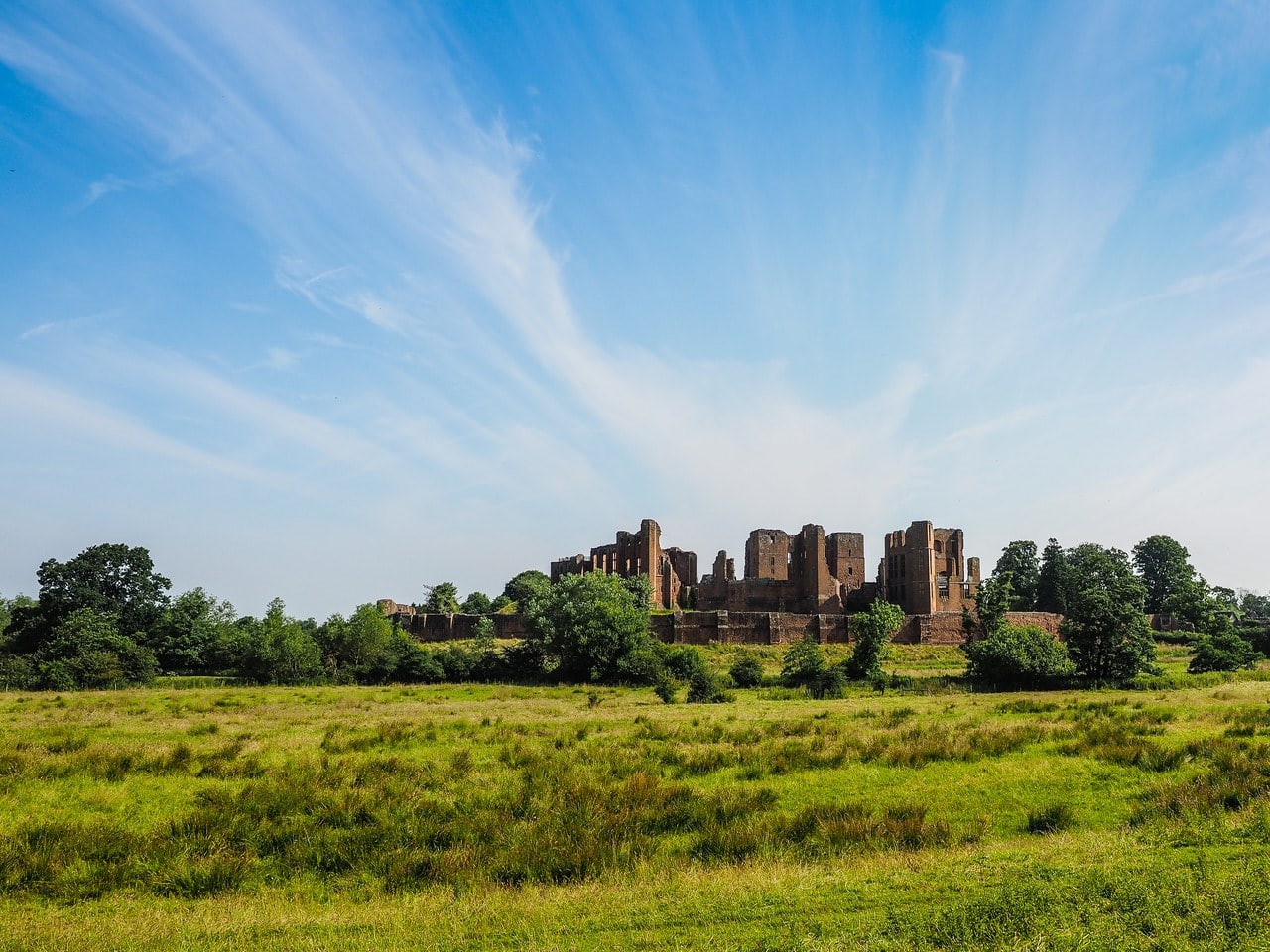
What finally ended a water defense was usually a decision. Kenilworth was taken in 1642, ordered made untenable in 1649 and dismantled the following year; the mere was drained after that, the trees felled and the interiors sold. Robert Dudley had built a bridge 183 meters long to carry hunting parties across it.
Moats You Can Visit Today
Heidelberg Castle, Germany. The Hirschgraben is the clearest surviving statement of the altitude argument: twenty-three meters wide, nearly twenty deep, never a water moat, though a brook runs through it.
Caerlaverock, Scotland. A wide moat still stands full around a triangular castle whose shape Historic Environment Scotland calls unique among British castles; the approach today crosses it on a modern bridge that replaced the drawbridge. A contemporary account of the 1300 siege describes good ditches filled to the edge with water, and the walls mined all the same.
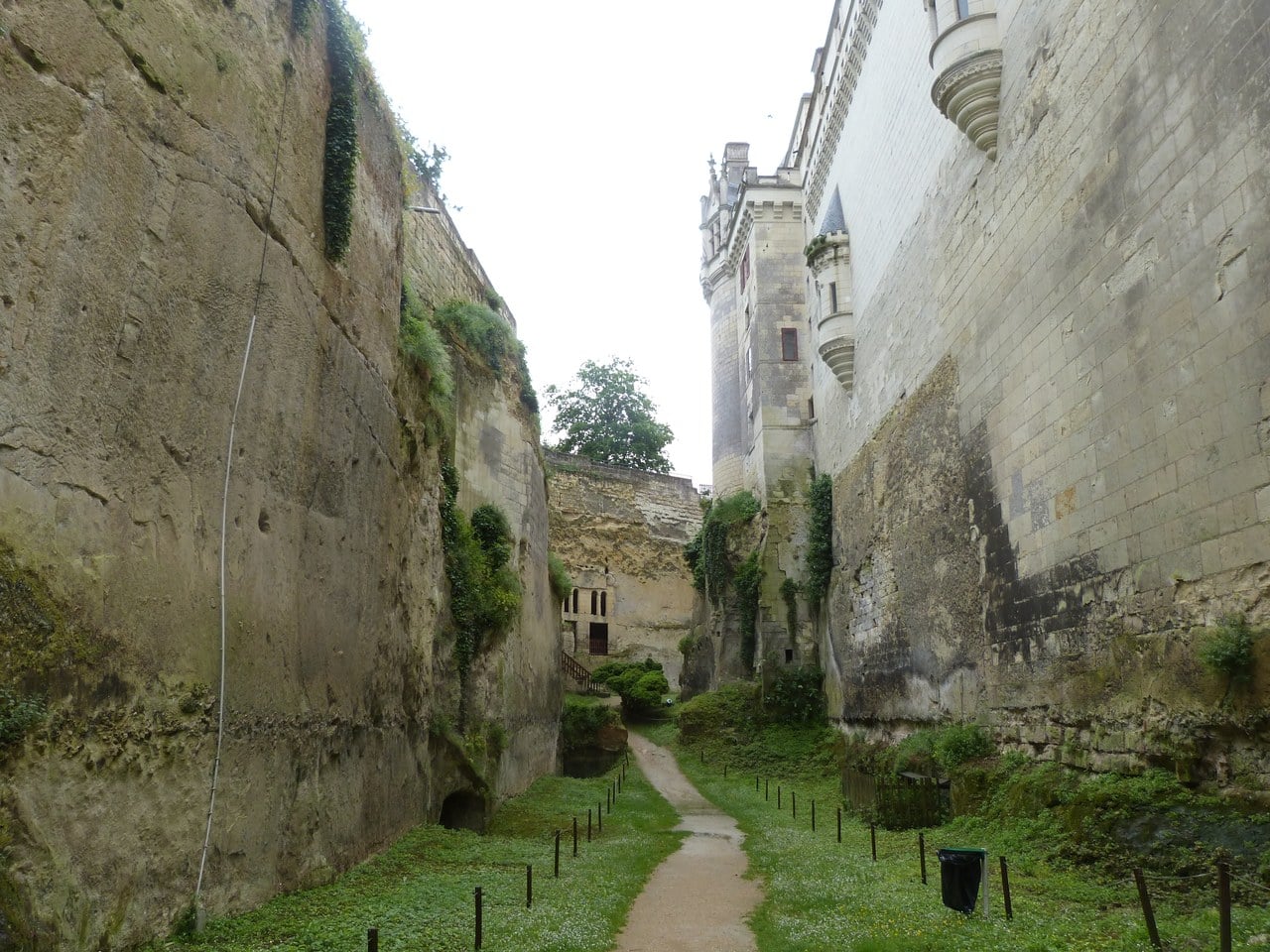
Château de Brézé, France. Brézé advertises, on its own account, moats among the deepest dry moats in Europe, and its brochure puts them at eighteen meters deep and ten wide; they were cut in the fifteenth century and enlarged in the sixteenth, and off their walls open an underground bakery, a seventeenth-century silkworm farm, a barrel room and one of the largest wine press rooms in France. Reaching the floor means a narrow stair of twelve steps and about eighty meters of descending passage, though three openings at garden level let a visitor look down instead.
Château de Vincennes, France. Vincennes has two ditch systems, 29.80 meters wide north and south and 25.80 east and west, dry today, and the operator runs guided walks down into the keep’s ditches. Whether those ever held water is unsettled, and the Centre des monuments nationaux says so in a footnote to its own teaching materials.
Château d’Angers, France. The dry ditches below the seventeen drum towers of Château d’Angers now hold formal gardens, first planted in 1911 and replanted in 2025. Their floor is not normally open: you look down from the Place Kennedy or the rampart walk.
Kenilworth Castle, England. Nothing of the water remains, which is the point. English Heritage labels the ground the site of the mere: a dry field where a lake once stopped a king’s miners for 172 days.
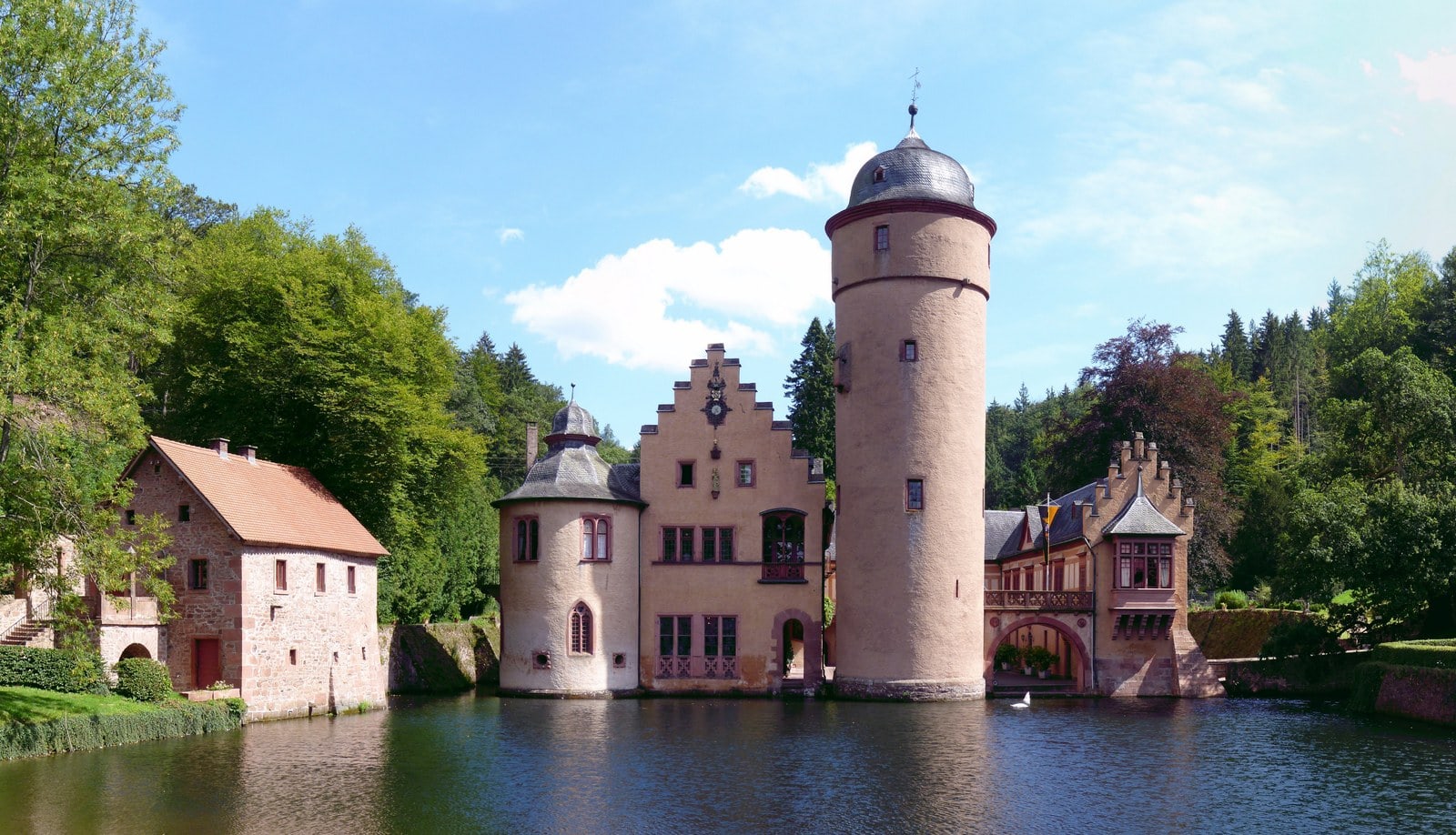
Schloss Mespelbrunn, Germany. Schloss Mespelbrunn is a small moated castle in the Spessart,, still ringed by water, and the clearest illustration of the German vocabulary: a Weiherhaus that became a Wasserburg around 1427 and then a Renaissance Schloss. Interiors are seen on a guided tour of about forty minutes.
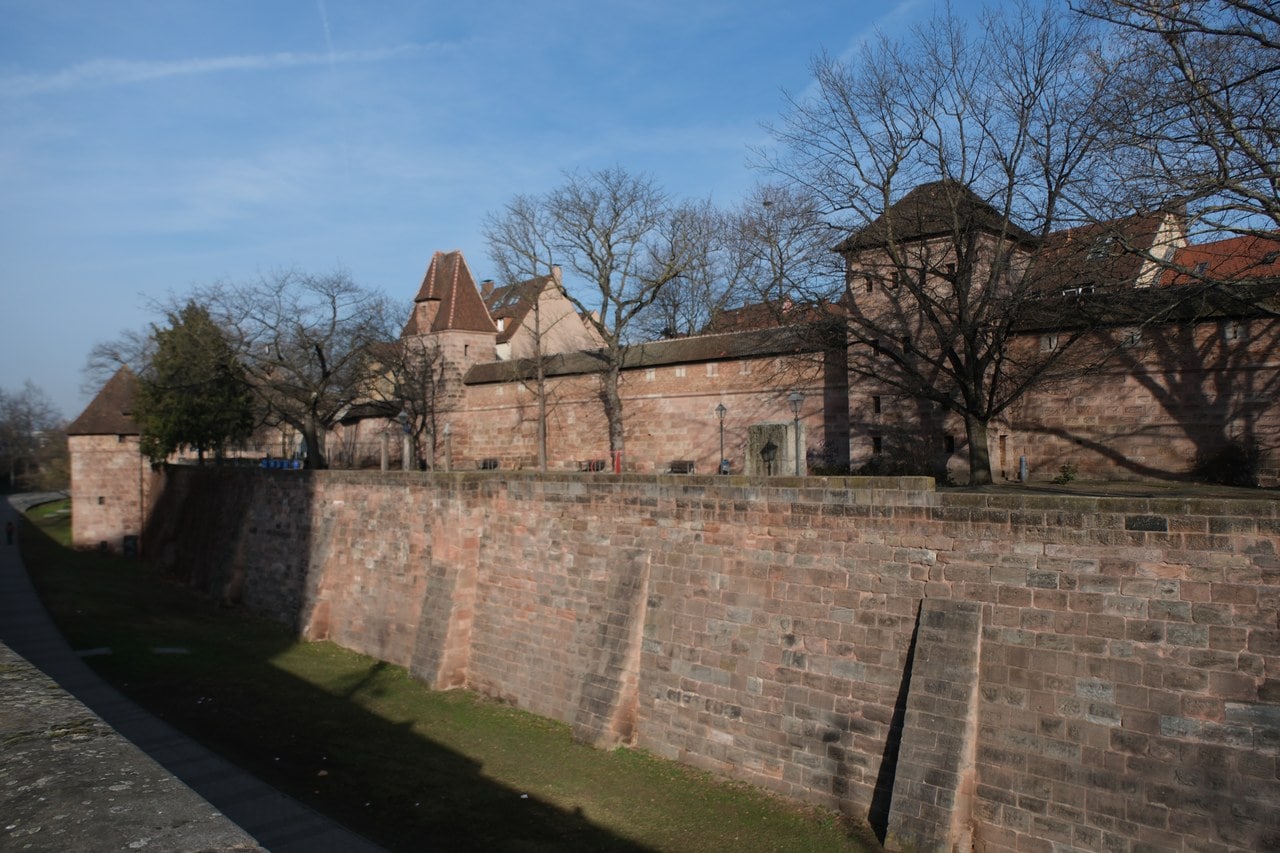
Nuremberg city ditch, Germany. Below Nuremberg Castle runs an unusually complete urban ditch system, belonging to the city rather than to the Kaiserburg: a Zwinger, a Zwinger wall rising out of the ditch, and a dry ditch, with some hundred and thirty ditch and wall towers recorded by the Deutsche Stiftung Denkmalschutz. Most of it survives, some now green space and some carrying a main road.
Chinon, in the Loire valley, earns a mention for its own reason: its ditches still divide the fortress into three separate strongholds.
Common Questions
Why is it called a moat?
Because the word slid from the mound to the ditch beside it. The Anglo-Norman Dictionary’s earliest citation shows the two still apart, in one Latin sentence where the ditch is fossa and the mota is the mound it stands on. English mote meant that mound too, from before 1272, and the earliest recorded use of the word for the ditch is English, in Langland’s Piers Plowman in 1362. The Oxford English Dictionary cautions that the switch may have happened first in Norman dialect.
Were all castle moats filled with water?
No, and German makes the point structurally. It keeps separate words for a ditch dividing sections of one castle, an Abschnittsgraben, and a ditch fronting a gate, a Torgraben, and because both run open at either end they could hold no water at all. Elsewhere the ground decided: a wet ditch needed a watercourse led into it, or an intake from the sea, a lake or a pond, at or above its own level.
How deep were castle moats?
Depth and width varied enormously, so the honest answer is a range with real examples in it. Heidelberg’s Hirschgraben is twenty-three meters across and nearly twenty deep. Vincennes’ enceinte ditches measure 29.80 meters wide on the north and south sides and 25.80 on the east and west. Avignon’s fourteenth-century town ditches ran about twenty meters wide but averaged only some four meters below the crest of the counterscarp.
Did castles keep alligators or crocodiles in their moats?
Animals in castle ditches are real, and the documented ones are not reptiles. Europe’s famous crocodile story belongs to Castel Nuovo in Naples and concerns a prison pit rather than a moat. In the telling, the animal reached Naples from Egypt clinging to a ship’s side and was caught with a horse’s thigh lashed to a ship’s anchor, its stuffed body afterward hung above one of the castle gates. Benedetto Croce, following Gaetano Amalfi, identified the whole thing as a travelling folktale.
How did attackers get across a moat?
By filling it, mostly, and what that cost is the measure of a ditch’s worth. Henry III’s siege train at Kenilworth in 1266 ran to two thousand wooden hurdles, sixty thousand crossbow bolts and nine siege engines, and one of his wooden towers, apparently holding two hundred crossbowmen, was put out of action by a single well-aimed missile. Beaten by the water, he had barges hauled overland from Chester, and the defenders repelled those too.
What is a dry moat, and why were so many moats dry?
A dry moat is a ditch never intended to hold water, and height is the usual reason. Heidelberg’s palace administration says it plainly: the Hirschgraben was not filled with water, which would be unusual for a hill castle anyway. On a spur castle a ditch also does something water never could. Because the ridge behind is usually higher than the walls, cutting a deep neck ditch across it restores a height advantage the site would otherwise have surrendered.
Were castle moats really used as sewers?
Sometimes, and mostly the dry ones, because a dry ditch can be shoveled out. Newcastle Castle’s operator records that the Black Gate’s garderobe chutes empty into the dry moat around it, which also took general waste. A fed water moat is a different object altogether: at Kenilworth the Augustinian canons were given permission to fish in the mere, which is not how anyone treats a cesspit.
What was a moat actually for?
To keep the miner off the wall, before anything else, and castles were built around that fight. At Coucy a countermine gallery ran right around the masonry beneath the talus, so that enemy miners broke through into a corridor the garrison already held, and the great tower’s screen wall thickens from 4.92 meters above the talus to 8.45 meters down at ditch level. A ditch was one layer of that system rather than an ornament.
Principal Sources
- Académie française. Dictionnaire de l’Académie française, 9th ed., s.v. “Douve.”
- Anglo-Norman Dictionary, s.v. “mote.” Aberystwyth University / Anglo-Norman Text Society.
- Boorde, Andrew. A Compendyous Regyment or a Dyetary of Helth. 1542. Quoted in A New English Dictionary on Historical Principles, s.v. “Moat.”
- Böhme, Horst Wolfgang, Reinhard Friedrich and Barbara Schock-Werner (eds). Wörterbuch der Burgen, Schlösser und Festungen. Reclam, Stuttgart, 2004.
- Centre des monuments nationaux. “Les broderies des fossés: des jardins historiques pour le château d’Angers.”
- Centre des monuments nationaux. Château de Vincennes: fiche de visite.
- Centre des monuments nationaux. Château de Vincennes: les matériaux et techniques de construction.
- Centre des monuments nationaux. Château de Vincennes: assurer une visite autonome.
- Château de Brézé (the operator’s own “parmi les plus profondes d’Europe”, the fifteenth/sixteenth-century cutting, and the bakery, magnanerie, salle des foudres and presses), its brochure (the eighteen by ten metres), and “Parcours.”
- Croce, Benedetto. Storie e leggende napoletane. 1919; 4th ed., Laterza, Bari, 1948.
- Centre des monuments nationaux. L’alimentation en eau du château de Vincennes. The carrier for the medieval collector sewer discharging into the eastern ditches and on toward the étang de Saint-Mandé.
- Deutsche Stiftung Denkmalschutz. “Nürnbergs Stadtgrabenstützmauer wird DSD-Förderprojekt.”
- English Heritage, “History of Kenilworth Castle” (King John’s dam and its cost, 1642, 1649, the drained mere and Dudley’s bridge) and “The Siege of Kenilworth Castle.”
- Historic England, standard class descriptions: moated sites, medieval fishponds (the inlet and outlet channels, sluices and overflow leat), and Bodiam Castle (the causeway and its later bridge).
- Historic Environment Scotland. “Caerlaverock Castle.”
- Institut für Geschichtliche Landeskunde Rheinland-Pfalz. Glossary, “Halsgraben.”
- Murray, James A. H. et al. (eds). A New English Dictionary on Historical Principles, vol. VI pt. 2. Oxford, 1908.
- Newcastle Castle. “Castle Characters: Gong Farmer.”
- Nicolas, Nicholas Harris (ed.). The Siege of Carlaverock. London, 1828.
- Schloss Mespelbrunn, Geschichte (the Weiherhaus to Wasserburg chain and 1427) and “Führungen.”
- Staatliche Schlösser und Gärten Baden-Württemberg. Schloss Heidelberg, “Geschichtshäppchen.”
- Viollet-le-Duc, Eugene-Emmanuel. Dictionnaire raisonné de l’architecture française du XIe au XVIe siècle, art. “Fossé.” B. Bance / A. Morel, 1854-68.
- Viollet-le-Duc, Eugene-Emmanuel. Dictionnaire raisonné…, art. “Siège.”
- Viollet-le-Duc, Eugene-Emmanuel. Dictionnaire raisonné…, art. “Braie, braye.”
Image credits. Hero: Schloss Mespelbrunn, photo Rainer Lippert, public domain, source Wasserschloss Mespelbrunn, Wikimedia Commons. Caerlaverock from the air, photo Simon Ledingham, CC BY-SA 2.0; Caerlaverock gatehouse and bridge, photo Michael Garlick, CC BY-SA 2.0. Château de Brézé moat, photo Thérèse Gaigé, CC BY-SA 3.0. Marburg neck ditch, photo Hydro, CC BY-SA 4.0. Château d’Angers ditch gardens, photo Fab5669, CC0. Heidelberg Hirschgraben, photo AnRo0002, CC0. Nuremberg city ditch, photo DALIBRI, CC BY-SA 4.0. Kenilworth Castle, photo JayBeeEm, CC BY-SA 3.0. The two cross-sections and the plan comparison are own-work diagrams by StoneKeep Atlas. Freely licensed images are resized to fit; otherwise unaltered.