
Largest Castles in the World
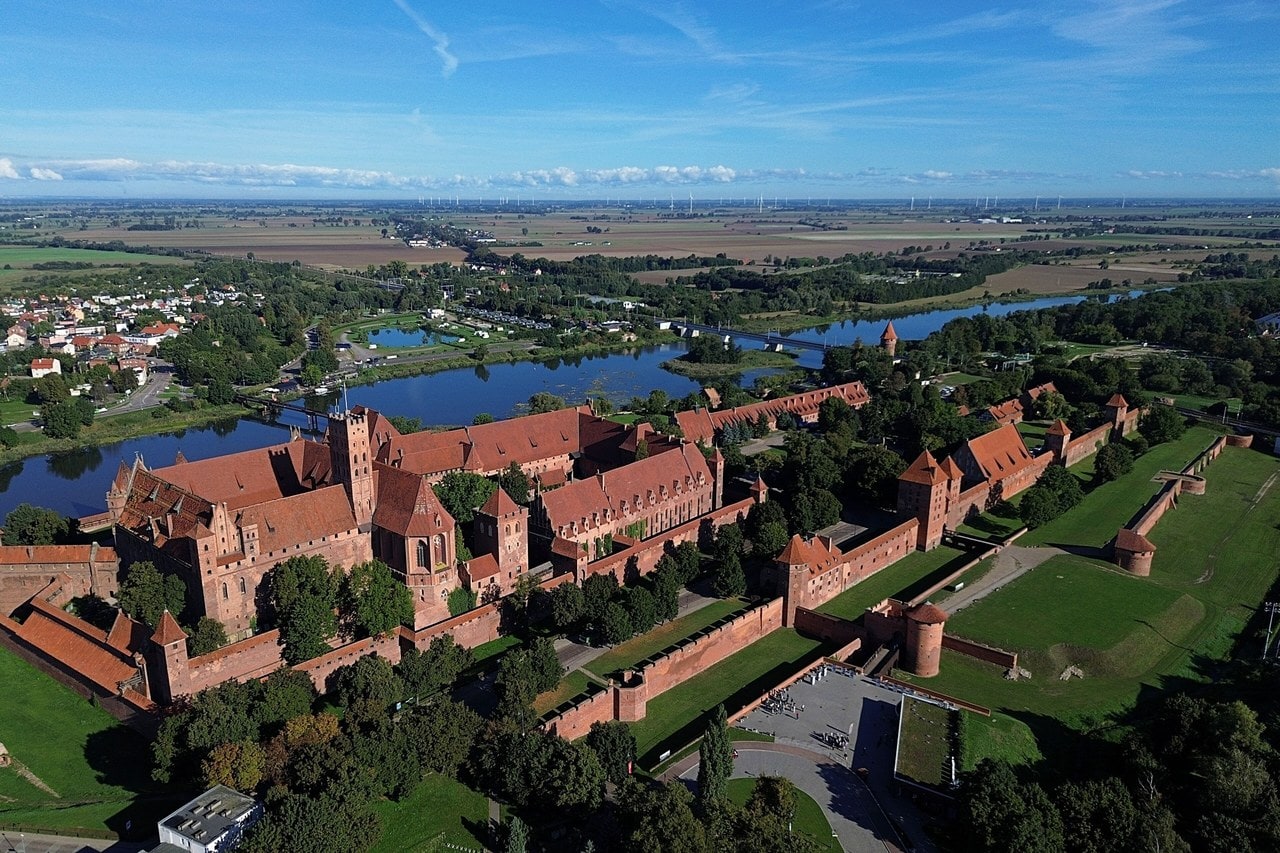
The largest castles in the world are not ranked by anybody who measures them. That sounds like a dodge, and it is the opposite: it is the single most useful fact about the question, and it is checkable in about a minute. Guinness World Records lists thirteen records about real castles. Eight of them are size records. Not one is called largest castle.
There is a largest ancient castle, and a largest brick castle, and a largest inhabited castle. There is a largest triangular castle, a largest cave castle, a tallest castle, a longest castle, and, separately from all of them, a largest inhabited-castle grounds. Eight titles, eight buildings, eight different tests. The qualifier is not decoration on the claim. The qualifier is the claim.
Once you can see that, the contradictions that fill this subject stop being contradictions. Malbork in Poland and Prague Castle in Czechia are both correctly described as record holders, and ICOMOS’s figure for Malbork’s whole walled complex is about three times the area Guinness fits to Prague. Windsor is called the largest castle in the world by people who are not wrong, and its record is about occupancy rather than area. These are not rival answers to one question. They are answers to different questions that happen to share four words.
This page states each criterion before giving an answer under it, names the body doing the counting, and quotes the wording that body actually published, the same method applied to counting castles by country. Where two authorities disagree, both are printed. Where a figure has no authority behind it, that is said plainly rather than repaired. All record pages were read on August 10, 2026; Guinness notes on every one of them that “Records change on a daily basis and are not immediately published online.”
The Largest Castle in the World: Eight Records, and Not One Says “Largest Castle”
Guinness publishes its full record index as a sitemap. Walking it returns 49,552 record pages. Filtering those for real castles (not sandcastles, not bouncy castles, not Lego sets, and not the records scoped to a single tower or to a self-builder) leaves thirteen. Eight carry a size or dimension claim: seven about a building, and one about its grounds.
| Record, as Guinness titles it | Holder | The published figure | What limits it |
|---|---|---|---|
| Largest ancient castle | Prague Castle, Czechia | 7.28 ha (18 acres) | a date: founded before 1000 A.D. |
| Largest brick castle | Malbork, Poland | 52 acres (21 ha) | the material |
| Largest inhabited castle | Windsor, England | no area given | occupancy |
| Largest triangular castle | Wewelsburg, Germany | a total perimeter of 240 m | the plan shape |
| Largest cave castle | Predjama, Slovenia | over 35 m high | the siting |
| Largest inhabited-castle grounds | Balmoral, Scotland | approximately 50,000 acres | the grounds, not the castle |
| Longest castle | Burghausen, Bavaria | 1,051.02 m | a linear dimension |
| Tallest castle | Neuschwanstein, Bavaria | 213 ft (65 m) above ground | height |
Read down that last column and the shape of the subject appears. A date. A material. Who lives there. A plan shape. A cave mouth. An estate boundary. A length. Five of these eight titles are not areas at all: the longest castle is certified on a line, the triangular castle on a perimeter, the cave castle and the tallest castle on a height, and the inhabited castle on no area figure whatsoever.
No unqualified largest castle record appears among those 49,552 pages, and the address where one would live returns a not-found page. That is what the index shows, and it is not a claim about what Guinness intends. Guinness’s own standing notice says its published set is incomplete.
What the Recording Vocabularies Actually Measure
The bodies that catalog these buildings for a living have a vocabulary for size, and what it does not contain matters as much as what it does.
Historic England’s FISH thesaurus defines a bailey as “the courtyard of a castle, ie. the area enclosed by the rampart or curtain.” France’s Inventaire général defines an enceinte and then says something that quietly dissolves the whole league table: “Une place forte peut avoir plusieurs enceintes qui se commandent les unes les autres. Elles se numérotent de l’extérieur vers l’intérieur.” A fortified place may have several enceintes, commanding one another, numbered from the outside in.
So “the area inside the walls” is not one number. It is a number per circuit, and a castle with an outer bailey, a middle ward and a core has three of them. Any two published areas for two different castles may be measuring different rings, and neither source has to say which.
Ambiguity is one problem. Absence is the other. These recording vocabularies define enclosures, and they carry no concept for a building’s floor area at all. What a reader instinctively pictures when they imagine a very large castle is the amount of building. That is not the quantity the professional vocabulary was built to record.
The Largest by Enclosed Area: Malbork and Its Three Figures
Malbork, on the Nogat in northern Poland, is the building most often named as the largest castle in the world. It became the Teutonic Order’s headquarters in 1309, when the Grand Master’s seat was moved there from Venice. Two authorities publish an area for it and a third figure circulates with no publisher at all, and the three are not measurements of the same thing.
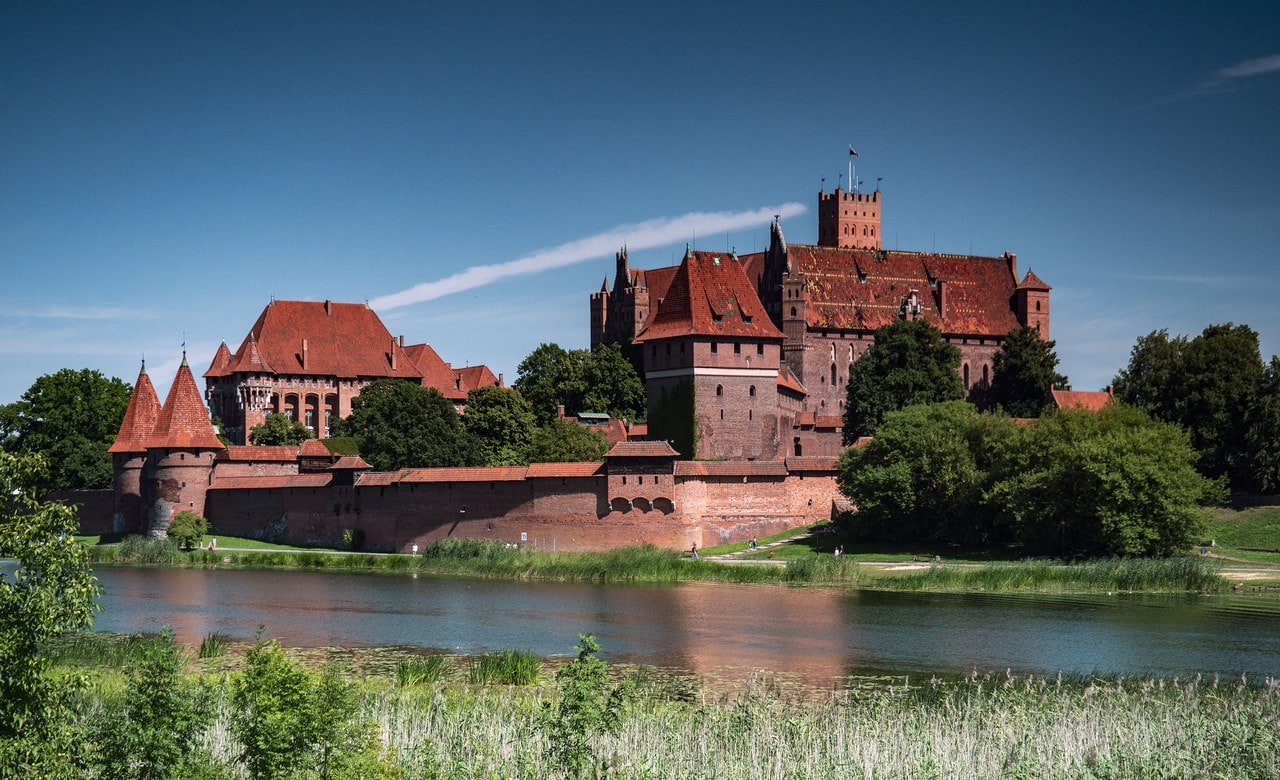
21 hectares. ICOMOS, evaluating the World Heritage nomination in 1997, wrote: “The whole complex of buildings and fortifications covers 21ha.” The scope is welded to the figure inside the same clause, which is rarer than it should be. Guinness gives the same area independently: “it encompasses a 52-acre (21-ha) site.”
18.038 hectares. UNESCO records the inscribed World Heritage property at that figure, and describes the site as “characterised by a tripartite layout comprising the High Castle, the Middle Castle, and the Outer Bailey.” This is a legal boundary drawn for heritage protection. It is a different object from a wall line, and the two are not expected to agree.
143,591 square meters. This one circulates widely, and eight separate routes to a source at any tier came back empty. Its commonest published form is “143,591 square meters (approximately 52 acres),” and that sentence refutes itself: 143,591 square meters is 35.5 acres, while 52 acres is 210,436 square meters. Somebody once pasted the acreage from the 21-hectare figure onto a different square-meter figure, and the pair has been copied ever since. It is not another of Malbork’s circuits, measured differently. It is an orphan.
The castle’s own museum, meanwhile, describes the complex in three parts and publishes no area figure at all, in either language, anywhere on its site. That is a fact about what the operator publishes and nothing more.
The 21 hectares carries one more qualification, because it is the number this page rests on. UNESCO’s assessment of what survives at Malbork is that the layout is the medieval part: fully preserved are “its tripartite architectural and functional layout, … as well as two masterpieces of Gothic architecture: the Grand Masters’ Palace and the Great Refectory,” while “the remaining elements of the castle complex were largely reconstructed” during works at the turn of the nineteenth and twentieth centuries and again after the Second World War. The footprint, which is the thing being measured, is the older part.
What Guinness Actually Certifies
Here is where the subject usually goes wrong. Prague Castle holds a Guinness record and covers 7.28 hectares. Malbork covers 21. People conclude either that Guinness is wrong or that one of the figures is.
Neither. Guinness’s guidance on the Prague record, printed in that page’s own description metadata rather than in its visible text, says exactly what it is measuring:
“This record is for the largest ancient castle in terms of ground area covered. For the purposes of this record, ancient is defined as a installation dating back prior to 1,000 A.D.” [sic]
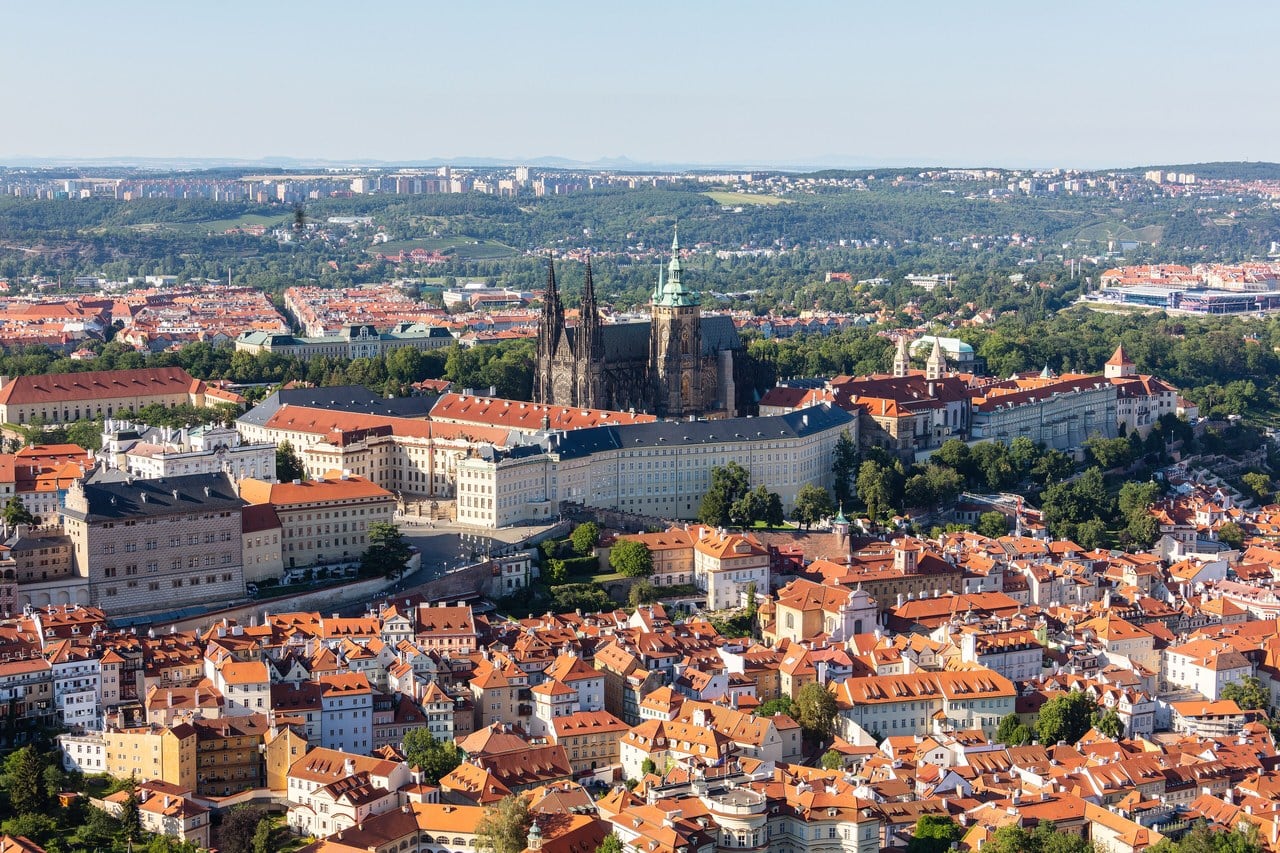
It is measuring area. The limiter is a date. Malbork was begun in the 1270s, so it was never eligible for that record at all. The two figures are answers under different admission rules, not rival measurements of the same competition. That definition governs record 69343 only; it is not Guinness’s general definition of “ancient.”
Two further things on these pages are worth more than the numbers.
Guinness says the measuring is hard, in its own voice. On its two castle-tower records it notes: “Castle keeps can be difficult to accurately measure, as the ground on which they stand often slopes, and/or is bordered by moats, ditches and other variable levels.” Every site that quotes Guinness’s figures quotes the numbers. It is the sentence that never travels with them.
And a taller candidate is set aside, with the reason printed. On the same records: Osaka Castle “measures 58.49 m high and was built in 1583-98. However, the building has been destroyed on two separate occasions, and the current measurable version is a concrete replica, constructed in 1995-97.” A taller candidate is set aside because what stands is a 1990s replica. That is a present-state judgment made by the certifier, and it is the judgment any measurement of a standing building has to make.
Prague’s own administration, incidentally, does not repeat the record in Guinness’s words. It says Prague Castle is “the largest coherent castle complex in the world, with an area of almost 70,000 m2,” crediting Guinness. The area matches; the category word does not. Coherent is the Castle Administration’s word and ancient is Guinness’s, and neither publisher writes both. And the figures are not the same either: Guinness’s 7.28 ha is 72,800 square meters, so the operator credits Guinness for a number Guinness does not publish.
One more arithmetic point, and the arithmetic here is ours rather than Guinness’s. Its Prague figure is derived rather than surveyed: “an oblong irregular polygon with an axis of 570 m … and an average transverse diameter of 128 m, giving a surface area of 7.28 ha.” That is a rectangle fitted to a shape Guinness itself calls irregular. Apply the identical method to the dimensions Guinness publishes for Windsor, “a waisted parallelogram measuring 576 X 164 m,” and Windsor comes out larger. That multiplication is ours, not Guinness’s, and Guinness publishes no area for Windsor to compare it against. Prague still holds the record, because the record is gated on a date. One publisher, two adjacent records, two different ways of arriving at a shape.
The Largest Castle in Europe: The Scopes the Authorities Publish
Ask for the largest castle in Europe and the same widening happens one rung down. What the authorities publish is consistently narrower than what circulates.
Historic England scopes its superlative to a nation: Windsor is “England’s largest castle … covering some 13 acres,” and the entry covers “Windsor Castle including all the buildings within the walls.” Note the hedge inside the figure: some 13 acres.
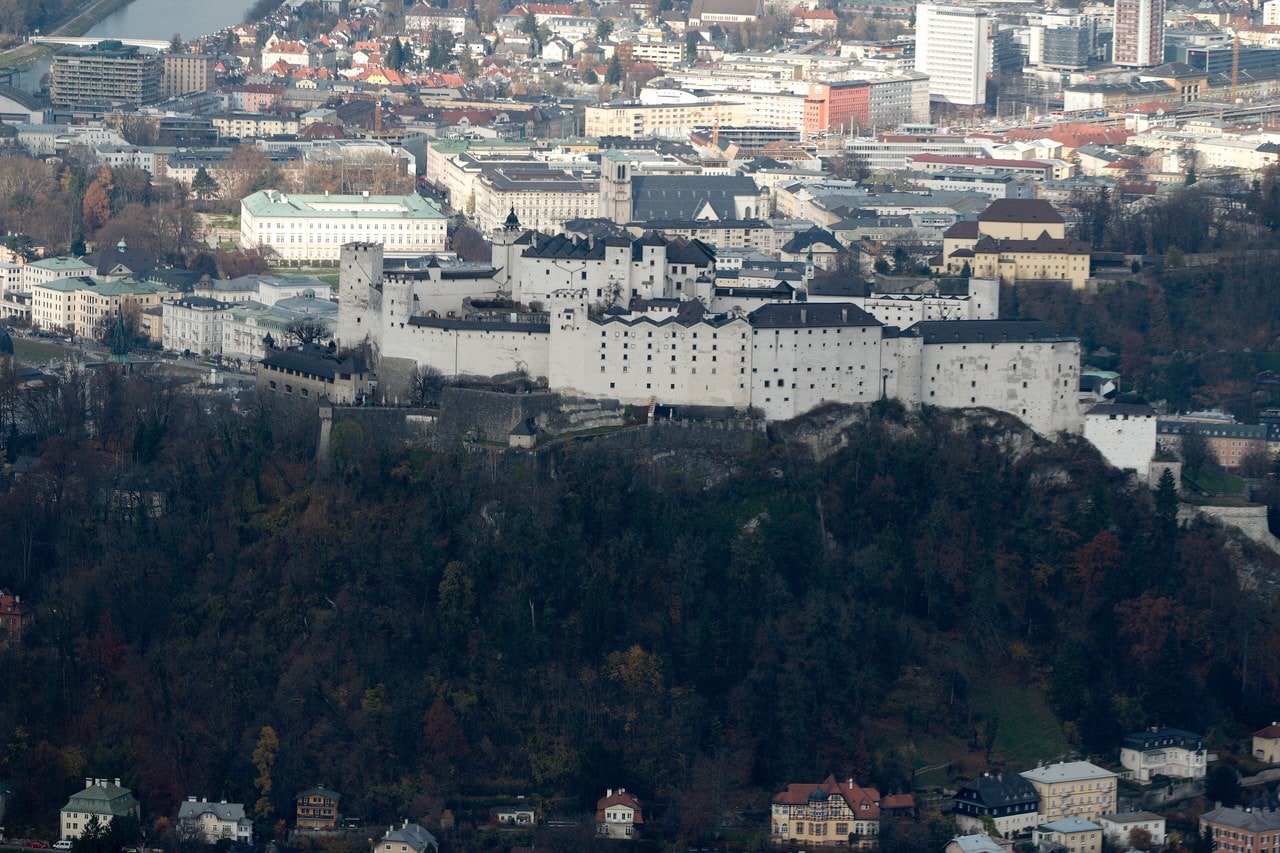
Hohensalzburg’s operator scopes to a region and hedges the claim itself: “one of the largest castle complexes in Central Europe,” with 32,000 square meters, worded identically in German and English. The 32,000-to-54,000 range circulating online has nothing behind its upper bound.
Mehrangarh’s museum trust scopes to a province: “one of the largest forts in Rajasthan.”
Three authorities, three scopes: a nation, a region, a province. Two of the three hedge the claim itself with one of the largest; Historic England does not hedge the claim, only the figure, and buys that precision by shrinking the scope to England. Not one of the three is continental, and not one is global.
England is where this stops being abstract, because two English national bodies answer the same question and name different buildings. Historic England’s statutory entry gives the title to Windsor. English Heritage gives it to Dover, and in doing so it does something no other source quoted on this page does. It names the criterion, names the perimeter, and then supplies a second figure for a wider one:
“In terms of area, Dover Castle is the largest castle in England. Its outer bailey curtain wall contains an area of almost 32 acres. If the castle’s ditch and its post-medieval outer defences are included, then the total area it covers is over 50 acres.”
Thirty-two acres inside one wall, over fifty if the ditch and the later outworks are counted, against Windsor’s “some 13 acres” for “Windsor Castle including all the buildings within the walls.” Neither body is being careless. They are measuring different circuits, and English Heritage is the only source cited here that publishes two of its own and says which is which. The continental claim is built the same way the world claim is, by taking a scoped statement and removing its scope.
The Longest Castle: Burghausen’s Certified Kilometer
One of only two records on this page carrying a full certification date belongs to a castle in Bavaria that few lists mention. Guinness certified the Burg zu Burghausen as the Longest castle at 1,051.02 meters on September 18, 2008.
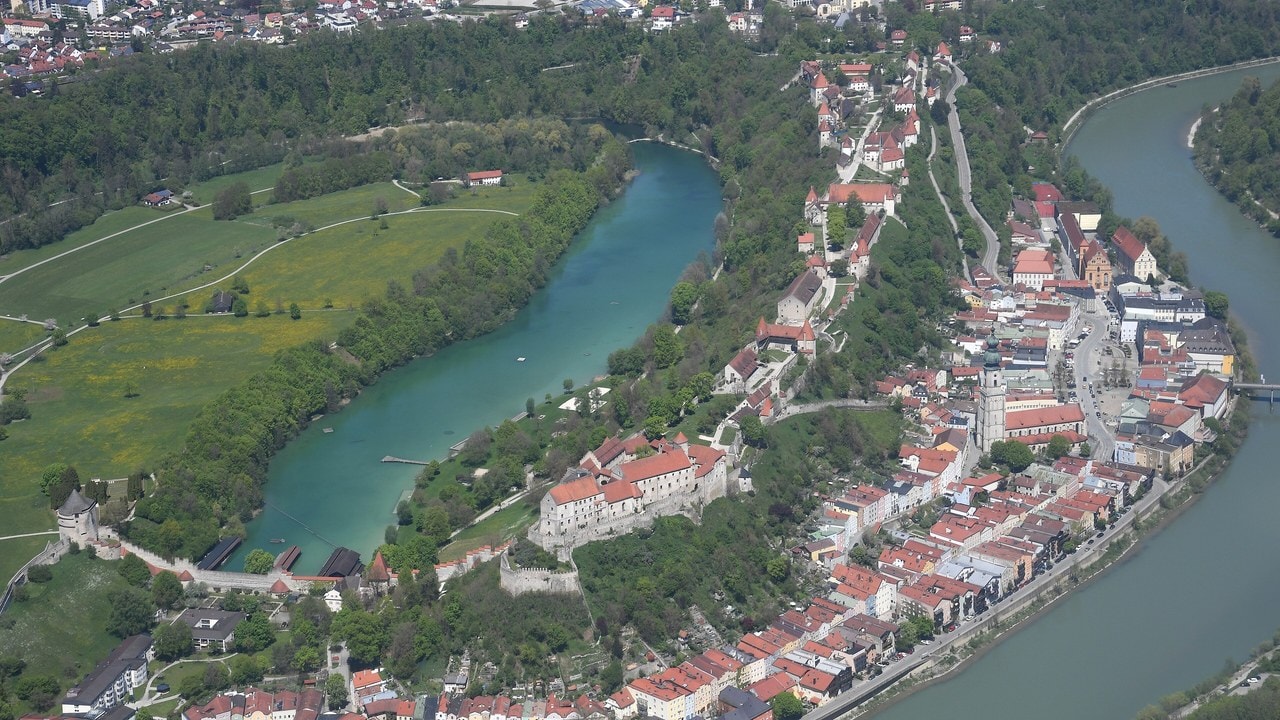
It is also the only one of these records where Guinness states the definition of castle it applied, and it borrows it from Encyclopaedia Britannica: “medieval European stronghold, generally the residence of the king or lord of the territory in which it stands.” On a page about measurement, a certifier showing which definition it used is worth more than another figure.
The length is not an artifact of modern surveying either. A charter of 1387 already documents the complex extending more than a kilometer to the north end of the ridge.
The Bavarian Palace Administration does not state the superlative in its own voice: “Mit einer Ausdehnung von etwas über 1000 Metern Länge ist die Burg Burghausen eine der längsten Burgen der Welt (das “Guinness”-Buch erklärte sie sogar zur längsten Burg überhaupt).” One of the longest castles in the world, with the absolute in a parenthesis and credited to Guinness. The body that owns the building hedges; the record book does not.
Several castles on this page have a full guide in the catalog, among them Burghausen, Windsor and Dover.
The Largest Occupied Castle: Windsor, and Who Counts as Living There
Windsor is the building most often called the largest castle in the world in casual use, and the claim is defensible once its qualifier is restored. The qualifier is not size. It is occupancy.
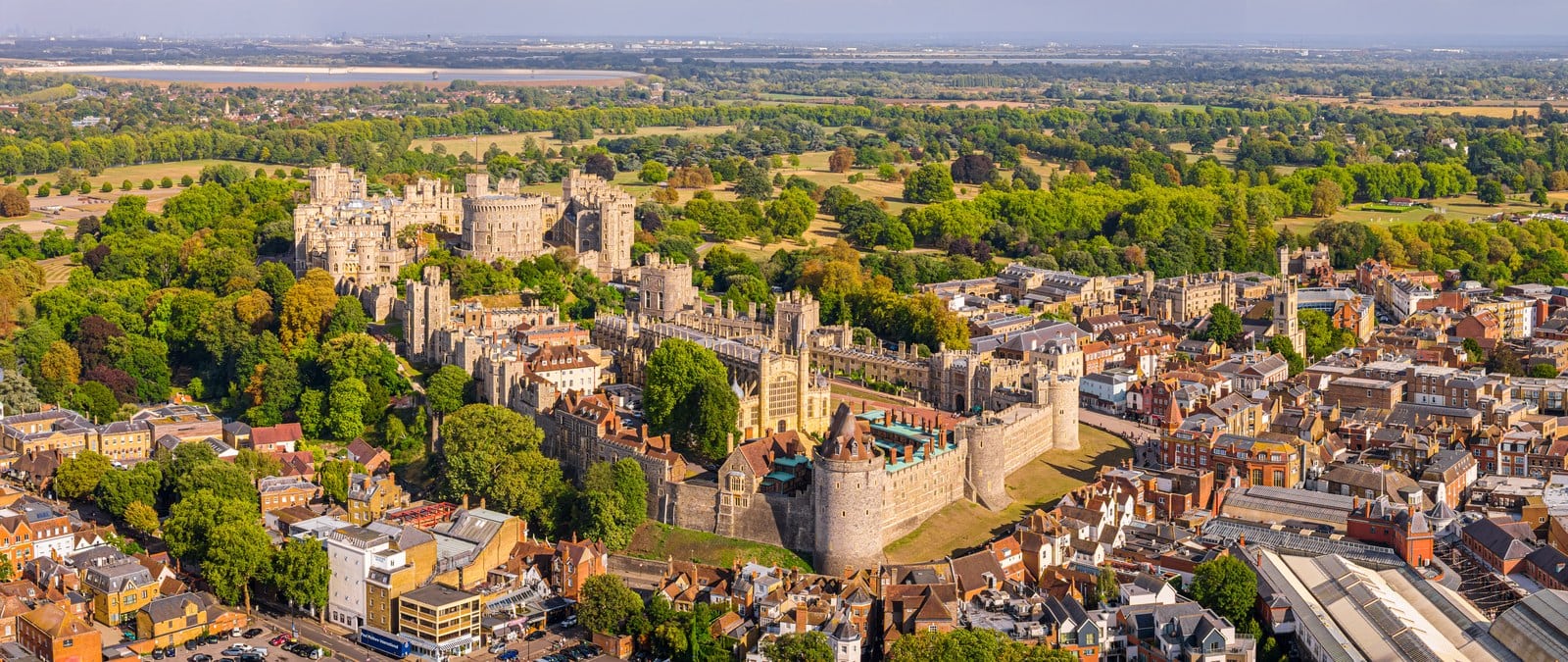
Historic England states that Windsor “holds the distinction of being the oldest and largest occupied castle in the world,” and the Royal Collection Trust says the same on its own visitor pages. Historic England’s statutory list entry, which is the legal record rather than the editorial one, says something narrower: “England’s largest castle … covering some 13 acres.”
Three bodies describe this building and no two of them describe it the same way. Guinness’s category is inhabited. Historic England and the Royal Collection Trust both say occupied. And Historic England’s own statutory entry uses neither word: it drops the world scope entirely and says England. Two words and a change of scope, not one claim. None of them is wrong. They are answering slightly different questions, and the differences are invisible once the sentence is shortened for a caption.
Guinness, for its part, publishes no area at all for Windsor. It gives a shape: “a waisted parallelogram measuring 576 X 164 m.” Whether Windsor is the oldest anything belongs to the question of the oldest castle, not to this page.
Where the Wall Outruns the Castle: Ranikot and Mehrangarh
Two buildings are regularly entered into this competition on numbers that are not measuring a castle.
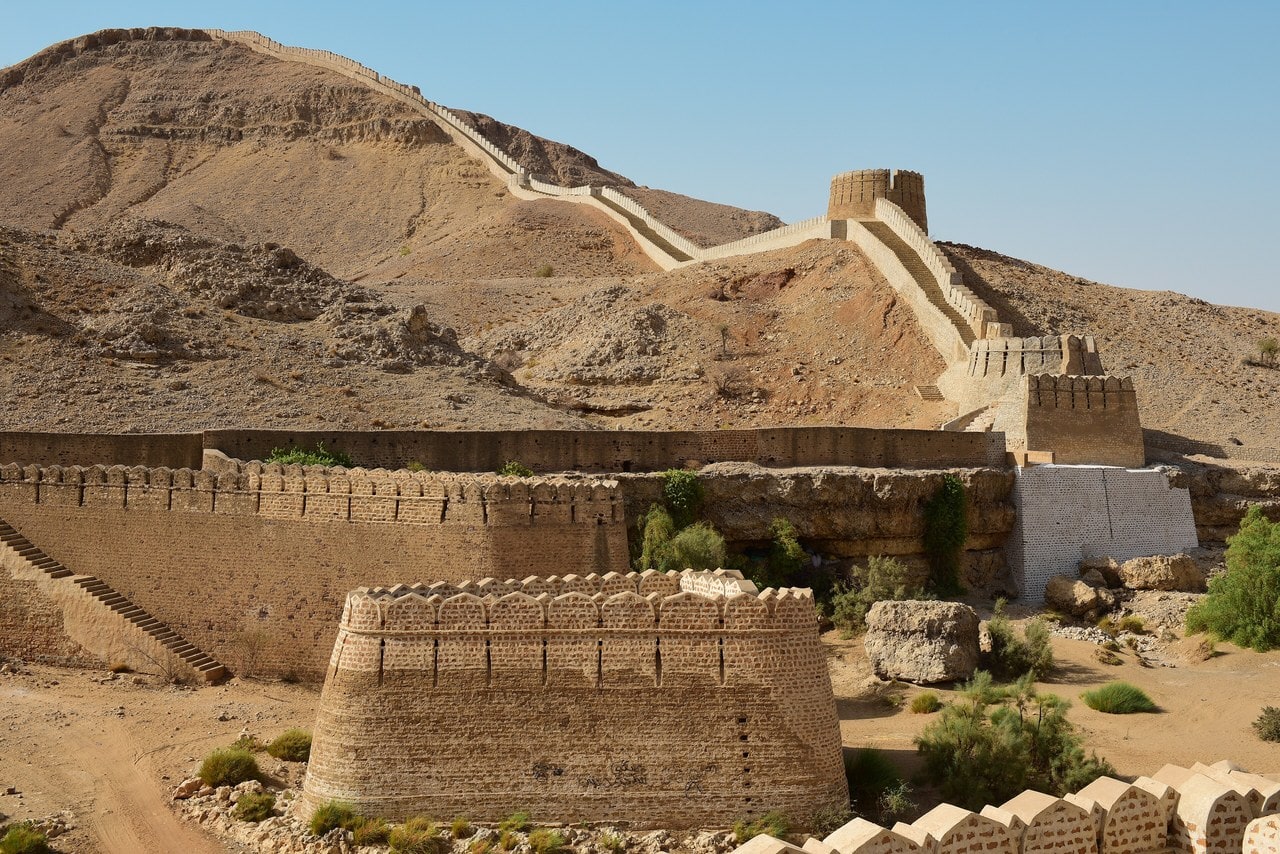
Ranikot, in Sindh. Pakistan’s own 1993 World Heritage Tentative List submission gives a wall 35 km long, and describes its course this way: the wall “runs on three sides of the area, while on the northern side the lofty peaks of the higher hillocks serve as a wall.” That same submission dates the fort to “the first quarter of the l9th century.” [sic] The Government of Sindh’s antiquities directorate gives the wall as “over 34 km in length,” so the two figures agree, and adds that it “encircles hillocks which appear to have never been inhabited by any human community,” and that the British annexed Sindh “even before the completion of the fort.” The custodian authority also says the chronology is unsettled: “different scholars have the dissimilar estimation about historical background.” [sic]
So the wall is long, real, and largely two centuries old rather than medieval; and the hills it runs among appear never to have been lived in. The two authorities describe the same geometry a synonym apart, the Sindh directorate writing that the peaks “serve as a rampart” where the State Party wrote “serve as a wall.”
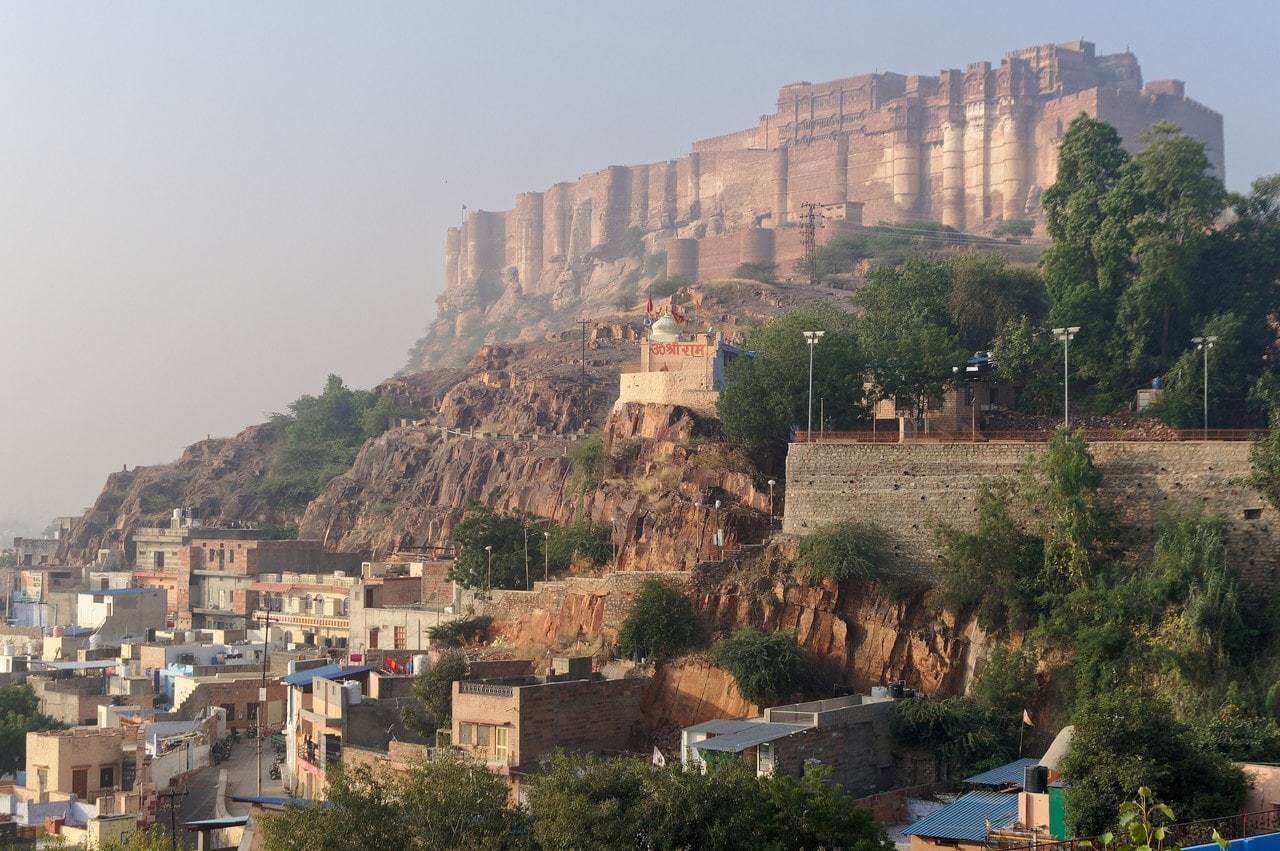
Mehrangarh, in Jodhpur. The figure attached to it online is 1,200 acres of property. Its own museum trust publishes no area, only linear dimensions (“Over 500 yards long, its wall rises in places to a height of 120 feet and is 70 feet thick”), and scopes its superlative to Rajasthan. It is also not one of the six components of the Hill Forts of Rajasthan World Heritage property; ICOMOS lists Chittorgarh, Kumbhalgarh, Ranthambore, Gagron, Amber and Jaisalmer. There is no ICOMOS evaluation of Mehrangarh, and no independent area figure of the kind that exists for Malbork. The 70-hectare Rao Jodha Desert Rock Park beside it is an ecological restoration created in 2006, entered from a visitor center 800 m from the fort gate, on its own ticket.
That is an estate figure standing in for an enclosure, and the same substitution happens at Windsor, where Windsor Great Park is a separate Crown Estate property.
The strongest evidence that this is a real distinction is that Guinness made a category for it. Largest inhabited-castle grounds goes to Balmoral, “approximately 50,000 acres (20,230 hectares) of land.” The record book itself separates the grounds from the castle, and it does something rarer still: it prints a rival figure against its own, noting that “one source (Scottish-places.info) states that the grounds of the castle extend for precisely 21,600 hectares ha (53,375 acres).” [sic] Both numbers are Guinness’s to reconcile, and it does not reconcile them.
The Largest Castles in the World, Drawn to One Scale
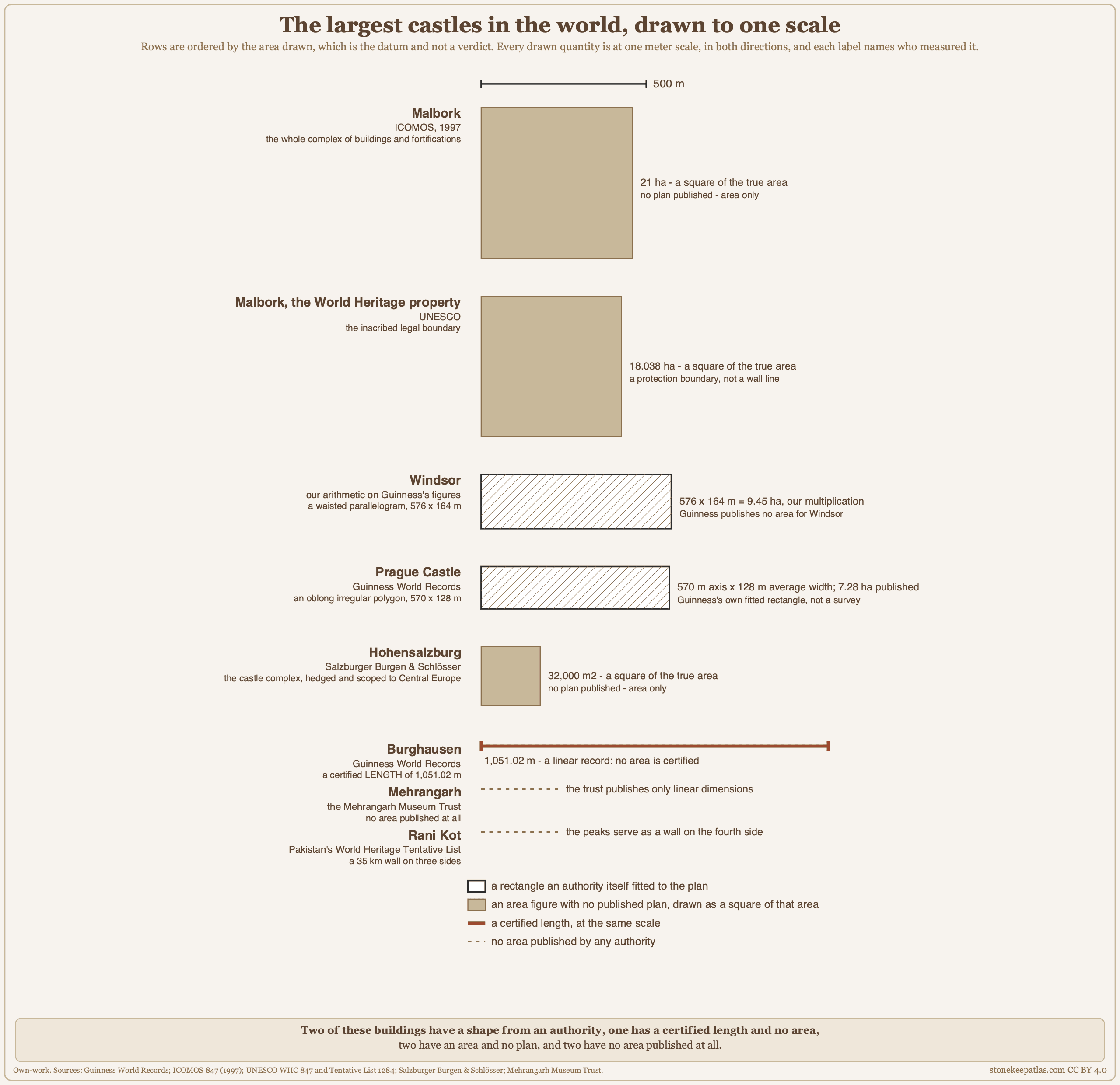
What the drawing shows is that the figures are not commensurable, and that is the argument the whole page has been making. Malbork’s 21 hectares is a whole fortified complex. Prague’s 7.28 is a rectangle fitted to an irregular shape. Windsor’s is a parallelogram with no area published at all. Burghausen’s is a line.
You Can Visit
For a traveler, the useful version of all this is short: the buildings that measure largest are not the buildings you see most of.
Malbork sells the enclosure and the interiors as two different tickets, and by the operator’s own ordinance “You can visit the museum only with a guide or an audio guide.” The largest by area is one you cannot simply walk around at your own pace.
Burghausen is the opposite: its certified kilometer is a measured superlative you can walk end to end, for nothing. The Bavarian Palace Administration states the grounds with their five courtyards are accessible “jederzeit,” special events excepted, and the walk along the ridge is step-free, while the museum in the Palas is reached only by 18 historic wooden steps that cannot be given a lift for monument-protection reasons. A complex this long cannot be taken in at once, and the operator has an answer for that: a 1:600 tactile model, 110 x 190 cm, at the Curaplatz, made so that visitors can grasp its dimensions.
Hohensalzburg’s outdoor enclosure stays open later than the museums from May to September, so in those months the scale is experienceable after the interiors have shut. The operator also notes: “The interior of the fortress is not barrier-free.”
Prague’s measured area and its visitable area are different figures. Prague City Tourism, the city’s tourism board, lists the courtyards, lanes and gardens as open for many hours either side of the ticketed buildings, with the ticket valid for 2 days.
Ranikot is a long wall in empty hills, reached off a rough track. It is named here as a wall, not recommended as a visit.
In this catalog, Burghausen Castle is the member guide for the longest castle. The Palais des Papes, Königstein Fortress and Château de Chambord are covered as related large complexes.
Common Questions
What is the largest castle in the world?
Guinness World Records certifies Malbork in Poland under record 113419, and the record’s own title is Largest brick castle: it “encompasses a 52-acre (21-ha) site,” built almost entirely from locally made red brick. The popular version of that sentence deletes the word brick. Guinness publishes no unqualified largest-castle record at all, so the honest answer names both the building and the category it won.
Is Prague Castle the biggest castle in the world?
It holds a Guinness record, and the record is gated on a date rather than on size. Guinness defines ancient, for that record only, as “a installation dating back prior to 1,000 A.D.” Prague Castle covers 7.28 hectares; Malbork covers 21 and was begun in the 1270s, which made it ineligible to enter. Both descriptions are correct because they answer different admission rules.
What is the 2nd largest castle in the world?
No authority publishes a ranking, so there is no second place to give. Guinness issues eight castle size records under eight different qualifiers: ancient, brick, inhabited, triangular, cave, tallest, grounds and longest. None is ranked against the others. A second-largest list therefore has to invent a shared criterion first, and every one in circulation does so silently.
What is the largest inhabited castle in the world?
Windsor, under Guinness record 69339, whose title is Largest inhabited castle. Note what the category is testing. It admits only buildings somebody still lives in, so a bigger enclosure that nobody occupies cannot enter, and the winner is decided by a condition rather than by a measurement. The entry reflects that: it records a shape and files no area figure at all.
How is a castle’s size actually measured?
Inconsistently, and the certifier says so. Guinness sets Osaka Castle aside from its height record because “the building has been destroyed on two separate occasions, and the current measurable version is a concrete replica, constructed in 1995-97.” That is a judgment about what stands today rather than what once stood, and every measurement of a standing building has to make it.
Does the castle’s park or grounds count?
Not in the same category, and Guinness settled that by creating a separate one. Largest inhabited-castle grounds goes to Balmoral, at “approximately 50,000 acres (20,230 hectares) of land.” The distinction matters because estate figures circulate as castle figures: Mehrangarh is credited online with 1,200 acres of property while its own museum trust publishes no area at all.
Which of these can you actually walk around?
Burghausen, freely. The Bavarian Palace Administration states its grounds and five courtyards are accessible “jederzeit,” special events excepted, and the ridge walk is step-free. Malbork is the opposite: the museum route is sold separately from the enclosure and, by the operator’s ordinance, “You can visit the museum only with a guide or an audio guide.” The largest by area is the one you cannot simply wander.
Principal Sources
- Bayerische Schlösserverwaltung. Burg Burghausen: Bedeutung and Entstehung. burg-burghausen.de.
- English Heritage. “Facts and FAQs about Dover Castle.” english-heritage.org.uk.
- Government of Sindh, Directorate General of Antiquities. “Rani Kot Fort, Jamshoro.” antiquities.sindhculture.gov.pk.
- Guinness World Records. “Largest ancient castle” (record 69343), “Largest brick castle” (113419), “Largest inhabited castle” (69339), “Largest triangular castle” (113405), “Largest inhabited-castle grounds” (644499) and “Longest castle.”, “Largest cave castle” (113417), “Tallest castle” (517823) and the two castle-tower records 512904 / 512991, which carry its guidance on measuring keeps. guinnessworldrecords.com.
- Historic England. National Heritage List for England, entry 1117776, Windsor Castle. Via Heritage Gateway.
- Historic England. “What Is the Oldest Castle in England?” Heritage Calling, November 14, 2024.
- Historic England. FISH Thesaurus of Monument Types, “bailey.” heritagedata.org.
- ICOMOS. Evaluation of World Heritage nomination 847, Castle of the Teutonic Order in Malbork, September 1997. whc.unesco.org.
- Inventaire général du patrimoine culturel. Thésaurus de l’architecture, “enceinte.” data.culture.fr.
- Mehrangarh Museum Trust. “History.” mehrangarh.org.
- Muzeum Zamkowe w Malborku. Castle Museum in Malbork. zamek.malbork.pl.
- Prague City Tourism. “Prague Castle.” prague.eu. Tourism board, cited as such.
- Royal Collection Trust. “Windsor Castle.” rct.uk.
- Salzburger Burgen & Schlösser Betriebsführung. “Hohensalzburg Fortress.” festung-hohensalzburg.at.
- Správa Pražského hradu. “Prague Castle for visitors.” hrad.cz.
- UNESCO World Heritage Centre. “Castle of the Teutonic Order in Malbork” (847) and “Rani Kot Fort, Dadu”, Tentative List 1284. whc.unesco.org.
Image credits. Hero: Malbork from the air, all three walled zones: Photo: Kapitel, CC BY-SA 4.0. Source: Malbork zamek (dron1), Wikimedia Commons. Scale comparison diagram: StoneKeep Atlas, own work, CC BY 4.0. Inline photographs are credited in their own captions. Freely licensed images are resized to fit; otherwise unaltered.