
Castles in England
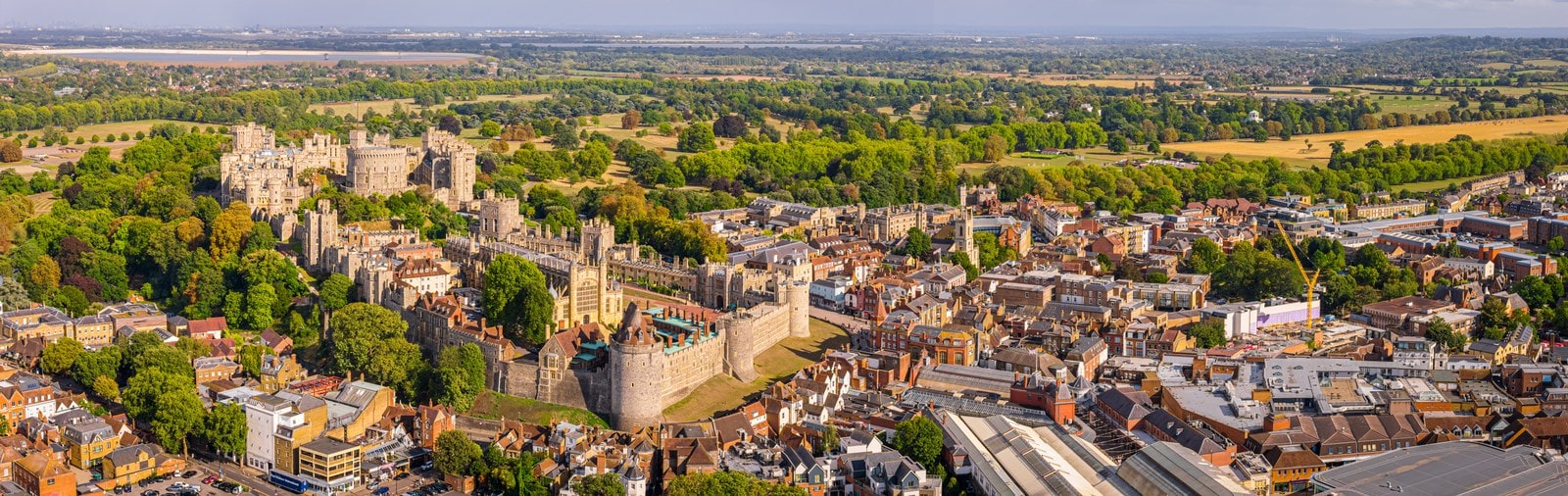
Castles in England are easiest to understand when you ask a single question of each one: what of it survives today? Historic England describes a medieval castle as a lord’s residence behind defenses, and says the defenses are often the best-preserved part; England’s famous castles differ in how much of the residence survives with them. At Windsor the residence is still lived in and worked in. At Dover, English Heritage says, the buildings, defenses and tunnels were adapted right into the era of nuclear weapons. At Framlingham the curtain wall stands with former workhouse buildings inside it. At Kenilworth the great tower stands open on its north side, where its wall was destroyed after an order of 1649, and at Bodiam the walls and towers rise almost to their full height out of a moat, around a courtyard whose buildings survive mainly as footings.
If you are weighing which castles to visit in England, that question is the one to sort them by, because it tells you what you will actually walk into. This page is the country guide, with a link to our full guide for each of those castles. It reads them along one line, from the castle still in use as a royal palace to the one whose courtyard buildings are mostly footings. It also names the bodies that run them. In England the operator decides how you get a ticket and which membership gets you in, and the operator of a working palace can close it at short notice, so the practical half of this page is organized around those bodies.
Each castle gets a short account of what survives and why, with a link to its full guide. After that come the choices a visitor has to make: region, operator, membership, and how to see more than one in a trip.
England’s Castles at a Glance
| Castle | What survives today | County | Runs the visit | Nearest station |
|---|---|---|---|---|
| Windsor Castle | In use as a working royal palace; its outward aspect largely remodeled c.1800-1830 | Berkshire | Royal Collection Trust | Windsor & Eton Central or Riverside |
| Dover Castle | Medieval castle unusually complete despite later changes (Historic England); Great Tower furnished as a re-creation; tunnels beneath adapted in the Cold War | Kent | English Heritage | Dover Priory |
| Framlingham Castle | Curtain wall standing, with thirteen towers in Historic England’s record; inside, the former workhouse buildings, the larger built around the shell of the medieval great hall | Suffolk | English Heritage | Wickham Market (at Campsea Ashe) |
| Kenilworth Castle | Ruin, slighted 1649-50; Leicester’s Gatehouse and the stables roofed; the mere drained; the Elizabethan garden re-created in 2009 | Warwickshire | English Heritage | Kenilworth |
| Bodiam Castle | Curtain walls and towers almost to full height in a wet moat; most of the interior ruined, mainly footings | East Sussex | National Trust | Robertsbridge |
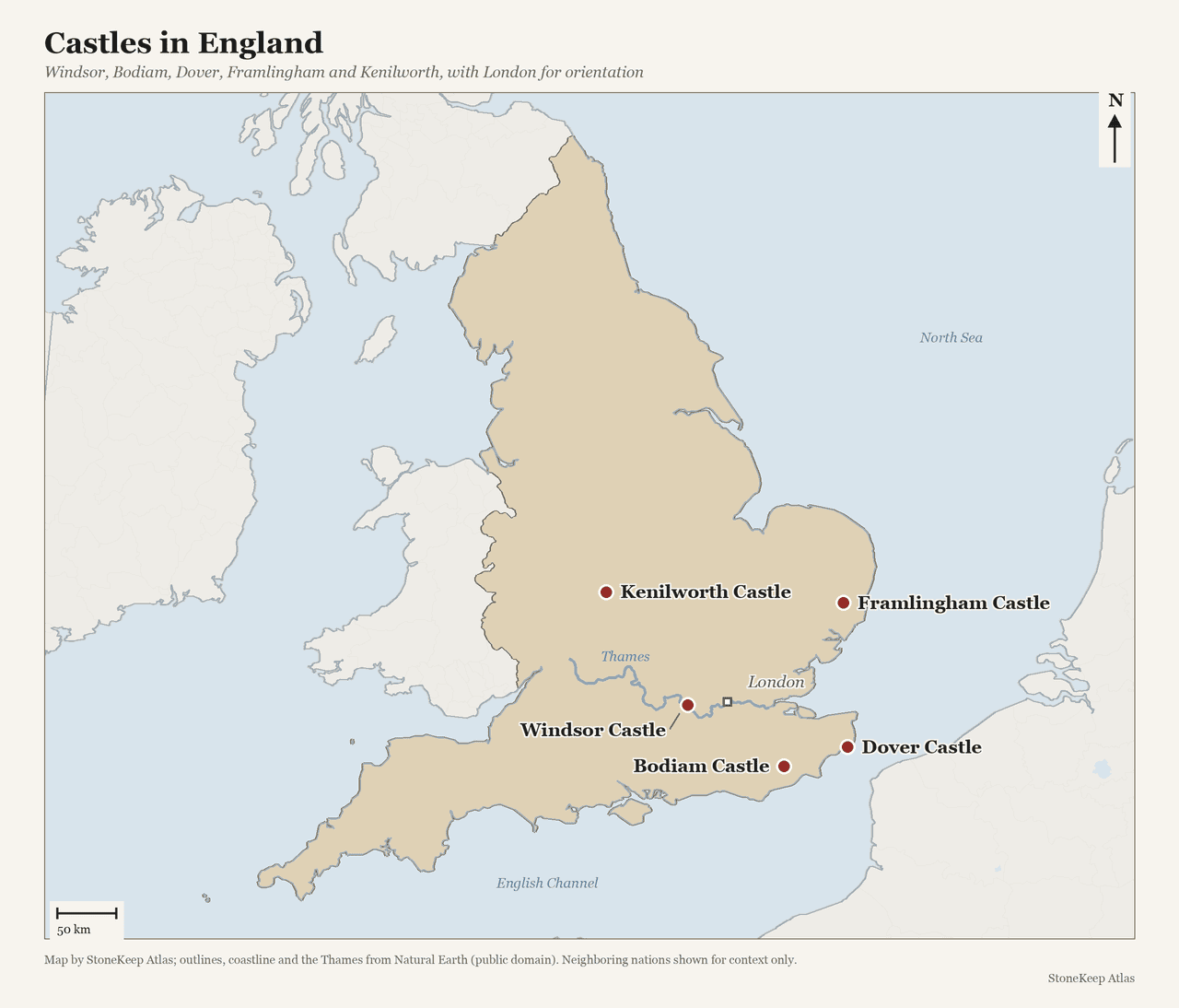
Every cell in the table above describes the building as it stands, in words the heritage bodies themselves use, and every cell is a fact that will not change next season. Prices, opening hours and closure dates do change, so they live only in the Admission table of each castle’s own guide, which is the place to check before you set out. The county column matters more than it looks. Windsor, Dover and Bodiam all lie south of the Thames, while Framlingham, in Suffolk, and Kenilworth, in Warwickshire, stand well to the north of it, and the section on visiting more than one explains what that means on the road.
What Survives: the Walls, the House, or Both
Start with the definition, because the rest of this page depends on it. Historic England’s thesaurus of monument types defines a castle as “A fortress and dwelling, usually medieval in origin, and often consisting of a keep, curtain wall and towers etc.” Both halves count. A castle was a lord’s home as well as a defended place, and Historic England’s introduction to stone castles makes the same point from the other side: “Castles in the medieval period were the residences of lords; the massive and well-built masonry defences are often the best-preserved and most striking surviving elements of such sites, but a contemporary visitor would have noticed resemblances to non-fortified great houses.” The distinction between a castle, a palace and a fortress is the subject of our article on what counts as a castle, and it is the right lens for England, where the castles in this guide sit at different points between the two halves of that definition.
Hold the castles up against it and they sort themselves. Windsor keeps both halves in use. It is a working royal palace, and what a visitor sees outside is largely the castle as James Wyatt and Jeffry Wyatville remodeled it between about 1800 and 1830, so the residence has survived by being altered for the people who went on living in it. Dover is a medieval castle that Historic England calls unusual in surviving in such a complete state despite later modifications, and the tunnels beneath it were adapted in the Cold War. Framlingham keeps its curtain wall, and inside it stand the former workhouse buildings, the larger of them built around the shell of the medieval great hall. Kenilworth lost part of both: an order of 1649 breached its defenses, and its great hall survives as a shell, though Leicester’s Gatehouse and the stables are still roofed. Bodiam keeps its walls and towers almost to their full height, while most of its interior is ruined.
That is why this page leans on the walls. Curtain walls, towers and battlements are the parts of a castle a visitor can read without an interpretation board: how thick, how high, where the openings are. How those parts worked is set out in our guide to castle walls and battlements. The residence is harder. Where it survives, as at Windsor, it wears the alterations of later centuries; where it has largely gone, as at Bodiam, most of the courtyard buildings survive mainly as footings, though Historic England records that the walls of the kitchen, pantry and buttery still stand. Neither state is better or worse. They are different answers to the same question, and each castle’s guide tells you which answer you are getting.
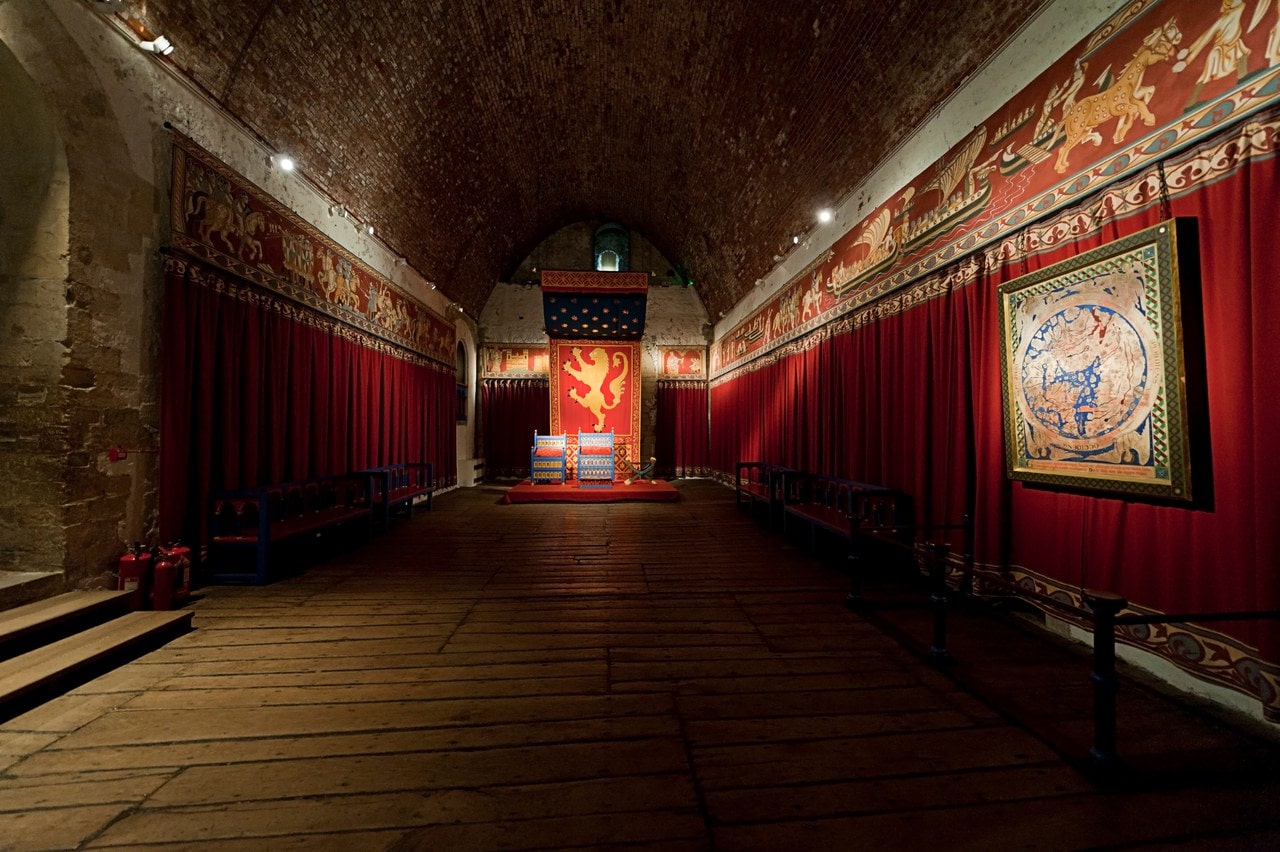
What survives is also not always what is original, and the heritage bodies say so. English Heritage describes the rooms of Dover’s Great Tower, with their wall hangings, furnishings and objects, as a re-creation of a regal medieval world: the rooms are Henry II’s, altered several times since, and the furnishing is modern. At Framlingham, Historic England gives the curtain wall as about ten meters high at its highest points and about 2.3 meters thick; the curtain carries a wall walk reached by steep spiral stairs, while the building inside is a later one wrapped around medieval fabric. At Bodiam, Historic England says that most of the fabric of the exterior is original, although some restoration and repair was carried out in the nineteenth and twentieth centuries. Windsor’s outward appearance is largely the work of the early nineteenth century. When you read a wall or a room at any of these castles, the useful question is whether you are looking at fabric that survived or at a later hand’s version of it.
From the Conquest to the Country House
Historic England sets out the long arc plainly. Castle design, it says, evolved in response to military developments, architectural fashion, influences from abroad and changing social attitudes, and that evolution can be read in the fabric of surviving castles, even relatively poorly preserved ones. The first chapter is earth and wood. Historic England notes that the castles of the Norman Conquest were of earth and timber, and that the first stone castles followed soon after 1066, going on to be built, rebuilt and extended over the following centuries.
Inside that story the great tower had its own decline and revival. Historic England records that toward the end of the thirteenth century and for much of the fourteenth the great tower declined in status and few new ones were built. It then records a revival from the late fourteenth century, with many elaborate new examples such as Old Wardour in Wiltshire and Tattershall in Lincolnshire. Our guide to castle keeps covers what great towers were built to do.
Purpose changed with fashion. Historic England treats the medieval castle as a lord’s residence as well as a stronghold, and dates the decline of its military capability from the fourteenth century, when gunpowder was developing; battlements and moats went on being built long afterward, which it reads as generally more for visual effect than practical use. Sieges were rarer than the popular picture suggests. In reality, Historic England observes, few castles were ever besieged or saw much fighting at all, and in recent years attention has shifted to their social, political and symbolic roles as seats of lordly power. By the sixteenth century the castellated form seems to have gone largely out of fashion, though many castles continued in use, mainly as residences, for centuries. Their more social purposes, in Historic England’s phrase, devolved upon the grand country house, while courthouses and prisons took over other functions.
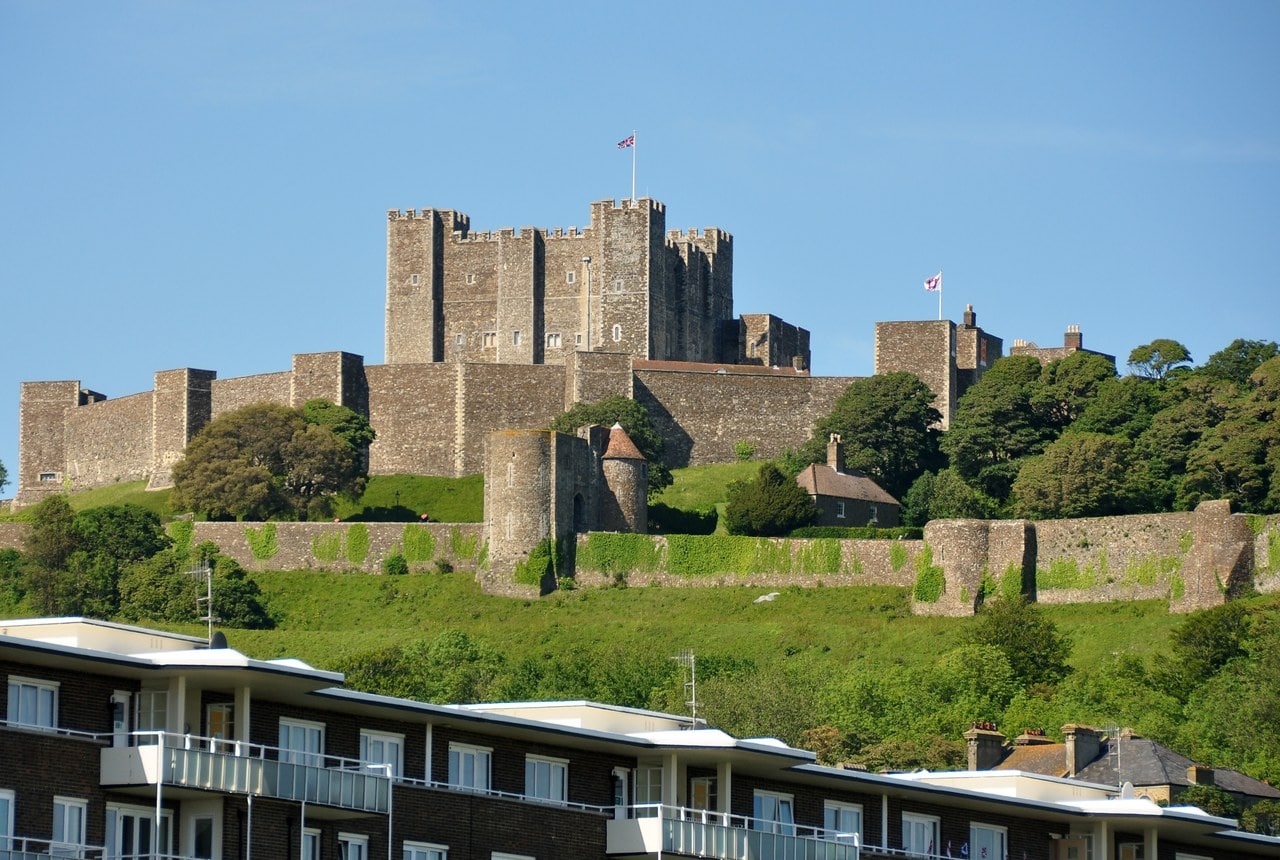
The castles on this page sit along that arc, and some are its exceptions. Dover belongs to the age when, in Historic England’s words, the Great Tower was “the heart of nearly any castle of the 11th to 13th centuries”: the list entry for Dover calls Henry II’s great keep there “the technically most ambitious of its kind in England” and says the defenses of its outer bailey pre-empted by almost half a century the concentric castles of the thirteenth century, castles surrounded by two or more lines of walled fortifications. Framlingham is a castle of curtain walls and towers, towers that Historic England describes as open-backed and linked by a wall walk. At Bodiam, how far the castle was meant for defense is still debated, as its section below reports, and its list entry says the water features around it were designed both to add to the defenses and to provide an attractive, elaborate approach. The sieges on this page are exceptions to Historic England’s observation that few castles were ever besieged. Dover’s garrison, led by Hubert de Burgh, resisted sieges in 1216 and 1217, during the First Barons’ War, when a coalition of English barons and Prince Louis, heir to the French throne, fought the crown. King John besieged Framlingham in 1216, and it surrendered after two days. In 1266 supporters of the late Simon de Montfort held Kenilworth against Henry III through a six-month siege. At Windsor, the Royal Household says, Edward III, who was born there, extended the castle in the 1360s.
A final mark came with the Civil Wars of the mid-seventeenth century. After them many castles were slighted, part-demolished, a process Historic England calls poorly understood and hard to tell apart from later decay. That caution matters for anyone looking at ruined castles in England: a breach in a wall is not, on its own, proof of deliberate demolition. Whatever caused them, Historic England adds, “the surviving ruins form some of our most evocative and impressive monuments.” Kenilworth in Warwickshire is a documented example, and its own section below returns to it. For the longer story, of which medieval English castles are one chapter, see our history of castles.
Windsor Castle: a Working Royal Palace
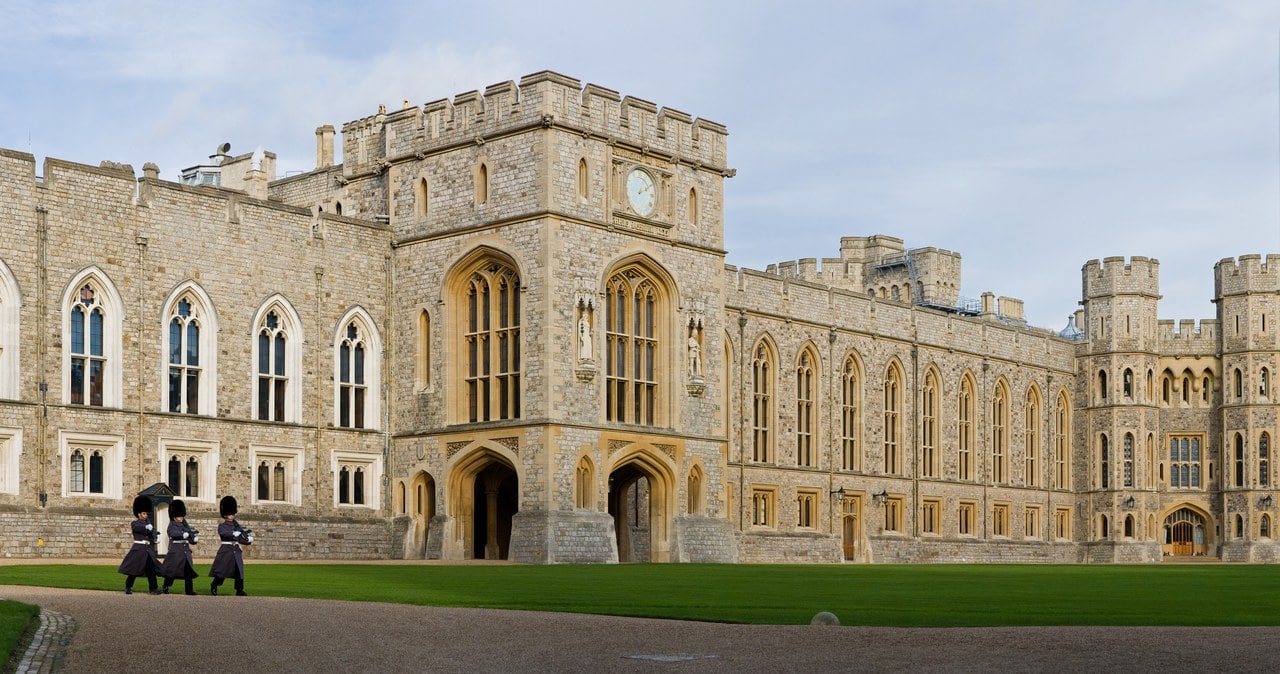
Windsor Castle is still a working royal palace, and that fact shapes everything else about it. The Royal Household says the outer walls of today’s structure stand in the same position as those of the original castle built by William the Conqueror in the 1070s. William did not live there, according to the Royal Collection Trust, since it served then as a defensive base; Henry I was the first king to use Windsor as a residence. Historic England dates the first stone buildings to Henry II, between 1165 and 1179. At the center, the Round Tower stands on an artificial motte, or castle mound, with baileys called the Lower, Middle and Upper Wards around it.
Much of what a visitor sees is later. In Historic England’s reading, the present aspect of the castle largely results from the alterations, additions and restorations carried out by James Wyatt and Jeffry Wyatville between about 1800 and 1830, with further work by Blore and Salvin in Queen Victoria’s reign. That is the pattern of a castle still in use: its occupants kept adapting it, so its outer walls still follow the line of the first castle while its outward appearance is largely of the nineteenth century. For the history, the buildings and the practical side of a visit, see our full guide to Windsor Castle.
Dover Castle: From a Roman Lighthouse to Cold War Tunnels
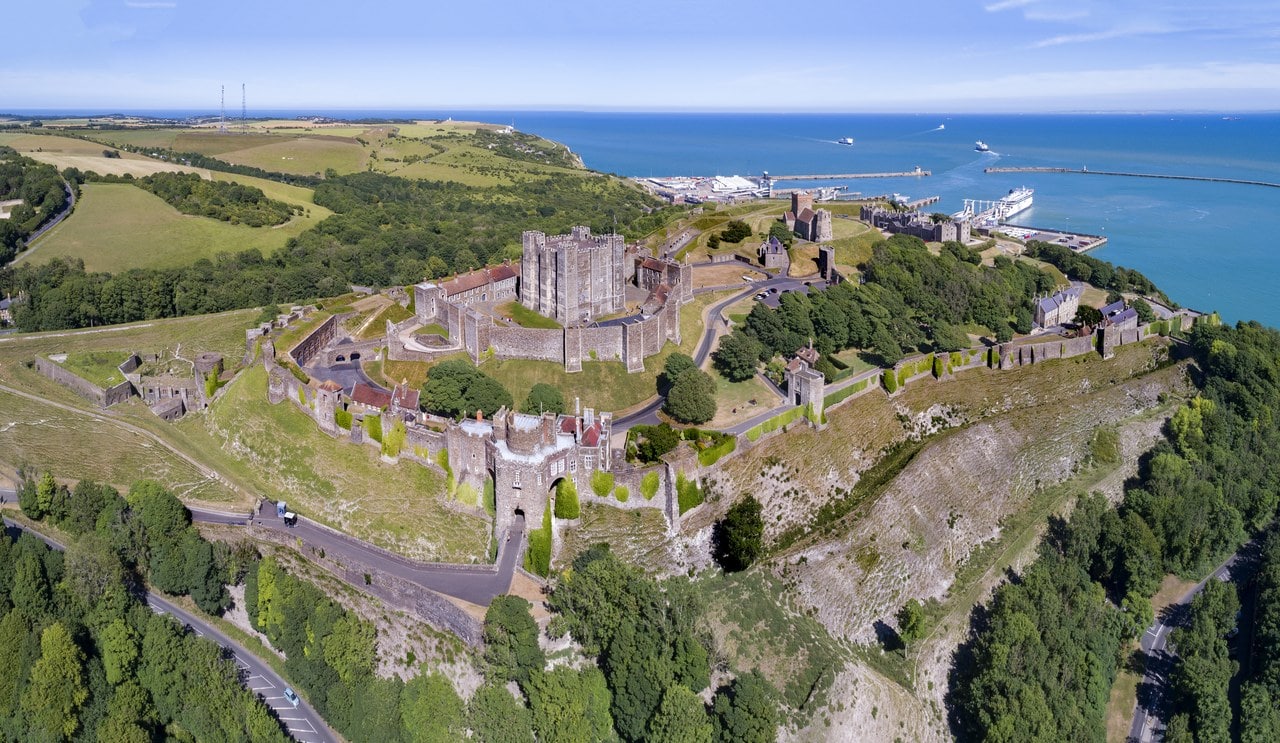
Dover Castle stands above the shortest route to the Continent, and Historic England says it became one of the most elaborate and heavily defended fortresses in Europe. The same record adds that Dover is believed to be the first castle in western Europe to have employed concentric lines of fortification. Two structures inside it are older than the castle itself. One of the Roman lighthouses survives within its walls as a stepped tower, though Historic England says it has been extensively modified. The Anglo-Saxon church of St Mary in Castro stands within the outer bailey. In 1066, English Heritage says, William the Conqueror came to Dover after the Battle of Hastings and established a fortification, possibly around the church, of which nothing survives.
King Henry II began the present castle in the 1180s, and over the next eight centuries, in English Heritage’s account, its buildings, defenses and tunnels were adapted right into the era of nuclear weapons. It held for King John in 1216. In 1642 Parliamentarian forces captured it by climbing the cliffs and surprising the garrison, English Heritage records. In 1940 Vice Admiral Bertram Ramsay directed the Dunkirk evacuation, Operation Dynamo, from tunnels under the castle, and in the Cold War those tunnels were adapted as a regional seat of government in the event of nuclear war. The Army left in 1958, apart from Constable’s Gate, which stayed a senior officer’s residence until 2015. Our guide to Dover Castle has the full story.
Framlingham Castle: the Walls, and the Workhouse Inside Them
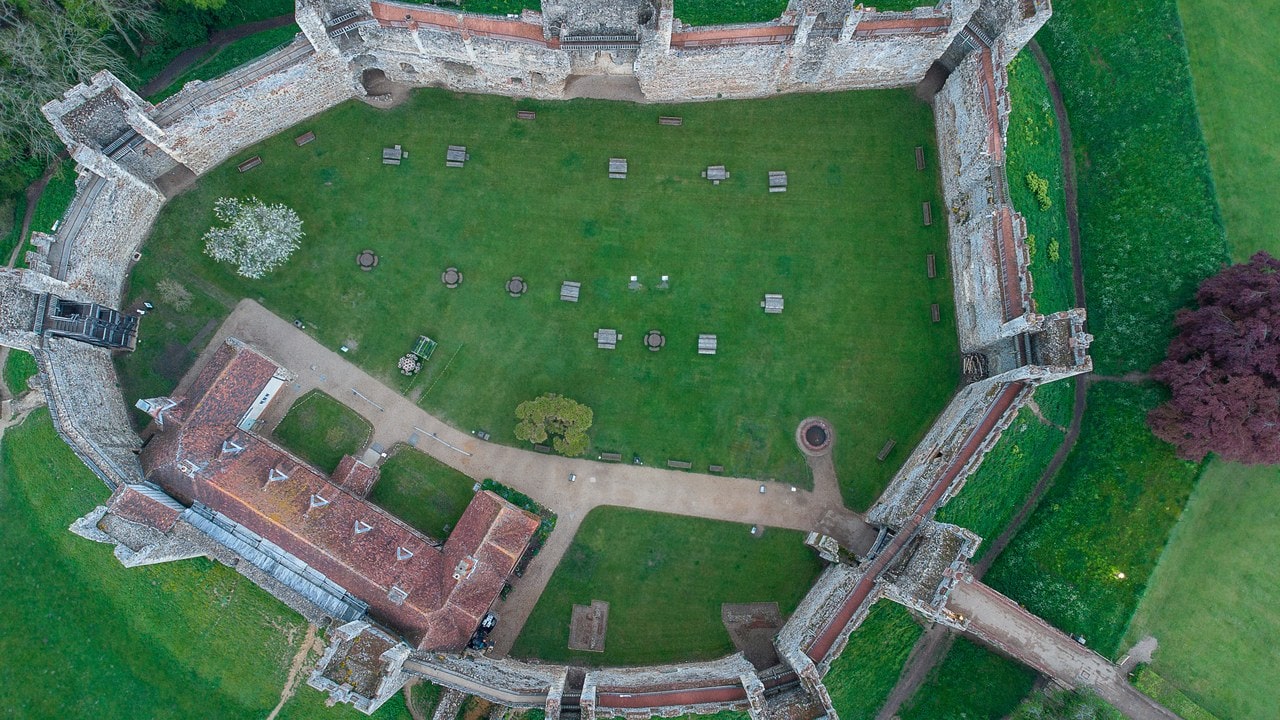
Framlingham’s story is written in its curtain wall. When the Bigod family regained the castle in 1189 under Richard I, The National Archives explains, they had to rebuild it, and the stone curtain wall that survives today was the result; the work is thought to have been finished by 1213. English Heritage credits Roger Bigod II with the huge curtain walls a visitor sees now. They carry thirteen towers in Historic England’s record, incorporated into the walls and projecting from them, a form explored in our reference on castle towers and turrets. Mary Tudor was at Framlingham in 1553, before her coronation. After Edward VI died on 6 July that year, the Duke of Northumberland moved to secure the throne for Lady Jane Grey, and English Heritage tells how Mary, learning of his plans to capture her, fled to Framlingham to gather her troops, arriving on 12 July. Thousands of her supporters flocked to the castle, and it was while she was there that she received the news that Northumberland had surrendered and she had been proclaimed queen.
What stands inside the walls is the result of a will. Sir Robert Hitcham bought the castle in 1635 and at his death in 1636 left it to Pembroke College, Cambridge, on condition that “all the castle, save the stone building be pulled down” and a poor house be established on the site. Today the former workhouse buildings stand there: the Red House of the mid-seventeenth century and, in English Heritage’s dating, the larger building added in 1729, which was built around the shell of the medieval great hall. That hall belongs to the story told in our guide to great halls and medieval castle life. Pembroke placed the castle in state guardianship in 1913, and it has been cared for under the English Heritage name since 1984, by the public body that carried it until 2015 and by the charity since. The full history is in our guide to Framlingham Castle.
Kenilworth Castle: Made Untenable, 1649-50
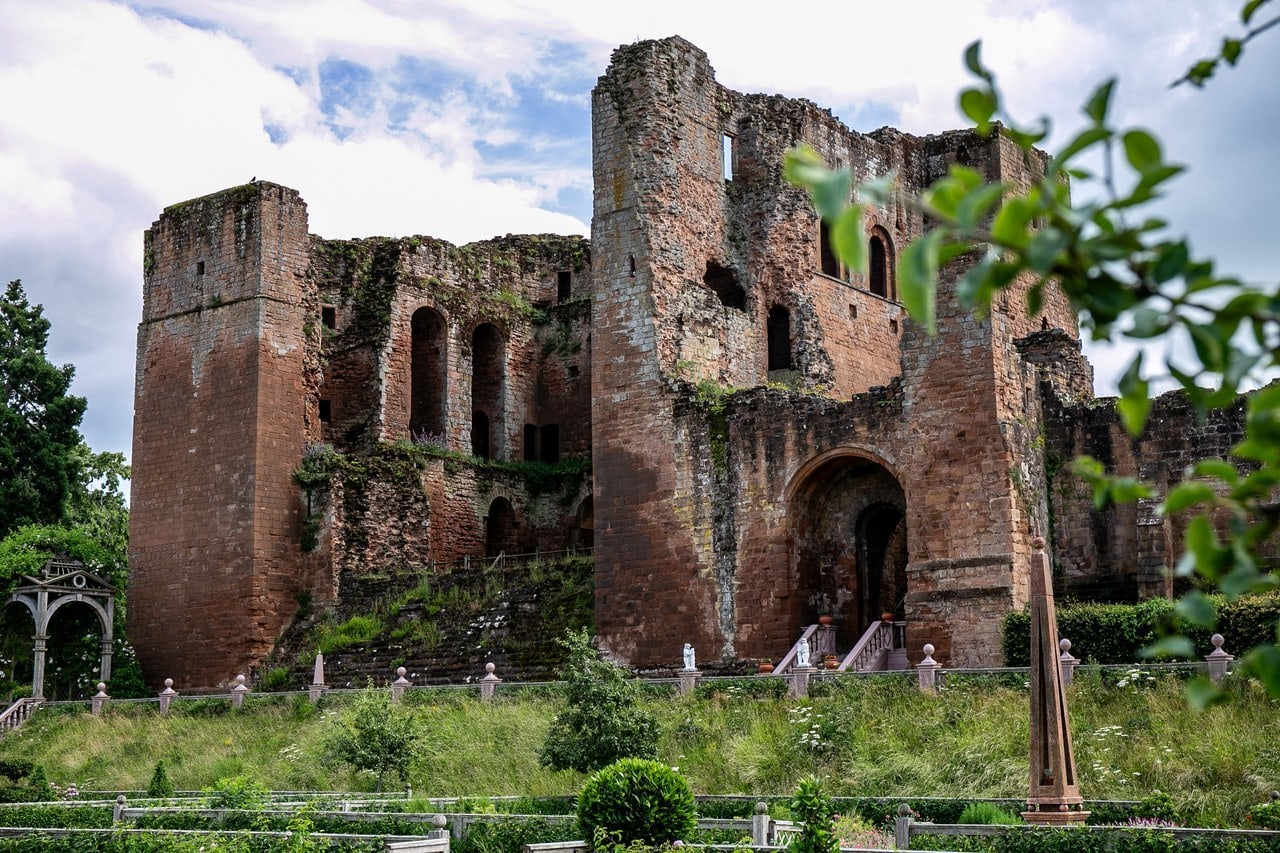
Kenilworth Castle grew around a great tower that Geoffrey de Clinton, Henry I’s chamberlain, probably built in the 1120s, by English Heritage’s dating. King John enlarged it, John of Gaunt rebuilt it from the early 1370s, and Robert Dudley fitted it out for Elizabeth I in the 1570s; what Gaunt built, English Heritage calls a palace. In 1266 water was the defense that mattered: the mere and its dams kept Henry III’s miners away from the walls, and the siege, 172 days long by English Heritage’s count, ended in surrender, not assault.
In 1649 the new regime ordered Kenilworth made “untenable,” English Heritage records, to avoid the cost of maintaining a garrison, and the north wall of the keep was destroyed and the outer curtain beyond it breached. After the Civil War the mere was drained, and the interiors were stripped out and sold. Today the great tower stands open on its north side, Gaunt’s great hall survives as a shell that still carries its tall traceried windows, and Leicester’s Building rises roofless beside the keep. Leicester’s Gatehouse, turned into a house after the Civil War, is still roofed, and so are the stables built in 1553 for John Dudley. North of the keep, the Elizabethan garden is English Heritage’s re-creation of 2009. Our guide to Kenilworth Castle reads the ruins age by age and sets out the visit.
Bodiam Castle: a Moated Shell
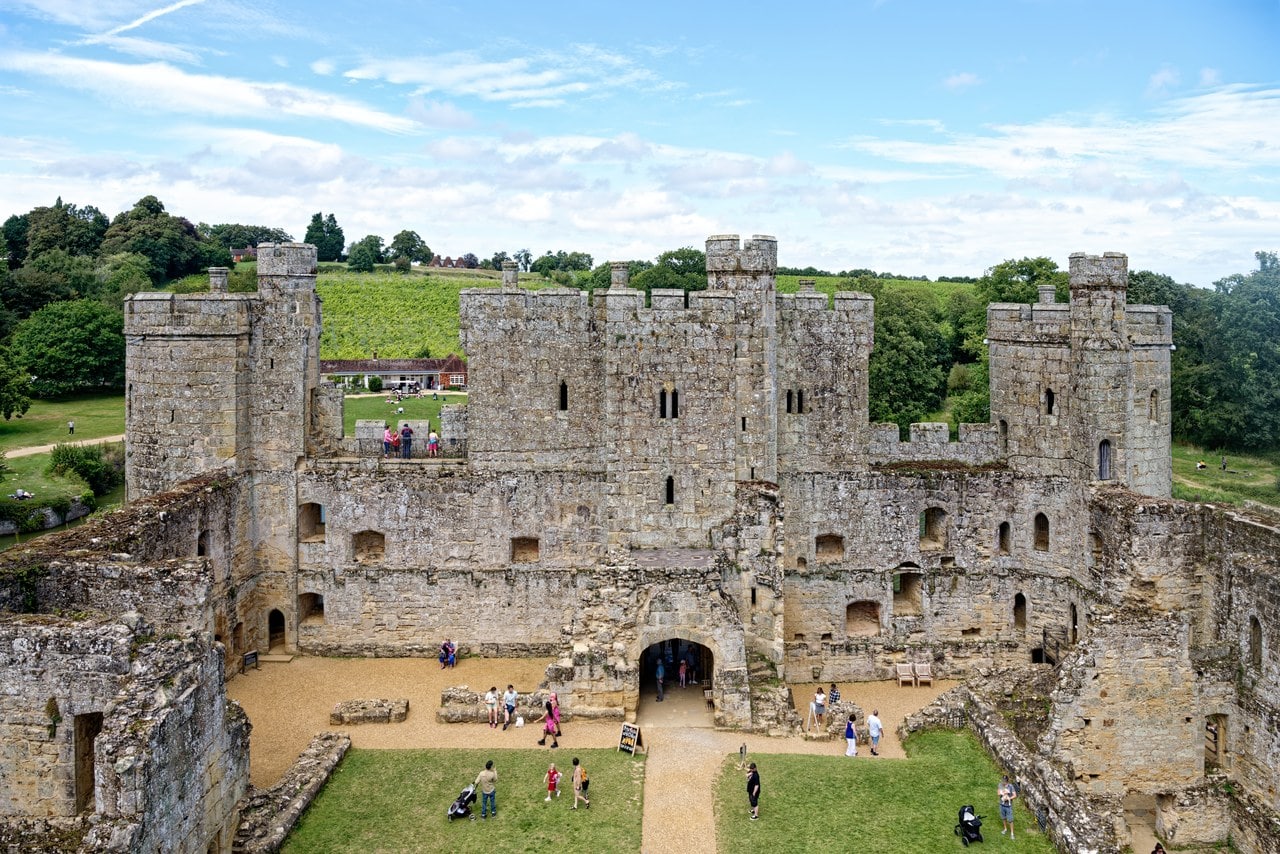
Most of the interior of Bodiam Castle is in a ruined state, in contrast to its exterior, as Historic England puts it: the curtain walls and towers stand almost to their full height inside a water-filled moat, while most of the buildings of its courtyard survive mainly as footings. Sir Edward Dallingridge built it after a royal license of 21 October 1385, and it was probably effectively complete by his death in 1393. Historic England classes it as a quadrangular castle, “a strongly fortified residence built of stone, or sometimes brick, around a square or rectangular courtyard.”
Why it was built that way is still argued, and the argument is part of the visit. Historic England’s own caption for Bodiam reads: “How much this was intended as a defensible castle, rather than an old soldier’s show-home, remains debated.” Historic England’s list entry adds that the survival of the water-filled moat, despite its being drained and partially excavated twice in the twentieth century, provides conditions for the survival of organic remains. Lord Curzon bought the castle in 1917, restored it in 1919 and left it to the National Trust on his death in 1925. Our guide to Bodiam Castle sets out the history, the debate and the visit in full.
Choosing Where to Go: Region, and Who Runs Them
Two questions settle most of a castle trip in England before any history does: where the castle is, and who runs it. Location decides how many you can see in a day. The operator decides what you pay, whether a membership you already hold gets you in, and how far ahead you need to look for closures. It also sets the rules for cameras. None of the three operators lets visitors fly a drone at its castles, and the aerial views on this page are licensed photographs; at Windsor, photography and filming are not permitted inside the State Apartments or St George’s Chapel, though the Royal Collection Trust encourages non-commercial photography in the outside areas of the precincts.
Kent and East Sussex
England’s southeast corner holds Dover, in Kent, and Bodiam, in East Sussex. Two of Kent’s other castles, not covered on this site, are named here so that you can place them. Leeds Castle, moated since at least 1272 in Historic England’s record, was bought in 1926 by Olive Wilson Filmer, later Lady Baillie, and her husband, and was furnished in the medieval style. She left it on her death in 1974 to the Leeds Castle Foundation. What you see inside is therefore twentieth-century work rather than a medieval interior, much of it by Stéphane Boudin, a Paris designer of grand interiors in the French taste, whose rooms from 1932 onward the castle says can still be seen today. Hever, the moated castle where Anne Boleyn grew up, owes much of what a visitor sees today, its owners say, to William Waldorf Astor, who bought it in 1903 and restored and extended it.
Berkshire
Windsor, in Berkshire, lies just west of London, and the walk to the castle runs uphill from the town’s High Street. For anyone based in London it is the one that fits most easily into a single day, a point the section on visiting more than one takes further.
Suffolk
Framlingham needs more planning than the other castles on this page. It is the hardest of them to reach without a car, so plan it as a separate day, or a night away, rather than a detour. Another Suffolk castle, not covered on this site, is named here because it belongs to Framlingham’s story. Orford Castle, at Orford on the Suffolk coast, was built in the twelfth century for Henry II, and English Heritage, which now cares for it, says it was intended to curtail the power of East Anglian barons such as Hugh Bigod of nearby Framlingham. Its polygonal keep still stands. Derek Renn, writing on Framlingham’s defenses in 1973, connected the two: “Framlingham as it stands today is clearly Bigod’s reply to Henry II’s Orford.” From Orford, English Heritage points visitors on to Framlingham, a short drive away.
Warwickshire
Kenilworth, a royal castle for much of its history, was granted by Elizabeth I in 1563 to Robert Dudley, soon to be Earl of Leicester. It stands in the town of Kenilworth, whose railway station is a mile from the castle, English Heritage says. Another Warwickshire castle, not covered on this site, is named here so that you can place it. Warwick was begun by William I in 1068 and granted in 1604 to Sir Fulke Greville, whose family held it for centuries, according to the Victoria County History.
Royal Collection Trust
Windsor is ticketed by the Royal Collection Trust, a charity that is also one of the five departments of the Royal Household and works without public funding. A day ticket can be converted into a year’s re-admission. Windsor is normally closed on Tuesdays and Wednesdays. Because it is a working royal palace, the Royal Collection Trust also sometimes closes the whole castle or its State Apartments at short notice, so check its opening times and closure list, or the Admission table in our Windsor guide, before you fix the day.
English Heritage
Dover, Framlingham and Kenilworth are run by English Heritage, a charity that cares for hundreds of historic sites in England. Its members get in free, though English Heritage notes that event days can carry an extra charge for members too. Advance booking is not required, but the charity says that pre-booking online guarantees entry. Each of them opens on fewer days in winter than in summer, so check the opening times for Dover, Framlingham or Kenilworth before a winter visit.
Two similar names are easy to confuse here. Since April 2015 the charity English Heritage has cared for the state’s National Heritage Collection under a license from Historic England, the public body that until then carried the English Heritage name. Historic England is not the body that sells you a ticket. It publishes the National Heritage List for England, while scheduling a monument or listing a building is an act of the Secretary of State for Culture, Media and Sport, a government minister.
National Trust
Bodiam belongs to the National Trust, a conservation charity founded in 1895, and Trust membership covers entry there, with parking at most Trust car parks. The castle came to the Trust by bequest, as the Bodiam section above explains.
Memberships
Each operator sells its own way in: English Heritage membership for Dover, Framlingham and Kenilworth, National Trust membership for Bodiam, a Royal Collection Trust ticket for Windsor. If you already hold one of those memberships, it gets you into its own castles here, and neither gets you into Windsor.
What This Guide Leaves Out
This page is not a ranking. A country guide that ordered its castles by merit would be answering a different question from the one this page asks about what survives. Nor is there a count of England’s castles here. Why England’s national register does not produce one is explained in our analysis of which country has the most castles, and in the first of the questions below.
England’s borders set the scope. Wales and Scotland have their own heritage bodies, Cadw and Historic Environment Scotland; Historic England’s remit is England, and this page follows it. The regional sections are built around the counties of the castles that have a full guide on this site, and the north of England and the West Country are not covered here. Within England, some well-known sites are left out as well. The Tower of London, run by Historic Royal Palaces, an independent charity, is not covered here, and neither are the country houses that carry the word “castle” in their names without ever having been medieval castles. One of those houses, Highclere, is taken up in the questions below.
Visiting More Than One
List the 5 castles on this map
- Windsor Castle — Berkshire, England
- Dover Castle — Kent, England
- Framlingham Castle — Suffolk, England
- Kenilworth Castle — Warwickshire, England
- Bodiam Castle — East Sussex, England
Geography does most of the planning. Windsor lies just west of London, Dover and Bodiam in the southeast corner of England, and Framlingham in Suffolk and Kenilworth in Warwickshire, north of the Thames. Dover and Bodiam are the natural pair, a little over an hour apart by road. Windsor, Bodiam and Dover chain southeast in under three hours of driving, while Framlingham, more than two hours from each of the others, is a trip of its own. Of the other castles with a full guide on this site, the nearest to Kenilworth is Windsor, about an hour and a half away by road; Dover and Bodiam are around three hours from it. Windsor is the closest to central London by road, and Framlingham and Kenilworth the farthest. Drive times here are our own estimates from openrouteservice, without traffic or stops.
Without a car the castles sort differently. Windsor is the simplest day out: direct trains from Waterloo reach Windsor & Eton Riverside, and trains from Paddington reach Windsor & Eton Central with a change at Slough. The Royal Collection Trust says both stations are less than ten minutes’ walk from the castle, though from Riverside the walk is up a steep hill. Dover has direct trains from St Pancras on the high-speed line and slower ones from Charing Cross. From Dover Priory, English Heritage says, it is a one-mile walk uphill to the castle, and there is also a local bus.
For Bodiam, direct trains from Charing Cross run to Robertsbridge, five miles away, where the National Trust warns there is no taxi rank, so a taxi must be booked ahead. The alternative is a train to Hastings and a bus that stops opposite the castle car park. A seasonal heritage steam railway from Tenterden stops a quarter of a mile from Bodiam, but it does not connect with the main line. Framlingham is the hardest to reach without a car. Trains from Liverpool Street need a change at Ipswich to reach Wickham Market station, which stands at Campsea Ashe six and a half miles away. From the station the link is Katch, an on-demand minibus that must be booked ahead; the other way in is the Ipswich Buses service from Ipswich, and neither runs on a Sunday.
Allow longer at Dover than at Windsor. English Heritage recommends at least three to four hours for Dover, and the Royal Collection Trust one and a half to two for Windsor. Stairs matter as much as time. At Dover, Framlingham and Bodiam the upper levels of the medieval fabric are reached only by steep stairs; at Windsor the Royal Collection Trust publishes a step-free route into the State Apartments by lift, though the castle itself stands on a steep hill. At Framlingham, English Heritage adds, the exhibition inside the workhouse has level access and a platform lift to the first floor.
If you would rather go with a guide than plan the rail and road legs yourself, GetYourGuide lists guided tours and tickets across England.
Some links on this page are affiliate links, which means StoneKeep Atlas may earn a small commission, at no extra cost to you, if you book through them.
Common Questions
How many castles are there in England?
England’s national register does not count castles. That register, the National Heritage List for England, records entries under separate legal instruments, not as castles: each castle in this guide is both a listed building and a scheduled monument, and the published open data has no field saying what kind of monument an entry is. The schedule cannot include residential buildings, so a castle still lived in can be scheduled in its uninhabited parts only: one entry is named “Warwick Castle (uninhabited parts)”. More on national castle counts.
Is there a complete list of castles in England?
The nearest thing is the National Heritage List for England, which Historic England calls “the only official, up to date register of all nationally protected historic buildings and sites in England.” It is not a list of castles. Historic England notes that most places on it are not open to the public, and a search for Windsor Castle also returns public houses of that name. The list can be searched on Historic England’s website.
What is the oldest castle in England still in use?
Historic England’s blog calls Windsor “the oldest and largest occupied castle in the world,” begun in the 1070s, yet its statutory list entry for Windsor does not use the word “oldest”. The word doing the work is “occupied”: the claim is about a castle still lived in, not about foundation date, and it is only as strong as that scope. For how claims like this are weighed across Europe and beyond, see our reference on the oldest castle in the world.
What is the largest castle in England?
Two heritage bodies give different answers. Historic England’s list entry for Windsor reads “England’s largest castle and a royal palace, covering some 13 acres.” English Heritage calls Dover the largest “in terms of area”: almost 32 acres inside the outer bailey curtain wall, and over 50 with the ditch and post-medieval outer defenses. The entry for Windsor does not say what makes it the largest, and this page does not choose between them. For size on a world scale, see our article on the largest castles in the world.
Which castle does the royal family live in?
Windsor is an official residence of the monarch, not the only one: the Royal Collection Trust calls Buckingham Palace “the home of the monarch.” At Windsor, the Royal Household says, Changing the Guard takes place regularly in the castle precincts, and when the monarch is in official residence the parade is held in the quadrangle. Successive monarchs have had their private apartments in the Upper Ward since the fourteenth century. Our guide to Windsor covers the visit.
Is Highclere Castle a real castle?
Not in the medieval sense. Historic England lists it as “a plain C18, 3-storeyed mansion” whose exterior was refaced in an Elizabethan style by Charles Barry; the third Earl of Carnarvon commissioned his designs in 1838. The bishops of Winchester had a palace at Highclere from at least the thirteenth century, on or near the site of the present house. Its owners call it both a much-loved real home and a much-loved fictional one, Downton Abbey. For the difference, see our article on what makes a building a castle.
Beyond England’s Castles
The castles on this page share a vocabulary with castles everywhere, and our reference articles take that vocabulary apart one piece at a time. For the names of the parts a visitor walks through, see our guide to the parts of a medieval castle. The way in is a subject of its own, covered in our reference on the castle gatehouse, portcullis, drawbridge and barbican. For the defensive logic behind all of it, read how castle defenses worked.
Conclusion
Read for what survives, the castles in this guide become a set of answers to one question. Dover, Framlingham and Kenilworth share an operator in English Heritage, Windsor and Bodiam each have their own, and every one of them has its own guide on this site. Windsor answers the question with a residence still in use, altered by the people who have lived in it. Dover answers with a medieval castle Historic England calls unusually complete, on a hill whose tunnels were adapted for the Cold War. Framlingham answers with a curtain wall and the former workhouse buildings inside it. Kenilworth answers with a great tower whose north wall came down after an order of 1649. Bodiam answers with a debate about why it was built, and with a ruined courtyard inside walls and towers that still rise almost to their full height out of its moat.
Principal Sources
- Cadw. “About us.” cadw.gov.wales.
- Drury, Paul, and Michael Copeman / Drury McPherson Partnership. Bodiam Castle, Robertsbridge, East Sussex: Conservation Management Plan for the National Trust. Part 1: Understanding and Significance. June 2016. sites.northwestern.edu.
- English Heritage. “About us.” english-heritage.org.uk.
- English Heritage. “Dover Castle: access.” english-heritage.org.uk.
- English Heritage. “Dover Castle: directions.” english-heritage.org.uk.
- English Heritage. “Dover Castle: things to see and do.” english-heritage.org.uk.
- English Heritage. “Dover Castle: prices and opening times.” english-heritage.org.uk.
- English Heritage. “FAQs: Dover Castle.” english-heritage.org.uk.
- English Heritage. “Framlingham Castle: access.” english-heritage.org.uk.
- English Heritage. “Framlingham Castle: directions.” english-heritage.org.uk.
- English Heritage. “Framlingham Castle: prices and opening times.” english-heritage.org.uk.
- English Heritage. “History of Dover Castle.” english-heritage.org.uk.
- English Heritage. “History of Framlingham Castle.” english-heritage.org.uk.
- English Heritage. “Kenilworth Castle.” english-heritage.org.uk.
- English Heritage. “Description of Kenilworth Castle.” english-heritage.org.uk.
- English Heritage. “Kenilworth Castle: directions.” english-heritage.org.uk.
- English Heritage. “Kenilworth Castle: prices and opening times.” english-heritage.org.uk.
- English Heritage. “Things to see and do at Kenilworth Castle and Elizabethan Garden.” english-heritage.org.uk.
- English Heritage. “History of Kenilworth Castle.” english-heritage.org.uk.
- English Heritage. “Significance of Kenilworth Castle.” english-heritage.org.uk.
- English Heritage. “The Siege of Kenilworth Castle.” english-heritage.org.uk.
- English Heritage. “History of Orford Castle.” english-heritage.org.uk.
- English Heritage. “Orford Castle.” english-heritage.org.uk.
- English Heritage. “Visit FAQs.” english-heritage.org.uk.
- Hever Castle. “The castle.” hevercastle.co.uk.
- Highclere Castle. highclerecastle.co.uk.
- Historic England. “Historic England and the English Heritage Trust.” historicengland.org.uk.
- Historic England. “A quadrangular castle and its landscaped setting, an associated millpond, medieval crofts and cultivation earthworks, and a World War II pillbox at Bodiam.” List entry 1013554 (scheduled monument). historicengland.org.uk.
- Historic England. “Bodiam Castle.” List entry 1044134 (listed building). historicengland.org.uk.
- Historic England. “Castle.” FISH Thesaurus of Monument Types, concept 68833. heritagedata.org.
- Historic England. “Dover Castle.” List entry 1019075 (scheduled monument). historicengland.org.uk.
- Historic England. “Framlingham Castle and its associated landscape including the mere, town ditch and Anglo-Saxon cemetery.” List entry 1002965 (scheduled monument). historicengland.org.uk.
- Historic England. “Framlingham Castle and Red House.” List entry 1030383 (listed building). historicengland.org.uk.
- Historic England. “Hever Castle.” List entry 1273465. historicengland.org.uk.
- Historic England. “Highclere Castle.” List entry 1092528. historicengland.org.uk.
- Historic England. “Highclere Park.” List entry 1000109 (registered park and garden). historicengland.org.uk.
- Historic England. “Leeds Castle.” List entry 1039919. historicengland.org.uk.
- Historic England. National Heritage List for England open data (ArcGIS feature service). arcgis.com.
- Historic England. Stone Castles: Introductions to Heritage Assets. historicengland.org.uk.
- Historic England. “The List.” historicengland.org.uk.
- Historic England. “What is the oldest castle in England?” Heritage Calling. heritagecalling.com.
- Historic England. “Windsor Castle including all the buildings within the walls.” List entry 1117776. historicengland.org.uk.
- Historic Environment Scotland. “Who we are.” historicenvironment.scot.
- Historic Royal Palaces. “About us.” hrp.org.uk.
- Ipswich Buses. 118/119 Ipswich | Otley | Framlingham (timetable from 12 April 2026). ipswichbuses.co.uk.
- Katch. “FAQs” and “Routes and fares.” katchalift.com.
- Leeds Castle. “Lady Baillie’s story.” leeds-castle.com.
- National Rail. “Robertsbridge Station.” nationalrail.co.uk.
- National Rail. “Wickham Market Station.” nationalrail.co.uk.
- National Trust. “About us.” nationaltrust.org.uk.
- National Trust. “Bodiam Castle.” nationaltrust.org.uk.
- National Trust. “Membership.” nationaltrust.org.uk.
- openrouteservice. Directions service. openrouteservice.org.
- Public Record Office. Calendar of the Patent Rolls: Richard II, 1385-1389, p. 42 (license to crenellate Bodiam, witness clause of 21 October).
- Renn, Derek. “Defending Framlingham Castle.” Proceedings of the Suffolk Institute of Archaeology XXXIII, part 1 (1973), 58-67. suffolkinstitute.pdfsrv.co.uk.
- Royal Collection Trust. “About Royal Collection Trust.” rct.uk.
- Royal Collection Trust. “Mobility access at Windsor Castle.” rct.uk.
- Royal Collection Trust. “Practical information for visiting Windsor Castle.” rct.uk.
- Royal Collection Trust. “Visit Windsor Castle.” rct.uk.
- Royal Collection Trust. “Who has lived at Windsor Castle?” rct.uk.
- Royal Household. “Windsor Castle.” royal.uk.
- The National Archives. “Framlingham Castle.” Education resource, archived 13 May 2026. web.archive.org.
- Victoria County History. A History of the County of Warwick, vol. 8 (1969), “The castle and castle estate.” british-history.ac.uk.
Image credits. Hero, Windsor Castle above the town from the air: Photo: Alexey Fedorenko / Adobe Stock; Dover Castle on its ridge from the waterfront: Photo: Nilfanion, CC BY-SA 4.0; Locator map: Map by StoneKeep Atlas; outlines, coastline and the Thames from Natural Earth (public domain); The king’s hall in Dover’s Great Tower: Photo: ian howard / Adobe Stock; The Upper Ward quadrangle at Windsor: Photo: Diliff, CC BY 3.0; Dover’s castle hill from the air: Photo: Chensiyuan, CC BY-SA 4.0; Framlingham from almost directly overhead: Photo: Rob / Adobe Stock; Kenilworth’s great tower from the Elizabethan garden: Photo: Val / Adobe Stock; The courtyard inside Bodiam’s curtain: Photo: Tilman2007, CC BY-SA 4.0. Freely licensed images are resized to fit; otherwise unaltered.