
Châteaux of France: The National Guide, Region by Region
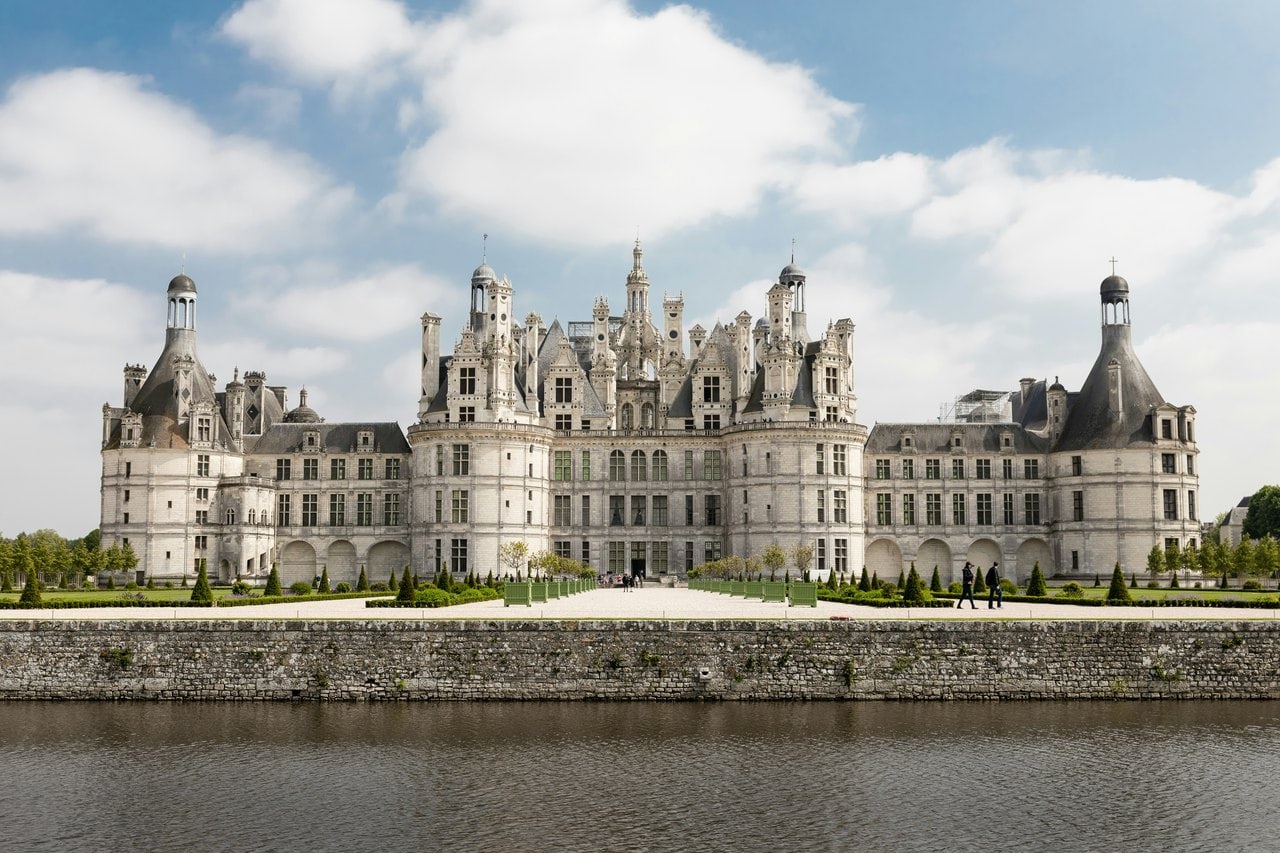
The châteaux of France are less a single tradition than a thousand-year argument about what a great building should do. Some were raised to hold a frontier, some to house a court, some to hang a collection, and at least one to imprison a fictional count. Forty-six of them now have full StoneKeep Atlas guides: the royal houses of the Loire Valley, the Norman frontier, the mountain fortresses of the Pyrenean south. This page organizes all of them the way a traveler actually meets them, region by region.
Each section below introduces one castle region of France, links to its dedicated regional guide, and walks through the monuments it holds. Use it as a national map of the catalog, a planning tool for choosing which France to visit first, or simply a long look at how differently the same country built for war, for power, and for pleasure.
The regions also read as chapters of one history. In the south and on the eastern frontier, where the fighting lasted longest, the medieval fortress survives best. The Renaissance belongs to the Loire, where kings back from the Italian wars rebuilt their hunting country in the new style. Absolutism belongs to the ring around Paris, where the court finally settled. And the nineteenth century runs through all of it, because France did not merely preserve its castles; at Carcassonne, Pierrefonds, and the Haut-Kœnigsbourg it rebuilt them, and what a visitor climbs to at all three is substantially a nineteenth-century idea of the Middle Ages.
It is worth saying plainly what that last point costs, because the buildings themselves say it. The Chambord estate describes its own military display as puissance militaire toute allégorique. The Mérimée notice for Chenonceau observes that the formerly defensive elements there serve as ornament. Langeais tells visitors the building is no longer a true fortress. And Versailles states that it never had a protective function in the sense of the medieval castle at all. The word château covers both a frontier keep and a palace with no walls, and four French institutions will tell you so on their own pages.
The Châteaux of France at a Glance
| Region | Guides | Signature châteaux | Regional guide |
|---|---|---|---|
| Loire Valley | 16 | Chambord, Chenonceau, Angers | Nine Royal Houses |
| Île-de-France | 4 | Versailles, Fontainebleau, Vincennes | Four Seats of Power |
| Hauts-de-France | 3 | Chantilly, Pierrefonds, Compiègne | Three Great Houses |
| Normandy | 5 | Château Gaillard, Falaise, Caen | Between the Sea and the Vexin |
| Alsace | 5 | Haut-Kœnigsbourg, Fleckenstein | Five Strongholds |
| Provence | 4 | Palais des Papes, Château d’If | Four Great Strongholds |
| Occitanie | 9 | Carcassonne, Peyrepertuse, Montségur | The Cathar Castles and Royal Fortresses of Languedoc |
List the 46 castles on this map
- Château de Chambord — Loir-et-Cher, France
- Château de Chenonceau — Indre-et-Loire, France
- Château de Blois — Loir-et-Cher, France
- Château d’Amboise — Indre-et-Loire, France
- Château du Clos Lucé — Indre-et-Loire, France
- Château d’Azay-le-Rideau — Indre-et-Loire, France
- Château de Cheverny — Loir-et-Cher, France
- Château de Villandry — Indre-et-Loire, France
- Château de Chaumont-sur-Loire — Loir-et-Cher, France
- Château de Chinon — Indre-et-Loire, France
- Château d’Angers — Maine-et-Loire, France
- Château d’Ussé — Indre-et-Loire, France
- Château de Saumur — Maine-et-Loire, France
- Château de Brézé — Maine-et-Loire, France
- Château de Langeais — Indre-et-Loire, France
- Château de Loches — Indre-et-Loire, France
- Palace of Versailles — Yvelines, France
- Château de Fontainebleau — Seine-et-Marne, France
- Château de Vincennes — Val-de-Marne, France
- Château de Vaux-le-Vicomte — Seine-et-Marne, France
- Château de Chantilly — Oise, France
- Château de Pierrefonds — Oise, France
- Château de Compiègne — Oise, France
- Château du Haut-Kœnigsbourg — Bas-Rhin, France
- Château de Fleckenstein — Bas-Rhin, France
- Château du Hohlandsbourg — Haut-Rhin, France
- Château du Haut-Barr — Bas-Rhin, France
- Three Castles of Eguisheim — Haut-Rhin, France
- Palais des Papes — Vaucluse, France
- Château d’If — Bouches-du-Rhône, France
- Château de Tarascon — Bouches-du-Rhône, France
- Château des Baux-de-Provence — Bouches-du-Rhône, France
- Carcassonne Castle — Aude, France
- Château de Peyrepertuse — Aude, France
- Château de Quéribus — Aude, France
- Château de Montségur — Ariège, France
- Châteaux de Lastours — Aude, France
- Château de Puilaurens — Aude, France
- Château de Termes — Aude, France
- Fort Saint-André — Gard, Occitanie, France
- Château de Foix — Ariège, France
- Mont-Saint-Michel — Normandy, France
- Château Gaillard — Normandy, France
- Château de Caen — Normandy, France
- Château de Falaise — Normandy, France
- Château de Gisors — Normandy, France
The Loire Valley: the Royal Heartland
Along a short stretch of river country between Blois and Azay-le-Rideau, the kings of France built the houses that taught Europe what the French Renaissance looked like. Château de Chambord, a hunting retreat scaled to astonish a continent, crowds its rooftop with lanterns and turrets and climbs around a staircase of double revolution: two intertwined flights, wound about an open core, so that two people climbing them can see one another through the openings and never meet. The estate is careful about its most famous association, and so are we. Leonardo da Vinci is described as an inspirateur, on indices, and he died on 2 May 1519, the year the work began. Whose design it is remains unresolved on the estate’s own account.
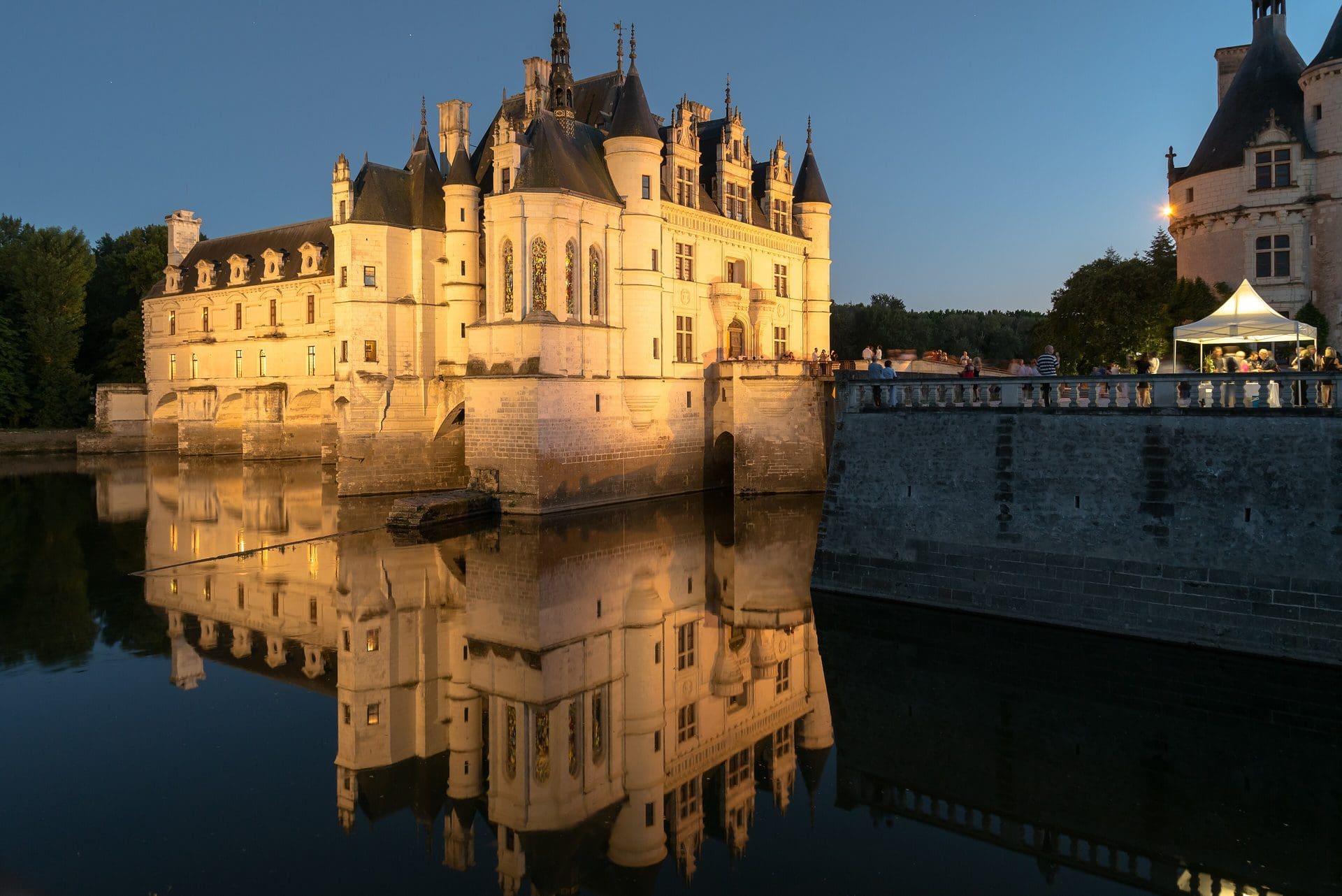
Château de Chenonceau strides across the river Cher on five piers; built, embellished, and saved by a succession of remarkable women, it has answered to the nickname Château des Dames since the sixteenth century. The whole valley landscape between Sully-sur-Loire and Chalonnes has been inscribed on the UNESCO World Heritage List since 2000.
The depth of the valley is in what stands between the two icons. Château de Blois gathers four wings of the thirteenth to seventeenth centuries around one courtyard, though the classical block was never finished, its money stopped in 1638, and the painted interiors a visitor admires are the nineteenth-century scheme rather than a Renaissance survival. Château d’Amboise holds the tomb of Leonardo da Vinci, who spent his last three years at the Château du Clos Lucé, the only home of his that is known apart from Vinci itself; a story we follow in full in Leonardo in France. Château d’Azay-le-Rideau rises from a low island in the Indre, the house Balzac called a faceted diamond, set by the Indre, mounted on piles masked by flowers. That sentence is usually quoted at the diamond and cut before the river that makes it work. The mirror of water that makes the photograph is not Balzac’s either: an arm of the Indre was widened in a 1950 campaign and the corbelled angle tower is 1856, so neither Berthelot nor the Biencourts ever saw that view.
Château de Cheverny lent its silhouette to Marlinspike Hall in the Tintin albums and keeps a permanent exhibition about it. Château de Villandry drew 370,000 visitors in 2025, more than 40 percent of them from outside France and 65 percent of them into the house as well as the gardens; its kitchen garden is replanted twice a year, a spring crop from March and a summer crop from July, so the same beds are a different garden in June and in September. Château de Chaumont-sur-Loire was Catherine de’ Medici’s from 1550, and when Henri II died of his tournament wound in 1559 she asked Diane de Poitiers to hand back Chenonceau, a crown gift that could not be alienated, and gave her Chaumont in exchange; Diane finished the building. And the fortress of Château de Chinon is where Joan of Arc came to meet the dauphin in 1429, not yet a crowned king, which is the entire point of the episode, and a scene the château itself presents as recognition rather than record.
Upstream and south, four more houses fill in what the famous ten leave out. Château de Langeais keeps a stone keep raised for Fulk Nerra at the end of the tenth century, among the oldest to survive anywhere in France, and a great hall where Charles VIII married Anne of Brittany at dawn on 6 December 1491, the beginning of Brittany’s attachment to the crown rather than its conclusion. Château de Loches answers it with a donjon built between 1013 and 1035 for the same Fulk Nerra, standing to something like thirty-seven meters and missing its crown. Château de Saumur is the castle in the Très Riches Heures du duc de Berry, and its silhouette is essentially Louis I’s, though nothing about it is untouched: it was bombed in 1940 and part of its north rampart collapsed in 2001. Château de Brézé hides the strangest thing in the valley beneath a neo-Gothic house of the nineteenth century: four kilometers of galleries, kitchens and stables cut into the tuffeau, ringed by dry ditches reaching up to eighteen meters in places, dug deeper at each campaign partly to quarry the stone the château above was built from.
Downstream, at the old capital of Anjou, stands a different Loire altogether: Château d’Angers, a ring of seventeen round towers about twelve meters across, banded in alternating black schist and pale limestone, display rather than strength on the archaeology, and standing over ditches that have been dry since the beginning. The towers are not the fortress the 1230s built. They were un-capped and lowered at the end of the sixteenth century and the start of the seventeenth to carry artillery, and only the Tour du Moulin probably keeps its original height. What the castle guards is the Apocalypse Tapestry, commissioned in 1375 by Duke Louis I of Anjou, the largest surviving tapestry of the Middle Ages, and inscribed on UNESCO’s Memory of the World register in 2023, a different register from the World Heritage List and a distinction worth keeping on a page with six World Heritage properties on it. Château d’Ussé, by tradition and by its own trading name, is the Sleeping Beauty château, though the estate’s own history page runs from Gelduin I to the Blacas without mentioning Perrault. Angers itself passed 300,000 visitors for the first time in 2024 and reports 326,000 for 2025 — a count for the whole site, not for the tapestry alone.
Our guide to the Châteaux of the Loire Valley gathers the nine royal houses into a single arc, and the women who built, won, and saved the greatest of them have a guide of their own in The Ladies of the Loire.
Île-de-France: the Seats of Power Around Paris
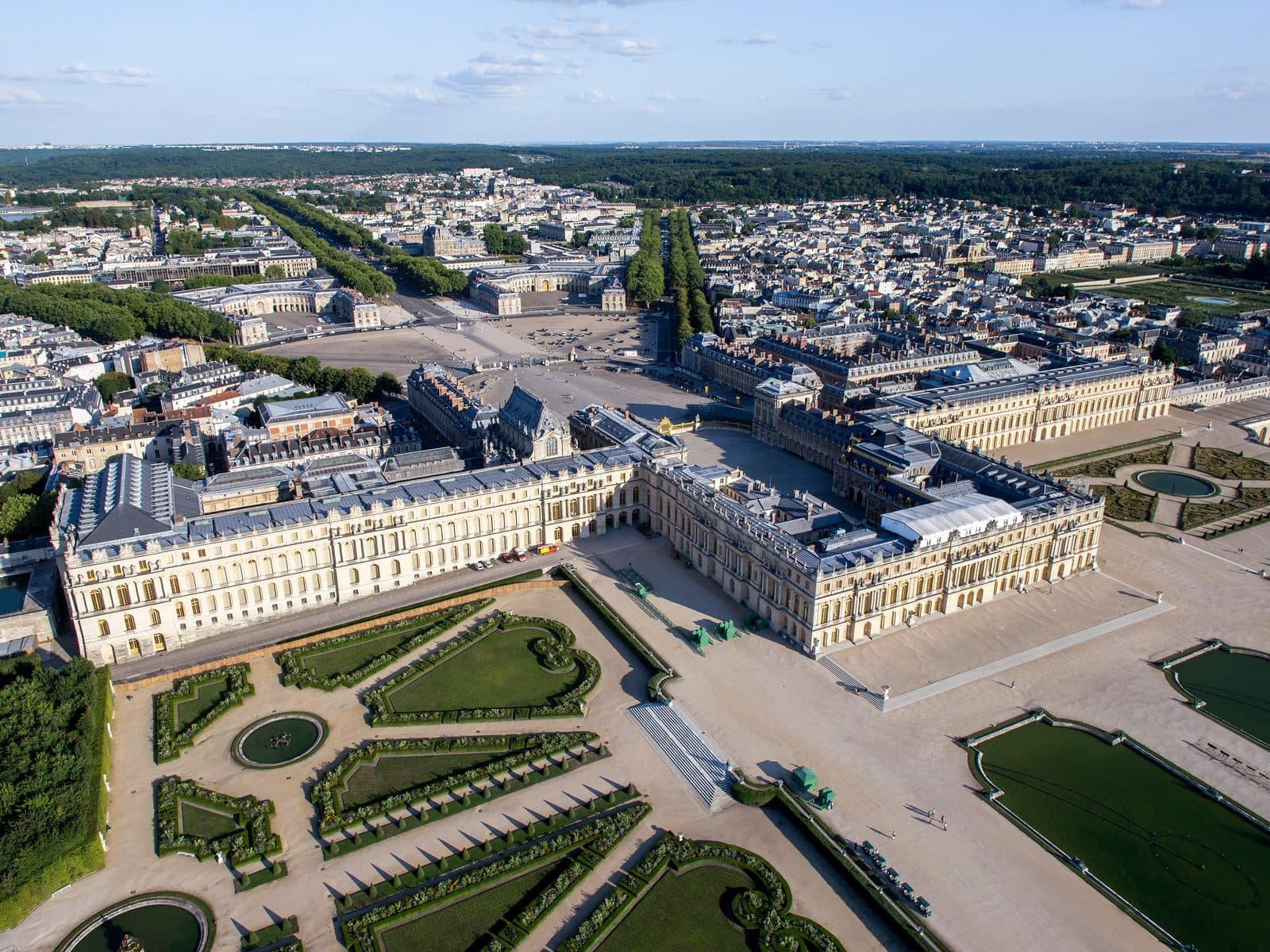
Within a short train ride of central Paris stand four royal residences that, between them, trace the whole arc of how French monarchs, and then a French emperor, chose to live and to rule. The Palace of Versailles is the largest of them by a distance, some 2,300 rooms over 63,154 square meters, and the clearest statement of what this page is about: the estate says outright that Versailles never had a protective function in the sense of a medieval castle. Louis XIV installed court and government there in 1682. The Hall of Mirrors, built between 1678 and 1684, runs seventy-three meters and carries 357 mirrors across seventeen arcades, made in France specifically to take the mirror trade away from Venice. It was among the first sites ever inscribed on the World Heritage List, in 1979.
Château de Fontainebleau answers it with accumulation rather than a single vision. It is not the château of one sovereign but of all of them: thirty-four kings and two emperors in succession, from the twelfth century to the nineteenth. A horseshoe staircase of the 1630s frames the courtyard where Napoleon said goodbye to his guard on 20 April 1814, and which has been called the cour des Adieux ever since. The palace joined the World Heritage List in 1981. Very little of it reads as medieval today beyond the square keep; the interiors are largely a Napoleonic refurnishing, because the Revolution left almost nothing movable in place.
This region holds the extremes of the story too. The donjon of the Château de Vincennes climbs fifty meters and is, so far as any surviving medieval keep in Europe goes, the tallest; the Centre des monuments nationaux calls it simply the tallest keep in Europe, and the narrower claim is ours, since Coucy’s was taller until it was dynamited in 1917. It was begun in 1361, three years before Charles V came to the throne, and the operator traces the decision to the Paris rising of 1358, which the future king witnessed. The nine forty-meter towers of its enceinte were pulled down between 1805 and 1820; only the Tour du Village still stands to its height. Château de Vaux-le-Vicomte is the private house whose owner, Nicolas Fouquet, was arrested at Nantes on 5 September 1661 by a captain of musketeers named d’Artagnan, and then held at three of the forty-six castles on this page: Angers, Amboise, and finally the donjon at Vincennes.
All four are gathered in Royal Residences of Île-de-France, and the system of rule that Versailles was built to stage has its own guide in Versailles and the Architecture of Absolutism.
Hauts-de-France: the Great Houses of the Oise
Just over the old provincial border north of the capital, the Oise department holds three grand houses a Paris traveler can reach in a day, each answering differently the question of what a great house is for. Château de Chantilly was built around a collector’s art: its Musée Condé holds the second collection of old master paintings in France after the Louvre, hung as the Duc d’Aumale hung it in the nineteenth century and unchanged since. That is not a curatorial accident. Aumale bequeathed the estate to the Institut de France in 1886 on three conditions that took effect at his death, that the museum open to the public, that his arrangement of it be preserved, and that the collections never be lent. The consequence is that the only way to see any of it is to come to Chantilly, and that includes the Très Riches Heures du duc de Berry, the most famous illuminated manuscript in the world, which is why Saumur and Vincennes both appear in a book that can never leave this one. Chantilly is not the only Institut de France property on this page: Jacques Siegfried gave Langeais and its collection to the same institution in 1904, and it owns both still.
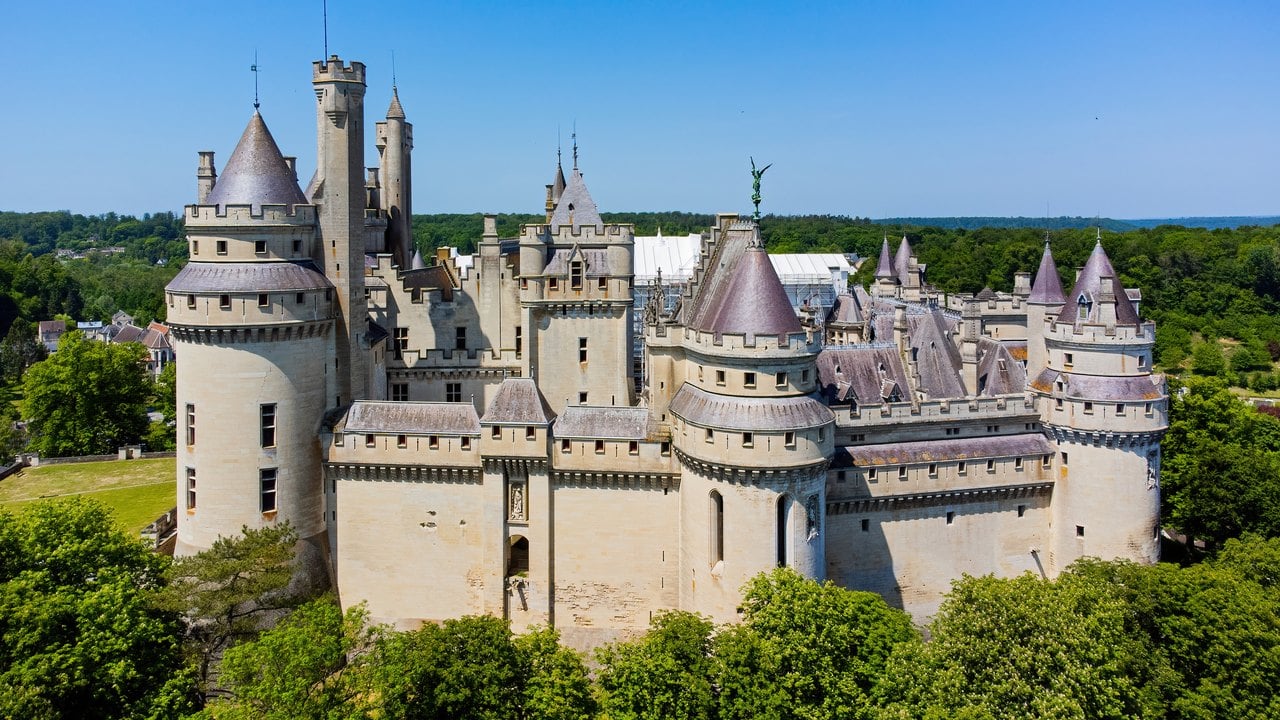
Château de Pierrefonds is a genuine late-medieval castle, built for Louis d’Orléans from 1397 in under ten years, shelled on Richelieu’s orders in 1617, and then reinvented, the word is the operator’s, by Eugène Viollet-le-Duc for Napoleon III from 1857. It is a reinterpretation of the Middle Ages and the Renaissance rather than a restoration of either, and the work stopped in 1870 with the silhouette finished and the interiors not. Louis d’Orléans himself was murdered in a Paris street in November 1407 by his cousin Jean sans Peur, and his widow, Valentine Visconti, withdrew to Blois, which joins two entries on this page across four hundred kilometers.
The third, Château de Compiègne, is the quietest of the imperial residences and the one that still feels like a house: a long neoclassical palace at the edge of its forest, remodeled for Napoleon I and beloved of Napoleon III, whose Second Empire court made it their favorite autumn residence. The scale of the difference is easy to miss. Versailles took 8.4 million entries in 2024; the national museum at Compiègne took just over 117,000, and its attendance rose 15 percent that year. All three are read together in Châteaux of the Oise.
Normandy: the Frontier and the Sea
Normandy has opened, and it reads as a border rather than a style. After 1066 the dukes held a kingdom across the Channel and a land frontier at home, running down the Epte east of Rouen, and what holding that line left standing is the region’s castle landscape. Château de Gisors is the lock on the river, begun in 1097 as an earth motte and carrying an octagonal great tower inside the stone ring its operator calls a chemise; the commune still calls it the eastern lock of Normandy. Philip II took it in 1193, eleven years before the duchy itself went, and the answer was Richard the Lionheart’s Château Gaillard, raised on the Seine between 1196 and 1198 to hold the river and the approach to Rouen, and quarried to a graded ruin from 1603. Inland stand the two ducal seats: Château de Caen, an enclosure of roughly five hectares built about 1060 and free to walk into today, and Château de Falaise, the birthplace town whose oldest standing building is Henry I’s great tower of about 1123. At the western end, Mont-Saint-Michel is a fortified abbey rather than a castle, and its operator says so. Our regional guide to the castles in Normandy reads them as one frontier and settles the order to drive them in.
Alsace: the Mountain Wall of the Vosges
The castles of Alsace crowd the eastern face of the Vosges like watchtowers on a single long wall. The regional tourism agency calls Alsace one of the European regions with the most castles, counting close to five hundred by the end of the Middle Ages; some eighty hill-castle sites survive today, and a waymarked walking route, the chemin des châteaux forts d’Alsace, runs 450 kilometers along the range from Wissembourg to Thann, maintained by the Club Vosgien.
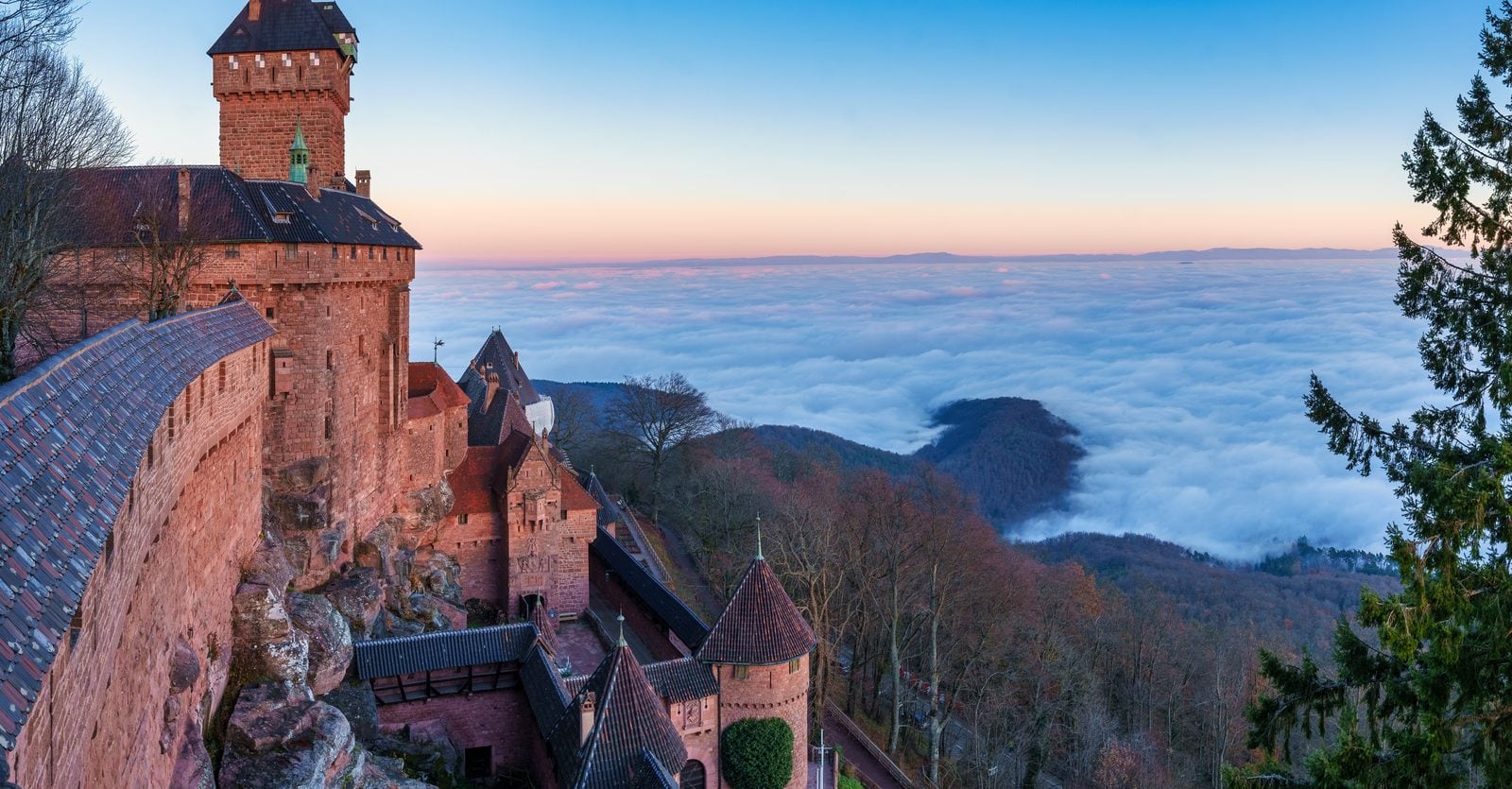
The region’s flagship is the Château du Haut-Kœnigsbourg, at 757 meters above sea level. Calling it a medieval castle rebuilt requires more care than the phrase suggests: it is a restitution of the castle in its supposed fifteenth-century state, entrusted to Bodo Ebhardt in 1900 and built between 1901 and 1908 for the German emperor Wilhelm II, in the decades when Alsace lay inside Germany, and Ebhardt more than once had to invent. The ruins were listed in 1862; the restituted parts were listed separately in 1993. It is also the busiest castle in the region by a wide margin, with 596,709 visitors in 2023 on the castle’s own count, which the regional agency ranks fourth among France’s paying châteaux, after Versailles, Chenonceau and Chambord.
Deeper in the northern forest, Château de Fleckenstein is carved into a bar of Vosges sandstone: a promontory twenty meters high, a hundred long and ten to fifteen wide, with staircases, chambers and a cistern cut from the living rock. Reputed impregnable, it lived up to the reputation and then fell without a fight to the troops of Louis XIV. It drew about 61,000 visitors in 2023 on the regional agency’s figures. The Château du Hohlandsbourg crowns a granite summit above Colmar; the Château du Haut-Barr watches half a province from its rocks above Saverne; and the Three Castles of Eguisheim began as one great fortress before family quarrels split it into three rival towers, and the birthplace of Bruno of Eguisheim, later Pope Leo IX. All five are gathered in Castles of Alsace.
Provence: Strongholds of the South
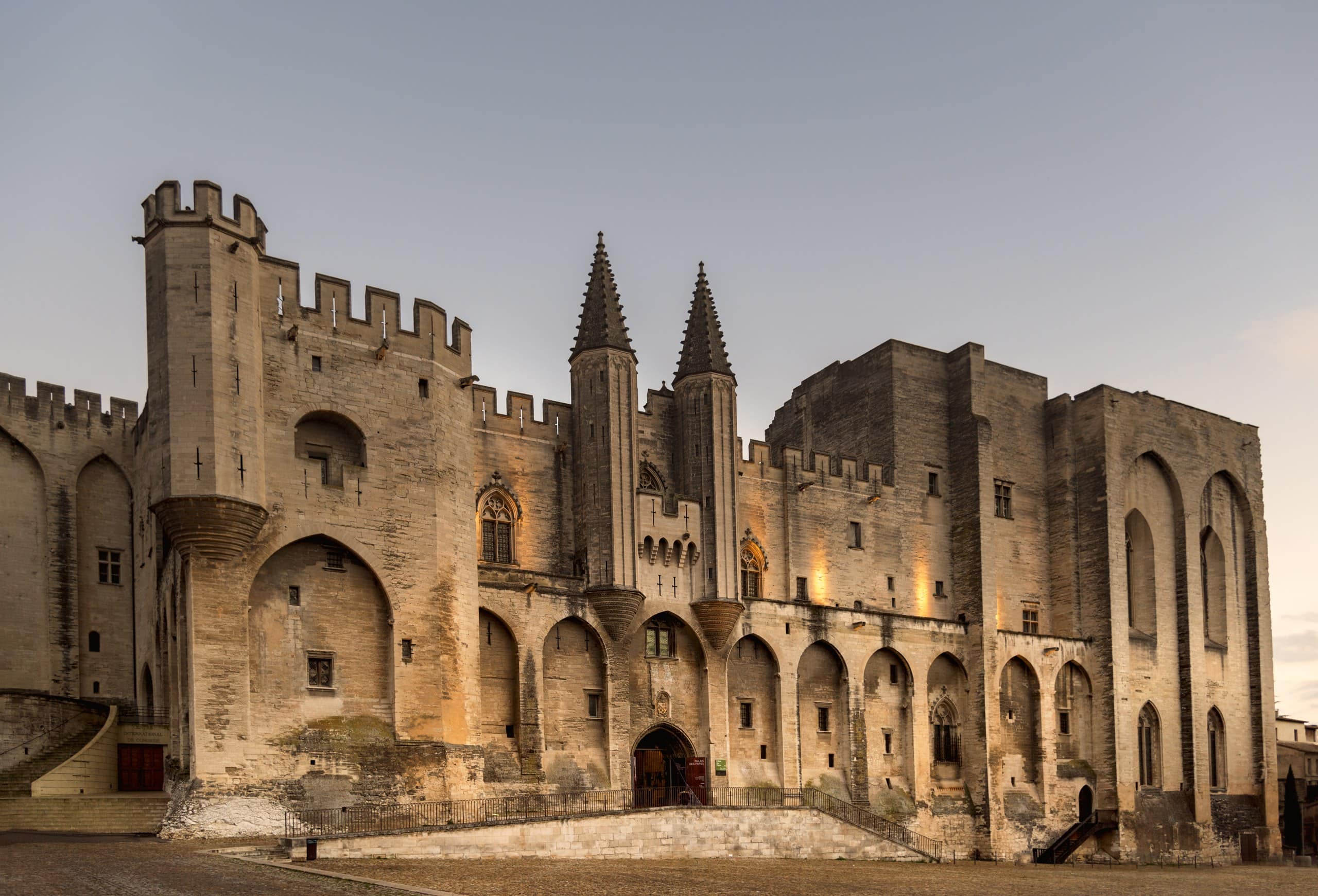
The castles of Provence are a lesson in how many different things a great building can be. The Palais des Papes in Avignon is what Avignon Tourisme calls the largest Gothic palace, the working capital of Western Christianity for most of the fourteenth century, and the centerpiece of a World Heritage town since the Historic Centre of Avignon was inscribed in 1995. It is principally the work of two popes, Benedict XII from 1335 with the architect Pierre Poisson, and Clement VI from 1342 with Jean de Louvres, raised in under twenty years by a workforce of some six hundred men, through the Hundred Years War and the Black Death. Do not expect medieval rooms: the palace was a barracks from the Revolution into the twentieth century, and a conservation campaign on its painted decoration has been running since January 2022.
Off Marseille, the island fortress of the Château d’If began with a rhinoceros. In January 1516 a Portuguese ship carrying the animal to the pope put in at Marseille, François I came to see it, and in the course of a four-day visit he also took the measure of the city’s defenses; the fortress was decided that year and finished in 1531. Its record is one of deterrence rather than combat: a maritime attack in 1536 was very quickly repulsed and the imperial galleys turned back. What carried its name around the world was fiction, when Alexandre Dumas chose it as the prison of Edmond Dantès in The Count of Monte Cristo.
Two more belong to the Rhône. Château de Tarascon rises forty-five meters from the river, the fortress of Good King René, though none of it is his work. It was begun in 1400 for Louis II of Anjou and Yolande of Aragon, extended by Louis III between 1429 and 1434, and René took possession of it in substantially its present state and changed the decoration. It is remarkably well preserved, a condition the town credits to sustained restoration and maintenance by the state’s monument architects, and its walls carry the carved graffiti of the prisoners later centuries locked inside it: a Catalan prisoner cut warships and merchantmen in 1480, and hundreds more were added by Spanish soldiers and British and Dutch sailors while the castle served as a prison from 1642 to 1926. Château des Baux-de-Provence is a ruin, and its state notice says so: a citadel carved from its clifftop, its keep largely cut from the rock and its cliff scarped as much as twenty meters to defeat a climb, seat of a dynasty that held seventy-nine towns and strongholds. Its enceinte came down with powder and picks in the 1630s, at the inhabitants’ own request, after a twenty-seven-day siege. The line ran out with Alix, the last heiress, who in 1426 willed the lands to a distant relative; they reached René of Anjou, and Provence and Les Baux passed to the crown of France in December 1481. All four are read together in Castles of Provence.
Occitanie: the Fortified Frontier
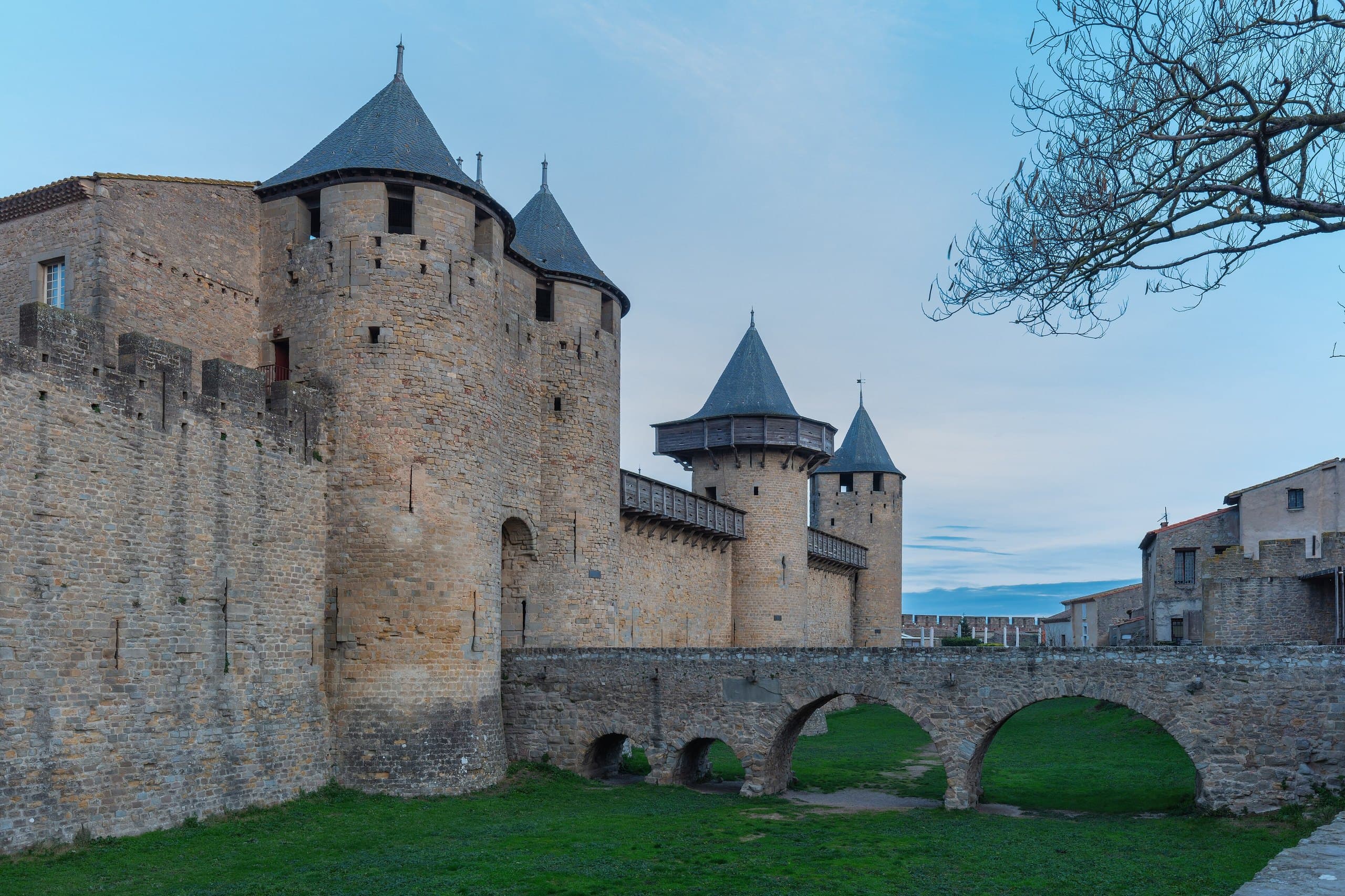
No region of France holds more of our catalog than the old Languedoc, and none carries a harder story. When people picture a medieval fortress they are often picturing Carcassonne Castle without knowing it: a double ring of honey-colored walls and round towers in the Aude, restored from 1853 in a campaign that ran to 1911, long outliving Viollet-le-Duc, who died in 1879 and was succeeded by Paul Boeswillwald, and inscribed by UNESCO in 1997. It is worth knowing what was rebuilt and what was not. The damage was concentrated at the top, so the lower courses are genuinely old and the skyline is not; Viollet-le-Duc roofed towers that had stood without roofs, and in slate rather than the flat tiles of the region. The Gallo-Roman towers are horseshoe-shaped, round toward the field and flat toward the city.
South of it, a line of mountain fortresses watches the passes toward the old border with Aragon. Château de Peyrepertuse is the largest, a ridge three hundred meters long and fifty wide climbing from about six hundred meters above sea level at its eastern end to eight hundred and fifty at its western summit, the nomination body’s vaisseau de pierre, a stone ship. It was never besieged. Its rock-cut stair was ordered by Saint Louis in 1242, and what survives today is vestiges: the eastern curtain has gone entirely and two of the three upper towers are razed to first-floor level. Château de Quéribus stands on its own pinnacle nearby. Both are routinely labelled châteaux cathares, and the Aude’s own tourist board says that label is applied à tort, wrongly. What a visitor climbs to is a French royal frontier fortress, restructured in the second half of the thirteenth century to hold newly conquered territory; the phrase citadelles du vertige is the historian Michel Roquebert’s, and he coined it for the group rather than for any one of them.
Westward in the Ariège, Château de Montségur crowns the summit bound forever to a siege that began in 1243, ran about eleven months, and ended in surrender on 16 March 1244, after which more than two hundred and thirty Cathars who would not recant were burned below the rock. What stands on the pog today is the royal remodel that followed, garrisoned into the seventeenth century. Château de Foix was a seat of power rather than a refuge, the command center of the counts of Foix from about the year 1000 until 1589, when Henri de Navarre became Henri IV and the county passed with him to the crown.
The catalog goes deeper still: the four Châteaux de Lastours, strung along a single knife-edge of rock in the Montagne Noire between 260 and 285 meters, are not the strongholds of the Cathar wars but the crown’s replacements for them: the castral village was demolished from 1240 and the four towers rebuilt from the middle of the thirteenth century, each covering the next, Cabaret’s keep pentagonal where Tour Régine and Quertinheux are round. Château de Puilaurens is probably the best-preserved of the royal fortresses established in the region during the thirteenth century, its curtain eight to ten meters high at 697 meters above the sea, though its crenellation is likely a sixteenth- or seventeenth-century restoration and nothing of the pre-royal castle survives, the earlier castle probably razed for Louis IX’s rebuild of 1255. Château de Termes and, at the region’s eastern edge, Fort Saint-André complete the group.
These strongholds are so entangled with the story of the Cathar faith and the crusade that destroyed it that we tell the region twice. The Cathar Castles follows the human story, the faith, the refuges, and the fall; Royal Fortresses of Languedoc follows the stones. In July 2026 UNESCO inscribed eight of these fortresses as the Royal Capetian Fortresses of Languedoc, a single serial property: Carcassonne, Lastours, Montségur, Peyrepertuse, Puilaurens, Termes and Quéribus, all covered here, together with Aguilar, which is not yet in the Atlas.
Beyond These Regions
The map of France is far from finished. Brittany, with the Château des Ducs de Bretagne at Nantes and the ramparts of Fougères, follows, and the Dordogne’s river strongholds, Beynac and Castelnaud among them, are on the horizon. Each will join this page as its guides publish. Several of the places on this page are also the subjects of our castle documentaries, free films that set the story each one is known for against the historical record, with a cited guide behind every episode. And France is only half of the Atlas: across the Rhine, our companion guide to The 15 Best Castles in Germany opens a catalog of more than sixty German castle guides, joined to this one by the Haut-Kœnigsbourg, the castle both countries can fairly claim.
Planning a Visit
You cannot see the châteaux of France in one trip, and you should not try. The map at the top of this page is the quickest way to see which ones cluster: select any château and it lists its nearest neighbours with driving times.
Five of them are a train ride from central Paris with no car at any point, and knowing which line is most of the battle. Versailles has three stations on three different lines, which is why it survives the engineering closures that regularly take out the closest one: Transilien line L from Saint-Lazare to Versailles Rive Droite, line N from Montparnasse to Versailles Chantiers, and RER C to Versailles Château-Rive Gauche, the nearest to the gates. Fontainebleau is Gare de Lyon to Fontainebleau-Avon and then the bus. Vincennes is simplest of all: Métro line 1 runs east to a station called Château de Vincennes. Chantilly is one station served two ways, about twenty-five minutes on the main line from Gare du Nord or about forty-five on RER D. And Compiègne, which is missing from most lists of castles near Paris, is among the easiest: Gare du Nord, between forty minutes and an hour and twenty depending on the train, then a ten-minute walk.
Eight of the forty-six are in the care of a single operator, the Centre des monuments nationaux: Carcassonne, Vincennes, Angers, Azay-le-Rideau, Pierrefonds, Fort Saint-André, the Château d’If and the abbey of Mont-Saint-Michel. If your trip leans on those, you are dealing with one institution rather than eight.
Beyond the capital the picture changes by region. The Loire is usually described as car country and it does not have to be: Blois is a genuine car-free base, with the Rémi coach line running to Chambord all year and a separate seasonal shuttle reaching Chaumont, Beauregard and Cheverny. Tours, Blois or Amboise all work as anchors. In Alsace the interchange is Sélestat, where a shuttle climbs to the Haut-Kœnigsbourg. In the south, Avignon puts the Palais des Papes, Tarascon and Les Baux within a short drive, while Carcassonne anchors the fortress country of the Aude. Be honest with yourself about that last group: the Aude fortresses are the most dispersed on this page, scattered along the Corbières ridges rather than gathered in one town, and Peyrepertuse, Quéribus and Puilaurens each sit at the top of their own climb, at or near seven hundred meters. Occitanie is the region that most rewards a dedicated trip and least rewards a day out.
Seasons matter more than the calendar suggests, and rarely for the reasons people expect. Villandry’s gardens are replanted twice a year, so June and September are two different gardens rather than a peak and a decline, and the estate makes a point of its winter light. Versailles closes some of its bosquets out of season. The Alsace castles are largely seasonal, with the Haut-Kœnigsbourg the exception. It closes on 1 January and on 25 and 26 December and on no other day, and the second Christmas holiday is an Alsace-Moselle peculiarity that the rest of France does not keep. In the south, heat is now managed rather than endured: several major operators publish a graded canicule protocol under which an orange heat warning shortens the visiting day and a red one shortens it further and cancels guided tours.
Budget more time than the ticket suggests. The Haut-Kœnigsbourg’s own guidance distinguishes an hour for the tour from two hours car park to car park, and that extra hour is the one visitors fail to plan for. Fontainebleau asks for about two hours. Villandry inverts the usual expectation: an hour for the château, an hour and a half for the gardens.
Accessibility varies more than any other practical fact here, and it is worth checking before you commit. The Haut-Kœnigsbourg describes itself as inaccessible to wheelchair users, twice and without hedging: 300 steps of varying height across twenty-one levels, the first flight at the ticket check. The lower courtyard can be reached from the car park up a three-hundred-meter earth track with a companion. Villandry’s ground floor is entirely accessible; its upper floors and donjon are stairs only, and its adapted garden route runs a kilometer and a half over cobbles and gravel with gradients.
Wherever you start, book the headline monuments ahead in high season. You can compare hotels across France on Booking.com, and reserve castle tickets, day trips, and skip-the-line entries through GetYourGuide, which is worth doing well in advance for Versailles, Chambord, and Carcassonne especially.
Some links on this page are affiliate links, which means StoneKeep Atlas may earn a small commission, at no extra cost to you, if you book through them.
Common Questions
How many châteaux are there in France?
France’s châteaux are usually counted at 40,000 to 45,000, a figure the national tourism agency and most travel writing repeat without a source. It is very close to a real number that means something else: the Ministère de la Culture recorded 45,223 protected immovable monuments at the end of 2024, a legal category that takes in bridges, gardens and archaeological sites as well as buildings, of which religious architecture is 34 percent and military architecture 4 percent. Counting the ministry’s own register instead, about 6,300 protection notices carry the denomination château or château fort, against more than 10,400 for église. The true national figure is unknowable rather than merely unknown, because a château that has never been protected appears in no register at all. The same question asked of ten countries at once is harder still.
What is the most visited château in France?
Versailles, and not narrowly. It recorded 8.4 million entries in 2024 on the Ministry of Culture’s own count, a total second only to the Louvre’s 8.7 million on the same page of the ministry’s report. That figure counts admissions including free entries, which is worth knowing because comparisons in this field are often made between incompatible numbers: the four-million figure frequently quoted for Carcassonne counts visitors to the free-entry medieval city, not to the ticketed château and ramparts.
Where are most of France’s castles?
They are spread across every region, but they cluster for reasons you can read off a map. The Loire Valley holds the royal Renaissance houses, because the court hunted and built there in the fifteenth and sixteenth centuries. Alsace keeps some eighty surviving hill-castle sites along the Vosges front, which the regional tourism agency counts among the largest such concentrations in Europe. And the old Languedoc holds the royal frontier fortresses, eight of which now form a single UNESCO property.
Which châteaux can you visit from Paris without a car?
Five, comfortably, all on scheduled trains: Versailles, Fontainebleau, Vincennes, Chantilly and Compiègne. Vincennes is inside the Métro network. The others are between twenty-five minutes and an hour and twenty from a Paris terminus, and each has a station within walking distance or a connecting bus. Chambord and the Loire châteaux are a longer day and need a coach connection from Blois.
What is the difference between a château and a castle?
A château is not necessarily a castle. The French word covers a fortified stronghold and an undefended country house equally, which is why Versailles and Peyrepertuse carry the same noun, and several of the operators on this page say as much about their own buildings. English draws the line differently, reserving castle for the fortified building. We take that distinction apart properly in our guide to castles, palaces and fortresses.
Which château did Leonardo da Vinci live in?
The Château du Clos Lucé at Amboise, where he spent the last three years of his life after François I invited him to France in 1516, and where he died on 2 May 1519. It is the only home of his that is known apart from Vinci itself. In October 1517 a visiting cardinal’s secretary recorded seeing three paintings in that house: the Mona Lisa, the Saint Anne and the Saint John. He is buried a few minutes away at the Château d’Amboise.
One Country, a Thousand Years of Castles
Read together, the forty-six guides behind this page tell a single story in seven regional accents. The south built for war and kept building after the war was won; the Loire turned fortresses into theater; Paris turned houses into instruments of rule; Alsace kept a mountain frontier in stone; Normandy held a border until the duchy was lost; and the nineteenth century, at Pierrefonds as at Carcassonne and the Haut-Kœnigsbourg, rebuilt the Middle Ages it wished it had inherited, which is why the most photographed medieval skylines in France are among its newest. Every château named here links to a full StoneKeep Atlas guide with its history, its visiting practicalities, and its sources. Or follow a thread across the map instead: our roundup of the fairytale castles in France gathers the eight châteaux, from the Loire to the Oise and Alsace, whose silhouettes look drawn from a storybook. Pick a region, and start walking.
Principal Sources
- Agence d’Attractivité de l’Alsace. Alsace, terre de châteaux forts, dossier de presse thématique. 2025.
- Aude Tourisme, the departmental tourist board, for the à tort ruling on the Cathar-castle label. audetourisme.com.
- Avignon Tourisme. “Le plus grand palais gothique.” palais-des-papes.com.
- Centre des monuments nationaux, for the fortresses and châteaux in its care, including Carcassonne, Vincennes, Angers, Azay-le-Rideau, Pierrefonds, Fort Saint-André, the Château d’If and the abbey of Mont-Saint-Michel. monuments-nationaux.fr.
- Château de Chambord. “Architecture.” chambord.org.
- Château de Versailles, for the estate’s scale and the Hall of Mirrors. chateauversailles.fr.
- Domaine national du Palais de Fontainebleau. chateaudefontainebleau.fr.
- Forteresses royales du Languedoc, the nomination body for the 2026 serial inscription. forteressesroyalesdulanguedoc.fr.
- Institut de France, for the terms of the Duc d’Aumale’s 1886 bequest of Chantilly. institutdefrance.fr.
- Ministère de la Culture. La protection au titre des monuments historiques, bilan 2023. culture.gouv.fr.
- Ministère de la Culture. Patrimostat 2025, attendance figures for 2024. culture.gouv.fr.
- Ministère de la Culture. “Les biens français inscrits sur la Liste du patrimoine mondial de l’Unesco.” culture.gouv.fr.
- Ministère de la Culture, base Mérimée and the Plateforme ouverte du patrimoine, for the individual protection notices cited above. pop.culture.gouv.fr.
- Ministère de la Culture, DRAC Occitanie. “Les Forteresses royales capétiennes du Languedoc inscrites sur la liste du patrimoine mondial de l’UNESCO.” culture.gouv.fr, for the inscription of 26 July 2026 at the 48th session of the World Heritage Committee.
Image credits. Hero, Château de Chambord: Dorian Mongel, Unsplash. Chenonceau: Ant°AM, CC BY-SA 4.0. Versailles: ToucanWings, CC BY-SA 3.0, via Wikimedia Commons. Pierrefonds and Haut-Kœnigsbourg: Adobe Stock, licensed. Palais des Papes: licensed via Envato. Carcassonne: Diego Delso, CC BY-SA 4.0, via Wikimedia Commons.