
Château de Quéribus
A Castle to Make You Dizzy
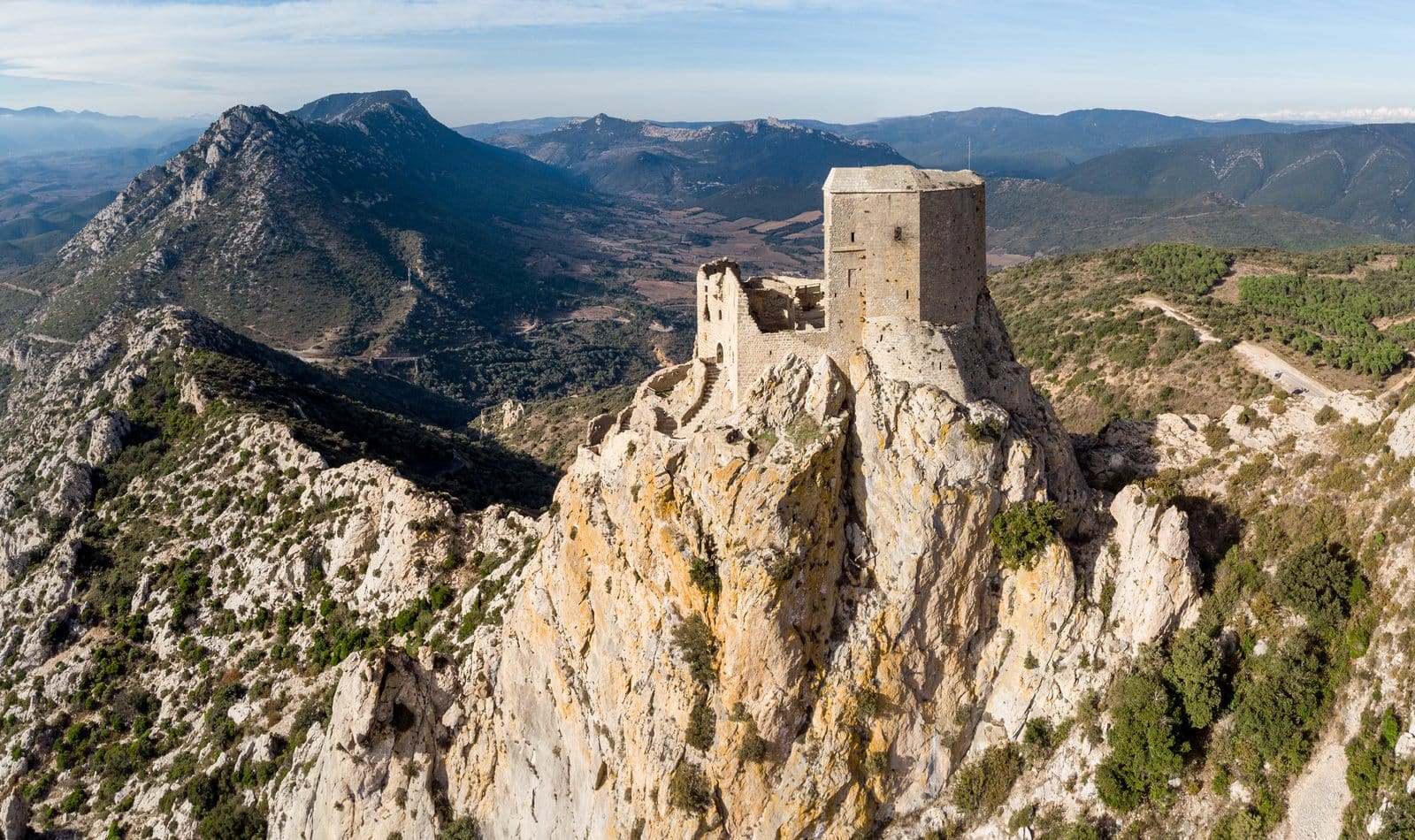
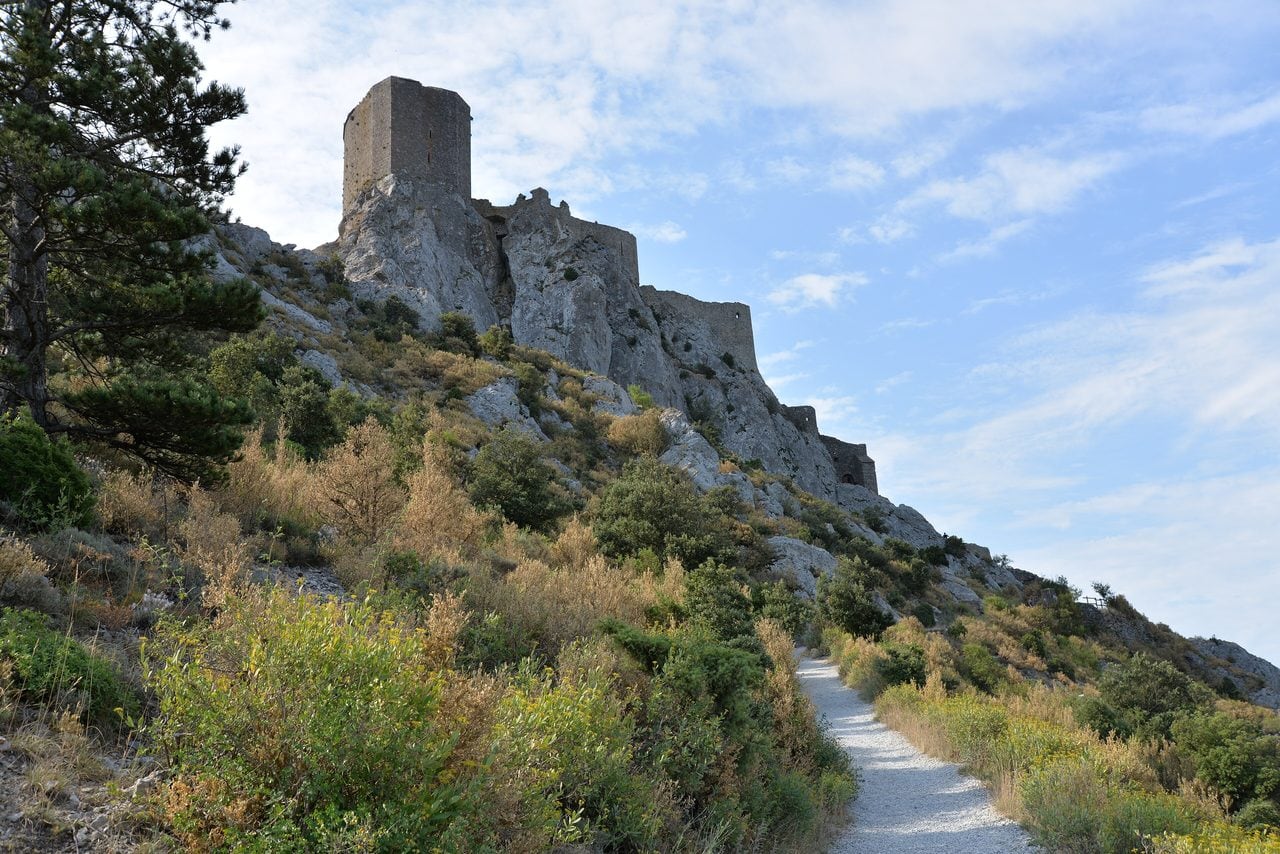
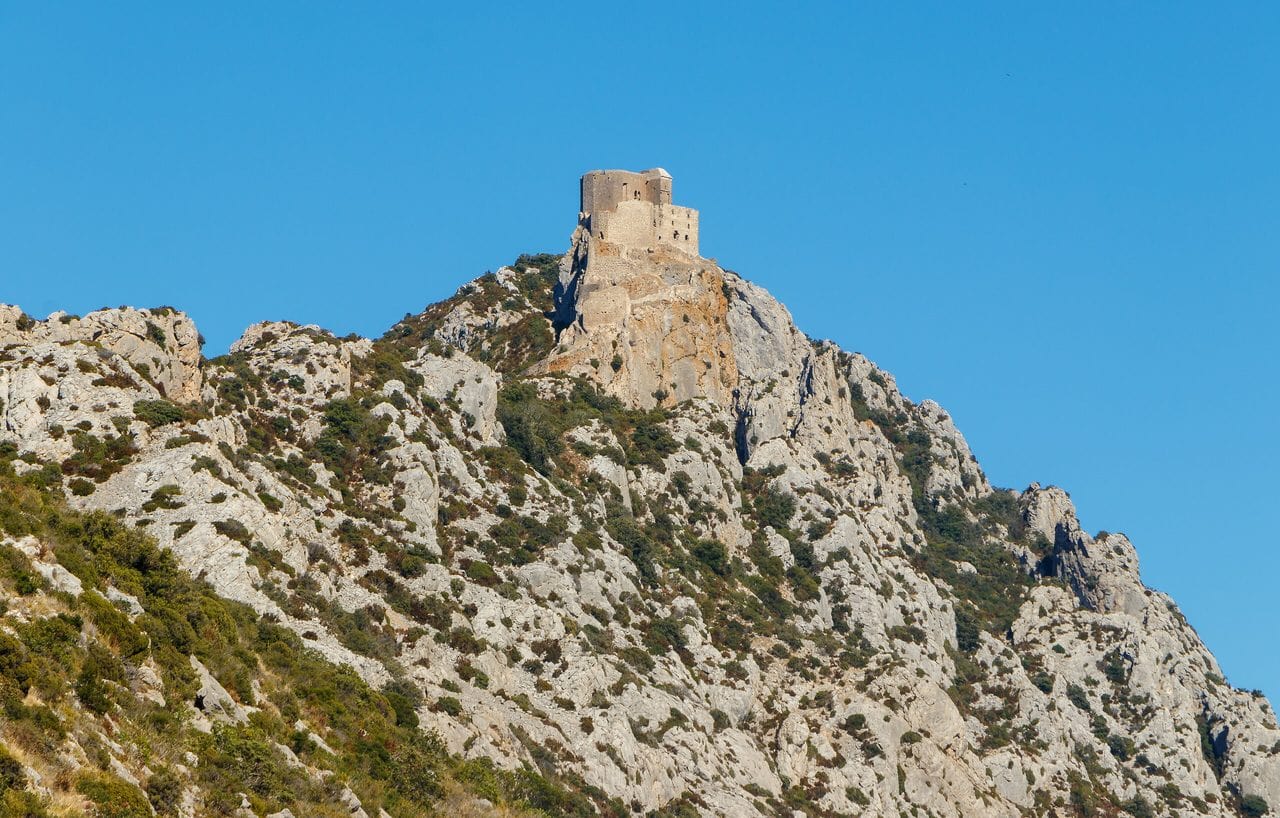
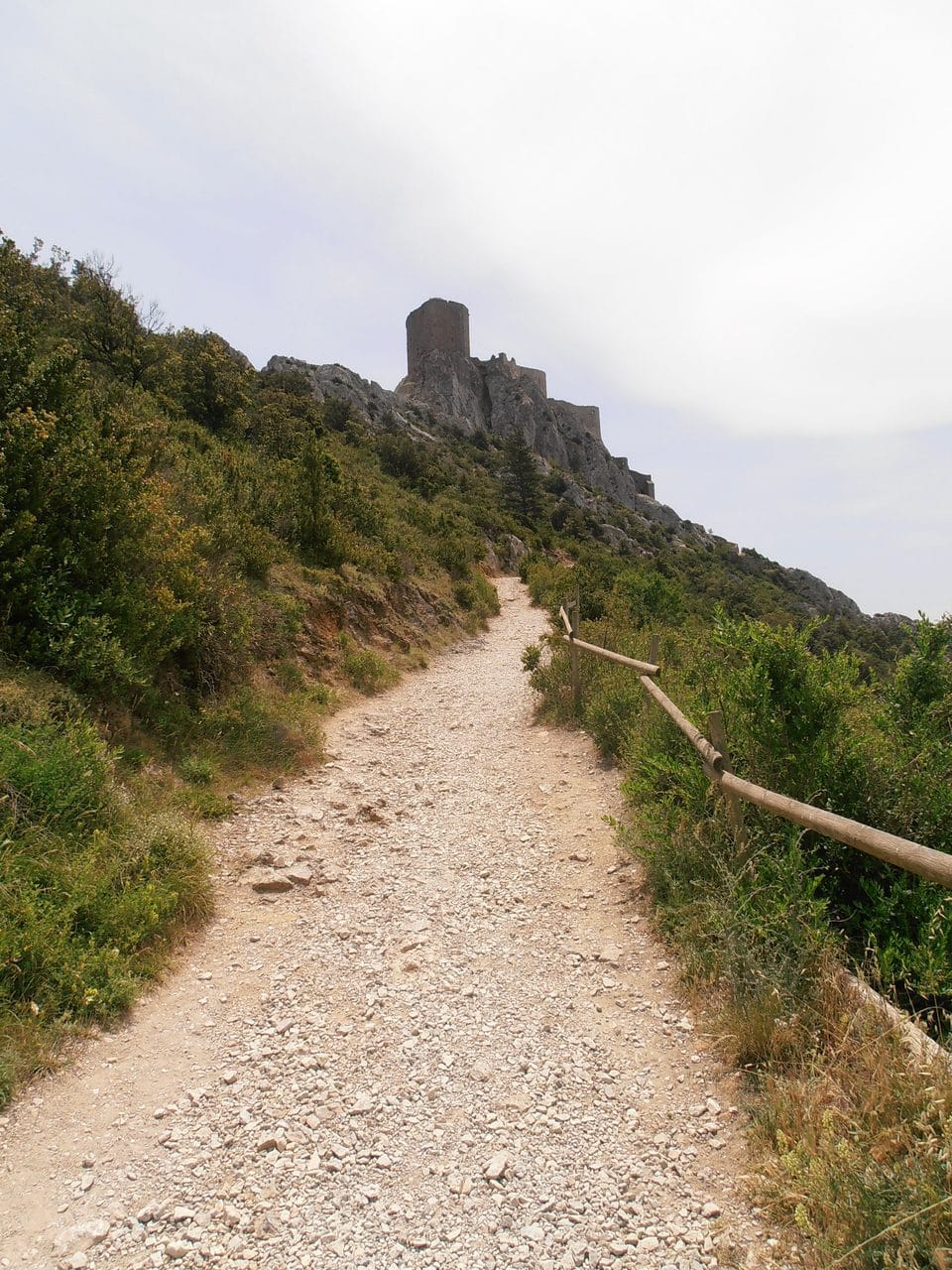
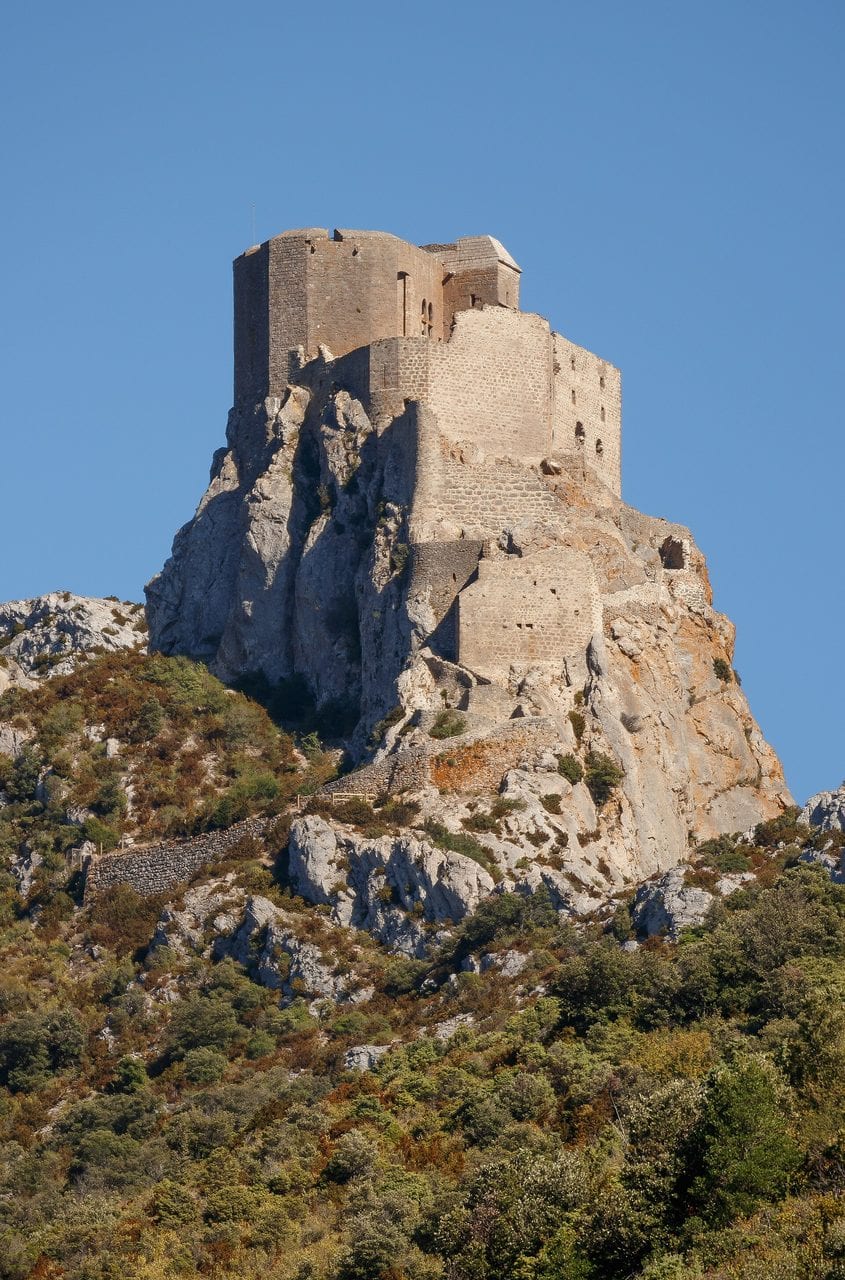
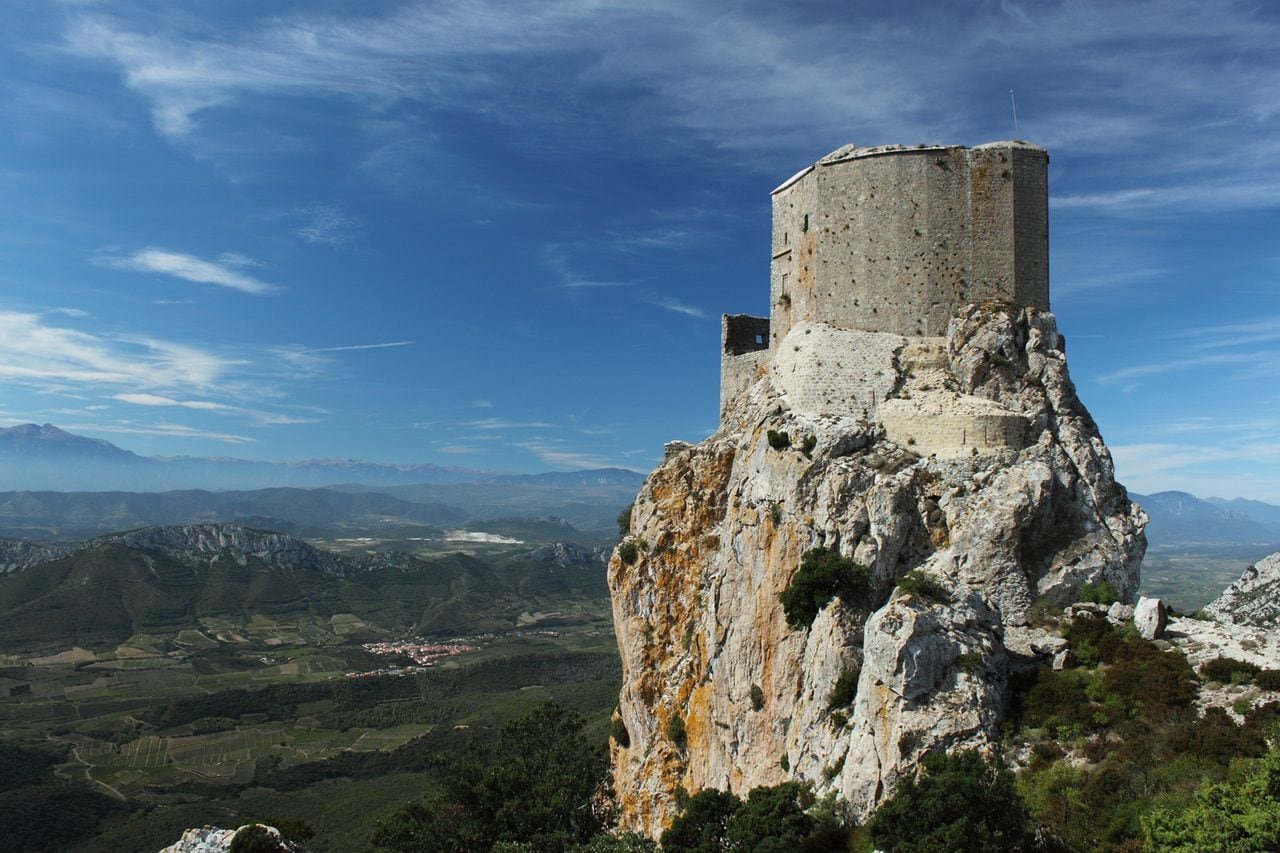
The Château de Quéribus does not so much sit on its mountain as balance on it. This fortress crowns a narrow spur of rock at 728 meters, on the southern crest of the Corbières, and from below its silhouette reads less like a building than like a tooth of stone the weather forgot to wear down. The historian Michel Roquebert coined citadelles du vertige, citadels of vertigo, for the whole group of these perched fortresses, and Quéribus earns the name as well as any of them. Cars stop at the foot of the spur; the last stretch is a ten-minute climb on foot, through three lines of wall, before the keep finally opens out and the ground falls away on every side.
 CC BY-SA 3.0" srcset="https://stonekeepatlas.com/wp-content/uploads/2026/06/chateau-de-queribus-approach-path.jpg 1280w, https://stonekeepatlas.com/wp-content/uploads/2026/06/chateau-de-queribus-approach-path-300x200.jpg 300w, https://stonekeepatlas.com/wp-content/uploads/2026/06/chateau-de-queribus-approach-path-1024x683.jpg 1024w, https://stonekeepatlas.com/wp-content/uploads/2026/06/chateau-de-queribus-approach-path-768x512.jpg 768w" sizes="auto, (max-width: 1280px) 100vw, 1280px" />
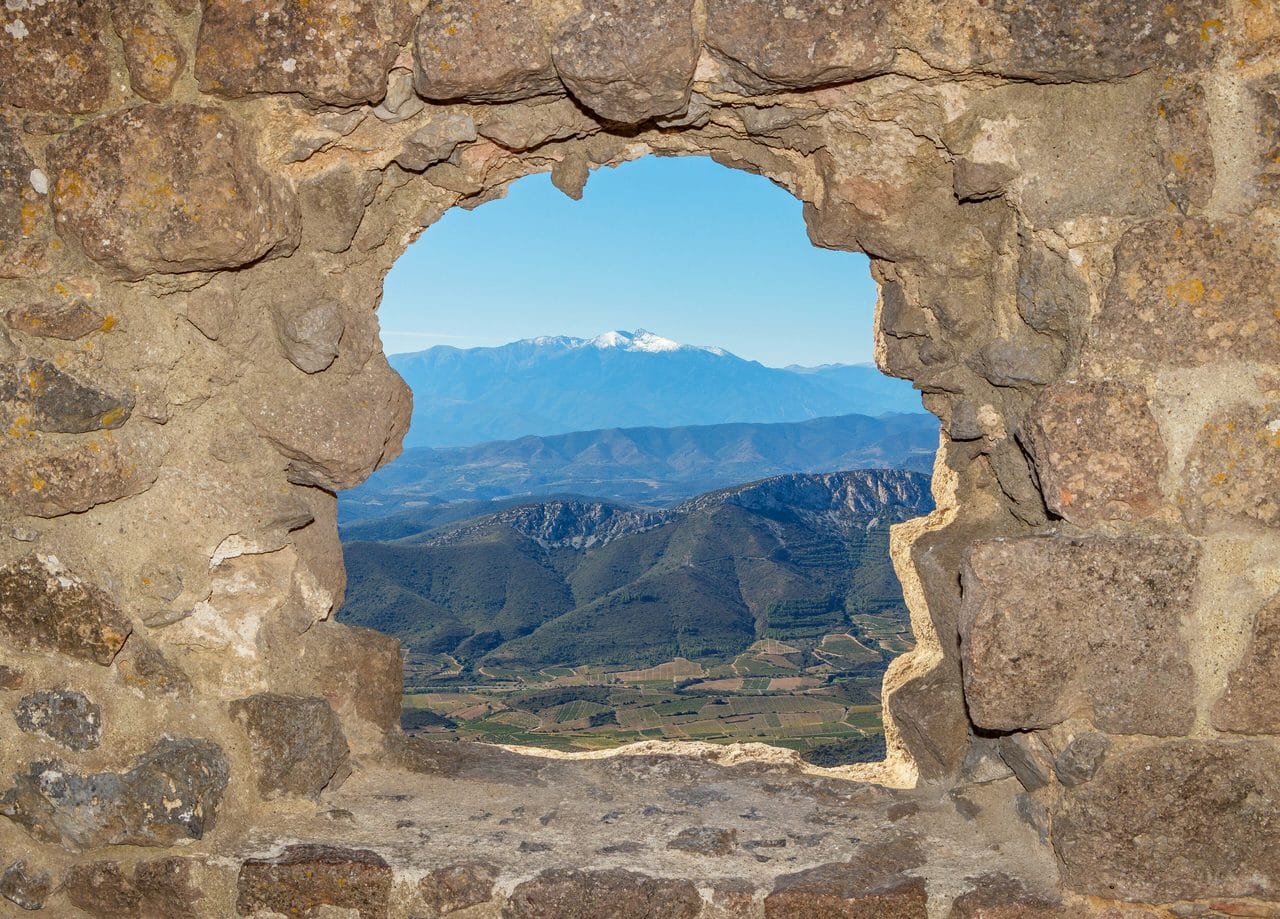
The reward is one of the great views of the French south. On a clear day the terrace of the keep takes in the Roussillon plain, the vineyards of Maury directly below, the long blue wall of the Pyrenees to the west, and the Mediterranean glittering to the east. Quéribus is the southernmost and the smallest of the famous “Five Sons of Carcassonne,” and where its larger sibling Peyrepertuse sprawls across an entire ridge a few kilometers away, Quéribus concentrates everything into a single dramatic upthrust. It is also the fortress most often remembered as the last refuge of Cathar resistance, the place where a persecuted faith made its final stand before the frontier of France closed over it.
Quick Facts
| Location | Cucugnan, Aude, Occitanie, France |
| Type | Royal frontier fortress (ruined) |
| First recorded | 1020; rebuilt for the French crown, late 13th–14th centuries |
| Elevation | 728 meters (2,388 feet) above sea level |
| Condition | Partially ruined |
| Managed by | Commune of Cucugnan |
| Protection | Monument historique (1907) |
| UNESCO | Component of the Royal Capetian Fortresses of Languedoc, inscribed 26 July 2026 |
| Admission (2026) | Adults €9; reduced €8; children 6–12 €5.50; family passes from €17 |
| Hours | Open most of the year; closed December 25, January 1, and roughly January 5–31. Seasonal: about 10:00–16:30 in winter to 9:00–19:45 in July–August |
| Website | cucugnan.fr |
From the Counts of Besalú to the Crown of Aragon
Quéribus enters the written record early. It first appears in 1020, under the Latin name Popia Cherbucio, in the will of Bernard Taillefer, count of Besalú, the very same testament that gives us the earliest mention of nearby Peyrepertuse. At that point the castle guarded the southern reach of a Catalan county rather than any French border.
 CC BY-SA 3.0" srcset="https://stonekeepatlas.com/wp-content/uploads/2026/06/chateau-de-queribus-ridge-distant.jpg 1280w, https://stonekeepatlas.com/wp-content/uploads/2026/06/chateau-de-queribus-ridge-distant-300x192.jpg 300w, https://stonekeepatlas.com/wp-content/uploads/2026/06/chateau-de-queribus-ridge-distant-1024x654.jpg 1024w, https://stonekeepatlas.com/wp-content/uploads/2026/06/chateau-de-queribus-ridge-distant-768x491.jpg 768w" sizes="auto, (max-width: 1280px) 100vw, 1280px" />
In 1111 the county of Besalú passed to the counts of Barcelona, and when the house of Barcelona took the crown of Aragon in 1162, Quéribus became a frontier fortress of the Aragonese realm, watching the approaches from the north. For most of the twelfth century it was a Spanish castle, not a French one, a fact that explains a great deal about what happened next. When the armies of northern France swept into Languedoc in the thirteenth century, Quéribus stood on the wrong side of a contested line, a stone outpost of a kingdom that lay beyond the mountains.
The Last Refuge
That war was the Albigensian Crusade, launched in 1209 against the Cathars, a dualist Christian movement that the Roman Church condemned as heresy and that had taken deep root across Languedoc. The Cathars taught that the visible world was the work of an evil principle and that salvation lay in renouncing it, a belief that placed them squarely outside the Catholic hierarchy and made them, in Rome’s eyes, a danger to be uprooted. The crusade that followed was savage from the outset; at Béziers in 1209 the town was put to the sword almost wholesale. As the crusading and then royal armies ground through the region over the following decades, dispossessed lords and hunted believers drifted toward the few high castles still beyond easy reach. Quéribus, almost unclimbable and tied to Aragon rather than France, became one of those sanctuaries. Benoît de Termes, a Cathar deacon of the Razès, took refuge within its walls and died there.
 CC BY-SA 3.0" srcset="https://stonekeepatlas.com/wp-content/uploads/2026/06/chateau-de-queribus-keep-pinnacle.jpg 1280w, https://stonekeepatlas.com/wp-content/uploads/2026/06/chateau-de-queribus-keep-pinnacle-300x225.jpg 300w, https://stonekeepatlas.com/wp-content/uploads/2026/06/chateau-de-queribus-keep-pinnacle-1024x768.jpg 1024w, https://stonekeepatlas.com/wp-content/uploads/2026/06/chateau-de-queribus-keep-pinnacle-768x576.jpg 768w" sizes="auto, (max-width: 1280px) 100vw, 1280px" />
Through these years the castle was held by Chabert de Barbaira, a knight sympathetic to the Cathar cause, and for a long while it was shielded as much by politics as by its cliffs. Chabert’s bond with Nuño Sánchez, lord of Roussillon, kept the worst of the crusade at arm’s length. When that protector died in 1241, the shelter dissolved. After the great Cathar stronghold of Montségur fell in 1244, with more than two hundred believers burned at the foot of the mountain, the survivors who could still flee gathered at a handful of remote sites, and Quéribus was among the last of them.
In 1255 Louis IX ordered the seneschal of Carcassonne, Pierre d’Auteuil, to reduce the final holdouts; the conduct of the operation is generally credited to Olivier de Termes, a lord of the region who had fought on the southern side of the crusade in his youth before making his peace with the crown. The defense of Quéribus was led by Chabert de Barbaira, who was captured and surrendered the fortress in May 1255; by most accounts the remaining Cathars slipped away beforehand, toward Aragon or northern Italy where their faith still found shelter. Quéribus is, by tradition, the last bastion of Cathar resistance to fall to the crusaders, more than a decade after Montségur. The label carries a touch of romance, and historians treat it with care, since the surrender was a negotiated affair and not a last battle, but the fortress did mark the end of the line. With it, organized Cathar resistance in the high Corbières was over.
A Royal Frontier Fortress
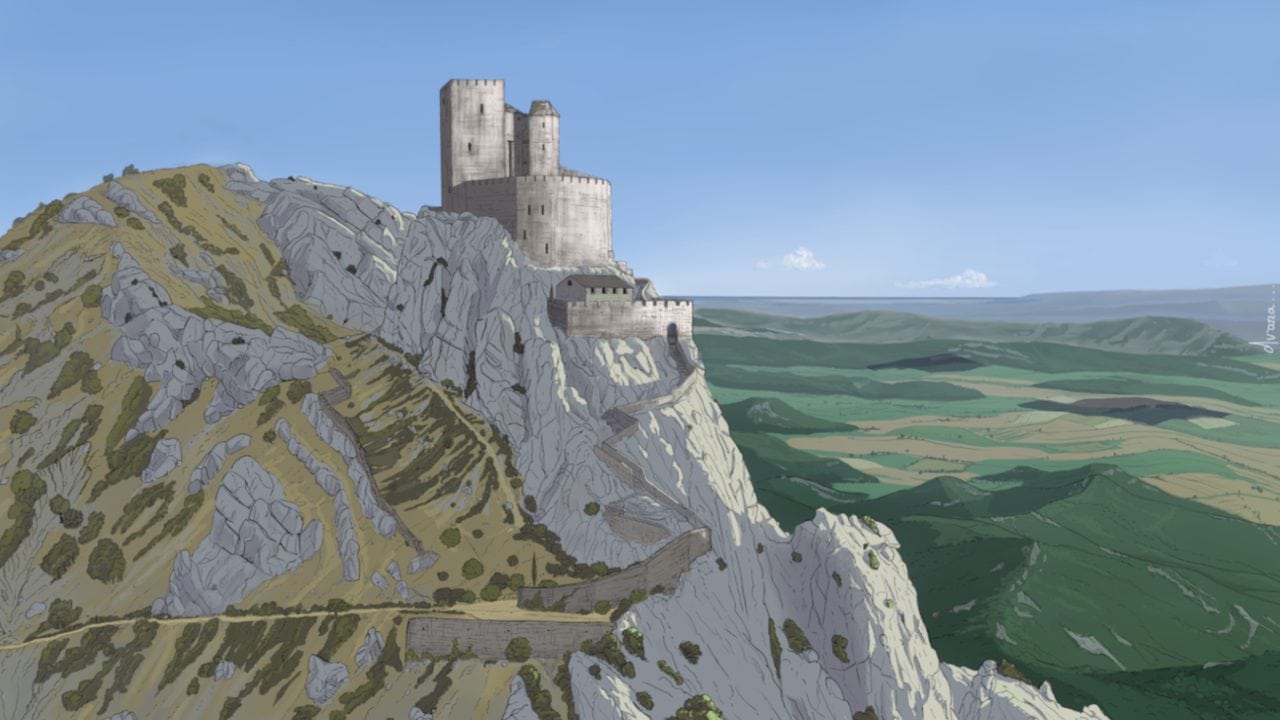
Capture turned Quéribus from a refuge into an instrument of the power that had taken it. The castle passed to the kingdom of France in the reign of Louis IX, and in 1258 the Treaty of Corbeil fixed the border between France and Aragon along the Corbières, a short distance to the south, within sight of the keep. Overnight the fortress changed roles. It was now a French sentinel watching Aragon, one of a line of strongholds rebuilt to anchor the new frontier on the great fortress-city of Carcassonne.
 CC BY-SA 4.0" srcset="https://stonekeepatlas.com/wp-content/uploads/2026/06/chateau-de-queribus-reconstruction-13th-century.jpg 1280w, https://stonekeepatlas.com/wp-content/uploads/2026/06/chateau-de-queribus-reconstruction-13th-century-300x169.jpg 300w, https://stonekeepatlas.com/wp-content/uploads/2026/06/chateau-de-queribus-reconstruction-13th-century-1024x576.jpg 1024w, https://stonekeepatlas.com/wp-content/uploads/2026/06/chateau-de-queribus-reconstruction-13th-century-768x432.jpg 768w" sizes="auto, (max-width: 1280px) 100vw, 1280px" />
That decision was sharpened by a scare. In 1240 the dispossessed viscount Raymond Trencavel tried to retake Carcassonne and failed, and the crown answered by making the city all but impregnable, wrapping it in a second ring of walls and turning the inner château’s defenses against the town itself. In the same campaign the royal administration seized about fifteen feudal castles across the Corbières and rebuilt them, top to bottom, as garrisons of the crown. These are the castles that tradition came to call the Five Sons of Carcassonne: Quéribus, Peyrepertuse, Aguilar, Puilaurens, and Termes, refashioned in the most advanced military style of the age. Built quickly, with great resources, by the same teams and to the same logic, they share a striking family likeness, with their geometric enceintes, round towers pierced for archers, and lodgings set against the curtain walls. The crown rebuilt and enlarged Quéribus across the late thirteenth and fourteenth centuries, raising new walls and the great keep that still crowns the summit. For all its drama, it was held by a tiny force; the operator’s own history records a garrison of only fifteen or twenty men, relying on the cliff and the climb to do most of the defending.
The fortress changed hands only once more, seized by Aragonese forces during Louis XI’s wars over Roussillon around 1473 before returning to France two years later. It kept its frontier purpose for four centuries in all, until politics made it pointless. In 1659 the Treaty of the Pyrenees moved the Franco-Spanish border south to the mountains themselves, and the whole line of Corbières castles found itself stranded far inside France, guarding a frontier that no longer existed. Quéribus lost its garrison, its upkeep, and its reason to be, and began the long slide into ruin.
Inside the Keep: The Salle du Pilier
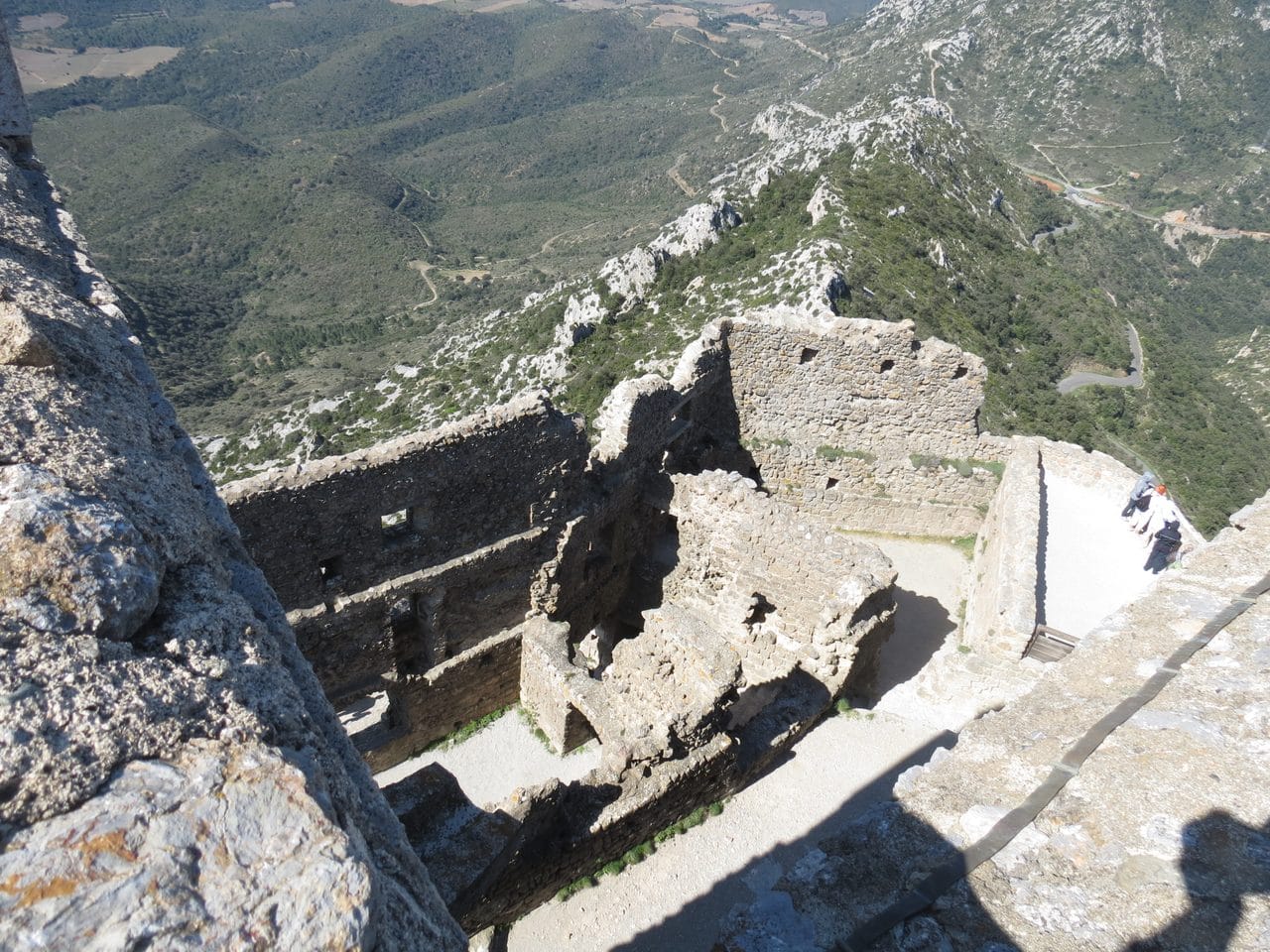
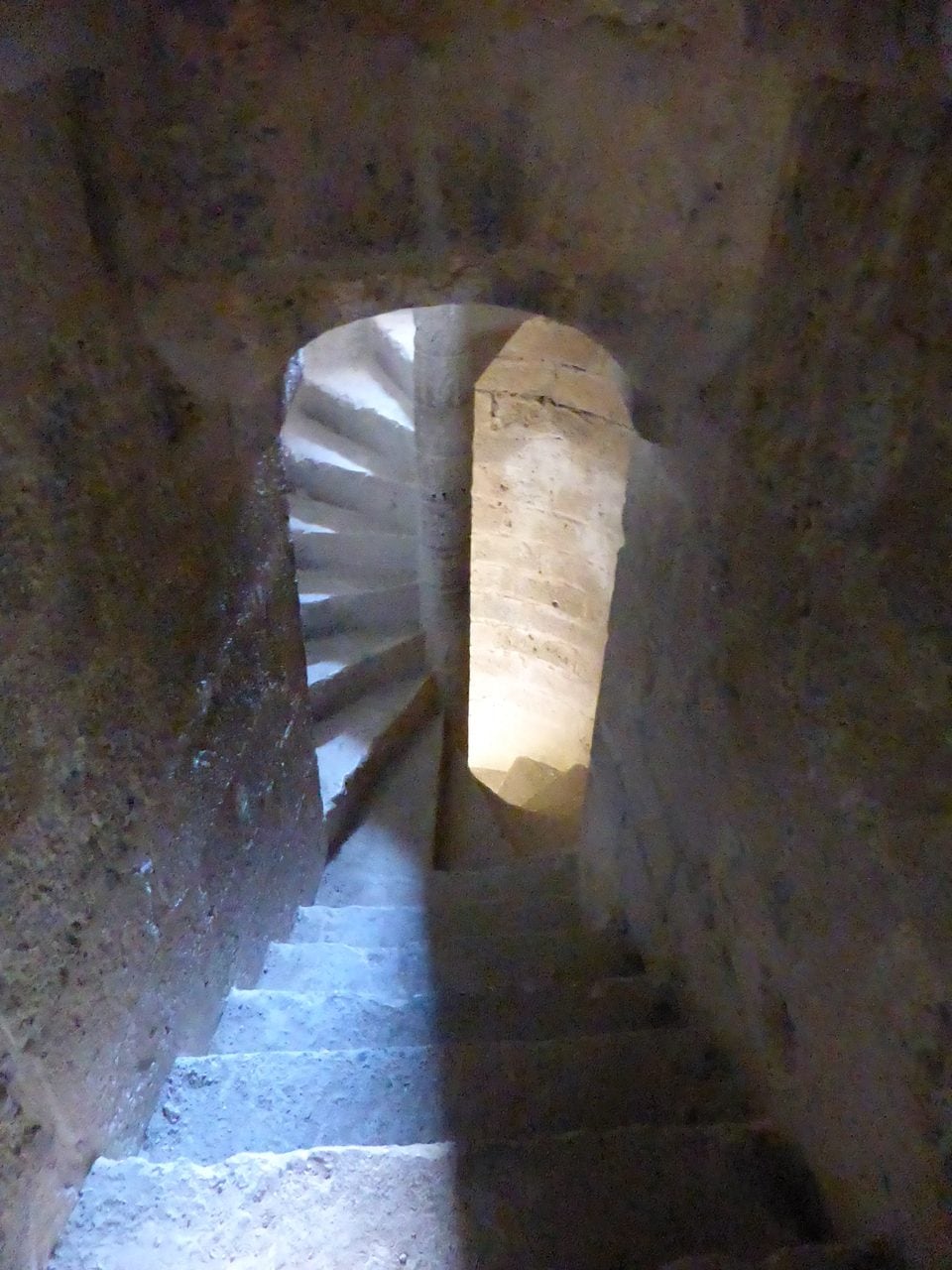
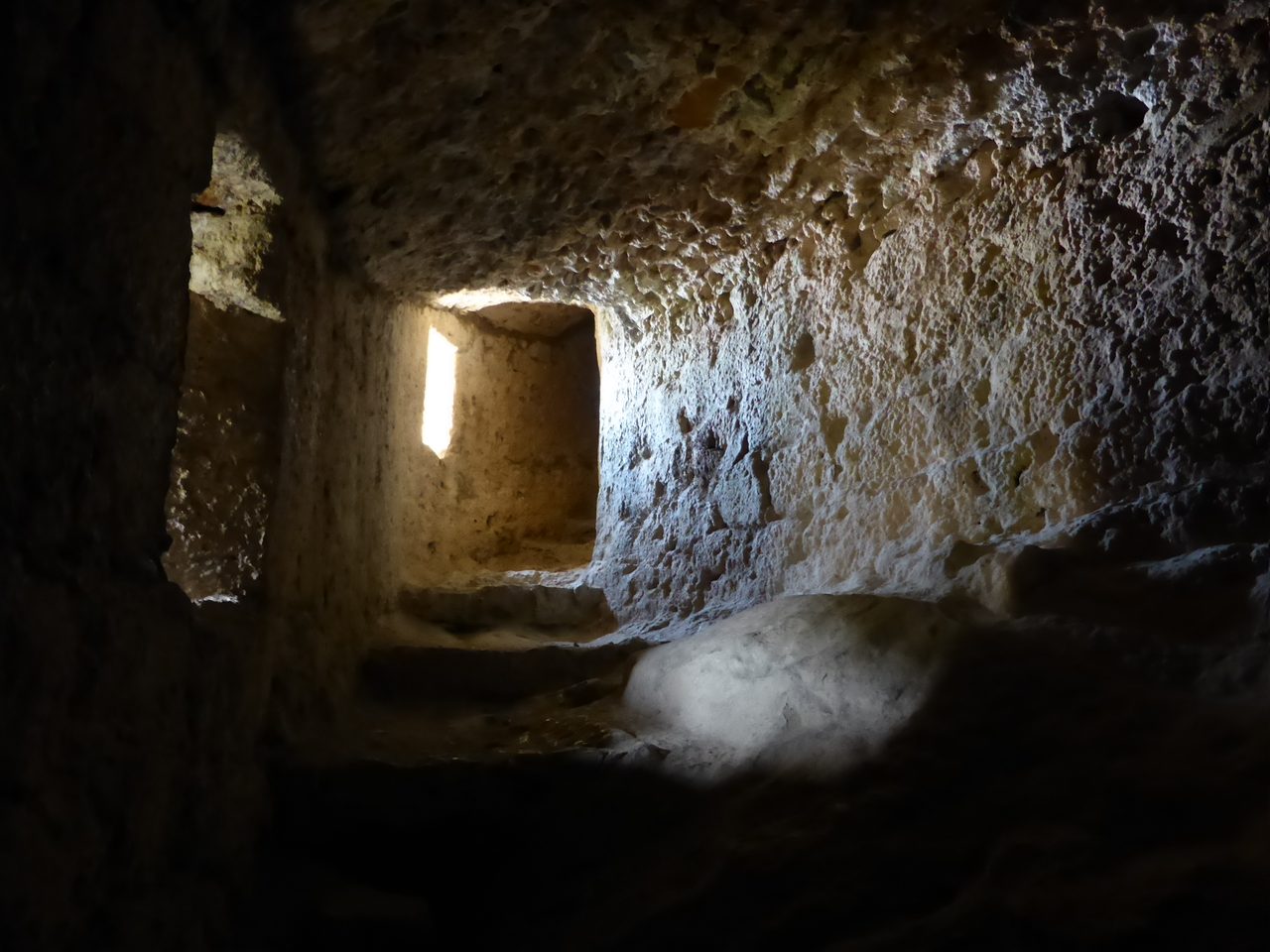
What survives rewards the climb. The approach rises through three successive curtain walls, each set a little higher than the last, and the stonework changes as you go: narrow arrow slits cut for crossbowmen in one stretch give way to wider openings shaped for cannon in another, four centuries of military engineering written into a single ascent. Murder holes and projecting turrets cover the principal gates, and battlemented walkways overlook the weaker points of each wall. Because the rock holds no spring, survival in a siege depended on rainwater, and cisterns hewn into the summit still sit among the living quarters, fireplaces, and storerooms that marked out the life of the small garrison.
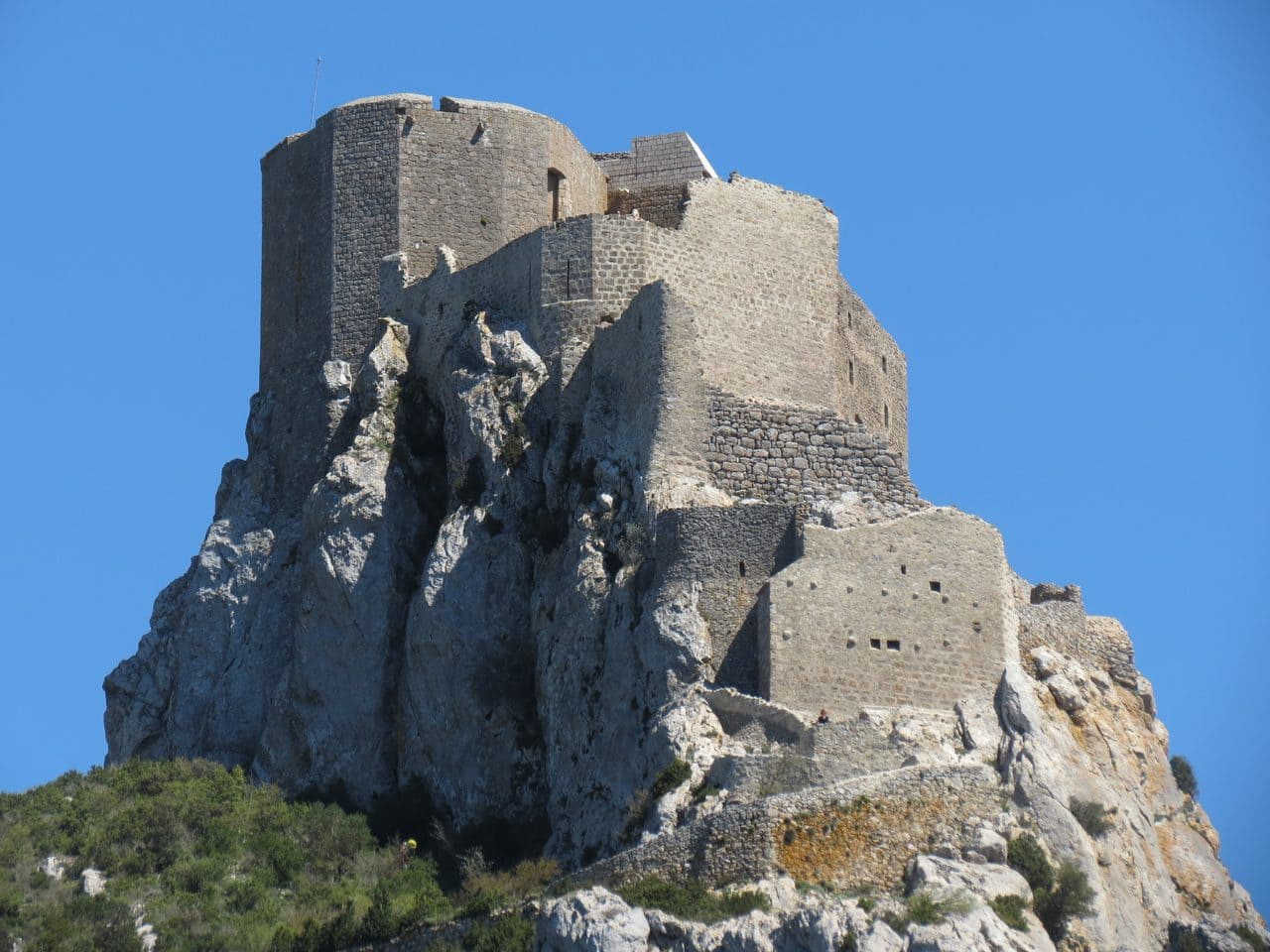
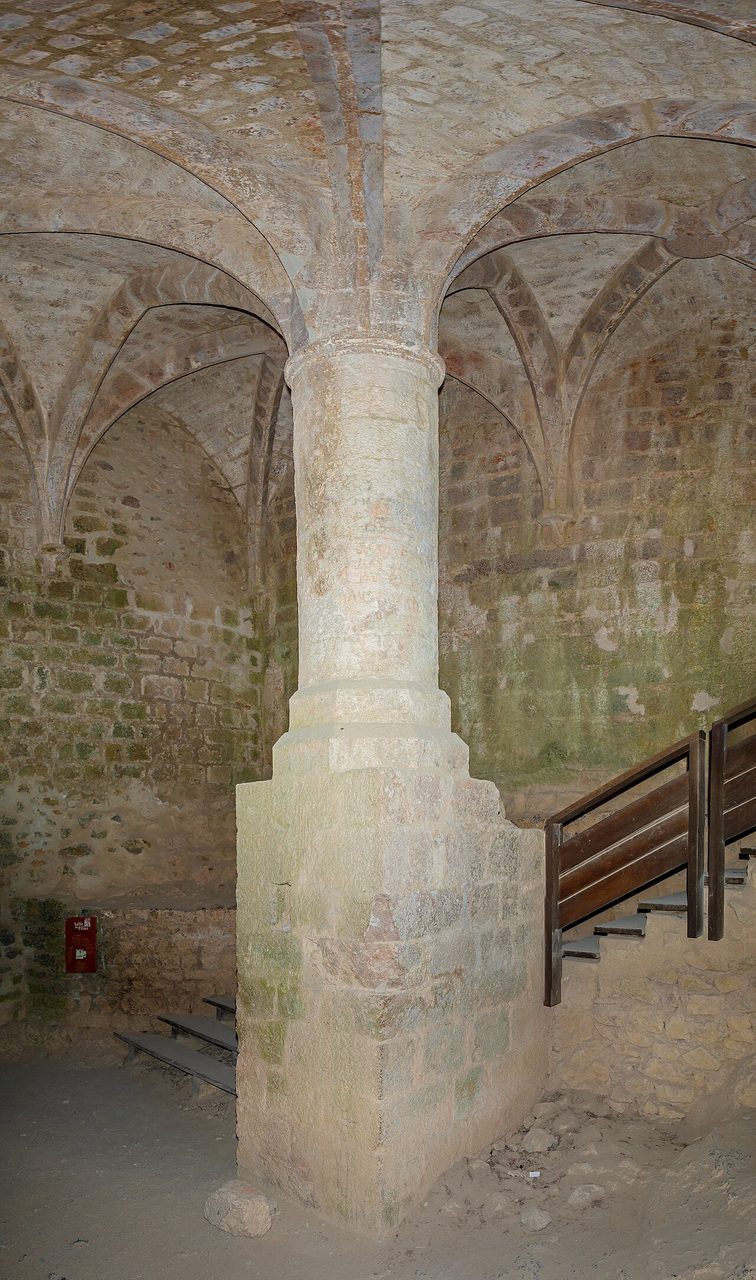
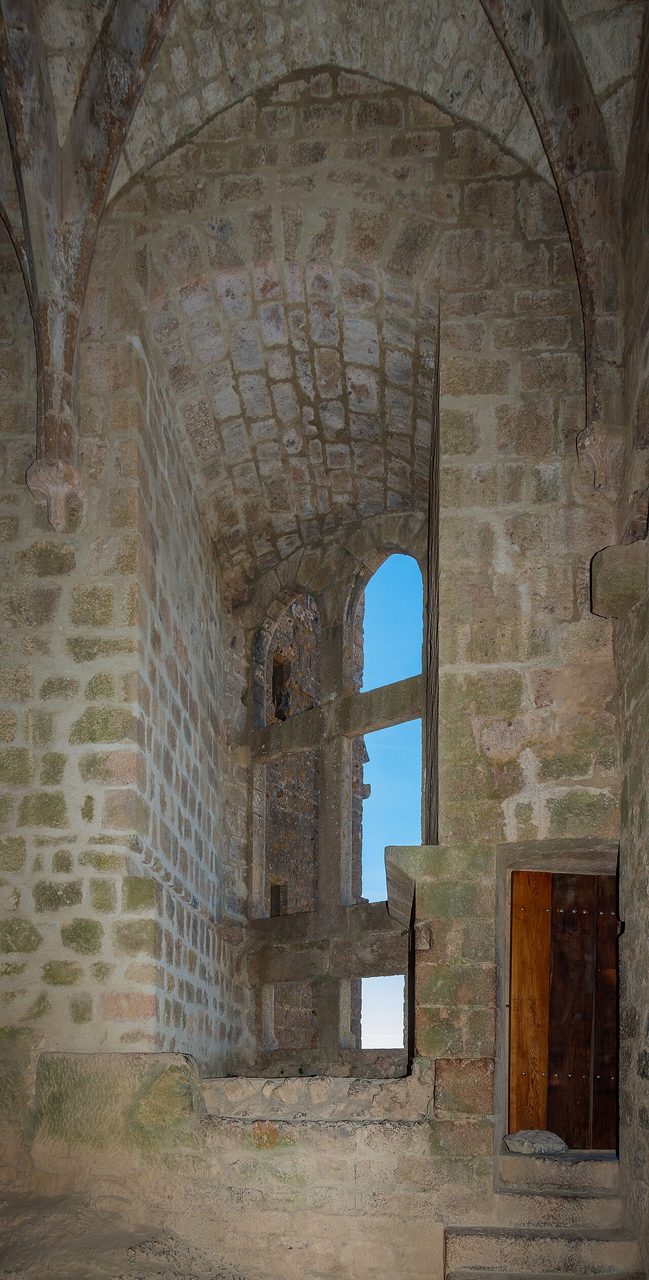
The keep crowns the topmost level, polygonal in plan, an unusual shape dictated by the awkward summit it stands on. Inside it lies the fortress’s masterpiece, the Salle du Pilier, the Hall of the Pillar. It is a Gothic chamber of double height, once split into a lower cellar and an upper hall, lit by a single tall mullioned window so generous that it floods the upper room with light. From one stout cylindrical pillar, set slightly off-center, ribbed vaulting springs outward like the fronds of a palm, dividing the ceiling into four unequal bays. The effect, in a fortress built to repel armies, is startlingly graceful. Visitors sometimes take the hall for a chapel, an easy mistake given the vaulting and the flood of light, but it was a domestic and defensive space of two rooms stacked one above the other, and the line of the vanished upper floor can still be read on the walls. That vault carries the flat roof of the keep, the lookout platform reached by a spiral stair in a turret on the keep’s flank, and from the platform the great panorama opens in every direction. Below the window, the smaller and rougher stones of the lower keep hint that this part of the structure may predate the twelfth century, older than almost anything else on the rock.
 CC BY-SA 3.0"/>
 CC BY-SA 3.0"/>
Ruin, Rescue, and Restoration
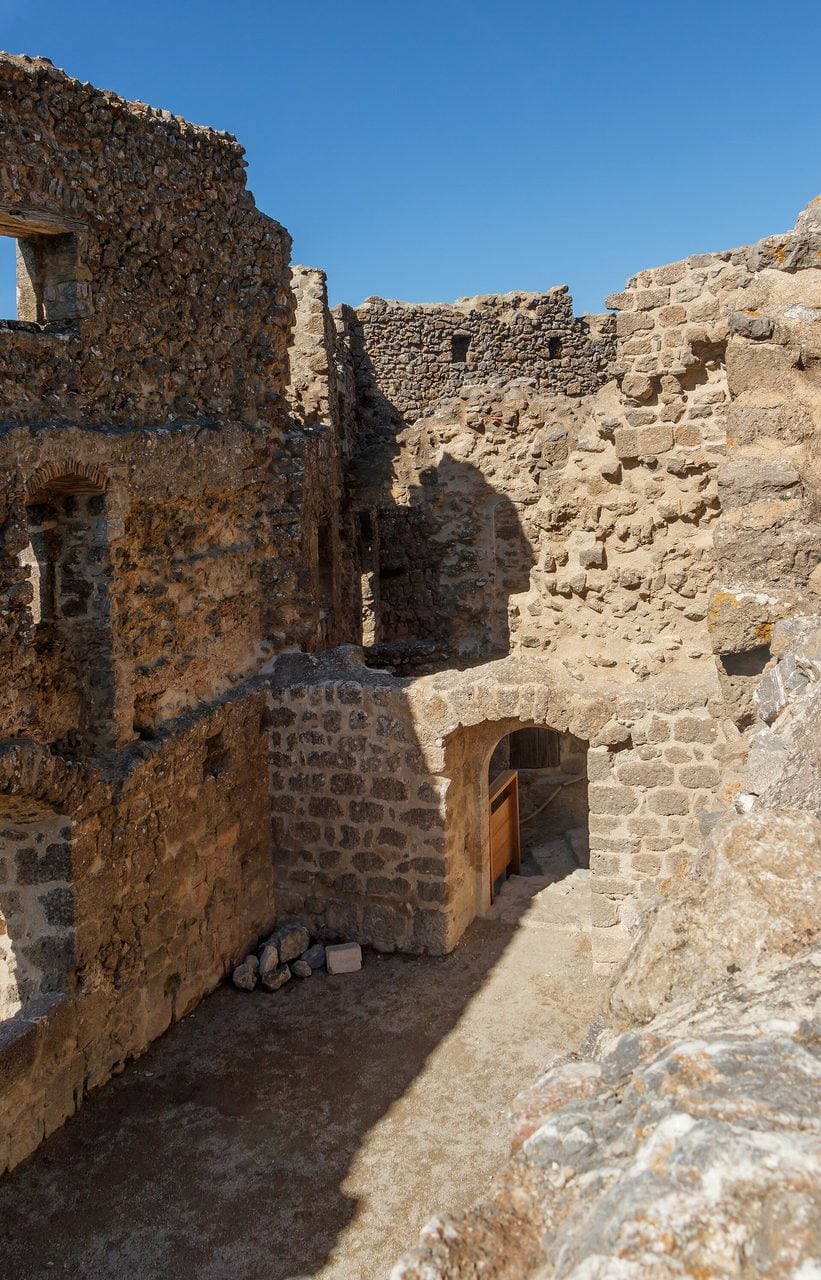
For more than a century after 1659 Quéribus was left to the weather. Roofs failed, walls slipped, and the path grew dangerous. The fortress was not rediscovered as a monument until the modern interest in the Cathar past began to gather, and in 1907 the French State listed it as a monument historique, the legal protection it still carries. Active rescue followed only slowly. Restoration work began on the turret in 1951, gathered pace with a complete restoration between 1998 and 2002, and has continued in stages since. The aim throughout has been to stabilize what survives and make the keep safe to enter rather than to rebuild what was lost, so that what the visitor climbs to today is a genuine medieval ruin, shored up but not reinvented.
 CC BY-SA 3.0"/>
Visiting Château de Quéribus
Quéribus stands above the village of Cucugnan, in the Aude, close to the border with the Pyrénées-Orientales. A free car park sits at the foot of the spur, followed by a short, well-made path of about ten minutes and then a climb through the castle’s own stairs and gates; sturdy shoes are a genuinely good idea, and the full visit takes around an hour. In 2026 admission is €9 for adults, €8 reduced (students, jobseekers, visitors with disabilities, and over-70s), and €5.50 for children aged 6 to 12, with family passes from €17. Down in the village, the Théâtre Achille Mir screens short audiovisual programs, among them a staging of the famous “Sermon of the Curé de Cucugnan,” drawn from Alphonse Daudet’s Letters from My Windmill, and a presentation on the castle itself.
 CC BY-SA 3.0"/>
The fortress opens most of the year, with seasonal hours that run from roughly 10:00 to 16:30 in the colder months out to 9:00 to 19:45 in July and August. It closes on December 25 and January 1, and for a winter break of about three weeks from early January. The village of Cucugnan at the foot of the climb rewards time of its own: a restored windmill, a clutch of artisans, and places to eat, all tied to the comic tale of the scolding Curé de Cucugnan that Daudet borrowed and made famous. Quéribus sits only a few kilometers from Peyrepertuse, and the two are very easily seen on the same day, the small and vertiginous paired with the vast and sprawling. The castle is also one of the eight sites in the “Royal Fortresses of Languedoc,” a serial property that the World Heritage Committee inscribed on 26 July 2026.
Where to stay
StoneKeep Atlas keeps its recommendations independent. The booking links below are affiliate links, which means we may earn a small commission if you book through them, at no extra cost to you.
There is no lodging on the rock itself. The closest beds are in Cucugnan at the foot of the climb and the neighboring wine villages of the Corbières, with a far wider choice in Carcassonne about ninety minutes to the north, a natural base for pairing Quéribus with the walled city and the other mountain castles. Search places to stay near Quéribus. To string several of the perched fortresses into a single outing, guided day trips from Carcassonne take in the Cathar castles together.
Some links on this page are affiliate links, which means StoneKeep Atlas may earn a small commission, at no extra cost to you, if you book through them.
More Views of Château de Quéribus
A fortress this vertical is hard to capture in a single frame. These views move from the rock and its three walls to the polygonal keep and the palm-vaulted Salle du Pilier within.
Beyond Quéribus: The Sentinel Fortresses
Quéribus makes most sense as one link in a chain. A short drive away, the Château de Peyrepertuse is the largest of the Cathar fortresses, a whole ridge turned into a stronghold and a natural companion to a Quéribus visit; the two were sentinels of the same frontier and are often climbed on the same day. Behind them both stands Carcassonne, the mother-fortress whose rebuilt double walls commanded the whole network and gave the “Five Sons” their name.
Together with Aguilar, Puilaurens, Termes, Lastours, and Montségur, these castles now form the “Royal Fortresses of Languedoc,” inscribed by UNESCO on 26 July 2026 under the official name Royal Capetian Fortresses of Languedoc. The name is deliberate: it sets aside the popular “Cathar castles” label, since these strongholds were largely built or rebuilt by the French crown rather than by the Cathars who sheltered in a few of them. More bluntly still, the Aude departmental tourism board says the châteaux cathares label is applied à tort, wrongly. The network they describe was real long before the Committee said so: a line of royal sentinels flung up along a thirteenth-century border, of which Quéribus was the southernmost watchman.
Quéribus was the last of them to fall; our guide to the Cathar Castles tells the whole arc of that resistance.
Conclusion
Quéribus compresses an entire era into a single rock. It was a Catalan outpost, then a Cathar refuge, then a French frontier lighthouse, and finally an obsolete ruin left behind by a moving border, all in the space of a few centuries. What endures is the strangeness of the place: a hall of palm-like Gothic vaulting balanced on a needle of stone, with the Pyrenees on one side and the sea on the other, and a path that still leaves visitors a little out of breath. It is, fittingly for the last stronghold of a vanished faith, a castle suspended between the earth and the sky.
Principal Sources
- Conseil départemental de l’Aude. Materials of the Forteresses royales du Languedoc, the serial UNESCO property it coordinates.
- Langlois, Gauthier. Study of Olivier de Termes.
- Mairie de Cucugnan. Official history and visitor information for the site, which it manages.
- Ministère de la Culture. Base Mérimée listing records.
The account also draws on standard scholarship on the Albigensian Crusade and the royal fortresses of the Corbières. Admission and opening details are taken from the operator’s 2026 schedule and should be confirmed before travel.
Image credits. Aerial view of Château de Quéribus: licensed via Adobe Stock; the approach path: Calips, CC BY-SA 3.0, via Wikimedia Commons; the castle on its ridge: H. Zell, CC BY-SA 3.0, via Wikimedia Commons; the keep on its pinnacle: Romain Bréget, CC BY-SA 3.0, via Wikimedia Commons; reconstruction drawing: Alexandre Avara, CC BY-SA 4.0, via Wikimedia Commons; the Salle du Pilier: H. Zell, CC BY-SA 3.0, via Wikimedia Commons; the keep window: H. Zell, CC BY-SA 3.0, via Wikimedia Commons; interior ruins: H. Zell, CC BY-SA 3.0, via Wikimedia Commons; the path to the castle: Tournasol7, CC BY-SA 3.0, via Wikimedia Commons; the keep on its rock: H. Zell, CC BY-SA 3.0, via Wikimedia Commons; window framing the Canigou: H. Zell, CC BY-SA 3.0, via Wikimedia Commons; looking down over the ruins: Romain Bréget, CC BY-SA 3.0, via Wikimedia Commons; the spiral stair: Jacques Le Letty, CC BY-SA 4.0, via Wikimedia Commons; the rock-cut cistern: Jacques Le Letty, CC BY-SA 4.0, via Wikimedia Commons; the keep from the east: Groumfy69, CC BY-SA 3.0, via Wikimedia Commons. Freely licensed images are resized to fit; otherwise unaltered.