
Castles of the Rhine Gorge
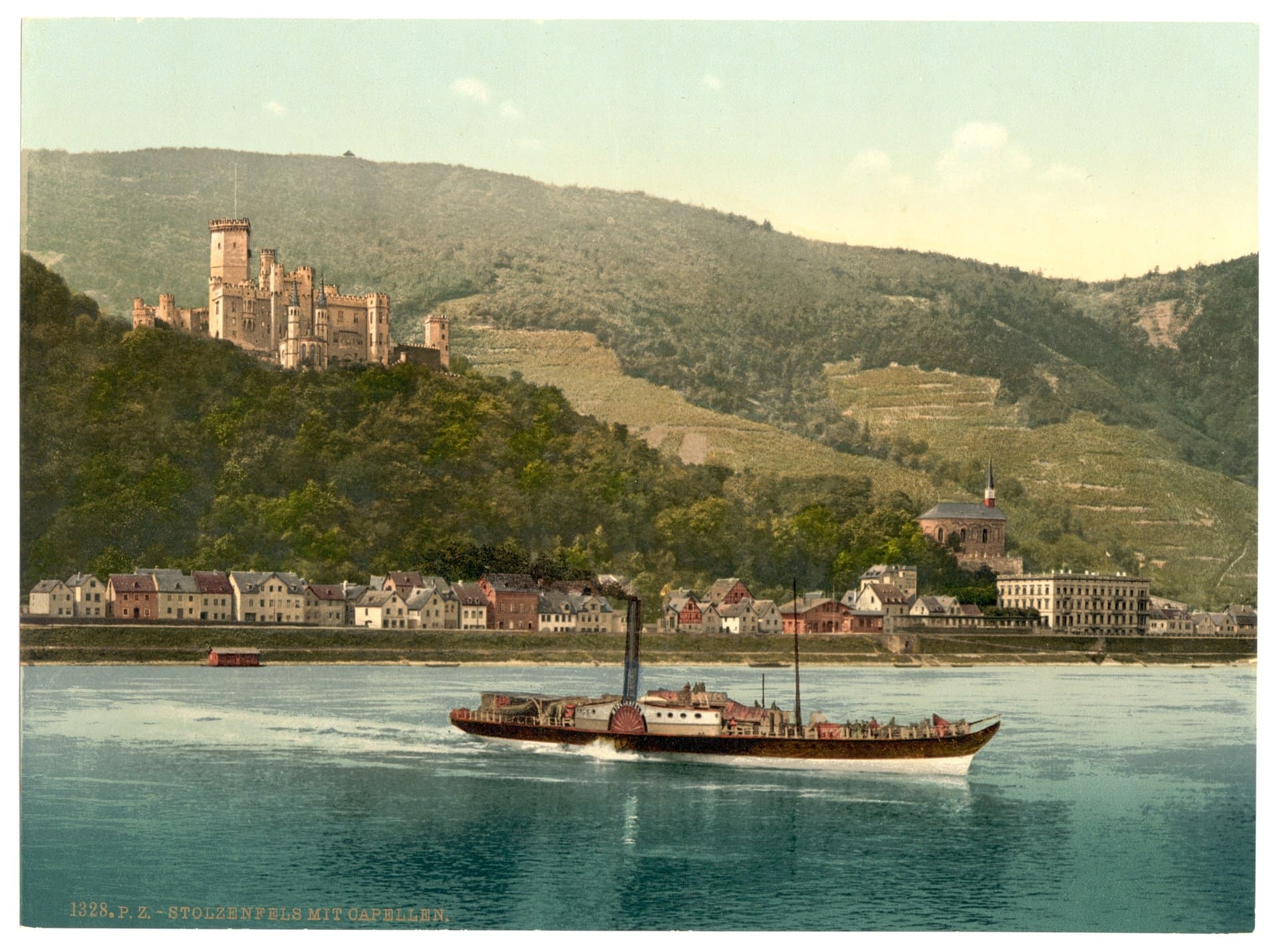
Short by river standards at just 65 kilometers between Bingen and Koblenz, the Rhine Gorge was nonetheless inscribed by UNESCO in 2002 as one of Europe’s most concentrated cultural landscapes. About 40 castles, palaces, and ruins stand inside the inscribed zone, on average one every 2.5 kilometers. Most listicles try to rank them. We don’t. Four castles in this guide (Burg Rheinstein, Burg Sooneck, Marksburg, and Schloss Stolzenfels) are bound by a coherent argument about what English-speakers mean when they say “Rhine castles,” and visiting them in that frame is more useful than visiting twenty of them as a checklist.
Three of the four are an extended-family project: the Hohenzollern Romantic restoration program of the 1820s, 30s, and 40s, when one Prussian prince and three of his cousins used Rhine ruins to invent Burgenromantik: the architectural sub-movement of Rheinromantik, the broader 19th-century enthusiasm for medieval Germany that produced Byron, Schreiber, Tombleson, and the riverboat tourist trade still running today. The fourth, Marksburg, is what they were trying to evoke: the only hilltop castle on the Middle Rhine never reduced to ruin, continuously occupied since the early 13th century. Visiting it after the three restorations is genuinely instructive: you learn the difference between a continuous medieval witness and a 19th-century reconstruction of one.
This guide walks the four downstream from Bingen to Koblenz, then closes with practical 2026 planning, a comparison table for the one-day visitor, and a short tour of the castles immediately beyond the four.
Why these four
The Hohenzollern restoration program began in March 1823, when Prince Friedrich Wilhelm Ludwig of Prussia (a Prussian cavalry general, nephew of King Friedrich Wilhelm III, cousin of the Crown Prince) bought the ruined castle of Vautsberg, also called Bonifatiusberg, from a Trier councilor’s heir for what amounted to a nominal sum. (The previous owner had picked it up for four Taler the year before.) Schinkel had drawn up romantic reconstruction plans seven years earlier, in 1816, after seeing the ruin during a Rhine sketching trip; those plans were the inspiration but not the execution. The prince renamed the castle Rheinstein in 1829 and rebuilt it from 1825 onward as a residential summer retreat. It was the first ruined Rhine castle reconstructed in the Romantic era for residential use, and the prototype that triggered everything that followed.
Hohenzollern’s Crown Prince was watching closely. In 1815, at the Vienna Congress where Prussia received the Rhineland, the city of Koblenz had offered him the ruin of Stolzenfels, a 13th-century Trier Archbishopric toll castle destroyed by French troops in 1689. He sat on the gift for eight years; in 1823, after his marriage to Elisabeth Ludovika of Bavaria and inspired by his cousin’s Rheinstein project, he formally accepted it. Full restoration didn’t begin until 1836, with Schinkel as master architect. When Schinkel suffered a stroke in 1840 and died on October 9, 1841, his pupil Friedrich August Stüler completed the project to its inauguration on September 14, 1842 in a torchlit medieval-costume procession. Queen Victoria attended the chapel inauguration on her 1845 Rhine visit. Stolzenfels became the most prestigious Rhine statement the Prussian state ever made: not a hunting lodge, not a private retreat, but a working summer residence for diplomatic reception.
Between Rheinstein and Stolzenfels, in April 1834, the Crown Prince and his three brothers, Prince Wilhelm (the future Emperor Wilhelm I), Prince Karl, and Prince Albrecht, jointly bought Sooneck. Their architect was Carl Schnitzler, the Prussian fortress builder at Koblenz, working under Generalmajor von Wussow. Construction ran 1843–1864. The brief from the brothers was explicit: alles sehr einfach im Sinne einer königlichen Jagdburg (everything very simple, in the spirit of a royal hunting castle), in deliberate contrast to the elaboration of Rheinstein and the grandeur of Stolzenfels. The 1848 Revolution and the Crown Prince’s subsequent illness meant the brothers used Sooneck rarely. It is, of the three restorations, the quietest.
The same dynastic story ties the trio to the broader Hohenzollern building program, and our 19th-Century Romantic Revival of German Castles hub places it inside the wider European Romantic movement, alongside Lichtenstein Castle in Swabia and the Wartburg in Thuringia.
Marksburg, on the right bank above Braubach, never went through any of this. It was first documented as a stone castle in 1231, built by the Eppstein family; the noble line “von Braubach” had been attested locally from 1117. It passed in 1283 to the Counts of Katzenelnbogen (specifically Eberhard I), in 1479 to Hesse, in 1803 to Nassau, and in 1866 to Prussia. Deutsche Burgenvereinigung (the German Castles Association, founded 1899) bought it from the Prussian state in 1900 for a symbolic 1,000 Goldmark, brokered by Kaiser Wilhelm II. They moved their headquarters there in 1931. It is the only hilltop castle on the Middle Rhine never reduced to ruin. (Wikipedia adds Burg Maus alongside; most listicles miss the nuance, and we mention it for completeness.) Continuous occupation means its 13th-century Romanesque Palas, its c.1435 Gothic Knight’s Hall, and its 16th-century-or-earlier Gothic kitchen survive in original substance. After three restorations, it is what the original looked like.
Burg Rheinstein (Trechtingshausen, Rhine km 533)
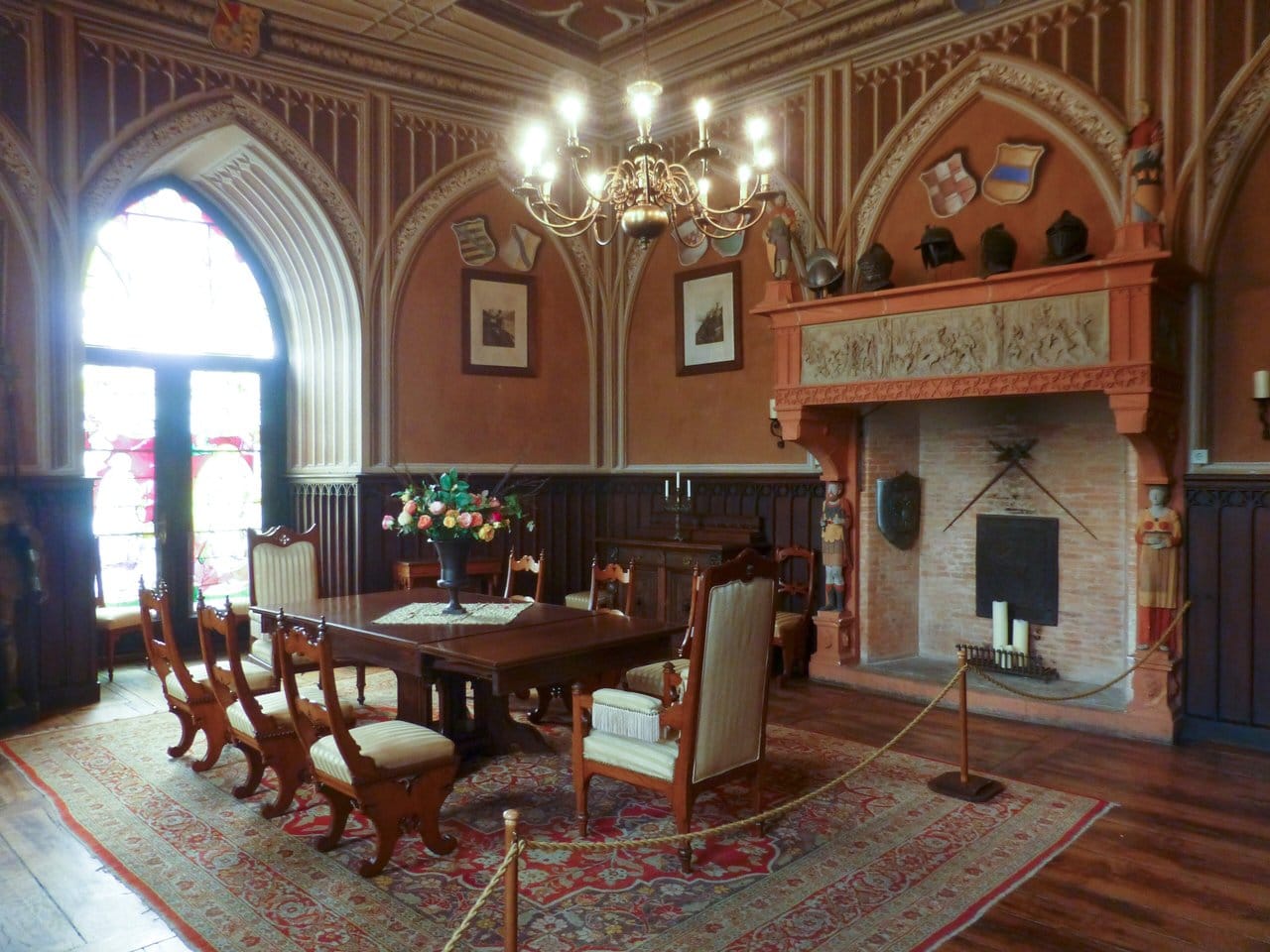
Rheinstein sits on a rocky spur above the left bank, two kilometers downstream from its near-twin Burg Reichenstein, just past Trechtingshausen. What visitors photograph today is essentially a Romantic-era invention: Prince Friedrich rebuilt it 1825–1829 with Johann Claudius von Lassaulx supervising the early phase and Wilhelm Kuhn completing the palace, then commissioned Anton Schnitzler of Düsseldorf for the painted interior decoration (with Ludwig Pose) and Philipp Hoffmann of Wiesbaden for the neo-Gothic chapel and Schweizerhaus 1839–1844. The medieval substance underneath, Mainz Archbishop Peter von Aspelt’s Vautsberg of c.1316/17 (first documented 1323), is mostly buried inside the 19th-century shell.
Its interiors are the strongest argument for visiting. The Burgenstube, Prince Friedrich’s living room, retains its painted ceiling and his Biedermeier furniture. The chapel is where Prince Friedrich, his wife Wilhelmine Luise of Anhalt-Bernburg, and his son Prince Georg are buried; the altar carries a carved Last Supper. Stained-glass collection (14th- to 17th-century church glass with 19th-century additions, assembled as Romantic spolia) was probably gathered after the 1802 secularization, though secure attribution requires the Schnell & Steiner Kunstführer.
What makes Rheinstein different from the other Hohenzollern projects is that the Hechers still live there. The Austrian opera tenor Hermann Hecher bought the castle in November 1975 from Princess Barbara Irene of Prussia, the last Hohenzollern owner, for DM 360,000, after a failed sale to an English buyer (who stripped the portable inventory) and an attempted purchase by the Hare Krishna movement. Hermann Hecher died in 2021; today his son Markus and daughter-in-law Cornelia run the castle alongside their children Marco and Cora, who also operate Sooneck. The operator describes Rheinstein as the only Mittelrhein castle owned by a family who live in it, and the framing matters: visitors notice the difference. The 2026 season runs March 21 to November 8, daily 10:00–18:00 with last admission 17:30; adult tickets are €11. There is a 20% combination discount with Sooneck. Weddings and events have been moved to Sooneck; the operator does not host them at Rheinstein.
Burg Sooneck (Niederheimbach, Rhine km 538)
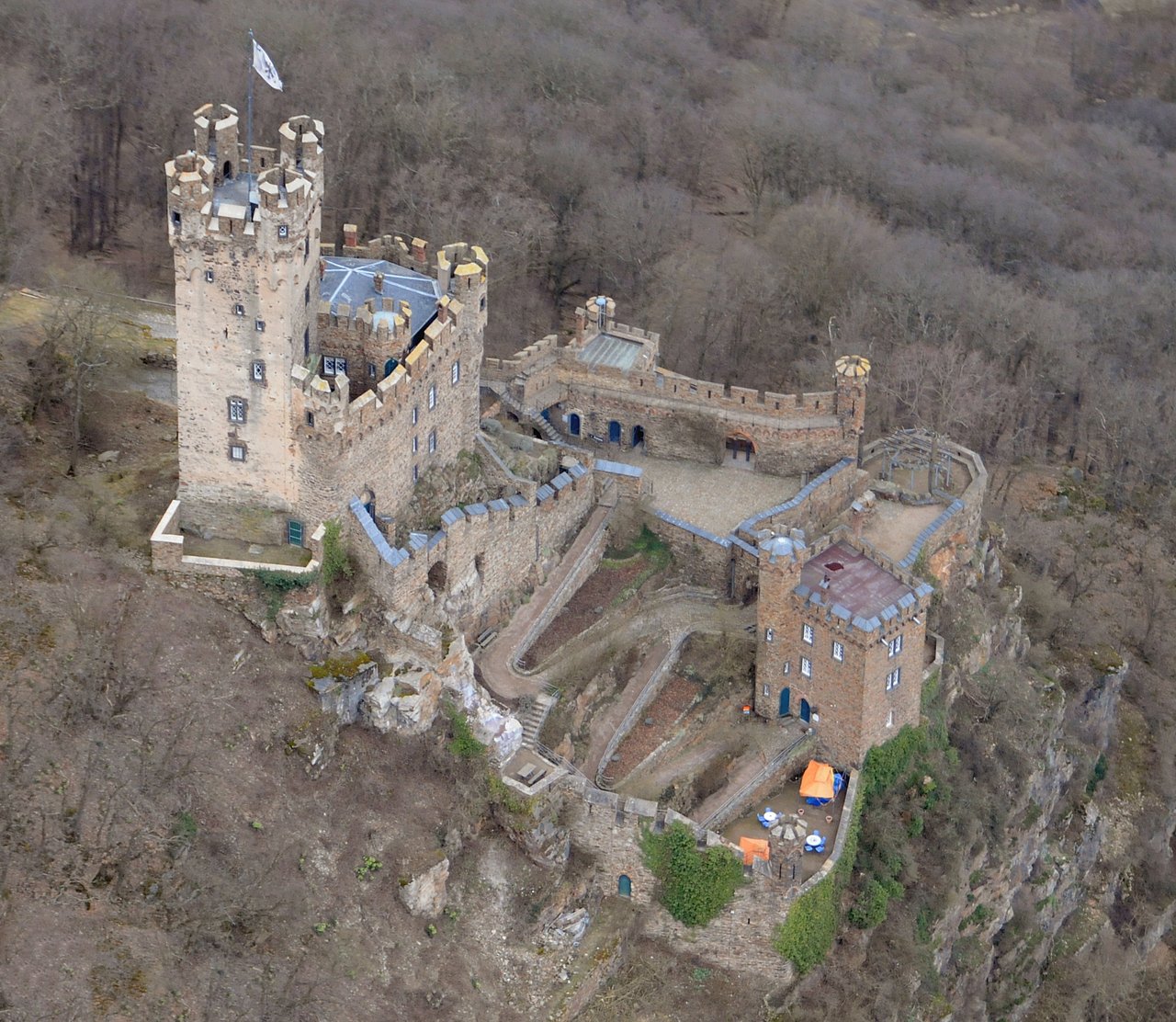
Sooneck is closed as of May 2026 for emergency masonry repairs; verify reopening directly with the operator before traveling. The notice has been posted on the operator site, on GDKE’s tor-zum-welterbe.de, and on der-rheinreisende.de; no reopening date has been announced.
When open, Sooneck is the quietest of the four. Five kilometers downstream from Rheinstein, on a wooded spur above the Rhine, the castle has a documentary mention from 1271 and a traditional founding date of c.1010/15 by the imperial abbey at Kornelimünster, near Aachen, for Rhine toll collection. Its 12th- and 13th-century lords were the Bolanden, then from 1241 the Hohenfels, the robber-knights destroyed by King Rudolf I of Habsburg in 1282, with an explicit imperial ban on rebuilding renewed at the Erfurt Reichstag in 1290. Mainz Archbishop Heinrich III von Virneburg lifted the ban in 1349; the Marshal of Waldeck rebuilt; the surviving late-medieval fabric (the square Bergfried, the four polygonal corner watch-turrets, the inner courtyard) dates from this rebuild. The French destroyed it again in 1689, in the Nine Years’ War. The four Hohenzollern brothers bought the ruin in April 1834 for the joint hunting lodge already described.
What makes Sooneck distinctive among the Rhine restorations is the unusual proportion of preserved late-medieval substance. Carl Schnitzler’s 1843–1864 work added arch friezes, crenellations, and flat roofs replacing the steep Walmdächer, but the keep, the corner watch-turrets, and significant wall fabric survive from the post-1349 rebuild. This is rare on the Romantic Rhine; most other restorations buried the medieval phase under their own work. The Rittersaal with its Maßwerk fireplace is the highlight room.
GDKE owns the castle and handles structural fabric and historic-room curation. Cora and Marco Hecher (the junior generation of the Rheinstein family) have leased the museum, shop, small Burgschänke, and visitor programming since spring 2021. They run weddings mid-April to mid-October and a Schatzsuche children’s treasure hunt with the costumed Burgfrau Anna Soon and Ritter Sir Eck (finding eight golden keys earns a wooden medallion). The site also participates in the GDKE-wide Geisterpass program (with Pfalzgrafenstein and Festung Ehrenbreitstein, identified by the ghost mascots Willi Bartzilli and Fritzi Dreispitzi). When open, season hours are daily 10:00–18:00 to November 1; adult tickets are €6.50.
Marksburg (Braubach, Rhine km 580)
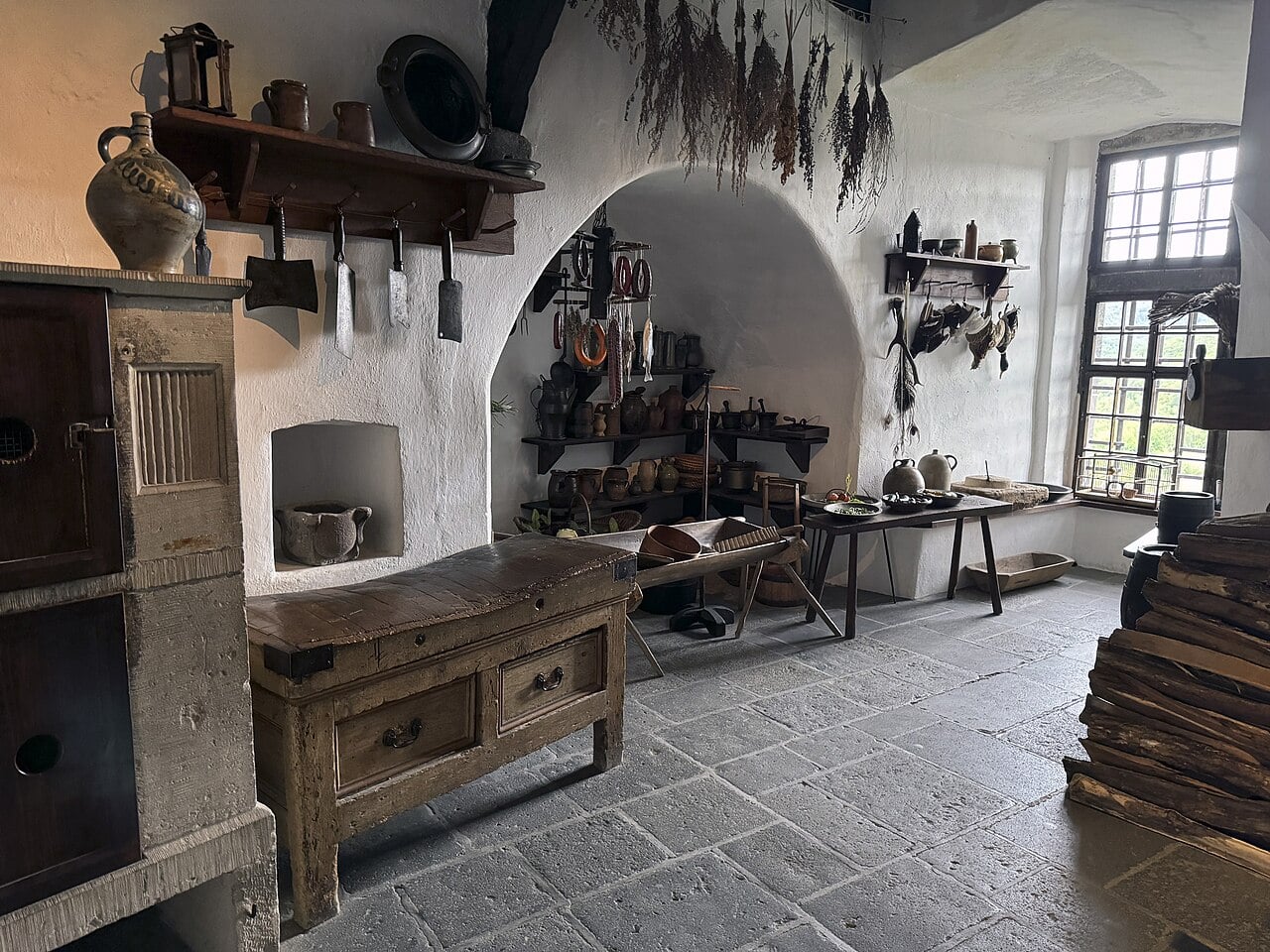
Marksburg sits above the right-bank town of Braubach, 42 kilometers downstream from Sooneck. The bergfried dates dendrochronologically to 1239; the ringwall to 1231; the Romanesque Palas to the first half of the 13th century; the Gothic Saalbau, traditionally called the Knight’s Hall, to c.1435 under Johann IV of Katzenelnbogen; the chapel of St. Mark to 1372 by dendrochronology, with original frescoes; the Gothic kitchen to 16th-century or earlier original substance, exceptionally well preserved. The 17th-century outer-ward bastions, Pulvereck and Scharfes Eck, hold cannons of which the earliest dates to c.1500. The “butter-churn” tower cap was originally raised in 1468, taken down in 1706, and re-erected by Bodo Ebhardt in 1905 during his 1900–1934 restoration.
The “never destroyed” framing carried in tourism literature needs nuance. Marksburg was never captured and never reduced to ruin, but it was significantly damaged by US artillery shelling from the opposite Rhine bank in March 1945, and Bodo Ebhardt himself died inside the castle earlier that year, on February 13, 1945. He is buried at the northwest fortification. Repair work began in 1947. The “1689 French troops failed to take it” claim sometimes attached to Marksburg is misleading: in the Nine Years’ War the Hessians defended Burg Rheinfels, which deflected the French; Marksburg was not seriously besieged. What the castle does record continuously is occupation since the 13th century: as a Katzenelnbogen residence, then a Hessian state prison, then Prussian military use, and as Deutsche Burgenvereinigung headquarters since 1931.
Marksburg is guided-tour-only, which catches some visitors off-guard. Tours run about 50 minutes; in summer (March–October) hours are daily 10:00–17:00 with last tour at 17:00; in winter, daily 11:00–16:00 with last tour at 16:00. English-language tours run daily at 13:00 and 16:00 in summer, by phone arrangement off-season; for German-language tours, multilingual handouts cover German, French, Dutch, Italian, and Russian. Adult admission starts at €11. The DBV operates roughly 3,000 members nationally; the European Castle Institute and the >25,000-volume DBV library are next door at Schloss Philippsburg, acquired in 1997 and opened at end-1999. The DBV has reported continuing financial strain in recent years.
Schloss Stolzenfels (Koblenz, Rhine km 585)
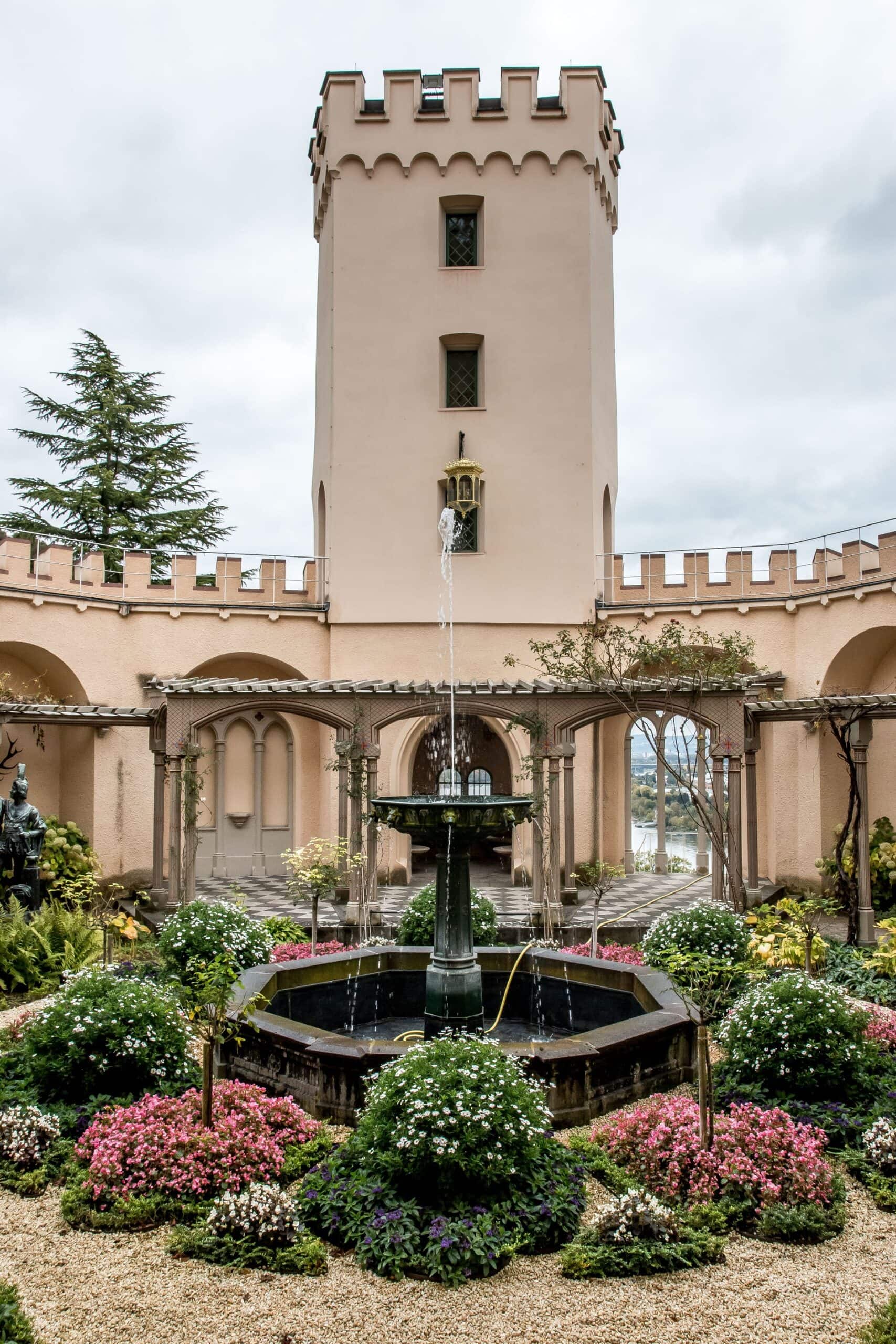
Stolzenfels is six kilometers downstream from Marksburg, on the left bank just south of Koblenz. The medieval castle was founded 1242–1259 by Trier Archbishop Arnold II von Isenburg as a counter-castle to the Mainz toll castle Lahneck across the river; first documentary mention is 1248. The pentagonal bergfried dates to c.1244–1248. Major medieval expansion came under Archbishops Kuno II and Werner III von Falkenstein 1388–1418. Trier’s Rhine toll moved to Engers in 1412. Swedes occupied the castle in 1632 during the Thirty Years’ War; French troops destroyed it in 1689 in the Nine Years’ War. Koblenz inherited the ruin in 1802 and offered it to the Crown Prince in 1815; he formally accepted in 1823 and began restoration in 1836 with Schinkel as master architect.
What separates Stolzenfels from Rheinstein and Sooneck is the totality of the design intention. Schinkel was not asked to dress the ruin in medieval costume; he was asked to design a complete Prussian summer residence with state-reception spaces, integrating the medieval bergfried as a design element rather than a structural anchor. He built the Großer Rittersaal with its vaulted hall modeled on the Marienburg in West Prussia. After his death in October 1841, Stüler completed the project; the inauguration was September 14, 1842, with a torchlit medieval-costume procession; the chapel followed 1843–1847 with Carl Schnitzler (the same fortress architect later directing Sooneck) doing the on-site execution under Stolzenfels’s local fortress commander Philipp von Wussow. Queen Victoria attended the chapel inauguration on her 1845 Rhine visit.
The interiors are the most intact of the three Hohenzollern projects. The Kleiner Rittersaal in the medieval Wohnturm holds Hermann Anton Stilke’s “Six Knightly Virtues” frescoes (1842–1846); the Adlerbrunnen (eagle fountain), modeled by Christian Daniel Rauch and cast at the Berlin Royal Iron Foundry in 1842, was a royal gift; the Klein-Venedig water feature and the Byzantine tea hall adjoining the Pergolagarten complete the program. Stolzenfels’s 9-hectare landscape park (serpentine ascent, Gründgesbach water features, fish ponds, viaduct) is genuinely Peter Joseph Lenné’s work, restored for BUGA 2011. The Pergolagarten itself was designed by Stüler with planting probably to Lenné’s ideas; no Lenné-signed plan for the castle has been located. Stolzenfels survived both world wars without major damage, which is why the 19th-century furnishings remain essentially intact.
We have a full visitor’s guide to Stolzenfels with the room-by-room walkthrough, ticket detail, and the Bus 650 access from Koblenz Hbf. Marksburg’s 2026 schedule has multiple windows: a winter weekend season, the main March 15 to October 31 Tue/Thu–Sun + holiday schedule (10:00–17:00, last entry 16:00), and a November weekends-only tail; closed in December and January. Verify ticket prices on gdke.ticketfritz.de before traveling. Access is by guided tour in German with English handouts on request.
Planning a Rhine Gorge castle visit
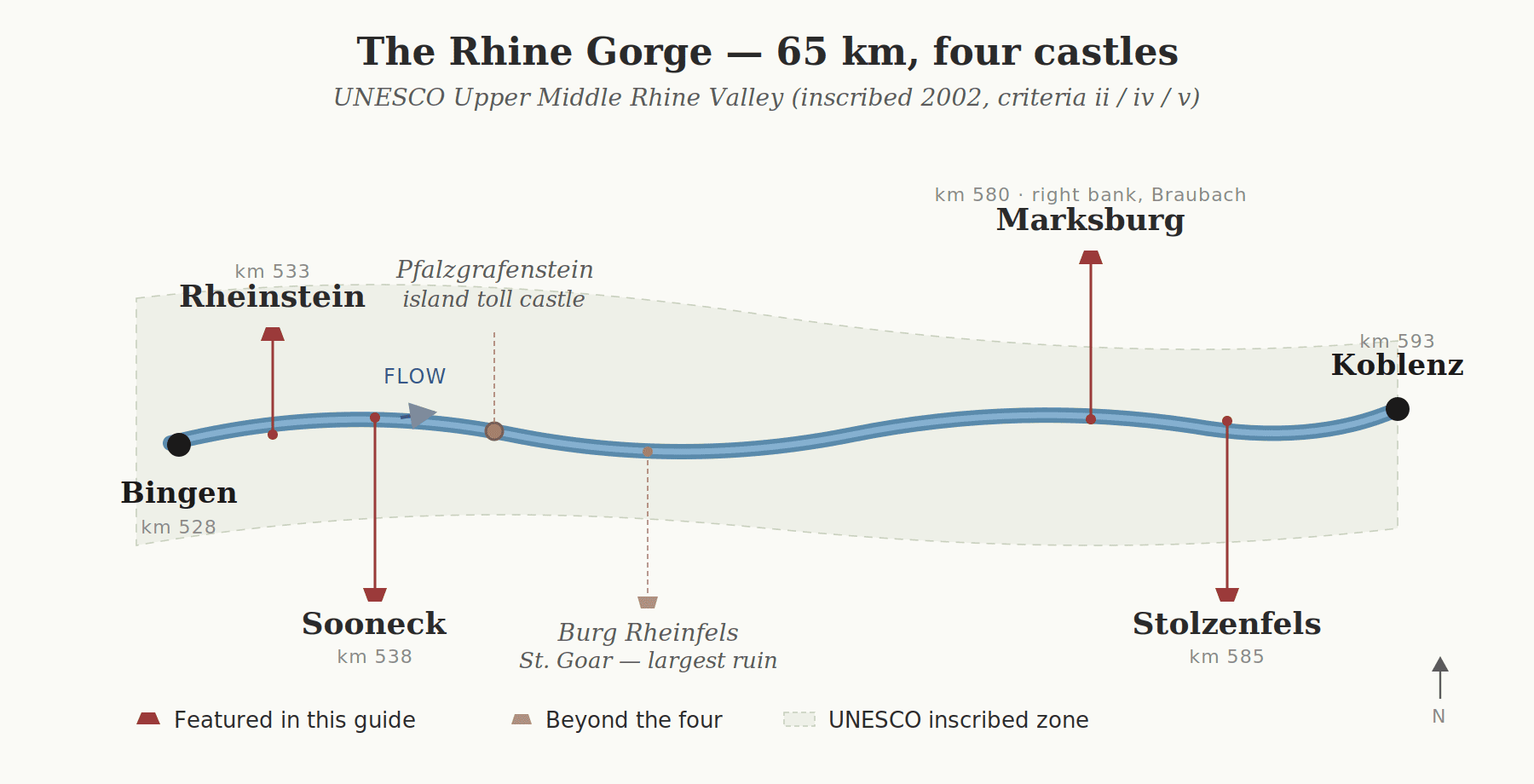
Visiting all four castles in a single day is technically possible from a Koblenz base (Stolzenfels at 09:30, Marksburg at 12:00, then a 60-minute drive south to Sooneck for 15:00 and Rheinstein for 16:30), but it is exhausting and the four start to blur. Two days is the recommended pace.
Two-day itinerary (recommended). Day 1, north pair: Stolzenfels in the morning, Marksburg in the afternoon, base in Koblenz. Day 2, south pair: Rheinstein and Sooneck (when reopened), with a KD river segment between if scheduling allows. Three days adds buffer for the Loreley boat segment plus a Boppard or St. Goar overnight, and gives space for the half-day Pfalzgrafenstein excursion described below.
One-day itinerary (only if you have no flexibility). Stolzenfels morning, Marksburg afternoon: both close to Koblenz, both intact-experience castles. Skip Rheinstein and Sooneck for a return trip. The comparison block below maps the alternative if you want one tour and one outdoor castle rather than two restorations.
Marksburg vs Rheinstein — the one-day choice
If you can only do one tour castle, the choice depends on what you want.
| Marksburg | Rheinstein | |
|---|---|---|
| Best for | Medieval authenticity, intact substance | Romantic-era interiors, family-run feel |
| Format | Guided tour only, ~50 min | Self-guided with audioguide |
| English | Daily 13:00 + 16:00 in summer | Self-paced English audioguide |
| Adult ticket | from €11 | €11 |
| Setting | Right bank, Braubach (north) | Left bank, Trechtingshausen (south) |
| Operator | Deutsche Burgenvereinigung | Hecher family (resident) |
For travelers who came for “the original,” Marksburg. For travelers who came for “the Romantic Rhine of the painters and poets,” Rheinstein. Neither choice is wrong; both are 60 to 90 minutes on site and easy half-day excursions from anywhere on the gorge.
Transport
2026 rail-disruption alert. The right-bank line RB10 is fully suspended Wiesbaden Hbf to Neuwied from July 10 20December 26–12, 2026 for the Generalsanierung Rechter Rhein, a complete renewal by DB InfraGO. Schienenersatzverkehr replacement buses will run, but the rail journey to Braubach (Marksburg), St. Goarshausen (Loreley, Burg Katz), Kaub (for the Pfalzgrafenstein ferry), and Assmannshausen (Burg Ehrenfels) is materially longer for the second half of the season. The new RE19 “Rheingau Loreley Express” was originally planned for December 2025 and has been delayed to December 2026.
The KD Köln-Düsseldorfer line is celebrating its 200th anniversary in 2026 (founded June 11, 1826). High-season Mittelrhein service runs April 25 to October 4, shoulder 4–April 24 and 5–October 18. Confirmed 2026 KD stops downstream from Rüdesheim to Koblenz: Rüdesheim, Bingen, Assmannshausen, Lorch, Bacharach, Kaub, Oberwesel, St. Goar, St. Goarshausen, Bad Salzig, Kamp-Bornhofen, Boppard, Braubach, Oberlahnstein, Koblenz. KD does not stop at Trechtingshausen or Niederheimbach, which means Rheinstein and Sooneck are not directly reachable by KD ferry. For Rheinstein, the alternative is the Bingen-Rüdesheimer Burgenfahrt sightseeing cruise, which lands at the castle.
The left-bank rail line, RB26 “MittelrheinBahn” operated by trans regio (a Transdev subsidiary), runs hourly with stops at Trechtingshausen and Niederheimbach. From Trechtingshausen station, Burg Reichenstein is about 500 meters along the riverbank and Burg Rheinstein is a 25- to 30-minute uphill walk via the Burgweg. From Niederheimbach station, Sooneck is a 30- to 40-minute uphill forest walk. There is no public bus or shuttle between Braubach station and Marksburg; the walk is 25 to 30 minutes uphill.
Stolzenfels is reached from Koblenz on Bus 650 to the Stolzenfels Schlossweg stop, then a 20-minute serpentine walk up through Lenné’s landscape gardens. A Deutschlandticket (€63 per month from 2026) covers RB26, RB10 when running, RE2, regional buses including 650, and most ferries, but not KD cruises. River cruises and castle day tours along the gorge can be booked in advance through GetYourGuide.
For drivers, the B-9 along the left bank connects all four castles with about 50 kilometers between Stolzenfels and Rheinstein. Driving is the easiest mode if you are doing all four; rail or KD plus walking is more atmospheric for individual castles. Anyone staying overnight can compare hotels in and around Koblenz.
Some links on this page are affiliate links, which means StoneKeep Atlas may earn a small commission, at no extra cost to you, if you book through them.
If you would rather sleep inside one of these castles than only tour it, several of them take overnight guests. Our guide to Castle Hotels on the Rhine covers where you can actually stay, from a youth-hostel castle to a Relais & Châteaux estate.
Beyond the four
Two castles inside the inscribed gorge that we did not include in the four are nevertheless essential reading. We left them out because they make a different argument from the Hohenzollern restoration program; we mention them here because any informed Rhine reader will notice their absence.
Pfalzgrafenstein sits on its own island near Kaub, a stone ship parked in the middle of the river. Built 1326–1327 under King Ludwig IV of Bavaria as a Rhine toll station (with the ring wall added 1338–1342, the bastion in 1606–1607, and the Baroque cap in 1714), it was never ruined, because as a midstream customs post it was never built to be lived in or besieged. The five-sided keep and ship-shaped curtain wall of a working toll station stand intact today, and the Romantischer Rhein tourism authority calls it the most photographed motif of the Middle Rhine. GDKE operates it; the only access is the small “Pfalz-Fähre” passenger ferry from Kaub. The 2026 season runs February 1 to October 31; the interior is unfurnished except for cannons; there are no toilets on the island, and the DB right-bank line is closed July 10–December 11, 2026, which lengthens the rail approach via Kaub. Adult admission is €8. Its full story (the contested toll, the failed sieges, Blücher’s 1813–14 Rhine crossing, and why power rather than legal permission kept it standing) is told in our Pfalzgrafenstein Castle guide.
Gutenfels is Pfalzgrafenstein’s land-side twin, and the two only make full sense together. Where the island tower collected the toll, Gutenfels (on the hill directly above Kaub) guarded it: the Wittelsbach Count Palatine bought castle, town, and Rhine-toll right together in 1277, welding hill castle, walled town, and river tower into a single fiscal-defensive system that outlasted every authority that questioned it. Built around 1220–1230 by the Bolanden-Falkenstein lords, dismantled by Nassau after 1803, and rebuilt in historicist form 1889–1892, it is today a private boutique hotel rather than a museum. The toll machine, the 1504 siege that renamed it, and the army that crossed below it are told in our Gutenfels Castle guide.
Burg Rheinfels above St. Goar is the largest ruin on the Rhine. At its peak it covered roughly five times its current footprint; built in 1245 by Diether V von Katzenelnbogen, it deflected the French in the Nine Years’ War (the campaign incorrectly attributed to Marksburg in the listicle ecosystem) and was finally slighted in 1796/97 by French Revolutionary forces. The City of St. Goar has owned it since 1924/25. Today the ruin is open as a museum with accessible walls and an underground mine-passage tour from April to September (bring a flashlight). Romantik Hotel Schloss Rheinfels has leased the residential portion since 1998, and a 2020 Hohenzollern restitution suit was settled out of court. Rheinfels is Rick Steves’ top-rated Rhine attraction, and it earned that ranking; we’ll likely cover it in detail in its own article.
The other named neighbors deserve briefer mention. Burg Reichenstein, two kilometers north of Rheinstein, is the Rhine’s first castle-hotel and operates as Hotel Burg Reichenstein under Lambert Lensing-Wolff (a Dortmund publisher and great-grandson of the Kirsch-Puricelli industrialists who reconstructed it 1899–1902); we’ll likely cover it in a forthcoming article. Burg Ehrenfels, opposite the Niederwald monument near Bingen, is a skeletal ruin with no interior access. Burg Maus and Burg Katz, the “mouse and cat” pair near St. Goarshausen, are mostly private; Burg Katz was bought in 1989 by Satoshi Kosugi, a Japanese management consultant, for an unrealized hotel project. Burg Lahneck at Lahnstein is private but offers hourly guided tours from noon (closed Mondays). Schloss Schönburg at Oberwesel is split between the Hüttl family’s 4-star Burghotel, a separate Tower Museum, and the DJH youth hostel.
For the political economy that produced the Gorge’s castle density in the first place (Hohenstaufen monopolisation, Interregnum-era proliferation, Rudolf I’s 1282 campaign, and the territorial-princely settlement that followed): see the focused historical treatment in The Rhine as Contested Territory: Castles, Tolls, and the Collapse of Imperial Authority.
A short closing argument
The Rhine Gorge is not a leaderboard, and it isn’t a theme park either. The four castles in this guide are useful to think with, not just to photograph: three Romantic-era restorations launched and largely funded by one extended Prussian royal family, and one continuous medieval witness that the others were trying to evoke. Visit them downstream (Rheinstein and Sooneck for the Hohenzollern prototype and its quietest sibling, then Marksburg and Stolzenfels for the contrast between continuous occupation and the most prestigious Rhine reconstruction the Prussian state ever made), and you will leave with a better answer to the question of what a Rhine castle is than any individual castle would give you.
Common Questions
Which four castles does this guide cover?
Burg Rheinstein, Burg Sooneck, the Marksburg, and Schloss Stolzenfels, spread along the gorge between Bingen and Koblenz.
What is the Rhine Gorge?
A short but dramatic stretch of the river, about 65 kilometers between Bingen and Koblenz, inscribed by UNESCO in 2002 as one of Europe’s most concentrated cultural landscapes, with about 40 castles, palaces and ruins inside the zone.
Why only four?
From the roughly 40 sites in the gorge, the guide picks four that are genuinely worth the visit and together tell its story, with a Beyond the four section pointing to the rest.
Principal Sources
- Börsch-Supan, Eva, and Dietrich Müller-Stüler. Friedrich August Stüler 1800–1865. Deutscher Kunstverlag, 1997. (For Stolzenfels under Schinkel and Stüler.)
- Friedhoff, Jens. Burgen und Schlösser an Rhein und Mosel. Regensburg: Schnell & Steiner, 2007.
- Großmann, G. Ulrich. Die Welt der Burgen. Munich: C. H. Beck, 2013.
- Rathke, Ursula. Preußische Burgenromantik am Rhein. Munich: Prestel, 1979 (reprint 2017). (The standard German monograph on the Hohenzollern Rhine reconstructions; Stolzenfels, Rheinstein, and Sooneck are core case studies.)
- Taylor, Robert R. The Castles of the Rhine: Recreating the Middle Ages in Modern Germany. Wilfrid Laurier University Press, 1998.
- Deutsche Burgenvereinigung. EBIDAT — Burgendatenbank. ebidat.de. (Scholarly castle dossiers; particularly useful for Marksburg, Sooneck, and Rheinstein.)
Operator and foundation websites for each castle: Marksburg / Deutsche Burgenvereinigung (marksburg.de), Generaldirektion Kulturelles Erbe Rheinland-Pfalz — Stolzenfels and Sooneck (burgen-rlp.de), Burg Rheinstein — Hecher family (burg-rheinstein.de). 2026 reference.
Image credits. Rheinstein Rittersaal interior: Muck, CC BY-SA 4.0; Sooneck aerial: Pudelek, CC BY-SA 3.0; Marksburg medieval kitchen: Gillfoto, CC BY-SA 4.0; Stolzenfels Pergolagarten: Gary Bembridge, CC BY 2.0 — all via Wikimedia Commons. Rhine Gorge map: © StoneKeep Atlas, 2026 (own work). Freely licensed images are resized to fit; otherwise unaltered.