
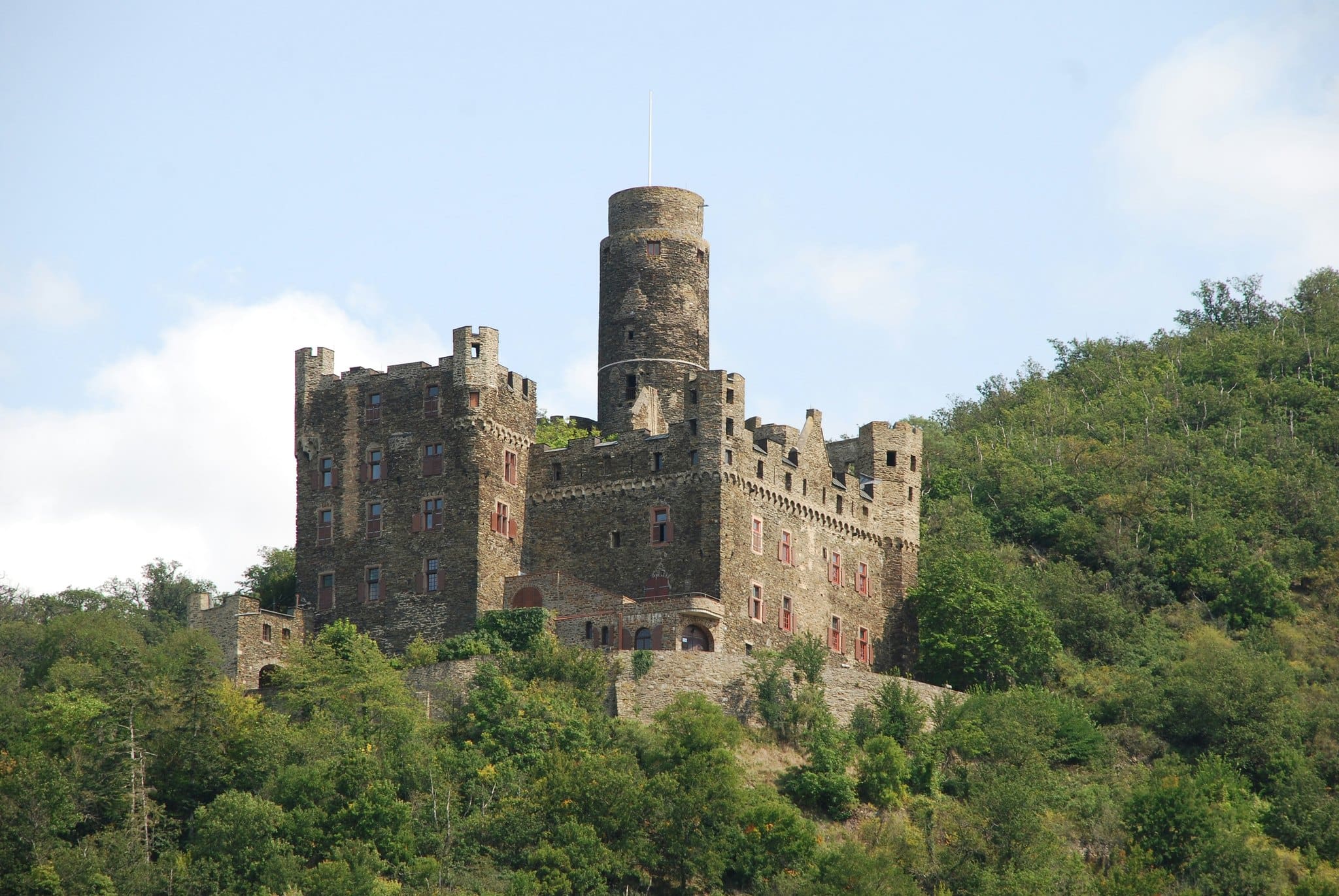
Maus Castle
Maus Castle was named by the people who built the castle next door to destroy it. High on a rock spur above the village of Wellmich, on the right bank of the Middle Rhine, it went up in the 1350s as a fortress of the Archbishops of Trier under the sober official name Burg Peterseck. The Counts of Katzenelnbogen, whose own great fortress of Rheinfels faced it from across the river, answered it with a larger castle a short way upstream and let it be known that their “cat” would make short work of this “mouse.” The mocking name stuck; the official one did not.
What the joke obscures is that the mouse won. Unlike its neighbors (Rheinfels, blown up by France at the end of the eighteenth century; Burg Katz, demolished by Napoleon’s army a decade later), Maus Castle was never besieged, never stormed, never destroyed. It outlasted the toll war that produced it, the electorate that built it, and the cat that was supposed to eat it. This is the story of a countercastle that won by never having to fight, and of a nickname that proved more durable than the war it came from.
Quick Facts
| Country | Germany |
| Region / State | Rhineland-Palatinate (Rheinland-Pfalz), western Germany — Upper Middle Rhine Valley, right (east) bank above Wellmich |
| Nearest Town | St. Goarshausen (Wellmich district); right-bank rail line; car ferry St. Goar–St. Goarshausen |
| Construction Period | Imperial building license 1356 (Charles IV to Boemund II); first phase complete by 1362; extended under Kuno von Falkenstein 1362–1388; reconstruction 1900–1906 |
| Founder | Archbishop-Elector Boemund II of Trier (Boemund II von Saarwerden) |
| Architectural Style | Late-medieval Hangburg (spur castle) with a 1900–1906 historicist reconstruction over surviving medieval fabric |
| Building Type | Burg — a Höhenburg on a rock spur; electoral residence and border fortification |
| Current Condition | Well preserved — reconstructed 1900–1906, external medieval silhouette retained; 1945 shell damage repaired |
| Open to Visitors | No general admission — privately owned; exterior viewing only by default; interior by pre-booked guided tour, plus weddings and occasional events |
| UNESCO Status | Within the Upper Middle Rhine Valley World Heritage Site (inscribed 2002) |
| Official website | burg-maus.de |
A countercastle licensed by an emperor (1353–1362)
In 1353 the Archbishop-Elector of Trier, Boemund II von Saarwerden, bought the village of Wellmich and its rights from Count Adolf I of Nassau-Idstein. He wanted a foothold on the right bank of the Rhine, and he wanted it for one reason: money. Trier had recently acquired toll rights on this stretch of the river, and the most dangerous neighbor to those rights was the family of the Counts of Katzenelnbogen, who already held the great fortress of Rheinfels and its toll station at St. Goar, directly across the water. In 1356 the Emperor Charles IV granted Boemund a license to fortify Wellmich, and construction began soon after.
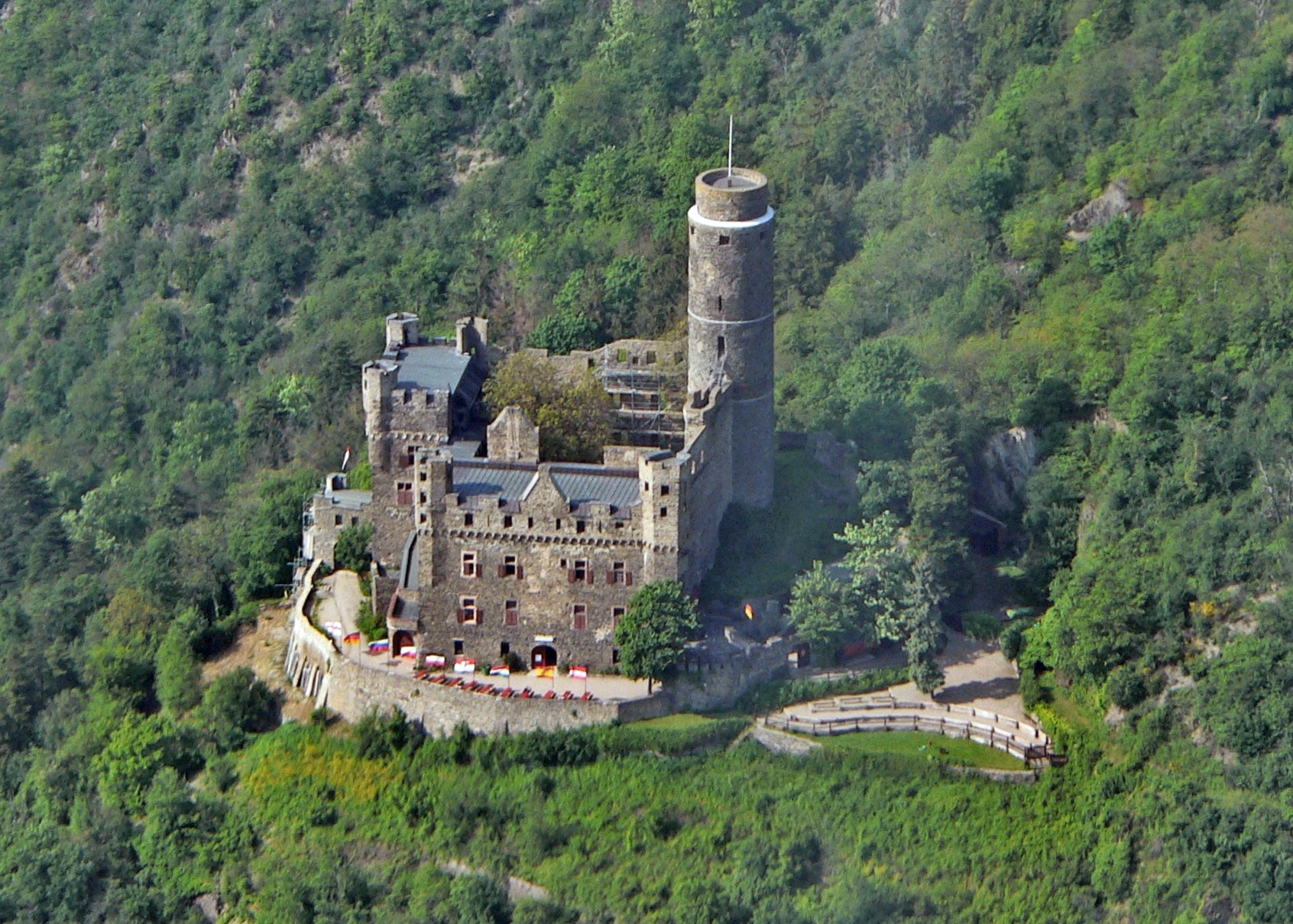
Maus was meant to be one jaw of a trap. Its intended name was Burg Peterseck, and a twin castle, to be called Petersberg, was planned for the left bank to close the pincer just north of Rheinfels. Petersberg was never built. Only the right-bank work went ahead, and its first phase (a round keep, a thick shield wall on the exposed eastern side, a residential range, and the southern half of a dwelling tower) was substantially complete by 1362. The trap that Trier designed would, in the end, only ever have one jaw.
The cat answers (1356–1388)
The Counts of Katzenelnbogen did not wait for Trier to finish. Count Wilhelm II von Katzenelnbogen began a castle of his own a short way upstream at St. Goarshausen, larger than the Trier work and squarely aimed at it; its chapel was consecrated in 1371. Officially it was Neukatzenelnbogen. Everyone called it Burg Katz: the Cat. The two castles now glared at each other across a few kilometers of river, each built to protect a toll the other was built to threaten.
The name “Maus” belongs to this rivalry, but later and more loosely than the popular story allows. Tradition has it that Wilhelm II himself coined the insult, declaring that his cat would snap up Trier’s mouse without effort; the line is repeated everywhere and documented nowhere; it is legend, not record. Its name first appears in writing only in 1719, by which time the castle was a ruin, recorded as derelict and uninhabited. (The date of 1744 sometimes given for the first mention is unsourced.) The mockery, in other words, outlived everyone who could have meant it, and attached itself firmly only once there was nothing left to mock.
More palace than fortress (1362–1437)
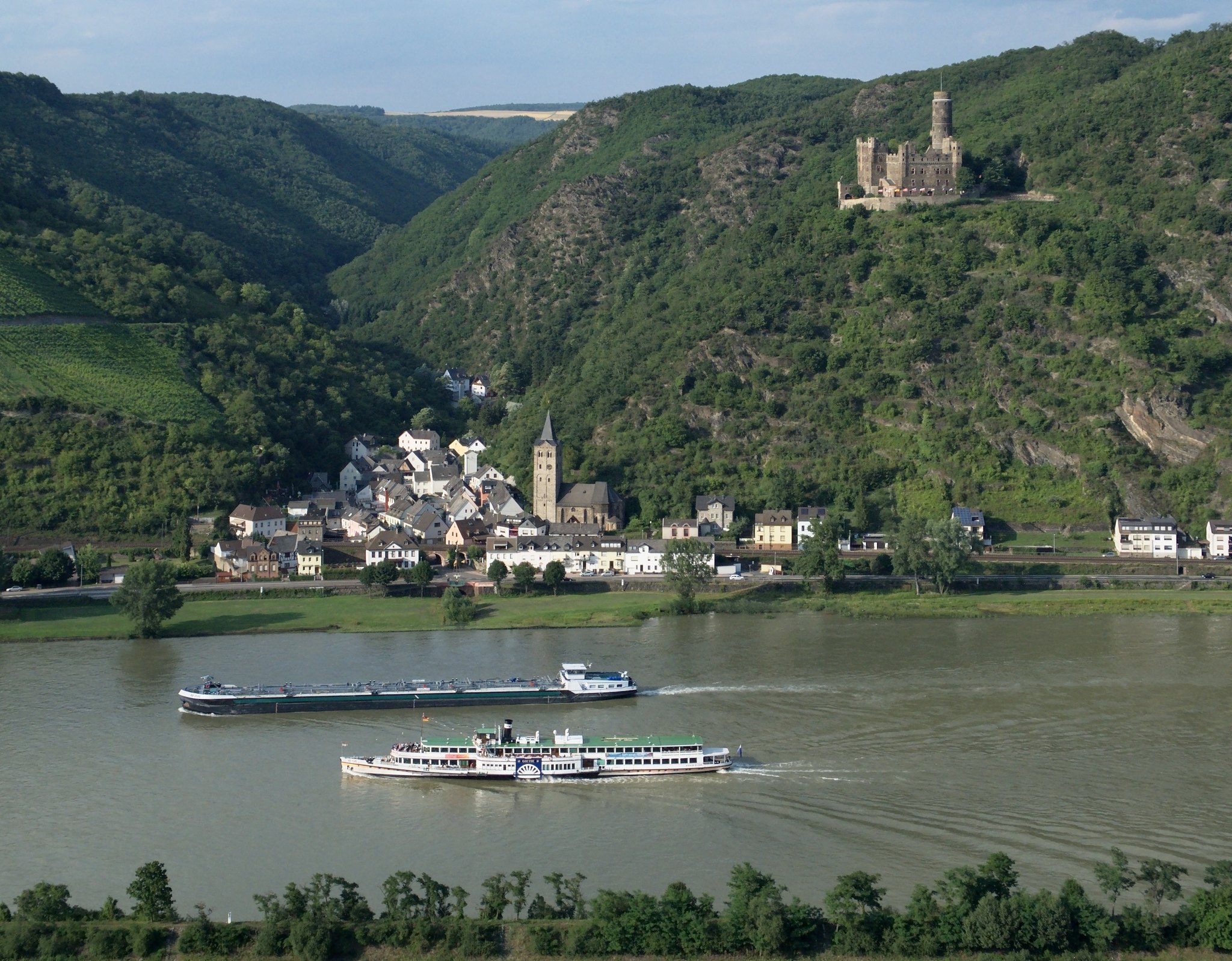
Boemund’s successor, Kuno von Falkenstein, Elector of Trier from 1362 to 1388, finished and enlarged the castle, almost doubling the dwelling tower with a near-identical northern addition that brought chimney heating and larger windows. Kuno made the place a favored residence; so did his great-nephew and successor, Werner von Falkenstein, Elector from 1388 to 1418, styled “von Königstein” in some older accounts after the family seat, but the same man. Both archbishops not only lived here but died here, Werner on October 4, 1418. For a border fort, it had become a remarkably domestic place.
That is the quiet point about Maus that the cat-and-mouse story tends to bury. By the late fourteenth century it was less a Rhine garrison than a Schloss in the older sense (an elevated princely residence), and the regional heritage record rates it among the most comfortable and technically up-to-date castles on the river of its day. The fortress built to win a toll war ended up being valued mostly as somewhere pleasant for an archbishop to stay.
Pledged, then forgotten (1437–1806)
From 1437 the castle and the town of Wellmich were pledged (verpfändet, mortgaged for cash) first to the von Helmstadt family and later to the von Nassau-Sporkenburg line. Across roughly four and a half centuries some twenty Trier officials administered the surrounding district from its rooms, and in 1588 Philipp von Nassau styled himself, in writing, lord of the Deuernburg: one more of the castle’s several names, alongside Thurnberg and the original Peterseck.
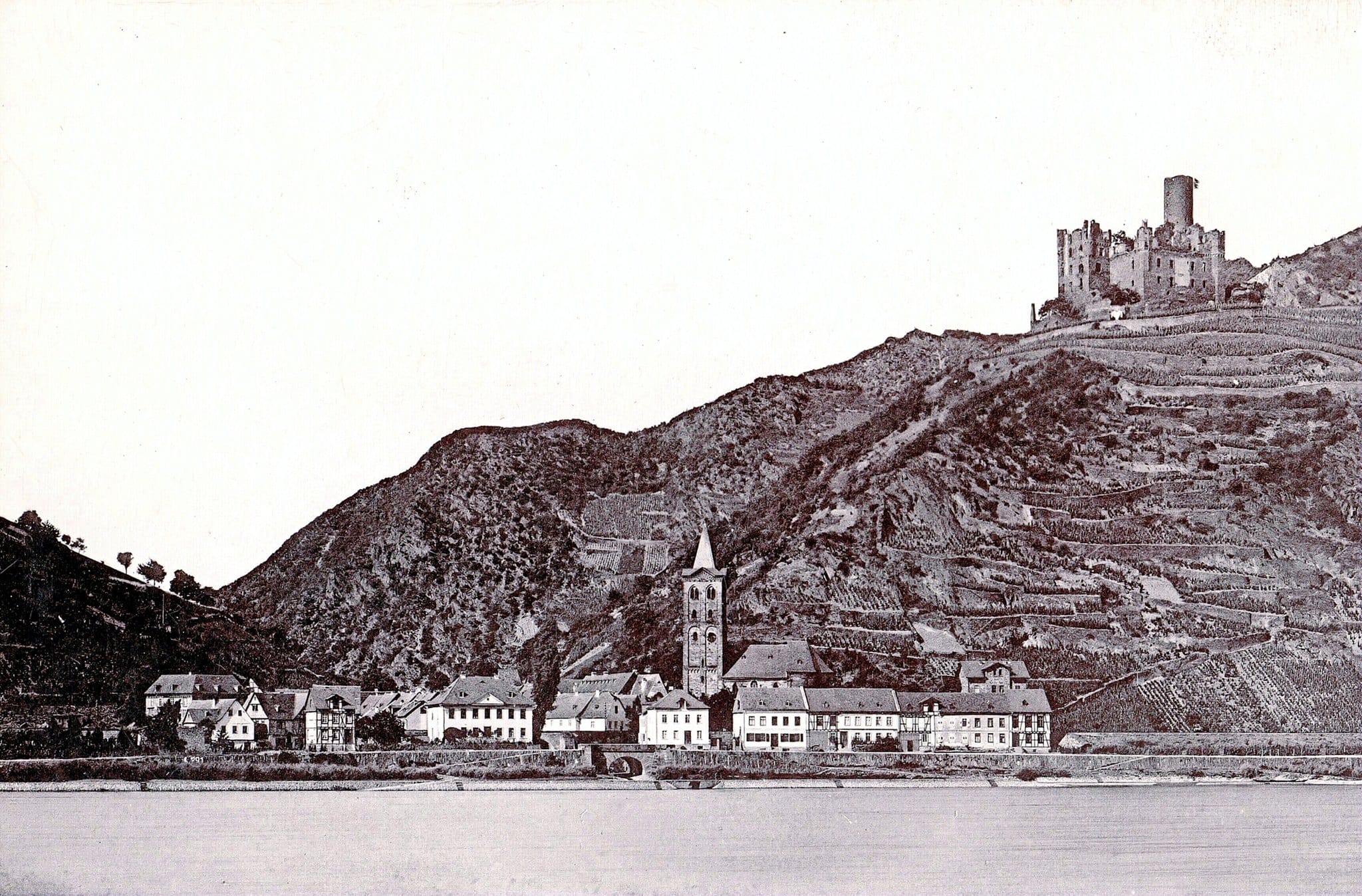
It was never reduced by a siege. Where Rheinfels and Burg Katz were eventually fought over and broken, Maus simply slid out of military relevance: by the Thirty Years’ War it counted for nothing as a defensive work, and by 1719 it stood derelict and empty. In 1806, after the Electorate of Trier was swept away with the old Empire, the ruin was auctioned auf Abbruch: for demolition and quarry stone. The sale went through. The demolition never did.
Habel’s rescue, Hugo’s mouse, Gärtner’s rebuild (1834–1906)
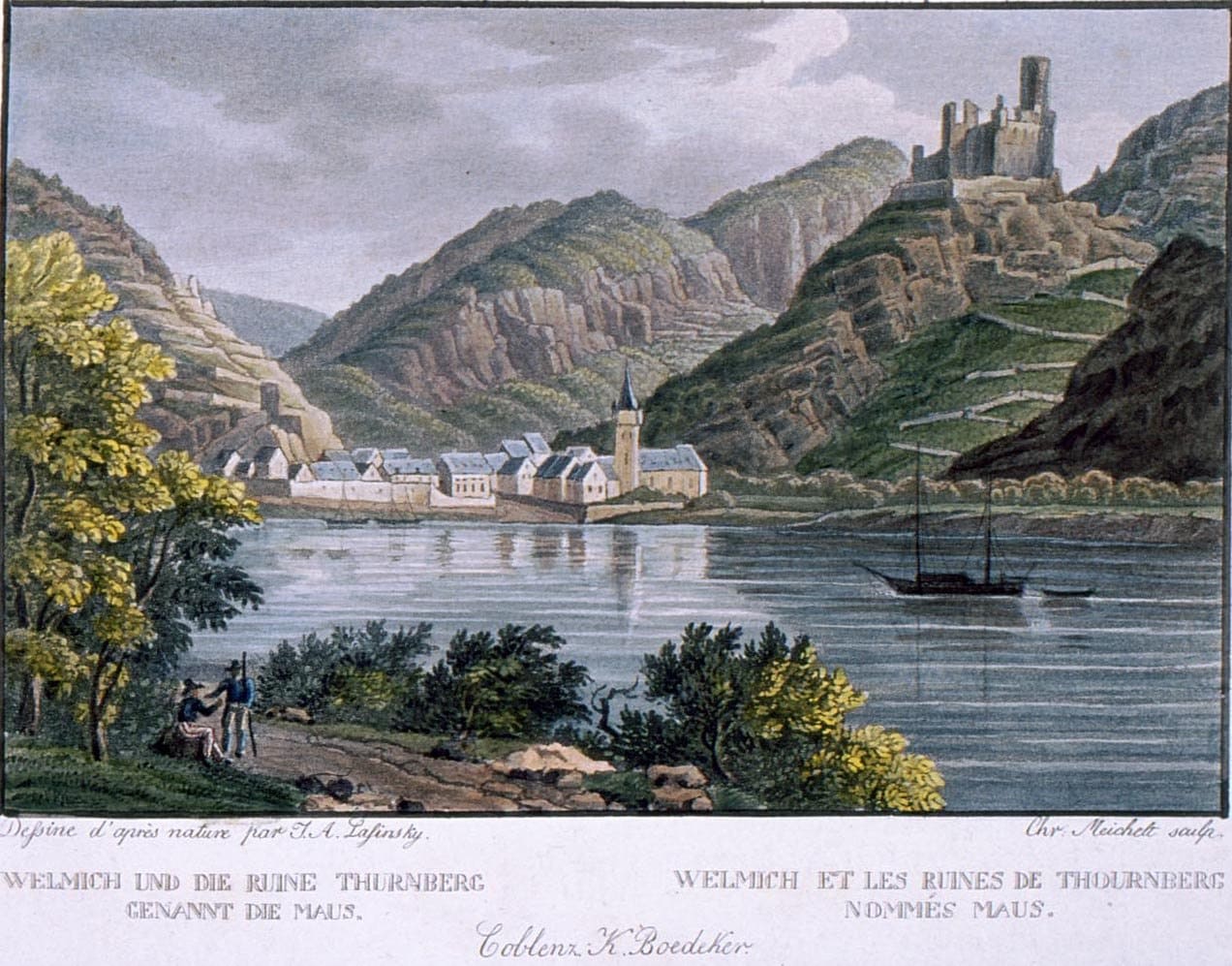
The ruin was saved by an antiquarian, not an architect. In 1834 the Nassau archivist Friedrich Gustav Habel acquired it for the express purpose of preserving it, the same Habel who rescued Gutenfels upstream at Kaub and several other Middle Rhine castles, which places him among the earliest private monument conservators on the river. (The often-repeated date of 1806 for his purchase is impossible: Habel, born in 1792, was a fourteen-year-old schoolboy that year and did not come into means until his father’s death in 1814.) In 1848 the surveyor Daniel Wagner drew a ground plan of the ruin before any rebuilding began.
By then the mouse had a literary afterlife. In Le Rhin (1842), Victor Hugo gave the ruin a whole letter (Lettre XV, “La Souris”) and made it one of the most ill-reputed wrecks on the river: a tower inhabited by living flames, a fourteenth-century Falkenstein lord flinging victims down a well, and a mythologized retelling of the rivalry in which the Mouse, rebuilt huge, would now eat the Cat. None of it is history, and Hugo did not pretend otherwise; it is Burgenromantik, the Rhine’s nineteenth-century imagination working on a convenient ruin. The actual rebuilding came at the turn of the next century: between 1900 and 1906 the Cologne architect Wilhelm Gärtner reconstructed the castle, keeping its external medieval silhouette while renewing the interior. A slim cap on the round keep is later still, added in 1924, and should be read as such. A subsequent owner from 1923 furnished it with an exotic collection; in March 1945 American artillery, covering the United States crossing of the Rhine and the occupation of Wellmich and Ehrenthal, damaged the stair hall, a corner tower, and the keep’s cap, all since repaired.
Visiting in 2026
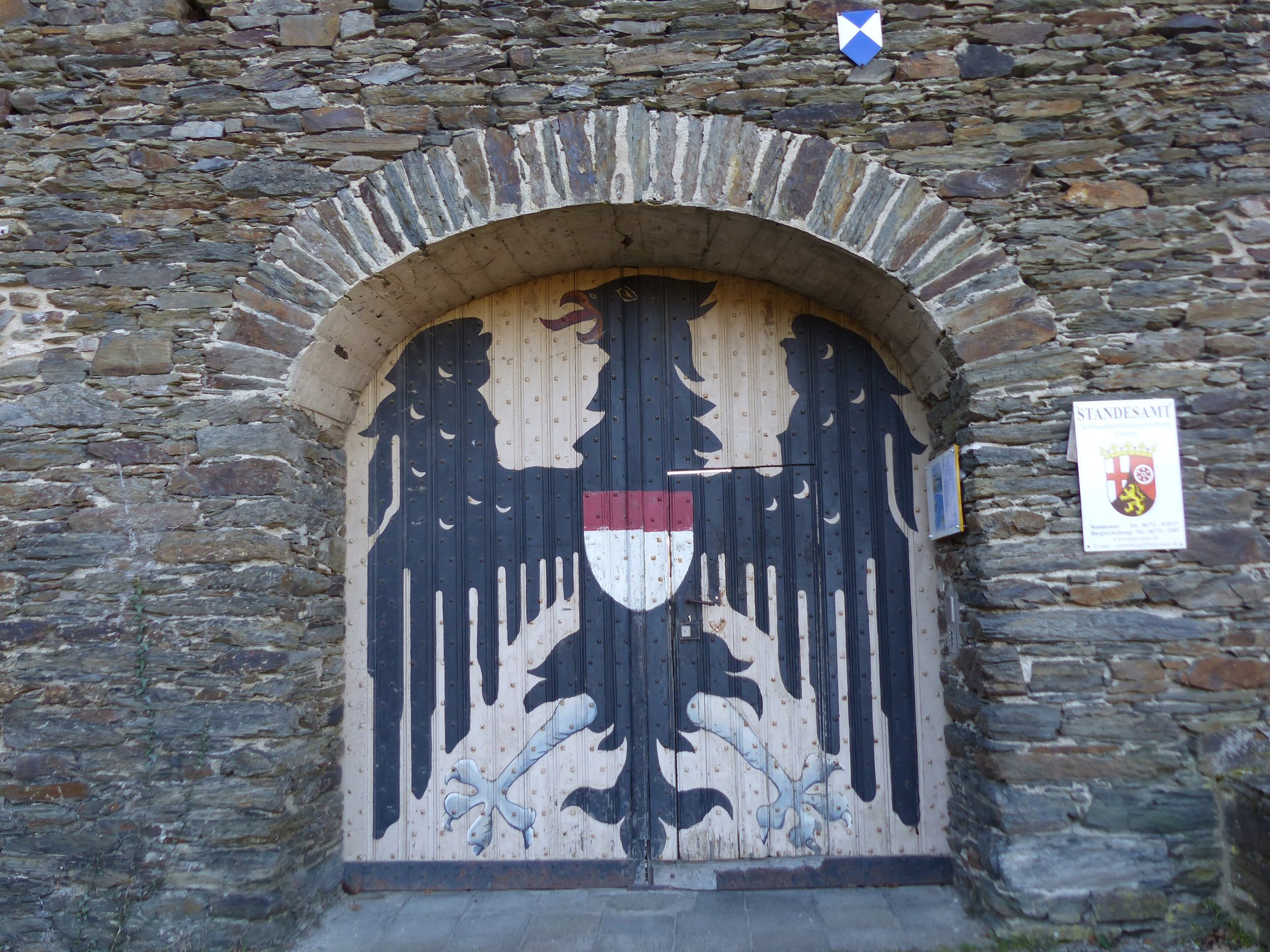
Maus is not a museum, and there is no ticket desk. It is privately owned, and by default it can be seen only from the outside. That is no great hardship: the castle reads best from a distance anyway: from a Rhine boat, from the right-bank railway, or from the St. Goar shore opposite, where it stands almost directly above Wellmich’s church with Rheinfels at the viewer’s back. To reach the walls themselves is a steep walk of about thirty minutes up from Wellmich; there is no vehicle access, and the meeting point for visits is in the village at Bachstraße 30 B.
The interior opens only through pre-booked guided tours run by Loreley-Touristik. Recurring format is a Mondscheinführung (a moonlight tour with a strolling wine tasting, roughly two hours, about €18 per person) offered on a handful of evening dates between late spring and autumn. The schedule is republished each spring, so the dates and price for the current year should be confirmed at loreley-touristik.de or by telephone on 06771-9100 rather than assumed. The castle also hosts civil weddings and the occasional concert or reading. The eagle-and-falcon shows that ran here for decades closed at the end of 2010; a short-lived successor in 2016 has also gone, and the falconry quarters are presently advertised for lease.
One practical caution for 2026: the right-bank Rhine railway that serves Wellmich is closed completely from July 10 to December 12, 2026 for Deutsche Bahn’s “Korridorsanierung Rechter Rhein,” the full renovation of the Troisdorf–Wiesbaden line, with regional trains replaced by buses over the whole period. Wellmich is squarely inside the closed stretch; two of its own bridges, on Bachstraße (the visit meeting-point street) and Blütenweg, are being rebuilt in the same program. For a visit during that window, plan on the replacement buses, or arrive by car or by the St. Goar–St. Goarshausen ferry; outside it, the right-bank trains stop at St. Goarshausen as usual. Anyone staying overnight can compare hotels in and around St. Goarshausen.
Some links on this page are affiliate links, which means StoneKeep Atlas may earn a small commission, at no extra cost to you, if you book through them.
Beyond Maus
Maus only fully makes sense beside its enemy: Burg Katz, the larger castle the Counts of Katzenelnbogen raised a short way upstream at St. Goarshausen, the cat that was built to eat the mouse; a dedicated account of it is forthcoming. The truer comparison, though, is across the river: Rheinfels at St. Goar, the Katzenelnbogen fortress Maus was raised to watch, and the one that, unlike Maus, was destroyed. The Rhine’s other purpose-built rival arrangement is upstream at Kaub, where Gutenfels and Pfalzgrafenstein worked a single toll between bank and river: where Maus and Katz were rivals, those two were partners. For a Rhine castle that, like Maus, came through history physically unbroken but was never romantically rebuilt, Marksburg is the control case; and Maus’s 1900–1906 reconstruction puts it in the same wave of historicist rebuilding as Rheinstein, Sooneck, and Stolzenfels. The whole cluster is mapped in Castles of the Rhine Gorge, and the toll-war logic that produced Maus runs through The Rhine as Contested Territory.
Conclusion
Maus Castle is, in the end, a fortress that won its war by never having to fight it. It was built as one jaw of a trap that was never finished, mocked by the enemy it was meant to contain, and then quietly outlived that enemy, the toll it guarded, and the state that raised it. The cat’s castle was blown up; the great fortress across the river was blown up; the mouse is still standing, rebuilt and lived in, watching the river it was designed to tax. Few castles on the Rhine have made so little noise and survived so completely.
Principal Sources
- Backes, Magnus. Wellmich am Mittelrhein mit Burg Maus und Kloster Ehrenthal. Rheinische Kunststätten, Heft 162. Neuss: Rheinischer Verein für Denkmalpflege und Landschaftsschutz, 1977.
- Dehio-Handbuch der deutschen Kunstdenkmäler: Rheinland-Pfalz, Saarland. München: Deutscher Kunstverlag (Baubeschreibung as cited by regionalgeschichte.net).
- Friedrich, Reinhard. “Burg Maus / Deuernburg (Wellmich).” EBIDAT — Burgendatenbank des Europäischen Burgeninstituts (Deutsche Burgenvereinigung).
- Herrmann, Christofer. “Die Deuernburg (Burg Maus) bei Wellmich nach einem Inventar von 1578.” Nassauische Annalen 104 (1993), pp. 105–116.
- Homburger, Michelle. “Burg Maus bei Wellmich.” KuLaDig, Kultur.Landschaft.Digital (Landschaftsverband Rheinland), object KLD-244548, 2015.
- Hugo, Victor. Le Rhin. Lettres à un ami, Lettre XV: “La Souris.” Paris: Henri-Louis Delloye, 1842.
- “Die Burg Maus in Wellmich.” Regionalgeschichte.net, Institut für geschichtliche Landeskunde an der Universität Mainz.
- “Upper Middle Rhine Valley.” UNESCO World Heritage Centre, inscription 1066 (2002).
Visitor information and 2026 access are drawn from the operator site burg-maus.de and from Loreley-Touristik, loreley-touristik.de, retrieved May 19, 2026.
Image credits. Featured image — Maus Castle from the Rhine: J. M. Fisher on Unsplash. The gorge at Wellmich: Johannes Robalotoff, CC BY-SA 3.0 DE. Aerial view: Roland Todt, edited by Sir Gawain, CC BY-SA 3.0. “Welmich und die Ruine Thurnberg genannt die Maus” (drawn by J. A. Lasinsky, engraved by Chr. Meichelt): scan by Frila, public domain. Wellmich with the castle in ruin, 1896: Römmler & Jonas, public domain. The castle gate: Whgler, CC BY-SA 4.0 — all except the Unsplash featured image via Wikimedia Commons. Freely licensed images are resized to fit; otherwise unaltered.