
The Rhine as Contested Territory: Castles, Tolls, and the Collapse of Imperial Authority
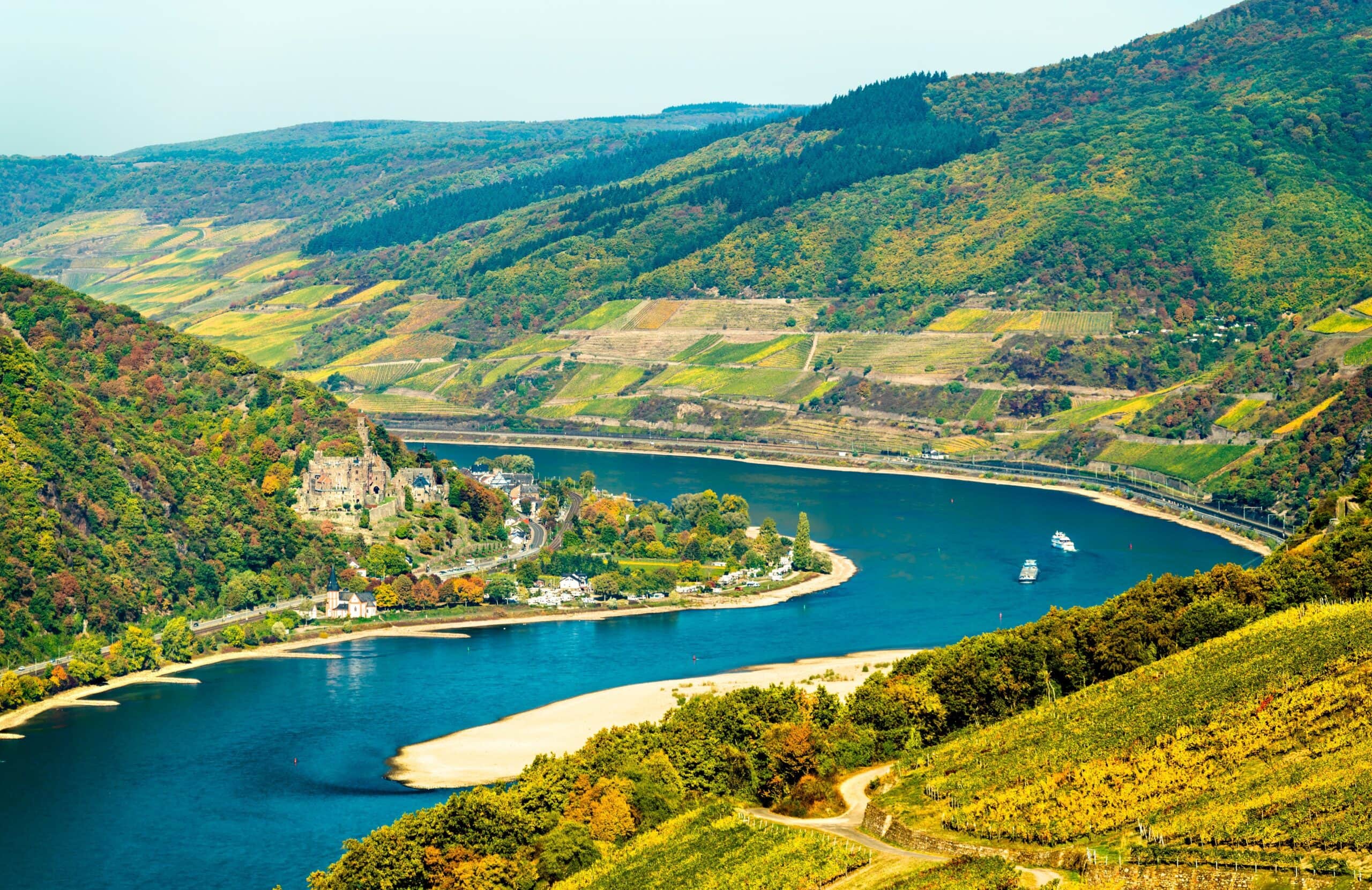
In the summer of 1282, a royal army stood beneath the walls of Burg Reichenstein on the Middle Rhine. King Rudolf I of Habsburg, recently elected to a throne that had stood effectively empty for two decades, had come to do what no German king before him had managed in living memory: take down a castle whose lords had grown rich by stopping merchant traffic on the river below.
Reichenstein fell. So did its sister fortress upstream at Sooneck. Lords of Bolanden-Hohenfels, until then comfortable practitioners of what nineteenth-century historians would later christen Raubritterei, were dispossessed; the castles were slighted and placed under a formal ban against rebuilding. It was the most dramatic gesture of restored royal authority on the Middle Rhine since the death of Friedrich II in 1250.
But it was not a restoration. Rudolf’s campaign was a settlement, not a revival. A dense landscape of castles crowds the gorge between Bingen and Koblenz today (roughly forty of them inscribed within the UNESCO World Heritage boundary, alongside some sixty surviving towns), and it is the surviving political map of a vacuum, not of an empire. The Middle Rhine corridor accumulated more fortifications between 1150 and 1340 than any equivalent stretch of any navigable river in Europe because the central authority that should have prevented their proliferation collapsed. What this article traces is the political economy of that collapse, the response it provoked, and the durable territorial order that emerged from it: an order built not by emperors but by archbishops, counts palatine, and the merchant cities of the Rhine. This is the Rhine as contested territory: a river whose castles record the absence of an empire rather than its reach.
The Reichsburgen and the Sanctioned Toll
When Friedrich Barbarossa convened the Diet of Roncaglia in November 1158 to compel his Lombard subjects to acknowledge imperial regalia (the rights belonging to the crown), the lawyers who drafted the Lex Regalia listed navigable rivers and their tolls (teloneum) among the prerogatives the empire would not relinquish. That decree was issued for Italy, but its implications for the Rhine were unambiguous. The river’s traffic was royal business; tolls were levied by royal grant or not at all.
In practice, on the Middle Rhine, this meant a network of imperial castles (Reichsburgen) held directly by the crown through its administrative knighthood. The unfree ministeriales who garrisoned these castles, raised tolls, and arbitrated disputes were not nobles in the strict sense but a service estate; their loyalty ran to the crown rather than to any regional dynasty. Barbarossa’s grandson Friedrich II expanded the network from his Sicilian court without ever residing on the Rhine for long. The imperial Pfalzen at Boppard, Kaiserslautern, and Ingelheim, surrounded by Reichsgut farmland and serviced by ministerial garrisons, projected royal presence across hundreds of kilometers of river.
This system was not perfect. Castles outside imperial control existed; the Mainz and Trier archbishoprics held their own Burgen, the Welf and Wittelsbach dynasties accumulated regional power, and the Counts Palatine functioned as the king’s deputies. But the principle was clear: tolls required imperial sanction. A baron who built a castle on the river and demanded payment from passing ships without a royal privilege was not exercising a customary right; he was a robber. The crown reserved the prerogative to grant or revoke toll rights (the Zollregal) and reserved the means to enforce that prerogative.
That this language describes a system rather than a routine reality is the first thing to acknowledge. Even at its functioning best, the Hohenstaufen Reichsburg network was a stretched instrument. But it existed, and it set the baseline against which everything that followed must be measured.
Collapse and Vacuum, 1245–1273
In July 1245, at the First Council of Lyon, Pope Innocent IV pronounced Friedrich II deposed. The emperor refused to recognize the council’s authority, but the rupture was decisive. When Friedrich died in December 1250 and his son Conrad IV in May 1254, the imperial throne effectively passed out of Hohenstaufen hands. What followed is conventionally called the Great Interregnum, though the term, like Faustrecht, is an artifact of later historical imagination. Rival kings continued to be elected (William of Holland, Richard of Cornwall, Alfonso of Castile), but none exercised effective authority over the Rhine corridor for nearly two decades.
Its effect was visible from the river. That toll-economy the Hohenstaufen had attempted to monopolize broke its banks. Modern scholarship can be specific about this proliferation. Friedrich Pfeiffer’s exhaustive study of medieval Rhine tolls finds twelve authorized toll stations between Mainz and Cologne in 1250; by 1254 the number had at least doubled to roughly twenty or twenty-four. Each additional station was either a newly built castle from which to enforce collection, or an existing castle whose lords had simply begun stopping ships and demanding payment.
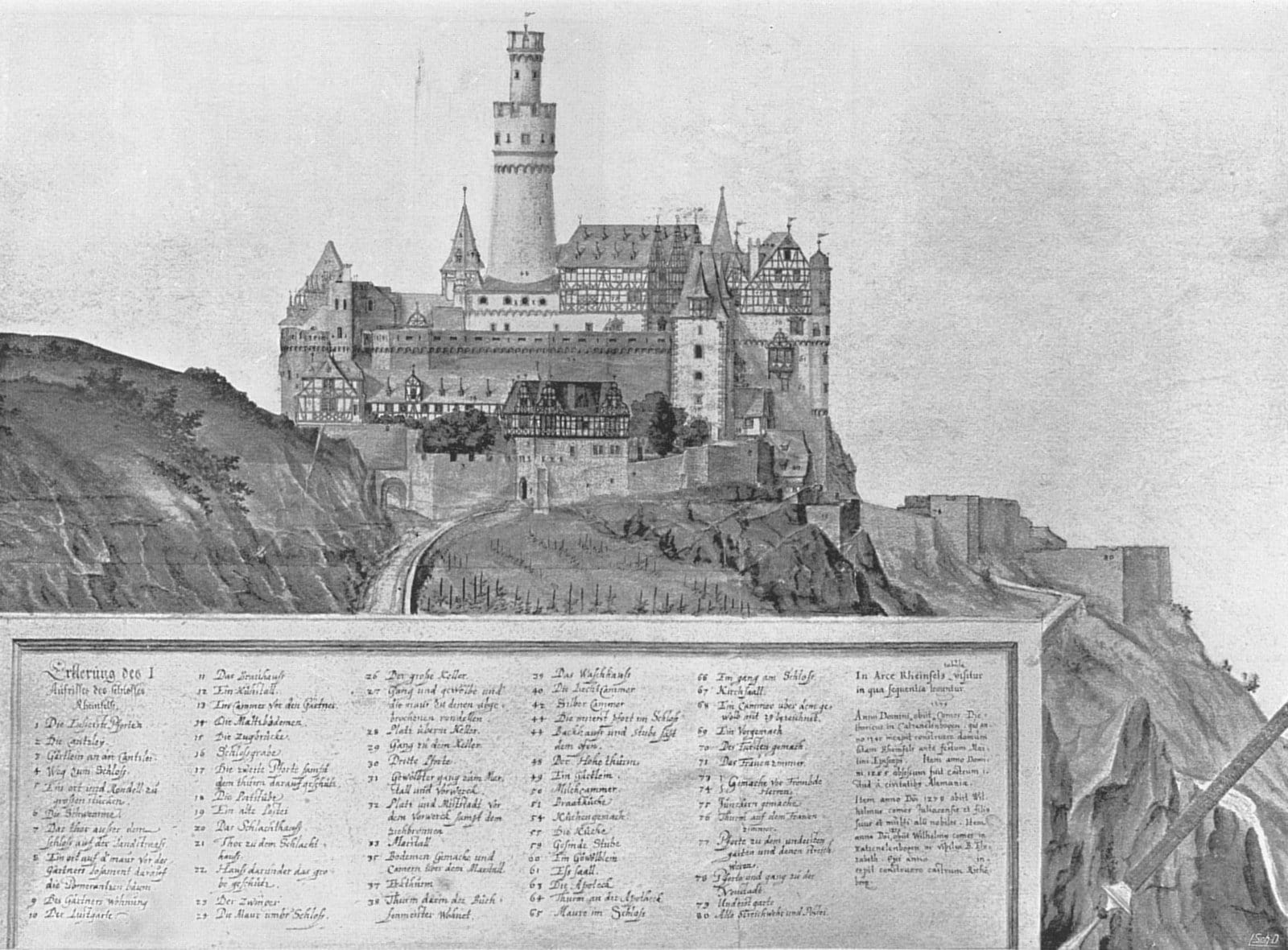
These new arrivals included some of the largest fortresses on the river. Count Diether V of Katzenelnbogen completed Burg Rheinfels above St. Goar in 1245 as a toll station substantial enough to draw a fourteen-month siege from the Rheinischer Bund a decade later; he survived the siege and kept the toll. That same pattern repeated, with smaller stakes, at site after site between Mainz and Koblenz.
What enabled it was not violence (though there was plenty) but the absence of an authority capable of withholding the necessary license. With no king to grant tolls, no king could refuse them either. The Mainz, Trier, and Cologne archbishops, themselves Reichsfürsten with their own ambitions, found the situation congenial. The Counts Palatine, whose dignity dated to the Carolingian period and which had been a Wittelsbach office since 1214, were now territorial princes with their own administrative geography. The unfree ministeriales of the old Reichsburg system, freed of effective royal supervision, transformed themselves: their service tenures hardened into hereditary lordships, and their fortresses began to function as private revenue properties.
During these decades, the Middle Rhine castle landscape that would survive into modernity was being built.
The Cities Organize: The Rheinischer Bund of 1254
Rhine cities moved before the princes did. On July 13, 1254, at Mainz, representatives of Mainz, Köln, Worms, Speyer, Straßburg, and Basel swore themselves into a ten-year sworn peace, a Landfriede modeled on the imperial Mainz Reichslandfriede of 1235. The Rheinischer Bund prohibited tolls levied without royal sanction since 1220, banned the practice of granting urban citizenship to rural fugitives (Pfahlbürger), and committed its members to mutual military aid against breakers of the peace. The archbishops of Mainz, Köln, and Trier and the bishops of Worms, Speyer, Straßburg, Metz, and Basel adhered. By the end of 1256, approximately sixty core cities had taken the oath, with over a hundred communes and more than thirty princes under their patronage attached.
Its operations were practical and immediate. A Rhine convoy fleet protected merchant traffic. Quarterly Bundestage arbitrated disputes among members. A Bundeskasse paid for it all. Within months of the founding oath, the Bund’s forces moved against Werner von Bolanden, the Mainz region’s most assertive new toll-collector. Selective enforcement (pulling down stations that violated the post-1220 ban, leaving alone those that could plausibly cite imperial precedent) continued for three years.
It was an impressive response, and it was also constitutively limited. The Bund could mount armed convoys and dismantle toll stations, but it could not legislate, could not raise armies of a size to challenge the great princes, and could not function in the absence of royal legitimacy. Its statute required einhellige Königswahl: a unanimous royal election. When January 1257 produced the opposite (Cologne, Mainz, and the Pfalzgraf electing Richard of Cornwall on January 13; Trier, Saxony, and Brandenburg electing Alfonso of Castile that April), the Bund split along its founding fault line. By the end of 1257 it was effectively dissolved.
Rudolf’s Reckoning: The Campaign of 1273–1282
Rudolf of Habsburg was elected King of the Romans at Frankfurt on October 1, 1273 and crowned at Aachen three weeks later. He came to the throne with neither the dynastic prestige of his Hohenstaufen predecessors nor the territorial base of the great princely houses. What he had was the support of those archbishop-electors who calculated that an unobjectionable Swabian count would suit them better than a strong rival from one of their own ranks. This calculation was correct in the narrow sense (Rudolf never threatened the elector-princes’ territorial gains), but it was also the precondition for what he accomplished in the decade that followed.
In the summer of 1282, Rudolf’s army moved against two castles that had become emblematic of the post-Hohenstaufen toll abuses: Burg Reichenstein near Trechtingshausen, held by Philipp von Bolanden-Hohenfels, and Burg Sooneck a short distance upstream, held by the same lineage. Both fortresses were taken (the sources are reticent about the operational detail), slighted to render them indefensible, and placed under a formal ban against rebuilding. The Bolanden-Hohenfels family lost its Rhine lordships permanently; the headless-walk legend that attaches itself to the episode in tourist literature is a nineteenth-century invention.
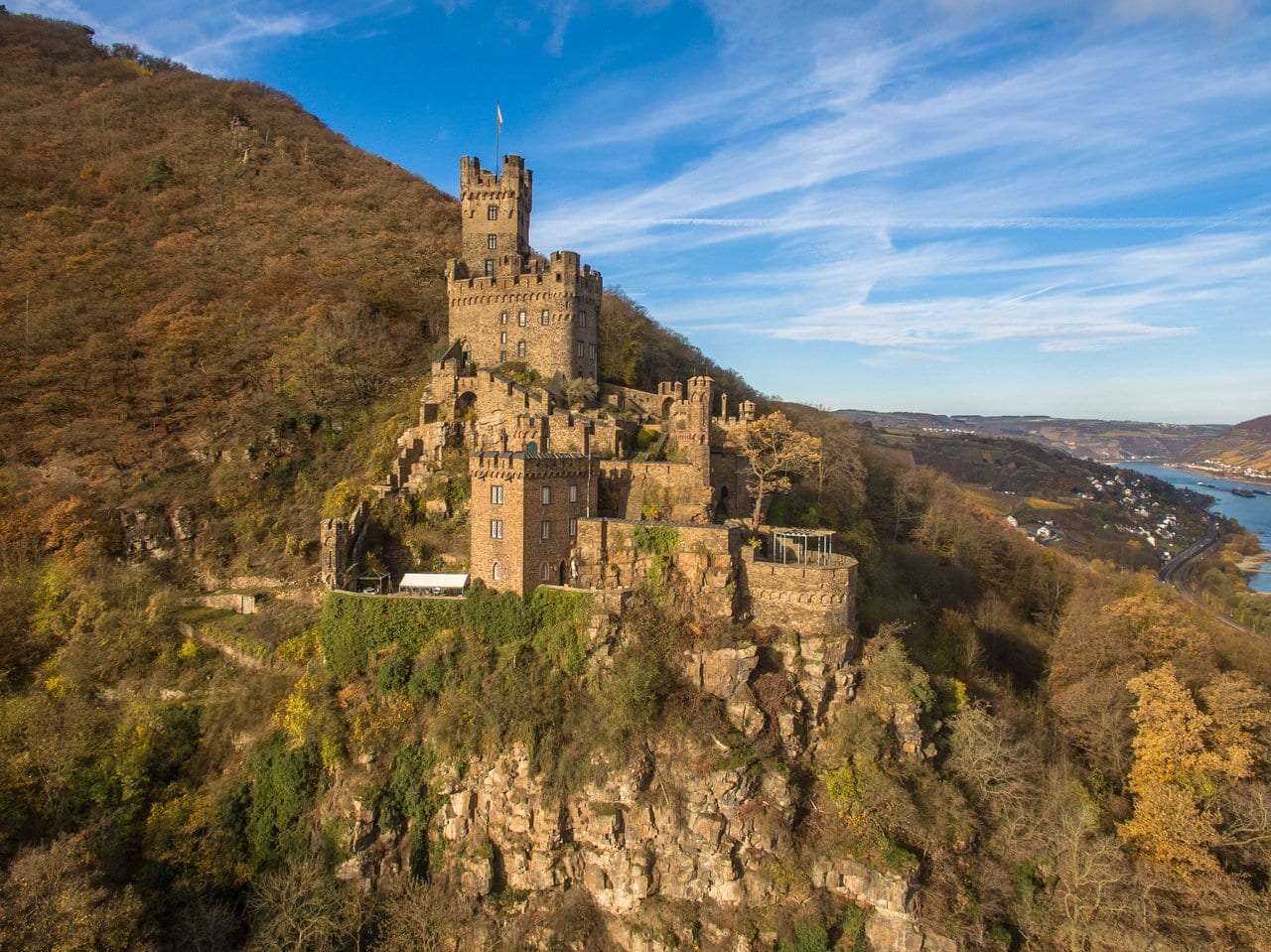
What is striking about the 1282 Rhine campaign is its restraint. Only Reichenstein and Sooneck are securely documented as 1282 slightings; the popular roster that includes Heimburg, Ehrenfels, Nollig, and Fürstenberg cannot be supported in the primary record. Rudolf was not razing the Rhine castle landscape; he was making an example of two clear cases that no regional power objected to losing. A more extensive operation, mounted against the Thuringian Raubritter in 1289–90, ended in mass executions on the Erfurt Fischmarkt; on the Rhine, no equivalent show of force was attempted.
This was the limit of what Rudolf’s authority could accomplish. He could end the worst abuses, with the tacit support of the regional powers who wanted them ended. He could not rebuild the Reichsburg system. Imperial instruments of direct administration on the Rhine (the ministerial network, the Pfalzen estates, the supervisory presence of the king himself) had decayed beyond recovery. Castles that came down at Reichenstein and Sooneck were the exceptions that proved the rule.
The New Equilibrium: Archbishops and Princes
What filled the imperial vacuum was not a restored center but a settled distribution of regional power. The archbishop-electors of Mainz, Trier, and Cologne consolidated their territorial blocks methodically through the decades after 1273. Each took over functions that had previously been imperial: coining money, collecting tolls on stretches of river they could plausibly claim as their own, building Landesburgen to enforce their writ over the countryside.
A clear illustration of the shift is the castle that today carries the name Rheinstein. Built around 1316 or 1317 by Archbishop Peter von Aspelt of Mainz on a height overlooking the river just downstream from the slighted Reichenstein, the medieval Vautsberg served a function that would have been imperial business a century earlier: it policed the Reichenstein Wiederaufbauverbot. Mainz, not the empire, ensured that the lords whom Rudolf had dispossessed did not return. The archbishop’s Landesburg sat above the empty walls of the Bolanden-Hohenfels site and watched.
By the time of the Eltzer Fehde of 1331–36 (when the imperial knight families of the Mosel valley fought Archbishop Balduin of Trier to a five-year stalemate), the political geography of the Rhine and its tributaries had crystallized. Castles were instruments of territorial princes, of archbishops, of imperial cities, and, increasingly rarely, of free knightly lineages who could afford to resist all of these. The Counts of Katzenelnbogen, whose Marksburg above Braubach had passed through the period as the corridor’s only undisturbed major castle, were carving out a mid-rank principality between the Lahn and Mosel; the Eltz family, after Balduin’s siege, kept fortress and toll rights through accommodation rather than victory. By then the empire was no longer one of the parties at the table.
What Survives: Reading the Rhine Today
Roughly forty castles inside the UNESCO Upper Middle Rhine Valley boundary (and the sixty or more that crowd the wider corridor) form a landscape that is misread when read as architecture. The architectural record is real and worth attention: the Salian-Hohenstaufen Bergfried tower, the thirteenth-century shield-wall (Schildmauer), the late-medieval gunpowder bastion. But the density of the landscape, which is what visitors encounter first, is not an architectural fact. It is a political one.
Castles cluster on this stretch of the Rhine because between roughly 1150 and 1340 (peaking in the Interregnum decades and the generation that followed) central authority on the river broke down completely and was filled in piecemeal by regional powers. Each lord who built a castle was claiming a share of the toll-economy that the empire could no longer monopolize. Each archbishop who built a Landesburg was extending his territorial jurisdiction into the gap. Each merchant city that joined the Rheinischer Bund was buying protection that the empire could no longer guarantee. The result, by the mid-fourteenth century, was a corridor with more independent fortified sites than any equivalent European waterway: the densest concentration, by the cautious formulation, along any navigable river in Europe.
Most of these castles fell into ruin during the Thirty Years’ War and the Nine Years’ War of 1688–97, when French armies systematically destroyed Rhine fortifications they could not occupy. The same policy reached beyond the gorge: on the Vosges frontier of newly annexed Alsace, the rock castle of Château de Fleckenstein was blown apart by Louis XIV’s soldiers in the same decades and never rebuilt. What stands today is mostly what the Romantic restorers of the 1820s through 1860s recovered or rebuilt. But the sites are medieval, and the spacing of the sites is the political map of the breakdown this article has traced. Romantic restorations are a nineteenth-century overlay on a thirteenth-century ruin field. That ruin field is what matters.
Anchors of the Argument
Reichenstein Castle is the textbook case of Rudolf I’s 1282 campaign. Held by the Bolanden-Hohenfels family (branches of which had grown rich as toll-collectors during the Interregnum decades), the castle was taken in summer 1282, slighted to render its fortifications useless, and placed under a formal ban against rebuilding. That family lost its Rhine lordships permanently. The much-repeated story that captured family members were forced to walk the length of the castle headless before execution is a nineteenth-century invention, like much else that hangs on the Raubritter legend. What is historical is the fact of the slighting and the fact that it set the limit of Rudolf’s Rhine reckoning: only Reichenstein and Sooneck are securely documented as 1282 targets. The castle remained ruinous for nearly six centuries before its 1830s rebuilding as a Romantic-era hunting seat for the Counts von Kanitz.
Burg Rheinfels illustrates the same toll-castle dynamic from the territorial-princely side. Count Diether V of Katzenelnbogen began the fortress above St. Goar in 1245, deep in the Interregnum decades when imperial authority on the Rhine had functionally vanished. The toll he established there grew aggressive enough to draw a fourteen-month siege from the Rheinischer Bund in 1255–56, which the castle survived. Rheinfels remained the Katzenelnbogen seat for over two centuries; when that line extinct in 1479 it passed to Hesse, who progressively expanded the fortifications until Rheinfels was, by the early modern period, one of the largest fortresses on the river. The French destroyed it systematically in 1796–97, leaving the ruined complex visible today above St. Goar. Where Reichenstein and Sooneck illustrate the Raubritter-style toll castle that Rudolf I would dismantle, Rheinfels illustrates the princely toll castle that no king could touch.
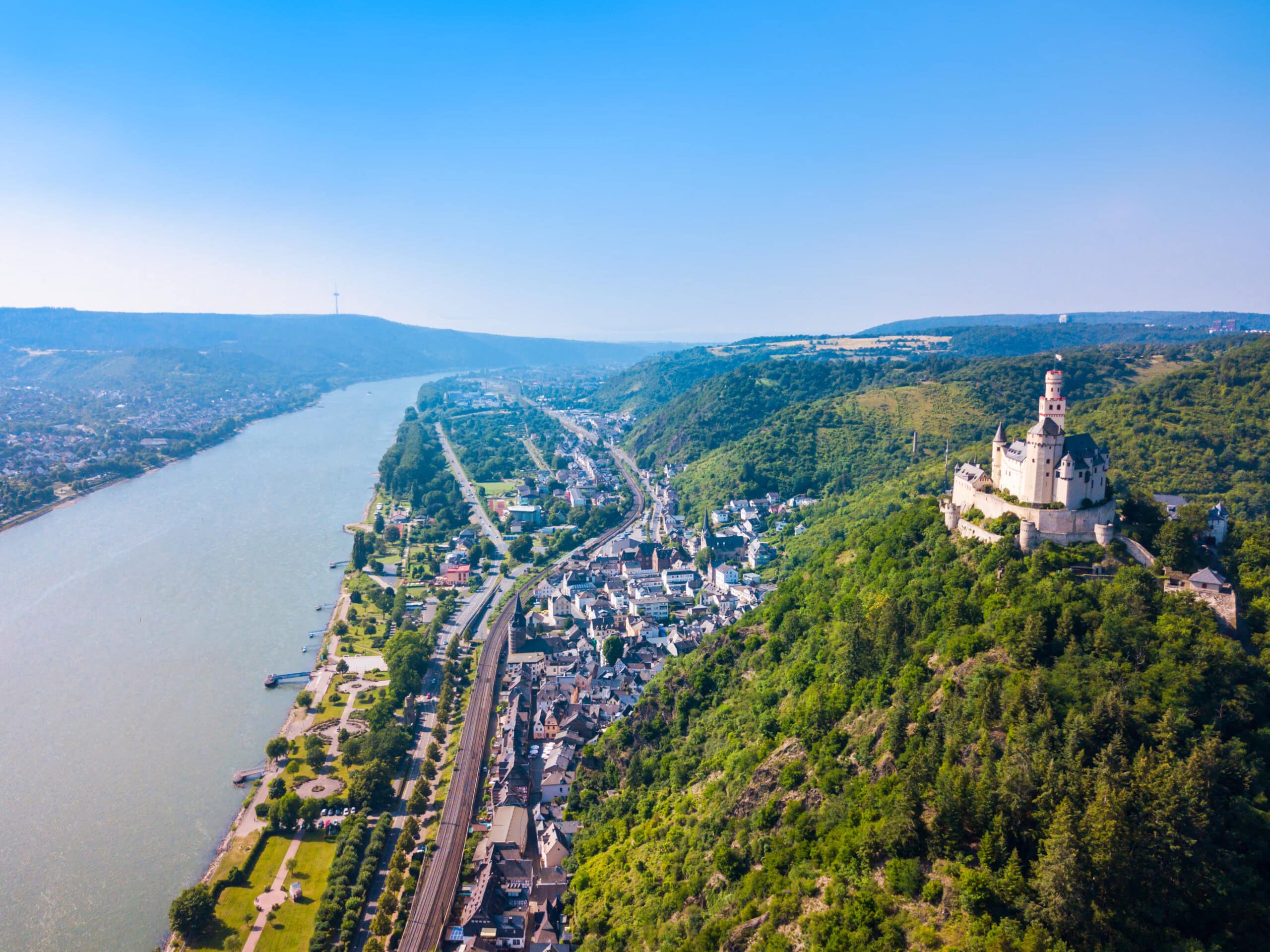
Marksburg, perched above Braubach, occupies the singular position in the Middle Rhine landscape of being the only major castle in the corridor never destroyed. Held from 1283 by the Counts of Katzenelnbogen (after their purchase from the Eppstein family), it was the seat of a documented Rhine toll station whose collection rights were continuous, well-attested, and never seriously challenged. Through the Thirty Years’ War, the Palatinate War of Succession, the French Revolutionary Wars, and even Napoleon’s reorganization of the Rhine, Marksburg accumulated minor damage but never fell to assault or fire. American artillery in March 1945 damaged the keep, the Rheinbau, the batteries and many of the roofs, and repair work did not begin until 1947. The castle has been the property of the Deutsche Burgenvereinigung since 1900 and operates as the association’s headquarters; the building one walks through today is recognizably the late-medieval Katzenelnbogen seat, not a Romantic reconstruction.
Pfalzgrafenstein, on its island in the river at Kaub, is the late-medieval resolution of the whole argument in a single building. When Ludwig the Bavarian raised it in 1326–1327 his royal title was contested and the toll it enforced was condemned by the pope and three archbishops, so in strict law it was no better sanctioned than the Raubritter tolls Rudolf I had dismantled forty years earlier; it survived untouched not because its levy was clean but because the Wittelsbach Pfalzgrafen held enough territorial power (Gutenfels, the walled town, and the island fortress together) to make the contest academic until the Golden Bull of 1356 turned what force had held into settled law. It is the clearest case on the river of the principle this essay traces: by the fourteenth century a Rhine toll castle survived or fell on whether a territorial prince, not a freelance knight, stood behind it.
Sooneck shared Reichenstein’s fate in the same 1282 campaign: captured by Rudolf I’s army, slighted, and placed under a rebuilding prohibition. The ban was lifted by Charles IV in 1349; the castle was rebuilt under Mainz administration from 1346 onward and stood until French troops destroyed it in 1689 during the Nine Years’ War. The widely repeated claim that Sooneck remained an enforced ruin for nearly four centuries conflates the two destruction phases and is incorrect: the medieval ban lasted approximately sixty years, the post-1689 ruinous phase about a century and a half, and the current building dates substantially to the 1834–1861 Prussian reconstruction under Crown Prince Friedrich Wilhelm.
Rheinstein, downstream from the slighted Reichenstein, was known in the medieval record as Vautsberg, built around 1316 or 1317 by Archbishop Peter von Aspelt of Mainz, with first documentary attestation as Mainz property in 1323 under Archbishop Matthias von Buchegg. Its primary function was administrative and territorial: Mainz built it as a Landesburg to police the imperial Wiederaufbauverbot on the Bolanden-Hohenfels site. Yet the empire could not enforce the verdict of its own king; the archbishop could, and did. Renamed Rheinstein in 1829 by Prince Friedrich of Prussia after his 1825–1829 Romantic rebuilding, the castle is one of the clearest material illustrations on the river of which institution had inherited the empire’s policing role.
Cochem, on the Mosel rather than the Rhine, illustrates the same political dynamic. In 1294 King Adolf von Nassau pledged the Reichsburg Cochem and approximately fifty surrounding villages (the Cochemer Reich) to Boemund I of Warsberg, Archbishop of Trier. The traditional figure of 50,000 silver marks for the pledge is unverifiable in primary documents, but the structural point is the same: the empire was not enforcing its toll rights along the Mosel; it was selling them off to a regional prince who could. That pledge was never redeemed. Albrecht I confirmed Trier as hereditary Burggraf in 1298, and Cochem remained Kurtrier property until the French occupation in 1794.
Conclusion
This Middle Rhine castle landscape preserves, with unusual material clarity, the political settlement of a failure. The Hohenstaufen attempt to monopolize the river’s toll-economy by means of imperial castles and ministerial garrisons did not survive the deposition of Friedrich II; the Rheinischer Bund’s effort to compensate by urban self-organization did not survive the double royal election of 1257; Rudolf I’s 1282 campaign ended the most egregious abuses without restoring the system that had been lost. What did emerge, durably, was the settled territorial geography of the archbishop-electors, the Counts Palatine, and the great merchant cities: the geography that still maps the corridor today.
What this article has not addressed is worth naming. Downstream, the Lower Rhine between Cologne and the North Sea evolved differently, under different pressures. Upstream, the Upper Rhine between Strasbourg and Basel kept a more durable imperial presence well into the late medieval period. Architecture of the castles themselves (the residential development of the Burgmannensitze, the gunpowder transformations of the fourteenth and fifteenth centuries) is a separate subject, as are the nineteenth-century Romantic restorations that gave the surviving sites their present appearance, which find their own treatment in The 19th-Century Romantic Revival of German Castles. What those sites preserve is the political moment traced here. Readers drawn to the regional geography that the moment produced can continue at Castles of the Rhine Gorge.
For how the Rhine’s fortresses held or fell when the armies came, see our history of the German castle sieges that defined a nation.
Principal Sources
- Sources
- Arnold, Benjamin. German Knighthood 1050–1300. Oxford: Clarendon Press, 1985.
- Arnold, Benjamin. Princes and Territories in Medieval Germany. Cambridge: Cambridge University Press, 1991.
- Arnold, Benjamin. Power and Property in Medieval Germany: Economic and Social Change, c. 900–1300. Oxford: Oxford University Press, 2004.
- Distler, Eva-Marie. Städtebünde im deutschen Spätmittelalter: Eine rechtshistorische Untersuchung zu Begriff, Verfassung und Funktion. Studien zur europäischen Rechtsgeschichte 207. Frankfurt am Main: Vittorio Klostermann, 2006.
- Flach, Dietmar. “Fiskalkapelle, Pfalzkapelle und Pfarrkirche: Varianten eigenkirchlicher Entwicklungen am Mittelrhein in der mainzischen Diözese am Beispiel von Andernach, Boppard und Koblenz.” In Deutsche Königspfalzen, Band 4, edited by Lutz Fenske, 13–52. Veröffentlichungen des Max-Planck-Instituts für Geschichte 11/4. Göttingen: Vandenhoeck & Ruprecht, 1996.
- Freed, John B. Frederick Barbarossa: The Prince and the Myth. New Haven: Yale University Press, 2016.
- Gardner, Roy, Noel Gaston, and Robert T. Masson. “Tolling the Rhine in 1254: Complementary Monopoly Revisited.” Journal of Economic History 62, no. 4 (2002): 939–973.
- Kaufhold, Martin. Deutsches Interregnum und europäische Politik: Konfliktlösungen und Entscheidungsstrukturen 1230–1280. MGH Schriften 49. Hannover: Hahn, 2000.
- Krieger, Karl-Friedrich. Rudolf von Habsburg. Darmstadt: Wissenschaftliche Buchgesellschaft, 2003.
- Monumenta Germaniae Historica, Constitutiones et Acta Publica II (1198–1272). Edited by Ludwig Weiland. Hannover: Hahn, 1896.
- Pfeiffer, Friedrich. Rheinische Transitzölle im Mittelalter. Berlin: Akademie Verlag, 1997.
- Regesta Imperii VI: Rudolf, Adolf, Albrecht, Heinrich VII. Edited by Oswald Redlich, Vincenz Samanek et al. Innsbruck/Köln: Böhlau, 1898–1948.
- Thon, Alexander. “Städte gegen Burgen: Tatsächliche und mutmaßliche Belagerungen rheinischer Adelsburgen durch den Rheinischen Bund 1254–1257.” Jahrbuch für westdeutsche Landesgeschichte 34 (2008): 17–42.
- Wilson, Peter H. Heart of Europe: A History of the Holy Roman Empire. Cambridge, MA: Belknap Press of Harvard University Press, 2016.
- Further Reading
- Freed, John B. Frederick Barbarossa: The Prince and the Myth. New Haven: Yale University Press, 2016. An exceptionally readable major biography that grounds the Hohenstaufen imperial system in its operational detail, essential for understanding what the system did before it broke.
- Krieger, Karl-Friedrich. Rudolf von Habsburg. Darmstadt: Wissenschaftliche Buchgesellschaft, 2003. The standard German-language biography of Rudolf I; accessible to non-specialists and balanced in its assessment of what the 1273–1291 reign actually accomplished. In German; no English equivalent exists.
- Pfeiffer, Friedrich. Rheinische Transitzölle im Mittelalter. Berlin: Akademie Verlag, 1997. The definitive scholarly study of Rhine tolls from the early medieval period to the early fourteenth century, with rigorous quantitative work on toll-station proliferation in the Interregnum. In German.
- Wilson, Peter H. Heart of Europe: A History of the Holy Roman Empire. Cambridge, MA: Belknap Press of Harvard University Press, 2016. The most accessible English-language history of the Holy Roman Empire; the chapters on imperial authority and territorial fragmentation provide the broadest context for the events traced here.
Image credits. Featured: Reichenstein Castle and the Rhine gorge in autumn, image via StoneKeep Atlas archive. §1: Wilhelm Dilich, measured drawing of Burg Rheinfels, 1607/08, public domain via Wikimedia Commons. §4: Sooneck Castle aerial in autumn, image via StoneKeep Atlas archive. §5: Marksburg above Braubach, image via Adobe Stock. Freely licensed images are resized to fit; otherwise unaltered.