
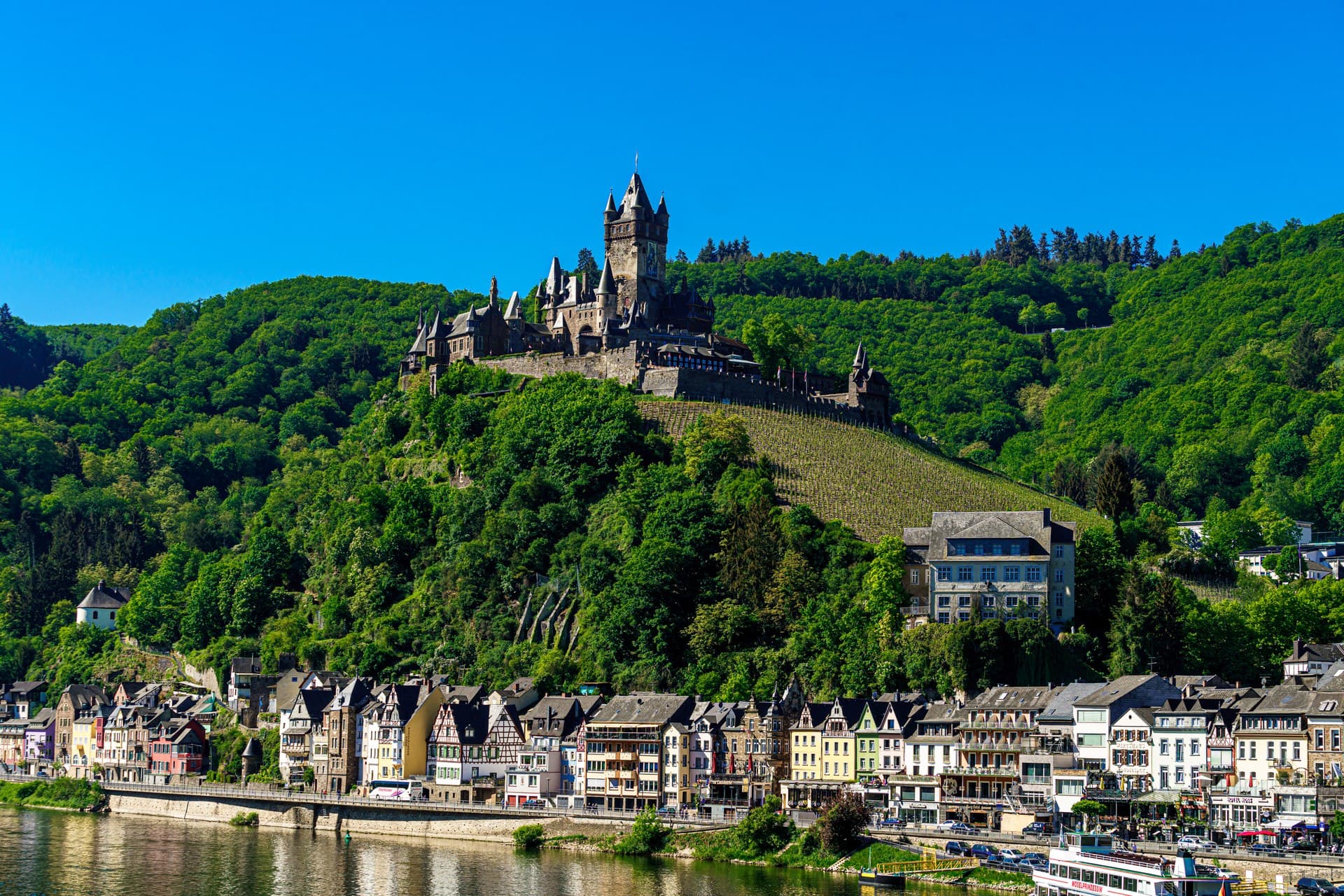
Cochem Castle
Cochem Castle (Reichsburg Cochem or the Imperial Castle of Cochem) rises on a conical hill directly above the town of Cochem on the middle Moselle, its towers visible from every direction on the river. The castle’s position is unlike that of any other fortification in the valley: where Eltz Castle hides in a forested side-gorge and Bürresheim Castle sits quietly among Eifel farmland, Cochem presides over a populated town and delivers a single coherent silhouette (rooftops, river-bend, castle) that has become one of the defining images of the German Moselle. What visitors see today, however, is almost entirely the work of the 1870s. An original medieval imperial castle was blown up by French troops in 1689 and stood in ruins for 179 years. The structure that replaced it is a Neo-Gothic creation built from a 16th-century engraving and freely extended by imagination. That gap between historical fact and romantic aspiration is what makes Cochem worth understanding.
The castle’s history divides into two clearly distinct chapters: a medieval imperial fortress and a nineteenth-century reinvention. First chapter spans nearly six centuries. Its second takes three years.
Quick Facts
| Country | Germany |
| Region / State | Rhineland-Palatinate |
| Nearest Town | Cochem |
| Construction Period | Original: c. 12th century; Reconstructed: 1874–1877 |
| Founder | Probably Siegfried von Ballenstedt (original); Louis Ravené (reconstruction) |
| Architectural Style | Medieval origins (Romanesque / Gothic); Neo-Gothic reconstruction |
| Building Type | Burg (Reichsburg — Imperial castle) |
| Current Condition | Restored |
| Open to Visitors | Yes |
| UNESCO Status | No |
| Official website | reichsburg-cochem.de |
From Imperial Tollhouse to French Ruin
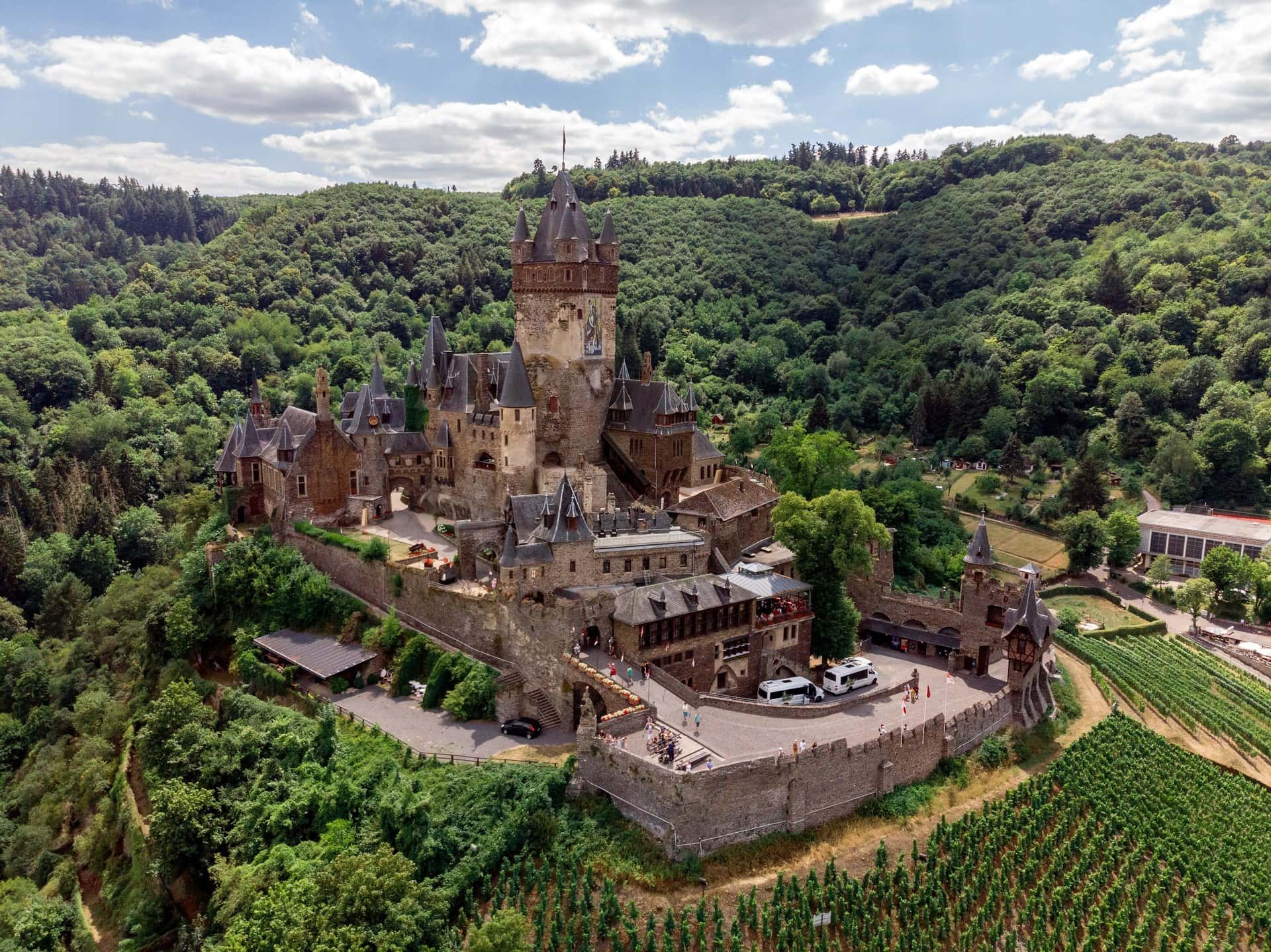
Cochem was built in the late eleventh century, probably under the Rhineland Palatinate counts, on a Bergkegel (a conical hill) rising some 100–150 meters above the Moselle. Its first secure documentary appearance is a toll charter of March 17, 1130 drawn up by Count Palatine William von Ballenstedt. Tradition holds that King Konrad III besieged and captured it in 1151, elevating it to a Reichsburg administered more directly by the crown, but this episode rests on relatively thin documentary evidence. Later in the thirteenth century, after a period of conflict with the Archbishop of Cologne, King Rudolf of Habsburg asserted control, while the decisive moment in Cochem’s medieval career came in 1294 when King Adolf of Nassau pledged the castle, the town of Cochem, and some fifty surrounding villages to Archbishop Boemund I of Trier as payment for his coronation support; from that point the fortress never effectively returned to imperial hands.
For the next five centuries Cochem served the Archbishopric of Trier as an administrative seat and, above all, as the enforcement point for a Moselle shipping toll. On the Rhine the same archbishopric held parallel toll-and-administrative castles at Burg Maus and Burg Stolzenfels, with Festung Ehrenbreitstein above Koblenz serving as the elector-residence from 1623: a system of Trier-electoral fortifications stretching from the Moselle confluence upstream to the Loreley reach. Archbishop Balduin of Luxemburg (the most powerful political figure on the Moselle in the 14th century) extended the curtain walls down to the town and stretched a heavy chain across the river below the castle. Every vessel on the Moselle paid to pass. The toll chain was the castle’s economic reason for being, and much of Trier’s Moselle wealth was extracted through it.
End came with Louis XIV’s systematic campaign to depopulate and destroy the Rhineland. French forces under Maréchal de Boufflers captured Cochem on November 8, 1688 during the Nine Years’ War. On May 19, 1689, as part of the same coordinated program that had leveled Heidelberg three months earlier, the castle was burned, undermined, and blown up by French troops on standing orders from the French high command. Ruin then sat empty for 179 years, with the town of Cochem passing to Prussia at the Congress of Vienna in 1815.
A Nineteenth-Century Dream Built on Medieval Foundations
In 1868 the Prussian state sold the ruin to Louis Fréderic Jacques Ravené, a Berlin iron merchant and Geheimer Kommerzienrat, for a symbolic 300 Taler. The sale was accompanied by expectations that the surviving medieval fabric be preserved, that the reconstruction draw heavily on the 1576 engraving of Cochem in Braun and Hogenberg’s Civitates Orbis Terrarum, and that plans receive ministerial approval; these conditions guided the rebuilding that began in 1868–69.
Ravené engaged architect Hermann Ende for the early works, then from 1871 Julius Carl Raschdorff (who would later design the Berlin Cathedral) took charge of the principal reconstruction. Main phase ran from 1874 to 1877, with interior painting and decoration continuing into the 1890s. Professor Ernst Ewald of Berlin executed the painted interiors, stained glass, and ceiling programs; the Italian mosaicist Antonio Salviati produced an 8×4 meter St Christopher mosaic on the keep, completed in 1877, destroyed on Nazi orders around 1942 and replaced in 1960.
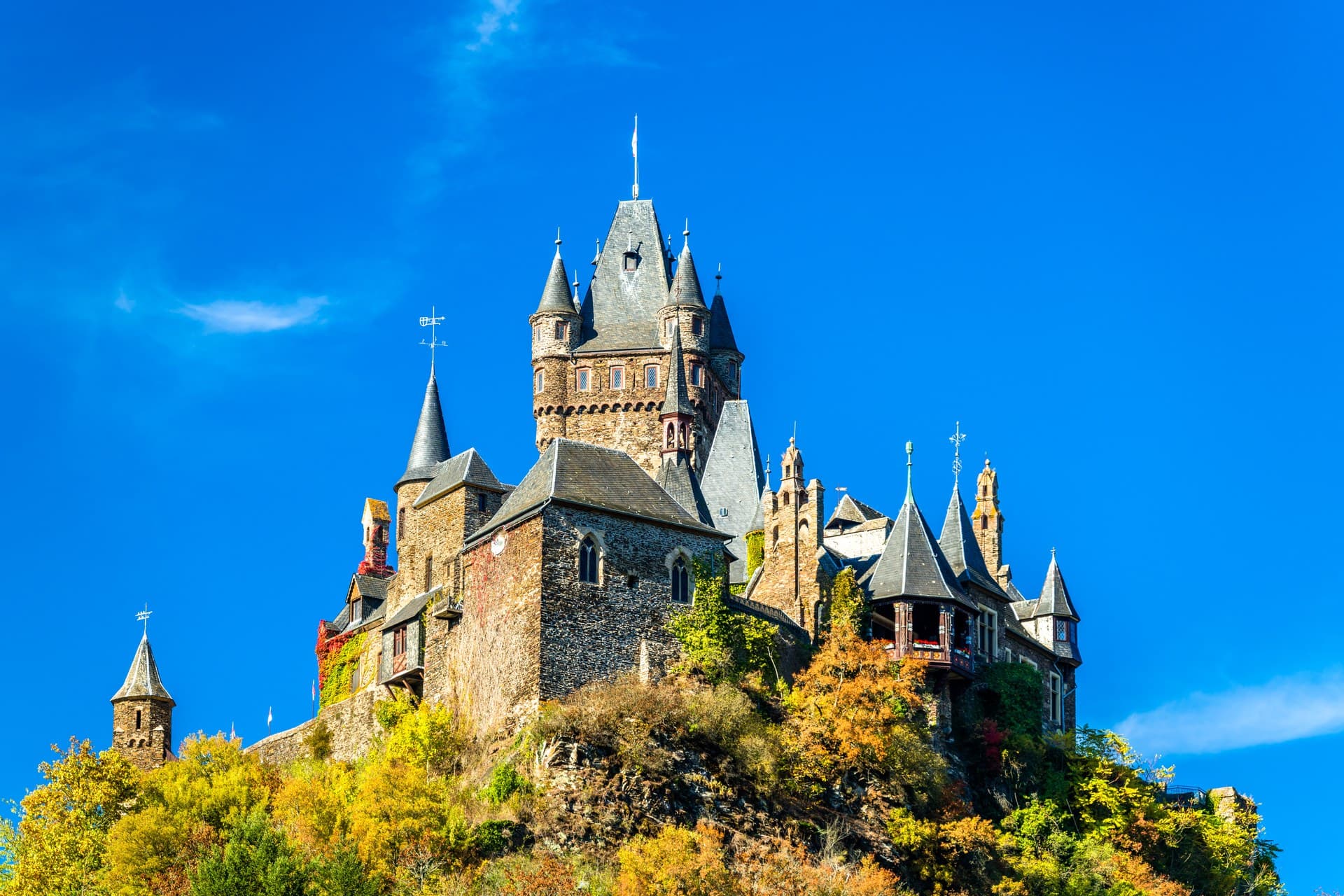
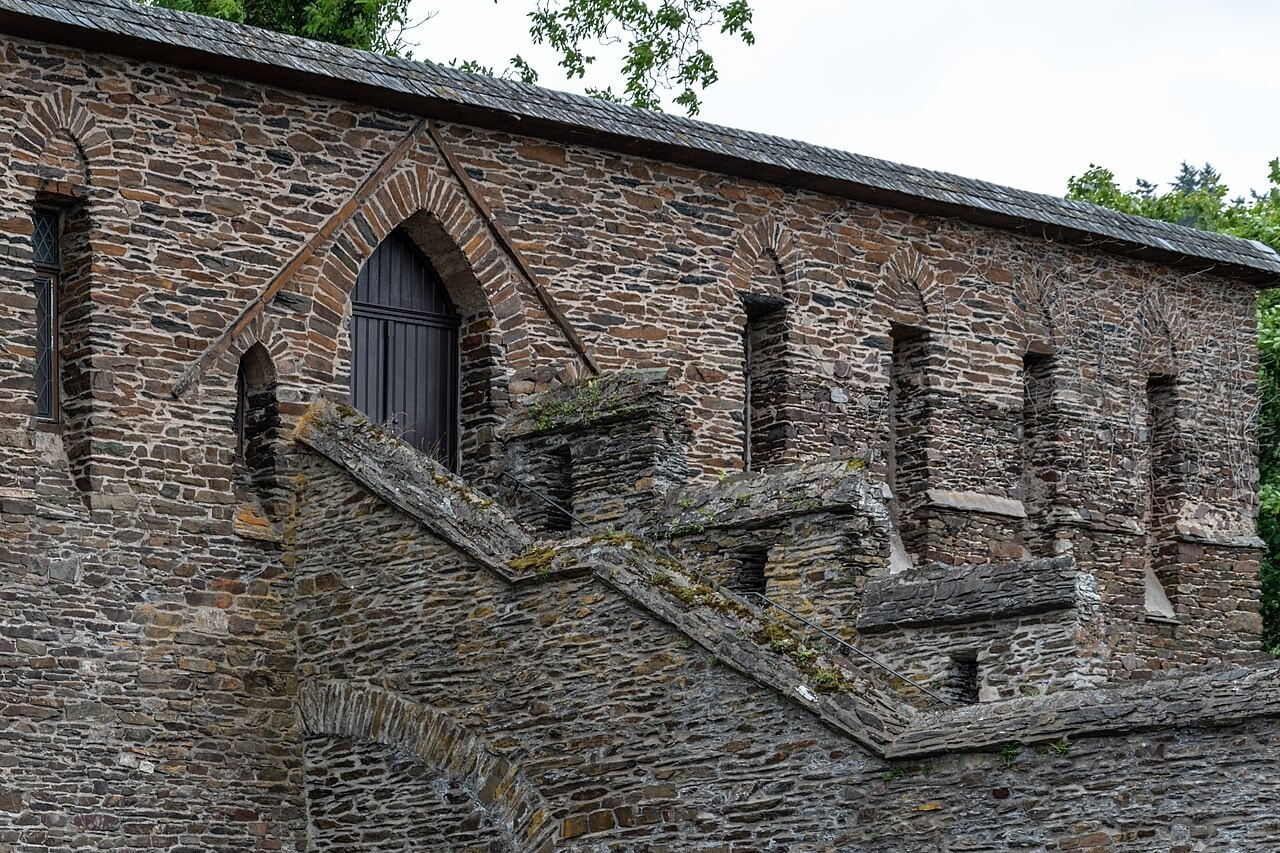
German scholarship is explicit about what survived and what was invented. Genuine medieval elements retained within the reconstruction include the lower octagonal core of the Bergfried with its vaulted cellar, sections of the ringwall, the body of the Hexenturm (Witches’ Tower) with its 14th‑century Gothic wall‑painting fragments, and the barrel‑vaulted cellar of the Rittersaal building. Everything else visible (the tourelle‑crowned upper octagonal tower, the Hexenturm’s conical helmet, the rebuilt Palas, the castle chapel described by Thon and Ulrich as ‘a complete new creation of the 19th century’, and most external rooflines) is Historicist invention. The Victorian Web has called the result ‘an example of fanciful Gothic Revival.’ Compared to the Prussian‑royal rebuilds at Stolzenfels and Rheinstein upstream on the Rhine, Cochem stands as the most freely imagined of its era, and the only one commissioned by a private industrialist.
After its wartime sale to the German Reich and postwar use by Rhineland-Palatinate as an administrative school, the Town of Cochem purchased the castle in 1978 for 664,000 DM. It has been operated since by Reichsburg Cochem GmbH, a municipal company that channels its operating surplus back into maintenance.
Visiting Reichsburg Cochem
The castle’s interior is accessible only by guided tour (there is no self-guided option), with tours running approximately every fifteen minutes during the main season. Duration is around forty minutes. Tours are conducted in German with printed English-language translations; audio-guides are available in nine further languages including French, Spanish, Italian, and Japanese. Entry tickets and local tours can also be booked in advance through GetYourGuide.
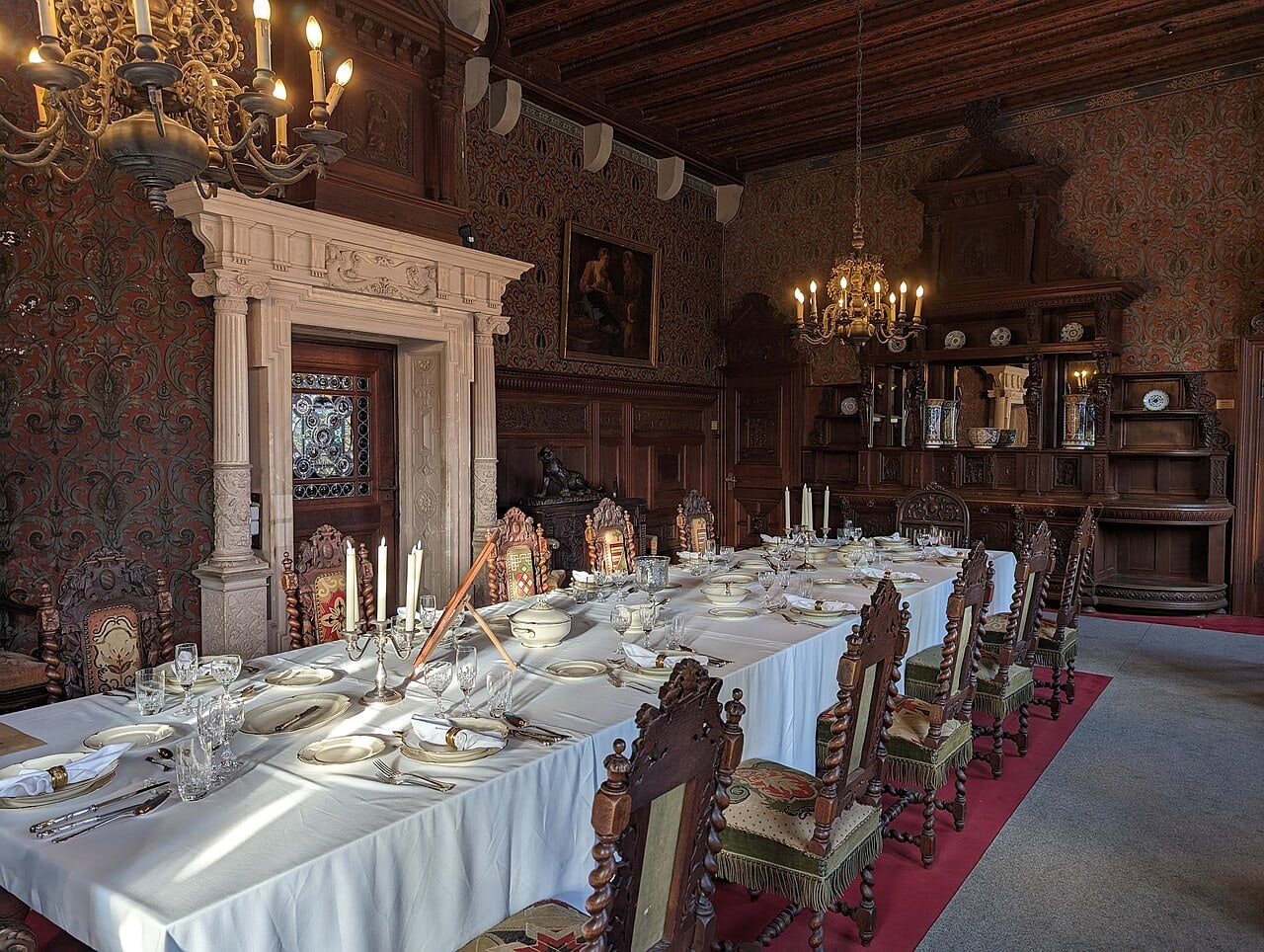
The standard route covers Gothic and Romanesque rooms furnished with the Ravené family’s collection of Renaissance and Baroque pieces, a Kemenate, the armory with weapons and suits of armor, the Rittersaal with its fireplace, a Speisesaal with a poker‑burnt ceiling, a hunting room, and the former chapel, now used for civil weddings. A 50‑meter‑deep medieval well and the castle’s viewing terrace are also included.
The castle also hosts a Friday–Saturday evening ‘Knight’s Meal’ in the cellar halls, a summer outdoor stage in the Rosenhof, an August Burgfest, and a December Advent program. House rules reserve the right to restrict visitor access during events, so touring conditions vary seasonally. Cochem is reached by a steep path from Schlossstraße in town; the ascent takes approximately ten to fifteen minutes on foot.
Admission prices for 2026, verified on the operator site at reichsburg-cochem.de. All interior visits are by guided tour only (approximately 40 minutes):
| Ticket | Price |
|---|---|
| Adult | €10.00 |
| Children, 6–17 | €5.00 |
| Group (12+ persons) | €9.00 per person |
| Pupils 18+, students | €9.00 |
| Family ticket (parents + 2 or more children under 18) | €26.00 |
The Knight’s Meal evening event (Friday and Saturday, 4 hours, includes the castle tour) is €64 adult / €32 child 6–17. Pricing is reviewed annually; verify on the operator site before traveling.
Cochem’s 1294 pledge from King Adolf von Nassau to Archbishop Boemund of Trier exemplifies the late-13th-century pattern of imperial toll-rights devolving to the territorial archbishops; the broader political-economic context is treated at length in The Rhine as Contested Territory: Castles, Tolls, and the Collapse of Imperial Authority. Anyone staying overnight can compare hotels in and around Cochem.
Some links on this page are affiliate links, which means StoneKeep Atlas may earn a small commission, at no extra cost to you, if you book through them.
Conclusion
Cochem is not the castle that occupied this hill for six centuries. It is something more complicated: a nineteenth-century industrialist’s interpretation of a medieval engraving, built on the genuine foundations of an imperial tollhouse, funded by the profits of 19th-century iron commerce, and now owned by the town that the original castle was built to protect. The authentic medieval fragments (the Bergfried’s lower core, the Hexenturm’s painted walls, the barrel-vaulted cellars) are embedded within a structure that openly acknowledges their transformation. The castle’s own website calls it “almost entirely a late nineteenth-century creation,” and that candour is its most instructive quality. Its unbroken silhouette above the river also earns Cochem its place among the fairytale castles in Germany.
To understand Cochem within the wider Moselle valley is to understand why Eltz Castle (intact, privately owned, never rebuilt) matters so much in contrast. Together they are the two poles of Moselle castle history: what survived, and what had to be imagined back into existence. Both experiences belong in the same journey through this valley, and both belong to the wider story of the castles of the Moselle valley.
The destruction of the Reichsburg in 1689 was part of a deliberate campaign described in our history of the sieges that defined Germany.
Principal Sources
- Reichsburg Cochem GmbH. “The Castle.” https://reichsburg-cochem.de/the-castle/?lang=en
- Wikipedia (German). “Reichsburg Cochem.” https://de.wikipedia.org/wiki/Reichsburg_Cochem
- Landow, George P. “Reichsburg Castle, Cochem, Germany — an Example of Fanciful Gothic Revival.” The Victorian Web. https://victorianweb.org/art/architecture/gothicrevival/reichsburg.html
Image credits. Featured image — Reichsburg Cochem above the town of Cochem on the middle Moselle — the view from the opposite bank that defines the castle’s place in the German travel landscape: via Adobe Stock. Aerial view of Reichsburg Cochem — the conical Bergkegel with all rings of curtain wall, vineyard terraces on the slope below: via Adobe Stock. Sections of original medieval masonry within the reconstruction — the older stonework, with its Gothic window arches, reveals the pre-1689 fabric embedded within Raschdorff’s 1870s rebuild: Dietmar Rabich, CC BY-SA 4.0, via Wikimedia Commons. The Neo-Gothic roofline of Reichsburg Cochem in autumn — the tourelle-crowned Bergfried and assembled spires that Julius Carl Raschdorff completed in 1877: via Adobe Stock. The castle’s dining room, furnished with the Ravené family’s collection of Renaissance and Baroque pieces — the interior character throughout reflects 19th-century historicist taste: Sten van Houwelingen, CC BY-SA 4.0, via Wikimedia Commons. Freely licensed images are resized to fit; otherwise unaltered.