
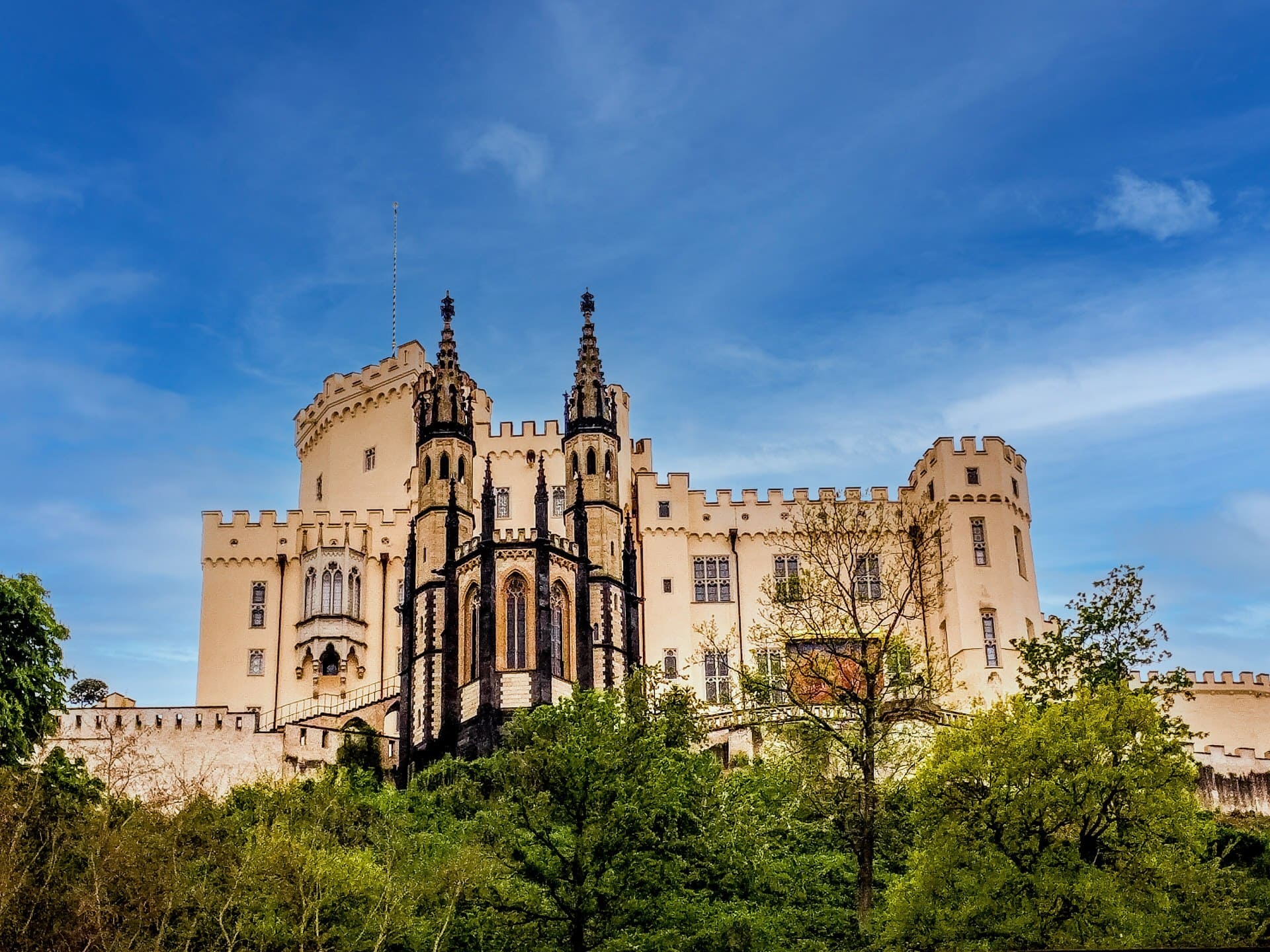
Stolzenfels Castle
Yellow against the Rhine, Stolzenfels rises like a Romantic stage set, its crenellated parapets and Italianate pergolas catching the afternoon sun on a wooded ridge south of Koblenz. Stolzenfels Castle (Schloss Stolzenfels), the Rhineland summer palace of King Frederick Wilhelm IV of Prussia, is the architectural showpiece of the Hohenzollern program that transformed the Rhine’s medieval ruins into a chain of fairy-tale residences in the 1820s, 30s, and 40s. Designed in 1836 by Karl Friedrich Schinkel, completed by his pupil Friedrich August Stüler after Schinkel’s death in 1841, and immortalised by Queen Victoria’s torchlit visit in August 1845, the castle is one of the most outstanding monuments of Rhine Romanticism still surviving in Germany; one of the most completely preserved Romantic-era princely interiors anywhere in the country. Within the UNESCO Upper Middle Rhine Valley World Heritage Site since 2002, today it is operated as a “living museum” by the Generaldirektion Kulturelles Erbe Rheinland-Pfalz, undergoing further restoration ahead of the federal horticultural show in 2029.
Quick Facts
| Country | Germany |
| Region / State | Rhineland-Palatinate (Rheinland-Pfalz), western Germany |
| Nearest Town | Koblenz (Stolzenfels is a left-bank suburb ~7 km south of the Hauptbahnhof) |
| Coordinates | 50.303194° N, 7.592389° E |
| Construction Period | Medieval Burg 1242–1259 (Archbishopric of Trier); Romantic rebuild 1836–1842 under Crown Prince and later King Frederick Wilhelm IV of Prussia; Schlosskapelle 1843–1847 |
| Founder | Archbishop Arnold II von Isenburg of Trier (medieval, 1242); Crown Prince Frederick Wilhelm of Prussia (Romantic rebuild, from 1823) |
| Architectural Style | Medieval Burg core (13th–14th century); Gothic Revival summer palace in the Burgenromantik tradition, designed by Karl Friedrich Schinkel (1836) and completed by Friedrich August Stüler (1841–1850), with first plans by Johann Claudius von Lassaulx |
| Building Type | Schloss — Romantic Gothic Revival summer palace integrating a 13th-century medieval Trier toll castle |
| Current Condition | Restored; Schinkel and Stüler’s 19th-century interiors substantially intact, with major exterior Sanierung 2007–2011 (€16.7m) and emergency slate-roof works 2024–2025 |
| Open to Visitors | Yes — guided tours only (German with English handout); standard tour ~45 min, longer Gesamtkunstwerk tour ~2 hrs |
| UNESCO Status | Within the Upper Middle Rhine Valley World Heritage Site (inscribed 2002, criteria ii, iv, v) |
| Official website | schloss-stolzenfels.de |
Origins and founding
Stolzenfels as we see it today is the product of two foundings: a medieval one by the Archbishops of Trier, and a Romantic one by the Hohenzollerns five and a half centuries later.
Between 1242 and 1259, the hillside above the small Rhine settlement of Stolzenfels was first fortified by Archbishop Arnold II von Isenburg of Trier. Burg was a Zollburg (a toll-castle), sited deliberately opposite Burg Lahneck, the Mainz fortress that had risen ten years earlier on the right bank where the Lahn enters the Rhine. The two castles eyed each other across the water for the better part of a century, each enforcing the river-tariffs of its archbishopric. Stolzenfels passed through the hands of successive Trier electors (Balduin von Luxemburg, Kuno II, Werner von Falkenstein) who added the Adjutantenturm in the 1330s, the Wohnturm in 1381, and a heightened pentagonal Bergfried that still stands. In 1412 the toll right itself was transferred away.
It ended during the Nine Years’ War. In 1689, French troops under Louis XIV’s marshals burned Stolzenfels along with much of the Rhineland, and the castle remained an open ruin for the next 130 years. Its stones were quarried by villagers; ivy grew through the windows; only the Bergfried and parts of the Palas wall stood at full height when, in 1802, the secularization of the Trier Electorate transferred the property to the City of Koblenz.
The Romantic founding came in 1823. The Congress of Vienna had handed the Rhineland to Prussia eight years earlier, and the City of Koblenz, looking for a way to court its new royal masters, gifted the ruin to the Crown Prince, the future King Frederick Wilhelm IV. He accepted, and for the next thirteen years the project sat fallow as he weighed what to do with it. The answer, when it came in 1836, would change the face of the Rhine.
Architectural character and evolution
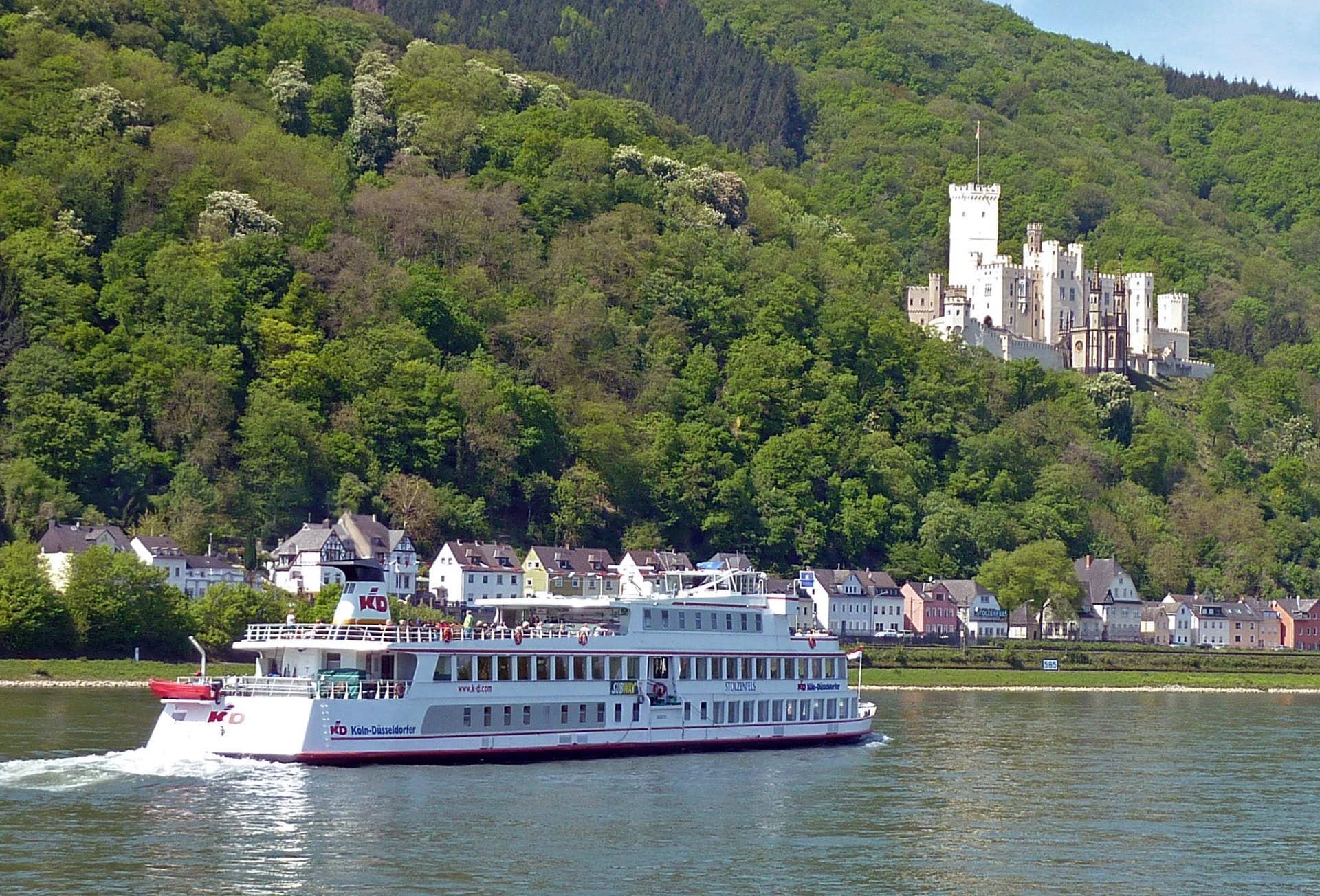
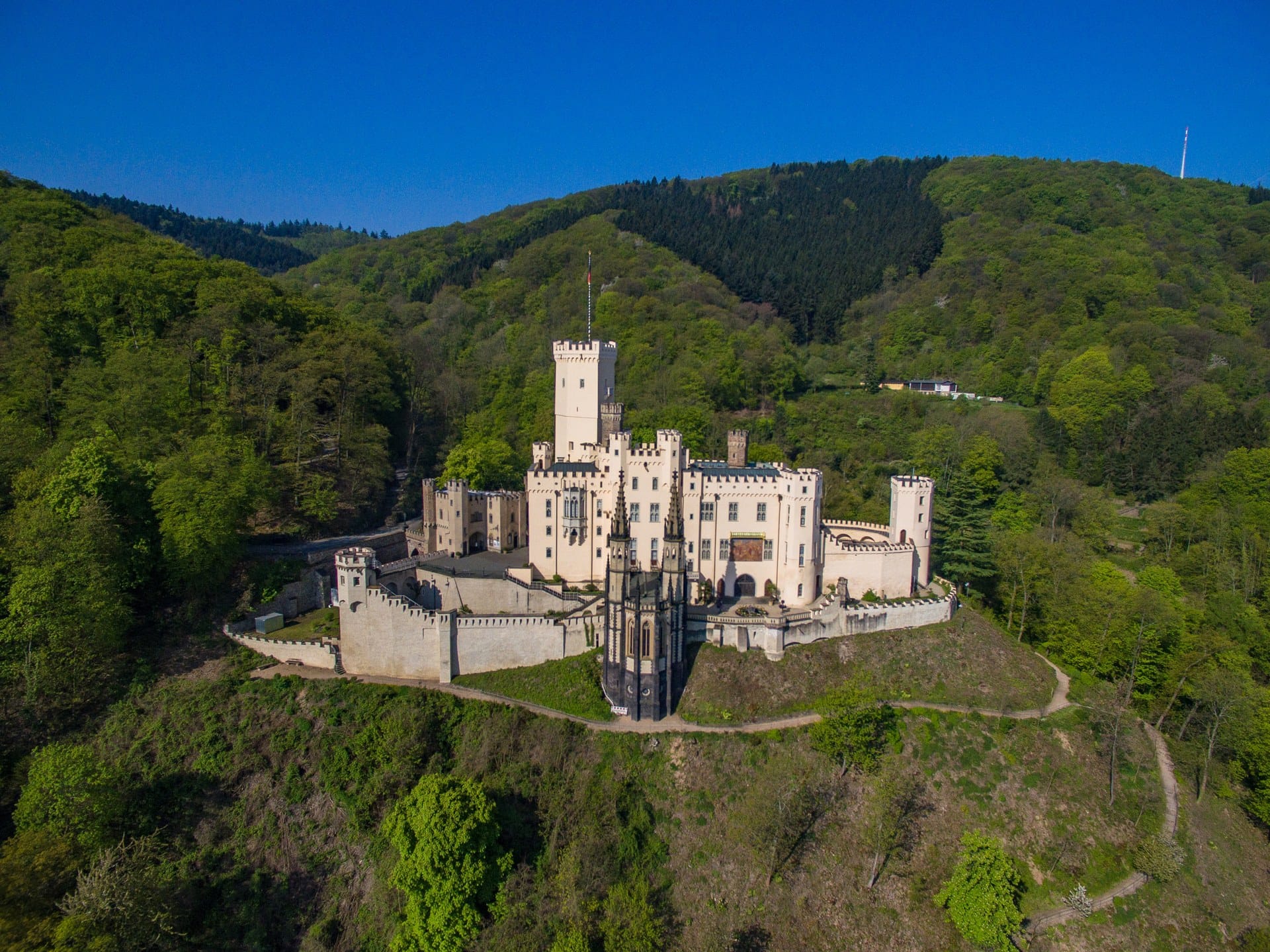
Stolzenfels is a Gothic Revival summer palace wrapped around the surviving fabric of a medieval Burg. Smooth pale-yellow (“hellgelb”) ochre lime-render unifies every facade into a single architectural personality, visible from miles up- and downriver and sometimes informally called Schinkelgelb after the architect, though primary documents prefer the descriptive Land terminology. The unbroken crenellated parapet running over flat roofs and turrets is the unifying gesture; the silhouette is asymmetric and picturesque, the medieval Bergfried left as a compositional anchor.
The architects: who built what
Attribution matters because Stolzenfels is sometimes credited carelessly to Schinkel alone. The truth is more interesting and more shared.
Lassaulx, the Koblenz architect, began the project who surveyed the ruin in the early 1830s and produced the first restoration plan, a modest residential conversion of a single Wohngebäude. Lassaulx’s separate but linked commission, the parish church of St. Menas at the foot of the hill, was already underway between 1826 and 1833. His scheme is the empirical seedbed of everything that followed.
In June 1836, Frederick Wilhelm approved a different, far more ambitious plan: Karl Friedrich Schinkel’s Generalplan, a complete Gothic-Romantic vision that absorbed the medieval fabric into a unified summer residence. Schinkel never directed construction on site; from his Berlin studio he supplied drawings, instructions, and the controlling architectural intelligence. He died on October 9, 1841, with the building two-thirds complete.
His pupil Friedrich August Stüler took over and finished the work; he substantially co-authored it. Stüler designed the Schlosskapelle from 1843 to 1847 with Carl Schnitzler, the Pergolagarten arcade and its Lenné-planted gardens, and the monumental brick park viaduct that carries the carriage road over the Gründgesbach. The expansion of the Königstrakt after Frederick Wilhelm’s accession in 1840 was Stüler’s work; so too was the interior refinement undertaken with Ludwig Persius and Heinrich Strack between 1841 and 1850. Local execution lay with the Ehrenbreitstein fortress builders W. Naumann and Carl Schnitzler under fortress commander Philipp von Wussow.
Schinkel deserves principal credit for the creative concept of Stolzenfels, Stüler played a major role in carrying the work forward after 1841, and Lassaulx contributed to the early phase. Stolzenfels is best understood as a collaborative Romantic project rather than the work of a single architect.
The interiors
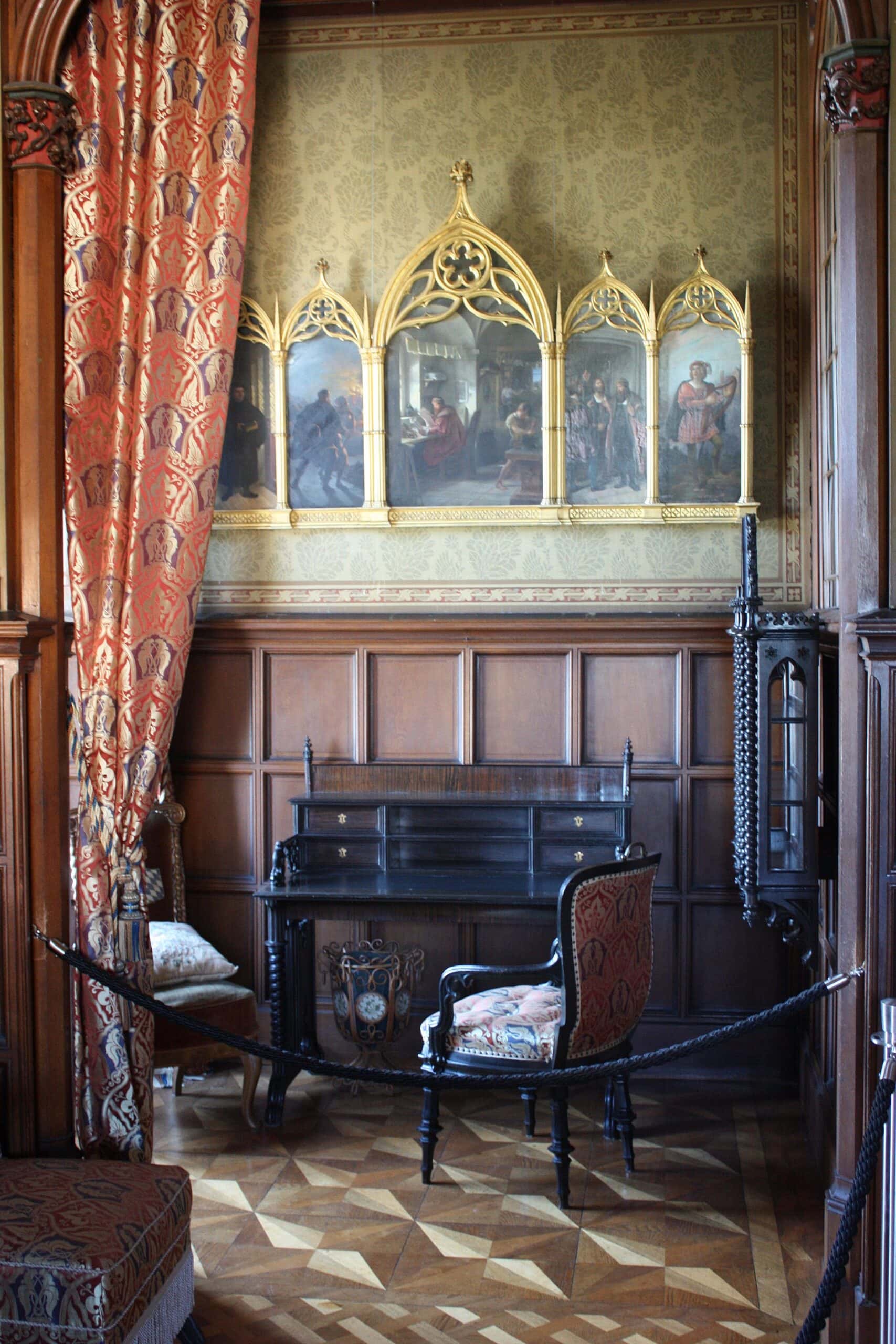
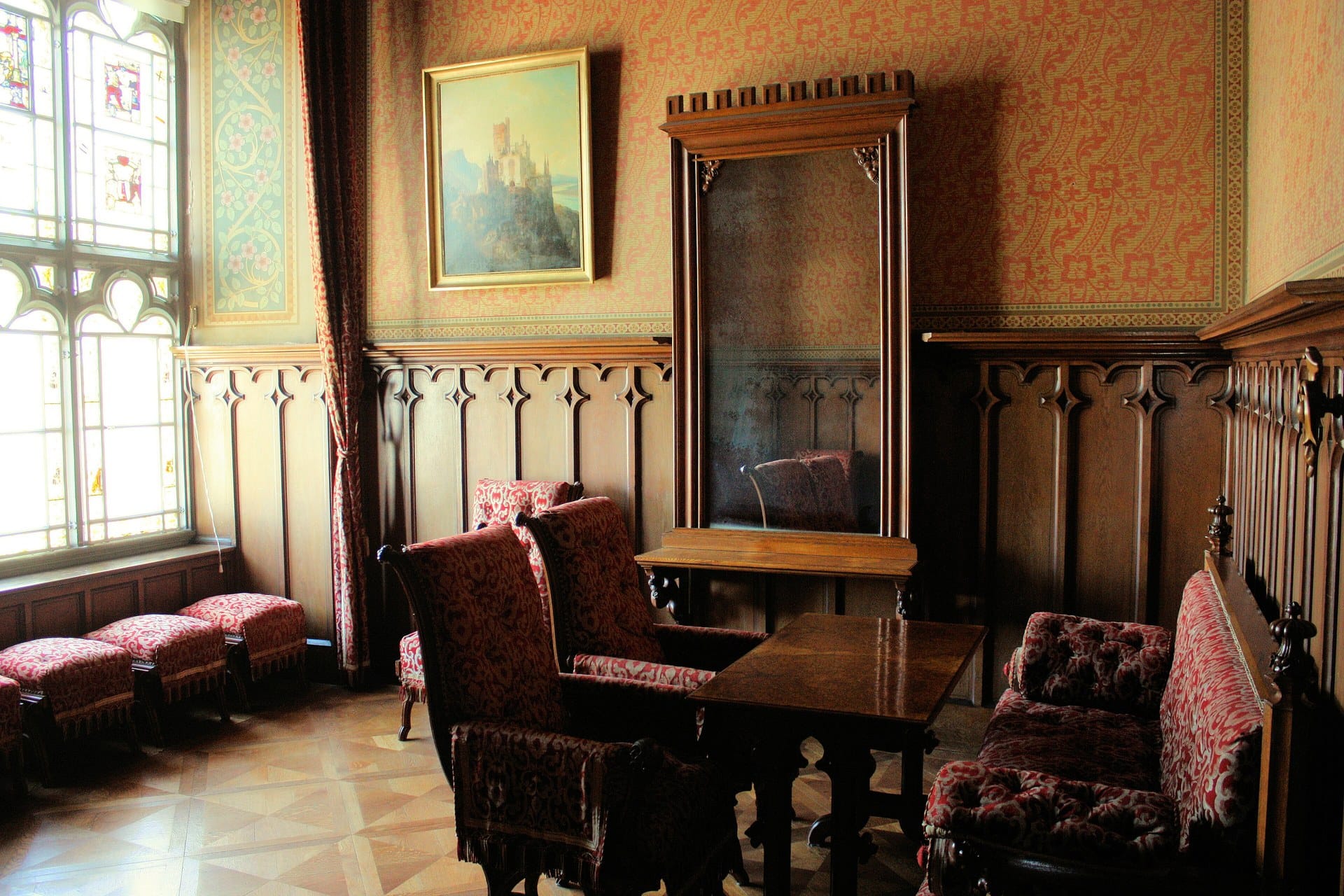
Schinkel’s design vocabulary at Stolzenfels synthesises three traditions: Gothic Revival from the English picturesque, Italianate villa from his earlier work at Schloss Glienicke and Charlottenhof Villa for the Crown Prince in Potsdam, and German Burgenromantik. The result is one of the most completely preserved Romantic-era princely interiors in Germany, with original woodwork by H. Rhode of Trier, J. W. Vetter of Neuwied, and the Koblenz cabinet-makers Gerstenkorn, Gerber, and Mündenich largely surviving in situ.
The Großer Rittersaal in the upper Palas was Schinkel’s homage to the Marienburg’s Großer Rempter, where he had personally worked: slender columns rise to a slim Netzgewölbe, and the King’s arms collection lines the walls below Hermann Anton Stilke’s monumental cycle of the Sechs Rittertugenden (Bravery, Loyalty, Love, Song, Justice, and Constancy), painted between 1842 and 1846.
The Kleiner Rittersaal occupies the surviving medieval Wohnturm of 1381, its reconstructed Sterngewölbe carrying further Stilke murals with Josef Kehren as co-author. Doors give onto the chapel-roof terrace.
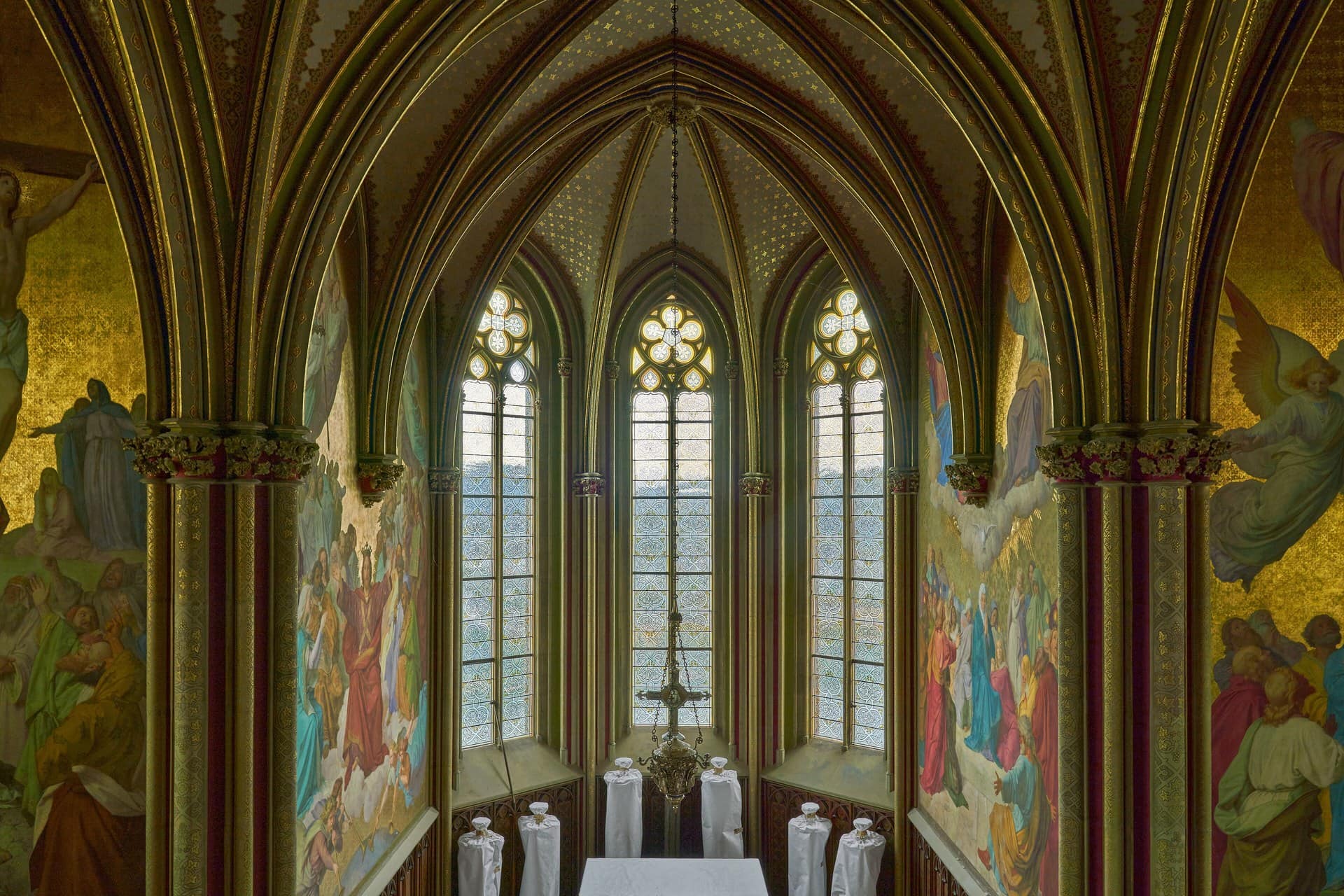
Schlosskapelle itself, Stüler’s masterpiece on the site, is a small cruciform space with an octagonal needle-spired choir, a ribbed cross-vault, and Ernst Deger’s twelve-panel Nazarene cycle of the Story of Salvation painted on gold ground, modeled on Deger’s earlier program at the Apollinariskirche in Remagen. The 1846 swallow’s-nest organ is by Ibach. An octagonal Taufkapelle sits below.
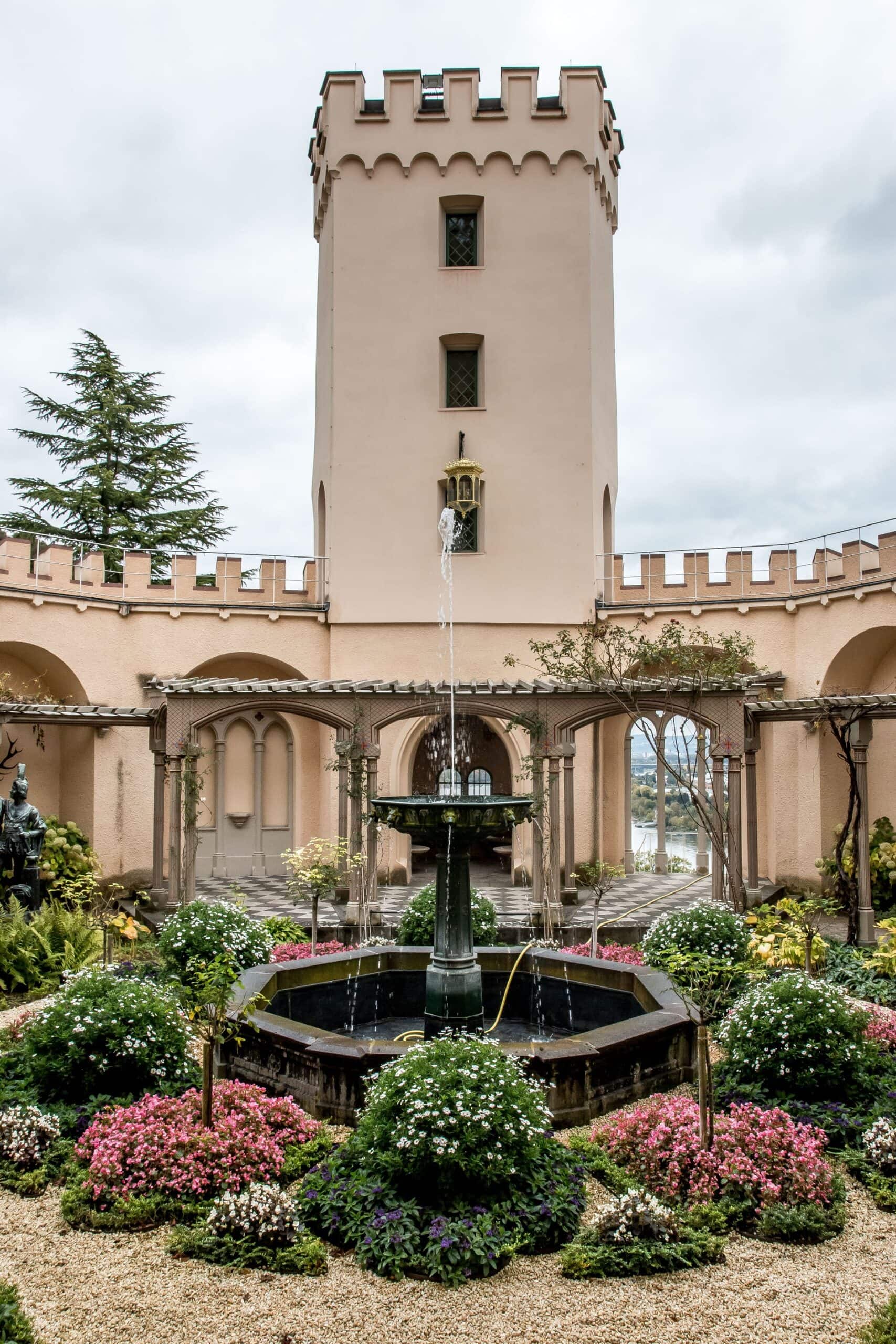
Outside, the Pergolagarten descends from the courtyard through Stüler’s arcaded loggia, with a central cast-iron fountain in a chalice basin and a rose-window flowerbed; the Schlossterrasse carries Christian Daniel Rauch’s cast-iron Adlersäule (the Eagle Column), gifted to the King in 1842 from the Royal Iron Foundry in Berlin. On the Palas exterior, Johann Adolf Lasinsky’s mural of 1844 depicts Archbishop Werner of Trier receiving King Ruprecht. Stolzenfels is Schinkel’s only complete Rhine castle commission, and the closest comparator within his oeuvre is Schloss Babelsberg at Potsdam, another neo-Gothic summer residence whose foundational scheme by Schinkel was completed and altered by Persius and Strack. The same authorship pattern recurs at Stolzenfels.
Historical significance
To understand why Stolzenfels matters, one has to read it as Frederick Wilhelm IV intended it to be read: as a political statement carved into the cliffside above the Rhine.
In 1815 the Congress of Vienna had given Prussia the Rhineland. The Province formed in 1822. But the territory was an awkward inheritance, culturally distinct, majority-Catholic, French-influenced after two decades of Napoleonic rule, its medieval past tied to the prince-bishoprics of Trier, Mainz, and Cologne rather than to the Protestant Hohenzollerns of distant Berlin. The new royal authority needed legitimation in a language the Rhineland would recognize.
Frederick Wilhelm’s answer, delivered in stone, was Romantic medievalism. Hohenzollern Burgenrenaissance (the Prussian program of acquiring and rebuilding Rhine ruins as fairy-tale residences) began with Prince Friedrich’s purchase of Burg Rheinstein in 1823 and continued with Burg Sooneck in the 1830s and 1840s, where Frederick Wilhelm joined his brothers. Stolzenfels was always intended to be the showpiece, the largest and most architecturally ambitious of the family’s Rhine projects, executed by the kingdom’s leading architect at the height of his powers. Chain extended across the river to Marksburg, though the never-destroyed Burg above Braubach was a counter-example, the rare Rhine fortress that needed no rebuilding, and downriver to the Moselle, where parallel restorations such as Cochem Castle belonged to the same wider Burgenromantik wave. (This is the cluster Stolzenfels anchors at the heart of the 19th-Century Romantic Revival hub and the Prussian Royal Castles hub.)
The political grammar was deliberate. By restoring a Trier ruin and inhabiting it himself, Frederick Wilhelm cast the new Prussian dynasty not as foreign occupiers but as continuators of the Rhineland’s medieval past. Same logic produced his parallel sponsorship of Cologne Cathedral’s resumed construction, with the foundation stone laid on September 4, 1842, eleven days before Stolzenfels itself was inaugurated. Both buildings spoke to Catholic Rhenish sensibilities; both demonstrated that Hohenzollern power could be expressed in the local visual language.
On September 14, 1842 the castle’s inauguration was theater as governance. The King, the court, and several thousand guests arrived in medieval costume. A torchlight procession escorted the royal party up the hillside; banquets, tournaments, and tableaux vivants performed dynastic continuity for an audience that included foreign royals, German princes, journalists, and curious tourists.
Stolzenfels is the architectural climax of Burgenromantik, the early-19th-century rediscovery of the German castle as a site of national feeling, fed by Lord Byron’s Childe Harold (whose third canto romanticised the Rhine in 1816), Heinrich Heine’s Die Lorelei (1824), and the Rhine steamship traffic that began the same year. Frederick Wilhelm reportedly told his architect that he wanted the castle to feel wie im Märchen, like in a fairy tale. Schinkel and Stüler delivered exactly that.
Cultural and royal associations
Stolzenfels was a Hohenzollern summer residence and reception house from its 1842 inauguration until the abdication of Wilhelm II in 1918. Frederick Wilhelm IV used the castle most intensively during his reign from 1840 to 1861; after his death it passed within the family to King Wilhelm I (German Emperor from 1871) and Empress Augusta, who continued to entertain at the Schloss into the 1880s. But the most famous moment in the castle’s social history came in the second year of its existence, when a young British queen disembarked from a Rhine steamer at the foot of the cliff.
Queen Victoria’s visit, August 1845
Queen Victoria and Prince Albert arrived at Stolzenfels on the afternoon of August 14, 1845. It was the centerpiece of their first state visit to Germany, a journey that doubled as Albert’s homecoming to Coburg-Gotha and as the public theater of an Anglo-Prussian dynastic alliance. The reciprocal nature of the visit mattered: three years earlier, on January 25, 1842, Frederick Wilhelm IV had crossed the Channel to stand as godfather to Victoria’s eldest son, the future Edward VII, at his christening in St George’s Chapel, Windsor.
On August 10 the royal yacht Victoria and Albert carried the couple to Antwerp through a Channel storm. From Brussels they took the new Belgian-Prussian railway to Cologne, then the Rhine steamer south. Frederick Wilhelm received them at Schloss Brühl. On August 12 they appeared on the balcony of the Fürstenberg Palais in Bonn for the unveiling of the Beethoven Monument on the seventy-fifth anniversary of the composer’s birth, in a crowd that included Liszt, Berlioz, Meyerbeer, Spohr, Jenny Lind, Pauline Viardot, and Alexander von Humboldt. Two days later the royal steamer brought them to Koblenz and up the wooded path to Stolzenfels.
The visit’s set piece was the Rhine illumination, commemorated in the Illustrated London News of August 23, 1845 under the title Illumination of the Rhine, from Stolzenfels. From the castle terrace the royal couple watched bonfires, Bengal lights, and lanterns spread along both banks of the river; flares lit the steamer routes; the castle itself stood flood-lit against the night sky. Eight military bands (some six hundred musicians) provided the soundtrack. The Schlosskapelle was inaugurated during the visit; a high-level concert in the music rooms featured Liszt, Meyerbeer at the piano, Pauline Viardot-García, and Jenny Lind. Frederick Wilhelm orchestrated the spectacle personally.
Victoria opened the German leg of her journal that month with a passage marvelling at being in Germany at all, the first such visit of her reign and a private homecoming for Albert. Among the banquet guests were the King and Queen of the Belgians (Leopold I and Louise-Marie), the King and Queen of the Netherlands, and Archduke Friedrich of Austria. In 1847 the royal couple commissioned two watercolours of the Knights’ Halls from Carl Graeb as memorial pieces; both remain in the Royal Collection at Windsor.
By the late 1840s Stolzenfels was a fixture of the European Grand Tour, exported worldwide by the Illustrated London News, the Baedeker handbooks (Karl Baedeker was based in Koblenz), and the Murray and Bradshaw guides. The castle’s status as a royal stage had been established in a single August evening, and it would carry that reputation for the rest of the century.
Visiting the castle
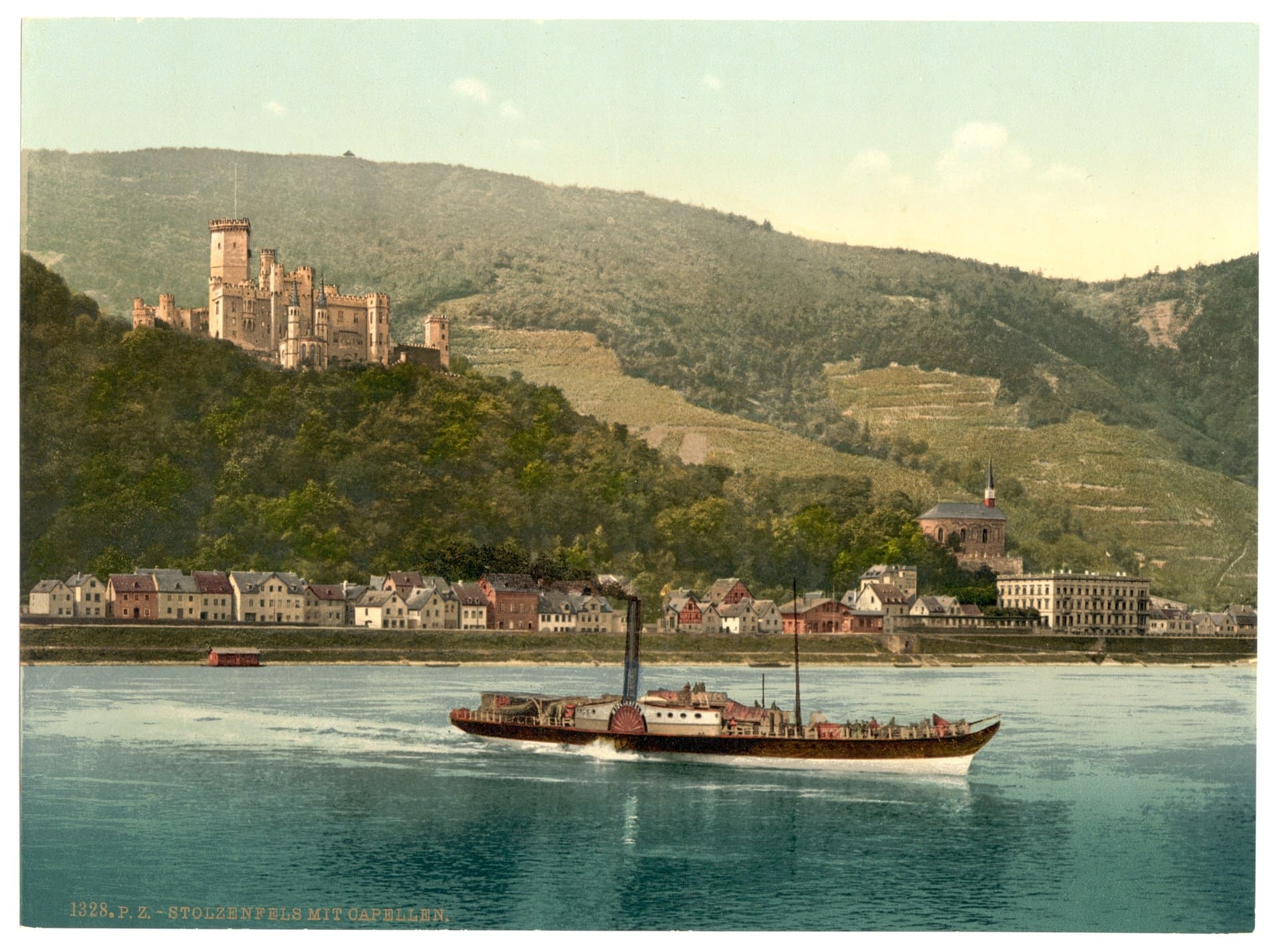
Stolzenfels lies about seven kilometers south of Koblenz Hauptbahnhof on the left bank of the Rhine, opposite the Lahn confluence and within sight of Marksburg upstream and Ehrenbreitstein Fortress downstream over the Koblenz Deutsches Eck. The simplest non-driving approach is the Koblenz to Stolzenfels Rhine boat from Konrad-Adenauer-Ufer in the city center, which lands at the Stolzenfels Anlegestelle directly below the castle from April through October. Drivers and walkers reach the village along the B9 and the Rhine cycle path; visitors arriving by train continue from Koblenz Hauptbahnhof on DB Regional Bus 650 or 670 (about ten to seventeen minutes, hourly) to the stop at Stolzenfels Schlossweg. Entry tickets and local tours can also be booked in advance through GetYourGuide.
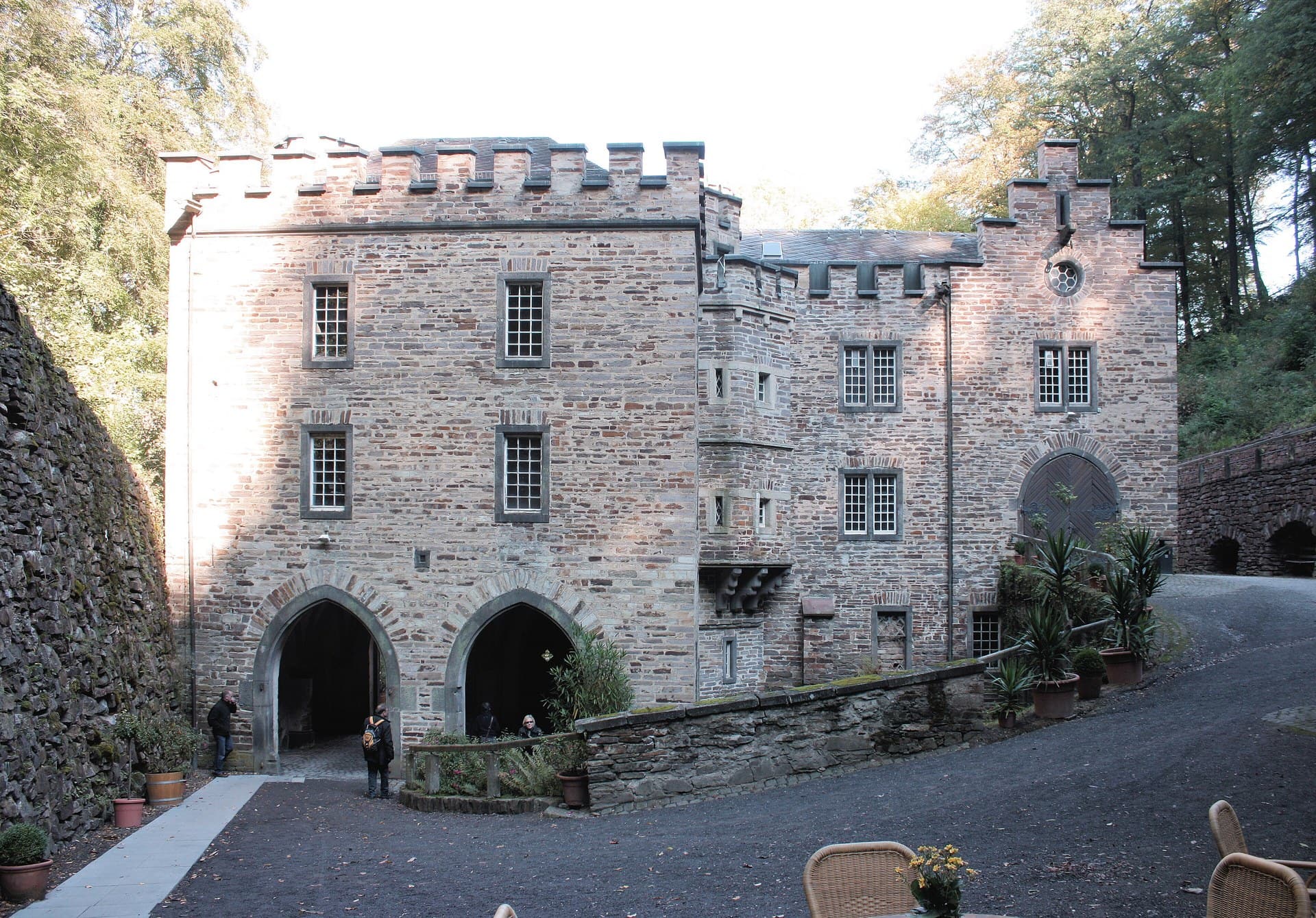
There is no direct road for ordinary visitors to the castle gate. From the village car park at Rhenser Straße 15, a serpentine footpath designed by Peter Joseph Lenné climbs roughly seventy meters through a wooded gorge, under a brick viaduct by Stüler, past a rock grotto with waterfall, the Klause that once housed castle staff, and the parish church of St. Menas, the first Hohenzollern building of the ensemble (Lassaulx, 1826–33). The path is sealed but unbroken in its gradient; allow twenty minutes uphill, twenty-five to thirty in summer heat. Benches and viewpoints punctuate the climb, and the framed view of the Rhine through the trees shifts at every bend.
The castle interiors are accessible by guided tour only, conducted in German with an English handout. Felt overshoes are provided to protect the original parquet. Standard tour runs about forty-five minutes and typically covers the Torwächterhaus and inner courtyard with its three-aisled arcade hall, the Großer Rittersaal with Stilke’s Six Knightly Virtues cycle, the Kleiner Rittersaal in the medieval Wohnturm, the historic living rooms of Frederick Wilhelm IV and Queen Elisabeth (largely original 19th-century furnishings), the joint bedchamber above the arcade, the Sommerhalle, and the Schlosskapelle with Deger’s Nazarene program. A longer “Gesamtkunstwerk” tour of about two hours adds the Klause and a more detailed treatment of Schinkel’s furnishings.
After the tour the gardens are open without further ticket. The Pergolagarten with its rose-clad arcades and central cast-iron fountain occupies the south-eastern terrace; the Schlossterrasse carries Rauch’s Adlersäule and offers the four-castle panorama north and south along the river. The 9-hectare Lenné landscape park spreads up the Schlossberg behind.
Photography inside the castle is prohibited; outdoors (courtyards, gardens, terraces, park), private photography is permitted, though drones are not without explicit permission from the GDKE. A typical visit runs about two to two-and-a-half hours door-to-door from the village car park; the Gesamtkunstwerk tour pushes that to three-and-a-half or four.
The pergola path cannot be made wheelchair-accessible because of its gradient and surface, but visitors with a disability ID can arrange in advance to drive up the service road to three dedicated bays at the castle. Inside, only the outer and inner courtyards are accessible; the historic interiors and tour route are not, and there is no accessible WC inside the castle. The accessible WC at the village Parkhaus is the available facility. Anyone staying overnight can compare hotels in and around Koblenz.
Some links on this page are affiliate links, which means StoneKeep Atlas may earn a small commission, at no extra cost to you, if you book through them.
The castle today
Stolzenfels is operated by the Generaldirektion Kulturelles Erbe Rheinland-Pfalz (GDKE), Direktion Burgen Schlösser Altertümer, with building maintenance by the state Landesbetrieb LBB. Since 2002 the castle has been part of the UNESCO Upper Middle Rhine Valley World Heritage Site, and since the late 2000s it has been the subject of sustained conservation work, a €16.7 million sanierung from 2007 to 2011 that returned the exterior render to its original hellgelb tone in time for the Bundesgartenschau Koblenz of 2011, followed by the restoration of the Bergfried, the gates, and the Lasinsky Palas mural in 2014, and a fifth phase concentrating on the Torwächterhaus from 2019. Pre-pandemic visitor figures of up to 250,000 a year placed it among the most-visited Rhine castles open to the public.
Next major chapter will be the Bundesgartenschau Oberes Mittelrheintal in 2029, a federal horticultural exhibition running from April to October across roughly sixty-seven kilometers of the Upper Middle Rhine between Koblenz and Bingen, with eight decentralised parks and three principal venues. Stolzenfels is positioned as one of its showpieces. In April 2024 the Munich firm Pool Leber Architekten won the design competition for an expansion of the visitor reception building at the foot of the hill, adding 570 square meters for ticketing, an orangery, temporary catering, and a photovoltaic system. The Lenné landscape park and the Pergolagarten will be further consolidated. Land Rheinland-Pfalz has committed roughly twenty-four-and-a-half million euros to the castle and grounds over the past decade.
Closed for most of 2024 and into the spring of 2025 for emergency slate-roof works after a routine inspection, the castle found severely damaged roof slabs over the battlements. It reopened on June 5, 2025 with reduced admission and a program of guided lectures on Rhine Romanticism. As of mid-2026 the gardens are partly reopened, exterior works continue, and the BUGA 2029 reception-building scheme is moving toward construction.
Stolzenfels’s 1836–1842 reconstruction under Crown Prince (later King) Friedrich Wilhelm IV, designed by Karl Friedrich Schinkel and continued by Friedrich August Stüler, is one of the canonical case studies in The 19th-Century Romantic Revival of German Castles.
Friedrich Wilhelm IV’s Stolzenfels stands near the start of the nineteenth-century royal-architecture sequence that Ludwig II would carry to its Bavarian apotheosis a generation later; the broader political context is examined in Ludwig II and the Architecture of Dreams.
Conclusion
There are larger Rhine castles, more famous ones, and ones with more dramatic medieval pedigrees. There is none that captures the Romantic Rhine more completely than Stolzenfels. Castle is many things at once: a medieval Trier toll-fortress in its bones, a Schinkel-and-Stüler stage set in its skin, a Hohenzollern political program in its silhouette, a Queen Victoria anecdote in its memory; the way it holds all of these together is its principal achievement. That stage set was the work of the same Prussian circle whose design idea is traced in our history of Schinkel, Persius, and the Prussian Romantic landscape.
It is also, almost uniquely among the Rhine sites, a building whose original 19th-century interiors survive substantially intact: Schinkel’s furniture in the rooms it was made for, Stilke’s murals on the Rittersaal walls, Deger’s Nazarene panels in the chapel they were painted for, Rauch’s cast-iron eagle on the terrace it was cast for. To stand on the Schlossterrasse on a summer evening, looking across to Burg Lahneck on the right bank with the lights of Koblenz fading downstream, is to see what Frederick Wilhelm IV saw; to understand, briefly, why he wanted to live here in a fairy tale.
Principal Sources
- Generaldirektion Kulturelles Erbe Rheinland-Pfalz (GDKE), Direktion Burgen, Schlösser, Altertümer, official site (schloss-stolzenfels.de), consulted June 2026, for the building history, the Knights’ Halls and interiors, the pergola garden, and current visitor information.
- UNESCO World Heritage Centre, “Upper Middle Rhine Valley,” for the 2002 inscription (criteria ii, iv, and v) that includes Schloss Stolzenfels among the valley’s monuments.
- German National Tourist Board (germany.travel), “Stolzenfels Castle,” for the toll-castle origin around 1250, the destruction during the War of the Grand Alliance in 1689, and the Gothic Revival rebuilding from 1836 after plans by Karl Friedrich Schinkel.
- Andreas Pecht, Schloss Stolzenfels (Generaldirektion Kulturelles Erbe Rheinland-Pfalz, Edition Burgen, Schlösser, Altertümer; Schnell & Steiner, Regensburg, 2011), for the architectural history and the Rhine Romantic decorative program.
- Encyclopaedia Britannica, “Frederick William IV,” for the king’s Romantic outlook and his patronage of the medieval revival on the Rhine.
Image credits. Featured image — Stolzenfels Castle on its wooded ridge above the Rhine, the architectural showpiece of the Hohenzollern Burgenrenaissance: Johnnytuch13, CC BY-SA 4.0, via Wikimedia Commons. The classic Rhine-traveler’s view of Stolzenfels — castle on the wooded slope, passenger ship rounding the bend at Lahnstein: Wolfgang Fricke, CC BY 3.0, via Wikimedia Commons. The Pergolagarten — Stüler’s arcaded loggia, the central cast-iron fountain, and the medieval Bergfried beyond: Gary Bembridge, CC BY 2.0, via Wikimedia Commons. A surviving 19th-century princely interior at Stolzenfels — painted narrative panels in gilded Gothic frames, original parquet, and period furnishings: Dguendel, CC BY 3.0, via Wikimedia Commons. A drawing room in the historic living quarters of Frederick Wilhelm IV and Queen Elisabeth — stained glass, Gothic Revival paneling, original 19th-century furnishings: Dguendel, CC BY 3.0, via Wikimedia Commons. Stüler’s Schlosskapelle, with its twin octagonal needle spires, on a stone podium above the Rhine: Phantom3Pix, CC BY-SA 4.0, via Wikimedia Commons. Inside the Schlosskapelle — Ernst Deger’s Nazarene cycle on gold ground, ribbed vault, stained glass: Virtual-Pano, CC BY-SA 4.0, via Wikimedia Commons. Stolzenfels around 1900 in a Detroit Publishing Co. photochrom — Rhine paddle-steamer, vineyards on the slope, chapel and Bergfried unchanged from today: Detroit Publishing Co., Library of Congress, public domain, via Wikimedia Commons. The Klause along Lenné’s serpentine footpath up to the castle — once housed castle staff, now a stop on the climb from Stolzenfels village: Dguendel, CC BY 3.0, via Wikimedia Commons. Freely licensed images are resized to fit; otherwise unaltered.