
Lahneck Castle
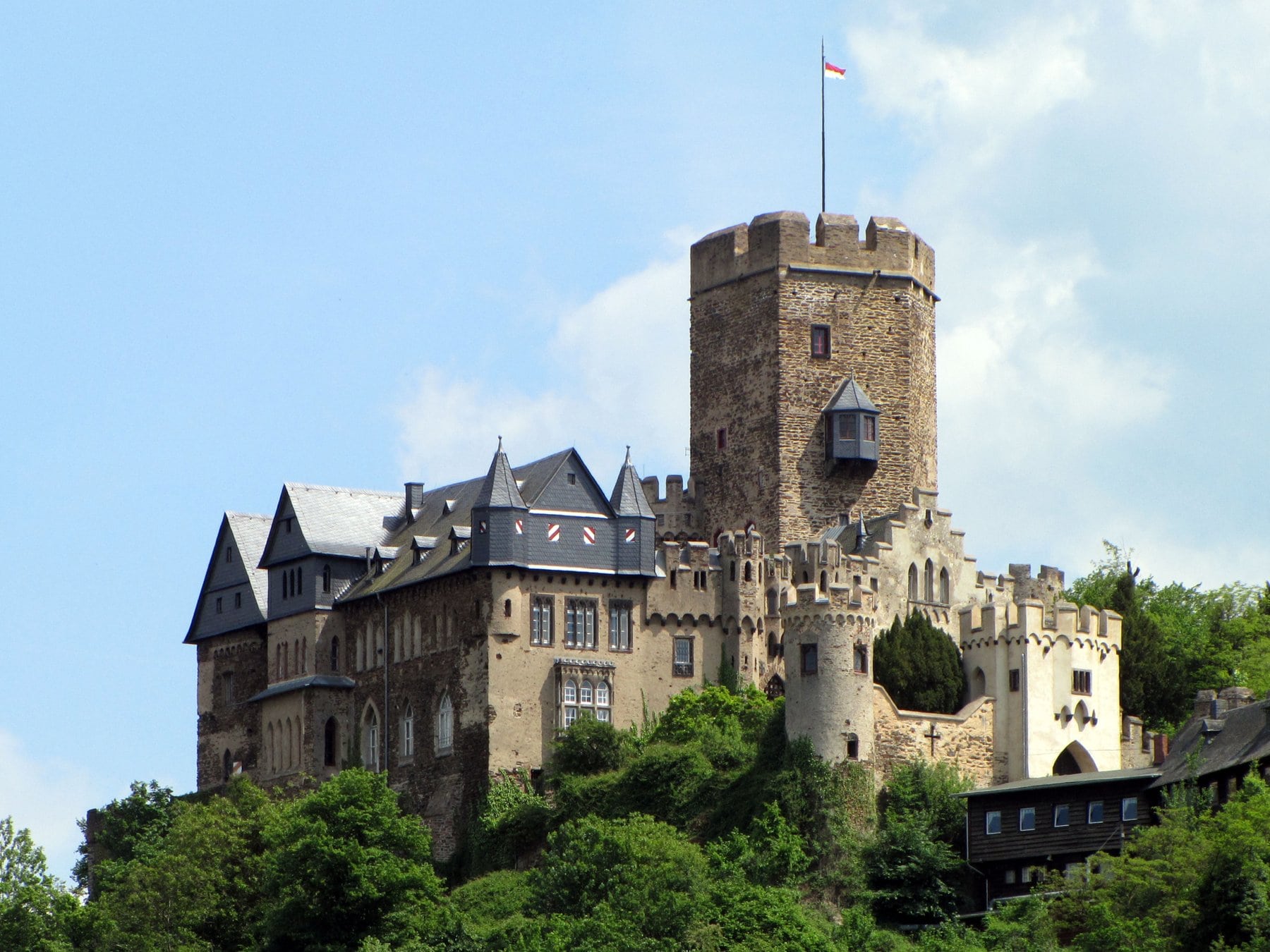
At the mouth of the Lahn, where the slower river slides into the Rhine on the right bank opposite Koblenz, a wedge of Diabas rises 164 meters above the water. On its tip stands a near-rectangular fortress with a pentagonal keep, a thick south-facing shield wall, and a Gothic chapel whose tracery windows still hold their 13th-century proportions. Lahneck was begun in the early 1230s by Archbishop-Elector Siegfried III of Eppstein of Mainz, as the northernmost outpost of his archiepiscopal territory and the guardian of the silver tolls that came down the Lahn from his Tiefenthal mine. It would burn in 1688, sit roofless for 161 years, and be rescued in 1850 by an English railway entrepreneur who chose, almost uniquely on this stretch of the Rhine, to rebuild it on its medieval footprint rather than reinvent it. Lahneck Castle is the quietest of the Mittelrhein’s Romantic restorations: a medieval shell that learned to be a 19th-century home, rather than a 19th-century home that swallowed a ruin.
Quick Facts
| Type | Höhenburg (hilltop spur castle) |
| Founded | c. 1232/1233 (traditional date 1226); first documentary reference 1244/1245 |
| Founder | Archbishop-Elector Siegfried III of Eppstein, Electorate of Mainz |
| Setting | Spur above the Lahn–Rhine confluence, right bank, 164 m above sea level |
| Destroyed | 1688, French troops in Louis XIV’s western campaign (Nine Years’ War) |
| Restored | From 1854 by Edward A. Moriarty, on the medieval footprint |
| Architecture | Pentagonal Bergfried (29 m), Schildmauer, Palas, chapel, two concentric ditch-and-wall rings |
| Current use | Private residence with guided tours and a Burgschenke |
| Owner | Erbengemeinschaft Mischke / von Preuschen, since 1907 |
| UNESCO status | Within the UNESCO Upper Middle Rhine Valley World Heritage Site (no. 1066, inscribed 2002) |
| Location | Oberlahnstein, Lahnstein, Rheinland-Pfalz, Germany |
| Coordinates | 50.3063° N, 7.6122° E |
| Official site | burg-lahneck.de |
Siegfried’s gatehouse on the Lahn (c. 1232–1244)
Mainz’s claim to Lahneck began with silver. In 1220, Emperor Friedrich II granted Archbishop Siegfried III of Eppstein the imperial fief of a working silver mine at Tiefenthal in the Taunus, several kilometers up the Lahn. Silver from Tiefenthal had to come down the Lahn to reach Mainz, and the Lahn met the Rhine at a point that lay almost a day’s ride beyond the archbishopric’s nearest other holdings. Siegfried needed a fortress at the confluence: close enough to tax the river, strong enough to hold the toll against ambitious neighbors.
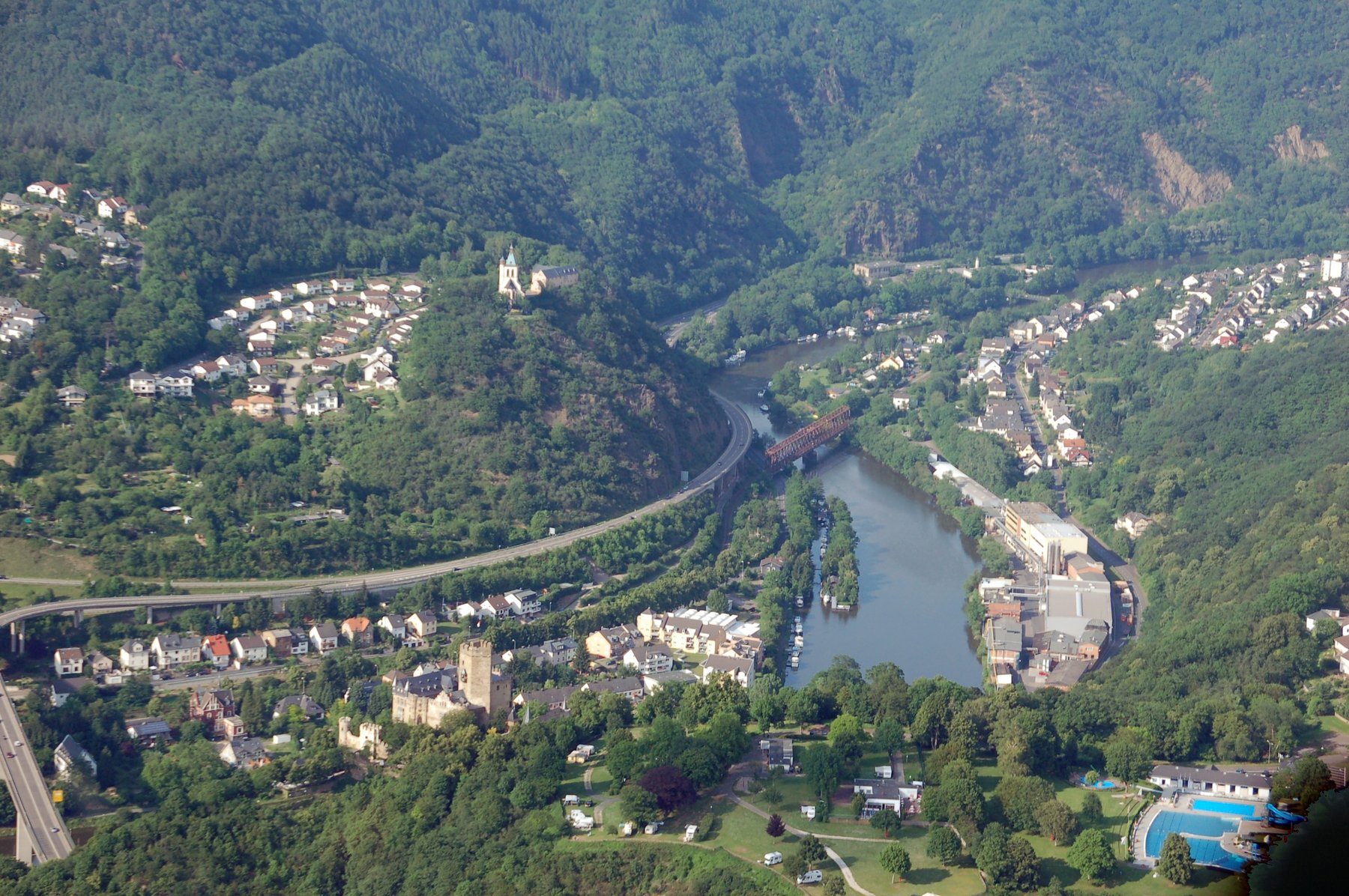
He chose a spur of dark Diabas on the right bank, above what was then the small market settlement of Oberlahnstein. A conventional founding year, repeated by the operator and on tourist signage, is 1226. The current scholarly best estimate, published by the Europäisches Burgeninstitut in its EBIDAT entry, is that masons began work „vor 1244, nach neueren Erkenntnissen wahrscheinlich ab 1233“, meaning around 1232–1233. First solid documentary reference comes in 1244/1245, when a Burggraf named Embricho von Logenecke is recorded as Siegfried III’s appointee.
Its name, Logenecke (also rendered Loynecke in 13th-century charters) derives from the medieval form of the river name Lahn (Loyn). After about 1365, as the river’s name simplified, the castle’s name settled into the modern Lahneck.
Directly across the Rhine, Archbishop Arnold II of Isenburg of Trier was watching. In 1242, roughly nine years after Mainz committed to Lahneck, Trier began Schloss Stolzenfels on the opposite (left) bank as an explicit Gegenburg, a counter-castle to the Mainz outpost. Two electors stared at each other across the river for the next five centuries, and the castles’ silhouettes remain visible from each other today.
Northernmost outpost of Mainz (1244–1475)
For five and a half centuries, Lahneck served as the northernmost exclave of the Archbishopric (and later Electorate) of Mainz, a salient of archiepiscopal territory wedged into the Lahn valley between Trier (south) and Cologne (north). Fortress administered Oberlahnstein, the Tiefenthal silver fief, and the toll on Lahn river traffic. A small garrison of ministeriales (unfree imperial knights serving the archbishop) manned it on rotation. That toll mattered: only thirty kilometers upstream on the Rhine, the imperial toll-island of Pfalzgrafenstein would later make a fortune doing on the river what Lahneck did on the Lahn.
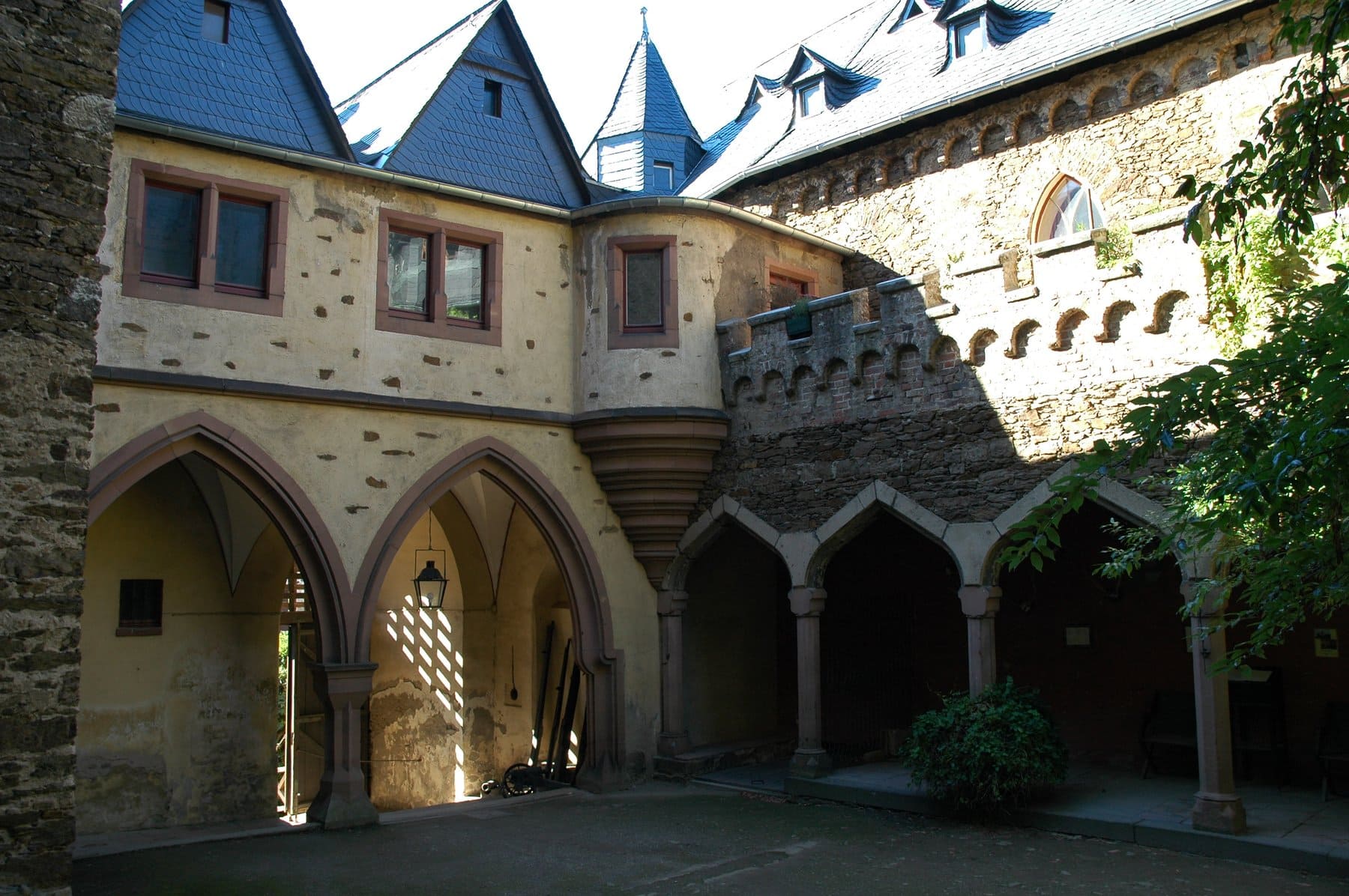
Most ambitious piece of medieval Lahneck is its chapel, dedicated to Saint Ulrich of Augsburg, erected in 1245. The choir projects east beyond the courtyard line; five tall tracery windows still articulate the elevation; and in 1332 Pope John XXII granted a forty-day indulgence to anyone attending Mass there. The original indulgence document survives in the Stadtarchiv Lahnstein, with a copy displayed inside the chapel.
Medieval plan settled into its mature form in the late 15th century under Archbishop Diether II of Isenburg-Büdingen (Mainz, 1475–1482). Diether retrofitted the now two-and-a-half-century-old fortress for the artillery age: he added a Zwinger (an outer wall ring set 8 to 15 meters beyond the original curtain), armed it with round flanking towers and the Fuchsturm gate-tower, and cut a 15-meter-wide outer Halsgraben across the spur’s neck. By 1500, Lahneck was a layered castle of two concentric rings around a 13th-century core, with the pentagonal Bergfried projecting 29 meters into the sky from the center of its south-facing Schildmauer. That keep (pointed Prallkeil aimed at the Streitacker, the attack approach, so cannonballs would glance off) remains medieval today.
Three wars and the last roof (1632–1689)
Lahneck’s medieval career ended in three rapid devastations, all within sixty years.
The first came with the Thirty Years’ War. In 1632, Swedish forces sweeping south across the Rhine took the castle and damaged it; in 1636, Imperial troops took it back and damaged it again. The Bohemian etcher Wenzel Hollar, traveling through the region in this period, drew the half-ruined silhouette: a documentary image worth more than the chronicles, because it shows that Lahneck was already structurally compromised three decades before the worst was to come.
Second came in 1662, in one of the Franco-Mainz skirmishes that punctuated the run-up to the larger French wars of Louis XIV. EBIDAT records the year tersely: „1633 und 1662 verwüstet.“ Devastated, twice.
The third destruction (the one that ended the castle’s career as a fortress) came on Louis XIV’s orders in 1688. The Nine Years’ War, known in Germany as the Pfälzischer Erbfolgekrieg (War of the Palatine Succession), opened with a French army crossing the Rhine in September. The strategy directed from Versailles was systematic devastation: burn whatever might shelter or supply an enemy army, leave the Rhineland incapable of resisting from a fixed point. In late 1688, French troops shot the last roofs of Lahneck on fire. Heidelberg would be slighted the following January; the entire Palatinate would burn through 1689. Lahneck, already weakened by two prior wars, was left a roofless shell.
Electorate of Mainz held it on paper for another century. But as a fortress, it was finished.
Ruin, Romantic engravers, and Goethe (1689–1850)
For 161 years, Lahneck stood roofless. The walls were used as a quarry by locals who needed building stone for Oberlahnstein. Chapel lost its furnishings. Bergfried, too tall and too solid to dismantle profitably, stayed where Siegfried’s masons had set it.
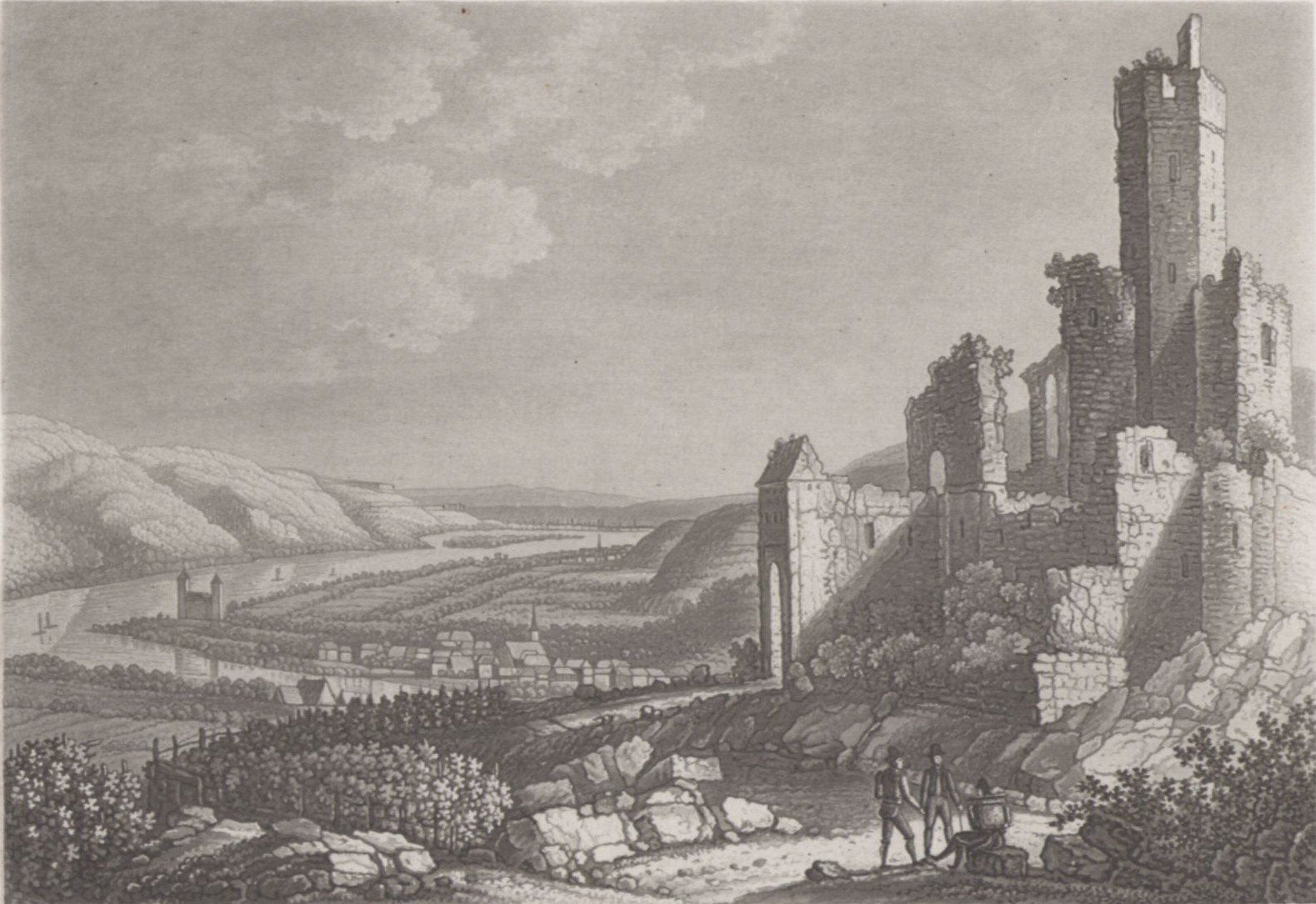
What rescued Lahneck was not a soldier or an archbishop but a sensibility. Beginning in the late 17th century, Matthäus Merian’s engravings put the Rhine ruins into the imagination of educated Europe; in the 18th century, English landscape travelers added Lahneck to the picturesque circuit; in the 19th, William Tombleson’s 1840 print and Samuel Prout’s drawing-room engraving made the silhouette portable enough to hang on a bourgeois wall. Rhine ruin had become an industry.
The moment that fixed Lahneck in German literary memory came on July 18, 1774, when a 24-year-old Johann Wolfgang von Goethe, traveling the Lahn valley with Lavater and Basedow, saw the ruin and dictated the poem Geistesgruß, a “greeting from the spirit” delivered, in the poem’s conceit, by the ghost of a knight on the bergfried looking down at passing barges on the river. Later editors identified the poem as a precursor to Gretchen’s König in Thule in Faust. Goethe’s eight lines did for Lahneck what Byron’s Childe Harold would later do for the rest of the Rhine: marked it as a place where the past was vast, unrecoverable, and somehow still present.
A century later, in 1863, the same Romantic sensibility produced a darker offering: the Idilia Dubb legend, the story of a 17-year-old Scottish woman who supposedly climbed the Bergfried in 1851 and died of thirst there, her diary discovered after. The story is a literary construct, first published in August 1863 as a serial in the Neues bayerisches Volksblatt at Stadtamhof, and reprinted that October in the Adenauer Kreis- und Wochenblatt, with a probable model in Thomas Hood’s 1842 short story The Tower of Lahneck. No contemporary 1851 record supports it. Copies of the 1863 newspaper articles are displayed inside the castle today, where the legend remains part of the visitor experience without quite being history. Our reference on dating a castle ghost story takes the Idilia Dubb case apart at length, alongside eighteen other buildings tested the same way.
Moriarty’s restraint (1850–1864)
In 1850, the von Lassaulx family (who had bought the secularized ruin in 1803) sold Lahneck to a Mr. Edward A. Moriarty. The German scholarly literature describes him uniformly as an English (or Scottish; sources vary) railway entrepreneur, identified in contemporary records as the director of the Rechts-Rheinische Eisenbahn-Gesellschaft, the Right-Bank Rhenish Railway Company. His full biography has resisted verification: there is no entry in the British engineering registers, and the “Right-Bank Rhenish” corporate title is anachronistic for 1850, since right-bank Rhine service through Oberlahnstein did not arrive until 1862. Whether the company existed as an early promotional venture, a Nassau commercial license, or a label retrofitted by later writers is unresolved. What is certain is that Moriarty had the means and the inclination, and that from 1854 he began to rebuild.
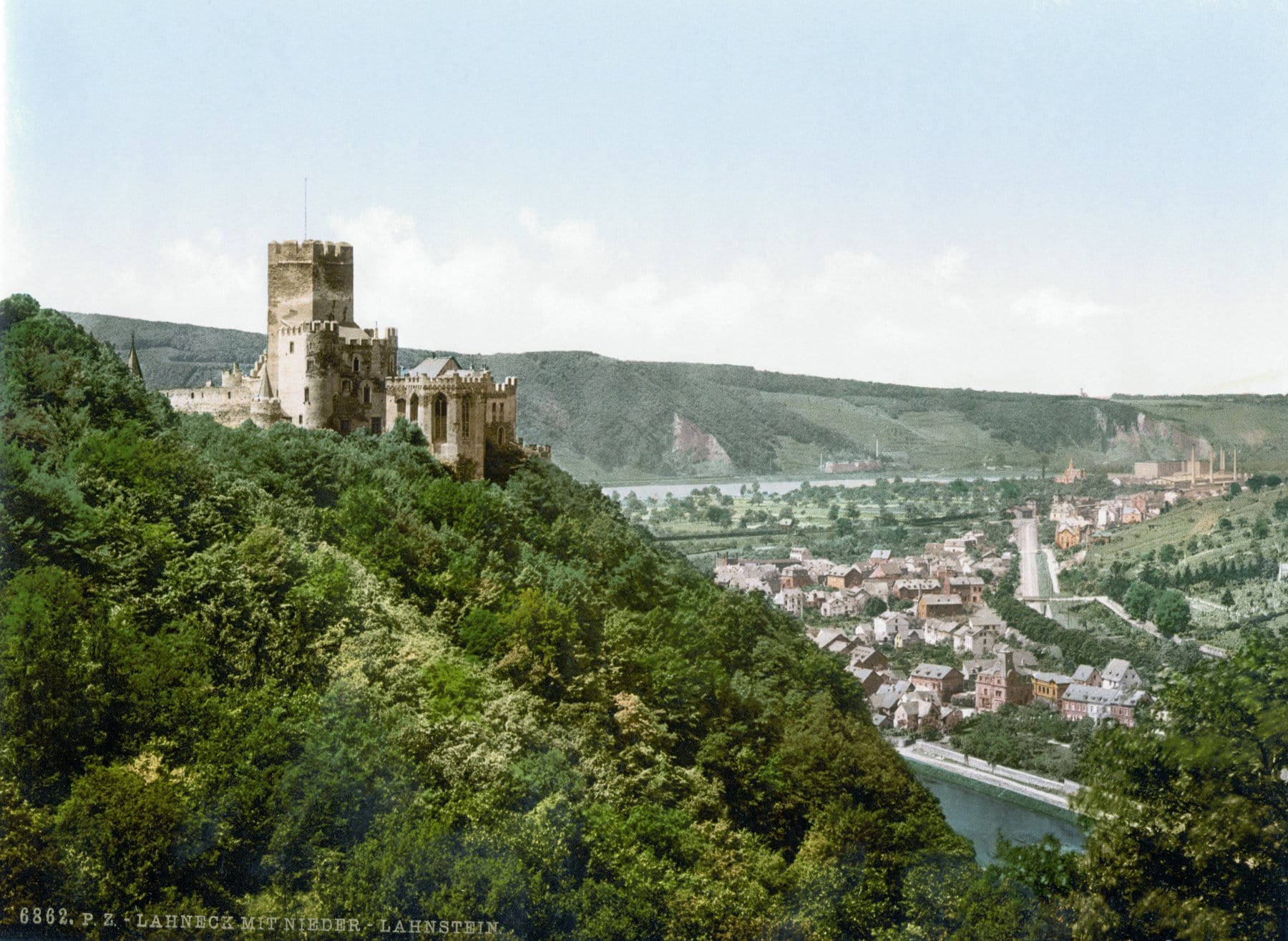
What he chose to do is the cornerstone of Lahneck’s distinct identity in the Mittelrhein. EBIDAT’s scholarly note is precise: „ab 1854 auf altem Grundriss größtenteils neu errichtet“, meaning from 1854, largely rebuilt on the old footprint. Pentagonal Bergfried was left as medieval stonework. The Schildmauer and corner towers retained their 13th- and 15th-century fabric. The chapel was reconstructed in its 13th-century outline. What Moriarty added was a habitable Gothic-Revival interior (paneled rooms, lancet windows, residential plumbing) and a battlemented crown on the keep that read as Romantic but did not change the silhouette beneath.
The contrast with Lahneck’s Mittelrhein neighbors is the point. At Stolzenfels, directly across the Rhine, the architects Lassaulx, Schinkel, and Stüler recomposed the silhouette wholesale for Crown Prince Friedrich Wilhelm IV between 1836 and 1842, the result is mostly 19th-century with medieval fragments embedded. At Schloss Drachenburg, further north at Königswinter, Stephan Sarter built an entirely new Wilhelmine fantasy in 1882–1884 on a site that had no medieval fabric at all. At Lahneck, Moriarty did the harder thing: he repaired.
Moriarty sold the castle to Gustav Göde in 1864. Ownership passed through Graf Ewald von Kleist (1878), the industrialist Hauswald (1893), and finally, in 1907, to Fregattenkapitän (later Vizeadmiral) Robert Mischke of the Imperial German Navy. Since 1946 the castle has been held jointly by the Erbengemeinschaft Mischke / von Preuschen, an inheritance community of Mischke’s descendants. The 1937 replacement of Moriarty’s neo-Gothic battlement crown with steeper hipped roofs (Walmdach) is the only major silhouette change Lahneck has seen since the Restoration, and it was made by a family that had every reason to preserve, not reinvent.
Visiting Lahneck Castle in 2026
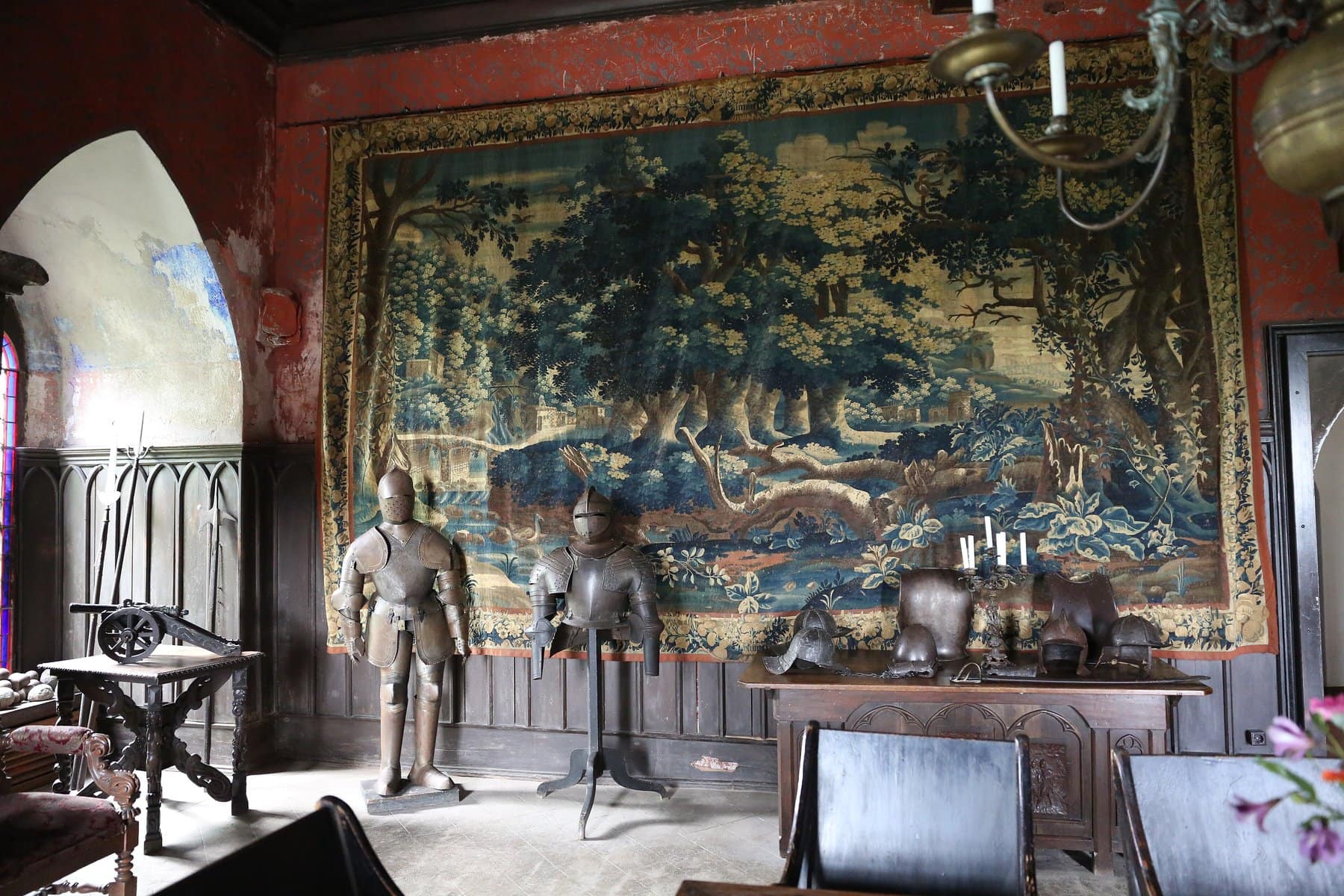
Lahneck opens for the 2026 season from April 7 to November 1, Tuesday through Sunday (closed Mondays, with the usual exceptions for Easter Monday and Whit Monday). All visits are by guided tour (there is no self-guided access), and tours run on the hour from 11:00 to 15:00, lasting about forty minutes. The standard tour includes the courtyard, the palas residential rooms, the chapel, and the climb to the bergfried platform, where the view extends north to the Mosel mouth at Koblenz and south down the gorge toward Boppard. Entry tickets and local tours can also be booked in advance through GetYourGuide.
An independently operated Burgschenke sits outside the west gate. It serves regional cooking from 12:00 to 20:00, Tuesday through Sunday, and is the only refreshment option on the castle hill itself.
| Ticket | 2026 price |
|---|---|
| Adult | €12.00 |
| Child (5–14) | €6.00 |
| Child under 5 | Free |
| Group (15+ persons) | By arrangement |
Getting there: Lahneck is signposted from the Burgweg in Oberlahnstein. The nearest train station is Niederlahnstein on the right-bank Rhine line (Rechte Rheinstrecke), about a fifteen-minute walk plus a stiff climb up the spur. Free public parking is available at the Freibad Lahnstein swimming-pool car park, with a five-minute walk uphill to the gate.
Note for 2026 travelers: The right-bank Rhine line through Lahnstein closes between July 10 and December 12, 2026 for DB InfraGO infrastructure works; rail replacement (SEV) buses run on the published schedule. Plan accordingly. Anyone staying overnight can compare hotels in and around Lahnstein.
Some links on this page are affiliate links, which means StoneKeep Atlas may earn a small commission, at no extra cost to you, if you book through them.
Beyond Lahneck
Lahneck is the right-bank Mainz half of a paired argument with Stolzenfels Castle, the Trier Gegenburg directly across the Rhine. Read the two together for the full electoral chess game; read Lahneck first if you want medieval fabric still legible in the silhouette, Stolzenfels first if you want Schinkel’s Romantic re-imagination at its most ambitious. Downstream, Marksburg offers the cluster’s only never-destroyed counterpoint: the experiment of seeing what a Mittelrhein fortress that was never burned actually looks like. Across the Rhine on the right bank, Maus Castle at Wellmich is the other Mittelrhein survivor whose medieval shell still defines its silhouette.
Upstream into the gorge proper, Rheinstein Castle and Reichenstein Castle show how much further Romantic restoration would go when wealth and ambition exceeded restraint: at Rheinstein, Prince Frederick of Prussia’s wholesale reinvention; at Reichenstein, a Wilhelmine country house wrapped in armor. For the full cluster view, see the Castles of the Rhine Gorge guide, which places the four anchor castles in their UNESCO 1066 context. The regional roundup Castles of the Middle Rhine will set Lahneck in the broader Mittelrhein landscape beyond the inscribed WHS boundary.
Conclusion
Lahneck’s silhouette is medieval first and Romantic second. Where Stolzenfels and Drachenburg are nineteenth-century projects of the imagination, Lahneck is what happens when a nineteenth-century buyer chooses the harder discipline of repair. The pentagonal Bergfried that Siegfried III’s masons set above the Lahn in the 1230s still stands at its full 29 meters, with its medieval Prallkeil facing south as it has for nearly eight hundred years. The chapel that Pope John XXII indulgenced in 1332 still holds a Mass on its 13th-century floor. The shield wall that the Counts of Isenburg-Büdingen retrofitted for the artillery age still wraps the south face of the courtyard. That is what makes Lahneck the cluster’s quietest restoration, and, on the case its fabric makes, arguably its most honest.
Principal Sources
- Bach, Adolf. Goethes Rheinreise mit Lavater und Basedow im Sommer 1774. Dokumente. Egelsbach: Hänsel-Hohenhausen, 1993 (orig. Zürich, 1923).
- Bagic, Milena, and Bernd Geil. “Burg Lahneck in Oberlahnstein.” KuLaDig — Kultur.Landschaft.Digital, Objekt KLD-252516. Universität Koblenz-Landau and Stadtarchiv Lahnstein, 2016. kuladig.de.
- Bodsch, Ingrid. Burg und Herrschaft: Zur Territorial- und Burgenpolitik der Erzbischöfe von Trier im Hochmittelalter bis zum Tod Dieters von Nassau (gest. 1307). Boppard am Rhein: Boldt, 1989.
- Friedrich, Reinhard, and Jens Friedhoff. “Lahneck.” EBIDAT — Burgendatenbank des Europäischen Burgeninstitutes / Deutsche Burgenvereinigung. ebidat.de.
- Graf, Klaus. “Neue Quellen zur Schauer-Geschichte der Idilia Dubb auf Burg Lahneck.” Archivalia, December 26, 2014. archivalia.hypotheses.org.
- Michel, Fritz, and Peter Bucher. Geschichte der Stadt Lahnstein. Lahnstein: Stadt Lahnstein, 1982.
- Thon, Alexander, Stefan Ulrich, and Jens Friedhoff. „Mit starken eisernen Ketten und Riegeln beschlossen…“: Burgen an der Lahn. Regensburg: Schnell & Steiner, 2008.
- UNESCO World Heritage Centre. “Upper Middle Rhine Valley.” Property no. 1066. Inscribed 2002. whc.unesco.org.
- Wegeler, Julius. Lahneck und Oberlahnstein. Koblenz: Hölscher, 1881.
- For 2026 visiting hours, ticket prices, and tour scheduling, consult the operator directly at burg-lahneck.de; the Burgschenke restaurant operates independently and is best reached at +49 2621 2244.
Image credits. Featured image and the views at the head of sections 2, 3, and 6: Holger Weinandt, Fritz Geller-Grimm, Peter Weller, and the Photoglob Co. (Detroit Publishing Co. collection, public domain), all via Wikimedia Commons under the licenses noted in each figcaption. Lasinsky’s 19th-century engraving of the ruin and the c. 1900 photochrom are public-domain works. The interior view of the Rittersaal is by Mag4music, CC BY-SA 3.0 via Wikimedia Commons. Plan view of the castle reproduced on EBIDAT from Bau- und Kunstdenkmäler Unterwesterwald, St. Goarshausen, Untertaunus (Wiesbaden, 1914), public domain. Freely licensed images are resized to fit; otherwise unaltered.