
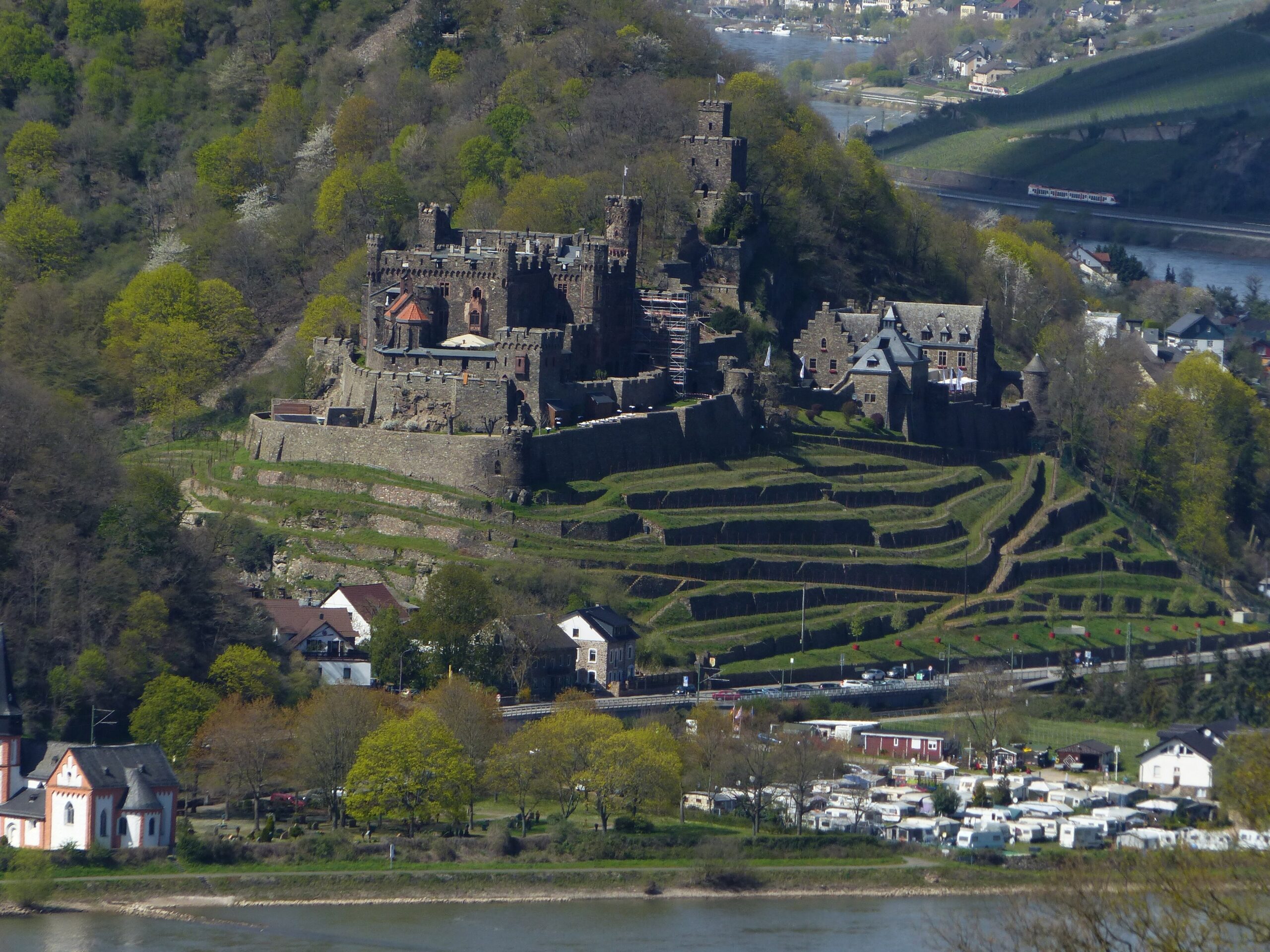
Reichenstein Castle
Reichenstein Castle is a paradox among the strongholds of the Upper Middle Rhine. Its silhouette (battlemented towers, neo-Gothic gables, an English Tudor flavour creeping into the windows) looks every inch a medieval fortress, yet almost everything visible above ground is younger than the Eiffel Tower. Medieval Reichenstein was twice destroyed: once by a king, once by a French army. What stands today on the rocky shoulder above Trechtingshausen is the work of an Italian-descended ironworks dynasty who, at the end of the 1890s, decided to wager their fortune on resurrecting a ruin.
That decision (ambitious, theatrical, and nearly bankrupting) produced what tourism writers like to call the last great Burgenromantik reconstruction on the Rhine. A century later, the same family has come back. A great-grandson of the 1898 patron has owned the castle since November 2014, and runs it as a museum, hotel, and restaurant.
Quick Facts
| Country | Germany |
| Region / State | Rhineland-Palatinate (Rheinland-Pfalz), western Germany |
| Nearest Town | Trechtingshausen (Bingen am Rhein) |
| Construction Period | Medieval core 13th century (first documented 1213); final destruction 1689; Burgenromantik reconstruction 1899–1902/03 |
| Founder | Reichsabtei Kornelimünster (probable 11th–12th-century origin); Baron Dr. Nikolaus Kirsch-Puricelli (1899 reconstruction patron) |
| Architectural Style | Medieval Schildmauerburg on a rocky spur (13th-century core, fragmentary); late-historicist neo-Gothic in an English Tudor manner (1899–1902/03), by architect Georg Strebel of Regensburg |
| Building Type | Burg — medieval rock-spur fortress, reborn around 1900 as an industrialist’s neo-Gothic country seat |
| Current Condition | Restored and in active use; medieval substance survives in fragments of Schildmauer and outer ring wall, embedded within the late-historicist reconstruction |
| Open to Visitors | Yes — museum daily 09:00–18:00 (April–October, last admission 17:00) and 09:00–17:00 (November–March, last admission 16:00); 23-room boutique hotel year-round; Puricelli Restaurant on site |
| UNESCO Status | Within the Upper Middle Rhine Valley World Heritage Site (inscribed 2002, criteria ii, iv, v) |
| Official website | burg-reichenstein.com |
A Kornelimünster outpost on the Rhine
Reichenstein begins, like many medieval castles in the gorge, in obscurity. A 1135 charter records Trechtingshausen and the parish of St. Clemens as possessions of Reichsabtei Kornelimünster, the great Carolingian-founded abbey near Aachen. The abbey’s holdings on the Middle Rhine were managed at a distance through advocates (Vögte), and a fortified seat for those advocates almost certainly stood here from the 11th or 12th century, although the European Castle Institute notes that the question remains open.
First incontestable documentary mention is 1213, when the castrum Richenstein appears in a record concerning the removal of an advocate named Reinbod. The following year, the lordship passed to the powerful Bolanden family, and from 1241 to a cadet branch (the Lords of Hohenfels), whose name became inseparable from the castle’s most notorious chapter.
Hohenfels were ambitious, well-connected, and prepared to lean on neighbors who were not. In 1245 the abbey transferred half-shares of its Reichenstein, Trechtingshausen, and Heimbach properties to the Archbishops of Mainz and Cologne, citing the family’s unlawful seizure as cause. By the 1270s the surrounding villages had been sold (in 1270, jointly to the Mainz Cathedral Chapter and the Mariengredenstift), but the Hohenfels held the castle itself and used its position above the Rhine for what later imperial chronicles would brand Landfriedensbruch: breach of the imperial peace, the crime of robber knights.
Whether they robbed Rhine shipping or enforced unauthorized tolls is a question medieval historians still pick at. What is certain is that by 1282 their behavior had outrun any patron willing to defend them. King Rudolf of Habsburg, newly elected and determined to restore order on the river, marched.
Destruction, prohibition, ruin
In 1282, Rudolf laid siege to Reichenstein together with neighboring Sooneck, the other Hohenfels stronghold. The Burgenwelt account suggests the garrison was starved into surrender rather than stormed; the Wormser Chronik records the siege with grim economy. Dietrich von Hohenfels’s helpers were beheaded in Trechtingshausen. Dietrich himself escaped, a fact later confirmed by his reappearance, very much alive, in 1290 selling Reichenstein to the Pfalzgraf.
That sale was illegal (the castle was a Mainz fief), and prompted decades of jurisdictional wrangling. More immediately, on the same 1290 imperial diet at Erfurt, Rudolf decreed that Reichenstein and Sooneck, both destroyed “by imperial right,” were never to be rebuilt. That prohibition stood for fifty-nine years; only in 1349 did Karl IV lift it.
By then control had passed permanently to the Archbishopric of Mainz. A 1344 arbitration awarded the castle to the see; thereafter Reichenstein served as the seat of an archiepiscopal Amtmann, with a rectangular residential tower added at the north-east corner of the inner bailey. To enforce the rebuilding ban from a safe distance (and to keep the increasingly assertive Pfalzgrafen on their side of the gorge), Mainz built a watchtower on the cliff opposite. That watchtower would later become Rheinstein.
For three and a half centuries the Mainz Reichenstein endured. It survived the late-medieval squabbles of the Rhineland, but it did not survive the French. In 1689, during the Nine Years’ War of the Palatine Succession, the troops of Louis XIV burned and undermined castle after castle along the Rhine. Reichenstein was reduced to walls and rubble. It would stay that way for almost exactly two hundred years.
Falkenburg interlude, then the iron-works baron
In 1834 a Prussian general bought the ruin. Franz Wilhelm August von Barfuß reroofed the surviving tower and renamed the place Falkenburg, after the kestrels (Turmfalken) that nested in its walls. In 1852 he and his descendants received royal permission to bear the surname “von Barfuß-Falkenburg.” The right lapsed in 1877 when the family sold.
A decisive sale, however, came at the end of 1898. A new owner was Baron Dr. Nikolaus Kirsch-Puricelli, an iron-works engineer from Luxembourg who had married into one of the Hunsrück’s great industrial dynasties. The Puricellis had migrated from Spurano on Lake Como to the Mosel-Trier region in the seventeenth century and on to the Palatinate from 1750. By the late nineteenth century they were sole owners of the Rheinböller Hütte, the iron foundry above Bad Kreuznach, and through Olga Puricelli (Nikolaus’s wife), the family fortune had concentrated in a single heir. Buying a ruined castle on the Rhine was, in that context, an act of self-display as much as investment. One Mittelrhein magazine has described the resulting work as “outshining even neighboring Burg Rheinstein of Prinz Heinrich von Preußen” in its ambition (the line is journalist Frank Zimmer’s in Mittelrheingold, and it captures, intentionally, the contrast between Hohenzollern royal patronage on one side of the Morgenbach and bourgeois-industrial nouveau-riche on the other).
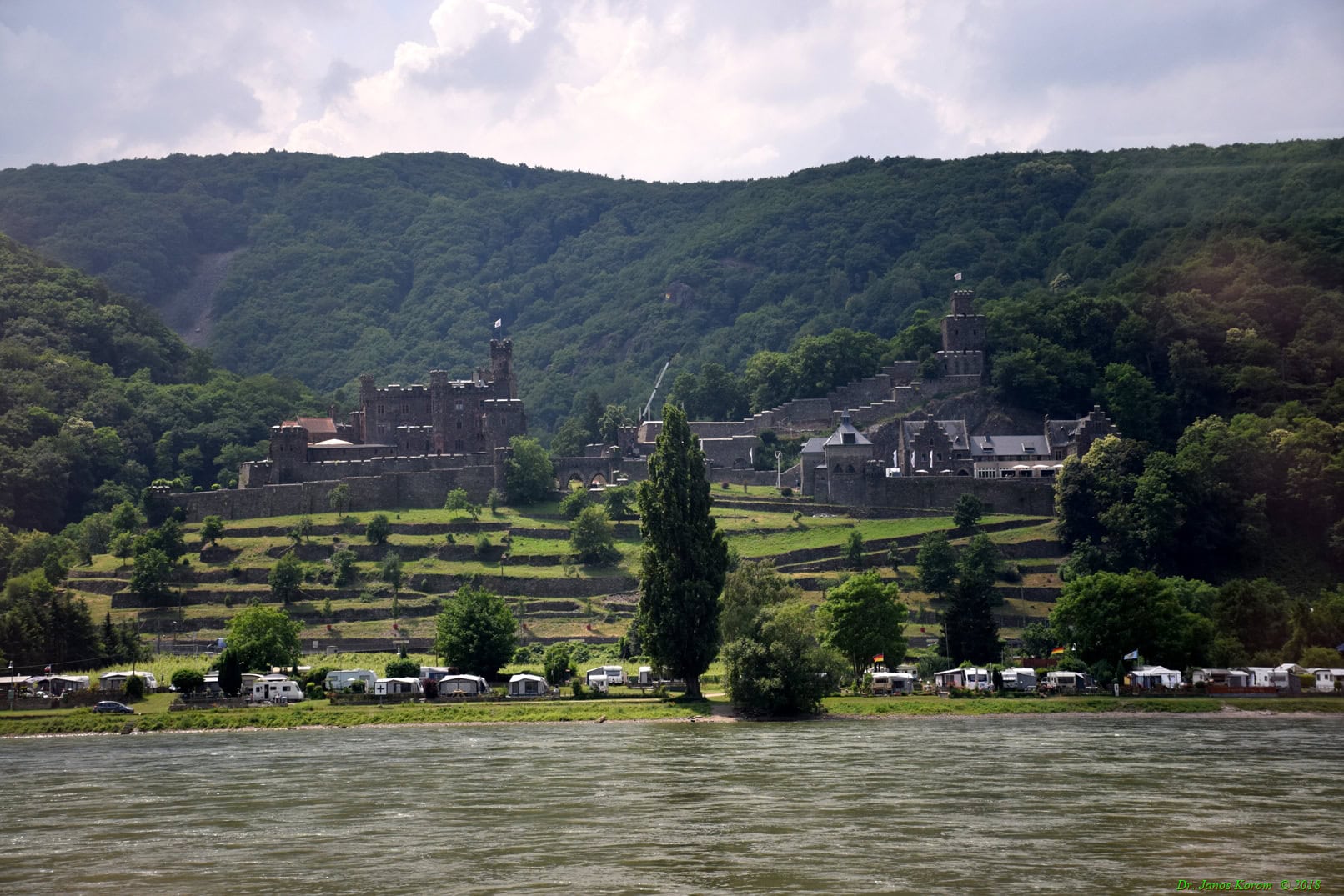
Construction began in 1899. An architect, Georg Strebel of Regensburg,, a Bavarian whose career outside this commission has so far resisted reconstruction by online research. Work was substantially complete by 1902 or 1903, and Reichenstein took its place at the late, theatrical end of the 19th-Century Romantic Revival that had been remaking the Rhine’s ruined castles since the 1820s.
Architecture: a Wilhelmine country house in armor
What Strebel built is best understood not as a castle restoration but as a Wilhelmine country house in castle’s clothing. The European Castle Institute’s entry, by Jens Friedhoff, is unsparing: “Bedingt durch tiefgreifende historistische Umgestaltungen … wurde die bauliche Entwicklung der 1689 zerstörten Burg verunklärt.” Identifying which masonry is medieval and which is 1900 takes a practiced eye.
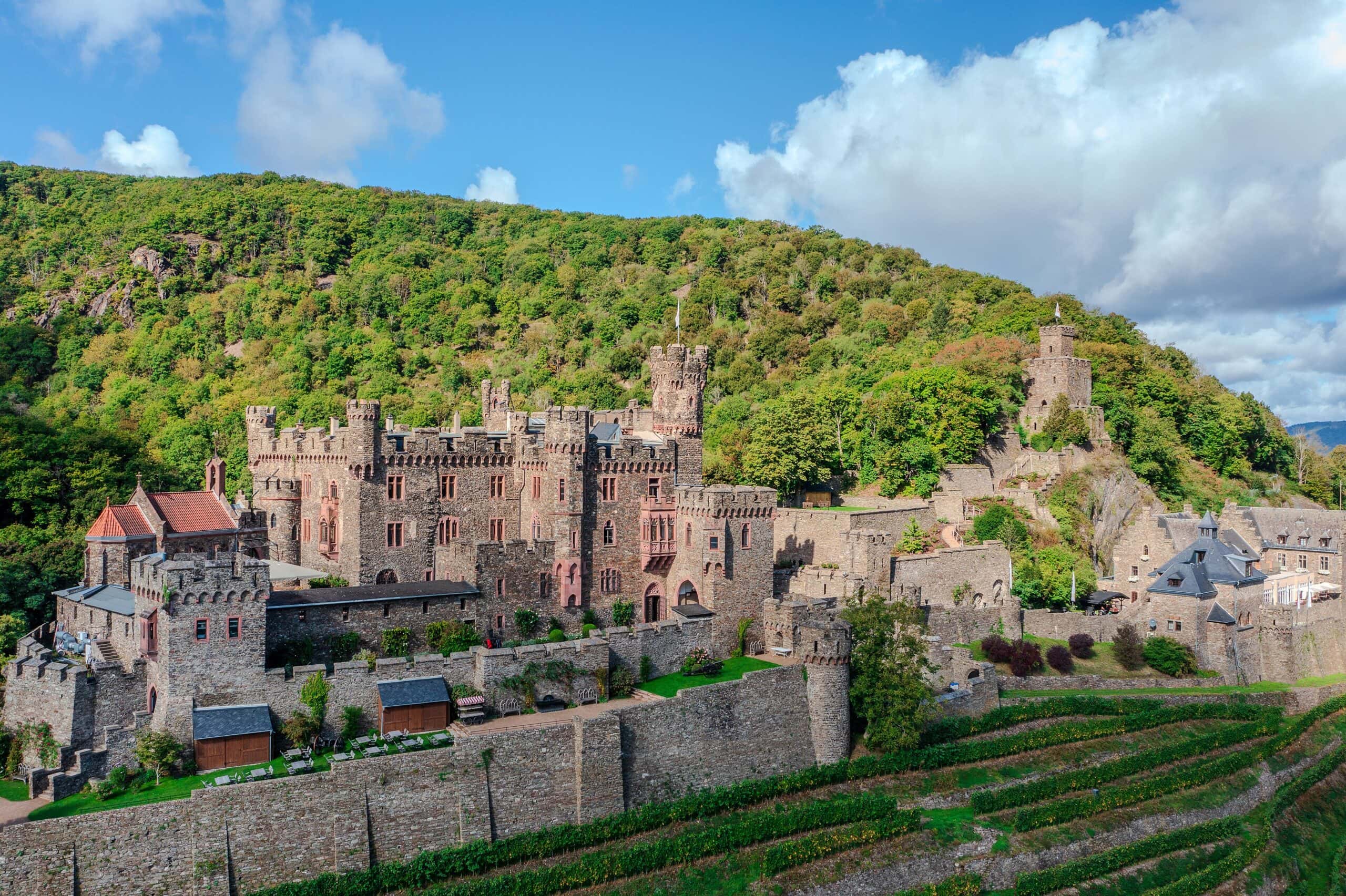
The medieval substance that does survive lies mostly in the rounded Schildmauer on the Rhine side (up to eight meters thick at the base and rising sixteen meters), with its Erkerturm, plus fragments of the outer ring wall. Two of the three corner towers in that outer ring still date in their lower courses from the 14th century. A 1629 view records a rectangular residential tower at the north-east corner of the inner bailey (the Mainz Amtmann’s lodgings), but it has not survived.
Almost everything else is Strebel’s. The three-story main building on the north-west, the chapel of St. Sebastian on the south edge with its inset polygonal choir, the tripartite economic range (carriage house, stable, press house) in the lower bailey, the Belvedere lookout tower above the complex: all are late-historicist. Interiors lean hard into the imagined late-medieval: carved beam ceilings, crenelated wall panelling imitating fittings from around 1500, a pointed-arch dining hall, a library oriel.
Setting itself does the rest of the work. Reichenstein is unusual on the Mittelrhein in not crowning a Bergrücken; it sits on a Felsvorsprung, an outcrop that drops almost directly to the Rhine. The Kirsch-Puricellis ran a private electricity supply to the property (the first house in the village to have it), and turned the silhouette into something the Rhine steamers could spot from a kilometer downstream.
The museum and the trophy collection
From around 1903 until 1936, the Kirsch-Puricelli family lived at Reichenstein. Olga Kirsch-Puricelli died in 1933; Nikolaus, who served as Luxembourg’s chargé d’affaires in Germany between 1925 and 1935, did not long outlive her. In 1938 their son Paul opened the castle as a museum, less than a year before the outbreak of the Second World War shut it down. It reopened after 1945.
The collection that visitors meet today is unusual. The display of armor and weapons is conventional. Hunting trophies are not: around 1,200 antlers, horns, and mounted heads from four continents line the upper galleries, hung in the dense Wilhelmine manner that contemporary museum practice has otherwise abandoned. The bilingual German/English audio guide is recommended for visitors aged twelve and up; the chapel organ and the basement bowling alley (Kegelbahn) returned to working order in a 2016 restoration.
Visiting today
You can stay in the castle the iron baron Kirsch-Puricelli rebuilt from a robber-knights’ ruin. See our guide to Castle Hotels on the Rhine for the hotel and museum.
Reichenstein sits on the left bank of the Rhine in the village of Trechtingshausen, around four minutes by train north of Bingen am Rhein. The MittelrheinBahn (line RB26) stops at Trechtingshausen station; the castle is a five-to-seven-minute uphill walk from there along Burgweg. By car, the approach is from the B9 federal road that runs along the Rhine’s left bank; twenty free spaces serve guests at the gate, with a further fifty free spaces below on the B9 itself, and three free electric-vehicle charging stations are available. Entry tickets and local tours can also be booked in advance through GetYourGuide.
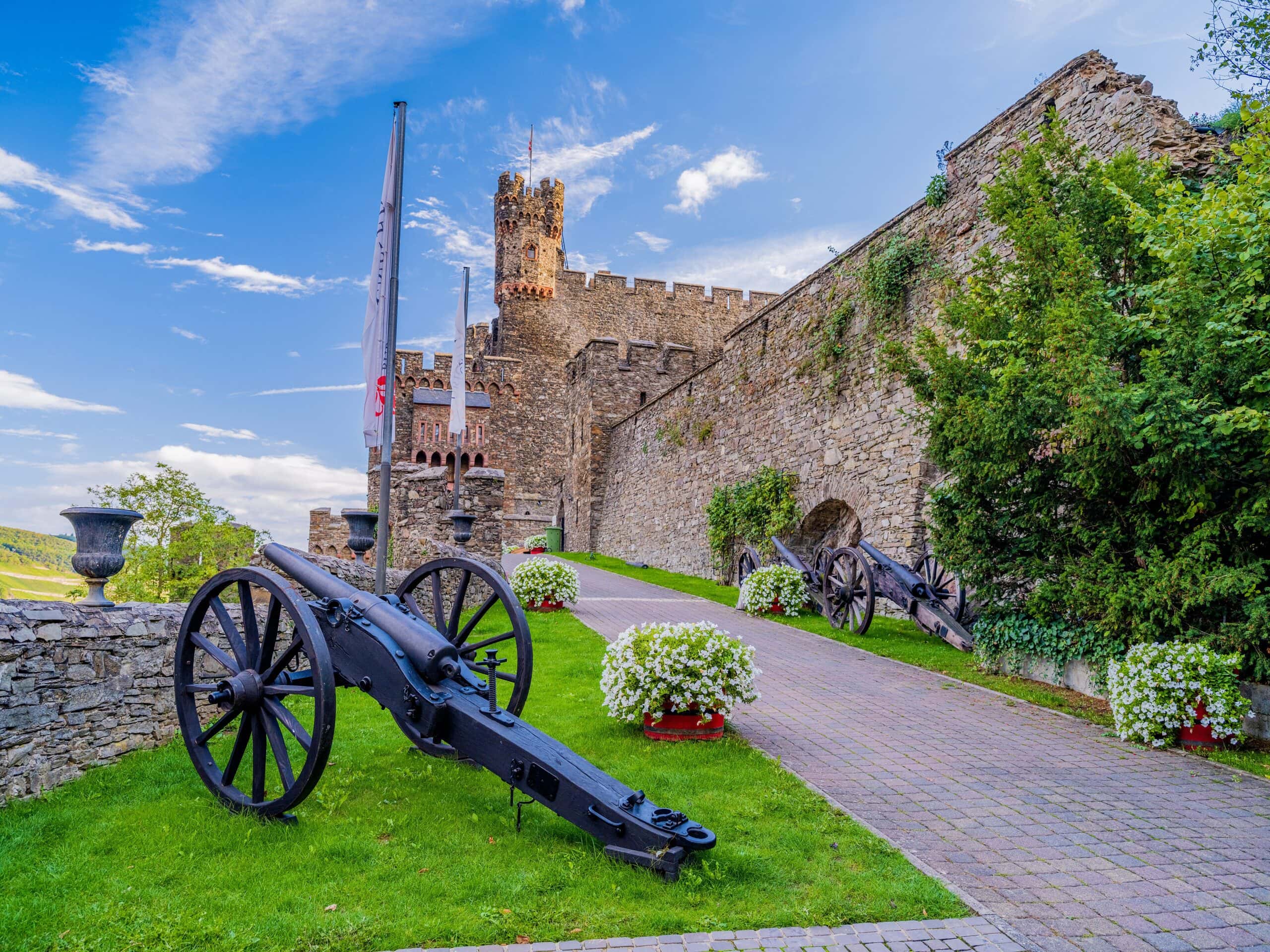
Museum is open daily, 09:00–18:00 between April and October (last admission 17:00) and 09:00–17:00 in winter (last admission 16:00). The museum is not wheelchair-accessible and dogs are not permitted inside.
Museum tickets, 2026
| Ticket | Price |
|---|---|
| Adult (14+) | €12.00 |
| Child, 5–13 | €6.00 |
| Under 5 | Free |
| 5-visit pass for two persons | Saves €30 (no time limit) |
Tickets are most reliably confirmed against the operator’s booking page at burg-reichenstein.com/museum. Hotel guests visit the museum free of charge.
The 23-room boutique hotel inside the castle (the operator describes it as “English country house” in style) opened at the end of 2015 and offers five categories of room, from Comfort doubles to two-level Galerie suites with panoramic Rhine views. The Puricelli Restaurant on site is listed in the MICHELIN Guide and Falstaff (no star, 85 points) and serves a regional, short-supply-chain menu drawing on the castle’s own kitchen garden.
A note on access in 2026: from March 20 to April 27, Deutsche Bahn is performing track-bed renewal between Bingen and Bacharach. Weekends in that window see the line fully closed with replacement buses; weekdays operate single-track with delays. Travelers in late March or April should consult bahn.de before booking. Anyone staying overnight can compare hotels in and around Bingen am Rhein.
Some links on this page are affiliate links, which means StoneKeep Atlas may earn a small commission, at no extra cost to you, if you book through them.
Beyond Reichenstein
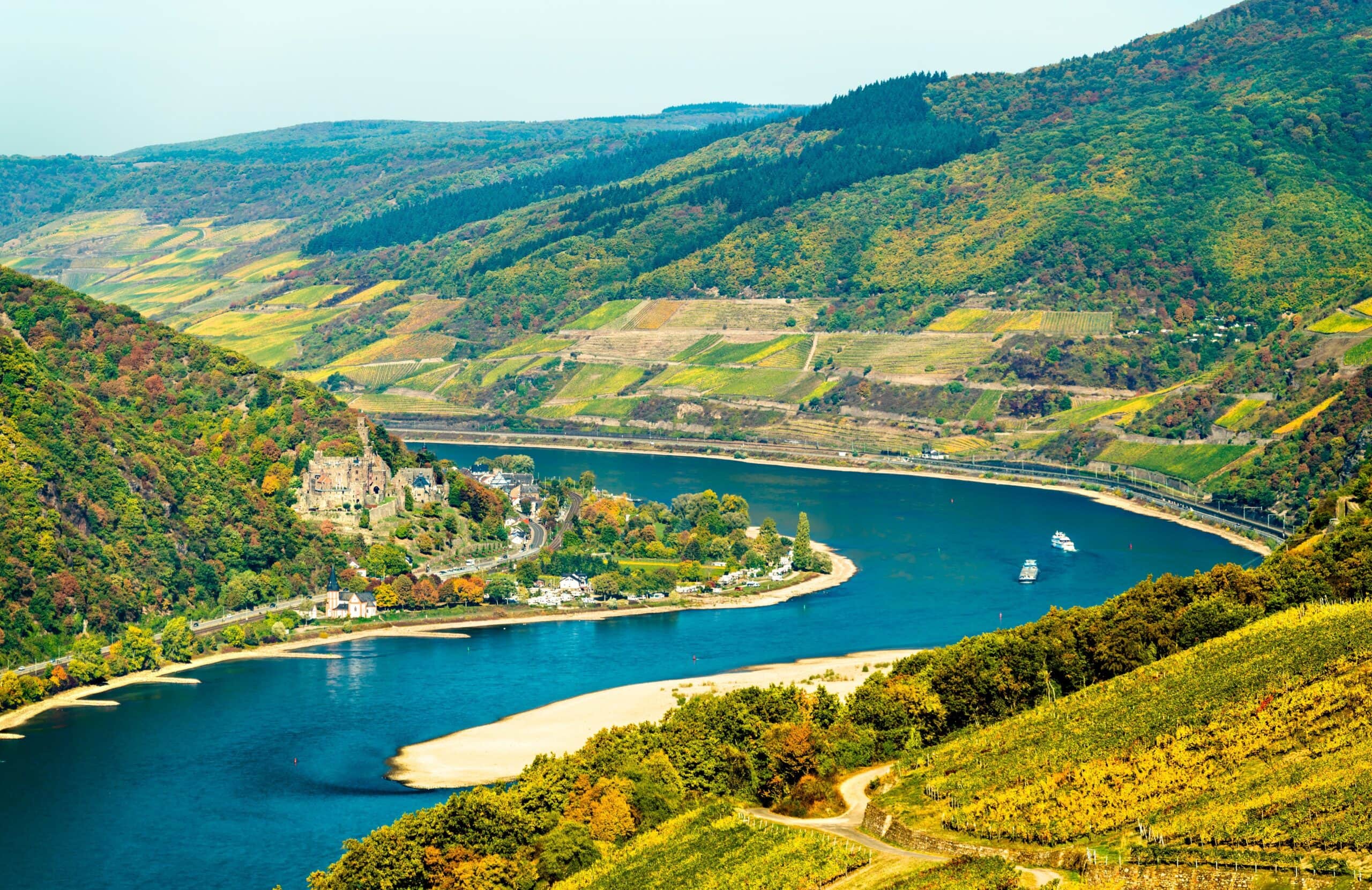
Reichenstein anchors a pair of left-bank castles barely two kilometers apart: a thirty-minute woodland walk through the Morgenbachtal (Reichenstein’s own gorge) brings you to Rheinstein, the Hohenzollern princely retreat that Reichenstein’s 1899 patrons were so determined to outshine. Continue downstream and the joint-princely castle of the four Hohenzollern brothers at Sooneck appears on the same bank within walking range. All three are members of the Castles of the Rhine Gorge cluster within the Upper Middle Rhine UNESCO World Heritage Site, and all three repay the patient traveler who threads them together with the 19th-Century Romantic Revival story of how the Rhine’s ruins came back from the dead.
Reichenstein’s 1282 slighting also anchors the political-economy argument developed in The Rhine as Contested Territory: Castles, Tolls, and the Collapse of Imperial Authority, which traces the Hohenstaufen collapse, the Interregnum-era toll-castle proliferation, and Rudolf I’s restrained reckoning that ended the Bolanden-Hohenfels lordship here.
Conclusion
Reichenstein is, in the end, a 1900 building that asks to be read as a late-medieval one, and that asks the question well enough that most visitors do not notice the trick until they are halfway through the trophy galleries. It is also, nearly eighty years after the last Kirsch-Puricelli left, a private home of the founders’ descendants again. Few castles on the Rhine have come so completely round.
You can also spend the night here. Hotel Burg Reichenstein occupies the castle, and we feature it in our guide to the Castle Hotels in Germany, where you can sleep inside the walls.
Principal Sources
- Burg Reichenstein. Operator site (current visitor information, hotel, restaurant, museum, and ownership statement). burg-reichenstein.com.
- “Die Burg Reichenstein in Trechtingshausen.” regionalgeschichte.net (Institut für Geschichtliche Landeskunde an der Universität Mainz).
- Friedhoff, Jens. “Burg Reichenstein.” EBIDAT, Burgendatenbank des Europäischen Burgeninstitutes, Deutsche Burgenvereinigung e.V., for the medieval ownership chain, the 1282 destruction, the Mainz Amtmann phase, and the late-historicist reconstruction. ms-visucom.de/cgi-bin/ebidat.pl?id=266.
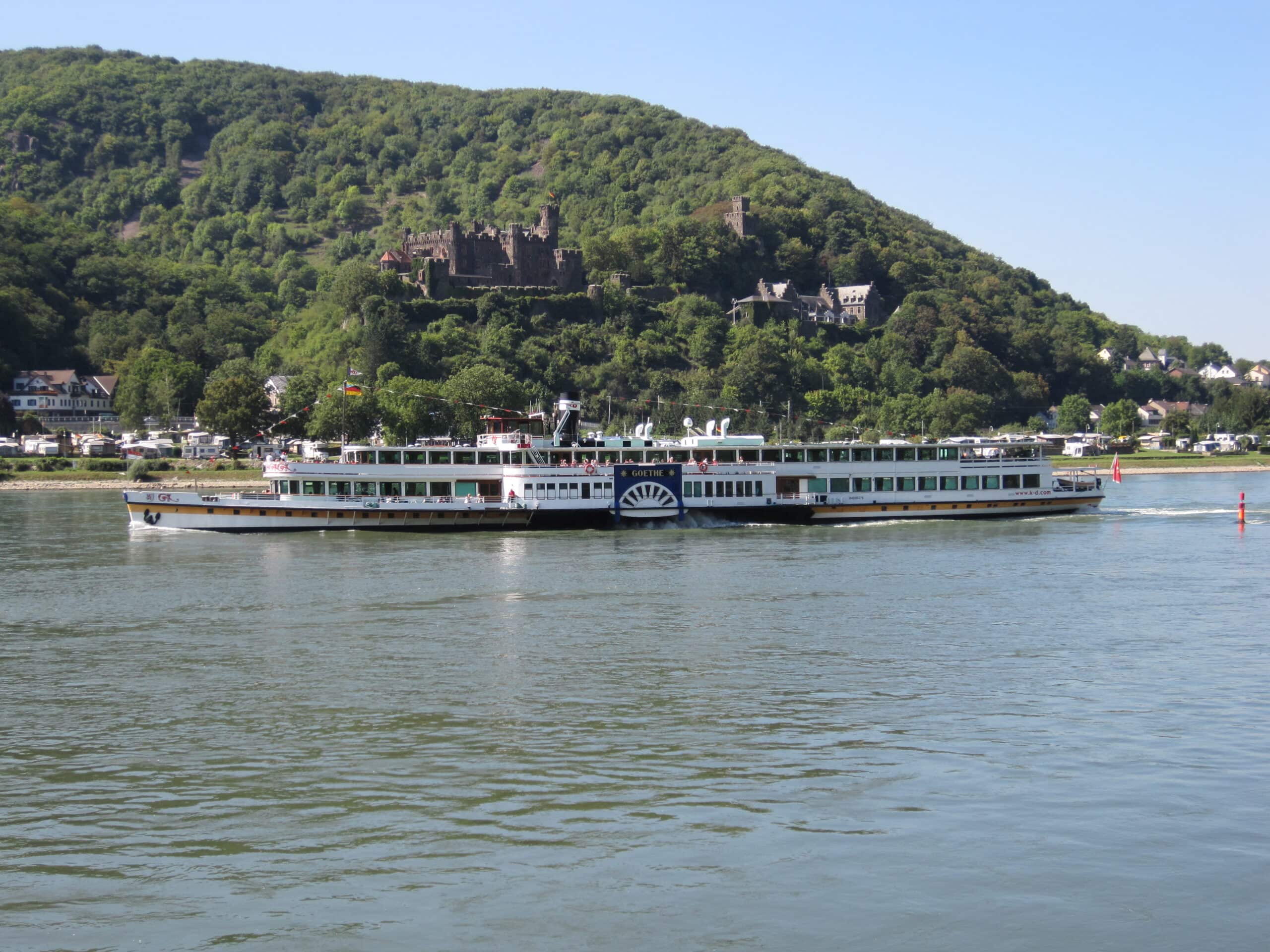
Image credits. Featured image — Reichenstein Castle from above Trechtingshausen, with the Belvedere tower at upper right and the outer ring wall enclosing the lower bailey: Whgler, CC BY-SA 4.0, via Wikimedia Commons. The Köln-Düsseldorfer paddle steamer Goethe passing below Reichenstein on the Rhine: Haffitt, CC BY-SA 3.0, via Wikimedia Commons. Reichenstein after the Strebel reconstruction: the three-story main building on the north-west, the corner towers of the outer ring wall, and the Belvedere tower above: János Korom Dr., CC BY-SA 2.0, via Wikimedia Commons. A 2025 aerial of Reichenstein: PopSpots, CC BY 4.0, via Wikimedia Commons. The approach to Reichenstein, with historic cannons on the lawn and the Schildmauer tower rising above the curtain wall: Poidabro, CC BY-SA 4.0, via Wikimedia Commons. Reichenstein in its UNESCO context: the castle anchors the left bank as the Rhine bends south-east toward Bingen, surrounded by the terraced vineyards of the Upper Middle Rhine Valley: via Adobe Stock. Freely licensed images are resized to fit; otherwise unaltered.