
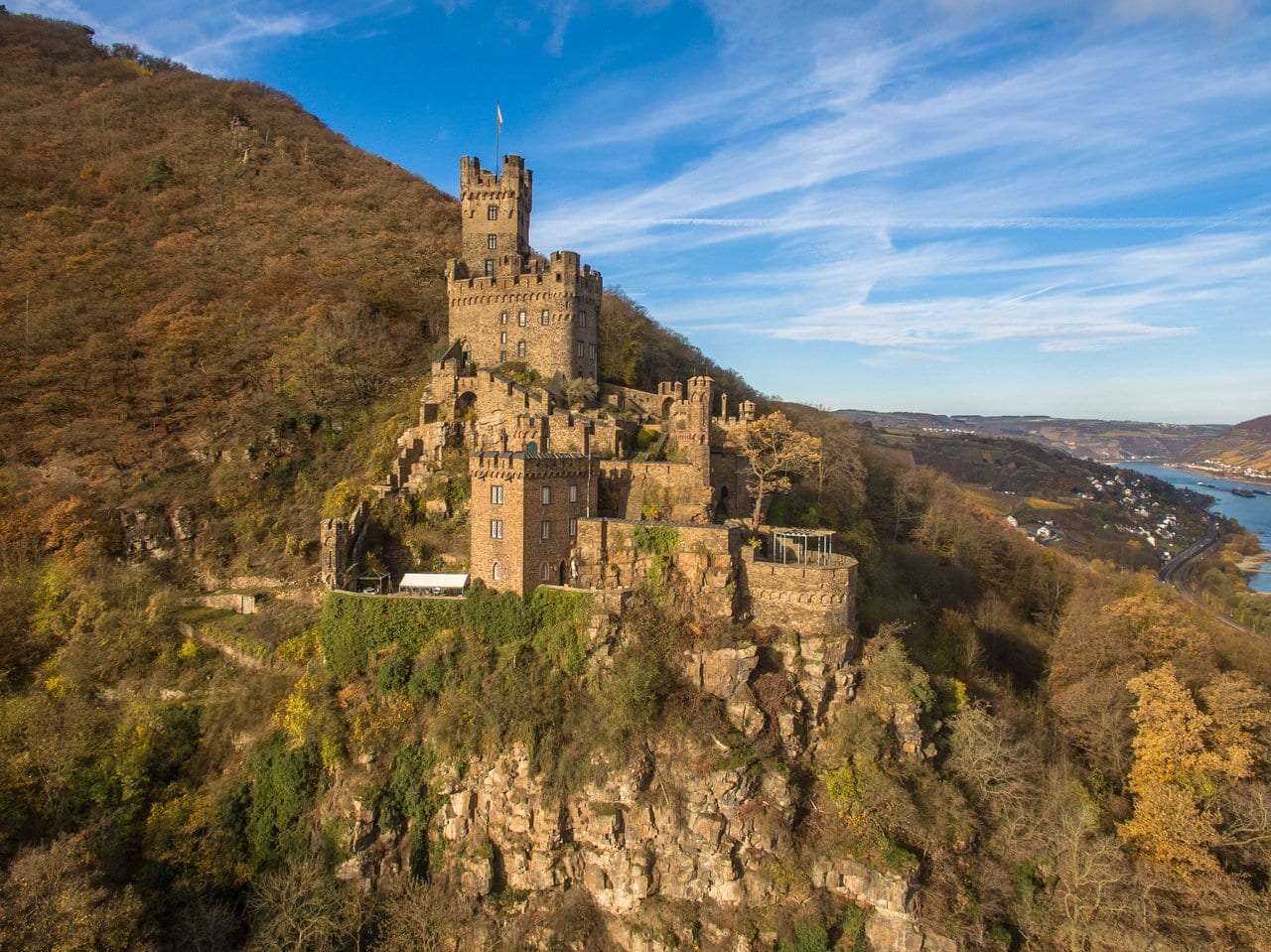
Sooneck Castle
Most Rhine castles were built once and broken once. Sooneck Castle was broken twice, by two different states, for the same reason; rebuilt a third time by people who admired exactly the thing it had originally been destroyed for. It began as a robber-knights’ eyrie above the river’s worst bottleneck, was stormed and outlawed by a German king, clawed its way back, was flattened again by a French army, and then, in the most Romantic century of all, was bought by the Prussian royal house and turned into a chivalric daydream.
The castle on its ridge above Niederheimbach today is a museum of nineteenth-century taste pretending to be a museum of the Middle Ages. That is not a criticism; it is the point. Sooneck Castle is one of the clearest places on the Rhine to watch a robbers’ nest become a fairy tale; to see who did the rewriting, and why.
Quick Facts
| Name | Sooneck Castle (Burg Sooneck; also Saneck, Sonneck) |
| Location | Above Niederheimbach, left bank of the Rhine, Rhine Gorge, Rhineland-Palatinate, Germany |
| First documented | 1271 (sold by Kornelimünster Abbey to the Archbishop of Mainz) |
| Destroyed | 1282 by King Rudolf I of Habsburg (rebuilding banned); again 1689 by French troops of Louis XIV |
| Rebuilt | Mid-14th century under Mainz; comprehensively in the 1840s–1861 by the Prussian royal house |
| Architect of the 19th-c. rebuild | Carl Schnitzler (Prussian military architect) |
| Current owner / use | State of Rhineland-Palatinate (GDKE); museum, leased and operated by the Hecher family |
| UNESCO | Upper Middle Rhine Valley World Heritage Site, since 2002 |
| Coordinates | 50.0436, 7.7558 |
| Official site | burg-sooneck.com |
The eyrie above the Bingen reach
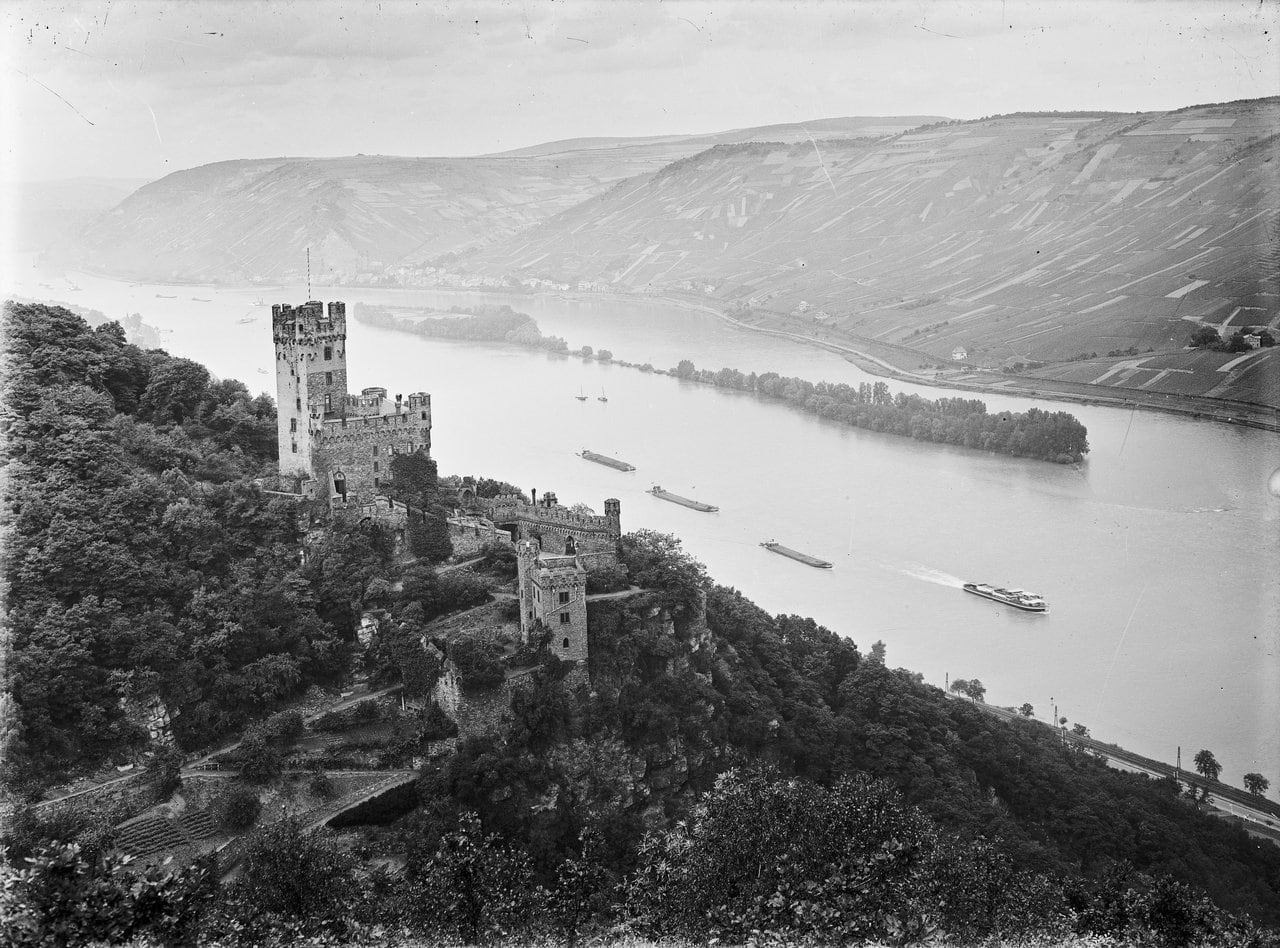
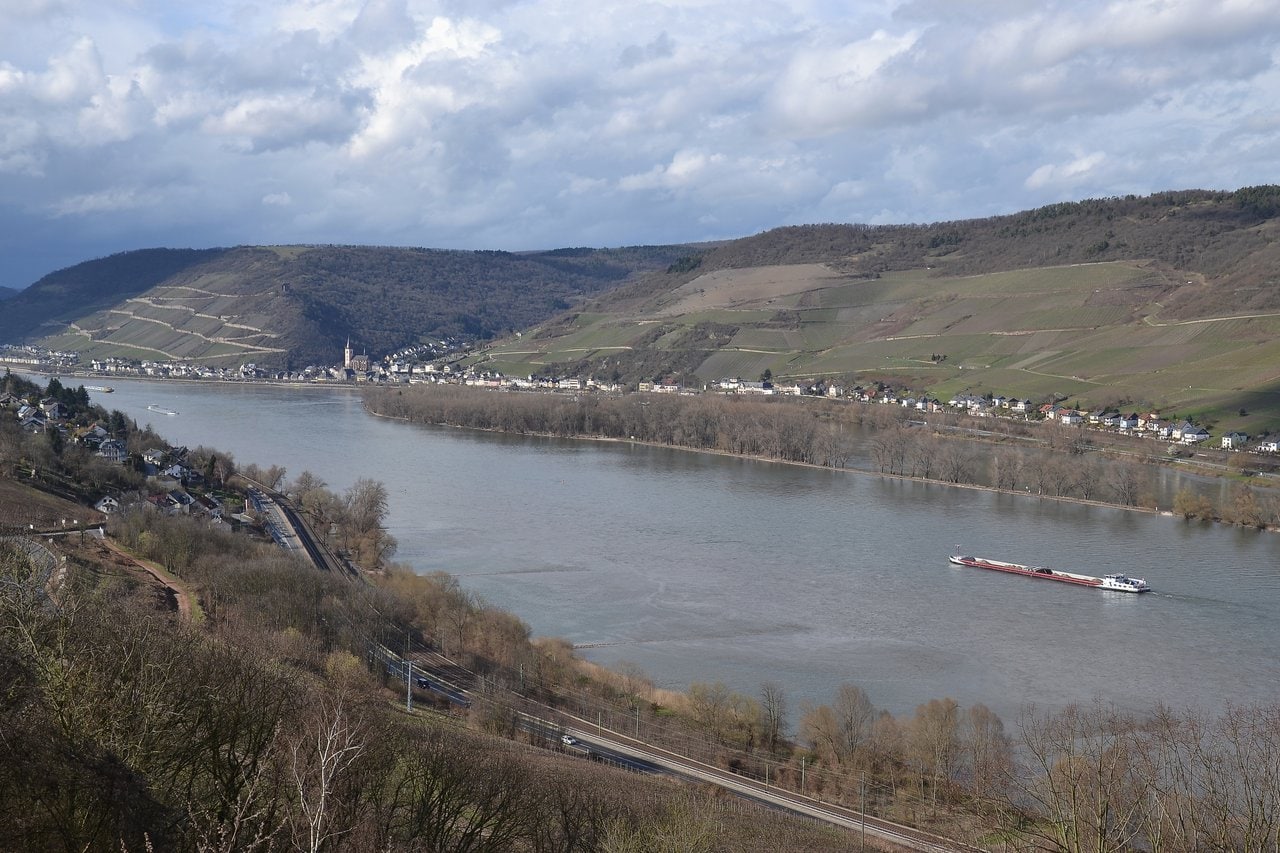
Sooneck sits on a steep spur on the left bank, just above the stretch of river where the Rhine narrows toward Bingen and the old reefs of the Binger Loch. It is the kind of position that medieval lords did not build for defense so much as for leverage: a castle here looks down on every boat that has to slow for the narrows. The name probably comes from the Soonwald, the forest at its back; the rose terraces and the storybook silhouette came much later.
The first firm documentary trace is 1271, when Kornelimünster Abbey near Aachen (which had held land in this stretch since Carolingian times) sold the place, then written Sanecke, to Archbishop Werner of Mainz. (A popular tradition pushes the castle back to the eleventh century, but there is no record to support it.) Long before that sale, the day-to-day castle was run by the lords of Hohenfels, who held it as the abbey’s Vögte, its protective bailiffs. The arrangement was identical to the one a short way downstream at Reichenstein, and it failed in exactly the same way. Men paid to guard the river instead taxed it for themselves. By the 1270s Philipp and then Dietrich von Hohenfels were running Sooneck as what the chronicles bluntly call a robber nest, levying their own tolls and plundering merchant traffic, and ignoring the fact that the property had legally passed to Mainz.
Rudolf von Habsburg breaks the nest
Towns tried first. The League of Rhenish Towns is recorded as having besieged Sooneck and Reichenstein together around 1254 to choke off the robber-knights’ tolls, although historians now treat the detail of those mid-century sieges as part-documented, part-presumed. What is not in doubt is that the merchant cities could harass the problem but not end it. Ending it took a king.
The Rhine’s robber barons were not a folklore exaggeration; they were a tax problem serious enough to draw the Crown. When Rudolf I of Habsburg took the German throne in 1273, restoring order on the imperial rivers was one of his signature projects, and the castles of the Bingen reach were among his targets. In 1282 his troops besieged, overran, and destroyed Sooneck. Rudolf then did something more pointed than simply slighting the walls: he forbade the castle to be rebuilt at all, and he made a point of restating the ban explicitly in 1290. Sooneck was not just defeated; it was legally abolished.
This is the hinge of the whole story, and it is why Sooneck and Reichenstein belong together: the same king broke both castles in the same campaign for the same reason. Sooneck’s legend industry later supplied a satisfying morality tale, the robber lord Siebold, who blinded a captured archer and was killed by the blind man’s last crossbow shot, but the legend is Wilhelm Ruland’s nineteenth-century romance, not the record. The record is duller and harder: a king deciding that a particular rock was not allowed to have a castle on it. No phantom appears in the morality tale either, and our reference on haunted castles records that the state authority’s own history page for Sooneck carries no Geist, no Spuk and no Gespenst.
Second life, second ruin
The ban held for two generations, then dissolved the way most medieval prohibitions did, through politics. Once the property and its bailiwick had passed firmly to the Electorate of Mainz, the imperial veto became inconvenient to the right people. In April 1346 Archbishop Heinrich III of Mainz enfeoffed Johann, Knight Marshal of Waldeck, with Sooneck, and Johann set about rebuilding; Emperor Charles IV formally lifted Rudolf’s old ban in 1349. The keep and great hall with their corner turrets, the genuinely medieval bones still legible in the structure, belong to this mid-fourteenth-century campaign.
What followed was less a fortress’s career than a family one. After Johann von Waldeck’s death the castle passed to several heirs at once and became a Ganerbenburg, a castle held jointly by branches of a kindred who were obliged, repeatedly and not always sincerely, to swear castle-peace with one another. Through marriage the Waldecks and the Breidbach zu Bürresheim family became entangled; when the Waldeck line died out in 1553 the Breidbachs held Sooneck alone, and when they faded the castle faded with them. It was already in poor repair when, in 1689, French troops of Louis XIV worked their way along the left bank during the War of the Palatine Succession and destroyed it, as they destroyed nearly every castle on that side of the river. In 1774 the Mainz cathedral chapter handed the ruin to villagers from Trechtingshausen, who did the most practical thing imaginable with a dead castle: they planted vineyards in it.
The ruin the Prussian princes wanted
By the early nineteenth century a derelict Rhine castle was no longer a liability but a desirable object, and the most enthusiastic collectors of them were the Hohenzollerns. In April 1834 the Prussian crown prince (the future King Friedrich Wilhelm IV) together with his brothers, the princes Wilhelm, Carl, and Albrecht, bought the wholly ruined Sooneck from the community that had inherited it. It was the third Rhine ruin the Prussian royal house took in hand, after Friedrich’s cousin’s Rheinstein and the crown prince’s own Stolzenfels.
The motive was not strategic and barely even residential. The Prussian kings ruled the Rhineland after 1815 as a new and not entirely welcome power, and rebuilding its ruins as Romantic showpieces was a way of looking like the river’s natural heirs rather than its latest occupiers. Sooneck’s specific assignment was the most modest of the three: not a palace like Stolzenfels but a hunting seat where the king could meet his brothers in the Soonwald, away from the court. The instruction to the builder is famous and revealing: “everything very simple, in the sense of a royal hunting lodge.”
Rebuilt as a chivalric daydream
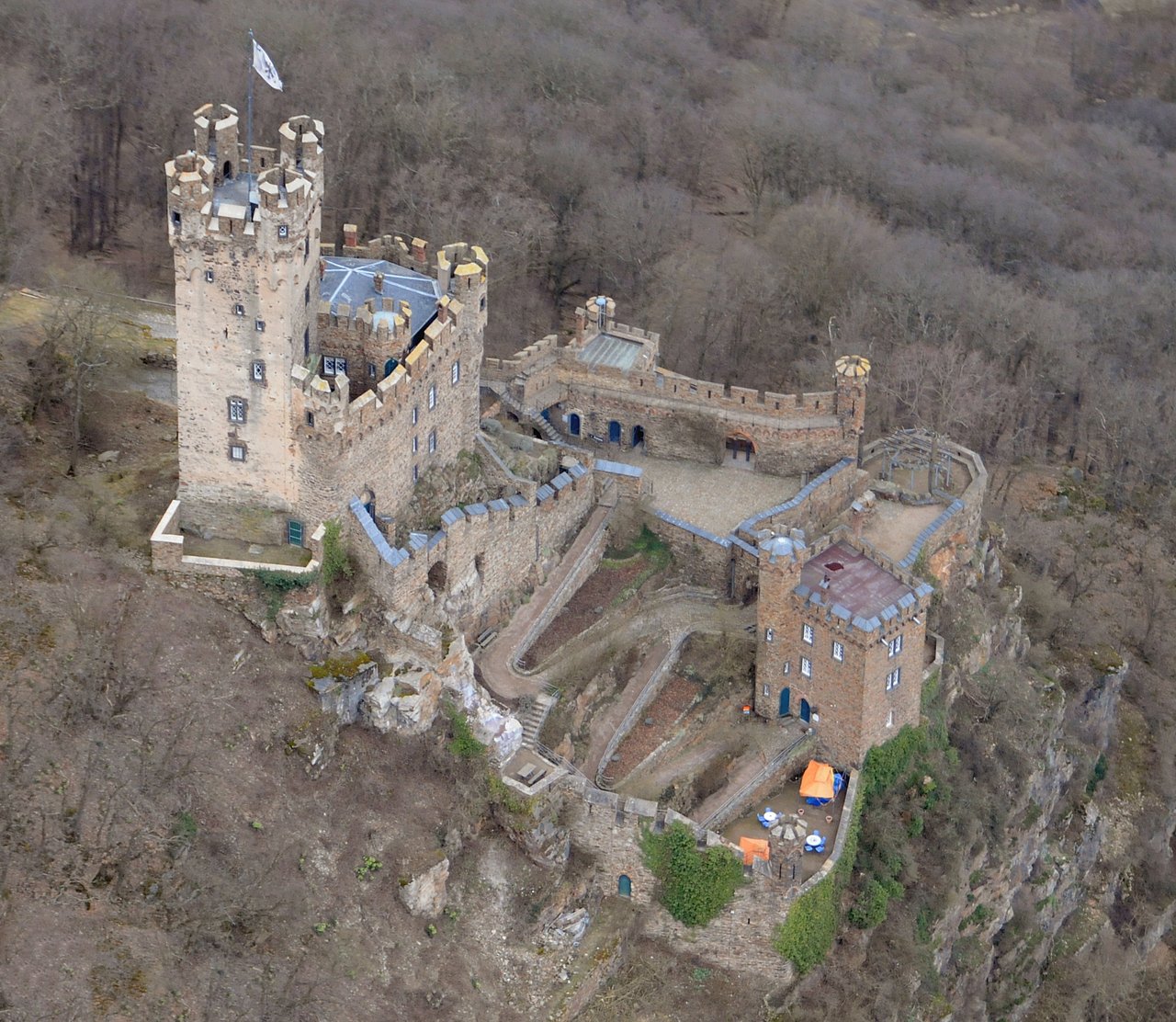
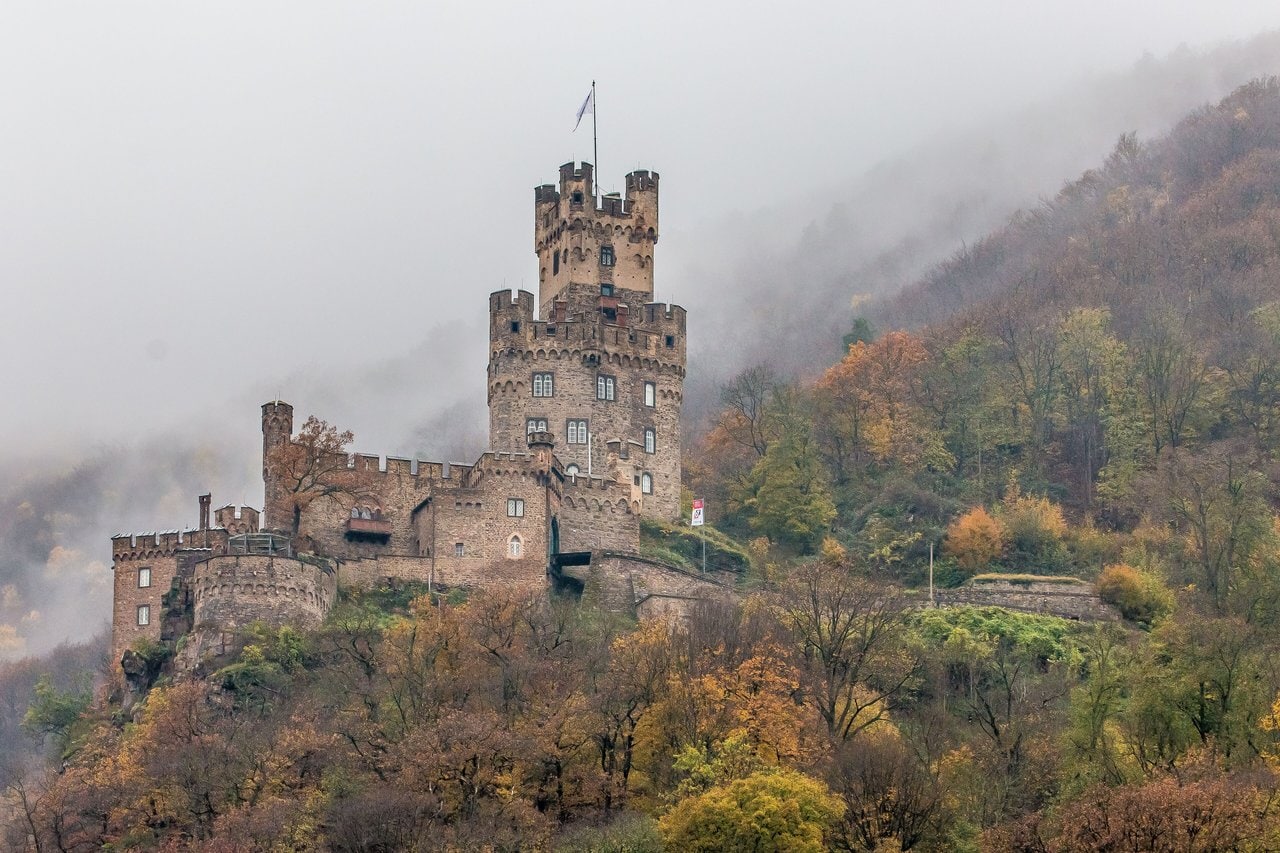
The reconstruction ran through the 1840s and was completed in 1861, to designs by the Prussian military architect Carl Schnitzler. Its guiding rule was that the Middle Ages should be the model for making the surviving structure habitable again: the fourteenth-century fabric was kept where it stood and dressed, not swept away, and Romantic-historicist additions filled the gaps. What is genuinely old is still legible if you know where to look: the square keep with its four polygonal corner turrets and the residential range beside it are the fourteenth-century core, and the round Talturm down the slope marks the medieval southwestern gate. Almost everything that reads as “castle” between them (the connecting ranges, the battlemented romance of the silhouette) is Schnitzler. Prussian royal crest set over the north gate (not the medieval entrance, which lay on the other side) is the rebuild quietly signing its own work.
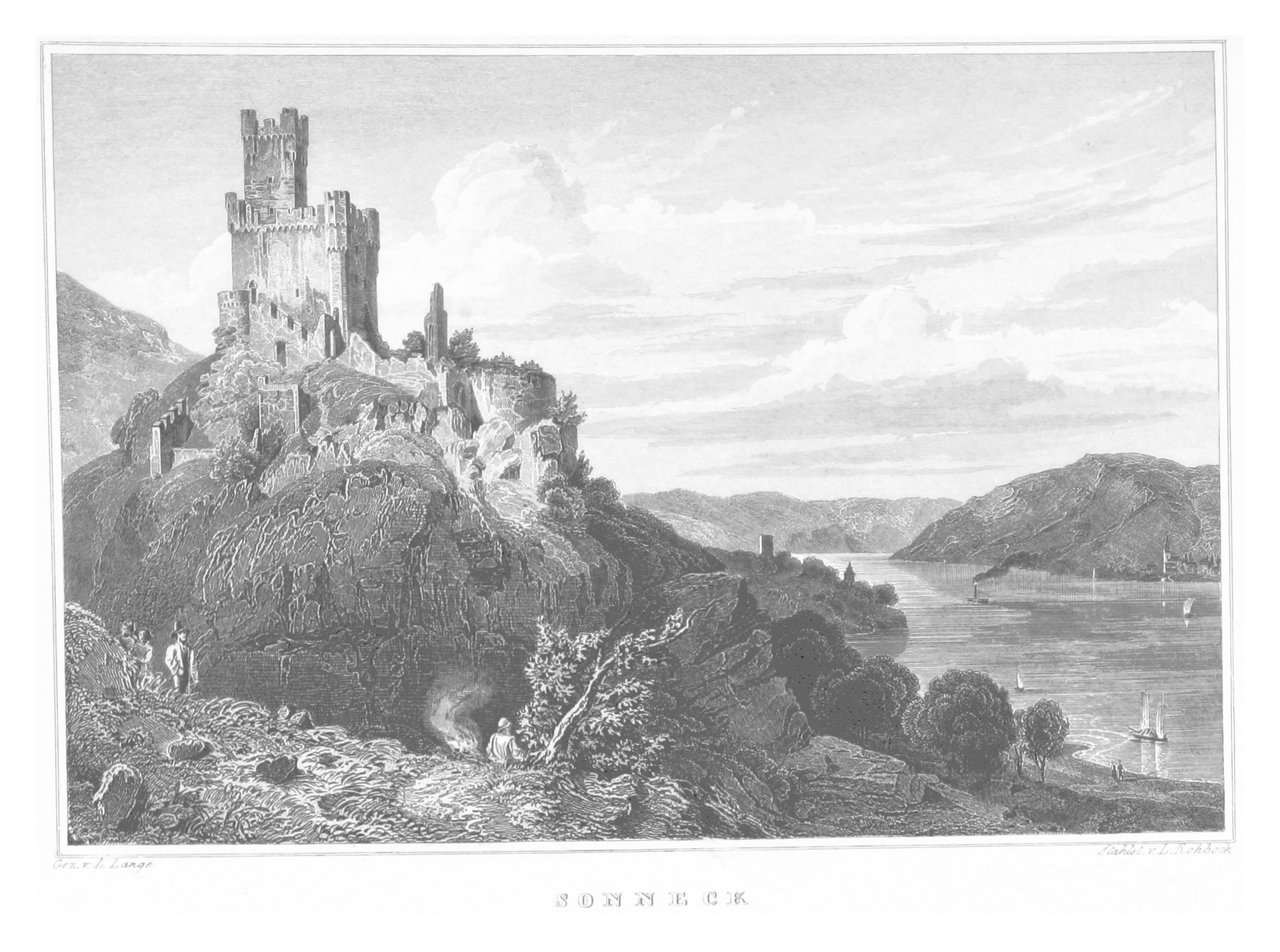
Then the daydream stalled. The revolutions of 1848, lasting disagreements within the royal family, and finally Friedrich Wilhelm IV’s illness and death meant the hunting lodge was almost never used as one; later Hohenzollerns rarely stayed. The accidental result is the castle’s real value to a visitor: a Rhine-Romantic interior that was furnished and then largely left alone, neo-Gothic and Biedermeier rooms, arms and armor, and a dense hang of paintings. (After looting in the Second World War the rooms were re-dressed in part with furniture brought from Stolzenfels, quietly reuniting two of the same royal project.) Since around 1990 the second floor has held the Koeth-Wanscheid Foundation’s collection of Rhine views, noble portraits, and eighteenth- and nineteenth-century furniture, and the old seventeenth-century bastion terraces below the walls are now the rose gardens that give Sooneck its picture-postcard reputation.
Visiting in 2026
Sooneck Castle is owned by the State of Rhineland-Palatinate, scientifically managed by the Generaldirektion Kulturelles Erbe (GDKE), and leased and run as a museum by the Hecher family, the same family that operates Burg Rheinstein a few kilometers upstream. The interior is seen by guided tour only, and the castle keeps a museum season, not year-round hours. Entry tickets and local tours can also be booked in advance through GetYourGuide.
Important: as of early 2026 the castle is temporarily closed to visitors for short-notice, safety-related masonry work, on the operator’s own notice. Anyone planning a visit should check burg-sooneck.com for the current reopening status before traveling; the figures below are the most recent published rates and apply when the museum is open.
| Visiting (when open) | Detail |
|---|---|
| Season | Roughly April to early November (reduced or holiday-only hours in late winter and November; closed December–January) |
| Hours (in season) | Daily, about 10:00–18:00; interior by guided tour only (German; English handouts) |
| Admission (most recent published) | Adults €6; children 5–14 €4.50 (confirm current rate on the operator site) |
| Getting there | Niederheimbach station on the left-bank line, then about a 40-minute uphill walk; Bingen–Rüdesheim boat landing at Niederheimbach; by car via the B9 with a parking lot below the castle |
| Access note | As a historic site it is not wheelchair accessible |
Sooneck also has an unusual modern tenant. Since 2015 the GDKE, the regional development agency, and the Rhein-Zeitung have installed a “Burgenblogger” each year, a writer who lives at Sooneck and the Koblenz fortress of Ehrenbreitstein from summer into autumn and reports on life in the castle and the valley. It is the rare Rhine castle whose nineteenth-century rooms are also, periodically, somebody’s desk.
One practical point sets Sooneck apart from the right-bank castles in 2026. Niederheimbach lies on the left bank, served by the left-bank Rhine line; the long DB InfraGO corridor closure that disrupts the right-bank railway through the second half of 2026 (the one that complicates reaching Burg Katz and Burg Maus across the river) does not affect Sooneck’s rail access. Here the obstacle is the building work, not the trains. Anyone staying overnight can compare hotels in and around Bingen am Rhein.
Some links on this page are affiliate links, which means StoneKeep Atlas may earn a small commission, at no extra cost to you, if you book through them.
Beyond Sooneck
Sooneck is best understood next to its neighbors. A short way downstream toward Bingen stands Reichenstein Castle, the other abbey-bailiff castle that turned robber and was broken in the same 1282 campaign, Sooneck’s twin in crime and punishment. Beside it Rheinstein Castle shows the Rhine-Romantic rebuild in its purest private form, while Stolzenfels Castle is the grander Prussian project against which Sooneck’s deliberate plainness is meant to be read. Further down the gorge, Pfalzgrafenstein and Gutenfels preserve the working machinery of the Rhine toll the robber knights had only ever parodied. For the whole sweep (how a single river accumulated so many castles and so many afterlives) see the regional overview of the castles of the Rhine Gorge.
Sooneck was the plainest of the Prussian royal house’s Rhine rebuildings; the full program (Rheinstein, Stolzenfels, Sooneck and Hohenzollern) is set out in the Prussian Royal Castles hub.
Conclusion
Sooneck Castle is a monument to a crime that was committed, punished, forgotten, and finally turned into decor. The Hohenzollerns did not rebuild the robbers’ nest because they admired robbery; they rebuilt it because by the 1840s the Middle Ages had become a costume the new rulers of the Rhine wanted to wear. What survives is honest about that in its own way: medieval bones inside a nineteenth-century imagination, a king’s simple hunting lodge that no king ever hunted from, rose terraces on the ruins of bastions on the ruins of an outlaws’ tower. Even closed for repairs, it is one of the most legible castles on the river, if you know that almost nothing you are looking at is what it pretends to be. For Castles of the Middle Rhine, a downriver guide to twelve castles on the Mittelrhein, see the regional roundup.
Principal Sources
- Generaldirektion Kulturelles Erbe Rheinland-Pfalz, Direktion Burgen, Schlösser, Altertümer. “Burg Sooneck.” gdke.rlp.de.
- Kulturerbe Mittelrhein. “Sooneck.” tor-zum-welterbe.de.
- Rathke, Ursula. Burg Sooneck. Verwaltung der staatlichen Schlösser Rheinland-Pfalz (guidebook 8), Mainz, 1995.
- Staatliche Burgen, Schlösser und Altertümer in Rheinland-Pfalz. Burgen, Schlösser, Altertümer Rheinland-Pfalz. Schnell & Steiner, Regensburg, 2003.
- Thon, Alexander. “Städte gegen Burgen: Tatsächliche und mutmaßliche Belagerungen von Burgen am Mittelrhein durch den Rheinischen Bund 1254–1257.” Jahrbuch für westdeutsche Landesgeschichte 34, 2008.
- “Burg Sooneck.” regionalgeschichte.net; UNESCO World Heritage List, Upper Middle Rhine Valley (ref. 1066).
Image credits. Featured image, Sooneck Castle on its rocky spur: Phantom3Pix, CC BY-SA 4.0, via Wikimedia Commons. Sooneck above the Rhine in the early 20th century: Joseph Knippenberg / Rheinisches Bildarchiv Köln (rba 225306), CC BY-SA 3.0. The castle plan from above: Pudelek (Marcin Szala), CC BY-SA 3.0, via Wikimedia Commons. Late-autumn mist over Sooneck: Gary Bembridge, CC BY 2.0, via Flickr. Poppel’s 1852 steel engraving: Johann Poppel, public domain. The view from the rose Rondell: Derzno, CC BY-SA 4.0, via Wikimedia Commons. Freely licensed images are resized to fit; otherwise unaltered.