
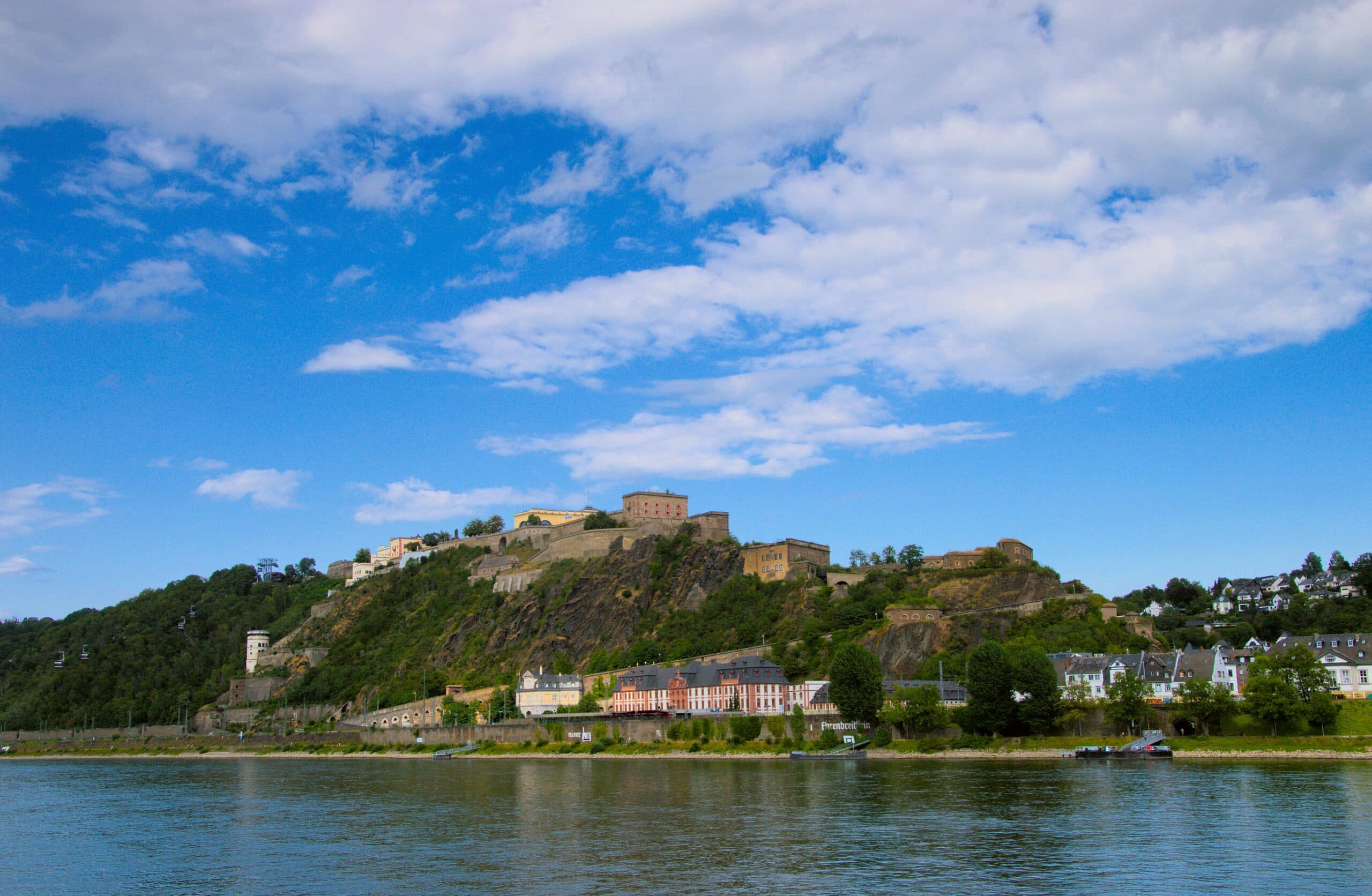
Ehrenbreitstein Fortress
From any vantage point on Koblenz’s left bank, the same shape commands the view: a long polygonal wall along a high cliff above the Rhine, running west toward the Deutsches Eck where the Mosel joins the river. Hundreds of thousands of visitors reach it every year, by cable car or by the elevator carved into the right-bank cliff, and most of them assume the building they walk into is medieval. It is not. A fortress on top of the rock is younger than the United States Constitution.
The mountain has held a stronghold for a thousand years, but the building visitors climb to today is fundamentally a new construction on cleared ground. The medieval donjon that once crowned the cliff was reduced to footings and rubble at the turn of the nineteenth century, and what rose in its place answered to a different state and a different strategic age. Ehrenbreitstein Fortress, in its present form, is a Prussian artillery work of 1817 to 1828, built under the construction lead of engineer-officer Carl Schnitzler within a directorate of senior Festungsbau engineers, on a plateau the French Revolutionary army had blown up with thirty thousand pounds of black powder seventeen years earlier. Eight hundred years of medieval Trier electoral architecture were leveled in a single 1801 demolition order; what visitors climb to today is the answer Berlin returned in stone. Two fortresses, one mountain: the medieval Trier seat below the surface and in fragmentary survivals, the visible silhouette above a geometry of post-Waterloo realpolitik.
Quick Facts
Figures below describe the fortress as it stands today: the 1817–1828 Prussian building, not the medieval seat that occupied the site before 1801.
| German name | Festung Ehrenbreitstein |
| Location | Koblenz (Ehrenbreitstein district, right bank), Rhineland-Palatinate, western Germany |
| Setting | Cliff fortress on the east bank of the Rhine, opposite the mouth of the Mosel; plateau 118 meters above the river |
| First fortress on site | Around 1000 (Konradiner Ehrenbert); held by the Archbishops of Trier from the 11th century |
| Demolition | 1801 (French Revolutionary engineers under the Treaty of Lunéville obligation to withdraw from the right bank) |
| Present fortress | 1817–1828, ready for service 1834; system by Aster, Rauch, Le Bauld de Nans, and Keibel; construction lead Carl Schnitzler |
| UNESCO status | Inside the inscribed Upper Middle Rhine Valley World Heritage Site (1066, inscribed 2002); originally a standalone Tentative WHS in 1984 |
| Current use | Cultural center, museum and event venue; seat of the GDKE Burgen, Schlösser, Altertümer directorate |
| Operator | Generaldirektion Kulturelles Erbe Rheinland-Pfalz (GDKE) |
| Official site | tor-zum-welterbe.de |
A Trier seat above the Deutsches Eck
The medieval story of Ehrenbreitstein is the story of the Archbishops of Trier becoming territorial princes. Ehrenbert’s original castle of around 1000 was a Frankish foundation, but by the early eleventh century Archbishop Poppo of Trier (1016–1047) had acquired it. A later Trier archbishop, Hillin von Falmagne (1152–1169), expanded the complex around 1160 with a five-sided keep, deepened ditches, and a cistern; a separate castle called Helfenstein rose on the adjacent peak in the twelfth century, seat of a ministerial family who took their name from it.
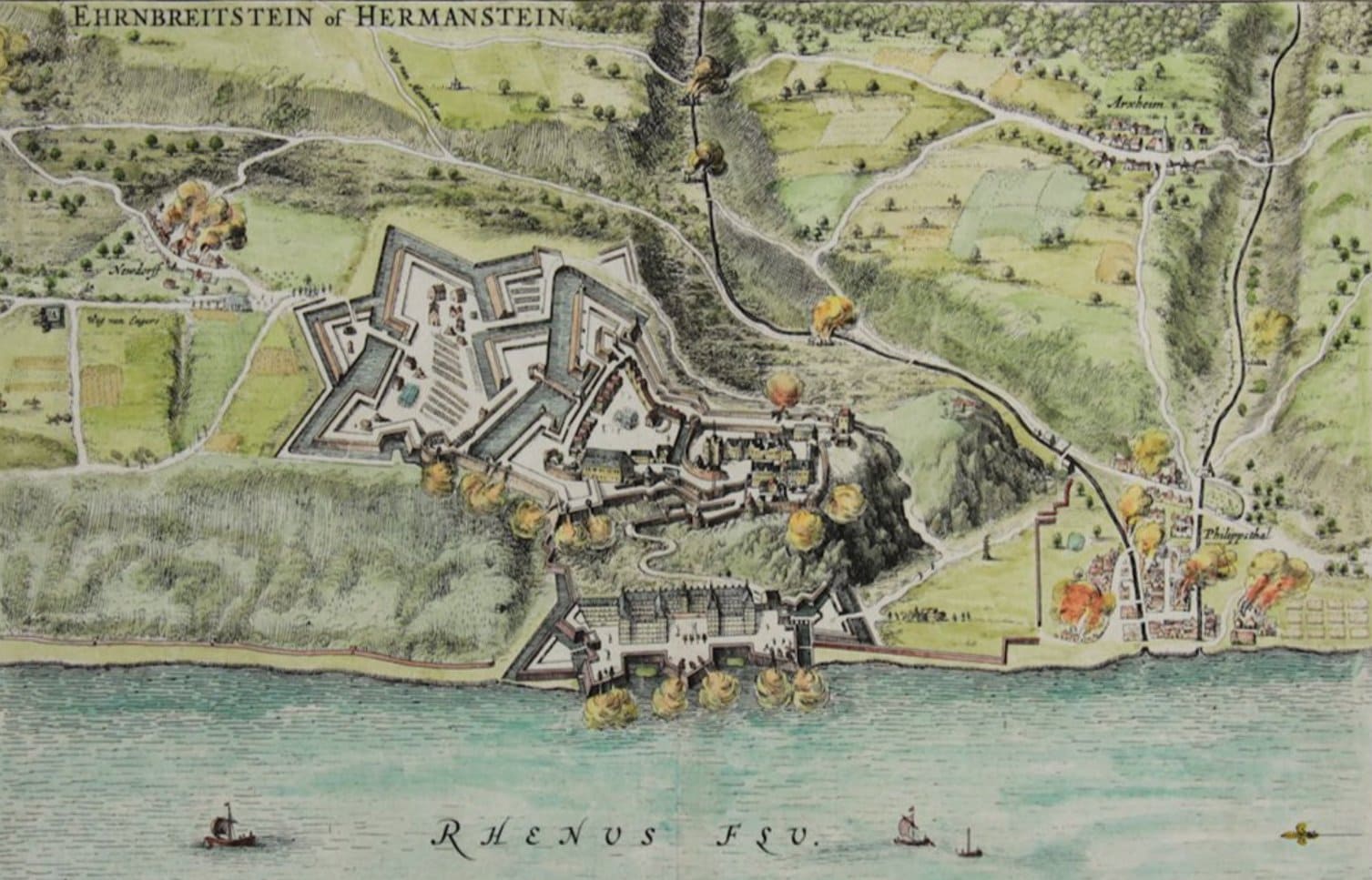
In the early sixteenth century, Archbishop Richard von Greiffenklau zu Vollrads (Trier elector 1511–1531) converted the medieval castle into an artillery fortress: the first such installation in the Trier electorate. Its symbol was the Vogel Greif, cast in 1524 by Meister Simon of Frankfurt am Main and in its day the largest cannon in Europe, still preserved in the fortress museum after centuries of disappearance and recovery.
Two seventeenth-century functions gave Ehrenbreitstein its civilian peak. Between 1626 and 1632, Archbishop Philipp Christoph von Sötern built the baroque Schloss Philippsburg at the foot of the mountain (the actual residential palace of the Trier prince-electors), the fortress above standing as its military shield. Then in 1657, the Holy Tunic (the seamless robe traditionally said to have been worn by Christ at his crucifixion, Trier Cathedral’s most sacred relic) was transferred to Ehrenbreitstein for safekeeping. It would remain there 137 years, until 1794, when the approach of the French Revolutionary army forced its evacuation back south.
French Revolutionary demolition, 1795–1801
French Revolutionary Wars took the Trier electorate apart in stages. Koblenz fell to French forces in October 1794. From 1795, French Revolutionary armies invested Ehrenbreitstein four times across four years. Fortress walls had been engineered to withstand direct artillery assault, and they did. What the French could not breach, they starved. A sustained blockade beginning in 1798 finally exhausted the garrison’s supplies, and on January 27, 1799 the fortress surrendered, not to bombardment but to hunger.
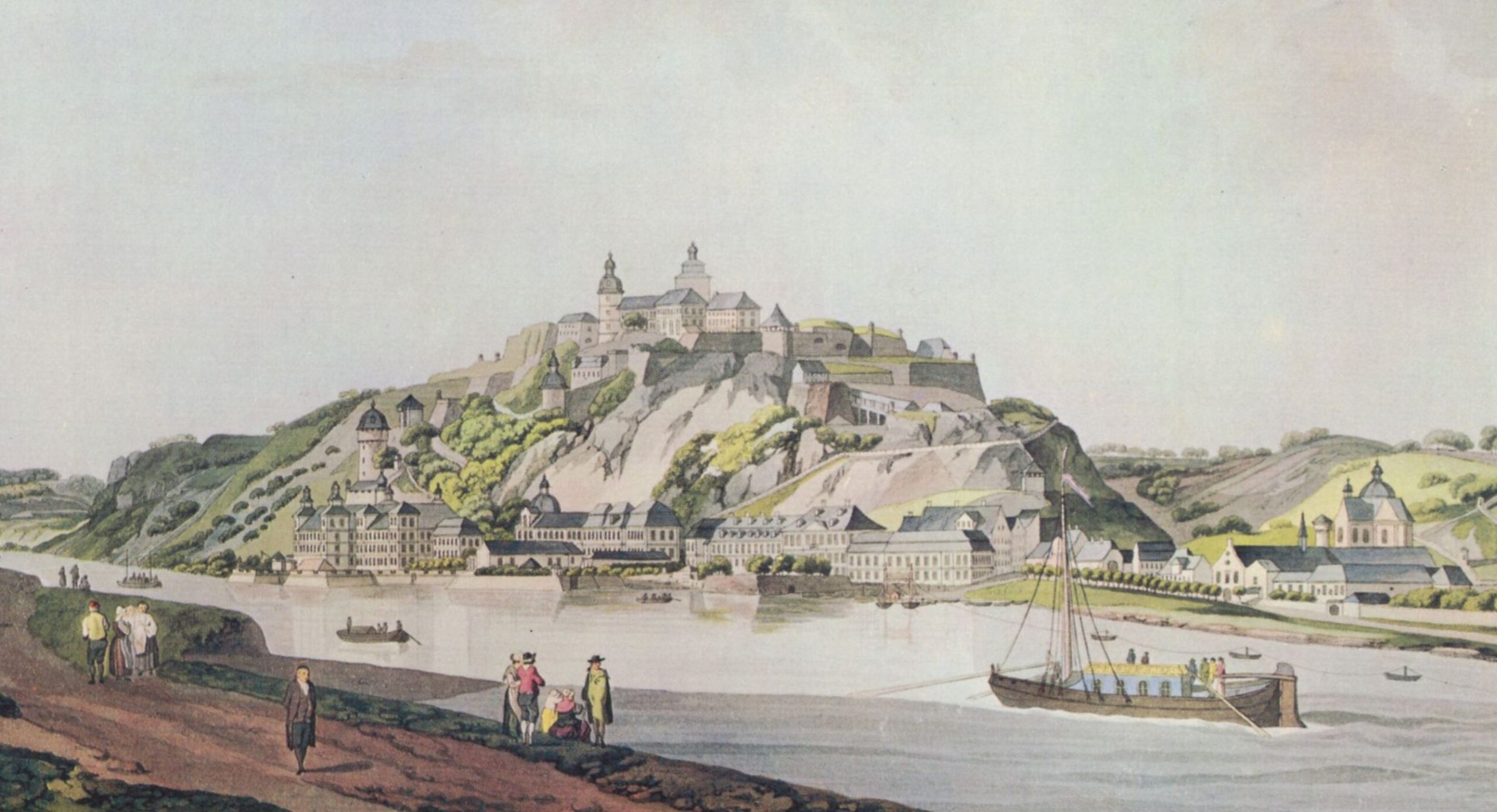
For two more years the building stood empty in French hands. Then in 1801, under the obligation of the Treaty of Lunéville to withdraw from the right bank, the occupying French Revolutionary engineers blew up the fortress with thirty thousand pounds of black powder. Medieval donjon, Greiffenklau artillery works, and Sötern-era expansions: all systematically demolished. The Philippsburg palace at the foot of the rock was so damaged by the explosion above that it had to be torn down. Eight centuries of Trier electoral architecture were reduced to a cleared site within a single year: not battle damage but deliberate policy, leaving nothing behind that could be refortified against France.
Schnitzler’s bastion, 1817–1828
The Congress of Vienna in 1815 transferred the Rhineland to the Kingdom of Prussia. Berlin inherited the river crossing that had defined Middle Rhine strategy since Roman times, and the problem that came with it: how to defend it against France.
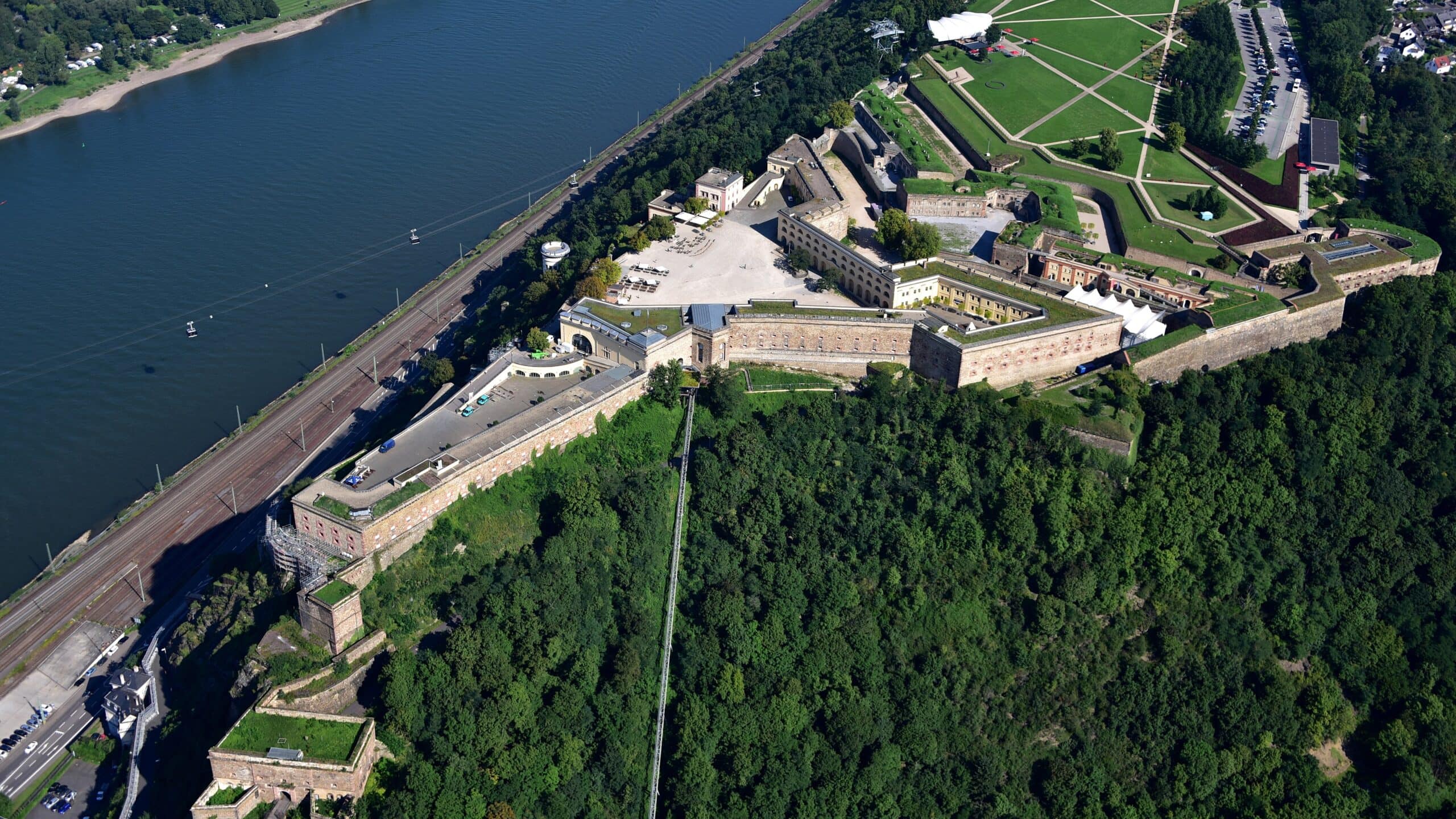
The answer was the Festung Koblenz, a comprehensive fortification system around the city designed between 1815 and 1834 by a Prussian Festungsbau directorate of senior engineers (Ernst Ludwig von Aster, Gustav von Rauch, Franz Le Bauld de Nans, and Gotthilf Benjamin Keibel, all four named on the 1819 Grabentor inscription. Ehrenbreitstein was its eastern keystone. King Friedrich Wilhelm III issued the order on March 11, 1815, and on-site construction was placed in the hands of engineer-officer Carl Joseph Heinrich Schnitzler. Construction ran from 1817 to 1828, with the fortress ready for service in 1834. Under the peace settlement, France reportedly paid fifteen million francs toward the new defenses: financing the very fortress designed to keep her armies out.
The design abandoned every medieval principle. The new fortress was a polygonal artillery work with outer walls up to three meters thick, moats twenty to twenty-five meters wide and two to five meters deep, casemates for around fifteen hundred soldiers, deep dry ditches, and a tower called Unnamed by diplomatic accident: on June 20, 1821, the Prussian crown prince and the Russian tsar’s son both visited the construction site, and since neither would yield naming priority to the other, the tower was left without a name at all. Said to be impregnable to any contemporary artillery, the fortress in service was never attacked.
Garrison, memorial, refugee shelter, 1828–1956
Fortress remained an active Prussian garrison until 1890, when the relentless development of artillery (particularly the steel-jacketed shells and high-velocity guns of the late nineteenth century) made traditional masonry-and-earthwork fortifications obsolete. Imperial Germany kept Ehrenbreitstein in military hands until the end of the First World War. Under the Treaty of Versailles, the Allied occupation of the Rhineland placed American troops in the fortress from December 1918; General Henry T. Allen, commander of the US Third Army, lobbied Marshal Ferdinand Foch to spare the building, and on February 25, 1922 the Inter-Allied Military Control Commission formally ordered its preservation. French troops succeeded the Americans through the end of the occupation in 1929, after which the fortress reverted to German civilian use.
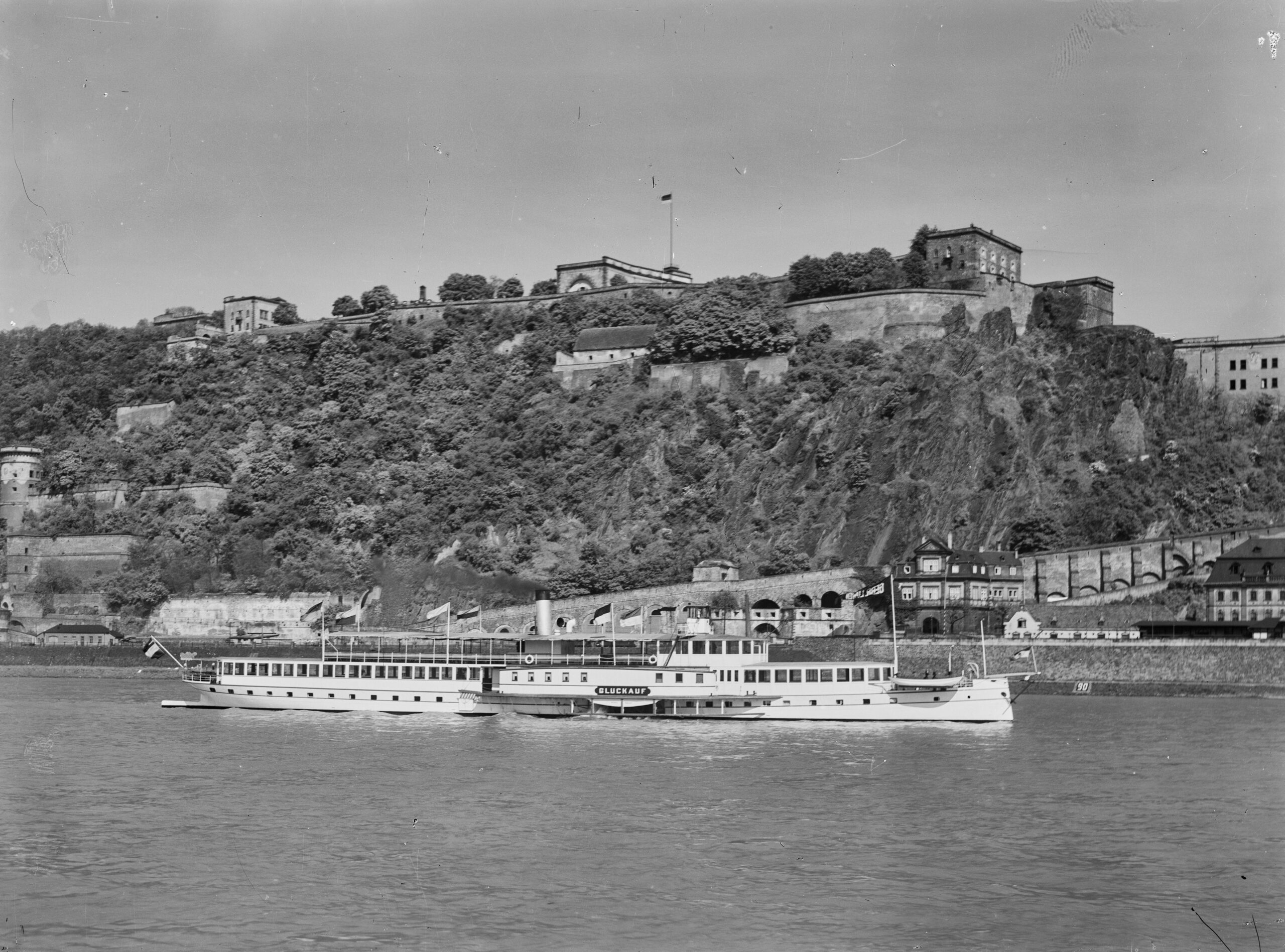
The post-1945 years gave Ehrenbreitstein its most unexpected role. From 1946 to 1950 the casemates housed displaced persons and refugees from territories east of the Oder-Neisse line: the population of a small town living inside the bastion. A youth hostel opened on the plateau in 1952; the first museum exhibitions appeared in 1956. 1972 dedication of the Ehrenmal des Deutschen Heeres (the German Army Memorial) gave the building a memorial function that continues today.
The fortress today: GDKE, Landesmuseum, three ways up
Since 1947 Ehrenbreitstein has belonged to the state of Rhineland-Palatinate, and since 1998 it has housed the Direktion Burgen, Schlösser, Altertümer (the GDKE division administering every state-owned castle and palace in the state). The fortress is not merely a museum but the operational headquarters of state castle administration.
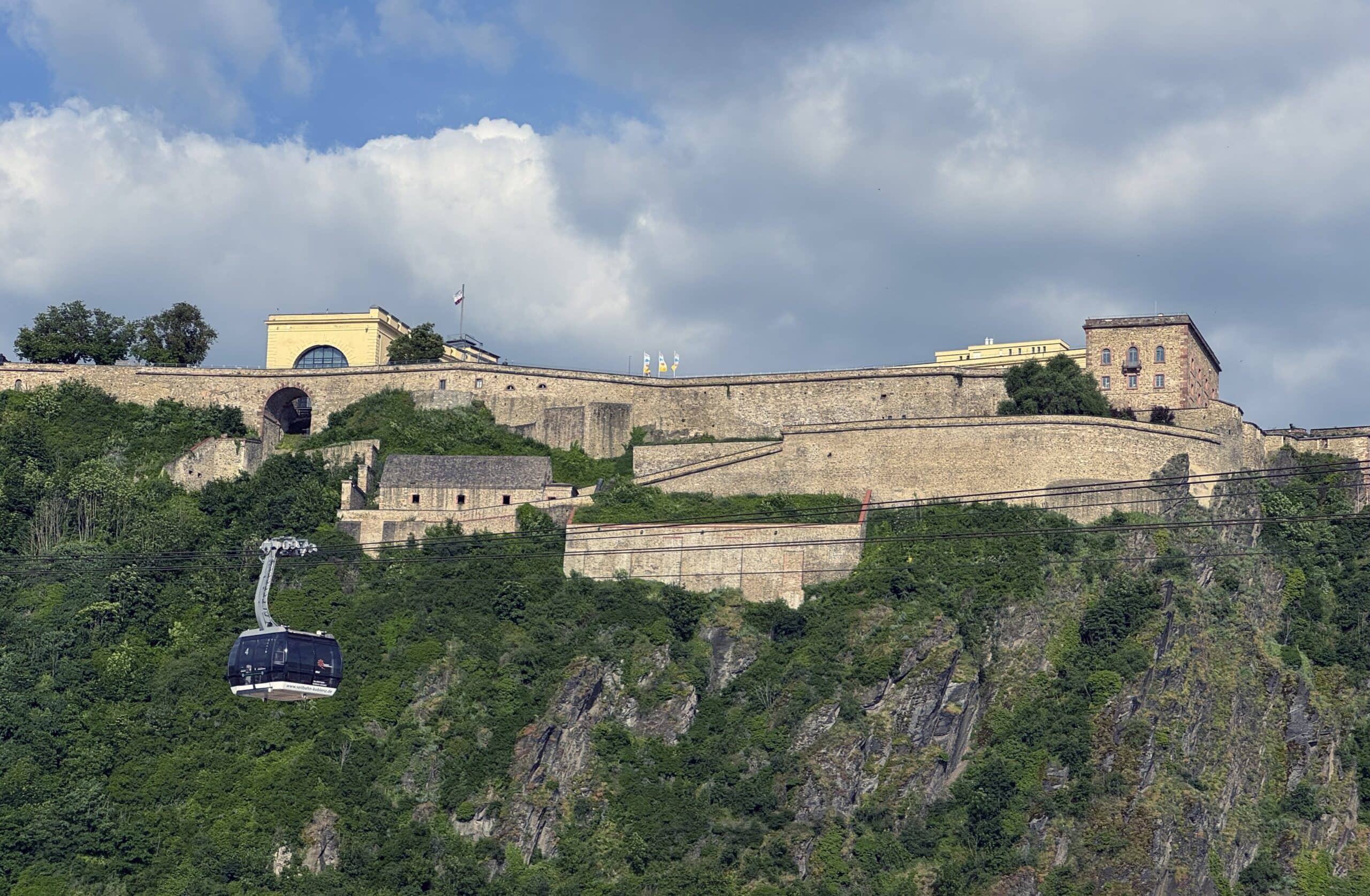
The Landesmuseum Koblenz occupies four exhibition buildings on the plateau, with permanent collections covering the history of photography, regional archaeology, viticulture and gastronomy, and the cultural history of the Rhineland. Four major event weekends fill the summer calendar; the dates and details appear in the pricing footnote below.
Three independent operators bring visitors to the plateau. The Seilbahn Koblenz crosses the Rhine in three minutes from the left bank at Konrad-Adenauer-Ufer; built for the 2011 Federal Garden Show with capacity for 7,600 passengers per hour, it is Germany’s most powerful aerial tram. The Koblenzer Verkehrsbetriebe Festungsaufzug, a barrier-free elevator at the right-bank base of the cliff, climbs 94 meters in three minutes and runs daily from six in the morning to one at night. Drivers reach the fortress directly via Greiffenklaustraße.
The cable car has its own survival story. A 2013 UNESCO ruling at Phnom Penh required it to be dismantled by June 30, 2026 to protect the World Heritage cultural landscape: after thirteen years of operation it was to disappear from the river. In March 2025, the Landesbetrieb Mobilität Rheinland-Pfalz, with UNESCO concurrence, extended the operating permit to 2030, and in October 2024 Snøhetta Studio Innsbruck won the international design competition for permanent replacement stations. Realization is contingent on UNESCO approval of the final design, with construction expected to begin no earlier than the winter of 2026 to 2027.
Visiting Ehrenbreitstein in 2026
The fortress is open daily from March 29 through November 1, 2026, from ten in the morning to six in the evening. After six the grounds and gastronomy remain freely accessible until midnight. The Seilbahn season runs from March 16 through November 1, daily 10:00 to 19:00, with extended Friday evening service to 23:00 from March 20 through October 30. The Festungsaufzug runs year-round, daily 06:00 to 01:00. Entry tickets and local tours can also be booked in advance through GetYourGuide.
For 2026, right-bank rail access to Ehrenbreitstein railway station is affected by the DB InfraGO corridor renewal between Troisdorf and Wiesbaden, closed from July 10 through December 12. Regional RB10 service is replaced by buses for the closure window. The Seilbahn from Konrad-Adenauer-Ufer on the left bank is unaffected, and the Festungsaufzug at the right-bank base operates normally. Anyone staying overnight can compare hotels in and around Koblenz.
Some links on this page are affiliate links, which means StoneKeep Atlas may earn a small commission, at no extra cost to you, if you book through them.
| Ticket | Adult | Reduced | Child / Student | Family I | Family II |
|---|---|---|---|---|---|
| Fortress only | €15.00 | €13.00 | €7.50 | €21.00 | €34.00 |
| Combo (fortress + Seilbahn return) | €26.00 | €24.00 | €13.50 | €42.00 | €65.00 |
Beyond Ehrenbreitstein
Within sight of the fortress, two Prussian counterparts complete the right-bank story. Downstream lies Stolzenfels Castle, the Romantic-revival palace rebuilt for King Friedrich Wilhelm IV between 1836 and 1842 under Karl Friedrich Schinkel and Friedrich August Stüler, with on-site execution by Ehrenbreitstein engineer-officers W. Naumann and Carl Schnitzler (the same Schnitzler who had built the fortress bastion two decades earlier). Upstream sits Lahneck Castle, the medieval Mainz electoral fortress whose neo-Gothic restoration from 1852 under Scottish railway entrepreneur Edward Moriarty stands as the opposite of Ehrenbreitstein’s wholesale Prussian reinvention.
Trier electoral dimension finds its counterpart at Cochem Castle on the Mosel (the other Trier-electoral fortress, destroyed by the troops of Louis XIV in 1689) during the Nine Years’ War and rebuilt 1868 to 1877 in Romantic neo-Gothic by the Berlin businessman Louis Ravené rather than in military classicism. Marksburg, the never-destroyed Mittelrhein counterpoint upstream of Koblenz, and Pfalzgrafenstein, the Wittelsbach toll castle in the river midstream, complete the cluster.
For broader context, see the Castles of the Rhine Gorge hub, the Rhine as Contested Territory thematic essay, and The Reformation and the Castle: Ehrenbreitstein’s Holy Tunic guardianship from 1657 to 1794 sits squarely inside the latter’s frame, the fortress as a Counter-Reformation strongbox for the Trier See’s most sacred relic.
Conclusion
Two fortresses, one mountain, and a thousand years of layered decisions about what the cliff above the Deutsches Eck should be for. The medieval Trier seat is gone, scattered as fragments and footings beneath the modern surface. What replaced it is no restoration; it is a Prussian answer to a Prussian question, written in artillery geometry. That the answer was never tested in war is its own historical irony. That its silhouette is now the most recognized cultural-landscape image of the entire Upper Middle Rhine Valley (the original 1984 nucleus of an inscription that grew outward to encompass sixty-five kilometers of river) is perhaps the most Prussian outcome of all: a fortress built for war that endures as a symbol of peace.
Ehrenbreitstein fell only to blockade and hunger in 1799, a fate examined in The Castle as Refuge: Sieges That Defined Germany.
Principal Sources
- Europa Nostra. “Europa Nostra welcomes UNESCO’s decision on dismantling cable car in Koblenz by 2026.” europanostra.org.
- Generaldirektion Kulturelles Erbe Rheinland-Pfalz. “Festung Ehrenbreitstein.” tor-zum-welterbe.de.
- Koblenzer Verkehrsbetriebe. “Festungsaufzug.” koveb.de.
- Museumsportal Rheinland-Pfalz. “Festung Ehrenbreitstein.” museumsportal-rlp.de.
- Seilbahn Koblenz / Skyglide Event Deutschland. “Die Seilbahn Koblenz.” seilbahn-koblenz.de.
- UNESCO. “Cultural Landscape of the Middle Rhine Valley: Nomination Document (1066).” 2002. whc.unesco.org.
- UNESCO World Heritage Centre. “Upper Middle Rhine Valley (WHS 1066).” whc.unesco.org.
- Wikipedia. “Ehrenbreitstein Fortress.” en.wikipedia.org.
- Wikipedia. “Koblenz Fortress (Festung Koblenz).” en.wikipedia.org.
Operator information for visiting: the fortress and Landesmuseum are administered by the Generaldirektion Kulturelles Erbe Rheinland-Pfalz; the cable car by Seilbahn Koblenz / Skyglide Event Deutschland GmbH; and the right-bank elevator by Koblenzer Verkehrsbetriebe.
Image credits. Featured image: Festung Ehrenbreitstein viewed from the Koblenz left bank, photo by Dominik Kristen via Pexels. In-article images (top to bottom): bird’s-eye plan of Ehrenbreitstein and Schloss Philippsburg by Matthäus Merian (1639), public domain via Wikimedia Commons; engraving of Ehrenbreitstein from the southwest before the 1801 demolition by Johann Andreas Ziegler, public domain via Wikimedia Commons; aerial view of the Prussian polygonal layout by Wolkenkratzer, CC BY-SA 4.0, via Wikimedia Commons; early-twentieth-century view with the Rhine paddle steamer Glückauf by Joseph Knippenberg via the Rheinisches Bildarchiv (rba_225543_kni), CC BY-SA 3.0, via Wikimedia Commons; the Seilbahn Koblenz descending the cliff in 2024 by Gillfoto, CC BY-SA 4.0, via Wikimedia Commons. Freely licensed images are resized to fit; otherwise unaltered.