
The Reformation and the Castle: Wartburg, Luther, and the Protestant Princes
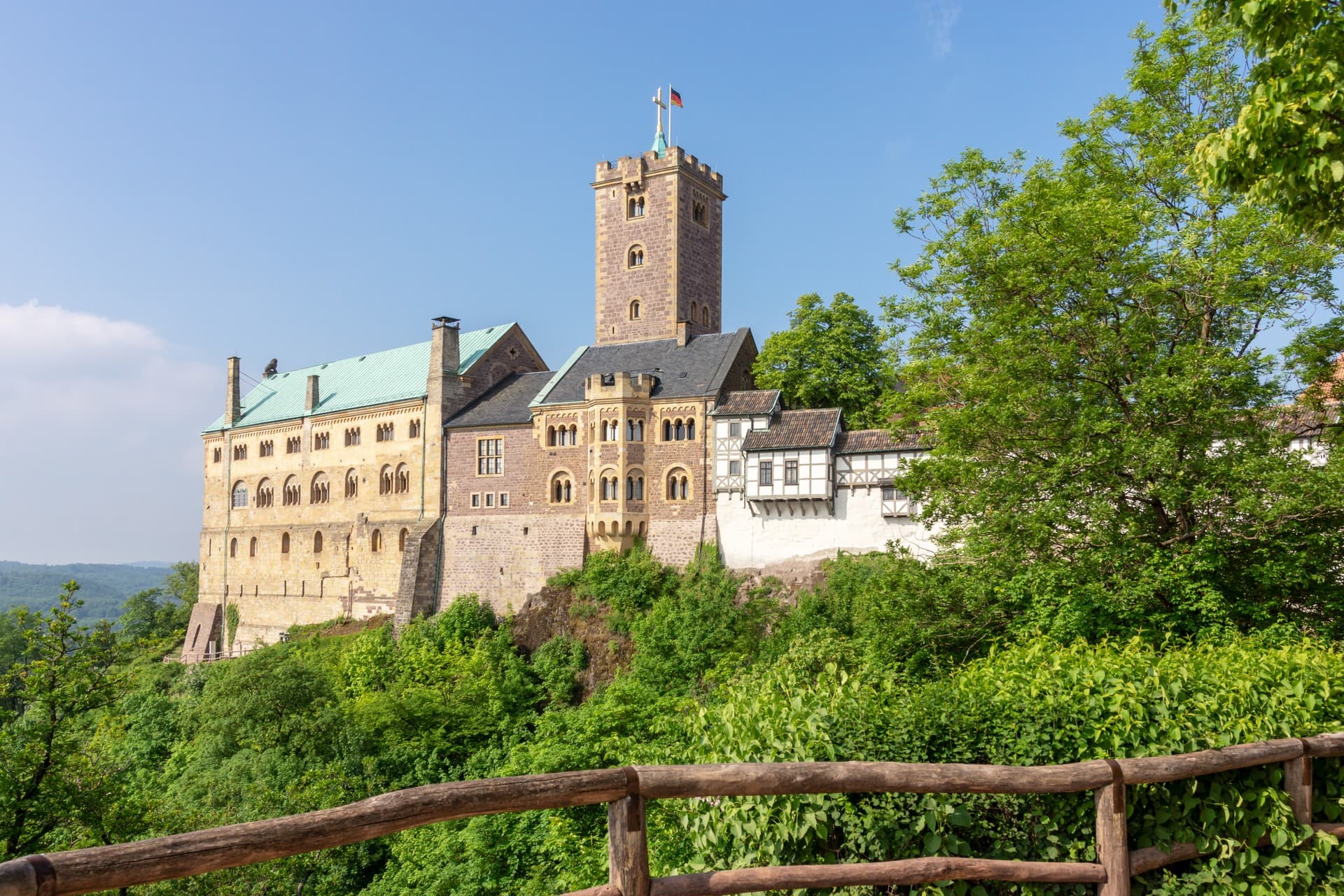
In the late afternoon of May 4, 1521, a small party left Worms under imperial safe-conduct. Martin Luther (three weeks past his refusal to recant before the Emperor Charles V) was riding home toward Wittenberg with Nikolaus von Amsdorf and the Augustinian Johann Petzensteiner. Their road climbed into Thuringia. As dusk settled over the Glasbachgrund ravine near the old castle of Altenstein, masked horsemen broke from the trees. There were shouts, drawn crossbows, a brief and theatrical struggle. Luther was pulled from the wagon and onto a horse. They disappeared into the forest.
That abduction had been arranged. Hans von Berlepsch, captain of the Wartburg, and Burkhard Hund von Wenkheim, lord of Altenstein, were acting on the orders of Elector Frederick the Wise of Saxony, who had taken care not to be told their destination, the better to plead ignorance if asked. After hours of circuitous riding through the forest, Luther reached the Wartburg above Eisenach near eleven o’clock that same night. He was given a small set of rooms in the south block of the castle and a new identity: a visiting Saxon nobleman called Junker Jörg, with beard and tonsure grown out, a sword on his hip, and no theology to confess.
He would remain on the rock for ten months. In that time, nearly everything that we now call the Reformation would receive its language. The long entanglement of the Reformation and the castle, the subject of what follows, would begin here.
The Junker Jörg Year
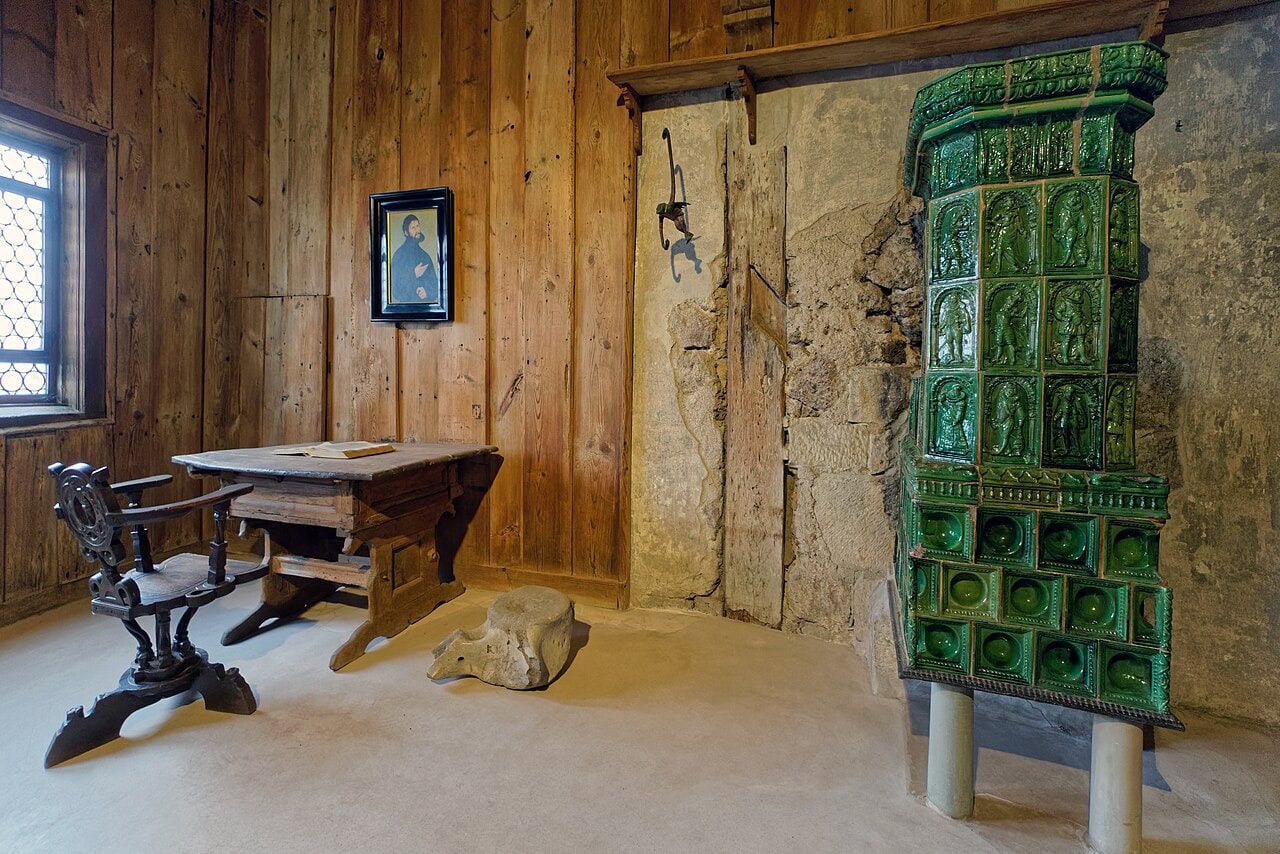
The Wartburg in 1521 was not a comfortable refuge. Luther’s letters describe brutal headaches, prolonged constipation, and the bouts of acute spiritual terror he called Anfechtungen: episodes in which he experienced the Devil as an almost physical adversary. He hunted partridges and disliked it. He grew a beard. He wrote constantly.
The first surviving letter from his exile, dated about May 8, 1521, is to Philip Melanchthon; the first to Spalatin, the Elector’s secretary and Luther’s most patient correspondent, is dated May 14. By the end of the month he had begun a torrent of writing that would, by the time he left the castle the following March, run to roughly thirty published works: a treatise On Monastic Vows, a sustained polemic against Jerome Emser, an exposition of the Magnificat begun before Worms and finished on the rock, and a vast pastoral correspondence aimed at the unstable congregation he had left in Wittenberg.
Decisive work began later. In December 1521, after a clandestine three-day visit to Wittenberg to assess the disturbances Andreas Karlstadt and the so-called Zwickau Prophets were stirring up, Luther returned to the Wartburg and started a new project. By early March 1522, after roughly eleven weeks of concentrated work, he had drafted a complete German New Testament.
He worked from Erasmus’s second edition, the 1519 Novum Testamentum printed at Basel by Johann Froben, with Greek and a freshly revised Latin in parallel columns. Erasmian Greek was the most reliable text then available. The Vulgate, the medieval Latin Bible upon which the Western Church had built its theology for a thousand years, became, for Luther, a secondary point of reference rather than the master text. This was itself a Reformation event before a word had been translated.
There is, almost inevitably, a legend attached. Sometime during his stay, the story goes, Luther threw an inkwell at the Devil. Visitors to the Lutherstube today are shown the spot on the wall where the stain is supposed to have remained. That legend, however, does not appear in any 1521–22 source. Its first printed form is from 1591, in the lawyer Georgius Godelmannus, where it is in fact the Devil who throws ink at Luther; the inversion to Luther throwing at the Devil appears around 1650, and Wartburg tour guides were pointing out the spot by 1713. That “stain” itself is a depression chipped from the plaster by souvenir-hunters across three centuries and repeatedly re-applied. Wartburg-Stiftung no longer treats it as authentic. What did happen at that desk was more remarkable than what the legend claims.
On March 1, 1522, against the Elector’s express wishes, Luther left the Wartburg and rode back to Wittenberg. Frederick learned of the departure only afterward; Luther wrote to him from Borna on March 5, taking sole responsibility. Exile was over. What he carried back was not.
The Sound of a German Bible
The September Testament (Das Newe Testament Deutzsch) appeared in Wittenberg in September 1522. It was printed by Melchior Lotter the Younger, published by Lucas Cranach the Elder and the goldsmith Christian Döring, and illustrated by woodcuts from Cranach’s workshop. A first edition ran to about three thousand copies and sold out within weeks; a revised printing followed in December the same year. By the time Luther’s complete Bible (Old and New Testaments together) was published in two folio volumes by Hans Lufft at Wittenberg in 1534, the German New Testament had already been through more than a dozen reprints.
The book’s significance is easy to overstate and easier to mis-state. Luther was not the first to translate the Bible into German. There were at least eighteen full or partial German Bibles in print before his, and he was not the first to put scripture in the hands of laity. What was new was the kind of German he wrote.
His reasoning, set out eight years later in the Sendbrief vom Dolmetschen, was direct. The translator must not ask the Latin letters how one should speak German, but rather ask the mother at home, the children on the street, and the common man at the market, and then look them on the mouth as to how they speak: und denselben auf das Maul sehen, wie sie reden, vnd darnach dolmetschen. The phrase later passed into proverb as dem Volk aufs Maul schauen, but Luther’s own verb was sehen (to look, not to gawk), and his three groups were specific. He named not an abstract “the people” but mothers, children, and marketplace traders.
Behind the principle lay a strategic choice. Luther wrote in the chancery German of Saxony (the ostmitteldeutsche Kanzleisprache used by the Wettin administration), rather than in the regional dialects of Bavaria, Swabia, or the Rhineland. That choice gave the translation a register that read as elevated everywhere but as native nowhere, which was an advantage. Combined with the rapid expansion of vernacular printing across the imperial cities, it gave Luther’s text a reach the Vulgate had never possessed in any vernacular.
Political consequence followed. The Edict of Worms (which bears the antedated date of May 8, 1521 but was signed by Charles V and publicly promulgated on May 26, after Luther’s safe-conduct had expired and most princes had left Worms) declared Luther an outlaw and forbade his writings. This edict had been drafted by the papal nuncio Girolamo Aleandro, and it had legal force. What it could not do was reach the printer’s apprentice in Augsburg or the burgher’s wife in Erfurt or the village pastor in the Saxon countryside who, by 1525, had a German Bible on his table. An Edict could ban a book. It had already escaped.
By the time Luther’s complete Bible was finished in 1534, the Reformation as a movement of texts had become irreversible. The translation done at the Wartburg, in eleven weeks, was the single most consequential book of the century.
A Castle Becomes a Symbol
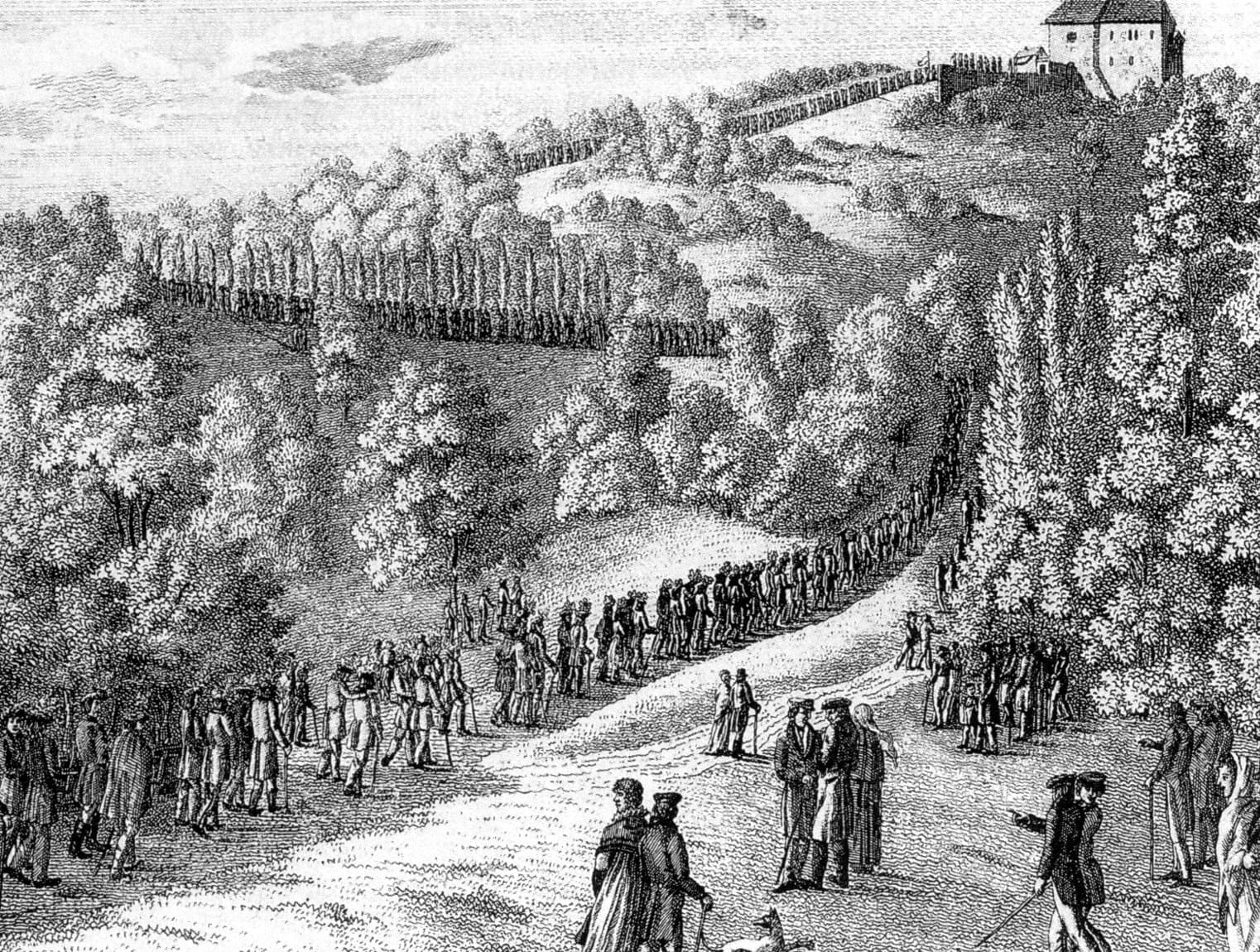
The Wartburg’s afterlife as a symbol is not a Reformation event. Through the rest of the sixteenth century, and most of the seventeenth and eighteenth, the castle was an aging Thuringian residence, increasingly dilapidated, with a complicated set of memories attached to it but no particular ideological role.
Real activation came in 1817. On October 18 that year, students from the new Burschenschaften (proto-nationalist German student fraternities) gathered at the Wartburg for the Wartburgfest, ostensibly to mark the three hundredth anniversary of the 95 Theses and the fourth of the Battle of Leipzig. Approximately five hundred students attended. There were speeches and hymns, and that evening, on a hill near the castle, some of the students threw onto a bonfire bundles of waste paper labeled with the titles of books by authors they considered reactionary, together with a soldier’s queue, a piece of military uniform and a corporal’s cane as symbols of the old order. That event was unmistakably both Protestant and German-national.
Architectural restoration followed. From the 1830s on, but most decisively from 1853 to the 1890s, Grand Duke Carl Alexander of Saxe-Weimar-Eisenach commissioned the architect Hugo von Ritgen to restore, and substantially reinvent, the castle in a Romantic-medievalist mode. Moritz von Schwind painted the great frescoes in the Hall of Minstrels and the Elisabeth Cycle in the mid-1850s. The Lutherstube was preserved and presented as the centerpiece of the Reformation memory. Wartburg was rebuilt to look like its own legend.
UNESCO inscription followed in 1999, with the Reformation associations explicitly cited. The castle that became a World Heritage site is essentially a nineteenth-century work of national imagination on a genuine medieval-and-Reformation core. This pattern (the Reformation site rebuilt by nineteenth-century nationalism into the form by which it is now known) recurs across Germany; the Romantic Revival of German castles traces the larger phenomenon. Wartburg is its purest case.
The Schmalkaldic Map
The Reformation’s first decade had produced a movement; its second produced a confessional bloc. In June 1530, the Diet of Augsburg, summoned by Charles V, was the inflection point. On June 25, the Augsburg Confession (drafted principally by Melanchthon, with Luther’s input from the Veste Coburg where he sheltered under imperial ban) was read in German before the Emperor. The text gave Lutheran territories a doctrinal flag. The political organization followed less than a year later: on February 27, 1531, at Schmalkalden in southern Thuringia, the Schmalkaldic League was formally constituted as a defensive alliance, led by Elector John Frederick of Saxony and Landgrave Philip of Hesse.
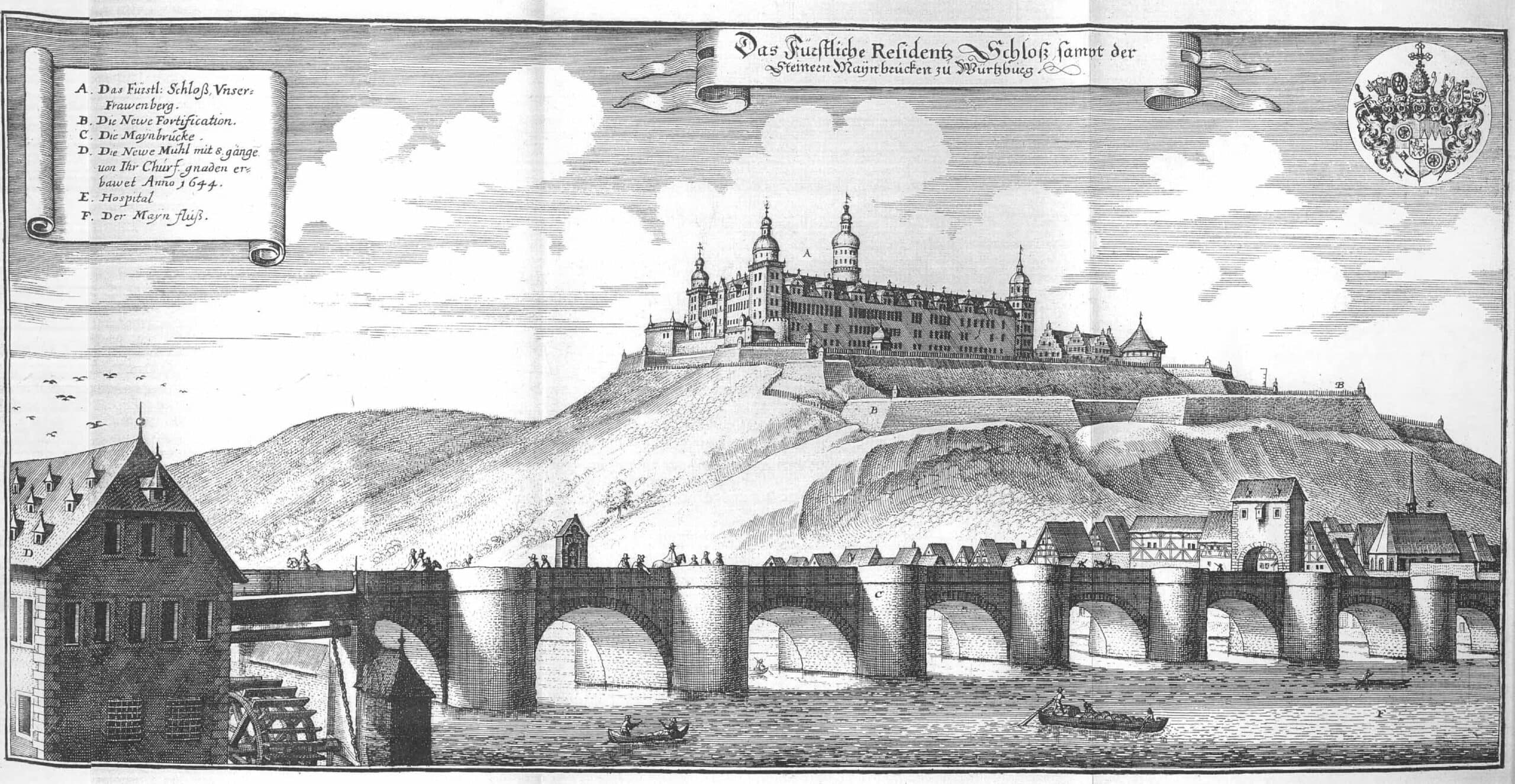
What the League required, almost immediately, was hardware. Italian-style bastion fortification (the trace italienne) had begun arriving in central Europe in the 1520s, brought north by military engineers fleeing the Italian Wars. Bastions, designed to absorb and redirect cannon fire and to enable flanking gunnery, replaced the high curtain walls of medieval defense. Through the 1530s and 1540s, fortifications across the Empire, Protestant and Catholic alike, adopted the new geometry. The Counter-Reformation Prince-Bishops of Würzburg expanded the Marienberg Fortress on the hill above the city into one of the most fully developed early-modern bastioned fortresses in Franconia. In Nuremberg, the city council that had adopted the Reformation in 1525 maintained its Imperial Castle as a layered Catholic-Protestant artifact, the city’s confessional position written into its defensive perimeter.
How far this rebuilding was confessional and how far it was simply engineering is a real historiographical question, and one this article should be careful about. Heinz Schilling’s confessionalization thesis, and the broader school of which he was the most influential exponent, argued that the architectural choices of Protestant and Catholic princes were genuinely ideological: that confessional identity shaped the building program. Post-revisionist work has insisted that bastion engineering responded primarily to gunpowder geometry, not to ideology; that Protestant and Catholic fortifications of the same decades are, in their formal logic, essentially indistinguishable; and that the confessional reading of architectural form is partly retrojected by later historians. The truth is mixed. Confessional alignment shaped where and when fortifications were built: by whom, against whom, with whose money. But the geometry of a sixteenth-century bastion is a function of cannon, not of catechism.
On April 24, 1547, the military reckoning of the Schmalkaldic alliance came at Mühlberg on the Elbe. Charles V’s forces, with the Duke of Alba commanding the imperial cavalry, crossed the river at dawn and routed the Saxon-Hessian army. Elector John Frederick was wounded, captured, and stripped of his electoral dignity. The League was broken. What replaced it, eight years later, was an entirely new kind of settlement.
The Thirty Years’ War in the Castle Landscape
Peace of Augsburg of September 25, 1555 worked for two generations. It established that the ruler of each territory determined the confession of his subjects, the principle later summarized in the Latin formula cuius regio, eius religio, which is not in the 1555 text itself and was coined around 1612 by the Greifswald jurist Joachim Stephani in his Institutiones Juris Canonici. The settlement left Calvinists outside the framework, allowed Catholic ecclesiastical territories to remain Catholic, and recognized a measure of toleration for individual Protestants in Catholic territories. It was a compromise that held, until it didn’t.
Two generations later, the system collapsed in Bohemia. On May 23, 1618, three Catholic regents of the predominantly Protestant Bohemian estates (Jaroslav Bořita of Martinice, Vilém Slavata of Chlum, and the secretary Philip Fabricius) were thrown from a window of the Bohemian Chancellery at Prague Castle in what came to be called the Defenestration of Prague. All three survived the fall. Bohemian Revolt that followed ignited the Thirty Years’ War. The Bohemian Protestant army was crushed at the Battle of White Mountain outside Prague on November 8, 1620, and the war then escalated outward through Danish, Swedish, and French phases over the next twenty-eight years.
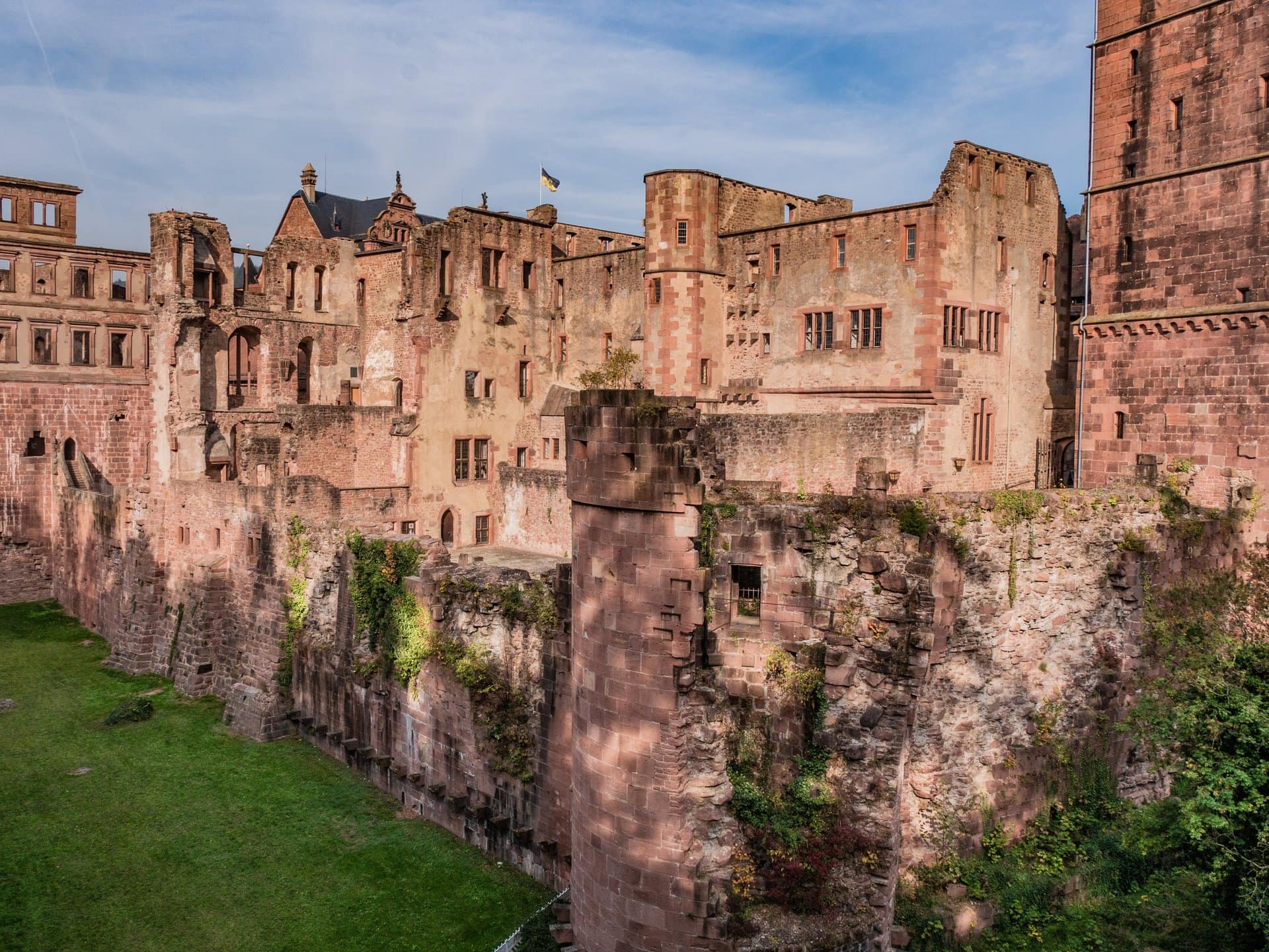
What the war did to the German castle landscape is the architectural record of the seventeenth century. Heidelberg fell to Johann Tserclaes, Count of Tilly, on September 19, 1622, in service to Maximilian I of Bavaria. Maximilian offered the great library of the Palatine Electors, the Bibliotheca Palatina, to Pope Gregory XV; the Vatican librarian Leo Allatius arrived in Heidelberg by December 1622 and oversaw the packing. In February 1623, fifty wagons left Heidelberg; the books were repacked at Munich into 196 mule-crates and crossed the Alps; the surviving 3,700 manuscripts and 13,000 printed volumes reached the Vatican on August 9, 1623, by which time Gregory XV had died. The castle itself was damaged but not yet ruined. The great destruction of Heidelberg by Louis XIV’s troops in 1689 and definitively in 1693, during the Nine Years’ War, lay seventy years in the future.
At Würzburg, the Marienberg fell to Gustavus Adolphus and the Swedish army on October 8, 1631, three weeks after Breitenfeld; the Swedish occupation of the city lasted until 1635, and the bishop’s library was shipped to Uppsala. To the north, in Mecklenburg, the dukes of Schwerin survived the war by repeatedly switching sides; the duchy’s Lutheran identity, formally established in 1549, held through the worst phases of the war by virtue of being too marginal to crush. At Mespelbrunn in the Spessart and Eltz on the Mosel (both moated or rock-perched, both protected by terrain, both kept out of the great armies’ lines of march), the castle stood largely undamaged. Geography, in the seventeenth century, did much of what defensive engineering had done in the fifteenth.
Westphalia and After
By the late 1640s, the war was being fought less for confessional victory than for political settlement. On October 24, 1648, the two treaties of the Peace of Westphalia ended it. The Treaty of Münster bound the Holy Roman Empire to France; the Treaty of Osnabrück bound the Empire to Sweden and to the Protestant Imperial estates. A separate Spanish-Dutch peace, also signed at Münster but earlier the same year, ended the Eighty Years’ War on a different legal track; Spain itself was not party to the October Westphalia settlement, and would continue at war with France until 1659. Calvinism was at last admitted as a recognized confession alongside Catholicism and Lutheranism. The settlement’s confessional reference year was set at 1624: ownership of churches, monasteries, and ecclesiastical revenues was frozen as of that date.
The architectural consequence followed less from the legal text than from exhaustion. The Empire’s princes, Catholic and Protestant alike, had spent the better part of three decades repairing or losing or rebuilding their seats. What rose in the second half of the seventeenth century, and definitively in the eighteenth, looked different. The Counter-Reformation Prince-Bishops of Würzburg eventually abandoned the Marienberg as their active residence and commissioned, from 1719, the Baroque Würzburg Residence as a new statement in stone: a statement no longer about confession but about dynastic and absolutist sovereignty. Heidelberg’s electors, after the French destructions, never seriously rebuilt their castle as a residence; they built a new town palace at Mannheim instead. Schwerin’s later Mecklenburg dukes turned a Renaissance core into, eventually, a nineteenth-century historicist palace. Post-1648 residences look less and less like fortifications and more and more like Versailles. Architecture’s argument had migrated.
Anchors of the Confessional Century
Wartburg — The Ideological Template
The site where the Reformation became material, the Wartburg is the article’s central case. Luther’s ten months on the rock in 1521–22 produced both the German New Testament that gave the movement a vernacular scripture and the constellation of polemics, treatises, and pastoral correspondence that defined its early shape. The castle’s afterlife (the 1817 Wartburgfest, the Carl Alexander–Ritgen restoration from the 1850s onward, the Moritz von Schwind frescoes, the 1999 UNESCO inscription) is itself an argument about what the Reformation means and how it should be remembered. Wartburg as visitors see it now is a nineteenth-century work of national imagination on a genuine Reformation foundation. No other German site so completely fuses event, place, and the symbolic appropriation of both.
Marienberg Fortress — The Catholic Mirror
Marienberg Fortress, the bishop’s stronghold on the hill above Würzburg, is the article’s principal Counter-Reformation site. The Prince-Bishops of Würzburg expanded the fortress through the sixteenth century into one of the most fully developed Italian-style bastioned strongholds in Franconia, holding it against the peasants’ siege of 1525 (when roughly fifteen thousand rebels under Florian Geyer were repelled) before losing it to Gustavus Adolphus and the Swedes on October 8, 1631. Catholic Würzburg’s investment in bastioned fortification across the confessional century reads as the spatial argument that confessional identity required architectural form, even where the bastion geometry itself was Italian and ideologically agnostic.
Heidelberg — The Calvinist Court
Palatine residence at Heidelberg is the article’s anchor for the Reformed (Calvinist) confession. Elector Frederick III “the Pious” commissioned the Heidelberg Catechism of 1563 (the foundational text of Reformed Protestantism in the Empire), and the court library, the Bibliotheca Palatina, became Europe’s leading center of Protestant humanist scholarship. The castle fell to Tilly in September 1622, the library was sent to Rome the following year, and the residence was definitively ruined by Louis XIV’s troops in 1689 and 1693. Heidelberg today is the Reformation’s most photogenic ruin: a place where you can read confessional history directly in the architectural record.
Nuremberg Imperial Castle — The Lutheran Imperial City
Imperial Castle at Nuremberg anchors the article’s treatment of the free imperial city as a Reformation actor. In March 1525, after six days of public disputations in the city’s Great Hall (the Nürnberger Religionsgespräch), Nuremberg’s city council formally adopted the Reformation, becoming the first free imperial city to do so; the Catholic Mass was abolished on April 21 that year. The Imperial Castle remained a Habsburg institution within a now-Lutheran city, a layered confessional artifact that captures something essential about Reformation-era Germany. Confession was not yet what one was, but what one’s city or one’s prince had become.
Schwerin — The Lutheran Residence Survives
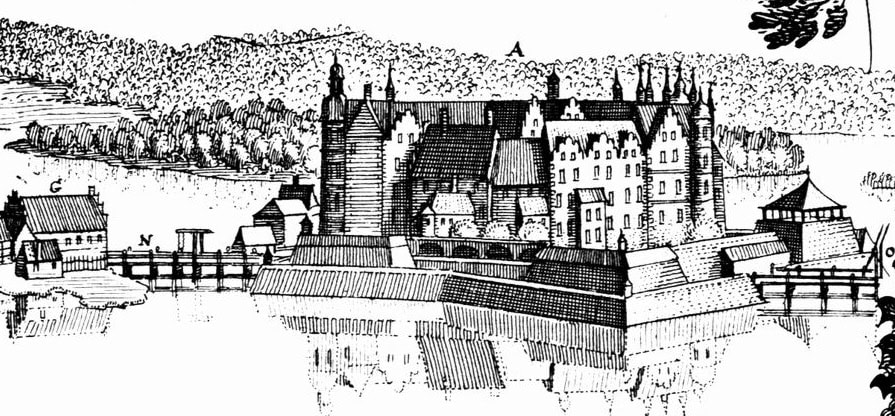
Ducal residence at Schwerin closes the article’s case as the Lutheran residence that survives the wars largely intact. Mecklenburg formally adopted the Reformation in 1549 at a Landtag near Sternberg under Duke Johann Albrecht I; the duke then commissioned the Neues Langes Haus of 1553–55, decorated with the red-terracotta plates of Statius von Düren of Lübeck in what became known as the Johann-Albrecht-Stil. The Italian-influenced phase under Johann Baptista Parr from 1560 added the Schlosskirche, the first Protestant church building in Mecklenburg. Schwerin as visitors see it now is overwhelmingly the nineteenth-century reconstruction (1845–57) by Demmler, Stüler, Semper, and Zwirner, modeled on Chambord, but the Renaissance core remains the spine.
Conclusion
Between 1521 and 1648, the German castle became something it had not been before. It became confessional. Princes built or rebuilt in the knowledge that their decisions would be read as confessional choices; cities fortified to defend not only their walls but their catechisms; bishops armored their hills against the Reformation that lapped at the foot of the rock. By the time the Westphalian treaties were signed, that vocabulary was already exhausted. The Counter-Reformation Prince-Bishops would soon abandon the Marienberg for a Baroque palace whose argument was no longer confessional but absolutist. Heidelberg’s ruins would stand as the war’s monument, never quite rebuilt. Schwerin would survive, and then be re-imagined two centuries later as a piece of historicist theater.
How far the architectural record of those one hundred and twenty-seven years was confessional in any strong sense (how far the bastions and residences carry ideological meaning rather than the imprint of gunpowder geometry) remains contested. The strongest argument the surviving fabric makes is the most modest one: that the people who built and rebuilt these places lived inside the confessional century even when their stonemasons did not. Just as the surviving Rhine castle landscape preserves the political moment of the medieval Interregnum, the central German castle landscape preserves the confessional century. The Wartburg that the visitor sees today, with its von Schwind frescoes and its Lutherstube and its UNESCO plaque, is itself a nineteenth-century argument about what 1521 meant. The Reformation’s architectural century closed in 1648. Its historiographical century continues.
The military side of that confessional struggle, the sieges and slightings that decided which castles survived, is told in The Castle as Refuge: Sieges That Defined Germany.
Common Questions
Where did Luther hide after the Diet of Worms?
At the Wartburg above Eisenach. Riding home from Worms in May 1521, he was spirited away to the castle, where, disguised as the knight Junker Jorg, he translated the New Testament into German.
What was the Junker Jorg year?
It is the name given to the roughly ten months across 1521 and 1522 that Luther spent in hiding at the Wartburg under that alias, the period in which he turned the New Testament into German prose.
How does the Reformation connect to castles?
Castles became both the shelters and the symbols of the confessional divide, from the Wartburg’s Bible to the map of the Schmalkaldic League and the fortresses fought over in the Thirty Years’ War.
Principal Sources
- Brecht, Martin. Martin Luther: Shaping and Defining the Reformation, 1521–1532. Translated by James L. Schaaf. Minneapolis: Fortress Press, 1990.
- MacCulloch, Diarmaid. Reformation: Europe’s House Divided, 1490–1700. London: Allen Lane / Penguin, 2003.
- Roper, Lyndal. Martin Luther: Renegade and Prophet. London: The Bodley Head, 2016.
- Schilling, Heinz. Martin Luther: Rebel in an Age of Upheaval. Translated by Rona Johnston. Oxford: Oxford University Press, 2017.
- Wilson, Peter H. The Thirty Years War: Europe’s Tragedy. Cambridge, MA: Belknap Press of Harvard University Press, 2009.
- Institutional reference: the Wartburg-Stiftung Eisenach, public-law foundation managing the Wartburg as a UNESCO World Heritage site, at wartburg.de.
Image credits. Featured image: the Wartburg above Eisenach, via Adobe Stock (licensed for site use). In-article images are attributed in their figcaptions. All Wikimedia Commons images used under their respective Creative Commons licenses, with attribution as shown. Freely licensed images are resized to fit; otherwise unaltered.