
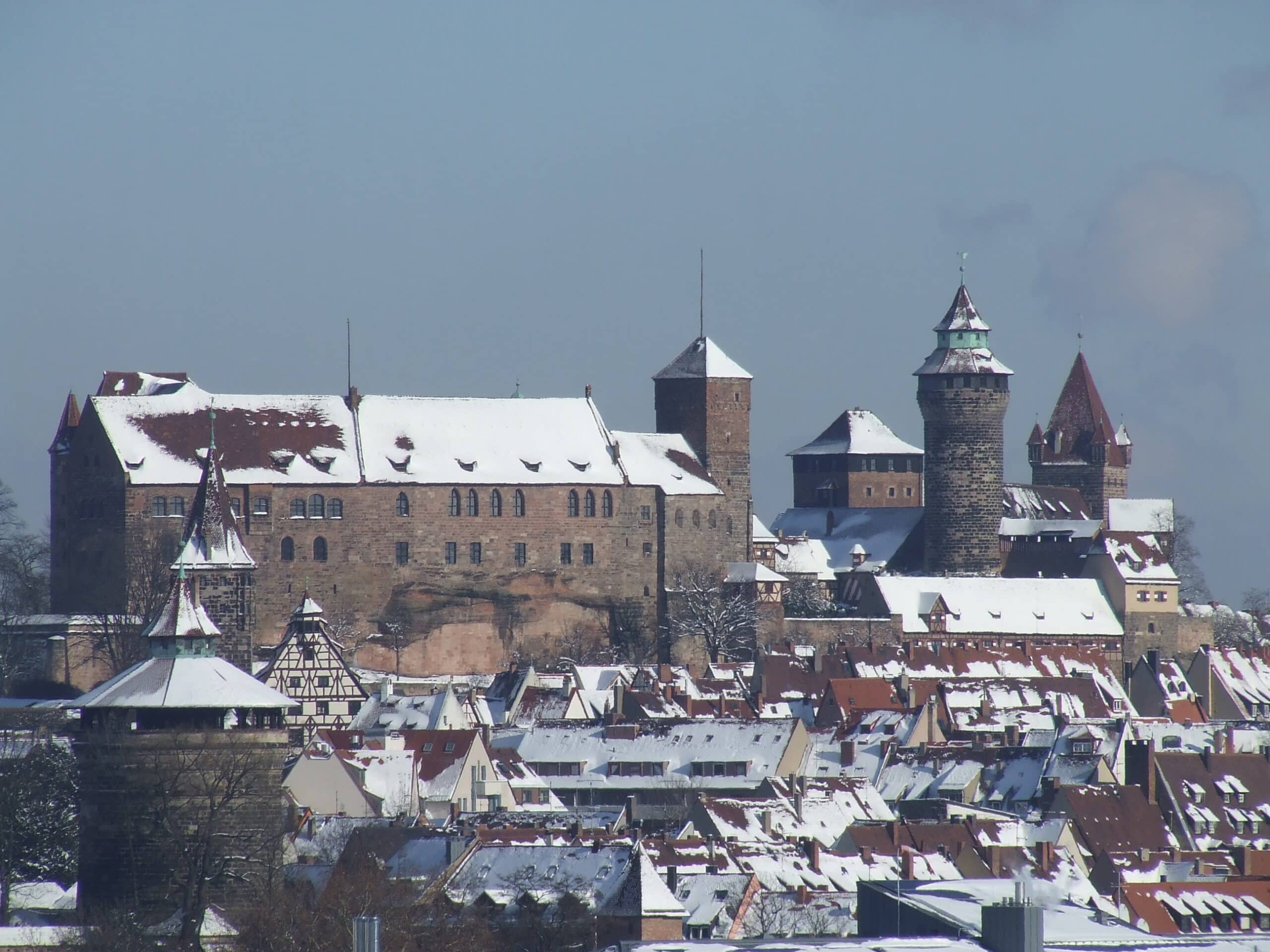
Nuremberg Castle
For nearly four centuries (from 1424 to 1796), the symbols by which Holy Roman Emperors claimed their legitimacy lived in Nuremberg. The imperial crown, the orb, the sword, the so-called Holy Lance: kept in a wall-cabinet at the Heilig-Geist-Spital chapel down in the city, under a 1423 charter of Sigismund of Luxembourg that left them with the city “irrevocably, forever.” The Kaiserburg, on its sandstone ridge above the Old Town, was where the emperor came to inspect them. It was where he stayed when he convened a Reichstag. It was where, on the upper floor of the Doppelkapelle, his Habsburg house-treasure later sat under the same vaults that had once received Hohenstaufen masses. Nuremberg’s castle did not hold the regalia. It held the emperor.
Three castles rise above the Sebald half of Nuremberg’s Old Town. The Burggrafenburg, the eastern precinct, was held by burgraves of the Hohenzollern family from 1191 to 1427, the same Hohenzollerns who would become electors of Brandenburg, kings in Prussia, and emperors of Germany. To the west, the Kaiserburg was the emperor’s residence: Palas, Doppelkapelle, the round Sinwellturm. Between them, the Stadtburg belonged to the city: granaries, bastions, the looming Luginsland tower of 1377. Each belonged to a different lord, and all three shared a single sandstone outcrop. Most of what visitors see today was rebuilt after January 1945.
Quick Facts
| Country | Germany |
| Region / State | Bavaria (Mittelfranken / Middle Franconia) |
| Nearest Town | Nuremberg |
| Construction Period | 11th–13th c. core (Hohenstaufen Palas + Doppelkapelle 1190–1197); reconstructed 1946–1981 |
| Founder | Hohenstaufen emperors Konrad III and Heinrich VI; Hohenzollern burgraves from 1191/92; Reichsstadt Nürnberg from 1427 |
| Architectural Style | Romanesque core (Doppelkapelle, Sinwellturm, Heidenturm); late-Gothic Kaiserstallung (1494–95); 16th-c. Italianate Burgbasteien (1538–45); postwar reconstruction |
| Building Type | Burg — composite Hohenstaufen Reichsburg with Burggrafenburg, Kaiserburg, and Stadtburg precincts |
| Current Condition | Reconstructed (principal phase 1946–1981; subsequent campaigns through the 2010s); fully restored |
| Open to Visitors | Yes — daily, with seasonal hours; closed January 1, Shrove Tuesday, December 24, 25, and 31 |
| UNESCO Status | Not inscribed |
| Heritage designation | Baudenkmäler, Bayerische Denkmalliste (Bayerisches Landesamt für Denkmalpflege): Kaiserburg D-5-64-000-305; former Burggrafenburg D-5-64-000-309; Luginsland D-5-64-000-306; Kaiserstallung D-5-64-000-307 |
| Official Website | kaiserburg-nuernberg.de |
Origins on the sandstone outcrop
The earliest documentary trace of Nuorenberc (the rocky place) comes from a charter Heinrich III issued to a noblewoman named Sigena on July 16, 1050. Archaeologists believe a tenth-century palisade had already stood on the Burgsandstein outcrop, perhaps under the Markgrafen von Schweinfurt. By 1105 the place was strong enough to hold out for two months against the rebel Heinrich V while its defenders stayed loyal to his father, Heinrich IV, who, camped near Würzburg and unable to relieve them, finally ordered them to surrender; in 1130 Lothar III was besieging it. Those two sieges, and the attack on the burgrave’s castle in 1420, are set beside other cases in our account of how medieval castles fell.
It was Konrad III, the first Hohenstaufen king, who built up the castle that mattered. Between his coronation in 1138 and his death in 1152 he raised the early Palas, an irregular residential tower, and the predecessor of the chapel that would become the Doppelkapelle. For decades, scholarship attributed the major Hohenstaufen building campaign to Friedrich Barbarossa, who visited Nuremberg twelve times and held a famous reception for Byzantine envoys here in 1156. Current research reverses that attribution. No new construction can be proved under Barbarossa. His son was the decisive Hohenstaufen builder.
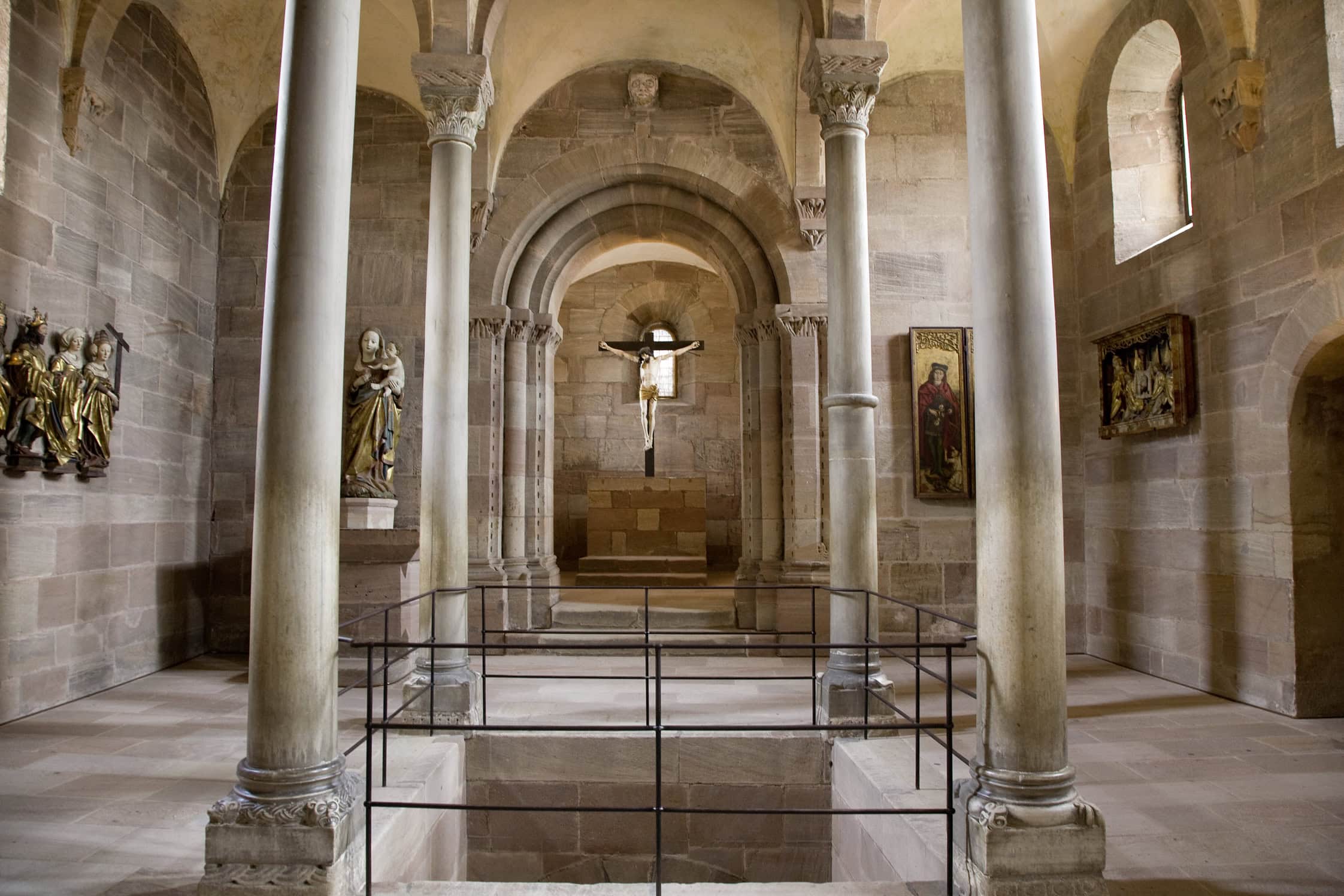
Between 1190 and 1197, in the seven years before he died at Messina, Heinrich VI raised the surviving two-story Palas and the Doppelkapelle, the imperial chapel that remains the most architecturally important structure on the rock. Its chapel works as a vertical hierarchy of three spaces. A lower chapel for the Hofstaat opens only from outside. The upper Kaiserkapelle, with four slender limestone columns rising to capitals carved in low Romanesque foliage, has a square central opening cut through its floor so the lower congregation could see and hear the Mass. Above that, a Herrscherempore communicated directly with the emperor’s apartments. By 1216, when Friedrich II handed the chapel to the Teutonic Order, the structure was complete enough to be described in legal documents. Comparable two-story palace chapels survive at Eger and Goslar; the Eger chapel is the closest typological parallel.
Eight decades later, on October 25, 1273, the day after his coronation at Aachen, Rudolf von Habsburg enfeoffed Burgrave Friedrich III with the burgraviate and its rights. Over the eighteen years of his reign he spent 269 days in Nuremberg, by the Historisches Lexikon Bayerns’ count. He raised the round Sinwellturm in the outer courtyard and added a brick upper stage to the older square Heidenturm. Rudolf was the first emperor in two centuries to treat Nuremberg as a working capital; he would not be the last.
Hohenzollern burgraves and the city’s rise (1191–1427)
The Hohenzollern story begins, in a precise sense, on this rock. In 1191 or 1192, Heinrich VI enfeoffed a Swabian count named Friedrich III von Zollern with the Burggrafschaft, the right to administer the eastern half of the castle as an imperial appointee. The first charter signed Fridricus prefectus de Nuremberg dates to 1192. From that act runs an unbroken line: Brandenburg by 1415, secular Prussia by 1525, Kingdom in Prussia by 1701, the German Empire from 1871. What ended in Berlin in 1918 began in a granted office on this outcrop. Hohenzollern Castle in the Swabian hills was the family’s mythologized ancestral seat, but the family’s first significant holding (and its first imperial title) was the burgraviate of Nuremberg.
For two centuries, the burgraves and the emperor lived on the same hill in different precincts. At the eastern end stood the Burggrafenburg: the five-cornered Fünfeckturm (around 1150 in the Historisches Lexikon Bayerns, eleventh century in its core in the Bavarian monuments list), the thirteenth-century Walburgiskapelle, and the burgrave’s residence behind them. The Kaiserburg sat on the western end. Between them, the city kept growing wealthier, and from the late thirteenth century it began to take a third position. A privilege of Heinrich VII, dated at Pisa on June 11, 1313, tied castle and town together. As Karl Hegel summarized it in his 1862 edition of the city’s chronicles, the imperial castle was never to be separated from the town, and on an emperor’s death its keeper was to hand it to the burghers until a new king was elected. By 1367 the Reichsstadt had walled off direct burgrave access and built its own gate, the Vestnertor. In 1377 it added the Luginsland, a forty-seven-meter tower, square in plan, in front of the burgrave’s castle. From it, the palace administration notes, the townspeople could see into the burgrave’s castle, and it presumes that keeping watch was part of the purpose.
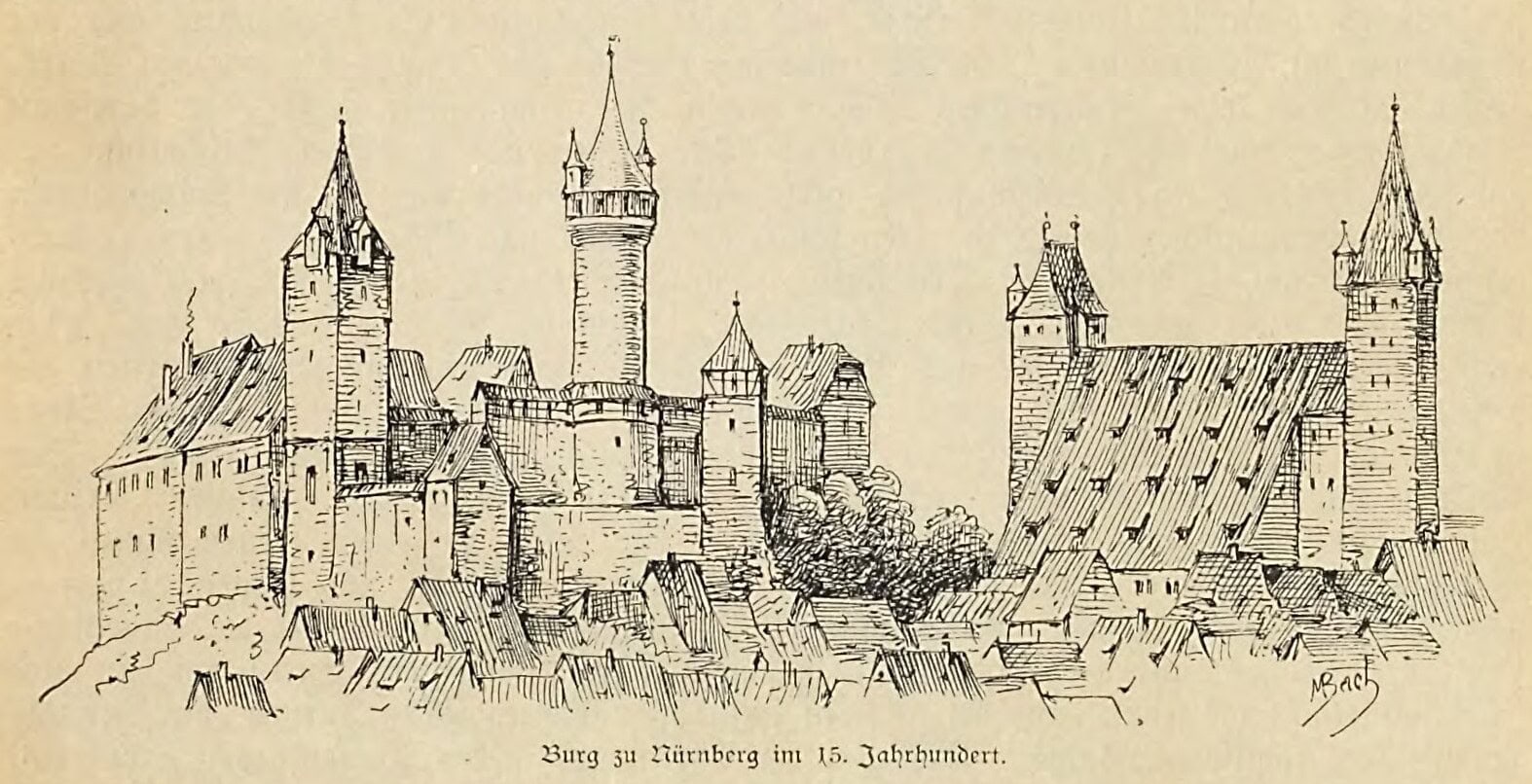
The relationship ended badly. In October 1420 a Wittelsbach commander acting in a dynastic feud burned the Burggrafenburg. In 1422 Sigismund, by then king of the Romans, gave the imperial castle into the council’s keeping. The city was to keep the royal lodging in repair for his visits, and except while the ruler was present no one but the council was to hold the castle. Five years later, in 1427, Friedrich VI of Hohenzollern (already Friedrich I, Elector of Brandenburg, since 1415) sold the city his burned castle together with most of his remaining rights there: his share of the court revenues and the tolls, forest rights, mills and several villages, for about 120,000 gold Gulden. He kept the imperial land court, the escort right and the hunting right in the imperial forest. Chapter 29 of the Golden Bull of 1356 had already confirmed what it described as a custom older than memory: a newly elected king of the Romans held his first royal court at Nuremberg, unless a lawful impediment stood in the way. After 1427 the city had the castle to match that role.
The Reichskleinodien era — 1424 and Nuremberg as imperial city (1424–1796)
On September 29, 1423, Sigismund of Luxembourg issued a charter at Ofen (Buda, now part of Budapest), committing the Reichskleinodien to the council of Nuremberg, to remain there “irrevocably, forever.” The promise carried a condition: if a rival king were raised against him, the city was to hand them back at Pilsen or Elbogen. Two council envoys, Sigmund Stromer and Jörg Pfinzing, escorted the imperial crown, the orb and sword, the Holy Lance and a long list of relics to Nuremberg. The king’s safe-conduct for Stromer was issued at Ofen on February 25, 1424, and a Nuremberg chronicle of the time says the treasure came from the royal castle of Plintenburg (Visegrád), on the Danube. It reached Nuremberg on Wednesday, March 22, 1424.
The regalia did not enter this castle. They were lodged in the Heilig-Geist-Spital chapel down in the city, under the supervision of the city council, in a wall-cabinet built into the upper sacristy. Relics (particles of the Holy Cross, the Holy Lance, and an inventory that grew over the centuries) hung in a Heiltumsschrein suspended from the choir vault. Once a year, on the second Friday after Easter, the city took them out. The procession crossed the Pegnitz, climbed to a temporary three-story wooden Heiltumsstuhl opposite the Frauenkirche on the Hauptmarkt, and showed each piece to the assembled crowd. The Heiltumsweisung ran from 1424 to about 1523, until Nuremberg’s adoption of the Reformation in 1525 ended the relic-veneration culture that sustained it.
Through that century the castle was the imperial face of the city. Friedrich III, the long-reigning Habsburg emperor, deposited his dynasty’s house-treasure in the upper Doppelkapelle in 1485, not the regalia, which never lodged on the hill, but his working valuables, under the same vaults that had once received Hohenstaufen masses. In 1494 the master mason Hans Beheim raised the Kaiserstallung, a six-story granary above stables for the emperor’s horses, its eastern façade more than two hundred meters long. Between 1538 and 1545, as gunpowder warfare made medieval curtain walls obsolete, the city built bastions on the north and west sides; for a brief moment Nuremberg led southern German fortification engineering. In 1543 the last imperial diet at Nuremberg met, and by 1663 the Reichstag had moved permanently to Regensburg.
The end came as quickly as the beginning. On July 23, 1796, with French troops under Jean-Baptiste Jourdan advancing on Franconia, Colonel Haller von Hallerstein loaded the regalia into wagons and carried them to Regensburg. Four years later, in October 1800, Franz II (already aware that his title was provisional) moved them on to the Vienna Schatzkammer. They have not returned. The charter of 1423 had left the regalia with Nuremberg forever, so long as no rival king arose; they stayed for 372 years, from 1424 to 1796.
Decline, Bavarian acquisition, and 19th-century restoration (1796–1939)
The same political settlement that ended the Holy Roman Empire ended the imperial castle. On July 12, 1806 the Rheinbundakte ceded Nuremberg to the Kingdom of Bavaria; the Empire itself dissolved less than a month later, on August 6. What Bavaria inherited was a ruin held together by neglect: the Burggrafenburg destroyed in 1420, the Reichsstadt’s once-glittering Kaiserburg disused, the Reichskleinodien gone to Vienna.
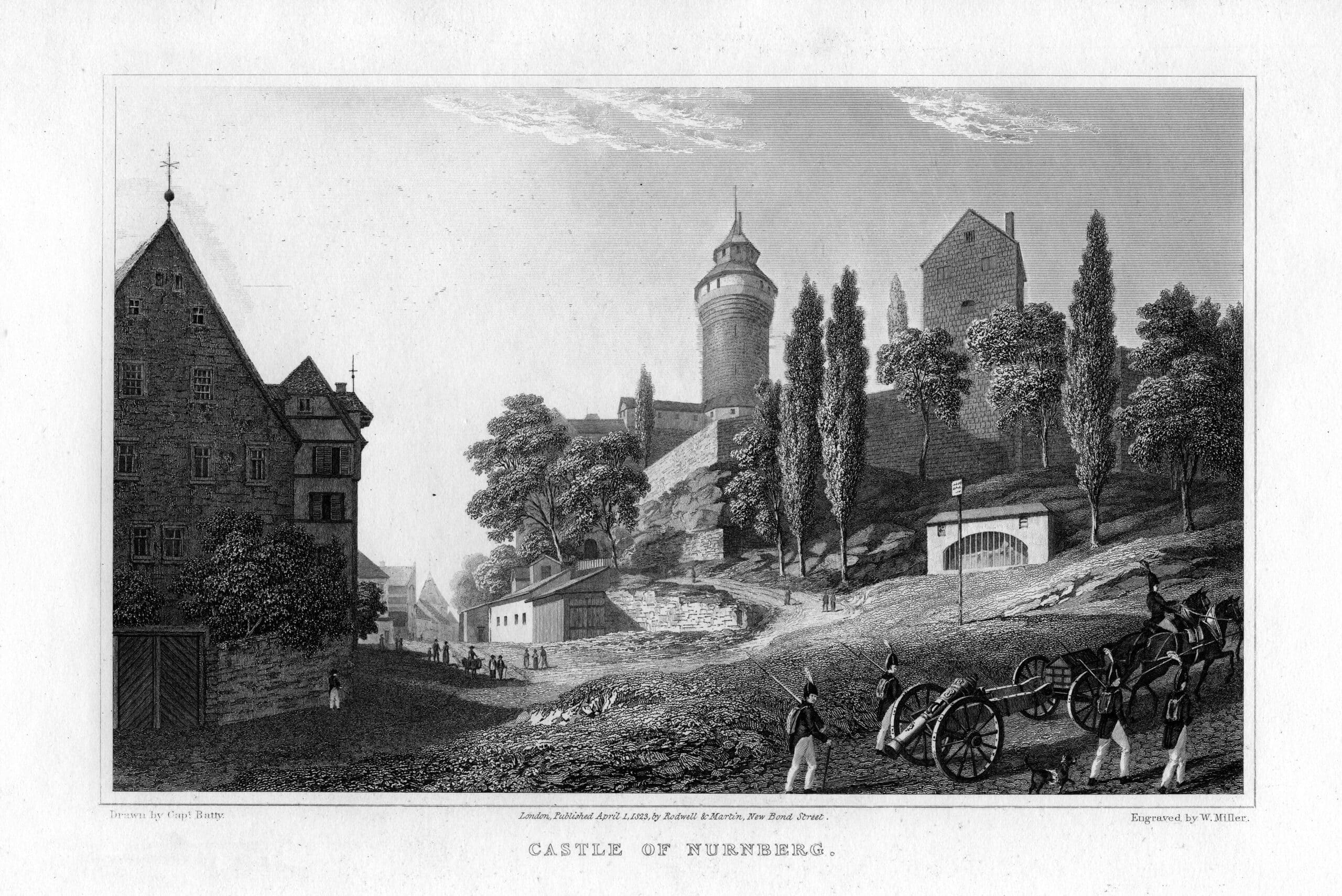
Nineteenth-century Bavaria reframed it. In 1833 Ludwig I commissioned Carl Alexander von Heideloff to restore the Palas in a neo-Gothic medievalist key, work that introduced the modern visitor to a “medieval” Nuremberg that had never existed. Heideloff’s fit-out of the upper floor was halted after a short time. Between 1851 and 1858, August von Voit took over for Maximilian II and built a royal apartment on the upper level, by the custodian’s dates; the wider restoration the king had entrusted to him was given up when Maximilian died in 1864, as the Historisches Lexikon Bayerns records. In 1856 Bavaria and the city signed a treaty consolidating ownership in the crown, a settlement that, with adjustments, still governs the castle. After the war of 1866, Ludwig II offered Wilhelm I of Prussia a share in the castle, four hundred thirty-nine years after Friedrich VI sold his burned castle and his rights to the city. In a letter quoted by his 1910 biographer Theodor Bitterauf, Ludwig wrote of the Hohenzollern and Wittelsbach banners flying together from the battlements of “this common ancestral castle”. The palace administration describes it as shared use that Ludwig had to concede after Bavaria’s defeat. Wilhelm II would later style himself Burggraf von Nürnberg. In 1891 August Essenwein restored the Doppelkapelle, reopening the central well between the floors that had been blocked. Outside the castle, Wagner’s Die Meistersinger von Nürnberg premiered in Munich in 1868. The city had become a stage on which a romanticized German past was performed.
World War II destruction and reconstruction (1944–present)
The castle’s twentieth century begins with appropriation. In 1934 a reworking of the castle began under the architect Rudolf Esterer, who stripped the nineteenth-century render and the Heideloff–Voit interiors and rebuilt key elements in what he called schöpferische Denkmalpflege, creative monument-care, a phrase that combined real conservation with the Nazi state’s instrumental view of the medieval past. The Reichskleinodien came back in 1938, after the Anschluss with Austria, and were displayed in the city as propaganda for the Reich’s medieval pedigree. From 1939 the city’s most important art was hidden in the Historischer Kunstbunker, a network of tunnels cut into the sandstone directly under the castle hill.
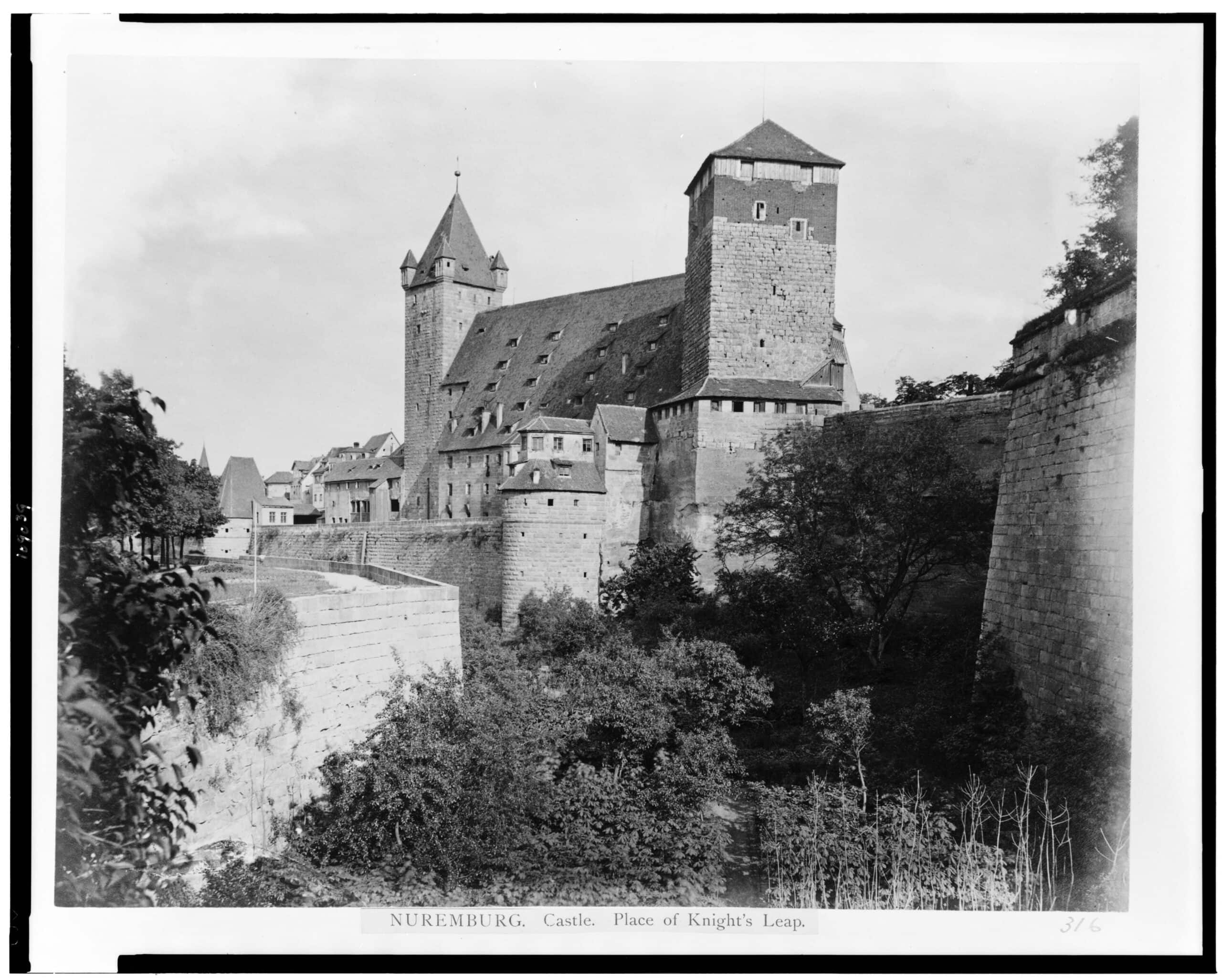
On January 2, 1945, 514 RAF Lancasters and seven Mosquitos struck Nuremberg. Bomber Command’s own campaign diary records that about 2,000 preserved medieval houses went up in flames. The castle lost roughly seventy to eighty percent of its built fabric. The Sinwellturm survived. So did the Heidenturm and the Doppelkapelle, sheltered by their massive Romanesque masonry. Palas, Kemenate, Luginsland, and southern walls: all collapsed.
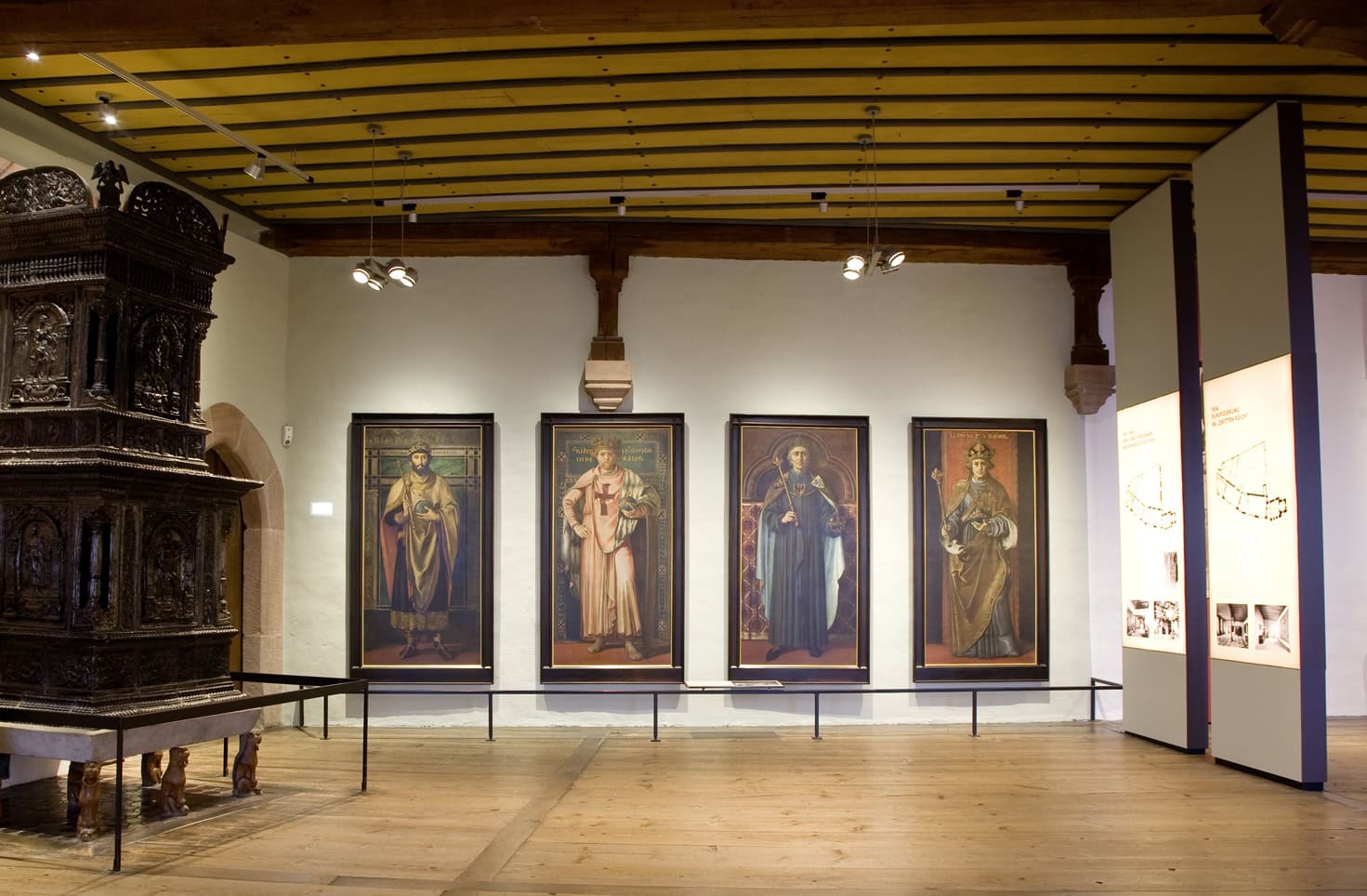
Reconstruction began in 1946 and continued in stages until 1981. Esterer remained in charge into the 1950s. The Doppelkapelle was reopened. In the Palas, the upper hall was rebuilt with two structural pillars where one had stood before the war, a deliberate departure from the original. In 2013 the BSV reopened the Palas with a permanent exhibition titled Kaiser – Reich – Stadt that reads the castle’s history through the lens this article keeps: emperor, empire, city. Nuremberg the name now also carries the Reichsparteitagsgelände on the city’s south edge and the Justizpalast where the postwar trials were held in 1945–46; neither stands at the castle, but both shape what the word means.
Visiting Nuremberg Castle
Today the Bayerische Schlösserverwaltung operates the castle as a museum. The Palas houses the permanent exhibition Kaiser – Reich – Stadt, walking visitors through the medieval imperial role, the regalia transfer, the Heiltumsweisung, and the Reformation that ended it. The Doppelkapelle is open. Sinwellturm can be climbed (a hundred thirteen steps to the platform), and the Tiefer Brunnen, the deep well cut more than fifty meters into the sandstone, is demonstrated by candle and camera approximately every half hour. The Burggarten, laid out on top of the sixteenth-century bastions, opens between April and October. The Kemenate now houses the Kaiserburg-Museum, a branch of the Germanisches Nationalmuseum with a strong collection of late-medieval armor. Entry tickets cannot be ordered online, the palace administration says; for third-party tours of Nuremberg, you can search GetYourGuide.
The castle is open daily all year, on shorter hours from October through March, and closes only on a few fixed days, Shrove Tuesday among them; the hours, the last admission and the closing days are in the admission table below. Tickets are sold only at the cash desk in the outer courtyard, which takes cash and cards (EC, Mastercard and Visa), and BSV annual passes are valid. An audio guide to the Palas exhibition comes in seven languages. Photographing the outside for private purposes is free, but flying a drone over the castle grounds is not permitted. In 2025 the Palas and Imperial Castle Museum drew approximately 190,000 visitors and the Sinwell Tower and Deep Well a further 174,000.
Admission
Admission to the Imperial Castle (BSV pricing 2026):
| Ticket | Price |
|---|---|
| Combination ticket (Palas with Doppelkapelle, Imperial Castle Museum, Sinwellturm, Tiefer Brunnen) — adult | €10.00 |
| Combination ticket — reduced | €9.00 |
| Palas with Doppelkapelle and Imperial Castle Museum — adult | €7.00 |
| Palas with Doppelkapelle and Imperial Castle Museum — reduced | €6.00 |
| Sinwellturm and Tiefer Brunnen — adult | €4.00 |
| Sinwellturm and Tiefer Brunnen — reduced | €3.00 |
| Combination Kaiserburg + Burg Cadolzburg — adult | €16.00 |
| Combination Kaiserburg + Burg Cadolzburg — reduced | €14.00 |
| Audio guide (seven languages, per person) | €2.00 |
| Children and young people under 18 | Free |
| BSV 14-day multi-castle ticket (Mehrtagesticket) | €40.00 |
| BSV annual ticket (Jahreskarte) | €55.00 |
| Hours, April to September | Daily 9:00-18:00 |
| Hours, October to March | Daily 10:00-16:00 |
| Last admission | About 60 minutes before closing |
| Closed | January 1, Shrove Tuesday, December 24, 25 and 31 |
For visitors planning a Franconian itinerary, the Kaiserburg combination ticket is paired with one for Burg Cadolzburg, the Franconian Hohenzollern seat about 22 kilometers west by road. Other Bavarian properties under the same operator (the Würzburg Residenz, Schloss Johannisburg in Aschaffenburg, and Festung Marienberg) sit within a half day’s drive. Anyone staying overnight can compare hotels in and around Nuremberg. For a night on the castle hill itself, the Kaiserstallung holds a youth hostel, and our guide to castle hotels in Germany covers the castles elsewhere in the country that take overnight guests.
Some links on this page are affiliate links, which means StoneKeep Atlas may earn a small commission, at no extra cost to you, if you book through them.
Common Questions
Can you climb the Sinwell Tower at Nuremberg Castle?
Yes. You enter the round tower, at the east end of the outer courtyard, through an annex on its north side, and a wooden staircase that the Bavarian Palace Administration dates probably to the eighteenth or nineteenth century climbs to the platform. Its viewing level is reached only by stairs. Inside, an exhibition of photographs shows the castle and the city after their destruction in the Second World War. The tower is named for its cylindrical form: in Middle High German, sinwell means approximately “extremely round.”
Can you see the Deep Well at Nuremberg Castle?
Only on a guided tour, which costs nothing extra on a ticket that includes the well; the Palas and the museum need no guide. An inscription dates the two-story wellhouse in the middle of the outer courtyard to 1563, though its half-timbered upper story was renewed in 1951. Written records mention the well only from the fourteenth century, but the operator considers it undoubtedly older, probably as old as the first castle buildings. One step leads in, and wheelchair users can follow the camera’s descent on a screen.
Is there parking at Nuremberg Castle?
Only for disabled drivers. The operator says the castle has no visitor parking and asks drivers to use the signposted parking garages in the city center. Two disabled bays sit in the outer courtyard between the café and the museum ticket desk, with more close by in the Vestnertorgraben and in Obere Söldnersgasse beside the youth hostel. For public transport it lists three nearby stops: the tram stop at the Tiergärtnertor, Burgstraße on the bus and Lorenzkirche on the U-Bahn.
Can you tour the tunnels under Nuremberg Castle?
Yes, separately from the castle ticket. A registered association, the Förderverein Nürnberger Felsengänge, runs the tours and sells the tickets, and they meet at the Historischer Kunstbunker, Obere Schmiedgasse 52. One descends from the castle garden into the casemates, vaulted galleries deep under the sixteenth-century bastions, whose hidden loopholes look out over the moat. Another visits the art bunker, vaults cut into the castle hill as beer cellars, where paintings, goldsmiths’ work and church windows, Nazi-looted art among them, sat out the bombing. Each tour lasts about an hour.
Was Nuremberg Castle damaged in World War II?
Badly. By the operator’s account, almost the entire Imperial Castle lay in ruins in 1945, while important Romanesque and late-Gothic parts survived virtually unscathed. Immediately after the war Rudolf Esterer rebuilt the complex almost exactly as he had remodeled it before the war. Burned out almost completely, the Kemenate was rebuilt from 1968 to 1971 as an exact reconstruction, while the Sinwell Tower came through with its wooden roof structure. Antonio Fazuni’s sixteenth-century bastions also survived largely intact.
Can you stay overnight at Nuremberg Castle?
Yes, in a youth hostel rather than a hotel. Inside the Kaiserstallung, the former city granary beside the Luginsland at the eastern end of the castle hill, is the Jugendherberge Nürnberg at Burg 2, run by the Bavarian branch of the German youth hostel association, the DJH. It has 353 beds in 92 rooms, every room with its own shower and toilet, and its own bistro and terrace. Its building has been adapted for guests with disabilities.
Are the gardens at Nuremberg Castle free to visit?
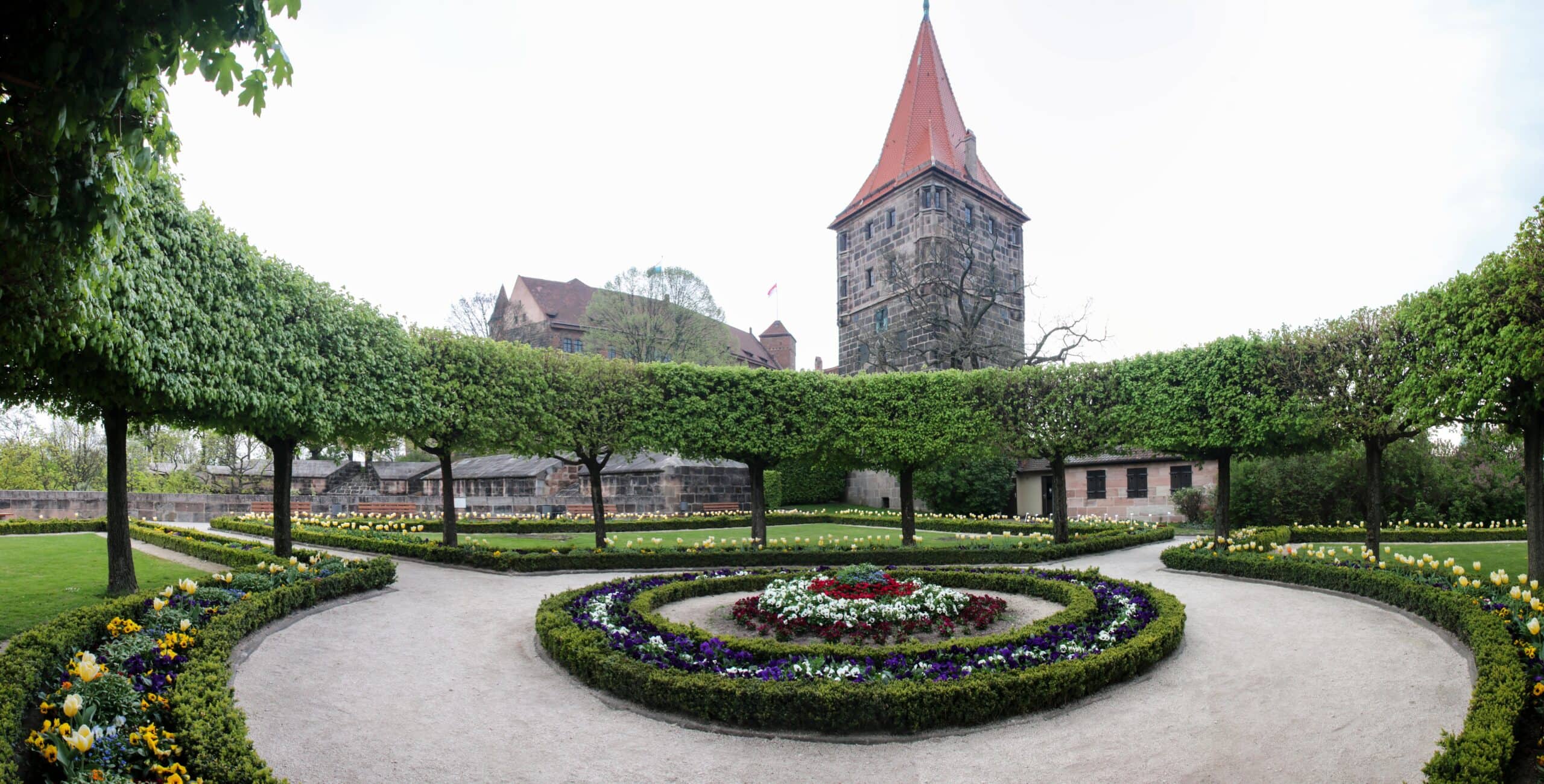
Yes: the operator lists both the Burggarten and the smaller Maria Sibylla Merian Garden as free to enter, and both close for the winter. On its great bastion, the Burggarten holds a square rose parterre framed by a row of trees. Between the Heidenturm and the Himmelsstallung, the Merian Garden opens only on Sunday and Monday afternoons in season. Every plant in it is taken from the books and drawings of Maria Sibylla Merian, who lived and worked in Nuremberg for fourteen years.
Is there a café at Nuremberg Castle?
Yes. The Burg Café Beer, run by a private company, occupies the Sekretariatsgebäude on the outer courtyard. It has a terrace and can be reached without steps. An accessible toilet on the same building’s ground floor is reached step-free through the café, and a second one is on the ground floor of the Kemenate, entered from the inner courtyard.
Beyond Nuremberg Castle
For a Bavarian itinerary, Best Castles in Bavaria places the Kaiserburg in context with the operator’s other holdings, from Ludwig II’s Neuschwanstein to the Würzburg prince-bishops’ seat. Natural local pairing is Burg Cadolzburg, the Franconian Hohenzollern seat about 22 kilometers west by road, the same dynasty that began on this rock. For the wider medieval-imperial story, the Wartburg in Thuringia carries a parallel role: another great Hohenstaufen ridge castle, and another stage on which the Holy Roman Empire conducted itself.
Conclusion
For nearly four centuries, from 1424 to 1796, the regalia of the Holy Roman Empire were kept in the city below, while the emperor stayed here on the rock. The castle was three fortresses in one: the emperor’s Kaiserburg, the burgraves’ castle and the city’s own works, sharing one sandstone outcrop under three jurisdictions. On January 2, 1945 an RAF raid brought most of it down. The reconstruction that followed, in stages until 1981, rebuilt the Palas and the Luginsland and reopened the Doppelkapelle, so that most of what a visitor walks through today is postwar fabric around the towers and the chapel that survived the raid.
Nuremberg’s 1525 adoption of the Reformation (the first imperial city to adopt it, in the Historisches Lexikon Bayerns’ account) and the Imperial Castle’s status as a Habsburg institution within a now-Lutheran city are examined in The Reformation and the Castle: Wartburg, Luther, and the Protestant Princes, which reads the imperial city as a Reformation actor.
Principal Sources
- Bayerische Schlösserverwaltung. “Kaiserburg Nürnberg,” with “Die Kaiserburg Nürnberg,” “Rundgang” and the film transcript on the castle’s building history. kaiserburg-nuernberg.de.
- Bayerische Staatsregierung. “Söder: Neues Gemälde für die Kaiserburg.” Press release, December 20, 2016. bayern.de.
- Bayerisches Landesamt für Denkmalpflege. Denkmalliste Nürnberg (Kreisfreie Stadt), Stand 30.10.2026, Baudenkmäler D-5-64-000-305 (Kaiserburg), D-5-64-000-306 (Luginsland), D-5-64-000-307 (Kaiserstallung) and D-5-64-000-309 (Burggrafenburg). geodaten.bayern.de.
- Bitterauf, Theodor. “Ludwig II., König von Baiern.” Allgemeine Deutsche Biographie 55 (1910), pp. 540-555. deutsche-biographie.de.
- Dehio Vereinigung, ed. Handbuch der Deutschen Kunstdenkmäler. Bayern Bd. 1: Franken — Die Regierungsbezirke Oberfranken, Mittelfranken und Unterfranken. 2nd ed. München: Deutscher Kunstverlag, 1999. ISBN 978-3-422-03051-0.
- Deutsches Jugendherbergswerk, Landesverband Bayern. “Jugendherberge Nürnberg.” jugendherberge.de.
- Diefenbacher, Michael. “Nürnberg, Reichsstadt: Politische und soziale Entwicklung.” Historisches Lexikon Bayerns, 2010. historisches-lexikon-bayerns.de.
- Förderverein Nürnberger Felsengänge. “Wehr- und Geheimgänge unter der Burg” and “Historischer Kunstbunker.” unterwelten-nuernberg.de.
- Friedel, Birgit. Die Nürnberger Burg. Geschichte, Baugeschichte und Archäologie. Schriften des Deutschen Burgenmuseums, vol. 1. Petersberg: Imhof Verlag, 2007. ISBN 978-3-86568-145-7.
- Friedel, Birgit. “Nürnberger Burg.” Historisches Lexikon Bayerns, 2010. historisches-lexikon-bayerns.de.
- Großmann, G. Ulrich, and Birgit Friedel. Die Kaiserpfalz Nürnberg. 2nd ed. Regensburg: Schnell & Steiner, 2013. ISBN 978-3-7954-2660-4.
- Hegel, Karl, ed. Die Chroniken der fränkischen Städte. Nürnberg, vol. 1. Die Chroniken der deutschen Städte vom 14. bis ins 16. Jahrhundert 1. Leipzig: S. Hirzel, 1862, pp. xx-xxiii and 371-372. archive.org.
- Murr, Christoph Gottlieb von, ed. “Diplomatarium Lipsano-Klinodiographicum,” no. XIII (charter of King Sigismund, Ofen, September 29, 1423). Journal zur Kunstgeschichte und zur allgemeinen Litteratur 12. Nürnberg, 1784, pp. 76-80. archive.org.
- Museen der Stadt Nürnberg. “Documentation Center Nazi Party Rally Grounds” and “Memorium Nuremberg Trials.” museums.nuernberg.de.
- Nürnberger Jahrbücher, vol. 1. Nuremberg, 1833. archive.org.
- Royal Air Force. “Bomber Command Campaign Diary, January 1945.” raf.mod.uk, archived by the Internet Archive.
- Schuhmann, Günther. “Friedrich III., Burggraf von Nürnberg.” Neue Deutsche Biographie 5 (1961). deutsche-biographie.de.
- Stadt Nürnberg. “Luftangriff auf Nürnberg am 2. Januar 1945.” Text after Stadtarchiv Nürnberg, Der Luftkrieg gegen Nürnberg: der Angriff am 2. Januar 1945 und die zerstörte Stadt, 2004. nuernberg.de.
- Whaley, Joachim. Germany and the Holy Roman Empire. 2 vols. Oxford: Oxford University Press, 2012. ISBN 978-0-19-873101-6 / 978-0-19-873102-3.
- Zeumer, Karl, ed. Quellensammlung zur Geschichte der Deutschen Reichsverfassung in Mittelalter und Neuzeit. 2nd ed. Tübingen: J. C. B. Mohr (Paul Siebeck), 1913, no. 148 (Golden Bull of 1356), chapter 29, p. 212. archive.org.
Image credits. Featured image — Nürnberger Burg im Winter von Südwest: DALIBRI, CC BY-SA 2.0 DE, via Wikimedia Commons. Doppelkapelle (Kaiserkapelle interior): © Bayerische Schlösserverwaltung. Photo: Maria Scherf / Andrea Gruber. www.kaiserburg-nuernberg.de. Burg zu Nürnberg im 15. Jahrhundert: Max Bach, public domain, via Wikimedia Commons. Permanent exhibition Kaiser – Reich – Stadt: © Bayerische Schlösserverwaltung. Photo: Rainer Herrmann. www.kaiserburg-nuernberg.de. Castle of Nurnberg, 1823 engraving: William Miller after a drawing by Captain Robert Batty, public domain, via Wikimedia Commons. Pre-war photograph “Place of Knight’s Leap”: Library of Congress, PPOC, public domain, via Wikimedia Commons. Burggarten: via Pixabay. Freely licensed images are resized to fit; any other change, such as a crop, is named in the credit.