
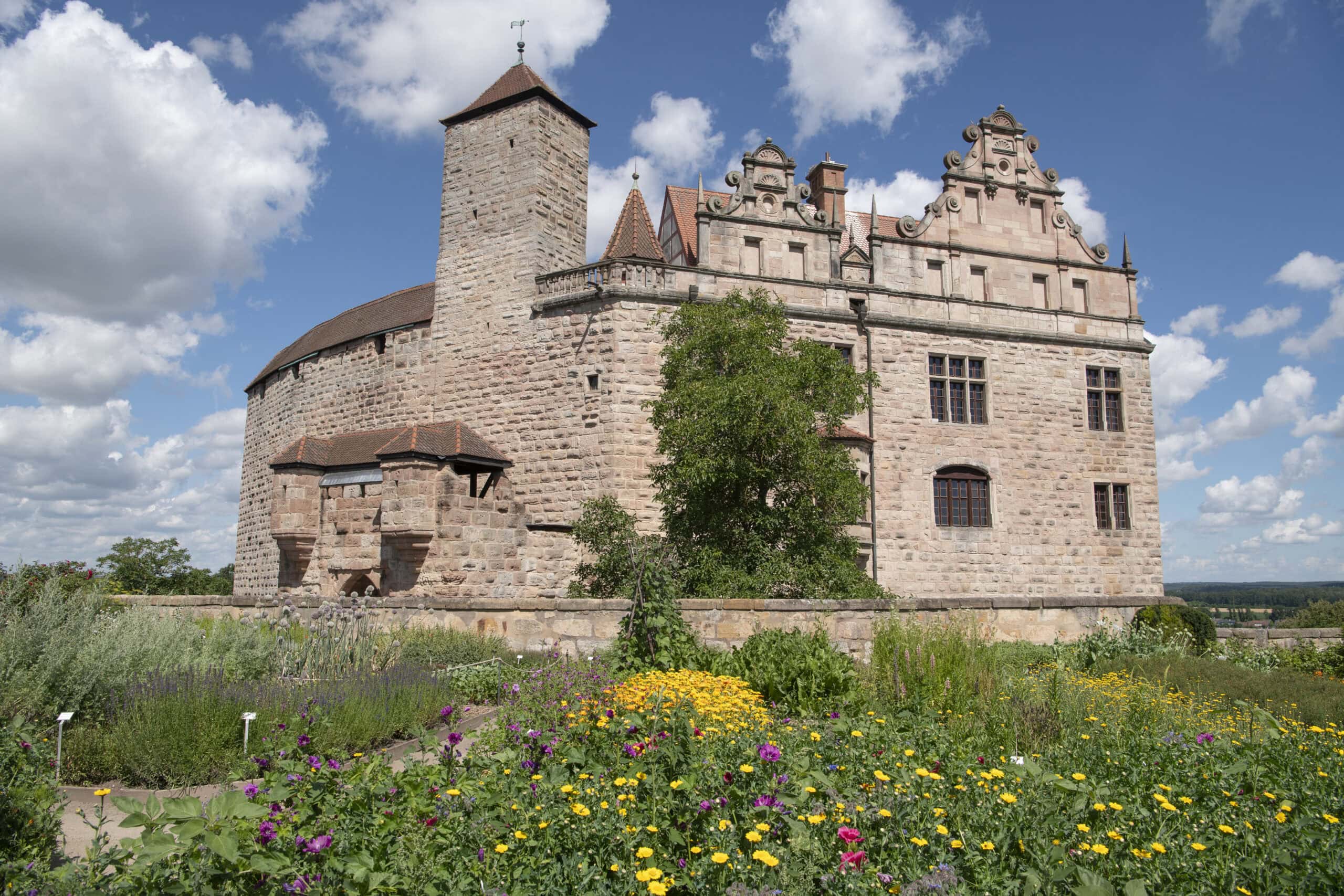
Cadolzburg Castle
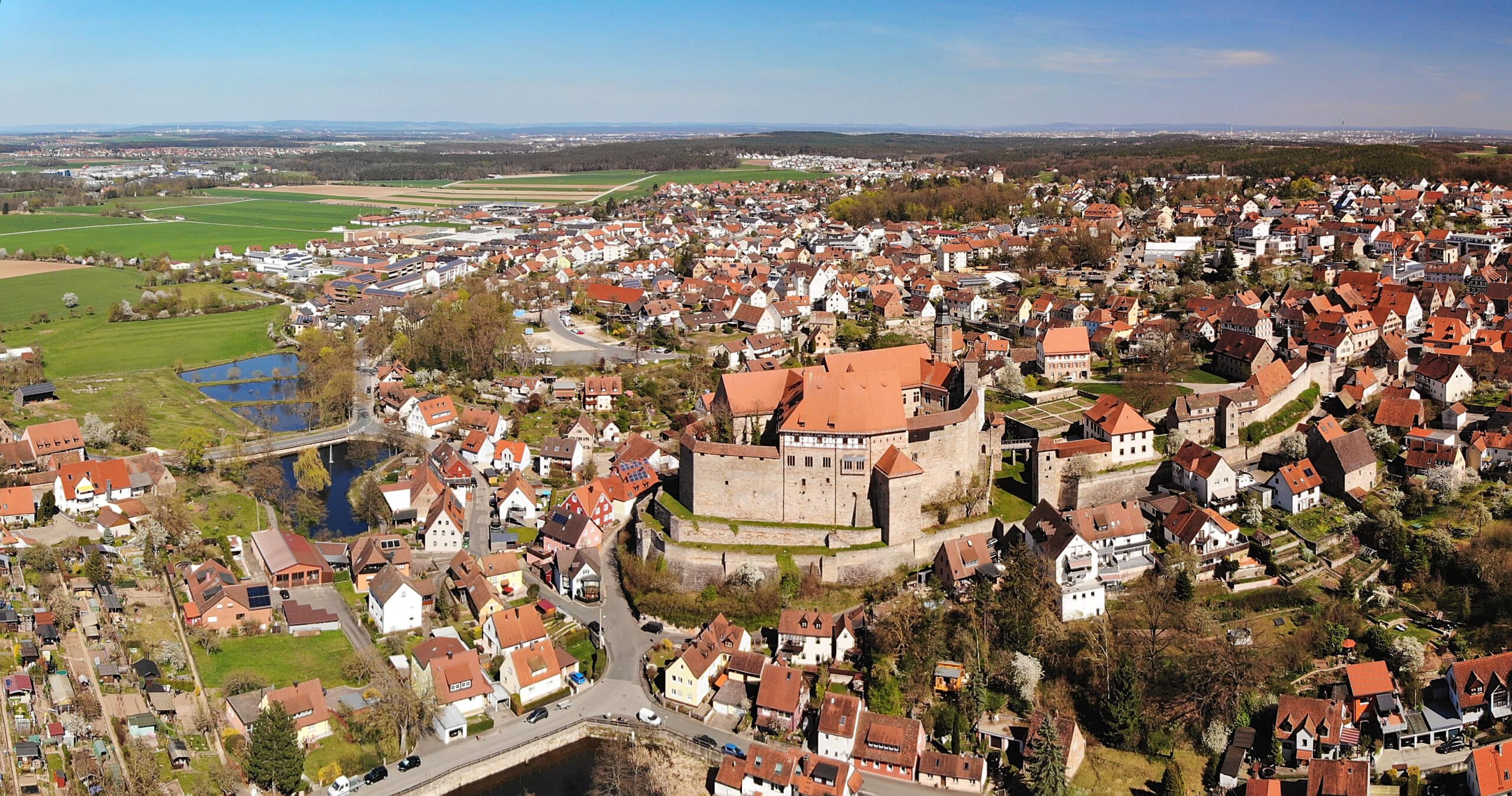
Cadolzburg Castle stands above the Mittelfranken village that shares its name, roughly thirty kilometers west of Nuremberg by rail. From the mid-thirteenth century until 1411 it served as the Franconian seat of the Hohenzollerns, the Burggrafen of Nürnberg whose senior branch would, in that pivotal year, accept stewardship of the Mark of Brandenburg and begin the rise that ended only with the German Empire. Two centuries of margravial residence followed, during which Markgraf Georg der Fromme introduced the Reformation to Brandenburg-Ansbach in 1528, with the Cadolzburg court among the first in southern Germany to follow Lutheran practice.
On the night of April 17, 1945, the entire late-medieval and Renaissance interior burned. What stands today is the result of a thirty-eight-year reconstruction that opened to the public in June 2017 as HerrschaftsZeiten! Erlebnis Cadolzburg, an experience museum that reconstructs late-medieval court life inside the surviving sandstone shell. Cadolzburg is neither a faithful restoration nor a ruin: it is one of Germany’s most ambitious modern readings of what a destroyed dynastic castle can become.
Quick Facts
| Castle Name (English) | Cadolzburg Castle |
| Castle Name (German) | Burg Cadolzburg |
| Location | Cadolzburg, Landkreis Fürth, Mittelfranken, Bavaria, Germany |
| Coordinates | 49.4594°N, 10.8509°E |
| Castle Type | Höhenburg (hilltop castle) |
| Built | Twelfth-century core; first documented 1157 |
| Style | Romanesque, Gothic, Renaissance |
| Current Use | Museum (HerrschaftsZeiten! Erlebnis Cadolzburg) |
| Operator | Bayerische Schlösserverwaltung |
| UNESCO Status | No |
| Hotel | No |
| Website | burg-cadolzburg.de |
Foundation and the Burggrafen of Nürnberg (c. 1157–1411)
Castle and village take their name from a single person. In 1157, a charter in the Heilsbronn–Würzburg tradition recorded a witness named Helmericus de Kadoldesburc, advocatus of the parish of Markt Erlbach, consenting to a tithe transaction between the bishopric of Würzburg and Kloster Heilsbronn. Helmericus served the bishops of Würzburg and the Grafen of Abenberg, lords of the surrounding Rangau territory. Personal name and place-name appear together in this earliest record: he came from a Burg already named for a “Kadold,” a Frankish given name otherwise lost from the documentary record.
In 1200 the Abenberger family died out, and their Rangau possessions passed through several hands. By the mid-thirteenth century, the Cadolzburg had fallen to the Burggrafen of Nürnberg, the Franconian Hohenzollern line whose senior member would later transform European dynastic history. Earliest secure documentary evidence dates from 1246, when Burggraf Friedrich III. issued a charter apud Kadolspurc, on the Cadolzburg itself. Friedrich’s marriage that same year to Elisabeth von Andechs-Meranien brought the family additional Franconian territory and established Cadolzburg as a primary residence.
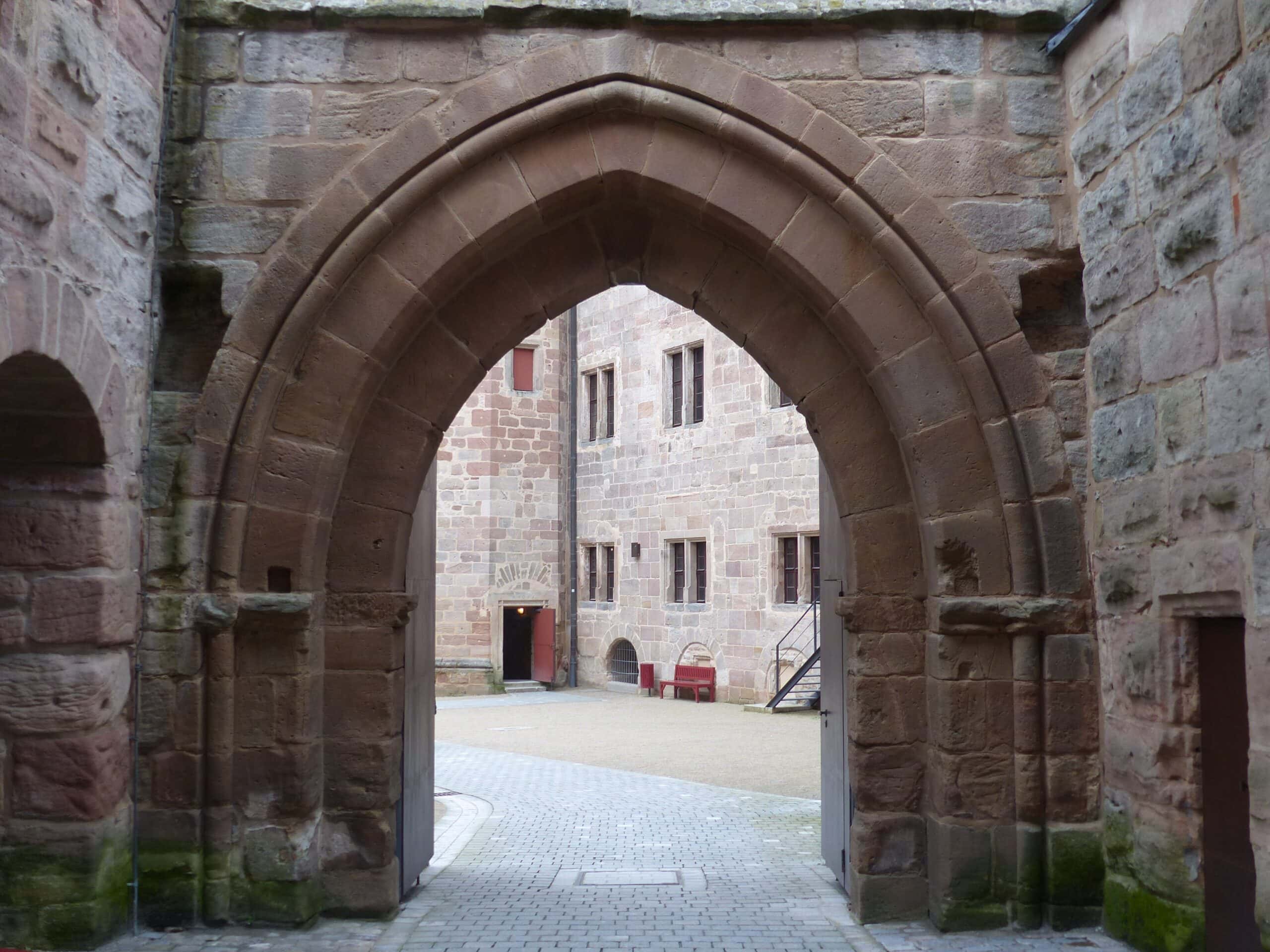
For the next century and a half, the Burggrafen built the Cadolzburg into the architectural form whose core still defines the silhouette today. A Romanesque round tower at the south-eastern corner of the Kernburg is the oldest surviving element. Gothic pointed-arch detailing on the inner gate, the palas, and the chapel followed in the late thirteenth and fourteenth centuries; Renaissance volute gables came later, in the sixteenth. Cadolzburg was never the only Hohenzollern seat in Franconia. Plassenburg above Kulmbach and the dynasty’s smaller Swabian Stammburg at Hohenzollern both belonged to the family, but Cadolzburg was the largest and the most architecturally consequential of the medieval seats.
In 1411 the political center of gravity shifted east. King Sigismund, needing a reliable steward for the troubled Mark of Brandenburg, appointed Burggraf Friedrich VI. of Nürnberg as Verweser and supreme captain. Four years later, on April 30, 1415 at the Council of Constance, Sigismund granted Friedrich the hereditary dignity of Margrave, Elector, and Erzkämmerer. Formal enfeoffment followed in the same city on April 18, 1417. Hohenzollerns had become a German imperial dynasty. Cadolzburg remained important, and Friedrich himself died there in 1440, but the family’s future lay in Berlin.
The Ansbach Residence and the Reformation (1411–1604)
After 1411 the senior Hohenzollern line held Brandenburg, but Cadolzburg passed to cadet branches that would eventually become the Margraves of Brandenburg-Ansbach. Most important of these was Markgraf Albrecht III., known as Achilles, born at the Cadolzburg in 1414 and later called the German Achilles by Aeneas Silvius Piccolomini (the future Pope Pius II.) for his vigor, his ambition, and his self-conscious imitation of antiquity. Albrecht ruled Brandenburg from 1470 to 1486 but lived much of his earlier life in the Franconian holdings, and Cadolzburg served as his political headquarters. His Dispositio Achillea of 1473, the dynasty’s first formal inheritance ordinance, separated the Brandenburg and Franconian lines and codified what was already true on the ground: Cadolzburg belonged to Franconia, not to Berlin.
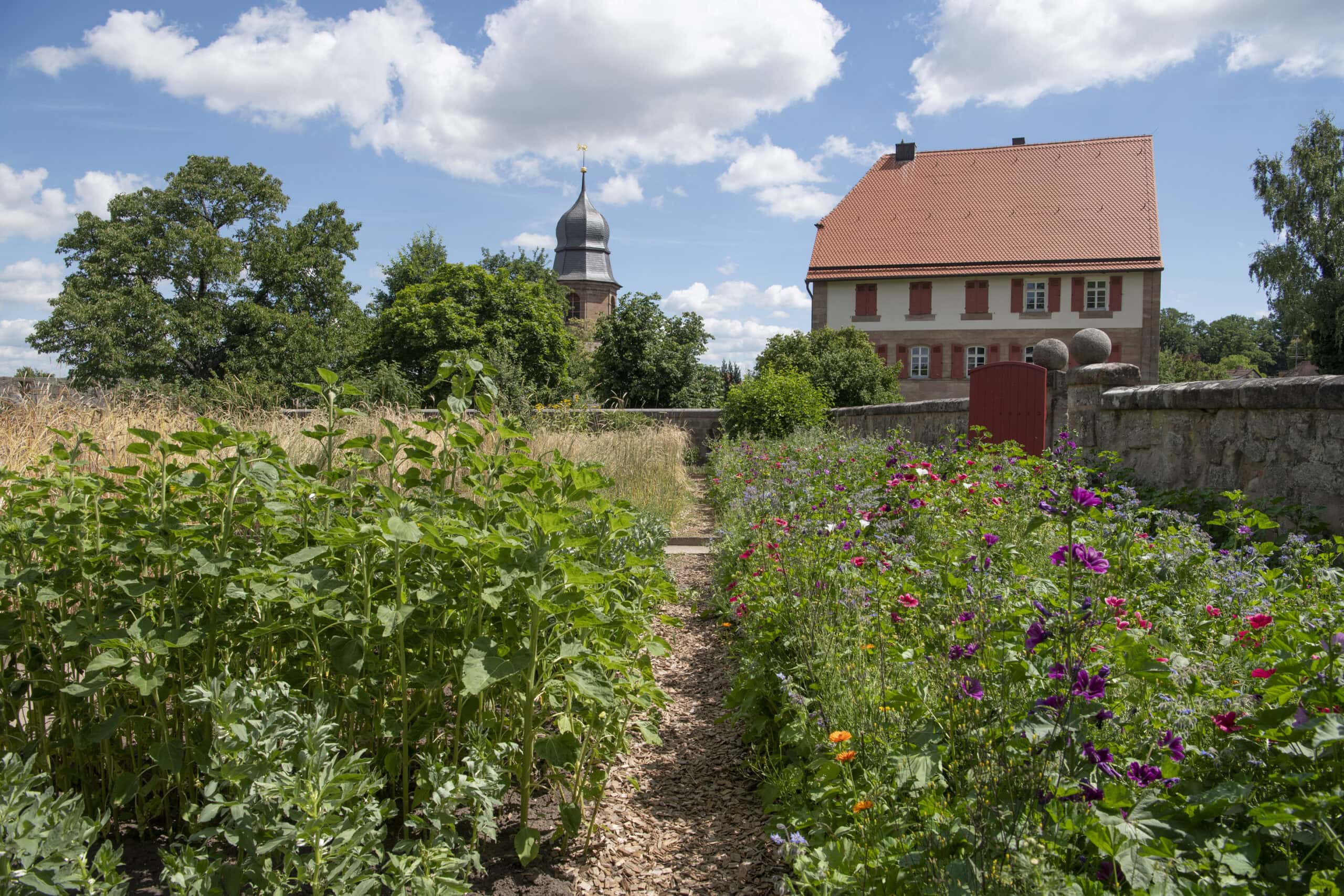
Renaissance enlargements followed under Albrecht’s successors. Volute gables on the west range, still visible from the herb garden today, date from the late sixteenth century and represent the high point of the castle’s residential identity. Markgraf Georg, who ruled Ansbach from 1515 to 1543 and is known to Protestant historiography as Georg der Fromme (Georg the Pious), made Cadolzburg one of his preferred residences. Georg’s contribution to German history is religious, not military: in 1528, jointly with the imperial city of Nürnberg, his administration drew up the Schwabacher Visitationsartikel and conducted a comprehensive Kirchenvisitation of the margraviate’s parishes. Cadolzburg was one of five Pfarrkapitel established that autumn to administer the new Lutheran order. A consolidating Kirchenordnung followed in 1533. Brandenburg-Ansbach was now officially Protestant, and one of the earliest Lutheran princely seats in southern Germany was the castle in which Georg conducted business.
Cadolzburg’s place within the wider story of the Reformation and the castle belongs to that early phase, when reformed practice was still consolidating in the German lands. Whereas the Wartburg further north in Thuringia had sheltered Luther himself during his Bible translation in 1521 and 1522, Cadolzburg shows the Reformation operationalized at the level of an entire princely administration: parishes visited, schoolmasters examined, hymnals introduced.
Walls were painted, the chapel reconfigured, the inner courtyard reorganized for ceremony. Some of this fabric survived to be photographed in the nineteenth century and reconstructed after 1979; much did not. Georg’s grandsons divided the inheritance further. By 1604, when Markgraf Joachim Ernst founded the separate line of Brandenburg-Ansbach, Cadolzburg had become one residence among several and not the most important. Ansbach itself, downhill in the milder country, was easier to govern from. Two centuries of Cadolzburg’s political centrality were ending.
Decline, Thirty Years’ War, and the Long Twilight (1604–1944)
Seventeenth century forces reduced Cadolzburg from a residence to an administrative seat. After 1604 the Ansbach margraves preferred their downhill capital, and the Cadolzburg was managed by an Amtmann, then by a Justizamt, the local court and administrative office. Maintenance fell off. Roofs leaked. Renaissance ceiling paintings darkened, were patched, were forgotten.
The Thirty Years’ War reached Mittelfranken in force. In September 1632, Wallenstein’s army and the Swedish forces of Gustav Adolf met at the Schlacht an der Alten Veste, ten kilometers east of Cadolzburg and one of the largest concentrations of troops in central Europe to that date. The engagement produced a tactical draw and a strategic catastrophe of disease and desertion. Cadolzburg itself survived intact: no documented siege, no battle damage. Its sandstone walls and isolated bluff position made it an unattractive target for armies more interested in cities, and the same was true for the rest of the war.
Eighteenth-century administrative downgrade continued. When the last childless Markgraf Karl Alexander signed the secret treaty negotiated by Karl August von Hardenberg on January 16, 1791, ceding Brandenburg-Ansbach and Brandenburg-Bayreuth to Prussia, Cadolzburg passed to the Hohenzollerns’ Berlin branch as a Prussian Justizamt. After the Treaty of Schönbrunn of December 15, 1805, Bavaria received the principalities in turn; Bavarian administration took effect in May 1806. The Bayerisches Forstamt occupied parts of the complex; agricultural and storage uses filled the rest.
By 1934 the Cadolzburg had become a Nationalpolitische Erziehungsanstalt, one of the Nazi regime’s elite secondary schools, and from 1939 a Führerschule der Hitler-Jugend. Renaissance ceilings, the chapel, the Bergfried, and every medieval and Renaissance interior that four centuries of administrative neglect had preserved were still in place when the school evacuated in early April 1945.
The Fire of 16–April 17, 1945
In the second week of April 1945, the US Seventh Army was advancing on Nuremberg from the west. Most Wehrmacht resistance in Franconia had collapsed. Villages of the Rangau, including Cadolzburg, were behind no defensive line and had no military purpose to defend. The Hitler-Jugend Führerschule had evacuated. The castle appeared to be empty.
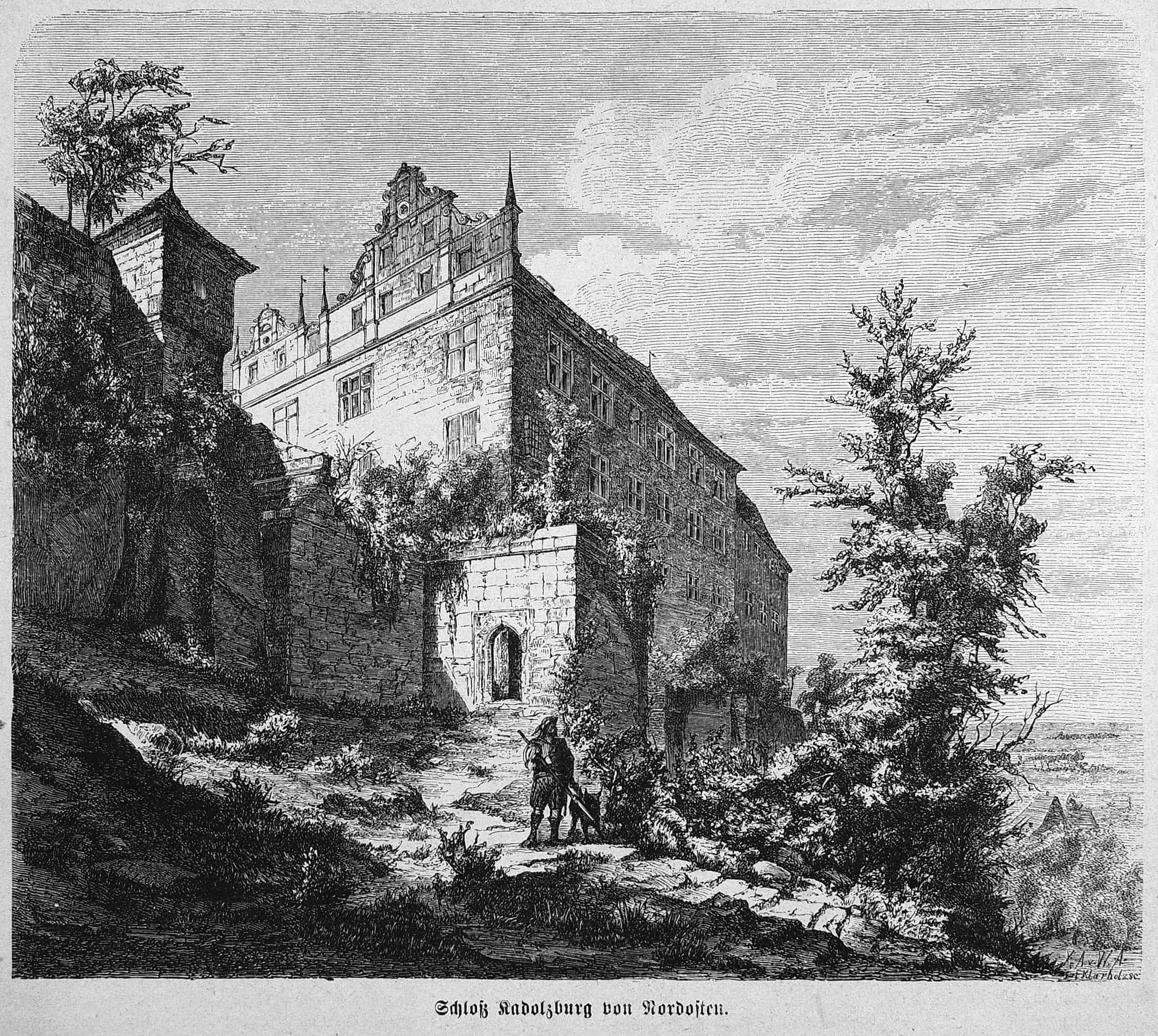
On the night of 16 to April 17, a small SS-Kampfgruppe (a remnant force, no more than a dozen men by some accounts) took position inside the Cadolzburg and opened fire on the American column moving toward Nuremberg. The Americans returned fire with rocket tanks. Wooden roofs caught. Renaissance ceiling paintings, the chapel, the kitchens, painted walls of the great hall, and the entire furnishings of four centuries of Hohenzollern residence: all burned. The fire took most of the night.
A popular postwar account, repeated in tourist literature for decades, attributed the burning to American retaliation for a sniper incident in the village. The Bayerische Schlösserverwaltung’s official history of the site, drawing on local archival research, instead documents the SS-Kampfgruppe entrenched in the castle. These two accounts are not equivalent. The first imagines the fire as a single American act of disproportionate response to a civilian rifle; the second describes a small German military force using the castle as a fortified firing position against an advancing army. The second matches the scale of the destruction; the first does not.
Cost beyond the castle was real. Volksbund records list thirteen soldiers and eight civilians killed in Cadolzburg on April 17, 1945, and fifty-seven buildings in the market town destroyed. Cost inside the walls was total. What survived the night was the sandstone shell: curtain walls, most of the towers, the Bergfried, and the masonry of the gables. What was gone was everything inside: every painted ceiling, every Renaissance carved cabinet, every chapel furnishing, the kitchen ranges, and the bedroom inventories that Heinrich Thiersch had photographed and measured around 1900. By the morning of April 17, Cadolzburg was the largest single-night loss of medieval and Renaissance interior fabric of any castle in Bavaria. Americans entered Nuremberg three days later.
Reconstruction (1979–2017)
Ruins of Cadolzburg stood for thirty-four years before the Bavarian Landtag, in 1979, passed a resolution authorizing reconstruction. Bayerische Schlösserverwaltung began stabilization works in 1982. The decision was not obvious. Several Bavarian castle ruins were left as ruins or rebuilt only in essential structural form. Cadolzburg, by contrast, was rebuilt comprehensively, with the original sandstone walls preserved wherever possible and contemporary materials inserted where reconstruction was structurally necessary.
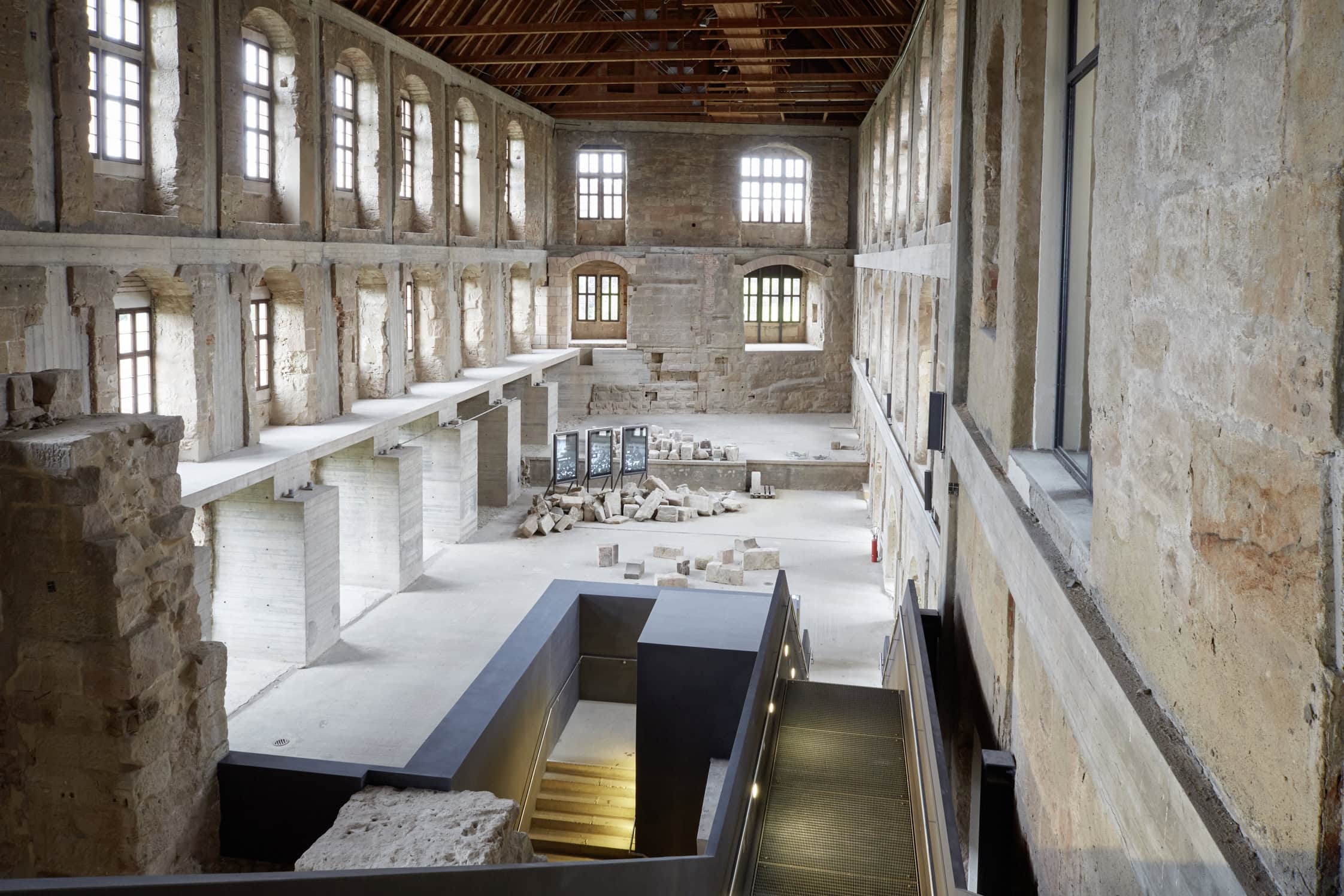
Reconstruction ran for thirty-five years. The early phase, through the 1990s, concentrated on roofs, walls, and stabilization. A 850th-anniversary year in 2007 marked the ground floor and first floor of the Alten Schloss being made publicly accessible for the first time. Five years later, in 2012, Bayerische Schlösserverwaltung committed to converting the entire Kernburg into a Burgerlebnismuseum: an experience museum, not a furnished historical interior. Architectural work was led by the Munich firm Claus + Forster; museum design was by Würth & Winderoll of Seefeld; curatorial concept came from Bayerische Schlösserverwaltung staff Dr. Sebastian Karnatz and Dr. Uta Piereth.
Reconstruction philosophy can be read in the building itself. Original masonry was conserved as found, with weathering, fire-damage scars, and historical patina deliberately preserved. New structural elements were built in exposed concrete, steel, and contemporary timber, openly contrasting with the medieval and Renaissance stone. The Großer Saal of the Alten Schloss is the clearest example: original sandstone walls rise four stories on three sides, scarred by the 1945 fire and the centuries before; a new concrete gallery and stair descend through the volume in visibly twenty-first-century geometry. Stone fragments from the destroyed interiors are arranged on the floor as found objects.
This is not restoration. A restored Cadolzburg would attempt to recreate the Renaissance interior of, say, 1600 or the medieval interior of 1450. Cadolzburg’s project rejected that choice. Interiors had burned beyond authentic restoration; what survived was the building’s archaeological record. The Bayerische Schlösserverwaltung decision was to preserve that record as the substance of the visitor experience, and to add new architecture as new architecture, not as imitation of what was lost.
Critics have argued that the choice forecloses any future authentic restoration and that exposed concrete in a thirteenth-century sandstone hall is a permanent stylistic intrusion. Defenders argue that no authentic restoration was ever possible after the fire and that the experience-museum approach engages visitors with how the castle was used in ways no recreated interior could. HerrschaftsZeiten! Erlebnis Cadolzburg opened on June 23, 2017. The opening was the culmination of thirty-eight years from the Landtag resolution, thirty-five from the first construction works, and a sustained argument about what a destroyed castle should become.
HerrschaftsZeiten! and the Experience Museum
Visitors entering the Alten Schloss do not encounter a sequence of period rooms. HerrschaftsZeiten! is organized thematically: court ceremony, dynastic politics, daily life, religion, military and economic management, and the architectural history of the castle itself. Each room corresponds to a theme and to a Hohenzollern figure or court function.
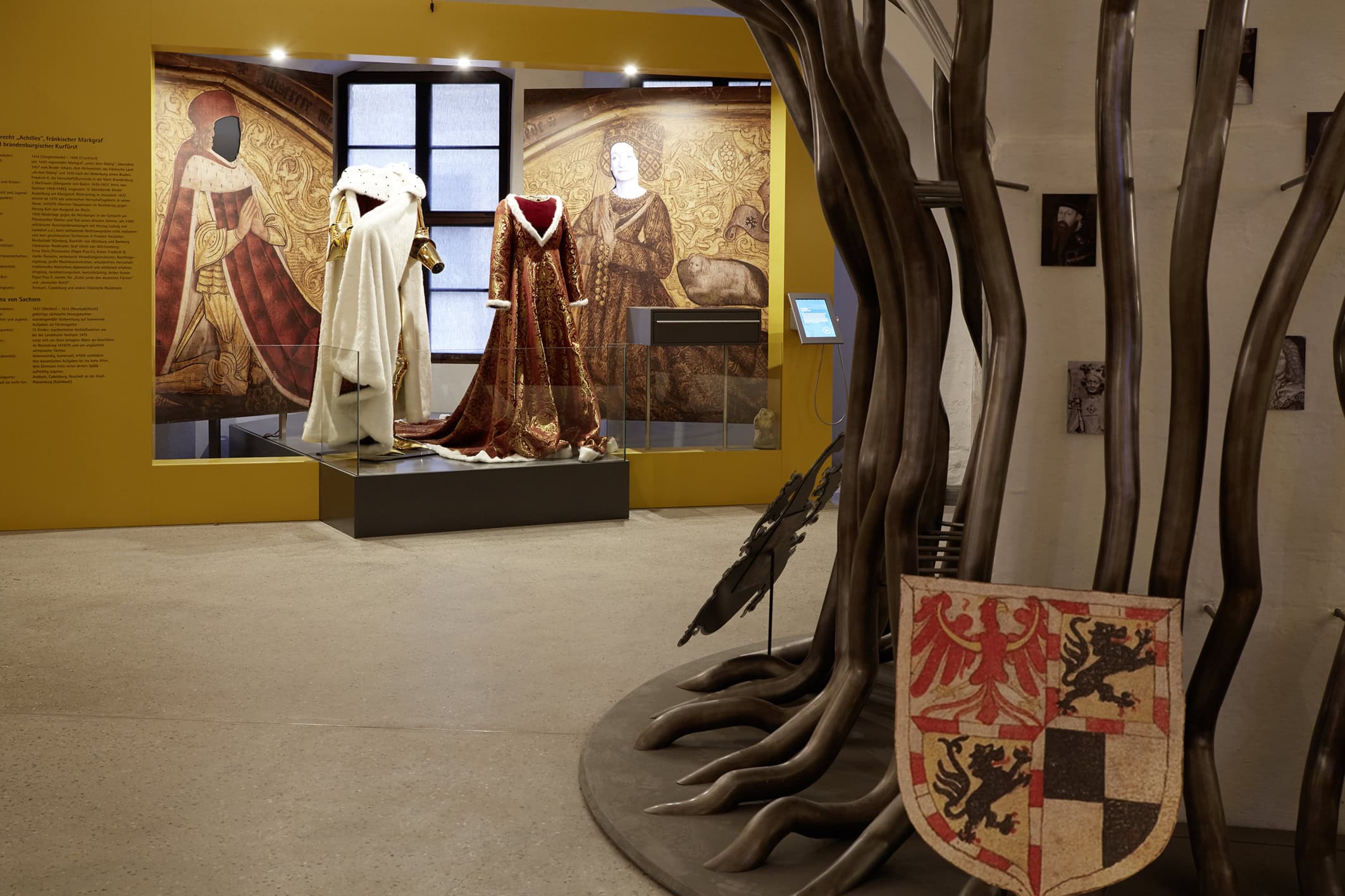
Inside the Albrecht Achilles room in the west range, surviving fragments of fifteenth-century wall paintings recovered from the rubble after 1945 have been reconstructed across the back wall. In front of the paintings, two mannequins in carefully researched Renaissance robes stand inside a glass case: Albrecht in white fur-trimmed coronation robes, Anna von Sachsen in red and gold. A metal sculpture of a dynastic tree dominates the center of the gallery, its roots and branches carrying heraldic shields of the Hohenzollern branches as they spread across the empire. This combination of original fabric (the paintings), evidentiary reconstruction (the robes), and interpretive sculpture (the tree) is characteristic of the museum’s method throughout.
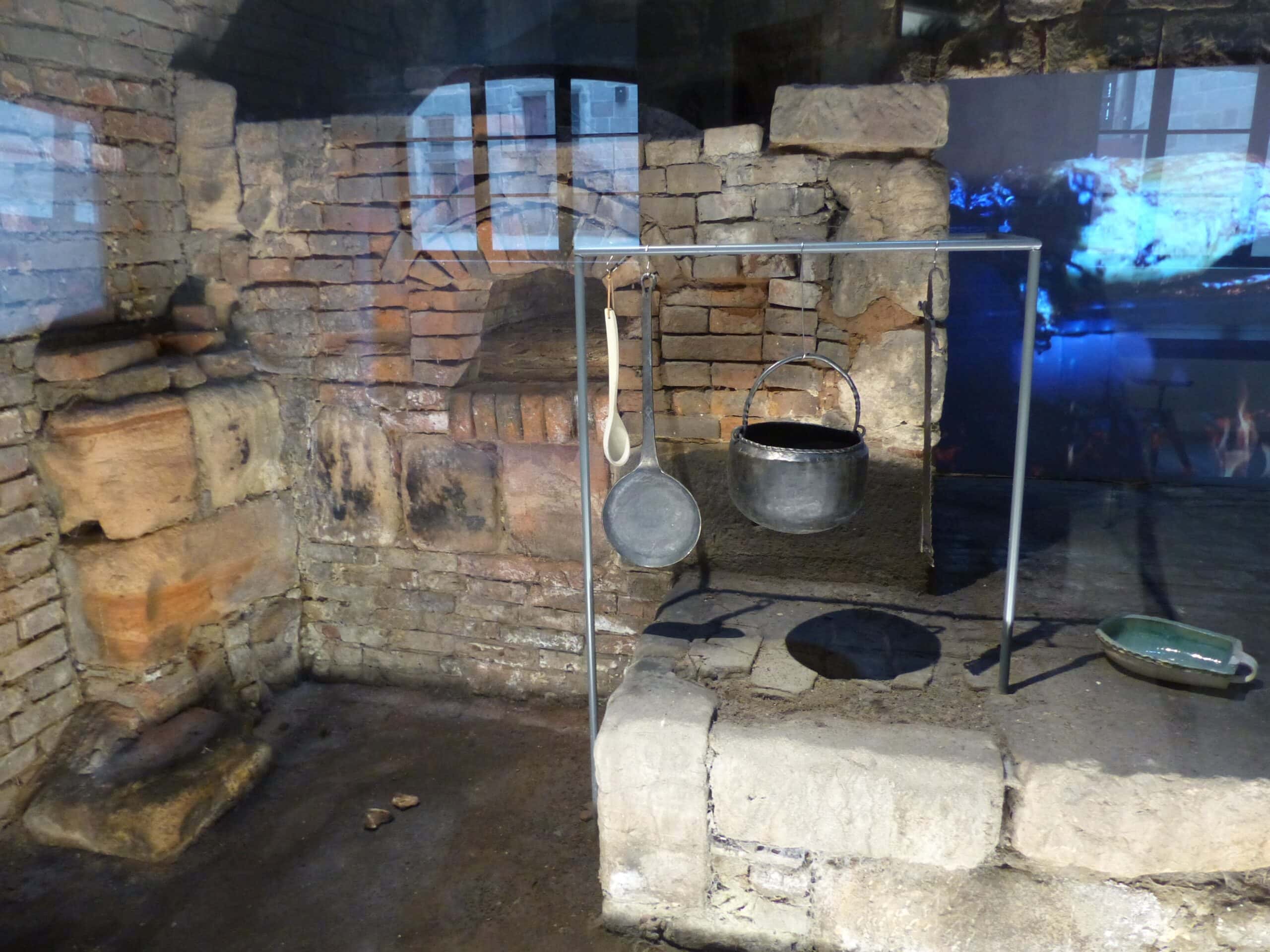
Other rooms include the medieval kitchen with its excavated hearth and bread oven, a chapel space that uses light and sound to evoke the lost interior, a court-ceremony room with audio reconstructions of dynastic festivities, and an architectural-history room in the Großer Saal itself, where the reconstruction philosophy is on display as exhibit content. Multimedia stations supplement physical exhibits throughout.
Interpretive method is selective and explicit. HerrschaftsZeiten! does not claim to show visitors the Cadolzburg as it was. It shows visitors the castle’s surviving record and the curatorial choices made in interpreting that record. Visitor experience is consequently more demanding than a furnished period interior; readers and viewers are asked to engage with how knowledge of the past is constructed, not only with the past itself. Critical reception has been correspondingly divided, with praise for accessibility and pedagogical ambition balanced by reservations about historical authenticity.
Visiting Cadolzburg (2026)
Cadolzburg can be visited year-round, with reduced winter hours. From April through September, the castle opens daily except Mondays from 09:00 to 18:00, with last admission at 17:15. October through March, the schedule shifts to 10:00 to 16:00, with last admission at 15:15. Annual closures are January 1, Faschingsdienstag, December 24, December 25, and December 31. The Burggarten, the castle garden along the south curtain wall, is open year-round with free admission and is one of the most rewarding parts of the visit for travelers who plan a stop without entering the museum itself. Entry tickets and local tours can also be booked in advance through GetYourGuide.
Tickets covering the full HerrschaftsZeiten! museum are €8 regular and €7 reduced; the price includes the multimedia guide that the museum’s interpretive method effectively requires. A combination ticket with the Kaiserburg Nürnberg, the imperial city-fortress that was the complement to Cadolzburg’s margravial role, costs €16 regular or €14 reduced. A second combination, with the Historisches Museum Cadolzburg in the village, is €10 regular or €8 reduced. Children and young people under eighteen enter free; children under fourteen must be accompanied by an adult. Group tours can be booked for €3 per person plus admission via the castle office (+49 9103 70086-21). No timed-entry slots are required. Visits average ninety minutes for the full museum; planners should add thirty to forty-five minutes for the Burggarten and the Vorburg.
| Ticket | Regular | Reduced |
|---|---|---|
| Cadolzburg Castle (HerrschaftsZeiten! museum) | €8 | €7 |
| Cadolzburg + Kaiserburg Nürnberg combination | €16 | €14 |
| Cadolzburg + Historisches Museum Cadolzburg | €10 | €8 |
| Children and young people under 18 | Free | Free |
| Group tour (per person, plus admission) | €3 | €3 |
Cadolzburg is reached from Nuremberg by rail in roughly forty minutes total. From Nürnberg Hauptbahnhof, S-Bahn or regional service to Fürth Hauptbahnhof takes about ten minutes; at Fürth, travelers change to the R11 Rangaubahn, the regional line operated by DB Regio Franken on the historic Fürth-to-Cadolzburg track. The R11 runs half-hourly from morning through evening and covers the 12.8 kilometers to Cadolzburg in twenty-three minutes. From Cadolzburg station the castle is a one-kilometer walk uphill through the historic Markt, allowing twelve to fifteen minutes on foot. Anyone staying overnight can compare hotels in and around Cadolzburg.
Some links on this page are affiliate links, which means StoneKeep Atlas may earn a small commission, at no extra cost to you, if you book through them.
Beyond Cadolzburg
Cadolzburg occupies a particular place in the architectural geography of Franconia. As the medieval seat of the cadet branch of the Hohenzollern dynasty, it stands in counterpoint to Plassenburg above Kulmbach, which served the Kulmbach-Bayreuth branch of the same family. Together with the more recent Veste Coburg further north (the seat of the Saxe-Coburg-Gotha line), these three constitute the surviving high-medieval fortresses of the Franconian princely families.
Contrast with ecclesiastical Franconia is sharper still. Prince-Bishops of Würzburg ruled the southern Main valley from the Marienberg Fortress above the river and, from the eighteenth century, the Würzburg Residence in the city below. Their counterparts at Mainz administered northern Mittelmain holdings from Johannisburg Palace in Aschaffenburg. Franconia of the seventeenth and eighteenth centuries was a landscape of competing residences: secular Hohenzollern at Cadolzburg and Plassenburg, ecclesiastical princely power at Würzburg and Aschaffenburg, and Wettin dynastic projection at Coburg.
Wittelsbach equivalent of Cadolzburg’s dynastic role lies further south. Burg Trausnitz above Landshut served the older Wittelsbach line in a structurally similar way: a medieval-Renaissance hybrid, a building the dynasty outgrew rather than abandoned. Parallels and differences are instructive, and the comparison illuminates both castles. Bavaria’s largest surviving medieval fortress, Burghausen on the Salzach, served a different function still: a Wittelsbach defensive stronghold rather than a dynastic Stammresidenz, with its own architectural and political logic.
For travelers exploring the Franconian princely landscape together, the Cadolzburg + Kaiserburg Nürnberg combination ticket is the practical starting point. Cadolzburg pairs naturally with Castles of Franconia, the regional travel guide that situates these residences within a single touring framework, and with the broader Best Castles in Bavaria for state-wide context.
Conclusion
Cadolzburg is the dynastic origin point that the House of Hohenzollern outgrew. From 1246 to 1411 the castle was the Franconian seat from which an obscure Burggrafen family climbed to imperial dignity, and from which Friedrich VI. eventually rode east to be invested with Brandenburg at the Council of Constance in 1417. For another two centuries Cadolzburg held the cadet branches and the Reformation court of Markgraf Georg the Pious. After the night of April 17, 1945, when the entire late-medieval and Renaissance interior burned, the choice presented to the postwar Bavarian state was whether to leave the ruin or to attempt restoration. Thirty-eight years of reconstruction that followed produced something rarer than either: a deliberate twenty-first-century reading of late-medieval court life, built into the surviving sandstone shell of one of Germany’s most consequential pre-1800 dynastic castles. Visitors who come to Cadolzburg today see the result, and they are asked, by the museum’s method, to think about what they are seeing.
Principal Sources
- Bayerische Architektenkammer. “Sanierung, Ausbau, Burgenmuseum, Schloss Cadolzburg, Cadolzburg.” byak.de.
- Bayerische Schlösserverwaltung. “Burg Cadolzburg.” burg-cadolzburg.de.
- Bayerische Schlösserverwaltung. “Die Cadolzburg – Museale Vermittlung von Zerstörung und Wiederaufbau nach dem Zweiten Weltkrieg.” Schlösserblog. schloesserblog.bayern.de.
- Burgenwelt. “Cadolzburg.” burgenwelt.org.
- Haus der Bayerischen Geschichte. “Burgschloss Cadolzburg.” Burgenatlas. hdbg.eu.
- Historisches Lexikon Bayerns. “Ansbach, Markgraftum: Politische Geschichte.” historisches-lexikon-bayerns.de.
- Karnatz, Sebastian, and Uta Piereth, eds. “herr im hauß.” Die Cadolzburg als Herrschaftssitz der fränkischen Zollern im Mittelalter. Forschungen zur Kunst- und Kulturgeschichte 12. Bayerische Schlösserverwaltung, 2017.
- Kraus, Andreas. Geschichte Bayerns: Von den Anfängen bis zur Gegenwart. C.H. Beck, 2004.
- Mahr, Helmut. “Die Aufdeckung des ältesten Cadolzburger Friedhofs und ihre Folgen für die Geschichte der Burg und der Pfarrkirche.” Fürther Heimatblätter 1991, no. 1, 1–9.
- Schwennicke, Detlev. Europäische Stammtafeln, Neue Folge. Vittorio Klostermann, various volumes.
- Zeune, Joachim. “Cadolzburg und Abenberg: Zwei frühe Burgen der Hohenzollern in Franken.” In Karnatz and Piereth 2017, 86–99.
Image credits. Featured image and three in-article photographs (Albrecht Achilles room, Großer Saal reconstruction, Burggarten): © Bayerische Schlösserverwaltung — photos by Veronika Freudling and Maria Scherf / Andrea Gruber, used by permission. Inner gate and medieval kitchen: Wolfgang Sauber, CC BY-SA 4.0, via Wikimedia Commons. Schloß Kadolzburg von Nordosten: wood engraving from Die Gartenlaube, 1871 (public domain via Wikimedia Commons). Aerial panorama: HaSe, CC BY-SA 4.0, via Wikimedia Commons. Freely licensed images are resized to fit; otherwise unaltered.