
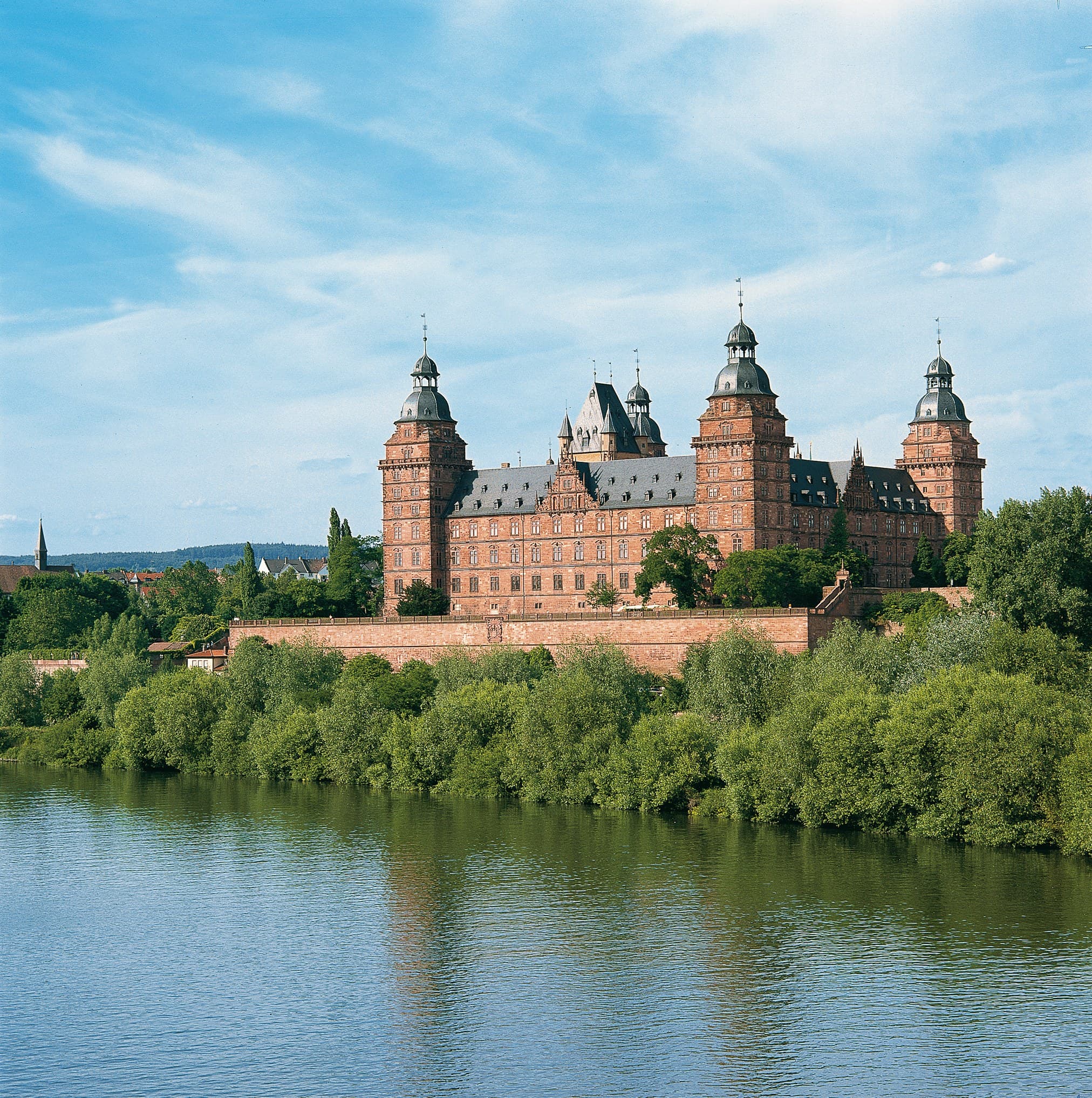
Johannisburg Palace
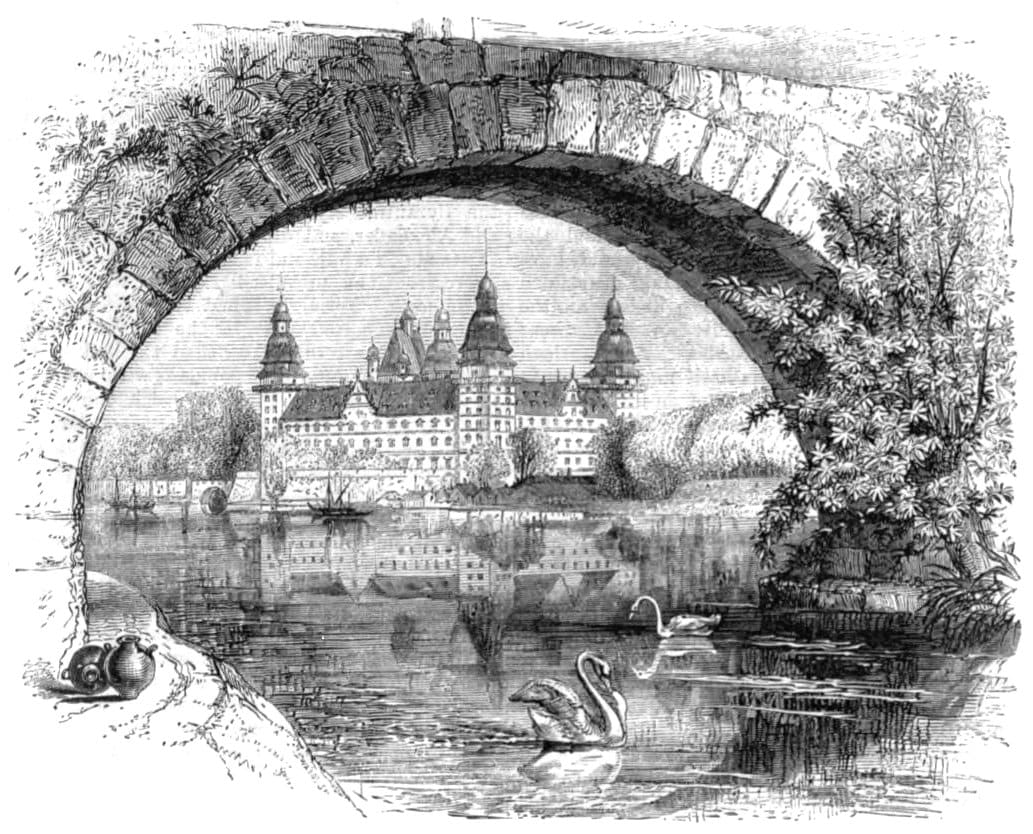
Johannisburg Palace (Schloss Johannisburg) is the four-towered Renaissance schloss that rises from the right bank of the Main River in Aschaffenburg, in the Bavarian district of Lower Franconia. For a building that suffered Albrecht Alcibiades’s wrath in 1552 and was nearly erased again by American shells in 1945, it keeps remarkably impressive composure. Four red Odenwald sandstone towers rise above a single rectangular block in such symmetry that the building reads almost like an architectural diagram: a Renaissance courtyard fortress, drawn with the regularity of a stamp. It is the work of one architect, Georg Ridinger, executed in barely a decade between 1605 and 1614, and it has the rare distinction among major German Renaissance Schlösser of having been finished by the man who started it.
What it is not, despite the persistence of the term in older guidebooks, is a Residenz in the Würzburg sense. For most of its working life Johannisburg served as the Zweitresidenz (the second seat) of the Prince-Archbishops and Electors of Mainz, a kind of country palace where the cathedral chapter was not constantly underfoot. Only in the final decades of the eighteenth century, when Friedrich Karl Joseph von Erthal made it his definitive Hauptresidenz in 1794 and Karl Theodor von Dalberg used it as his principal seat from 1803 to 1813, did Johannisburg take on the formal apparatus of an electoral residence. Even then it remained, in fundamental conception, a Schloss: a defended four-wing complex around a central courtyard, with the medieval Bergfried still embedded in its north wing as a stubborn reminder that the site had been a fortress before it was a residence.
Quick Facts
| Country | Germany |
| Region / State | Bavaria (Unterfranken / Lower Franconia) |
| Nearest Town | Aschaffenburg |
| Construction Period | 1605–1614 (interiors to ~1618; medieval Bergfried 13th–14th c.) |
| Founder | Prince-Archbishop-Elector Johann Schweikard von Kronberg (commissioned 1607; architect Georg Ridinger of Strasbourg) |
| Architectural Style | German Renaissance (Vierflügelanlage); embedded late-Gothic chapel core |
| Building Type | Schloss — Mainz electoral Zweitresidenz; Hauptresidenz from 1794 to 1813 |
| Current Condition | Reconstructed (principal phase 1954–1964; East tower 1968; chapel altar restoration through 1989); facade conservation campaign ongoing 2024–present |
| Open to Visitors | Yes — daily except Mondays, with seasonal hours; two operators (Bayerische Schlösserverwaltung and Stadtmuseum Aschaffenburg) issue separate tickets |
| UNESCO Status | Not inscribed |
| Official Website | schloesser-aschaffenburg.de |
From medieval Burg to Renaissance Schloss (1144–1614)
Mainz archbishops held Aschaffenburg from the late tenth century, when the territory passed to the Electorate under Archbishop Willigis (975–1011), who built the first stone bridge over the Main at Aschaffenburg in 989. Aschaffenburg sat on the Main’s right bank in a strategically delicate position: too far east to be casually administered from Mainz itself, yet close enough to matter in the archdiocese’s territorial reach toward Franconia. By the thirteenth century the archbishops had built a stone fortress on the high spur above the river: the Burg Johannisburg, named for John the Baptist, patron of the Mainz cathedral. Its square Bergfried, built around 1337 and raised in height in the late fourteenth century, would prove the only major fragment of the medieval castle to survive the catastrophe of 1552, and to outlast everything Ridinger built around it.
Aschaffenburg’s medieval Burg was modest by later standards, a tower-and-curtain complex rather than a palatial residence. The first documented stay of an archbishop dates to 1144; the place-name appears in records from at least the early eighth century, when the Ravenna Cosmography names Ascapha on the Main, and its full -burg form, Ascaffinburg, is first documented in a 974 gift charter from Emperor Otto II. Throughout the late Middle Ages and into the Reformation, the Burg served the archbishops adequately if unremarkably. That changed on a single August day in 1552.
On August 10, 1552 (the feast of St. Lawrence), Albrecht II Alcibiades, Margrave of Brandenburg-Kulmbach, sacked and burned the Burg Johannisburg. The destruction was part of his broader Second Margrave’s War (1552–1555), a campaign of aggressive territorial extortion against the prince-bishoprics of Bamberg, Würzburg, and Mainz that left a trail of looted treasuries and burned fortresses across Franconia. Aschaffenburg’s Burg was one of his cleaner victories: he had no realistic prospect of holding it, but he could destroy it and demand ransom for what remained. What survived was the Bergfried, built of stone too thick and too low for incendiary destruction to reach, and fragments of the curtain walls. Archbishops did not rebuild. For five decades the Burg sat as a partial ruin, more useful as a quarry than as a residence.
The decision to start fresh, when it came, was made by Archbishop-Elector Johann Schweikard von Kronberg (Elector 1604–1626). An administrator-cleric of the kind the Counter-Reformation prized (pragmatic, Romanophile, comfortable spending), he commissioned a complete new Schloss on the cleared and partially leveled medieval site. He chose as his architect Georg Ridinger (1568–1617), an Alsatian-born master builder from Strasbourg who had trained in fortress architecture in France and Italy, then in his late thirties and at the height of his powers. The brief was extraordinarily clean: design and construct a new four-wing Schloss around an inner courtyard, incorporating the surviving medieval Bergfried, in red Odenwald sandstone, on a footprint of roughly 87.5 by 86 meters. Construction began in 1605 with demolition and the construction of the retaining wall, the formal commission to Ridinger following in March 1607. Inauguration came on February 17, 1614 (the tenth anniversary of Schweikard’s election as Archbishop-Elector of Mainz, a date marked with commemorative coins struck for the occasion), with the Elector taking up residence the following year. Final building works continued after Ridinger’s death in November 1617, finishing in 1618–1619.
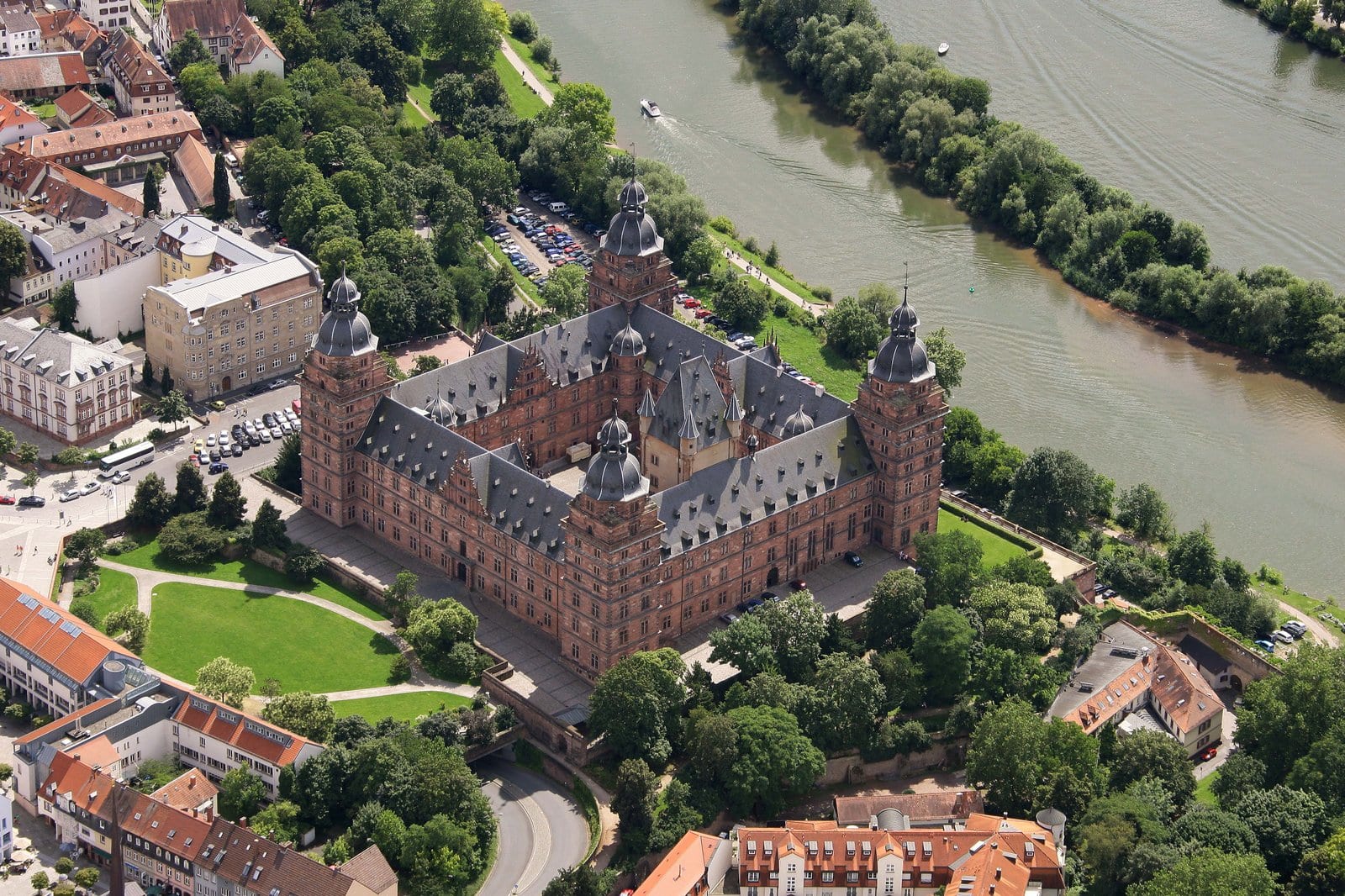
The Vierflügelanlage and the fifth tower
Ridinger’s achievement was to deliver a building of such architectural coherence that visitors today often assume it must have been built by a much later, more centralized state apparatus. Four wings are nearly identical in elevation: three-story facades over a high basement, with each corner anchored by a square tower that rises five stories above the wings, to a total of eight stories internally and 52 meters from grade to weather vane. The lower three tower stories align with the wing floors and share their fenestration; three more rise through the wing roof zone; the seventh is encircled by a balustrade; and the eighth steps inward to an octagonal drum that supports the slate-covered dome and its lantern. The wings themselves are a uniform 13.5 meters in depth, and the inner courtyard, at 51 by 51 meters, is a near-perfect square.
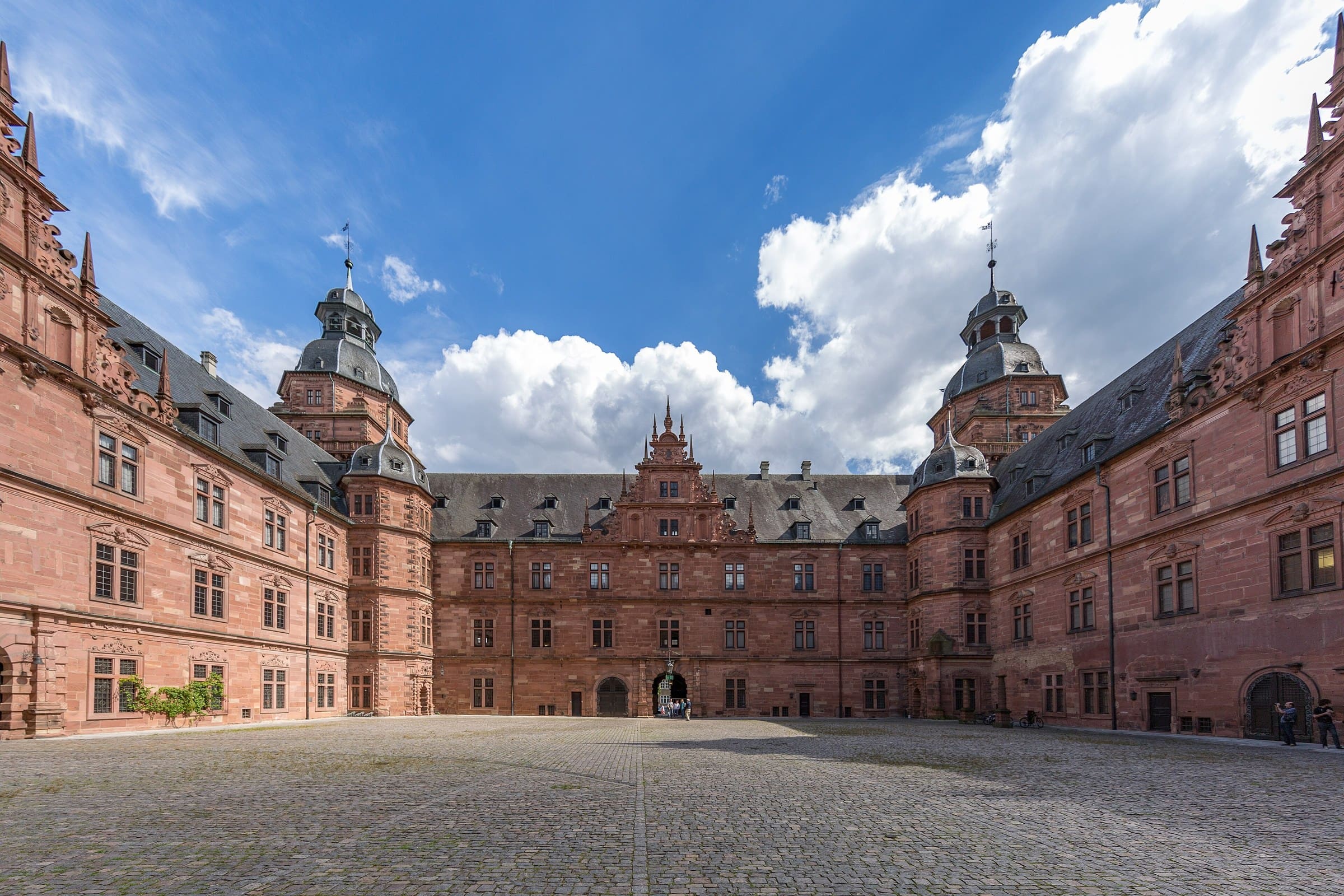
The interior courtyard view explains Johannisburg in a way no exterior elevation can. Step through the arched gate of the Eingangsflügel (the western entrance wing), and you are inside what is functionally a fortified town square. The four wings rise around you with disciplined uniformity. The four corner towers stand sentinel at each angle. And rising at the back, asymmetrical and unmistakably older, is the medieval Bergfried, visible from the courtyard in a way it never quite is from outside. This is what makes Johannisburg a Schloss rather than a Residenz: the building turns inward. Most ceremonial elevations face the courtyard, not the exterior. The grandest gable, on the inner facade of the northern Mainflügel, faces the inside of the complex. There is no garden parterre, no axial approach across formal grounds, no Versailles-derived staging. The visitor is meant to feel the enclosure.
The single major irregularity is the Bergfried itself. Ridinger did not place it at a corner, where modern eyes might expect a “fifth tower” to live. He folded it into the fabric of the north wing, where it rises through the slate roof as the older keep it always was: a fifth tower of plainer medieval design rather than Renaissance ornament, and a deliberate visual anchor connecting the new Schloss to the medieval site beneath it. The four corner towers, by contrast, are the structural anchors of the building, integrated into its bearing walls and accessed from the wing interiors. The result is architecturally honest: four Renaissance corner towers of identical geometry plus one older, plainer mid-wing keep that announces what was here before.
Hans Juncker and the Schlosskapelle
The Schlosskapelle, located in the Kapellenflügel (the eastern wing), is one of the few rooms in Johannisburg whose pre-1944 fabric survives substantially intact. Its ribbed net-vault dates to the late-Gothic phase of construction (a feature Ridinger preserved when he raised the new wings around the older chapel core), and the vault rises in elegant geometric counterpoint above an altar program that is almost startlingly art-historical for a courtly chapel.
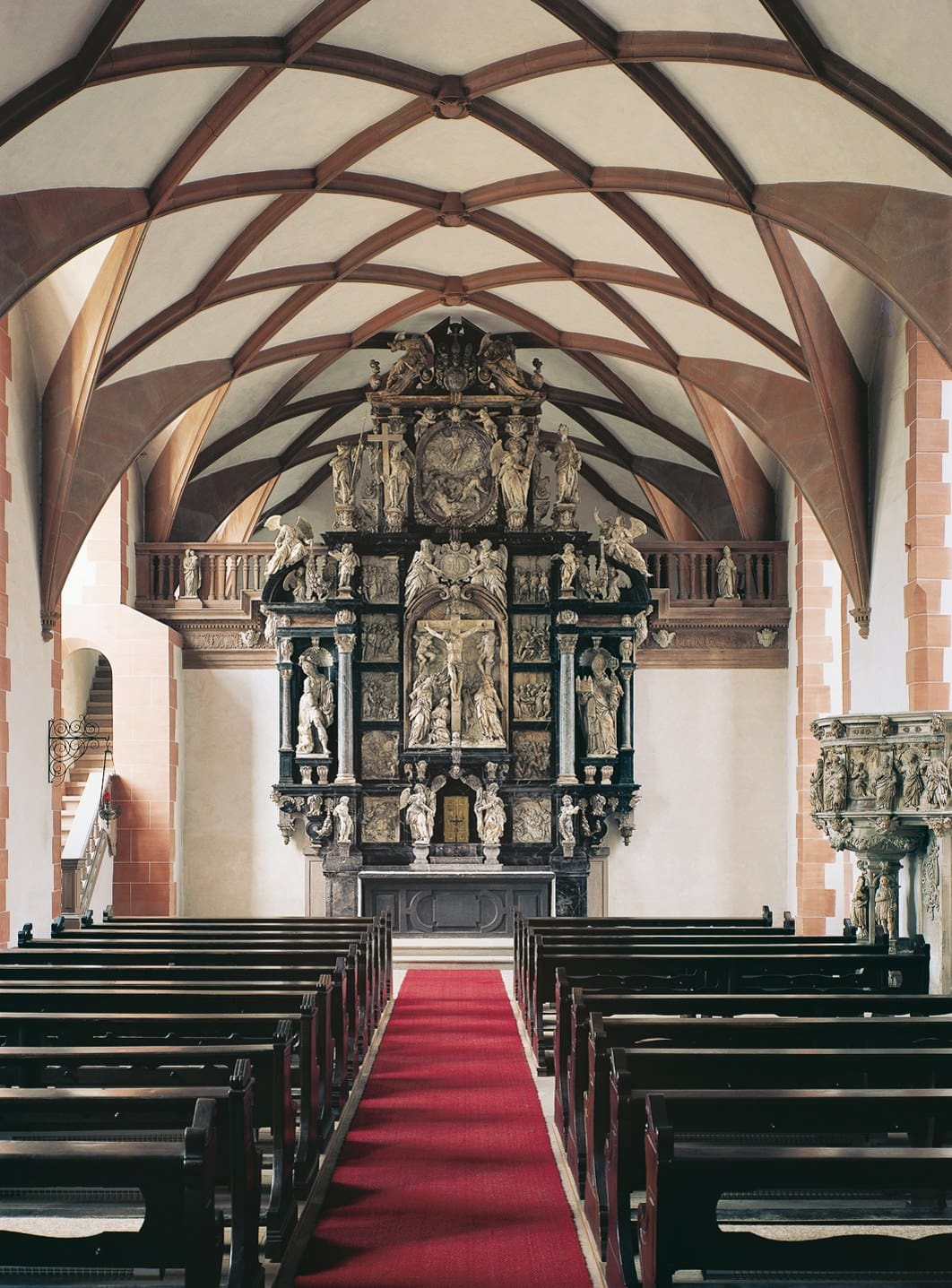
The high altar and pulpit are the work of Hans Juncker (ca. 1582 – ca. 1624), the Mainz court sculptor (Hofbildhauer) whose career was defined almost entirely by Johann Schweikard’s patronage. Juncker carved the high altar between 1609 and 1613: a multi-tiered ensemble in dark and agate-colored marble framing 31 alabaster sculptures and roughly 150 relief figures, organized around a central Crucifixion group, with five Passion reliefs on each side and a Resurrection above; Schweikard himself appears in the altar program as a donor figure, depicted as a bishop holding a sculpted model of the Schloss in his arms. Completed in 1618, the pulpit is its visual companion in the same idiom: alabaster figures over a reddish-marble frieze. The chapel’s triumphal-arch portal, designed jointly with Ridinger in red Main sandstone and trachyte tuff, completes Juncker’s program: John the Baptist and John the Evangelist flank the door, with a Baptism of Christ relief above and a crowned Madonna with Child in the pediment.
What survived 1944 was the chapel structure, the vault, and most of the Juncker ensemble. Damage to the altar required restoration as late as 1989; the protracted rebuild timeline for Johannisburg always involved completing the easy parts first and leaving the most artistically delicate work for decades. By the late twentieth century the chapel was once again functional and intact, and it remains today the single most important original art-historical interior in the building. For visitors interested in late-Renaissance and early-Baroque German sculpture, it is the room that earns the trip on its own.
Mainz on the Main: Erthal, Dalberg, and Bavaria (1700s–1864)
For the eighteenth century, Johannisburg meant Mainz. The Prince-Archbishops of Mainz, who were also Electors of the Holy Roman Empire and Arch-Chancellors of Germany, used the Schloss with increasing seriousness as the century progressed. It was not their official seat (that was always the Kurfürstliches Schloss in Mainz itself), but it was where the Elector preferred to be when matters of state allowed it. Mainz, on the left bank of the Rhine, was militarily exposed: every French campaign against the Empire treated it as a logical objective. Aschaffenburg, ninety kilometers up the Main and shielded by the broad Frankfurt plain, was deeper inside the Empire’s interior and considerably safer.
Friedrich Karl Joseph von Erthal (Archbishop-Elector July 18, 1774 – July 4, 1802) was the penultimate Prince-Archbishop of Mainz, and the last to preside over an intact Electorate before the Reichsdeputationshauptschluss dissolved the archbishopric in 1803. Born January 3, 1719 in Mainz into the Franconian imperial knightly family of the von Erthals, he had risen through the cathedral chapter to election as Archbishop-Elector on July 18, 1774. In October 1792, with the French Revolutionary Army at the gates of Mainz, Erthal fled. His route ran from Mainz to Erfurt by way of Aschaffenburg, a stop that turned out to be more permanent than he intended. He returned briefly to Mainz after the city’s recapture by Imperial forces, but the writing on the wall was unambiguous. On June 12, 1794, Erthal made Aschaffenburg his definitive Hauptresidenz. From that date Johannisburg was no longer a country palace; it was the seat of government for the truncated remnant of the Mainz Electorate.
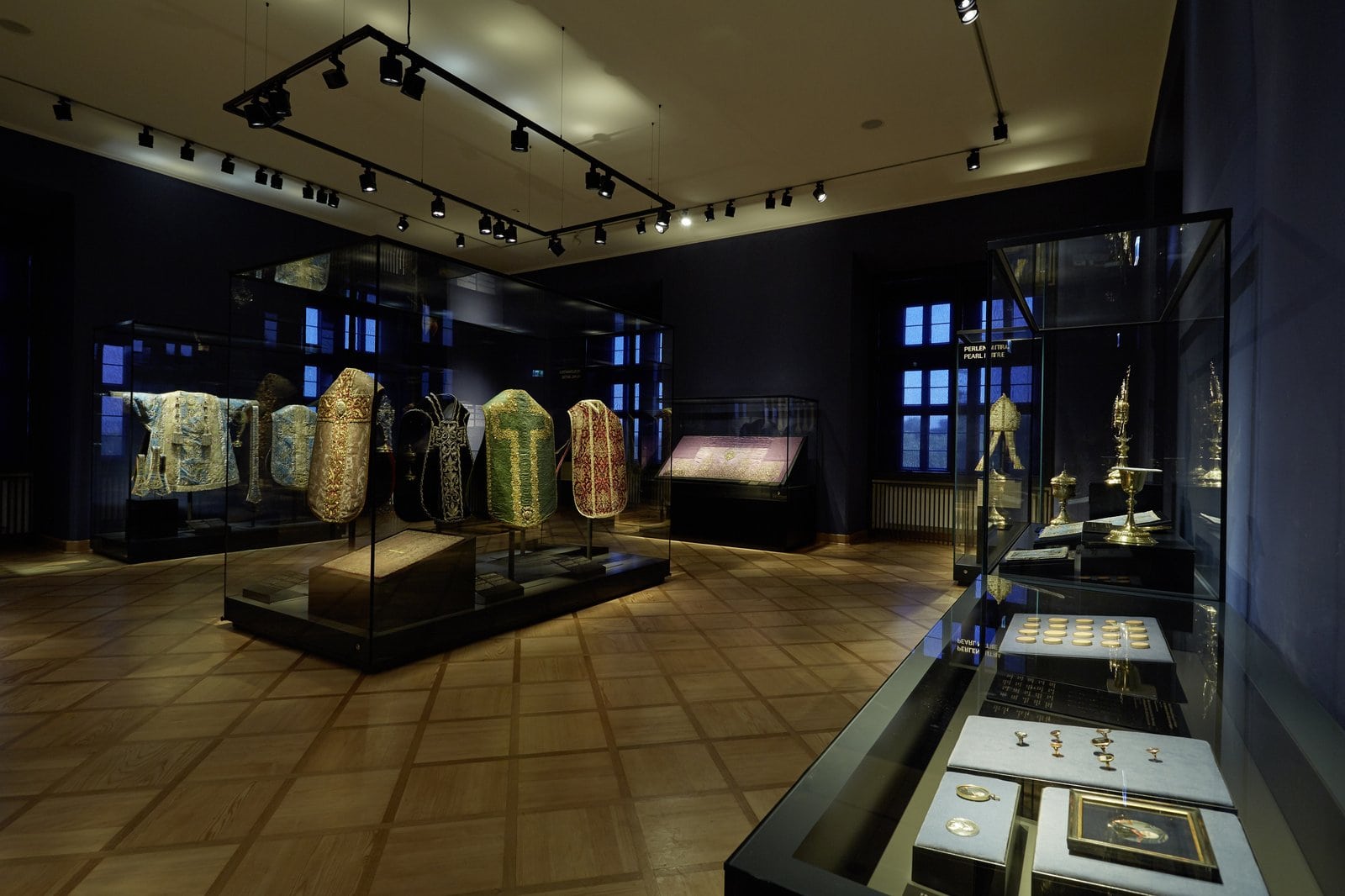
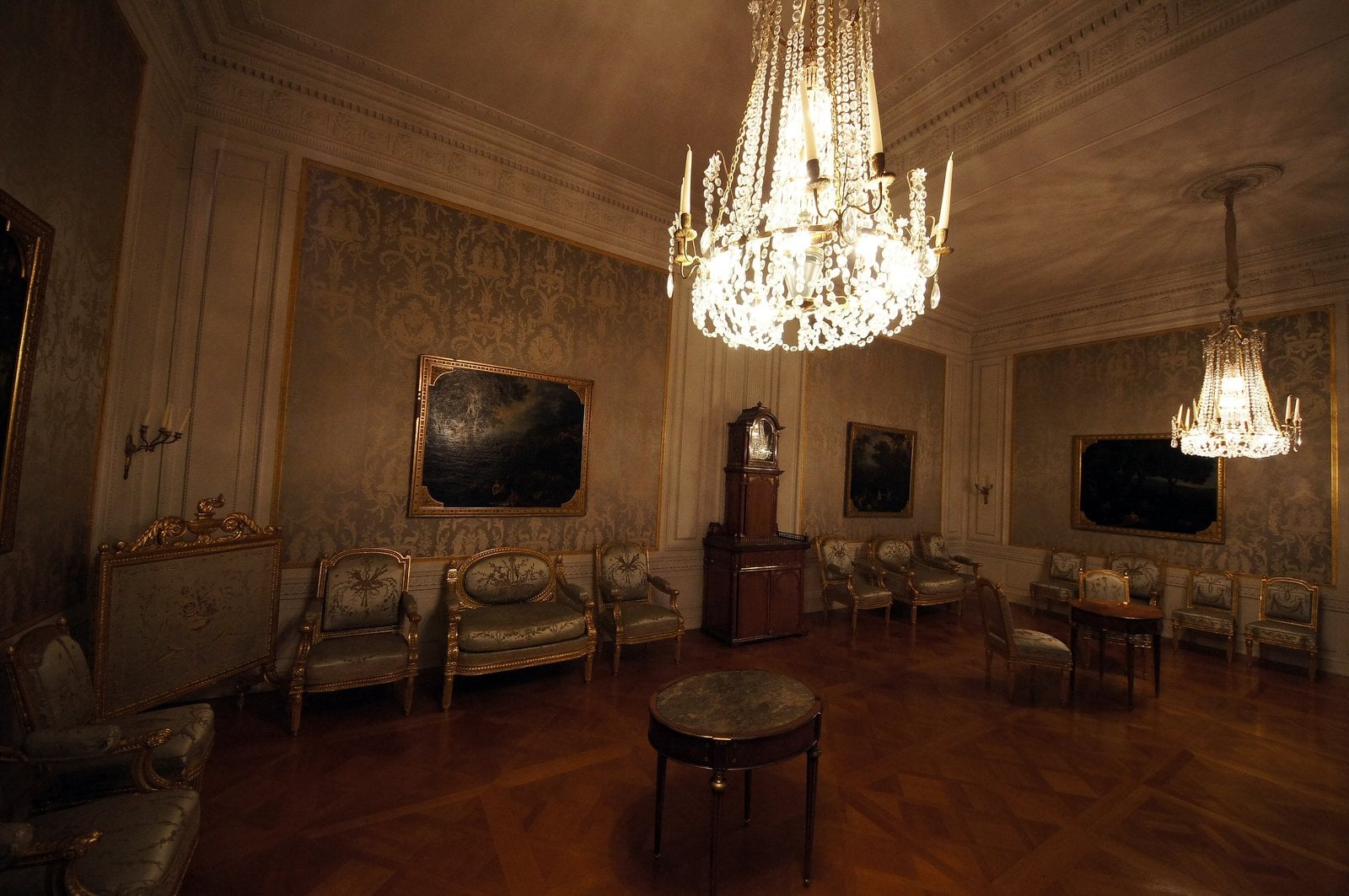
Mainz’s treasury, the cathedral library’s most precious manuscripts, the archive, and the cathedral’s liturgical vestments (many dating to the early Middle Ages) were evacuated in stages, beginning with Erthal’s flight on October 3, 1792, three weeks before General Custine’s troops entered the city on October 21. The Domschatz and the cathedral archive were sent down the Rhine to safety, while the court itself fled to the right-bank Mainz residences at Aschaffenburg, Erfurt, and Heiligenstadt. Vestments and other ecclesiastical textiles were ultimately consolidated at Johannisburg, where they have remained ever since: the historical reason the Paramentenkammer exists today. Erthal’s interior fittings of the Schloss (the Fürstliche Wohnräume, the Princely Apartments) were executed in the classicizing style of the late 1780s and 1790s, with restrained Louis-Seize elements adapted to a German imperial idiom. Red silk wall hangings, gilded mirrors, white-painted boiseries, and parquet floors define the surviving rooms. These apartments suffered grievous damage in 1944 and were rebuilt with painstaking attention to original color schemes and textile patterns; the most recent restoration phase reopened the apartments to the public in 2023.
Erthal resigned on July 4, 1802 and died three weeks later, on July 25, 1802, in Aschaffenburg, aged 83. His successor was Karl Theodor Anton Maria von Dalberg (born 1744), the last Elector of Mainz and the first and only Prince-Primate of the Confederation of the Rhine. Dalberg made Johannisburg his principal residence from 1803 to 1813. He hosted Napoleon at the Schloss first on October 2, 1806, and again on subsequent visits as the French Emperor moved between the German theaters of his campaigns. In 1810, with Mainz definitively absorbed into French territory, Dalberg’s Aschaffenburg-based principality was consolidated into the Grand Duchy of Frankfurt. Three years later, with Napoleon’s collapse, Dalberg’s career ended.
The Austro-Bavarian Treaty of June 26, 1814, transferred Aschaffenburg and its Schloss from the dissolved Grand Duchy of Frankfurt to the Kingdom of Bavaria; the transfer was confirmed by the Congress of Vienna in 1815. Johannisburg thus joined the Wittelsbach royal patrimony as a former-electoral residence. King Ludwig I of Bavaria (reigned 1825–1848) made his first stay at the Schloss in the summer of 1816 as Crown Prince and returned often. It was Ludwig I who commissioned the nearby Pompejanum on the opposite bank of the Main, built between 1840 and 1848 by his court architect Friedrich von Gärtner (1791–1847), with interior painting completed by 1850 by Gärtner’s pupil Friedrich Andreas Klumpp after Gärtner’s death, as an idealized reconstruction of Pompeii’s House of the Dioscuri (Casa dei Dioscuri), conceived not as a residence but as a study object so German art-lovers could see ancient Roman domestic architecture without traveling to Italy. The Pompejanum was part of Ludwig I’s broader cultivation of Aschaffenburg as a Mediterranean retreat: the city is traditionally said to have been called his Bayerisches Nizza (Bavarian Nice), though the direct attribution to Ludwig I himself is not securely documented in the primary sources. Ludwig I represented his absent grandson, the new Bavarian king Ludwig II, at the Schloss’s fiftieth-anniversary jubilee of Bavarian sovereignty in June 1864. Ludwig II himself (the famous castle-builder of Neuschwanstein and Linderhof) came to Aschaffenburg only twice as king: on June 30, 1864 for a one-night visit with his grandfather (during which the two visited the Pompejanum and Schönbusch together), and again from November 20–24, 1866, a four-day stay after the Austro-Prussian War devoted in part to visiting wounded soldiers. Johannisburg never figured in his architectural biography, a clarification worth making since the conflation with the Wittelsbach “fairy-tale king’s” famous residences appears occasionally in tourist materials. In 1835, J. M. W. Turner sketched Schloss Johannisburg from across the Main during his Rhine and Main tour; the drawing survives in the Tate’s Turner Bequest (CCCIV 44a, accession D30714).
Destroyed and reborn (1944–1964)
Schloss Johannisburg’s twentieth-century catastrophe came in two distinct phases. The first was the strategic bombing campaign: six USAAF raids on Aschaffenburg between October 27, 1944 and January 3, 1945 progressively gutted the Schloss room by room: the upper floors of the Mainflügel on October 27, November 5, and November 21; the Nordturm and Bergfried on December 12; the Südturm on December 29 and further parts on January 3. Severely damaged, the Schloss was still standing. The second and decisive phase was the Battle of Aschaffenburg, fought March 28 – April 3, 1945, in which the US 45th Infantry Division under LTC Felix L. Sparks faced a determined German garrison commanded by Major Emil Lamberth. Sustained artillery bombardment between March 25 and April 2 caused the entire complex to burn out, with portions of the masonry bursting and collapsing under the heat; the chapel’s net-vault and the entrance stucco ceilings were destroyed. Lamberth surrendered to Sparks at 9 a.m. on April 3, 1945, after hanging white flags from the damaged towers of the Schloss itself. By the time American forces secured the city, Johannisburg was a roofless shell.
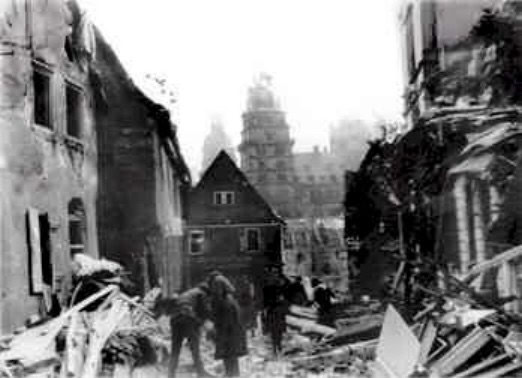
The post-1945 condition was somehow worse than the immediate wartime damage. On December 28, 1947, half of the Ostturm (East Tower) collapsed, weakened by structural damage and exposure. By the late 1940s the Schloss was a partially roofed ruin in which surviving fragments of the Juncker altar, the Wohnräume textiles, and the cork-model collection had to be salvaged from the rubble.
Postwar opinion in Aschaffenburg was initially split: there were serious proposals to leave the Schloss as a ruin, a monument to what bombing and artillery had done to the town. The decisive intervention came in 1954, when the Aschaffenburg bookseller Bernhard Pattloch founded a citizens’ Aktionsausschuss zum Wiederaufbau, a civic action committee that raised donations, ran public tombolas, and lobbied the Bavarian Finance Ministry until the state agreed to fund a full rebuild. Securing work on the burnt-out walls and unstable towers had in fact been ongoing since 1947 under the Bavarian Palace Administration (BSV), whose first postwar president, Rudolf Esterer (1879–1965, BSV president 1945–1952), set the doctrinal framework: a schöpferische Denkmalspflege (“creative monument care”) that combined faithful exterior reconstruction with adapted interior use. The principal rebuild ran in phases under BSV: the South and West towers were re-roofed and the Bergfried, Stadtflügel and Mainflügel stair-tower restored between 1956 and 1960; the Südflügel, Mainflügel and Schlosskapelle were restored by 1964, when the first display rooms reopened; the Kapellen- and Stadtflügel were re-roofed in 1965 and 1966; the Ostturm was rebuilt in 1968; the carillon was installed in 1969; the courtyard and outdoor works were finished in 1980; and the chapel altar restoration was finalized in 1989. A phrase often used in BSV’s own materials, “rebuilt 1954–1964 (East tower 1968; surrounding works through 1989),” captures the layered character of the project. Reconstruction was guided by extensive prewar photographic documentation and the surviving original drawings from the Ridinger campaign. Façades and roofs were rebuilt in detail-faithful form; interiors, by contrast, were laid out for the building’s new museum function rather than reconstructed room by room. In conservation terms, this is a faithful exterior reconstruction over a re-planned interior: not a creative reinterpretation, but not a wholesale recreation either.
Schloss Johannisburg is currently in the second phase of its first comprehensive Sanierung since the postwar rebuild, a two-Bauabschnitt program managed by the Staatliches Bauamt Aschaffenburg for the Bavarian Finance Ministry, with BSV as operator. BA1 (€15.7 million, 2016–2023) restored the Mainflügel: the river-facing sandstone facades and corner towers, the Hofbibliothek, the Fürstliche Wohnräume, and the Staatsgalerie filial gallery, with technical-services replacement throughout. BA2 began on November 4, 2024 with a €10.8-million facade restoration of the remaining three sides: the Eingangs-, Stadt-, and Kapellenflügel, in that sequence, working counter-clockwise around the courtyard. As of May 2026 BA2 is in progress; the Schloss remains open at normal hours, with all six museum rounds (Staatsgalerie, Paramentenkammer, Schlosskapelle, Korkmodellsammlung, Fürstliche Wohnräume, and the city Schlossmuseum) accessible without partial closures.
Visiting Johannisburg in 2026
Schloss Johannisburg is operated by two distinct institutions whose ticketing does not overlap. Visitors interested in the full building should plan to buy two tickets. Entry tickets and local tours can also be booked in advance through GetYourGuide.
The Bavarian Palace Administration (Bayerische Schlösserverwaltung, or BSV) manages the headline rooms: the Staatsgalerie in der Johannisburg, with its collection of Lucas Cranach the Elder paintings; the Paramentenkammer, with its evacuated Mainz vestments; the Schlosskapelle, with the Juncker altar and pulpit; the Korkmodellsammlung, the cork-model collection of Roman antiquities produced by Carl May (May 11, 1747 – June 6, 1822) and his son Georg Heinrich May (1790–1853) between approximately 1792 and 1854; and the Fürstliche Wohnräume, the late-electoral classicist apartments reopened to the public in 2023. The BSV admission for 2026 is €7 (€6 reduced); a combined ticket with the nearby Pompejanum is €10 (€8). Hours are April 1 to October 3: 9:00 to 18:00; October 4 to March 31: 10:00 to 16:00. The Schloss is closed Mondays except certain public holidays. Card payment is not currently accepted.
Operated separately by the Museen der Stadt Aschaffenburg in 1,400 m² of additional wings, the Städtisches Schlossmuseum sells its own ticket at €6 (€5 reduced) and a distinct city Kombiticket with the Pompejanum at €9 (€7 reduced), distinct from the BSV’s €10/€8 combined ticket. Hours run Tuesday to Sunday, 9:00–18:00 in April–September and 10:00–16:00 in October–March, closed Mondays. The municipal collections cover six centuries of Aschaffenburg’s princely representation, city and industrial history, sculpture, painting, applied art, and contemporary art, supplemented by rotating special exhibitions on regional artists and applied-arts themes. As of publication there are no temporary closures or exhibition gaps.
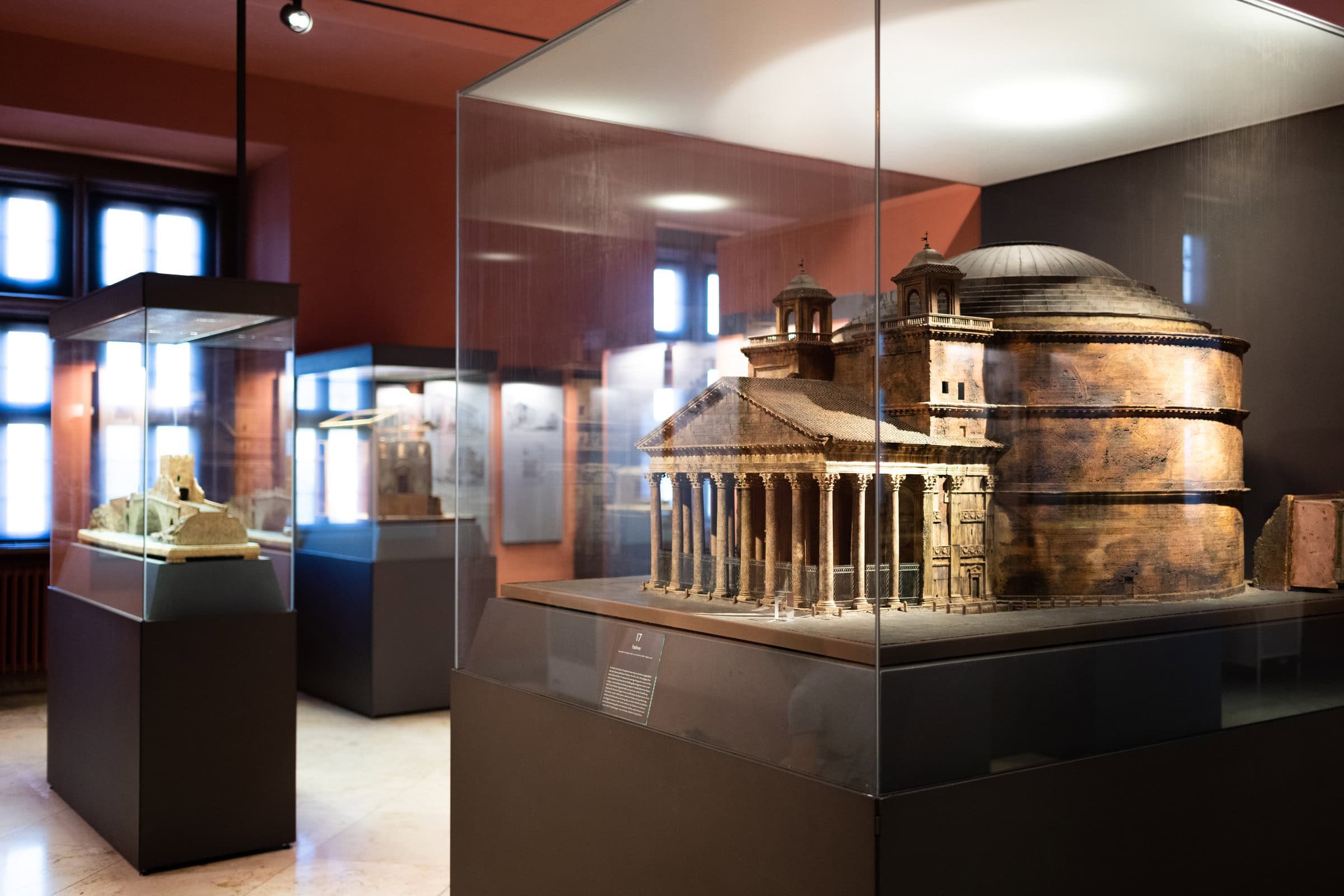
The Korkmodellsammlung deserves a particular note: it is reportedly the largest collection of its kind in the world, and it represents one of the few intact survivors of the late-eighteenth-century vogue for Phelloplastik, the production of architectural cork models, originally as souvenirs of the Roman Grand Tour, but elevated by the Mays into objects of considerable scholarly precision. The May models reproduce major monuments of ancient Rome (the Pantheon, Colosseum, Temple of Vesta, and others) at scales of roughly 1:80 to 1:100 with extraordinary fidelity to surface texture. They were purchased by Erthal and his successors over four decades and have remained in the Schloss collection since.
Across the Main, the Pompejanum (€7 / €6 reduced; combined ticket as above) hosts through October 31, 2026, the special exhibition Troublemaker. Mischwesen der Antike on hybrid creatures of classical antiquity. The Bavarian Radio Symphony Orchestra is scheduled to perform at Johannisburg on May 21, 2026, as part of the regular concert program. The Schloss is a fifteen-minute walk from Aschaffenburg Hauptbahnhof, which lies on the regional rail network with frequent services from Frankfurt am Main (forty minutes) and Würzburg (sixty-five minutes). For visitors making the broader Mainz–Würzburg–Aschaffenburg circuit of Prince-Bishop Residences, Johannisburg is the practical eastern anchor of the trip. Anyone staying overnight can compare hotels in and around Aschaffenburg.
Some links on this page are affiliate links, which means StoneKeep Atlas may earn a small commission, at no extra cost to you, if you book through them.
Beyond Johannisburg Palace
Johannisburg is one face of a broader category of German palaces built or held by the prince-bishops, prince-archbishops, and prince-electors of the Holy Roman Empire: sovereigns whose temporal authority required residences blending courtly grandeur with ecclesiastical ritual. A natural pairing for a visitor in the region is with the Würzburg Residence, an hour east by rail and a comparable BSV-managed site, though where Johannisburg is a Renaissance courtyard fortress finished in 1614, Würzburg is a late-Baroque ceremonial palace finished in the 1740s. The two read as bookends of the imperial church’s two great residential ambitions. Closer to Würzburg, Marienberg Fortress stands in for what Johannisburg would have been had Albrecht Alcibiades’s 1552 destruction not occurred and the rebuild not happened: a hilltop bishop’s castle of medieval origin progressively adapted but never replaced. Within the broader catalog of Bavarian castles, Johannisburg sits alongside Neuschwanstein Castle, Hohenschwangau Castle, Linderhof Palace, and Herrenchiemsee New Palace, all operated by the Bayerische Schlösserverwaltung. Within the wider catalog of German castles, Johannisburg sits among the Prince-Bishop Residences of the imperial church (Würzburg, Bamberg, Mainz, Trier, and Salzburg), the residential network of which it was, for two and a half centuries, the eastern Mainz anchor.
Conclusion
Schloss Johannisburg is, in the end, a building that earned its single-architect coherence because Johann Schweikard von Kronberg could afford to commission one, and that survived the catastrophe of 1944–1945 because the Bavarian state, twenty years later, was determined to give it back. Over the four decades between 1954 and the chapel altar’s restoration in 1989, the BSV restored the Vierflügelanlage to its 1614 silhouette, the Schlosskapelle to Juncker’s vision, and the Fürstliche Wohnräume to Erthal’s classicizing taste. From across the Main, in 2026, what looks back is a Renaissance fortress that has spent four centuries being a Schloss and not a Residenz, and that wears the distinction with discernible pride.
The role of the Counter-Reformation prince-bishoprics in the wider confessional century is examined in The Reformation and the Castle.
Principal Sources
- Dehio, Georg. Handbuch der deutschen Kunstdenkmäler. Bayern Bd. 1: Franken — Die Regierungsbezirke Oberfranken, Mittelfranken und Unterfranken. 2nd ed. München: Deutscher Kunstverlag, 1999. ISBN 978-3-422-03051-0.
- Fischer, Roman. Aschaffenburg im Mittelalter. Studien zur Geschichte der Stadt von der Karolingerzeit bis zum Ende der Stauferherrschaft. Veröffentlichungen des Geschichts- und Kunstvereins Aschaffenburg, Bd. 32. Aschaffenburg: Geschichts- und Kunstverein, 1989. ISBN 978-3-87965-041-5.
- Hemmeter, Karlheinz. Bayerische Baudenkmäler im Zweiten Weltkrieg. Verluste – Schäden – Wiederaufbau. München: Bayerisches Landesamt für Denkmalpflege, 1995. The standard reference for war damage and postwar reconstruction of Bavarian monuments, and the underlying scholarly basis for the HdBG Wiederaufbauatlas entries on Schloss Johannisburg and the wider Aschaffenburg building stock.
- Pattloch, Bernd. Schloss Johannisburg in Aschaffenburg. Zerstörung und Wiederaufbau 1944 bis 1999. Aschaffenburg: Geschichts- und Kunstverein, 2007. ISBN 978-3-87965-108-5.
- Roda, Burkard von, and Werner Helmberger. Schloss Aschaffenburg. Amtlicher Führer. 9th ed. München: Bayerische Verwaltung der staatlichen Schlösser, Gärten und Seen, 1997. ISBN 978-3-980565-42-4.
- Stadtarchiv Aschaffenburg. Aschaffenburg 2.0 — Bodendenkmäler: Schloss Johannisburg. Digital archive entry incorporating the archaeological investigations of the medieval predecessor structures, including the dating of the surviving Bergfried to c. 1337 with a late-fourteenth-century elevation. aschaffenburgzweinull.stadtarchiv-digital.de.
- Ridinger, Georg. Architectur des Maintzischen Churfürstlichen neuen Schlossbawes St. Johannspürg zu Aschaffenburg. Mainz, 1616. Thirty-four engravings by Georg Keller after designs by Ridinger, printed by Johann Albin — the architect’s own contemporary documentation of the Schloss, presented to Schweikard before final completion and the most authoritative single record of the building’s original state. Hofbibliothek Aschaffenburg, D IV, 5; further holdings include the Metropolitan Museum of Art (object no. 48.19). Modern facsimile edition with explanatory commentary by Hans-Bernd Spies, 2nd expanded ed.
- Richter, Thomas, ed. Der Bildhauer Hans Juncker — Wunderkind zwischen Spätrenaissance und Barock. Aschaffenburg / München: Hirmer Verlag, 2014. ISBN 978-3-7774-2227-5. Standard scholarly monograph on Juncker, published in connection with the 2014 Schloss-Jubiläum exhibition Wunderkind mit Hammer und Meißel at the Schlossmuseum Aschaffenburg.
- Lütkenhaus, Hildegard, and Winfried Wilhelmy, eds. Der Mainzer Domschatz. Meisterwerke des Bischöflichen Dom- und Diözesanmuseums Mainz, vol. 3. Regensburg: Schnell & Steiner, 2022. ISBN 978-3-7954-3548-6. Standard 608-page scholarly catalog of the Mainz cathedral treasure, including its 1792–1803 dispersion and the holdings that ended up at Johannisburg.
Operator and institutional sources for this article include the Bayerische Schlösserverwaltung portal at schloesser.bayern.de and the joint BSV/Stadt Aschaffenburg site at schloesser-aschaffenburg.de; the Stadtmuseum Aschaffenburg at museen-aschaffenburg.de; the Haus der Bayerischen Geschichte’s Wiederaufbauatlas at hdbg.eu/wiederaufbau; and the Tate’s Turner Bequest catalog entry CCCIV 44a (accession D30714) for J. M. W. Turner’s 1835 sketch.
Image credits. Hero photo and Schlosskapelle interior: © Bayerische Schlösserverwaltung (photographer Lucinde Weiss), schloesser.bayern.de. Aerial view and Paramentenkammer: © Bayerische Schlösserverwaltung (Paramentenkammer photographer: Scherf-Gruber), schloesser.bayern.de. Korkmodellsammlung interior: © Bayerische Schlösserverwaltung (photographer www.kreativ-instinkt.de), schloesser.bayern.de. Courtyard interior: Martin Kraft, CC BY-SA 3.0, via Wikimedia Commons. Fürstliche Wohnräume: Allie Caulfield, CC BY 2.0, via Wikimedia Commons. Sulman engraving: Thomas Sulman (c. 1834–1900), public domain, via Wikimedia Commons. 1945 ruin: 45thDivision.org, public domain, via Wikimedia Commons. Freely licensed images are resized to fit; otherwise unaltered.