
Herrenchiemsee New Palace
Herrenchiemsee New Palace (Schloss Herrenchiemsee or Neues Schloss Herrenchiemsee) stands on the largest island in the Chiemsee, a Bavarian lake roughly eighty kilometers southeast of Munich. It was the last and most ambitious of the three palaces built for King Ludwig II of Bavaria: a deliberate architectural homage to the Versailles of Louis XIV, conceived as a monument to absolute monarchy at the very moment Bavarian kingship was being absorbed into the new German Empire. Begun in 1878 and abandoned when Ludwig died in June 1886, the palace was never finished. In July 2025 it was inscribed, together with Neuschwanstein, Linderhof, and the Royal House on the Schachen, as a UNESCO World Heritage Site.
Quick Facts
| Country | Germany |
| Region / State | Bavaria (Oberbayern) — Chiemgau, on the Herreninsel in the Chiemsee |
| Nearest Town | Prien am Chiemsee (ferry departure point) |
| Coordinates | 47.8606° N, 12.3981° E |
| Construction Period | 1878–1886 (unfinished at Ludwig II’s death) |
| Founder | King Ludwig II of Bavaria |
| Architectural Style | 19th-century historicism / Neo-Baroque, modeled on Versailles |
| Building Type | Schloss (palace) — royal pleasure palace and Versailles homage |
| Current Condition | Partially finished; preserved as left in 1886; operated as a museum by the Bayerische Schlösserverwaltung |
| Open to Visitors | Yes — by guided tour, reached by ferry from Prien am Chiemsee |
| UNESCO Status | World Heritage Site (inscribed 2025) as component 1726-004 of The Palaces of King Ludwig II of Bavaria |
| Official website | herrenchiemsee.de |
Overview
Herrenchiemsee is often described as Ludwig II’s “Bavarian Versailles,” and the description is almost literal. The king ordered it built in explicit imitation of the French royal palace he had visited and revered, not as a stylistic reference but as a functioning temple to the ideal of absolute kingship embodied by Louis XIV. Its central block, State Rooms, Great Hall of Mirrors, and approach gardens were all modeled directly on their Versailles counterparts, with some elements, including the mirror gallery, built to dimensions exceeding the original.
Herrenchiemsee occupies the Herreninsel, a 238-hectare wooded island in the Chiemsee. Ludwig purchased the island in 1873 to protect its forests from commercial logging and to secure a setting for the palace he had been designing in his mind for years. Construction began in 1878. Only a fraction of the intended building was completed: roughly twenty rooms in the central corps-de-logis were finished to the king’s standard. Its north and south wings, designed to mirror each other across a vast axial complex, remain either unbuilt or left as raw masonry. When Ludwig drowned in Lake Starnberg on June 13, 1886, construction stopped within days. As it stands today, the palace preserves the moment of his death.
Location and Setting
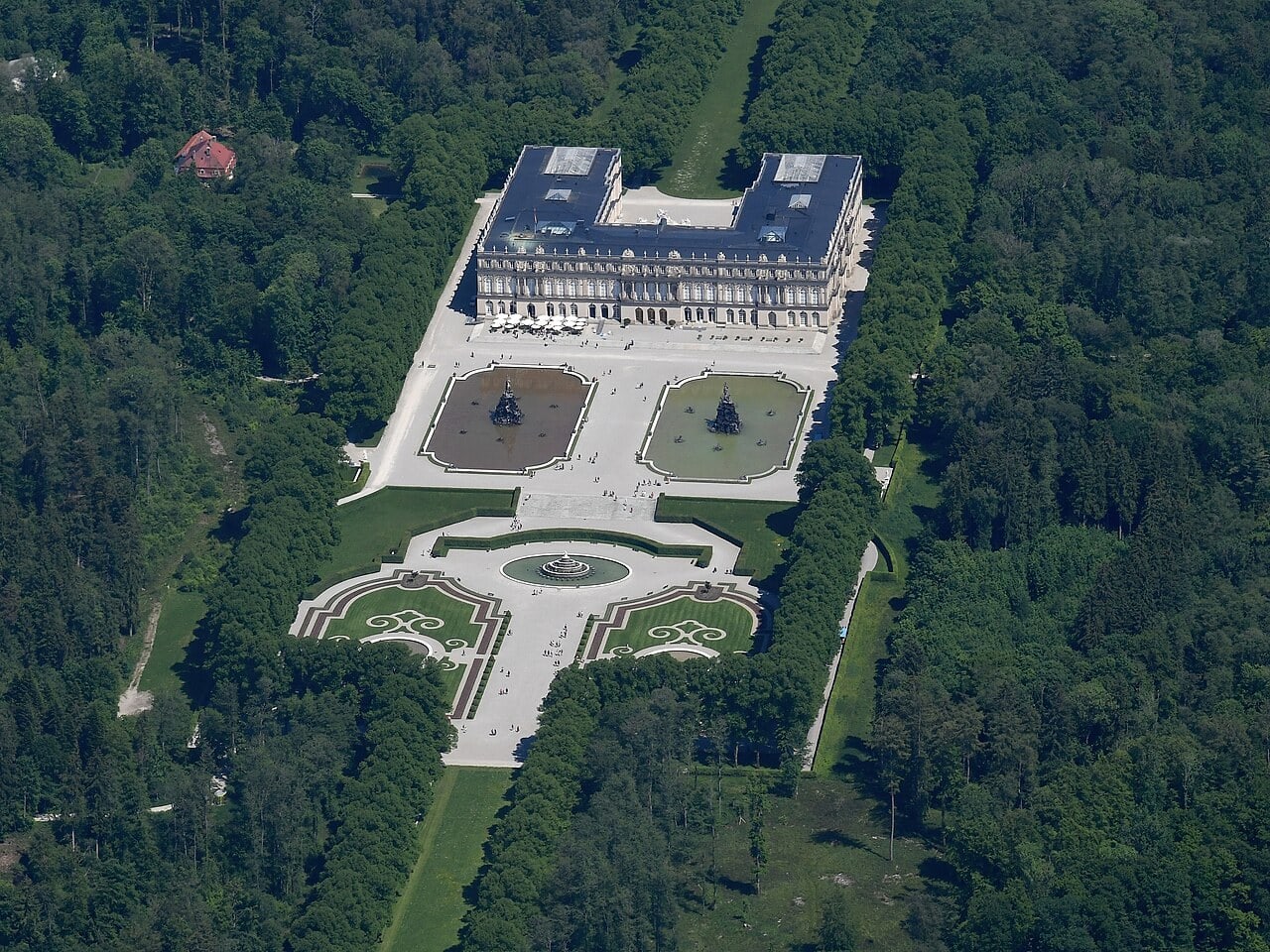
Chiemsee is the largest lake in Bavaria, fed by Alpine rivers and ringed by meadows and moraines that rise into the pre-Alpine foothills to the south. The Herreninsel (“Gentlemen’s Island”) is its largest island; the smaller Fraueninsel (“Ladies’ Island”) lies nearby, occupied by a Benedictine nunnery founded in the eighth century. Access to Herrenchiemsee is by passenger ferry from Prien am Chiemsee, the main lakeside town and the nearest rail station. From the ferry landing, a wide path lined with linden trees leads north through the island forest to the palace.
On the island’s western side, the New Palace was sited on the central axis, with its main façade facing west toward the lake and the setting sun. Ground in front of it was graded into a vast formal garden modeled on the parterre of Versailles, with a central canal, geometric lawns, and a succession of sculpted fountains along the axis: the Fama fountain nearest the palace, Latona further out, and an unfinished Apollo basin beyond that marks the furthest extent of the completed grounds. Partially finished in 1886, the gardens have been maintained, though never fully completed, ever since.
The setting is not only picturesque: it is deliberate. Ludwig wanted his Versailles to face open water rather than be enclosed by a city. The island removed the palace from the Bavarian public; the lake framed it at a theatrical distance; the mountains provided a backdrop that no French palace could match. Of all three Ludwig palaces, this is the one most consciously designed as a set piece to be approached by ceremony.
Historical Background
The island before Ludwig
Herreninsel had been occupied since at least the eighth century by an Augustinian monastery, the Altes Schloss Herrenchiemsee (Old Palace), which grew over the medieval centuries into a substantial religious complex. In 1803 the monastery was secularized during the Napoleonic reorganisation of the German states. After passing through several private hands, the island was acquired in the 1870s by a Bavarian timber firm that intended to clear its ancient woodlands. Ludwig bought the island in September 1873 partly to stop the logging and partly because he had already begun to imagine a Bavarian Versailles and needed a site grand enough to carry it.
Design and construction, 1873–1886
Ludwig’s court architect Georg von Dollmann, who had also worked on Linderhof and Neuschwanstein, drew up the initial plans in close consultation with the king. Julius Hofmann later took over direction of the works. Construction on the central block began in 1878. The building was conceived on a U-plan with a central corps-de-logis flanked by two long wings enclosing a Cour d’honneur, the Versailles layout in essentials, though adapted to the island’s topography.
Ludwig visited the site only once during construction, in September 1885, less than a year before his death. By then the central block was structurally complete and the State Rooms were being fitted out. Its scale was extraordinary, the costs catastrophic. By June 1886 the bill for completed work had been estimated at roughly 16.5 million gold marks, more than twice the cost of Neuschwanstein. Ludwig’s three major building projects together created a severe debt crisis that strained the Bavarian treasury; by 1886 his cabinet was actively seeking ways to stop him from spending further.
The unfinished palace, 1886–1945
On June 9, 1886 Ludwig was declared insane by a government commission and deposed; four days later he was found drowned in Lake Starnberg under circumstances that have never been fully resolved. Construction at Herrenchiemsee halted within days. Bavaria inherited the unfinished palace along with its debts. Instead of demolishing the building or completing it (both were politically impossible), the state opened the finished rooms to paying visitors in August 1886, less than two months after Ludwig’s death. Entrance fees were used to pay down the construction debts, a program that continued into the twentieth century.
The Constitutional Convention of 1948
In August 1948 the Altes Schloss (the former monastery on the same island, not the New Palace) hosted the Constitutional Convention (Verfassungskonvent) that drafted the foundational text of the West German Basic Law (Grundgesetz). Delegates from the eleven West German Länder met at Herrenchiemsee for two weeks of concentrated work that produced the so-called Herrenchiemsee Draft, the blueprint from which the Parliamentary Council in Bonn wrote the Basic Law the following year. A permanent exhibition on the Convention opened in the Altes Schloss in 2023. Its historical resonance is pointed: a palace built as a temple to absolute monarchy became, sixty-two years after its royal builder’s death, the birthplace of modern German democracy’s founding document.
Architectural Highlights
Exterior and setting
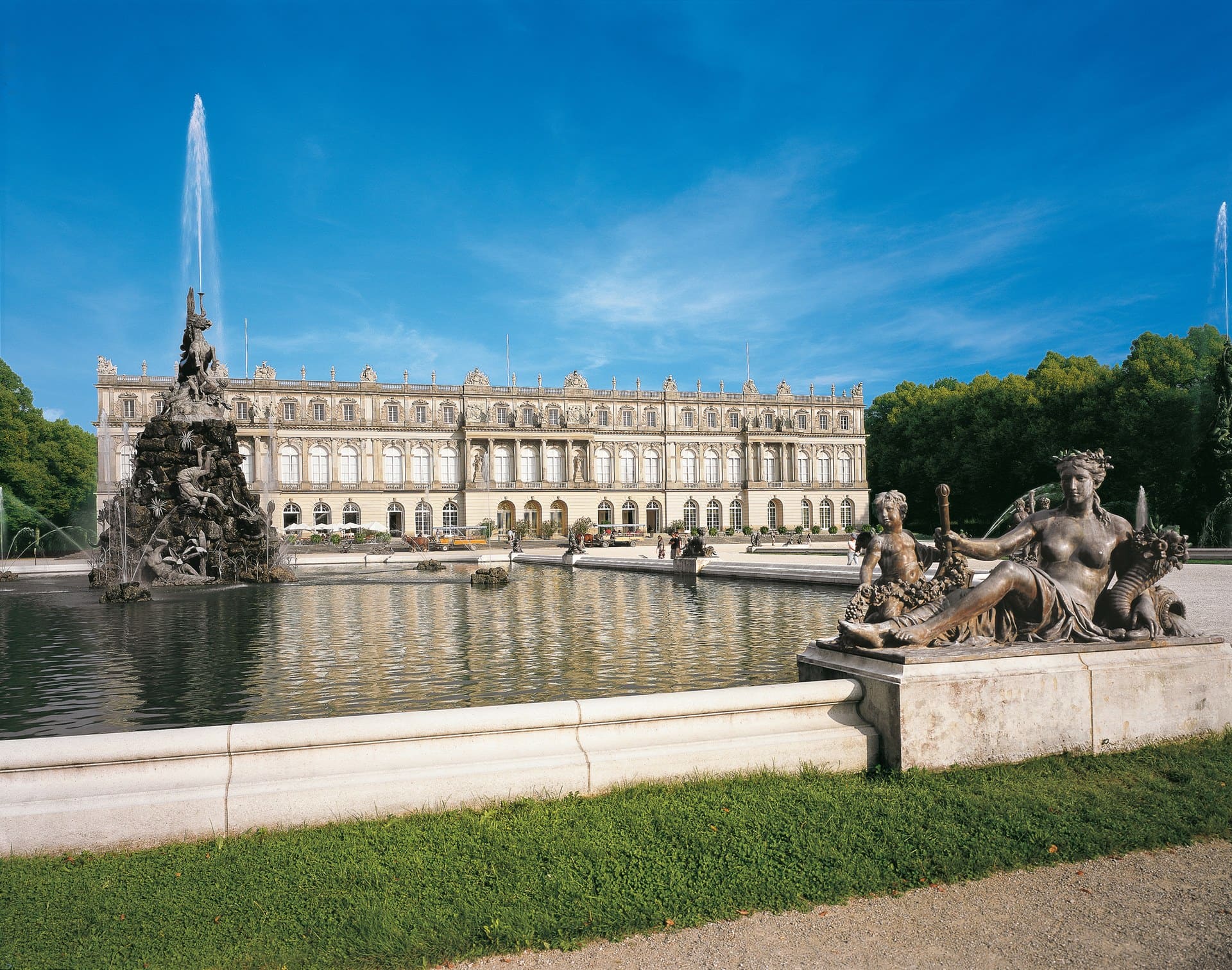
Its west façade, the only one fully completed, presents a three-story palace front roughly 100 meters wide, with a rusticated ground floor, a piano nobile defined by tall round-arched windows framed by engaged columns, and a crowning attic story with a balustrade and sculptural figures. Slightly projecting pavilions flank the central block, the whole composition organized around the central axis that continues through the entrance hall, the State Staircase, and the enfilade of rooms to the Great Hall of Mirrors at the back. The detailing is Neo-Baroque in a particularly French register; the references are to Louis XIV’s Versailles throughout, with no medievalism and none of Neuschwanstein’s Romantic eclecticism.
Interior rooms
Beyond the ambassadors’ staircase, roughly twenty rooms of the central block were finished. Each was designed as a direct quotation from Versailles, occasionally enriched beyond the original.
The State Staircase (Prunktreppenhaus) rises through the full height of the palace on the south side of the entrance hall. It is modeled on the now‑destroyed Ambassadors’ Staircase (Escalier des Ambassadeurs) at Versailles, and Ludwig’s version, completed in 1881, follows the original very closely, forming one of the fullest surviving reconstructions of Louis XIV’s original.
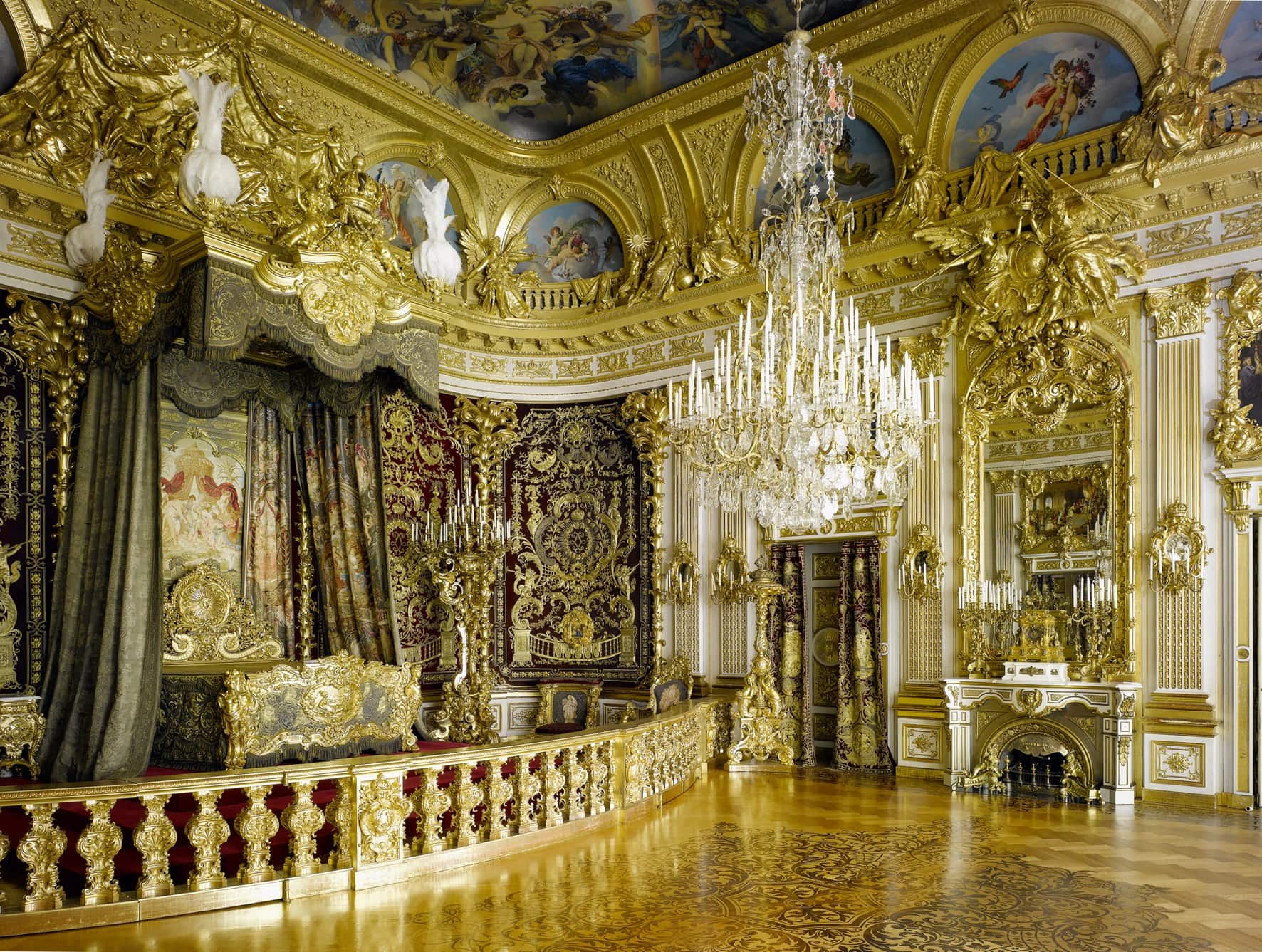
The State Bedchamber (Paradeschlafzimmer) is the most richly decorated room in the palace and the spatial heart of the state apartment. It directly evokes the King’s Bedchamber at Versailles, though Herrenchiemsee’s version is even more lavish. More than four kilograms of gold leaf were used on the ceiling, the bed canopy, and the balustrade separating the bed alcove from the rest of the room. The room’s blue, gold, and red palette recalls the courtly color scheme associated with Louis XIV.
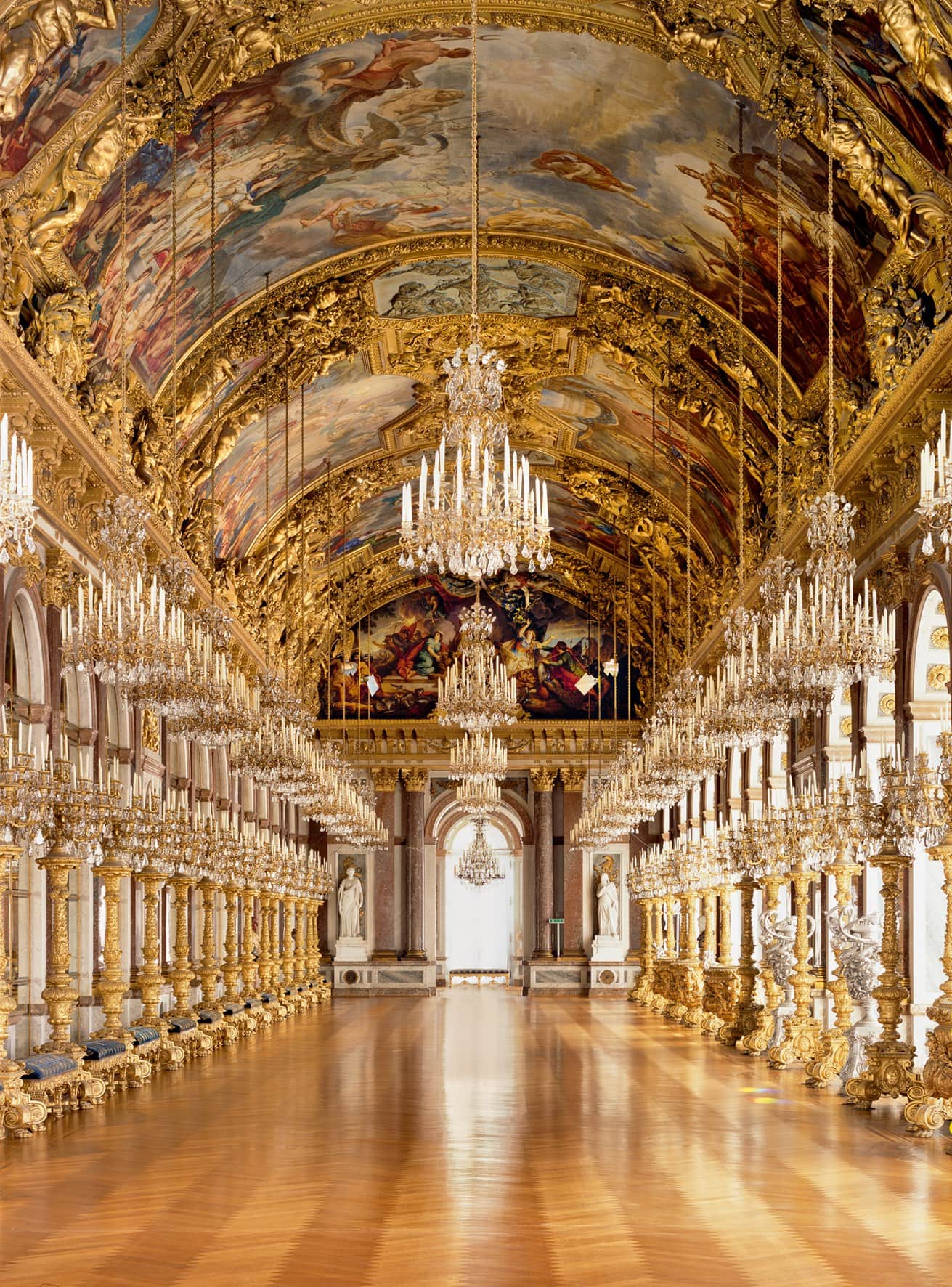
Great Hall of Mirrors (Große Spiegelgalerie) runs along the garden side of the central block and is Herrenchiemsee’s most famous room. At roughly 98 meters long, it is deliberately longer than the Hall of Mirrors at Versailles (which measures approximately 73 meters). Thirty-three chandeliers hang along the length of the vaulted ceiling, and thirty-three mirror panels alternate with windows along the garden wall. Its proportions, the sequence of mirrors and arcades, and the decorative scheme all follow Versailles closely, with the additional length reflecting both Ludwig’s wish to exceed his model and the building’s different geometric plan.
The Small Apartment of private rooms (bedroom, study, dining room, and bathroom) was finished for Ludwig’s personal use. The Small Dining Room contains one of Linderhof’s most famous features, the Tischlein-deck-dich (“table set yourself”) mechanical dining table that could be lowered through the floor to a kitchen below and raised again with meals, allowing Ludwig to dine without the presence of servants. Herrenchiemsee’s version is larger and more elaborate than Linderhof’s.
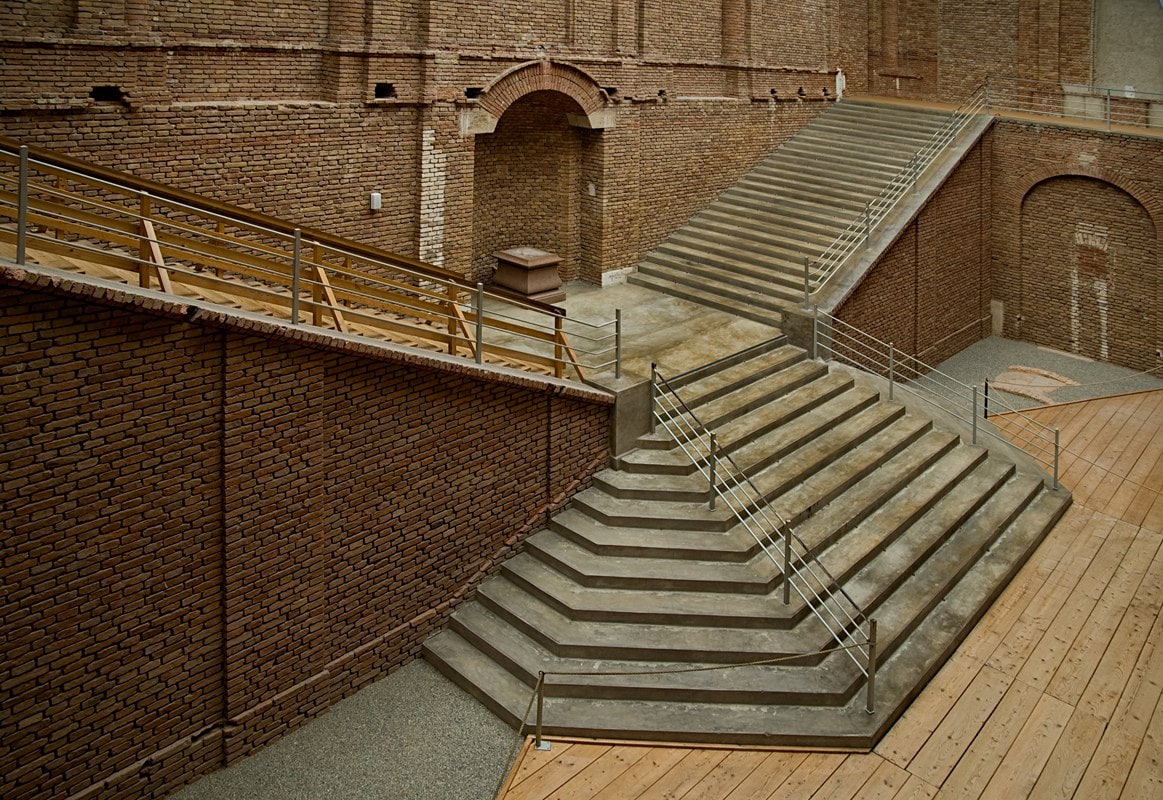
The Unfinished Staircase (Nord-Prunktreppenhaus), the northern counterpart to the completed State Staircase, was begun but halted at Ludwig’s death. It has been preserved as it was left: bare brick walls, an unplastered vault, and the framing timbers still visible. Its contrast with the gilded State Staircase on the opposite side of the palace is deliberate and moving: one staircase shows what the building was meant to be, the other shows what actually happened.
Visiting the Castle
Herrenchiemsee is reached by passenger ferry from Prien am Chiemsee; the crossing takes about fifteen minutes. From the landing, a wooded path leads to the palace on foot, or a horse-drawn carriage covers the same route in about fifteen minutes between mid-April and the end of October. The operator advises allowing about an hour to reach the New Palace, the crossing included. The palace is open daily year-round, with reduced hours in winter; opening times and current schedules are best confirmed on the official site before travel. Entry tickets and local tours can also be booked in advance through GetYourGuide.
Entry to the New Palace is by guided tour only. Tours run in German and English at fixed intervals throughout the day, and last approximately thirty-five minutes. They cover the State Staircase, the sequence of finished state rooms including the Great Hall of Mirrors and the State Bedchamber, the Small Apartment, and (pointedly) the unfinished northern staircase. Interior photography without flash is permitted.
On the same island, the Altes Schloss holds the King Ludwig II Museum (dedicated to his three building projects) and the permanent exhibition on the 1948 Constitutional Convention. Both are included in the combined ticket and are easily visited in the same day. Anyone staying overnight can compare hotels in and around Prien am Chiemsee.
Admission
| Ticket | Price |
|---|---|
| Island combined ticket, from 19 October 2026 (New Palace tour, King Ludwig II Museum, Augustinian canons’ monastery) | 11.00 euros / 10.00 reduced |
| Island combined ticket, 18 May to 18 October 2026, including the special exhibition | 14.00 euros / 13.00 reduced |
| Special exhibition alone, 18 May to 18 October 2026 | 7.00 euros / 6.00 reduced, sold only at the on-site desks |
| Augustinian canons’ monastery alone | 6.00 euros / 5.00 reduced |
| King Ludwig II Museum alone | 6.00 euros / 5.00 reduced |
| Guided tour of the island minster | 6.00 euros / 5.00 reduced, not in the combined ticket |
| Children and young people under 18 | Free |
| Carriage from the landing to the palace, one way | 5.00 euros adults, 2.00 euros ages 5 to 14, mid-April to end of October |
| Ferry crossing | Not included in any ticket above; fares are set by Chiemsee-Schifffahrt |
Some links on this page are affiliate links, which means StoneKeep Atlas may earn a small commission, at no extra cost to you, if you book through them.
Nearby Attractions
The Fraueninsel, a short ferry hop from the Herreninsel, is worth a separate visit. Its eighth-century Benedictine nunnery is still active, and the island’s village of fishermen’s cottages and its small church are among the most atmospheric corners of the Chiemsee. Prien am Chiemsee itself has the lake’s best concentration of accommodation and a restored steam railway that runs to the ferry pier in summer.
Visitors combining Herrenchiemsee with Ludwig II’s other palaces often pair it with Linderhof Palace (about two hours’ drive southwest) and Neuschwanstein Castle (about two-and-a-half hours further west), which shares its village with Hohenschwangau Castle, the childhood home where Ludwig first absorbed the legends his later palaces would stage. The Castles of King Ludwig II provides a broader overview of the three royal palaces as a single architectural and biographical program.
Travel Tips
- Allow a full day on the island. A combined ticket covers the New Palace, the Ludwig II Museum, and the Altes Schloss exhibitions; each is worth unhurried time.
- Book the New Palace tour online before you arrive in high season. Walk-up tickets sell out on summer weekends.
- No cars run on the island. Walking distances between the ferry pier, the Altes Schloss, and the New Palace are substantial but flat and pleasant.
- Bring layers: the palace interiors are cool year-round, and the gardens and lake paths are exposed to wind off the Chiemsee.
- The horse-drawn carriages between the ferry and the palace are genuine (not a costume piece) and a pleasant alternative to walking, especially in hot weather.
The political reading of Herrenchiemsee as Bourbon counter-monument (Louis XIV’s absolutism invoked architecturally precisely because it had ended in 1789 and could no longer be co-opted by anyone) is developed in Ludwig II and the Architecture of Dreams.
Conclusion
Herrenchiemsee is the most architecturally literal of Ludwig II’s palaces: a conscious attempt to rebuild Versailles on a Bavarian island, room by room, at the moment when the European order that had made Versailles meaningful was already passing. It is also, because construction halted abruptly, the most unvarnished record of that ambition. Gilded State Rooms and the bare masonry of the unfinished northern staircase stand within the same building, a few meters apart, and together they make the palace a monument not only to Ludwig’s vision but to its sudden end. Its recent inscription as a UNESCO World Heritage Site recognizes both dimensions. The Versailles it set out to reproduce, and the absolutism that palace expressed, are traced in our essay on Versailles and the architecture of absolutism.
For the broader regional context, see Best Castles in Bavaria, a survey of nine castles across four castle traditions, of which Herrenchiemsee is the easternmost Wittelsbach palace.
Principal Sources
- Bayerische Schlösserverwaltung (Bavarian Palace Administration). Schloss Herrenchiemsee, official site. herrenchiemsee.de.
- Petzet, Michael (ed.). König Ludwig II. und die Kunst: Ausstellung im Festsaalbau der Münchner Residenz vom 20. Juni bis 15. Oktober 1968. Munich: Prestel-Verlag, 1968.
- UNESCO World Heritage Centre. “The Palaces of King Ludwig II of Bavaria.” World Heritage List no. 1726. whc.unesco.org/en/list/1726/.
Image credits. Featured image — The west façade of Herrenchiemsee New Palace with the Fama fountain in the foreground: © Bayerische Schlösserverwaltung. www.herrenchiemsee.de. Aerial view of the New Palace from the west, the axial gardens running away into the woodland of the Herreninsel: Carsten Steger, CC BY-SA 4.0, via Wikimedia Commons. The State Bedchamber — blue velvet, gold leaf, and an ornate balustrade separating the royal alcove from the anteroom: © Bayerische Schlösserverwaltung. www.herrenchiemsee.de. The Great Hall of Mirrors (Große Spiegelgalerie) — thirty-three mirrored bays and thirty-three chandeliers, deliberately longer than its Versailles model: © Bayerische Schlösserverwaltung. www.herrenchiemsee.de. The unfinished northern staircase, left as bare masonry when construction halted at Ludwig II’s death in 1886: digital cat, CC BY 2.0, via Wikimedia Commons. Freely licensed images are resized to fit; otherwise unaltered.