
Ludwig II and the Architecture of Dreams
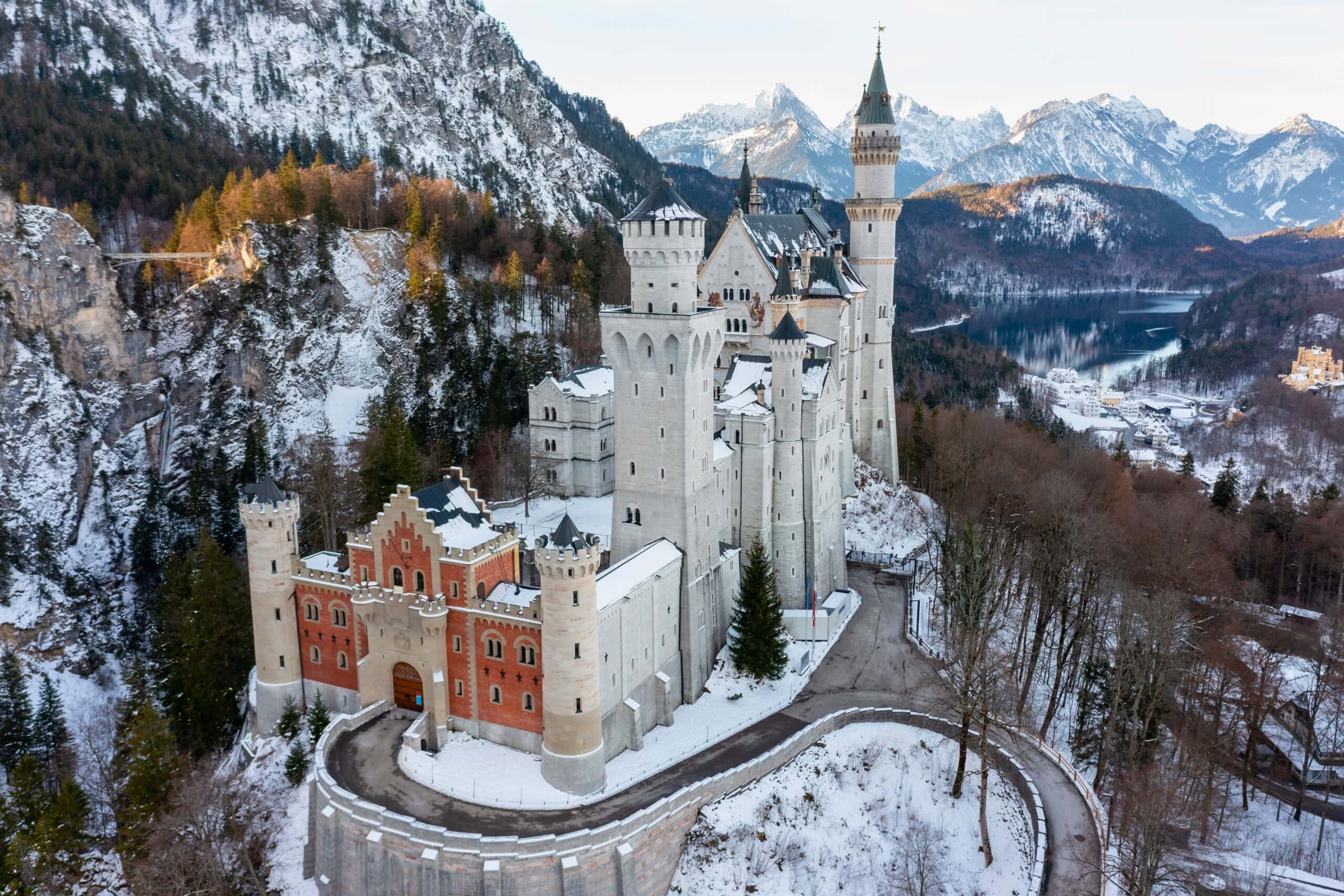
On September 5, 1869, three years and two months after Bavaria’s army lost the Austro-Prussian War in seven weeks, King Ludwig II of Bavaria signed the foundation deed of a castle that would never be finished. The site was a ridge high above the Pöllat gorge, looking down on his father’s medievalist palace at Hohenschwangau, near Füssen in the Allgäu; up to eight meters of rock had been cut away to make room for the foundations; the surveyed plan was Eduard Riedel’s, the picturesque silhouette Christian Jank’s, the iconographic program the art and literary historian Hyazinth Holland’s. The building plan, portraits of the king, and coins of his reign were set into the stone, following the tradition established by Ludwig I. Ludwig was 24 years old. He had been king of Bavaria for five years.
By the time the stone went down, the conditions under which a Bavarian king could express ambition in public architecture had already collapsed. The 1866 Treaty of Berlin had imposed a 30-million-gulden indemnity, and a secret defensive-offensive alliance signed the same day transferred command of the Bavarian army to Prussia in the event of war. Nearly fifteen months after the foundation stone was set, on November 30, 1870, Ludwig signed the so-called Kaiserbrief inviting Wilhelm I of Prussia to take the hereditary title of German Emperor: a letter initiated and drafted by Bismarck and copied out in Ludwig’s own hand. From 1871, secret payments from Bismarck reached the king out of the Welfenfonds; how they were connected to the letter is taken up below. Neuschwanstein, in this sense, is not an aesthetic decision insulated from politics. It is an architectural fact built inside a political settlement, and legible as a statement only against the political position it implicitly reframes. Ludwig II’s architecture of dreams begins not with fantasy but with that settlement.
The Hohenschwangau formation
Ludwig II’s medievalist visual program, later imposed on Neuschwanstein, was not invented in response to political reverses. It was the architectural language of his upbringing. His father (then Crown Prince Maximilian, later King Maximilian II) bought the ruined medieval Schwanstein in 1832 and between 1833 and 1837 had it rebuilt under Domenico Quaglio as the four-towered neo-Gothic schloss of Hohenschwangau; Joseph Daniel Ohlmüller and Georg Friedrich Ziebland carried the work on into the 1850s. Its rooms were painted, largely in the mid-1830s, with more than ninety murals by Lorenzo Quaglio, Wilhelm Lindenschmit, Franz Xaver Glink, Michael Neher and others, several cycles after designs by Moritz von Schwind: the legend of the Swan Knight Lohengrin, the Wilkina saga of Dietrich of Bern, and the world of the minnesingers. Ludwig, born August 25, 1845, grew up inside this iconographic program. Figures he would later commission for Neuschwanstein’s wall paintings were already on the walls of the castle where he spent the summers of his childhood.
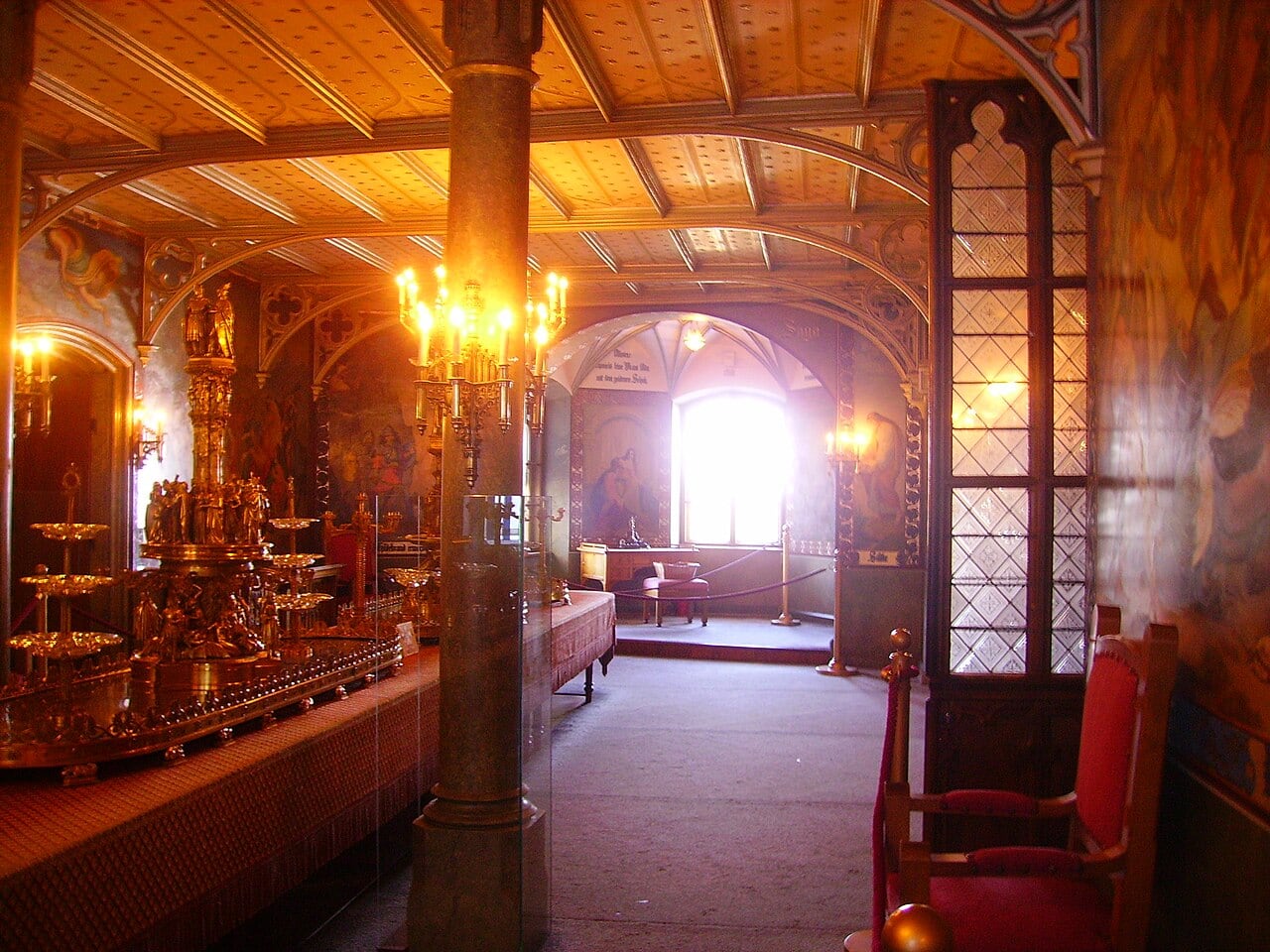
His encounter with Wagner himself came in stages, though popular biographies often describe a single transformative moment. As a boy Ludwig already knew Wagner’s texts and music, and as a youth he was carried away by Wagner’s prose work Das Kunstwerk der Zukunft (The Artwork of the Future); he saw his first staged Lohengrin at the Munich Hof- und Nationaltheater on February 2, 1861, at the age of 15, and his first staged Tannhäuser on December 22 of the same year. Hohenschwangau’s frescoes had given him the iconography. Wagner’s writings supplied the theoretical frame. Munich’s 1861 performances gave him the music on the stage. By the time Ludwig succeeded his father on March 10, 1864 (at the age of 18, after Maximilian II’s sudden death), the architectural and operatic vocabulary that would define his reign was already in place.
This sequence matters for what came next. The Wagnerian-medievalist imagination did not emerge from the trauma of 1866 or the federal absorption of 1871. It preceded both. What changed after those events was not the imagination but its political horizon. The castle projects of the late 1860s and 1870s redirect an inherited program onto private terrain after the public terrain closed.
The Wagner patronage and the public-cultural program (1864-1866)
Ludwig’s first phase as king treated Wagner and the medievalist cultural program as projects of the Bavarian state. Within weeks of his accession Ludwig sent his cabinet secretary, Franz von Pfistermeister, to find the composer, then in flight from his creditors, and on May 4, 1864, eight weeks after the accession, the king received Wagner in the Munich Residenz. By the end of the month the composer was installed at a royal villa near Lake Starnberg; his debts had been settled at roughly 21,000 gulden; an annual salary of 4,000 gulden had been arranged, publicly disclosed as 1,200. In 1864 alone, payments from Ludwig’s cabinet treasury to Wagner totaled 42,333 gulden; yet the sums the king spent on Wagner were, as the Wagner scholar Sven Friedrich has argued against a widespread prejudice, by no means excessive.
These were public acts. They had public results. Tristan und Isolde, the work Wagner had been unable to mount anywhere else, premiered at the Munich Hof- und Nationaltheater under Hans von Bülow on June 10, 1865. Die Meistersinger von Nürnberg followed on June 21, 1868. In the same period, Ludwig commissioned Gottfried Semper to design a monumental Festival Theater on the Isar (a public Munich Festspielhaus large enough to mount the unfinished Ring cycle) for which Semper produced detailed drawings between 1864 and 1866. Architecture in this phase was civic. The opera was public. The cultural argument was state-sponsored.
Munich’s political class did not accept this program quietly. The subsidies paid to the composer had already stirred resentment there, and in December 1865, once Wagner had begun to meddle in Bavarian politics and to challenge the ministry, Ludwig asked him, with inner reluctance, to leave Bavaria. That Festival Theater never broke ground. By 1872 Wagner had committed to Bayreuth, where Ludwig’s separate 1874 loan of 100,000 Thaler (300,000 marks) would underwrite the Festspielhaus actually built. The 1869 and 1870 Munich premieres of Das Rheingold and Die Walküre (both over Wagner’s protest that the Ring should premiere only at Bayreuth) were the surviving public residue of a program that had already begun to retreat. By the time Neuschwanstein’s foundation stone was laid in September 1869, the Munich civic ambitions had collapsed and the architectural ambitions had migrated upward into the Alps.
Political defeat and the closing of the public sphere
Fought across June and July 1866, the Austro-Prussian War lasted seven weeks. Bavaria, allied with Austria, was defeated in a series of small engagements along the Main and at Kissingen, and signed the Treaty of Berlin on August 22. The published terms were severe (a 30-million-gulden indemnity and the cession of three small districts including Gersfeld and Orb), but the parallel terms were the structurally decisive ones. A secret defensive-offensive alliance signed the same day transferred command of the Bavarian army to the King of Prussia in the event of war. Bavaria’s right to make alliances and to decide on war and peace, central rights of its sovereignty, would survive four more years.
Bavaria’s transition of 1870-71 left an unusually clean paper trail. On October 31, 1870, Ludwig instructed Count Bray, the head of the Bavarian delegation, to negotiate a payment of two million gulden. On November 19, the Prussian envoy to Bavaria, Baron Georg von Werthern, telegraphed Bismarck, marking it strictly secret, that the King of Bavaria had fallen into great financial difficulty through building and theater, and that “six million gulden would be very agreeable to him, provided the ministers learned nothing of it.” The go-between was Count Max von Holnstein, the king’s chief equerry. The fund Bismarck would draw on was the Welfenfonds: the seized private fortune of the deposed King George V of Hanover, re-sequestered by Prussian royal decree on March 2, 1868, and administered outside Reichstag oversight.
Ludwig signed the Kaiserbrief at Hohenschwangau on November 30, 1870, three days after Bismarck completed the draft. Prince Luitpold delivered it to Wilhelm I at Versailles, the German headquarters in the war with France, on December 3. On January 18, 1871, the Imperial Proclamation followed in the palace’s Hall of Mirrors; Ludwig was absent.
The payments began in the middle of July 1871, out of the Welfenfonds and at Ludwig’s personal disposal: 300,000 marks a year at first (the coinage law of 1873 converted 7 south German gulden into 12 marks) and later considerably more, about five million marks in all by 1885, of which Holnstein, who arranged them, received ten percent. In February 1884 Bismarck added a one-off million. Was the letter their price? Ludwig’s biographer in the Neue Deutsche Biographie, Dieter Albrecht, answers in three judgments that belong together: the money was certainly not Ludwig’s condition for Bavaria’s entry into the Empire; whether he made money an ultimatum for the letter cannot be stated with final certainty; but in November 1870 he had his great financial embarrassment conveyed emphatically to Bismarck, in the closest connection with the imperial question and the letter, one unmistakable to everyone involved. Albrecht ties the money to the buildings through the debts: Ludwig had to pay for all his buildings out of the regular income of the court and cabinet treasury, ran into debt from 1877, and owed it to these funds that the debts, 8.25 million marks by early 1884, were not higher. Ludwig’s later architecture was also the architecture of a kingdom that had just given up, in 1870-71, central rights of sovereignty, above all the right to make alliances and to decide on war and peace. The Prussian apotheosis had already happened on a different mountain: Friedrich Wilhelm IV’s reconstruction of Hohenzollern, designed by Friedrich August Stüler, was completed in 1867, a year after Königgrätz. Hohenzollern and Ludwig’s castles belong to the same compositional logic, but on Ludwig’s side of the new arrangement the same language carried very different consequences. At Hohenzollern it spoke for the Prussian crown, victor of 1866; Ludwig’s castles cited powers his kingdom no longer held in full, and the debts of building them became the immediate cause of the crisis that ended his reign.
Neuschwanstein as Wagnerian Gesamtkunstwerk
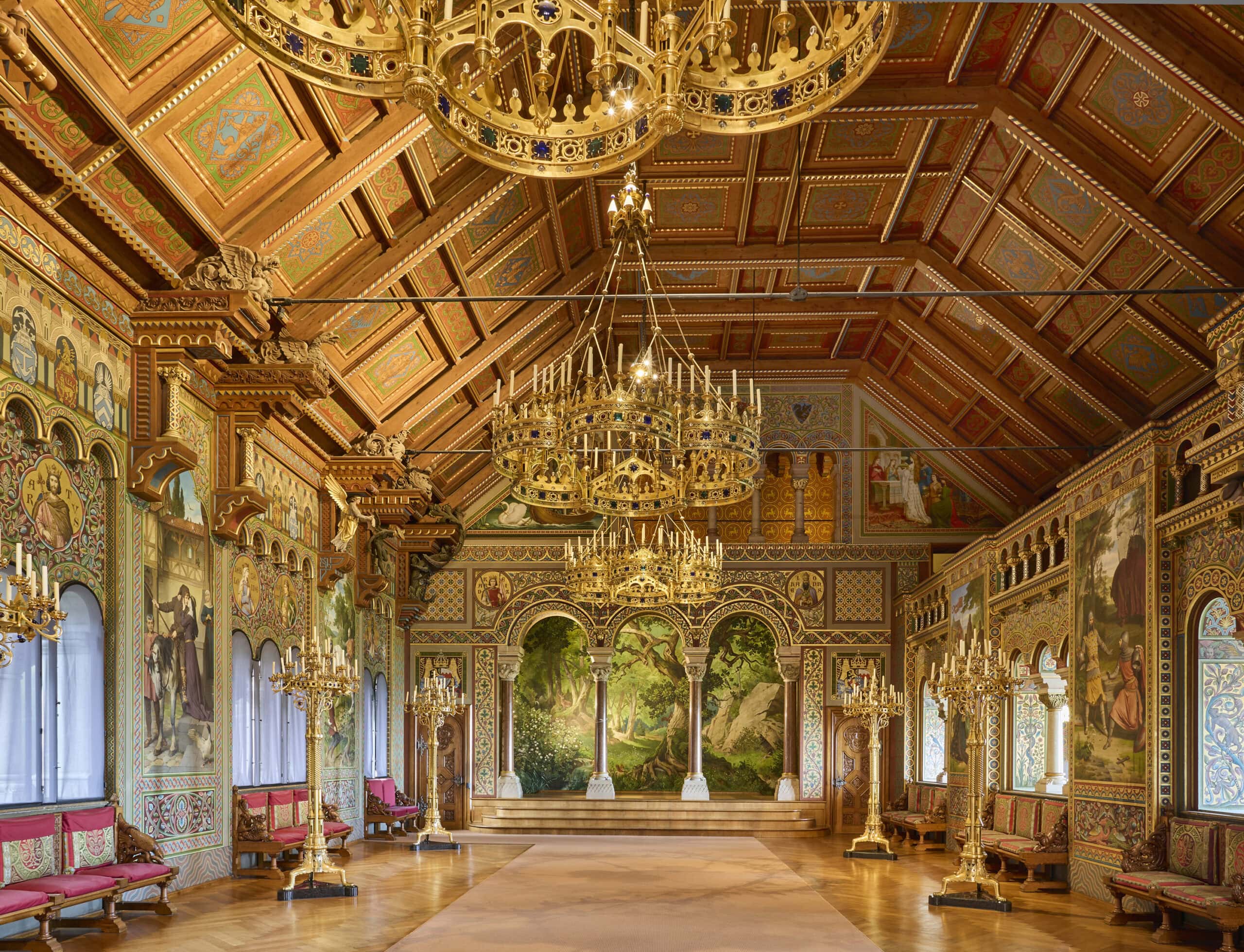
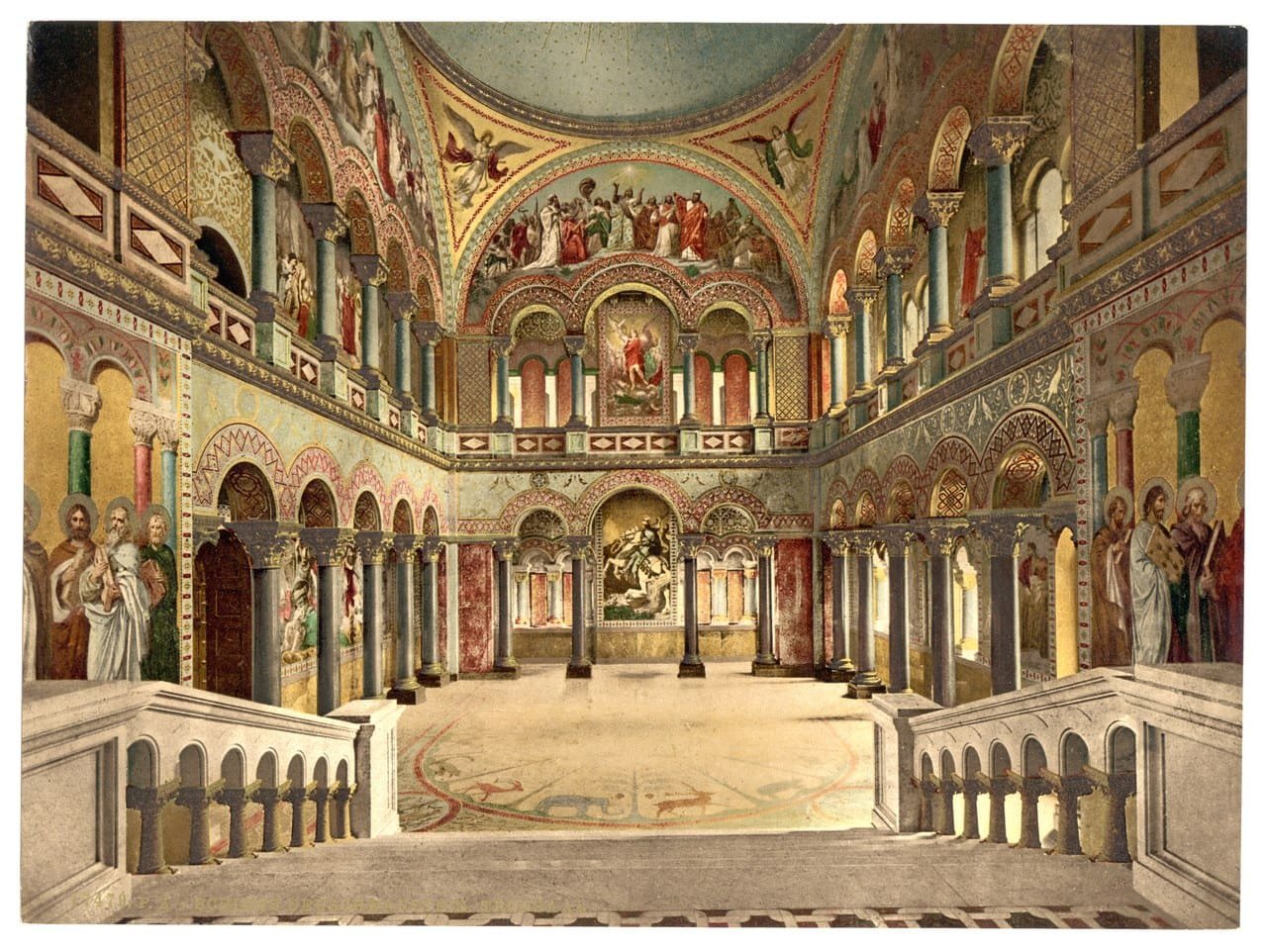
Ludwig announced the plan to Wagner in May 1868. The ridge above his father’s Hohenschwangau carried the ruins of two small castles, Vorder- and Hinterhohenschwangau, and it was his intention, he wrote, “to rebuild the old castle ruin of Hohenschwangau near the Pöllat Gorge in the authentic style of the old German knights’ castles”; the new castle would recall Tannhäuser and Lohengrin, and its site was “holy and unapproachable, a worthy temple for the divine friend who has brought salvation and true blessing to the world.” Neuschwanstein’s iconographic argument is unusually explicit. It is a sequence of citations from the legends Wagner had put on the stage, rendered in architecture rather than performed, a Gesamtkunstwerk or “total work of art,” the older term Wagner had taken up in 1849 for the interplay of all the arts. The castle’s picture cycles were inspired by Wagner’s operas, though, as the palace administration stresses, they were painted from the medieval sagas he had drawn on rather than from his stage works. The Sängersaal, filling the whole fourth upper floor of the east Palas (the castle’s main residential building), unites two rooms of the Wartburg, its Festsaal and the Sängersaal where the song contest of Tannhäuser was said to have taken place, but its murals tell mainly the legend of Parzival and the Holy Grail rather than the contest. Neuschwanstein’s royal bedroom has the legend of Tristan and Isolde as its leitmotif. Its Throne Hall, added from 1881 and conceived as the legendary Hall of the Grail, takes Byzantine church interiors, above all Munich’s Allerheiligen-Hofkirche, as its model, with an apse meant for a throne that, after the king’s death, was never made. The bedroom, the throne room, the singers’ hall: each is a stage set for a legend Wagner had also put on the stage, and none was built for an audience; in the king’s lifetime no great banquet or performance was held even in the singers’ hall.
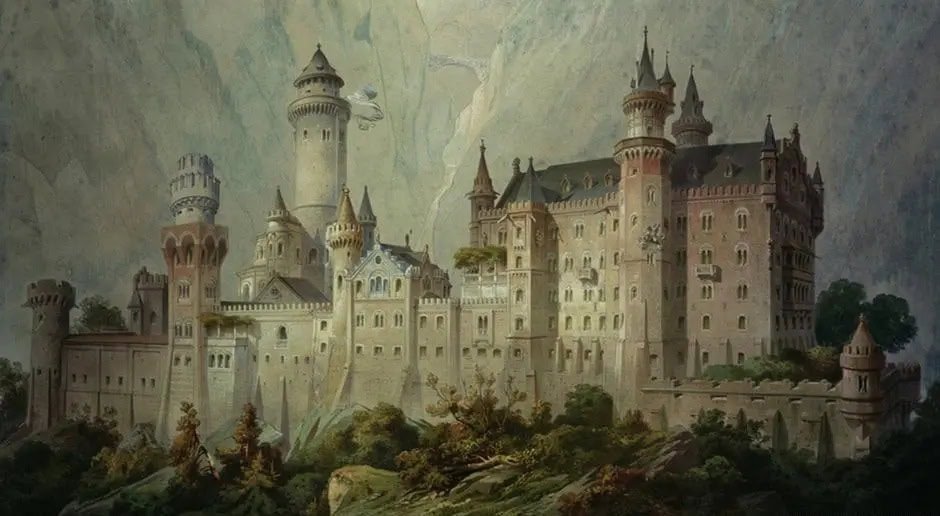
Personnel of the project carry the same argument in the design history. Several hands shaped the surviving castle, and the one who fixed its image was not an architect at all. Eduard Riedel, the architect who had already remodeled Schloss Berg for Ludwig’s father, was in charge from 1869 to 1874 and translated the king’s intentions into structurally sound plans. The picturesque silhouette that produced the recognizable Neuschwanstein image was the work of Christian Jank, a Munich stage painter who had designed scenery for Wagner’s Lohengrin in 1867 and for the 1862 Munich Fairytale Maskenfest, and who supplied the project with what the Bavarian palace administration calls Idealentwürfe: ideal designs, not buildable drawings, into which he worked motifs from stage sets for Lohengrin and Tannhäuser. Georg von Dollmann replaced Riedel in 1874, and under him the exterior shed many of Jank’s picturesque details and took on ever stricter forms. The Romanesque interiors, finished by mid-1884, were designed by Julius Hofmann, working from an iconographic program devised by the art and literary historian Hyazinth Holland; only the late-Gothic bedroom and chapel go back to a preliminary design by Peter Herwegen. Hofmann went on to bring the building to a provisional completion between 1886 and 1892, finishing the Bower and the Square Tower in simplified form; the planned keep, with a chapel of its own, was never built. The chain runs from theater scenery to ideal design to structural plan to executed building, with the theatrical source at the top of the sequence and the building at the bottom.
Execution registered the same logic. The castle was conceived in 1868 as a rebuilt medieval Burg above Hohenschwangau, evolved over the next decade into a much larger Romanesque-revival castle, and by Ludwig’s death in 1886 had completed only roughly fifteen of approximately two hundred planned rooms. Disbursed expenditure had reached 6.18 million marks against an original estimate of 3.2 million. Ludwig occupied Neuschwanstein for fewer than two hundred days in total in the seventeen years between the foundation stone and his death. It was a residence only in the thinnest sense: from the end of 1873 he lodged on his visits in the gateway building, and his rooms in the Palas became habitable only in 1884. It was an architectural performance designed to be witnessed by an audience of one. The court theater worked the same way: between 1872 and 1885 it gave 209 private performances for the king alone, and he wanted, as he once said, to look on for himself but not to be a spectacle for the crowd.
Linderhof and Herrenchiemsee as Bourbon counter-monuments
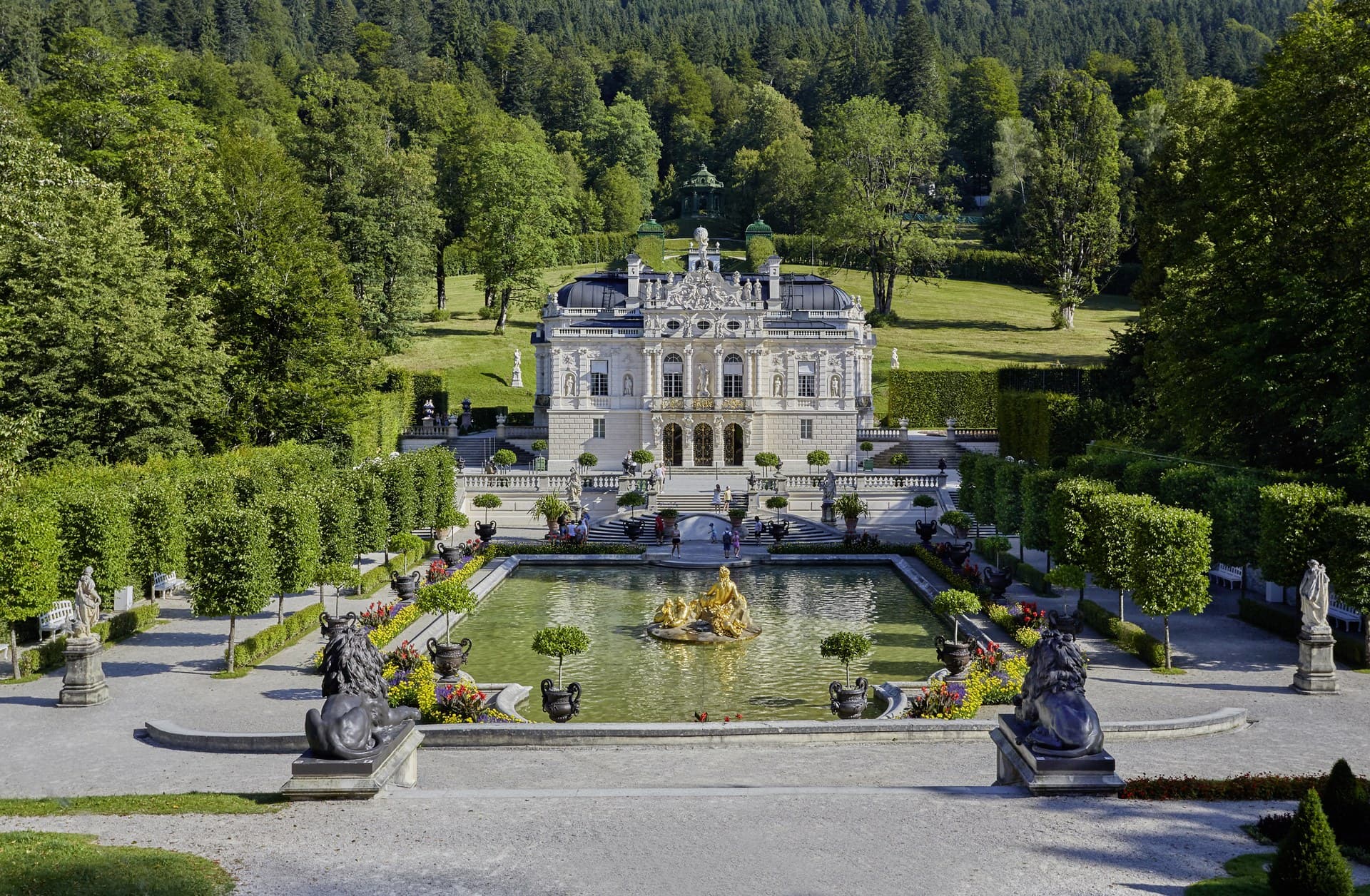
Ludwig’s second architectural branch took its citations not from medieval Germany but from Bourbon France. Linderhof, in the Graswang valley near Ettal, was begun in 1869 by turning a forester’s house of 1790, which his father had used as a hunting lodge, into the Königshäuschen, and grew over six documented building phases: in 1874 the lodge was moved a short way to a new site, where it still stands, to make way for the palace, and the last phase, an enlarged bedroom begun in 1885, was still unfinished when Ludwig died. It was nonetheless the only one of the three royal palaces Ludwig completed and inhabited. Its idiom is not the grand axial Versailles but the more intimate Rococo of Louis XV’s France, in a small palace that the Neue Deutsche Biographie describes as modeled on the Petit Trianon. Georg von Dollmann was the principal architect; Carl von Effner laid out the gardens. The Hall of Mirrors is small; the Hundinghütte, built in 1876 at the foot of the Kreuzspitze after Hunding’s dwelling in the first act of Die Walküre, burned in 1945, and the hut in the park today is a reconstruction of 1990; the Venus Grotto, an artificial cavern built in 1875-77 to Wagner’s stage directions, with a gilded shell-shaped boat and, from 1878-81, electric lighting, dramatizes the opening of Tannhäuser, and it reopened in April 2025 after a ten-year restoration in which some of its fittings were reconstructed. Total disbursed cost at Ludwig’s death was 8.46 million marks. Ludwig occupied Linderhof for substantial periods over a decade.
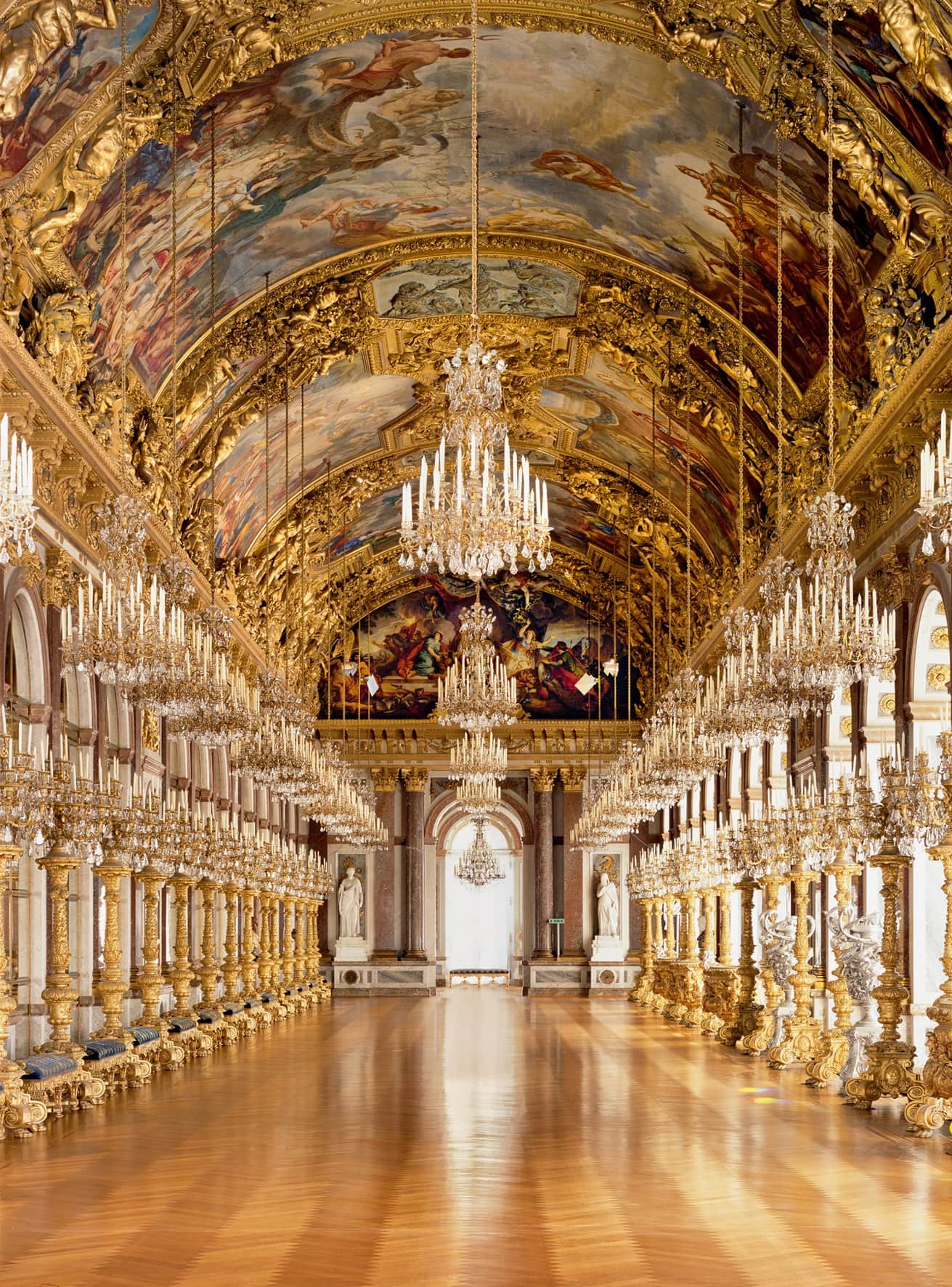
Herrenchiemsee, by contrast, is the explicit Versailles citation. Ludwig purchased the island of Herreninsel in Lake Chiemsee in 1873 for 350,000 gulden, specifically as the site for an image of Versailles, a ‘temple of fame’ for the Sun King; the foundation stone was laid on May 21, 1878, to designs by Dollmann, replaced by Julius Hofmann in 1884. The king asked for a true-to-scale copy of the Versailles Hall of Mirrors, the room of the Imperial Proclamation of January 1871, although the palace administration dates his first designs for a palace modeled on Versailles to 1868; the gallery built in 1879-81 is, at 98 meters, longer than its original, and with its two corner rooms, the Hall of Peace and the Hall of War, it fills the whole garden front. The interior program (a State Staircase after Versailles’ Ambassadors’ Staircase, demolished there in 1752, a State Bedchamber, the gallery) translates Louis XIV’s ceremonial vocabulary into the late nineteenth century, alters it and in places outdoes it: a glass roof that entirely changes the character of the staircase, a State Bedchamber more lavish than the French one, thirty-three chandeliers Versailles never had. Herrenchiemsee’s original construction estimate ran to approximately 5.7 million marks; by 1886, with only twenty of the planned seventy rooms completed, disbursed expenditure had reached 16.58 million marks, roughly three times the initial figure. Sections of the unfinished palace were later demolished. Ludwig occupied Herrenchiemsee for nine days in September 1885. He never returned.
This Bourbon citation does the political work the Wagnerian medievalism could not. Where Neuschwanstein invokes a German imperial tradition that was being captured by Prussia, Herrenchiemsee invokes a French absolutism that the Revolution had ended in 1789 and that could no longer be co-opted by anyone. That vanished absolutism, and the palace built to embody it, is the subject of our companion history, Versailles and the Architecture of Absolutism. Linderhof’s smaller intimate-chamber idiom belongs to the same logic at a different register: not the public ceremonial Versailles but the private retreat at the Petit Trianon (Linderhof’s model in the Neue Deutsche Biographie’s account), where Louis XV had withdrawn from the formal court. Both palaces situate Ludwig within an alternative sovereign tradition, one that, by the late nineteenth century, was unambiguously historical. He could be its custodian without anyone contesting the claim.
The collapse and the legend (1886)
The crisis that ended the reign had its immediate cause in the cabinet treasury from which every palace had been paid. The ministry had met the debts of spring 1884 by arranging a bank loan of 7.5 million marks, but the king went on placing building orders, and by the summer of 1885 the treasury was again some six million marks in debt. Now the ministry demanded bluntly that the building stop, and when Ludwig asked in April 1886 for a finance bill to be put to the Landtag, the Bavarian parliament, the ministry refused outright. Faced with a king who would not give way, and with its own position at risk, the ministry steered at last toward having him declared unfit to rule and a regency installed.
On June 8, 1886, a four-physician commission (Bernhard von Gudden, Friedrich Wilhelm Hagen, Hubert Grashey, and Max Hubrich) signed a psychiatric report declaring Ludwig II permanently incapacitated by paranoia. The report was written to meet a constitutional test: Bavarian law required incapacity demonstrably lasting more than one year to justify a regency. None of the four physicians had examined the king in person. Their diagnosis was reconstructed from selected servant testimony and written reports from former officials of the court. Two of those servants had been questioned as witnesses through Holnstein, who had arranged the Welfenfonds payments and, as chief equerry, headed the stable staff from which most of the king’s attendants were drawn; their statements were passed to Gudden. Modern psychiatric historiography has reached no consensus on a diagnosis. Reinhard Steinberg and Peter Falkai argued in 2021 that Gudden’s reasoning was at least defensible by 1880s nosology, while most specialists now read the evidence as a personality disorder rather than a fully developed psychosis: impairment of some kind, but not the paranoia the report certified. The Council of Ministers ratified the report on June 9; Prince Luitpold was proclaimed regent on June 10.
A first deposition commission, led by the foreign minister, Baron von Crailsheim, and by Holnstein, was turned back at Neuschwanstein by Ludwig’s gendarmerie on the morning of June 10; several commissioners were briefly held in the castle gate. A second commission arrived overnight on June 11-12 with sufficient force, and Gudden personally informed Ludwig of the verdict. At four o’clock in the morning of June 12, the king was transported by closed carriage from Neuschwanstein to Schloss Berg on Lake Starnberg. On the evening of June 13, after a morning walk together, Ludwig and Gudden went out for a second walk in the park by the lake, this time without the attendants. Their bodies were recovered from the shallow water before midnight; the king’s watch had stopped at 6:54, Gudden bore marks consistent with a struggle, and the partially released autopsy recorded no water in Ludwig’s lungs. The official verdict was suicide by drowning, but it has never been the only reading. Dieter Albrecht’s entry in the Neue Deutsche Biographie judges that Ludwig probably sought death and drowned Gudden, who tried to hold him back, but himself died not by drowning but of heart failure; the psychiatrist Heinz Häfner, who argues that the king was not psychotic, reads the death as a deliberate suicide. The Wittelsbach family archive denied researchers access to key documents as recently as Häfner’s study of 2008, and the manner of death remains formally unexplained. The question of whether the precipitating diagnosis was clinically defensible or politically expedient (Häfner argues the latter) does not bear directly on what came next.
What came next was the program’s completion. On August 1, 1886, seven weeks after Ludwig’s death, the Bavarian state opened Neuschwanstein and Linderhof to paid public visits. The debts outlived him: the loan of 1884 was repaid out of the civil list until 1901. Whatever the motive for the opening, its cultural effect was the consequential one. The castles that had been built to be inhabited alone and seen by no one were, within two months of his death, converted into objects of viewing. Neuschwanstein passed almost immediately into the standard visual repertory of European royal architecture. This dream-king program succeeded only after Ludwig was no longer present to witness its succession. What had been built as private monument became, under the regency his uncle Luitpold held for Ludwig’s brother, King Otto, the most legible public artifact in nineteenth-century European royal building.
Where the Argument Stands Today
Hohenschwangau Castle supplied the vocabulary. Its murals are where the program begins: their Lohengrin and minnesinger subjects are the iconographic field Ludwig would later impose, at much larger scale, on Neuschwanstein. The castle’s owner, the Wittelsbacher Ausgleichsfonds, describes its interiors, exterior, furnishings and more than ninety murals as made to match one another, and the ensemble as surviving the way Maximilian and his artist-architect made it, so the vocabulary is still on the walls where Ludwig first met it.
Neuschwanstein Castle is the argumentative center: the Sängersaal as Wartburg hall and Grail stage, the bedroom as Tristan tableau, the Throne Hall as a Grail hall on the model of Byzantine church interiors. The guided tour passes through the king’s rooms on the third and fourth upper floors, with the Throne Hall near the start of that sequence and the Sängersaal as the last of the royal rooms, and then finishes on the second upper floor, whose rooms remained a bare shell and now hold the museum’s service rooms, a shop and a café among them. So the tour ends in rooms that were never finished.
Linderhof Palace is the Rococo private chamber, and its oval dining room shows what that meant. Its table can be lowered by a crank to the kitchen on the floor below, an eighteenth-century French invention that had first let court society keep its amorous suppers unobserved. What Ludwig wanted from it, the palace administration writes, was not gallantry but undisturbed dreaming among an imaginary court, and it quotes one of his cooks, Theodor Hierneis, for whom the king, though he always sat down alone, believed himself in the company of Louis XIV and Louis XV. In the woods of the park, information boards on the path from the Temple of Venus to the Hermitage of Gurnemanz describe Ludwig’s unrealized building projects, among them a palace, a theater and a chapel.
Herrenchiemsee New Palace is the explicit Versailles citation, and the palace administration says that it remained a torso, like its park: by Ludwig’s death only the gardens along the central axis had been largely completed. It is also where the unbuilt part of the program can be seen. The König-Ludwig-II.-Museum, twelve rooms on the ground floor of the south wing, presents his other building projects alongside the three palaces, and its objects include a model for Gottfried Semper’s Festival Theater on the Isar, Christian Jank’s 1869 ideal design for Neuschwanstein (never executed as drawn) and Max Schultze’s 1885 design for the bedroom of Falkenstein.
Falkenstein (never built) is the counter-evidence. In 1883 Ludwig commissioned a fourth castle to rise in place of the ruin of Germany’s highest-lying medieval castle, on a mountain high above Pfronten. Jank’s first design was architecturally unfeasible on the small summit plateau, Georg von Dollmann’s scaled-down version of 1884 displeased the king, and Max Schultze, senior building officer to the Princes of Thurn und Taxis at Regensburg, then developed the project from June 1884 to September 1885, with Gothic interiors throughout except for the bedroom, a Byzantine sanctuary, before resigning. Julius Hofmann had not finalized the design when Ludwig died, and only an access road and a water pipeline to the summit had been built. On the mountain the medieval ruin he meant to replace still stands. The program had not exhausted itself by 1886, and the three palaces he began were not the whole of it.
Conclusion
What changed for European royal architecture after Ludwig was that the language of monarchical legitimacy (the language Maximilian had used, as crown prince, at Hohenschwangau, Friedrich Wilhelm IV at Stolzenfels and Hohenzollern, Carl Alexander of Saxe-Weimar at the Wartburg) had decoupled from political power. By 1886, the federal constitutional state had absorbed the central sovereign rights of the German princes; the Romantic-medievalist and Bourbon-absolutist citations these princes had built into stone no longer corresponded to the powers they had once stood for. Bavaria kept its own diplomatic service and reserved rights over its railways, post and telegraph, beer and spirits taxes and army, which its king commanded in peacetime only; as Patrick Henßler writes in the Historisches Lexikon Bayerns, those reserved rights exempted Bavaria from imperial law without being actual elements of sovereignty. What Ludwig made visible, by pursuing those citations to architectural completeness on private terrain, was the gap between the architectural language and what it had once meant. His castles, which no stranger was ever meant to enter, began opening to the public within weeks of his death, and Neuschwanstein has become, in the palace administration’s own words, one of the best-known, most-visited and most-photographed buildings in the world. In 2025 UNESCO inscribed Neuschwanstein, Linderhof and Herrenchiemsee, with the King’s House on the Schachen, Ludwig’s mountain house at the foot of the Wetterstein massif, as a single World Heritage site. Being seen by strangers was the new public meaning, distinct from the private meaning they had been built to express. Near the start of the guided tour at Neuschwanstein, visitors now stand in the Throne Hall, before an apse meant for a throne that was never made.
For readers planning to visit, the companion hub The Castles of King Ludwig II covers logistics, ticketing, and pacing for Hohenschwangau, Neuschwanstein, Linderhof and Herrenchiemsee, and Wittelsbach Castles of Bavaria surveys the dynasty’s wider building. The broader nineteenth-century context (the parallel projects of Friedrich Wilhelm IV, Carl Alexander, Demmler at Schwerin, and Frühling at Wernigerode) is surveyed at The 19th-Century Romantic Revival of German Castles.
Principal Sources
- Albrecht, Dieter. “Ludwig II.” Neue Deutsche Biographie 15 (1987), 374-379. deutsche-biographie.de.
- Bayerische Schlösserverwaltung. Schloss Neuschwanstein, Schloss Linderhof, and Schloss Herrenchiemsee: official building histories and biographical pages. neuschwanstein.de history, tour, interior, “Idea and history” section; schloesser.bayern.de; schlosslinderhof.de building phases, dining room, park buildings, Hundinghütte, Venus Grotto restoration; King’s House on the Schachen; herrenchiemsee.de Hall of Mirrors, park, chronology, King Ludwig II Museum; Herrenchiemsee visitor leaflet (02/2026).
- Bitterauf, Theodor. “Ludwig II. König von Baiern.” Allgemeine Deutsche Biographie 55 (1910), 540-555. deutsche-biographie.de.
- Eger, Manfred, ed. Königsfreundschaft: Ludwig II. und Richard Wagner. Legende und Wirklichkeit. 2 vols. Bayreuth: Druckhaus Bayreuth, 1987.
- Friedrich, Sven. “Wagner’s Finances.” In Wagner in Context, edited by David Trippett, chapter 23, 229-238. Cambridge: Cambridge University Press, 2024. doi.org/10.1017/9781108871150.024.
- Häfner, Heinz. Ein König wird beseitigt: Ludwig II. von Bayern. Munich: C.H. Beck, 2008.
- Haus der Bayerischen Geschichte. “Gründung des Deutschen Kaiserreichs 1871.” Teaching materials for the Bavarian State Exhibition 2011, Götterdämmerung: Ludwig II. und seine Zeit. archiv.hdbg.de.
- Historisches Lexikon Bayerns. Online encyclopedia of the Bayerische Staatsbibliothek and Generaldirektion der Staatlichen Archive Bayerns. Henßler, Patrick, “Reservatrechte” (2007); Immler, Gerhard, “Königskrise (1885/86)” (2021); Storz, Dieter, “Schutz- und Trutzbündnisse, 1866” (2026).
- Konrad, Ulrich. “Wagner, Richard.” Neue Deutsche Biographie 27 (2020). deutsche-biographie.de.
- Muffat, Karl August. Beschreibung und Geschichte des Schlosses und der ehemaligen Reichsherrschaft Hohenschwangau. Munich: Lindauer, 1837. digitale-sammlungen.de.
- Petzet, Michael. Gebaute Träume: Die Schlösser Ludwigs II. von Bayern. Photographs by Achim Bunz. Munich: Hirmer, 1995.
- Petzet, Michael, ed. König Ludwig II. und die Kunst. Munich: Prestel, 1968. Exhibition catalog, Festsaalbau der Münchner Residenz.
- Pflanze, Otto. Bismarck and the Development of Germany. 3 vols. Princeton: Princeton University Press, 1990.
- Schatz, Uwe Gerd. “Falkenstein – Ein Projekt Ludwigs II.” Blog der Bayerischen Schlösserverwaltung, May 13, 2019. schloesserblog.bayern.de.
- Schatz, Uwe Gerd. Schloss Neuschwanstein: Amtlicher Führer. Munich: Bayerische Verwaltung der staatlichen Schlösser, Gärten und Seen, 2019.
- Schmid, Elmar D., and Gerhard Hojer. Schloss Linderhof: Amtlicher Führer. Munich: Bayerische Schlösserverwaltung, 2006.
- Schmid, Elmar D., and Kerstin Knirr. Herrenchiemsee: Museum im Augustiner-Chorherrenstift, Königsschloss, König-Ludwig-II.-Museum. Amtlicher Führer. Munich: Bayerische Schlösserverwaltung, 2005.
- Spotts, Frederic. Bayreuth: A History of the Wagner Festival. New Haven: Yale University Press, 1994.
- Steinberg, Reinhard, and Peter Falkai. “Was King Ludwig II of Bavaria misdiagnosed by Gudden and his colleagues?” European Archives of Psychiatry and Clinical Neuroscience 271, no. 4 (2021): 799-807. doi.org/10.1007/s00406-020-01161-8.
- Strobel, Otto, ed. König Ludwig II. und Richard Wagner: Briefwechsel. 5 vols. Karlsruhe: Braun, 1936-39.
- Wittelsbacher Ausgleichsfonds. “Schloss Hohenschwangau.” hohenschwangau.de.
Further Reading
- Blunt, Wilfrid. The Dream King: Ludwig II of Bavaria. London: Hamish Hamilton, 1970. The classic English-language study of the period; less analytically current than later works but richly observed on the architectural side.
- Häfner, Heinz. Ein König wird beseitigt: Ludwig II. von Bayern. Munich: C.H. Beck, 2008. A detailed psychiatric reassessment of the 1886 deposition, arguing that the king was not psychotic, that the report rested on accusations his opponents had gathered against him, and that Prince Luitpold drove the deposition; influential and contested. In German.
- King, Greg. The Mad King: The Life and Times of Ludwig II of Bavaria. Secaucus, NJ: Birch Lane Press, 1996. An evidence-based popular biography that documents the king’s reign without indulging the deposition-era stereotype its title invokes.
- McIntosh, Christopher. The Swan King: Ludwig II of Bavaria. London: Allen Lane, 1982; reissued London: Tauris Parke, 2003. The standard English-language analytical biography; particularly strong on the cultural-political context of the Wagner patronage.
- Petzet, Michael. Gebaute Träume: Die Schlösser Ludwigs II. von Bayern. Photographs by Achim Bunz. Munich: Hirmer, 1995. An architectural monograph on the three palaces, with extensive plans and construction-phase documentation. In German.
- Spotts, Frederic. Bayreuth: A History of the Wagner Festival. New Haven: Yale University Press, 1994. A history of the Festival in English that treats its funding in detail, including Ludwig’s role in the Festspielhaus loan and Wagner’s Munich-to-Bayreuth shift.
Image credits. Hero, Neuschwanstein Castle in winter snow, from the air: Photo: Thilo Wagner / Envato Elements; Heroes’ Hall at Hohenschwangau: Photo: Zairon, CC BY-SA 3.0; Singers’ Hall at Neuschwanstein: Photo: © Bayerische Schlösserverwaltung / Maria Scherf; Christian Jank’s 1869 design for Neuschwanstein: Christian Jank, public domain; South façade of Linderhof Palace: Photo: © Bayerische Schlösserverwaltung / Maria Scherf / Andrea Gruber; Great Hall of Mirrors at Herrenchiemsee: Photo: © Bayerische Schlösserverwaltung / Rainer Herrmann / Ulrich Pfeuffer / Maria Scherf; Throne Hall photochrom: Photochrom Print Collection, Library of Congress, public domain. Freely licensed images are resized to fit; any other change, such as a crop, is named in the credit.