
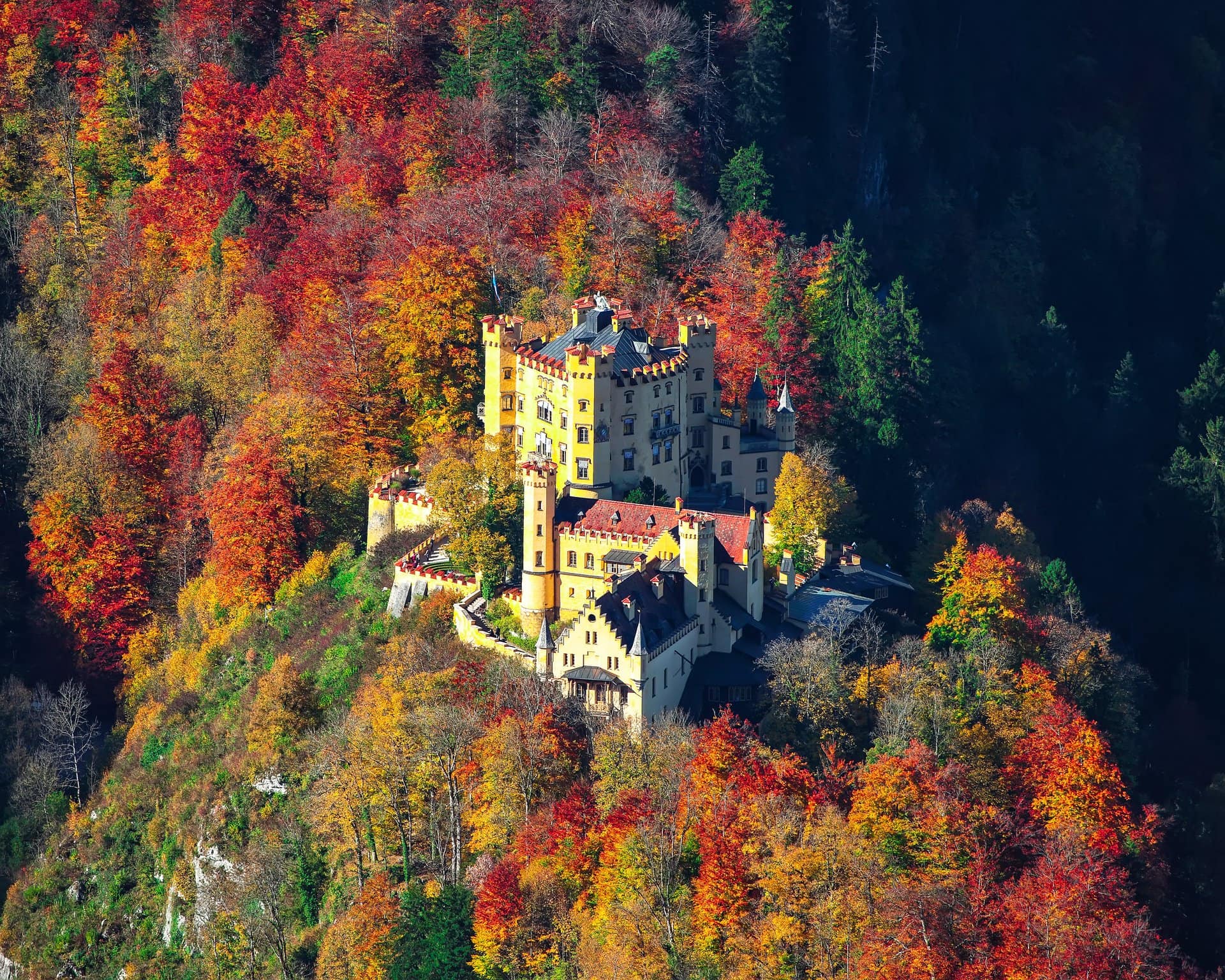
Hohenschwangau Castle
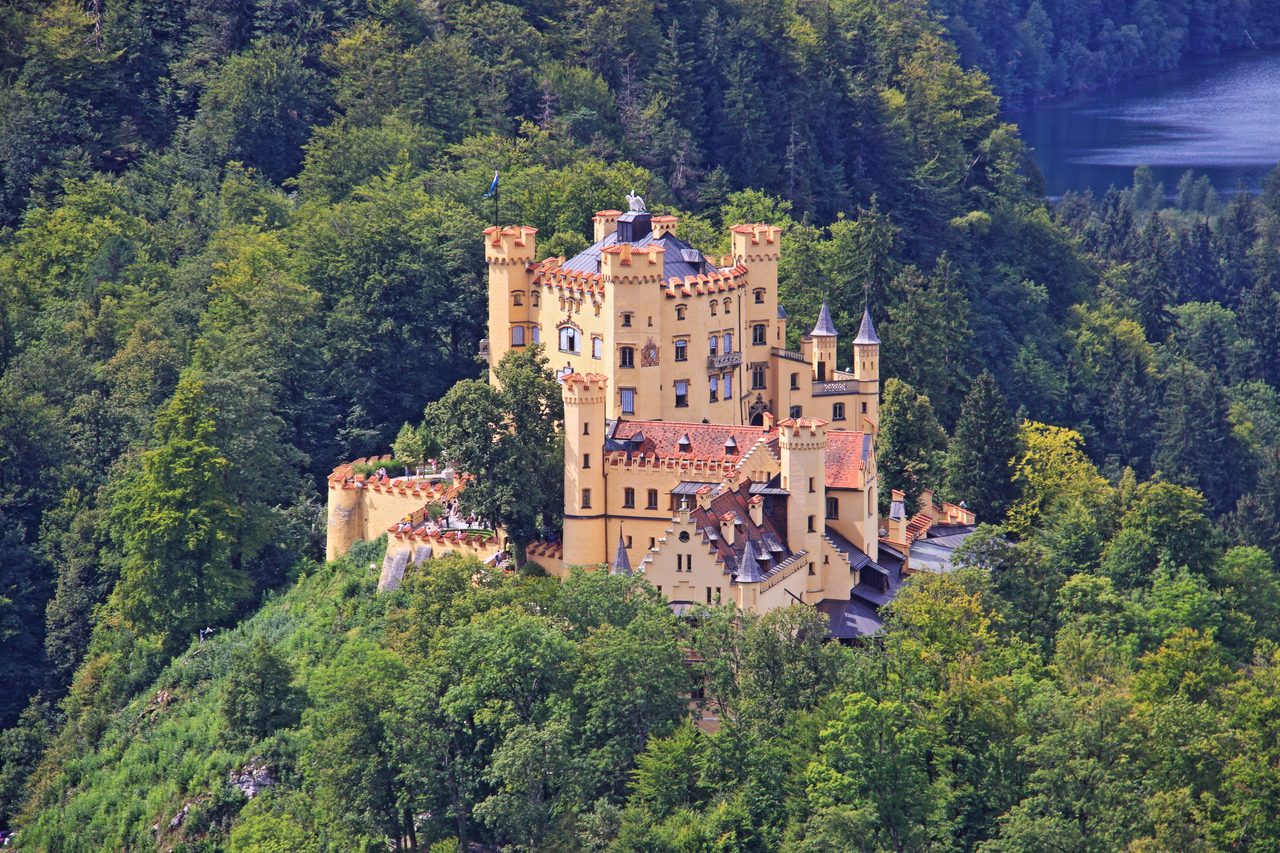
Hohenschwangau Castle is the quieter of the two castles that face each other across the Schwangau valley, and in one important sense the more consequential of the pair. Long before King Ludwig II raised Neuschwanstein on the ridge across the valley, he learned the Swan Knight legend from the painted walls of the family home below: the neo-Gothic Schloss Hohenschwangau that his father rebuilt from ruinous masonry. The ochre palace above the Alpsee is where the imagery of romantic Bavaria was first assembled, decades before a single stone of its more famous neighbor was laid.
That makes Hohenschwangau Castle worth understanding on its own terms rather than as a warm-up act. Its rooms are not a rehearsal for Neuschwanstein but its source, and the building beneath them is older and stranger than the nineteenth-century costume suggests: a castle first recorded in 1397, rebuilt in the 1540s by an Italian master builder into a form that Bavaria’s own state castle database calls foreign to castle building north of the Alps. This guide follows that sequence, the mural cycles Crown Prince Maximilian painted over it, the childhood Ludwig spent inside them, and the practicalities of visiting today.
Quick Facts
| Country | Germany |
|---|---|
| Region / State | Bavaria |
| Location | Hohenschwangau, Schwangau (Ostallgäu district) |
| Nearest town & station | Füssen (Füssen Bahnhof, about 5 km) |
| Built | Castle first recorded 1397; new build 1538 to 1547; rebuilt as a Schloss 1833 to 1837; completed to 1855 |
| Built for | Crown Prince Maximilian of Bavaria, later King Maximilian II |
| Architects | Lucio de Spari (1538 to 1547); Domenico Quaglio, Joseph Daniel Ohlmüller and Georg Friedrich Ziebland (1832 to 1855) |
| Architectural style | Neo-Gothic (Gothic Revival) |
| Castle type | Palace-castle (Schloss) |
| Condition | Preserved as a Romantic-era palace; castle garden replanted 2007 |
| Owner / managed by | Wittelsbacher Ausgleichsfonds, a foundation under public law |
| Open to public | Yes; guided tours only, about 45 minutes |
| Official website | hohenschwangau.de |
History
The lords of Schwangau and their six castles
A family, not a building, comes first in this valley. Hiltibold von Swanegow appears in the record in 1146/47, and the Historisches Lexikon Bayerns traces his descendants across the next four centuries as ministerials, unfree noble servants who held land in return for service. They served the Welf dukes, passed to the Hohenstaufen from 1191, and rose in the thirteenth century to Reichsfreiheit, imperial immediacy. By 1286 Georg and Heinrich von Schwangau were styling themselves Romani regni ministeriales, ministerials of the Roman empire, and their territory was still being called the electoral free imperial lordship of Hohenschwangau in the eighteenth century.
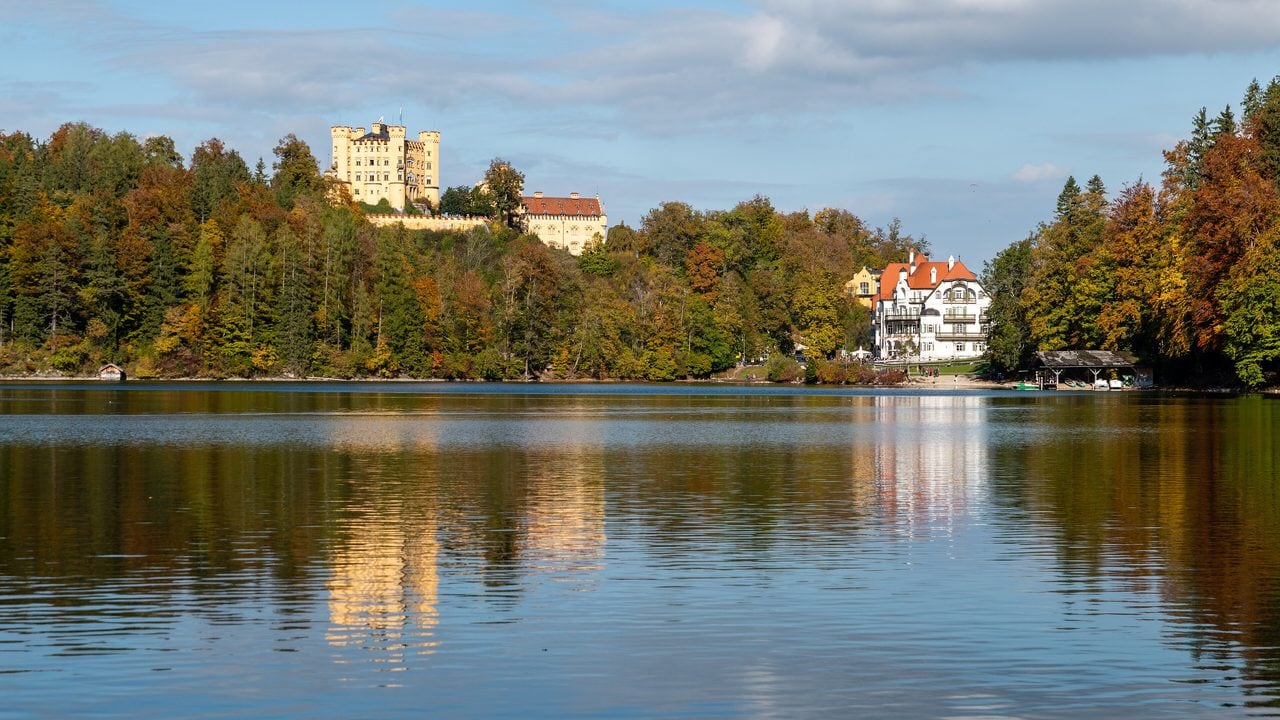
What that service actually consisted of answers a question the valley’s postcards never raise. The Schwangauer held the road running from Füssen over Reutte to the Fernpass, one of the through-routes across the Alps, together with the escort right and the hunting ban that went with it; ore mining on the Säuling mattered at times as well. A castle here is not scenery. It is a tollgate on a mountain crossing.
One of the best-known members of the family wrote poetry. Hiltbold von Schwangau, active around 1195 to 1254, left twenty-two love songs that survive in the Große Heidelberger Liederhandschrift, better known as the Codex Manesse; the encyclopedia gives the shelfmark and folio and notes that the minnesinger there carries a black swan on a red field. That reading is worth holding beside the official blazon, which shows a silver swan armed black with wings spread on red, adopted as the municipality’s arms in 1953. Two credible records, two tinctures, and the manuscript is the older witness. A century and a half later the family produced a subject rather than an author: Margareta von Schwangau, born about 1392, married the poet Oswald von Wolkenstein and is the woman celebrated in his love songs.
Six castles carried the family at its height, and the count needs its date. The Historisches Lexikon Bayerns lists six around 1363, one of them held only intermittently: Frauenstein am Berzenkopf, Vorderhohenschwangau, Hinterhohenschwangau, Schwanstein, the round Scheiblingsturm or Synwellenturm, and Tannenberg. A separate article by the same encyclopedia counts five as imperial fiefs and records all five as ruinous by 1523, a list that leaves Tannenberg out. Six and five are two scopes rather than a contradiction, and the article that merges them will be wrong about both.
Two of the six now lie under the neighbor. Vorderhohenschwangau became Neuschwanstein’s gatehouse and Hinterhohenschwangau its main block, a mapping the encyclopedia and the Bavarian heritage office confirm independently; the Bavarian Palace Administration describes what Ludwig found on that ridge as the remains of two small castles rather than one work. On 12 January 1536 the line ended with Georg Schwangauer, after four hundred years.
Schwanstein, the building on the lower rise
Today’s castle stands not on that high ridge but on the gentler rise below it, and its own recorded history begins later than the family’s. The Bavarian heritage office’s statutory listing puts it plainly: a medieval castle first mentioned in 1397. The owning foundation’s own caption dates the fabric to the end of the fourteenth century, which is the same statement in different words. Where the operator’s visitor pages say twelfth century they are describing the lordship, first recorded in 1146/47, and not this building. Both dates are right about different things, and collapsing them into one is how the confusion starts.
What stood here before 1397 is genuinely disputed, and two Bavarian institutions disagree. Haus der Bayerischen Geschichte, whose castle database is written by the archaeologist Joachim Zeune, makes a round tower mentioned in 1363 as the Synweln Turm, also called the Swan, the direct predecessor of today’s palace, appearing from 1476 as Burg Schwanstain; the same account describes Hohenschwangau as built towards the middle of the fourteenth century as a round residential tower. The Historisches Lexikon Bayerns instead lists Schwanstein and the round Scheiblingsturm as two separate castles among the six. A state institution’s castle specialist and the state library’s encyclopedia are describing the same documents and reaching different buildings. Note in passing that sinwel is Middle High German for round, so the tower’s two names both mean round tower and neither says what it was for.
The name is worth following, because it explains the neighbor’s. Haus der Bayerischen Geschichte calls the arms redend, canting: a shield whose image explains the place name. The place name Schwangau carries the element swane, swan; the arms show a swan, on numerous seals from 1200 onward; and the castle name Schwanstein is then a heraldischer Burgname, a castle name taken from the armorial image. So the chain runs from the place to the arms to the building, in that order, and Ludwig’s New Swan Stone answers the third link.
The Baumgartner rebuild, 1538 to 1547
Heinrich and Georg von Schwangau sold the lordship in 1535, a year before the line died out, for 31,000 gulden. The buyer was the Augsburg patrician and imperial councillor Hans Baumgartner, also written Johann, of a family that appears in the records as Baumgartner and Paumgartner alike; Charles V enfeoffed him on 1 December 1535, and the Tyrolean mines were part of what made the purchase attractive. In 1537 the Baumgartner rose to the imperial baronage and took Hohenschwangau into their title. The lordship did not stay peaceful: in 1553 the castle was besieged by the Augsburg cardinal Otto Truchsess von Waldburg, because the Baumgartner had built a mill of their own against the bishop’s older monopoly, and the bishop won.
Their new building is the one that still governs the site. Zeune’s account is unusually direct about it: the decisive work was the new build under Lucio de Spari between 1538 and 1547, a box-like residential block foreign to castle building north of the Alps, with three corner towers round in the base and polygonal above, ringed by a low defensive Zwinger carrying seven small bastions. Its inspiration, he writes, is likely to have come from the Castel Nuovo of the builder’s native Naples, and that hedge belongs in any sentence that repeats it. The spelling and the origin are themselves unsettled: Haus der Bayerischen Geschichte writes Lucio de Spari and calls him Neapolitan, the heritage office writes Lucio di Spazzi and gives no birthplace.
Albrecht V brought the lordship to the Wittelsbachs in 1567, and Bavarian officials sat at Schloss Schwanstein from then on, which is one reason two names ran in parallel for two centuries.
Decay, and a rescue in 1820
Decay came early and repeatedly, and it did not wait for the wars usually blamed for it. Five of the lordship’s fortifications were already ruinous in 1523. Gun and powder were stored on the bastions in 1586. By 1611 Hohenschwangau was again largely dilapidated, and the inventory taken that year records what the pre-romantic castle actually held: an armoury, a gate parlour, two wine cellars, two vaulted kitchens, a bakery, a hen room above the small riding stable, a milk room, a wash and bath house in poor repair, a cistern, a piped fountain, three prisons and a torture chamber, two pig sties, and outside a large riding stable, a cart shed, a barn, a cattle house, a fisherman’s house, a fish tank and a dance house. A description of the 1830s adds a chapel, a drawbridge, a large clock in the gate parlour, and water brought from the high mountains through brass pipes over four thousand feet, about 1.3 kilometers.
What followed was outside control rather than siege, and it fell on the territory rather than on the building. The lordship passed under imperial administration in 1704 and to the Hochstift Augsburg from 1709 to 1715; Austria occupied it from 1742 to 1745, until the Peace of Füssen, and again from 1778 or 1779 to 1800. The operator’s German pages state that the castle was severely damaged during the Napoleonic Wars, and that is their claim rather than a heritage-office finding. What is certain is the outcome: in 1820 Prince Ludwig von Oettingen-Wallerstein saved the repeatedly war-damaged castle from total demolition. A rescue, not a sale, and the only sale in this part of the story is the one that comes next.
Maximilian’s romantic reconstruction, 1833 to 1837
Crown Prince Maximilian of Bavaria, the future King Maximilian II, came upon the ruin in 1829 while walking in the Alps near Füssen. He was a prince of the romantic generation, drawn to the Middle Ages as an age of faith and rooted German feeling that industrial Europe seemed to be shedding, and the broken walls above the Alpsee answered something in him. The operator’s account of what happened next is emphatic and leaves no room for calculation: he decided on the purchase and the rebuilding spontaneously. He bought the ruinous masonry in 1832.
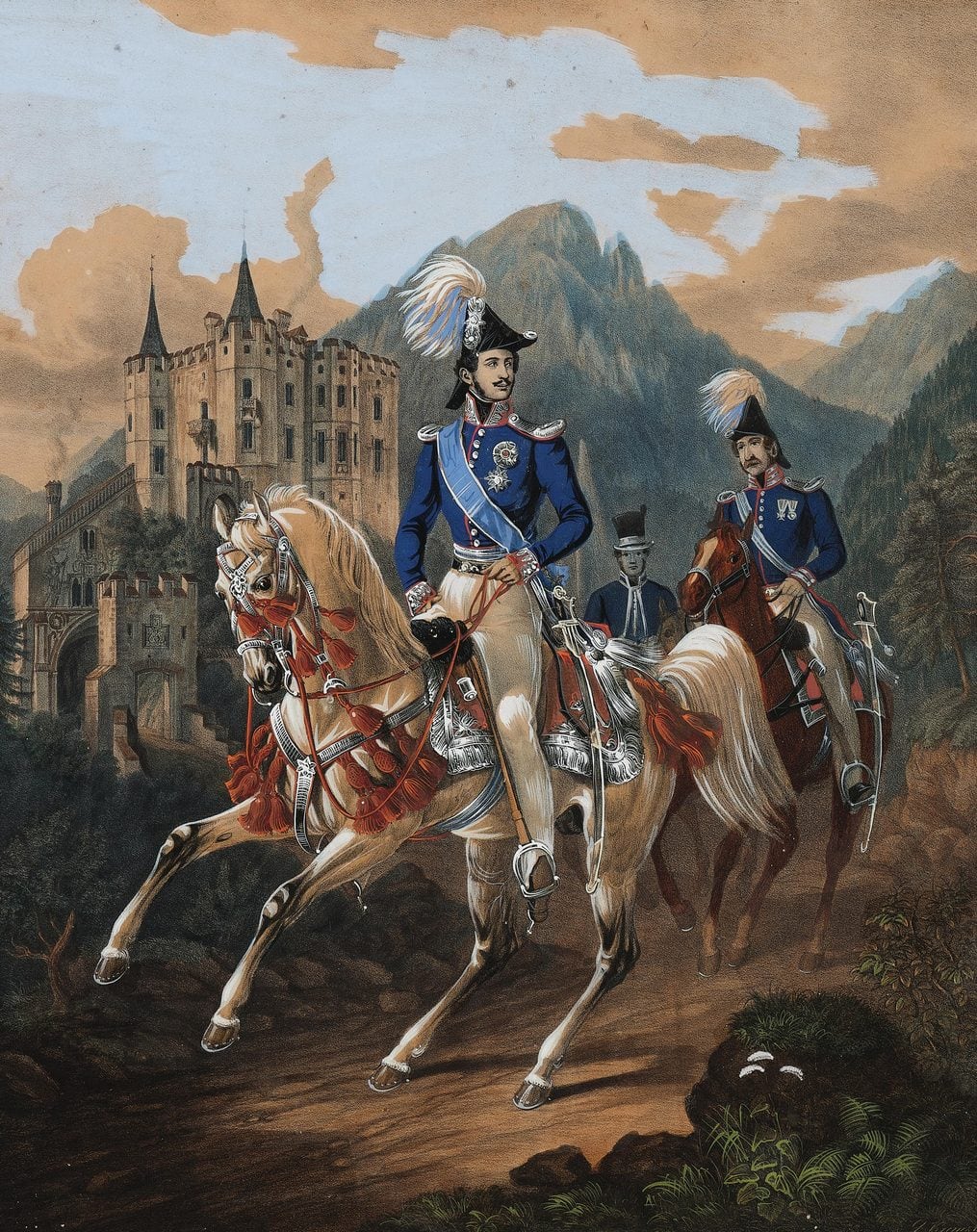
Three architects worked on the result, and the heritage office names them in a sequence our own earlier account got wrong. Quaglio and Joseph Daniel Ohlmüller appear jointly for 1832 to 1838; Georg Friedrich Ziebland is dated 1839 to 1855, which makes him the completer rather than a founding member of the team. Domenico Quaglio, the prince’s art teacher, was given the Bauleitung, the construction management, and he was an architectural and theater painter by trade, called variously a theater architect and a scene painter by the operator and the municipality. That theatrical training is the most useful single fact about him here, because the building he managed is a set as much as a house. He died in 1837, before completion.
Dates for the work vary between sources because they are measuring different things, and the scopes reconcile cleanly. The main building phase runs from 1833 to 1837; the whole campaign, decoration and outbuildings included, runs from 1832 to 1855; Ziebland’s completion accounts for 1839 to 1855. Two ranges of the ancillary buildings sit inside that tail, the Fürstenbau of 1853 and 1854 and the Kavaliersbau of 1851 to 1855.
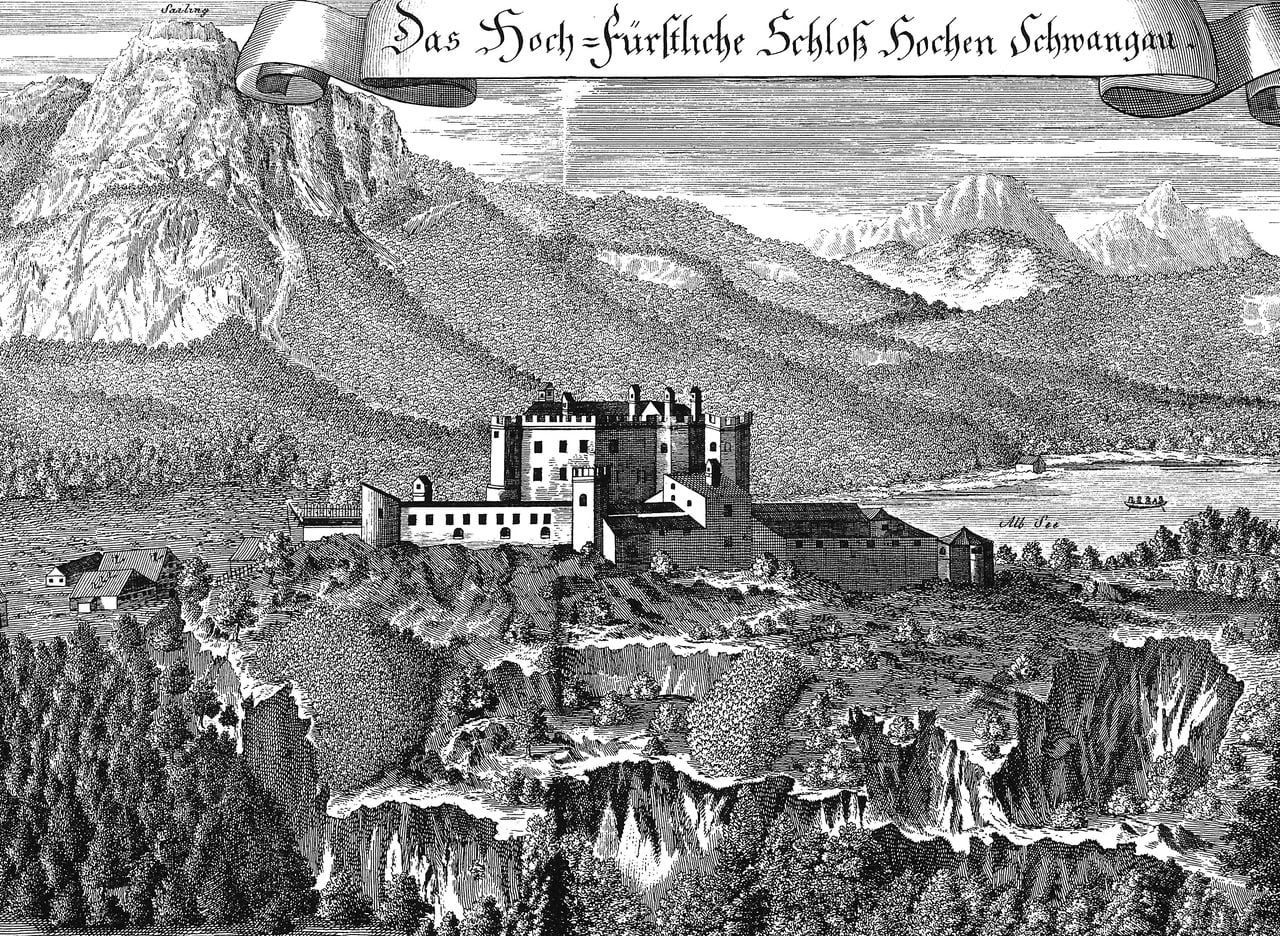
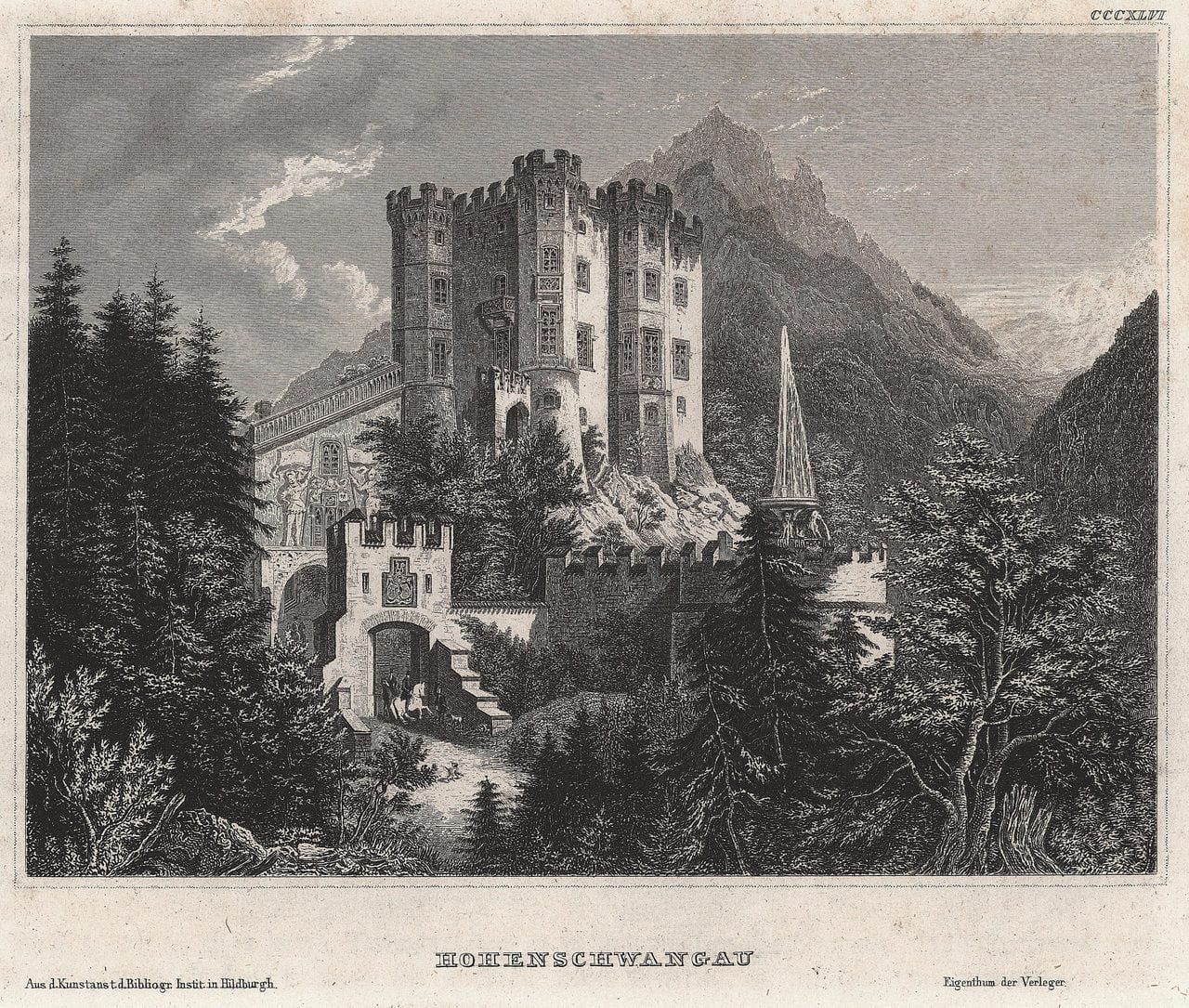
The names of the two castles then settled into their modern arrangement, late and formally. Maximilian called his rebuilt castle Hohenschwangau from the 1830s, but the building had appeared as Burg Schwanstain from 1476 and Bavarian officials had sat at Schloss Schwanstein after 1567, while the lordship carried the Hohenschwangau name throughout. That is how Wening’s plate could title the castle Hochen Schwangau in 1701. Haus der Bayerischen Geschichte gives the year the swap was made official without a hedge: in 1891 Burg Schwanstein was renamed Hohenschwangau.
Ludwig II’s childhood, and the letter that complicates it
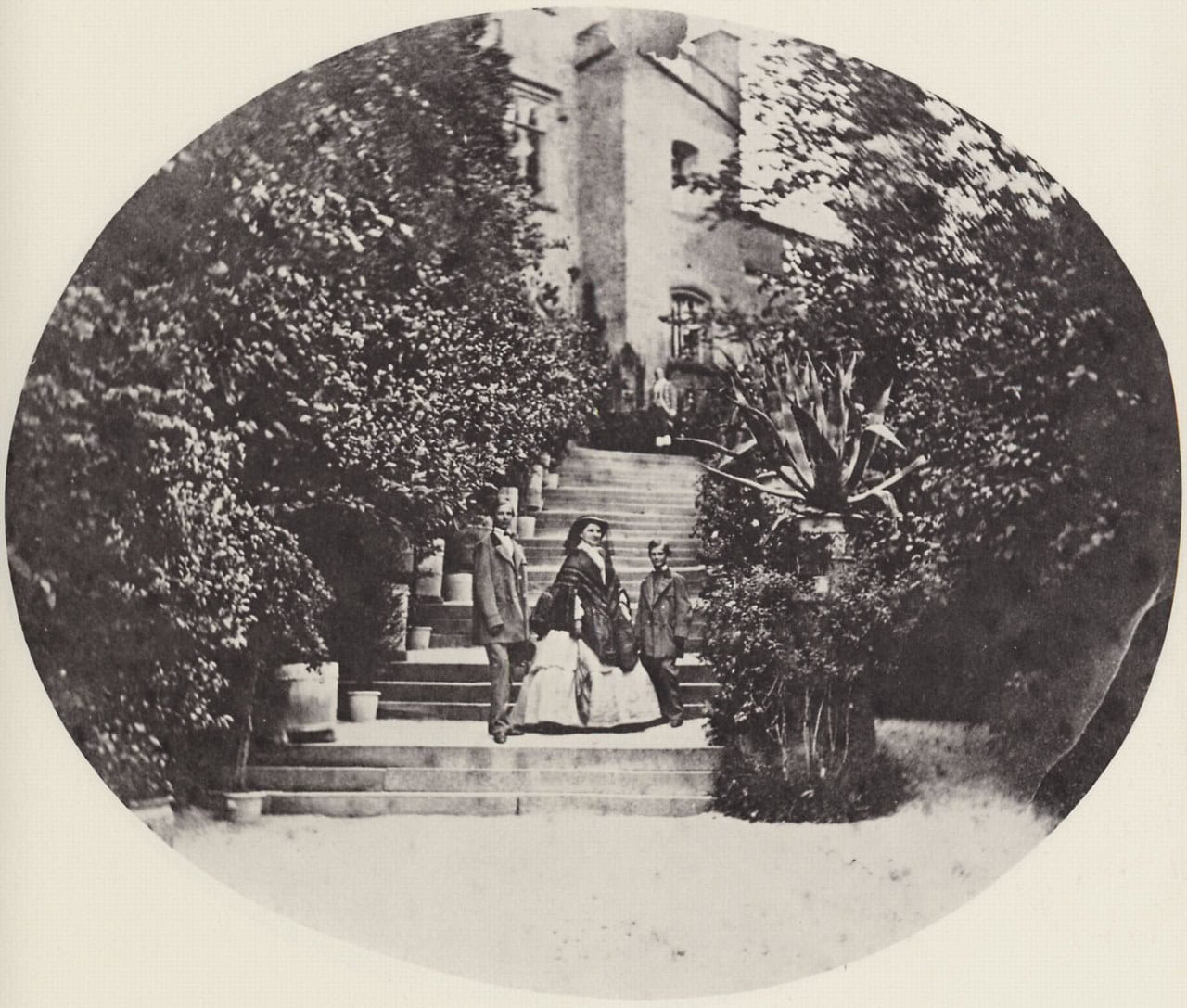
Maximilian became king in 1848, and the castle settled into its role as the family’s summer home in the mountains. His two sons, the future Ludwig II and Prince Otto, spent their childhood summers here, in rooms hung with swans and saga heroes, looking out at the lakes and peaks that would occupy Ludwig for the rest of his life. Their mother left her own marks on the landscape: Queen Marie was a mountain-climber, and Maximilian had the Marienbrücke built high above the Pöllat gorge in the 1840s as a birthday present for her. A listed monument to her still stands on the western shore of the Alpsee, an artificially assembled limestone formation with a polished marble tablet, inscribed 1897.
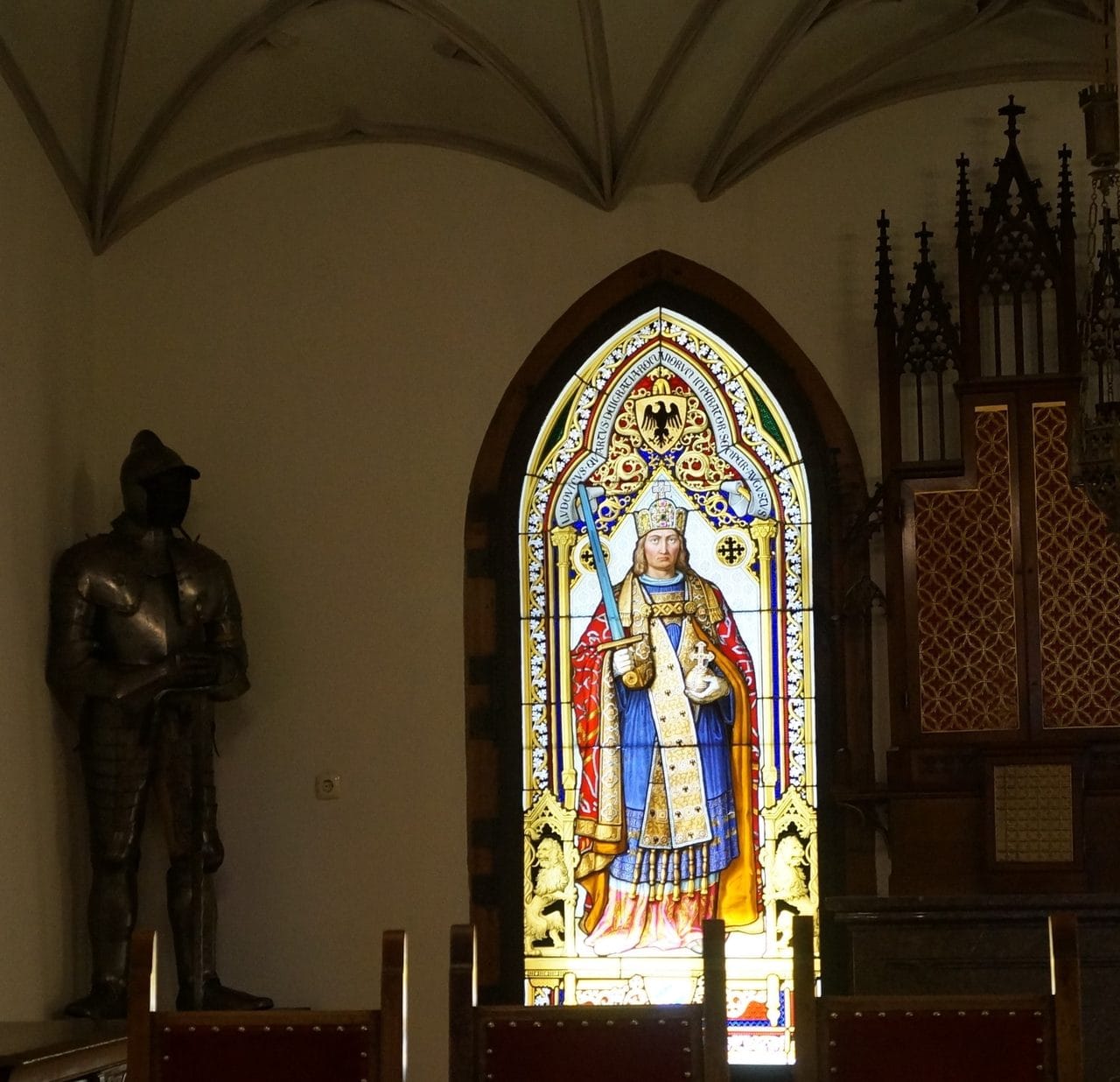
Does this castle explain the one across the valley? Its operator says so in as many words, writing that here was the beginning of Ludwig’s dreams for the building of his Neuschwanstein, and the Bavarian Palace Administration carries the mechanism: Ludwig identified himself from his youth with the Lohengrin to whom Richard Wagner had dedicated a romantic opera in 1850, and the saga was familiar to him from his father’s murals. Elsewhere on its own site the operator softens this to something a visitor may only sense, so the claim belongs to the sources that make it rather than to us.
A letter Ludwig wrote to Wagner in May 1868 complicates the sweet version, and it is the more interesting for that. He sets out his intention to rebuild the old castle ruin of Hohenschwangau by the Pöllat gorge in the true style of the old German knights’ castles, using the name for the upper ruins rather than for his father’s house, and then says why the new one will be better: it will be finer and more habitable in every respect than das untere Hohenschwangau, das jährlich durch die Prosa meiner Mutter entweiht wird, the lower Hohenschwangau, desecrated every year by his mother’s prose. Neuschwanstein was begun the following year, in 1869, on the site of Vorderhohenschwangau. Read alongside that sentence, the son’s castle is not only a tribute to the father’s. It is also an escape from it.
From royal residence to public-law foundation
Hohenschwangau stayed a lived-in house far longer than its neighbor. After Ludwig II’s death in 1886 his uncle Luitpold, Prince Regent of Bavaria, made it his favorite summer residence and was the last of the family to inhabit it properly. Haus der Bayerischen Geschichte records what he installed: electric current, a lift in the stairwell, and running hot and cold water. No source above tourism tier gives a year for that work; the municipality says 1910, and the figures circulating elsewhere disagree with each other, which is usually the sign of one unsourced claim being recopied. The same account supplies the detail that undercuts the modernizing: Luitpold kept five candles on his desk rather than an electric lamp.
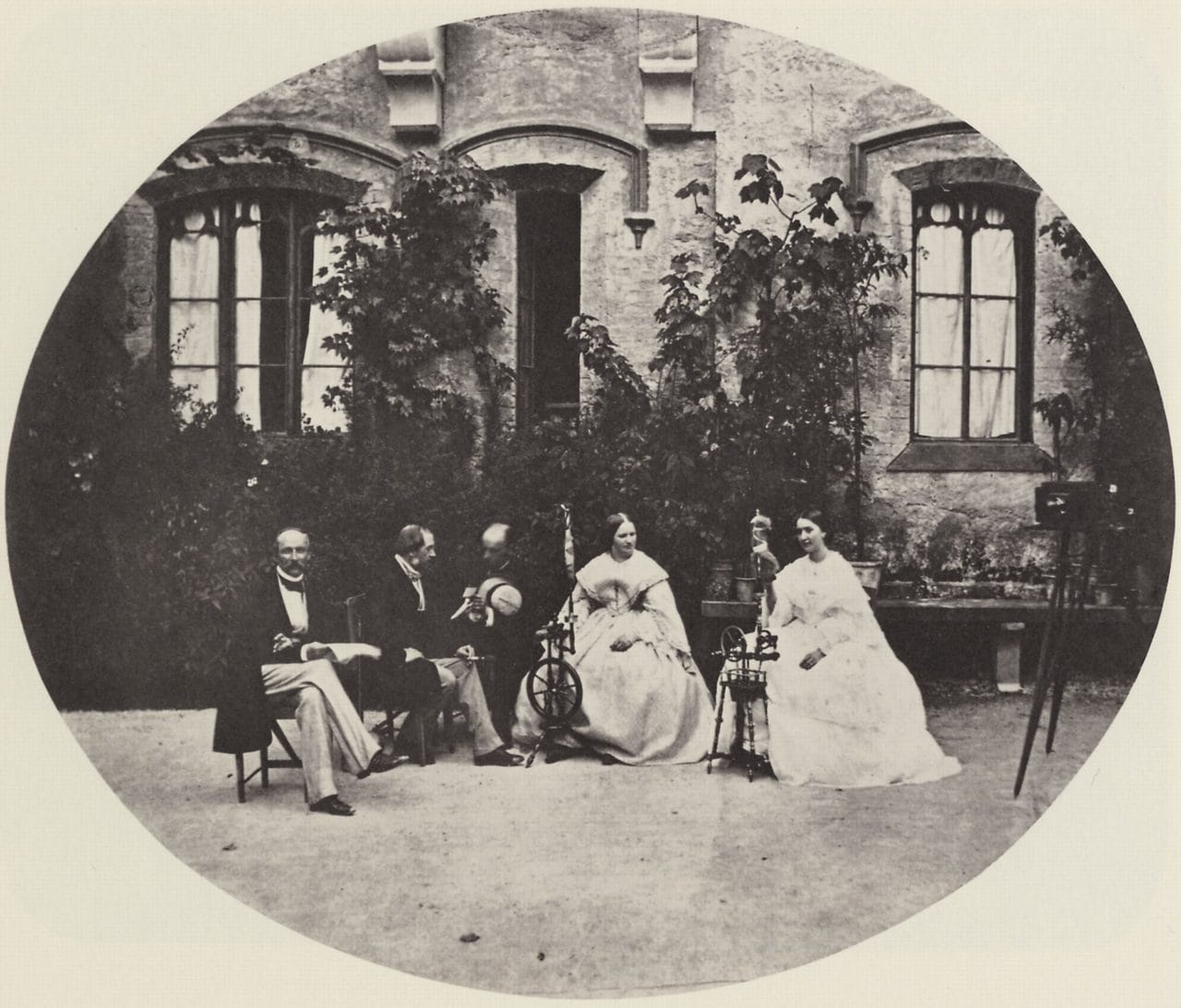
Luitpold died in 1912, residential use effectively ended with him, and the castle opened to the public the following year, in 1913. Its ownership changed for good after the Bavarian monarchy fell. An agreement of 24 January 1923 between the new Free State of Bavaria and the House of Wittelsbach was given effect by a law of 9 March that year, creating the Wittelsbacher Ausgleichsfonds as a Stiftung des öffentlichen Rechts, a public-law foundation; Crown Prince Rupprecht signed for the family. That settlement is what separated the two castles in the valley. Neuschwanstein, Herrenchiemsee and Linderhof passed to the Bavarian state; Hohenschwangau, Berchtesgaden and Grünau passed to the new foundation, and the Historisches Lexikon Bayerns records that this castle came in from the estate of King Otto, Ludwig’s brother.
Rupprecht himself was head of the house from 1921. He went into exile in Italy in 1939 as a declared opponent of the National Socialists, and the family was taken into Sippenhaft, kin detention, in July 1944. Whether the castle itself was touched by either world war is not addressed by any source consulted for this guide, so this account makes no claim about it either way.
The fund still owns the castle, which is why Hohenschwangau is run in the foundation’s own name rather than by the state palace administration that operates Neuschwanstein. Both are ticketed from one office in the village below, but that is a choice the operator has made for the visitor’s convenience and not a consequence of the ownership split. What the owner claims to have preserved is worth stating exactly: an exceptional monument of the Romantic era, and, in the municipality’s words, a nineteenth-century interior kept to the present day. Not a medieval castle, then, and never presented as one.
Architecture
A castle named from its arms
Start with the swan, because the building does. A swan appears on the family’s seals from 1200 onward, on the Zurich armorial roll of about 1335 and the Donaueschingen armorial of 1440, and the state’s heraldic account calls the arms canting, a shield whose device explains the place name. Schwanstein is therefore a heraldic castle name, taken from the armorial image rather than the reverse. That order matters for reading everything inside: the swan is the premise of the decorative program, not an ornament applied to a finished house.
What stands today
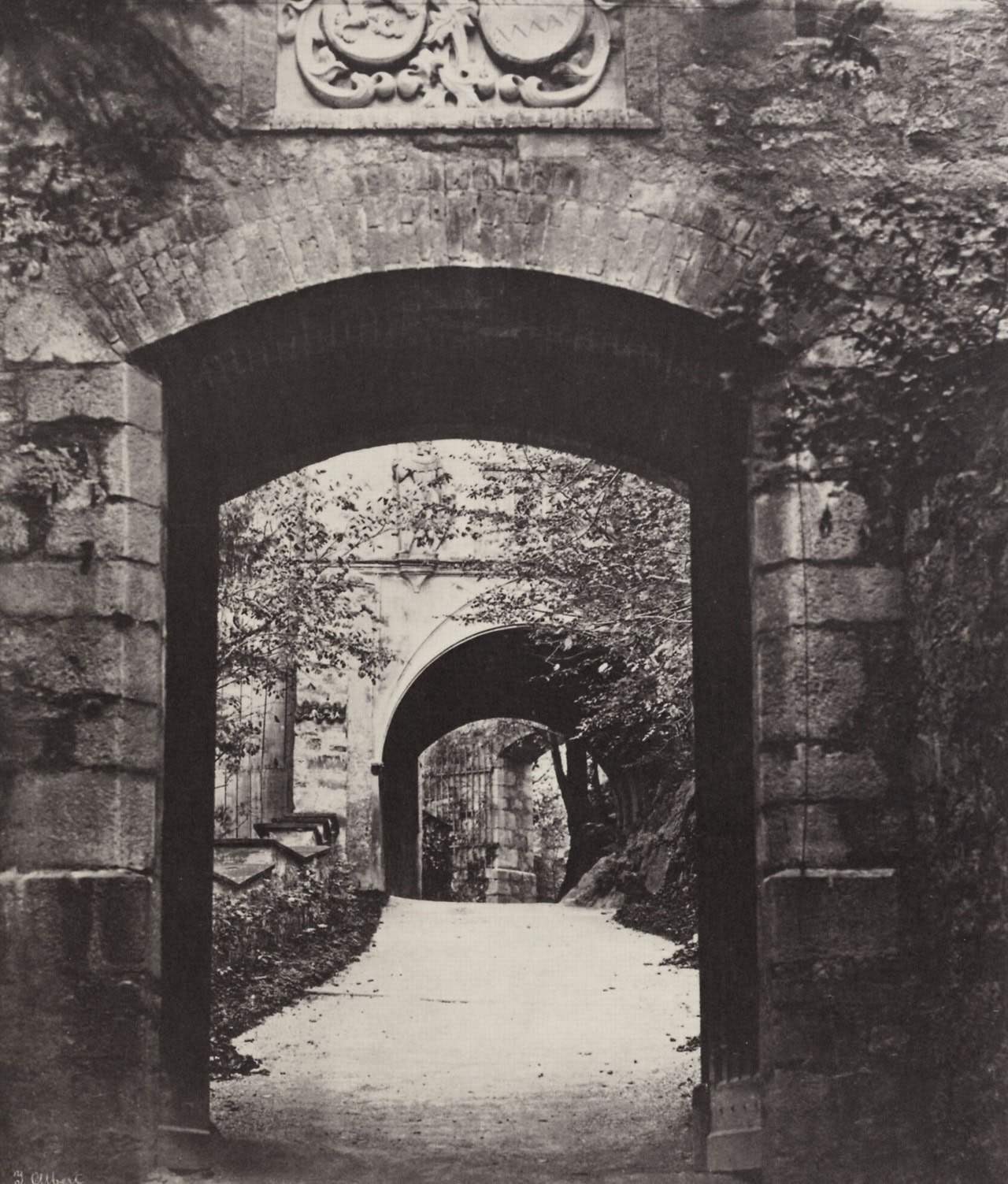
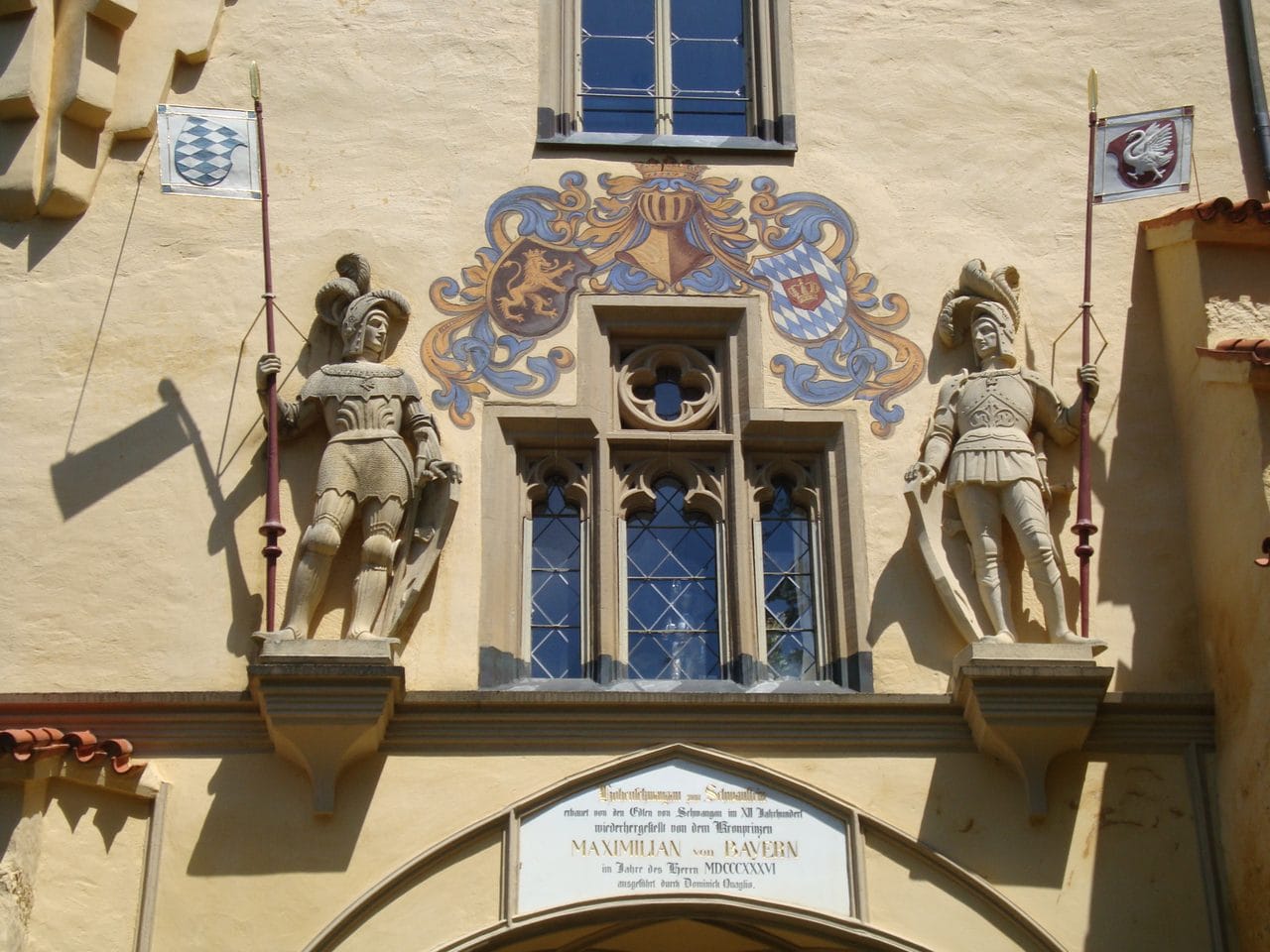
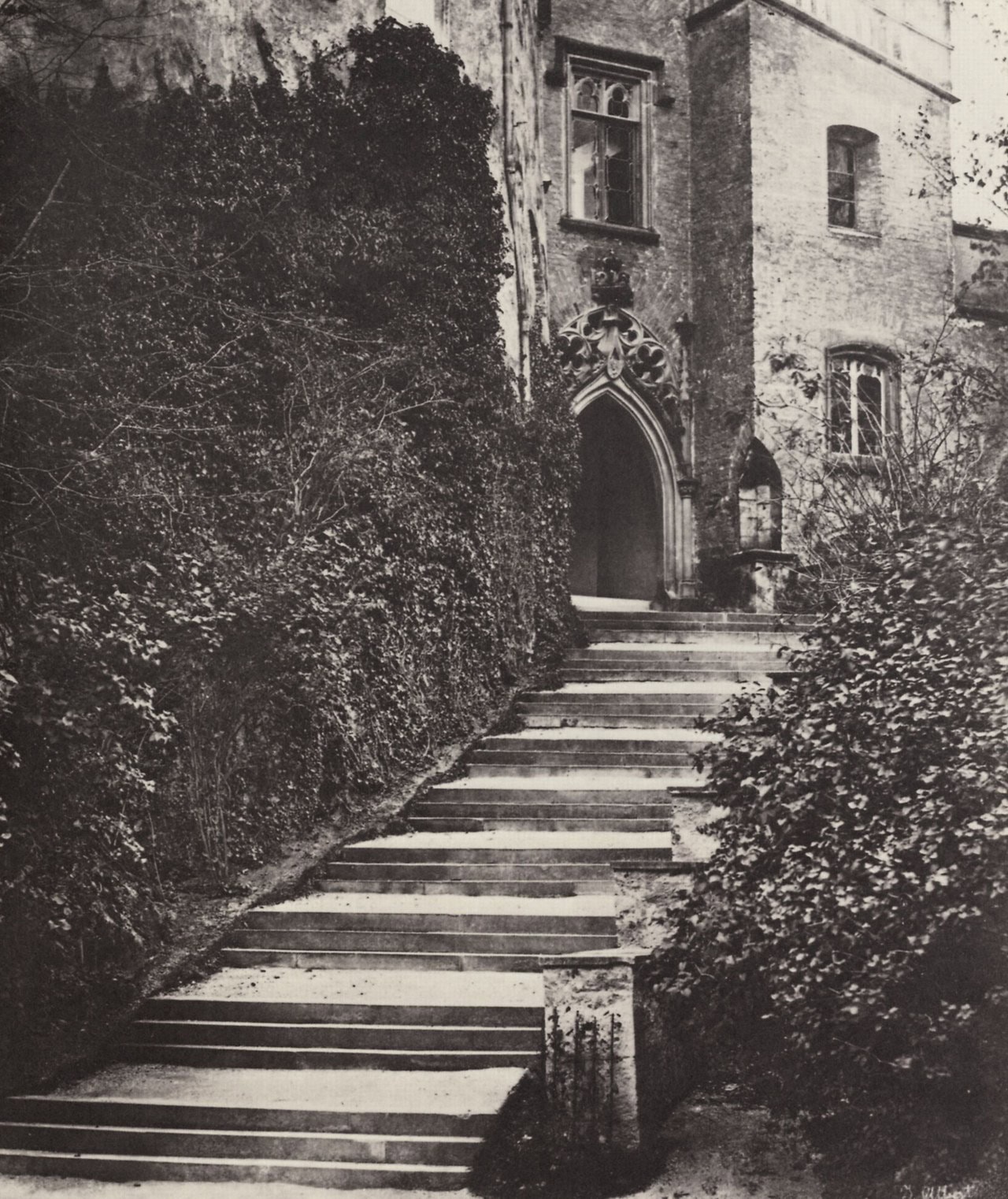
Set aside the fairytale vocabulary and the heritage office’s description is precise. A cube-shaped block of four stories, solid masonry rather than the timber framing the same register records elsewhere in the village, sits under a flat hipped roof, with one rectangular and three polygonal corner towers, each of them raised over a round substructure. Oriels, crenellation and a columned balcony break the elevations; the windows and the two castle gates are segmental-arched, and the gates carry armorial reliefs. To the north a three-story gate tower rises with polygonal turrets of its own.
The rest of the listed ensemble is itemized component by component, and the detail is worth having because it is what lets you read the silhouette. Fürstenbau, the former upper stable range, is two stories under a saddle roof with a polygonal corner tower at its south-west, a loggia and segmental-arched windows, remodelled by Ziebland in 1853 and 1854. Kavaliersbau, built by Ziebland between 1851 and 1855, carries a stepped gable and a stair tower where it meets the Fürstenbau, which is the one piece of vertical circulation the record names. Then the crenellated Wehrmauer, the two gates, the Schlosspark laid out by Quaglio at the same time to the south and west of the main building, and an orangery on a high two-story plinth with a glazed south face.
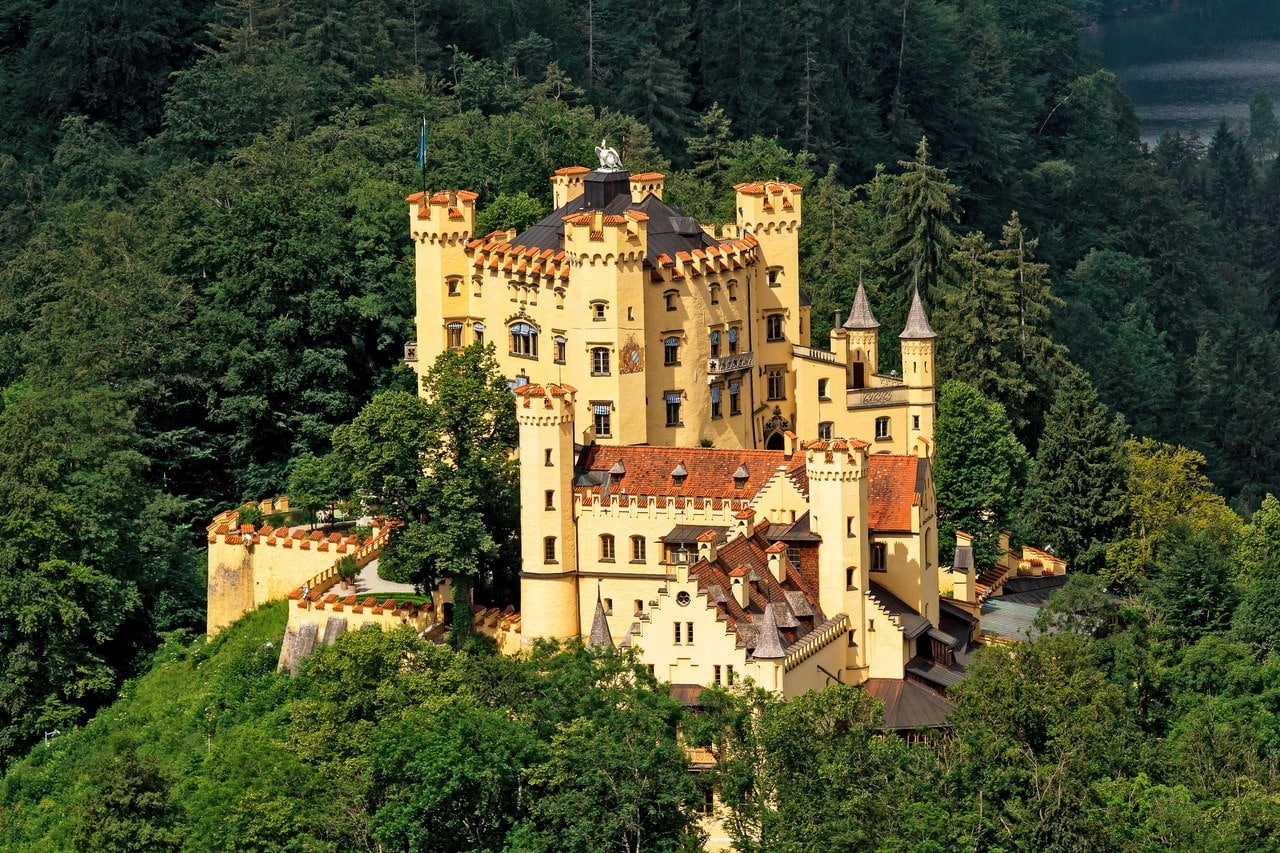
Which century you are actually looking at is the question a visitor most often gets wrong, and the answer is not the obvious one. Zeune’s judgement is that what survives is essentially the castle of 1538 to 1547, and that the work of the 1830s concerned in the first instance the treatment of the facades together with their miniature crenellation. Quaglio, on the same account, took over the sixteenth-century castle walls in the main. Even the corner towers belong to the earlier campaign: three are de Spari’s, and the south-west one was added only after Quaglio’s death in 1837.
One piece of that sixteenth-century castle needs its own answer, because this page has now given it two names. Zeune has de Spari’s block ringed by a Wehrzwinger, a low outer ward carrying seven small bastions, probably after the Castel Nuovo, and the 1611 inventory still has gun and powder stored on those bastions in 1586. The wall the heritage register lists today is not that ward. It enters the list as a crenellated Wehrmauer dated with the nineteenth-century campaign, in the same breath as the fountain and the wall painting set into it. What became of the Zwinger and its seven bastions is stated by neither the register nor the castle database, so this guide leaves it open rather than inventing a demolition.
Nothing medieval is visible in the standing fabric, and the state’s own filing system says so twice over. The building above ground is listed as a Baudenkmal and described as neo-Gothic; the medieval material is a separate Bodendenkmal, registered as findings in the area of the existing castle, which is to say archaeology in the ground. Any reuse of older parts belongs to the sixteenth-century rebuild rather than to Maximilian’s. So the sequence is four-phase and each phase has its own evidence: a castle recorded in 1397, a new build of 1538 to 1547, repair and extension into a Schloss, the main building phase running 1833 to 1837 inside the architects’ documented 1832 to 1838, and completion from 1839 to 1855.
One point of style is worth nailing down, because the tourism pages and the heritage office differ. Both the heritage office and the operator’s German pages call the building neo-Gothic; a museum record held by the Landesstelle für die nichtstaatlichen Museen goes further and describes it as built in the style of English neo-Gothic. Where the municipal tourism page says the windows are pointed, the heritage office says segmental in four separate places, and the statutory record is the one to follow. The municipality’s own summary of the building is the fairest short verdict available: its architecture stands as an example of the nineteenth century’s romanticizing reception of the Middle Ages.
More than ninety wall paintings
Interiors are the reason this castle matters to the history of taste, and the reason it matters to Ludwig. More than ninety wall paintings cover its rooms, a figure the operator gives in both languages. Haus der Bayerischen Geschichte describes them as historicizing wall paintings illustrating certain high points of German history, and thereby of the House of Wittelsbach, executed by Michael Neher, Lorenzo Quaglio and Wilhelm Lindenschmitt, partly after designs by Moritz von Schwind. That dynastic reading is the state’s own, not a tourism gloss, and the room names bear it out.
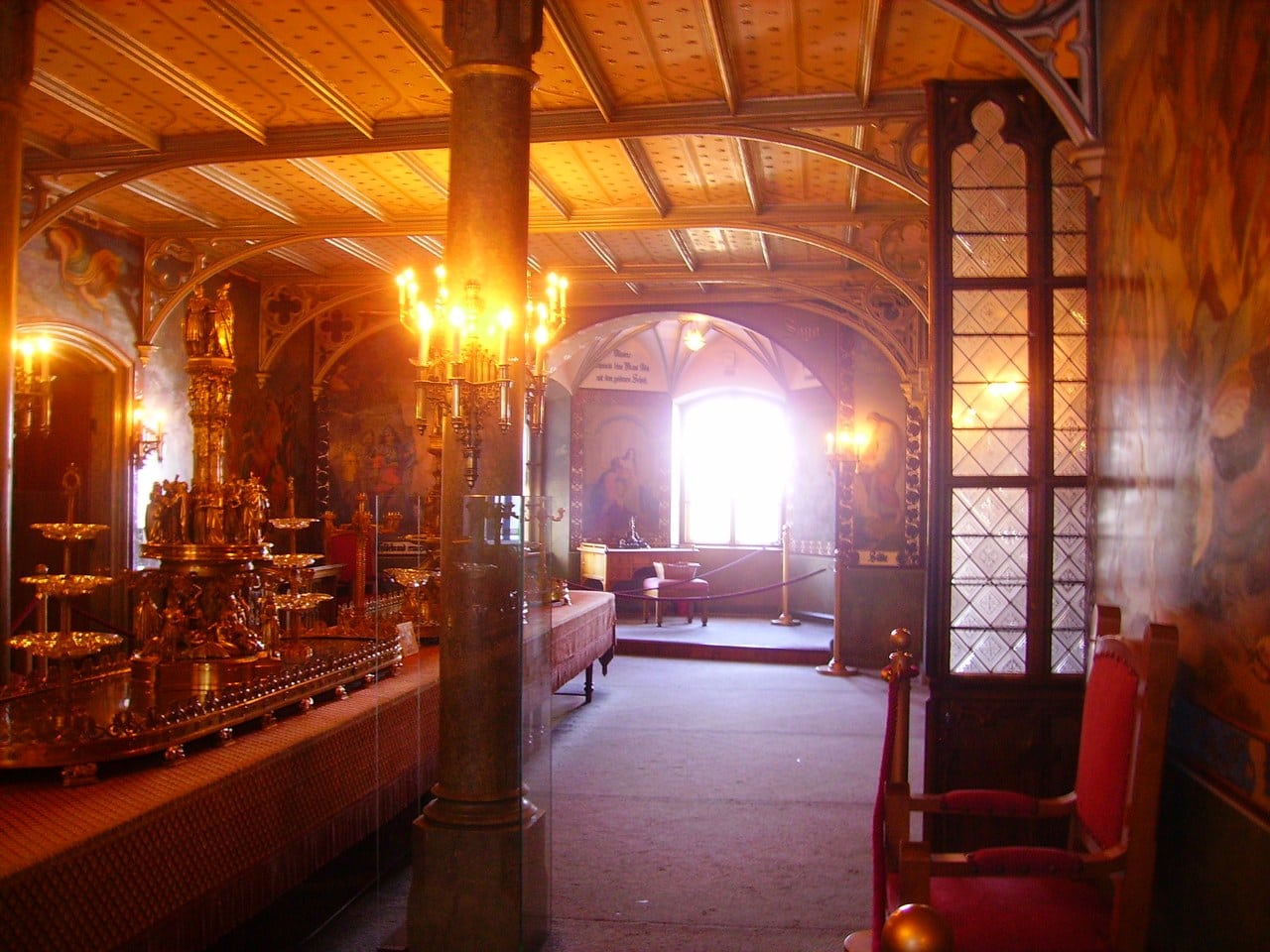
Seven rooms are named by the owning foundation, and they divide neatly by function. Heldensaal, the great festival hall, carries the Wilkina saga with Dietrich von Bern after Schwind’s designs, painted in 1835 and 1836. Muffat’s contemporary account divides its sixteen pictures between Glink with seven, Giessman with six and Neher with three. Orientzimmer was Queen Marie’s bedroom. Tassozimmer holds a starry ceiling that can be illuminated, which is a piece of stagecraft entirely in keeping with a building managed by a theater painter; the foundation states it in the present tense and assigns the room no occupant. Hohenstaufenzimmer served Ludwig II as a dressing and music room, and it holds the piano on which Wagner is said to have played for the king.
Muffat adds one the foundation’s list leaves out, and it is the room that explains the castle’s name: the Schwanritter-Saal, first of the sequence, its four pictures composed by Christian Ruben and painted by Neher and Lorenzo Quaglio, and fitted as the dining room. Schyrenzimmer, with its oriel, and Berchtazimmer and Billiardzimmer complete the set. The foundation dates the Heldensaal cycle to 1835 and 1836 and the other rooms only to around 1835 or around 1840, so the program runs into the 1840s rather than finishing with the hall.
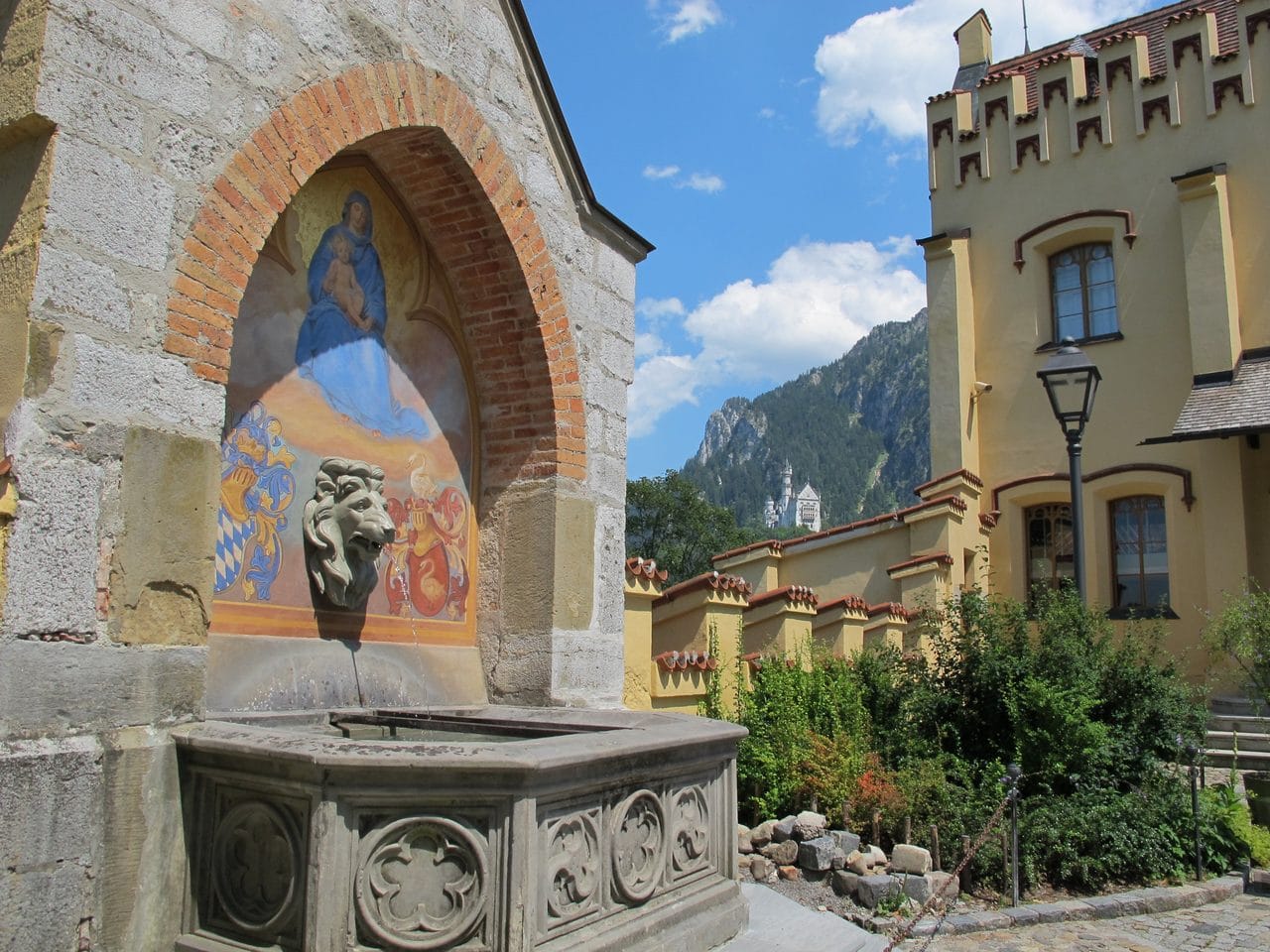
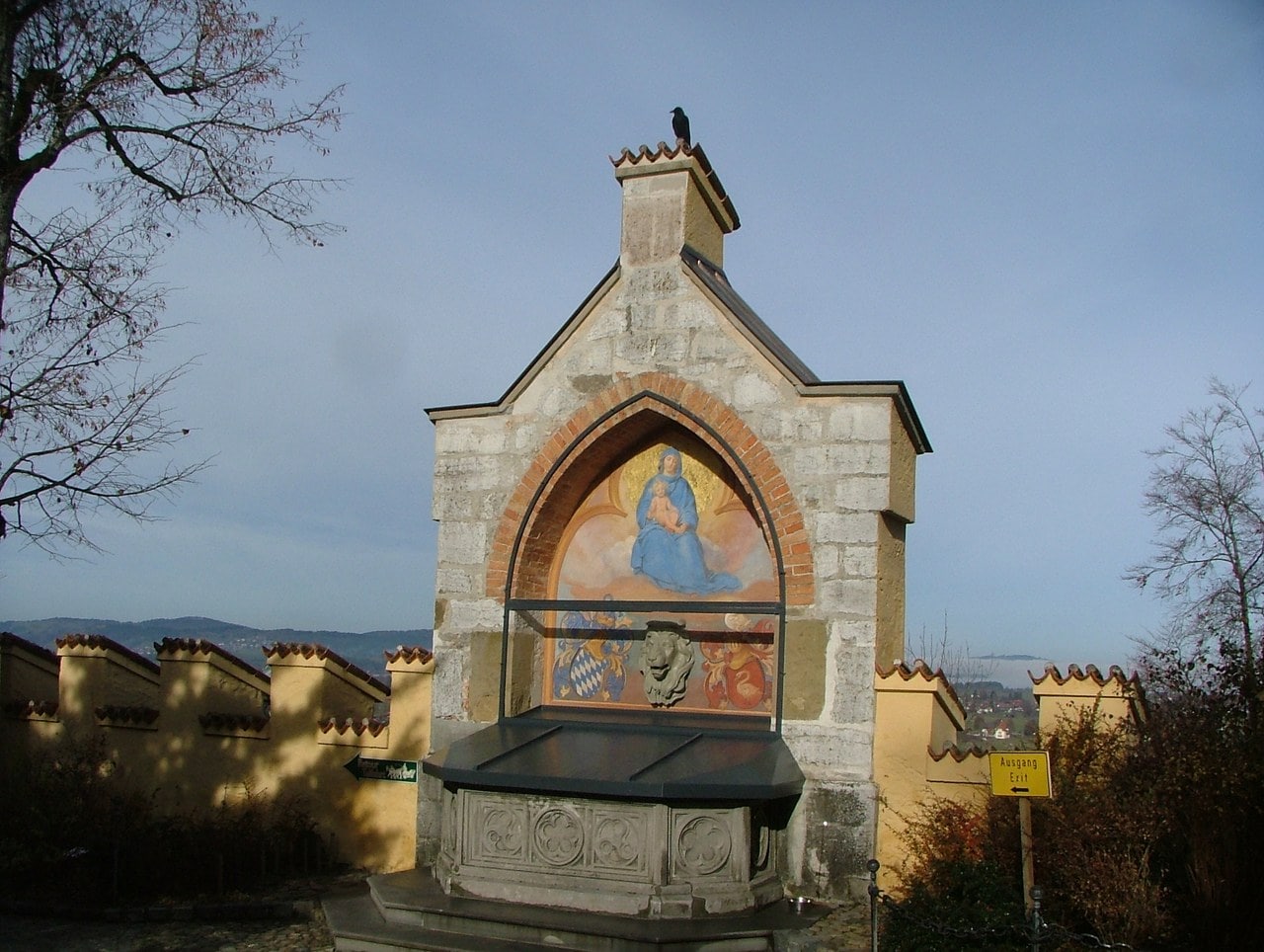
How the cycle was regarded in its own century is easier to demonstrate than to assert. Bavarian State Library holdings include a folio devoted to it alone, published in Leipzig by Alphons Dürr in 1886: Moritz von Schwind’s Wandgemälde im Schloss Hohenschwangau, forty-six compositions engraved from the watercolour designs by Julius Naue and Hermann Walde. A posthumous volume given over to the murals of one castle is evidence of standing in a way that a superlative in our own voice would not be. Franz Xaver Glink worked in both places. The heritage office credits him with the wall painting above the lion-head fountain in the Wehrmauer, the Marienbrunnen, and Karl August Muffat’s description of 1837, published a year after the gateway tablet was cut, catalogues the hall picture by picture and gives him seven of its sixteen.
The program walks outdoors
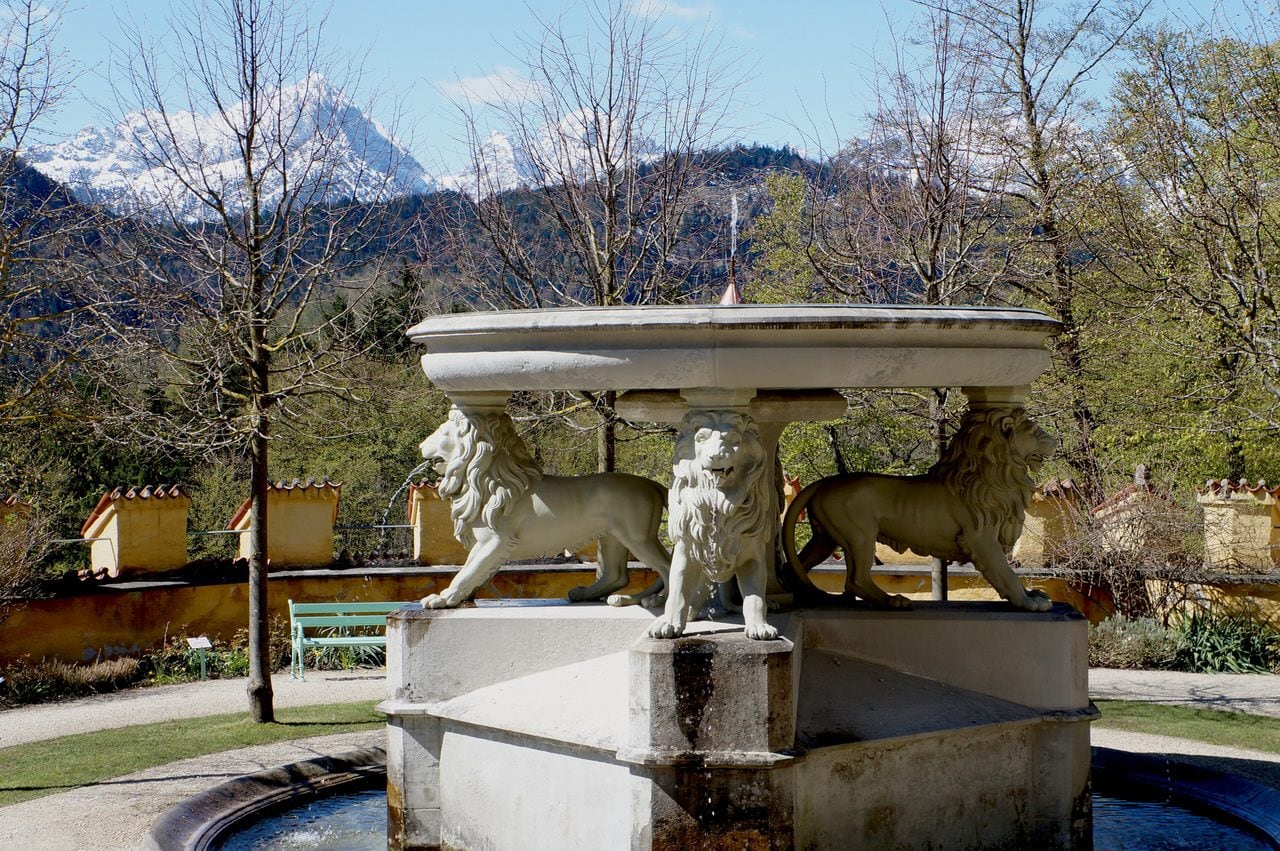
Outside the rooms the same argument continues in water, and this is the part of Hohenschwangau nobody writes about. Every fountain in the garden takes up the romantic program of the interiors, according to the operator, and each carries a theme. Löwenbrunnen, the lion fountain, was made after an example of the Alhambra and stands for the Orient; it was designed by Ludwig von Schwanthaler. Schwanenbrunnen, with a bronze swan by Ludwig Schaller, stands for local identity and chivalry.
Marienbrunnen in the courtyard stands for Christian faith, and it is the one of the five this page actually shows you: the gabled wall fountain set into the Wehrmauer, a carved lion’s-head spout between the Bavarian lozenge and the Schwangau arms beneath a Madonna painted by Glink. Muffat saw it in 1837 as the first of the courtyard fountains, issuing from the ring wall under a Madonna in fresco and shaded by three lindens. Its name is Marian and not a reference to Queen Marie, which is worth saying because the coincidence invites the wrong guess. Felsenbad stands for Late Antiquity, and the Gänsemännchen fountain of 1867 for medieval legend.
Two of those links close a circuit through the building. An Orient fountain in the garden answers an Orient room upstairs, the queen’s own bedroom; a swan fountain answers the arms that gave the castle its name. Four sourced steps, and they make the garden an argument rather than a decoration.
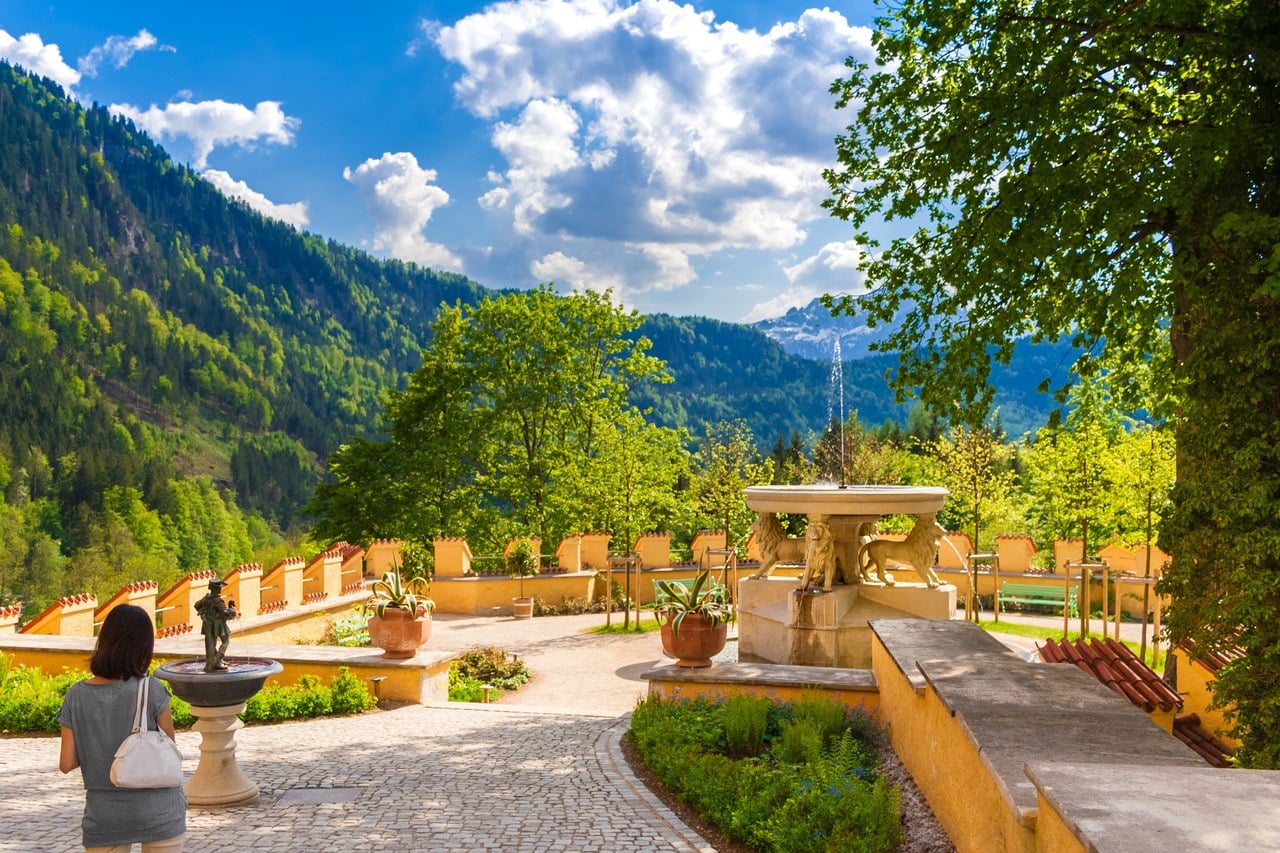
Two separate gardens are involved, and conflating them is easy. Schlossgarten, at the castle, was laid out from Quaglio’s plans between 1833 and 1837, extended in 1851 by Georg Friedrich Ziebland and Peter Joseph Lenné, and replanted in 2007 to the nineteenth-century scheme. Schwanseepark lies down in the valley, north-west of the castle in the low ground between the Kienberg, the Perzenkopf and the Schwansee, and it was formed between 1838 and 1864 in two phases, beginning with the court garden architect Carl August Sckell. Lenné’s revised plan for it is dated 1853 and the heritage office notes that it was carried out only rudimentarily; the first extension plans of 1851 belong to Josef Wenglein and the forestry official Thoma. Its winding paths deliberately take in old quarries on the southern flanks of the Kienberg and the Perzenkopf, and the modelled riding arena in its south-east is overgrown today.
Visiting Hohenschwangau Castle
List the 9 castles on this map
- Hohenschwangau Castle — Swabia, Bavaria, Germany
- Neuschwanstein Castle — Swabia, Bavaria, Germany
- Linderhof Palace — Bavaria (Oberbayern), Germany
- Herrenchiemsee New Palace — Chiemgau, Upper Bavaria, Germany
- Lichtenstein Castle — Baden-Württemberg, Germany
- Rheinstein Castle — Rhineland-Palatinate (Rheinland-Pfalz), Germany
- Wartburg Castle — Thuringia (Thüringen), Germany
- Nuremberg Castle — Bavaria, Germany
- Hohenzollern Castle — Baden-Württemberg, Germany
Hohenschwangau sits in the village of the same name in the municipality of Schwangau, in the Ostallgäu district of Swabia, near Füssen and the Austrian border. It stands on a wooded rise above the northern end of the Alpsee, with the smaller Schwansee in the valley below and the ridge of Neuschwanstein rising opposite. Both castles share the village, the parking and the ticket office, which makes a combined visit straightforward and a confused visit easy.
Getting there
Füssen Bahnhof is the nearest station, about 5 km away, with a taxi ride of roughly eight minutes. From the station, RVA lines 73 and 78 both reach the castles in about fifteen minutes; the stop appears on the timetables as Hohenschwangau Neuschwanstein Castles and on the operator’s page as Alpseestraße. Regional trains connect Füssen with Munich, Augsburg, Buchloe and Kaufbeuren, and the municipality also lists a Flixbus service from Munich. Munich Airport lies about 155 km off, roughly three hours away by rail and bus. Drivers leave the A7 at the Füssen exit, about 7 km short of the village.
Coming from the airport, the operator sets out the whole chain on its own arrival page, and it is worth following rather than improvising. Take S-Bahn line S1 or S8 to München Hauptbahnhof, change there for a Regional Express or Bayerische Regiobahn service to Füssen from the platform group numbered 27 to 36, and finish on line 73 towards Steingaden and Garmisch-Partenkirchen or line 78 towards Schwangau.
Which day ticket to carry repays settling before you travel, because the two obvious ones behave differently. A Deutschland-Ticket is valid across Germany on local and regional services, buses included, never on IC or ICE trains, and it is sold only as a monthly subscription, which rules it out for most visitors. A BayernTicket buys one day on every regional train and, in Deutsche Bahn’s own wording, almost all scheduled buses in Bavaria, with up to three children aged six to fourteen carried free. Its catch is the clock: from Monday to Friday it starts only at nine in the morning, later than the first train a full castle day wants, and just at weekends and on public holidays does it run from midnight. Neither page lists acceptance line by line for RVA 73 and 78, so ask at the Füssen bus station rather than assuming.
Two local details repay knowing in advance. A Schwangau guest card or a KÖNIGSCARD, issued by your accommodation, carries free travel on second-class buses and trains across a named group of communities including Schwangau and Füssen, and the same cards appear on the castle’s own reduced-rate list. Evening departures back towards Füssen are seasonal rather than standing: the municipality runs a late bus in July, August and September only, three services a day on line 78, at a flat fare of one euro. Neither line publishes a headway, so check the municipality’s own timetable rather than assuming a frequency.
Roads to both castles are closed to public traffic, so the last stretch is on foot or by horse. Park in the valley lots P1 to P4; P2 takes campers and motorbikes and holds three designated disabled bays, and there is no exception to the driving ban for visitors with reduced mobility. Walking up from the Ticket Center takes twenty to thirty minutes on the operator’s transport and tour pages, though its own frequently-asked-questions page says fifteen to twenty, so treat the climb as somewhere in that band rather than a fixed figure. Horse-drawn carriages run from in front of the Ticket Center to the foot of the castle in about ten minutes; they operate on demand with no timetable, cannot be reserved, and are paid to the driver at the stop. There is no carriage service at all during the winter opening hours.
One trap catches a great many visitors. The shuttle bus that everybody reads about serves Neuschwanstein only, running from the Alpsee car park up to the Jugend viewpoint and Mary’s Bridge; it does not climb this hill, and Hohenschwangau’s two options are the ones above. Note also that a Deutschland-Ticket, a BayernTicket, a SchwangauCard and a KÖNIGSCARD are all invalid on that shuttle, whatever they cover elsewhere. Before setting out, the operator publishes a daily operating status for the carriages, the shuttle and the viewpoints on its own homepage, which is a more reliable answer than any figure printed here.
Admission
| Ticket | Price |
|---|---|
| Adults | EUR 23.50 |
| Reduced (65 and over, students, visitors with a disability, hotel guest card, KÖNIGSCARD; identity document required) | EUR 19.50 |
| Children 7 to 17 | EUR 12.00 |
| Children under 7 | Free, but a ticket is still required |
| Registered companion of a visitor needing an escort | Free |
| Online or reservation service fee | EUR 2.50 per person per ticket, free tickets included |
| Wittelsbach-Ticket (castle and Museum of the Bavarian Kings) | EUR 36.00; reduced EUR 31.00; child EUR 12.00; plus EUR 5.00 online fee |
| Kings-Ticket (both castles) | EUR 43.50; reduced EUR 38.50; child EUR 12.00; plus EUR 5.00 online fee |
| Swan-Ticket (both castles and the museum) | EUR 56.00; reduced EUR 50.00; child EUR 12.00; plus EUR 7.50 online fee |
| Group tour, from 15 paying guests | EUR 19.50, written request only; booking fee EUR 1.50 per ticket |
| Summer season 2026 | 28 March to 15 October; guided tours daily 9:00 to 16:30 |
| Winter season | From 16 October 2026; guided tours daily 10:00 to 16:00. The operator publishes no end date for the 2026-27 winter season and no 2027 summer dates |
| Ticket Center hours | Daily 8:00 to 16:00 in summer 2026; 8:00 to 15:30 from 16 October 2026 |
| Closed | 24, 25 and 31 December, and 1 January |
| Horse-drawn carriage, paid directly to the driver | EUR 5.50 up, EUR 3.00 down, per person; about 10 minutes; no carriage service during the winter opening hours |
| Parking | Car EUR 12.00 for up to 6 hours, EUR 1.00 each additional hour, EUR 16.00 maximum; camper EUR 16.00 rising to EUR 20.00; motorbike EUR 5.00 per day; coach EUR 35.00 per day |
| Prices and hours verified | 7 August 2026, against the operator’s price list headed “Prices from 01.01.2026” |
Booking mechanics matter more here than the numbers, and several of them surprise people. Tickets come either from the operator’s online shop or from the Ticket Center counter in the village, and counter tickets are valid for the same day only; a limited number is released there each morning at 8:00, first come first served. Reservation by telephone or email is not possible, tickets cannot be held or blocked at the counter, and there is no waiting list. Online tickets are excluded from exchange and from return, so a missed connection is a lost ticket. A QR code on a charged phone is accepted in place of a printout.
Families should note two rules that cost money if missed. Small children need a ticket of their own even when admission is free, for evacuation reasons the operator states explicitly, and the service fee applies to those free tickets as well; children must also be added at the moment of purchase, because the operator will not add them afterwards. Anyone holding a Bavarian Palace Administration product should note a further exclusion: the annual pass, the fourteen-day Mehrtagesticket and the Königsschlösser combination pass cover Neuschwanstein and none of them covers Hohenschwangau, because this castle belongs to the Wittelsbach foundation rather than to the state administration. Combination tickets, finally, are issued for a single visit date and cannot be spread over two days.
What the tour shows
Interiors can be seen only on a guided tour of limited capacity, at a fixed entry time printed on the ticket, and the tour lasts about forty-five minutes. Guides work in German and English; portable audio guides cover twelve further languages, from French and Mandarin to Hungarian and Korean, and the devices are handed out inside the castle rather than at the Ticket Center. Photography and filming are both forbidden throughout, so the painted rooms leave with you only in memory.
Everything outside the turnstile is free. No ticket is needed to walk up, stand in the courtyard, look across at Neuschwanstein or see the fountains in the castle garden, a point the operator makes twice on its own pages. When your entry time approaches, watch the monitor beside the turnstiles for your tour number; the guide meets the group inside. Expect about a hundred and eighty steps on the route, ninety up and ninety down, and note that there is no visitor elevator in the building.
How long you need
Allow more than the tour length, because the operator does. It asks visitors to be in the village at least an hour before their admission time, and the reason is unforgiving: the foundation’s terms state that visitors arriving late have forfeited their right of access, with no refund of the admission fee or of any service fee paid. Add the hour, the climb, forty-five minutes inside and the walk down, and Hohenschwangau alone comes to about two to two and a half hours, car to car. That total is our own arithmetic on the operator’s published components rather than a figure it publishes.
Both castles and the museum together make a full day. Neuschwanstein carries its own separately timed tour and a longer arrival buffer, and the Museum of the Bavarian Kings at the foot of the hill needs no timed slot at all: sixteen exhibition rooms on two floors, with a visit the operator describes as not time-bounded. Anyone with an hour to fill before their entry time has that answer 400 meters away. A sensible order is to collect tickets in the village, walk or ride up, spend the wait in the free courtyard and garden, take the tour, then come down for the museum or the Alpsee circuit, which runs about 5.2 km in roughly an hour and a half. Seeing the father’s castle before the son’s turns two pretty buildings into a story with a beginning.
Best time to visit
Hour of day beats season here, and the operator says so itself: on most days, it writes, it is sold out in the late morning hours. Same-day tickets are released at the counter from 8:00 and go quickly, so arriving without a booking is a gamble that gets worse as the morning runs on. Holiday periods add a second queue: the operator warns of significant waiting times at the bus and carriage stops during holidays generally and particularly through the summer months and around Christmas and New Year.
Winter changes what is available rather than what is open. Tours start an hour later and finish half an hour earlier from 16 October, no carriage runs up to this castle in the winter opening hours, so a winter visitor walks, and Mary’s Bridge across the valley closes in ice and snow, with its status published daily. Four days are closed outright at Christmas and New Year, when the shuttle bus does not run either. Two things a reader might reasonably expect are simply not published: the operator lists no events at the castle, and although the castle garden was replanted in 2007 to its nineteenth-century scheme, no bloom period or peak month is published for it anywhere. This guide invents neither.
Photography
Ban first, because its scope is wider than most visitors assume. Photography and filming are forbidden inside all three sights, the museum included, so the museum’s celebrated twenty-one-meter panorama window looking straight at the castle is not a photo spot. The foundation’s terms make the consequence explicit: a visitor who does not comply may be removed without financial compensation and excluded from future access. Commercial and press shoots need written permission in advance from the foundation’s art and tradition department at Schloss Nymphenburg in Munich.
Everything you are permitted to photograph is therefore outdoors, and all of it is free. Courtyard and garden need no ticket, which puts the lion fountain, the swan fountain and the Marienbrunnen within reach of anyone who walks up. For the building whole, the operator recommends one named viewpoint by name: the Jugend, on the narrow ridge to the left of the Pöllat, which frames the castle with the Alpsee to the left and the Schwansee to the right. Reaching it means about forty-five minutes uphill from the P4 car park, or five minutes on foot from the shuttle’s terminus. From there the camera looks roughly west at the castle’s eastern face, which is a matter of geometry we have computed rather than advice the operator gives.
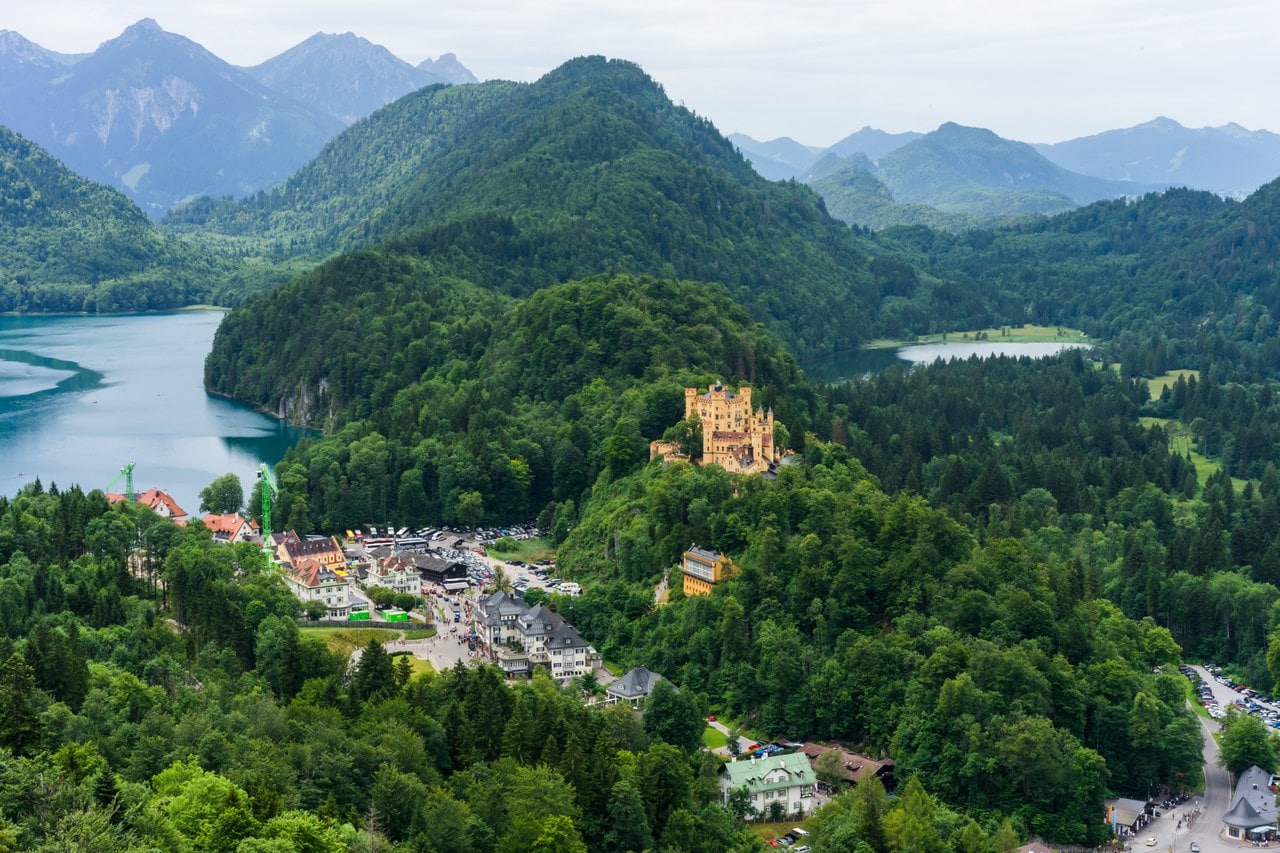
That viewpoint carries a piece of history most photographers will not know they are standing in. Maximilian II laid out paths and viewpoints around the castle in order to enjoy the landscape, loved this spot particularly, and planned a viewing pavilion there in 1855; Queen Marie was often on the Jugend with Otto and Ludwig. The photograph the operator recommends is taken from the place the family used to look at the castle from.
Accessibility
Read the operator’s own statement before planning anything, because it is a refusal rather than a caution. There is no way to avoid the stairs, it writes, and therefore persons with limited mobility or guests who depend on a wheelchair cannot visit Hohenschwangau Castle. That is unusually blunt for an operator and it should be reported as it stands: this castle’s interior is not visitable by a wheelchair user, and no elevator exists in the building.
Around that refusal, several things are still possible. Approaching is easy: the lakeside walkway from the village has no steps and only a moderate slope, and the barrier is the turnstile and stairs at the castle entrance rather than the climb. For the ascent the operator recommends the carriage, though that advice holds in the main season only, since none runs in winter. Three designated disabled bays sit in the P2 car park, and private cars may not go up the hill under any circumstances. Visitors with a hearing impairment can ask their guide for the tour text in writing, available in several languages, and a companion registered as necessary in a disability certificate is admitted free. No wheelchairs or walking aids are for hire on site; the nearest supplier is Popp Reha-Team in Füssen, about 5 km away. Barrier-free public toilets are in the village, at the tourist information office and between the Schlossbräustüberl and the museum.
A full alternative exists 400 meters away, and it is the answer this guide would give anyone the stairs exclude. The Museum of the Bavarian Kings is barrier-free: a ramp from the forecourt to the foyer, lifts to every area of a two-floor exhibition, stools and benches in the rooms, portable fold-up seats in the foyer, and accessible toilets on the ground floor. It needs no timed slot, sits opposite the Alpsee car park, and the operator sells it together with the castle as the Wittelsbach-Ticket. One warning about the same operator page: the elevator, the in-castle accessible toilet and the paved hiking trail it describes all belong to Neuschwanstein, and none of the three applies here.
Guided tours and timed-entry tickets for both castles can also be booked in advance through GetYourGuide, and rooms in the village and around Füssen through Booking.com.
Some links on this page are affiliate links, which means StoneKeep Atlas may earn a small commission, at no extra cost to you, if you book through them.
More Views of Hohenschwangau Castle
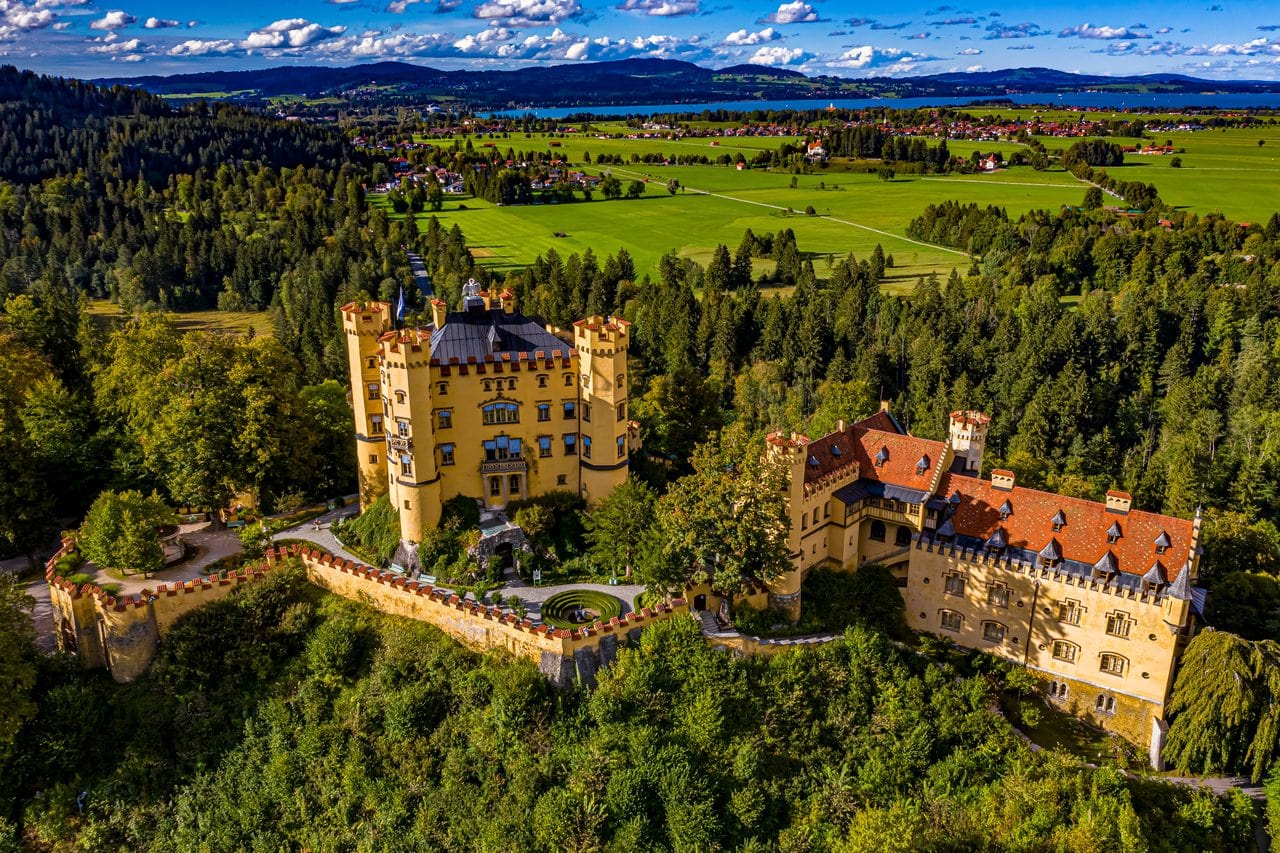
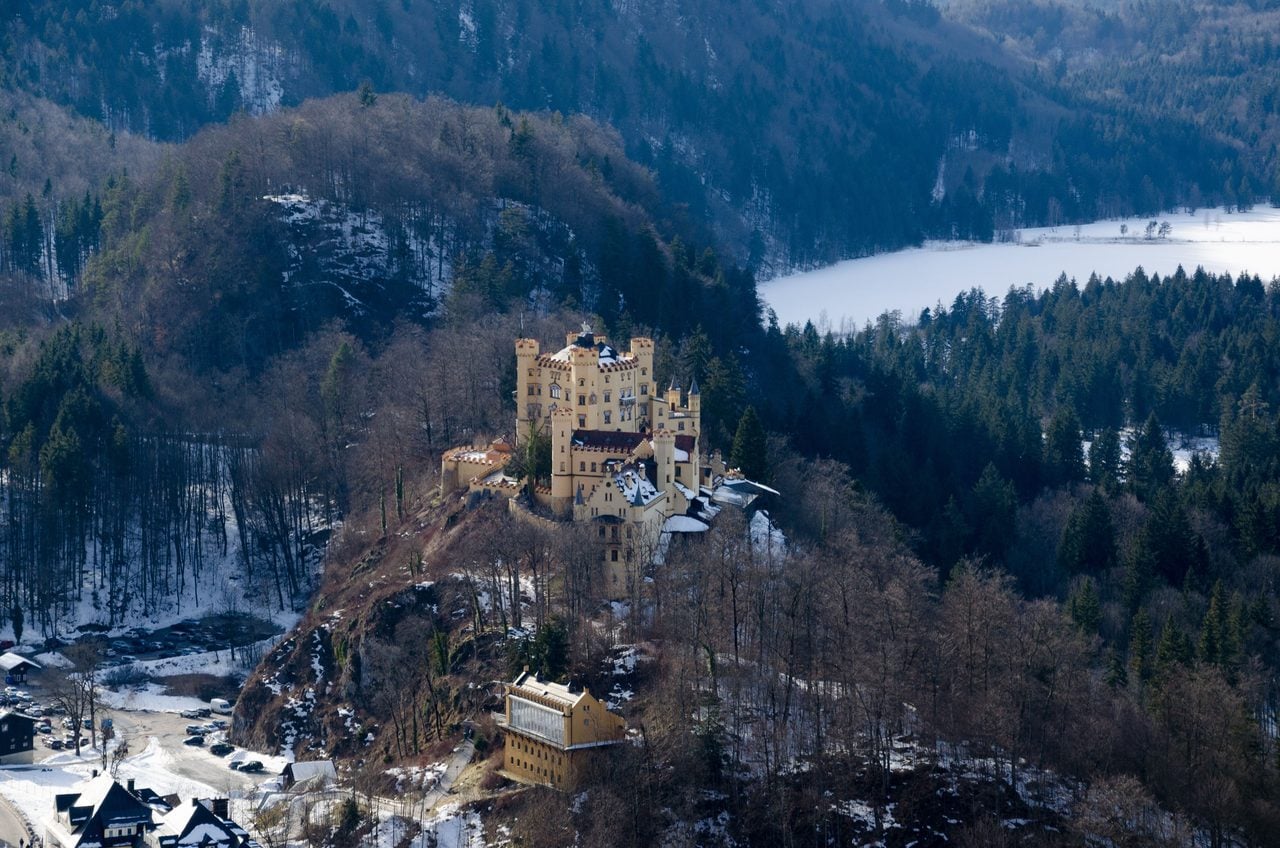
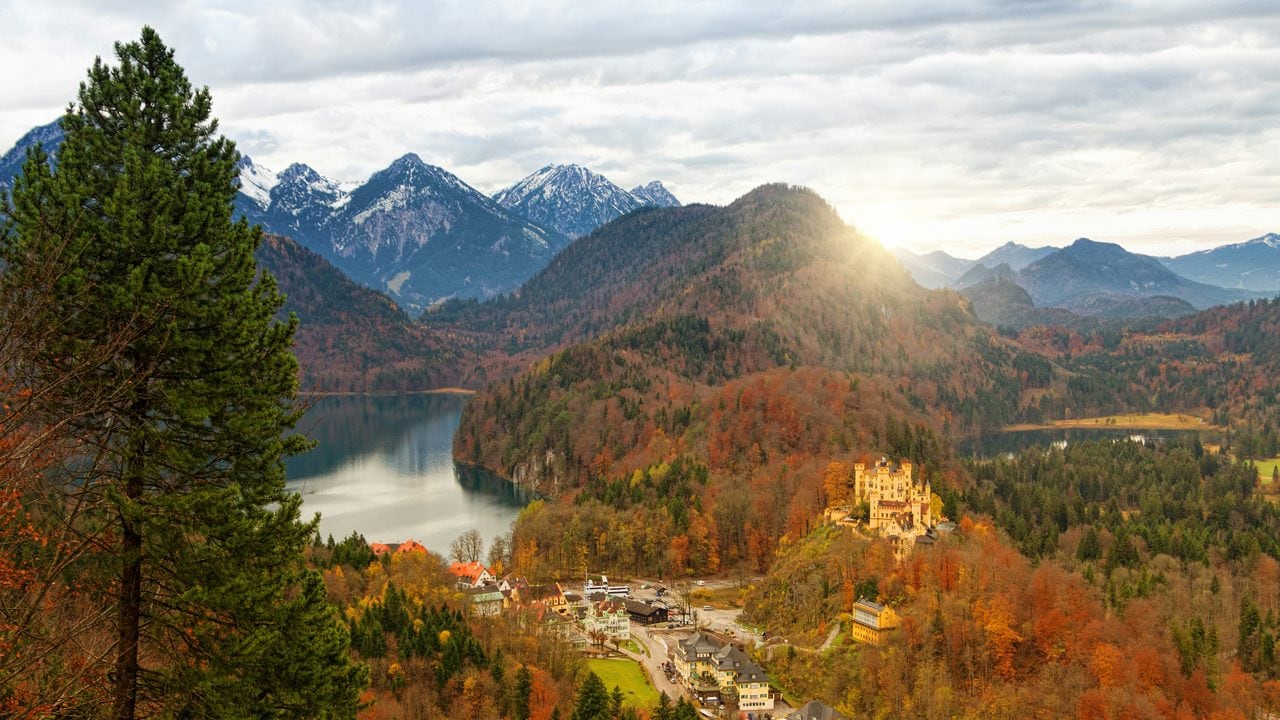
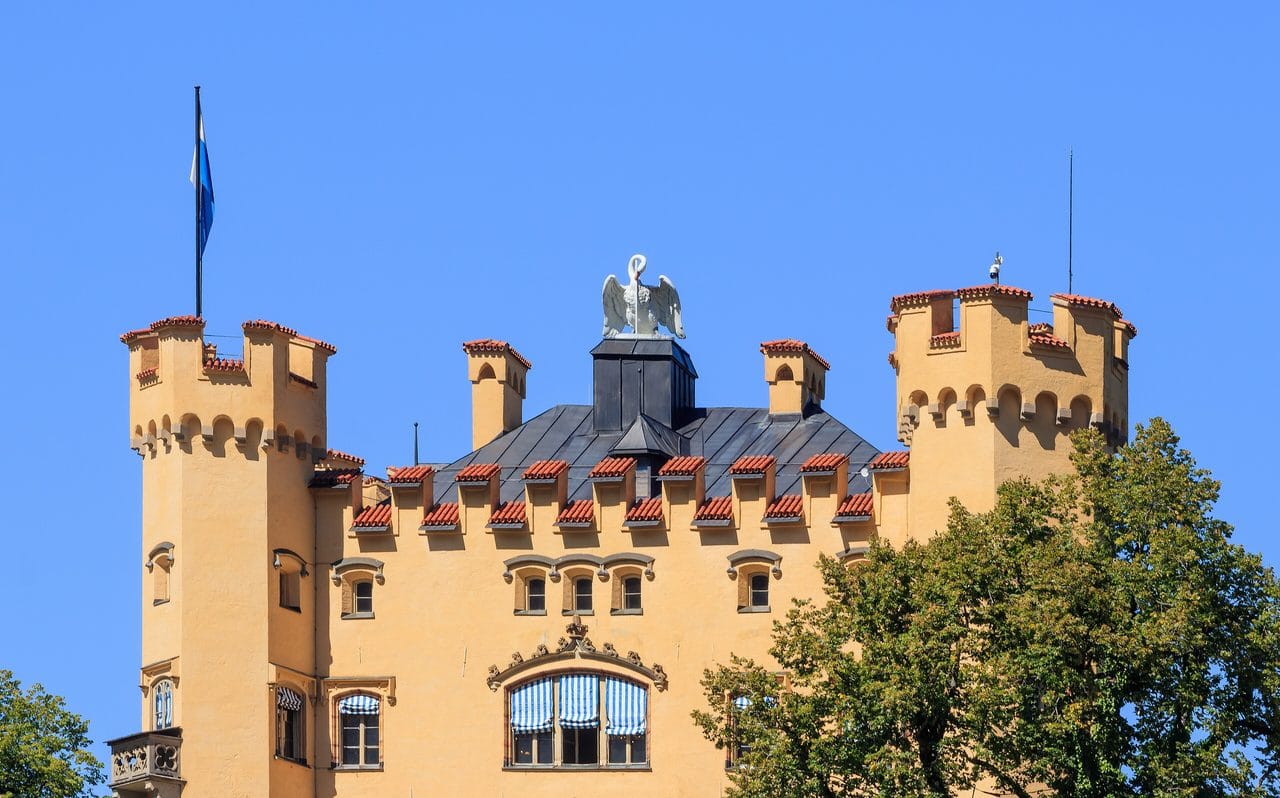
A closer look at Hohenschwangau across the seasons, from its painted rooms and the swan-crowned roofline to the lake and mountains it overlooks.
Common Questions
What is the difference between Hohenschwangau Castle and Neuschwanstein Castle?
Different men, different centuries, different owners. One is Maximilian II’s family home of the 1830s, built over a sixteenth-century core; the other is his son’s stage set, begun in 1869 on a ruined ridge. Their ownership still differs, and the operator says so on its own ticket page: it sells Neuschwanstein’s tickets on behalf of the Bavarian Palace Administration and Hohenschwangau’s on its own behalf, as the Wittelsbach foundation’s agent.
Should I visit Hohenschwangau or Neuschwanstein, or both?
Both, if the day allows, and in that order. Budget carefully, though: the operator asks for a buffer of an hour and a half to two hours before a Neuschwanstein entry time, against one hour here, and each tour is separately timed. If only one is possible, choose by appetite. Hohenschwangau rewards anyone interested in why the other castle exists; Neuschwanstein rewards anyone who came for the silhouette.
Is it worth going inside Hohenschwangau Castle?
Only the interior is ticketed, so this is the one real decision the visit asks of you. Go in if painted rooms interest you: the walls are the argument of the place, and you will not leave with a picture of them, because photography and filming inside are forbidden. Skip it if you came for the view, and spend the wait in the museum the operator itself recommends for visitors with time to fill.
Can you walk from Neuschwanstein to Hohenschwangau?
Yes. Both castles rise from the same village, so the connection is a downhill walk to the valley and an uphill one on the other side rather than a transfer between destinations. From the shuttle’s terminus above Neuschwanstein there is still a steep fifteen-minute descent to that castle’s entrance, which catches people out. Dogs cannot help you here: animals are barred from the buses and the carriages as well as the buildings.
Who lived in Hohenschwangau Castle?
Maximilian II and Queen Marie made it their summer house, and their sons Ludwig and Otto grew up in it. Prince Regent Luitpold was the last of the family to live here properly, until 1912. Ludwig’s own contribution as king was almost nothing: the municipality records that he had scarcely anything altered in the castle, which is part of why the nineteenth-century rooms survive as they do.
When was Hohenschwangau Castle built?
Four times over, which is why the answers you find disagree. Bavaria’s heritage register splits the evidence between two entries: D-7-77-169-30 covers the standing neo-Gothic palace, and D-7-8430-0043 covers the medieval findings beneath it. Between those two lies the decisive campaign of 1538 to 1547. Anyone quoting a single year is picking one of four, and the operator’s twelfth century belongs to the lordship rather than to any building.
How long is the walk up to Hohenschwangau Castle?
Somewhere between fifteen and thirty minutes, and the spread is the operator’s own rather than ours: its questions page gives the shorter figure and its transport and tour pages the longer one. Paths are well marked and the gradient is moderate. Nothing is charged and nothing is booked for the climb itself, so a visitor without a tour ticket can still make the ascent and stand in the courtyard.
Beyond Hohenschwangau Castle
Hohenschwangau is the natural first stop in a tour of King Ludwig II’s Bavaria. Across the valley, Neuschwanstein Castle is the answer to this castle’s question, and the two should always be read together. Ludwig went on to build in two further keys: Linderhof Palace, the small rococo retreat he finished and lived in, and the unfinished Versailles homage of Herrenchiemsee New Palace on its island in the Chiemsee.
How nineteenth-century Bavaria built castles to its own legends runs through The Castles of King Ludwig II and the dynastic survey Wittelsbach Castles of Bavaria, which picks up the House of Wittelsbach thread this castle’s murals were painted to illustrate. Hohenschwangau also opens the valley pair in our tour of the fairytale castles in Germany. Readers drawn to the romantic-revival impulse will find its cousins elsewhere: Lichtenstein Castle in Württemberg, the Rhineland fantasy of Drachenburg Castle, and the ducal showpiece of Schwerin Castle. For the wider picture, the hub guides to the 19th-century romantic revival of German castles and the best castles in Bavaria set it in its proper company.
Conclusion
Hohenschwangau is easy to underrate. Beside the white silhouette across the valley, the older ochre palace can look like a footnote, somewhere to fill the hour before the main event. Its claim is stronger than that, and it is not only sentimental. Under the neo-Gothic costume sits a sixteenth-century building that the state’s castle database calls foreign to castle building north of the Alps, and over it lies a mural program that a Leipzig publisher thought worth a folio of its own in 1886. This was also the world that made Ludwig II, painted rooms where a child met the Swan Knight and an adult wrote that his mother’s prose desecrated the place every year. See it first, and the castle opposite stops being a fairy tale from nowhere.
Principal Sources
- Bayerische Schlösserverwaltung. “The Idea of Building the Castle.” Ludwig II’s identification with Lohengrin from his youth, the letter to Wagner of May 1868, the Marienbrücke of the 1840s as a birthday present for Queen Marie, the remains of two small castles on the ridge, and the start of building in 1869. neuschwanstein.de.
- Bayerisches Landesamt für Denkmalpflege. Denkmalliste Schwangau, Stand 09.07.2026. Statutory record: the standing neo-Gothic building at D-7-77-169-30 with its towers, roof, segmental arches and ancillary ranges; the medieval findings at D-7-8430-0043; the fountains and their sculptors; the monument to Queen Marie of 1897; and the Schwanseepark at D-7-77-169-54. geodaten.bayern.de.
- Deutsche Bahn. “Deutschland-Ticket.” Validity nationwide in local public transport and regional rail including buses, the exclusion of long-distance IC and ICE services, and the subscription-only condition. bahn.de.
- Deutsche Bahn. “Bayern-Ticket.” Validity on all regional trains of all railway companies and almost all scheduled buses in Bavaria, the exclusion of ICE and IC, the nine-in-the-morning start on weekdays against midnight at weekends and on public holidays, and up to three children aged six to fourteen carried free. regional.bahn.de.
- Gemeinde Schwangau. “Gästekarte.” Free bus and second-class rail travel on the guest card and the KÖNIGSCARD, the rail approach by way of Munich, Augsburg, Buchloe and Kaufbeuren, the Flixbus service, and the late bus of July, August and September. schwangau.de.
- Gemeinde Schwangau. “Hohenschwangau.” The municipality’s account of the building as an example of the nineteenth century’s romanticizing reception of the Middle Ages, the year 1910 for Prince Regent Luitpold’s installations, the surviving nineteenth-century interior, and Ludwig II having scarcely anything altered. schwangau.de.
- Gemeinde Schwangau. Timetables for bus lines 73 and 78, Füssen to Schwangau and Hohenschwangau, valid from 14 December 2025, published for RVA-Betrieb Füssen. schwangau.de.
- Haus der Bayerischen Geschichte. Community entry for Schwangau. The canting arms explaining the place name, the swan on seals from 1200, the official blazon of a silver swan armed black on red, and the municipal arms of 1953. hdbg.eu.
- Haus der Bayerischen Geschichte. “Luitpold.” The electric current, the lift in the stairwell and the running hot and cold water Luitpold introduced at Hohenschwangau, and the five candles he kept on his desk. hdbg.de.
- Immler, Gerhard. “Wittelsbacher Ausgleichsfonds.” Historisches Lexikon Bayerns. The agreement of 24 January 1923, the law of 9 March creating the foundation, and Hohenschwangau’s arrival in it from the estate of King Otto. historisches-lexikon-bayerns.de.
- Landesstelle für die nichtstaatlichen Museen in Bayern. “Schloss Hohenschwangau.” Museum record describing the castle as rebuilt in the style of English neo-Gothic after designs by the architectural and theater painter Domenico Quaglio. museen-in-bayern.de.
- Liebhart, Wilhelm. “Hohenschwangau, Herrschaft.” Historisches Lexikon Bayerns. The lordship’s duty on the road to the Fernpass, the sale of 1535 for 31,000 gulden to Hans Baumgartner and his enfeoffment by Charles V, the elevation of 1537, the siege of 1553, the five ruinous fortifications of 1523 as imperial fiefs, the wartime occupations, and the Bavarian officials at Schloss Schwanstein after 1567.
- Liebhart, Wilhelm. “Schwangau, Herren von.” Historisches Lexikon Bayerns. Hiltibold von Swanegow in 1146/47, the rise to imperial immediacy and the style Romani regni ministeriales in 1286, the six castles of about 1363, Hiltbold III and his twenty-two songs in the Codex Manesse, Margareta von Schwangau, the mapping of Vorder- and Hinterhohenschwangau onto Neuschwanstein, and the extinction of the line on 12 January 1536.
- Muffat, Karl August. Beschreibung und Geschichte des Schlosses und der ehemaligen Reichsherrschaft Hohenschwangau. Munich, 1837. A contemporary description published a year after the gateway tablet was cut, digitized by the Bayerische Staatsbibliothek. It catalogues the Heldensaal picture by picture and is the only source consulted that apportions the hall between its three painters. digitale-sammlungen.de.
- OpenStreetMap contributors. Water polygons and viewpoint nodes for the Alpsee, the Schwansee and the Jugend ridge, queried through the Overpass API and used for the sightline bearing this guide labels as its own computation. openstreetmap.org.
- Schwind, Moritz von. Moritz von Schwind’s Wandgemälde im Schloss Hohenschwangau: 46 Kompositionen nach den Aquarell-Entwürfen in Kupfer gestochen von Julius Naue und Hermann Walde. Leipzig: Alphons Dürr, 1886. Held by the Bayerische Staatsbibliothek.
- Ticket Center Hohenschwangau. “Alpsee hiking path.” The circular trail of about 5.2 km, taking roughly an hour and a half. hohenschwangau.de.
- Ticket Center Hohenschwangau. “Castle garden.” The garden laid out from Quaglio’s plans between 1833 and 1837, extended in 1851 by Ziebland and Lenné and replanted in 2007 to the nineteenth-century scheme; the five named fountains and their themes, the lion fountain made after an example of the Alhambra; and free access without a ticket. hohenschwangau.de.
- Ticket Center Hohenschwangau. “Combination tickets.” The four combination tickets with their prices, the advance service fees of 5.00 and 7.50 euros for online purchase, and the restriction of each to a single visit date. The three that include Hohenschwangau are in the Admission table; the fourth pairs Neuschwanstein with the museum. hohenschwangau.de.
- Ticket Center Hohenschwangau. “Events in Hohenschwangau.” Consulted for the negative: no events were listed as of 7 August 2026. hohenschwangau.de.
- Ticket Center Hohenschwangau. “For families.” Significant waiting times at the bus and carriage stops during holidays and particularly through the summer months and around Christmas and New Year. hohenschwangau.de.
- Ticket Center Hohenschwangau. “For visitors with reduced mobility.” The operator’s statement that the stairs cannot be avoided and that persons with limited mobility or guests depending on a wheelchair cannot visit the castle; the step-free lakeside walkway, the turnstile, the three disabled bays in P2, the written tour text for hearing-impaired visitors, the absence of aids for hire, and the barrier-free Museum of the Bavarian Kings. hohenschwangau.de.
- Ticket Center Hohenschwangau. “Frequently asked questions,” with its German counterpart Besucherinformationen. The exclusion of Hohenschwangau from every Bavarian Palace Administration pass, the ticketless castle courtyard, the operator’s statement that most days it is sold out in the late morning hours, the booking and refund rules, the ban on photography and filming in all three sights, the recommendation of the “Jugend” viewpoint, and the exclusion of animals from the buildings and from the buses and carriages alike. hohenschwangau.de.
- Ticket Center Hohenschwangau. “Guided tours.” The tour of approximately 45 minutes, its limited capacity, the approximately 180 steps in ninety up and ninety down, the absence of an elevator, the German and English guides and twelve audio-guide languages, the twenty to thirty minute walk up, and the horse-drawn carriage with its fares and its winter suspension. hohenschwangau.de.
- Ticket Center Hohenschwangau. “How to find us.” Füssen Bahnhof as the nearest station at about 5 km, the RVA lines 73 and 78 with their directions and the ride of about fifteen minutes, the A7 exit, and the distances from Munich and Memmingen airports. hohenschwangau.de.
- Ticket Center Hohenschwangau. “How to reach the castles.” The closure of both castle roads to private traffic, the lots P1 to P4, the carriage’s operation on demand without a timetable, the shuttle bus that serves Neuschwanstein alone with the tickets that are invalid on it, and the daily operating status the operator publishes. hohenschwangau.de.
- Ticket Center Hohenschwangau. “Local map and parking.” The vehicle restrictions in each of the four lots and all parking charges. hohenschwangau.de.
- Ticket Center Hohenschwangau. “Mary’s Bridge.” The winter closure in ice and snow and the daily status published on the operator’s homepage. hohenschwangau.de.
- Ticket Center Hohenschwangau. “Museum of the Bavarian Kings.” Sixteen exhibition rooms on two floors reached by lifts, a visit the operator describes as not time-bounded, and the twenty-one-meter panorama window facing the castle. hohenschwangau.de.
- Ticket Center Hohenschwangau. “Official tickets.” Which castle’s tickets are sold on whose behalf, the arrival buffers of one hour for Hohenschwangau and one and a half to two for Neuschwanstein, the same-day validity of counter tickets, and the daily release at 8:00. hohenschwangau.de.
- Ticket Center Hohenschwangau. “Opening times.” The 2026 summer season of 28 March to 15 October and the winter season from 16 October, the daily hours for the castle and the Ticket Center, and the four closing days. hohenschwangau.de.
- Ticket Center Hohenschwangau. “Ticket prices,” headed “Prices from 01.01.2026.” All individual prices, the exact reduced-rate eligibility including the hotel guest card and the KÖNIGSCARD, the free admission of a registered companion, the service fee of 2.50 euros applying to free tickets as well, the exclusion of tickets from exchange and cancellation, and the group rate. hohenschwangau.de.
- Ticket Center Hohenschwangau. “Viewpoint Jugend.” The viewpoint the operator recommends for a photograph from a distance, its framing with the Alpsee to the left and the Schwansee to the right, the paths and viewpoints Maximilian II laid out, his planned pavilion of 1855, Queen Marie’s visits there with Otto and Ludwig, and the walking times from P4 and from the bus stop. hohenschwangau.de.
- Wening, Michael. Historico-Topographica Descriptio. Munich, 1701. Bayerische Staatsbibliothek, shelfmark Hbks/F 18-1. The plate titled Das Hoch-Fuerstliche Schloss Hochen Schwangau.
- Wittelsbacher Ausgleichsfonds. “Geschichte.” The owning foundation’s own account of the 1923 agreement and law, the division of the dynastic palaces between the state and the fund, Crown Prince Rupprecht as head of the house from 1921, his exile to Italy in 1939 and the family’s detention in July 1944. waf-bayern.de.
- Wittelsbacher Ausgleichsfonds. “Kunst und Tradition.” Image and filming permissions granted in writing by the foundation’s art and tradition department at Schloss Nymphenburg. waf-bayern.de.
- Wittelsbacher Ausgleichsfonds. “Schloss Hohenschwangau.” The seven named rooms, the Heldensaal cycle of 1835 and 1836 with the Wilkina saga after Schwind and its painters Friedrich Giesmann and Michael Neher, the Tassozimmer’s illuminable starry ceiling, the Orientzimmer as Queen Marie’s bedroom, and the Hohenstaufenzimmer with the piano Wagner is said to have played. waf-bayern.de.
- Wittelsbacher Ausgleichsfonds. Terms and Conditions, version vB 19.07.2025. Clause 3.2 on photography and the removal and exclusion of visitors who breach the house rules, clause 3.4 on refunds, and clause 3.5, under which visitors arriving late have forfeited their right of access. hohenschwangau.de.
- Zeune, Joachim. “Schloss Hohenschwangau.” Burgen in Bayern, Haus der Bayerischen Geschichte. The new build under Lucio de Spari from 1538 to 1547 and its form foreign to castle building north of the Alps, the corner towers and the one added after 1837, the sixteenth-century walls taken over in the 1830s, the round tower of 1363 as the earliest predecessor, the heraldic castle name, the inventory of 1611, the rescue of 1820 by Prince Ludwig von Oettingen-Wallerstein, the mural executants, and the renaming of 1891. hdbg.eu.
Where two credible records disagree, this guide reports the disagreement rather than choosing between them: on the identity of the round tower of 1363, on the tincture of the swan, and on the spelling and origin of the builder of 1538. Prices, opening times and tour details reflect the operator’s published information for 2026 and should be confirmed before travel.
Image credits. Hero, the castle on its wooded hillside in autumn: Photo: via Envato Elements; The castle on its wooded hill above the Alpsee: Photo: Marco Desscouleurs / Adobe Stock; Michael Wening’s plate of 1701, the castle before Maximilian’s rebuild: Engraving: Michael Wening, public domain; The castle gateway, with a second arch beyond the first: Photo: Joseph Albert, public domain; Crown Prince Maximilian before the finished building, 1840: Lithograph: Gustav Wilhelm Kraus, public domain; The gateway tablet, the Bavarian lozenge left and the Schwangau swan right: Photo: sailko, CC BY-SA 3.0; The castle staircase, Queen Marie and her sons on the steps: Photo: Joseph Albert, public domain; A crowned figure with sceptre and orb in a Gothic-arched stained-glass light: Photo: Pierre André, CC BY-SA 4.0; The castle courtyard about 1860, still a lived-in summer home: Photo: Josef Albert, public domain; The castle from above, corner towers and the Wehrmauer below: Photo: lom742 / Adobe Stock; The great festival hall, its timber ceiling on a single column: Photo: Zairon, CC BY-SA 3.0; The terrace garden and its fountains: Photo: H-AB Photography / Adobe Stock; Above the Alpsee, the castle and the lakeside Museum of the Bavarian Kings: Photo: Christoph Strässler, CC BY-SA 2.0; The stair to the crocketed entrance portal: Photo: Joseph Albert, public domain; Neuschwanstein across the valley, past the Marienbrunnen: Photo: sailko, CC BY-SA 3.0; The Alpsee and the smaller Schwansee from the Jugend viewpoint: Photo: vanila91 / Adobe Stock; Aerial view of Hohenschwangau Castle and the Alpsee: Roman / Adobe Stock; Hohenschwangau Castle in winter: via Pexels; Autumn light over the Alpsee and Hohenschwangau: Johannes Plenio / Unsplash; The swan finial on the castle roof, the arms that gave the castle its name: Llez, CC BY-SA 3.0. Source: Hohenschwangau Castle 09, Wikimedia Commons; The lion fountain, its basin carried by four lions, made after an example of the Alhambra: Pierre André, CC BY-SA 4.0. Source: Schloss Hohenschwangau (Baviara 2016) (10), Wikimedia Commons; Hohenschwangau in a nineteenth-century steel engraving: Meyer’s Universum, public domain. Source: Meyers Universum Band 08 17, Wikimedia Commons; Hohenschwangau painted by Ferdinand Jodl: public domain. Source: Ferdinand Jodl - Schloss Hohenschwangau - 9485 - Bavarian State Painting Collections, Wikimedia Commons; The Marienbrunnen, Schwanthaler’s lion-head spout below Glink’s painted Madonna, in the Wehrmauer: Richard Mayer, CC BY 3.0. Source: Schlossbrunnen - panoramio, Wikimedia Commons. Freely licensed images are resized to fit; otherwise unaltered.