
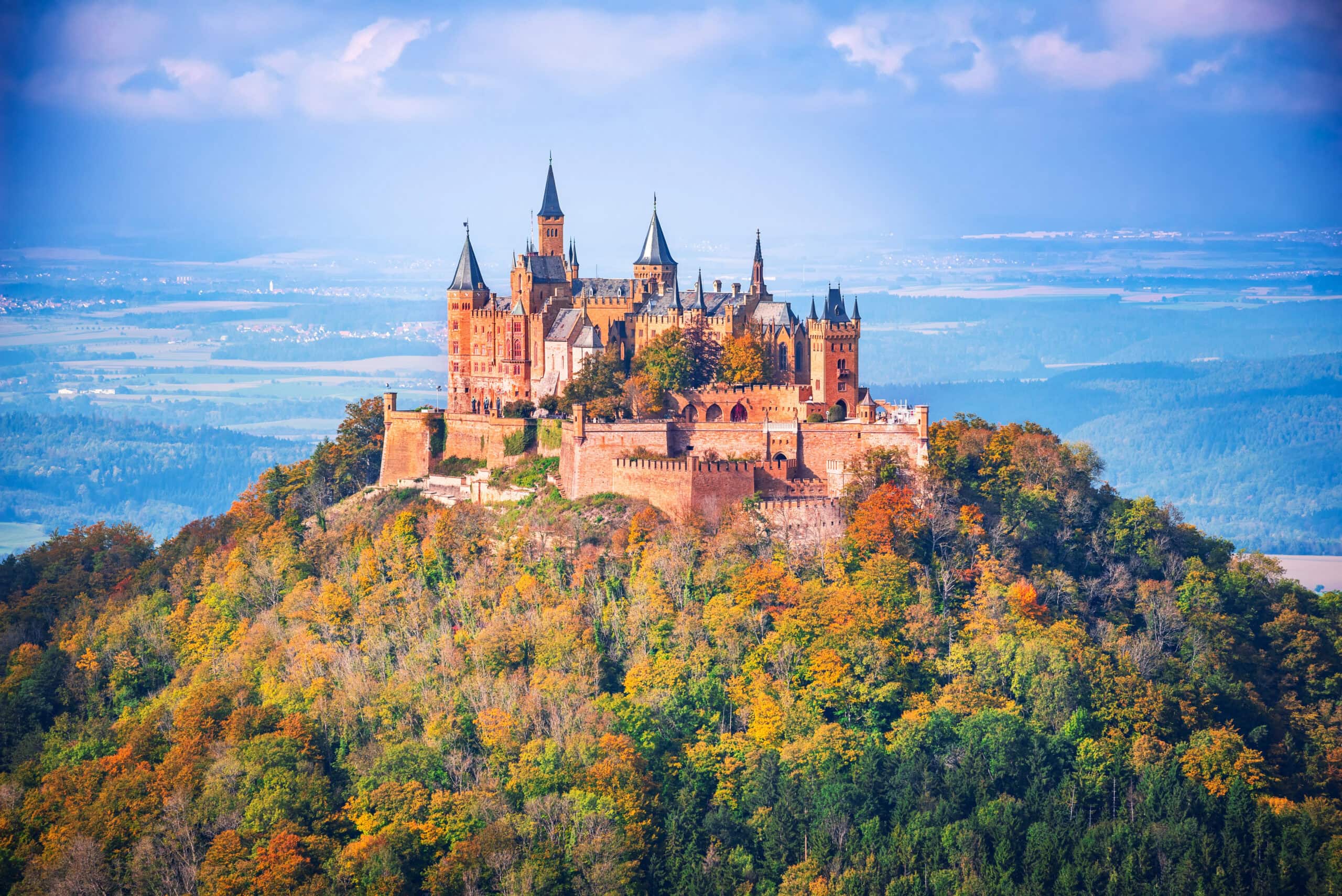
Hohenzollern Castle
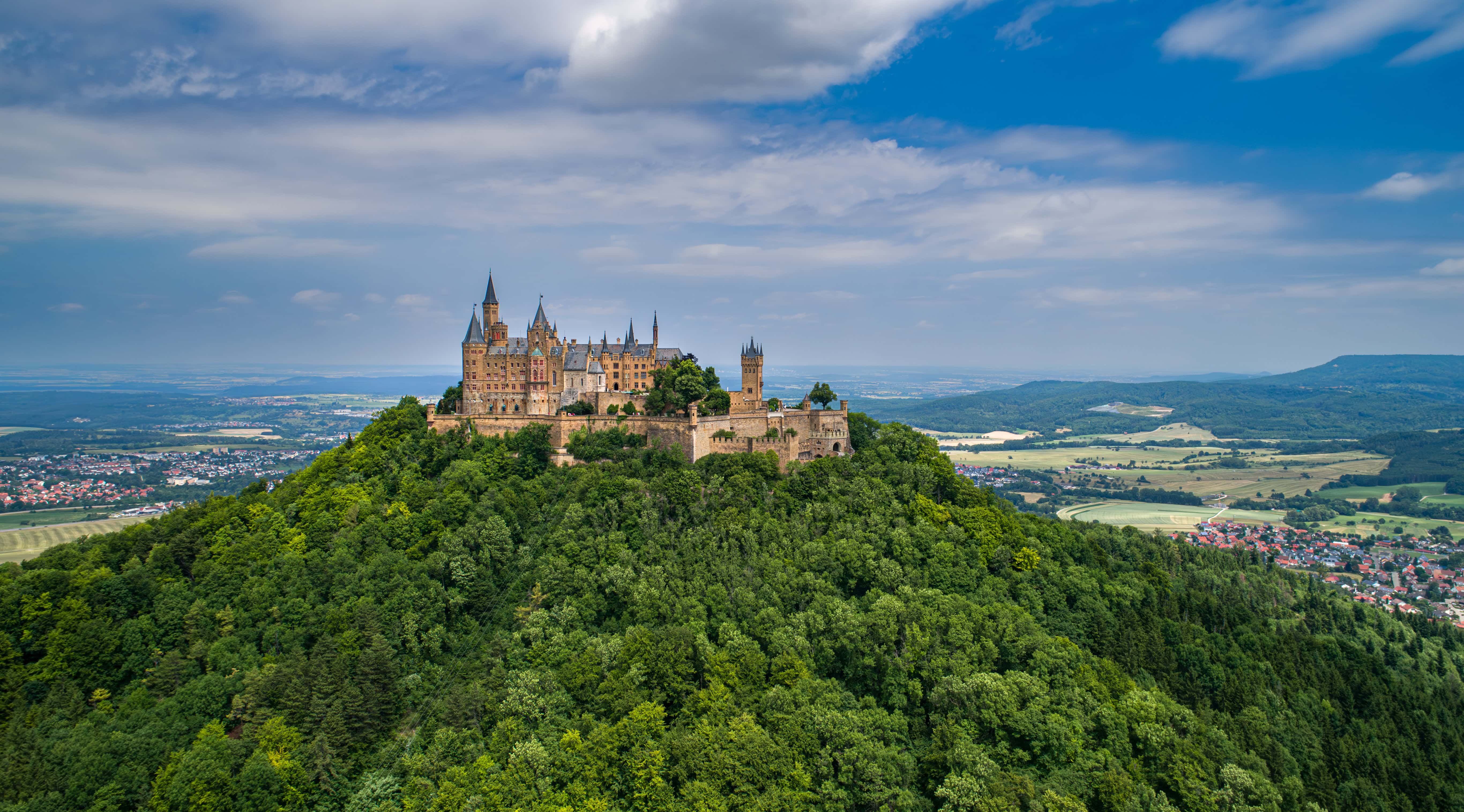
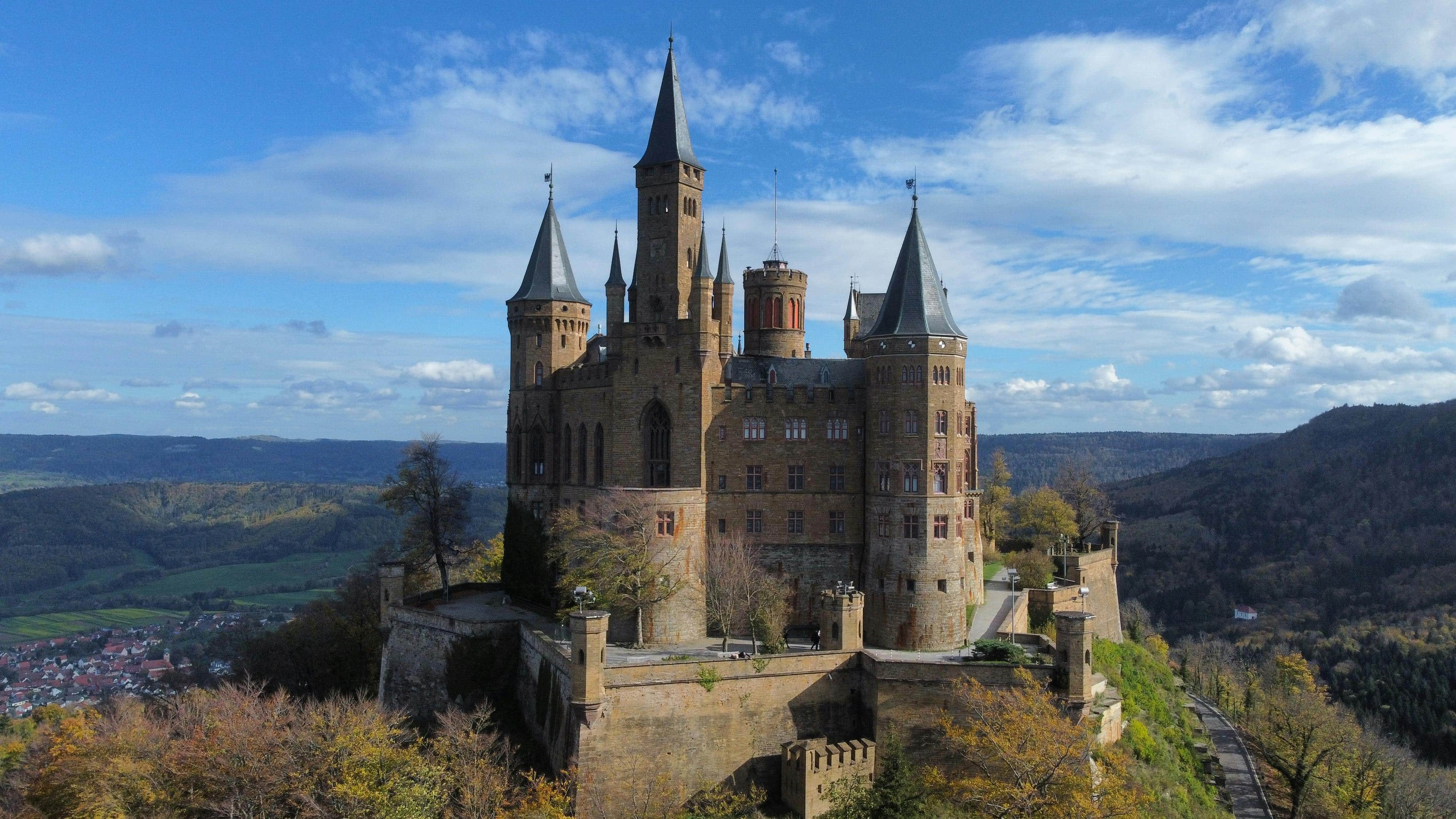
Hohenzollern Castle (Burg Hohenzollern) rises from an isolated limestone cone in the Swabian Jura of Baden-Württemberg, its towers and battlements visible from across the plain for nearly a hundred kilometers in clear weather. The castle stands at 855 meters above sea level, which is almost entirely alone: no town clusters at its feet, no river runs below it, no other high ground competes with its silhouette. Its effect is absolute: the mountain belongs to the castle.
What stands today is the third castle to have stood on this site. It was commissioned in the 1840s by King Frederick William IV of Prussia and built between 1850 and 1867 as a deliberate act of dynastic memory, a monument to the origins of the House of Hohenzollern, the family whose members became Brandenburg Electors, Prussian Kings, and, from 1871, German Emperors. Its architecture is Neo-Gothic, not medieval. It was built above all to represent a dynasty, and a nineteenth-century castle could no longer stand against modern guns, but it also had a military role: Prussia stationed up to 180 men there as an outpost near the French border, and in the First World War it was still a garrison, whose men were probably kept busy maintaining the building. It was never a permanent royal residence. What it represented was the idea of a dynasty with deep roots and a claim to continuity across nine centuries.
Quick Facts
| Country | Germany |
| Region / State | Baden-Württemberg (Swabian Jura / Zollernalb) |
| Nearest Town | Hechingen (~5 km north) |
| Construction Period | 19th-century Romantic (1850–1867); site occupied since c. 1040 |
| Founder | King Frederick William IV of Prussia |
| Architectural Style | Neo-Gothic (English Gothic Revival and Loire Valley influence) |
| Building Type | Burg (dynastic memorial; third castle on the medieval site) |
| Current Condition | Well-preserved |
| Open to Visitors | Yes — year-round |
| UNESCO Status | No |
| Official website | burg-hohenzollern.com |
Overview
Hohenzollern Castle is simultaneously one of Germany’s most photographed hilltop fortresses and one of its most deliberately constructed ones. The building is a 19th-century creation: an act of romantic historicism by a Prussian king who visited the ruined site as a young crown prince, was moved by the view and the family associations, and spent the following decades planning a reconstruction. What was built is not a restoration of what once stood but a new castle in the style of a medieval one, designed by the Berlin architect Friedrich August Stüler.
It belongs to the same current of 19th-century castle-building that produced Neuschwanstein Castle in Bavaria and Lichtenstein Castle on the edge of the Swabian Alb, though where Neuschwanstein was the private fantasy of an eccentric king, and Lichtenstein the bibliophile passion of a Württemberg count, Hohenzollern is more overtly institutional. It was built to celebrate a dynasty, and its rooms, treasures, and heraldry communicate that purpose clearly.
Location and Setting
Known as the Zoller, or colloquially Zollernberg, the mountain is an isolated outcrop of the Swabian Jura that rises steeply from the surrounding farmland between Stuttgart and Lake Constance. The castle covers almost the entire summit, giving it an appearance from a distance of an enormous crown placed on the peak. There is no gradual approach: the mountain comes into view from the plain and the castle comes into view on the mountain, and the two are essentially the same thing at this scale.
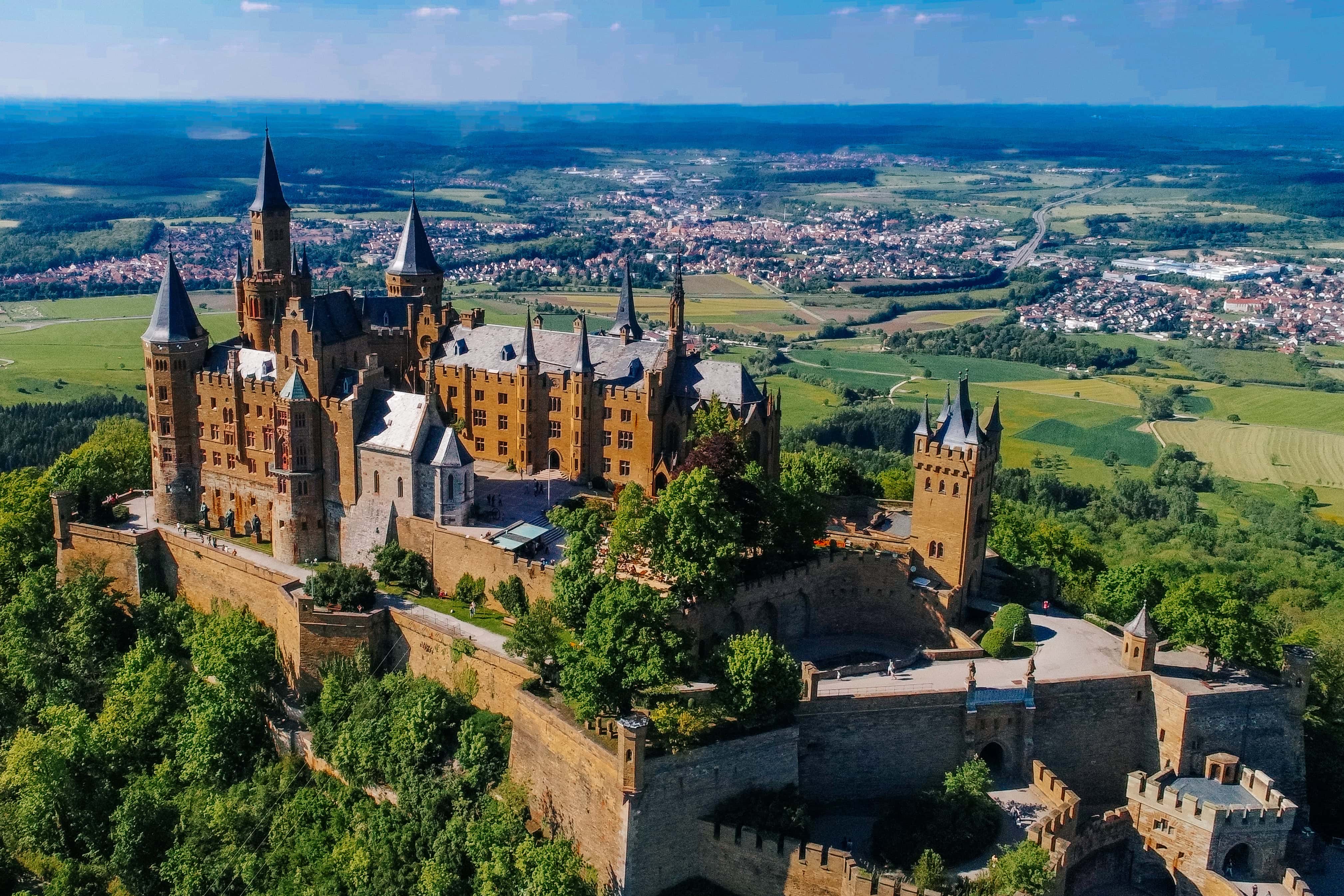
Its summit position delivers views extending up to a hundred kilometers on clear days, across the Alb plateau and southwest toward the Black Forest and the Alps on the horizon. The approach from the car parks at the base of the hill is steep enough that a shuttle bus runs between the lower parking area and the castle’s Eagle Gate, though the walk through beech and fir woodland is an equally legitimate way to arrive.
Historical Background
A fortification of some kind stood on the Zoller Mountain from around 1040, when the Counts of Zollern established their first stronghold here. The family took its name from the mountain, and from that name the dynasty’s entire subsequent history (Brandenburg, Prussia, the German Empire) ultimately descends. A first castle was described by medieval chroniclers as the “crown of all castles in Swabia,” though it did not survive to demonstrate the claim: in 1423, an alliance of free imperial cities of Swabia besieged it for ten months and destroyed it completely.
A second castle, built between 1454 and 1461 on the same foundations, was a more substantial structure that served the Catholic Swabian branch of the Hohenzollerns as a refuge through the turbulence of the Reformation and the Thirty Years’ War. By the eighteenth century, with the Hohenzollern line now occupying the Prussian throne, this second castle had lost its strategic relevance and fallen into ruin.
Today’s castle traces its origins to 1819, when Crown Prince Friedrich Wilhelm of Prussia climbed the desolate peak during a journey through southern Germany and was struck by the decay of his family’s ancestral seat. He became King Frederick William IV of Prussia in 1840 and set about rebuilding Hohenzollern as a dynastic memorial on a grand scale. Stüler’s design drew on English Gothic Revival models and the massed towers of the Loire châteaux; the foundation stone was laid in 1852 and the castle was inaugurated on October 3, 1867, under Frederick William’s brother and successor, King Wilhelm I of Prussia.
It was never a working residence. No member of the Hohenzollern family lived there permanently, and none of the three German Emperors of the late nineteenth and early twentieth centuries maintained a court here. It was used for formal occasions, family gatherings, and the preservation of dynastic artefacts. In 1945, the former Crown Prince Wilhelm (son of Kaiser Wilhelm II, the last German Emperor) briefly took up residence after the end of the war. From 1952, Prince Louis Ferdinand of Prussia systematically enriched the castle’s collections, transforming the former kitchen into a treasury chamber and establishing Hohenzollern as a museum of Prussian royal history.
For most of its existence since 1867, the castle was jointly owned by the Prussian and Swabian branches of the Hohenzollern family in a two-to-one ratio. On December 31, 2025, Prince Karl Friedrich of Hohenzollern-Sigmaringen transferred his one-third share to Prince Georg Friedrich of Prussia, making the Prussian line the sole owner from January 1, 2026.
Architectural Highlights
The castle is entered through the Eagle Gate (Adlertor), a twin-towered gatehouse with a raised drawbridge and densely carved stonework that announces the Neo-Gothic program of the whole complex. Beyond it, a ring of ramparts and bastions (the Zwinger) wraps around the mountaintop, offering rampart walks with panoramic views in every direction before the inner castle is reached.
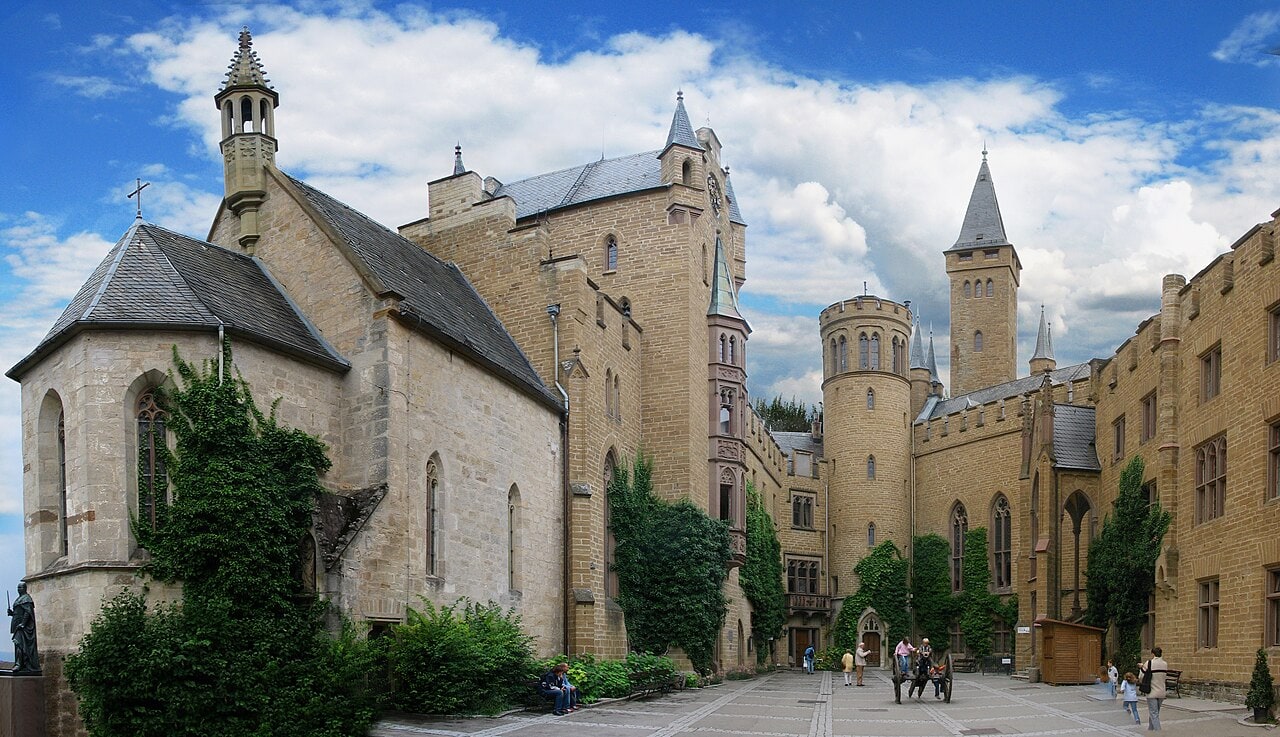
Its main building is horseshoe-shaped and rises several stories above the bastion ring, its spires and turrets clustering against the sky in a silhouette that reads as medieval from a distance but reveals its nineteenth-century polish on closer inspection. Its stonework is too regular, the joinery too precise, the whole ensemble too coherent to be the product of centuries of incremental building. This is architecture as statement, not architecture as accumulation, and it is notably different in character from Neuschwanstein, which achieves a dreamlike excess that Hohenzollern deliberately avoids.
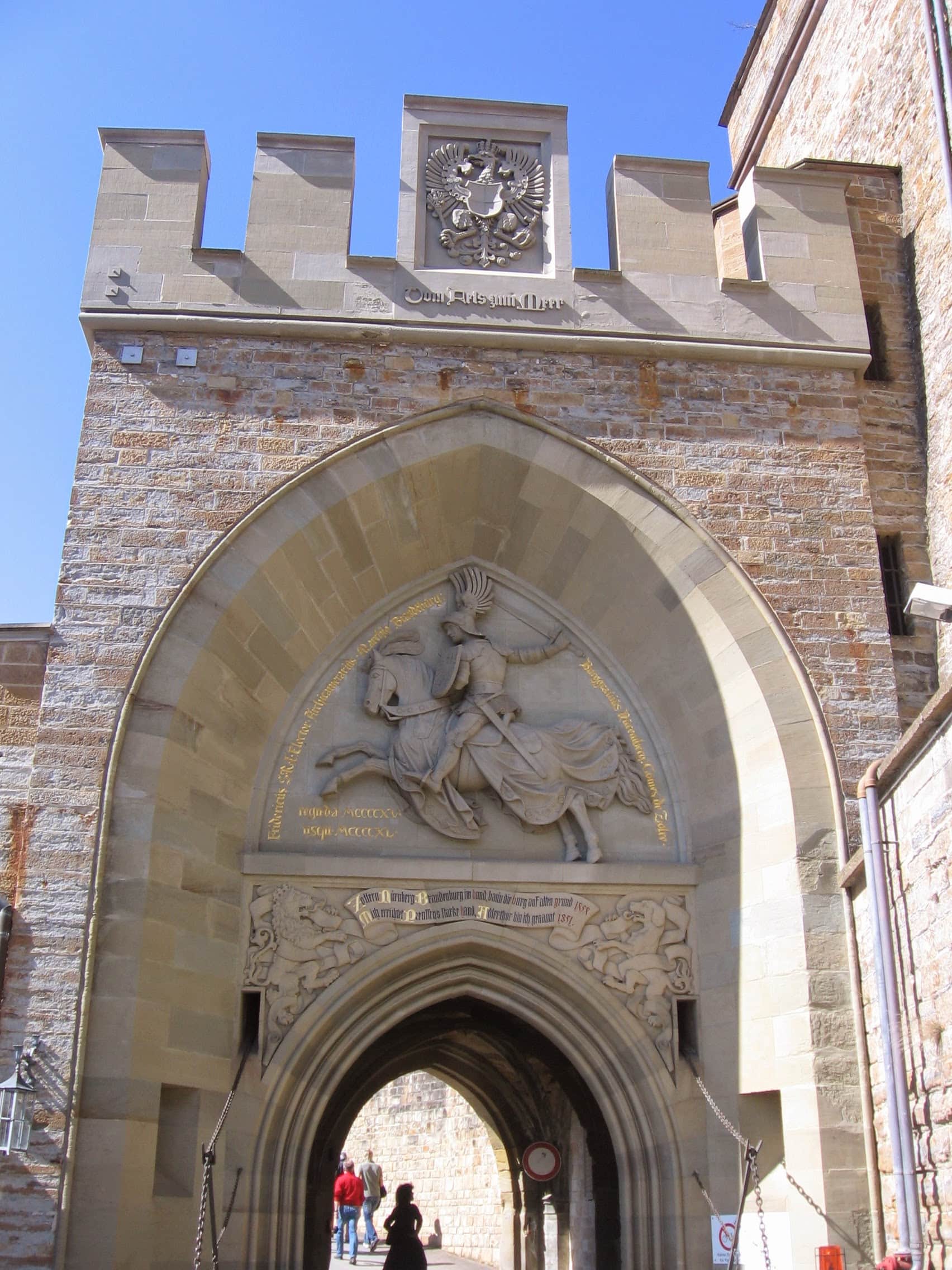
The interior contains 17 showrooms open to visitors, moving from the Hall of the Counts through the Hall of the Emperors (lined with statues of Hohenzollern rulers and bishops) to the library, royal apartments, and a family tree room covering nine centuries of dynastic genealogy. The Treasury (Schatzkammer) holds the most significant objects: the imperial crown of Kaiser Wilhelm II, the personal effects and uniform of Frederick the Great, gold and silver jewellery spanning three centuries, weapons, and armor. Photography is not permitted in the Treasury.
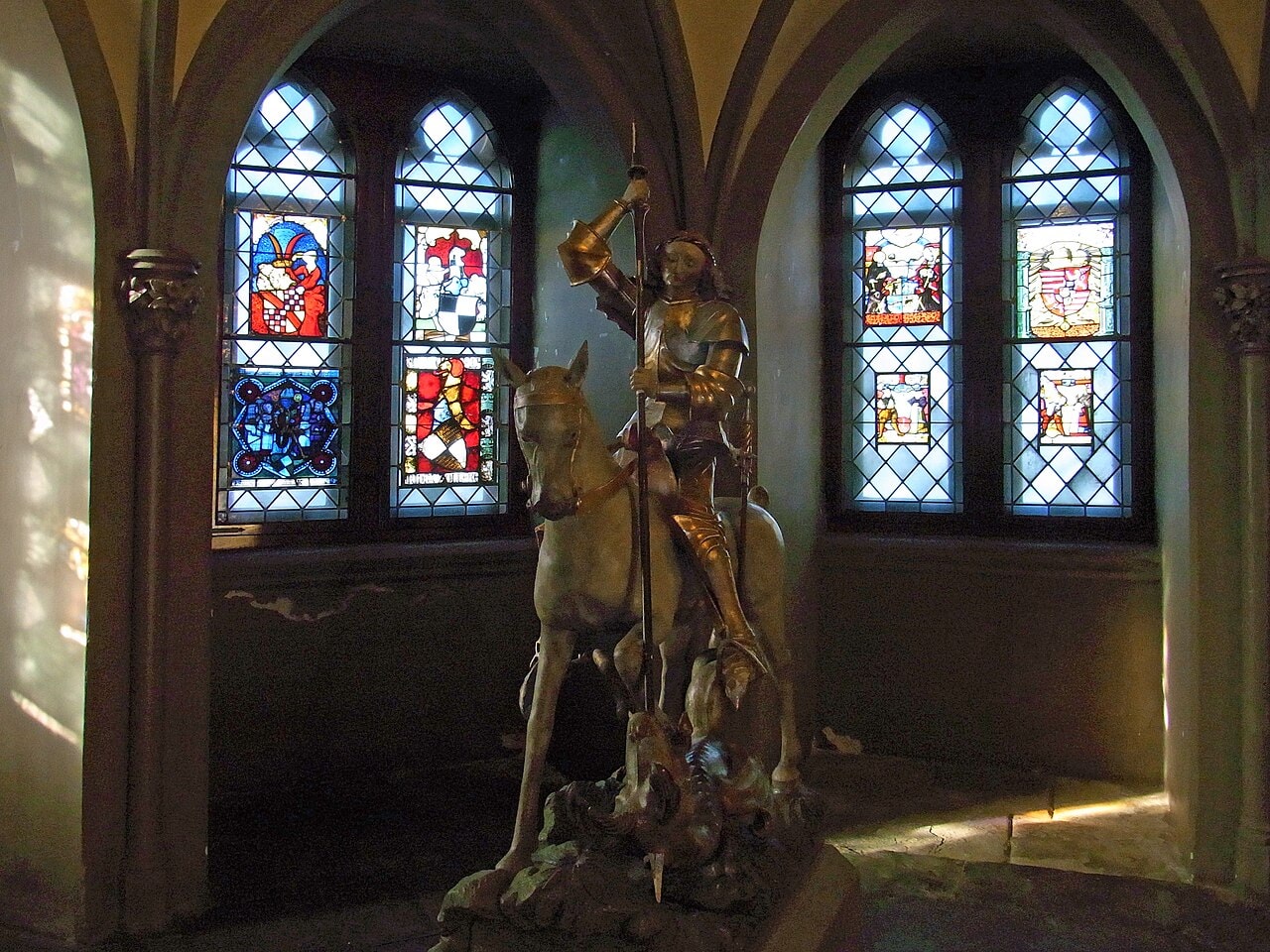
Of the earlier structures that once occupied the summit, only the Chapel of St. Michael still stands as a building, and the new castle rests on the foundation walls of the old ones.
Visiting the Castle
Hohenzollern Castle has a long visiting season, with fuller access from late March to early November. In winter, the castle grounds, restaurant, and special seasonal events remain available, while access to the interiors is more limited. During Advent, the castle also hosts its annual Royal Winter Magic illumination event. Entry tickets and local tours can also be booked in advance through GetYourGuide.
Its interior is self-guided: visitors move at their own pace through the showrooms, with expert staff stationed in each room to answer questions. A free smartphone app functions as an audio guide. Tickets include parking and the shuttle bus from the lower car park to the Eagle Gate; online booking is recommended on busy days. The castle’s restaurant serves regional food and the family’s own Prussian beer, Preußens Pilsner, from a dining room overlooking the courtyard and the plain below. Anyone staying overnight can compare hotels in and around Hechingen.
Some links on this page are affiliate links, which means StoneKeep Atlas may earn a small commission, at no extra cost to you, if you book through them.
Nearby Attractions
Lichtenstein Castle (Schloss Lichtenstein) stands approximately 30 kilometers northeast, above the Echaz Valley on the edge of the Swabian Alb, a compact neo-Gothic castle built by Duke Wilhelm of Urach in 1840–42, inspired by Hauff’s novel Lichtenstein. The two castles represent the two main traditions of nineteenth-century German castle-building: Hohenzollern the dynastic memorial, Lichtenstein the literary fantasy.
Tübingen, the university town approximately 25 kilometers north, is the natural base for a visit, with its medieval old town, riverside promenade, and excellent train connections to Stuttgart. Hechingen, the nearest town to the castle, offers a small historic center with a synagogue and local museum. Stuttgart, the state capital, lies approximately 50 kilometers north.
Travel Tips
- Book online. Tickets are cheaper online than at the site and include parking and the shuttle bus. On-site ticket availability can be limited in peak season.
- The interior is not heated. Dress appropriately for the temperature, particularly in winter and spring, when the showrooms can be very cold.
- Its Treasury is the most significant interior room. Allow time for it; it contains the most historically important objects and is accessible directly from the courtyard without stairs.
- Photography is not permitted in the Treasury. All other indoor and outdoor areas allow personal photography (no flash, no tripod indoors).
- Allow 2–3 hours. This includes the shuttle or walk, the rampart circuit, the seventeen showrooms, and the Treasury.
- Access for limited mobility visitors. A wheelchair-accessible shuttle runs to the Eagle Gate; a lift connects to the Schnarrwacht bastion. The museum rooms require a staircase of 25 steps; the Treasury is accessible without steps.
- Drones are prohibited on the entire castle hill, including car parks.
- By public transport from Hechingen: Bus 344 serves the castle on weekends and public holidays (roughly every two hours). Bus 306 provides a limited weekday service. From Stuttgart by train to Hechingen takes approximately 45 minutes.
Hohenzollern’s 1850–1867 rebuilding under Friedrich Wilhelm IV and the architects Friedrich August Stüler and Carl Alexander von Heideloff is one of the canonical case studies in The 19th-Century Romantic Revival of German Castles, which treats the dynastic-symbolic motivation behind the Hohenzollern project.
The 1867 completion of the Hohenzollern reconstruction stands in striking parallel with the contemporaneous collapse of Bavarian sovereignty under Ludwig II: both the Prussian apotheosis and the Bavarian withdrawal expressed in the same medievalist architectural vocabulary, but with very different political consequences; the comparison is developed in Ludwig II and the Architecture of Dreams.
For the wider story of how German castles became confessional instruments between 1521 and 1648, see The Reformation and the Castle.
Hohenzollern has its own episode in our documentary series, collected with the other castles we have filmed.
Conclusion
Hohenzollern Castle was built to make a point about the past: to assert that the family which ruled Prussia and then Germany had roots stretching back a thousand years into the Swabian hills. The point was made with considerable architectural skill, and the castle’s position on its isolated mountain ensures that it commands attention in every direction. That commanding silhouette also earns Hohenzollern a central place among the fairytale castles in Germany. But the building is also candid about what it is: a nineteenth-century construction, built in the image of a medieval original that no longer existed, by a king who wanted his dynasty to have a visible ancestral home in southern Germany.
That self-awareness is what makes Hohenzollern interesting alongside its more theatrical peers. It is less a fantasy than Neuschwanstein Castle and less a ruin than Heidelberg; it is a formal, purposeful statement in Neo-Gothic stone, still privately owned by the family that commissioned it, open to the public as the flagship of a region that has taken the Hohenzollern name as its own. For the broader sweep of Prussian royal building (from this Swabian ancestral memorial to the great palaces of the north), see the Prussian Royal Castles.
Principal Sources
- Burg Hohenzollern, official site (burg-hohenzollern.com), “Castle History,” consulted June 2026, for the building of the third castle between 1850 and 1867, Friedrich August Stüler’s design, the St. Michael’s and Christ chapels, and current visitor information.
- Encyclopaedia Britannica, “House of Hohenzollern,” for the dynasty’s Swabian origins and its division into the Swabian and the Franconian–Brandenburg–Prussian branches.
- Encyclopaedia Britannica, “Frederick William IV,” for the Romantic sensibility of the king who commissioned the rebuilding as a dynastic memorial.
- Structurae, “Hohenzollern Castle,” for the construction chronology, Stüler’s English Gothic Revival and Loire-château influences, Moritz von Prittwitz’s spiral ramp, and the Prussian relics kept in the castle, including effects of Frederick the Great.
Image credits. Featured image, Hohenzollern Castle on its limestone outlier above the Swabian plain in autumn: Photo: ecstk22 / Adobe Stock. Aerial view looking northwest over Hohenzollern Castle, with the town of Hechingen on the Swabian plain below: via Adobe Stock. Burg Hohenzollern from the approach ridge, the Neo-Gothic towers begun in 1850 for King Frederick William IV and completed in 1867 under Wilhelm I: via Adobe Stock. The inner courtyard with the 15th-century St. Michael’s Chapel beside the sandstone Neo-Gothic reconstruction of 1850–1867: Joachim Fenkes, Böblingen, via Wikimedia Commons. The main gate arch with relief of Frederick I of Brandenburg and the dynastic motto “Vom Fels zum Meer”: Runner1928, CC BY-SA 3.0, via Wikimedia Commons. The vestibule of the Chapel of St. Michael, with bronze equestrian figure of St. George and heraldic stained glass: Rainer Halama, CC BY-SA 3.0, via Wikimedia Commons. The castle from the approach side, with access road, bastion ring, and rampart walk: stock photo. Freely licensed images are resized to fit; otherwise unaltered.