
Lichtenstein Castle
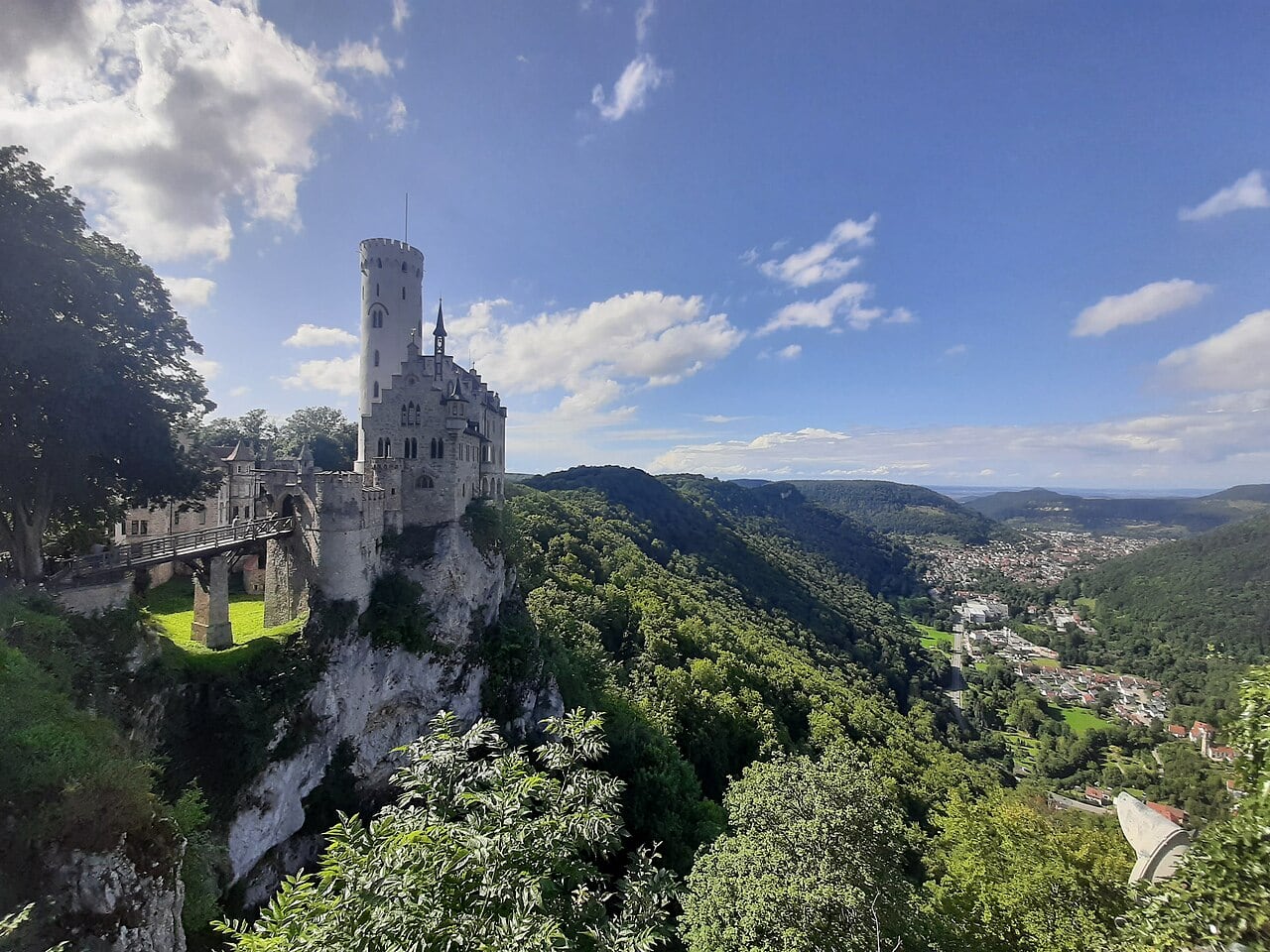
On a limestone crag of the Swabian Jura, 817 meters above sea level and roughly 250 meters above the Echaz valley near the village of Honau, Lichtenstein Castle (Schloss Lichtenstein) rises on a footprint so narrow that the iron bridge to its gate spans a natural chasm in the rock. The castle was built between 1840 and 1842 for Count Wilhelm of Württemberg (the future 1st Duke of Urach) by the Nuremberg architect Carl Alexander Heideloff, commissioned to give stone form to the imaginary knightly seat at the center of Wilhelm Hauff’s 1826 historical novel Lichtenstein. It predates Neuschwanstein Castle by nearly thirty years, and is the only major German castle whose conception is tied directly to a preceding work of fiction. On November 2, 2024 the restored Fürstengruft of the Dukes of Urach reopened to the public, drawing around 400 visitors on the day.
Quick Facts
| Country | Germany |
| Region / State | Baden-Württemberg, Swabian Jura (Schwäbische Alb) |
| Nearest Town | Honau (Gemeinde Lichtenstein); nearest city Reutlingen |
| Construction Period | 19th Century Romantic (Historismus / Neugotik, 1840–1842), built on medieval foundations of the c. 1390 Burg Lichtenstein |
| Founder | Wilhelm, Count of Württemberg, from 1867 1st Duke of Urach (1810–1869) |
| Architectural Style | Gothic Revival (Neugotik / romantic Historismus) |
| Building Type | Schloss (romantic Historismus schloss on medieval substructure) |
| Current Condition | Well-preserved |
| Open to Visitors | Yes — seasonal; interior by guided tour only |
| UNESCO Status | Not directly listed; located within the UNESCO Biosphere Reserve Schwäbische Alb |
| Official website | schloss-lichtenstein.de |
Overview
Lichtenstein Castle is not a reconstructed medieval castle like the Château du Haut-Kœnigsbourg but a 19th-century Romantic invention built on medieval foundations. Two earlier castles occupied the crag and the adjacent rock: a 12th-century ministerial seat, Burg Alt-Lichtenstein, destroyed in the Württemberg wars of 1311 and 1377–81; and a late-medieval successor built around 1390, demoted to a forester’s house in the 17th century and finally dismantled in 1802. What visitors see today is the product of a Romantic generation that read Hauff’s novel as an injunction to rebuild: to give the imagined castle a physical address on the Albtrauf.
Its current building is compact, with a slim round tower, pointed windows, carved oriels, and a single narrow bridge connecting the Kernschloss to the forecourt. Inside, a Knights’ Hall, chapel, and armory hold a collection of late-medieval arms, armor, stained glass, and panel painting assembled by the founder. Lichtenstein has remained in the continuous ownership of the House of Urach since 1842 and is privately managed today.
Location and Setting
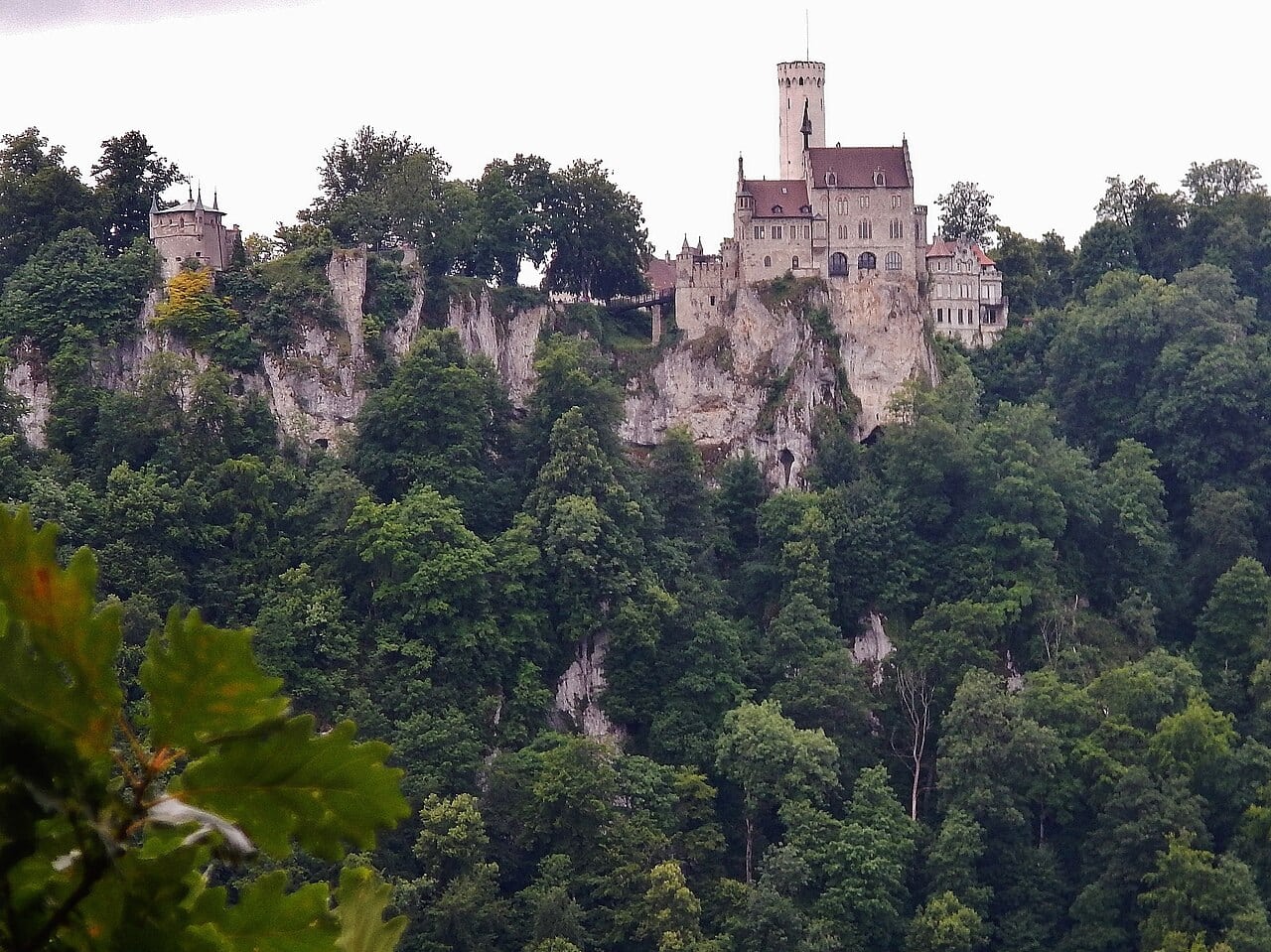
It sits on a free-standing limestone outcrop of the Albtrauf, the sharp north-western escarpment where the Swabian Jura (Schwäbische Alb) falls away to the Swabian lowland. Its position (roughly 250 meters above the valley floor, with the rock-edge drop beginning immediately beyond the outer walls) was chosen specifically for its dramatic silhouette, visible from kilometers down the Echaz valley and from the road climbing the Honauer Steige.
Its underlying rock is Upper Jurassic karst limestone, the same stone from which the walls are cut. Beneath the 19th-century build, medieval ashlar of the c. 1390 Burg Lichtenstein survives up to the height of the second story, preserved within the current substructure. A short distance to the south-east, on a separate spur, the foundations of the older Burg Alt-Lichtenstein are freely accessible as a ruin.
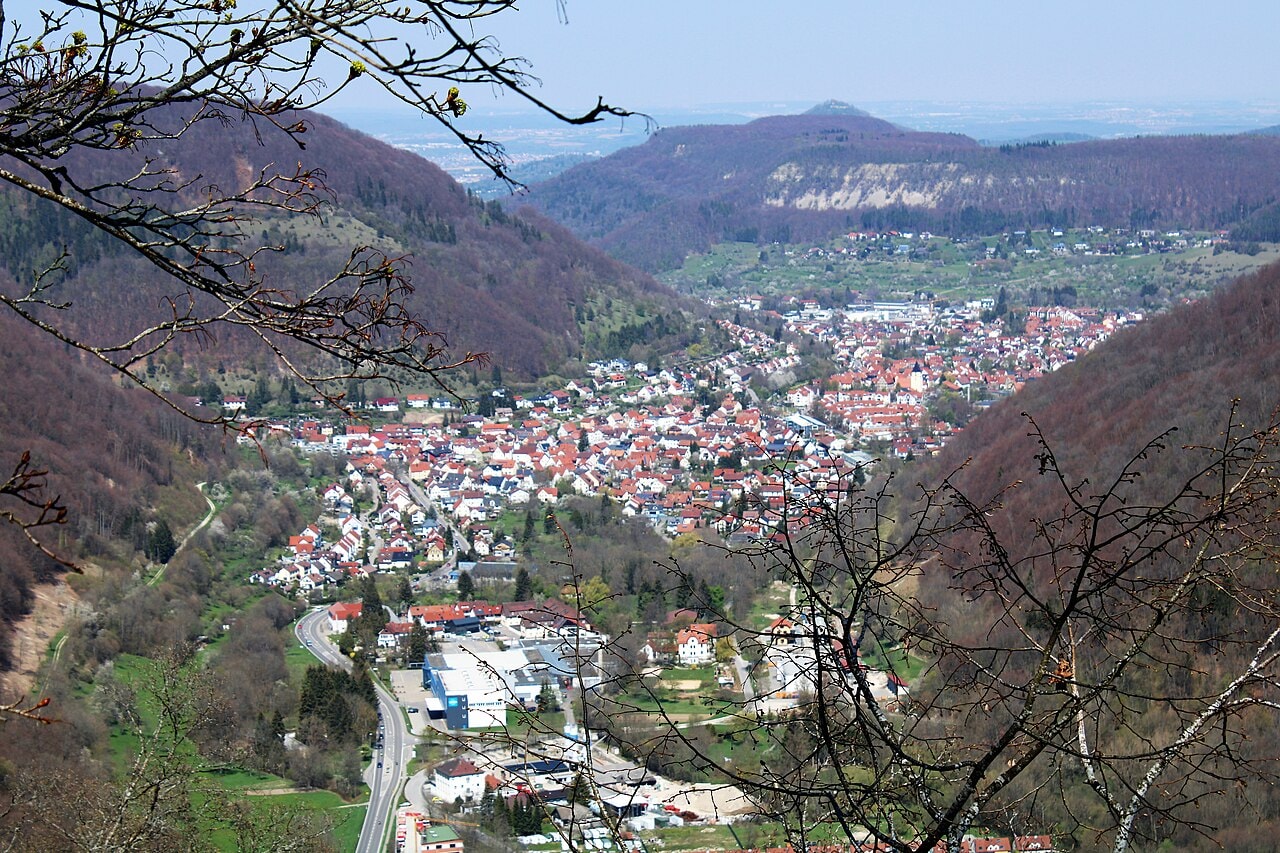
Lichtenstein lies within the UNESCO Biosphere Reserve Schwäbische Alb, recognized in 2009; a 2024 regional decision to extend the reserve’s boundary expressly includes the site, though the expanded boundary is scheduled to take formal legal effect in 2026.
Historical Background
The medieval castles (12th–14th century)
A first castle, later called Burg Alt-Lichtenstein, was built in the second half of the 12th century by a Swabian ministerial family, the Lords of Lichtenstein. They served the Margraves of Ronsberg and, later, the Counts of Württemberg, holding property in Honau and the surrounding Echaz villages. Alt-Lichtenstein was destroyed in 1311 by the Imperial city of Reutlingen during the Reichskrieg against Count Eberhard I of Württemberg, rebuilt after the 1315 peace, and finally destroyed again between 1377 and 1381 during the Swabian Cities War. By 1389 the site and its lordship had passed to Württemberg. Ceramic evidence suggests a castle already stood on the present Schloss rock during this period, parallel to Alt-Lichtenstein.
Late medieval to early modern (c. 1390–1802)
Around 1390 the ducal authorities built a new Burg Lichtenstein on the rock that today carries the Schloss. Late-medieval chroniclers described it as one of the strongest castles in the region, notable for early stone casemates and firearm embrasures on its southern flank. It lost its residential status in 1567, was used as a forester’s seat in the 17th century and held as a pledge by the Tyrolean Habsburgs during the Thirty Years’ War. Lichtenstein’s male line ended fighting the Ottomans in 1687. In 1802 Duke Friedrich II of Württemberg (from 1806 King Friedrich I) ordered the upper ruin dismantled and a simple late-Baroque forester’s and hunting lodge (Forsthaus) built on the medieval substructure to plans by the Württemberg state architect Carl Kümmerer.
Hauff’s novel and the Urach project (1826–1842)
In April 1826 the Swabian writer Wilhelm Hauff (1802–1827) published Lichtenstein. Romantische Sage aus der würtembergischen Geschichte, a three-volume historical novel set in 1519 and modeled closely on Walter Scott. Its plot (the exile of Duke Ulrich of Württemberg, his concealment at the castle Lichtenstein and in the nearby Nebelhöhle cave, and the loyalty of the piper Hans von Hardt) is widely regarded as the founding text of the German historical novel. That novel’s success generated operas, stage adaptations, and a lasting popular image of Württemberg’s Reformation-era past.
Count Wilhelm of Württemberg, a cousin of King Wilhelm I and a passionate collector of weapons, armor, and medieval painting, had long sought a ruined site to rebuild as a summer seat for his collection. Negotiations with the ducal forestry administration began in 1837; the Forsthaus and its land were formally purchased on August 25, 1838 for 7,553 Gulden and 58 Kreuzer. Design sketches from the court painter Franz Seraph Stirnbrand were rejected in favor of a scheme by Carl Alexander Heideloff (1789–1865), conservator of monuments in Nuremberg and one of the leading theoreticians of the German Gothic Revival. Detailed executable drawings were prepared by the Reutlingen building inspector Johann Georg Rupp, who supervised the site while Heideloff consulted from Nuremberg.
Demolition of the Forsthaus and ground works began in spring 1839. By October the new outer walls enclosed the old lodge, which was incorporated into the build. In 1840 the brief was enlarged: Count Wilhelm requested additional living rooms, and the northern Palas was raised a story and the tower by two to preserve the silhouette. The interior program (with stained glass by Friedrich Pfort of Reutlingen, sculpture by Ernst Machold, and painted scenes from Hauff’s novel by Heideloff’s pupil Georg Eberlein) was completed in the spring of 1842. King Wilhelm I of Württemberg attended the inauguration on May 27, 1842.
Urach continuity, twentieth century, and today
Count Wilhelm was elevated to 1st Duke of Urach on May 28, 1867 by King Karl of Württemberg and died at Lichtenstein Castle on July 16, 1869. His son Wilhelm Karl, 2nd Duke of Urach, added the Gerobau (1899–1900) and Fürstenbau (1907/08), both by the Stuttgart architect Karl Mayer. The forward defenses of the site (the Mathildenturm, Eugenienbastion, and Augustenturm) were designed by Count Wilhelm himself in reaction to the 1848 revolutions and built between 1854 and 1861. On April 22–23, 1945 the Schloss was shelled by United States artillery, shattering windows, damaging the tower roof, and destroying a Renaissance Nativity that tradition associated with Marco Zoppo; the castle was not occupied, and a written protection order obtained from the French military governor kept it out of post-war requisition. Since 1929 the building has been owned by a Urach family company (Gesellschaft bürgerlichen Rechtes), with conservation support from the Wüstenrot Foundation and the Fördergemeinschaft Schloss Lichtenstein. The restored Fürstengruft (the burial vault of the Dukes of Urach) was formally reopened to the public on November 2, 2024.
Architectural Highlights
Exterior and setting
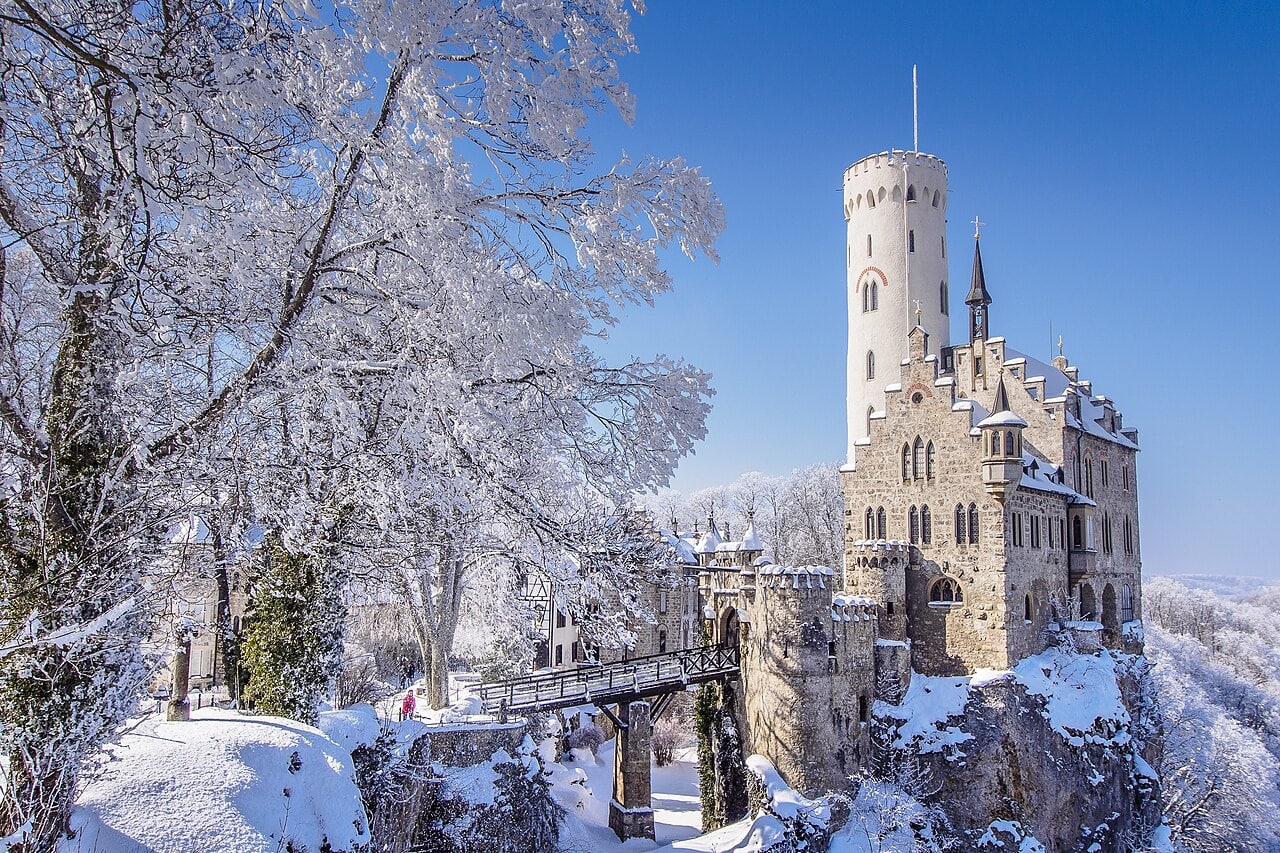
Heideloff’s design is essentially scenographic: the silhouette, rather than the defensibility, drove every exterior decision. Built directly on the edge of the limestone crag, the compact Kernschloss is approached across an iron bridge that replaced the original drawbridge over a natural ravine in the rock some time in the 20th century. Its slim battlemented round tower is modeled on the tower of Burg Landsberg near Meiningen; the oriels (Erker) on Nuremberg burghers’ houses; and the gate on the Plassenburg at Kulmbach. The build material is local Jurassic limestone ashlar.
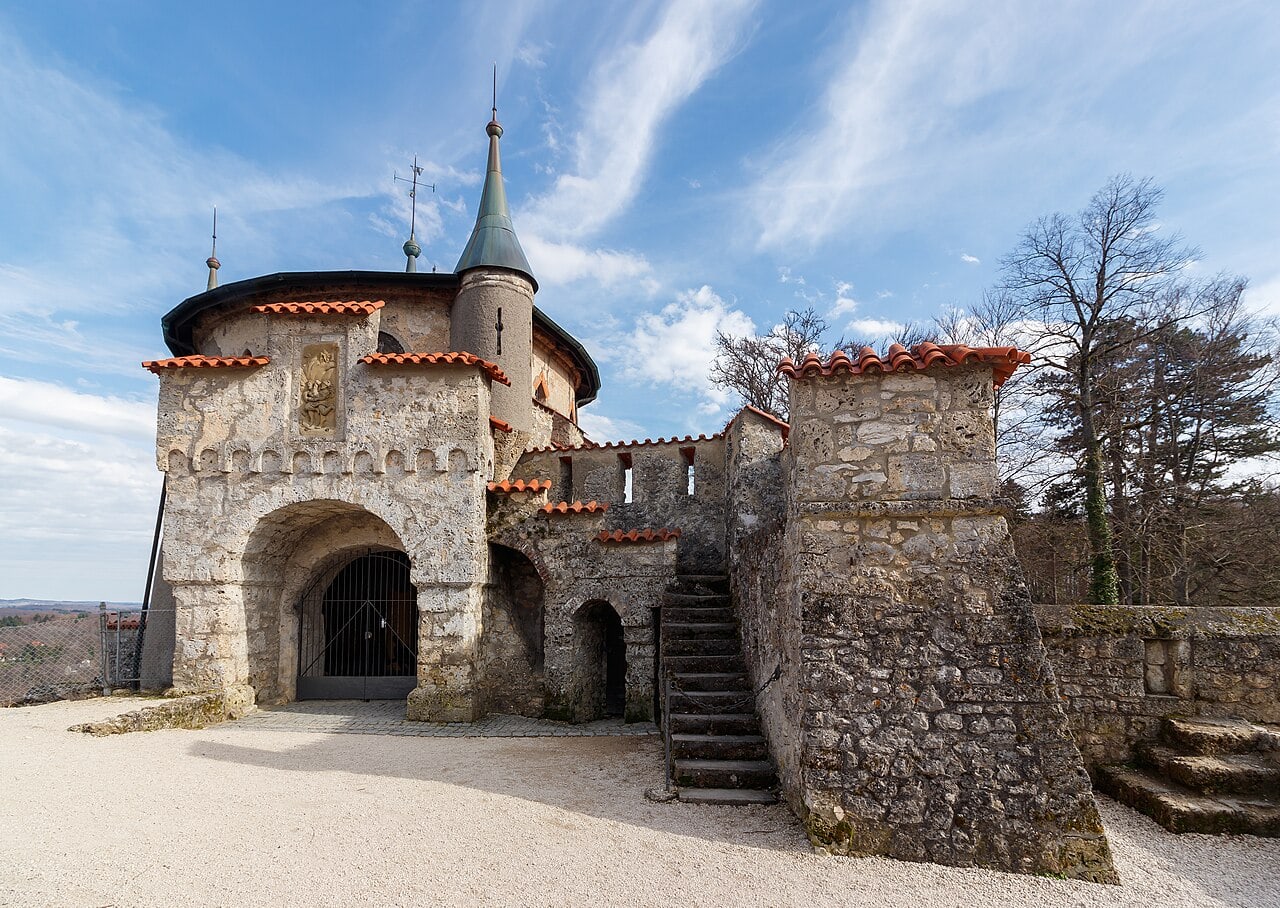
A wider forecourt of the 1850s, with the Mathildenturm, Eugenienbastion, and Augustenturm, encloses the older service buildings and the later Gerobau and Fürstenbau. Where the Kernschloss is a deliberately picturesque composition, this outer ring is genuinely defensive, a conscious historical parallel in which the 19th-century duke drilled his own military theories into stone alongside his Romantic reverie.
Interior rooms
A guided route passes through about a dozen rooms on the ground and first floors. Its ground-floor Waffenhalle (armory) is built so that the rock itself projects into the room; it holds the Duke’s collection of late-medieval arms and armor. The adjacent Schlosskapelle is glazed with stained glass of the 14th and 15th centuries (historic pieces brought to the castle by Count Wilhelm rather than 19th-century copies) and centered on a carved altar. The wood-panelled Trinkstube carries painted wall scenes and a tiled stove of the build period.
On the first floor, the Königszimmer is decorated with painted ornament and portraits; the Wappenzimmer holds late-medieval Swabian panel painting; and the Rittersaal, the largest and most elaborate room in the castle, is panelled in oak with painted ceilings and window reveals. The upper apartments (the private rooms of Count Wilhelm and his wife Theodolinde) are accessible only on the extended tour. A carved figure known as the Schütze vom Lichtenstein stands on the staircase.
Museen.de and the official castle publications note that the arms, armor, stained-glass windows, and panel paintings on display include genuine medieval works, forming a substantial privately assembled collection of its kind in southern Germany. The architectural envelope, however, is entirely Heideloff’s: a building designed to house and to flatter the collection, not one that inherits it.
Visiting the Castle
Visitors reach the Kernschloss only on a guided tour of about thirty minutes, conducted in German; tours depart roughly every twenty minutes during the visiting season. An extended tour (Sonderführung) includes the private upper apartments. The courtyard itself is open without a guide, with outdoor tables available at the adjacent Schlossschenke inn. Closed in January and February, the castle also hosts occasional evening events and open-air concerts in the courtyard during the summer. There is no lift, and access to the interior requires crossing the outer bridge and climbing several flights of stairs; photography inside the castle is not permitted. Entry tickets and local tours can also be booked in advance through GetYourGuide.
Current ticket prices, the precise visiting-season dates, and any changes to access rules (including photography and tour availability) should be confirmed on the official Schloss Lichtenstein website before planning a visit, since the site updates this information each year. Anyone staying overnight can compare hotels in and around Reutlingen.
Some links on this page are affiliate links, which means StoneKeep Atlas may earn a small commission, at no extra cost to you, if you book through them.
Nearby Attractions
The Nebelhöhle, five kilometers south at Sonnenbühl, is the cave in which Duke Ulrich hides in Hauff’s novel. First documented in 1486, it has been developed as a show cave with around 450 meters of the 800-meter system accessible to visitors by a stepped route. A walking trail (“Hochgehträumt”) connects the cave to the castle. The neighboring Bärenhöhle at Erpfingen, about twelve kilometers further, is a Pleistocene bone cave also open to the public. Below the castle in the village stands the small Wilhelm-Hauff-Museum in Honau. Its major regional neighbor is Hohenzollern Castle, twenty-five kilometers south at Hechingen, whose own reconstruction for Friedrich Wilhelm IV of Prussia belongs to the same Romantic moment as Lichtenstein. The ruin of Burg Alt-Lichtenstein lies five hundred meters south-east of the castle and is freely accessible on a marked footpath.
Travel Tips
- Stuttgart is the practical base, roughly forty-five kilometers north; trains to Reutlingen Hauptbahnhof take about forty-five minutes, and a regional bus continues up the Honauer Steige to the castle car park.
- Arriving by car, the B312 climbs from Reutlingen via Pfullingen and Honau; parking is available at the Aufberg-Parkplatz a short walk from the gate.
- The castle closes in January and February; verify current opening hours and tour availability at the official website before travel.
- Allow a half-day for the castle and courtyard, a full day if combining with the Nebelhöhle and the Hauff Museum in Honau.
- The interior is seen only on a guided tour, so arrive allowing time for the wait at the ticket office on busy days.
Lichtenstein’s 1840–1842 construction by Count Wilhelm of Württemberg (directly inspired by Wilhelm Hauff’s 1826 novel of the same name and the most literarily-conceived of the German Romantic castles) is treated in The 19th-Century Romantic Revival of German Castles.
Conclusion
Lichtenstein Castle began as a chapter in a novel and became a building because a Romantic-era Swabian count took that chapter seriously enough to commission its translation into stone. A paradox at its heart is that it is neither truly medieval nor entirely modern: its medieval substructure is real, its 19th-century envelope is an idea of the Middle Ages filtered through Hauff’s imagination and Heideloff’s pattern books, and the collections inside are a mix of both. That storybook origin story is precisely why Lichtenstein appears beside its Swabian neighbor Hohenzollern in our tour of the fairytale castles in Germany. To walk through its rooms is to see a generation of Germans deciding what their own past should look like and then building it. Lichtenstein is an early and fully resolved answer to that question: the foundation stone, in effect, of the sequence of 19th-century Romantic Revival castles that would lead through Hohenzollern Castle and on to the stage-set fantasies of Neuschwanstein Castle a generation later. In Bavaria the same impulse was already at work while Lichtenstein was rising: Crown Prince Maximilian had begun rebuilding Hohenschwangau Castle in 1832, and it was there, among painted medieval legends, that the young Ludwig II grew up. That taste for Romantic castles grew in part from the cult of the picturesque ruin embodied by Heidelberg Castle, the Renaissance palace of the Electors Palatine that visitors came to cherish precisely because it was broken.
Principal Sources
- Bidlingmaier, Rolf. “Schloß Lichtenstein. Die Baugeschichte eines romantischen Symbols.” Reutlinger Geschichtsblätter, N.F. 33 (1994), pp. 113–152.
- Bidlingmaier, Rolf, with Hans-Christoph Dittscheid. “Erfindung als Erinnerung. Burg Lichtenstein zwischen Hauff’s poetischer Fiktion und Heideloff’s künstlerischer Konkretisierung.” In Ernst Osterkamp et al. (eds.), Wilhelm Hauff oder die Virtuosität der Einbildungskraft. Göttingen: Wallstein, 2005, pp. 263–319.
- Landesarchiv Baden-Württemberg, Hauptstaatsarchiv Stuttgart. Bestände GU 20 (Schlossbau, Nutzung und Verwaltung), GU 97 (Pläne, Risse und Ansichten 1784–1918), and GU 105 (Wilhelm I. Herzog von Urach, 1810–1869). “Pläne des Schlosses Lichtenstein.” landesarchiv-bw.de.
- Schloss Lichtenstein, Schlossverwaltung (Herzog von Urach). Official castle website: Geschichte und Familie, Rundgang. schloss-lichtenstein.de.
Image credits. Featured image — Lichtenstein Castle (Schloss Lichtenstein) on the Albtrauf escarpment of the Swabian Jura: Melchmi, CC BY-SA 4.0, via Wikimedia Commons. The current castle (right) and the ruin of Burg Alt-Lichtenstein (upper left) share the Albtrauf, seen from the Schwäbische-Alb-Nordrand-Weg hiking trail: qwesy qwesy, CC BY 3.0, via Wikimedia Commons. View from the castle over the villages of Honau and Unterhausen in the Echaz valley below: Roland Puskaric, CC BY-SA 4.0, via Wikimedia Commons. The iron bridge, gate, and slim battlemented tower of the Kernschloss in winter: Janobi, CC BY-SA 4.0, via Wikimedia Commons. The Augusten-Bastion, part of the 1854–1861 forward defenses designed by Count Wilhelm of Württemberg himself: Llez, CC BY-SA 3.0, via Wikimedia Commons. Freely licensed images are resized to fit; otherwise unaltered.