
Wittelsbach Castles of Bavaria: 738 Years of Dynastic Architecture, 1180–1918
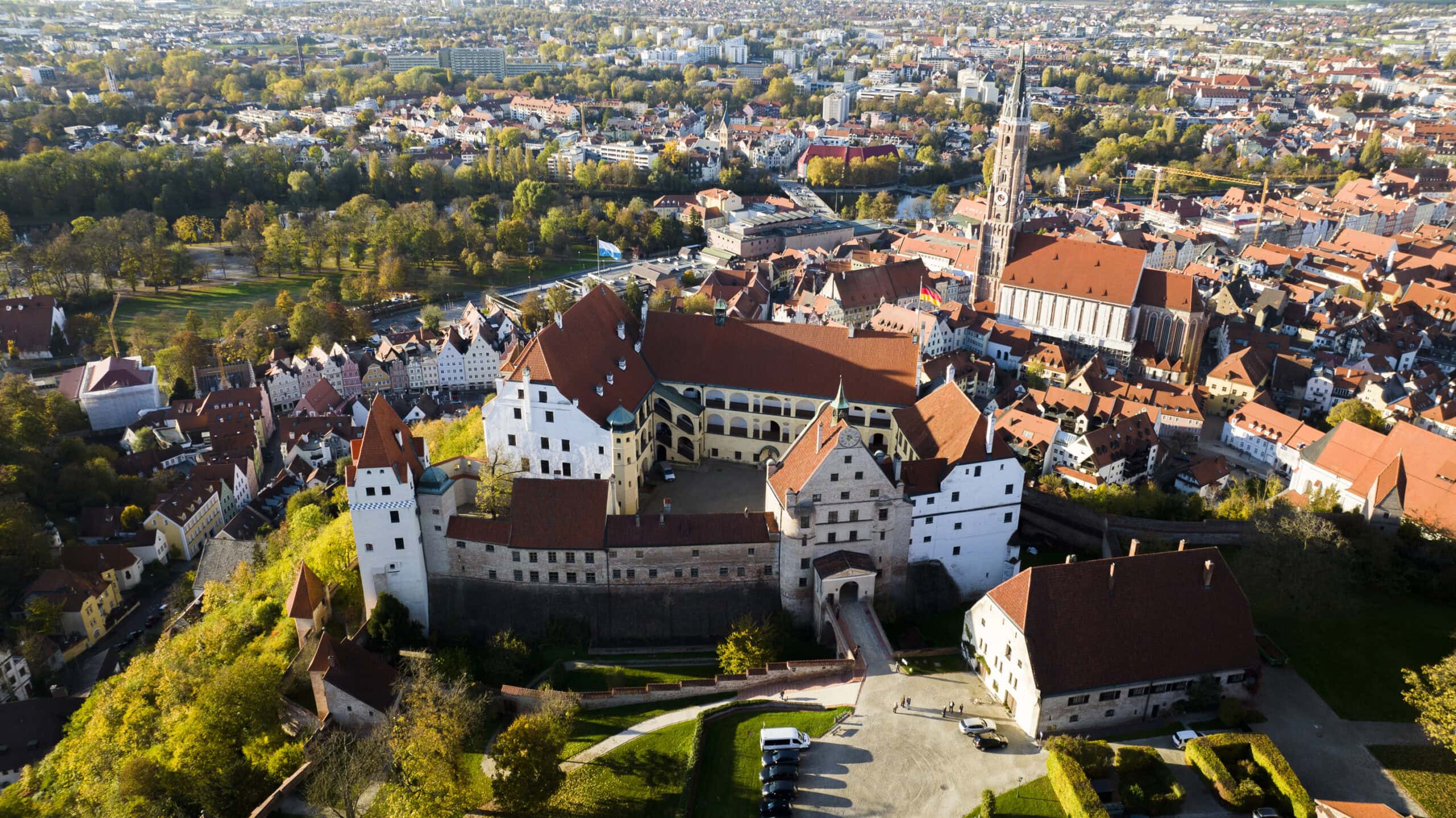
The Wittelsbach dynasty ruled Bavaria for seven hundred and thirty-eight years. Between Otto I’s investiture at Altenburg on September 16, 1180 and Ludwig III’s release of his subjects from their oath of loyalty in the Anif Declaration of November 12, 1918, no other family held Bavaria, and Bavaria held no other family. The visible inventory of that 738-year tenure is the Wittelsbach castles: from the medieval ducal seat at Trausnitz, founded the year after the dynasty’s second-generation duke came of age, to the unfinished Versailles answer at Herrenchiemsee, where Ludwig II stayed only a few days in September 1885 and then never returned.
No other German dynasty matches the figure. Habsburg-Austria held its crownlands for roughly six hundred and thirty-six years; the Welfs in Brunswick-Lüneburg and Hannover, six hundred and thirty-one; the Hohenzollern hold on Brandenburg and Prussia lasted five hundred and three. Among the major principalities of the old Reich, Wittelsbach-Bavaria stands alone as a single unbroken tenure.
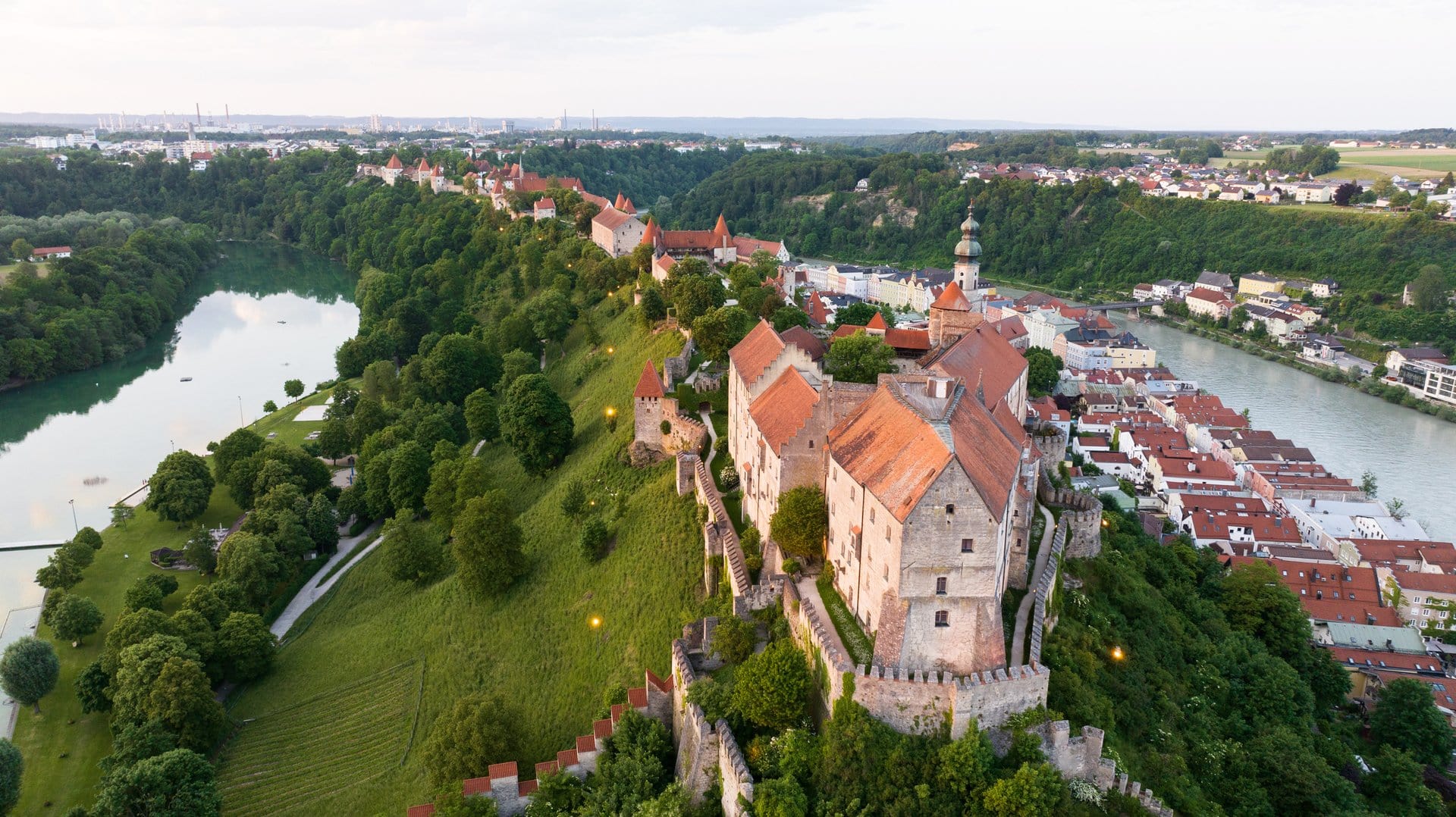
This article examines the architectural inheritance of that tenure in three generations. The argument is that each generation of Wittelsbach residence tracked a change in what Bavaria was politically, and that the resulting Bavaria, the one a visitor still walks through today, is the cumulative inventory of three political settlements, each of which the dynasty outbuilt before that settlement outgrew them. Generation one was the medieval ducal seat: Trausnitz, Burghausen, and the Alter Hof at Munich, built when Bavaria was a Reichsfürstentum holding territory inside the larger frame of the Holy Roman Empire. Generation two was the Renaissance and Baroque residence: the Munich Residenz, Nymphenburg, and the Schleißheim trio, built when Bavaria had won, in 1623, the electoral dignity it had been denied for the four hundred years before. Generation three was Ludwig II’s romantic-historicist quartet, Neuschwanstein, Linderhof, Herrenchiemsee, and the Königshaus am Schachen, built when Bavaria had become a kingdom that had already outlived its sovereignty.
Scope here is Bavaria proper. The collateral Palatine branch of the family, which received the Pfalzgrafschaft bei Rhein in 1214 and ruled from Heidelberg until reunification with the Bavarian line in 1777, is acknowledged but is not the subject. The longest-tenured dynasty in major German history left more castles than this article can describe; it left, in particular, the castles that defined what Bavaria became.
Generation One: The Ducal Seats, 1180–1505
Bavaria came to the Wittelsbach not through battle but through forfeiture. At the Hoftag of Gelnhausen in April 1180, Emperor Friedrich I Barbarossa stripped Duke Henry the Lion of his two duchies. Saxony was redistributed at once; Bavaria was held in reserve. Five months later, on September 16, 1180, at a Hoftag at Altenburg in Thuringia, Barbarossa enfeoffed his old comital ally Otto of Wittelsbach with what remained of the Bavarian duchy. Otto’s claim was secured at Regensburg that November and confirmed at Nuremberg in February 1181. He died at Pfullendorf on July 11, 1183, after barely three years on the ducal throne, and was succeeded by his minor son Ludwig I, the Kelheimer.
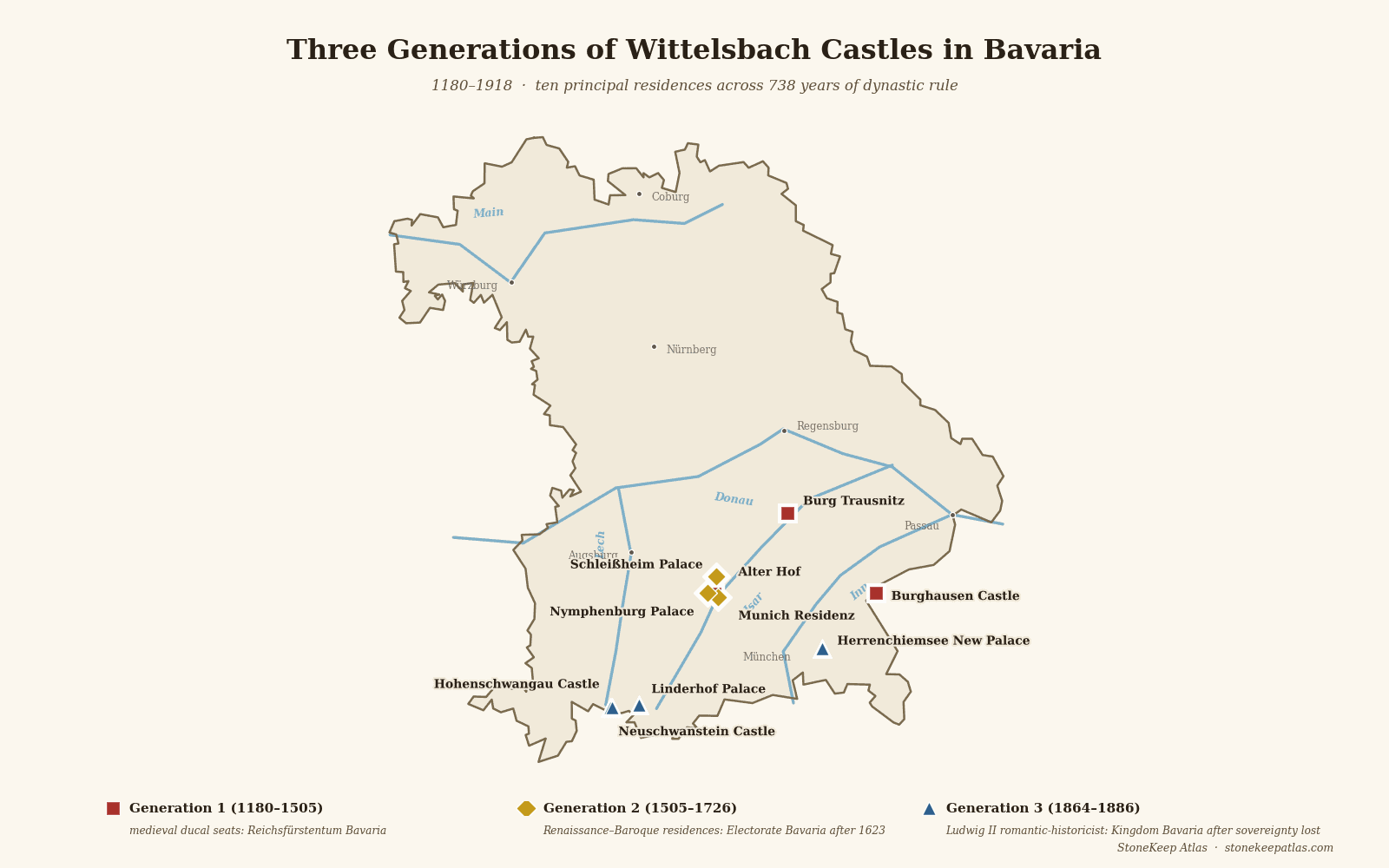
Munich was not yet the medieval Wittelsbach capital. It was Kelheim, then Landshut, then a network of seats from which a partitioned and re-partitioned family administered a heterogeneous duchy. Trausnitz Castle, founded by Ludwig I in 1204 above the new ducal town of Landshut, became the longest-serving of these. From the first Bavarian partition in 1255 until the reunification two hundred and fifty years later, Trausnitz was the seat of the Lower Bavarian dukes. Its companion residence at Burghausen, strung over a thousand meters along a knife-edge ridge above the Salzach, was rebuilt and extended through the late thirteenth and fourteenth centuries by the same Lower Bavarian line, reaching its present form under the Rich Dukes of Bayern-Landshut and particularly Georg the Rich in the 1480s. Per the Bayerische Schlösserverwaltung, Burghausen “from 1255 to 1503 … was the second residence of the Lower Bavarian dukes,” and at approximately 1,051 meters it is recognized by Guinness World Records as the longest castle complex in the world.
Munich entered the dynastic geography in 1253, when Ludwig II of Upper Bavaria began building the Alter Hof as the seat from which he would govern Upper Bavaria and the Palatinate. By 1255 the partition formalized the arrangement: Upper Bavaria and the Palatinate to Ludwig the Severe, with Munich the new capital; Lower Bavaria to Heinrich XIII, ruling from Landshut. Two grandsons of Ludwig the Severe stood at the center of fourteenth-century European politics. Ludwig IV the Bavarian, the elder of the two, was elected King of the Romans at Frankfurt on October 20, 1314 in a contested election against Friedrich the Fair of Habsburg. He defeated Friedrich at the Battle of Mühldorf on September 28, 1322, and on January 17, 1328 he was crowned Holy Roman Emperor in Rome by Sciarra Colonna and representatives of the Roman commune, the only medieval imperial coronation performed without papal sanction. From 1328 onward, the Alter Hof was the residence of an emperor.
Even so, the dynastic geography this generation built turned out to be its own problem. Inheritance customs in Bavaria were partible, and the duchy divided in 1255, again in 1349, and finally in 1392 into four lines (Bayern-München, Bayern-Landshut, Bayern-Ingolstadt, Bayern-Straubing). Reunification came only after the Landshut War of Succession. Georg the Rich of Bayern-Landshut, the last male of the senior line, died on December 1, 1503 without leaving a son. Maximilian I’s Kölner Schiedsspruch, the Cologne arbitration of July 30, 1505, ended the war by awarding the bulk of Lower Bavaria to Munich and closing the medieval partition tradition. Three years later, on July 8, 1506, Albrecht IV promulgated the Primogeniturordnung that locked the unification in. From that moment, Bavaria had one ducal capital, one ducal line, and a building site at Munich big enough for what came next.
Generation Two: Residence, Counter-Reformation, Electorate, 1505–1726
Single-ducal-capital Munich took eight generations of Wittelsbach to finish, and they finished it as a different kind of country. The fortified Neuveste, begun in 1385 after the suppression of an urban revolt, was the architectural starting point. By the second half of the sixteenth century, that medieval ducal castle had been outgrown. Duke Albrecht V (r. 1550–1579), the most cosmopolitan member of the dynasty since Ludwig the Bavarian, built next door to it the first room of the modern Residenz: a barrel-vaulted hall sixty-six meters long, completed in 1568–1571 by court architect Wilhelm Egkl to designs of Jacopo Strada, to house Albrecht’s collection of antique sculpture. Bayerische Schlösserverwaltung calls it “the largest and most lavish Renaissance hall north of the Alps.” Albrecht’s other foundation of these years was the Münchener Hofbibliothek, established 1558 with his purchase of the Widmanstetter library; today the Bayerische Staatsbibliothek, it is the oldest of Albrecht’s institutions still in continuous operation. He had also chosen sides in the Reformation: hard, early, and on the Roman side, a decision that fixed Bavaria’s confessional character for the next four hundred years.
That decision had a payoff. When Albrecht’s great-grandson Maximilian I led the Catholic League in the early Thirty Years’ War, his armies defeated Friedrich V of the Palatinate at the Battle of the White Mountain on November 8, 1620, and the emperor punished Friedrich with the loss of his electoral dignity. At the Regensburger Deputationstag on February 25, 1623, Maximilian was personally enfeoffed with the Pfälzische Kurwürde, the Palatine electoral dignity. The original investiture document is preserved in the Bayerisches Hauptstaatsarchiv. After 1623, Bavarian Wittelsbach were Electors of the Holy Roman Empire, with the constitutional right to vote on the emperor, and the architecture caught up.
It caught up first in the country, then in town. In 1664, Elector Ferdinand Maria and his Savoyard consort Henriette Adelaide commissioned a summer residence to mark the birth, on July 11, 1662, of their long-awaited heir Max Emanuel. The Italian architect Agostino Barelli laid out the central pavilion at Nymphenburg; over the next century, Enrico Zuccalli, Joseph Effner, and François de Cuvilliés the Elder built the wings, the canal, the radial avenue back to Munich, and the four park pavilions, of which the Amalienburg (1734–1739) by Cuvilliés is one of the masterworks of European Rococo. Max Emanuel himself, raised on Henriette Adelaide’s gift, commissioned the second great Wittelsbach country complex at Schleißheim. Altes Schloss there, built 1617–1623 by Heinrich Schön the Elder for Maximilian I, was the Catholic-pilgrimage backdrop; the Lustheim garden palace by Zuccalli (1684–1688) commemorated Max Emanuel’s first marriage; the Neues Schloss, cornerstone laid April 14, 1701, was the principal stage. Construction halted in 1704 when the elector’s alliance with France ended in defeat at Blenheim, and he was placed under imperial ban and went into exile in Brussels and France. Work resumed in 1719, after his restoration under the Peace of Baden (1714), and the Neues Schloss reached substantial completion in 1726, the year of Max Emanuel’s death.
Munich Residenz itself absorbed eighty years of additive construction between 1600 and 1750. By the middle of the eighteenth century, the dynasty was confident enough to build for pleasure rather than display. Altes Residenztheater, designed by Cuvilliés the Elder for Max III Joseph and completed between 1751 and 1755, is the surviving emblem of that moment. Its painted wood interior, evacuated for safety in 1943 and reinstalled after the war in the Apothekenstock wing of the Residenz, is the actual 1750s fabric in a different room. Neue Residenz facing the Hofgarten dates from 1612–1616, the Reiche Zimmer from the 1730s, the Königsbau and Festsaalbau from the nineteenth century. The unifying argument of the whole, as the Residenz’s own curators have it, is that the Wittelsbach Electors built like Electors.
Even the counter-example confirms it. Würzburg Residence was built by a different family, the Schönborn prince-bishops of Würzburg, and a different church, and yet by 1814 it had passed into Wittelsbach hands as part of the Bavarian Kingdom, where it has stayed since. Its architecture is Schönborn; its inheritance is Wittelsbach. The Electorate that built the Residenz in Munich was confident enough, by the early eighteenth century, that other German princes built like it. By the time Bavaria became a kingdom in 1806, the three largest residential complexes in the German-speaking world were all Wittelsbach property: the Munich Residenz, Nymphenburg, and Schleißheim. They are still administered today by what is now the Bayerische Schlösserverwaltung.
The Bridge: Kingdom, Klenze, and Maximilian II, 1806–1864
Max IV Joseph of Pfalz-Zweibrücken-Birkenfeld inherited the Wittelsbach throne in 1799, and on January 1, 1806 he ceased to be an Elector. On that date, under the terms of the Treaty of Pressburg the previous month and at Napoleon’s nomination, he became Maximilian I, King of Bavaria. His kingdom was three times the size of the Old Bavarian Electorate. Reichsdeputationshauptschluss of 1803 had secularized the Prince-Bishoprics of Würzburg, Bamberg, Augsburg, and Eichstätt and assigned them to Bavaria. Pressburg added Tyrol, briefly. Confederation of the Rhine, joined on July 12, 1806, regularized the new dynastic order. By the Final Act of the Congress of Vienna in 1815, Bavaria had Franconia and the Swabian Allgäu permanently; Würzburg had returned to it in 1814 after the brief Habsburg Grand Duchy interlude of 1805/06–1814; and Sachsen-Coburg was the only major piece of the modern Free State of Bavaria still outside, which would arrive by referendum on July 1, 1920.
It fell to Maximilian I’s son Ludwig I, king from 1825 to 1848, to translate the new kingdom into stone. Ludwig was a connoisseur of classical antiquity and a builder by temperament. His chosen instruments were two architects: Leo von Klenze for the classicist civic program, and Friedrich von Gärtner for the Romantic-historicist counterweight. Klenze built the Glyptothek (1816–1830) to house the king’s antiquities, the Königsbau wing of the Munich Residenz (1826–1835) for the king himself, the Alte Pinakothek (1826–1836) for his paintings, and the Walhalla (1830–1842) at Donaustauf above the Danube as a Greek temple of German worthies. Gärtner laid out the Ludwigstraße from 1827, built the Staatsbibliothek of 1832–1843 on its eastern side, and closed its southern end with the Florentine arcaded Feldherrnhalle (1841–1844, consecrated 1844). The Munich the world thinks of as a Bavarian city was largely built in twenty-five years by these two men under one king.
Ludwig I abdicated on March 20, 1848, after the Lola Montez affair and the European revolutions, in favor of his son Maximilian II. Maximilian II’s contribution to the Wittelsbach castle inventory was made before he was king. As Crown Prince, in 1832, he discovered and purchased the ruined Hohenstaufen castle of Schwanstein at the foot of the Alps near Füssen, and from 1832 to 1837 he rebuilt it in the new Maximilianstil, the historicist house style he would later use across his reign. The architect was Domenico Quaglio, who died in 1837 with the work unfinished; Joseph Daniel Ohlmüller and Georg Friedrich Ziebland continued the additions until about 1855. Moritz von Schwind painted the frescoes. Rebuilt Hohenschwangau was the family summer residence, and it was where Maximilian II raised his elder son, who would inherit it.
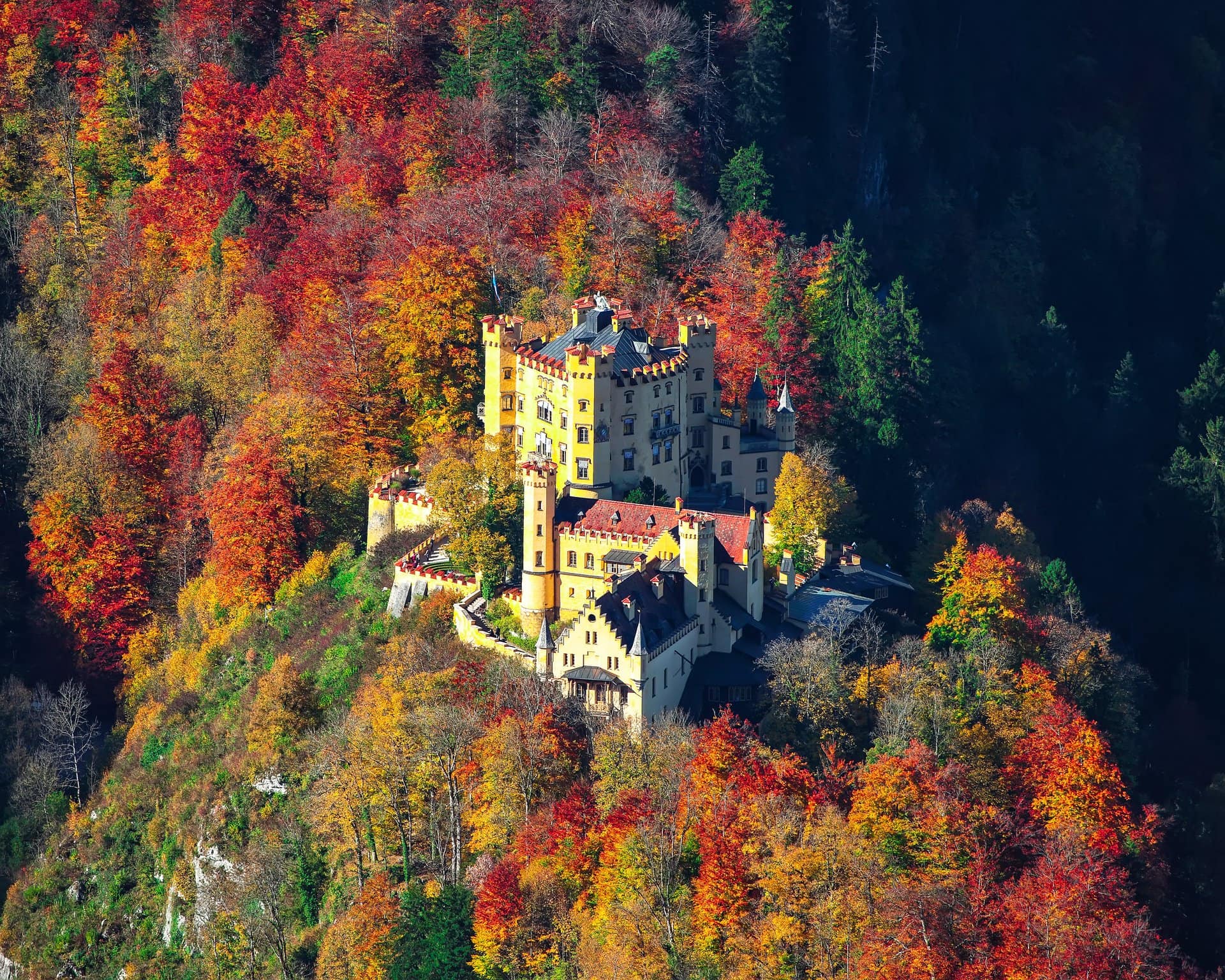
The architectural vocabulary that the Crown Prince chose at Hohenschwangau, medievalizing, narrative, and programmed around Wagnerian and chivalric subjects, was the vocabulary his son would use to build the most famous Wittelsbach castles of all.
Generation Three: Ludwig II and the Architecture of Sovereignty Lost, 1864–1886
Ludwig II was born at Schloss Nymphenburg on August 25, 1845 and acceded to the Bavarian throne on March 10, 1864, at the age of eighteen. Two years later, in the Austro-Prussian War of 1866, Bavaria fought on the losing Austrian side; five years after that, in the Franco-Prussian War of 1870–71, Bavaria fought on the winning Prussian side and was paid for it by being absorbed, on highly favorable but visibly subordinate terms, into the new German Empire. Ludwig signed the Kaiserbrief that offered the imperial crown to the King of Prussia on November 30, 1870. From that moment, he was the king of a country that retained its own crown, army, post office, and railways but had lost its foreign policy and its sovereignty. The architecture that followed was the architecture of a kingdom that had outlived its sovereignty.
Foundation stone of Neuschwanstein was laid on September 5, 1869. Theatrical designs were drawn by the stage painter Christian Jank; the architectural plans were executed first by Eduard Riedel (1869–1874), then by Georg von Dollmann (from 1874), then after 1884 by Julius Hofmann. The style was Neo-Romanesque rather than the neo-Gothic of Hohenschwangau, with Byzantine and Gothic interiors and a programmatic decoration drawn from Wagner’s operas. The castle was never finished. Ludwig occupied it for only 172 days in total. Its keep, its chapel, and its high tower were never built. At Ludwig’s death in 1886, only the Gateway Building, the Knights’ Wing, and the Palas were structurally complete; perhaps fourteen rooms inside were finished. Bayerische Schlösserverwaltung’s own English visitor page records, with a candor that is striking for a tourist-facing site, that the castle “was opened to the public from August 1, 1886,” seven weeks after the king’s death.
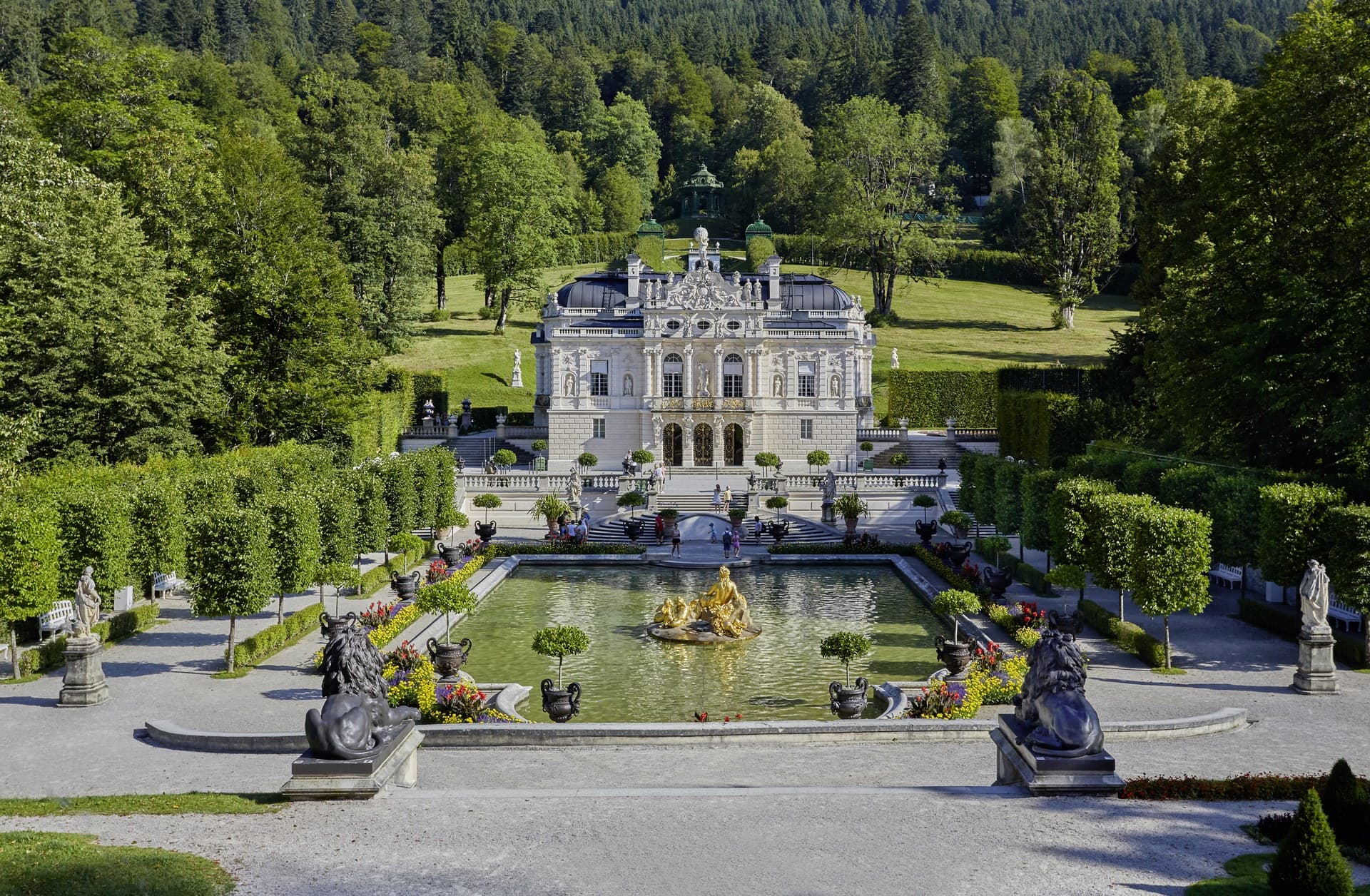
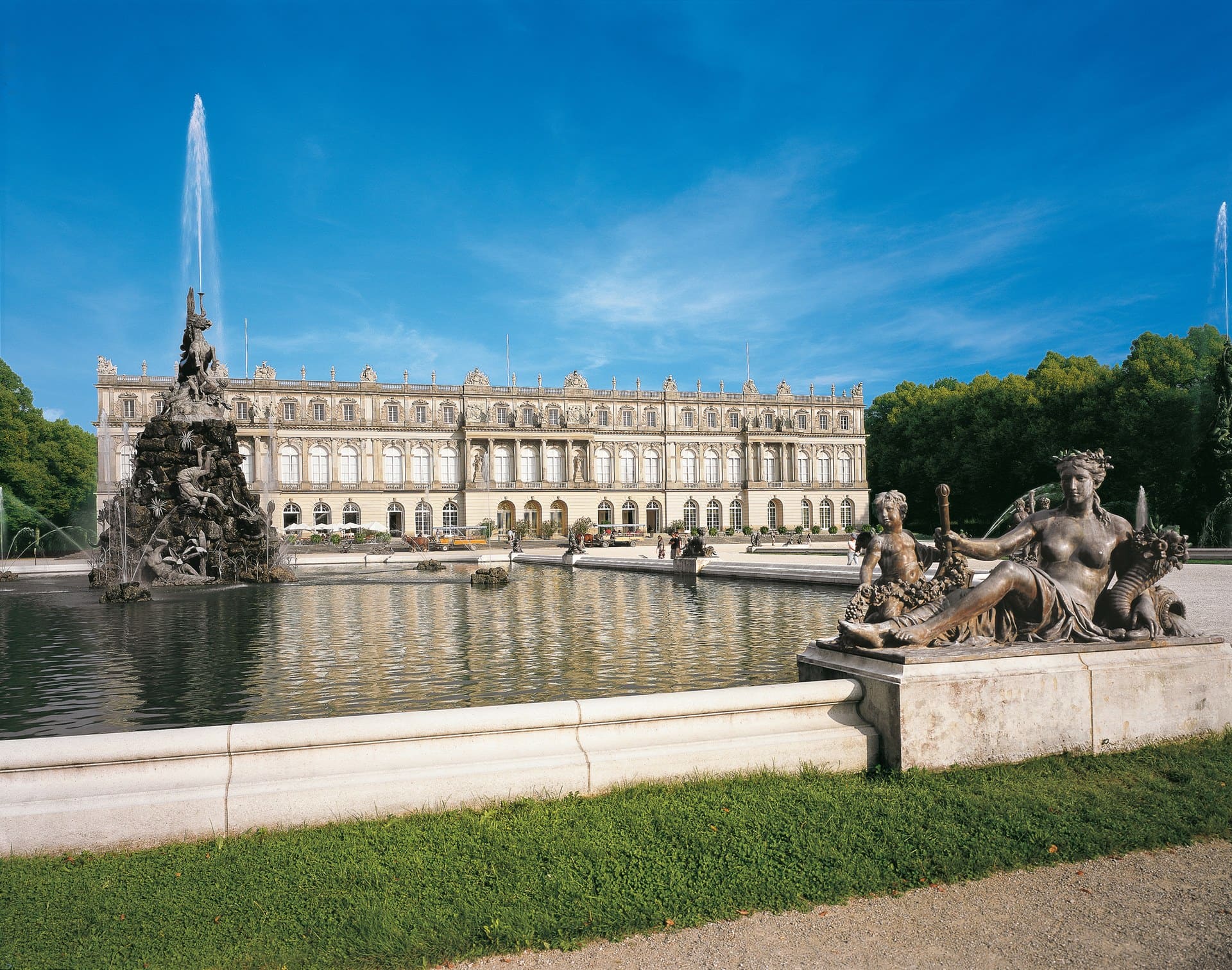
Linderhof was the only one of Ludwig’s monumental projects substantially completed in his lifetime. Begun in 1869 as a rebuilding of his father’s hunting lodge in the Graswang valley above Ettal and evolved through 1886 into a small Neo-Rococo palace surrounded by a Versailles-inspired water garden, a Venus Grotto, and a Moorish Kiosk, Linderhof is the Versailles strain in Ludwig’s imagination at its most controlled. Herrenchiemsee, begun in 1878 on the largest island in the Chiemsee, is that same imagination at its largest. Its Spiegelgalerie measures 98 meters along the garden front. Hall of Mirrors proper at 75 meters exceeds the 73-meter original at Versailles by two meters, and the corner halls extend the enfilade further. Construction halted in 1885 with the main pavilion roofed but the side wings unbuilt. Bayerische Schlösserverwaltung notes that Ludwig “only had an opportunity to stay at the palace for a few days in September 1885.” A fourth project, the Königshaus am Schachen, was a small mountain pavilion above 1,800 meters near Garmisch-Partenkirchen, built 1869–1872, and the only one of the four Ludwig actually finished in his lifetime.
On June 8, 1886 a medical commission led by Bernhard von Gudden declared Ludwig II permanently insane; on June 10, the proclamation of Prince Luitpold as Regent was published; in the early hours of June 12, a second commission seized the king at Neuschwanstein and transported him to Schloss Berg on Lake Starnberg. He and Gudden both died there on the evening of June 13, 1886 in shallow water. Official autopsy concluded suicide by drowning; the absence of water in the king’s lungs has kept that conclusion contested for almost a hundred and forty years, and the question of what happened at Starnberg in June 1886 remains historically unresolved. On July 12, 2025, Neuschwanstein, Linderhof, Herrenchiemsee, and Schachen were inscribed together on the UNESCO World Heritage List as “The Palaces of King Ludwig II of Bavaria.” Bavarian state received the inscription certificate at the Munich Residenz on December 15, 2025. Three of the four castles their builder never finished. The kingdom that built them ended thirty-two years after he did.
What the Three Generations Mean
Medieval ducal seats built when Bavaria was a Reichsfürstentum, Renaissance and Baroque residences built when Bavaria became an Electorate, and romantic-historicist castles built when Bavaria had become a kingdom without sovereignty: each of the three generations of Wittelsbach residence is the architecture of a different political settlement, built at the moment that settlement was being achieved or being lost. The Antiquarium of 1568 is the architecture of a duke confident enough to collect like a Roman emperor; Nymphenburg of 1664 is the architecture of a court that was about to become electoral; Klenze’s Königsbau of 1826 is the architecture of a kingdom learning to be one; Neuschwanstein of 1869 is the architecture of a king who has just been told he no longer has a foreign policy.
Ludwig III, the last Wittelsbach king, never used the word abdication. On November 12, 1918, four days after the Munich revolution that ousted him, he issued from Schloss Anif near Salzburg a declaration releasing his civil servants and his army from their oath of loyalty. Kurt Eisner’s revolutionary government in Munich proclaimed it the following day as an abdication, ending the dynasty. Ludwig III did not contradict the proclamation. He died in exile at Schloss Nádasdy in Sárvár, Hungary, on October 18, 1921; his body was returned to Munich and buried, by his own request, in the family vault at the Frauenkirche. A 738-year arc that began at Altenburg on September 16, 1180 closed at Anif on November 12, 1918. The castles remained.
The Castles of the Wittelsbach Bavaria
Burg Trausnitz: The Lower Bavarian Capital (1204)
Burg Trausnitz is the single most representative survival of the first Wittelsbach generation. Founded by Ludwig I the Kelheimer in 1204 in the same act as the founding of the town of Landshut below, it served from the partition of 1255 to the reunification of 1505 as the seat of the Lower Bavarian line. Medieval keep, palas, and chapel survive; the courtyard arcading was added under Wilhelm V in the 1570s as the Italian-Renaissance residence of the Wittelsbach Crown Prince in the years before Munich consolidated everything. Trausnitz is where the Wittelsbach learned to be Bavarian dukes.
Burghausen Castle: The Longest Castle in the World (Rebuilt from c. 1255)
Burghausen Castle, strung above the Salzach on a knife-edge ridge across the river from Austria, was the secondary residence of the Lower Bavarian dukes between 1255 and 1503. At approximately 1,051 meters in length it is recognized by Guinness World Records as the longest castle complex in the world. Bulk of the fabric dates from the building campaigns of the Rich Dukes of Bayern-Landshut in the late fifteenth century under Georg the Rich, the Wittelsbach whose death without an heir set off the Landshut War of Succession that, when settled in 1505, reunified Bavaria for good.
Munich Residenz: The Wittelsbach Headquarters (1385–1918)
Munich Residenz is the architectural sum of the Wittelsbach dynasty after 1505. Begun in 1385 as the Neuveste, expanded sixty-six meters at a time by the Antiquarium of 1568 under Albrecht V, the Reiche Zimmer of the 1730s under Karl Albrecht, the Königsbau of 1826–1835 under Ludwig I, and the Festsaalbau of the 1840s under Maximilian II, the Residenz is the only one of the great German Residenzschlösser whose owners built continuously across five hundred years. It was the principal residence of every Wittelsbach Elector and King from Albrecht V to Ludwig III, and it is the building that received, on December 15, 2025, the UNESCO inscription certificate for Ludwig II’s four castles.
Nymphenburg Palace: The Birth-Gift Capital of Baroque Bavaria (1664)
Nymphenburg Palace was the second great Wittelsbach building act of the Electorate era. Commissioned in 1664 by Elector Ferdinand Maria and his Savoyard consort Henriette Adelaide to mark the birth of their heir Max Emanuel in 1662, the Italian Baroque pavilion designed by Agostino Barelli was expanded over the next century by Zuccalli, Viscardi, Effner, and Cuvilliés into a residence that closes the Munich axis from the city’s center. Amalienburg of 1734–1739 in the park is one of the masterworks of European Rococo. Nymphenburg has been administered by the Bayerische Schlösserverwaltung continuously since 1918.
Hohenschwangau Castle: The Bridge to Ludwig II (1832–1837)
Hohenschwangau Castle is the bridge between the Kingdom era and the Ludwig II era. Bought as a ruin by Crown Prince Maximilian in 1832 and rebuilt 1832–1837 in the new Maximilianstil by Domenico Quaglio, Joseph Daniel Ohlmüller, and Georg Friedrich Ziebland, it was the summer residence in which Ludwig II spent much of his childhood and the architectural vocabulary that he would later transpose, recast in Neo-Romanesque, onto the neighboring crag of Schwanstein. Frescoes by Moritz von Schwind anchor the interior. Hohenschwangau remained in family hands until 1923 and is open to the public today through the Wittelsbach Compensation Fund foundation.
Neuschwanstein Castle: The Architecture of Sovereignty Lost (1869–1886)
Neuschwanstein Castle, foundation stone laid September 5, 1869, is the most famous of the Wittelsbach castles and the least architecturally finished of them. At its commissioner’s death in 1886, only the Gateway Building, the Knights’ Wing, and the Palas were structurally complete; perhaps fourteen rooms were habitable; the chapel, the keep, and the high tower were unbuilt. Neuschwanstein is the architecture of a king learning what to do with a kingdom that has lost its foreign policy. Inscribed on the UNESCO World Heritage List as one of the four Palaces of King Ludwig II on July 12, 2025.
Linderhof Palace: The Only One That Was Finished (1869–1886)
Linderhof Palace is the only one of Ludwig II’s three monumental commissions substantially completed in his lifetime. Begun in 1869 as a rebuilding of his father’s hunting lodge in the Graswang valley above Ettal, it evolved through seventeen years into a small Neo-Rococo palace surrounded by a Versailles-inspired water garden, a Venus Grotto with electric lighting, a Moorish Kiosk imported from the 1867 Paris Exposition, and the curious Hundinghütte and Schwanenturm pavilions. Georg von Dollmann was the architect of record. Inscribed on the UNESCO World Heritage List on July 12, 2025 alongside Neuschwanstein, Herrenchiemsee, and Schachen.
Herrenchiemsee New Palace: The Versailles That Was Not Finished (1878–1885)
Herrenchiemsee New Palace, begun 1878 on the largest island of the Chiemsee, is Ludwig II’s response to Versailles taken to its limit. Its Spiegelgalerie along the garden front measures 98 meters in total enfilade. Hall of Mirrors proper at 75 meters exceeds the 73-meter original at Versailles by two meters, and the corner halls extend the gallery further. Only the main pavilion was built before construction halted in 1885; the side wings remain unbuilt to this day. Ludwig II stayed there only a few days in September 1885 and never returned. Inscribed alongside Neuschwanstein, Linderhof, and Schachen as a UNESCO World Heritage Site on July 12, 2025.
Common Questions
Who were the Wittelsbachs?
The dynasty that ruled Bavaria for seven hundred and thirty-eight years, from Otto I’s investiture at Altenburg in 1180 to Ludwig III’s release of his subjects from their oath in the Anif Declaration of 1918.
How does the guide organize their castles?
It follows three generations of Wittelsbach castle-building: the medieval ducal seats (1180 to 1505), the age of the Munich Residence, Counter-Reformation and electorate (1505 to 1726), and Ludwig II’s palaces of sovereignty lost (1864 to 1886).
What ties the castles together?
Each generation used building to express power in its own key, so the castles read together as a single dynastic story rather than a list of separate monuments.
Principal Sources
- Bayerische Schlösserverwaltung. Bayerische Verwaltung der staatlichen Schlösser, Gärten und Seen. schloesser.bayern.de.
- Bayerisches Hauptstaatsarchiv. “1623. Bayern wird Kurfürstentum.” Exhibition catalog. Staatsarchiv Amberg, 2023.
- Glaser, Hubert (ed.). Wittelsbach und Bayern: Die Zeit der frühen Herzöge. Hirmer/Piper, 1980.
- Haus der Bayerischen Geschichte. Portal Königreich Bayern. hdbg.de.
- Historisches Lexikon Bayerns. Bayerische Akademie der Wissenschaften and Bayerische Staatsbibliothek. Lemmata: “Alter Hof, München”; “Bayerische Teilungen”; “Feldherrnhalle”; “Großherzogtum Würzburg (1805/06-1814)”; “Kölner Schiedsspruch, 30. Juli 1505.” historisches-lexikon-bayerns.de.
- Neue Deutsche Biographie. Bayerische Akademie der Wissenschaften. Entries: Ferdinand III. von Habsburg-Lothringen, Großherzog von Würzburg; Ludwig IV., Holy Roman Emperor; Maximilian I., Kurfürst von Bayern; Otto I., Herzog von Bayern; Otto II., Herzog von Bayern. deutsche-biographie.de.
- Schmid, Alois (ed.). Handbuch der bayerischen Geschichte. Vols. I–IV. C. H. Beck, 2017–2024.
- Steinberg, Reinhard. “Bernhard von Guddens psychiatrische Begutachtung und die Absetzung König Ludwigs II. von Bayern 1886.” Der Nervenarzt, 90/1 (2019).
- UNESCO World Heritage Centre. “The Palaces of King Ludwig II of Bavaria: Neuschwanstein, Linderhof, Schachen and Herrenchiemsee.” Inscription decision 47 COM, July 12, 2025. whc.unesco.org.
- Bayerische Schlösserverwaltung is the operator of the Munich Residenz, Nymphenburg, Schleißheim, Hohenschwangau, Neuschwanstein, Linderhof, Herrenchiemsee, Schachen, Trausnitz, and Burghausen; all on-site visit information, building dates, and conservation context in this article have been cross-checked against its English and German visitor pages and against the Historisches Lexikon Bayerns where institutional history was at issue.
Image credits. Featured image: aerial of Burg Trausnitz above the Landshut Altstadt, StoneKeep Atlas. Generation One: aerial of Burghausen Castle along the Salzach ridge, Bayerische Schlösserverwaltung. Generation Two: 3-generation map of Wittelsbach palaces in Bavaria, StoneKeep Atlas original commissioned for this article. Bridge section: Hohenschwangau Castle on its wooded hillside in autumn, StoneKeep Atlas. Generation Three: south façade of Linderhof Palace with the Flora parterre, Bayerische Schlösserverwaltung. Generation Three: west façade of Herrenchiemsee New Palace with the Fama fountain, Bayerische Schlösserverwaltung. Freely licensed images are resized to fit; otherwise unaltered.