
Schleissheim Palace
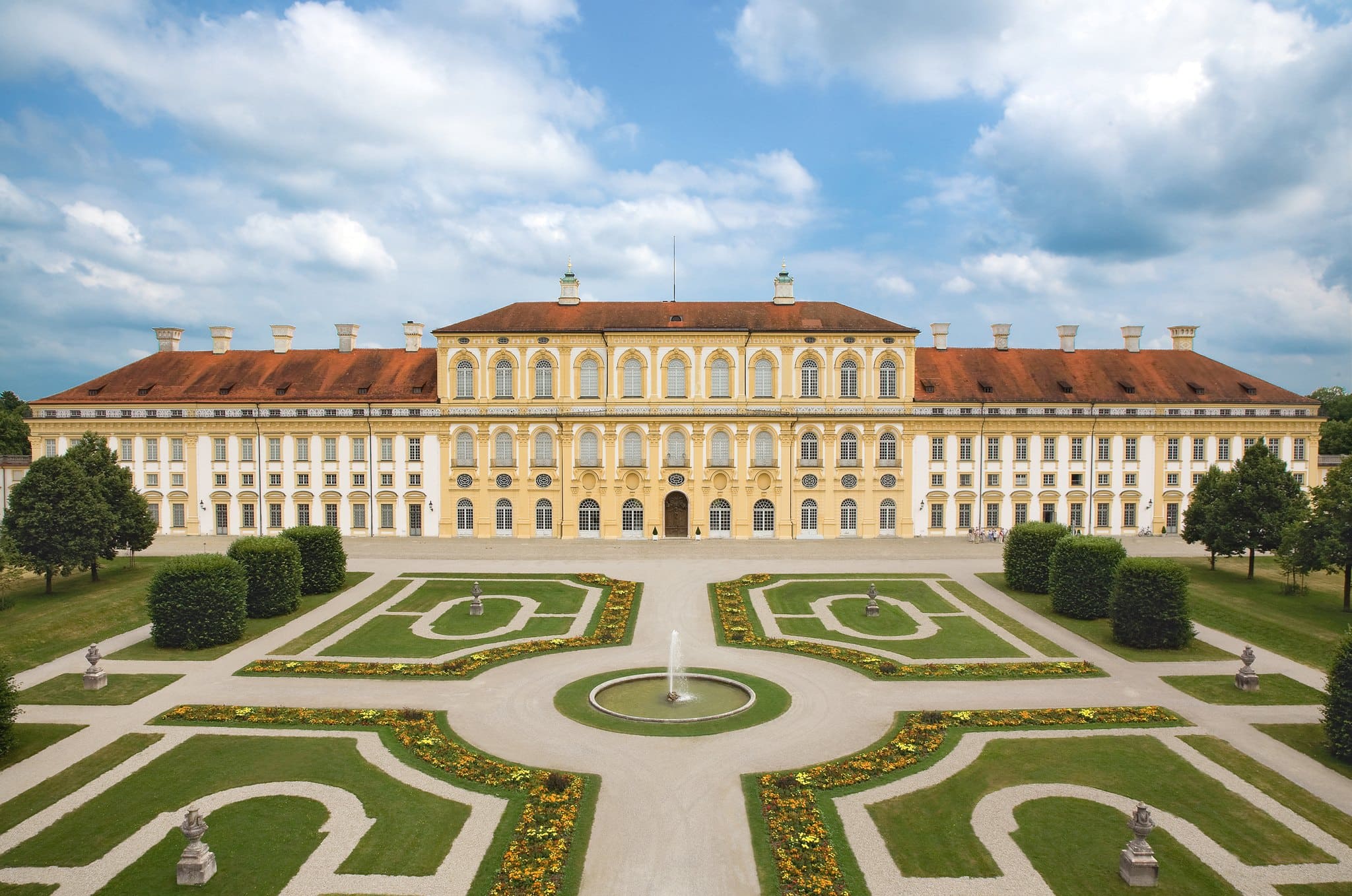
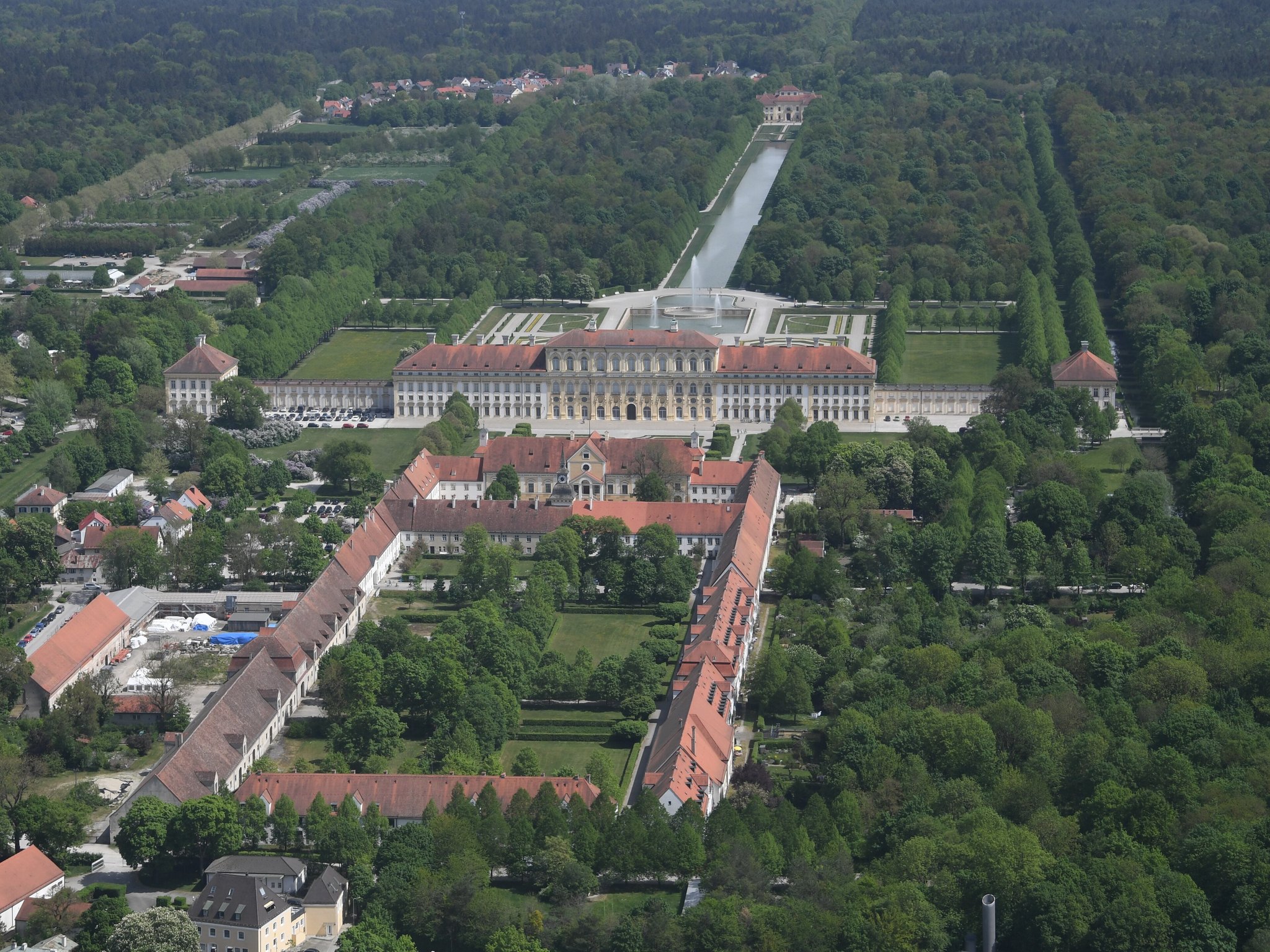
Schleissheim Palace stands on flat former marshland at Oberschleißheim, about thirteen kilometers north of Munich, where three palaces and one of Germany’s best-preserved Baroque gardens form a single immense ensemble. What began in 1597 as an isolated moorland farm, bought by a pious duke who wanted somewhere to pray, grew over a century and a half into one of the most ambitious palace schemes the Wittelsbach electors ever attempted. The complex gathers three buildings of rising scale: the Altes Schloss, a country seat of the early 1600s; Schloss Lustheim, a jewel-box garden villa of the 1680s; and the monumental Neues Schloss, begun in 1701 as Elector Max Emanuel’s bid to raise a Bavarian Versailles fit for an emperor.
That bid is the story the place tells. Where the Munich Residenz secured the dynasty’s rank and Nymphenburg kept the lighter soul of a summer retreat, Schleissheim is the reach that outran the grasp. War, exile, and an empty treasury cut the great four-wing design down to its central block, and the elector died before the work was finished. What survives is a built record of one ruler’s rising and arrested ambition, bound together by a French formal garden that, almost alone among its German peers, was never swept away by later fashion.
Quick Facts
| Name | Schleissheim Palace |
| German name | Schloss Schleißheim |
| Location | Oberschleißheim, Upper Bavaria, Germany |
| Built | Old Palace 1617–c.1623; Lustheim 1684–1688; New Palace begun 1701 |
| Patrons | Duke Wilhelm V (estate, 1597); Elector Max Emanuel (Lustheim, New Palace) |
| Architects | Enrico Zuccalli and Joseph Effner (New Palace); Zuccalli (Lustheim) |
| Style | Baroque, with a Renaissance country palace (Old Palace) |
| Garden | Formal French Baroque, laid out by Dominique Girard from 1715 |
| Current use | Museum complex, administered by the Bavarian Palace Administration |
| Collections | State Gallery of European Baroque Art (New Palace); Meissen porcelain (Lustheim); religious folk art and an East and West Prussia collection (Old Palace) |
| Open to public | Yes; closed Mondays |
| Official site | schloesser-schleissheim.de |
A duke’s estate on the moor
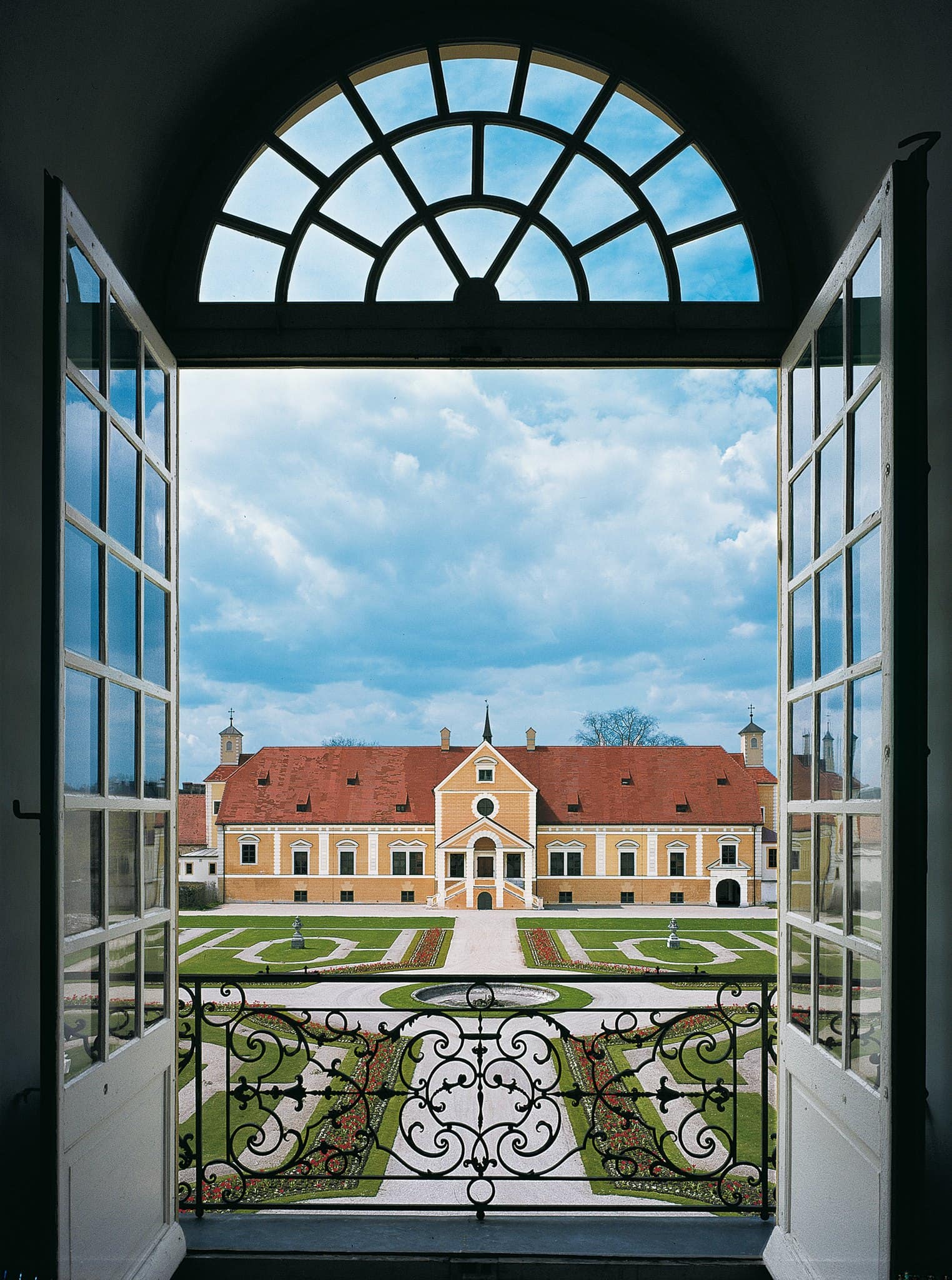
Schleissheim’s first owner had no palace in mind. In 1597 Duke Wilhelm V of Bavaria bought an isolated moorland farm, together with its small chapel of St Margaret, from the cathedral chapter of Freising. Wilhelm had already wearied of court splendor; within a year he abdicated in favor of his energetic son Maximilian and withdrew into religious meditation. Between 1598 and 1600 he laid out an estate and manor here, ringed by hermitages and forest chapels, and kept the property working as a farm, with a stud that supplied the ducal stables and a modest trade in Schleissheim beer and cheese.
Maximilian I, drawn more by the farm’s profits than by its piety, took the estate from his father in 1616 in exchange for a life annuity. A year later he ordered the old manor pulled down and replaced by a proper residence. Building went up quickly, to plans by Heinrich Schön the Elder, very likely with Hans Krumper at his side and with Maximilian himself closely involved; the Dutch artist Peter Candid oversaw the painted and stuccoed interiors. Among the rooms was the chapel of St William, named for the founding duke, whose stucco decoration is one of the few original fabrics to come through the centuries that followed. By about 1623 the result stood complete: a long, low country palace in the manner of the villa architecture of the Veneto, the building known ever since as the Old Palace.
It did not survive the twentieth century intact. Allied air raids in the Second World War destroyed almost the entire roof and most of the rooms, and reconstruction could begin only in 1970, continuing in stages through the end of the 1980s. Today the rebuilt Old Palace serves a quieter purpose than Maximilian intended. It holds two branches of the Bavarian National Museum: the ecumenical collection of Gertrud Weinhold, more than six thousand objects of religious folk art gathered under the title “The Religious Year and its Festivals,” and a smaller memorial collection on the culture of East and West Prussia, tracing that lost German east from the days of the Teutonic Order to the expulsions of 1945.
Lustheim: a garden villa for a Habsburg bride
The transformation of Schleissheim from farm to showpiece began with a wedding. On July 15, 1685 the young Elector Max Emanuel married Maria Antonia, daughter of the Holy Roman Emperor Leopold I, a match that tied the Bavarian Wittelsbachs directly to the house of Habsburg and, through her, gave Max Emanuel a distant claim on the Spanish inheritance. To mark the marriage he commissioned a garden villa at the far end of his Schleissheim estate, and he gave the work to his court architect Enrico Zuccalli, a Grisons-born master already shaping the Bavarian Baroque.
Zuccalli’s plan dated from 1684, a year before the wedding, and its geometry already implied a far larger scheme to come. Lustheim sits roughly thirteen hundred meters down the central axis from the Old Palace, designed at once as the heart of its own gardens and as a point de vue, the eye-catching object that closes a long vista. Modeled on the Italian casino, the small pleasure house went up fast in brick, a two-story festival hall at its core flanked by apartments for the elector and his bride. Its ceilings carry a cycle of frescoes, painted in 1686 and 1687 by Francesco Rosa, Giovanni Trubillo, and Johann Anton Gumpp, that exalt Diana, goddess of the hunt; this was the first cycle of secular ceiling painting in Bavaria, and it announced a taste that would soon spread across the south. A sweeping colonnade was begun behind the villa to link two outlying pavilions, but the structures proved too large for the building methods of the day, fell into ruin after the deaths of architect and patron, and were finally demolished in 1741.
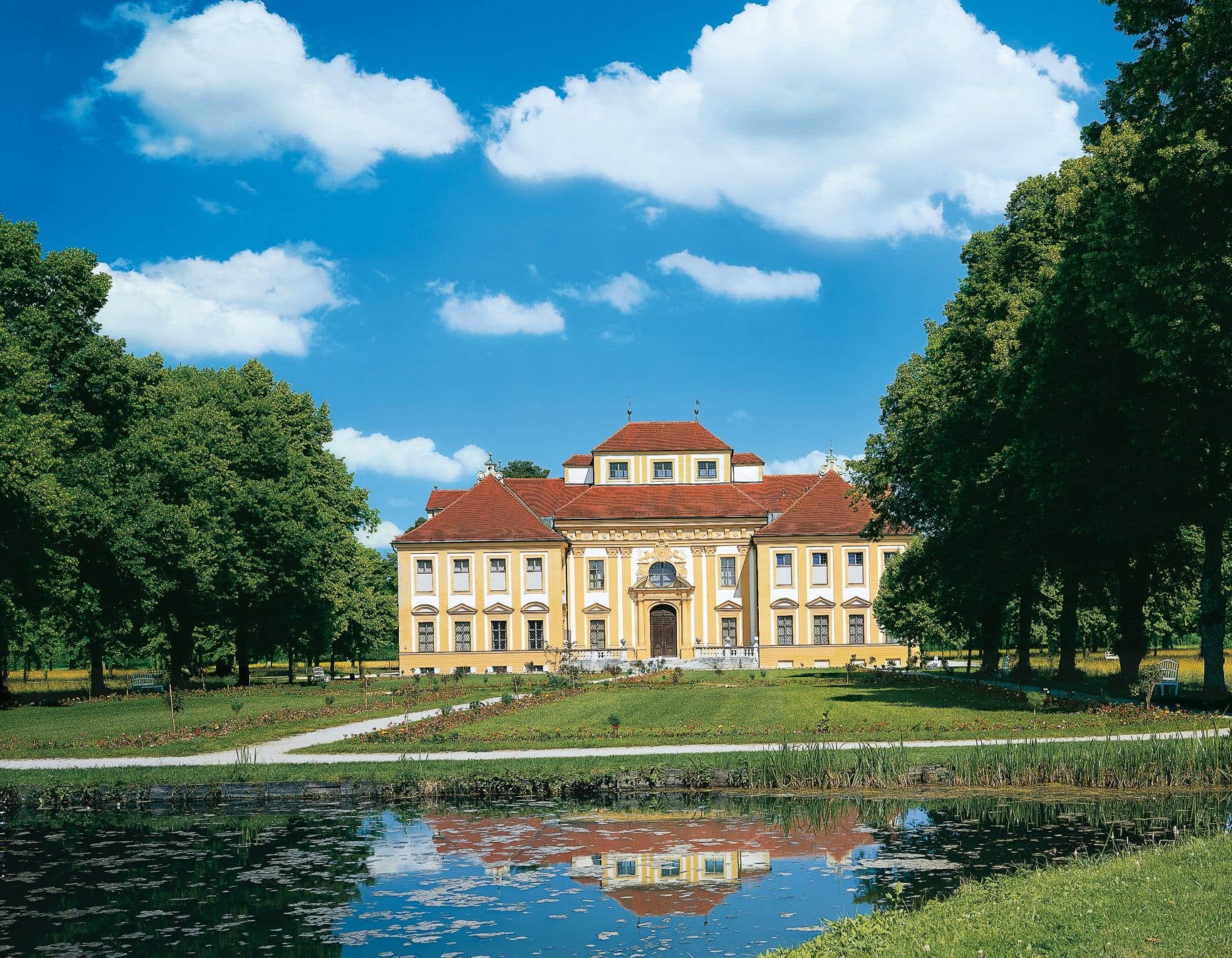
Lustheim’s interior found an unexpected second life in the modern era. Since 1971 it has housed the Meissen porcelain collection assembled by the industrialist Ernst Schneider, who gave it to Bavaria in 1968; it was the first branch museum the Bavarian National Museum ever opened. More than two thousand pieces fill the rooms of the little summer palace, tracing the Meissen manufactory from its founding in 1710 to the Seven Years’ War: the early wares of the Böttger period, the chinoiseries of the painter Johann Gregorius Höroldt, the lifelike animals modeled by Johann Joachim Kaendler, and showpieces from the great services made for Count Sulkowski and Count Brühl. In scope and quality it rivals only the royal collection at the Dresden Zwinger, and it gives Lustheim, almost by accident, the porcelain palace that Augustus the Strong dreamed of but never built.
Max Emanuel’s Bavarian Versailles
Max Emanuel had grander designs than a hunting villa. By 1700 he ranked among the most powerful princes of the Empire: a celebrated general who had stormed Belgrade from the Turks, governor of the Spanish Netherlands, and a man who believed his dynasty might one day wear the imperial crown the Habsburgs had held for centuries. For a time the prize seemed within reach. His son by Maria Antonia, Joseph Ferdinand, had been named heir to the whole Spanish monarchy, until the boy’s death in 1699 dashed that hope and left the Spanish succession to be fought over by the courts of Europe.
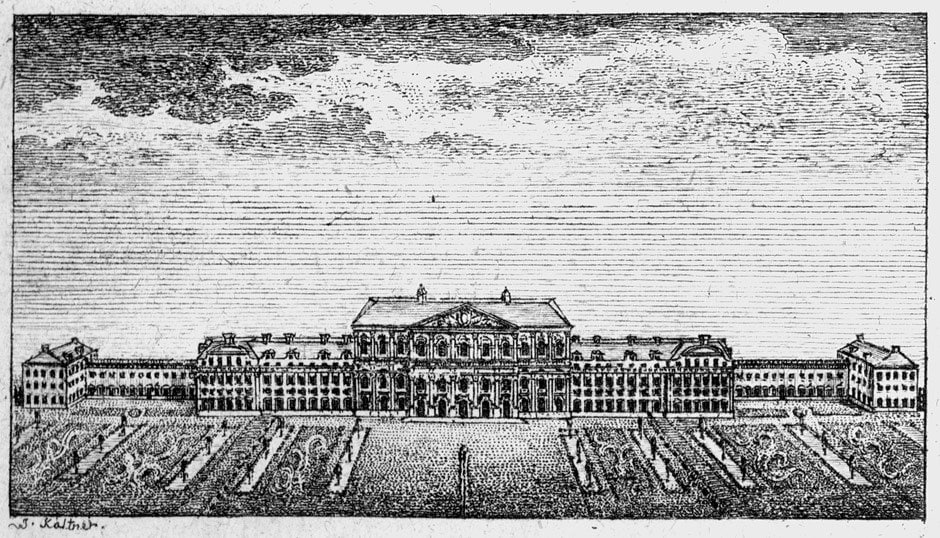
In that mood of high confidence Max Emanuel laid the foundation stone of a new palace at Schleissheim on April 14, 1701. He meant it as his future residence, a seat to match his expected station, and the plan Zuccalli drew up was vast: a four-wing complex around a great court of honor, its long arms reaching west to enclose the Old Palace and fold the whole estate into one continuous Baroque composition. Had it risen as drawn, Schleissheim would have stood among the largest palaces in the Empire, the Wittelsbach answer to Versailles set down on the open Bavarian plain. Max Emanuel had seen the French model at close hand during his years in the Spanish Netherlands, and he meant Schleissheim to bear the comparison: a garden front of monumental length, a court of honor deep enough to swallow a small town, and a single axis running unbroken from the Old Palace through parterre and canal to the edge of sight. The dynasty’s other seats were growing in the same years, the Munich Residenz in the capital and the summer palace of Nymphenburg just to its west, but Schleissheim was to be the boldest of them all, the Wittelsbach statement in stone.
War, exile, and a grandeur reduced
That confidence did not last two seasons. In the War of the Spanish Succession, Max Emanuel threw in his lot with Louis XIV of France against Austria, gambling that a French victory would carry the Wittelsbachs past the Habsburgs at last. On August 13, 1704, near the Danube village of Blenheim, the allied armies of the Duke of Marlborough and Prince Eugene of Savoy shattered the French and Bavarian forces. Building at Schleissheim stopped at once, with little more than the shell of the main wing standing, and the elector fled his own country.
A decade of ruin followed. Bavaria fell under Austrian occupation, its people rising in a doomed revolt in 1705 and 1706; Max Emanuel lost the Netherlands after the defeat at Ramillies and took refuge at the French court, where he waited out the war in the shadow of the very Versailles he had hoped to rival. Only the peace settlements of 1714 restored him, and he returned to Munich in 1715 to an empty treasury and an imperial dream that had evaporated.
He built anyway. Lacking the money for the four-wing scheme, he had it pared back step by step until nothing remained of the grand design but the central block: the New Palace as it stands, a magnificent fragment never joined to the Old Palace as planned. A wooden model made in 1725, still kept in the palace, preserves the lost vision in miniature, the finished New Palace linked by long wings to a re-Baroqued Old Palace to form the great four-winged court that money and war never allowed. To complete the building he turned to Joseph Effner, a gardener’s son from nearby Dachau whom he had sent to train in Paris, and it is Effner’s hand that shaped the great interiors. When Max Emanuel died on February 26, 1726 the palace was still unfinished, its marble chimneypieces, paneling, and floors installed only gradually by his son Karl Albrecht. The sharpest irony came sixteen years later: in 1742 that same son was crowned Holy Roman Emperor as Charles VII, the prize his father had chased across two decades of war, won at last when the man who built Schleissheim to receive it was long dead. Charles VII would hold the title barely three years before dying back in the Munich Residenz in 1745, the imperial Wittelsbach moment as brief as it had been late. Historians have read the elector’s late devotion to architecture as a way of answering in stone the political defeats he could not undo, and Schleissheim is the largest of those answers.
Interiors and the Baroque painting gallery
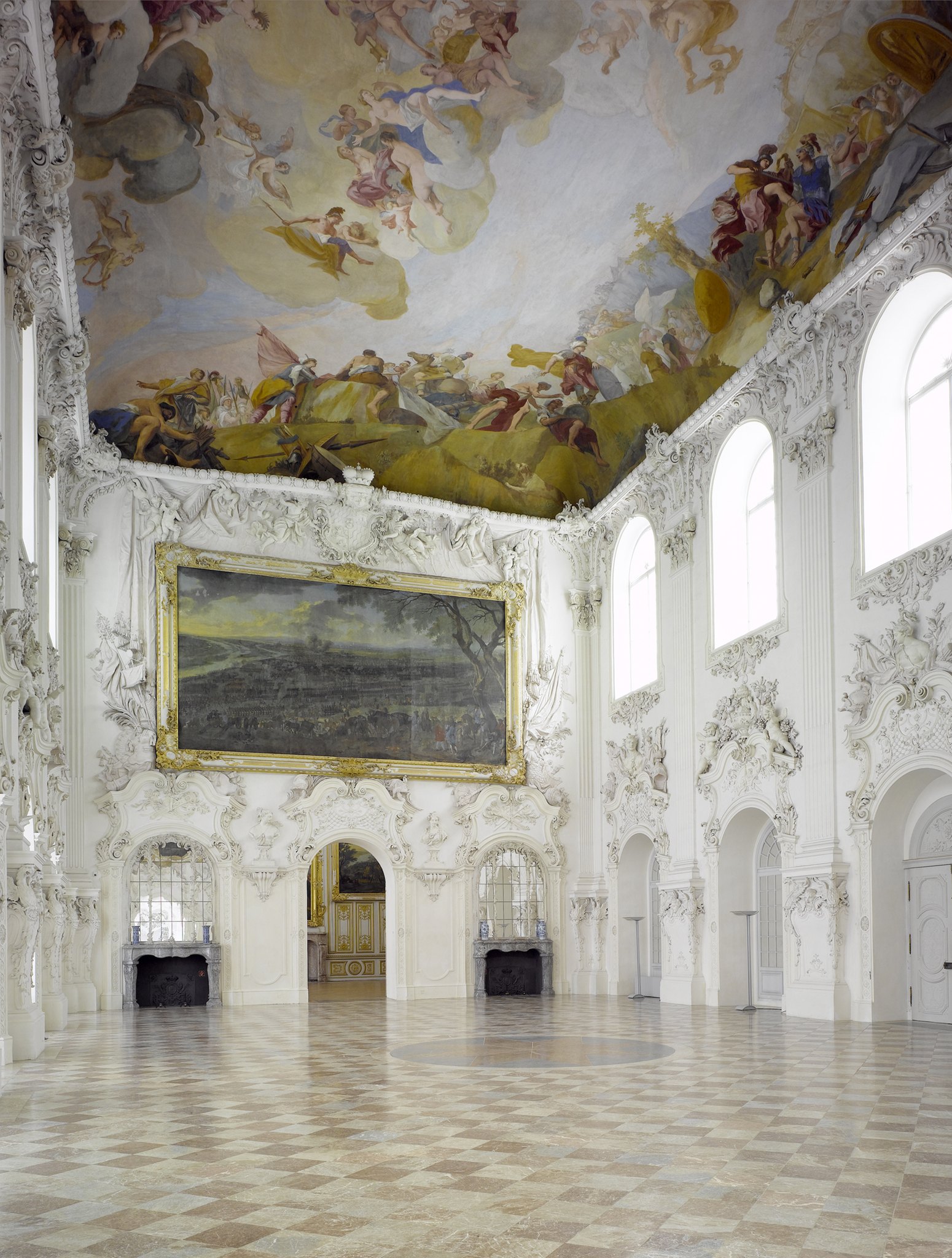
Inside, Schleissheim spends without restraint the splendor its exterior was denied. Effner arranged the state rooms as a rising ceremonial sequence, a route built to impress an ascending order of visitors: a grand staircase hall, then the Large Hall and the Hall of Victories on the upper floor, climaxing in the Great Gallery. Its decorative program turns throughout on Max Emanuel’s fame as a soldier, the general’s laurels standing in for the imperial purple he never gained. Cosmas Damian Asam, already a celebrated fresco painter, began the ceilings above the staircase and in the chapel; the Venetian Jacopo Amigoni then took on the vast remainder, including the continuous painting that once spread across the entire vault of the Large Hall and ranked, for several decades, as the largest ceiling picture in the world. Johann Baptist Zimmermann supplied the stuccowork, and the rooms still hold rare survivals of their original furnishing, among them gilt console tables from the court workshop of Johann Adam Pichler and the state beds of the elector and electress. Effner’s grand staircase, climbing the full height of the building beneath Asam’s painted dome, counts among the finest Baroque stair halls in Germany, a stroke of pure theater for a palace that had to make its argument indoors. A later ruler, Max III Joseph, added in 1763 the two great carved portals by the Rococo sculptor Ignaz Günther that still guard the entrances.
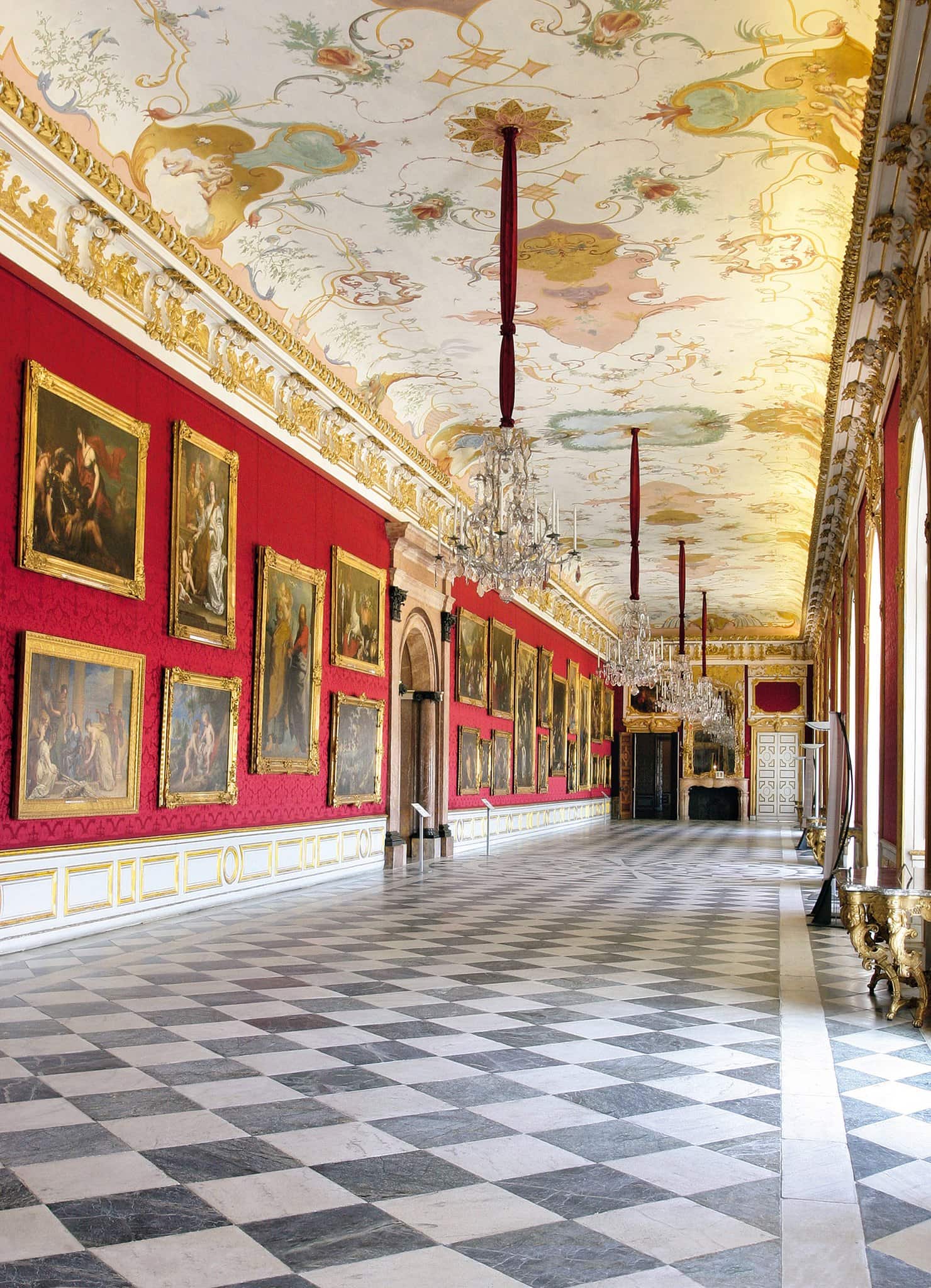
Max Emanuel had been a collector as well as a builder, and the pictures he gathered turned Schleissheim into a gallery palace by the end of the eighteenth century. That tradition continues today. The state rooms of the New Palace house the State Gallery of European Baroque Art, a division of the Bavarian State Painting Collections, with major works of the Italian, Flemish, Dutch, French, and Spanish schools hung in the very halls Effner built. After long restoration the gallery reopened in 2001, three hundred years to the year after the foundation stone was laid, so that the palace conceived as an emperor’s residence now does its finest work as a museum of the age that made it. Anyone who knows the picture rooms of the Munich Residenz or the painted halls of Nymphenburg will find Schleissheim the most concentrated Baroque interior of the three.
The formal garden and the canal
Schleissheim’s garden may be its greatest treasure, and it is certainly its luckiest survivor. Zuccalli laid out the framework from 1684 as Lustheim went up, and from 1689 a wide system of canals was dug, the skeleton a water garden on the grand scale required. French designs for the parterre were drawn up around 1701 by Charles Carbonnet, the gardener then reshaping the grounds at Nymphenburg, but the war intervened before they could be built. The garden as it survives is the work of Dominique Girard, a pupil of André Le Nôtre at Versailles, who from 1715 laid out the embroidered parterre, the pools, the sculptures, and the cascade in the full French Baroque manner. Below the palace terrace the parterre spreads in scrolled beds of clipped box and colored gravel, set with fountains and statuary; beyond it the wooded bosket compartments once held the hidden cabinets and water tricks that amused the court. By common reckoning the result ranks among the most important Baroque gardens in Europe. A long central axis orders the whole composition; first a track for the court game of pall-mall, it was turned into the present canal toward the end of the eighteenth century, carrying the eye across the water to Lustheim at the vista’s end.
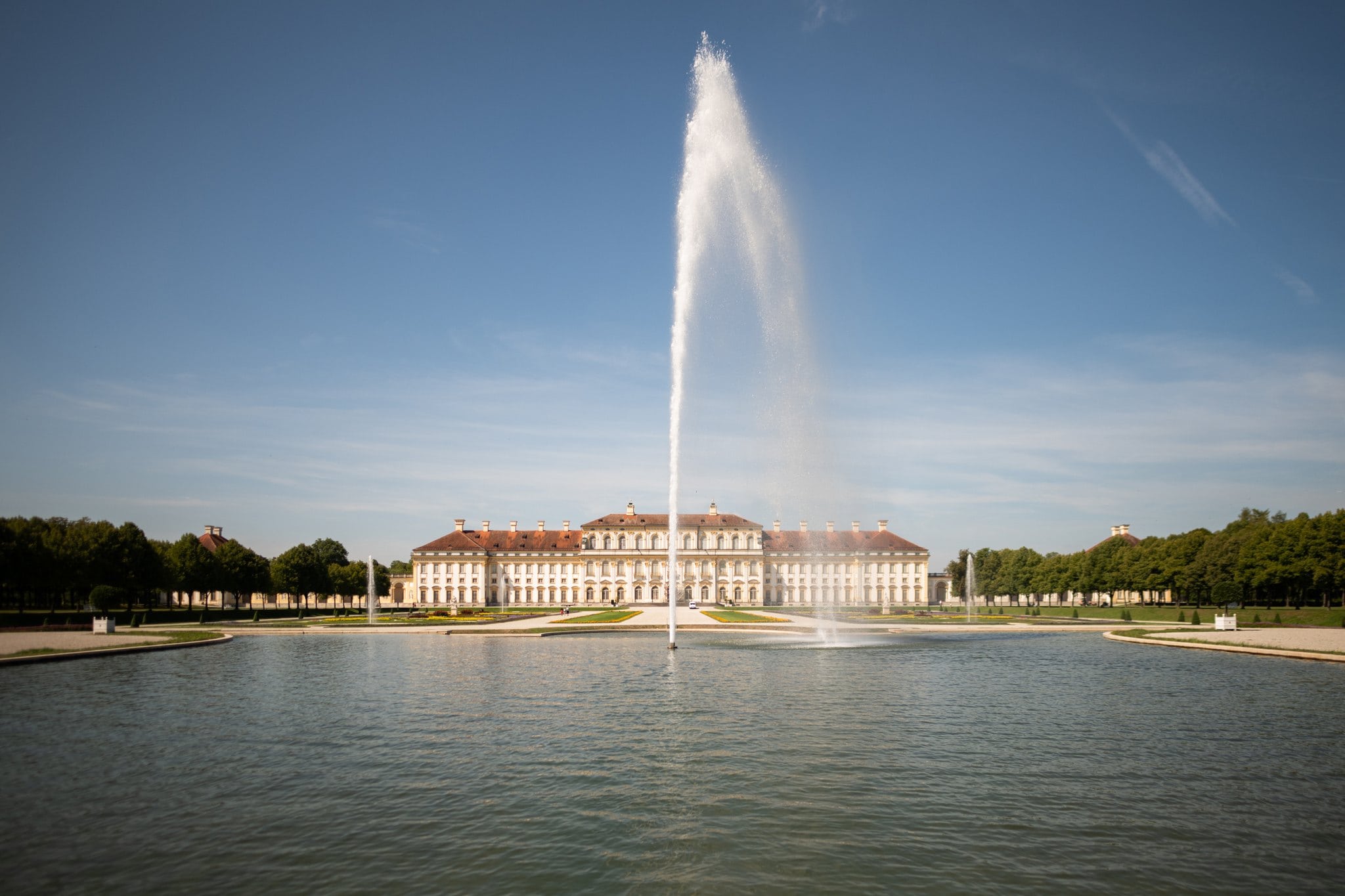
What makes the garden extraordinary is that it is still here. When the landscape style swept Europe in the nineteenth century, most formal Baroque gardens were torn up and replanted as rolling English parks; Schleissheim escaped, and survives as among the few French gardens in Germany never converted, its bones essentially those Girard set down three centuries ago. It was carefully restored between 1865 and 1868 by Carl Effner, a descendant of the palace’s own architect, working for King Ludwig I. Schleissheim’s canals still belong to the North Munich Canal System that also feeds the waterworks at Nymphenburg, a single Baroque hydraulic landscape spread across the plain north of the city.
Visiting Schleissheim Palace in 2026
Schleissheim lies in Oberschleißheim, roughly thirteen to fifteen kilometers north of central Munich and easily reached by S-Bahn from the city. The three palaces keep the same hours: from April through September they open daily except Monday, 9 a.m. to 6 p.m., and from October through March, 10 a.m. to 4 p.m.; a handful of public holidays that fall on a Monday are exceptions. The court garden stays open far longer, from 8 a.m. until anywhere between 5 and 8 p.m. depending on the season, and its restored waterworks play every hour on the hour, from 10 a.m. to 4 p.m. daily between April and the end of September. All three palaces close on January 1, Shrove Tuesday, and 24, 25, and December 31. Entry tickets and local tours can also be booked in advance through GetYourGuide.
No regular guided tours run, but an audio guide is available in the New Palace in German, English, Italian, and French. Tickets can be bought for each palace separately or as a single combination ticket covering all three, which is much the best value for a full visit. Note that the ticket office does not accept card payment, and that children under eighteen enter free.
The palaces draw a steady rather than overwhelming crowd: in 2025 the Bavarian Palace Administration counted about 51,000 visitors to the New Palace, just under 31,000 to the Old Palace, and a little over 31,000 to Lustheim, some 113,000 across the ensemble. That modest scale is part of Schleissheim’s appeal. A short ride from one of Europe’s busiest palace circuits, it offers a great Baroque interior, a world-class porcelain collection, and a rare surviving French garden, usually without the queues.
| Ticket (2026) | Adult | Reduced |
|---|---|---|
| Combination ticket (Old + New + Lustheim) | €11 | €9 |
| New Palace | €7 | €6 |
| Lustheim Palace | €5 | €4 |
| Old Palace | €4 | €3 |
| “Beautiful Stable” and Renatus Chapel | Free | Free |
Admission prices and opening hours are reviewed regularly; confirm the current schedule on the Bavarian Palace Administration’s official site before traveling.
Beyond Schleissheim
Schleissheim is best understood as the third point of a Wittelsbach triangle around Munich. The Munich Residenz was the dynasty’s seat of power, the city palace where rank was displayed and business done; Nymphenburg, just to the west, was the summer house where the family could lay rank aside and simply enjoy being Wittelsbachs. Schleissheim is the third register, the register of ambition: the place where the dynasty reached for an imperial future and built, even after that future slipped away, on a scale meant for an emperor. Seen together, the three palaces tell a fuller story than any one of them alone, which is why a Munich visitor with a free day is well rewarded by adding Schleissheim to the route.
For the longer view of the family, the older Wittelsbach seat at Landshut shows where the dynasty began, while Linderhof, the small French palace King Ludwig II completed in the 1870s, is the strange late echo of Max Emanuel’s idea: another Bavarian ruler chasing Versailles, this time to the finish. Schleissheim was Bavaria’s first attempt at a Versailles of its own and Linderhof its last. Both belong to the wider survey of the region’s great houses gathered in our guide to the Wittelsbach castles of Bavaria and in our overview of the best castles in Bavaria.
Common Questions
How do I get to Schleissheim Palace?
Schleissheim lies in Oberschleissheim, roughly thirteen to fifteen kilometers north of central Munich, and is easily reached by S-Bahn from the city.
What are the opening hours?
All three palaces keep the same hours: from April through September they open daily except Monday, 9 a.m. to 6 p.m., and from October through March, 10 a.m. to 4 p.m. They close on 1 January, Shrove Tuesday, and 24, 25 and 31 December. The court garden stays open far longer, and its restored waterworks play every hour on the hour from 10 a.m. to 4 p.m. daily between April and the end of September.
Do I need a separate ticket for each palace?
Tickets can be bought for each palace separately or as a single combination ticket covering all three, which is much the best value for a full visit. Note that the ticket office does not accept card payment, and children under eighteen enter free.
Are there guided tours?
No regular guided tours run, but an audio guide is available in the New Palace in German, English, Italian and French.
Conclusion
Schleissheim is a monument to a future that never came. Max Emanuel built it to receive an imperial crown his defeat at Blenheim placed forever out of reach, and the palace that resulted is grandest exactly where it was forced to compromise, a central block standing in for a scheme four times its size. Yet the half-realized dream has aged into something better than the whole might have been: an intimate Baroque ensemble of three palaces and a garden that time, for once, declined to destroy. The reach exceeded the grasp, and what remains of the reaching is well worth the short journey north from Munich.
Principal Sources
- Krückmann, Peter O., and Victoria Salley. Schleißheim. Munich/London/New York, 2001.
- Schmid, Elmar D. Schloß Schleißheim: Die barocke Residenz mit Altem Schloß und Schloß Lustheim. Munich, 1980.
- Bavarian Palace Administration (Bayerische Schlösserverwaltung), Schleißheim Palaces and Court Garden, official site at schloesser-schleissheim.de (building histories, collections, admission charges, and opening hours, accessed May 2026).
- Bavarian National Museum (Bayerisches Nationalmuseum), Schloss Lustheim and Altes Schloss branch-museum pages, bayerisches-nationalmuseum.de.
- “Maximilian II Emanuel,” Encyclopædia Britannica, britannica.com.
Visitor information throughout this guide follows the Bavarian Palace Administration, which manages the Schleißheim ensemble and publishes its admission charges, opening hours, and annual visitor figures; prices and times are reviewed each year and should be confirmed on the operator’s site before a visit.
Image credits. Featured image, the New Palace garden front: © Bayerische Schlösserverwaltung (Photo: Maria Scherf/ Andrea Gruber), schloesser-schleissheim.de. The Old Palace: © Bayerische Schlösserverwaltung (Photo: Marion von Plate/ Marianne Schwenk). Schloss Lustheim: © Bayerische Schlösserverwaltung (Photo: Ambild Bildarchiv, Alfred Müller). The Large Hall: © Bayerische Schlösserverwaltung (Photo: Maria Scherf/ Andrea Gruber). The Great Gallery: © Bayerische Schlösserverwaltung (Photo: Andrea Gruber). The garden front with fountain: © Bayerische Schlösserverwaltung (Photo: www.kreativ-instinkt.de). The aerial view of the palace complex: photograph by Carsten Steger, CC BY-SA 4.0, via Wikimedia Commons. The engraving of about 1775: Kästner (?), public domain, via Wikimedia Commons. Anyone staying overnight can compare hotels in and around Munich. Freely licensed images are resized to fit; otherwise unaltered.
Some links on this page are affiliate links, which means StoneKeep Atlas may earn a small commission, at no extra cost to you, if you book through them.