
The Rhine Toll Castles: How an Imperial Tax System Built the Mittelrhein, 1300–1815
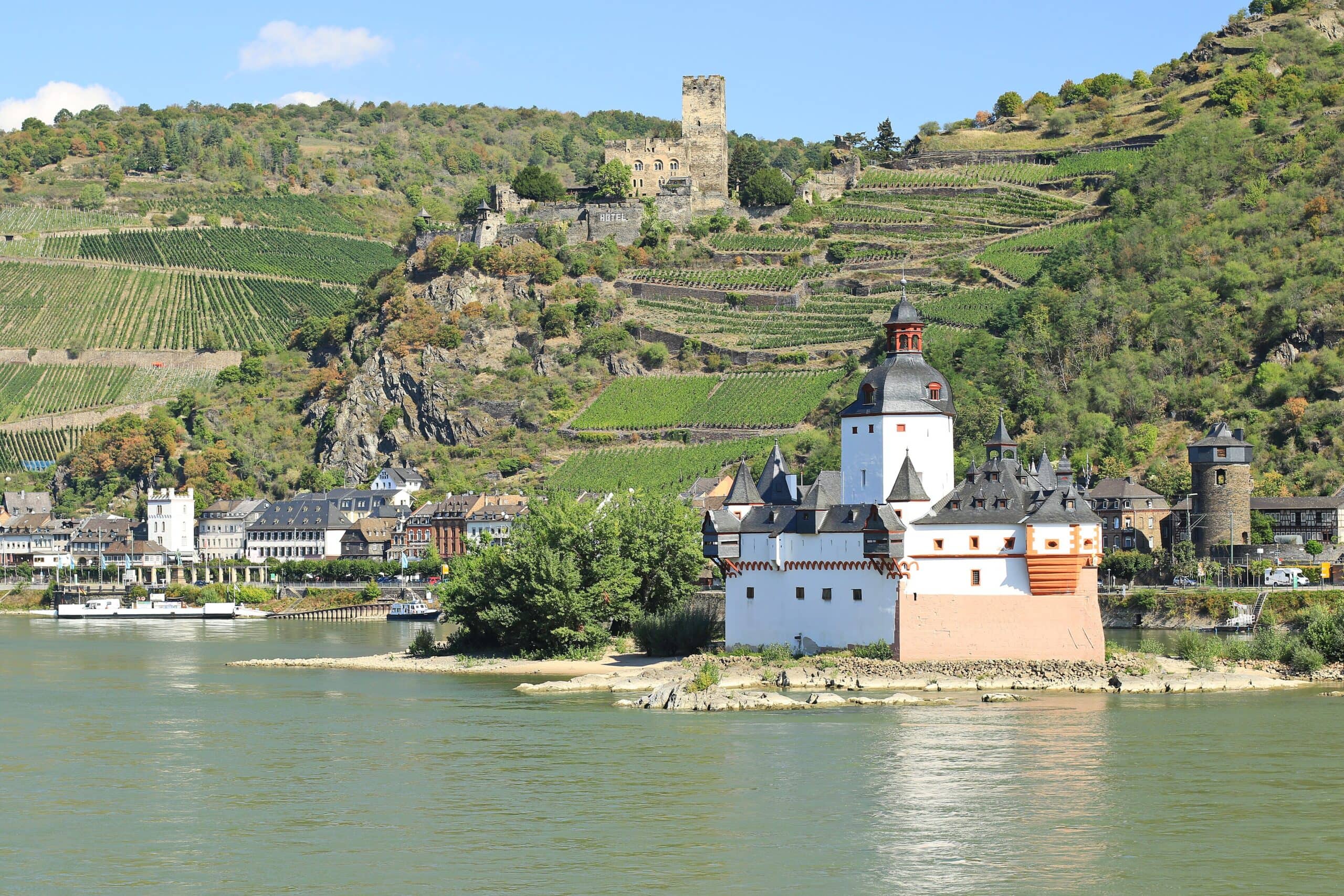
On a small island in the Rhine below Kaub, where the river narrows and quickens between two hills, the white pentagonal hull of Burg Pfalzgrafenstein still rises out of the water like a stone ship moored against the current. In 1326 the Counts Palatine built it there, not to hold the Rhine but to tax it. From its battlements a chain could be lowered across the river to halt every vessel coming downstream; from the riverbank at Kaub another stretched the same way for traffic moving up. Between them, nothing larger than a fisherman’s punt could pass without paying. For five hundred and forty-one years that chain held. In 1867 the last toll officials left the island. The chain is the article in miniature.
The popular Rhine of the imagination is a corridor of castles built by knights for love, war, or vanity. The historical Rhine of 1300 to 1815 is something blunter: a corridor of customs houses. By the end of the fourteenth century, sixty-two licensed toll stations stood between Mainz and the Dutch border, more than one for every kilometer of navigable river. Some were palisaded wharfs with a counting room; many were stone-built castles with portcullis, garrison, and chapel. The castles taxed cargo; the cargo paid for the castles. To understand the Mittelrhein landscape (its density, its violence, its sudden bursts of architectural ambition where a Romantic eye sees only scenery) requires understanding the system that paid for it. The Rhine toll castles are not an episode in Mittelrhein history; they are its institutional backbone, a network of Zollburgen that, between Heinrich VII’s 1309 grant of the Koblenz Rheinzoll and the imperial law that abolished them in 1803, taxed every cargo, funded every Elector, and built the castle landscape we now read as scenery.
The Rhine Before 1300: A Federal River of Tolls
Rhine traffic had always been taxed. Carolingian charters from the ninth century already mention river dues at Köln, Andernach, and Mainz. But what the early-medieval emperors collected was a coherent imperial revenue: a single Zollregal, exercised by the king through a small number of crown agents, sufficient to maintain a notion of unified Rhine governance. That coherence held, barely, through the Salian and Staufen centuries. Friedrich Barbarossa’s 1158 Lex Regalia at Roncaglia restated the principle: the river belonged to the king, who alone could grant the right to tax its traffic. As late as the death of Friedrich II in 1250, scholars count perhaps nineteen licensed toll stations between Basel and the North Sea.
The Interregnum changed everything. Between Friedrich’s death and Rudolf of Habsburg’s election in 1273, two decades of contested kingship and absentee rule transferred the practical power of toll-grant from the crown to whoever was strong enough to take it. By 1273 the count of toll stations had jumped from nineteen to forty-four, a near-tripling in a single generation. The new stations were granted by counter-kings buying support, by archbishops asserting territorial claims, by Counts Palatine carving out toll-collection rights along their own banks, and by enterprising castellans who simply began collecting and dared the crown to stop them. That toll-revolt (Rudolf I’s campaign of 1273 to 1282, the slighting of Reichenstein and Sooneck, the formal ban against rebuilding, the new equilibrium of archbishops and princes that emerged from the wreckage) is the subject of a companion article on this site, and is the proper place to read the pre-1300 story in full. Here it serves only as preface. By the year 1300, the system Rudolf had tried to restrain was already metastasizing: by the end of the fourteenth century the toll-station count would reach sixty-two. The toll wall the Rhine became under Balduin of Luxembourg and his successors did not arrive in a single political moment. It accumulated, station by station, charter by charter, for a hundred and fifty years.
Balduin of Luxembourg Builds a Trier Toll Empire (1307–1354)
Balduin von Luxemburg was elected Archbishop of Trier on December 7, 1307 at the age of twenty-two. He held the seat for almost forty-six years (until his death on January 21, 1354) and in that time turned the Trier electorate from a chronically indebted ecclesiastical principality into the dominant fiscal power of the Mittelrhein. He did it almost entirely through the river. His instrument was the same one Rudolf I had tried to dismantle: the imperial toll grant, transmuted from a royal favor into a permanent territorial possession through the politics of imperial election.
Balduin’s opening move came in 1309. Balduin had engineered the election of his elder brother Heinrich, Count of Luxembourg, as King of the Romans at Frankfurt on November 27, 1308; Heinrich was crowned at Aachen as King Heinrich VII on January 6, 1309. Within months, Heinrich began rewarding the brother who had made him king. He named Balduin Vogt and Gubernator of the imperial cities of Boppard and Oberwesel, administrative compensation for the costs of the coronation. More consequentially, he transferred to Balduin in 1309 a perpetual grant of the Rhine toll at Koblenz, the most lucrative single toll station on the Trier reach. Koblenz’s Rheinzoll had been an imperial revenue since the Salian period; making it permanent Trier property was the single act of statecraft on which Balduin’s entire toll empire would be built.
His second move came three years later. In July or August 1312, in the imperial camp before Rome where Heinrich VII was preparing for his Italian coronation, the king issued an instrument pledging Boppard and Oberwesel to Balduin as a Reichspfand (an imperial pledge) for twelve thousand pounds Heller, money Balduin had loaned Heinrich to fund the Italian expedition. A Reichspfand was theoretically redeemable: the emperor could buy back the cities by repaying the loan. In practice, the loan was never repaid. Heinrich died at Buonconvento on August 24, 1313, leaving Balduin holding the cities as collateral on an unrecoverable debt. In 1314 Heinrich’s successor Ludwig der Bayer (whose election Balduin again supported) confirmed the Pfandschaft and raised the redemption sum to twenty-six thousand Mark Heller, an amount so large that, in the contemporary phrase of the regional chronicles, “a return to the imperial city was no longer practically possible.” Boppard and Oberwesel were Trier in everything but name.
The cities did not accept this quietly. In 1318 and again in 1327, the burghers of Boppard rose against Trier rule. Boppard’s 1318 revolt was put down in a few weeks; the 1327 revolt required a brief but destructive siege that left parts of the lower town in ruins. Trier finished the work by building a customs hall, a literal Zollhaus, directly against the Bergfried of the old imperial castle in 1340 and 1341, making the toll-collection function physically visible in the heart of the city. In 1497 the Bopparder Krieg, when Maximilian I tried and failed to free the city from Trier rule, would be the last serious challenge to the arrangement until the French armies arrived in 1794.
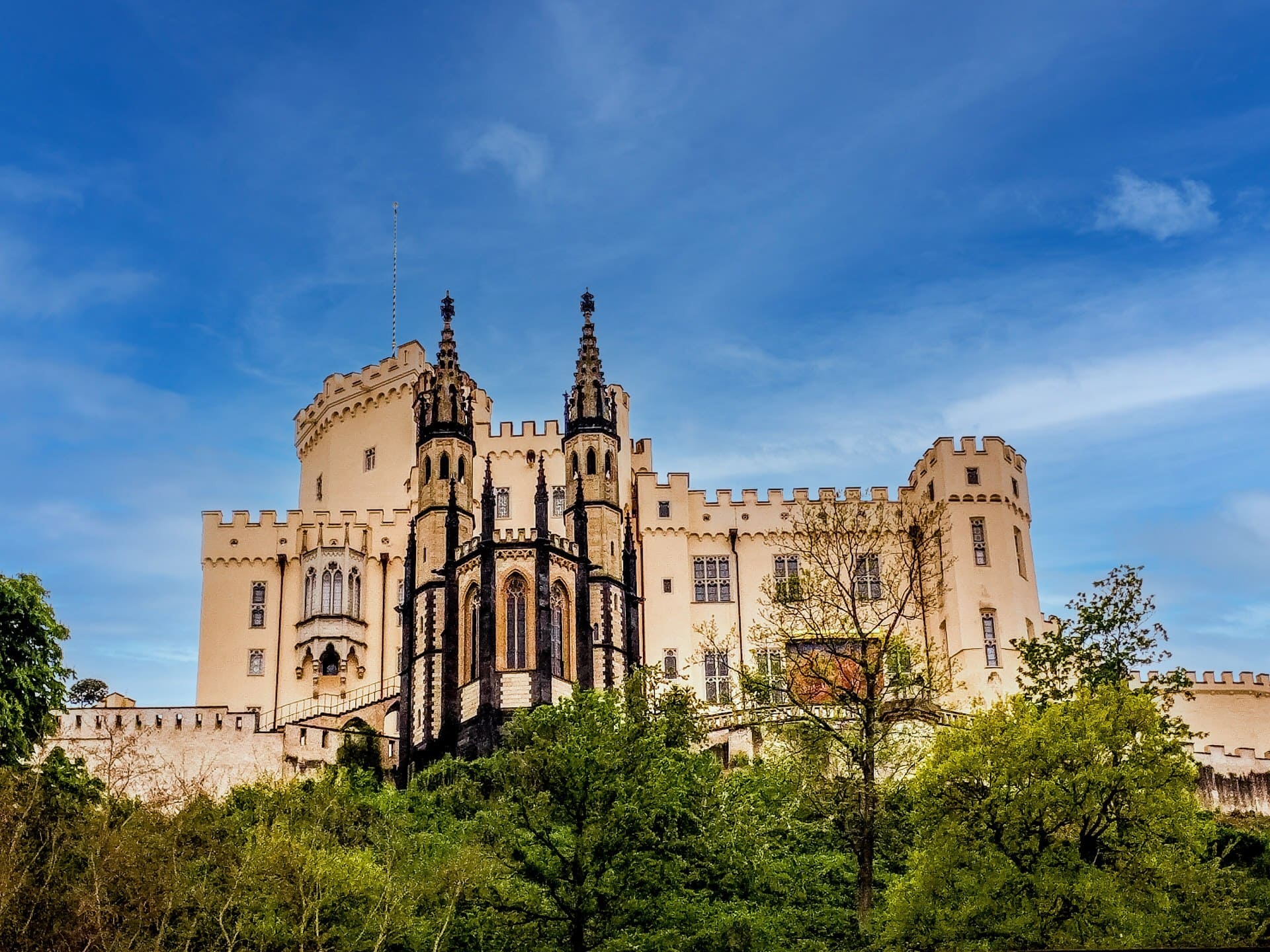
His third move was fiscal-geographical. By 1328, with the Koblenz toll secure and Boppard and Oberwesel held, Balduin relocated the operating site of the Koblenz Rheinzoll upstream to Burg Stolzenfels, an old toll fortress above the river that he had refurbished as a Trier outpost. This relocation accomplished two things at once: it moved the toll-collection station out of the dense city of Koblenz, where Mainz had competing claims and the city itself had jurisdictional friction with the archbishopric, and it gave Trier a defensible Rhine-bank stronghold from which the toll could be enforced under arms. Stolzenfels would remain the operating Trier toll castle for the Koblenz station from 1328 until the Mélac fires of 1689 reduced it to a ruin. Friedrich Wilhelm IV’s Romantic reconstruction of 1836 to 1842 (built when no toll had been collected there for forty years) preserved the Trier-electoral shape of the castle but emptied it of its institutional purpose.
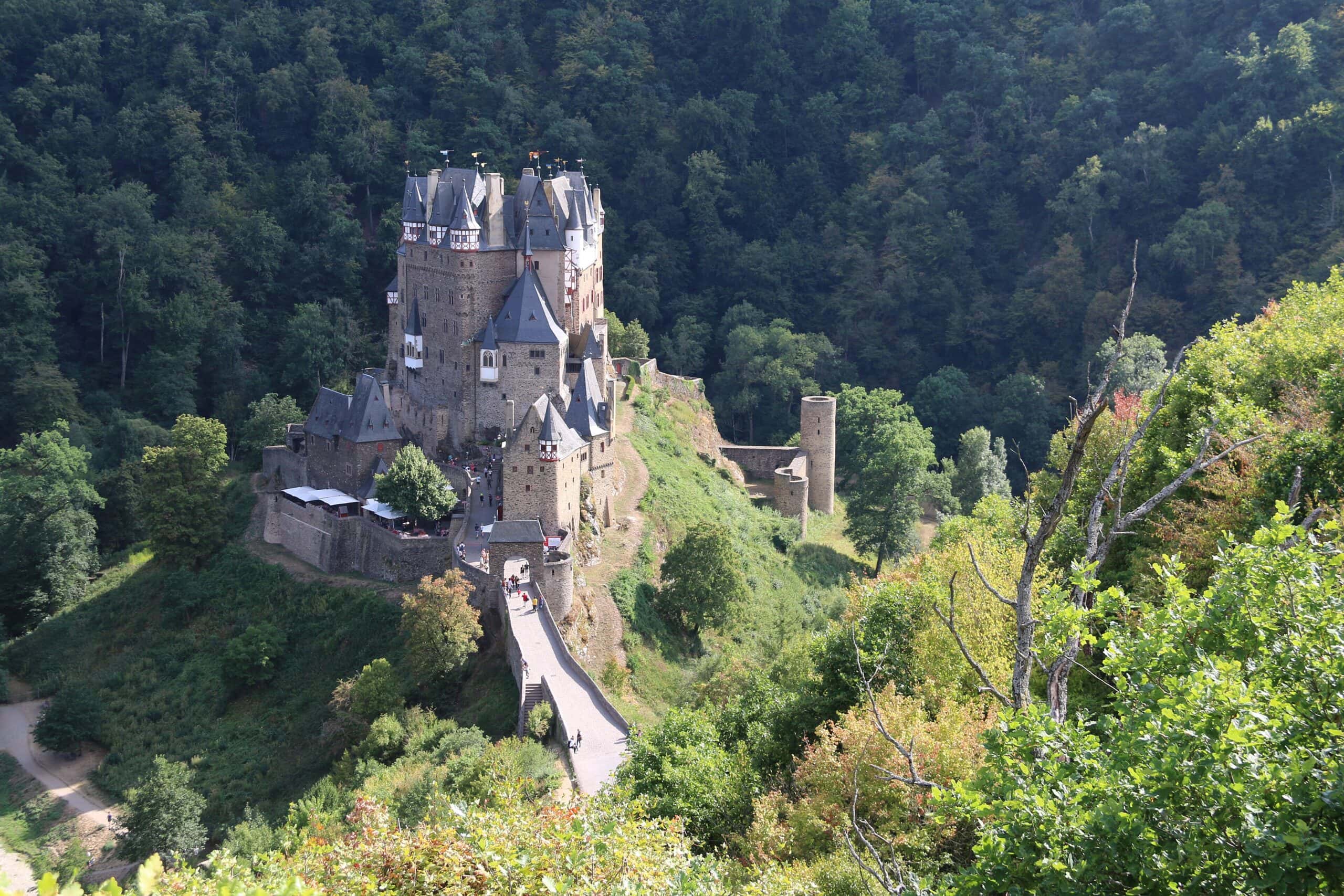
Balduin’s territorial program extended in three further directions. To the south he pursued the Mosel valley, consolidating Cochem (already Trier from 1294) and absorbing Schmidtburg in 1328 when the Wildgrafen line died out. To the east he projected Trier authority into the Westerwald and the Lahn, building Burg Balduinstein on the Lahn before 1321 and Burg Balduineck in the Hunsrück during the Eltzer Fehde. That feud (fought between 1331 and 1336 against the houses of Eltz, Waldeck, and Ehrenburg) produced the most spectacular military expression of his program: a series of Trutzburgen, or siege castles, built deliberately to dominate the rebellious families’ strongholds. The siege castle contemporaries called Baldeneltz, later known as Trutzeltz, and Rauschenburg ringed Burg Eltz itself; Balduineck threatened the Hunsrück. In 1337 the Eltz family submitted, accepted Trier overlordship, and was permitted to keep its ancestral seat. Trutzeltz was never demolished, only left to decay after the settlement, and the political message stood: a Rhine archbishop could now build castles by the half-dozen, garrison them indefinitely, and use them as bargaining chips against the river’s older noble families. The Trier toll empire paid for the campaign.
By his death in January 1354, Balduin had transformed the practical economic geography of the Mittelrhein. The Trier electorate controlled the Koblenz Rheinzoll permanently and operated it from Stolzenfels; held Boppard and Oberwesel as effectively heritary territory with the Bopparder Zollhaus collecting downstream traffic; ran the Cochem Mosel toll station; took the Schmidtburg revenues; and projected its administrative arm into the Hunsrück, the Westerwald, and the Lahn through a network of Lehnsherrschaften, Pfandschaften, and Öffnungsverträge, agreements opening other families’ castles to Trier garrisons. The historian Friedhelm Burgard’s appraisal of Balduin as “the most enterprising elector of fourteenth-century Trier” is the standard one.
The Elector College and the Limits of the King’s Toll Power (1338–1356)
Toll-grant power had always belonged to the king. From Barbarossa onward it was articulated as one of the imperial Regalien, a sovereign prerogative inseparable from the crown itself. Yet by the middle of the fourteenth century the kings had effectively lost the ability to use it. The story of how that happened (how a corporate body of seven Electors closed its ranks around the river and rendered the king’s formal authority politically unusable) runs through three documents in 1338, a separate alliance the following year, and the imperial constitution of 1356. Together they form the institutional pivot of the Mittelrhein toll system.
The first document is the Kurverein von Rhense, the Electors’ Alliance of Rhens. On July 15, 1338 the Electors of Mainz, Köln, Trier, the Pfalz, Saxe-Wittenberg, and Brandenburg met first at Oberlahnstein on the right bank of the Rhine, then crossed to a meadow outside the village of Rhens (the Nußbaumgarten, in Cologne territory, on the river’s left bank), where on July 16 they sealed a mutual-defense pact. Its purpose was to bind the Electors against any external power that might claim authority over imperial elections, especially the papacy at Avignon, which had been refusing to recognize Ludwig der Bayer for two decades. Those same six Electors on the same day promulgated the Weistum von Rhense, a juridical declaration that an Elector majority alone conferred the right to administer the regalia and bear the royal title without papal nomination, approbation, or confirmation. Three weeks later, on August 6, 1338 at the Reichstag in Frankfurt, Ludwig himself issued the imperial law known by its opening words as Licet iuris, declaring that the king elected by the Electors was, by that election alone and without papal involvement, also Emperor.
None of these three documents mentions Rhine tolls. Historians are unambiguous on this: 1338 was an anti-curial moment, not a fiscal one. The Rhens texts and Licet iuris together resolved the Imperial constitution’s relationship with the papacy, locking the choice of king inside the Elector college and locking the papacy out. They did not address (and, in their own framing, did not need to address) the question of who could grant a Rhine toll, or under what conditions. Popular accounts that read a “Rhine toll limitation” into Rhens are reading backward from the system’s later effects.
A fiscal effect, however, was real, and it arrived in 1339. In the autumn of that year, with the Rhens institutional consolidation behind them, the Electors concluded their first joint alliance specifically against new imperial Rhine toll grants. The historian Friedrich Pfeiffer, whose 1997 study Rheinische Transitzölle im Mittelalter remains the authoritative reconstruction of the medieval system, puts the relationship between the two events without ambiguity: the Electors “allied themselves for the first time in 1339, not coincidentally soon after the Kurverein of Rhens, against the imposition of new Rhine toll dues. Without formally disputing the king’s right of toll grant, they sought to make it depend on their consent. In the long term they largely succeeded.” The Electors did not strip the king of the Zollregal; they made it politically unusable without their assent. By the time Karl IV codified the Electors’ powers in the Goldene Bulle of 1356 (itself drafted under heavy elector influence and ratified at the Reichstag in Nürnberg and Metz that year), the principle was already settled in practice. After 1356, no king could grant a new Rhine toll without bringing the Electors with him, and almost no king tried.
The political reading is straightforward once stated: the king’s de jure toll-grant power survived; the king’s de facto toll-grant power did not. Subsequent imperial grants of new Rhine tolls were issued almost exclusively to Electors themselves, or to imperial cities the Electors had agreed to tolerate. Maximilian I’s tentative attempt to free Boppard from Trier in 1495 to 1497 failed precisely because the Electors closed ranks behind Trier; Karl V’s mid-sixteenth-century interventions had to negotiate the Electors’ tariff settlements station by station. The Rhine had become, fiscally, an Elector league dressed as an imperial river. The 1338 Rhens texts had cleared the constitutional ground; the 1339 alliance and the 1356 Goldene Bulle drove the fiscal pivot into law.
The Toll Castle at Work: Pfalzgrafenstein and Sterrenberg Compared
The system was institutional, but the buildings that ran it stood in the water and on the hills, and their individual fates illustrate two very different stories of what a toll castle could become. Pfalzgrafenstein and Sterrenberg sit ten kilometers apart on the same reach of the river, both built in roughly the same generation, both designed to extract revenue from passing traffic. The first survived as a working toll station for five and a half centuries. The second was effectively obsolete within two hundred years of its construction. The difference is not about the buildings themselves; it is about who held them and what political weight stood behind the toll.
Burg Pfalzgrafenstein was built on a long, narrow rock island in the Rhine below Kaub by Ludwig der Bayer in 1326 and 1327. Ludwig had been Pfalzgraf bei Rhein before his election as king in 1314, and the Pfalz electorate held the right bank around Kaub through its older castle on the hill above the village, Burg Gutenfels. With Pfalzgrafenstein the Wittelsbachs built the third element of a system: hill castle, riverbank station, island fortress, all designed to operate as a single toll-collection mechanism. A chain stretched from the island to the Kaub bank could halt downstream traffic at the narrowest point of the Rhine Gorge; a second chain to the western bank halted upstream traffic. The toll house was the island; Gutenfels enforced the toll from above; the village wharf cleared and reloaded vessels. The system was so effective, and so well politically supported by the Pfalz electorate, that it functioned essentially without interruption from 1327 through every war and territorial reshuffle of the next five centuries. Pfalzgrafenstein survived the Thirty Years’ War, the Palatinate War of Succession in which the French destroyed many Pfalz castles, the Revolutionary Wars, Napoleon’s annexation of the left bank, the 1803 Reichsdeputationshauptschluss, the dissolution of the Empire in 1806, the Wars of Liberation in 1813 to 1815 (when Blücher famously crossed the Rhine here on New Year’s Day 1814 with a hundred thousand men, using Pfalzgrafenstein as a navigation anchor), and forty years of Nassau and Prussian administration. Toll officials worked the island continuously. When the last of them locked the doors in 1867 (the year after Prussia annexed Nassau and unified the Rhine bank into a single jurisdiction), they ended an operation that had collected tolls on Rhine traffic without serious interruption for five hundred and forty-one years.
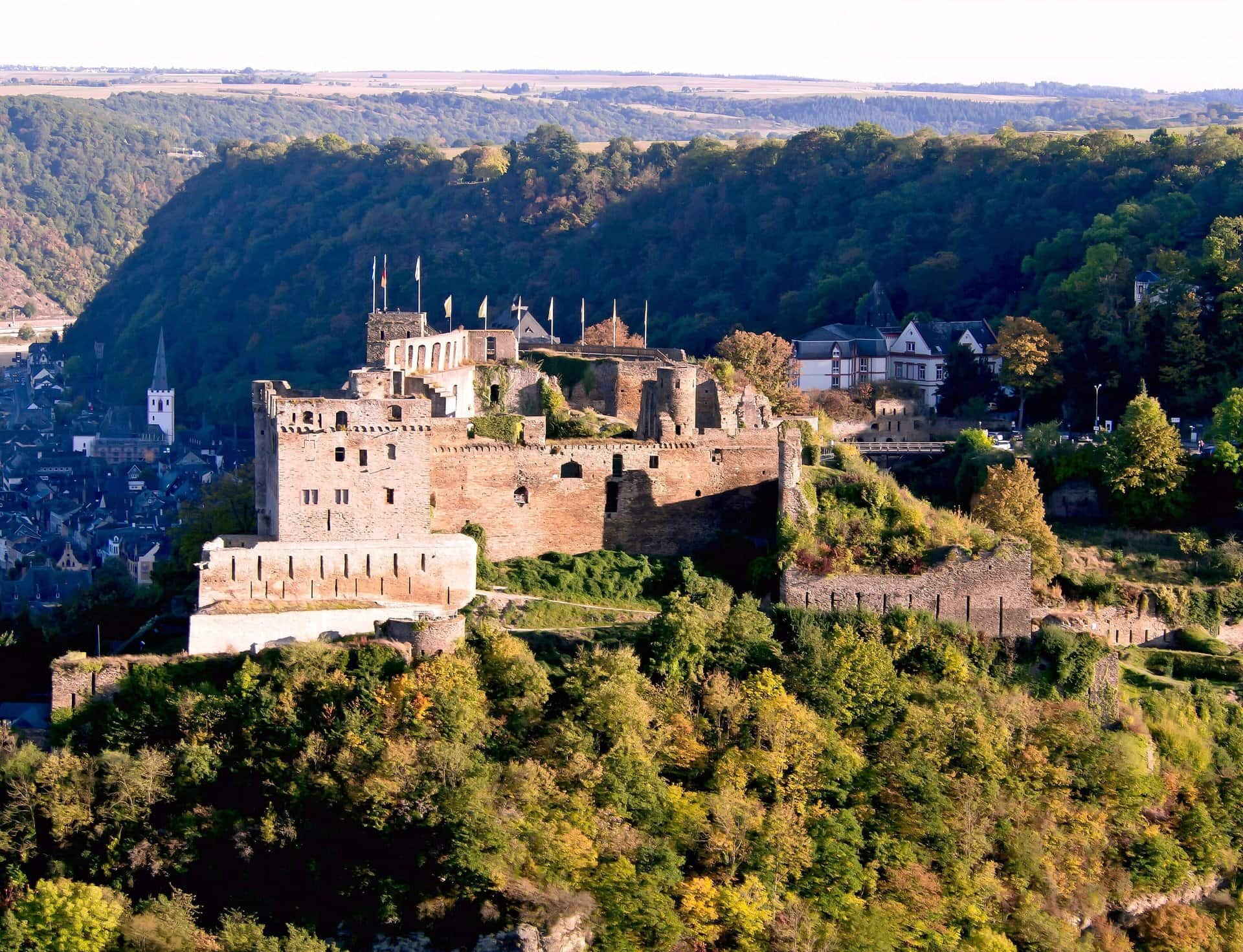
Burg Sterrenberg, on the opposite hill above Kamp-Bornhofen and just downstream of Pfalzgrafenstein, tells the opposite story. It was the older of the two (first attested in 1190, fully built by the mid-thirteenth century) and it had been a Reichsburg, an imperial castle, held by the ministerial family of Beyer von Boppard as Erbburggrafen. Sterrenberg controlled a stretch of the riverbank but never developed a toll station of comparable revenue to Kaub. Its Rhine toll, where it existed at all, was a thin supplementary income; the castle’s real function was strategic and territorial. When Trier consolidated Boppard in 1327, Sterrenberg’s regional importance evaporated, and the bitter family dispute between the Beyer von Boppard and their Liebenstein neighbors absorbed whatever institutional energy the place might have had. By 1456 the castle was already described in surviving records as derelict; by 1568 it was uninhabitable; by the time of the Mélac fires in 1689 it was a ruin that the French did not even bother to slight. Burg Liebenstein next door (its companion in the popular legend of the “Hostile Brothers”) fared no better.
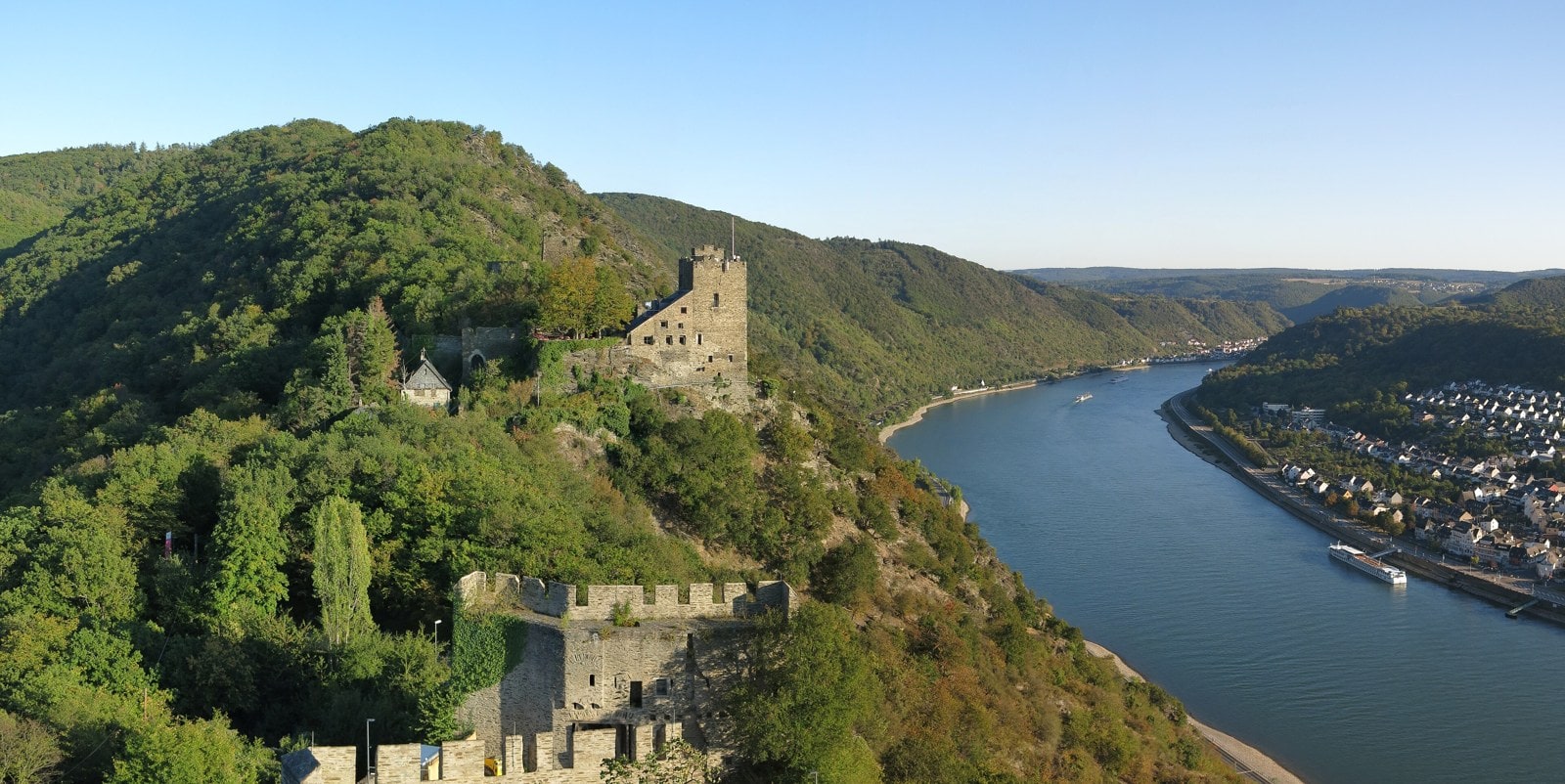
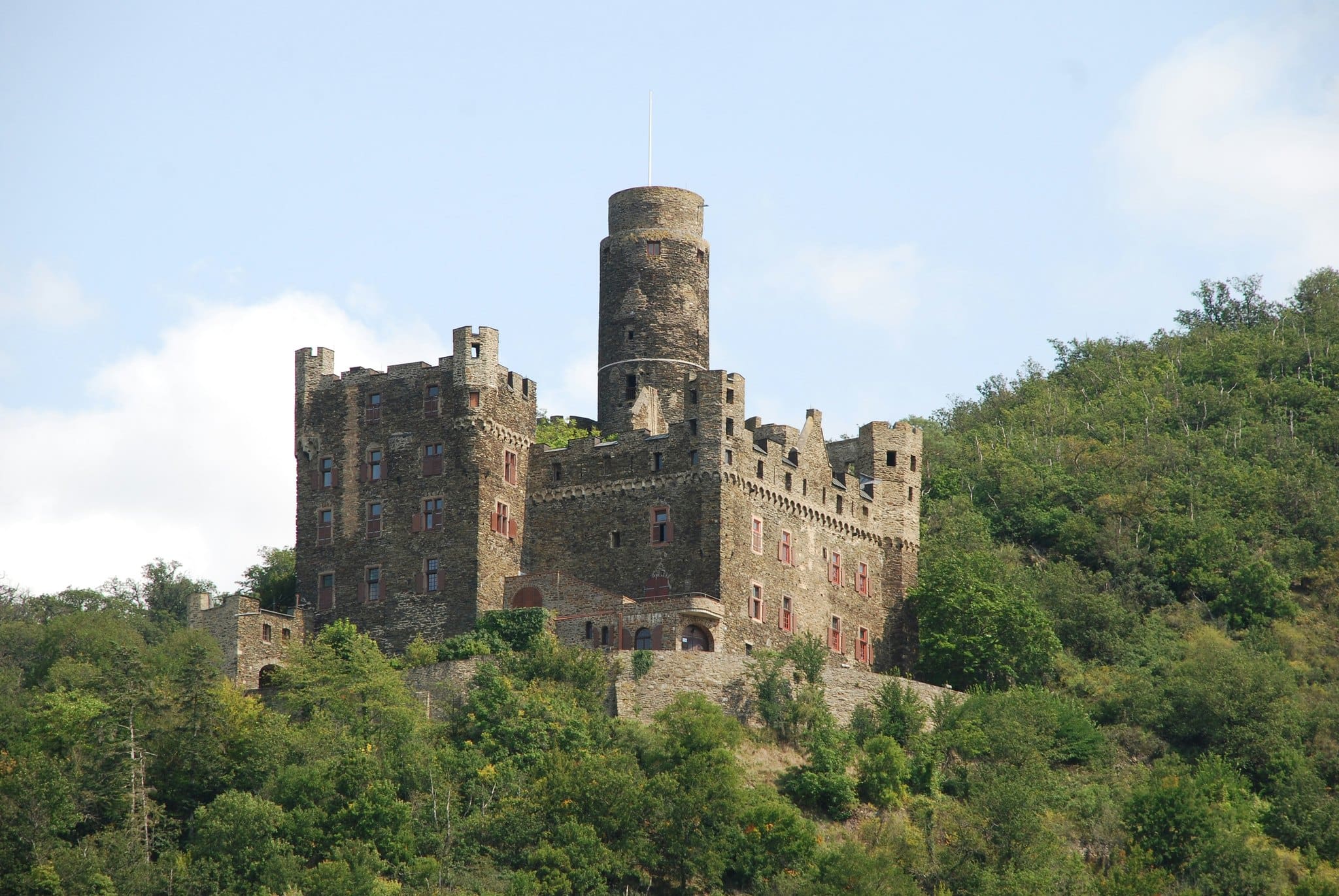
A Trier counter-toll project that emerged in the 1350s makes the contrast sharper still. With Sterrenberg fading and Liebenstein irrelevant, the Trier electorate built two new toll castles on the right bank near St. Goarshausen specifically to compete with the Katzenelnbogen toll house at Burg Rheinfels across the river. Burg Maus was begun in 1356 under Archbishop Boemund II at Wellmich, and Burg Katz was the Katzenelnbogen counter-counter-toll station built in turn to intimidate Maus. The Maus and Katz pair illustrate the same institutional point as Pfalzgrafenstein and Gutenfels: a toll castle worked when it had a powerful sponsor and a defensible position; without those, even a well-placed castle on a strategic stretch of river (Sterrenberg’s actual situation) fell out of the system. Rhine traffic was unforgiving on small operators. By 1400 every toll station that mattered was either electoral or held under direct electoral protection. Wildcat collectors of the kind Rudolf I had hunted in 1282 were three generations gone.
The Toll Wall: Sixty-Two Stations and the Goods That Crossed Them (1400–1600)
By the end of the fourteenth century the count of Rhine toll stations had reached its medieval maximum: sixty-two, according to the most careful modern reconstruction. These figures bear repeating because the trajectory is the point. Nineteen stations at the end of the twelfth century. Forty-four by the end of the thirteenth. Sixty-two by 1400, a more-than-tripling in two hundred years. Between Mainz and Köln, a stretch of perhaps two hundred kilometers, the density was such that an average barge would have stopped to pay at intervals of every six or seven kilometers. The toll wall the Rhine became under Balduin, Karl IV, and their successors was not metaphorical. It was a working obstacle course.
The earliest tariff schedule that survives in any detail is the Koblenz one, in three layers: a mid-eleventh-century original, an updated 1209 version, and a third reworking around 1300. Eleventh-century rates have a certain practical archaism that bring the period into focus. A ship sailing between Lorch and Speyer paid four pennies. A live falcon (the period’s premier hunting bird) was taxed at four pennies per bird, exactly the toll of a whole ship; one wonders how many barges ran half-empty rather than declare a single falcon. Every tenth sword passing through Koblenz was taken in kind. Copper from Duisburg merchants was levied as a mix of cash and product. By the early fourteenth century the tariffs had been rationalised into a quantitative system: levies per Fuder of wine (a barrel of approximately twelve hundred litres), per Last of grain or fish (a unit of roughly two metric tons), per Stück of cloth bales, with a flat Vorzoll per ship. Coins shifted too. The early payments in Pfennige and Mark gave way to Turnosen, the silver Tournois groschen originally a French royal coin, which became the international standard of late-medieval Rhine valuation.
The clearest single window into a mature fourteenth-century tariff comes from the Bacharach Landfriede of 1317, a peace settlement under Ludwig der Bayer that codified rates for the Bacharach toll station for transit traffic. Wine was taxed at thirty-three Turnosen per Fuder. Grain was taxed at eighteen Turnos-groschen per hundred Malter, a Malter being a dry-measure unit of approximately one hundred and fifty litres. Salt (the period’s most strategic commodity after wine) was thirty Turnos-groschen per hundred Hüte, a Hut being a moulded conical loaf weighing perhaps twenty pounds. These were the rates at a single station on a single stretch of river. The arithmetic of cumulative passage across multiple stations is what made the system extortionate. By the mid-fifteenth century the cumulative toll burden between Bingen and Koblenz alone (a single morning’s run for a downstream barge) has been estimated at roughly two-thirds of the cargo’s value, according to the synthesis in Pfeiffer’s Transitzölle. A merchant shipping wine from the Rheingau to the Hanseatic ports at Cologne effectively paid the value of the wine itself in cumulative tolls; the price differential between Mainz and Köln on a Fuder of wine was the only thing that made the trade work at all.
Goods themselves followed a stable pattern. Wine dominated, both Rheingau and Mosel moving north toward the Netherlands, and Mediterranean wine moving south. Salt came down the Rhine from the Lorraine boilworks and across from the Atlantic via Antwerp. Grain (wheat, barley, oats) moved in both directions. Sea fish, especially herring and stockfish from the Hanseatic North Sea fisheries, was the great northbound-to-southbound cargo of the late medieval Rhine; Cologne’s herring trade alone justified the city’s staple right. Cloth bales (Flemish, Brabantine, English) moved upstream. Iron, copper, and lead, often levied in kind in the early tariffs, increasingly traveled as bullion or finished metalwork. Lumber was rafted in vast quantities through Bacharach, which held the regional staple for timber. Each station had its own list of taxable categories and its own exemption schedule.
Exemption schedules were as important as the rates. Ecclesiastical institutions (the abbeys of Brauweiler, Echternach, St. Maximin, the Trier cathedral chapter, the Mainz Domkapitel, the Simeonstift, and dozens of smaller monastic houses) held imperial privileges exempting their cargo from named tolls, often dating back to Ottonian or Salian grants. Imperial cities held their own bundles of toll exemptions, sometimes city-wide, sometimes by commodity. The Hanseatic League negotiated station-by-station, building a patchwork of immunities through the fifteenth century. Frankfurt-am-Main merchants traveling to and from the spring and autumn fairs received fair-passes that exempted them from selected stations in the weeks around each fair. Pilgrims, clergy, and diplomatic envoys were exempt on presentation of letters. The result was a system in which the published toll rate was almost never what an individual cargo actually paid; every passage was a negotiation against the specific exemption schedule of every specific station.
Above all stations stood Cologne. On May 7, 1259, Archbishop Konrad von Hochstaden granted the burghers of Cologne the Stapelrecht (the staple right) over all goods passing the city by water or land. Every cargo, in principle, had to be unloaded at the Cologne wharves and offered to the city’s burghers for sale for a fixed period before it could be reloaded and continued onward. Legal compulsion fitted the physical reality: deep-draught Niederländer barges from the Dutch estuaries could not navigate the shallower upstream reaches, and shallow-draught Oberländer vessels from the Mittelrhein could not handle the lower Rhine. Cologne was the natural break-bulk point of the entire river; the staple right made the break a fiscal monopoly. The combined Cologne dues — the archbishop’s Rheinzoll, the city’s wine excise, the gauging fee (Rutenpfennig), the crane fee (Krangeld), and the staple fee itself — produced an income that, by the end of the fourteenth century, made the Cologne wine excise alone account for between ten and thirteen percent of the city’s total revenue. Cologne’s ensemble was the single most expensive passage on the Rhine, and the single most contested institution in Rhenish merchant politics. On March 31, 1831 the Mainzer Akte finally ended it.
Political enforcement of the system kept pace with its growth. Werner von Falkenstein, Trier’s archbishop from 1388, crushed the last Oberwesel revolt in the Weseler Krieg of 1390 to 1391, ending two generations of intermittent burgher resistance. Maximilian I’s Bopparder Krieg of 1497 ended the same way: Boppard remained Trier until the French arrived. Every effective challenge to the Rhine toll system from inside the Empire was put down by the late fifteenth century.
War and Ruin: The Toll System Between Reformation and Mélac (1500–1689)
The toll system of the sixteenth and seventeenth centuries was the same system as the fourteenth, gathering supplementary dues and political complications without fundamental structural change. The Reformation cut sideways through it. Trier, Mainz, and Köln remained Catholic; the Pfalz electorate turned Calvinist under Friedrich III in 1559 and back to Catholic Wittelsbach hands only in 1685; the smaller territories scattered confessionally. The result was a Rhine toll wall whose stations now belonged to political units in active religious antagonism with their neighbors, a structural complication never resolved before the entire system was swept away.
The Thirty Years’ War tested the toll system more severely than any conflict since Rudolf I’s campaign. Between 1618 and 1648 nearly every Rhine castle of military significance was occupied, contested, or briefly destroyed. Mansfeld passed through the Mittelrhein in 1622; Gustav Adolf’s Swedish armies took most of the river’s left bank by 1632; French and imperial forces traded the corridor through the 1640s. Toll collection continued where it could and lapsed where it couldn’t; tariff schedules tracked currency depreciation and the collapse of Hanseatic commerce. In 1648 the Peace of Westphalia restored the political map but not the economic substrate. Rhenish commerce was diminished for a generation.

What followed was worse. The Nine Years’ War of 1688 to 1697 (the Pfälzischer Erbfolgekrieg, fought by Louis XIV against an Augsburg-League coalition for control of the Pfalz inheritance) became the moment of mass castle destruction on the Rhine. Louis’s general Ezéchiel de Mélac was sent into the Pfalz in 1689 with explicit orders to slight every defensible fortification. Heidelberg burned. The Pfalz castles were systematically demolished. Stolzenfels burned; the Mäuseturm below Bingen was severely damaged; Trier-Koblenz lost much of its medieval fortification system. Burg Marksburg alone, among the major Mittelrhein toll castles, survived without serious damage, and survived precisely because its Katzenelnbogen-Hessen owners had negotiated effective neutrality. Pfalzgrafenstein in the river was technically reachable but militarily worthless and was left intact. The toll system continued to function (Marksburg, Pfalzgrafenstein, and the still-standing stations at Boppard and Oberwesel kept collecting), but the architectural infrastructure of the system had been gutted. Eighteenth-century proliferation of supplementary dues followed: crane fees, weighing fees, staple fees, the increasingly elaborate Akzise. By 1750 a typical Rhine cargo was paying a base toll plus eight or ten subsidiary dues per major station.
The End (1794–1815): From French Occupation to Free Rhine
The end came in five layers between 1794 and 1815. None of them, contrary to popular accounts, was the work of Napoleon personally. Institutional abolition of the Rhine tolls came in an Imperial law promulgated under Franco-Russian pressure in 1803, four years before Napoleon’s coronation as Emperor of the French. Chronology matters because the actual mechanism is unusual: an institution that had survived five centuries of war, revolt, and reform was dismantled in nine years by the combined effect of French Revolutionary military occupation, French Republican administrative reform, an imperial-level treaty, an Imperial law, and an international convention. Each layer did distinct work.
The first layer was military. In late autumn 1794, after the French victory at Fleurus on June 26, the Army of the Sambre-and-Meuse under Jean-Baptiste Jourdan and the Army of the Moselle under Jean-Baptiste Kléber pushed the First Coalition forces across the Rhine. Koblenz fell to Kléber in October 1794. By the end of the year French troops controlled the entire left bank from Basel to Cleves. The Trier, Mainz, and Köln electoral toll stations on the left bank ceased operating immediately; their administrators fled across the river or to the courts of friendly princes; the toll books were impounded or burned. The right bank (Marksburg, Sterrenberg, Liebenstein, Maus, Katz, Pfalzgrafenstein, Gutenfels) remained imperial territory and continued collecting, but the system’s coherence was already broken.
The second layer was administrative-statutory. On November 4, 1797, three weeks after the secret clauses of the Treaty of Campo Formio recognized the Rhine as France’s eastern border, the Directory organized the conquered left-bank territories into four départements (Roer, Sarre, Rhin-et-Moselle, and Mont-Tonnerre) under a single government commissioner, the Alsatian François-Joseph Rudler, with seat at Mainz. In 1798 French law was extended across the four départements: feudal dues were abolished by statute, ecclesiastical property was secularised, and the customs frontier of the French Republic was relocated from the western frontier of France to the Rhine itself. Seigniorial tolls of Trier, Mainz, Köln, and the Pfalz on the left bank were extinguished as a matter of French statutory law. The Rhine had become, for its left bank, a French customs border.
The third layer was diplomatic. On February 9, 1801 the Treaty of Lunéville between France and the Holy Roman Empire formalised the situation. Article VI confirmed that “the Thalweg of the Rhine will henceforth be the limit between the French Republic and the Germanic Empire.” Article VII triggered the compensation process: the German princes who had lost left-bank territories to France would be made whole on the right bank through secularisation of ecclesiastical principalities and mediatisation of free imperial cities. Lunéville itself did not contain a toll-abolition clause; it created the political compulsion for one. The Reich would now have to redraw its internal map, and in doing so it would have to address what was to happen to the imperial tolls on a river that no longer had a German left bank.
The fourth layer is the legal hinge of the entire story. On February 25, 1803, the extraordinary Imperial Deputation meeting at Regensburg promulgated the Reichsdeputationshauptschluss, the great concluding act of the Imperial Deputation, drafted under combined Franco-Russian guidance and accepted by the Empire’s principal princes. The recess secularised seventy ecclesiastical principalities, abolished forty-five imperial cities (only six survived as independent entities: Augsburg, Bremen, Frankfurt am Main, Hamburg, Lübeck, and Nürnberg), and rewrote the political map of the Reich. Tucked into § 39 was the single clause that ended a half-millennium of Rhine toll institutional history: “All Rhine tolls levied on either bank shall be abolished, and may not be re-established under any name whatever.” Trier, Mainz, and Köln (the three great electoral toll-holding archbishoprics) disappeared as territorial powers. Their toll rights, accumulated through five centuries of imperial grants, Reichspfänder, and electoral consolidations, were extinguished by a single line of an Imperial law. The right-bank stations passed to Nassau, Hessen-Darmstadt, and the residual Wittelsbach lands. The seigniorial Rhine toll, the institution that had built Stolzenfels and Pfalzgrafenstein and the Trier toll empire of Balduin, ceased to exist.
The fifth layer was the substitute system. The Reichsdeputationshauptschluss had abolished the medieval tolls but the river still needed a navigation regime, a maintenance fund for towpaths and channel works, and a body to administer them. On October 15, 1804 a Franco-Imperial convention (the Octroivertrag, also called the Rhine Octroi Convention) replaced the multiplicity of feudal tolls with a single navigation due, the Rhin-Octroi, levied at between five and fifteen collection stations along the river, the net proceeds split fifty-fifty between the two banks and dedicated to riverworks. Karl Theodor von Dalberg, the last Kurfürst-Erzkanzler of the Empire, signed for the Reich; the administrative seat was Mainz. The Octroi administration was the direct organizational predecessor of the body that, a decade later, would become the Central Commission for the Navigation of the Rhine.
On August 6, 1806 the Empire itself dissolved when Franz II abdicated under French pressure. The Confederation of the Rhine took the western and central German territories; the Octroi regime continued under Napoleonic protection through the Continental System years. After the Wars of Liberation, the First Peace of Paris of May 30, 1814 articulated, in its Article V, the principle of freedom of navigation on international rivers. The principle was codified at the Congress of Vienna. Annex XVI B to the Vienna Final Act, signed on March 24, 1815, established the Central Commission for the Navigation of the Rhine (the Zentralkommission für die Rheinschifffahrt, ZKR) as a permanent international body with seat at Mainz. Articles 108 to 117 of the Vienna Final Act of June 9, 1815, with the Annex XVI B provisions, gave the Commission its constitutional foundation. On August 5, 1816 the Commission held its first plenary at Mainz, with delegates from France, the Netherlands, Prussia, Baden, Hessen-Darmstadt, Bavaria, and Nassau.
A legal regime took fifteen more years to take effect. Stalled negotiations between Prussia and the Netherlands over whether the freedom of navigation extended to the open sea delayed agreement until the Mainzer Akte of March 31, 1831, the first effective uniform Rhine navigation regime, which abolished the Cologne and Mainz staple rights, consolidated tolls into a single transparent schedule, and gave the Central Commission a working legal personality. The Mainzer Akte is the moment the medieval Rhine becomes the modern Rhine. Tolls of any kind were finally abolished entirely by the Revised Rhine Navigation Convention (the Mannheimer Akte) of October 17, 1868, which remains the legal foundation of Rhine navigation to this day.
Pfalzgrafenstein outlasted all of it. By the Reichsdeputationshauptschluss of 1803 the island toll station had passed from the Pfalz to Nassau; the Nassau administration continued to collect a navigation due there through the 1815 settlement, through the Mainzer Akte, through the unification of customs administration under the Zollverein in 1834. Only when Prussia annexed Nassau on August 23, 1866, after the Austro-Prussian War, did toll collection at Pfalzgrafenstein finally cease. The last toll officials locked the island in 1867. The chain came down. The five-hundred-and-forty-one-year operation ended. The white stone hull on its island became, very quickly, a relic: a Romantic icon, painted by Turner, photographed for postcards, eventually given to the state of Rhineland-Palatinate as a heritage site. Its institution had been dead for sixty-four years, since § 39 of an Imperial law that, when it was signed, no one knew was the legal pivot of an entire era. The institution that has shaped how we read this stretch of Rhine has been gone almost as long as it functioned. Buildings remain, but they are scenery now.
Anchors of the Argument
Burg Stolzenfels is the textbook Trier operating toll castle. After Balduin of Luxembourg’s 1328 relocation of the Koblenz Rheinzoll, Stolzenfels became the working collection site for the most lucrative single toll station on the Trier reach. Mélac’s troops burned the fortress in 1689; it stood ruined for nearly a century and a half until Friedrich Wilhelm IV’s 1836–1842 reconstruction restored the silhouette but emptied the building of its institutional purpose. Stolzenfels as visitors see it today is recognizably the Trier electoral toll fortress of the fourteenth and fifteenth centuries, with a nineteenth-century Romantic overlay; the toll-collection function had ceased there in 1794.
Burg Pfalzgrafenstein is the longest continuously operating Rhine toll station. Built on its island by Ludwig der Bayer in 1326–1327, the castle held the choke point at Kaub for five centuries and forty-one years, finally closing in 1867 after Prussian annexation of Nassau ended the residual Nassau toll. The castle outlasted the medieval seigniorial system that produced it, the Reichsdeputationshauptschluss that abolished that system, the Octroi regime that replaced it, the Mainzer Akte that codified free navigation, and four decades of post-1834 Zollverein customs administration. Only national unification ended the toll.
Burg Gutenfels, the Wittelsbach hill castle above Kaub, was the strategic anchor of the Kaub-Pfalzgrafenstein-Gutenfels toll triangle. Without Gutenfels enforcing the toll from above and Kaub clearing vessels on the bank, the island castle would have been impossible to defend. The three operated as a single fiscal-military system from 1327 onward.
Marksburg survived because it was never seriously challenged. The Katzenelnbogen toll station at Braubach, in operation continuously from 1283, accumulated supplementary dues and political accommodations across four centuries and the Mélac fires of 1689 passed it by. Marksburg is the only major Mittelrhein toll castle never destroyed, and its building today is recognizably the late-medieval Katzenelnbogen seat rather than a Romantic reconstruction. It demonstrates what an undamaged toll castle of the system actually looked like.
Burg Rheinfels, begun by Count Diether V of Katzenelnbogen in 1245, illustrates the princely toll castle that escalated into a regional fortress. Its 1255–1256 fourteen-month siege by the Rheinischer Bund failed; its toll station continued for centuries; it became, by the early modern period, one of the largest fortifications on the river. French troops destroyed it systematically in 1796–1797, and the ruined complex remains visible above St. Goar today.
Burg Sterrenberg and Burg Liebenstein are the counter-cases: well-positioned but underpowered, they failed to develop into significant toll stations and faded from the system. By 1568 Sterrenberg was uninhabitable; Liebenstein lasted only marginally longer. The pair illustrate that a toll castle without a heavyweight sponsor was not viable in the mature system.
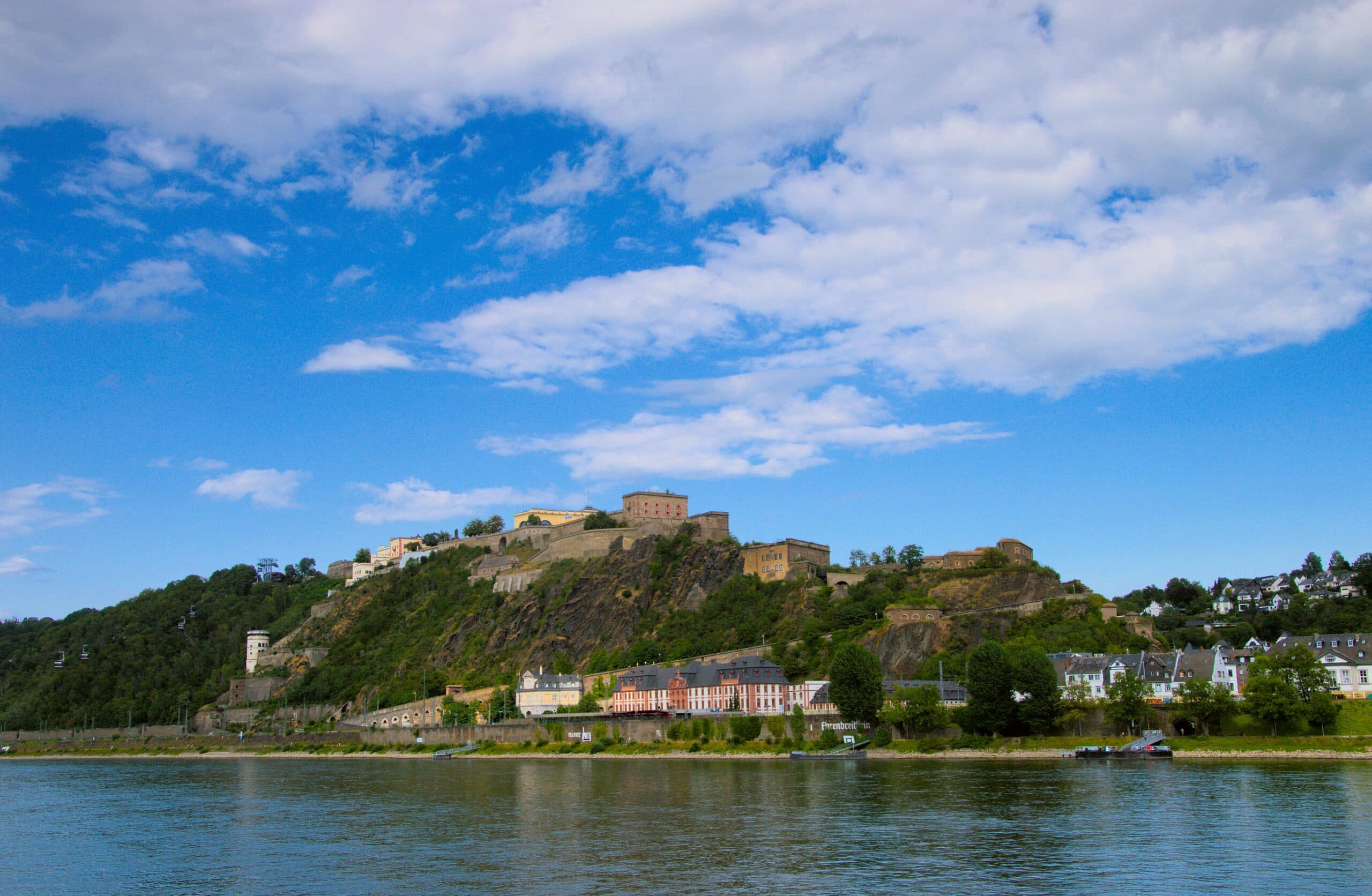
Festung Ehrenbreitstein, across the Rhine from Koblenz, became the Trier electoral residence after the Mélac fires of 1689 destroyed the older Koblenz castles. Rebuilt as a baroque fortress through the early eighteenth century, Ehrenbreitstein housed the Trier electors in their final century before the French Revolutionary armies took it in 1799. It is the architectural endpoint of the Trier toll empire: the castle the toll system built, rebuilt, and ultimately failed to defend.
Beyond these named castles, the surviving Mittelrhein toll-castle landscape is best read against two companion articles on this site: The Rhine as Contested Territory for the pre-1300 setup, and the hub pages Castles of the Middle Rhine and Castles of the Rhine Gorge for the broader landscape context in which the toll-castle argument operates.
The fate of these toll castles in wartime forms part of our wider history of German castle sieges.
Common Questions
What was a Rhine toll castle?
A castle built to levy a toll on boats passing on the river. Between about 1300 and 1600 the Middle Rhine was lined with them, turning the river into a tax engine controlled from the water’s edge.
How many toll stations were there?
At the height of the system, between about 1400 and 1600, there were sixty-two toll stations along the Rhine.
When did the Rhine tolls end?
The system unravelled with war and French occupation, and the tolls were finally swept away in the era of 1794 to 1815, from the French occupation of the Rhineland to the settlement that reopened the river.
Principal Sources
- Becker, Hans-Jürgen. “Das Mandat Fidem catholicam Ludwigs des Bayern von 1338.” Deutsches Archiv für Erforschung des Mittelalters 26 (1970): 454–512.
- Boockmann, Hartmut. Stauferzeit und spätes Mittelalter: Deutschland 1125–1517. Berlin: Siedler, 1987.
- Brose, Eric Dorne. German History 1789–1871: From the Holy Roman Empire to the Bismarckian Reich. New York and Oxford: Berghahn Books, 2008.
- Burgard, Friedhelm. “Balduin von Luxemburg, Erzbischof von Trier.” In Portal Rheinische Geschichte. Köln: Landschaftsverband Rheinland.
- Heyen, Franz-Josef, ed. Balduin von Luxemburg: Erzbischof von Trier — Kurfürst des Reiches 1285–1354. Mainz: Selbstverlag der Gesellschaft für mittelrheinische Kirchengeschichte, 1985.
- Menzel, Michael, ed. Dokumente zur Geschichte des deutschen Reiches und seiner Verfassung 1336–1339. Monumenta Germaniae Historica, Constitutiones et Acta Publica Imperatorum et Regum, Band VII, Teil 1. Wiesbaden: Harrassowitz, 2013.
- Moraw, Peter. Von offener Verfassung zu gestalteter Verdichtung: das Reich im späten Mittelalter, 1250 bis 1490. Berlin: Propyläen, 1985.
- Pfeiffer, Friedrich. Rheinische Transitzölle im Mittelalter. Berlin: Akademie-Verlag, 1997. Re-edition: Berlin and Boston: De Gruyter, 2014 (DOI 10.1515/9783050074191).
- Reichert, Winfried. Landesherrschaft zwischen Reich und Frankreich: Verfassung, Wirtschaft und Territorialpolitik in der Grafschaft Luxemburg von der Mitte des 13. bis zur Mitte des 14. Jahrhunderts. 2 vols. Trierer Historische Forschungen 24. Trier: Verlag Trierer Historische Forschungen, 1993.
- Schmid, Alois. “Rhense, Kurverein von (1338).” In Lexikon des Mittelalters, vol. 7, col. 785. Munich: Artemis & Winkler, 1995.
- Stengel, Edmund E. Avignon und Rhens: Forschungen zur Geschichte des Kampfes um das Recht am Reich in der ersten Hälfte des 14. Jahrhunderts. Quellen und Studien zur Verfassungsgeschichte des Deutschen Reiches in Mittelalter und Neuzeit, Bd. 6/1. Weimar: Böhlau, 1930.
- Thiemeyer, Guido, and Isabel Tölle. “Supranationalität im 19. Jahrhundert? Die Beispiele der Zentralkommission für die Rheinschifffahrt und des Octroivertrages 1804–1851.” Journal of European Integration History / Zeitschrift für die Geschichte der Europäischen Integration 17, no. 2 (2011): 177–196.
- Thomas, Heinz. Deutsche Geschichte des Spätmittelalters 1250–1500. Stuttgart: Kohlhammer, 1983.
- Thon, Alexander. “Nichts als Zoll für den Erzbischof? Anmerkungen zu Ersterwähnung und Frühgeschichte von Burg Lahnstein (‘Martinsburg’).” In Burgenlandschaft Mittelrhein: Burg und Verkehr in Europa. Forschungen zu Burgen und Schlössern, Bd. 20. Petersberg: Michael Imhof Verlag, 2020, pp. 119–131.
- Whaley, Joachim. Germany and the Holy Roman Empire, vol. 1: Maximilian I to the Peace of Westphalia, 1493–1648. Oxford: Oxford University Press, 2012.
- Zeumer, Karl. “Ludwigs des Bayern Königswahlgesetz Licet iuris vom 6. August 1338. Mit einer Beilage: Das Renser Weistum vom 16. Juli 1338.” Neues Archiv der Gesellschaft für ältere deutsche Geschichtskunde 30 (1905): 85–112 and 485–487.
- Primary documents: Hauptschluß der außerordentlichen Reichsdeputation vom 25. Februar 1803; Kurverein von Rhense und Weistum von Rhense, 16. Juli 1338; Licet iuris vom 6. August 1338; Octroivertrag vom 15. Oktober 1804; Wiener Schlussakte vom 9. Juni 1815, Artikel 108–117 und Anlage XVI B; Mainzer Akte (Rheinschifffahrtsakte) vom 31. März 1831; Revidierte Rheinschifffahrtsakte (Mannheimer Akte) vom 17. Oktober 1868.
- Institutional reference: the Zentralkommission für die Rheinschifffahrt / Central Commission for the Navigation of the Rhine, founded under Annex XVI B of the Vienna Final Act 1815 and operating today from Strasbourg, at ccr-zkr.org.
Image credits. Featured image: Burg Pfalzgrafenstein on its island in the Rhine below Kaub, via Adobe Stock (licensed for site use). In-article images are attributed in their figcaptions. All Wikimedia Commons images used under their respective Creative Commons licenses, with attribution as shown. Freely licensed images are resized to fit; otherwise unaltered.