
Sterrenberg Castle
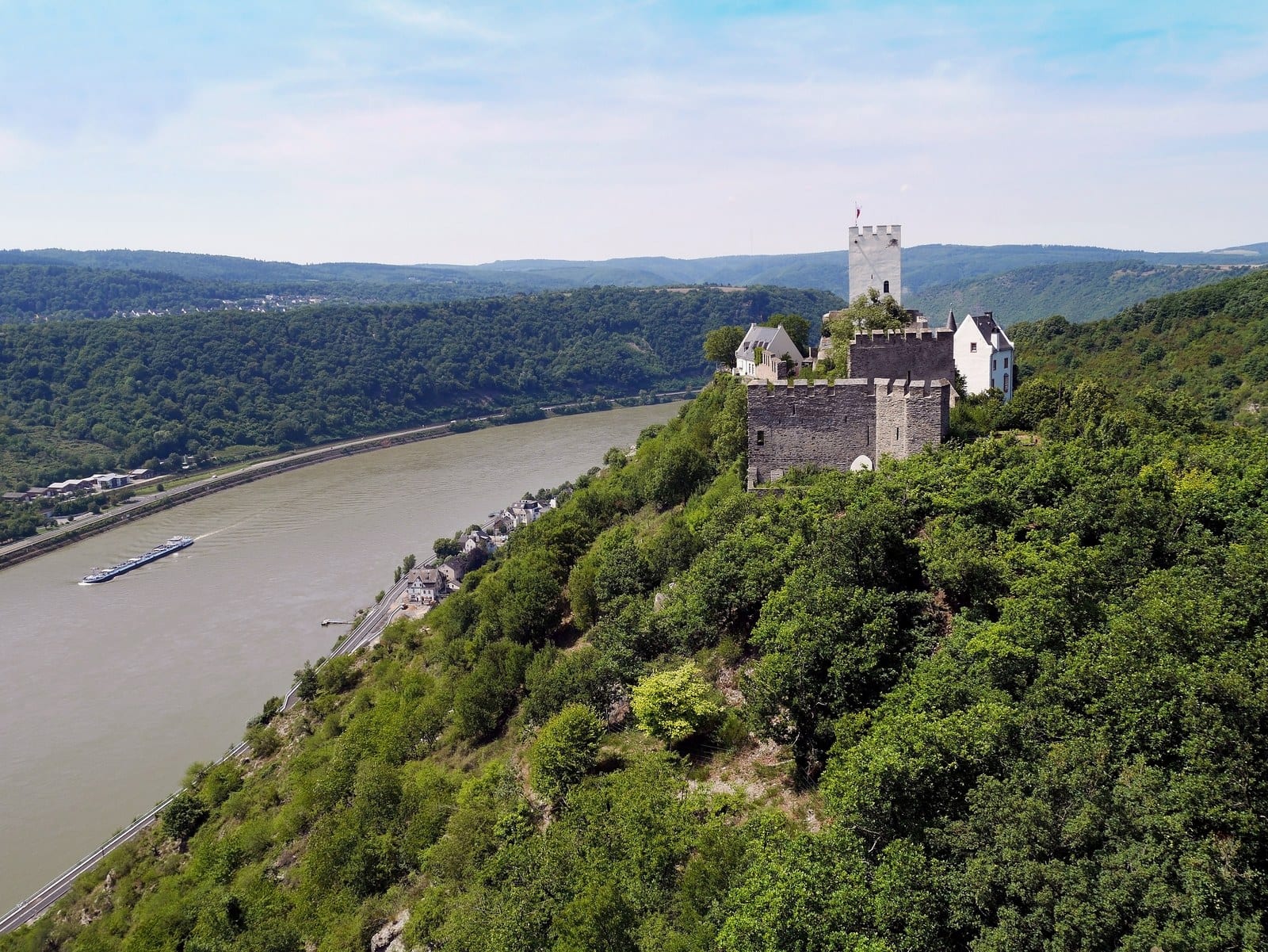
Above the right bank of the Rhine, where the river bends north past Kamp-Bornhofen toward the Loreley, two ruined castles stand on a single forested ridge. Lower of the two, the elder of the pair, first appears in writing in 1189/90, in the imperial fief register of Werner II. von Bolanden, when the Hohenstaufen ministerial added it to a roster of more than a dozen castles he held across the Empire. Higher of the pair, Burg Liebenstein, was built nearly a century later by a younger branch of the same family. Together they are known across the German Rhine as die feindlichen Brüder, the hostile brothers, after a feud-legend that has filled travel guides since the early 19th century.
Legend is older than the guidebooks, but not nearly as old as it sounds. The earliest mention of Sterrenberg Castle as one of the “hostile brothers” is a single sentence in the 1587 travel diary of a Dutch jurist; the elaborate plot of cursing brothers and unlucky lovers belongs to the Romantic Rhine boom that followed Napoleon’s defeat. A dramatic wall that divides the two castles (the so-called Streitmauer, the dispute-wall) was not built by feuding brothers either. It is a defensive shield wall raised by the Archbishop of Trier in the 1320s, more than thirty years after Liebenstein was founded, against a sibling that had by then passed into other hands. The story the castle tells, when modern scholars read its stones and surviving documents, is less a tale of fraternal hatred than one of imperial ministerials, electoral expansion, and the strange afterlife of an old ruin that became a 19th-century stage set.
Quick Facts
| Location | Above Kamp-Bornhofen, Rhein-Lahn district, Rhineland-Palatinate, Germany |
| Coordinates | 50.21377° N, 7.63336° E |
| Type | Spur castle (Spornburg), ruin with 1968–78 partial reconstruction |
| Built | Late 12th century; first documented 1189/90 |
| Founders | Reichsburg held in fief by the Bolanden family |
| Current use | Ruin with restaurant, café, exhibition, civil registry, holiday apartments |
| Hours (2026) | Weekend afternoons, mid-April through October (phone to confirm) |
| Admission | Free |
| Operator | Landgasthof Zum Weissen Schwanen GmbH, Braubach |
| Owner | State of Rhineland-Palatinate (GDKE) |
| Official website | burg-sterrenberg.com |
| UNESCO status | Inside Upper Middle Rhine Valley WHS 1066 (inscribed 2002) |
A Reichsburg under the Bolandens (c. 1189/90–c. 1250)
First documentary trace of Sterrenberg appears in the Lehnsbuch (the fief register) of Werner II. von Bolanden, conventionally dated 1189/90. This was one of the earliest secular administrative books compiled in the Holy Roman Empire, and it survives today in the Hessisches Hauptstaatsarchiv in Wiesbaden. Werner listed Sterrenberg among the imperial fiefs he held alongside the toll station at Bornhofen below the castle, and the entry places the site at the upper end of a chain of Bolanden possessions extending across the Mittelrhein, the Pfalz, and Hessen.
Werner II. (c. 1130–c. 1190) was one of the most powerful Reichsministerialen in the service of Friedrich Barbarossa and his son Heinrich VI. Chronicler Giselbert of Mons described him as a man who held seventeen castles, was lord over uncounted villages, and could call on the homage of eleven hundred knights. Friedrich Barbarossa sent him to negotiate with the Lombard League in 1183, and the Hohenstaufen dynasty entrusted him with managing the Bopparder Reich, the imperial estate district around Boppard, of which Sterrenberg and its toll formed the downstream anchor.
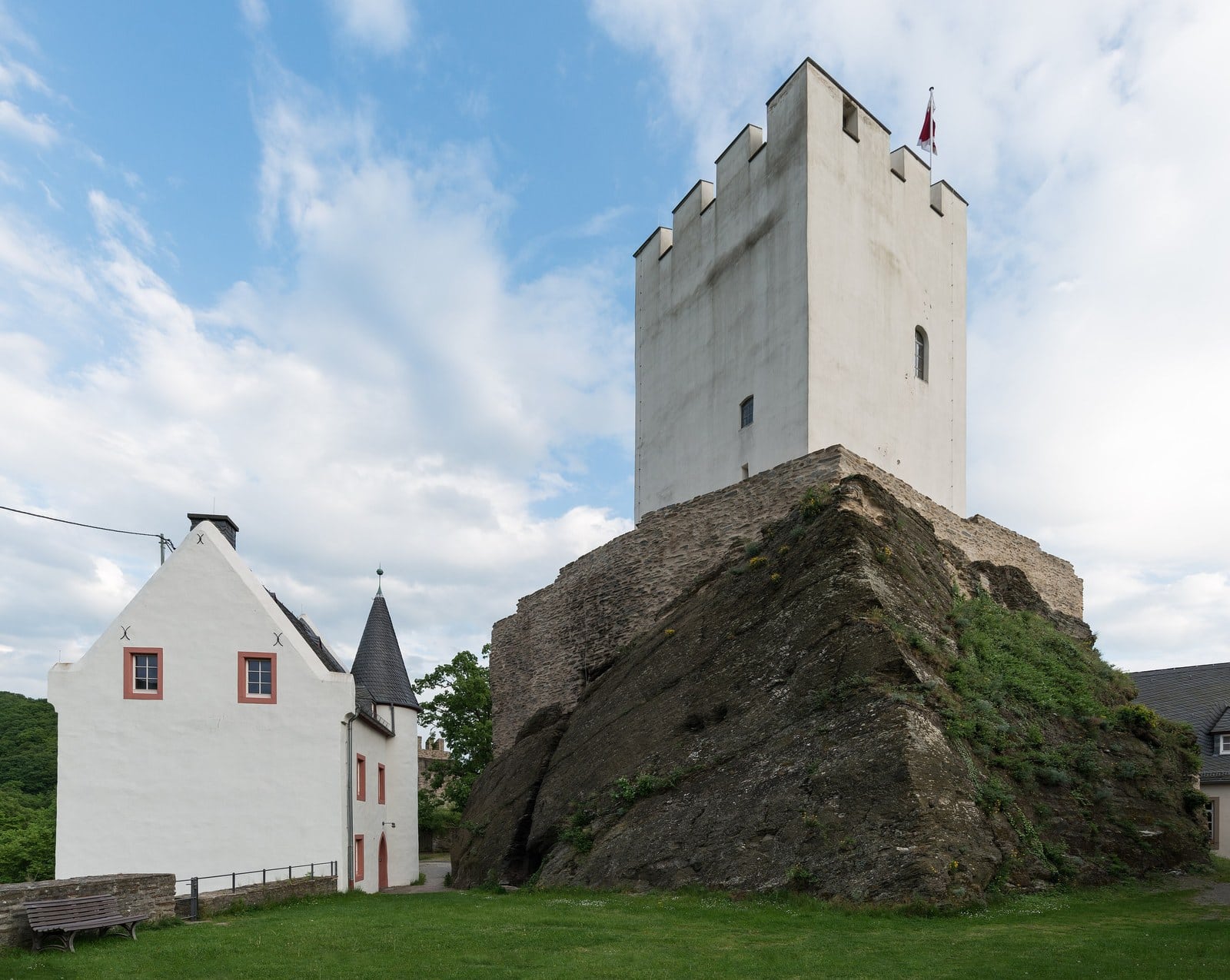
Local tradition holds that an imperial castle stood on this spur as early as 1034, but the date is not attested in any surviving charter and modern scholarship treats it as folklore. What the surviving fabric does confirm is a substantial Staufer-era construction: a square keep, just over eight meters on a side, finished in white lime plaster and entered through a doorway seven meters above the ground. Around it stretched a ring wall enclosing the spur, with an inner shield wall closing the line of attack along the ridge. The whole composition is, in the words of the European Castle Institute’s database (EBIDAT), “a relatively unaltered impression of a Staufer-era Rhine castle.” In 1249 troops of the anti-king William of Holland sacked the town that had grown up beneath the castle, but the keep itself came through. Bolandens partitioned the inheritance in 1268, and a generation later the family’s ambitions shifted to a second ridge above the river.
The junior castle and the older brother (1268–1295)
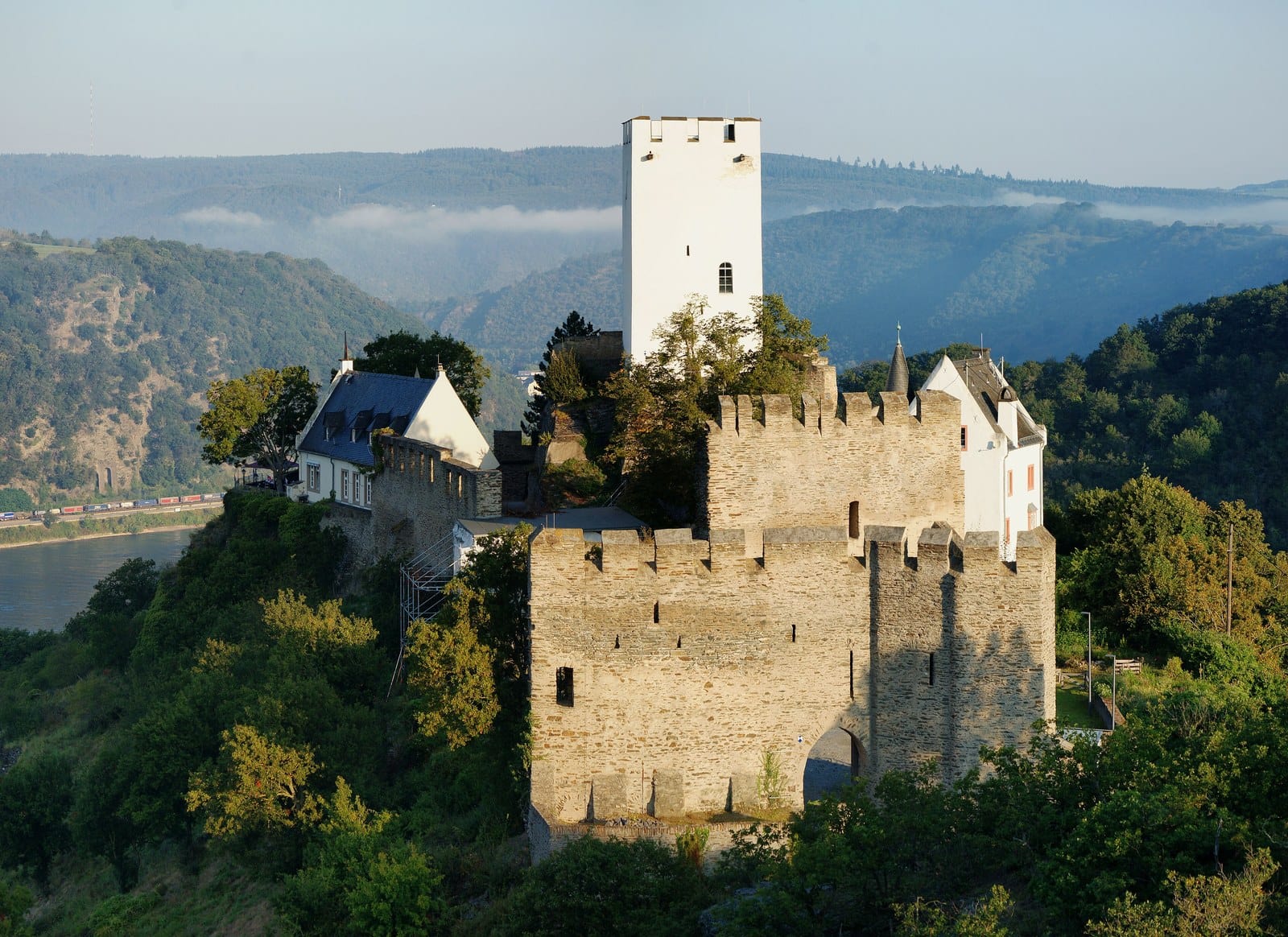
The 1268 partition between the brothers Werner IV. and Philipp von Bolanden divided both land and ambition. By 1284 a junior member of the wider family, Albrecht von Lewenstein (married to Luccarda von Bolanden) had begun building a second castle on the higher rocky outcrop directly above Sterrenberg, on a saddle some thirteen to twenty meters higher than the older ridge. Construction at Liebenstein ran through about 1290. From the outset the new castle was the architectural ambition of a junior line, a residence, not a Reichslehen, and there is no record of fighting between the two households during the brief period in which both belonged to the broader Bolanden orbit.
What happened next set the stage for everything that followed. By 1294 two Burgmannen who had served at Sterrenberg (Siegfried Schenk and Ludwig, both styled von Sterrenberg) bought Liebenstein outright, moved into the new castle, and adopted the name von Liebenstein. Sterrenberg’s garrison had effectively migrated upslope. A year later, Sterrenberg itself was briefly held by the Grafen von Sponheim-Dannenfels, and parts of it were pledged onward to the Grafen von Katzenelnbogen, the dynasty whose ambitions further north would soon raise the rival downstream castle of Burg Maus. Senior ridge was passing out of the Bolanden hand it had occupied for a century, and the political fact of two adjacent castles in two different hands would shortly become the most consequential thing about the site.
Balduin’s wall (1310–1346)
By 1310, Sterrenberg had passed as imperial pledge to one of the most relentless territorial operators of the 14th-century Empire: Balduin of Luxembourg, Archbishop of Trier from 1307 to 1354 and a brother of Emperor Heinrich VII. Balduin spent his long pontificate methodically converting pledges, marriages, and inheritances into a continuous Kurtrier territory along the Rhine and Mosel. Sterrenberg fit his program exactly. In 1315 he prevailed in a feud with Diether VI. von Katzenelnbogen, who died at a tournament that same year; in 1316 King Ludwig the Bavarian formally empowered him to redeem the remaining Katzenelnbogen share; by 1320 Sterrenberg was wholly his.
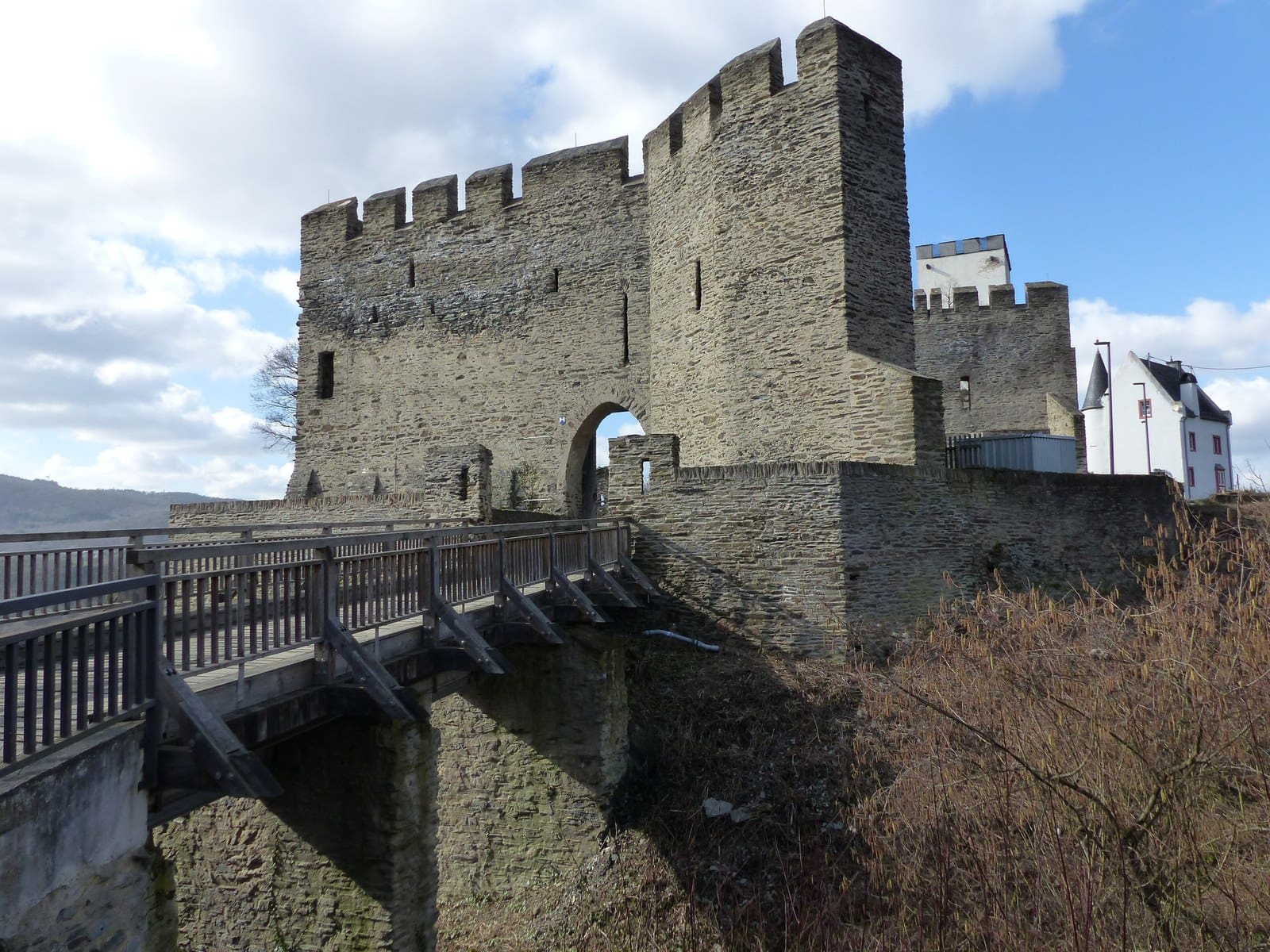
Two years later Balduin pledged the castle to one of his vassals, Friedrich Walpot von Polch, with explicit building obligations. A new pledge-holder set about raising what is now the most distinctive structure on the site: the outer shield wall, twenty-one meters long, nine meters high, and almost three meters thick, with embrasures over the spitzbogig gate, two spiral stairs, and four exterior buttresses bracing it from below. That same 1322 transaction generated the first documentary reference to the castle chapel, a capella in castro Sterinberg rediscovered archaeologically in 2018 with surviving altar and 14th-century floor tiles. The inner shield wall was rebuilt after 1341 under Heinrich IV. Beyer von Boppard, and in 1346 the seat received town rights.
Outer wall is the structure later guidebooks would call the Streitmauer. The current scholarly consensus (articulated most clearly by Kurt Frein in Burgen und Schlösser in 2021) reads it as a Kurtrier defensive reinforcement against the now-rival Liebenstein, raised after the political situation of 1294/95 made the upper castle a potential threat. The medieval sources, however, call the wall simply Mantel, the mantle. No medieval charter describes it as the boundary of any feud, no chronicle records a single skirmish between the two castles, and the name Streitmauer does not appear before the early-modern period. The wall is what it looks like: a defensive answer to a changed political map. But the story attached to it is a much later overlay.
Maus eclipses Sterrenberg (1353–1568)
Sterrenberg’s strategic life ended not with a siege but with a building project a few kilometers downstream. Between 1353 and 1357, Archbishop Balduin’s successor at Trier built Burg Maus above Wellmich, a larger, more modern fortress with thicker walls and a better field of fire over the Rhine. Within a generation the electoral garrison and administrative weight had migrated to Maus. Sterrenberg remained a Kurtrier seat in name and continued to host an Unteramt through the 15th century, but the buildings fell out of repair.
Its decline is documented step by step. A 1456 inspection records the castle as baufällig, dilapidated. In 1492 it still anchored the local administrative district but had clearly become a liability rather than an asset. In 1568, when Archbishop Jakob III. von Eltz mortgaged it to Philipp von Nassau for six thousand gulden, the deed of pledge described Sterrenberg plainly as ein alt verfallen, unbewohnt Haus, an old, decayed, uninhabited house. That sentence is the closest thing the archives give us to a date of death: by 1568 the castle was no longer a castle in any operational sense, merely a recorded ruin still bringing in feudal income.
Travel guides have long preferred a more dramatic ending, and a stubborn legend places Sterrenberg’s destruction at the hands of French troops under General Mélac in 1689. The story is geographically wrong (Mélac’s right-bank campaigns during the Palatinate War of Succession targeted the Siebengebirge area north of Bonn, not the Mittelrhein gorge) and chronologically redundant, since the castle had already been a documented ruin for more than a century by the time Louis XIV’s armies crossed the Rhine. Sterrenberg’s slow eclipse is the unromantic truth: it was outbuilt, outmoded, and outranked. Dating the feud legend itself gives 1587, a travel diary naming both ruins and no ghost, which our reference on haunted castles sets against the story it is supposed to support.
The hostile brothers find a poet (1587–1900)
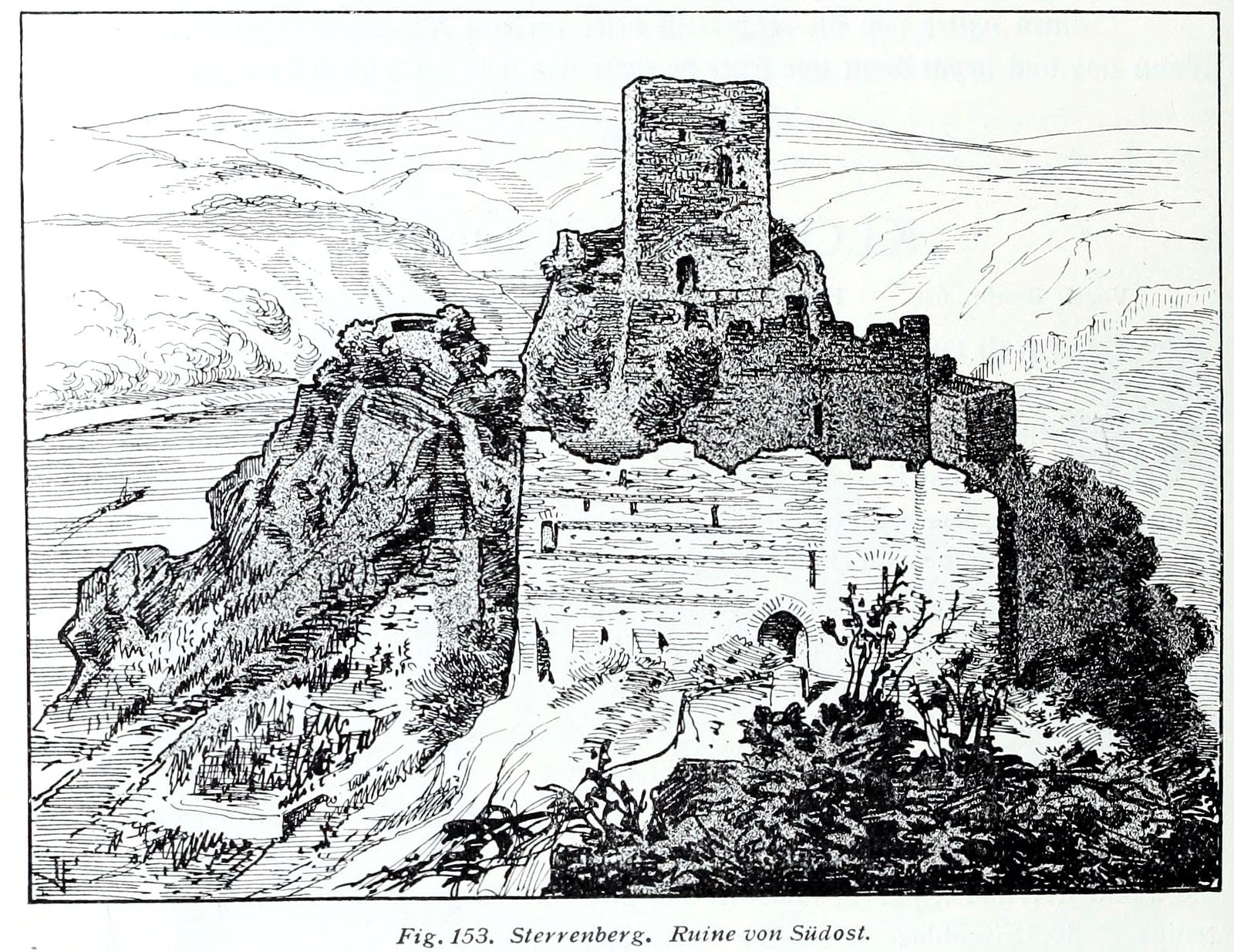
The first written trace of the feud-legend predates the Romantic Rhine boom by more than two centuries, but only just barely. In the summer of 1587 the Utrecht jurist Arnoldus Buchelius (a Dutch humanist with a notebook and a curiosity to match) traveled up the Rhine and recorded, in his Iter Germanicum, that “two brothers, the former owners of these castles, had long feuded; the victor wished the other’s castle to be left empty. At the foot of the hill stands a church said to have been founded by their sister.” That is the whole of the medieval legend in writing: one sentence, in a Latin travel diary, set down nineteen years after the castles themselves were formally recorded as uninhabited ruins. Buchelius does not name the brothers. He does not date the feud. He reports the local talk of villagers and innkeepers.
Legend grew with the river traffic. The Köln-Düsseldorfer steamship company began regular Rhine voyages in 1826; Karl Baedeker founded his Koblenz guidebook house in 1827; and the post-Waterloo English Grand Tour redirected mass tourism onto the gorge. Heinrich Heine published “Zwei Brüder” in Buch der Lieder the same year as Baedeker’s first guide, sharpening the tale to a single castle and a duel over a Countess Laura. Karl Geib’s Rhine sagas (1828–36), Karl Simrock’s anthology of 1837, and Heinrich Pröhle’s collection of 1886 added the rest: cursing fathers, mistaken loves, a sister immured in a convent, a wall raised in bitterness. Painters from Johann Adolf Lasinsky to J. M. W. Turner (whose 1817 watercolor in the Fitzwilliam Museum titles the pair “the Hostile Brothers”) installed the legend visually for English-speaking visitors.
A useful witness on what happened is Pröhle himself. Writing in 1886, he noted in passing that the castles’ nickname likely came first, and that the legend grew up to explain the name. It is the right reading. The wall, the brothers, the sister, the curse: none of them appear in a medieval document. What appears is a 16th-century traveler’s note, a 19th-century tourist industry hungry for stories, and a name (die feindlichen Brüder) that, once attached to the silhouette of two ruins on one ridge, made a tale almost inevitable.
Visiting Sterrenberg Castle in 2026
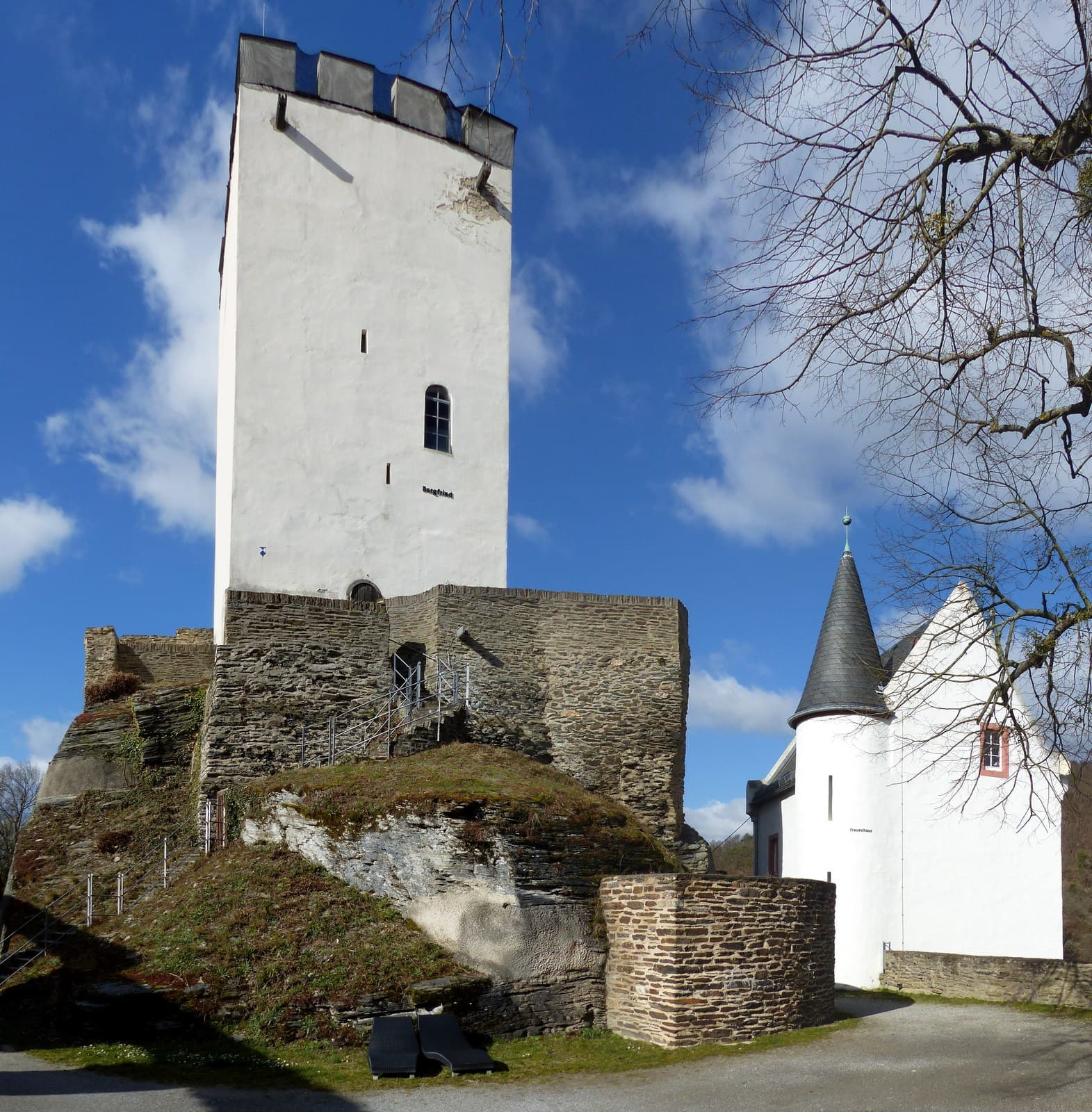
Sterrenberg Castle stands a thirty-minute walk above Kamp-Bornhofen station on the right bank of the Rhine. The footpath is comfortable for general fitness levels; signage from the village reads Burgen Liebenstein und Sterrenberg, and visitors with cars can drive up the B 42 to a parking area directly in front of the castle. The keep, exhibition, and grounds open weekend afternoons from mid-April through the end of October. The operator publishes 12:00 to 18:00 Saturday and Sunday, while the state cultural heritage office quotes a slightly different Thursday-to-Sunday window. A phone call before traveling is the safer planning move. Admission to the grounds and bergfried exhibition is free; the restaurant, café, and four holiday apartments in the Frauenhaus are paid services. Entry tickets and local tours can also be booked in advance through GetYourGuide.
The castle is operated under lease by the Landgasthof Zum Weissen Schwanen in Braubach for the Generaldirektion Kulturelles Erbe Rheinland-Pfalz, which holds the property on behalf of the state. The restaurant pours wines from the Bopparder Hamm; the right bank below the castles is too steep for vineyards. The Standesamt on the bergfried’s upper floor performs civil weddings. The Rheinsteig hiking trail passes the gate, and Burg Liebenstein, two hundred meters away and a fifteen-minute climb higher, can be reached on the same loop. Liebenstein operates as a private hotel-restaurant with separate hours.
One travel note demands attention for 2026: the right-bank Rhine railway between Wiesbaden and Neuwied (the line that serves Kamp-Bornhofen station) is closed from July 10 to December 12, 2026 for the Deutsche Bahn InfraGO Korridorsanierung. During the closure, the regional VIAS RB 10 service is suspended on the affected stretch and replaced with substitute buses (SEV); long-distance ICE and IC trains reroute to the left bank. Travelers in this window should plan via the left-bank rail line (alighting at Boppard or Bad Salzig and crossing by Rhine ferry) or via the SEV bus connections. Current schedules are at bahn.de and on the DB InfraGO project portal. Anyone staying overnight can compare hotels in and around Kamp-Bornhofen.
Some links on this page are affiliate links, which means StoneKeep Atlas may earn a small commission, at no extra cost to you, if you book through them.
Beyond Sterrenberg
Sterrenberg makes the most sense alongside the other castles of the right-bank Mittelrhein. Its closest companion in every sense is Burg Liebenstein, the junior castle on the same ridge, and the partner that gives the pair its tourist-board nickname. A different paired duo, Pfalzgrafenstein and Gutenfels at Kaub seven kilometers upstream, shows the same Mittelrhein pattern of a river castle below and a hill castle above, though theirs was a working toll system rather than a dynastic curiosity. Twelve kilometers north, Burg Katz and Burg Maus face each other across the Loreley reach; Maus is the same fortress whose construction in the 1350s ended Sterrenberg’s strategic life. Burg Rheinfels at St. Goar, the largest ruin in the gorge, is the regional anchor for any deeper visit, and Marksburg at Braubach (the only Mittelrhein castle never destroyed) combines easily with Sterrenberg on a day’s outing. Across the river and a few kilometers north stands Stolzenfels, the Kurtrier residence that, in the 19th century, would become the great Romantic reimagining of what a Mittelrhein castle ought to look like.
For the wider Romantic-era Rhine (the literary tradition Sterrenberg helped seed), see the hub on Castles of the Middle Rhine, which collects the twelve canonical sites of the inscribed UNESCO landscape and traces them downstream from Bingen to Koblenz.
Conclusion
Sterrenberg Castle has three claims on attention, none of them the one the legend promises. It is the elder of the two ridges above Kamp-Bornhofen, a Staufer-era Reichsburg that entered the imperial fief system through the most successful ministerial family of its century. It carries one of the most photographed shield walls in the Rhine gorge, a 14th-century Kurtrier defensive build that scholars now read confidently against the rival castle next door, but that owes its Streitmauer nickname and its romantic dressing entirely to a 19th-century tourist industry. And it stands at the precise spot where Buchelius wrote down a sentence in 1587 that, two and a half centuries later, would furnish German literature with one of its enduring Rhine tales. The castle’s actual story turns out to be more interesting than the legend’s: a longer arc, with named scholars and dated charters, and a slow eclipse that asks better questions than a duel ever could.
Principal Sources
- Bosl, Karl. Die Reichsministerialität der Salier und Staufer. Stuttgart: Hiersemann, 1950.
- Buchelius, Arnoldus. Diarium, edited by G. Brom and L. A. van Langeraad. Werken van het Historisch Genootschap, 3rd ser. no. 21. Amsterdam: Johannes Müller, 1907.
- Frein, Kurt. “Burg Sterrenberg am Rhein – die äußere Schildmauer (14. Jahrhundert).” Burgen und Schlösser 62, no. 1 (2021): 2–17.
- Friedrich, Reinhard, and Jens Friedhoff. “Sterrenberg.” EBIDAT — Burgendatenbank des Europäischen Burgeninstituts. Deutsche Burgenvereinigung. ebidat.de.
- Ketterer-Senger, Iris, Philipp Siemens, and Florian Weber. “Burg Sterrenberg südöstlich von Kamp-Bornhofen.” KuLaDig — Kultur.Landschaft.Digital. Landschaftsverband Rheinland, 2023; updated 2026. kuladig.de.
- Monschauer, Winfried. Burg Sterrenberg. Führungsheft 19, Edition Burgen, Schlösser, Altertümer Rheinland-Pfalz. Regensburg: Schnell & Steiner, 2003.
- Pröhle, Heinrich. Rheinlands schönste Sagen und Geschichten. Berlin: Tonger & Greven, 1886.
- Schmidt, Achim, and Kurt Frein. “Baugeschichtliche Beobachtungen zur Geschichte der Burg Sterrenberg bei Kamp-Bornhofen.” Burgen und Schlösser 57, no. 3 (2016): 130–146.
Image credits. Featured: Burg Sterrenberg from the Rhine, Rainer Lippert, CC BY-SA 3.0. Keep and women’s house, north-west view: DXR, CC BY-SA 4.0. View of Sterrenberg from Liebenstein: Xjvolker, CC BY-SA 4.0. The outer Schildmauer (2022): Whgler, CC BY-SA 4.0. Sterrenberg. Ruine von Südost (1907): Ferdinand Luthmer, public domain. Bergfried with Frauenhaus (2022): Whgler, CC BY-SA 4.0. All images via Wikimedia Commons. Freely licensed images are resized to fit; otherwise unaltered.