
Castles of the Middle Rhine
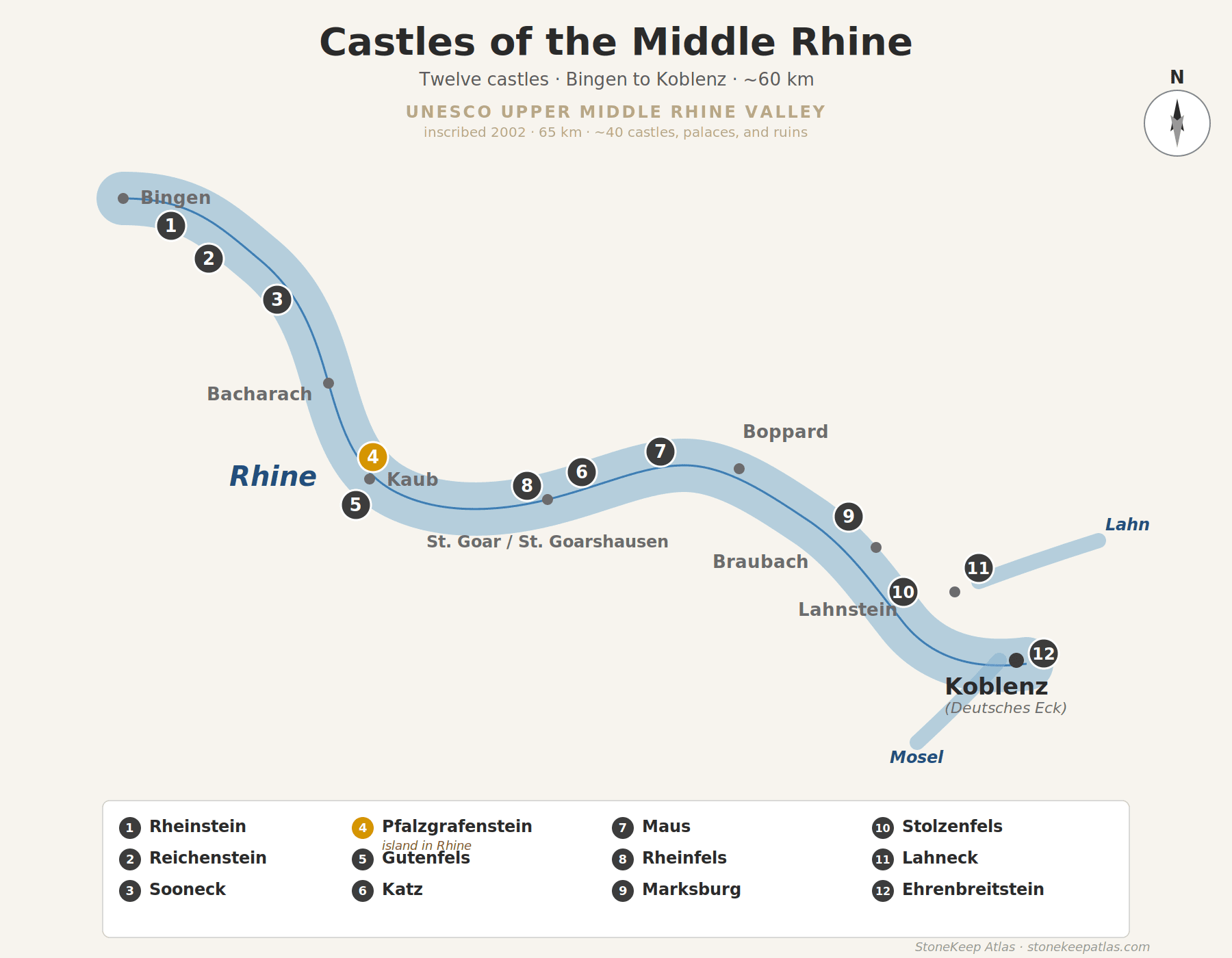
The Middle Rhine runs about 130 kilometers from the Nahe confluence at Bingen to the Sieg confluence at Bonn, cutting through the slate plateau that separates the Eifel from the Westerwald and the Hunsrück from the Taunus. Inside that corridor, between Bingen and Koblenz, lies the 65-kilometer stretch that UNESCO inscribed in 2002 as the Upper Middle Rhine Valley — approximately 40 hilltop castles, palaces, and ruins spread across one of the densest concentrations of medieval fortification on any European river.
This guide profiles twelve of them in downriver geographic order, from Burg Rheinstein just below Bingen to Festung Ehrenbreitstein at the Deutsches Eck. The selection is comprehensive rather than curated: every castle on the Mittelrhein that StoneKeep Atlas has published in depth gets a profile here. Readers looking for a curated four-castle thematic argument about the Hohenzollern Romantic restorations should also visit our companion guide, Castles of the Rhine Gorge, which builds a tighter Burgenromantik narrative around Rheinstein, Sooneck, Marksburg, and Stolzenfels.
The Mittelrhein’s castle landscape is best read through three braided threads that run from the High Middle Ages to the late nineteenth century: a regulated commercial corridor governed by river tolls, a frontier where three ecclesiastical electorates met the Wittelsbach Palatinate, and a Prussian-era project of romantic restoration that effectively invented Burgenromantik as an architectural sub-movement. We start with the threads, then walk the river.
Toll geography: the river that taxed itself
From roughly 1000 to 1868, the Middle Rhine functioned as a regulated, tax-extracted commercial corridor — and the castles on its banks were primarily instruments of that taxation. Only the Holy Roman Emperor could authorize a Rhine toll, and the customary minimum spacing between stations was five kilometers. The system existed in permanent instability: emperors wanted few stations widely spaced, while landed elites perpetually multiplied them. By the late thirteenth century, more than twelve toll stations operated between Mainz and Cologne. During the Great Interregnum of 1250–1273, with no emperor to police the system, that number roughly doubled in four years, and unauthorized robber-castles proliferated.
In response, the cities of Mainz, Worms, and Oppenheim founded the Rheinischer Städtebund at the Mainz Diet of 13 July 1254 — what eventually drew in over seventy cities on both banks of the Rhine, plus lay and ecclesiastical princes. Over the next three years the League besieged and dismantled ten to twelve robber-castles along the river. It failed at Burg Rheinfels in 1256, where the Katzenelnbogen toll castle held out, and the League itself collapsed in 1257 over the divided royal election. The campaign nevertheless established the precedent for urban political action against toll abuse — the closest the medieval Mittelrhein came to a coordinated anti-toll uprising. King Rudolf I of Habsburg replicated the playbook in 1282, destroying Burg Reichenstein and Burg Sooneck and executing the Hohenfels robber-barons.
The system was formalized by Emperor Charles IV’s Golden Bull of 1356, which conferred sovereign toll rights along with coinage and high justice on the seven Imperial Electors, three of whom (Mainz, Trier, Cologne) controlled most of the Mittelrhein. The legal endpoint of the Rheinzoll regime was not the Congress of Vienna of 1815 alone; it required the Mainz Convention of 1831 to abolish compulsory transhipment and graduate the toll reductions, and ultimately the Mannheim Act of 17 October 1868 to abolish navigation tolls altogether. The 1868 Act remains the legal foundation of the Central Commission for the Navigation of the Rhine today.
Three archbishops on one river
From the Hohenstaufen consolidation of the late twelfth century through the secularization of 1803, the three Rhine arch-electorates ruled most of the castle landscape between Bingen and Koblenz. Kurmainz built or held Burg Klopp at Bingen, Ehrenfels at Rüdesheim, Rheinstein, Sooneck and Reichenstein (after 1344), and Burg Lahneck — the northernmost Mainz exclave, founded under Archbishop Siegfried III of Eppstein in 1226 to guard silver mines and the Mainz toll station at Oberlahnstein. Kurtrier built and held Burg Maus (Boemund II, from 1356), the original Burg Stolzenfels (Arnold II von Isenburg, from 1242), and above all Festung Ehrenbreitstein, the elector-residence from 1623 until the French blew it up in 1801. The Counts of Katzenelnbogen — secular, not ecclesiastical — held Burg Rheinfels from 1245, Burg Katz from 1371, and Marksburg from 1283, passing everything to Hesse-Kassel and Hesse-Darmstadt in 1479 when the male line died out. The Wittelsbach Palatinate held Pfalzgrafenstein (from 1326) and Gutenfels (after 1277).
These were not merely toll posts. They were administrative seats, courts of justice, electoral residences, treasuries, and — in the case of Ehrenbreitstein from 1657 to 1794 — reliquary repositories. The Holy Tunic of Trier was guarded inside Ehrenbreitstein for over a century. The system disintegrated catastrophically in the French Revolutionary Wars. French troops crossed the Rhine in 1794; over the next seven years, almost every Mittelrhein castle was occupied, looted, or demolished. Rheinfels surrendered without battle on 1 November 1794 and was slighted in 1796–1797. Katz and Gutenfels were blown up by Napoleon’s order in 1806. Ehrenbreitstein was demolished by the French in 1801. The Reichsdeputationshauptschluss of 25 February 1803 formally dissolved the ecclesiastical electorates, and the Final Act of the Congress of Vienna transferred their territories largely to Nassau and Prussia. The result was a coherent Prussian Rhine Province inheriting a landscape of ruins.
1823 and the Prussian invention of Burgenromantik
After Prussia acquired the Rhineland in 1815, the rebuilding of Mittelrhein ruins became a Hohenzollern family project that effectively invented Burgenromantik as an architectural sub-movement within the broader Rheinromantik. The pivot was March 1823, and the catalyst was Prince Friedrich Wilhelm Ludwig of Prussia — a nephew of King Friedrich Wilhelm III. On 31 March 1823, he bought the dilapidated Mainz-electoral ruin then known as Vautsberg from the Hessian state for a nominal sum and renamed it Burg Rheinstein. He commissioned the Koblenz building inspector Johann Claudius von Lassaulx to plan the reconstruction; Karl Friedrich Schinkel reviewed and contributed to the designs; the executed rebuild by Wilhelm Kuhn ran 1825–1829, with the neo-Gothic chapel completed 1839–1844. Rheinstein became the first such castle to be romantically rebuilt on the Rhine.
Three further Hohenzollern projects followed. The City of Koblenz formally gifted the Stolzenfels ruin to Crown Prince Friedrich Wilhelm — the future Friedrich Wilhelm IV — on 4 March 1823. Lassaulx prepared an initial plan; Schinkel’s executed reconstruction design was approved by the crown prince in June 1836, with construction running 1836–1842 and Friedrich August Stüler taking over after Schinkel’s death in 1841. Garden design by Peter Joseph Lenné. Burg Sooneck was bought in April 1834 — not 1842, as some travel sources still report — by the crown prince and his three brothers Wilhelm, Carl, and Albrecht, and rebuilt 1834–1861 by the military architect Carl Schnitzler as a hunting lodge never actually used as such. Burg Lahneck was bought in 1850 by the Scottish railway entrepreneur Edward A. Moriarty, who began an English neo-Gothic rebuild in 1852 that continued in phases until 1937.
The cultural driver of British and continental Rhine tourism behind all of this was Lord Byron’s Childe Harold’s Pilgrimage Canto III, published in London in 1816 — the same year that the Hohenzollerns acquired the Rhine Province. The architectural counter-example is Marksburg, the only Middle Rhine hilltop castle never reduced to ruin: surrendered without siege to the French in 1796, sold by the Prussian state to the Deutsche Burgenvereinigung in 1900 for a symbolic 1,000 gold Marks, conserved rather than re-imagined.
The Bingen reach: Rheinstein, Reichenstein, Sooneck
The three left-bank castles between Bingen and Lorch form the upstream cluster of the UNESCO inscription and the densest concentration of Hohenzollern-era rebuilds anywhere on the river.
Burg Rheinstein stands on a 90-meter spur of slate above the left bank near Trechtingshausen, less than four kilometers downriver of Bingen. The Archbishopric of Mainz built it around 1316–1320 as a residential tower with an integrated shield wall; it changed hands among Mainz fief-holders for two and a half centuries before falling into ruin in the seventeenth century. The decisive moment came on 31 March 1823, when Prince Friedrich Wilhelm Ludwig of Prussia bought the ruin from the Hessian state and inaugurated the era of Hohenzollern Burgenromantik. The reconstruction by Wilhelm Kuhn under Lassaulx’s plans, with Schinkel’s input, ran 1825–1829, and Philipp Hoffmann’s neo-Gothic chapel was added 1839–1844. The Hohenzollerns held Rheinstein until 1975, when Hermann Hecher bought it; the Hecher family still operates it as a castle museum, restaurant, and apartment venue, open daily from mid-March to early November.
Burg Reichenstein, also called the Falkenburg, sits a further kilometer downriver above Trechtingshausen. It is first documented in 1213 as a bailiwick of the imperial Abbey of Kornelimünster near Aachen, but the medieval castle became notorious in the late thirteenth century as a robber-knight nest under the Hohenfels family. Rudolf I of Habsburg captured and destroyed it in 1282 with an explicit prohibition on rebuilding; the ruin passed to the Counts Palatine, then to Kurmainz in 1344, and was destroyed again by French troops in the Palatinate War of Succession in 1689. The current building dates from the comprehensive Tudor-influenced neo-Gothic rebuild of 1899–1902 for the industrialist Baron Nikolaus Kirsch-Puricelli — the last Mittelrhein castle rebuilt under the Romantic-era impulse. Today it operates as a castle museum (with a substantial collection of takenplatten cast-iron stove plates and over a thousand hunting trophies), hotel, and restaurant.
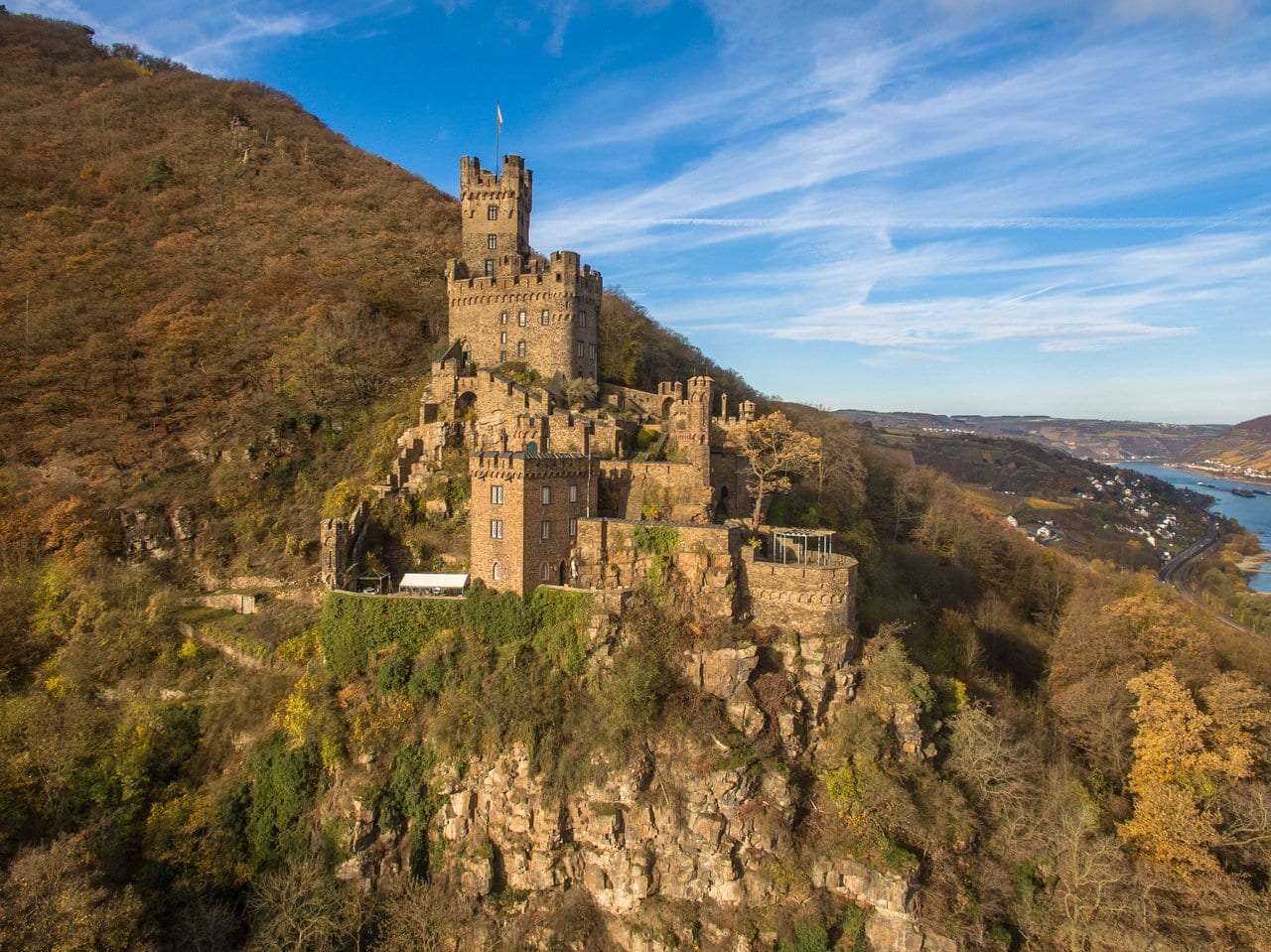
Burg Sooneck stands on the southern slope of the Soonwald above Niederheimbach. Like Reichenstein, it was administered in the thirteenth century by the Hohenfels as bailiffs of the Abbey of Kornelimünster, and like Reichenstein it was destroyed by Rudolf I of Habsburg in 1282 with an explicit rebuilding ban. The ban was lifted in 1346, the castle rebuilt, and it was destroyed again by Louis XIV’s troops in 1689. The decisive nineteenth-century moment came in April 1834, when Crown Prince Friedrich Wilhelm and his brothers Wilhelm, Carl, and Albrecht of Prussia bought the ruin and commissioned the military architect Carl Schnitzler to convert it into a Hohenzollern hunting lodge. Schnitzler’s neo-Gothic interpretation, completed in stages between 1834 and 1861, was never actually used as such — the 1848 revolutions and subsequent family disagreements intervened. The castle has been state-owned since 1918 and is managed today by the Generaldirektion Kulturelles Erbe Rheinland-Pfalz.
The toll pair at Kaub: Pfalzgrafenstein and Gutenfels
Five kilometers downstream, the river divides around the rocky island of Falkenau, where two Wittelsbach Palatinate castles operated in concert with the fortified town of Kaub to extract tolls from every vessel passing through the channel.
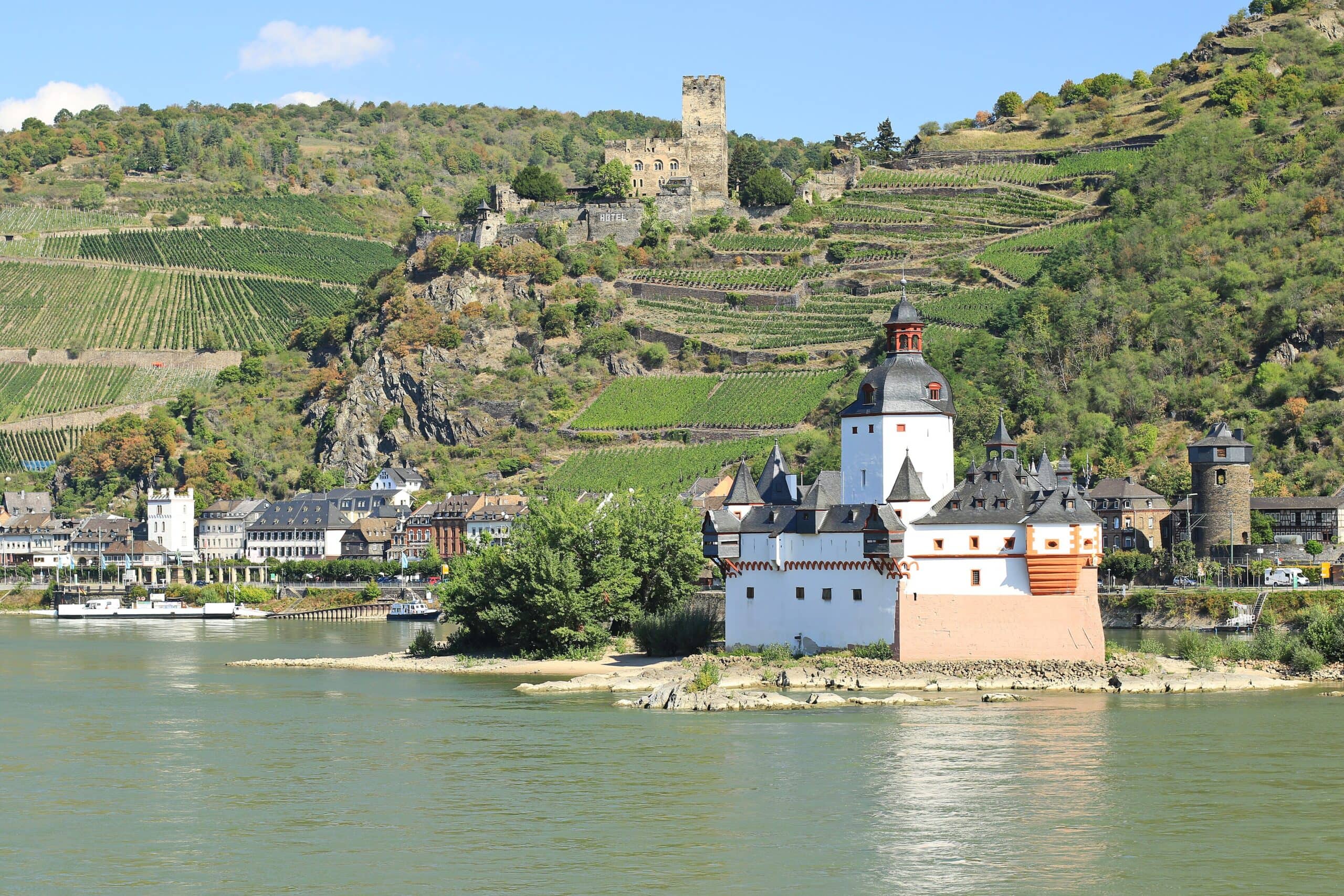
Burg Pfalzgrafenstein is the small white-and-yellow pentagonal keep midstream. Ludwig IV the Bavarian — soon to be Holy Roman Emperor — built it in 1326–1327 to enforce a new Palatinate toll against the protests of the archbishops of Mainz, Trier, and Cologne; Pope John XXII excommunicated him in part over this and other tolls. The hexagonal defensive wall went up around 1338–1340; corner turrets and a gun bastion in 1607 made it the first Mittelrhein castle adapted for cannon; the baroque tower cap dates from 1714. Pfalzgrafenstein withstood a 39-day Hessian siege in 1504 during the War of the Succession of Landshut and was occupied (without combat) by Spanish forces from 1620 to 1631 — so although it is often described as never having fallen, the more precise phrasing is that it was never destroyed by military action. It collected tolls until 1867, was acquired by Prussia, and has been Rhineland-Palatinate state property since 1947. The interior is intentionally maintained without electricity or plumbing to preserve its fourteenth-century character; access is by passenger ferry from Kaub, dependent on river and ice conditions.
Burg Gutenfels sits directly above on the right bank, the hill-castle partner to Pfalzgrafenstein’s island keep. The Lords of Falkenstein-Münzenberg built it around 1220–1222; castle and town passed to the Electorate of the Palatinate (Wittelsbach) in 1277. King Adolf of Nassau died here in 1298 following his defeat at Göllheim. Like Pfalzgrafenstein, Gutenfels withstood the 1504 siege — after which the name “good rock” appears to have displaced earlier usage. French Revolutionary forces took it in 1793, and Napoleon ordered its partial demolition in 1806. The neo-Romantic rebuild of 1889–1892 by Walther Wilhelm Theodor Carl Reineck of Cologne restored the silhouette without recovering the medieval interior. It operates today as a five-room castle hotel, reopened in 2022, with occasional moonlight tours via Loreley Touristik rather than regular museum opening.
The Loreley reach: Katz, Maus, Rheinfels
Below Kaub, the gorge narrows toward its tightest point at the Loreley rock, where the river compresses to about 113 meters wide and reaches 25 meters deep. Three castles command this reach: two on the east bank above St. Goarshausen and Wellmich, one on the west bank above St. Goar.
Burg Katz — formally Burg Neukatzenelnbogen — is the upstream cat in the famous “cat-and-mouse” pairing. Count Wilhelm II of Katzenelnbogen built it between 1360 and 1371 as a strategic outpost commanding the Loreley reach and protecting the lucrative family toll at Rheinfels against the new Trier castle “Maus” downstream. The Cat-versus-Mouse nickname pair is a folkloric play on the Katzenelnbogen name (literally “cat’s elbow”). Katz passed to Hesse-Kassel in 1479, survived sieges in 1626 and 1647, was damaged in the 1692 French attack on Rheinfels, and surrendered in the Seven Years’ War. Napoleon ordered it blown up in 1806 together with Gutenfels. The current building dates from the 1896–1898 rebuild by the Cologne firm Schreiterer & Below for Ferdinand Berg, the district administrator of St. Goarshausen. In 1989 the Japanese management consultant Satoshi Kosugi bought it for 4.3 million Deutschmarks, planning a Japanese-tourist hotel that never materialized. It is privately owned today and not open to the public; the building can be viewed from outside.
Burg Maus — the mouse in the pairing, originally Burg Peterseck — stands above Wellmich just downstream of St. Goarshausen. Construction began in 1356 by Archbishop-Elector Boemund II of Trier and continued under his successors for around thirty years, until roughly 1388. Boemund and his successors used it as an electoral residence as well as a toll-and-administrative post against the Katzenelnbogen at Rheinfels. Maus is, with Marksburg, one of only two Mittelrhein hilltop castles never destroyed by gunpowder, although it fell into sixteenth- and seventeenth-century disrepair before being restored 1900–1906 by the Cologne architect Wilhelm Gärtner in late-Rhine-Romantik style. Since 1989 it has operated as a falconry and eagle display center, with flight demonstrations from late March through early October; interior visits are by guided tour only.
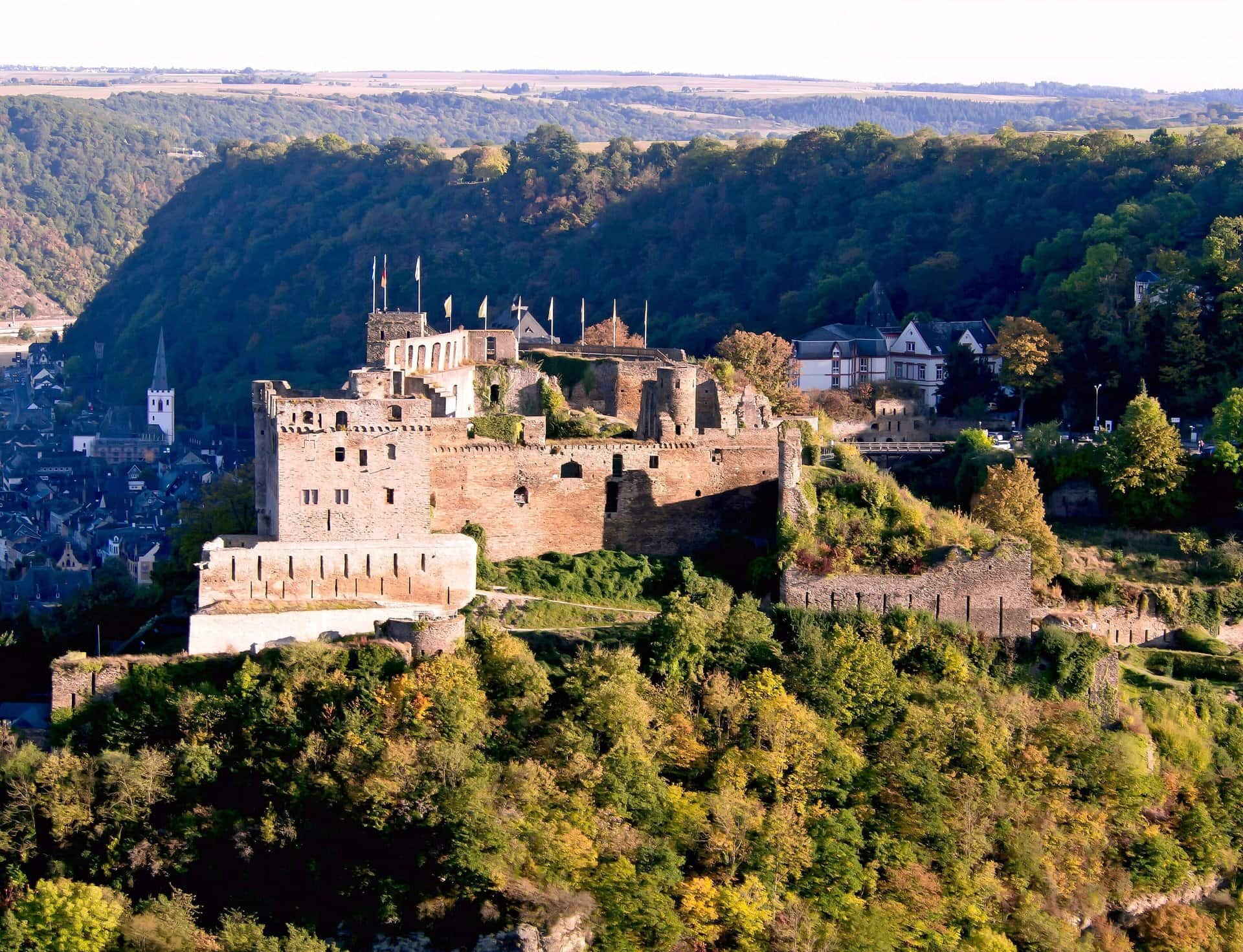
Burg Rheinfels, on the west bank above St. Goar, was the largest fortress on the Mittelrhein at its peak — about four hectares of walls, ravelins, casemates, and outworks. Count Diether V of Katzenelnbogen founded it in 1245 as a toll castle; it survived the 1255–1257 siege by the Rheinischer Städtebund, the iconic case of a toll castle defeating the urban coalition, and was thereafter reputed impregnable. It passed to Hesse-Kassel in 1479, was further fortified through the seventeenth century, and withstood the 1692–1693 French winter siege when roughly 3,000 defenders held out against 28,000 French troops. It capitulated without resistance to French Revolutionary forces on 1 November 1794; the outer defenses were slighted in 1796, the keep blown up in 1797, and the stone subsequently quarried until 1812. Prince Wilhelm of Prussia bought what remained in 1843 to halt further demolition. The substantial ruin is now the largest castle ruin on the Middle Rhine, with a museum, self-guided tour, and the Romantik-Hotel Schloss Rheinfels in the surviving Darmstadt building.
Toward Koblenz: Marksburg and Stolzenfels
The final 15 kilometers between St. Goar and Koblenz pair the only never-ruined hilltop castle on the Rhine with the most spectacularly successful Hohenzollern rebuild.
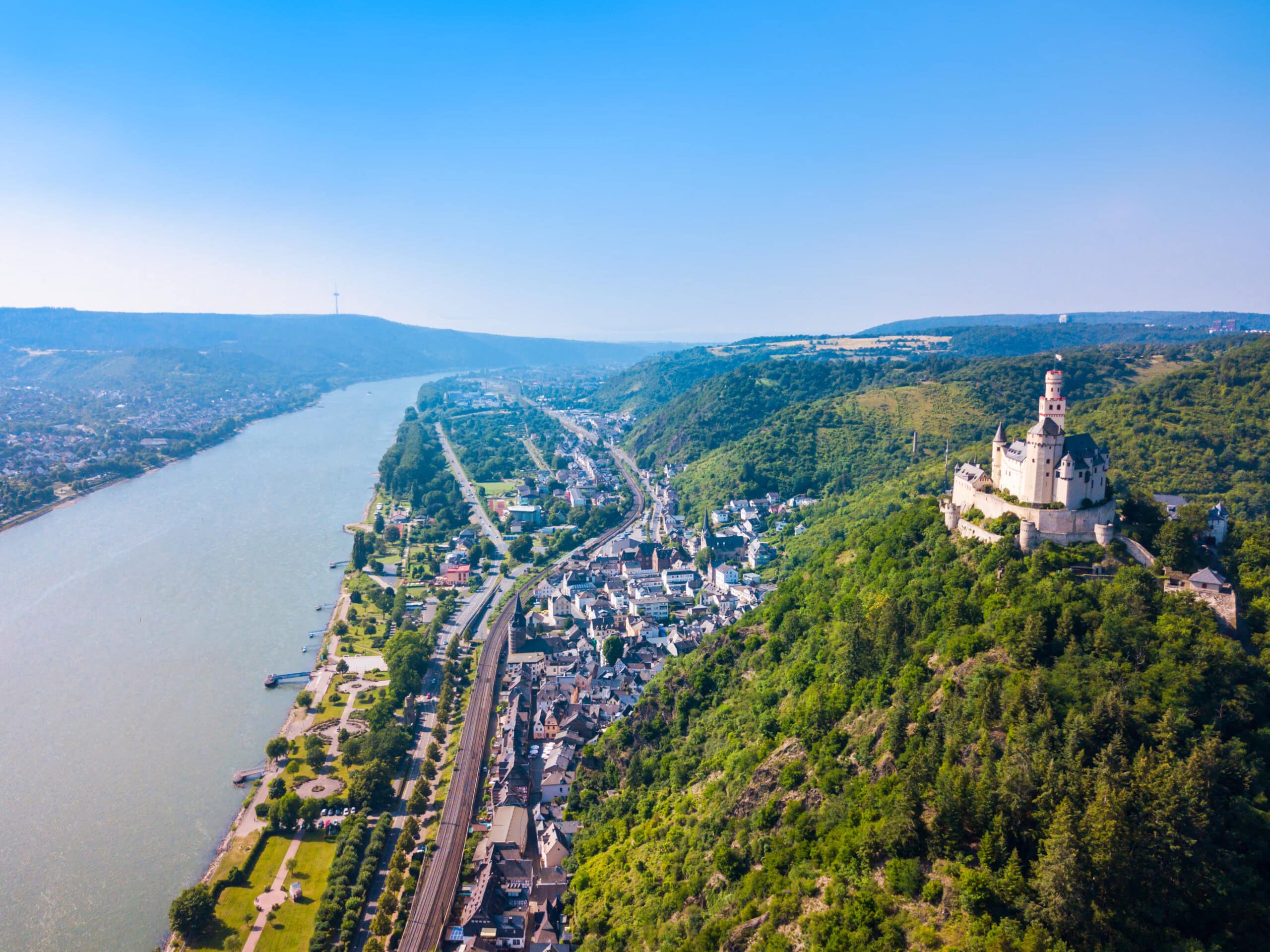
Marksburg crowns a 150-meter cliff above Braubach on the east bank. The Eppstein family — supplier of four archbishops of Mainz in the thirteenth century — built the stone keep around 1100 and expanded it into a castle by 1117; first documentary mention dates from 1231. The castle passed to the Counts of Katzenelnbogen in 1283 and was substantially expanded in the fourteenth and fifteenth centuries with the distinctive butter-churn keep. It passed to Hesse-Kassel in 1479 and surrendered without siege to the French in 1796 — the only Middle Rhine hilltop castle never reduced to ruin, and the only one of the originally medieval fortifications that never fell into disrepair. In 1900 the newly founded Deutsche Burgenvereinigung bought it from the Prussian state for the symbolic price of 1,000 gold Marks. The DBV has had its headquarters here since 1931 and operates Marksburg as its flagship museum and the seat of the Europäisches Burgeninstitut. Annual visitor numbers approached 200,000 in recent years. The single instance of combat damage in nine centuries was an American artillery shelling in March 1945, faithfully restored thereafter.
Schloss Stolzenfels sits across the river and 12 kilometers downstream, on a vineyard slope just south of Koblenz. Trier built the original toll castle from 1242 under Archbishop Arnold II von Isenburg; tolls were levied here until 1412. French troops destroyed it in 1688–1689 during the Palatinate War of Succession, and the ruin was given to the City of Koblenz under Napoleon. The decisive moment came on 4 March 1823, when the city formally gifted the ruin to Crown Prince Friedrich Wilhelm — later King Friedrich Wilhelm IV — as a Schenkung. Lassaulx made an initial reconstruction plan; the executed Schinkel design was approved by the crown prince in June 1836, with construction running 1836–1842. Friedrich August Stüler took over after Schinkel’s death in 1841; Peter Joseph Lenné designed the gardens. The castle was inaugurated 14 September 1842 with a torchlight procession in Old-German costume, and Queen Victoria visited in 1845. It passed to state ownership in 1918, was substantially restored 2007–2011 in conjunction with the Bundesgartenschau Koblenz, and is managed today by the Generaldirektion Kulturelles Erbe Rheinland-Pfalz, receiving up to 250,000 visitors annually.
The Koblenz confluence: Lahneck and Ehrenbreitstein
The northern boundary of the UNESCO inscription is the Lahnstein Gate, where the Lahn joins the Rhine and the gorge opens into the Neuwied basin. Two castles guard this confluence, one on each tributary mouth.
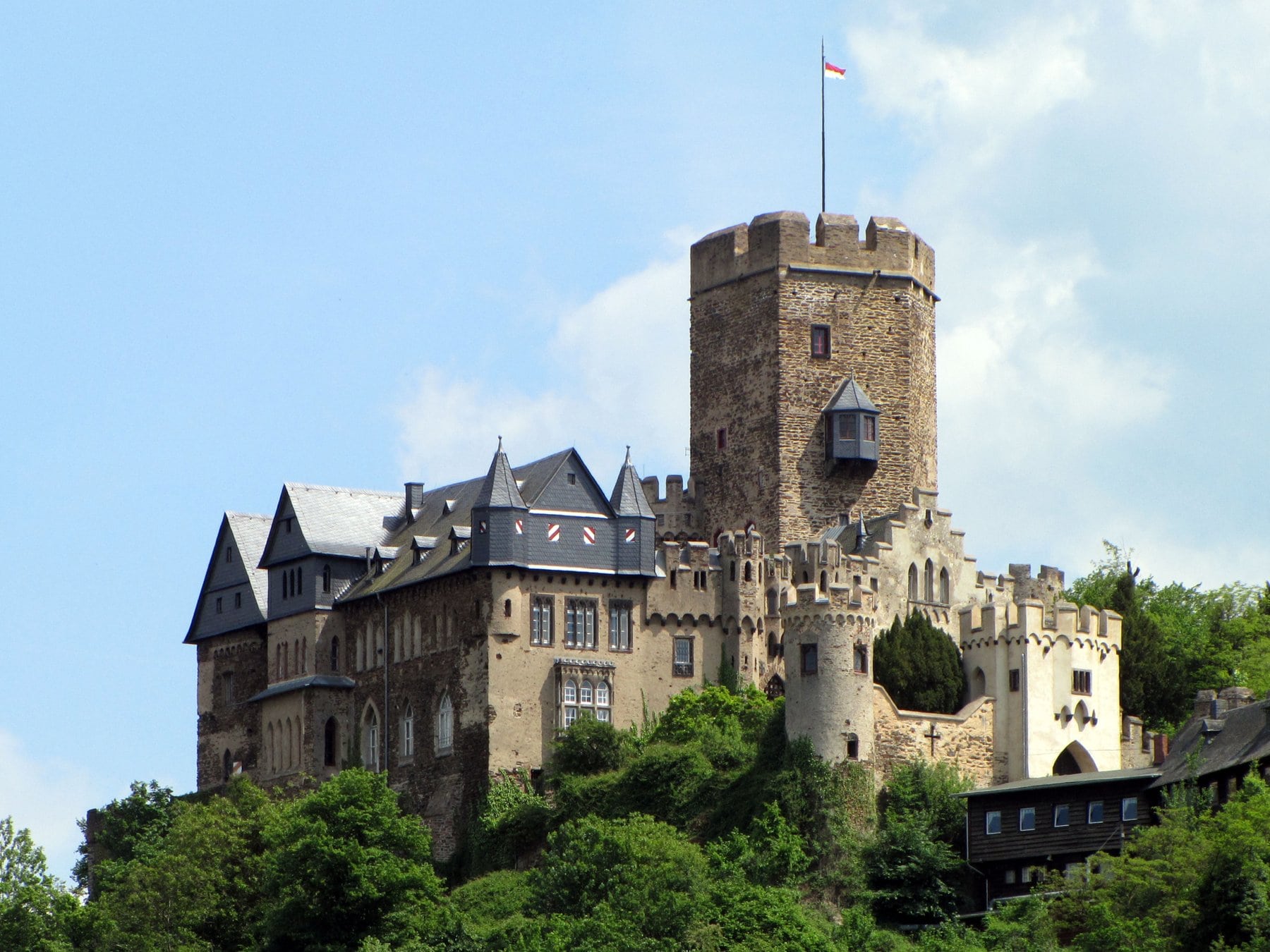
Burg Lahneck stands on a 164-meter schist spur at the mouth of the Lahn at Lahnstein. Archbishop Siegfried III of Eppstein of Mainz began construction in 1226 to defend the Lahn mouth, the Tiefenthal silver mine, and the Mainz toll station at Oberlahnstein (the actual riverside toll was levied at Schloss Martinsburg below, not at Lahneck itself, which sat too far from the river for direct collection). Lahneck was the northernmost Mainz exclave on the Rhine. It was the site of the 1400 deposition of King Wenzel by the four Rhenish Electors. The Thirty Years’ War damaged it in 1632 and 1636, and French troops destroyed it in 1688. In 1850, the Scottish railway entrepreneur Edward A. Moriarty bought the ruin and began an English neo-Gothic rebuild in 1852, with subsequent piecemeal additions continuing under various owners until 1937 under the Karlsruhe architecture professor Karl Caesar. Imperial Vice-Admiral Robert Mischke bought Lahneck in 1907; the Mischke and von Preuschen heirs still own it. The castle opens as a museum from mid-April through early November, with guided tours Tuesday through Sunday.
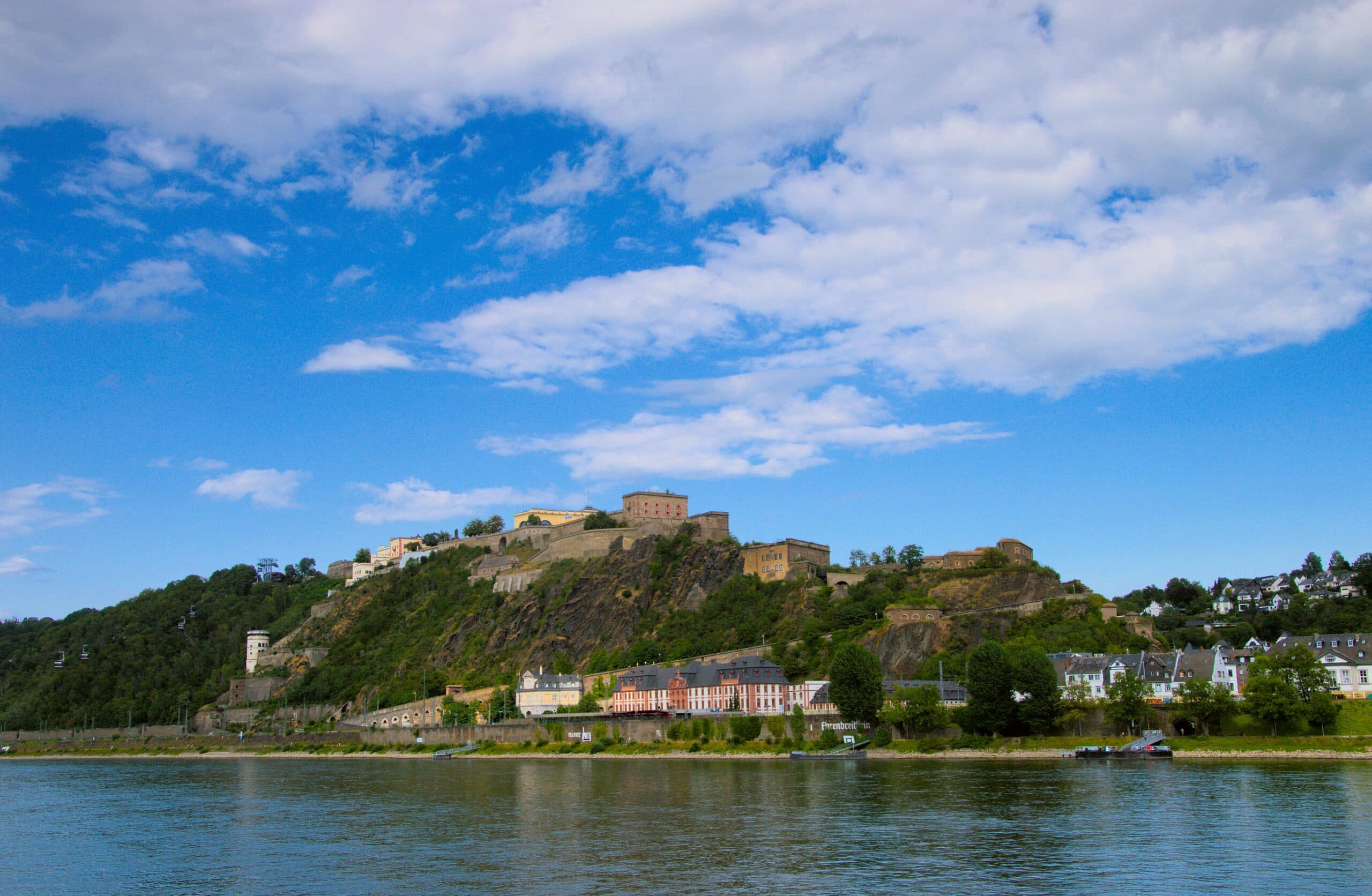
Festung Ehrenbreitstein crowns the basalt cliff opposite the Deutsches Eck — the spit of land where the Mosel flows into the Rhine — and is the largest castle on the Mittelrhein by any reasonable measure. The original castle goes back to a Conradine nobleman named Ehrenbert around AD 1000; the archbishops of Trier expanded it from 1152 under Hillin, and it became the Trier electoral residence from 1623 when Philipp Christoph von Sötern built the Philippsburg at its foot. Balthasar Neumann added the third ring of fortifications around 1730. The Holy Tunic of Trier was guarded inside Ehrenbreitstein from 1657 to 1794. French Revolutionary forces took Koblenz in 1794 but Ehrenbreitstein withstood three sieges in 1794–1795 before capitulating by starvation in 1799 after a year-long siege; the French demolished it in 1801. Prussia rebuilt it 1817–1828 as a polygonal artillery fortress anchoring the wider Festung Koblenz fortification ring — whose perimeter measured approximately 14 km. The fortress was never attacked in active service. It served as US Army headquarters 1919–1923 and under French occupation thereafter; it has been managed by the State of Rhineland-Palatinate since 1947 and houses the Landesmuseum Koblenz. Visit-Koblenz describes Ehrenbreitstein as “the second largest preserved fortress in Europe” without specifying the comparative metric — the claim is widely repeated but the academic literature does not rank European fortresses by a single defined measure, so treat it as a tourism-trade convention rather than a documented superlative. A cable car across the Rhine, opened for the 2011 Bundesgartenschau, links the fortress to the Koblenz waterfront.
Beyond the twelve
Several additional Mittelrhein castles fall inside the UNESCO inscription but are not yet profiled in depth on StoneKeep Atlas. Burg Stahleck above Bacharach was the Palatinate’s principal toll castle from the twelfth century and is now a youth hostel. Burg Liebenstein and Burg Sterrenberg are the paired “hostile brothers” on the right bank above Kamp-Bornhofen, separated by a curtain wall whose original purpose is contested. Burg Schönburg above Oberwesel is a Bolanden lordship that became Schönburg-electoral and is now a romantic-period rebuild operating as a hotel. The Mittelrhein also extends downstream of the UNESCO core into the Unteres Mittelrheintal between Koblenz and Bonn, where Schloss Drachenburg above Königswinter (covered in our 19th-Century Romantic Revival hub) and the Drachenfels ruin made famous by Byron’s Childe Harold sit on the right bank above the Siebengebirge.
The thematic context for the regulated commercial corridor described here is the subject of The Rhine as Contested Territory, which traces the medieval and early-modern conflicts that shaped the toll system, with a forthcoming companion history article on the Rhine toll wars proper. The Prussian rebuilding program at Rheinstein, Stolzenfels, Sooneck, and elsewhere is the substance of Castles of the Rhine Gorge and The 19th-Century Romantic Revival of German Castles, and the broader Hohenzollern royal context for that work is in The Prussian Royal Castles.
Principal Sources
Carqué, Bernd. “Constructing Modern Meanings by Rebuilding Medieval Ruins: The Castles of Stolzenfels, Haut-Kœnigsbourg, and Trifels in the Nineteenth and Twentieth Centuries.” In Castle Studies. Berlin: De Gruyter, 2024.
Generaldirektion Kulturelles Erbe Rheinland-Pfalz / Karn, Georg Peter, ed. Stolzenfels: ein preußisches Königsschloss am Rhein — Forschung, Instandsetzung und Restaurierung. Petersberg: Michael Imhof Verlag, 2020.
Pfotenhauer, Angela, and Elmar Lixenfeld. Oberes Mittelrheintal — Welterbe: Von Bingen und Rüdesheim bis Koblenz. Bonn: Deutsche Stiftung Denkmalschutz, 2006.
Rathke, Ursula. Preußische Burgenromantik am Rhein: Studien zum Wiederaufbau von Rheinstein, Stolzenfels und Sooneck (1823–1860). Munich: Prestel, 1979.
Taylor, Robert R. The Castles of the Rhine: Recreating the Middle Ages in Modern Germany. Waterloo, ON: Wilfrid Laurier University Press, 1998.
Thon, Alexander. “Städte gegen Burgen: Tatsächliche und Mutmaßliche Belagerungen von Burgen am Mittelrhein durch den Rheinischen Bund 1254–1257.” Jahrbuch für westdeutsche Landesgeschichte 34 (2008): 17–42.
Tümmers, Horst-Johannes. Der Rhein: Ein europäischer Fluss und seine Geschichte. 2nd ed. Munich: C.H. Beck, 1999.
Central Commission for the Navigation of the Rhine. “Legal basis / Texts.” ccr-zkr.org.
UNESCO World Heritage Centre. “Upper Middle Rhine Valley.” whc.unesco.org. Operator hours and admission for state-managed sites should be verified against burgen-rlp.de (Generaldirektion Kulturelles Erbe Rheinland-Pfalz) close to the date of any visit, as schedules vary seasonally.
Image credits. Featured image: Burg Pfalzgrafenstein with Burg Gutenfels behind, Kora27, CC BY-SA 4.0, via Wikimedia Commons. Map: StoneKeep Atlas (own work). Inline images, in order of appearance: Sooneck Castle aerial: Phantom3Pix, CC BY-SA 4.0, via Wikimedia Commons; Burg Rheinfels: Rolf Kranz, CC BY-SA 4.0, via Wikimedia Commons; Marksburg aerial: via Adobe Stock; Lahneck Castle bergfried: Holger Weinandt, CC BY-SA 3.0 DE, via Wikimedia Commons; Festung Ehrenbreitstein: photo by Dominik Kristen via Pexels.