
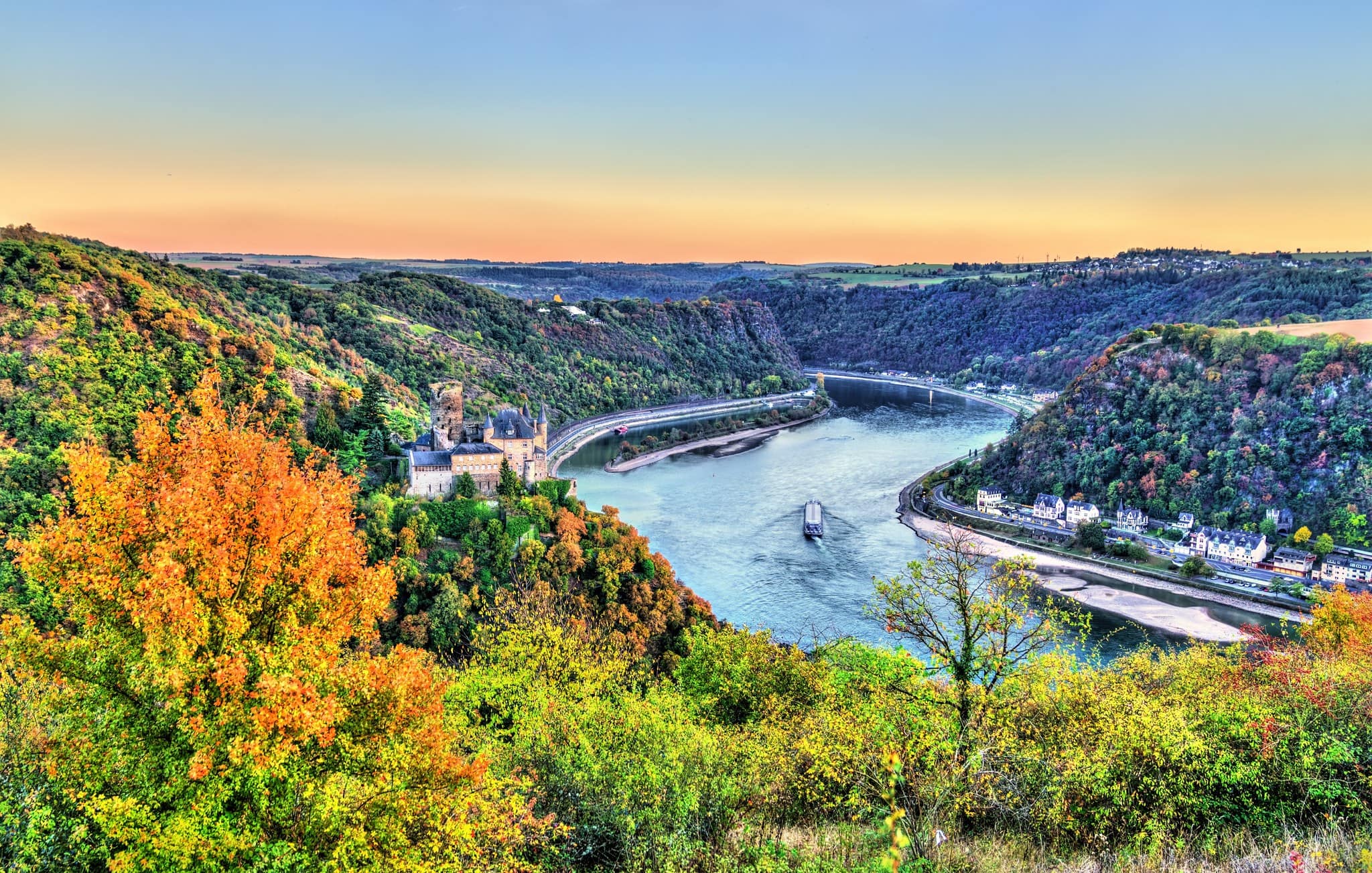
Katz Castle
Katz Castle is the larger half of the most famous joke on the Rhine. High on a rock spur above St. Goarshausen, on the right bank of the Middle Rhine and almost directly opposite Rheinfels, it was raised in the 1360s by the Counts of Katzenelnbogen under the formal name Burg Neukatzenelnbogen. Its purpose was money: with Rheinfels across the water it closed a toll trap on both directions of river traffic, and it was deliberately planted to overshadow a smaller fortress the Archbishops of Trier were building a short way downstream: the castle the same rivalry would nickname the “mouse.”
The nicknames stuck and the official names faded, but the outcome inverted the joke. Katz was the bigger, prouder, better-armed of the pair, and it never fought the mouse at all. What it could not survive was France: besieged and broken in the Hessian inheritance wars, it was finally blown up in 1806 as one of the last castles left standing on the river. The mouse it was built to devour is still there, unbroken. This is the story of the cat that was eaten, and the article in which the pair, told first from the other bank, finally completes.
Quick Facts
| Country | Germany |
| Region / State | Rhineland-Palatinate (Rheinland-Pfalz), western Germany — Upper Middle Rhine Valley, right (east) bank above St. Goarshausen |
| Nearest Town | St. Goarshausen; right-bank rail line; car ferry St. Goar–St. Goarshausen |
| Construction Period | Built for the Counts of Katzenelnbogen c. 1360–1371 (chapel charter 1371); slighted 1806; historicist reconstruction from 1896 |
| Founder | Count Wilhelm II von Katzenelnbogen (count 1332–1385) |
| Architectural Style | Late-medieval Spornburg (spur castle) of the compact equal-tower type, almost entirely rebuilt as a historicist residence after 1896 |
| Building Type | Burg — a Höhenburg on a rock spur; toll castle and border fortification |
| Current Condition | Standing and maintained — the visible building is a post-1896 reconstruction; genuine medieval fabric survives only in the keep ruin, parts of the shield wall, and the Zwinger |
| Open to Visitors | No — privately owned; not open to the public; exterior viewing only |
| UNESCO Status | Within the Upper Middle Rhine Valley World Heritage Site (inscribed 2002) |
| Coordinates | 50.1518 N, 7.7241 E |
The cat the counts built to eat the mouse (1356–1371)
The Counts of Katzenelnbogen were the great toll lords of the fourteenth-century Rhine. From Rheinfels, the fortress Count Diether V had begun above St. Goar in 1245, they taxed every ship laboring upstream through the narrows below the Loreley. What they could not do from the left bank alone was tax the right one; and in 1356 the Archbishops of Trier gave them a reason to want it, beginning a toll castle of their own above Wellmich, a short way downstream.
Count Wilhelm II von Katzenelnbogen answered with a fortress squarely opposite St. Goar, on the spur above St. Goarshausen, larger than the Trier work and pointed straight at it. Building was substantially finished by 1371, the year its chapel was consecrated; the dating anchor is a charter of that year endowing an altar inside it. The official name was Burg Neukatzenelnbogen, after the family’s ancestral seat. With it the counts could now stop ships running downstream as well as up: the notorious St. Goar double toll, levied from both banks at once.
The popular names came later and from a story that cannot be verified. Tradition holds that Wilhelm II mocked the smaller Trier castle by boasting that his “cat” would make short work of that “mouse”; the line is repeated in every guidebook and documented in none, and the Trier fortress was not recorded as Burg Maus until centuries afterward. As told in the account of Maus Castle across the way, the cat-and-mouse quip is legend, not record. What is certain is the shape of the rivalry it dressed up: two toll machines glaring at each other across a few kilometers of the same river.
The right-bank jaw of a toll machine (1371–1479)
For its first century the castle did exactly what it was built to do. It guarded the toll, sheltered the walled town below, and secured the road back into Katzenelnbogen territory; from 1378 it is documented as the seat of resident Burggrafen, the officers who ran the toll and the district from inside its walls. In 1395 Count Johann IV (who would himself die at Rheinfels in 1444) is recorded to have pushed its works outward into a Trutzburg aimed at Trier. With Rheinfels on the far bank it formed a closed toll bar across the gorge: the river here belonged, in practice, to whoever held both spurs.
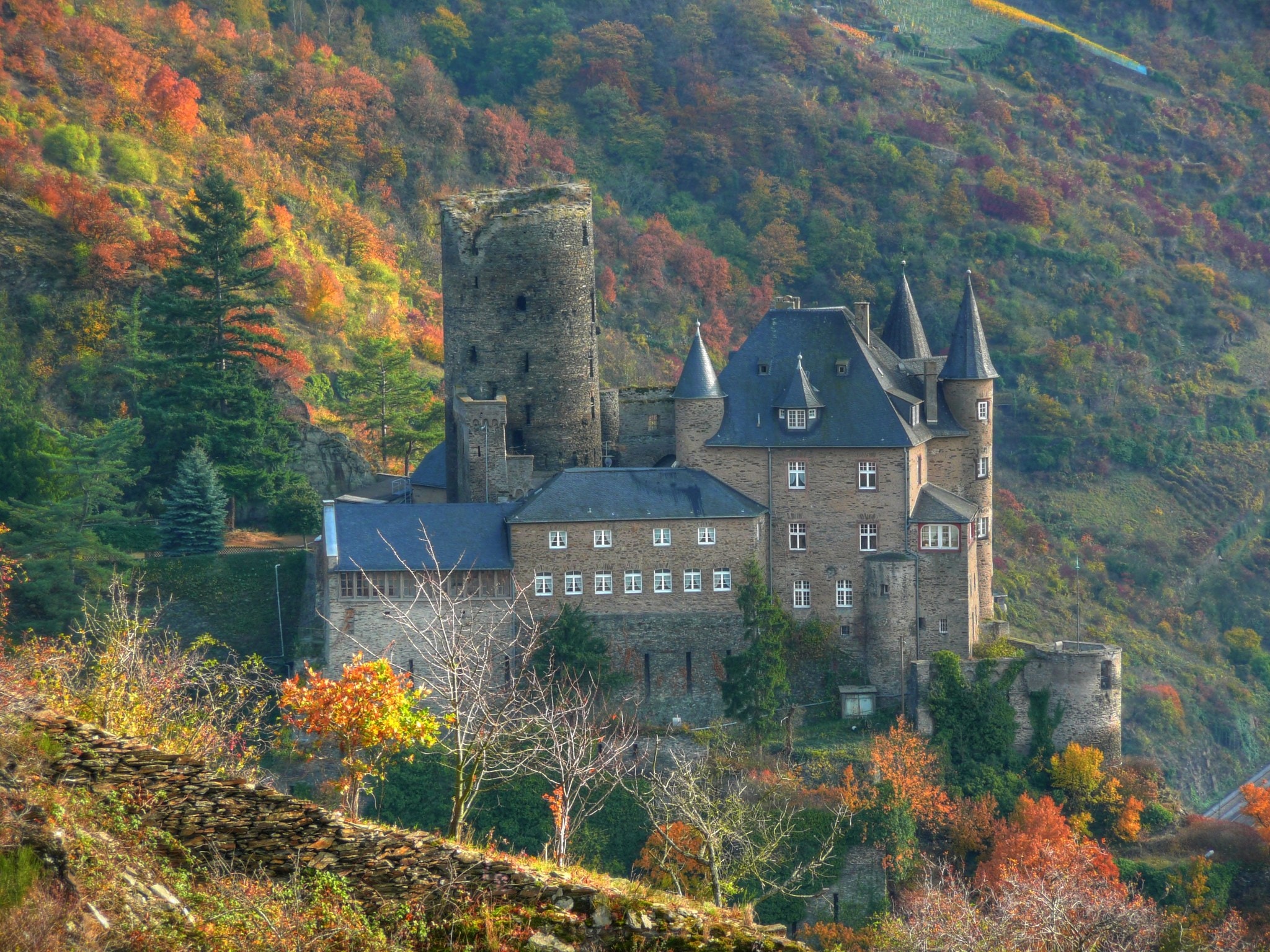
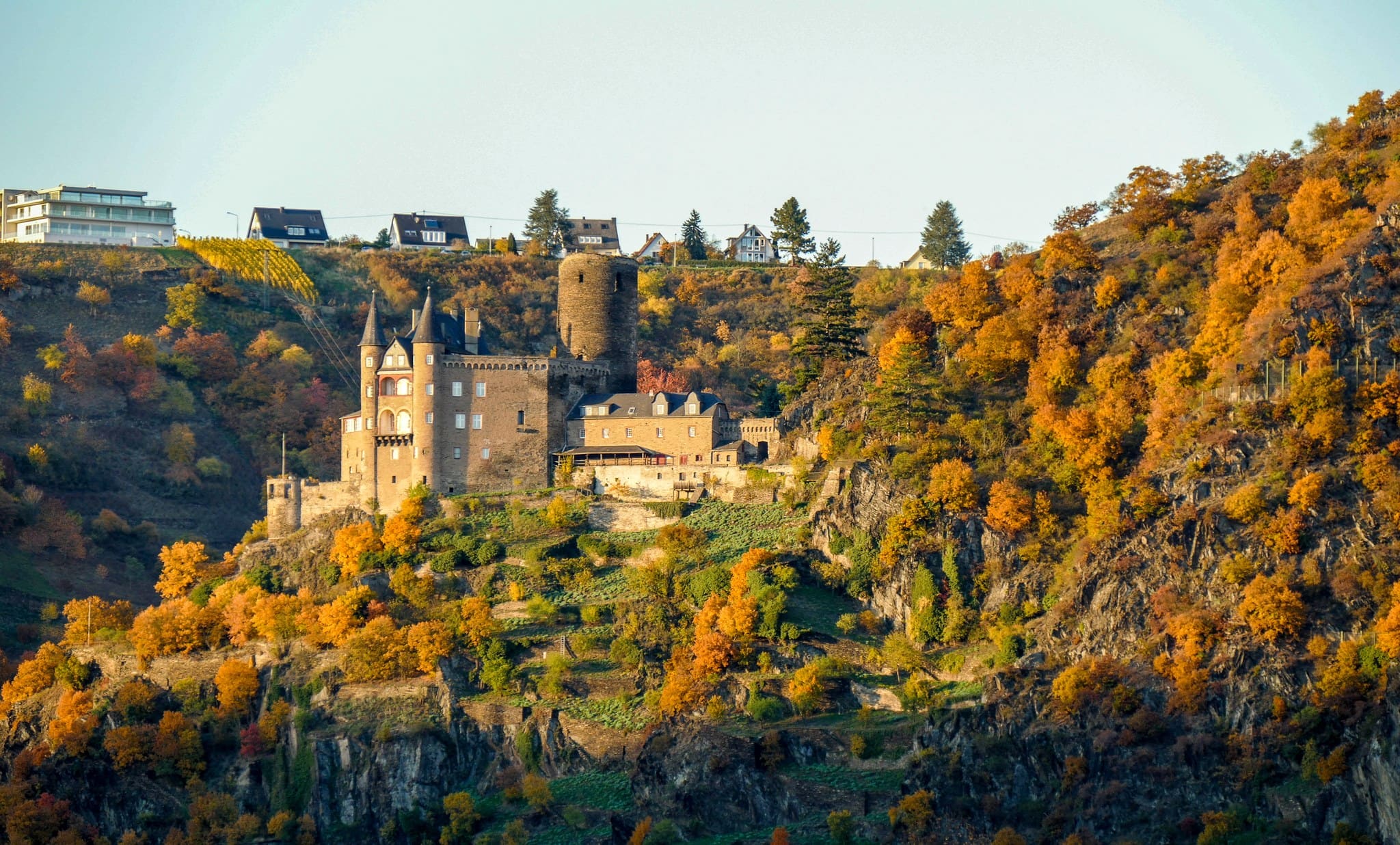
The building reflected the family that raised it. It is a compact Spornburg of rubble stone, unusually small in footprint and tightly packed, built with the Katzenelnbogen habit of almost never using a pointed arch. The plan approaches the later fortress type of roughly equal towers, but it is still dominated on the exposed northeastern side by a tall round keep (originally between about 45 and 50 meters, of which roughly 30 still stand, octagonal at the top in the family manner), backed by a three-story dwelling tower, a rock-cut neck ditch, and a triangular bastion thrown out in front of the gate.
None of this passed quietly to heirs. In 1479 the male line of the Counts of Katzenelnbogen died out with Philipp the Elder, at the height of the family’s power. The county (and with it the castle) passed to the Landgraves of Hesse: Philipp’s daughter Anna von Katzenelnbogen had married Landgrave Heinrich III “the Rich” of Hesse-Marburg at Marburg in 1458, and the inheritance fell in when the male line failed. Hesse acquired a fortress; it also acquired a quarrel.
A bone of contention between the Hesses (1479–1763)
By the sixteenth century the proud countercastle had been quietly demoted. From 1520 it kept only a military garrison, and in 1583 it passed to Hesse-Kassel, run less as a seat in its own right than as a forward support for the far greater fortress of Rheinfels across the water. Like Rheinfels, it then became a counter in the inheritance fights between Hesse-Kassel and Hesse-Darmstadt: besieged and partly destroyed in 1626 and again in 1647, in the Hessian war that ran alongside the Thirty Years’ War, and patched, reinforced, and re-gunned between the sieges. A castle built to tax a river was now being fought over by cousins.
The punishment did not end there. In 1692, during the Nine Years’ War, the castle was damaged again while the armies of Louis XIV besieged Rheinfels; in the Seven Years’ War the French took it in 1758 and handed it back in 1763. Through all of it Katz kept being repaired, and through all of it it remained, technically, undestroyed: a distinction that would matter for exactly one more lifetime.
One of the last castles France blew up (1806–1816)
The end came not from the mouse but from France. Rheinfels had been surrendered without a fight to the revolutionary army and blown up in 1796 and 1797; Katz stayed in Hessian hands a decade longer, its account books still recording repair money as late as 1800. Then, in 1806, on Napoleon’s orders, a French engineer detachment mined and detonated it, one of the last castles still standing on the Rhine to be deliberately slighted, brought down in the same campaign as Burg Gutenfels above Kaub. The demolition was thorough but not as total as Rheinfels’s: enough of the walls and the keep stub survived to make a later rebuild conceivable.
In 1816 the ruin passed to the Duchy of Nassau, and across the nineteenth century it moved through private hands while the river below filled with Romantic tourists. When Victor Hugo came up the Rhine in September 1840 he drew the broken castle from the Saint-Goar bank in pen and wash, labeled it Le Chat, and sent the sketch to his son; it later illustrated his Le Rhin. The irony was complete: the proud cat lay in pieces, a picturesque subject for a passing French poet, while the mouse it had been built to eat sat across the river, derelict but standing, exactly as it had been left.
A Cologne firm’s idea of the Middle Ages (1896–1989)
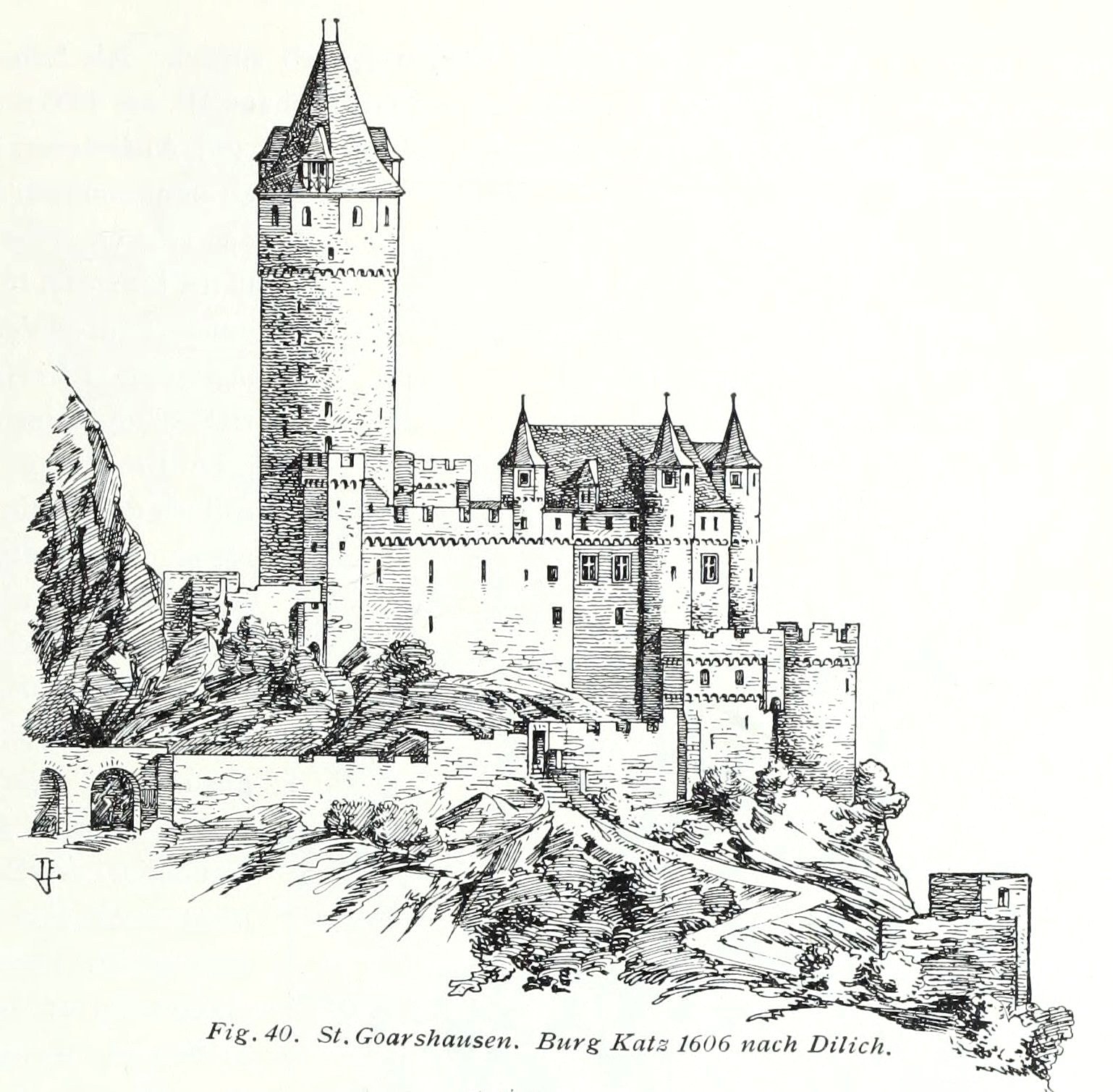
What stands on the spur today is not the medieval castle. Ferdinand Berg, the district administrator (Landrat) of the St. Goarshausen district, bought the ruin in 1896; the rebuilding followed in 1898–99, to designs by the Cologne firm of Schreiterer & Below, with the castle-restoration specialist Bodo Ebhardt involved and the work loosely following Wilhelm Dilich’s survey drawings of 1606–07. It followed 1890s taste rather than the evidence of the stones: genuine medieval fabric survives in just three places: the ruined core of the keep, parts of the hill-side shield wall, and the Zwinger. The silhouette that launches a thousand postcards is, in substance, a Wilhelmine country house wearing a castle.
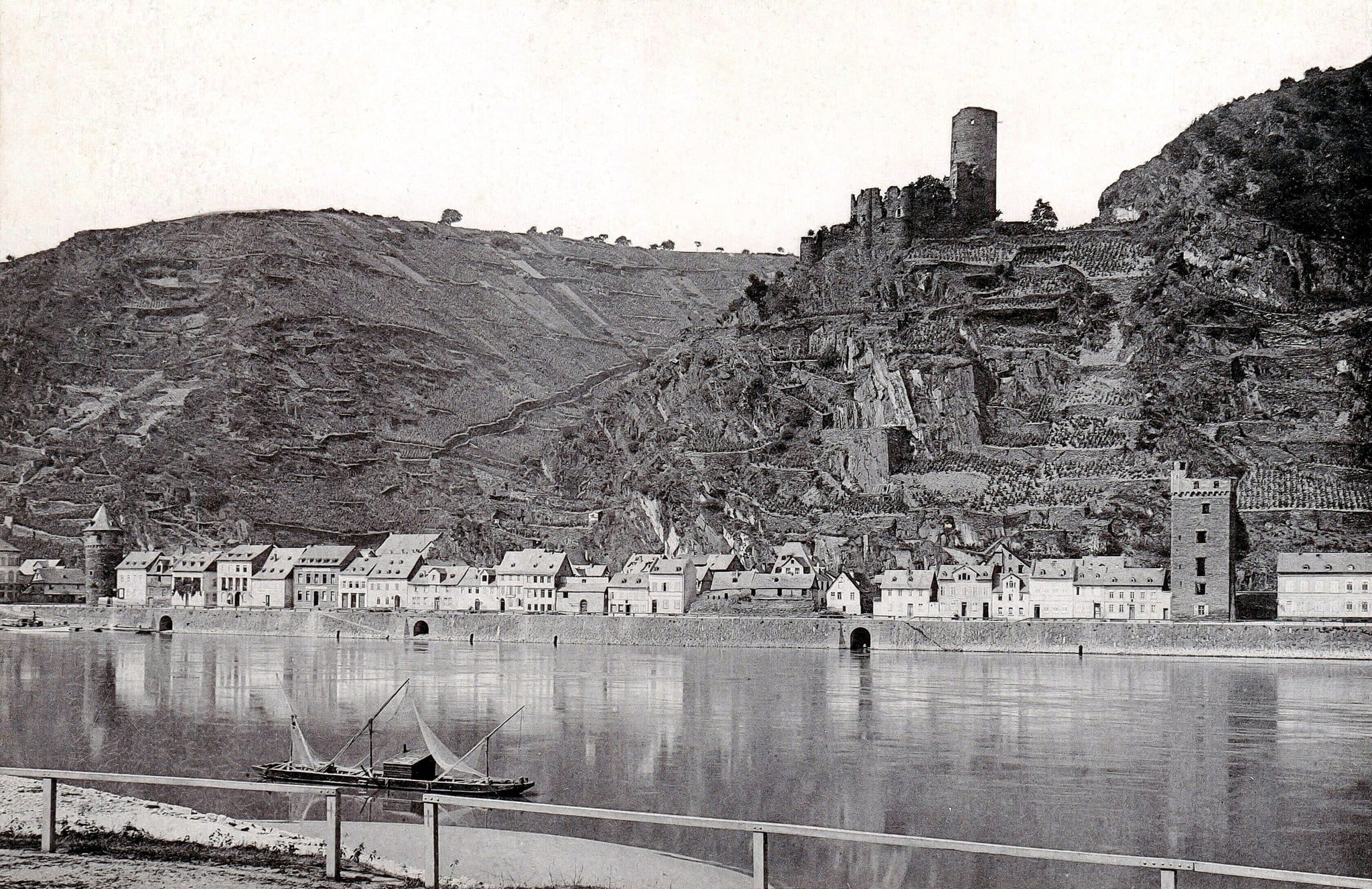
The twentieth century kept changing the locks. The castle was auctioned in 1928 and passed in 1936 to the Reich Labor Service (Reichsarbeitsdienst), which set up a training camp in it. After the Second World War the Federal Republic of Germany inherited it as the Reich’s legal successor, and it served first as a makeshift schoolhouse for the Institut Hofmann; boarding pupils were still housed on the site until 1966. Until the end of 1987 it was a staff recreation home of the federal finance administration, closed at last over something as ordinary as a missing fire escape.
In 1989 the Japanese management consultant Satoshi Kosugi bought Burg Katz for 4.3 million Deutsche Marks, reportedly intending to convert it into a hotel for Japanese visitors. According to Der Spiegel, which covered the sale that year, and the historian Horst-Johannes Tümmers, the conversion never happened. The castle has remained in private Japanese ownership ever since, lived in by no one the public sees and entered by no visitor at all.
Visiting in 2026
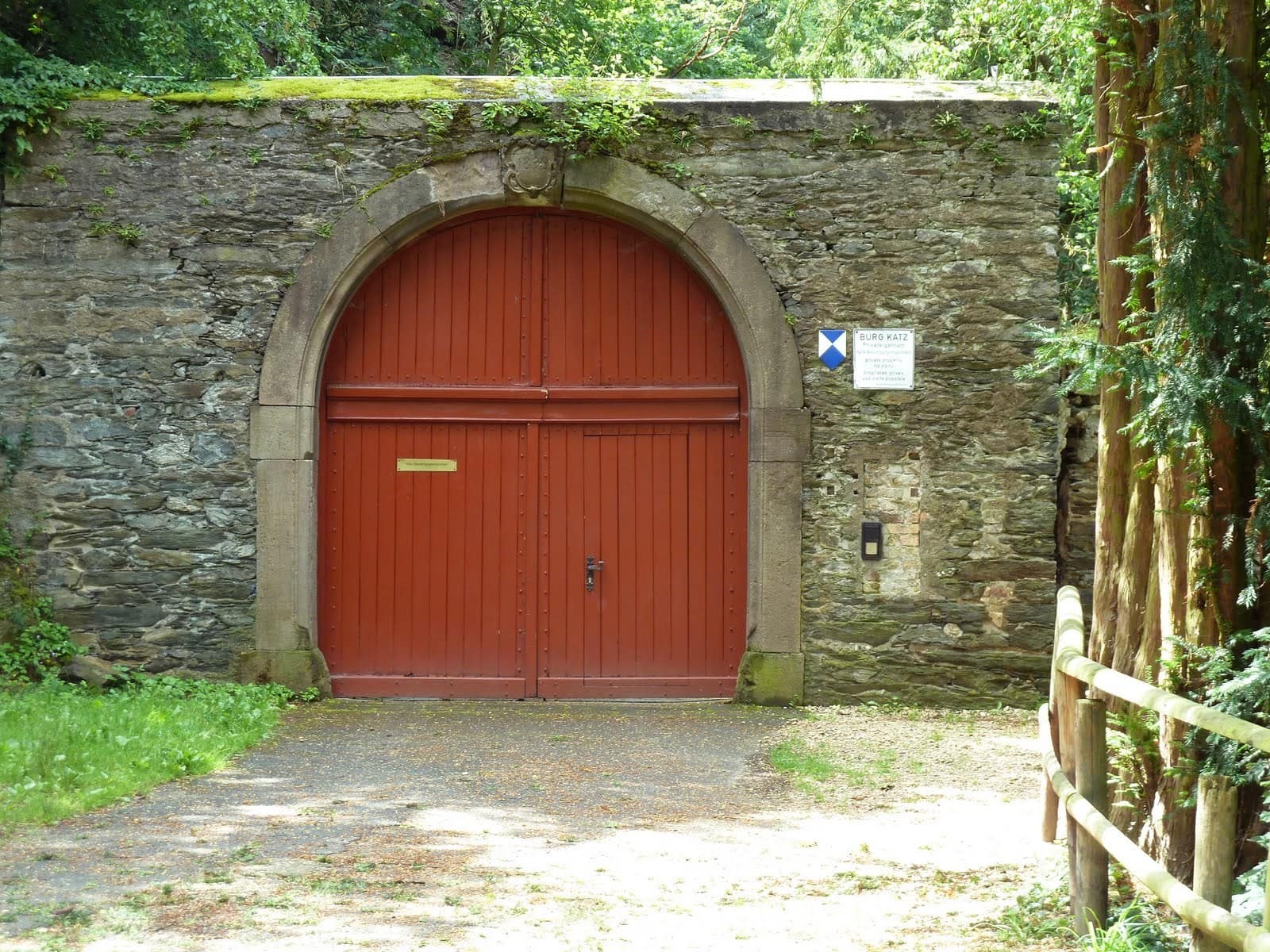
There is no admission to Katz Castle. It is private property, closed to the public, and there is no interior to tour, no ticket office, and no gate to queue at. What there is, instead, is one of the best castle views on the river, and you reach it by looking, not entering.
The classic, unobstructed view is from across the water at St. Goar (where, unlike Katz, the great fortress of Rheinfels is open to walk through), with the castle reading as a single mass on its spur and the Loreley behind it; the St. Goar–St. Goarshausen car and passenger ferry puts you on that bank in minutes. River cruises pass directly beneath it, and the climb to the Loreley plateau or to the Dreiburgenblick above St. Goarshausen (the “three-castle view,” taking in Katz, Maus, and Rheinfels at once) lays the whole rivalry out in one frame. The Rheinsteig and Rheinburgenweg trails both pass within sight of the walls.
The one night the castle performs is the third Saturday in September, when it is itself a stage. At Rhein in Flammen (“The Night of the Loreley,” on September 19 in 2026) great fireworks are fired from Katz and from Rheinfels opposite, with an illuminated convoy of passenger ships on the river between them, the main display falling between roughly 9 and 10 p.m. It is the one occasion on which the private cat earns its keep in public.
One travel note for 2026: the right-bank Rhine railway through St. Goarshausen (the Troisdorf–Wiesbaden line) is fully closed from July 10 to December 12, 2026 for the DB InfraGO “Korridorsanierung Rechter Rhein” corridor renewal. Regional trains on the RB 10 are replaced by buses (Schienenersatzverkehr) for the whole period. During that window, reach St. Goarshausen by car or via the St. Goar–St. Goarshausen ferry from the left-bank line; outside it, normal rail service applies. Anyone staying overnight can compare hotels in and around St. Goarshausen.
Some links on this page are affiliate links, which means StoneKeep Atlas may earn a small commission, at no extra cost to you, if you book through them.
Beyond Katz
Katz belongs to the densest concentration of castles in Europe, and it is best understood beside its neighbors. The wider story is told in the hub guide to the castles of the Rhine Gorge, which sets the toll-castle system in its full landscape.
For the rest of the joke, read Maus Castle downstream: the “mouse” that outlasted the cat by never fighting at all. Directly opposite stands Rheinfels, the Katzenelnbogen super-fortress that formed the other jaw of the double toll and shared Katz’s fate at French hands; Gutenfels at Kaub was blown up in the very same 1806 campaign. For the family castle France never touched, see Marksburg, the only Rhenish hill castle never destroyed; and for a near-exact parallel to Katz’s afterlife (a medieval ruin rebuilt around 1900 into a historicist seat), see Reichenstein.
Conclusion
Katz Castle is, in the end, a fortress that won every argument except the last one. It was the larger of the cat-and-mouse pair, the better-armed jaw of the toll trap, the castle pointed in mockery at a smaller rival, and it never had to prove any of it, because what destroyed it was France, not the mouse. What survived the explosion was not the building but the joke; what stands on the spur now is an 1890s architect’s confident guess at what a Rhine castle should look like, while across the water the mouse is still there, unrebuilt and unbothered. The pair only ever made sense together; here, at last, it is whole.
Principal Sources
- Becher, Constantin. “Burg Katz bei Sankt Goarshausen.” KuLaDig, Landschaftsverband Rheinland.
- Dehio, Georg. Handbuch der Deutschen Kunstdenkmäler: Rheinland-Pfalz, Saarland. 2nd ed. Deutscher Kunstverlag, Munich and Berlin, 1984.
- Demandt, Karl E. Rheinfels und andere Katzenelnbogener Burgen als Residenzen, Verwaltungszentren und Festungen 1350–1650. Arbeiten der Hessischen Historischen Kommission, N.F. Bd. 5. Darmstadt, 1990.
- Friedrich, Reinhard, and Jens Friedhoff. “Burg Katz.” EBIDAT, Europäisches Burgeninstitut (Deutsche Burgenvereinigung).
- Fuhr, Michael P. Wer will des Stromes Hüter sein? 40 Burgen und Schlösser am Mittelrhein. Schnell & Steiner, Regensburg, 2002.
- Generaldirektion Kulturelles Erbe Rheinland-Pfalz. Staatliche Burgen, Schlösser und Altertümer in Rheinland-Pfalz. Schnell & Steiner, Regensburg, 2003.
- “Burg Katz in St. Goarshausen.” regionalgeschichte.net, Institut für Geschichtliche Landeskunde an der Universität Mainz.
- “Burgen – Wild entschlossen.” Der Spiegel, no. 16, April 17, 1989, pp. 116–117; and Tümmers, Horst-Johannes. Der Rhein: ein europäischer Fluss und seine Geschichte. 2nd ed. C. H. Beck, Munich, 1999.
Visitor information was confirmed against the official tourism pages for the castle and the Loreley region, loreley-touristik.de and romantischer-rhein.de; the UNESCO World Heritage portal for the Upper Middle Rhine Valley, welterbe-mittelrheintal.de; the Rhein in Flammen organizer, rhein-in-flammen.com; and the DB InfraGO corridor-renewal project pages for the right-bank Rhine line, all consulted in 2026.
Image credits. Featured image licensed via Adobe Stock (no. 238944322). Burg Katz in autumn: Charlie1965nrw, CC BY-SA 3.0, via Wikimedia Commons. The medieval keep and the rebuilt castle: Alexander Hoernigk, CC BY 3.0, via Wikimedia Commons. Burg Katz in 1606 after Wilhelm Dilich (engraving by Ferdinand Luthmer): public domain, via Wikimedia Commons. St. Goarshausen with the ruined Katz, 1897: Römmler & Jonas, public domain, via Wikimedia Commons. The castle gate: Ralf Houven, CC BY 3.0, via Wikimedia Commons. Freely licensed images are resized to fit; otherwise unaltered.