
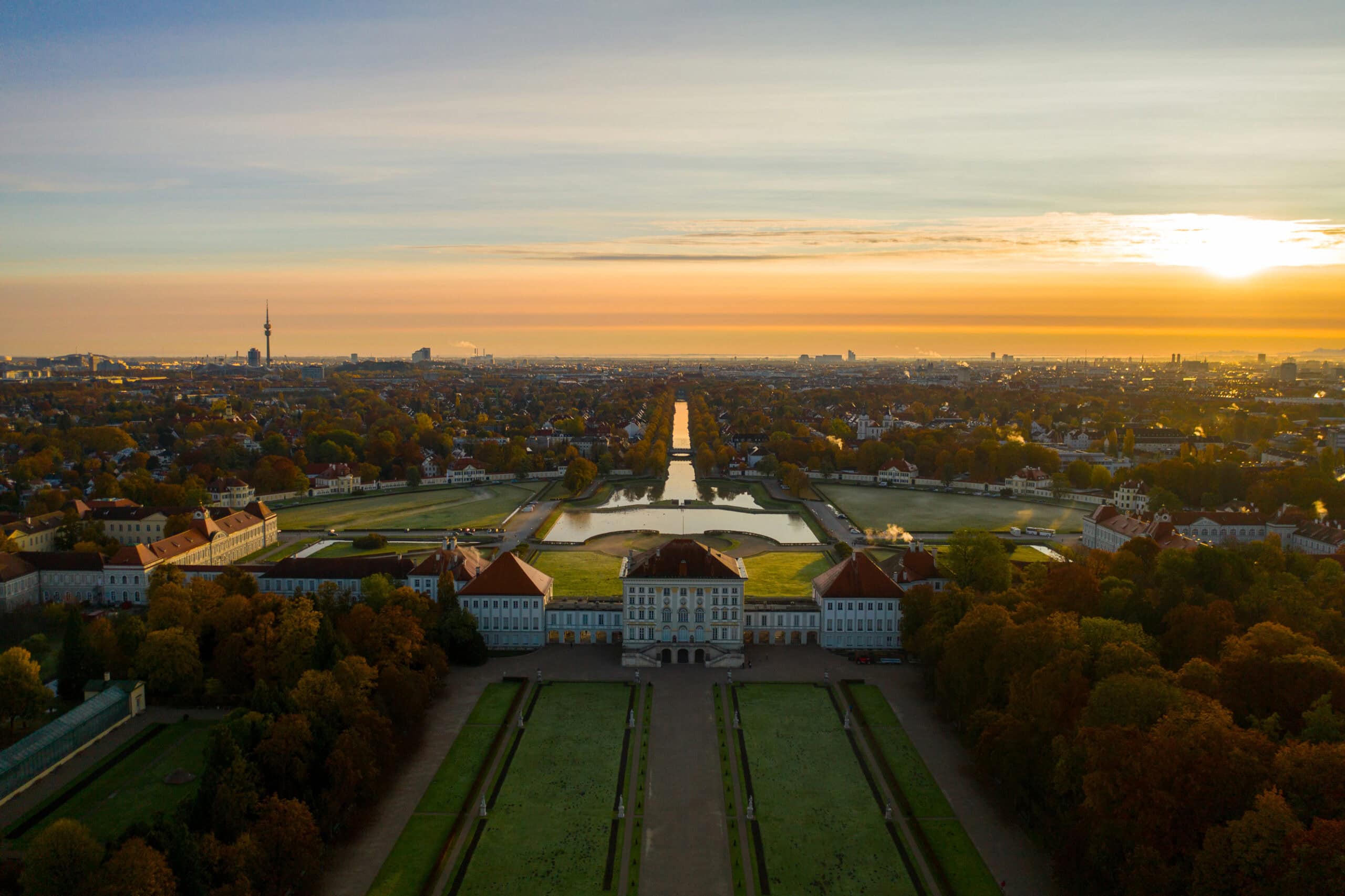
Nymphenburg Palace
Nymphenburg Palace began as a gift. In 1664 the Bavarian elector Ferdinand Maria gave his wife, Henriette Adelaide of Savoy, the means to build a summer villa on open meadow west of Munich, his thanks for the birth two years earlier of the long-awaited heir, Max Emanuel. What rose there was modest beside what followed: a single Italian pavilion in a walled garden, a carriage ride of some two hours from the city and its winter Residenz. Across the next century and a half that villa swelled into one of the broadest palace fronts in Europe, framed by a park of pleasure pavilions and, in time, an English landscape garden. Where the Munich Residenz records the Wittelsbach ascent from duchy to electorate to kingdom, Nymphenburg records something gentler: a dynasty at its ease, building for the pleasure of being itself. It is the summer answer to the Residenz’s winter ceremony, and the birthplace, in 1845, of Bavaria’s most storied king.
Quick Facts
| Name | Nymphenburg Palace |
| German name | Schloss Nymphenburg |
| Location | Munich, Bavaria, Germany |
| Built | From 1664; extended to c. 1758 |
| Founders | Elector Ferdinand Maria & Henriette Adelaide of Savoy |
| Architects | Agostino Barelli, Enrico Zuccalli, Joseph Effner, François Cuvilliés the Elder |
| Style | Italian Baroque core; Rococo and Neoclassical additions |
| Frontage | About 632 m (north–south span) |
| Park | About 200 hectares (180 ha within the wall; 229 ha whole ensemble) |
| Owner / operator | Bavarian Palace Administration (its headquarters) |
| Open to public | Yes: palace, Marstallmuseum, porcelain museum, and four park palaces |
| Notable | Birthplace of King Ludwig II (1845); Gallery of Beauties; Nymphenburg porcelain |
| Official site | schloss-nymphenburg.de |
A villa in the meadow of the nymphs
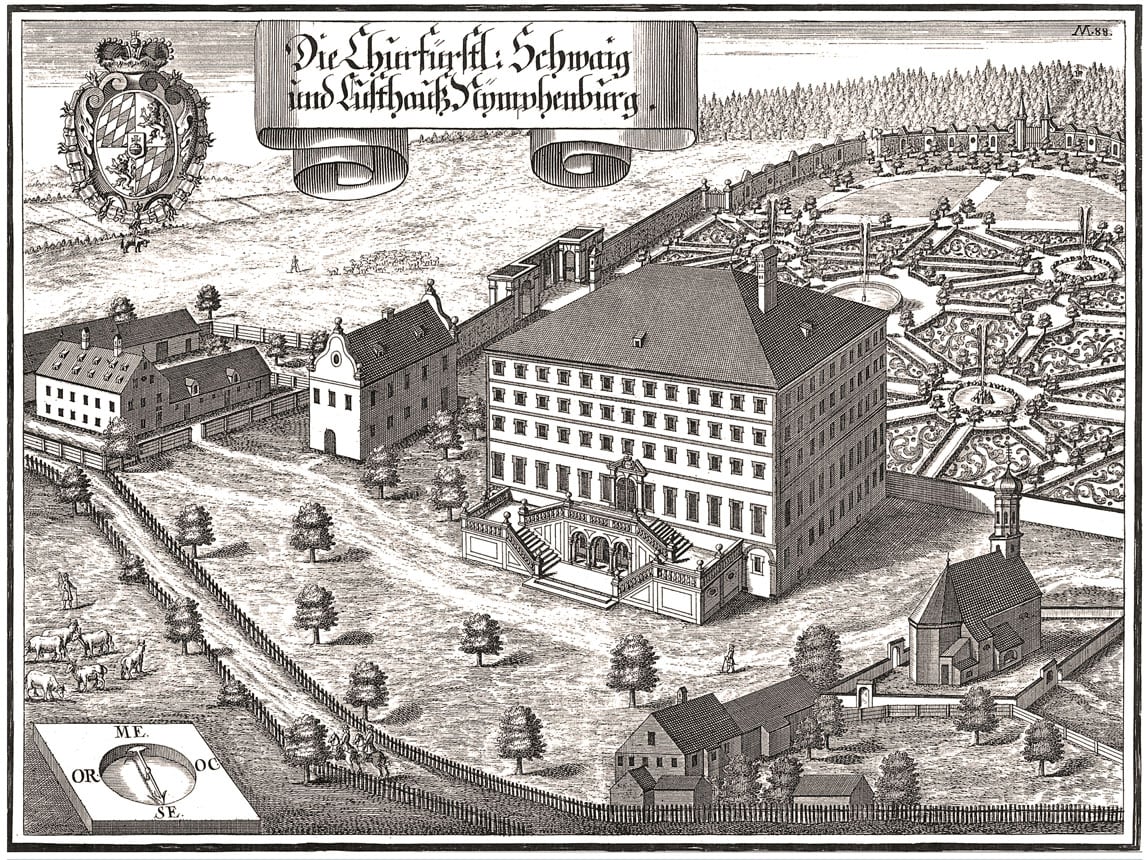
Ferdinand Maria and Henriette Adelaide had waited ten years for a son. When Max Emanuel arrived in 1662, the grateful elector handed his Savoyard wife a country estate at Kemnathen on the edge of the court lands, two hours west of the city, and the funds to build on it. Construction began in 1664 to plans by Agostino Barelli, a north Italian architect already at work on Munich’s Theatine Church. Barelli gave the electress a tall cubic pavilion in the Italian manner, flanked by a court church and service buildings and fronted by a small geometric garden. Contemporaries called it simply the Lusthaus Nymphenburg, the pleasure house. Henriette Adelaide, who took a leading role in the project, is said to have named her retreat for the nymphs, the Borgo delle ninfe that becomes Nymphenburg in German. Surrounded by open country, the villa was somewhere the court could shed a little of its formality. Munich has since grown out to meet it, so that the meadow retreat now sits inside the city, yet the long approach and the canal still preserve the sense of arrival from another world. Its builder did not see the work finished. She died at Nymphenburg in 1676, and by about 1679 the palace stood complete in its first, compact form, the central block roofed and the rooms in use. Enrico Zuccalli had by then begun reshaping the central pavilion, the first hint that a summer house for one electress would not stay a summer house for long.
Max Emanuel and the making of a Baroque palace
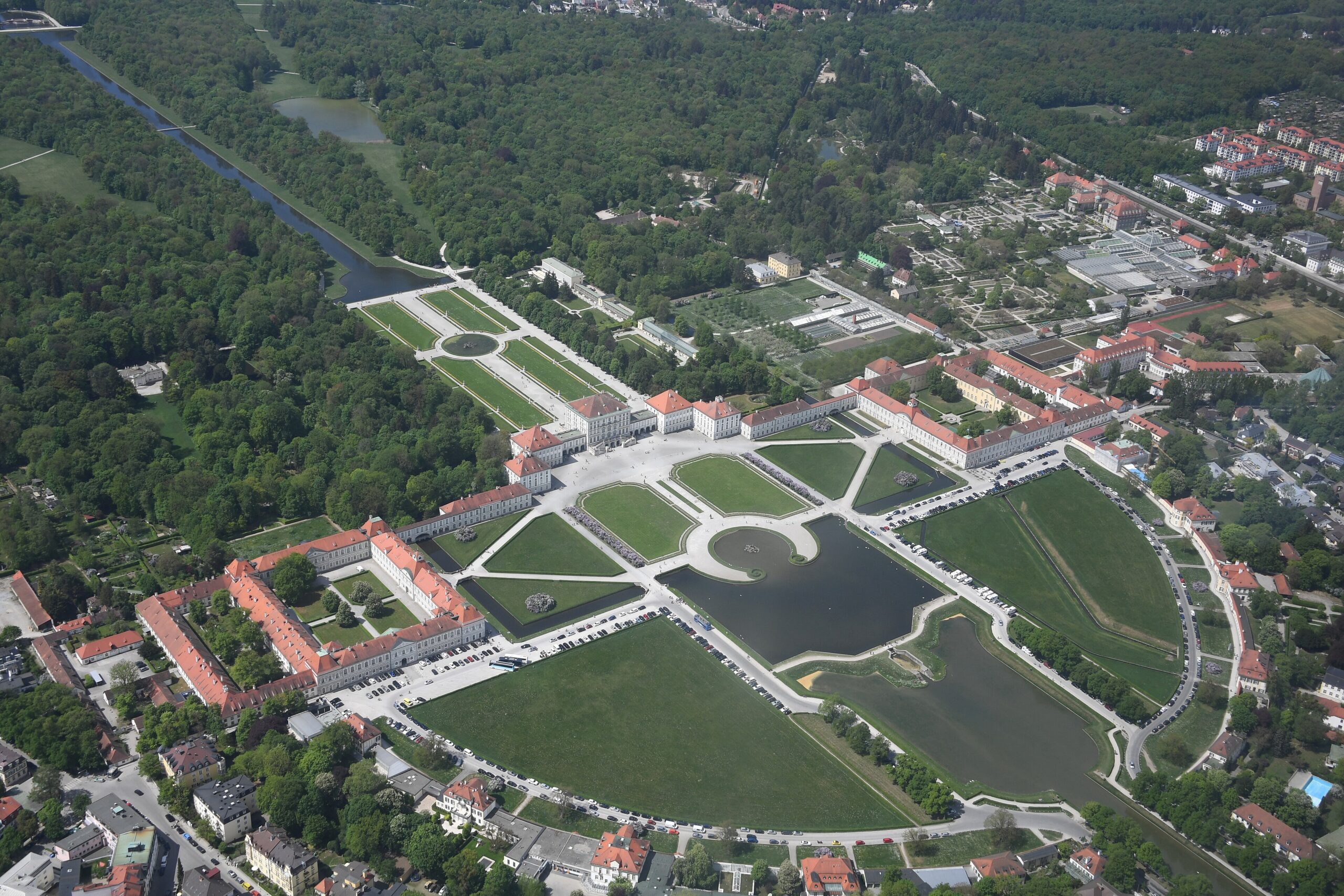
Max Emanuel inherited his mother’s villa in 1679 and spent the next four decades turning it into a palace. Ambitious, an able soldier, and for a time a candidate for grander thrones, he wanted a seat that announced Bavaria’s weight among the German courts. From 1701 his architect Enrico Zuccalli added a pair of pavilions to north and south of the original block, joined to it by gallery wings, and the elector laid out a vast Baroque park on the French model, its central canal fed from the Würm and drawing the eye westward to the horizon. Moving that much water across flat ground was an engineering feat in itself, and the canal system that resulted still runs today. War interrupted the vision. Max Emanuel backed France in the War of the Spanish Succession, lost, and spent the years from 1704 to 1715 in exile while Bavaria sat under Austrian occupation. Those were lean years for the duchy, and work on the palace halted entirely until his fortunes recovered. On his return he brought a suite of French and French-trained artists who reset the palace in the latest Paris fashion. Chief among them were the architect Joseph Effner and the garden designer Dominique Girard. Effner redesigned the central pavilion, furnished the state rooms, and drew up a master plan for the whole site; Girard gave the park its definitive Baroque geometry. Franz Joachim Beich filled the connecting galleries with painted views of the Bavarian palaces, a record of the dynasty’s holdings hung where every guest would pass, while the stuccoist Johann Baptist Zimmermann emerged as the leading decorative hand of the Munich court. Effner’s plan reached beyond the palace itself. Radiating from the central block, a great crescent of paired cavalier houses was to curve around a circular forecourt, a self-contained ideal town able to house the entire royal household and its servants. Begun from this design, the crescent took shape over three decades and reached completion under Max Emanuel’s son. By the time the work slowed, Nymphenburg had grown from one Italian pavilion into a symmetrical complex whose frontage runs some six hundred and thirty meters from wing to wing, half as wide again as the garden front of Versailles.
Rococo zenith: Karl Albrecht and Max III Joseph
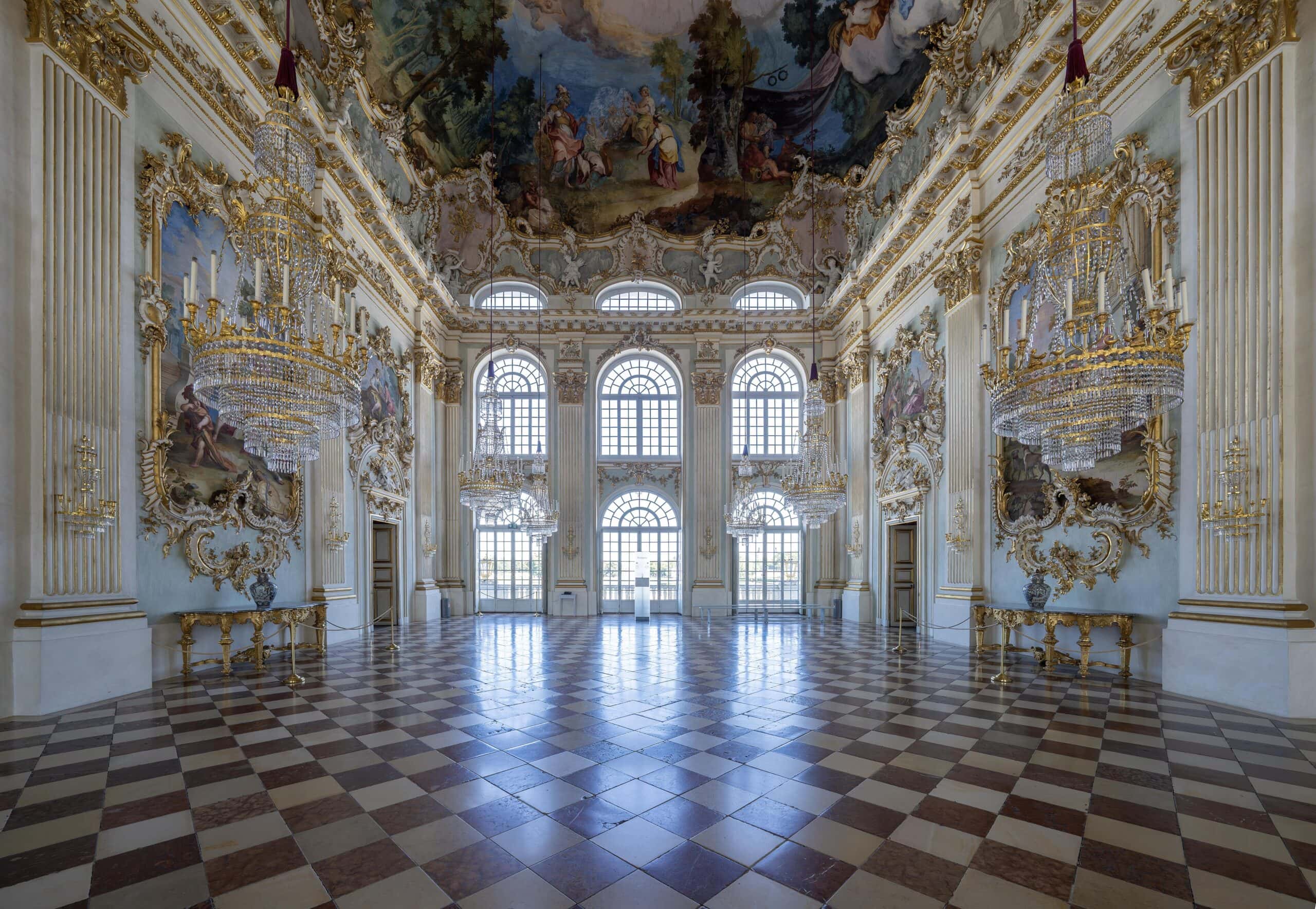
Two electors brought Nymphenburg to its decorative peak. Karl Albrecht, who ruled from 1726 and was crowned Holy Roman Emperor as Charles VII in 1742, finished his father’s crescent and commissioned the building that many consider the palace’s finest single room. His imperial adventure did not last. He died in the Munich Residenz in January 1745, not at Nymphenburg as some accounts claim, his title already collapsing under Austrian counterattack. His son Max III Joseph turned from politics to patronage. Under his rule, from 1745 to 1777, the Steinerner Saal, the great two-story Stone Hall at the heart of the palace, received the airy Rococo decoration it still wears. Johann Baptist Zimmermann painted the ceiling, a sunlit assembly of gods and nymphs that opens the room to a painted sky, while François Cuvilliés the Elder directed the gilded stuccowork; the hall was complete by about 1758 and has scarcely changed since. As the ceremonial center of the palace, the Stone Hall ran the full depth of the central block, its windows framing the canal on one side and the forecourt on the other. Zimmermann’s ceiling plays on the palace’s own name, filling the vault with nymphs and river gods so that the room becomes a painted echo of the watery park outside. Concerts and court festivities filled it through the summers. That same reign painted the chapel vault, remodeled the Grand Parterre with statues of the Olympian gods, and added the outdoor staircases that still serve as the palace’s ceremonial approach. Max III Joseph also gave Nymphenburg the craft most closely tied to its name. In 1747 he founded a porcelain manufactory, first at Neudeck in the Au district and from 1761 in a cavalier house on the northern crescent, directly before the palace. Its early modeler Franz Anton Bustelli produced Rococo figures, among them a celebrated set of commedia dell’arte characters, now counted among the finest porcelain ever made in Europe. Such pieces set the royal table and made Nymphenburg porcelain a prize across the courts of the eighteenth century. Powered by water drawn from the palace canal, the workshop still produces porcelain entirely by hand, one of the last in the world to do so, and its painting tradition was placed on Germany’s national register of intangible cultural heritage in 2016. The wares carry the palace name across the world, and the manufactory has never left the grounds it was born on.
Four jewels in the park: the Lustschlösser
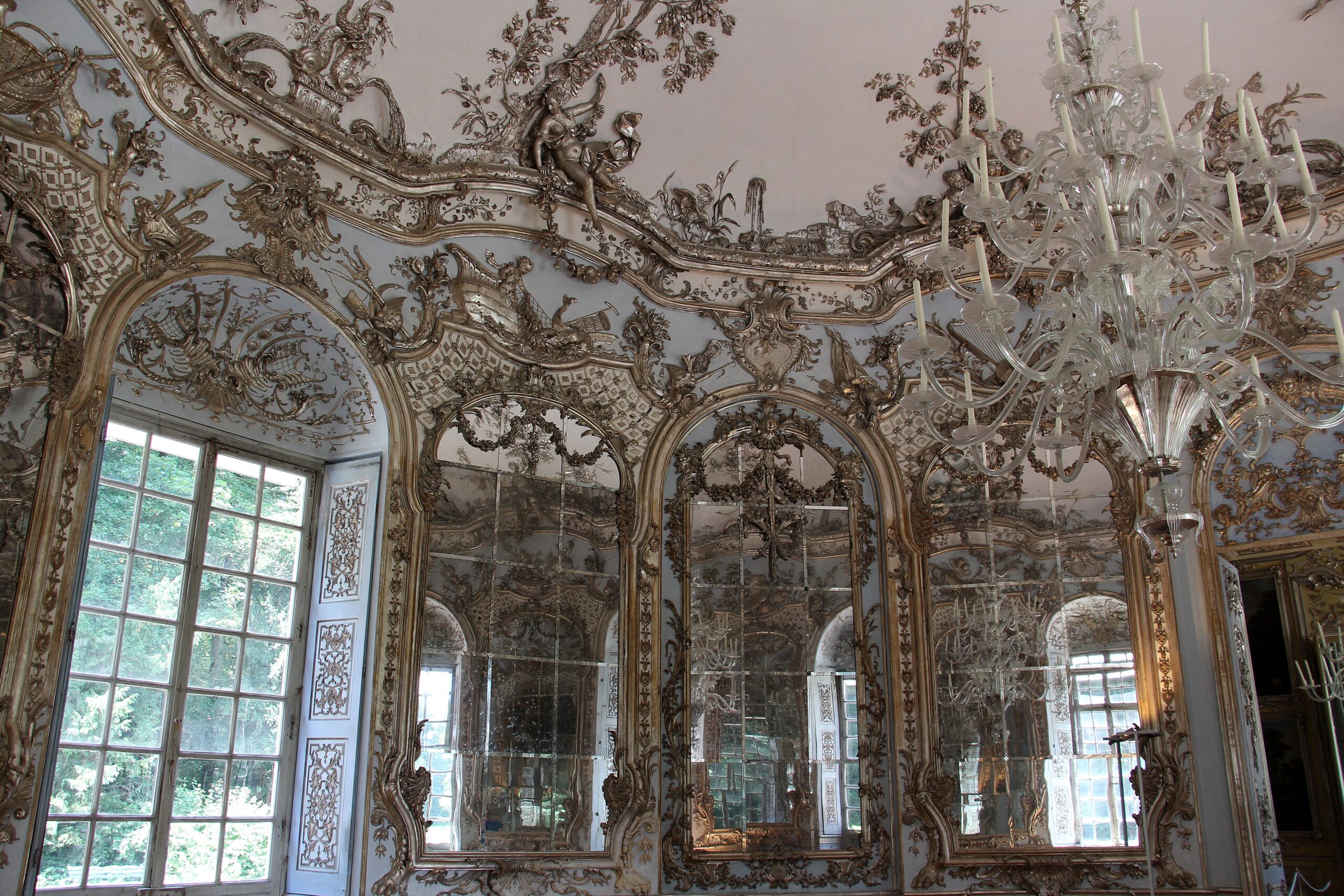
If the palace shows the Wittelsbachs building for show, the park shows them building for pleasure. Scattered through the grounds are four small pavilions, each a perfect expression of what an eighteenth-century court did when it wanted to enjoy itself. They are the clearest argument for reading Nymphenburg as a leisure palace rather than a seat of state. No throne room demanded them; they exist only because a wealthy court wanted places to bathe, take tea, hunt, and dream. Joseph Effner built three of them for Max Emanuel within a single decade. Raised between 1716 and 1719, the Pagodenburg is an octagonal tea house dressed inside in blue-and-white Delft tiles below and Chinese lacquer above, a fashionable fantasy of the Far East where the court rested after a game of pall-mall on the adjoining green. A bathing pavilion of 1718 to 1722, the Badenburg is built around a two-story banqueting hall and a heated pool sunk into its lower floor, which the Bavarian Palace Administration describes as the first heated indoor pool since antiquity, a claim that nods to the Roman baths it consciously echoes. Finished in 1728, the Magdalenenklause runs in the opposite direction entirely: Effner designed it as an artificial ruin, a hermit’s retreat of deliberately cracked walls and a grotto chapel, dedicated to the penitent Saint Mary Magdalene who gave the building its name, where the elector could play at withdrawal from the world. Max Emanuel did not live to see it completed. The fourth and finest came a generation later. Karl Albrecht commissioned the Amalienburg for his wife, the electress Maria Amalia, and between 1734 and 1739 François Cuvilliés the Elder built her a hunting lodge that ranks among the supreme achievements of European Rococo. It was a working lodge, with a kennel room, a kitchen lined in Dutch tiles, and a rooftop platform for shooting pheasant, but its heart is the silver-and-blue Hall of Mirrors, where pale stucco foliage climbs across mirrored walls and dissolves the line between room and reflection. Beyond it open a lemon-yellow retiring room and a blue cabinet, each as finely worked as anything in the main palace. Cuvilliés would go on to design the Cuvilliés Theatre at the Munich Residenz, yet the Amalienburg remained his most concentrated masterpiece, a small building that holds more invention than wings ten times its size.
From Baroque parterre to English park
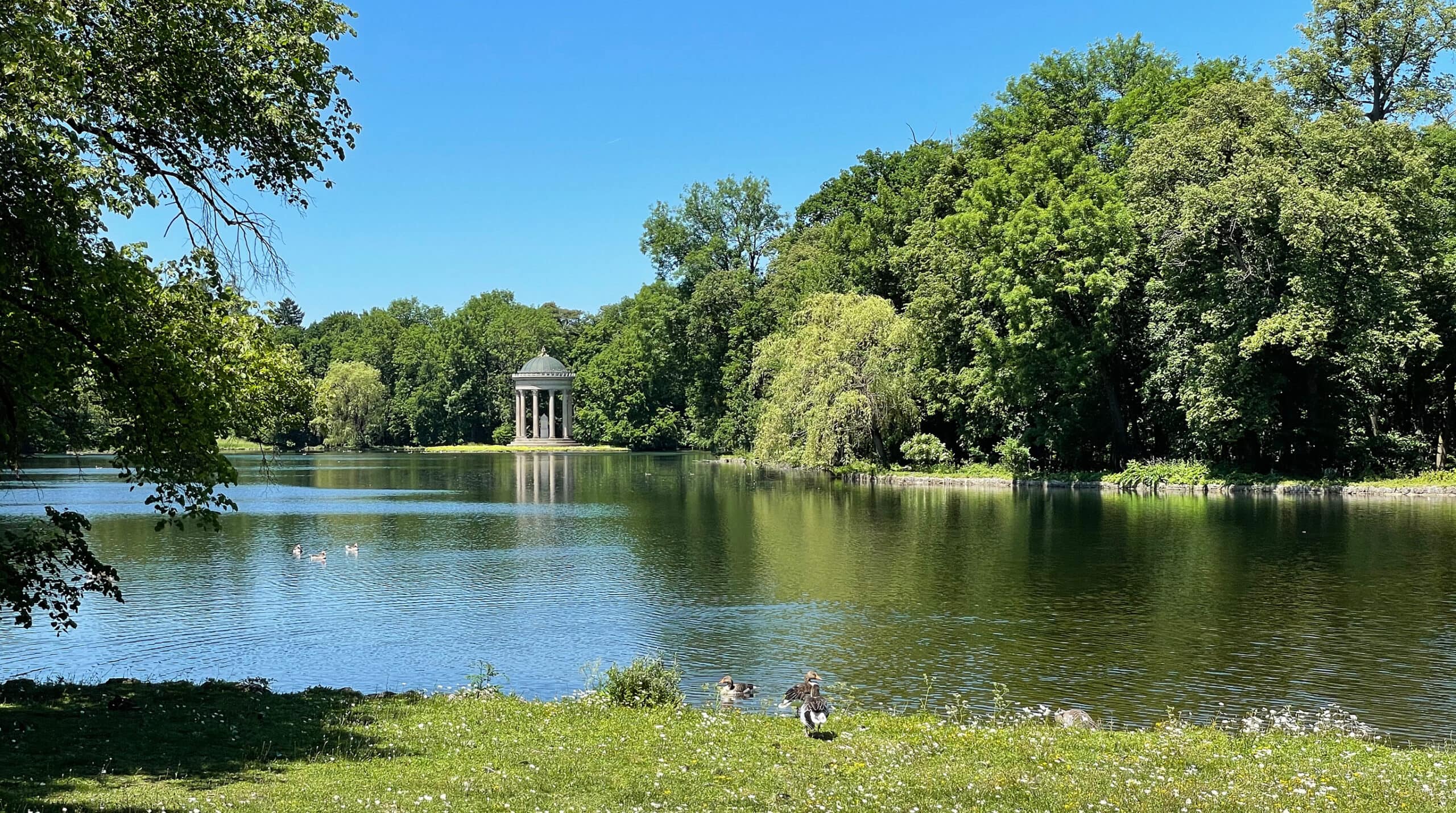
Nymphenburg’s gardens changed with the century’s taste. For their first hundred years they were strictly French: clipped parterres, straight allées, and the long central canal aligned on the palace axis, all of it laid out by Girard and Effner from Max Emanuel’s day. When the Baroque style fell from fashion, the gardens followed the building into a new age. Friedrich Ludwig von Sckell, the leading German landscape gardener of his generation and the designer of Munich’s English Garden, carried out the change. He had already shaped the Kronprinzengarten here in 1799; commissioned around 1800 by the future King Max I Joseph, he then worked between 1804 and 1823 to soften the rigid geometry into an English landscape park of winding paths, irregular lakes, and open meadows framed by trees. He was too skilled to erase what came before. Sckell kept the Grand Parterre nearest the palace and preserved the central canal and cascade, so that a visitor today passes from formal Baroque order near the building into naturalistic landscape beyond, the two styles stitched together with rare tact. At the canal’s western end the marble cascade still spills between river-god figures, the formal climax that Sckell chose to keep. A small Corinthian temple, the Monopteros designed by Leo von Klenze, was set above the lake in 1865 to replace two earlier wooden rotundas, and it carries a marble dedication to King Ludwig I. Karl Theodor had opened the gardens to the public as early as 1792; Sckell’s redesign gave Munich one of the great city parks of Europe, and it remains so, an everyday refuge of about two hundred hectares where deer and waterfowl share the lawns with joggers. Within its historic wall the park covers a hundred and eighty hectares, and the whole ensemble runs to well over two hundred. Its historic fountains, still driven by water power alone, are among the oldest continuously working machines in Europe.
A kingdom’s summer seat
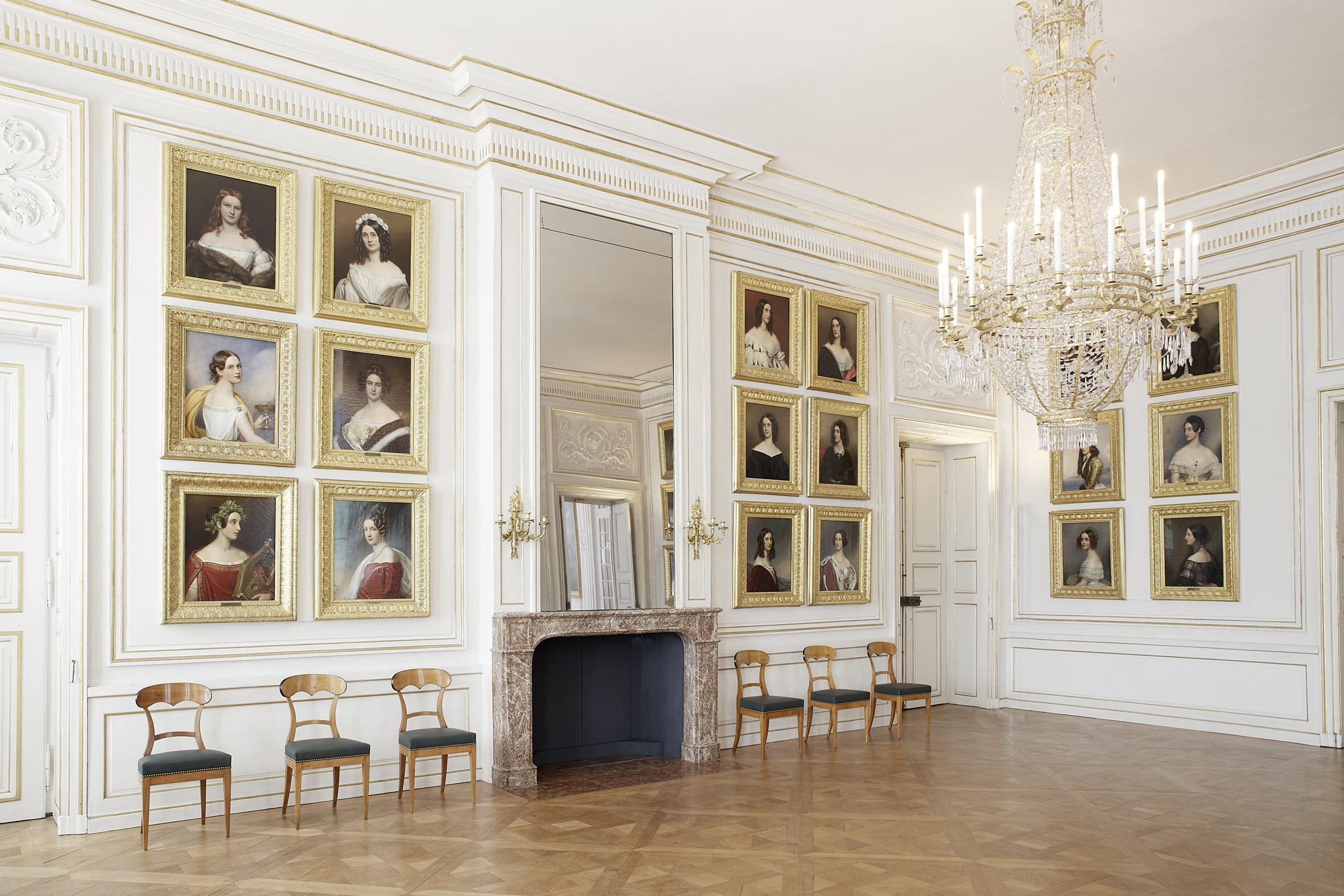
When Bavaria became a kingdom in 1806, Nymphenburg gained a new role as a royal summer residence. Maximilian I Joseph, the first king, had several rooms refitted in restrained Neoclassical taste, and he died at the palace in 1825. His successors kept coming back through the summers, and the building accumulated the domestic memories that turn a showpiece into a home. One room above all draws visitors today. In the south pavilion, in a gold-and-white salon that once served as a small dining room, hangs the Gallery of Beauties, the collection King Ludwig I commissioned from Joseph Karl Stieler, his court painter since 1820, between 1827 and 1850. What set the series apart from earlier court galleries was its reach across class: Stieler painted not only princesses and countesses but women from ordinary Munich, all chosen by the king’s own eye. Thirty-six portraits survive, among them a shoemaker’s daughter, the celebrated Helene Sedlmayr, who is said to have caught the king’s notice while delivering toys to the palace, and the dancer Lola Montez, whose hold over the aging Ludwig helped force his abdication in the revolution of 1848. Among the faces too is Marie of Prussia, who would become the mother of Ludwig II. That series was painted for the Munich Residenz and moved to Nymphenburg only after the Second World War, but the room suits it, a private indulgence at home in a pleasure palace. The palace’s deepest claim on Bavarian memory is a birth. On August 25, 1845, in the Queen’s bedchamber of the south wing, the future King Ludwig II was born to Crown Prince Maximilian and Marie of Prussia, and church bells were rung across Munich to announce the heir. He was baptized the next day in the Stone Hall and named for his grandfather Ludwig I, with whom he shared the August 25 feast of Saint Louis. The boy who would build Neuschwanstein and Linderhof, and who would chase a private world as far from public life as he could go, came into the world in the summer house of his family. His birth room is preserved, and it remains one of the quiet centers of any visit.
Visiting Nymphenburg in 2026
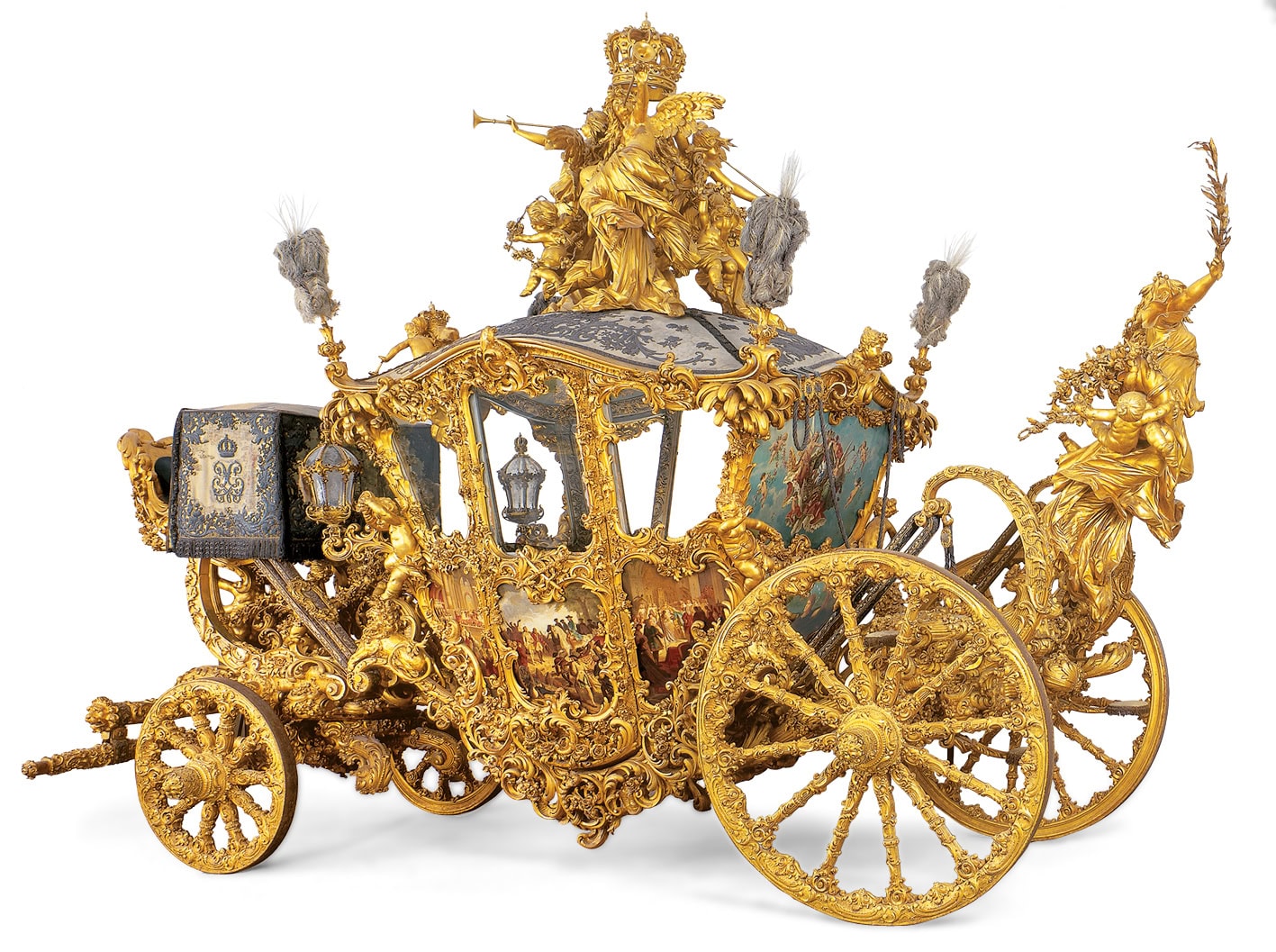
Nymphenburg sits in western Munich, easily reached by tram from the city center, and it rewards a half-day at least. The palace interior, the Marstallmuseum, the porcelain museum, and the four park pavilions can be seen on a single combination ticket, which costs 20 euros for adults in the main season from April 1 to October 15 and 16 euros in winter when the park pavilions close. Tickets for the palace alone run 10 euros, the Marstallmuseum 8 euros, and the four park palaces together 6 euros. Visitors under eighteen enter free. The palace and Marstallmuseum open daily, from 9 a.m. to 6 p.m. in the main season and 10 a.m. to 4 p.m. through the winter, with last admission half an hour before closing; all sites close on January 1, Shrove Tuesday, and 24, 25, and December 31. There are no scheduled guided tours, but an audio guide in eleven languages costs 3.50 euros, and entry to the palace itself runs on timed slots that are worth booking online in advance. The Marstallmuseum holds the royal coaches and sleighs, among them Karl Albrecht’s gilded coronation coach, one of the finest French Rococo carriages anywhere, and the dream-like state sleighs that Ludwig II rode by torchlight; the floor above displays the Bäuml collection of Nymphenburg porcelain. The north wing houses the Museum of Man and Nature, a natural-history collection run independently of the palace tour. The palace also serves as the working headquarters of the Bavarian Palace Administration, which cares for it along with dozens of other royal sites across the state. The park itself needs no ticket and keeps long hours, opening at six in the morning and closing as late as half past nine on summer evenings. Tram line 17 runs to the Schloss Nymphenburg stop a short walk from the forecourt, where the Hubertus fountain plays before the central pavilion and a café occupies one of the wings for those who want to linger. A visitor with time to spare should walk the canal axis out to the cascade and back by way of the pavilions, which is the surest way to feel why the Wittelsbachs kept returning. At the time of writing, the palace’s Lacquer Cabinet is closed for restoration until autumn 2026, though the other state rooms remain open. Entry tickets and local tours can also be booked in advance through GetYourGuide.
Beyond Nymphenburg
Nymphenburg is one of three great Wittelsbach houses around Munich, and it makes most sense seen against the other two. The Munich Residenz in the city center was the family’s seat of government and ceremony, a labyrinth of state rooms built to project rank; Nymphenburg was where the same family went to relax. Between them lies Schloss Schleißheim to the north, Max Emanuel’s true attempt at a Bavarian Versailles, a palace begun in open imitation of Louis XIV that ambition and money never let him finish at full scale. Together the three map the full range of what a German electoral court built, from the business of rule to the pursuit of pleasure. Schleißheim shows the ambition that overreached, the Residenz the rank that was won, and Nymphenburg the ease that both were meant to buy. For travelers drawn by the Ludwig II connection, Nymphenburg is the natural starting point of a longer trail. The king born here would spend his reign building the castles that made him famous: Neuschwanstein above the Alpine foothills, Linderhof in its mountain valley, and the childhood home at Hohenschwangau where he grew up. Nymphenburg belongs with Burg Trausnitz and the other Wittelsbach residences gathered on our guide to the best castles in Bavaria, and it anchors the dynastic story told across our Wittelsbach hub. Seen alone it is a beautiful summer palace; seen in company it is the comfortable heart of a family that ruled Bavaria for more than seven centuries.
Conclusion
Few buildings trace a dynasty’s character as plainly as Nymphenburg. It started as one man’s gift to his wife and grew, over four generations, into a palace that never quite lost the private warmth of its origin. The Wittelsbachs built the Munich Residenz to be seen and Nymphenburg to be enjoyed, and the difference still registers the moment a visitor steps from the ceremonial Stone Hall into the intimate glitter of the Amalienburg or out along the canal into Sckell’s quiet park. Kings were born and died here, a porcelain workshop has hummed on the grounds for more than two and a half centuries, and a city now walks its dogs where electors once played at being hermits. Nymphenburg endures not as a monument to power but as a record of pleasure, the place a great family built for the simple business of being itself.
Principal Sources
- Bavarian Palace Administration. Nymphenburg Palace and Park; Park Palaces; Gallery of Beauties (Room 15); Queen’s Bedchamber (Room 20). schloss-nymphenburg.de. Accessed May 29, 2026.
- Bavarian Palace Administration. Admission Charges and Opening Hours 2026. schloesser.bayern.de. Accessed May 29, 2026.
- Bayerisches Staatsministerium der Finanzen und für Heimat. Besucherbilanz 2024 der Bayerischen Schlösserverwaltung. Press release Nr. 042/25, February 12, 2025.
- Haus der Bayerischen Geschichte and bavarikon. Schönheitengalerie König Ludwigs I. bavarikon.de.
- Porzellan Manufaktur Nymphenburg. Manufactory History. nymphenburg.com.
- Operator pages at schloss-nymphenburg.de and schloesser.bayern.de are canonical for building chronology, room attributions, and all visitor-facing detail; dates and figures were cross-checked against the heritage and scholarly sources above.
Image credits. Featured image: Nymphenburg from the air at sunset, © Bayerische Schlösserverwaltung, photograph by www.kreativ-instinkt.de, schloss-nymphenburg.de. The 1701 view of the original villa is an engraving by Michael Wening (public domain, via Wikimedia Commons). Aerial view of the full palace and crescent by Carsten Steger, CC BY-SA 4.0, via Wikimedia Commons. Steinerner Saal interior by AuHaidhausen, CC BY 4.0, via Wikimedia Commons. Amalienburg Hall of Mirrors by Fred Romero, CC BY 2.0, via Wikimedia Commons. Monopteros and lake, and the Gallery of Beauties, © Bayerische Schlösserverwaltung, photographs by Andrea Gruber, schloss-nymphenburg.de. Ludwig II’s state coach in the Marstallmuseum, © Bayerische Schlösserverwaltung, photograph by Rainer Herrmann and Tanja Mayr, schloss-nymphenburg.de. Anyone staying overnight can compare hotels in and around Munich. Freely licensed images are resized to fit; otherwise unaltered.
Some links on this page are affiliate links, which means StoneKeep Atlas may earn a small commission, at no extra cost to you, if you book through them.