
Castles of Franconia: Seven Princely Seats Across the Region
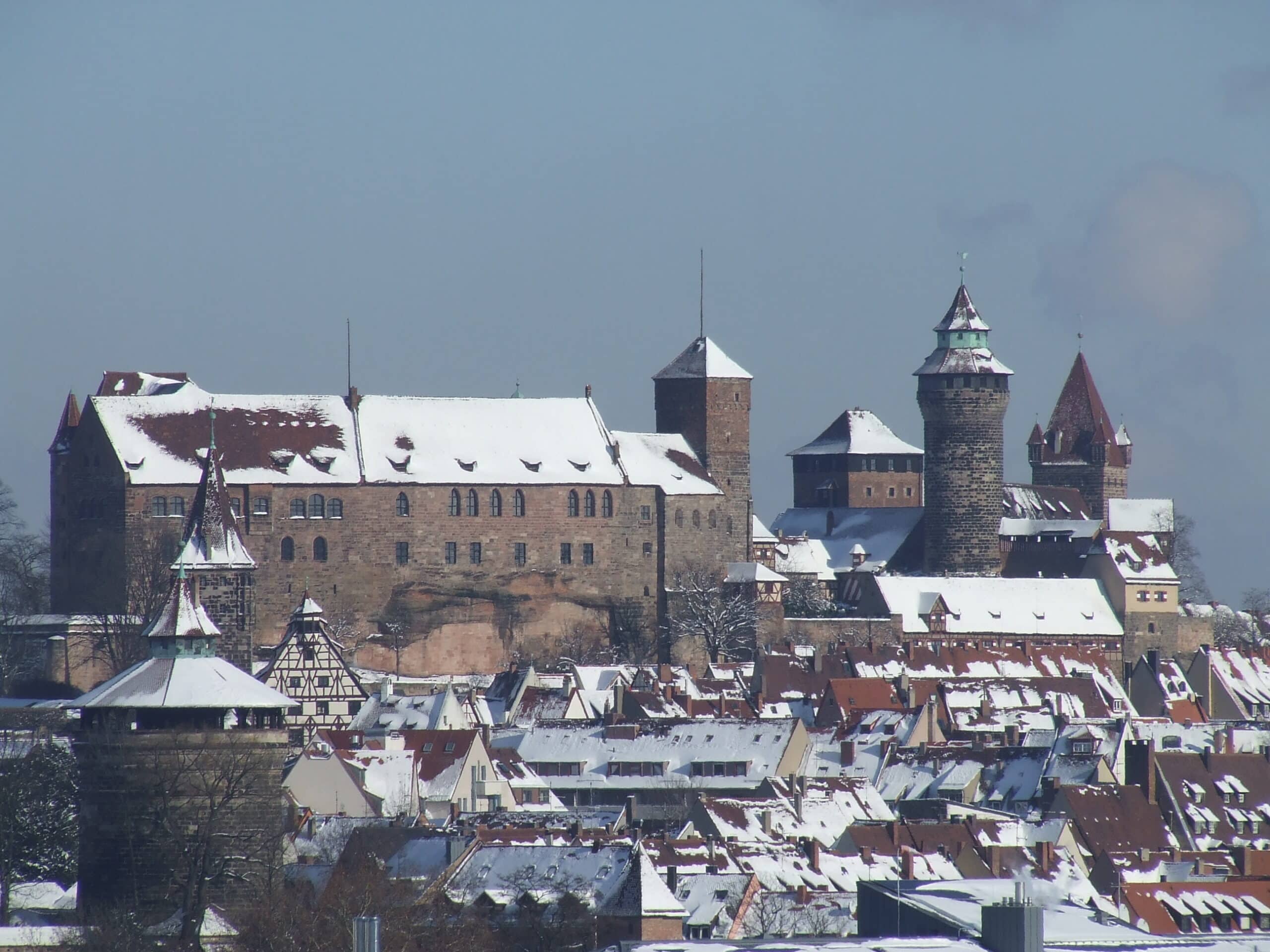
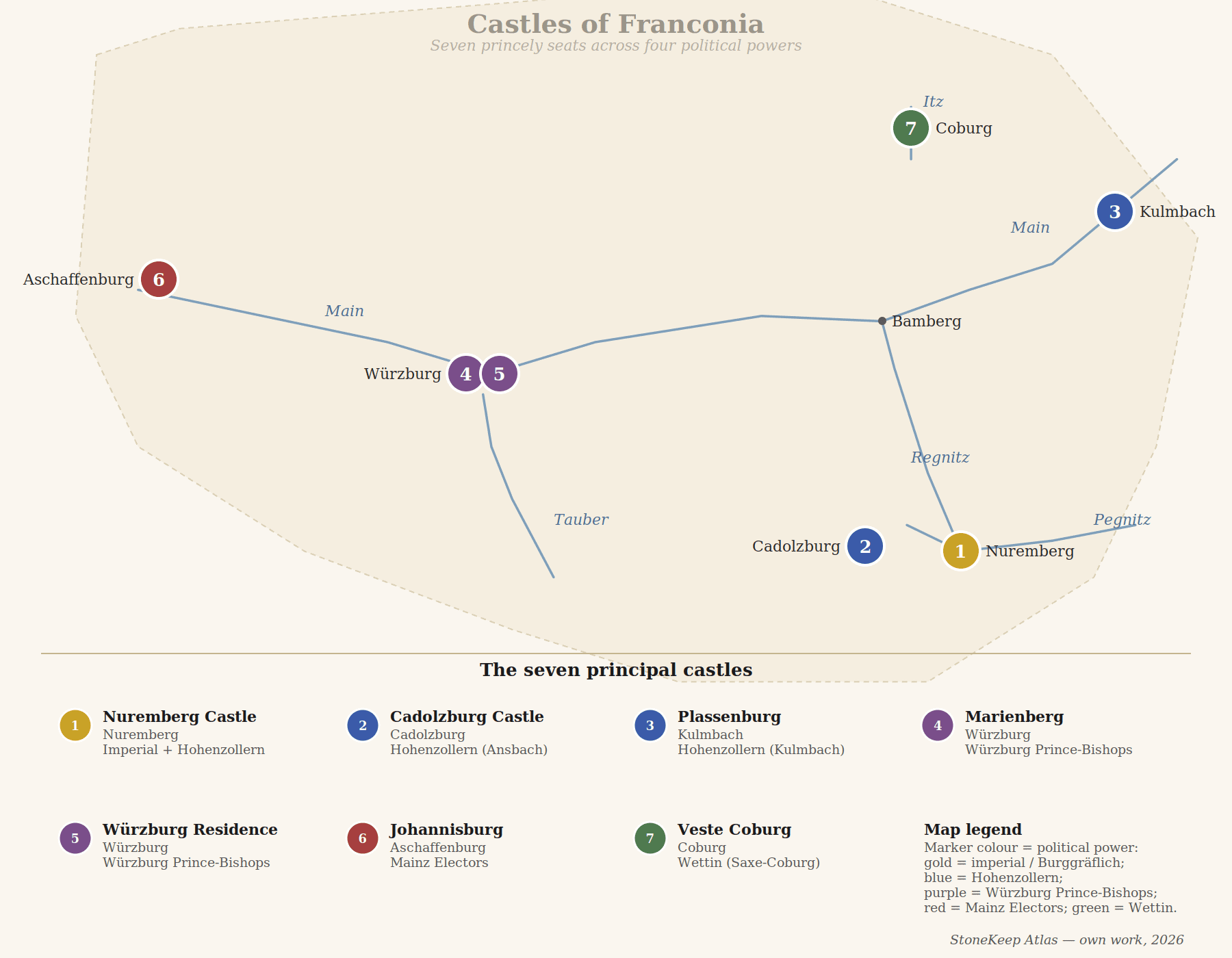
The castles of Franconia trace a region that does not behave like other corners of Bavaria. Where Upper Bavaria built its identity around a single dynasty, the Wittelsbachs in Munich, Franconia spent five centuries divided among a dozen competing princes, none of whom could speak for the whole. The result is a particular kind of fortress landscape: secular seats for the Hohenzollern margraves at one pole, Renaissance fortresses for the Würzburg prince-bishops at another, a Reichsstadt-administered imperial palace at Nuremberg, and a Saxon ridge fortress at Coburg that pulled a Wettin family into Franconian geography for six centuries. Seven principal castles span the region: from the sandstone outcrop above Nuremberg’s Old Town to the dolomite ridge above the Itz Valley, roughly four hundred kilometers east to west and a thousand years of building campaigns, from a round church begun before the year 1000 to a Baroque palace finished around 1780.
What follows is built around a four-power thesis: the Franconian Hohenzollern at Cadolzburg and Plassenburg, the Würzburg prince-bishops at Marienberg and the Würzburg Residence, the Mainz electors at Johannisburg in Aschaffenburg, and the Saxon Wettin Ernestines at Veste Coburg, with Nuremberg as both Reichsstadt and Hohenzollern Burggrafensitz at the center. The framing simplifies. Bamberg, the third great Franconian prince-bishopric, kept a court of its own through the same centuries; the Schönborn family who built the Würzburg Residence also held Bamberg through most of the eighteenth century. A dense layer of imperial knights, the Reichsritterschaft, controlled a patchwork of moated castles like Mespelbrunn in the Spessart forest; those belong on a different list. The seven castles of Franconia in this hub are princely seats. They are the buildings that record what it meant to be a Hohenzollern margrave, a Würzburg prince-bishop, a Mainz elector, or a Coburg Wettin between the year 1000 and the dissolution of the Holy Roman Empire in 1806.
Nuremberg Castle
Nuremberg Castle (Kaiserburg Nürnberg) is not one castle but three. On the eastern flank of the sandstone outcrop sits the Burggrafenburg, held by Hohenzollern Burgraves from 1191 or 1192 until 1427. To its west rises the Kaiserburg proper, the working palace of elected German kings and emperors. Between them runs the Stadtburg, which held the defensive functions of the Reichsstadt. Each precinct answered to a different authority. Hohenzollern Burgraves administered their own fief as imperial vassals. Kaiserburg was a Reichsburg, owned by the Empire itself, occupied by emperors when they convened a Reichstag at Nuremberg. From the city itself the burghers administered courts and walls.
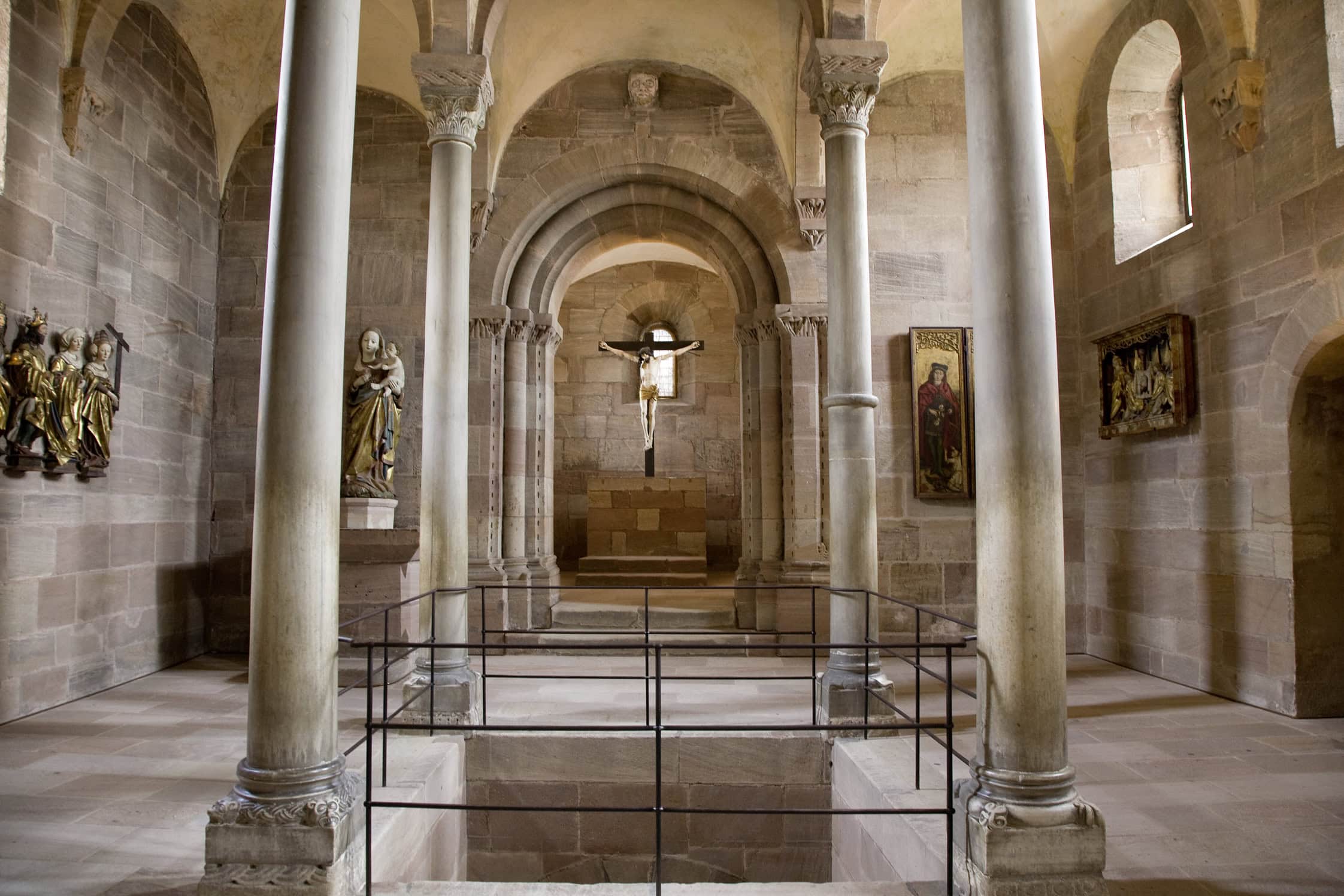
Hohenstaufen building is the Romanesque core. Palas and the two-story Doppelkapelle went up between roughly 1190 and 1216, initiated under Heinrich VI and completed during the regency of Friedrich II, who handed the chapel to the Teutonic Order in 1216. Romanesque Sinwellturm, climbable today in 113 steps to the platform, and the Heidenturm date from the same campaign.
From 1424 until 1796 Nuremberg held the imperial regalia, the Reichskleinodien, by Sigismund of Luxembourg’s decree of September 29, 1423. Crown, orb, sword, and Holy Lance lived in a wall cabinet at the Heilig-Geist-Spital chapel down in the city, not on the Burg itself. By that point the Burggrafen had already gone: their precinct was destroyed in a Bavarian raid in 1420, and the family sold what remained, plus the castle administration, to the Reichsstadt on June 27, 1427 for 120,000 Gulden. They had moved their household to Cadolzburg, thirty kilometers west, more than a century and a half earlier.
Cadolzburg Castle
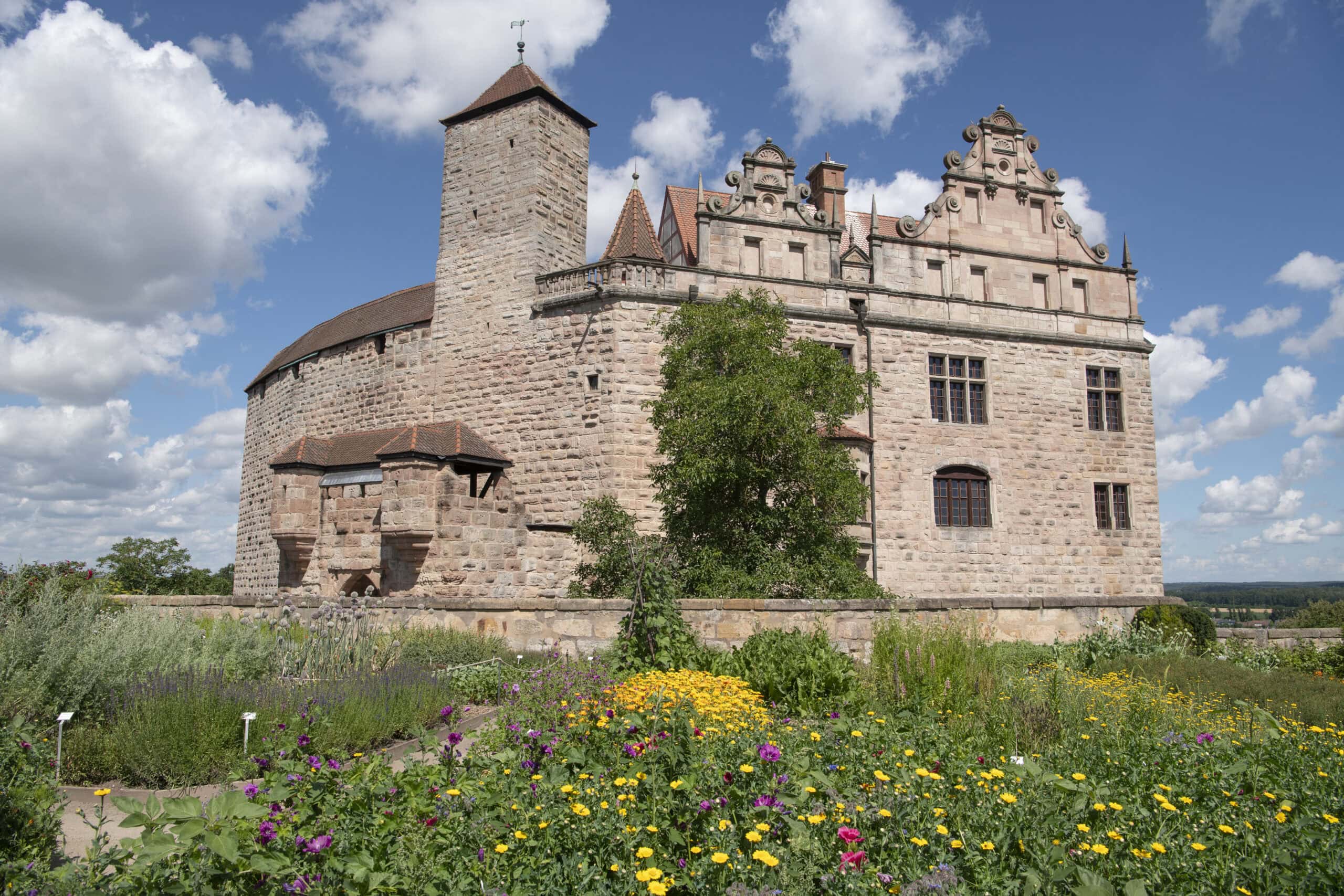
Burg Cadolzburg sits thirty kilometers west of Nuremberg by rail, on a sandstone ridge above the Mittelfranken village that shares its name. First documented in 1157 as the seat of one Helmericus de Kadoldesburc, it became the principal Franconian Hohenzollern residence from around 1260, when the Burgraves of Nuremberg moved their household out of the cramped Burggrafenburg in the imperial city. Cadolzburg held that role for two centuries.
Its pivotal sequence is 1411 to 1417. On July 8, 1411 King Sigismund of Luxembourg appointed Burggraf Friedrich VI as Hauptmann and Verweser of the Mark of Brandenburg. On April 30, 1415, at the Council of Constance, Sigismund invested Friedrich with the electoral dignity. Formal enfeoffment with the Markgrafschaft followed on April 18, 1417, making him Kurfürst Friedrich I of Brandenburg. His Franconian household stayed at Cadolzburg through the lifetimes of his grandsons, until Albrecht Achilles moved the senior Franconian residence to Ansbach in 1456 or 1457.
Cadolzburg’s other historical claim is the Reformation. Markgraf Georg der Fromme of Brandenburg-Ansbach launched a church visitation in 1528 that introduced Lutheran practice to Brandenburg-Ansbach, formalized in 1533 with the Brandenburg-Nürnbergische Kirchenordnung. Cadolzburg by then served as a secondary residence to Ansbach.
On April 17, 1945 the entire late-medieval and Renaissance interior burned in a skirmish between SS holdouts and US troops. A thirty-eight-year reconstruction, 1979 to 2017, returned the building. It reopened on June 23, 2017 as HerrschaftsZeiten! Erlebnis Cadolzburg, an experience museum operated by the Bayerische Schlösserverwaltung.
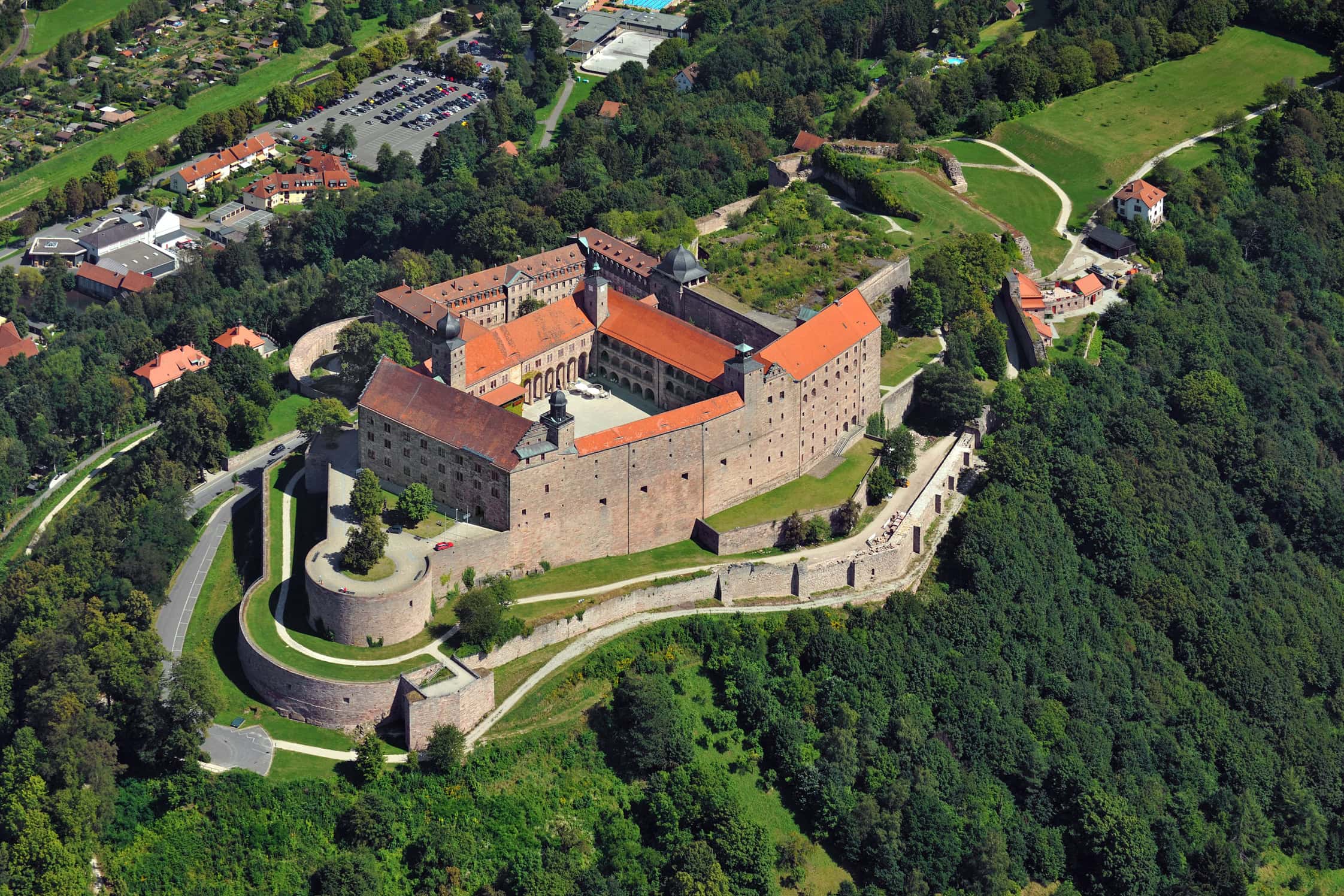
Plassenburg Fortress
Plassenburg Fortress (Festung Plassenburg) crowns a sandstone spur fifty meters above Kulmbach in Upper Franconia, where the White Main and Red Main converge. First documented in 1135 under the Counts of Andechs, it passed through the Counts of Orlamünde to the Hohenzollern in 1338 or 1340. From then onward it was the seat of the Franconian Hohenzollern Kulmbach-Bayreuth line, the cousin branch of the dynasty whose other half ran Brandenburg-Ansbach.
A 1398 partition of the Franconian Hohenzollern lands split Plassenburg-Bayreuth from Ansbach. A 1486 partition, the Dispositio Achillea of Albrecht Achilles, formalized the three-way Hohenzollern structure of Brandenburg proper, Brandenburg-Ansbach, and Brandenburg-Kulmbach. Plassenburg held the seat of the northern half.
In 1552 Markgraf Albrecht Alcibiades of Brandenburg-Kulmbach launched the Second Margraves’ War against the Hochstifte of Würzburg and Bamberg and the Reichsstadt of Nuremberg, dragging the Mainz exclave at Aschaffenburg into the destruction. By 1553 the Franconian Bund had turned on him. Albrecht’s enemies stormed Kulmbach on November 26, 1553 and besieged Plassenburg through the winter. The fortress capitulated on June 22, 1554, and the Franconian Bund deliberately razed it.
What rises on the rock today is the Renaissance rebuild commissioned by Markgraf Georg Friedrich starting in 1557, with Caspar Vischer brought in as architect from 1563. The Schöner Hof, an arcaded inner courtyard widely considered one of the most important creations of the German Renaissance, was complete by 1575. In 1604 Markgraf Christian transferred the residence to Bayreuth. Napoleonic troops carried out a partial Schleifung in 1806; the buildings around the inner courtyards were spared.
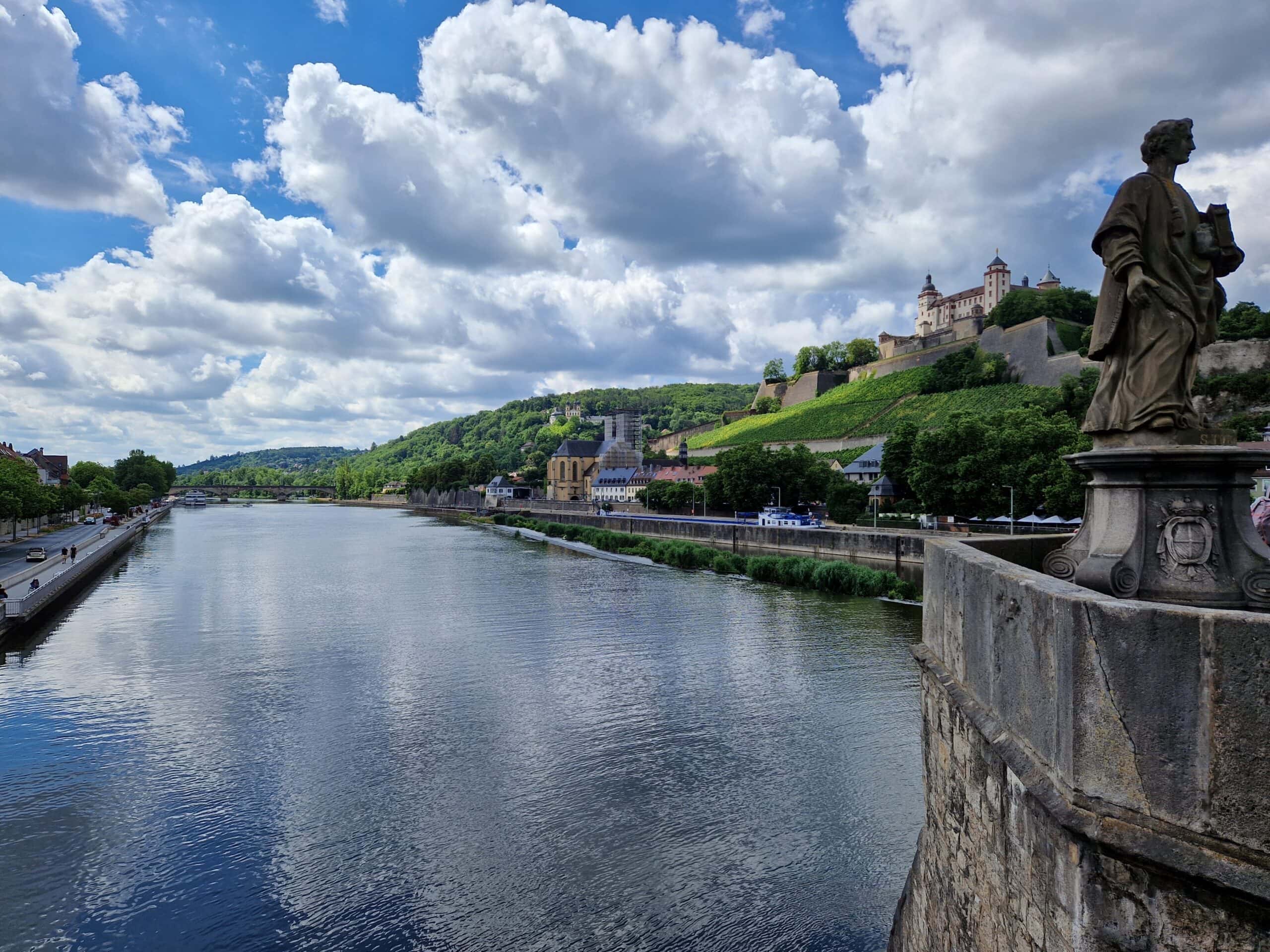
Marienberg Fortress
Marienberg Fortress (Festung Marienberg) stands on the wooded hill above the Main’s left bank, watching the city of Würzburg on the opposite side. For 466 years, from 1253 to 1719, the prince-bishops of Würzburg ruled their city from the wrong side of the river. From the hilltop they could weigh, and occasionally send troops down the slope.
A round Marienkirche, first attested under a different dedication in 706 and rebuilt in its surviving Romanesque form around the year 1000, gave the hill its name long before any fortress crowned it. Bishop Konrad I von Querfurt began the medieval Höhenburg in 1201. After a rupture with the city in 1253, the bishops moved into the keep, where they would stay until the Schönborn era moved them out.
Three campaigns reshaped the fortress between Renaissance and Baroque. From 1573 to 1617, under Bishop Julius Echter von Mespelbrunn, the medieval keep became a Renaissance Schloss. On October 18, 1631 a Swedish army of twelve thousand under Gustav II Adolf, with Bernhard of Sachsen-Weimar leading the actual storming, took the fortress in a single afternoon. The Schönborn bishops responded with the barocke Bastionärbefestigung of 1649 to 1656. Balthasar Neumann then built the Maschikuliturm between 1724 and 1729, to the design of Maximilian von Welsch, sealing the south flank.
In 1719 Fürstbischof Johann Philipp Franz von Schönborn moved the bishops’ household down the hill. Marienberg is undergoing a general restoration from 2023 to the early 2030s; what is open in 2026 is the outer Echterhof courtyard, the Maschikuliturm, and the Museum für Franken in the Zeughaus and Echterbastei.
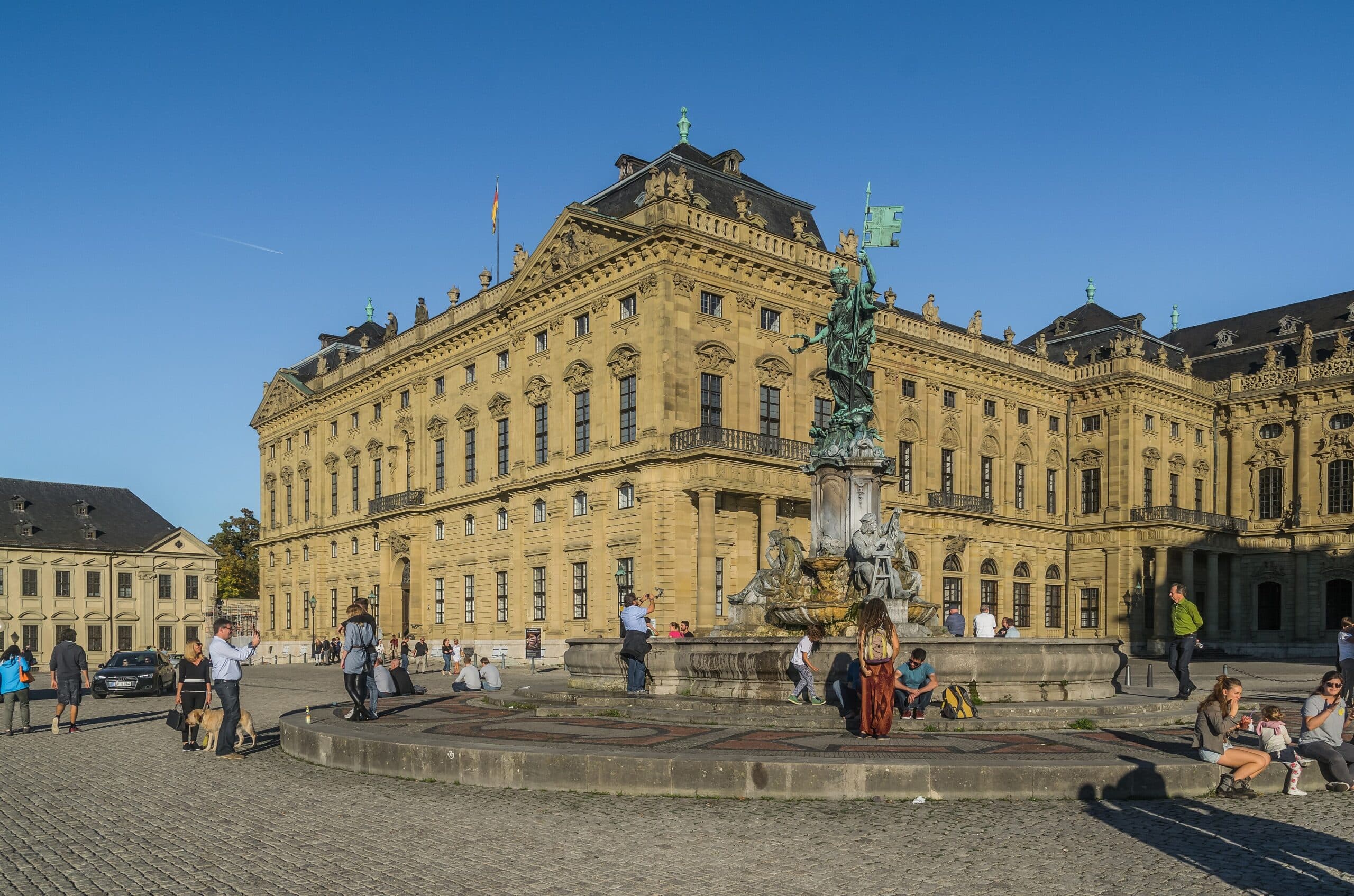
Würzburg Residence
Würzburg Residence (Würzburger Residenz) was the answer to Marienberg. On his accession in September 1719, Fürstbischof Johann Philipp Franz von Schönborn decided to abandon the medieval fortress on the hill and build a court at ground level in the city. Groundbreaking came on May 22, 1720. Construction of the shell ran to 1744, the interiors to about 1770, the gardens to about 1780.
Balthasar Neumann supervised the design, the most ambitious Baroque palace north of the Alps. Schönborn’s network across the Empire delivered architects, sculptors, stuccoists, and painters from the German lands and Italy. Johann Philipp Franz’s uncle Lothar Franz von Schönborn held the prince-bishopric of Bamberg from 1693 and the Mainz electorate from 1695, both until his death in 1729. Johann Philipp Franz’s younger brother Friedrich Karl held the imperial Reichsvizekanzler office from 1705 to 1734, then succeeded as prince-bishop of Bamberg and Würzburg simultaneously from 1729 to 1746. Few early-modern German families concentrated more ecclesiastical and imperial offices than the Schönborn.
Giovanni Battista Tiepolo painted the Kaisersaal frescoes between 1751 and 1752 and the Treppenhaus ceiling, the largest fresco in the world, between 1752 and 1753.
An RAF firestorm raid devastated Würzburg on March 16, 1945. The Residence shell stood but its roof and interiors were gutted. The central block, with the Vestibül, Gartensaal, Treppenhaus, Weißer Saal, and Kaisersaal, survived the firestorm by chance and provided the basis for postwar reconstruction. UNESCO inscribed the building in 1981 under criteria (i) and (iv), Bavaria’s first World Heritage site.
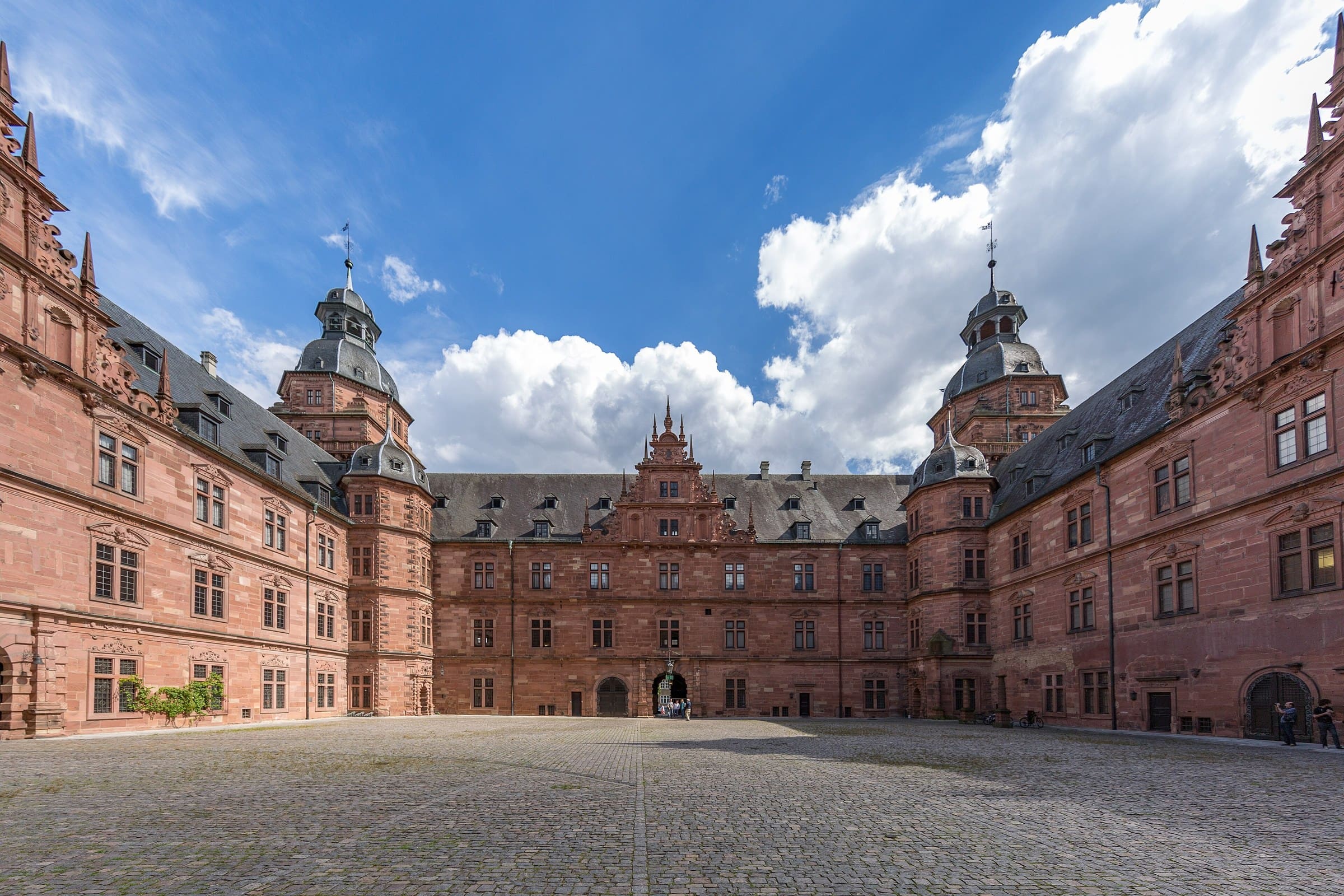
Johannisburg Palace
Johannisburg Palace (Schloss Johannisburg) is the four-towered Renaissance Schloss that rises from the right bank of the Main River in Aschaffenburg, in Lower Franconia. For most of its working life it was the Zweitresidenz, the second seat, of the Prince-Archbishops and Electors of Mainz, a country palace where the cathedral chapter was not constantly underfoot.
Two histories converge in the building. One is the medieval Burg on the same site, the seat of the Mainz electors in Aschaffenburg since the thirteenth century. On August 10, 1552, Laurentiustag, troops of Markgraf Albrecht Alcibiades of Brandenburg-Kulmbach put the medieval Burg to the torch as part of the Second Margraves’ War that would consume Plassenburg the following year. What stood of the medieval fortress afterward was a partial ruin and a 1337 Bergfried that the new building would absorb.
The replacement is the Renaissance Schloss commissioned in 1605 by Kurerzbischof Johann Schweikard von Kronberg, built by the Strasbourg architect Georg Ridinger between 1605 and 1614. Hans Juncker carved the alabaster altar of the Schlosskapelle between 1609 and 1613, completing the pulpit by 1618.
Friedrich Karl Joseph von Erthal elevated Johannisburg to Hauptresidenz in 1794 as French armies advanced on Mainz. Karl Theodor von Dalberg ruled the Principality of Aschaffenburg from the building between 1803 and 1813. Catastrophic damage in the bombing of November 21, 1944 was reversed by a reconstruction campaign of 1954 to 1964.
Veste Coburg
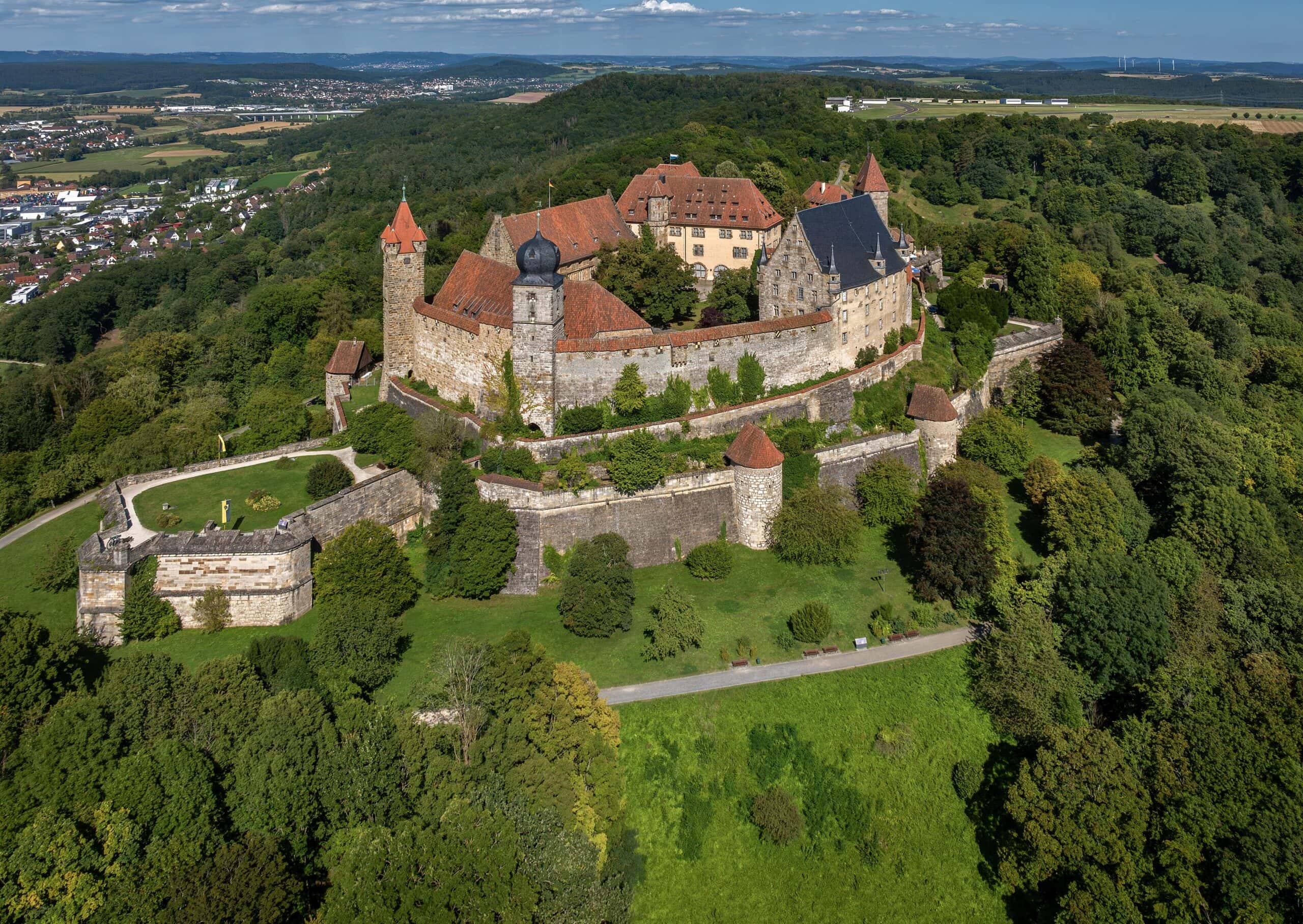
Veste Coburg crowns a dolomite ridge above the Itz Valley in Upper Franconia, the northernmost of the seven by some margin. Coburg as a place name first appears in 1056, when Richeza of Lotharingia, widow of the Polish king Mieszko II, donated her properties to Archbishop Anno II of Cologne. Anno used the gift to endow Saalfeld Abbey in 1071. A chapel of Saints Peter and Paul on the fortified Coberg is attested in 1075. First documentary use of sloss for the structure comes in 1225, under the Dukes of Merania.
Wettin acquisition came in two stages. In 1346 or 1347 Markgraf Friedrich III the Strict of Meissen married Katharina von Henneberg. After Katharina’s mother Jutta von Brandenburg died on February 1, 1353, Friedrich rode to Prague, where Emperor Charles IV invested him with the Coburg lordship on February 9. From 1485, by the Leipziger Teilung, Coburg fell to the Ernestine Wettin line.
Luther’s most famous Coburg stay ran from April 15 to October 4, 1530, a hundred and seventy-two days. Under double ban from Empire and Church, he could not safely attend the Diet of Augsburg, so the Wettin Elector Johann lodged him at Coburg, the southernmost Saxon fortress within reach. Wallenstein besieged the Veste unsuccessfully in 1632; Imperial General Lamboy took it on March 28, 1635 after a renewed siege beginning October 20, 1634.
Bodo Ebhardt restored the fortress between April 13, 1909 and September 6, 1924. After Carl Eduard’s abdication in 1918 and the plebiscite of November 30, 1919, Coburg joined Bavaria on July 1, 1920. By marriage and inheritance, the Saxe-Coburg dynasty seated four European thrones: Belgium from 1831, Portugal from 1836, Britain from 1840, and Bulgaria from 1887.
At a glance
| Castle | German name | First built | Lord | UNESCO | 2026 visiting |
|---|---|---|---|---|---|
| Nuremberg Castle | Kaiserburg Nürnberg | c. 1190–1216 (Hohenstaufen core) | Empire + Hohenzollern Burggrafen 1191/92–1427; Reichsstadt from 1427 | No | Open daily |
| Cadolzburg Castle | Burg Cadolzburg | First documented 1157 | Franconian Hohenzollern (Brandenburg-Ansbach line) | No | Open Tue–Sun |
| Plassenburg Fortress | Festung Plassenburg | First documented 1135; rebuilt 1557 onward | Franconian Hohenzollern (Brandenburg-Kulmbach line) | No | Open daily |
| Marienberg Fortress | Festung Marienberg | c. 1000 round church; fortified 1201 | Würzburg Prince-Bishops 1253–1719 | No | Partial (restoration to early 2030s) |
| Würzburg Residence | Würzburger Residenz | 1720–1744 | Würzburg Prince-Bishops (Schönborn) | Yes (1981) | Open daily |
| Johannisburg Palace | Schloss Johannisburg | 1605–1614 | Mainz Electors; Hauptresidenz 1794–1813 | No | Open Tue–Sun |
| Veste Coburg | Veste Coburg | Place documented 1056; first sloss 1225 | Saxon Wettin (Ernestine line) from 1485 | No | Seasonal: March 28 – November 8, 2026 |
Beyond the seven
Three further bodies of Franconian castle architecture deserve a brief acknowledgment.
Bamberg, the third Franconian prince-bishopric, ran a court of its own through the same centuries. Lothar Franz von Schönborn, who built the Pommersfelden palace and helped fund the Würzburg Residence, was prince-bishop of Bamberg from 1693 and elector of Mainz from 1695, both until his death in 1729. Bamberg’s principal seats, the Alte Hofhaltung and the Neue Residenz on the Domberg, belong to this conversation but lie outside the seven-castle frame and will get a dedicated treatment.
The Reichsritterschaft, a dense layer of imperial knights answering to nobody but the emperor, controlled a different category of castle. Mespelbrunn, the moated seat of the Echter family in the Spessart forest, is the type case. Julius Echter von Mespelbrunn rose to become prince-bishop of Würzburg, but his family’s seat remained a Wasserburg of the imperial knighthood, not a princely seat. A separate hub will treat the Wasserburgen of Franconia and the Spessart.
A three-day itinerary covers the seven. Day one: the Würzburg pair plus Johannisburg in Aschaffenburg, all on the Main. Day two: Nuremberg and Cadolzburg, side by side in Middle Franconia. Day three: Plassenburg and Veste Coburg in the north, an hour and a quarter apart.
For travelers planning a broader regional tour, Best Castles in Bavaria places these Franconian seats inside the larger Bavarian context alongside the Wittelsbach royal castles. The Castles of the Middle Rhine hub offers a comparable regional roundup further west. The Reformation history article picks up the Cadolzburg and Coburg threads in a Protestant-princes context; The Prussian Royal Castles follows the Franconian Hohenzollern line into its later Brandenburg-Prussian phase.
The seven castles of Franconia together record what a princely landscape looks like when no single prince was strong enough to dominate the rest. Each is its own building. Together they make the region legible.
Common Questions
Which castles does this guide cover?
Seven across Franconia: Nuremberg Castle, Cadolzburg, the Plassenburg, Marienberg Fortress, the Wurzburg Residence, Johannisburg Palace, and Veste Coburg.
Where and what is Franconia?
Franconia is the northern part of modern Bavaria. Where Upper Bavaria built its identity around a single dynasty, the Wittelsbachs in Munich, Franconia spent five centuries divided among a dozen competing princes.
What makes Franconia’s castles distinctive?
That divided past. With no single ruling house, the region’s strongholds range widely, from the imperial castle at Nuremberg to prince-bishops’ fortresses and residences, each the seat of a different power.
Principal Sources
- Bayerische Schlösserverwaltung. “Burg Cadolzburg.” burg-cadolzburg.de.
- Bayerische Schlösserverwaltung. “Kaiserburg Nürnberg.” kaiserburg-nuernberg.de.
- Bayerische Schlösserverwaltung. “Festung Marienberg.” schloesser.bayern.de.
- Bayerische Schlösserverwaltung. “Plassenburg.” schloesser.bayern.de.
- Bayerische Schlösserverwaltung. “Schloss Johannisburg, Aschaffenburg.” schloesser-aschaffenburg.de.
- Bayerische Schlösserverwaltung. “Würzburger Residenz.” residenz-wuerzburg.de.
- Haus der Bayerischen Geschichte. “Veste Coburg.” Wiederaufbauatlas. hdbg.eu.
- Historisches Lexikon Bayerns. “Reichskleinodien.” historisches-lexikon-bayerns.de.
- Historisches Lexikon Bayerns. “Vereinigung Coburgs mit Bayern, 1. Juli 1920.” historisches-lexikon-bayerns.de.
- Historisches Lexikon Bayerns. “Wettiner (Spätmittelalter).” historisches-lexikon-bayerns.de.
- Historisches Lexikon Bayerns. “Würzburg, Festung Marienberg.” historisches-lexikon-bayerns.de.
- Kunstsammlungen der Veste Coburg. “Authentic Luther Location.” kunstsammlungen-coburg.de.
- Neue Deutsche Biographie. “Georg der Fromme, Markgraf von Brandenburg-Ansbach.” deutsche-biographie.de.
- Stadtarchiv Aschaffenburg. “Bodendenkmäler — Schloss Johannisburg.” aschaffenburgzweinull.stadtarchiv-digital.de.
- UNESCO World Heritage Centre. “Würzburg Residence with the Court Gardens and Residence Square.” whc.unesco.org.
Image credits. Featured: Nürnberger Burg in winter, viewed from the southwest — DALIBRI, CC BY-SA 2.0 DE, via Wikimedia Commons. Franconia map: StoneKeep Atlas (own work). Cadolzburg from the south-east with the Burggarten — Bayerische Schlösserverwaltung. Plassenburg aerial — © Bayerische Schlösserverwaltung. Marienberg from the Alte Mainbrücke — Holger Uwe Schmitt, CC BY-SA 4.0, via Wikimedia Commons. Würzburg Residence west façade — DXR / Daniel Vorndran, CC BY-SA 4.0, via Wikimedia Commons. Veste Coburg from the air — Reinhold Möller, CC BY-SA 4.0, via Wikimedia Commons. Nuremberg Kaiserkapelle — © Bayerische Schlösserverwaltung, photo Maria Scherf / Andrea Gruber. Johannisburg Palace courtyard — Martin Kraft, CC BY-SA 3.0, via Wikimedia Commons. Freely licensed images are resized to fit; otherwise unaltered.