
Coburg Fortress
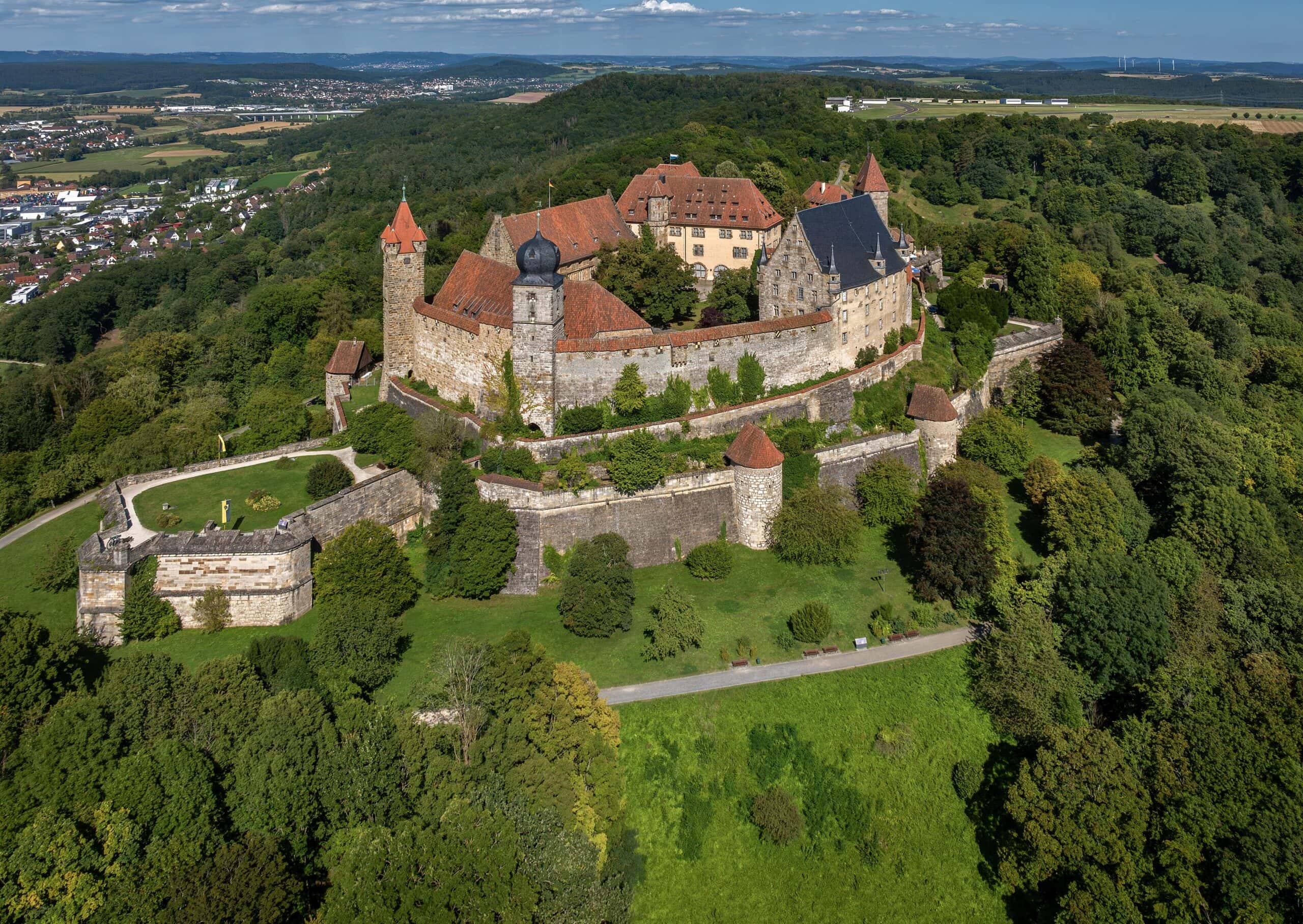
A thousand years before tourism, a place on a dolomite ridge above the Itz Valley already carried the name Coberg, “the cold hill.” When the future Empress Richeza of Lotharingia signed it away to her brother, Archbishop Anno II of Cologne in 1056, no castle stood on it yet, only a fortified hill site with a chapel. The castle came later, stone by stone, dynasty by dynasty, until by the seventeenth century the ridge held one of the largest princely fortresses in the German lands. It is still there. Today’s Coburg Fortress, known in German as the Veste Coburg, competes for no size record — the world’s longest castle, certified at 1,051.02 meters, is Burghausen on the Salzach — but it is one of the best-preserved princely fortress complexes in the country, and its claim on history is harder to overstate. Martin Luther sat out the Diet of Augsburg here in 1530. Lucas Cranach the Elder spent six months painting here in 1506. Saxe-Coburg dukes who married into the British, Belgian, Bulgarian, and Portuguese thrones called this their Stammburg, the ancestral seat. None of that explains the building, but all of it explains why the building survived. Today’s Coburg Fortress is layered, not large, and the layers are why it matters.
Quick Facts
| Location | Coburg, Upper Franconia (Oberfranken), Bavaria, Germany |
| German name | Veste Coburg |
| Founded | Place documented 1056; chapel 1075; first sloss 1225 |
| Elevation | 464 m above sea level; 167 m above the town |
| Footprint | Approximately 135 × 260 m; ~25,000 m² castle surface |
| Builder / Owner | Wettin dukes (Ernestine line, from 1485); now Free State of Bavaria (building) + Coburger Landesstiftung (collections) |
| Type | Princely fortress (Veste) |
| Setting | Dolomite ridge above the Itz Valley |
| Current use | Museum (Kunstsammlungen der Veste Coburg) |
| UNESCO status | Not listed |
| Open to public | Yes – March 28 to November 8, 2026 |
| Admission | €11 adult / €4 reduced / free under 18 |
| Nearest town | Coburg |
| Official site | veste.kunstsammlungen-coburg.de |
From Mons Coburg to Wettin Fortress (1056–1485)
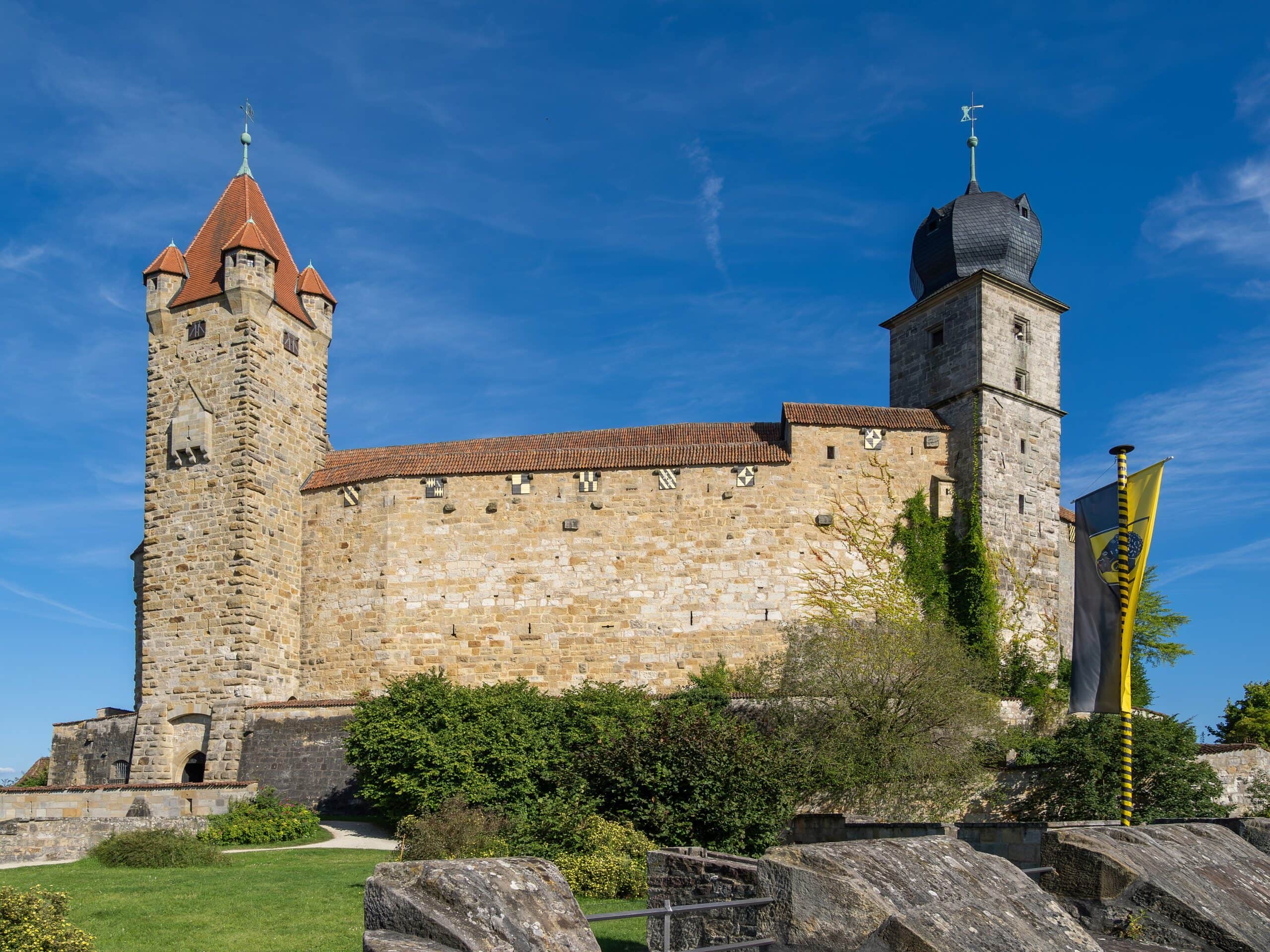
Coburg’s earliest documentary trace appears in 1056, in a donation by Richeza of Lotharingia (sister of the Polish Queen Mathilde and onetime queen consort of Poland herself) to her brother Anno II of Cologne. The donation passed to the Benedictine monks of Saalfeld in 1071. A chapel of Saints Peter and Paul is documented on the befestigten Coberg, the fortified Coberg, by 1075, confirming an early defended hill site even before the castle proper. The structure on the ridge first appears in surviving documents as a sloss in 1225, under the Dukes of Merania, who controlled the site through the early thirteenth century. The Blue Tower, the Blauer Turm, survives from this period and stands as the oldest extant fabric of the present castle.
When the Meranian line died out in 1248, the property passed to the Counts of Henneberg-Schleusingen, who held it (with a brief Brandenburg-Ascanian interlude in 1291–1312) for the next century and a half. The decisive transfer came in 1353, when the Wettin Friedrich III the Strict of Meissen married Katharina von Henneberg and brought Coburg into the Wettin orbit. The Partition of Leipzig in 1485 then assigned the Pflege Coburg to the Ernestine branch of the Wettins, where it would remain until the end of the German monarchies in 1918. By the fifteenth century the Veste already showed its characteristic doubled curtain wall, with substantial additions during the Hussite Wars of the 1420s and 1430s, when the threat from Bohemia drove a wave of fortress upgrades across the Ernestine lands. As Stammburg of the Ernestine line, this Wettin Veste was not yet the building one visits today, but its bones were already in place.
Luther at the Coburg, 1530
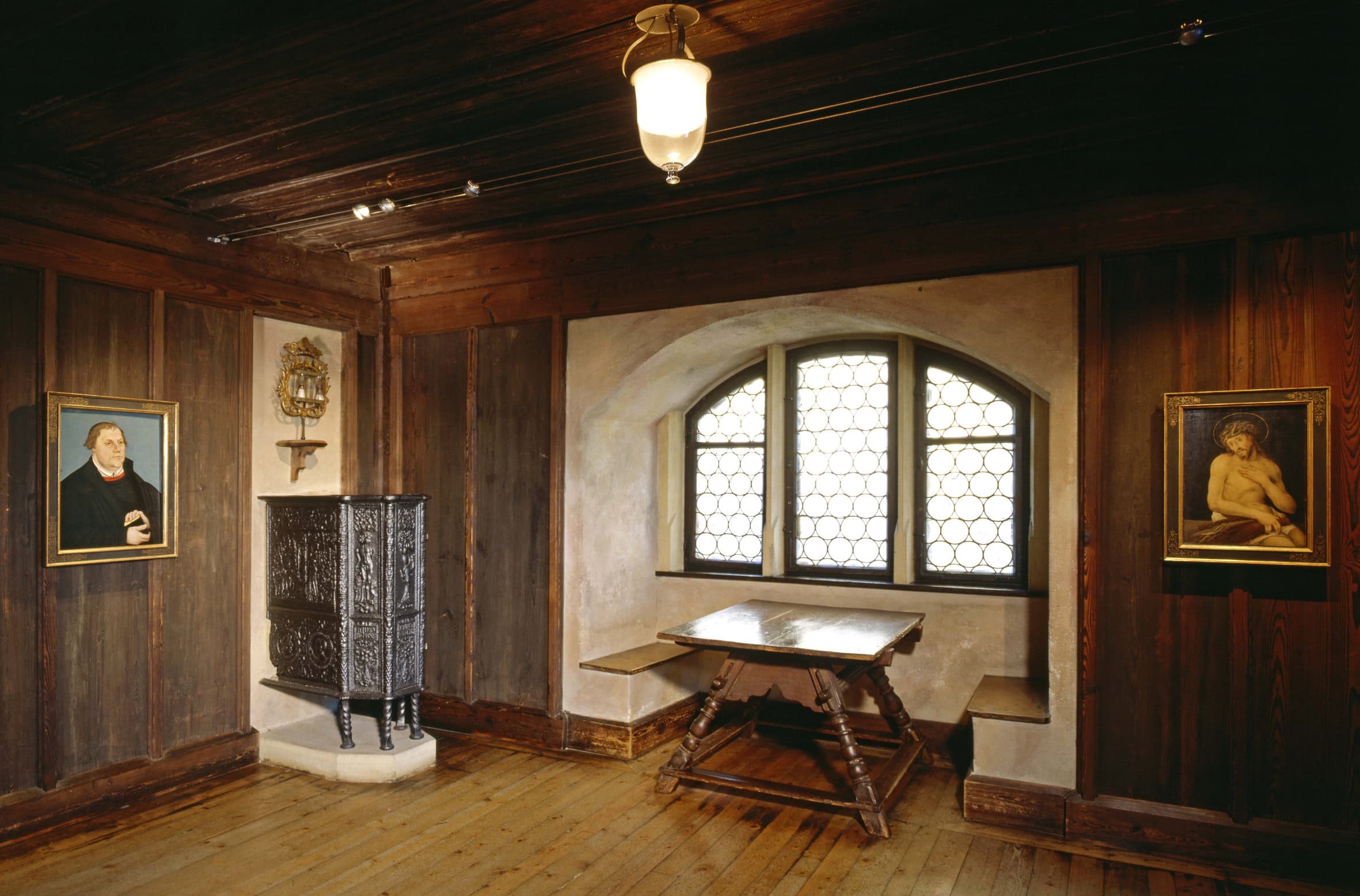
In April 1530, the Veste Coburg became the southernmost outpost of Electoral Saxony and the staging point for the most important Reformation diet of the century. Emperor Charles V had summoned a Reichstag at Augsburg to settle the religious quarrel that had split the Empire since the 1521 Edict of Worms. Martin Luther, still under imperial ban from that earlier diet, could not legally cross into Bavarian territory. Coburg was the last Wettin soil between Wittenberg and Augsburg, and Elector John the Steadfast resolved to leave his banned theologian there.
Luther arrived in Coburg town with the elector’s delegation on Good Friday, April 15, 1530. The elector, Melanchthon, Jonas, and Spalatin continued on to Augsburg on April 24; Luther had already been transferred up to the Veste on the night of 22/April 23. For the next six months he held court in a four-room suite in the Hohes Haus (today the Lutherzimmer), reading dispatches from Augsburg by candlelight and answering them by the next courier. The body of work he produced at the Coburg is substantial: the Vermahnung an die Geistlichen (his first Coburg writing), the Sendbrief vom Dolmetschen on Bible translation, the sermon Dass man Kinder zur Schulen halten solle dedicated to Lazarus Spengler of Nuremberg, commentaries on Psalms 117 and 118, partial work on the Psalter known as the Coburger Psalter, an Ezekiel commentary on Gog and Magog, and approximately 120 letters, including the warm letter to his four-year-old son Hans describing a garden where well-behaved children prayed. He left the Veste on October 4, 1530, ten days after the Diet of Augsburg had closed, and reached Wittenberg on the evening of October 13. Across the intervening five centuries, the walls of the Lutherzimmer have stood almost untouched.
Ducal Renaissance and Thirty Years’ War (1485–1635)
The Ernestine Wettins inherited a fortified medieval Veste in 1485 and spent the next century turning it into a Renaissance residence. Cranach the Elder himself stayed at the Veste in August 1506, accompanying Elector Friedrich the Wise and the young Johann the Steadfast on a six-month hunting camp during which (court records suggest) the painter began the long working relationship with the dynasty that would shape Lutheran portraiture for half a century. In 1547, after Elector John Frederick’s defeat at Mühlberg, the Ernestine court formally relocated from the Veste to a new residence in the town, Schloss Ehrenburg, and the fortress on the hill began its long second life as a defensive bastion rather than a court.
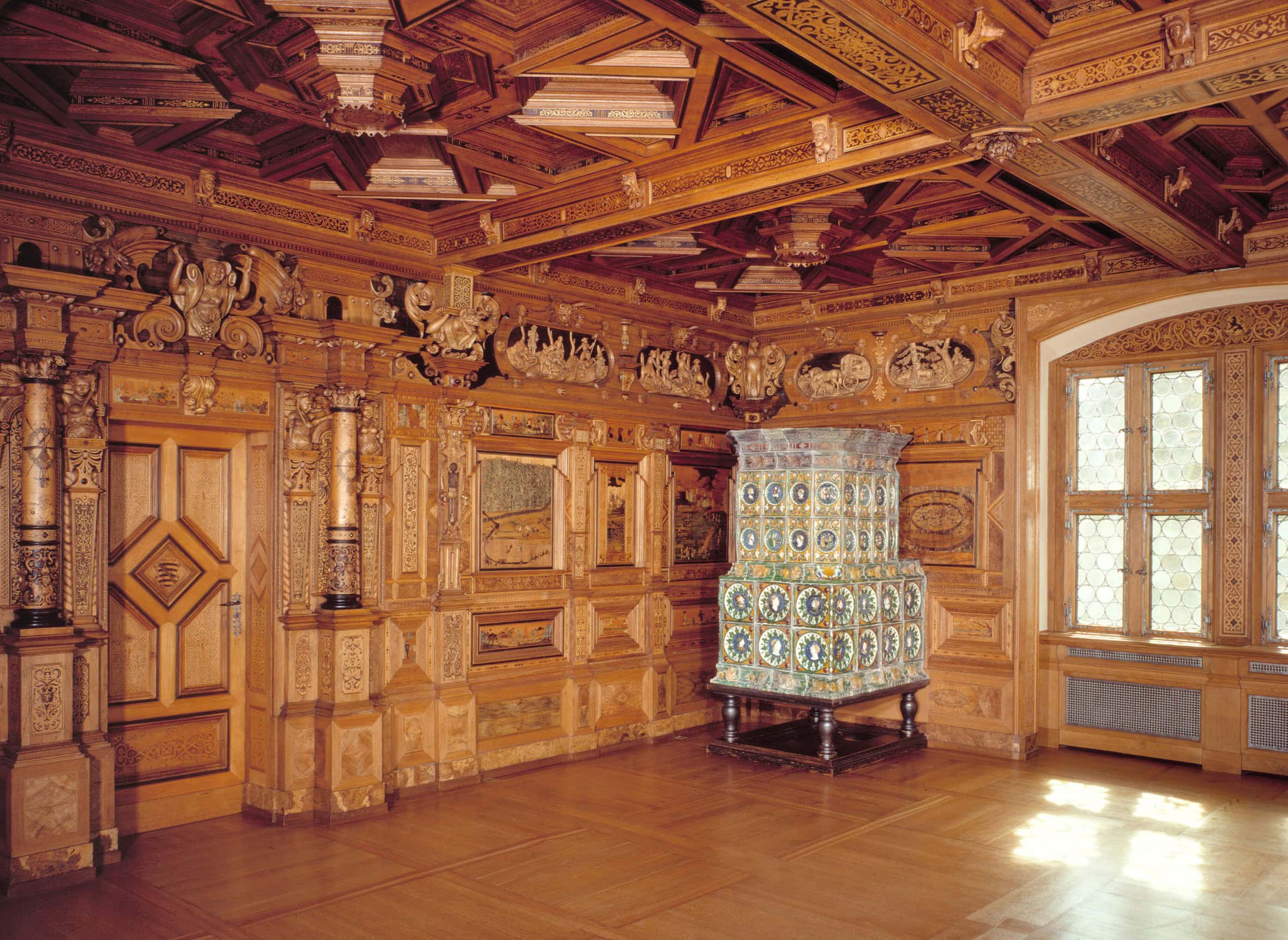
That retreat made the Veste’s military identity more important, not less. Duke Johann Casimir, founder of the duchy of Saxe-Coburg in 1596, ordered extensive modernization from that year onward: massive bastioned outworks, a new Princely Building (Fürstenbau), and the Jagdintarsienzimmer of 1632, the Hunting Marquetry Room of some sixty marquetry panels installed at the height of the Thirty Years’ War in a fortress that would, within months, be at the center of one of the war’s most consequential sieges. In November 1632, the Imperial general Wallenstein laid siege to the Veste with thousands of troops; the small Saxon garrison under Colonel Taupadel held the rock until Wallenstein withdrew. Three years later, in 1635, the fortress was finally surrendered, not stormed, but tricked by a forged letter purportedly from the duke ordering capitulation to the Imperial commander Lamboy. With that surrender, the Veste’s run as a working military stronghold ended.
From Dynastic Memorial to Romantic Restoration (1635–1900)
In the two centuries after the 1635 surrender, the Veste’s role shrank from active princely seat to dynastic monument, and then expanded again as a project of nineteenth-century historicism. The Saxe-Coburg duchy was extinguished by failure of the male line in 1633 and again in 1699; Coburg passed through Saxe-Altenburg (from 1638), Saxe-Gotha (from 1672), and Saxe-Coburg-Saalfeld (from 1735), three changes of dynastic owner inside a century, each treating the Veste as inheritance rather than residence. In 1747, Duke Franz Josias introduced primogeniture for the Saxe-Coburg-Saalfeld line and the dynastic situation finally stabilized. Through this period the Veste was maintained but quiet: the energy and money went into the town palaces, especially the rebuilt Schloss Ehrenburg, while the fortress on the hill became a memorial to the Reformation, to the Stammburg of the Ernestine line, to a Saxon past that newer ducal buildings could not embody.
Signed on November 12, 1826, the Treaty of Hildburghausen redrew the Ernestine map for the last time. Ernst III of Saxe-Coburg-Saalfeld ceded Saalfeld to Saxe-Meiningen, received Gotha in exchange, and became Ernst I, Duke of Saxe-Coburg and Gotha. Within a generation, that dynasty’s name would be borne by consorts of Britain, Belgium, Bulgaria, Portugal, and eventually by the British royal house itself, until George V renamed it Windsor in 1917. New dukes treated the Veste as a project worthy of the dynasty’s new visibility. From 1838 to roughly 1860, under Ernst I and his son Ernst II, the Nuremberg architect Karl Alexander von Heideloff led a neo-Gothic remodeling of the fortress: pinnacles, pointed-arch tracery, romantic-medievalist roofs imposed over the late-Gothic and Renaissance fabric. It was the same restoration impulse that produced Hohenschwangau in the Bavarian Alps and Stolzenfels on the Rhine, applied with characteristic nineteenth-century confidence to a building whose medieval substance was already considerable. The Lutherzimmer was reorganized as a memorial chamber, and a Reformatorenzimmer, or Hall of Reformers, was installed in 1844. The Veste’s dynastic role and its Reformation role were welded together as a single legitimizing narrative for a Protestant ducal house now exporting consorts to the courts of Europe. One of those consorts, Prince Albert, the cadet son of Ernst I, had been born at Schloss Rosenau near Coburg in 1819, married Queen Victoria of Britain in 1840, and made the Veste a station on the family’s visits, though never their residence. The dynastic British connection ran through Rosenau, Ehrenburg, and London. The Veste’s role was older and more specific: the Stammburg, the dynastic origin point, the building that made the rest of the story Saxe-Coburg’s to tell.
Ebhardt, Carl Eduard, and the 1919 Settlement (1900–1998)
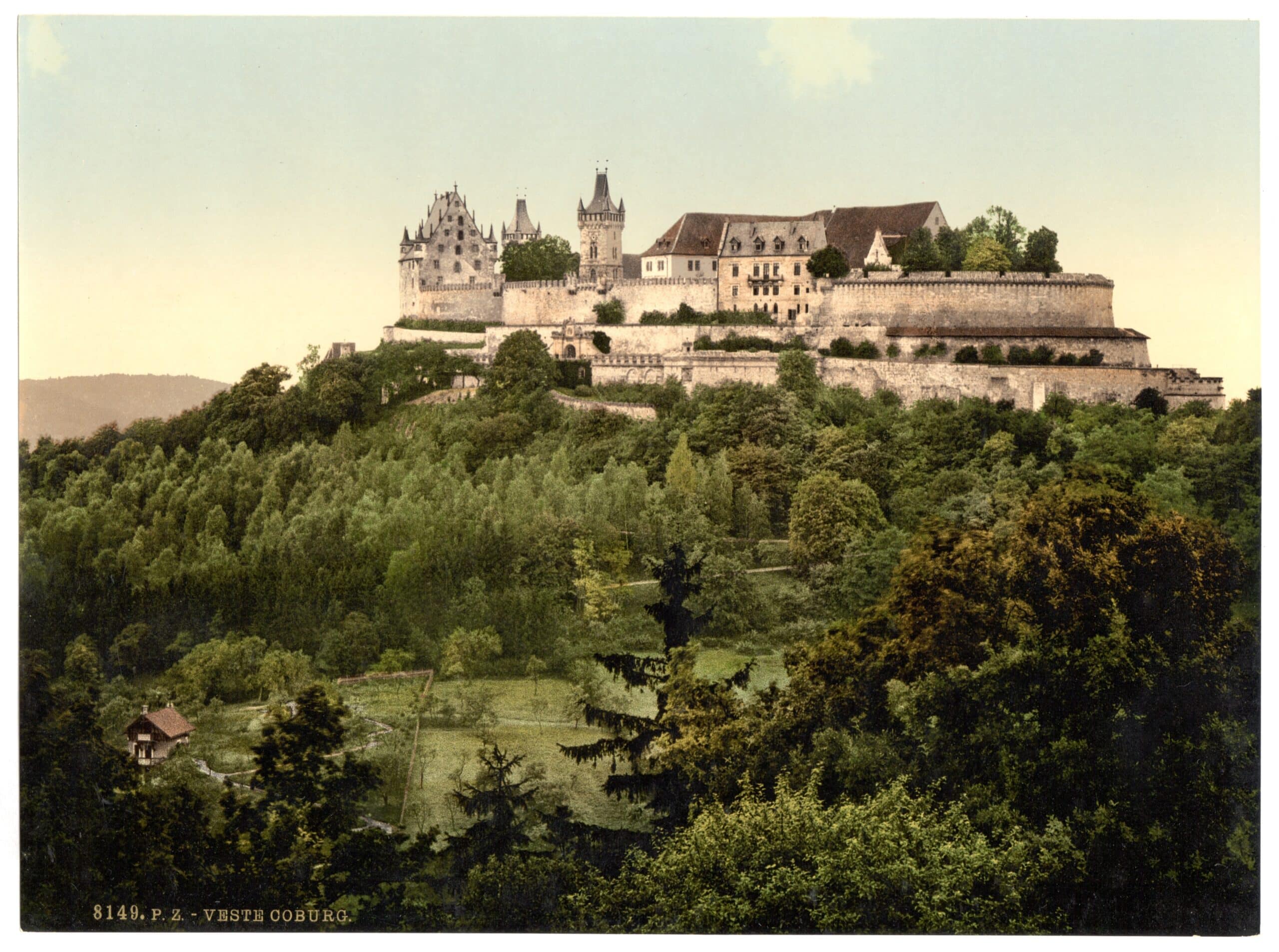
By 1900 the Heideloff restoration looked dated even to its inheritors. A grandson of Queen Victoria, Charles Edward, or Carl Eduard, had been placed on the Coburg throne by Edward VII in 1900, and the new young duke commissioned a counter-restoration. From 1909 to 1924, the architect Bodo Ebhardt undid much of Heideloff’s nineteenth-century work in favor of a more “authentic” medievalist vision, removing the pinnacles, restoring older roof forms, and consolidating the late-Gothic and Renaissance fabric beneath. Paid for partly by ducal funds and partly by a Reichswide lottery, the project produced the Veste roughly in the form a visitor sees today.
Political ground, however, was shifting under the building. Carl Eduard abdicated on November 14, 1918 with the rest of the German princes. A Free State of Coburg was declared, and a year-long negotiation followed over the disposition of the ducal assets. The result was the Abfindungsvertrag, or indemnity treaty, signed on June 7, 1919 between Carl Eduard and the new Coburg republic. Under its terms, the cultural assets of the duchy were transferred to a new public-law foundation, the *Coburger Landesstiftung, established by law on August 9, 1919. The Veste itself passed to the Free State of Bavaria (Coburg voted to join Bavaria by plebiscite on November 30, 1919 and formally united with it on July 1, 1920), and its administration to the Bayerische Schlösserverwaltung. But the collections, the art, the manuscripts, the Cranachs, stayed with the Landesstiftung. Carl Eduard’s family retained the right to reside in part of the Fürstenbau, a right that lapsed only with the death of Prince Friedrich Josias in 1998. Today the Kunstsammlungen der Veste Coburg, as an institute of the Coburger Landesstiftung, operates the museum in a building owned by the State of Bavaria: a tripartite arrangement unique in German heritage governance, and the reason the ducal collections never left the Stammburg*.
Visiting 2026
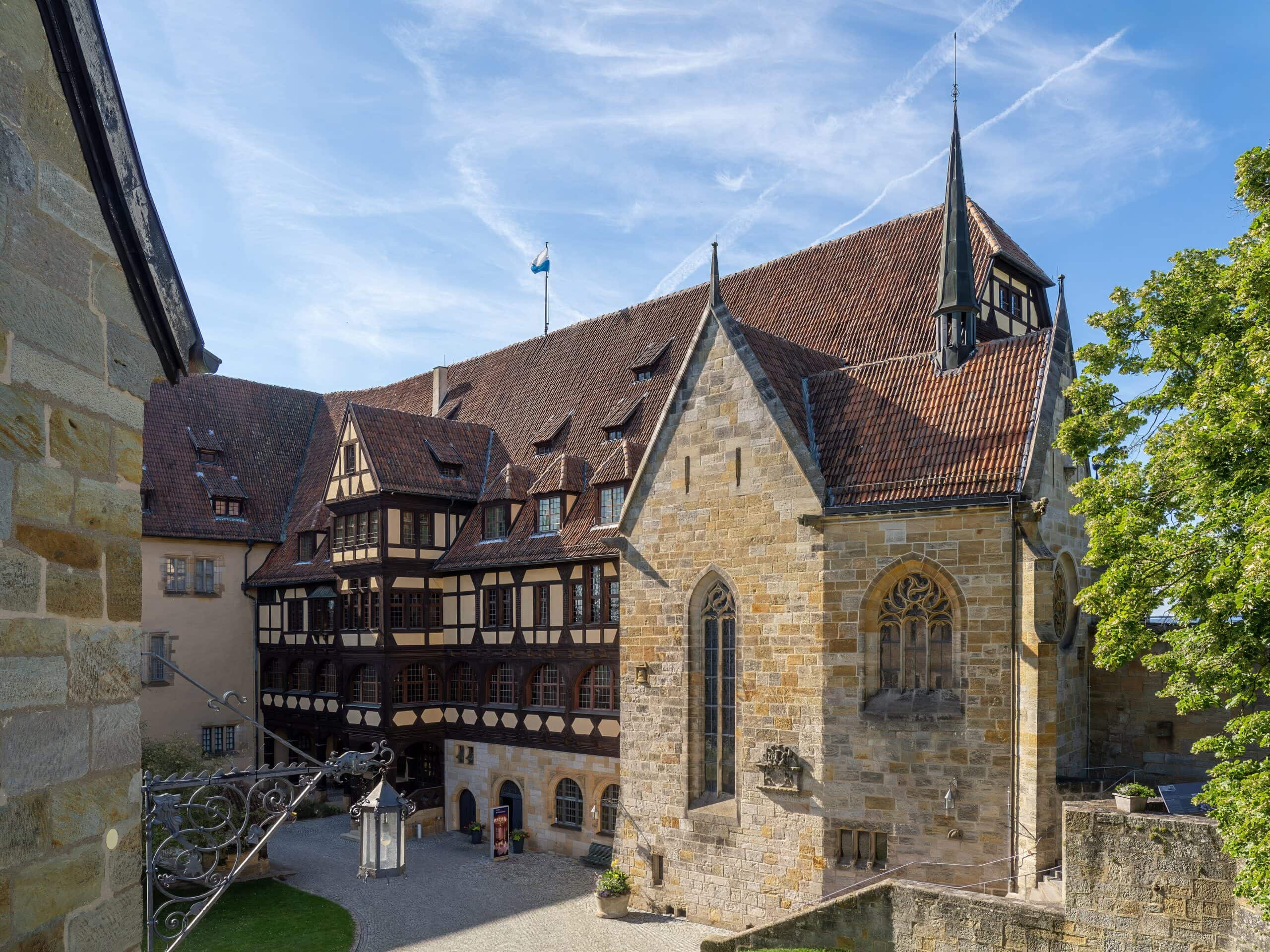
Kunstsammlungen der Veste Coburg is open daily from March 28 to November 8, 2026, 10am to 5pm, closed Mondays from October. Admission is €11 for adults, €4 reduced, free for visitors under eighteen. The site rewards a half-day visit: the Lutherzimmer (Hohes Haus) anchors the Reformation route, the Jagdintarsienzimmer is shown in situ, and the painting galleries display some thirty works by Lucas Cranach and his workshop alongside Dürer, Grünewald, and Holbein. The Kupferstichkabinett, or copperplate engraving cabinet, holds more than 220,000 sheets of prints and drawings, by far the largest holding of its kind outside a national capital. Around ten thousand objects of historical arms and armor place the collection in the international first rank, and the Venetian-glass holdings include the twelfth-century Hedwigsbecher reliquary glass that came to Luther personally. Coburg town is reachable by ICE train from Berlin (about three hours) and from Munich (about two hours); the fortress itself is fifteen minutes’ walk uphill from the Bahnhof or a short ride on the Veste bus. Entry tickets and local tours can also be booked in advance through GetYourGuide. Anyone staying overnight can compare hotels in and around Coburg.
Some links on this page are affiliate links, which means StoneKeep Atlas may earn a small commission, at no extra cost to you, if you book through them.
Beyond Veste Coburg
Veste Coburg belongs to a Franconian fortress landscape that extends to the Plassenburg above Kulmbach, the Marienberg above Würzburg, and the imperial Burg of Nuremberg: each a princely seat refortified during the Reformation century, each shaped by the same Thirty Years’ War sieges that defined the Veste’s military identity. Its Reformation role places it in a different cluster: the Wartburg, where Luther had translated the New Testament under Junker Jörg’s beard nine years earlier, and the Schmalkalden Schloss Wilhelmsburg, seat of the Protestant alliance that grew out of the Augsburg moment Luther watched from the Coburg. For travelers planning a Bavarian castle itinerary that frames the Veste in its broader regional context, see our guide to the Best Castles in Bavaria. Worth noting: the Veste joined Bavaria by plebiscite only in 1920, and belongs by dynasty to the Ernestine-Saxon castle landscape rather than to the Wittelsbach or prince-bishop traditions that organize that guide.
Conclusion
Veste Coburg competes for no size record. It is not the most visited, the most photographed, or the most architecturally pure. What it is, instead, is layered: a 1225 medieval shell, a 1632 marquetry room, a 1530 Reformation parlor, an 1844 dynastic memorial, a 1924 counter-restoration, and a 1919 ownership settlement that uniquely preserved the ducal art collections inside the Stammburg itself. The fortress one walks today is the cumulative work of all of those moments, none of them erased by the others. That is the Veste’s actual claim: not size, but the rare completeness with which an eight-century dynastic history is still readable in the stones.
The seven-day stand against Wallenstein in 1632 belongs to the wider record of German castle sieges.
Principal Sources
- Bayerische Schlösserverwaltung. “Veste Coburg.” Schlösser, Burgen und Residenzen in Bayern. schloesser-coburg.de.
- Brecht, Martin. Martin Luther: Shaping and Defining the Reformation, 1521–1532. Trans. James L. Schaaf. Minneapolis: Fortress Press, 1990.
- Habel, Heinrich, et al. Denkmäler in Bayern, Band IV.48: Stadt Coburg. Munich: Bayerisches Landesamt für Denkmalpflege / Karl M. Lipp Verlag, 2006.
- Historisches Lexikon Bayerns. “Coburger Landesstiftung” (Stefan Nöth) and “Freistaat Coburg, 1918–1920.” historisches-lexikon-bayerns.de.
- Kaufmann, Thomas. Geschichte der Reformation in Deutschland. Frankfurt am Main: Suhrkamp, 2016.
- Kunstsammlungen der Veste Coburg. “From Castle to Fortress” and “Cranach and the Veste Coburg.” kunstsammlungen-coburg.de.
- Luther, Martin. D. Martin Luthers Werke. Weimarer Ausgabe (WA). Weimar: Hermann Böhlaus Nachfolger, 1883–2009. (Coburg letters and Augsburg-period works principally in WA 30/II–III.)
- Admission rates and opening hours as published by the Kunstsammlungen der Veste Coburg at veste.kunstsammlungen-coburg.de/en/visit/; confirm at time of travel.
Image credits. Hero aerial © Reinhold Möller Ermell, CC BY-SA 4.0, via Wikimedia Commons. West-front medieval towers © Reinhold Möller Ermell, CC BY-SA 4.0, via Wikimedia Commons. Lutherzimmer interior © Kunstsammlungen der Veste Coburg, kunstsammlungen-coburg.de. Jagdintarsienzimmer © Kunstsammlungen der Veste Coburg, kunstsammlungen-coburg.de. Veste Coburg c. 1900: Library of Congress photochrom, public domain. Inner courtyard with Lutherkapelle and Carl-Eduard-Bau © Reinhold Möller Ermell, CC BY-SA 4.0, via Wikimedia Commons. Freely licensed images are resized to fit; otherwise unaltered.