
Types of Castles
There are more types of castles than the familiar three, and the bodies that catalog castles for a living do not agree on how many. Historic England’s recording thesaurus files eleven kinds of castle beneath the heading; the European castle database EBIDAT offers twenty-nine in a single dropdown, and a second list of twenty-seven beside it for something else entirely. The answer most often given is motte-and-bailey, stone keep, concentric. Those three names come out of real scholarship. The arrangement of them into a sequence is how the subject is usually taught, and it is the part that does not survive contact with the records.
This guide is about how castles are classified rather than when they were built. For the story of how castles changed over time, and for the motte and the ringwork in detail, see our history of castles and parts of a medieval castle.
The Three Types You Were Taught
The scheme runs like this. A motte-and-bailey castle is a timber tower on a raised mound with a walled yard below. A stone keep replaces the timber with masonry. A concentric castle wraps two or more rings of wall around the whole thing. Each stage is presented as succeeding the last.
Every leg of that sequence fails against the documents of one national body alone.
Stone keeps did not arrive as a phase. Historic England’s scheduling class description puts them “throughout the medieval period, from immediately after the Norman Conquest to the mid- 15th century, with a peak in the middle of the 12th century.” Four centuries is not a stage. The same paragraph adds that they are “rare nationally with only 104 recorded examples” and that “considerable diversity of form is exhibited with no two examples being exactly alike,” which is a national authority conceding that its own type has no consistent shape.
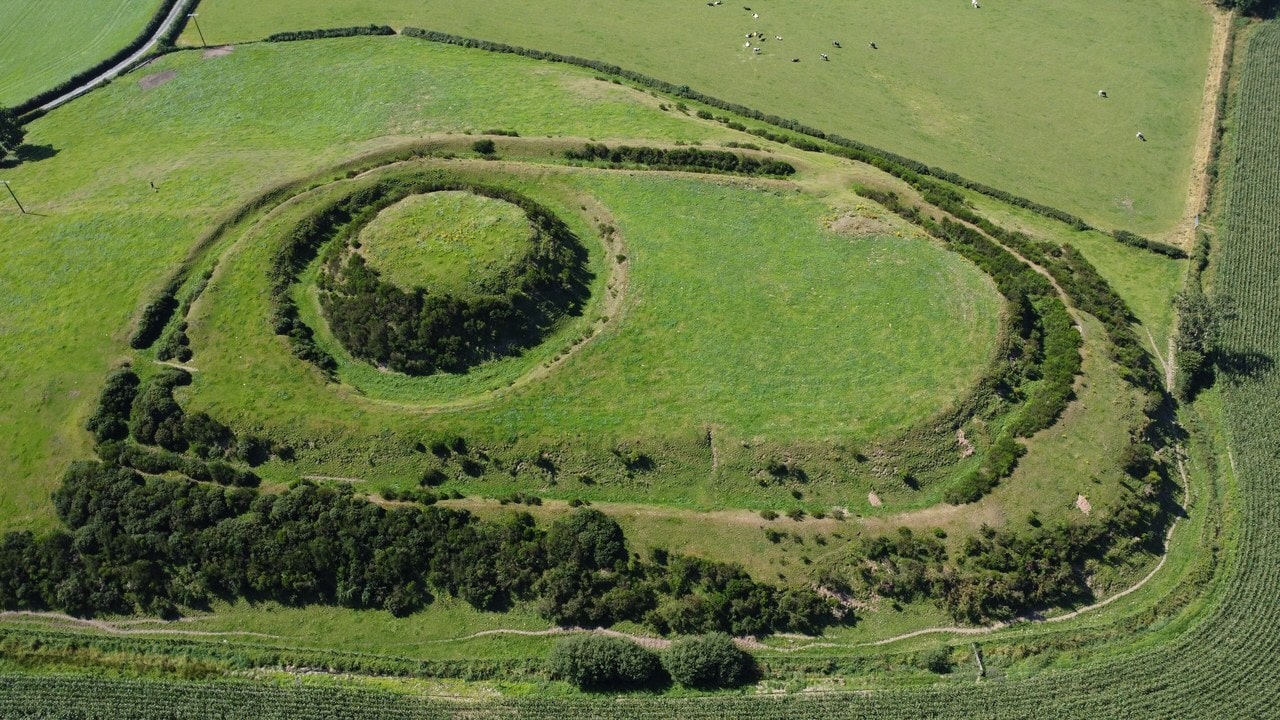
Nor did stone replace the mound. At York, Historic England records “a well-documented example of a tower keep castle overlying an important urban motte and bailey castle,” and English Heritage’s account of Clifford’s Tower has Henry III deciding “to build a completely new stone tower on the mound.” A stone keep can stand on a motte, so the two categories are not consecutive states of one building. Masonry on a mound is in any case uncommon: Higham reports Impey’s count of ninety-four mottes with summit masonry out of more than eight hundred.
Concentric is not a period at all. Historic England’s thesaurus defines a concentric castle as “a castle surrounded by two or more lines of walled fortifications,” and that sentence is the whole scope note. No date, no reign. The contrast is what makes this decisive: in the same thesaurus a quadrangular castle carries “this design became common in England after 1300,” and an artillery castle carries “constructed between 1481 and 1561 for defence using heavy guns.” The vocabulary knows how to date a class. On this one it declines.
The shell keep is the clearest case, and it is a category that dissolves the closer you stand. G. T. Clark promoted it in 1884. Ella Armitage titled an appendix “The So-Called Shell Keep” as early as 1912. Historic England’s own two instruments disagree about what the thing is. Its thesaurus files a shell keep under Keep and defines it as “a Norman keep, in the form of a circular or polygonal enclosure surrounded by a wall,” with no mound in the definition. Its scheduling prose calls it “an enclosure of masonry, extending round the top of an earlier motte or castle ringwork and replacing the existing timber palisades.” Robert Higham’s review holds that the palisade-into-stone transformation “cannot be demonstrated archaeologically or historically” for this class, while allowing that elsewhere “the traditional idea of a timber-into-stone transformation makes sense.” One authority, two instruments, two answers, and a specialist who disputes the succession here and grants it next door. Our castle keeps guide takes the shell-keep dispute to its end, with Higham’s review and the counts behind it.
So the three names are sound and the ladder is not. Where the ladder comes from we could not establish: it is not in Higham, not in the English or Scottish recording vocabularies, and not in EBIDAT’s mask, and we have not searched curriculum archives or textbook editions. What can be shown is how the triad behaves once it reaches a classroom. A Year 6 worksheet on castle types closes with a task asking which type of castle the pupil thinks is best. A classification does not ask that.
What a Classification Is Actually For
A recording vocabulary is built to find things again. Historic England says so in the scope note above its own form-based classes: sites are grouped by form “where this has been deemed to be useful for retrieval purposes.” That single clause is the difference between how England indexes castles and what England thinks a castle is. Keep it in view before reading any list as a statement about buildings.
Read that way, the disagreements stop looking like errors. EBIDAT’s search mask, run by the Deutsche Burgenvereinigung and the European Castle Institute, asks about a castle’s siting, its form, its function and legal standing, its date, its present use, its state of survival and whether you can get in, as separate and independently combinable questions. A castle is not filed as one of a list. It is described on several answers at once.
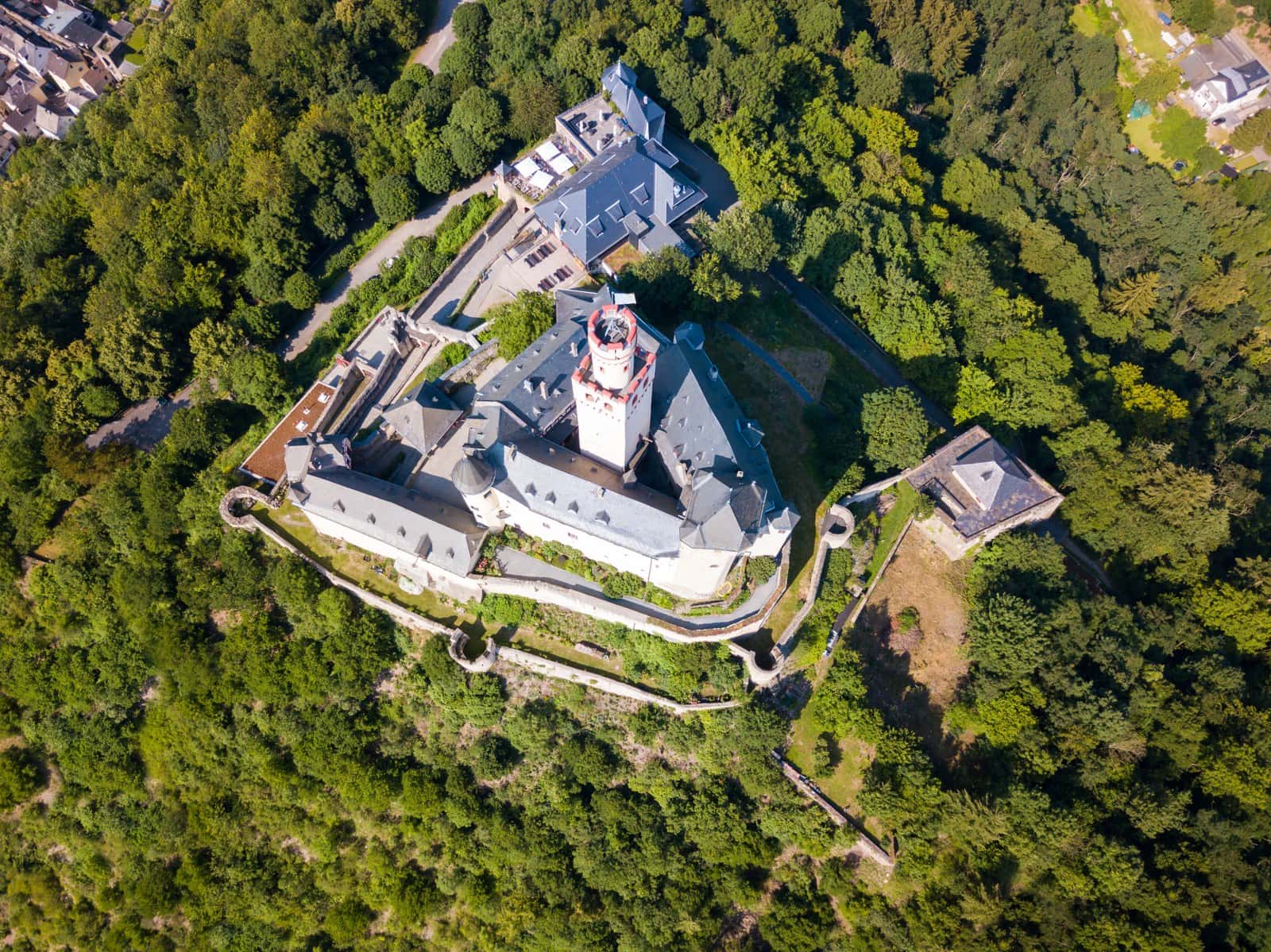
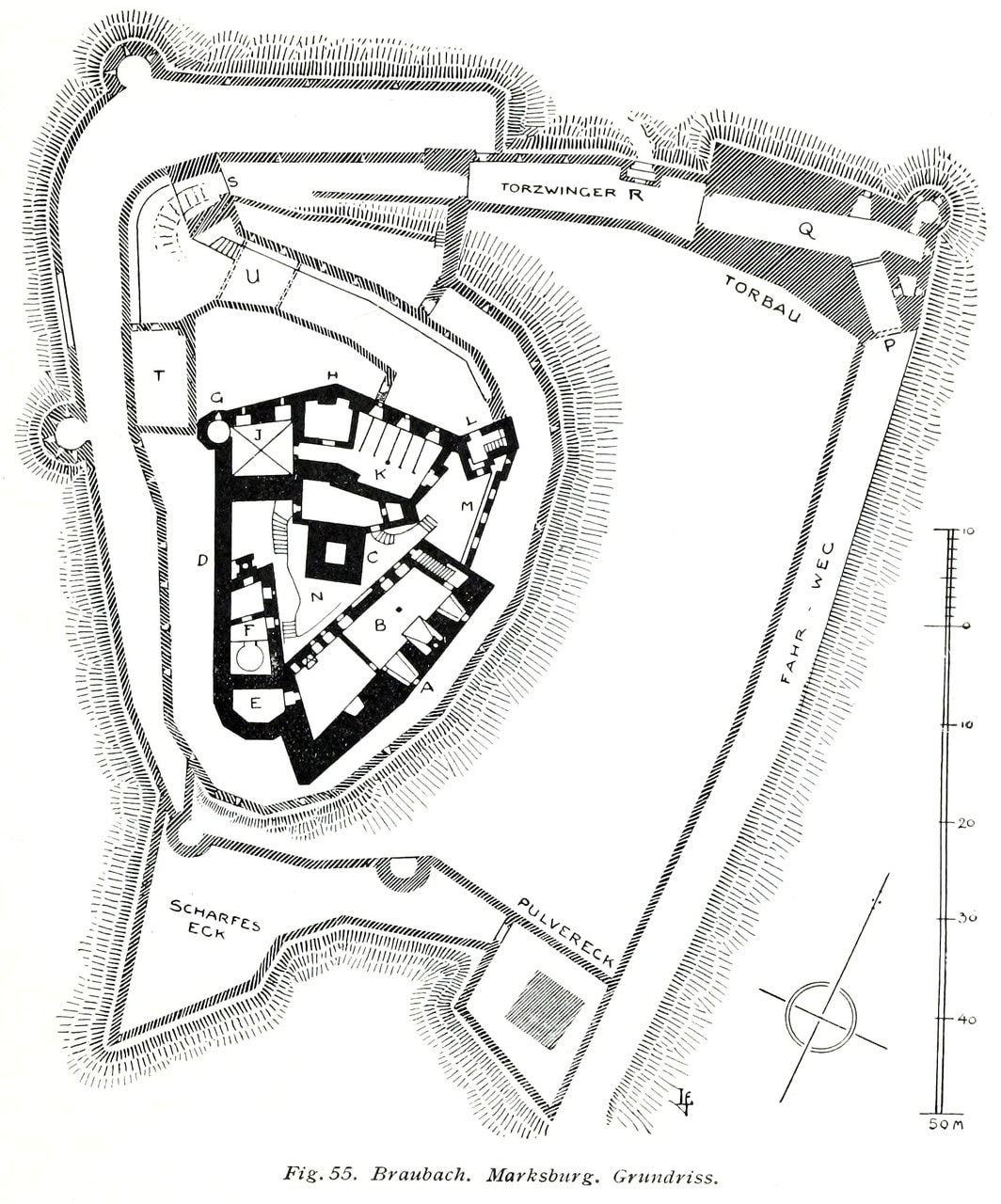
The Marksburg record shows what that looks like in practice. On the record display, the field labeled Klassifizierung reads “Randhausanlage Kompaktanlage”, both plan words explained under By Plan below; Funktion Rechtsstellung reads “Landesburg Dynastensitz”; Höhenlage reads “Gipfel-Bergkuppe”; the date begins in the first half of the thirteenth century; and survival is “Weitgehend erhalten,” largely preserved. None of those answers is deducible from another, which is what it means for them to be separate questions. One caution: the same list of values is labeled Typ on the search mask and Klassifizierung on the record, so an EBIDAT field name means something only with the interface attached.
| What the field asks [ours] | EBIDAT’s label | Marksburg’s answer |
|---|---|---|
| Where does it stand? | Höhenlage | Gipfel-Bergkuppe |
| What form does it take? | Klassifizierung | Randhausanlage, Kompaktanlage |
| Who held it, and under what standing? | Funktion Rechtsstellung | Landesburg, Dynastensitz |
| When does it begin? | Datierung-Beginn | 1.H.13.Jh. |
| How much of it survives? | Erhaltung – Heutiger Zustand | Weitgehend erhalten |
The Getty’s Art & Architecture Thesaurus makes a related separation structurally. Castles resolve in its Objects facet; Romanesque, Gothic Revival and Scottish Baronial resolve in its Styles and Periods facet. A style and a kind of building are answers to different questions, and a list that mixes “concentric castle” with “Gothic Revival castle” has merged two of them.
Three of those questions carry most of the argument here, and the sections below take them in turn: where a castle stands, how it is laid out, and who held it. Selecting and grouping them this way is ours, not EBIDAT’s. It also leaves out the question the record answers last, how much of the castle is still standing, which is where the categories start to break.
By Where It Stands
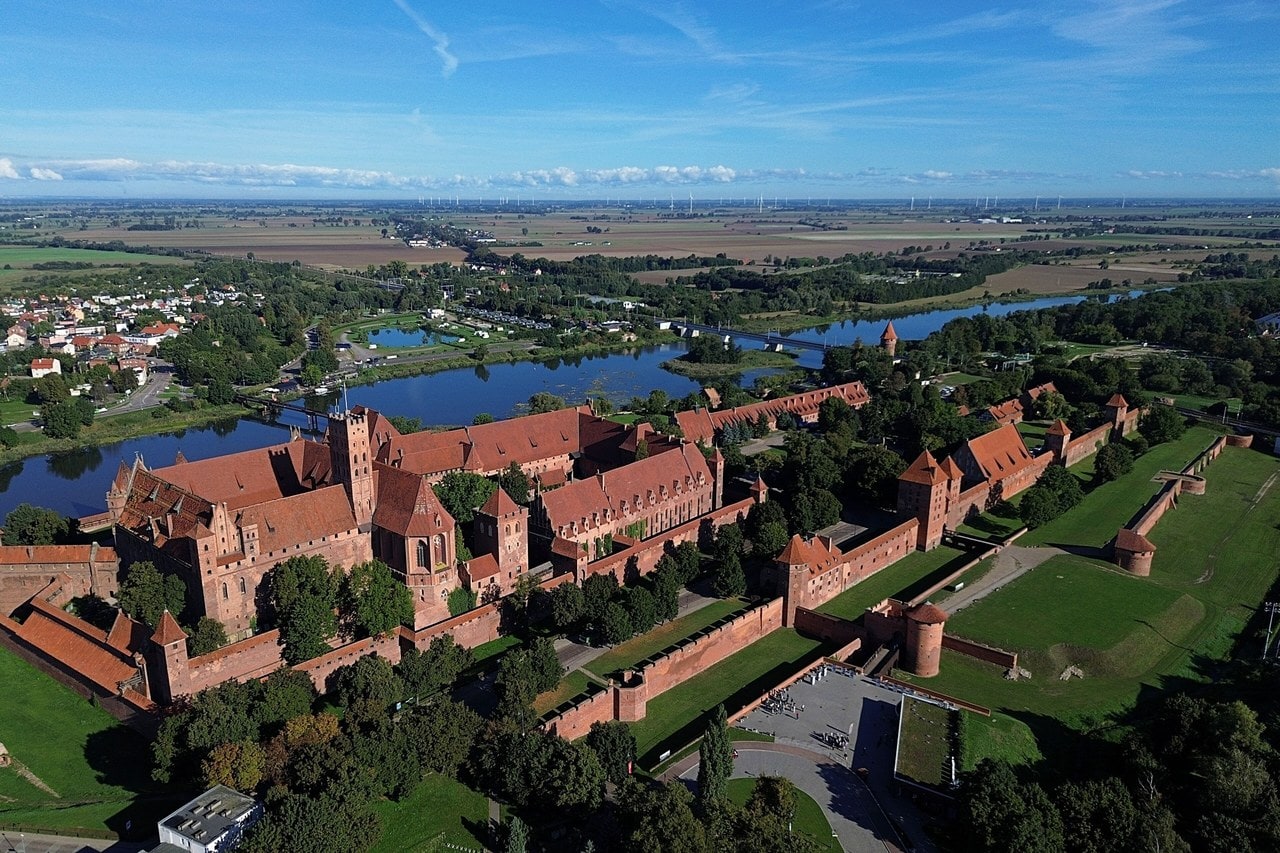
German castle studies begin with the ground. The Institute for Regional History at Mainz treats Höhenburg, the height castle, as the covering term, and nests the more precise words inside it: summit, spur, hillside and ridge are subdivisions of one category rather than rivals to it. The distinction that matters is between a castle on high ground and one on the flat, a Niederungsburg.
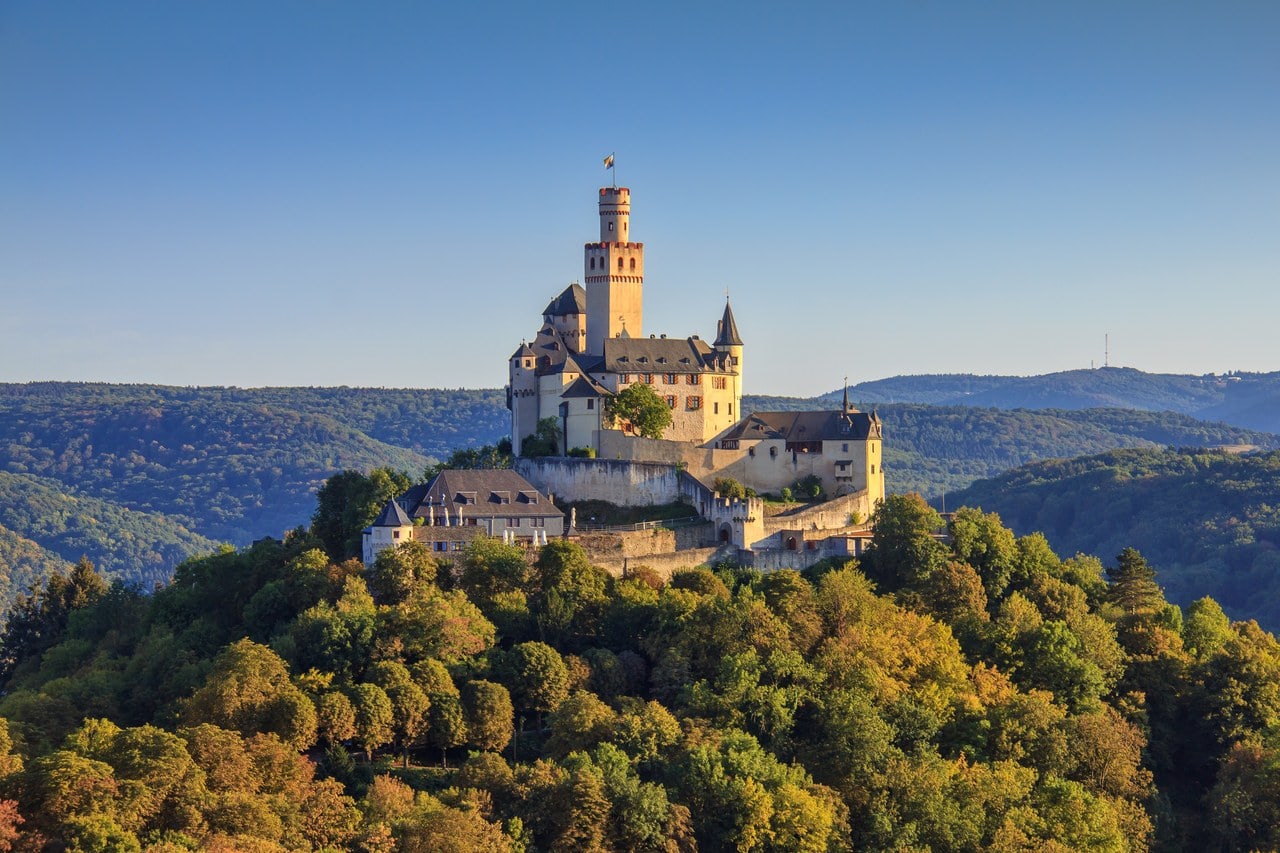
EBIDAT’s form list does not carry Höhenburg. Its form list carries Gipfelburg for a summit and Abschnittsburg for a site cut off by a ditch across a neck of land, and its record for Marksburg answers the siting question with “Gipfel-Bergkuppe.” Marksburg’s own operator, meanwhile, calls the castle “die einzige nie zerstörte Höhenburg am Mittelrhein,” the only never-destroyed height castle on the Middle Rhine. Two German institutions use the word and one German database’s form field does not carry it. Attribute the term to whoever is using it and the apparent conflict disappears.
Water is another siting condition with a vocabulary of its own. A Wasserburg sits in standing water rather than on a rise, and the arrangement is common enough in Germany to have produced its own word. Our how castle moats worked guide covers what the water was doing.
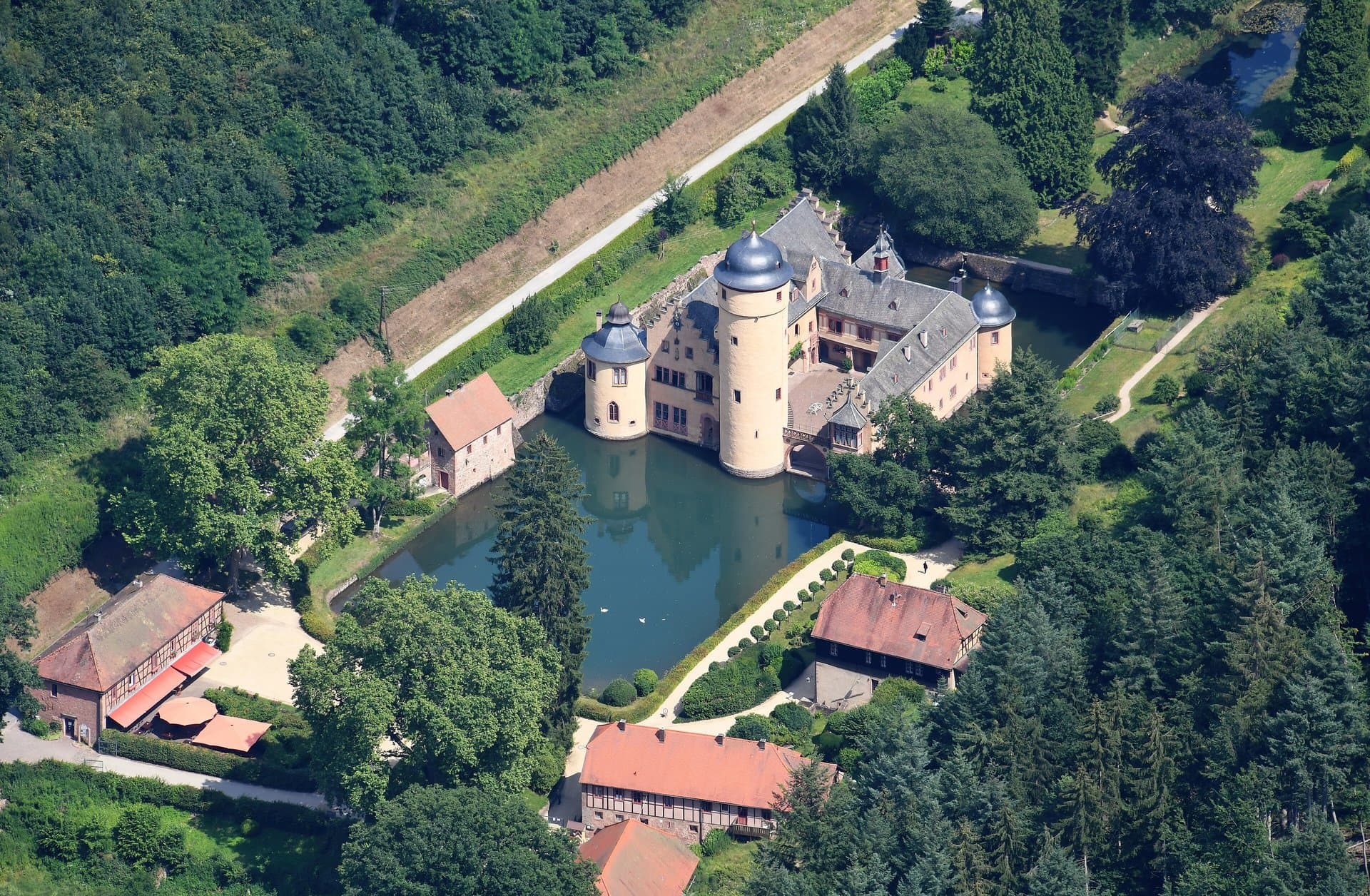
Two more of EBIDAT’s form values are siting conditions in all but name. A Felsenburg is built on rock, using the outcrop as its own defense, and a Höhlenburg is built into a cave. Neither is a plan or a period. Both describe what the builders found on site.
By Plan
The second question is what shape the walls make once the site is chosen, and this is where the popular scheme has its one genuine survivor.
EBIDAT’s form list separates two arrangements that look alike from outside. In a Randhausanlage the buildings stand against the inside of the ring wall, leaving a courtyard in the middle. Kompaktanlage sits beside it in the same field, and the database publishes no definition of either word: what it publishes is which castles carry which value. Marksburg carries both, which is a useful warning: these are descriptions of an arrangement, and a castle large enough can do two things at once. Beside them sit Ringmauerburg, a castle whose defense is its ring wall; Schildmauerburg, one carrying a single massive shield wall across the vulnerable side; and Frontturmburg, one with its tower forward against the approach.
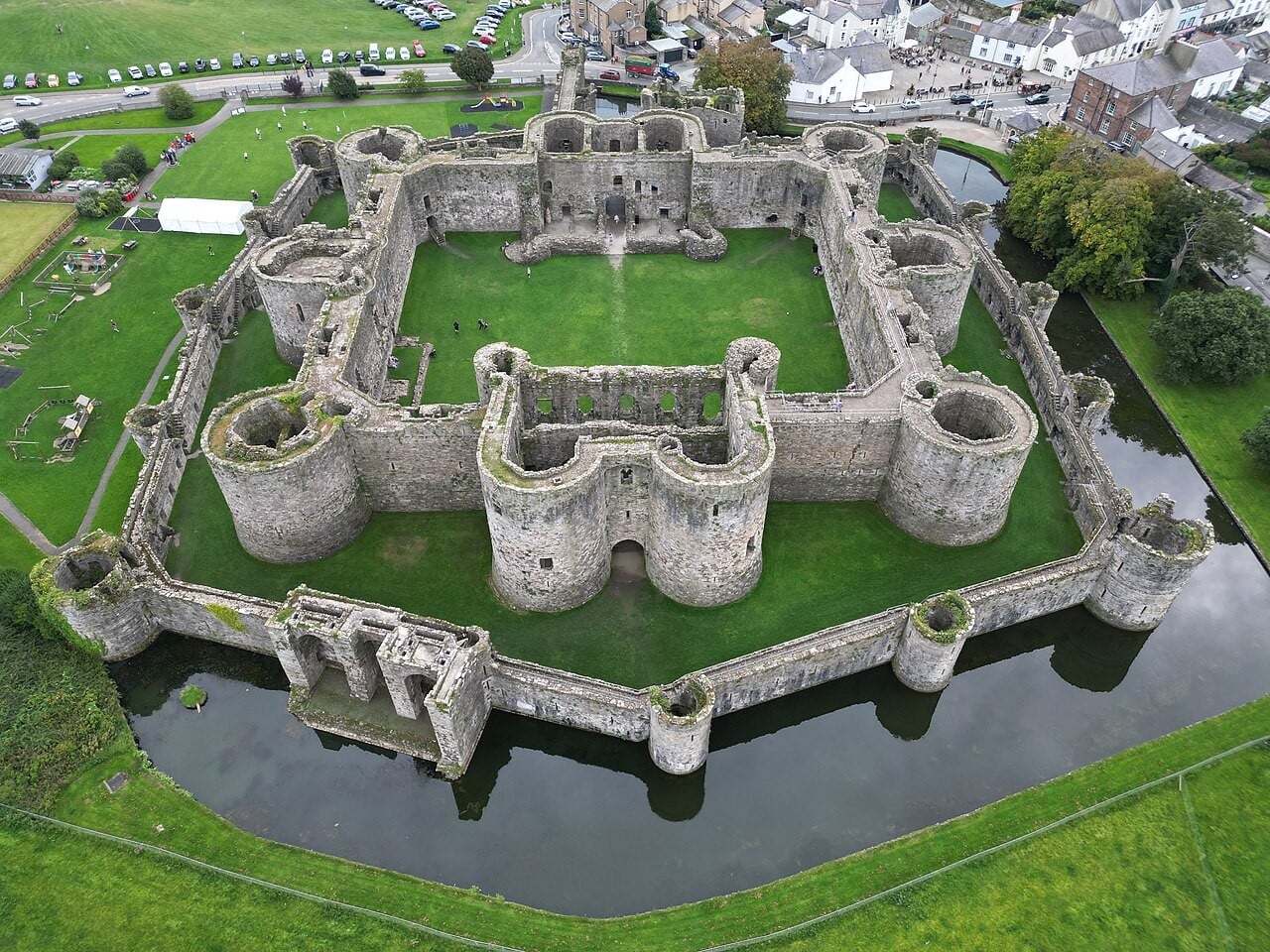
Concentric planning belongs here rather than to a century. The definition, again, is geometric: two or more lines of walled fortification, one inside the other. Beaumaris is the case everybody reaches for, and Cadw’s own page is careful in a way that most retellings are not. It describes “no fewer than four concentric rings of formidable defences” and calls the castle “famous as the greatest castle never built” rather than pronouncing it the greatest. The reason is on the same page: “lack of money and trouble brewing in Scotland meant building work had petered out by the 1320s,” and “the south gatehouse and the six great towers in the inner ward never reached their intended height.” So the standard example of concentric planning is an unfinished castle, and any sentence calling it concentric owes the reader that.
The enclosure castle, which some lists offer as a further type, is not one. In Historic England’s thesaurus “enclosure castle” is an alternative label for castle itself, a synonym kept for retrieval. A list that presents it as a type alongside the others has separated a word from its own headword. Framlingham Castle is the clearest English case: thirteen towers on a curtain about ten metres high at its highest points, enclosing a courtyard that is now grass.
By Who Held It
The third axis is the one English castle writing barely uses, and it is the reason a German castle record can look so unfamiliar. Beside its form list on the search mask, EBIDAT carries a second field, Funktion, with twenty-seven values. Most of them name who held the castle or under what legal standing: Landesburg, a territorial ruler’s castle; Reichsburg, an imperial one; Bischofsburg for a bishop; Ministerialensitz for the seat of a ministerialis, the unfree knight of the German nobility; Dynastensitz, Adelssitz, Stammsitz, Amtssitz, Königsburg, Ordensburg for the military orders. Some of the values name a use rather than a holder, and one of the twenty-seven is simply Unbekannt, unknown.
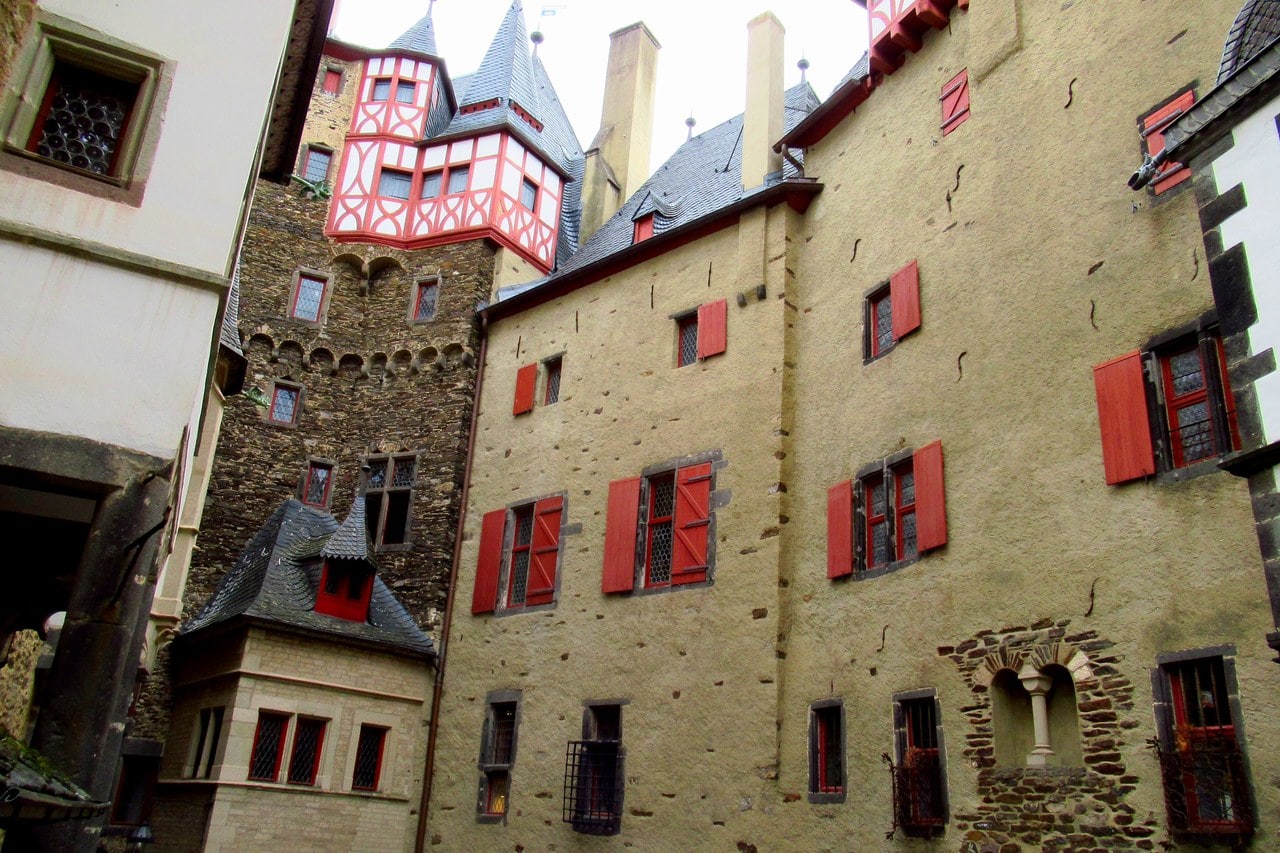
The Ganerbenburg is the sharpest of them, and the Historisches Lexikon Bayerns is unusually direct about what kind of category it is: “Hierunter ist kein Bautyp zu verstehen, sondern ein spezieller Funktionstyp mit politischen und gesellschaftlichen Implikationen.” Not a building type but a functional one, with political and social implications. A Ganerbenburg is a castle held in common by co-heirs under a Burgfrieden, a castle-peace contract governing how the shared fortress was run. Initially the arrangement was conceived so that the co-heirs lived together inside the castle. They could be relatives, though they did not have to be, and nothing about the masonry tells you which it was. Our guides to Eltz Castle and Schönburg are both of this kind.
English has one word on this axis, and its existence is instructive. Historic England’s thesaurus carries “adulterine castle,” defined as “a castle erected without permission, ie. without a royal licence to crenellate.” Our history guide compares the English, French and German mechanisms; what the German field actually contains is the question here. The German vocabulary has no equivalent, and the Institute at Mainz explains why in a sentence about building rights: where the English kingship could assert its claim to control castle-building, the German king “war von Anfang an nicht in der Lage, diesem Recht genügend Geltung zu verschaffen,” was from the outset unable to give that right sufficient force. A crown that can enforce a license needs a word for the castles built without one. A crown that cannot gets a vocabulary for how castles were shared instead. The two national records explain each other, and the comparison is ours.
France sorts on the same axis with a different instrument. The Inventaire général defines a maison forte as a dwelling with defensive elements “mais dont le possesseur ne détient pas en principe les droits seigneuriaux permettant d’élever un château muni de défenses importantes,” whose owner does not, in principle, hold the seigneurial rights that would allow a properly defended castle. The building is classified by what its owner was entitled to build, not by what he built.
The same vocabulary goes further and instructs its own catalogers where the line falls. Its note on château fort reads: “Ne pas appeler château fort un château présentant des éléments de fortification décoratifs ou à mission défensive limitée. Ne pas confondre avec fort, ni avec forteresse.” Do not call a château with decorative fortification a château fort, and do not confuse it with a fort or a fortress. That is an instruction to a cataloger rather than a statement about buildings, which is what makes it useful: it tells you the distinction was hard enough to need saying. Where the castle-palace-fortress boundary itself is concerned, see castle vs palace vs fortress.
The Tower House
A tower house is a type of building rather than a kind of tower, and it is the clearest example of two national records defining the same term differently.
Historic Environment Scotland defines a tower house as “a permanently occupied, fortified residence, built from the mid-14th to the 17th century,” adding that tower houses “are rectilinear in plan, often with one or more additional wings, and provide accommodation on several storeys.” Historic England defines the same term as “a multi-storey, fortified hall house with one of the crosswings being raised in the form of a crenellated tower,” permanently occupied, of the same date bracket, and “found mainly in the border counties of the North of England.”
The two agree on the centuries and describe different buildings. Scotland’s is a tower with wings attached; England’s is a hall with one wing raised into a tower, and England’s is explicitly regional. Quoting the English definition as the definition of a tower house would misdescribe every Scottish example, which is a good reason to read a scope note to its end. Both records file the type under fortified house rather than under castle.
Whether that filing makes a tower house a castle changes what each country can count, and our country with the most castles guide works through the totals.
Where the Categories Break
A classification earns trust by naming its own failures, and these vocabularies do.
Take the Turmburg, a castle whose defense is essentially one tower. The Institute at Mainz gives a clean discriminator against the motte: a Turmburg stands on “gewachsenem Boden,” undisturbed natural ground, where a motte stands on an artificially heaped mound. Then it concedes the point: “Zuweilen ist eine Unterscheidung zwischen Turmburg und Motte kaum zu treffen,” at times a distinction between the two can hardly be made, because some fortified courtyard sites laid out at ground level were later remodeled into mottes. The category fails when a building moves between types over time, and the vocabulary says so rather than hiding it.
EBIDAT’s form list carries the strain openly. Among its twenty-nine values sit Gipfelburg and Niederungsburg, which answer where; Randhausanlage and Kompaktanlage, which answer how it is laid out; and Abgegangene Burgstelle and Burgstall, which answer how much is left. Three questions in one dropdown. The database that most clearly separates the axes elsewhere does not keep them apart here. That is not a criticism of EBIDAT; it is what a working tool looks like when the material resists.
Specialists reach the same place from the other direction. Reviewing the shell keep, Higham argues that separate descriptive terms are needed for the motte-top alone, and proposes six: integrated shell-keep on motte; integrated shell-keep on encased motte; circular castle; donjon with or without ring-wall on motte; complex donjon on motte; and simple donjon on motte. Six proposed terms stand where the schoolroom has one. He also raises the objection against himself that “medieval castle designers will always end up defeating our efforts at categorization,” and then answers it: “I think it nevertheless remains true that we should stick to a specific use for the term shell-keep: the essential feature should be internal buildings at least some of which are ranged against the inside face of the surrounding wall.” The response to a leaky category is a tighter definition, and he supplies the tighter definition in the same breath.
Contemporaries had less of a problem because they had fewer words. In the English royal-works documents Higham surveys, all motte structures, whatever their sort, were great towers or donjons: the king’s houses on the motte at Berkhamsted, “a le doungion” at Windsor. Most of this vocabulary was invented by people looking back at the buildings, which is why it fits them imperfectly.
Outside Europe
The European term does not transfer, and the international vocabulary shows where it stops. The Getty files the Japanese tenshu as a fortification element rather than as a kind of castle, and instructs anyone describing the western European equivalent to use “keeps” instead. A vocabulary that indexes both traditions has to keep them apart. What the Japanese tradition classifies, and how, is a question for Japanese sources; none has been read for this article.
Castles You Can Visit
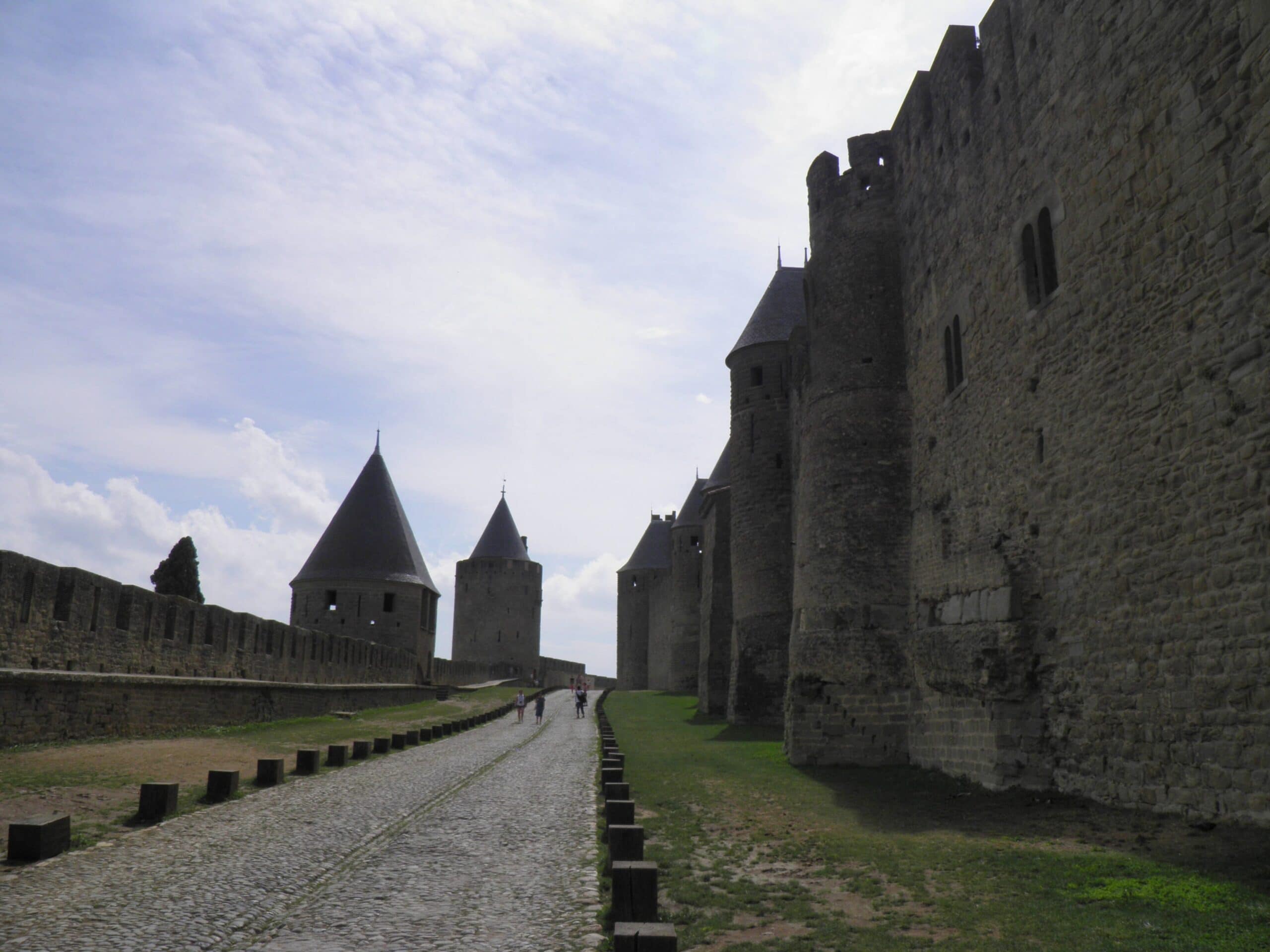
A concentric plan you can read for free: Carcassonne, in southern France. The double enceinte is the point of the site, and the space between the two rings, the lices, is inside the free zone along with the medieval city. A ticket buys the Château Comtal, the towers and the wall-walk on the inner ring. The free ring is the outer one, which is worth knowing before you queue.
A Ganerbenburg whose division you can see: Eltz, above the Moselle in Germany. The co-heirs’ separate houses are visible as separate houses from the inner courtyard, which is unusual: on most castles of this kind the arrangement is a matter of record rather than of sightlines.
A recorded form, on the record: Marksburg, at Braubach on the Middle Rhine. EBIDAT files it as Randhausanlage and Kompaktanlage, Landesburg and Dynastensitz, on a Gipfel-Bergkuppe, largely preserved. Its EBIDAT entry is the one quoted above, and the castle is open.
A Wasserburg in its water: Mespelbrunn, in the Spessart hills of Bavaria. A moated house still standing in the pond that defines the category.
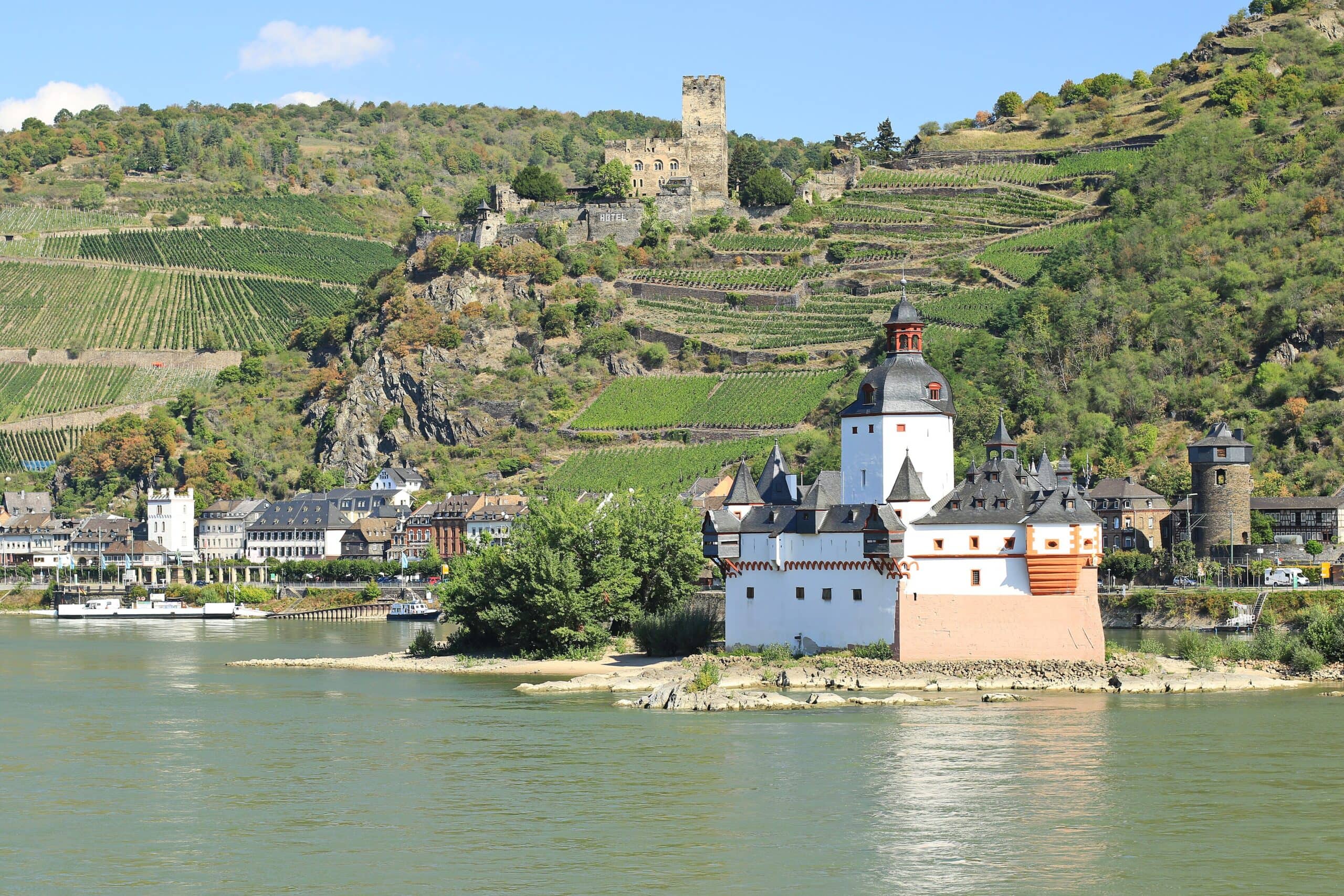
An island castle in mid-river: Pfalzgrafenstein, at Kaub on the Rhine. Reached by the small passenger ferry from Kaub, which cannot dock when the Rhine runs high. Check before you travel.
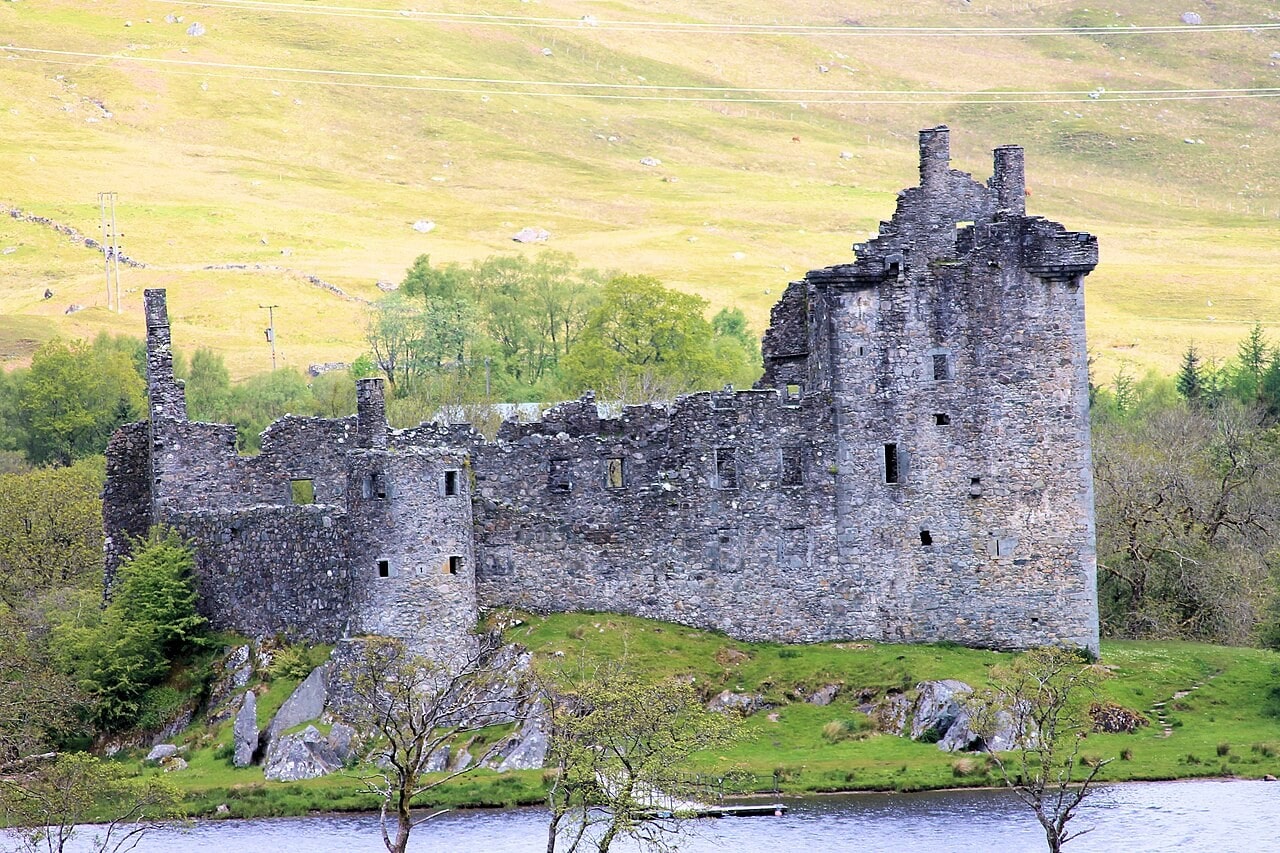
Two types we cannot send you to, and the reason is the type. For a motte-and-bailey there is no guide in this catalog, because the class survives overwhelmingly as earthwork. Scheduling protects a site; it does not open one. For a tower house the options are worse. In Scotland, at Kilchurn, the interior is shut for conservation with no published reopening date, and Historic Environment Scotland lists the site as grounds or exterior access only, a different label from the one it uses for its closed properties, so the tower can be walked around but not entered. At Dunrobin, open in season, the tower house survives entirely enclosed by later work. Both are still tower houses. Neither shows you one.
Common Questions
What are the four types of castles?
No cataloging authority publishes a canonical four. The number varies with the vocabulary: Historic England’s thesaurus files eleven kinds of castle, EBIDAT offers twenty-nine values in its form field, and Historic Environment Scotland’s equivalent heading carries just four narrower terms. Lists reaching four usually add the shell keep to the familiar three. That is a real category with a contested definition rather than a fourth stage.
Did stone keeps replace motte and bailey castles?
No, and the record says so twice over. Historic England’s class description for tower keep castles notes that “a few were constructed on the sites of earlier earthwork castle types but most were new creations,” and at York it records a tower keep castle “overlying” the earlier motte and bailey. Stone towers were built alongside earthwork castles, sometimes on top of one, and across four centuries rather than in a phase.
What is a small castle called?
It depends on what is small about it. EBIDAT’s form vocabulary carries Wohnturm for a residential tower and Turmburg for a castle whose defense is essentially a single tower. A Burgstall is different again: the site of a castle rather than a castle, used where little or nothing stands. English tends to reach for “tower house,” which is a specific dated type in both British records rather than a general word for something small.
What are different names for castles?
Recording vocabularies keep synonyms deliberately, so a searcher finds the record whichever word they use. Historic England’s castle heading carries “enclosure castle,” “citadel,” “castle gate” and “castle gatehouse” as alternative labels for the same concept. That is why a list offering “enclosure castle” as a separate type has gone wrong: it has promoted a synonym into a category.
Are the different types of castles in the UK the same everywhere?
They are not, because the UK has more than one recording vocabulary. Historic England’s castle heading carries eleven narrower terms; Historic Environment Scotland’s carries four and defines a castle by the office it served, as “a medieval fortified building or range of buildings, serving as a royal, or baronial, residence, or administrative centre.” A building can therefore be filed one way in one nation and another way across a border.
Principal Sources
- Cadw. “Beaumaris Castle.” cadw.gov.wales
- Deutsche Burgenvereinigung. “Die Marksburg.” marksburg.de
- Deutsche Burgenvereinigung / Europäisches Burgeninstitut. EBIDAT: Die Burgendatenbank, search mask and record 67, Marksburg. ebidat.de
- English Heritage. “History of Clifford’s Tower, York.” english-heritage.org.uk
- Getty Research Institute. Art & Architecture Thesaurus (castles 300006891; tenshu 300310678). getty.edu
- Higham, Robert. “Shell-keeps Revisited: The Bailey on the Motte?” Castle Studies Group, revision 23, 1 July 2017.
- Historic England. FISH Thesaurus of Monument Types (Castle 68833; Concentric Castle 68837; Shell Keep 68839; Tower House 68914; Adulterine Castle 68834; Monument By Form 102872). heritagedata.org
- Historic England. Scheduled monument list entries 1011799, York Castle and 1017574, Restormel Castle, whose designation texts carry the class descriptions quoted here, read via Heritage Gateway. heritagegateway.org.uk
- Historic Environment Scotland. Scottish Monument Types Thesaurus (CASTLE 295; TOWER HOUSE 344; FORTIFIED HOUSE 341). heritagedata.org
- Historisches Lexikon Bayerns. “Ganerbschaft.” historisches-lexikon-bayerns.de
- Institut für Geschichtliche Landeskunde Rheinland-Pfalz e.V. Glossary entries: Höhenburgen, Turmburg, Steinburg, Burgbaurecht. regionalgeschichte.net
- Inventaire général, Ministère de la Culture. Thésaurus de l’architecture: château fort (T96-453), maison forte (T96-521), motte (T96-483). data.culture.fr
Image credits. Hero, the Marksburg from directly above: Photo: saiko3p / Adobe Stock; the Motte of Urr from the air: Photo: DsMaxwell, CC BY-SA 4.0; Malbork on the flat bank of the Nogat: Photo: Kapitel, CC BY-SA 4.0; Marksburg on its hill crown: Photo: Adrian72 / Adobe Stock; Mespelbrunn in its pond: Photo: Carsten Steger, CC BY-SA 4.0; Luthmer’s 1914 ground plan of the Marksburg: Photo: Ferdinand Luthmer, public domain; Beaumaris from the air: Photo: Llywelyn2000, CC BY-SA 4.0; the courtyard at Eltz: Photo: Dkvtig, CC BY-SA 4.0; Kilchurn across the water: Photo: Andrew Wood, CC BY-SA 2.0; the lices at Carcassonne: Photo: Gzen92, CC BY-SA 4.0; Pfalzgrafenstein on its island at Kaub: Photo: Kora27, CC BY-SA 4.0. Freely licensed images are resized to fit; otherwise unaltered.