
Castle Documentaries
We make castle documentaries, and every one of them starts in the same place: with the single thing everyone says about a castle. Sometimes that claim survives contact with the record. More often it turns out to be younger than the building, or aimed at a different room, or assembled after the fact by people with something to sell.
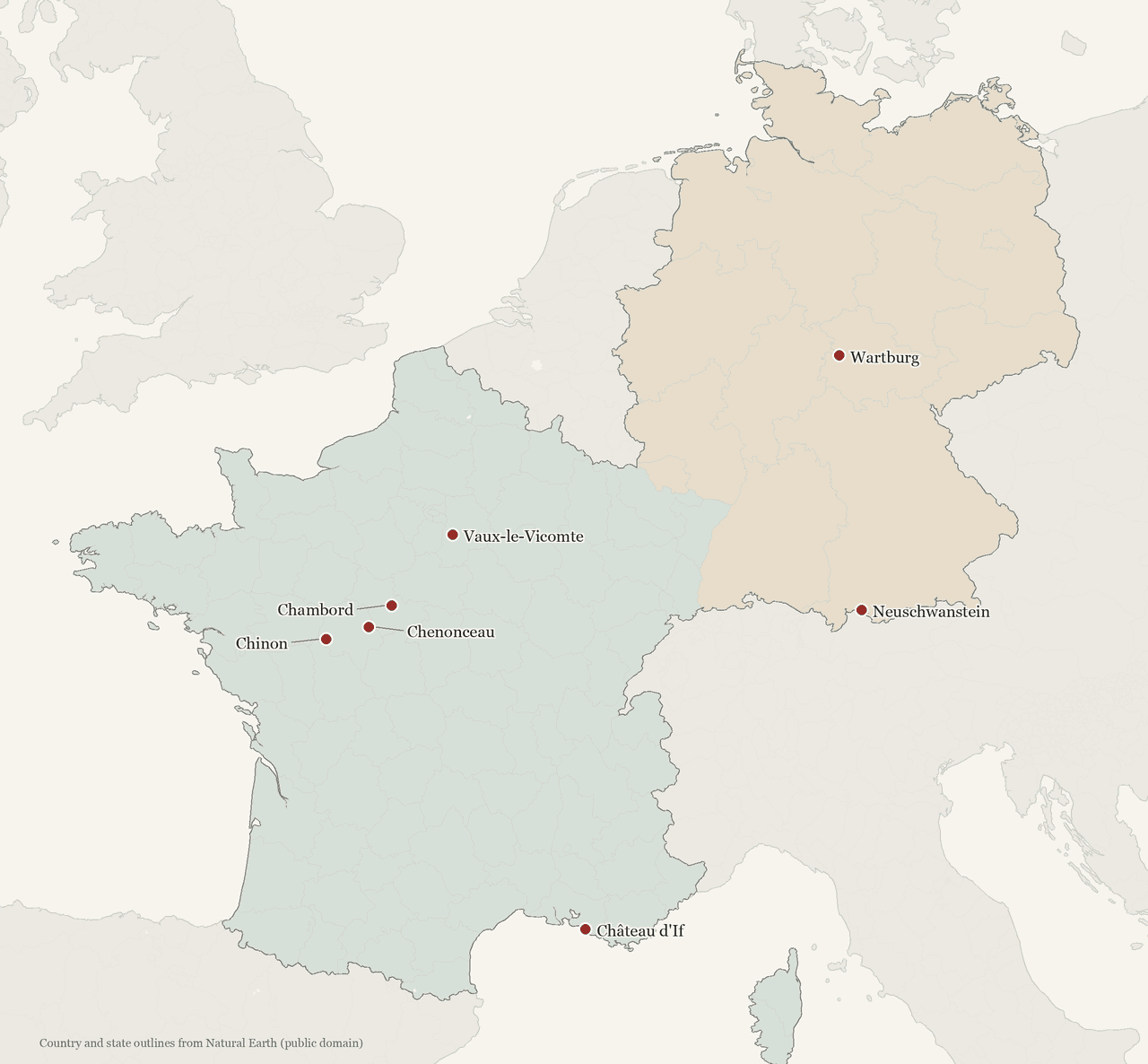
Seven films are finished so far, covering five castles in France and two in Germany. All of them are free to watch, none of them asks you for an account, and each one has a fully cited written guide on this site standing behind it, so you can check the work rather than take our word for it.
How These Documentaries Are Made
The method is small enough to state in a paragraph. We find the claim a castle is famous for, usually by reading what its own operator, its tourist board and the existing videos all repeat. Then we go to the primary record: the institution that owns the site, the national heritage authority, the scholarly literature. Where those disagree with the popular version, the film is about the gap. Where they disagree with each other, we say so and leave it open rather than picking the tidier answer.
Two things follow from that, and they are worth stating plainly because they cost us material. We cut sections we cannot source, which is why some episodes are shorter than they might be. And we leave real controversies unresolved, which is less satisfying than a conclusion. Ludwig II’s death is the clearest case in this collection: the Bavarian Palace Administration itself calls the circumstances mysterious, the medical literature is still arguing, and so our film argues with nobody.
Our sourcing rules, including how we handle a source that turns out to be wrong, are written down in full on our editorial standards page. Where two credible authorities contradict each other, we log it rather than average it, and those cases are collected in where sources disagree.
Where to Start
There is no required order, and these are not ranked. If you want the one viewers have returned to most, start with Vaux-le-Vicomte: it has a party, an arrest and the team that went on to make Versailles, and it moves fastest.
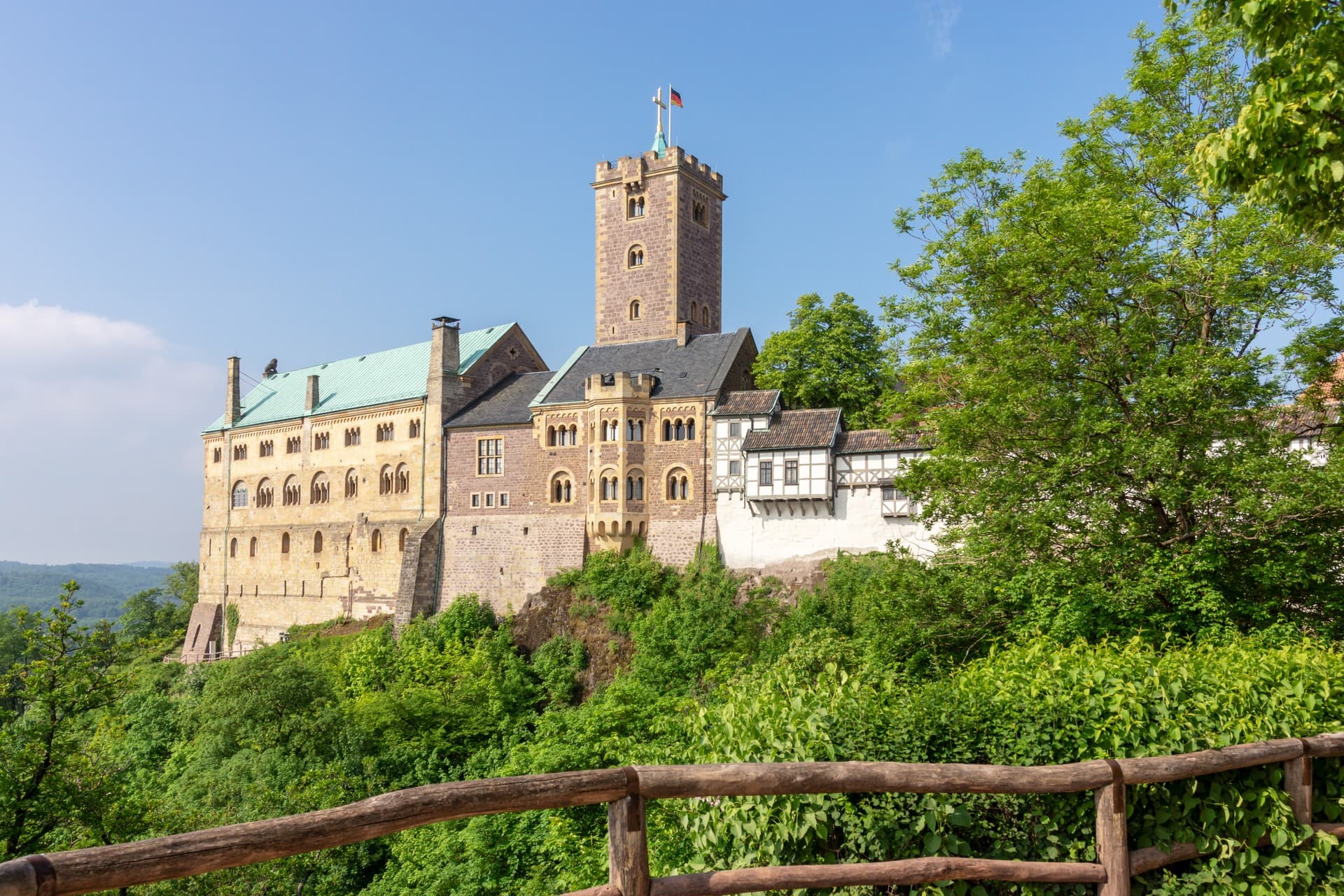
If you would rather start with the film that shows most clearly what this method does, take the Wartburg. Its famous attraction is a stain on a wall that is not on the wall, has not been there since about 1900, and was painted on long after Luther left. The castle’s own foundation published the monograph that says so.
For architecture, Chambord is the one to watch, because the mystery at its center is real rather than manufactured: nobody knows who designed it, and the reason nobody knows is itself documented. The runtimes are on every entry below; the shortest is Neuschwanstein.
A note on the headings below: each is the film’s own title, and each states the claim the episode goes on to test. Chenonceau was not fought over by two queens, and Chambord’s architect is not known. That is the point of the films, and the correction is in the paragraphs under each title.
The Episodes: Germany
Neuschwanstein: The Castle That Ruined a King
Ludwig II of Bavaria built a medieval castle in the nineteenth century, decorated it with scenes from Wagner operas, and never finished it. That much is well known. What gets flattened is the end of the story. The expert opinion was written on 7 June 1886, and two days later the king was declared mentally ill and unfit to govern. The Bavarian Palace Administration records that the trigger was his refusal to respond to foreign banks threatening to seize his assets, and that the government then removed him from office by a procedure, in its own words, not provided for in the Bavarian constitution. He was taken into custody at Neuschwanstein on 12 June and interned at Berg. On 13 June he died in Lake Starnberg, along with the psychiatrist von Gudden.
The film does not tell you how he died, because nobody can. The palace administration calls the circumstances mysterious and the medical literature is still in open disagreement. What can be said, and is documented, is that none of the officials who declared the king unfit could imagine examining him first.
Read: the cited Neuschwanstein Castle guide, where the visiting detail lives.
Luther Vanished Into Wartburg Castle and Remade a Language
Hidden at the Wartburg in May 1521 under the alias Junker Jörg, Martin Luther translated the New Testament into a German built to be read aloud from the Rhine to Saxony. He worked at it from 18 December 1521 to 1 March 1522, seventy-three days, and the result was printed as the September Testament of 1522.
The Lutherstube is also home to the most famous stain in German tourism, where Luther supposedly threw his inkwell at the devil. The foundation that runs the castle published the monograph calling that a legend. Only in the late seventeenth century did the ink become physical, more than a hundred years after Luther’s death, and the same story attached itself to other places he had stayed, Coburg among them. That gap between a story and the first text that records it is the whole subject of our guide to haunted castles, which dates the earliest surviving record for nineteen buildings. What kept the Wartburg’s stain alive was the visitors: they scraped fragments of the inked plaster off the wall to carry away, and the wall was re-inked for the next arrivals.
The renewals eventually stopped, and by about 1900 there was no stain left to see. That has not stopped people standing in front of the wall and looking for it.
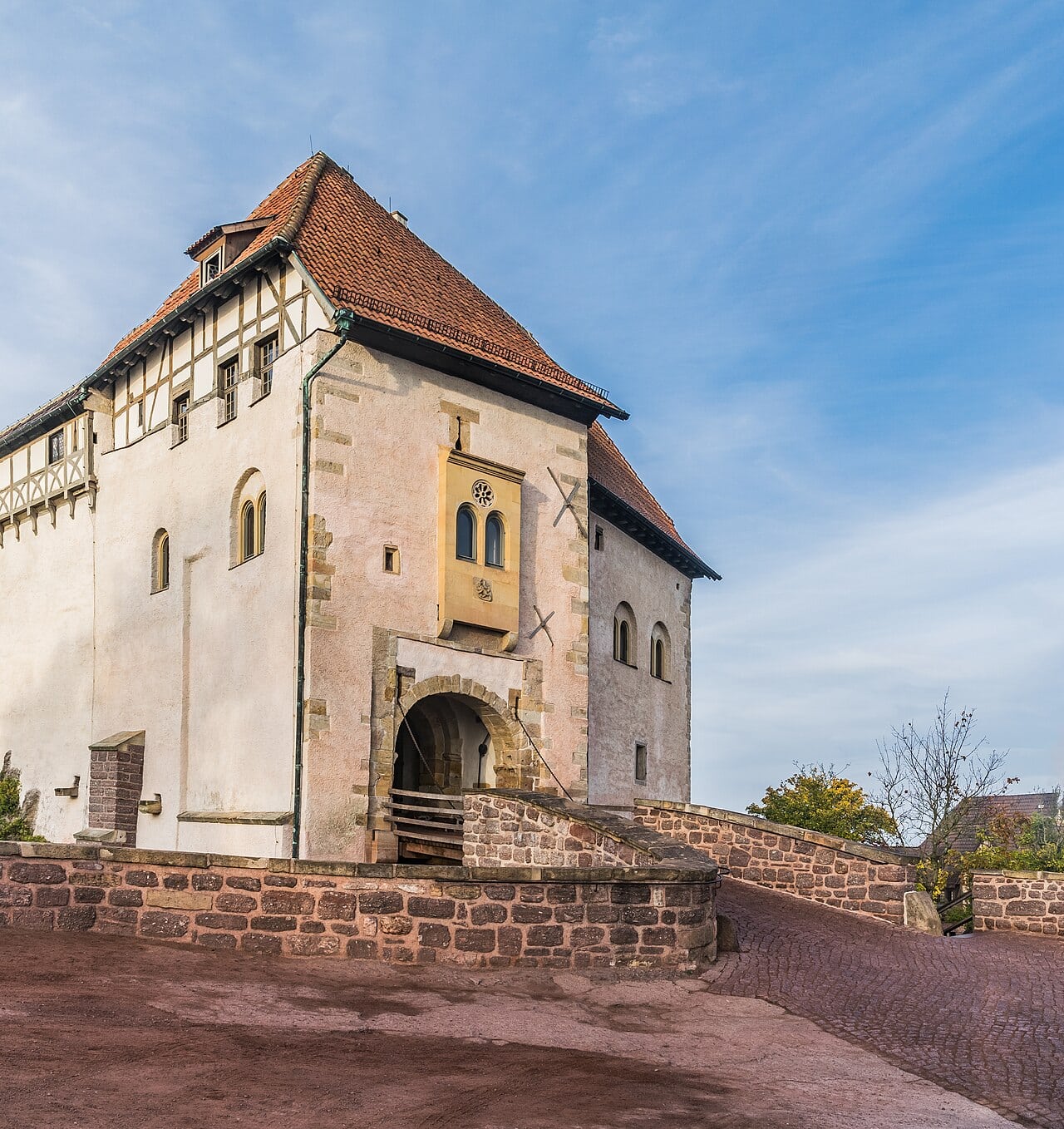
What a visitor sees elsewhere needs the same care, and the seam does not run where you would expect. The foundation dates the Palas to the twelfth century and calls it one of the finest and best-preserved Romanesque secular buildings north of the Alps, while UNESCO scopes the genuinely old fabric more tightly still, to the palace in its lower sections, the rampart masonry and the South Tower. Most of what stands around those is a nineteenth-century addition: Grand Duke Carl Alexander resolved on the renewal in 1838, and the architect Hugo von Ritgen built new work that by 1890 had brought the Palas, the Ritterhaus, the Vogtei and the wall-walks to the shape a visitor walks through now.
Read: the cited Wartburg Castle guide, where the visiting detail lives.
The Episodes: France
Chenonceau: The Castle Two Queens Fought Over
Only one of them was a queen. Diane de Poitiers was Henri II’s favorite, and he gave her Chenonceau outright, in a deed granting it to her as her own true patrimony. Catherine de Médicis was the actual queen, and she took it back. Henri died on 10 July 1559 of a wound taken at a tournament; by the end of that year Diane had signed Chenonceau away at Blois, receiving Chaumont-sur-Loire in exchange.
Both women left the building itself. Diane threw the bridge across the Cher. Catherine put the two-story gallery on top of the bridge, and between them they produced the silhouette everyone photographs. Attributing both to one of them, which happens often, erases the argument the architecture is a record of.
The house’s own framing is broader than the duel anyway. Chenonceau calls itself the Château des Dames, and the first of those ladies was neither queen nor favorite: Katherine Briçonnet ran the rebuilding at the start of the sixteenth century, decades before either of them arrived.
Read: the cited Château de Chenonceau guide, where the visiting detail lives.
Château d’If: The Real Prison Behind Monte Cristo
An island fortress off Marseille shows visitors a prison cell whose occupant never existed. Alexandre Dumas published The Count of Monte-Cristo in 1844 and put Edmond Dantès in a dungeon here. Visitors have been asking to see it ever since, and the site now has an installation for exactly that purpose, while noting that the genuine cells were a far cry from the one Dumas described.
The building was not designed as a prison at all. François I saw the weakness of the city’s defences on a visit in January 1516 and decided to fortify the island. Marseille had been attached to the kingdom only in 1481 and was not yet trusted, and the Marseillais read the new fortress exactly that way: they called it la Malvoisine, the bad neighbor. Prisoners followed within a few decades.
The documented ones are worth more than the fictional one. Protestants and, later, Republicans were held here for three centuries. What decided a prisoner’s fate was money, because the operator records the fortress organised by level: windowless dungeons beneath the castle, where few survived more than a few weeks; collective prisons on the ground floor; and private cells on the first floor, the pistoles, for anyone who could pay. Mirabeau, held for several months across 1774 and 1775, had a pistole and wrote a book in it.
Read: the cited Château d’If guide, where the visiting detail lives.
Vaux-le-Vicomte: The Castle That Built Versailles
On 17 August 1661 Nicolas Fouquet threw a party for Louis XIV that included the premiere of Molière’s Les Fâcheux, the first comédie-ballet, made with the choreographer Pierre Beauchamp and the composer Jean-Baptiste Lully. Three weeks later, on 5 September, the king’s own birthday, Fouquet was arrested at Nantes by d’Artagnan of the musketeers. His trial ran three years.
The famous version makes the party the cause. Our film does not, because the record supports the sequence and not the causation, and the case against Fouquet was being assembled before any guests arrived.
The other half of the legend needs adjusting too, in the opposite direction from the one you might expect. Louis XIV did not discover his artists at Vaux. Louis Le Vau had been the king’s architect since 1656, and the estate records that Vaux was the first time the three men worked together on a single project. Vaux is where Le Nôtre made his name. Charles Le Brun’s royal appointment came in 1664, after Vaux was finished and its owner was in prison.
Read: the cited Château de Vaux-le-Vicomte guide, where the visiting detail lives.
Joan of Arc Found a King Hiding in Chinon Castle
The scene everyone knows has Joan of Arc walk into a crowded hall and pick out a disguised Charles VII. The fortress’s own account splits that into two meetings, five weeks apart. She reached Chinon on 23 February 1429 after an eleven-day ride and was lodged in the Coudray Tower. Two days later the future king received her privately, with a small committee present. The public audience, the one called the sign, came between 27 March and 5 April, and it carries the ceremony that popular retelling assigns to the first. Charles was crowned at Reims on 17 July that year.
What survives is less than the story needs. Louis I of Anjou began the royal lodgings around 1370 and they were continued under Charles VII and Marie of Anjou, three ranges around a courtyard. The west and north wings are gone, and so is the hall where the recognition is supposed to have happened; what a visitor walks through today is the surviving south wing, kept and turned into museum space. A restoration campaign between 2000 and 2010 put roofs back over lodgings that had stood open for two centuries.
Read: the cited Château de Chinon guide, where the visiting detail lives.
Everyone Says Leonardo Built Chambord Castle. The Truth Is Stranger.
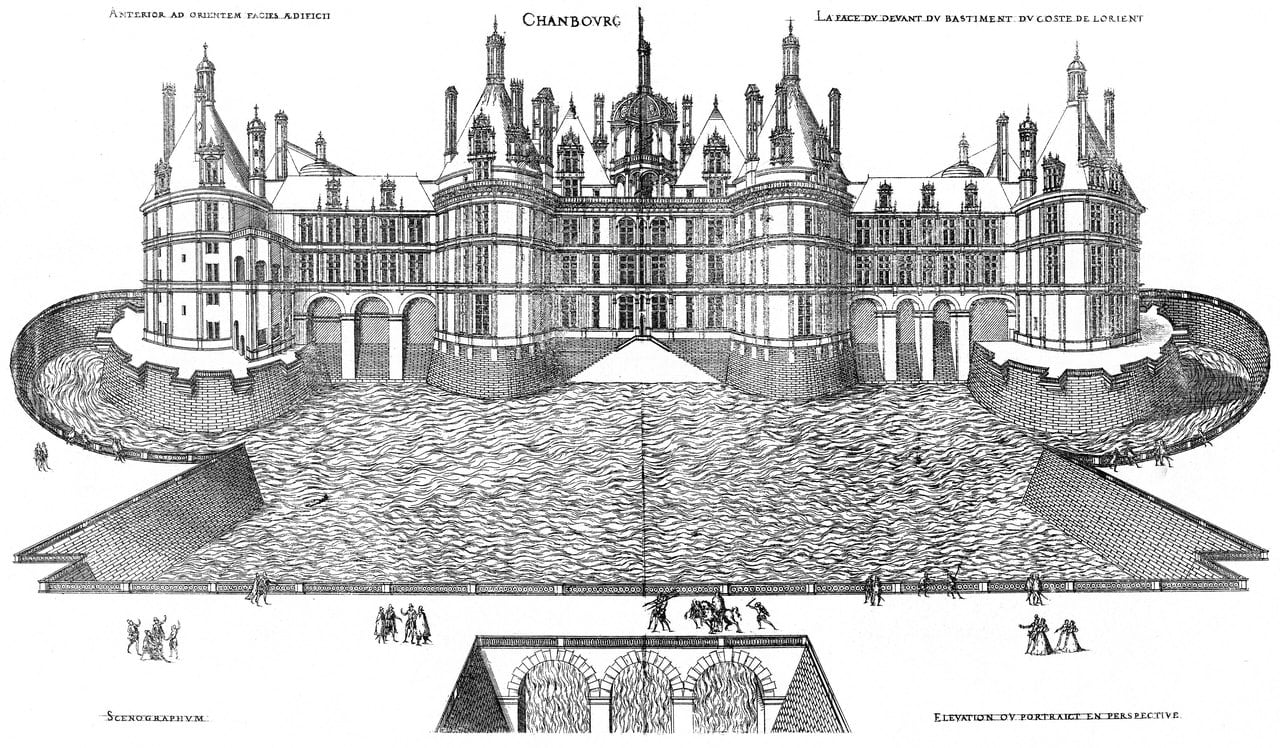
Chambord’s keep is laid out on a Greek cross: four rooms, each nine meters by eighteen, opening off a central crossing. At that crossing stands the double staircase, two spiral flights winding one above the other around a hollow, partly open core, rising to the lantern tower that crowns the roof. Two people climbing at once can see each other through openings in the core and never meet. Guides attribute the design to Leonardo da Vinci. So, in effect, does the estate, which reads the staircase and several other features as evidence of his hand behind François I’s project.
The stranger fact is that the estate also says nobody knows who designed the place. Its own words are that the architect’s identity has remained an enigma, and that no plan and no text contemporary with the building gives the name. There is a reason for the silence, and it is documented: the site’s records were dispersed or destroyed at the end of the eighteenth century. Names get proposed and argued over, and none of them is established. A five-hundred-year-old building that half of Europe has photographed has no author, and that absence is a finding rather than a gap waiting for a confident answer.
Read: the cited Château de Chambord guide, where the visiting detail lives.
What Seven Castles Turned Out to Have in Common
Seven films in, a pattern has emerged, and it is not the one we expected. The most famous fact about a famous castle is often the least reliable thing about it, and in these seven it tends to fail in one direction: the story is younger than the building, and it suited whoever was repeating it.
The Wartburg’s stain was a legend the castle kept repainting. Château d’If’s celebrated prisoner was a novelist’s invention, and the site now stages an installation for the tourists the novel produced. Chenonceau’s duel between two queens involved one queen. Chinon’s recognition scene is two meetings pressed into one, in a hall that no longer exists.
Two of the seven break the pattern, which is the more interesting result. Vaux-le-Vicomte fails in reverse: the legend undersells the men involved, treating a team of established royal professionals as a discovery Louis XIV made at a garden party. And Neuschwanstein’s popular story is not too harsh on the people who deposed Ludwig II. It is too kind. The version where a mad king is quietly removed for his own good is gentler than the record, in which the palace administration itself records a deposition carried out by a procedure the Bavarian constitution did not provide for, and the opinion that deposed him was written without any of its authors examining him.
So this is not a collection of debunkings, and a hub that promised seven of those would be lying about two of them. It is a collection about what happens to a building’s history when a great many people find a particular version of it useful.
Common Questions
Are these documentaries free?
Yes. All seven are on YouTube at full length, with no paywall, no account and no rental. Every film links its fully cited guide, and most also carry a key-sources list in the description, so you can check the sources without watching anything.
What is the castle documentary on Netflix?
The series people usually mean is Secrets of Great British Castles, presented by the historian Dan Jones, which works through British castles one per episode. There is also the BBC’s Secrets of the Castle. Both are British productions, which is the gap our films sit in: everything in this collection is in France or Germany.
What is the 25-year castle project in France?
Guédelon, in Burgundy, where a castle has been under construction since 1997 using thirteenth-century methods and materials, as an experiment in archaeology rather than a reconstruction of anything specific. It is the subject of the BBC’s Secrets of the Castle. It is not one of our episodes, and we have not filmed there.
Do you use AI narration?
Yes. The narration is read by synthetic voices, and we would rather you heard it here than worked it out. Everything else is human: the research, the script, the sourcing, the edit. We do not publish AI-generated images in a factual guide, and the photography in these films is licensed, public domain, or our own.
Beyond the Documentaries
If the films leave you wanting the mechanics rather than the stories, the reference articles on this site take the buildings apart: what a gatehouse actually did, how castle defenses worked as a system, why moats were rarely what films show, what walls and battlements were for, and what all the parts of a medieval castle are called. This page is updated as new episodes go live.
Conclusion
Seven castles, five in France and two in Germany, and in five cases the story a visitor arrives with does not survive an afternoon with the sources. That is not a complaint about the castles or the people who run them, several of whom are the ones who told us. It is a description of how the past reaches us: through whoever found a version of it worth repeating, whether that was a seventeenth-century castellan with a stain to repaint, a novelist who needed a dungeon, or a government that declared a king unfit without examining him. The films are an attempt to hear which century is speaking. The written guides behind them show the receipts.
Principal Sources
- Bayerische Schlösserverwaltung. “King Ludwig II of Bavaria.” neuschwanstein.de.
- Bayerische Schlösserverwaltung. “King Ludwig II: dates.” neuschwanstein.de.
- Bayerische Schlösserverwaltung. “Neuschwanstein Castle.” neuschwanstein.de.
- Centre des monuments nationaux. “History of the Château d’If.” chateau-if.fr.
- Château de Chenonceau. “The history of the Château.” chenonceau.com.
- Château de Chenonceau. Guide de visite, official visit guide, English edition. Available through the operator’s media library.
- Domaine national de Chambord. “Architecture.” chambord.org.
- Domaine national de Chambord. “As history unfolds.” chambord.org.
- Forteresse royale de Chinon. “1429.” forteressechinon.fr.
- Forteresse royale de Chinon. “Joan of Arc.” forteressechinon.fr.
- Forteresse royale de Chinon. “The royal dwellings.” forteressechinon.fr.
- Schwarz, Hilmar. Die Legende vom Tintenfleck: die Lutherstube auf der Wartburg. Kleine Schriftenreihe der Wartburg-Stiftung 4. Eisenach: Wartburg-Stiftung, 1991.
- Steinberg, Reinhard, and Peter Falkai. “Was King Ludwig II of Bavaria misdiagnosed by Gudden and his colleagues?” European Archives of Psychiatry and Clinical Neuroscience, 2020. PMC8119274.
- UNESCO World Heritage Centre. “Wartburg Castle.” Reference 897. whc.unesco.org.
- Vaux-le-Vicomte. “Nicolas Fouquet.” vaux-le-vicomte.com.
- Wartburg-Stiftung. “Fakten und Zahlen.” wartburg.de.
- Wartburg-Stiftung. “Welterbe Wartburg.” wartburg.de.
Image credits. Hero, the Wartburg on its wooded ridge: via Adobe Stock; The Wartburg’s gate building and drawbridge: Photo: Krzysztof Golik, CC BY-SA 4.0; Perspective elevation of Chambord: Jacques Androuet du Cerceau, public domain; Locator map: own work; country and state outlines from Natural Earth, public domain. Freely licensed images are resized to fit; otherwise unaltered.