
Sanssouci Palace
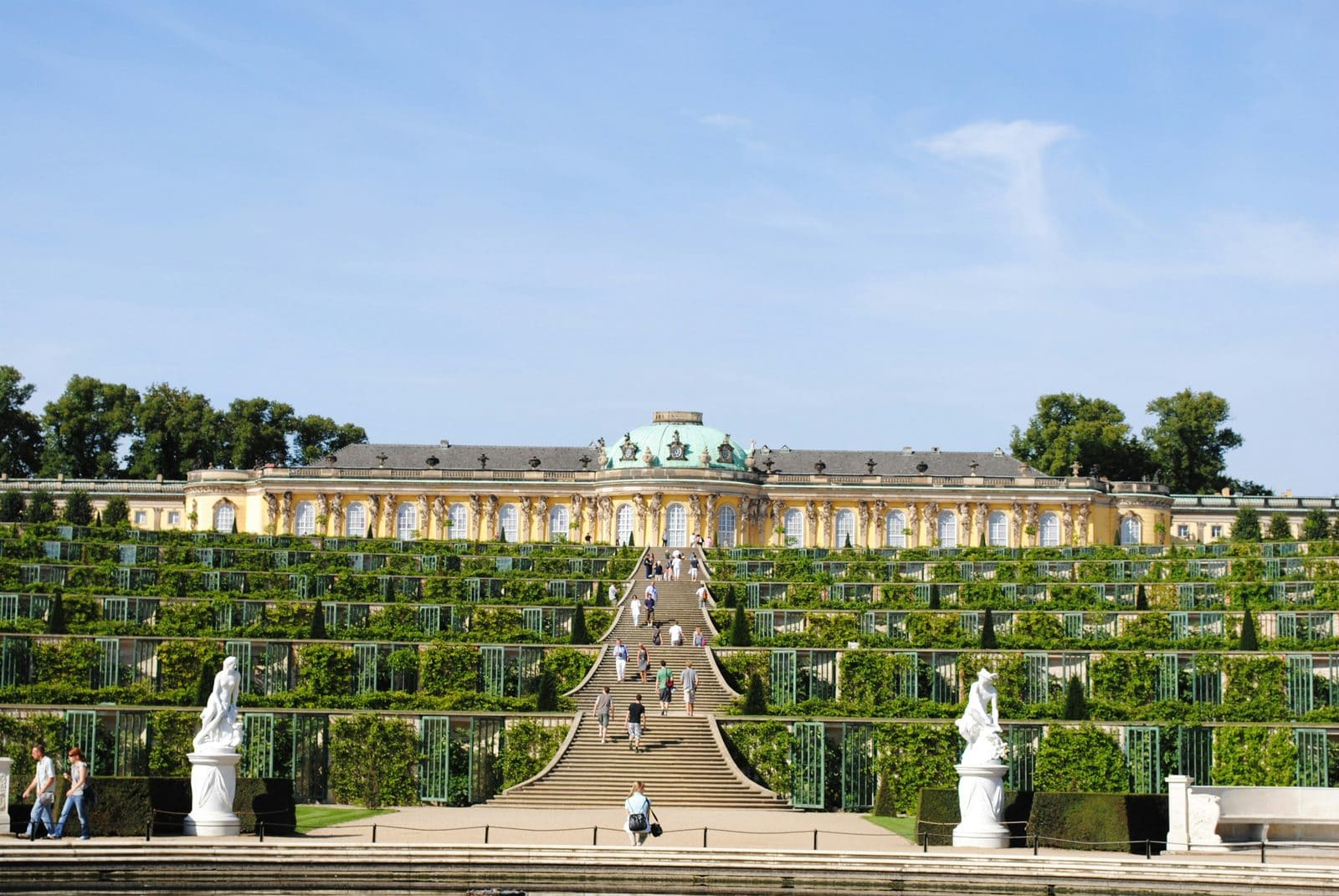
Sanssouci Palace stands on a terraced hillside above Potsdam, a single-story building of twelve rooms that a king built for himself rather than for his state. Frederick the Great laid out six south-facing vineyard terraces here in 1744 and raised the palace on their crown between 1745 and 1747, and for nearly forty summers it was the place he preferred above all his grander residences. Its name, taken from the French for “without a care,” was both a wish and a program. Here Frederick meant to escape the ceremony of the Berlin court, to read and play the flute and argue philosophy with his guests, and to live, as he put it, like a private man.
That ambition left a strange and durable monument. While other monarchs measured themselves against the Palace of Versailles and the length of their facades, Frederick measured himself in the smallness of his retreat, and the contrast between the intimate palace and the monumental Prussia that grew up around it is the whole story of the place. He sketched the design himself, fought his own architect over it, and asked to be buried on the top terrace beside his dogs. That last wish took two centuries to honor. A vineyard pleasure house had become, by then, one of Germany’s most visited World Heritage sites, and yet it never quite shed the privacy its builder intended.
Quick Facts
| Location | Potsdam, Brandenburg, Germany |
| Built | 1745–1747 (vineyard terraces laid out 1744) |
| Built for | Frederick the Great (Frederick II of Prussia) |
| Architect | Georg Wenzeslaus von Knobelsdorff; completed by Johann Boumann |
| Style | Frederician Rococo |
| Type | Royal summer / pleasure palace (Lustschloss) |
| Rooms | Twelve, on a single floor |
| Current use | Museum |
| Owner / operator | Stiftung Preußische Schlösser und Gärten Berlin-Brandenburg (SPSG) |
| UNESCO | Inscribed 1990, “Palaces and Parks of Potsdam and Berlin” (Ref. 532) |
| Open to public | Yes; timed admission |
| Official site | spsg.de |
“Without a Care”: The Idea of Sanssouci
Frederick II came to the Prussian throne in 1740 and spent much of the following two decades at war, expanding and defending the kingdom his soldier-father had drilled into shape. As a young prince he had been bullied toward soldiering by that father, had tried to flee the country at twenty-one, and had been made to watch the beheading of the friend who fled with him. The flute, the books and the French verse he loved were the very things his upbringing had tried to crush out of him. Sanssouci was conceived as the antidote to all of it. As early as 1744 he ordered the barren southern slope of the Bornstedt ridge to be cut into terraces and planted with vines, figs and exotic fruit, turning what one account calls a “desolate hill” into a geometric garden. Upon that stage he meant to set a small house where he could be, for a few months each year, something other than a king.
The French name carried the whole idea. “Sans souci” means “without a care,” and Frederick had the words set in gilded letters across the garden front, oddly punctuated as “Sans, Souci.” He wrote of the palace as a place that “should only last my lifetime,” and he resisted even minor repairs, as though permanence were a kind of pretension the building was meant to avoid. This was not a residence for governing or for receiving foreign courts. It was a refuge for reading, music and conversation, a private Prussian Arcadia for a king who called himself the first servant of his state and then, each summer, tried to stop being one.
Knobelsdorff, Frederick, and the Single Story
The man charged with realizing the king’s sketch was Georg Wenzeslaus von Knobelsdorff, the architect who had already given Frederick the New Wing at Charlottenburg and who knew his patron’s tastes intimately. At Sanssouci the two men fell out. Knobelsdorff argued for a semi-basement that would lift the principal rooms onto a raised floor, keep damp out of the building, and give it the dignity of a proper base. Frederick refused. He wanted the rooms level with the top terrace, so that he could step straight from his library into the garden without climbing a single stair, and he got his way.
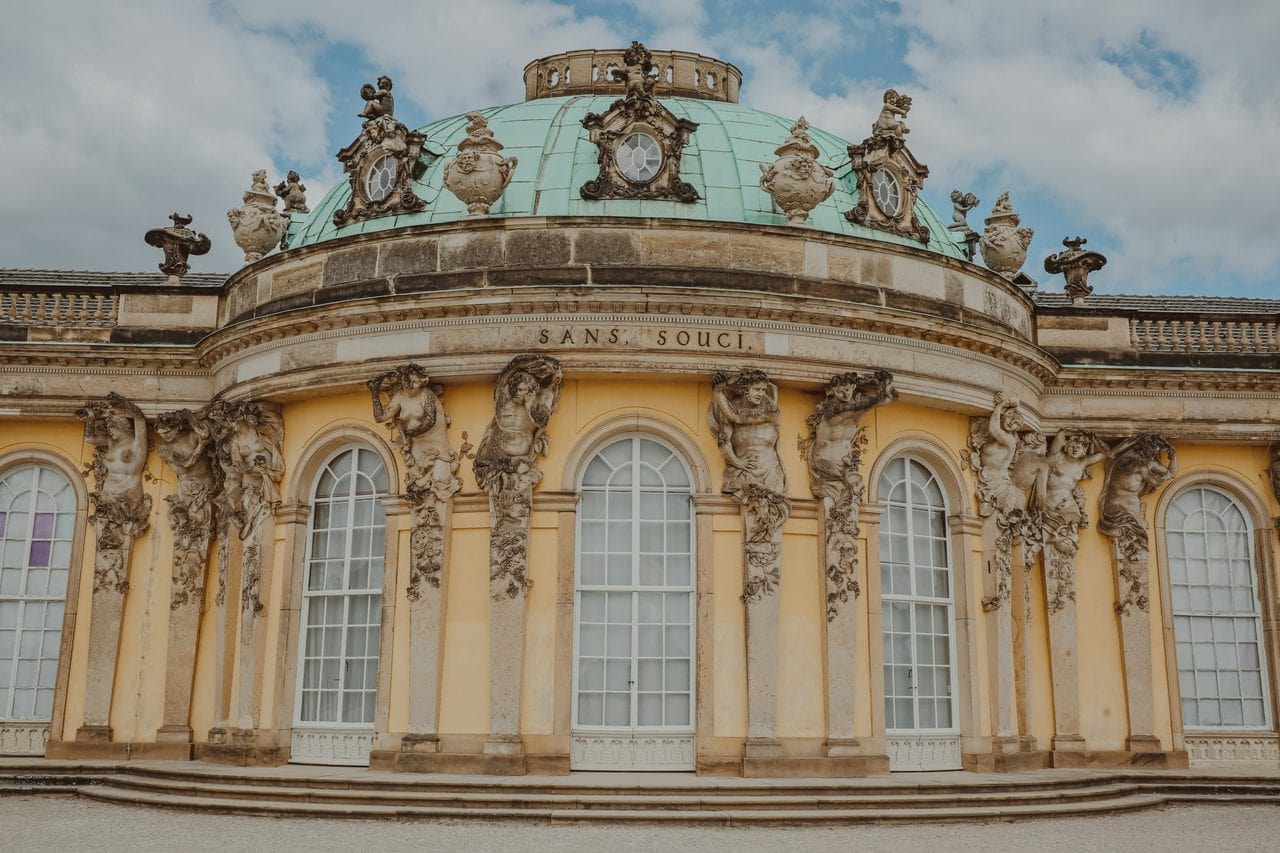
Time proved the architect right about the damp and wrong about the king. The garden-flush design is exactly what makes Sanssouci feel like a private villa rather than a palace, a building that lies down along its hill instead of rising above it. Knobelsdorff was relieved of charge of the works in 1746, ostensibly on grounds of health, and the Dutch builder Johann Boumann saw the project to completion in 1747. The two men did not break entirely: Knobelsdorff kept his royal offices and his standing with Frederick until his death in 1753. What survives is a single elegant story, its garden front bowed outward at the center beneath a low dome, with paired sandstone bacchants by Friedrich Christian Glume straining as if to hold up the cornice. The decoration throughout follows a style historians now call Frederician Rococo, lighter and more linear than the French original, and shaped at every turn by the king’s own taste; he reviewed drawings, costs and materials himself and overruled his craftsmen as readily as he had overruled his architect.
Inside the Twelve Rooms
Behind that modest front lies a single enfilade of twelve rooms, of which Frederick occupied only five as his private apartment. A visitor enters through a small vestibule and the oval Marble Hall, the ceremonial heart of the palace, domed and lit from a central oculus in deliberate echo of the Roman Pantheon, its columns and floor worked in white and yellow marble. From there the rooms run in a line: an audience and dining room hung with French paintings, the king’s combined study and bedroom, a library lined in cedar and gilt where Frederick kept his French classics and almost no German books, and the room that gives the palace its reputation for beauty, the Concert Room.
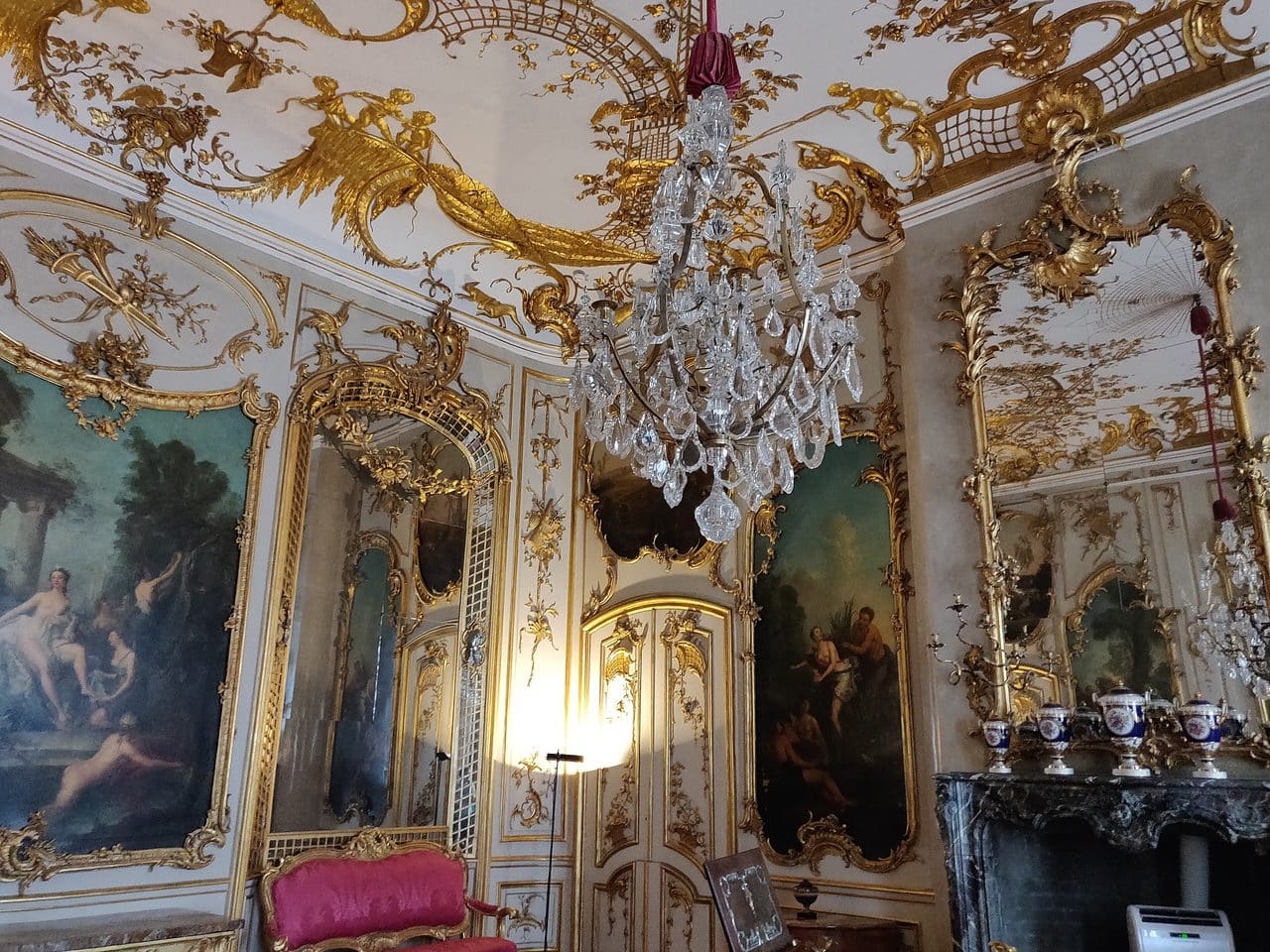
This concert room is among the finest Rococo interiors in Germany, its walls dissolved into gilded trelliswork, musical instruments, vines and spider’s webs modeled in stucco by Johann Michael Hoppenhaupt. Westward lie five guest rooms, one of them carved with apes, parrots and painted fruit and named, after the fact, for Voltaire. Whether the philosopher ever actually slept there is uncertain, but the playful and faintly mocking decoration suits the memory of the most celebrated and most difficult of the king’s guests.
The Philosopher’s Court
Music and conversation were the real occupations of Sanssouci, and Frederick built his days around them. Most evenings closed with a chamber concert in which the king took the solo flute part, playing his own sonatas before a small audience. That scene was painted a century later by Adolph Menzel, whose candlelit “Flute Concert” became the popular image of the palace even though its painter was imagining a moment he could never have witnessed. Frederick was a serious amateur who composed more than a hundred flute sonatas and several symphonies, and he drew the leading musicians of the age to Potsdam. One of them, Carl Philipp Emanuel Bach, served as his harpsichordist. In 1747 the harpsichordist’s father, Johann Sebastian Bach, came to the Prussian court, where the king set him an intricate theme to improvise upon; from that challenge grew the Musical Offering, one of the monuments of European music.
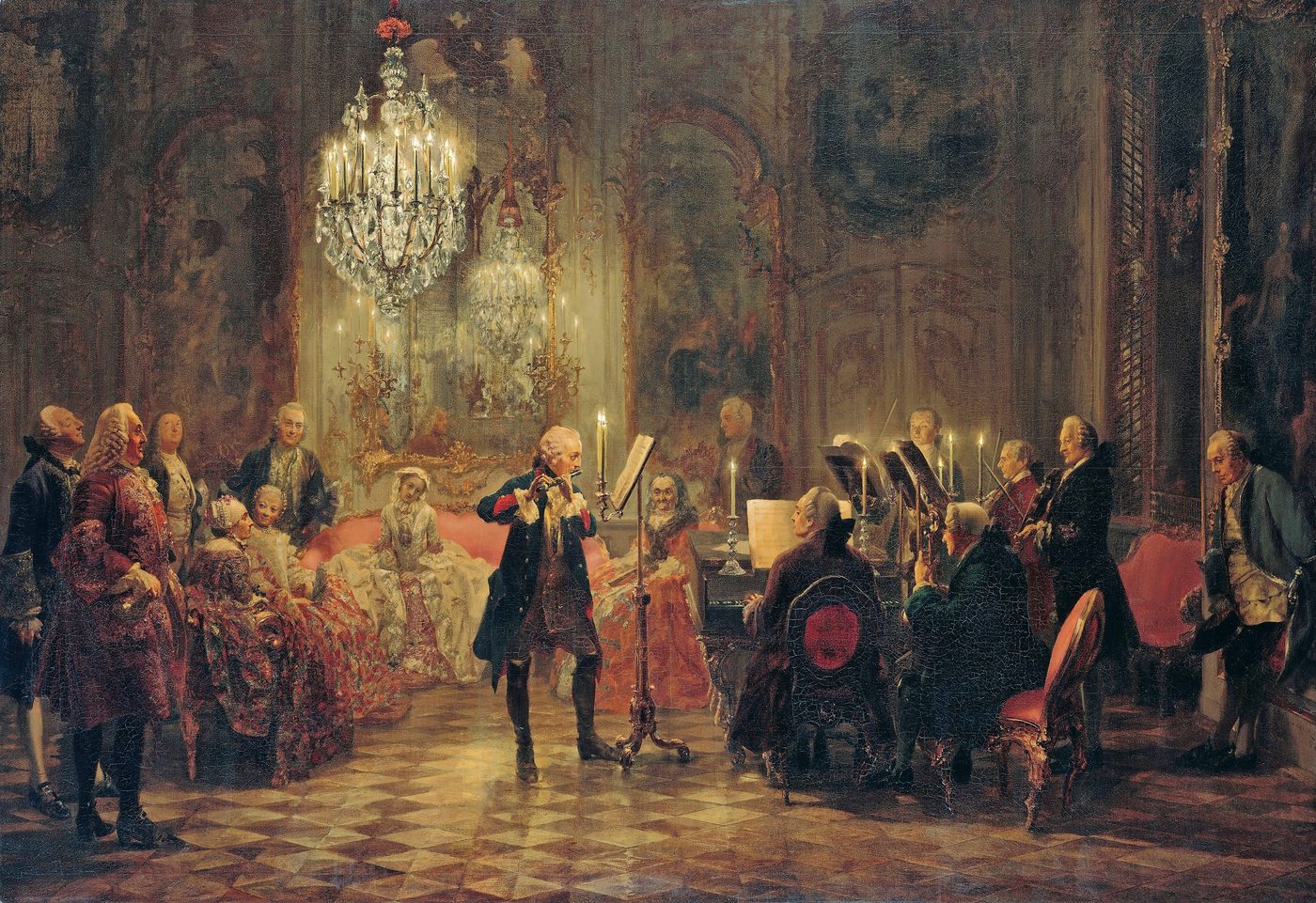
The talk was cultivated as carefully as the music. Frederick conducted his court in French, gathered writers and thinkers around his table, and styled himself the philosopher of Sanssouci. He wrote constantly in the same language, turning out history, verse and political essays, including a treatise against the cynicism of Machiavelli composed before he took the throne. His most famous guest was Voltaire, who arrived in 1750 to live at the Prussian court and stayed nearly three years before the friendship soured into one of the great literary quarrels of the century. These suppers, later mythologized as the round table of Sanssouci, were where the king seems to have been happiest, pretending for an evening at a time to be merely the cleverest man in a room of clever men. It was the life the small palace had been built to make possible.
The Terraces and the Wider Park
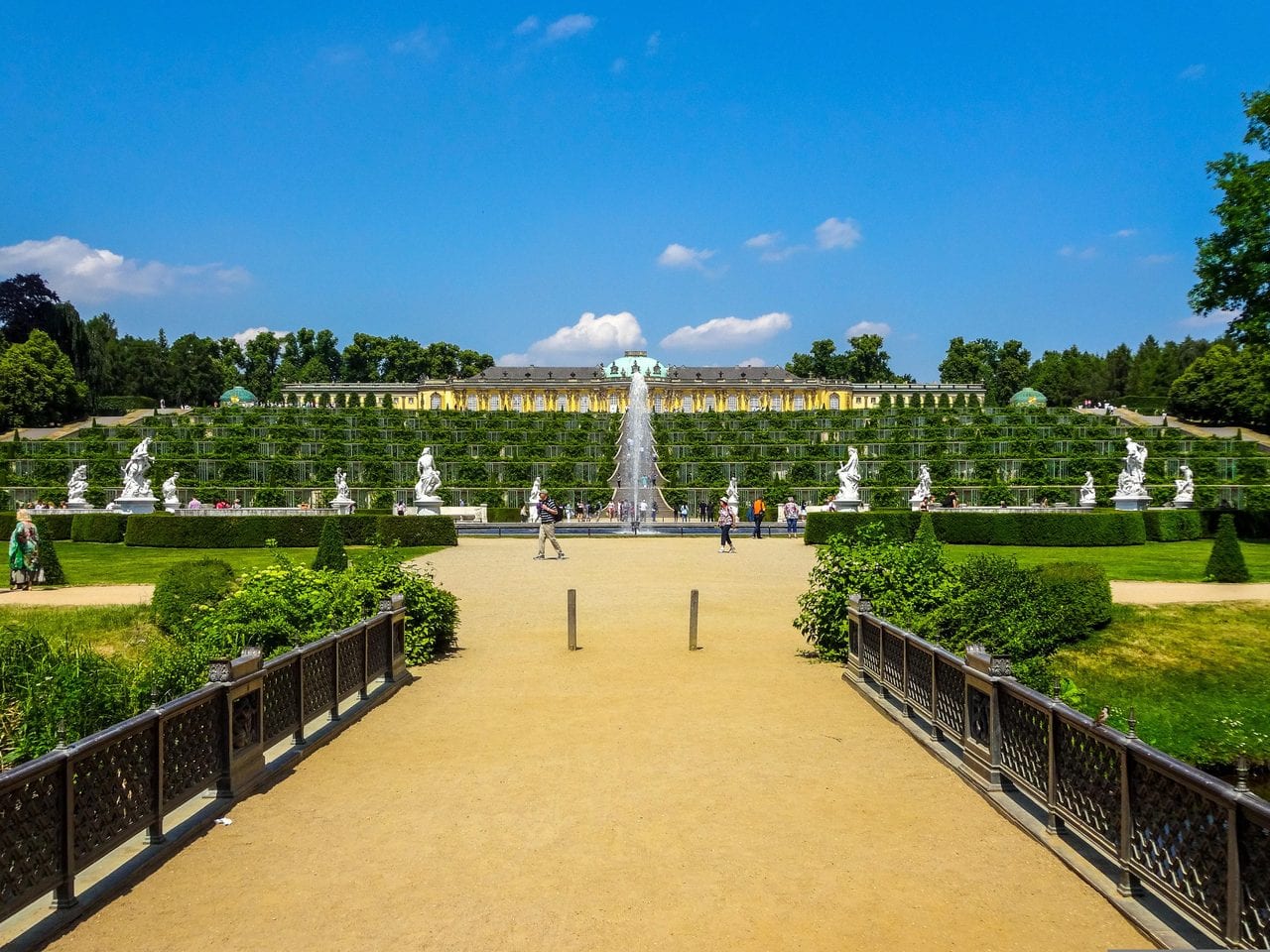
The palace cannot be separated from the hill it crowns. Six broad terraces step down the slope below the garden front, their curved retaining walls fitted with 168 glazed niches in which figs and grapes were trained against the warmth of the south-facing stone. A grand staircase climbs the center, today in 132 steps, and from the top the view runs out across the park toward a fountain and the long axial avenue Frederick cut through the grounds. Curiously, that fountain never played in his lifetime; the hydraulics of the age defeated him, and only in the 1840s did a steam engine, hidden inside a mosque-like pump house by the river, finally drive the jet he had wanted. In the warm months potted orange and bay trees were carried out by the dozen to line the terraces, and a century later the landscape gardener Peter Joseph Lenne wove the formal grounds into the sweeping park that visitors walk today. This combination of working vineyard, formal garden and pleasure palace is what gives Sanssouci its particular character, and what the king meant by living close to nature.
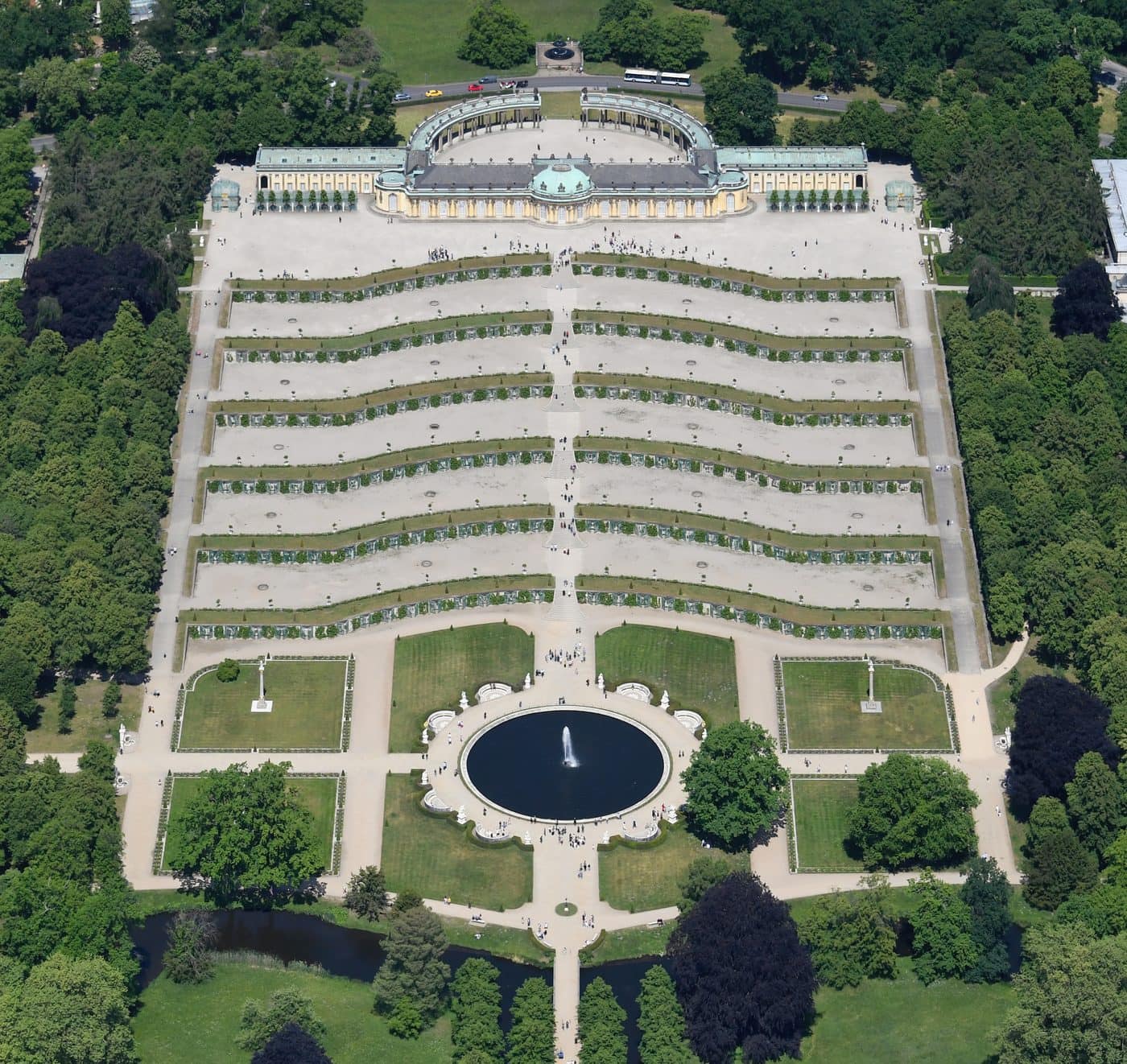
Around this intimate core a far larger ensemble accumulated over the following century. To the east stands the Picture Gallery, built between 1755 and 1764 and reckoned the oldest surviving purpose-built museum building in Germany. To the west are the New Chambers, first an orangery and later a guest house. Beyond them spread the works of later reigns: the vast Neues Palais of 1763 to 1769, which Frederick raised after the Seven Years’ War and cheerfully called a fanfaronade; the Orangery Palace of the next century; Schinkel’s Charlottenhof; the Chinese House with its gilded diners. Sanssouci the palace is small. Sanssouci the park is one of the largest royal landscapes in Europe.
The Miller of Sanssouci
No story about the palace is told more often than the one about the windmill beside it, and almost none of it is true. A mill does stand just north of the palace, and it is genuinely older: a post mill built from 1737 by the miller Johann Wilhelm Gravenitz, some years before Frederick raised his retreat next to it. What stands today is a Dutch-style smock mill that replaced the original between 1787 and 1791, paid for in part by Frederick William II because the legend had already made it famous.
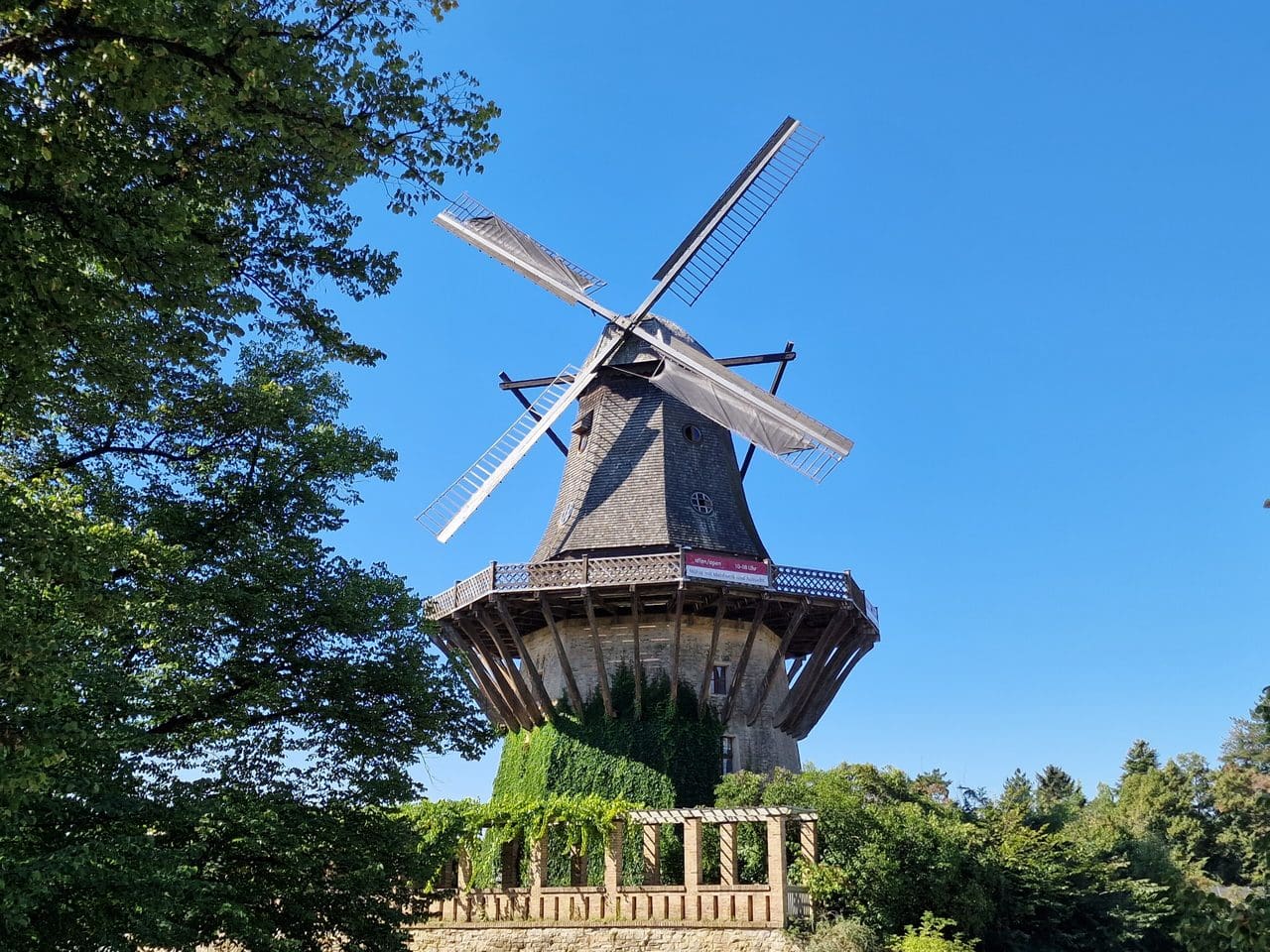
That legend runs like a fable. Frederick, the story goes, was so annoyed by the clatter of the mill’s sails that he ordered it removed, only for the miller to refuse, declaring that his title was good and that there were still judges in Berlin who would uphold it. The king, a believer in the rule of law, is supposed to have backed down and let the mill stand. It makes a fine parable of royal restraint, and it was invented for exactly that purpose. It first appeared in print in 1787, a year after Frederick’s death, in a French life of the king, and was polished into verse a decade later. No primary record supports it. The real Gravenitz petitioned the crown about the wind his royal neighbor’s building blocked, a humbler and more human complaint than the legend allows.
A Grave on the Terrace
Frederick died at Sanssouci on August 17, 1786, in the armchair of his study, in the house he had built to be free of cares. His will had been explicit. He wished to be buried on the uppermost vineyard terrace, in a simple vault he had prepared in his own lifetime, beside the greyhounds he had loved better than most people, and to be carried there at night without ceremony, “without pomp, without splendor.”
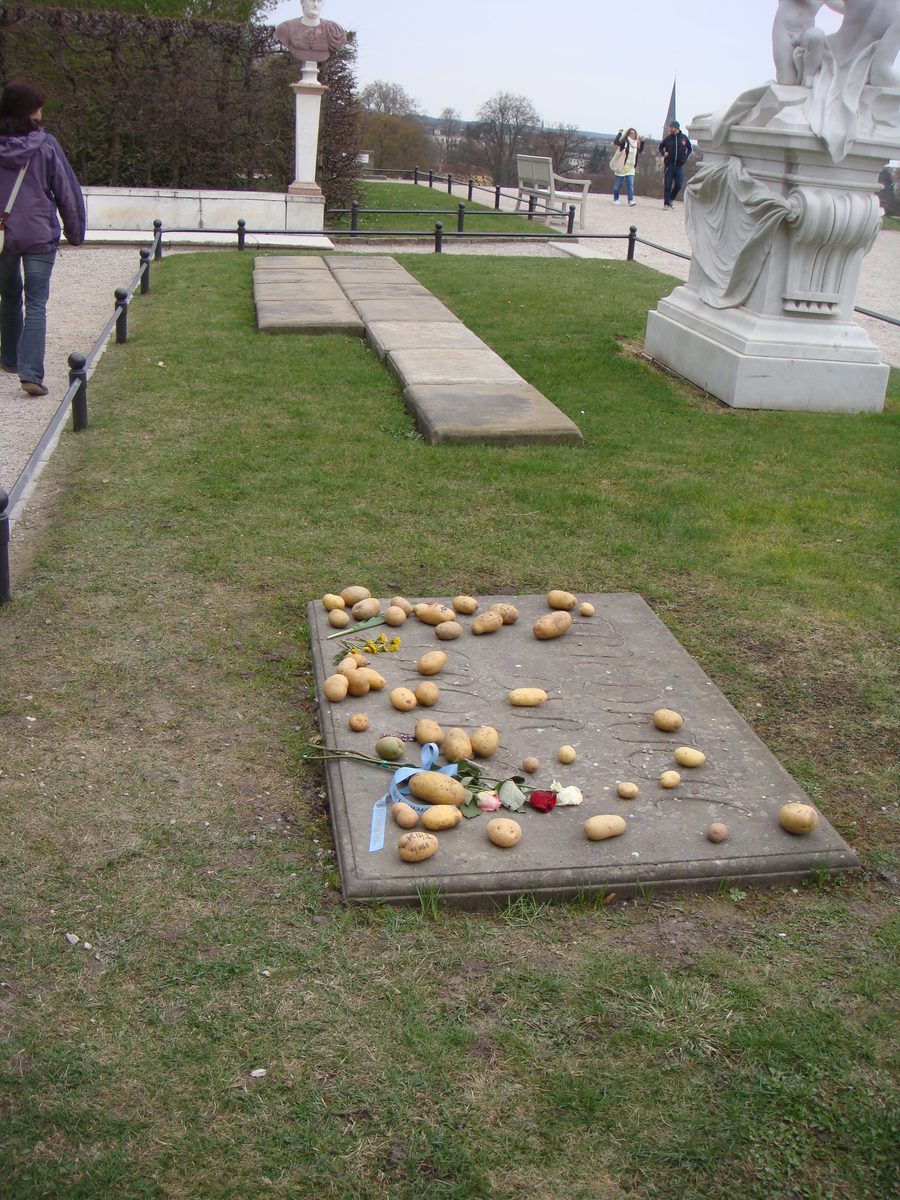
Almost none of that happened, at first. His nephew and successor, Frederick William II, ignored the instructions and had the coffin placed in the Garrison Church at Potsdam, next to the father Frederick had despised. There the king lay through the nineteenth century and into the twentieth. As the Second World War closed in, the coffin began a long exile. It was removed from Potsdam in 1943, sheltered in a bunker and then a Thuringian salt mine, recovered there by American troops, held for a time at a church in Marburg, and finally carried in the early 1950s to Hohenzollern Castle, the ancestral mountain seat of his dynasty, where it rested for some forty years. Only after the two Germanys reunited was the old wish finally honored. On the night of August 17, 1991, the 205th anniversary of his death, Frederick was at last buried on the terrace beside his dogs. A small irony attended the moment: the king who had asked for no ceremony lay in state under a guard of honor before a watching nation, and the event stirred unease among Germans who read it as a revival of Prussian myth. His grave is a plain slab, level with the vines. Visitors still leave potatoes on it, a nod to the crop he pressed on a skeptical Prussia.
Sanssouci as World Heritage
In 1990 UNESCO inscribed Sanssouci, together with the surrounding palaces and gardens, on the World Heritage List under the title “Palaces and Parks of Potsdam and Berlin.” The listing, reference 532, was recognized under three cultural criteria for the artistic quality of its buildings and the way palace and designed landscape were composed as a single work across two centuries. That inscribed area was enlarged twice, in 1992 and again in 1999, until it covered more than two thousand hectares, making it one of the largest World Heritage sites in Germany. What the listing honors is not Sanssouci alone but the whole composed landscape of palaces, parks and sightlines that Prussian kings and their gardeners built across the hills west of Berlin over nearly two centuries.
Among German World Heritage sites the distinction is worth drawing. Wartburg, high above Eisenach, is the inscribed castle of German history, the fortress where Luther translated the New Testament. Sanssouci is its courtly opposite, the inscribed palace: not a stronghold but a pleasure house, not medieval but of the Enlightenment, valued less for what it withstood than for what it expressed. Both earned the same global recognition by very different means.
Visiting Sanssouci in 2026
Sanssouci sits on Maulbeerallee in Potsdam, easily reached from Berlin by regional train and a short bus or a walk through the park. Entry to the park itself is free; entry to the palace is not, and it is the single most important thing to plan for. Visits run on fixed timed-admission slots, the daily quota of tickets is limited, and in the summer season they routinely sell out. Booking online in advance through the operator, SPSG, is strongly advised. Same-day tickets, when any remain, are sold at the visitor center by the Historic Mill from thirty minutes before the palace opens. Entry tickets and local tours can also be booked in advance through GetYourGuide.
| Ticket | Price |
|---|---|
| Sanssouci Palace, single | €14 (reduced €10) |
| sanssouci+ day ticket (all Potsdam SPSG palaces), adult | €22 |
| sanssouci+ day ticket, family (2 adults + up to 4 children) | €49 |
A single ticket to the palace costs 14 euros, or 10 reduced, and includes a fixed entry time. Travelers planning to see more of the park can buy the sanssouci+ day ticket, at 22 euros for an adult or 49 for a family of up to two adults and four children, which covers all the SPSG palaces open in Potsdam on the day. The palace opens Tuesday to Sunday and closes on Mondays, from 10am to 5.30pm between April and October and from 10am to 4.30pm in the winter months, with last admission half an hour before closing. One practical warning: the climb from the park to the palace door runs to 132 steps, and the step-free route is worth asking about for anyone who needs it.
Beyond Sanssouci
Sanssouci belongs to a small but growing group of Prussian royal residences in the collection. The most direct companion is Charlottenburg Palace in Berlin, the formal court seat Frederick inherited and embellished, and the place from which his heart moved to Potsdam; the two palaces share an architect in Knobelsdorff, and reading them together shows the same man working in two registers, grand and intimate. Readers drawn to the dynasty’s wider story will find more in the survey of the Prussian royal castles, which traces how the Hohenzollerns shaped their landscape of power.
There is also a quieter thread that ties Sanssouci to Hohenzollern Castle in Swabia, the mountain seat where Frederick’s coffin waited out the Cold War before its return to the terrace in 1991. Further south, the Wittelsbach pleasure palaces of Bavaria offer the closest parallel to Frederick’s taste for the small and the private: the Amalienburg in the park of Nymphenburg Palace, and the lighter apartments of the Munich Residenz, share Sanssouci’s instinct that a prince’s truest luxury was a room built for pleasure rather than for show. Set against the grandest model of the age, Sanssouci is the intimate counter-statement to Versailles and the architecture of absolutism.
Conclusion
Sanssouci endures because it refused to be grand. Frederick built almost nothing here for posterity and asked that the place not outlast him, and in failing to get that wish he left something rarer than another baroque monument: a true record of how an absolute monarch wanted to live when no one was watching. Twelve rooms, a hillside of vines, a flute, a few friends and a row of dogs’ graves on the terrace add up to a self-portrait more honest than any state portrait in oils. Two and a half centuries on, the crowds who climb the 132 steps come looking for exactly that, the king without his crown, at rest in the garden he made to be free of cares.
Principal Sources
- Blanning, Tim. Frederick the Great: King of Prussia. Allen Lane, 2015.
- MacDonogh, Giles. Frederick the Great: A Life in Deed and Letters. St. Martin’s Press, 1999.
- Streidt, Gert, and Peter Feierabend. Prussia: Art and Architecture. Könemann, 1999.
- Stiftung Preußische Schlösser und Gärten Berlin-Brandenburg (SPSG), object and press pages for Sanssouci Palace, spsg.de.
- UNESCO World Heritage Centre, “Palaces and Parks of Potsdam and Berlin” (Ref. 532), whc.unesco.org.
- University of Oxford, “Frederick the Great” research project, frederick.mml.ox.ac.uk.
- Landeshauptstadt Potsdam, potsdam.de; Museum Barberini, museum-barberini.de (Historic Mill).
Sanssouci Palace is operated by the Stiftung Preußische Schlösser und Gärten Berlin-Brandenburg; admission prices and opening hours change seasonally and were drawn from SPSG visitor information current at the time of writing, and should be confirmed at spsg.de before a visit.
Image credits. Featured image, the palace above its vineyard terraces: photo by Sandip Roy, Unsplash. The parterre and fountain: photo by Nikolai Kolosov, Pixabay. The garden front with its bacchants: photo by Wendell Adriel, Unsplash. The Concert Room: photo by Kurt Kaiser, CC0, via Wikimedia Commons. Menzel’s “The Flute Concert of Sanssouci”: Adolph von Menzel, public domain, via Wikimedia Commons. The palace and terraces from the south: photo by Carsten Steger, CC BY-SA 4.0, via Wikimedia Commons. The Historic Mill: photo by Rigorius, CC BY-SA 4.0, via Wikimedia Commons. Frederick the Great’s grave: photo by Karen Mardahl, CC BY-SA 2.0, via Wikimedia Commons. Anyone staying overnight can compare hotels in and around Potsdam. Freely licensed images are resized to fit; otherwise unaltered.
Some links on this page are affiliate links, which means StoneKeep Atlas may earn a small commission, at no extra cost to you, if you book through them.