
Royal Palaces of Berlin & Brandenburg
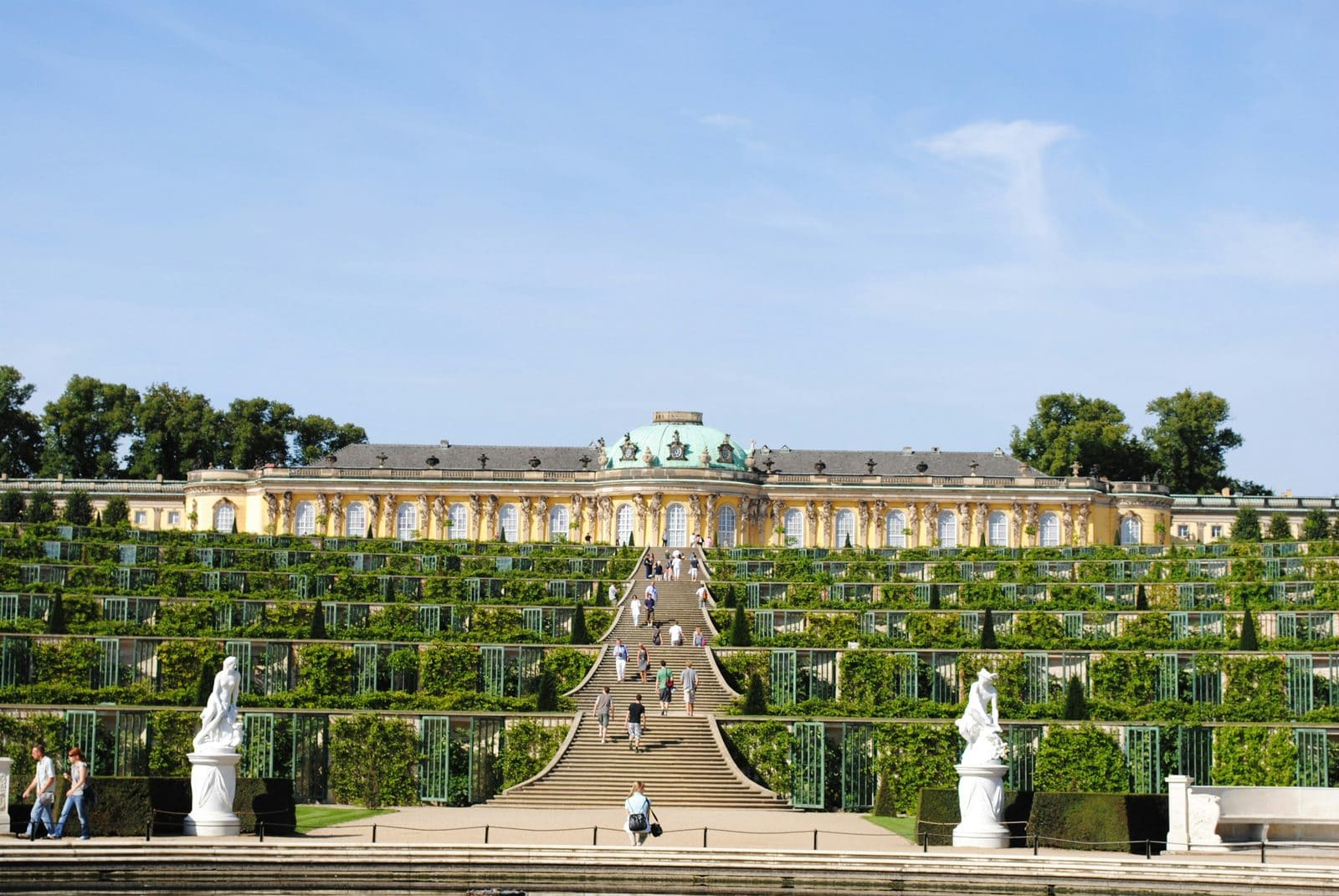
Four palaces tell the whole story of the Hohenzollern dynasty in stone, and they stand within half an hour of one another. The royal palaces of Berlin and Brandenburg that this guide gathers run from the confident Berlin seat of Prussia’s first kings to the quiet country house where the dynasty’s German story ended at a conference table in 1945. Between them lie the two faces of Frederick the Great: the vineyard retreat he built to escape his own court, and the vast display palace he raised a few years later to prove the escape had cost him nothing.
Three of the four sit in Potsdam, southwest of the capital, and belong to the UNESCO World Heritage Site known as the Palaces and Parks of Potsdam and Berlin. The fourth, Charlottenburg, stands in Berlin itself and lies outside that inscription, the grand exception that proves how tightly the rest cluster together. Read in sequence they trace a single arc of taste and power across two centuries, and they can be seen, with planning, across a long weekend.
Charlottenburg: the dynasty’s grand statement in Berlin
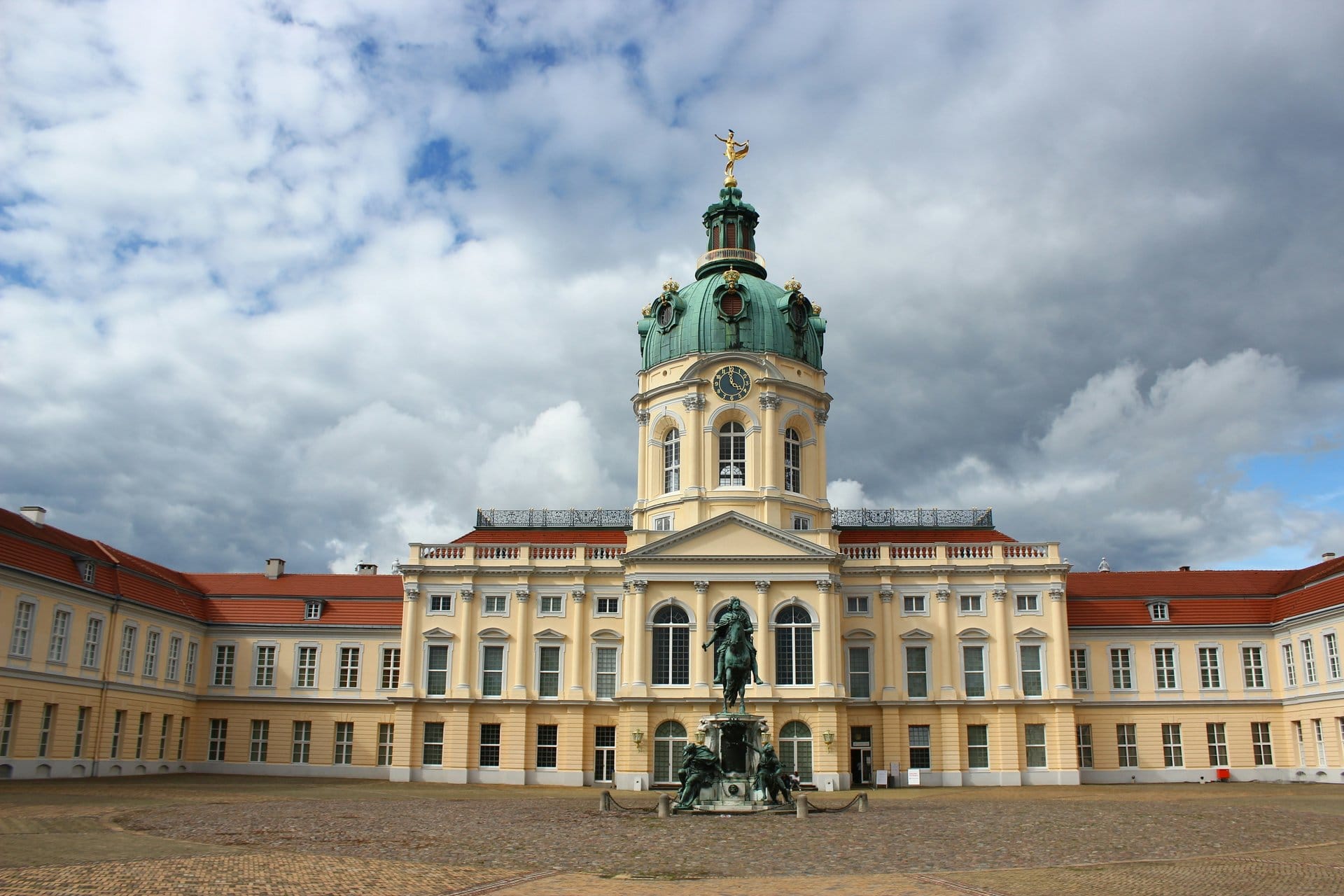
Charlottenburg began as something far smaller than it became. In 1695 the Elector Friedrich III commissioned a summer villa west of Berlin for his wife, Sophie Charlotte, a cultivated princess who gathered philosophers and musicians around her, and Johann Arnold Nering drew the first modest house, called Lietzenburg. When Friedrich crowned himself King Friedrich I of Prussia in 1701 the villa needed to match the new dignity, and after Sophie Charlotte’s early death in 1705 it was renamed Charlottenburg in her memory. Johann Friedrich Eosander added the domed center and the long orangery wing, and the building grew across the eighteenth century into the largest palace in Berlin.
Its grandest interiors belong to Frederick the Great, who set Georg Wenzeslaus von Knobelsdorff to build the New Wing (Neuer Flügel) in the 1740s, with the Golden Gallery, a long room of mirrored Rococo dressed in green and gold. Around the palace the family laid out a garden of memory, with the little Belvedere teahouse, the New Pavilion, and the Mausoleum where Queen Luise and others of the line were laid to rest. Yet Charlottenburg was never the seat of Prussian power. That role belonged to the Berlin Stadtschloss, the city palace at the heart of the capital, and Charlottenburg remained the family’s grandest country house rather than its throne.
A British air raid in 1943 gutted the palace, and its survival is owed to a long postwar reconstruction directed by the art historian Margarete Kühn, who chose to rebuild rather than clear the ruin. Where the original ceilings were lost beyond copying, the modern painter Hann Trier supplied bold abstract replacements, so the rebuilt rooms carry their own century openly rather than pretending the damage never happened.
Sanssouci: Frederick’s retreat above the vineyard
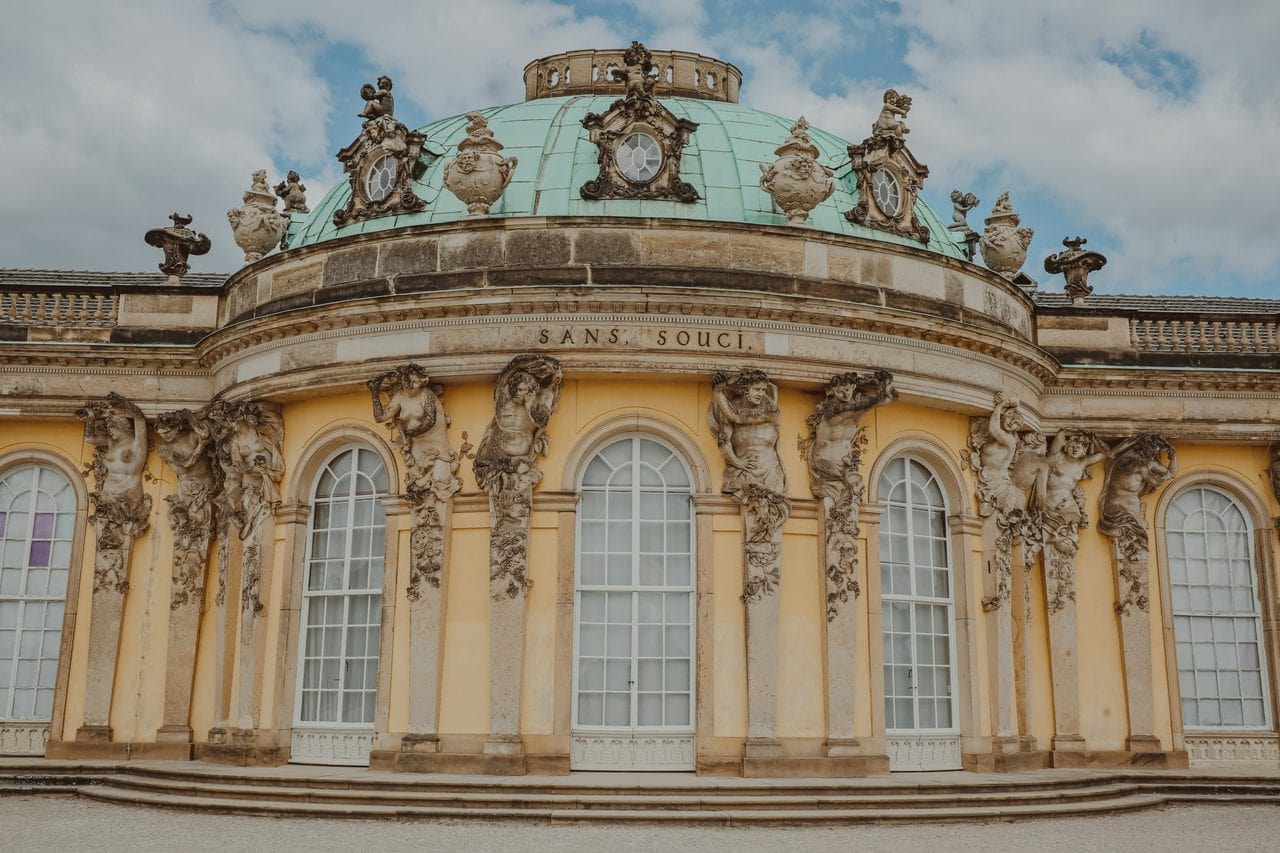
If Charlottenburg shows the Hohenzollerns building to impress, Sanssouci shows their most famous king building to disappear. Frederick the Great laid out the palace between 1745 and 1747 on a south-facing hill above Potsdam, which he terraced into six curved tiers for vines and figs, and he sketched the plan himself before handing it to Knobelsdorff to refine. The name, French for “without a care,” was set in gilded letters across the garden front. What rose there was deliberately small: a single story, ten principal rooms in one enfilade, often counted as twelve in the guidebooks, and no grand staircase, because Frederick wanted to step straight from his library into the garden without ceremony.
The restraint was a kind of argument. Frederick used Sanssouci as a private refuge from his own court, a place for flute concerts, French conversation, and the company of writers, and Voltaire stayed for three years in a guest room still named for him. The intimacy came at a cost in friendship. Knobelsdorff wanted the palace raised on a base so it would read as a monument from the park below, and the king refused, insisting on the direct garden access, and the quarrel effectively ended their partnership, with Jan Bouman left to finish the work.
Frederick asked to be buried on the highest terrace beside his greyhounds, with no pomp. The wish was honored only in 1991, when his coffin was brought back from the south of Germany and laid in a plain slab on the terrace on the night of August 17, the two hundred and fifth anniversary of his death.
The Neues Palais: Frederick’s boast at the far end of the park
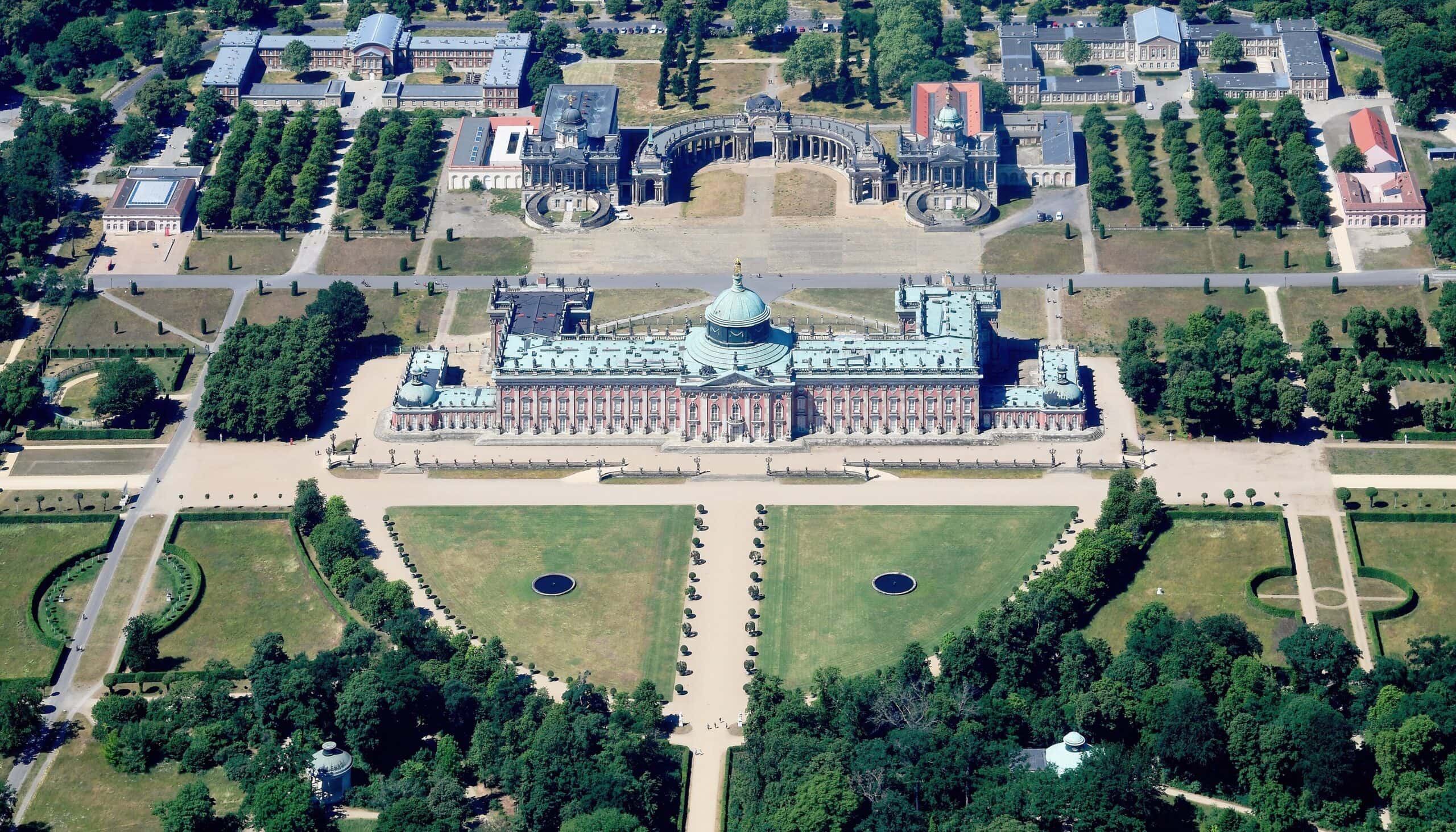
The Neues Palais answers Sanssouci across the same park, and it answers it loudly. Frederick built it between 1763 and 1769, immediately after the Seven Years’ War had drained Prussia and almost destroyed it, and the timing was the point. A vast Baroque palace of around two hundred rooms, raised at the western end of the gardens, it was meant to show the courts of Europe that Prussia had emerged from the war richer in nerve than in money. Frederick called it his fanfaronade, his piece of showing-off, and rarely lived in it himself. The architects Johann Gottfried Büring, Heinrich Ludwig Manger, and Carl von Gontard gave it a crowned central dome and a giant order of pilasters, and behind it they set the Communs, a pair of grand service buildings linked by a colonnade that housed the kitchens and staff the display required.
Inside, the contrast with Sanssouci is total. Where the older palace is a single intimate file of rooms, the Neues Palais opens with the Grotto Hall (Grottensaal), its walls encrusted with shells, minerals, and semiprecious stones, and rises to the Marble Hall (Marmorsaal), a double-height ballroom in red and white stone. The palace also keeps one of the few surviving eighteenth-century court theaters in Europe, the Schlosstheater, still used for performances today.
A century and a half after Frederick, the building found a second life as a true royal home. Kaiser Wilhelm II made it his principal residence and ran his court from it until he abdicated and fled in 1918, which is why its rooms preserve the last imperial fittings as fully as the Frederician ones.
Cecilienhof: the last palace, and the conference that ended an era
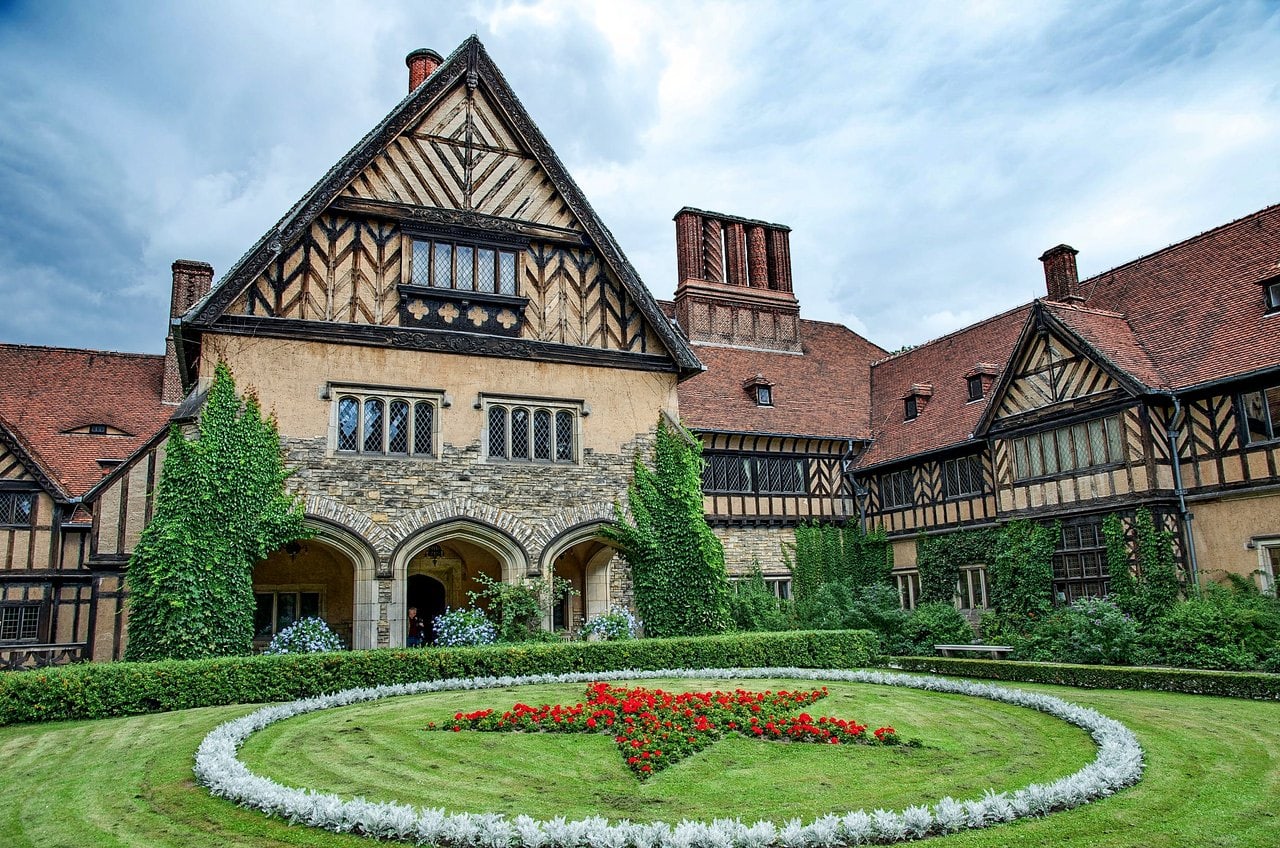
Cecilienhof is the strangest of the four and the most consequential. It was the last palace the Hohenzollerns ever built, raised between 1913 and 1917 for Crown Prince Wilhelm and Crown Princess Cecilie in the Neuer Garten on the Jungfernsee. At a moment when the dynasty had only four years left, it took the form not of a palace at all but of an English country house. The architect Paul Schultze-Naumburg gave it half-timbered gables, tall brick chimneys, and an irregular plan around courtyards, a Tudor Revival design of 176 rooms that looks as though it had been carried over from the English shires. The family lived in it only briefly before the monarchy fell in 1918, though Cecilie stayed on into the Second World War.
Its place in history was fixed in the summer of 1945. From July 17 to August 2, with the war in Europe just over, Cecilienhof hosted the Potsdam Conference, where Truman, Stalin, and Churchill, the last replaced midway by Clement Attlee after a British election, settled the shape of postwar Germany and Europe. The Soviet delegation planted a large red star in red flowers in the court of honor, and it is renewed there still. Today the palace presents itself less as a royal residence than as the historic site of that meeting, with the conference rooms and the round negotiating table kept as they were.
The palace is closed for a major renovation that began on November 1, 2024 and is now projected to run until about December 2028, with a hotel planned to return to part of the building afterward. For now the surrounding Neuer Garten stays open, and the conference rooms can be toured online while the doors are shut.
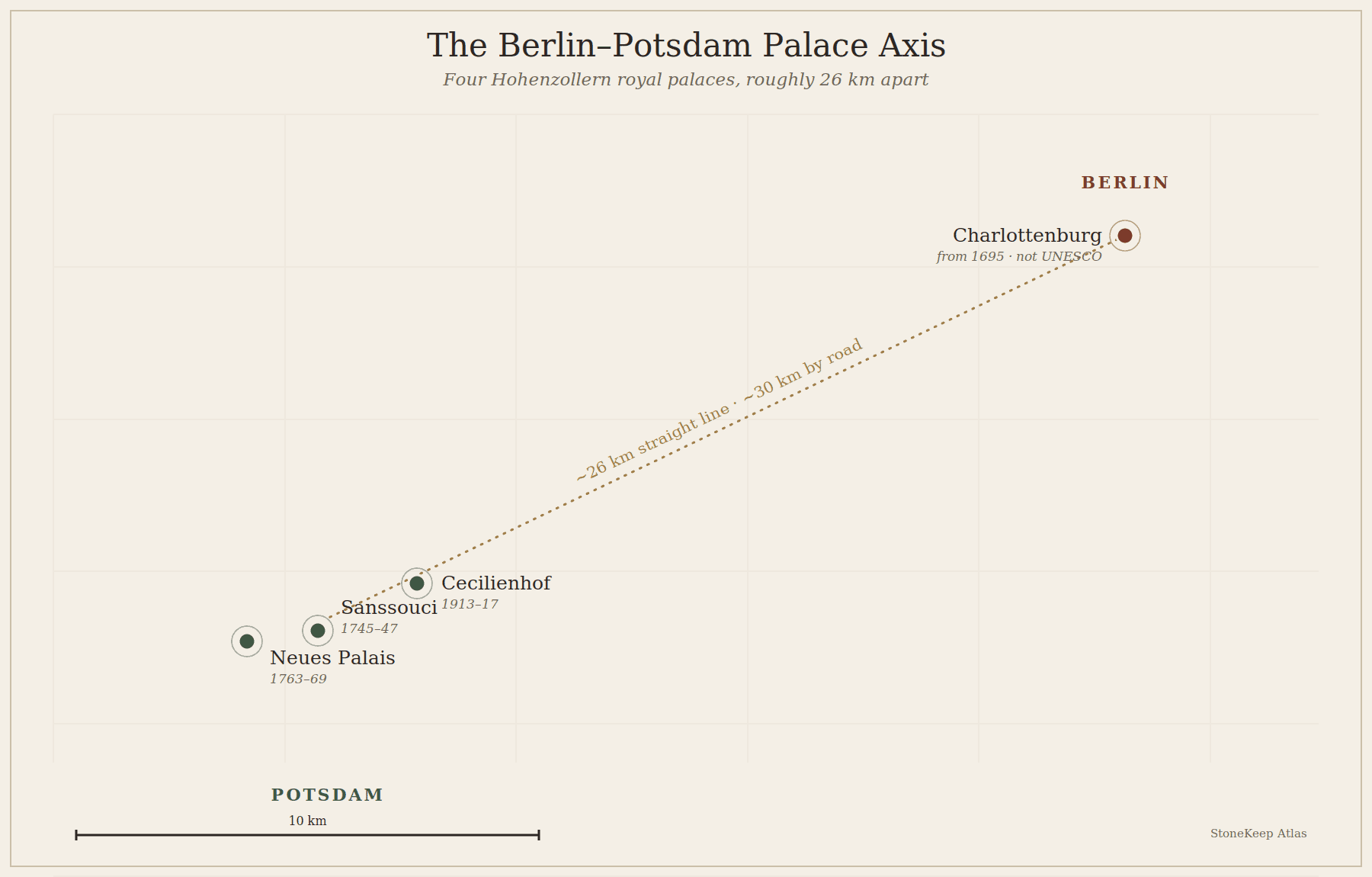
The Berlin–Potsdam landscape
Seen in order, the four palaces map the rise and fall of a single house. Charlottenburg is the confidence of the first kings, Sanssouci and the Neues Palais are the two halves of Frederick’s character, and Cecilienhof is the quiet end of the line. They also map a landscape. Three of them stand in Potsdam, within the green sweep of Sanssouci Park and the Neuer Garten, while Charlottenburg lies roughly twenty-six kilometers away in Berlin, about half an hour by car or regional train. The road between them is, in effect, the route the dynasty traveled from its capital to its summer country.
That landscape holds more than these four. Across the Havel from Potsdam rises Babelsberg Palace, the neo-Gothic summer residence of Wilhelm I, a reminder that the royal map of Berlin and Brandenburg runs well beyond the great houses gathered here, out to the princely garden palaces of Potsdam that Wilhelm and his brothers built as summer retreats.
All four are cared for today by a single institution, the Stiftung Preußische Schlösser und Gärten Berlin-Brandenburg, the Prussian Palaces and Gardens Foundation, which has looked after the former royal estates of both states since 1995. Three of the four belong to the UNESCO World Heritage Site called the Palaces and Parks of Potsdam and Berlin, first inscribed in 1990 and extended in 1992 and 1999. Charlottenburg is the exception, sitting outside the inscribed area, even though other Berlin sites such as Glienicke and the Peacock Island lie within it. The distinction is worth keeping straight, because the World Heritage label belongs to the Potsdam ensemble and its Berlin satellites rather than to every Prussian palace in the region.
| Palace | Where | Built | Built for / by | UNESCO | Visiting now |
|---|---|---|---|---|---|
| Charlottenburg | Berlin | from 1695 | Sophie Charlotte; New Wing for Frederick the Great | No | Open as a museum |
| Sanssouci | Potsdam | 1745–1747 | Frederick the Great | Yes | Open; timed tickets |
| Neues Palais | Potsdam | 1763–1769 | Frederick the Great | Yes | Open Wed–Mon (closed Tue) |
| Cecilienhof | Potsdam | 1913–1917 | Crown Prince Wilhelm & Cecilie | Yes | Closed until ~Dec 2028 |
Anyone making the trip should treat Potsdam as its heart. Sanssouci and the Neues Palais sit at opposite ends of the same park and combine easily in a day, both requiring timed tickets that sell out in summer, and the sanssouci+ day pass covers most of the Potsdam palaces while fixing a slot for Sanssouci itself. Cecilienhof, in the separate Neuer Garten, is closed until its renovation finishes, so for now it is a walk through the park rather than a tour. Charlottenburg is a Berlin visit in its own right, better paired with the city than with Potsdam. For the wider story of the dynasty beyond this Berlin and Potsdam core, including the Hohenzollerns’ ancestral mountain seat in Swabia and their nineteenth-century castle-building on the Rhine, see our guide to the Prussian royal castles.
A little apart from these governing seats stand the private retreats of the Neuer Garten on the Heiliger See: the neoclassical Marble Palace that Friedrich Wilhelm II built as the first of its kind in Prussia, and the painted-timber folly on the Pfaueninsel across the Havel.
Later still, and grander than any of them, came Friedrich Wilhelm IV’s Orangery Palace on the ridge above Sanssouci, the last and largest of the Potsdam palaces and the most assertively Italian, built to crown a Roman processional avenue that was never finished.
Principal Sources
- Stiftung Preußische Schlösser und Gärten Berlin-Brandenburg. “Schlösser und Gärten.” spsg.de.
- UNESCO World Heritage Centre. “Palaces and Parks of Potsdam and Berlin (Ref. 532).” whc.unesco.org.
- Landeshauptstadt Potsdam. “New Palace / Neues Palais.” potsdam.de.
- visitBerlin. “Charlottenburg Palace.” visitberlin.de.
- All four palaces are administered by the Stiftung Preußische Schlösser und Gärten Berlin-Brandenburg; visiting times, ticket types, and the Cecilienhof closure should be confirmed on the foundation’s own pages before travel.
Image credits. Hero, Sanssouci above its vineyard terraces: photo by Sandip Roy, Unsplash. Charlottenburg, the cour d’honneur: photo by Lasma Artmane, Unsplash. Sanssouci garden front: photo by Wendell Adriel, Unsplash. The Neues Palais from the air: photo by Carsten Steger, CC BY-SA 4.0, via Wikimedia Commons. Cecilienhof courtyard: photo by ernstol, CC BY-SA 3.0, via Wikimedia Commons. Map: StoneKeep Atlas (own work).