
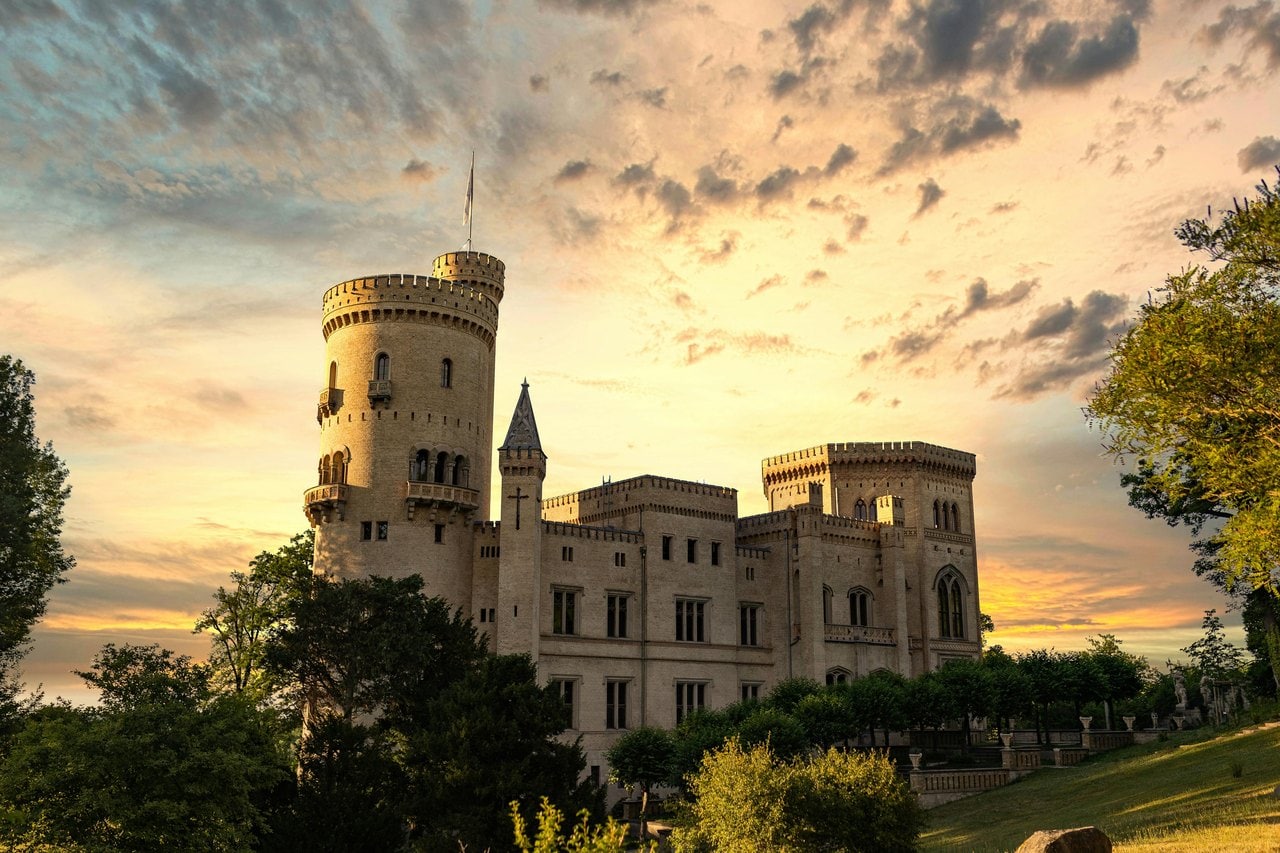
Babelsberg Palace
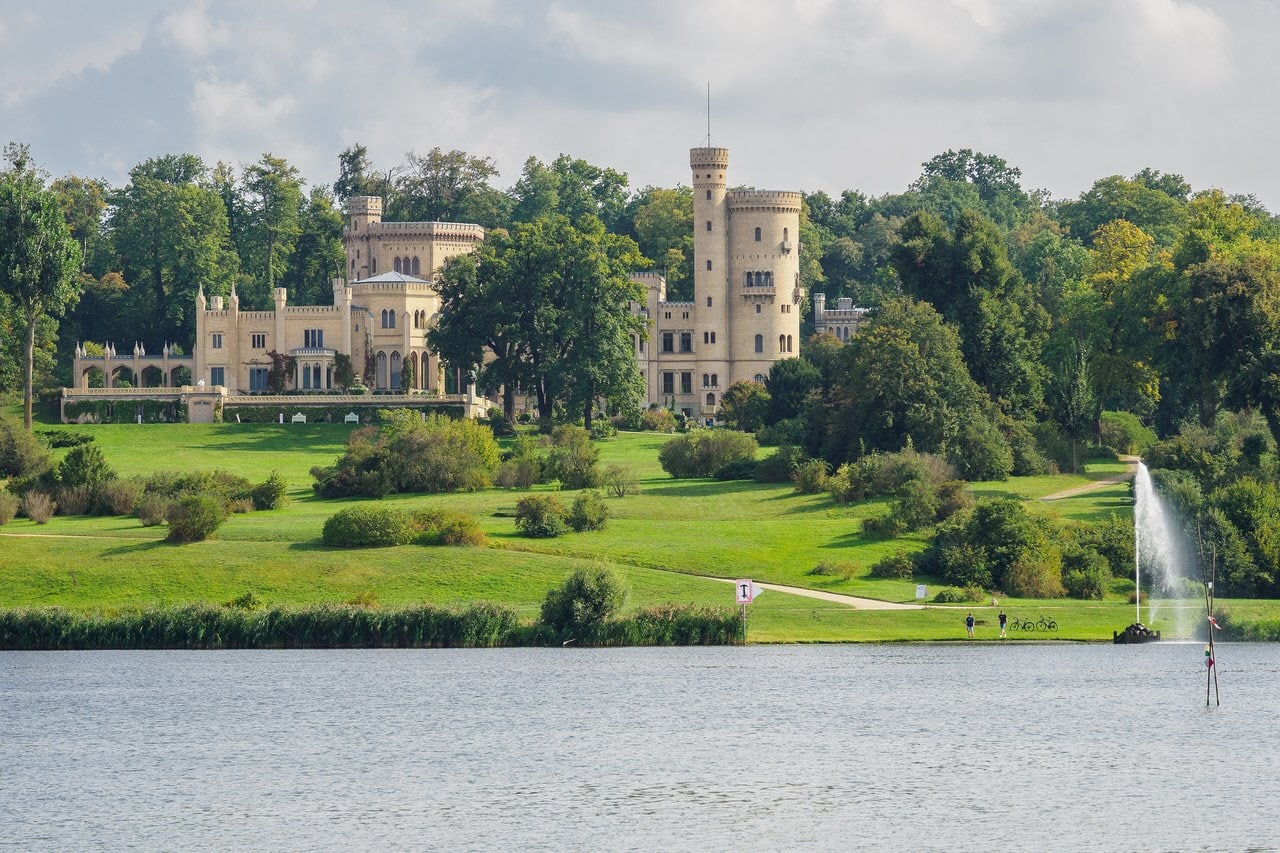
Babelsberg Palace (German: Schloss Babelsberg) is the neo-Gothic summer residence of Prince Wilhelm of Prussia, the future Emperor Wilhelm I, raised on a wooded hill above the Havel in Potsdam, directly across the water from Berlin. Karl Friedrich Schinkel drew its first plans in the English Tudor manner in 1833, and over the following decades it grew into a turreted palace where one of the decisive meetings in modern German history took place. Today the palace and its great landscape park belong to the UNESCO World Heritage Site known as the Palaces and Parks of Potsdam and Berlin.
Quick Facts
| Location | Potsdam, Germany (Babelsberg Park, on the Havel at the Berlin border) |
| Built | 1834 to 1835 by Karl Friedrich Schinkel; greatly extended 1844 to 1849 |
| Style | English Tudor and neo-Gothic (Gothic Revival) |
| Patron | Prince Wilhelm of Prussia, later Emperor Wilhelm I (1797 to 1888), with Princess Augusta |
| Architects | Karl Friedrich Schinkel, Ludwig Persius, and Johann Heinrich Strack |
| Landscape | Peter Joseph Lenné and Prince Hermann von Pückler-Muskau |
| Owner | Stiftung Preußische Schlösser und Gärten Berlin-Brandenburg (SPSG) |
| UNESCO | Part of the World Heritage Site “Palaces and Parks of Potsdam and Berlin” (inscribed 1990) |
| Visiting | Palace interior closed for restoration, open only for special events; park open daily, free |
| Official site | spsg.de |
A Prince’s English Idea
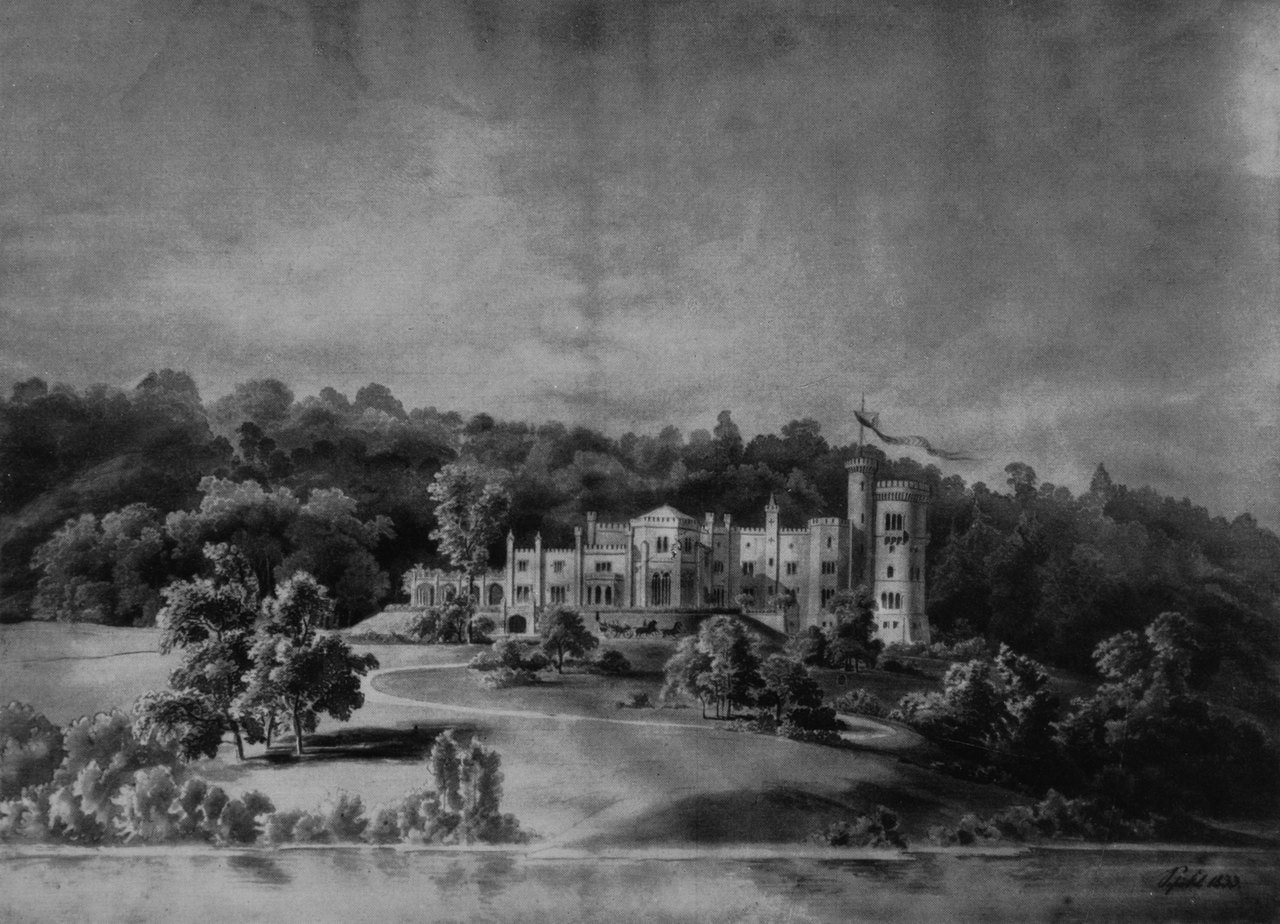
Prince Wilhelm of Prussia, second son of King Friedrich Wilhelm III, was nearly forty before he gained a country retreat of his own. In 1833 his father granted him the wooded rise on the Havel that would give the palace its name, and Wilhelm and his wife, Augusta of Saxe-Weimar-Eisenach, set about building a summer house there. They turned to Karl Friedrich Schinkel, the architect who had already shaped so much of royal Prussia.
Schinkel designed not a classical villa but a small castle in the English Tudor style, looking to Windsor Castle, then being remodeled by Jeffry Wyatville, for its battlements, slender turrets, and pointed windows. The prince’s purse was modest and money ran short, so the first Babelsberg, built between 1834 and 1835, was a compact thing of cottage size: an east wing with the couple’s private rooms, an octagonal tea salon, and Wilhelm’s study beneath a low tower. Such a choice was very much of its moment. Gothic Revival was sweeping the courts of Europe, and Babelsberg became one of its earliest and most influential expressions on the German side of the Channel.
Persius, Strack, and the Larger Palace
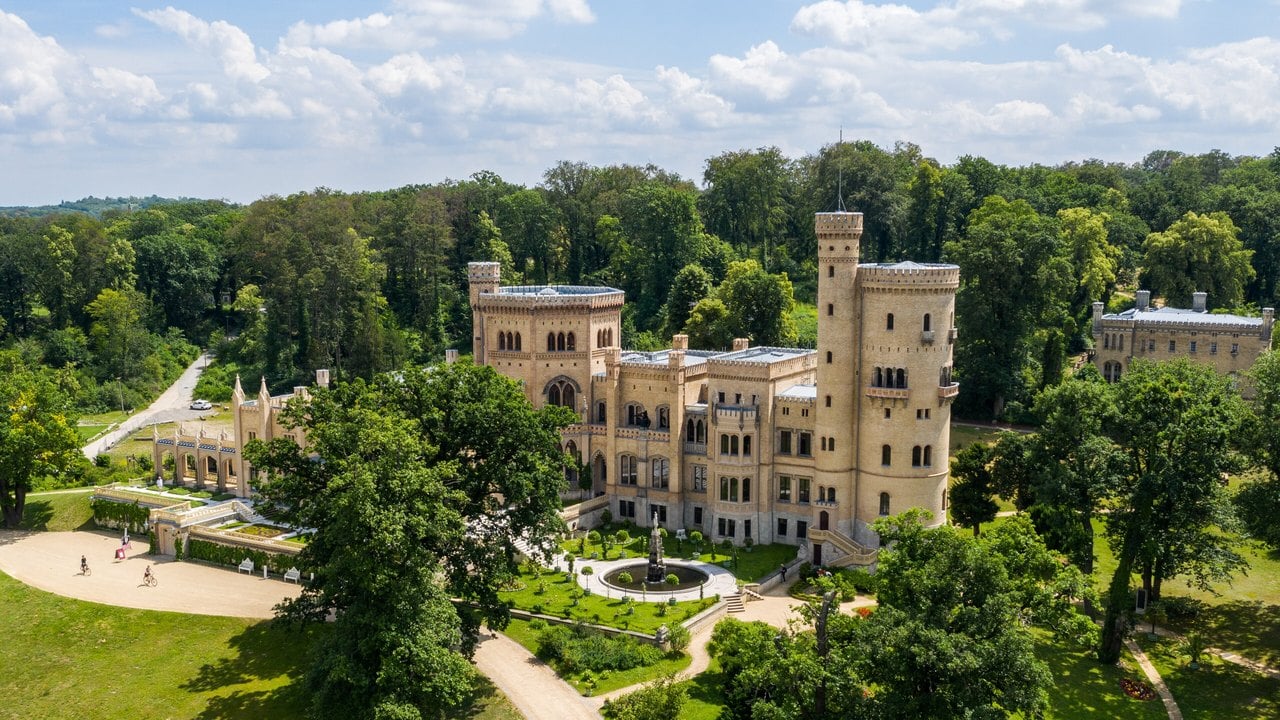
When Wilhelm became heir to the Prussian throne in 1840, the cottage no longer matched his station, and the palace entered a second, far grander phase. Schinkel had died in 1841, so the work passed to his pupil Ludwig Persius, who reworked the design heavily and planned a large western wing built around a ballroom. Persius died in 1845 with only the foundations laid, and a second Schinkel pupil, Johann Heinrich Strack, carried the building through to completion in 1849.
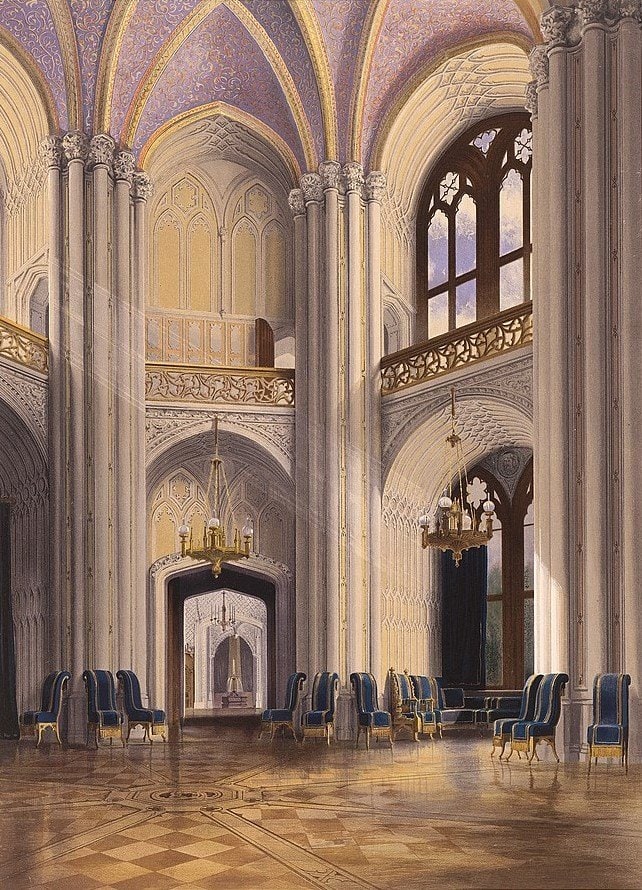
The result is the asymmetrical, L-shaped palace seen today, its outline broken by two contrasting towers: the stout Dicker Turm, about twenty-eight meters high, and the slender octagonal stair tower beside it, rising some thirty-two meters to a flagstaff at its tip. Throughout the work, Augusta took a close and demanding interest. Well read in English Gothic, she pressed for richer ornament than the restrained Schinkel had intended, and the plans were revised more than once at her insistence. The grandest of the new interiors, the dance hall, or Tanzsaal, received a vaulted ceiling painted as a deep blue sky scattered with golden stars.
Wilhelm, Augusta, and a Court on the Havel
For more than fifty years Babelsberg was the summer world of Wilhelm and Augusta, and the couple went on furnishing and refining it into the 1880s. Terraces stepping down toward the river were laid with mosaics, fountains, and beds of flowers, and the long views reached across the water to the Glienicke Bridge and the church tower at Sacrow.
Royal life left its mark on the place. In 1858 Queen Victoria and Prince Albert stayed at Babelsberg for two weeks to visit their daughter, the Princess Royal, then expecting the child who would become Kaiser Wilhelm II. Wilhelm and Augusta had celebrated their silver wedding in the park four years earlier. After the second attempt on Wilhelm’s life in June 1878, the wounded king recovered at Babelsberg and signed there the harsh law against the socialists that bore down on the young labor movement. The marriage was not always an easy one, and the liberal-minded Augusta carried a lifelong distrust of the very man her husband would summon to Babelsberg in the autumn of 1862.
The Babelsberg Interview, 1862
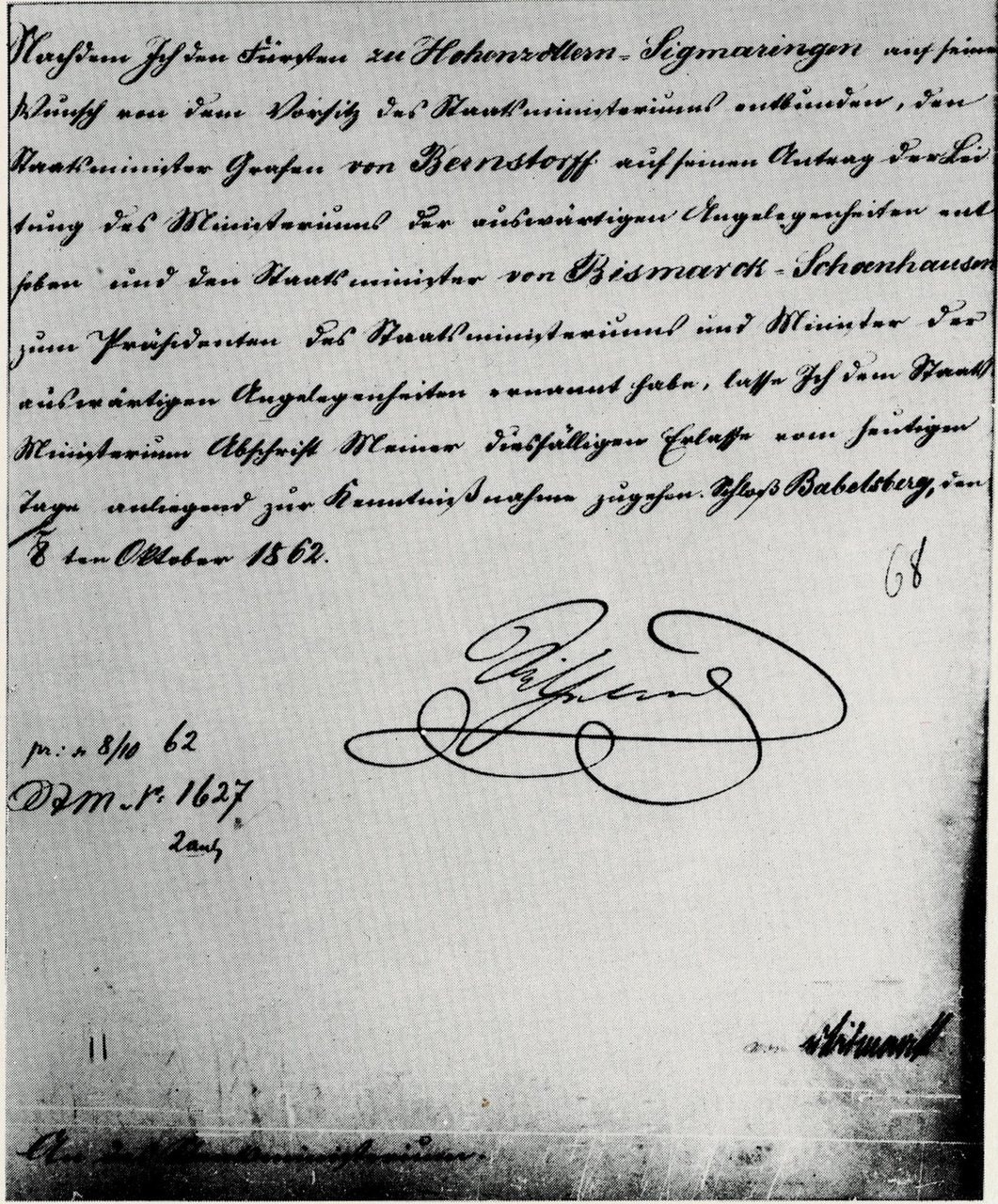
The most consequential day in the palace’s history fell on September 22, 1862. For two years Prussia had been gripped by a constitutional crisis: the liberal majority in the lower house refused to approve the budget for King Wilhelm’s costly army reform, and the king, unwilling to give way, had drafted a deed of abdication rather than govern against his conscience. His war minister, Albrecht von Roon, urged him to see one man before he signed. That man was Otto von Bismarck, hurried back from his diplomatic post in Paris.
At Babelsberg, Bismarck offered the king what no one else would: a pledge to force the army reform through, with or without the consent of parliament. Wilhelm set the abdication aside and, the next day, made Bismarck acting head of the Prussian government; the formal appointment as minister-president and foreign minister followed on October 8. The famous declaration that the great questions of the age would be settled “by iron and blood” came a week after the meeting, on September 30, before a budget commission in Berlin, and not at Babelsberg. Yet the decision that launched Bismarck on the road to a united Germany was taken here, in a neo-Gothic palace above the Havel. The high drama of the scene rests largely on Bismarck’s own memoirs, and historians still argue over how far he stage-managed it, but its outcome reshaped Europe.
From Imperial Summer to Museum
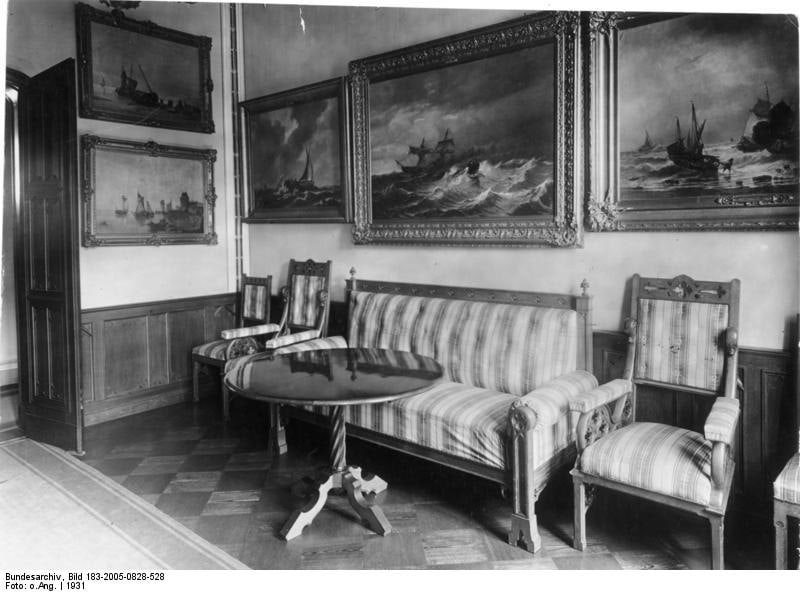
After Wilhelm died in 1888, the palace lost its purpose. His successors preferred other houses, and a scheme to enlarge Babelsberg for a later crown prince came to nothing. During the Second World War the palace, the Flatow Tower, and the kitchen building together became the largest store for the art treasures of the Prussian palaces, sheltering paintings and furniture gathered from across Berlin and Potsdam; much of it was carried east after 1945 and only partly returned.
Under the German Democratic Republic the building served a succession of uses, from a school for people’s judges to the new academy of film, and from 1963 it housed a museum of prehistory and early history. That collection finally moved out in 1999. By then the palace and park had passed, with German reunification, to the Stiftung Preußische Schlösser und Gärten Berlin-Brandenburg, the foundation that tends the former royal estates of Potsdam and Berlin and has cared for Babelsberg ever since.
Visiting Babelsberg Palace
Babelsberg is the rare palace better known today for its outside than its inside. Between 2013 and 2016 the foundation restored the building’s shell, its facades, roof, terraces, and some 380 windows, at a cost of close to ten million euros, but the restoration of the interiors still lies ahead, and no reopening date has been announced. For now the palace stays closed to general visiting. Its restored terraces and fountains can be admired from the park, and the SPSG opens the interior only for occasional special events and guided tours, offered chiefly between May and October. Entry tickets and local tours can also be booked in advance through GetYourGuide.
The surrounding Babelsberg Park, by contrast, is open every day from eight in the morning until dusk, free of charge, and it remains one of the great walking landscapes around Potsdam. Its 124 hectares hold the Flatow Tower, a small palace by the water, a castle-like engine house that once pumped water from the Havel, and the terraces below the palace, all threaded with paths that frame the river views. The palace stands at Park Babelsberg 10, 14482 Potsdam; bus 694 from the Babelsberg S-Bahn station stops close by. Anyone staying overnight can compare hotels in and around Potsdam.
Some links on this page are affiliate links, which means StoneKeep Atlas may earn a small commission, at no extra cost to you, if you book through them.
Beyond Babelsberg
Babelsberg belongs to a remarkable gathering of palaces and parks where Berlin meets Potsdam. Directly across the Havel, reached over the Glienicke Bridge, stands the neoclassical Glienicke Palace, the Italian villa of Wilhelm’s brother Prince Carl; the two estates were laid out to be admired from one another across the water. Together with the nearby Charlottenhof they form a quieter, more romantic strand of Prussian taste, the garden palaces of Potsdam, the princely retreat rather than the seat of state. Babelsberg is the Gothic answer within that program, the subject of our history of Schinkel, Persius, and the Prussian Romantic landscape.
Grander royal houses lie only a short way off: Frederick the Great’s Sanssouci Palace and the monumental Neues Palais in their shared park, the twentieth-century Cecilienhof Palace, and, on the Berlin side, baroque Charlottenburg Palace. They are drawn together in our guides to the royal palaces of Berlin and Brandenburg and the wider Prussian royal castles, the lineage of dynastic and revival architecture to which Babelsberg, the emperor’s own Gothic summer house, firmly belongs.
Conclusion
Babelsberg Palace is the most personal of the imperial residences around the capital: the house where Wilhelm I spent his summers for half a century, and where he chose the chancellor who would make him an emperor. Schinkel’s English fancy, enlarged by Persius and Strack and enriched by Augusta’s exacting eye, still crowns its hill above the Havel, its towers and battlements rising over one of the loveliest landscape parks in Germany. The interiors wait behind scaffolding for the long work that will one day reopen them; until then, the terraces, the towers, and the wide water views are reward enough for the climb up from the river.
Principal Sources
- Otto-von-Bismarck-Stiftung. “Preußischer Ministerpräsident 1862 bis 1871.” bismarck-biografie.de.
- Landeshauptstadt Potsdam. “Schloss und Park Babelsberg.” potsdam.de.
- Museumsportal Berlin. “Schloss Babelsberg.” museumsportal-berlin.de.
- Royal Collection Trust. “Queen Victoria’s Journal, August 1858.” rct.uk.
- Stiftung Preußische Schlösser und Gärten Berlin-Brandenburg. “Babelsberg Palace” and “Babelsberg Park.” spsg.de.
- UNESCO World Heritage Centre. “Palaces and Parks of Potsdam and Berlin.” whc.unesco.org.
Image credits. Hero image by Eddson Lens (Pexels). Schinkel’s 1833 design and the October 8, 1862 decree: Karl Friedrich Schinkel and Wilhelm I of Prussia, public domain, via Wikimedia Commons. Aerial view: © Raimond Spekking / CC BY-SA 4.0 (via Wikimedia Commons). Tanzsaal watercolor: after Carl Graeb, public domain, via Wikimedia Commons. 1931 interior: Bundesarchiv, Bild 183-2005-0828-528 / CC-BY-SA 3.0. View across the Havel (2025): JoachimKohler-HB, CC BY-SA 4.0, via Wikimedia Commons. Freely licensed images are resized to fit; otherwise unaltered.