
Scottish Castle Documentaries
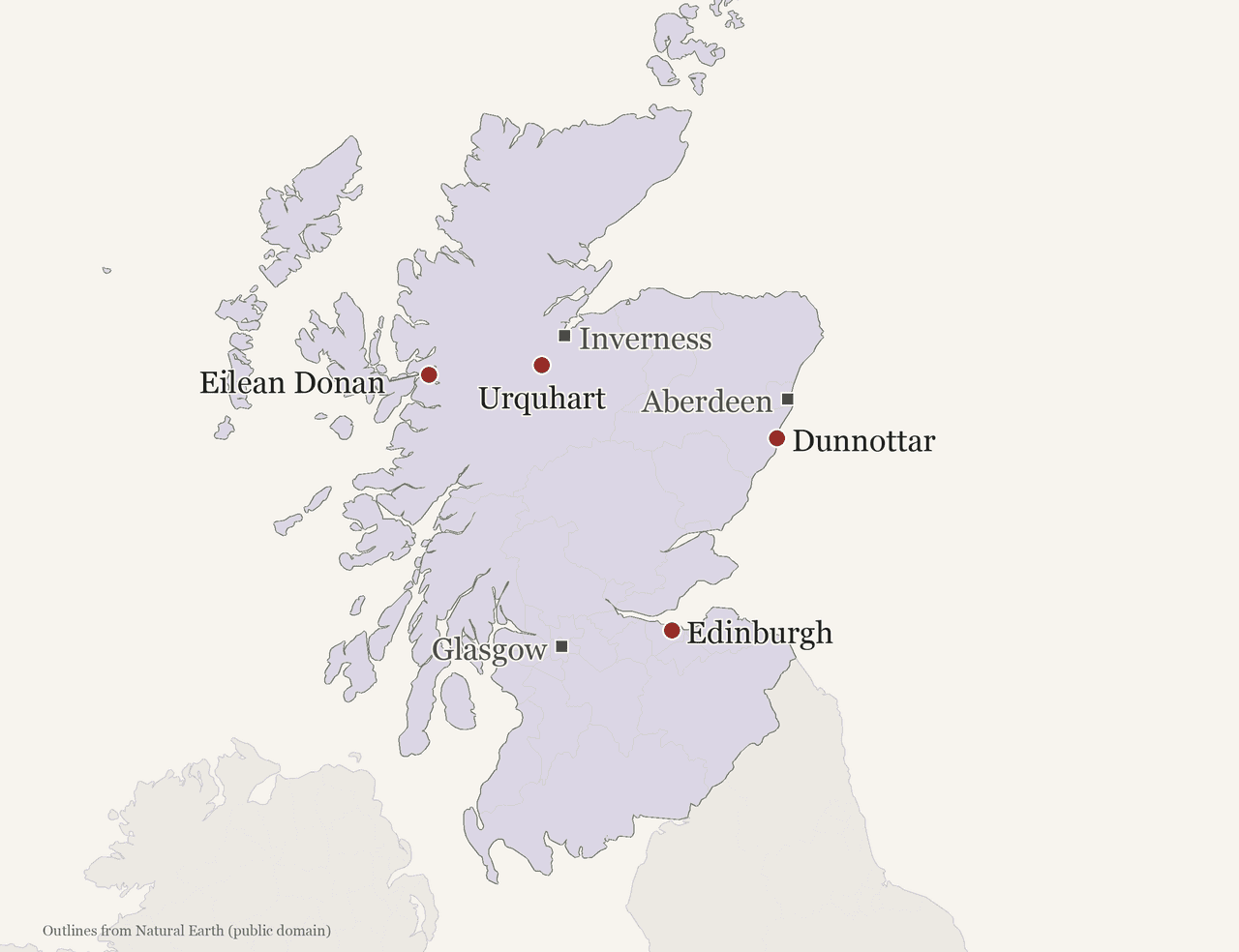
These Scottish castle documentaries take one castle at a time and set the story it is known for against the written record. They run from the capital into the Highlands and out to both coasts, the sea lochs of the west and the cliffs of Aberdeenshire.
Two of the films follow the same crown jewels, the Honours of Scotland, from opposite ends. Each block below sets the scene and poses the question its film asks, then stops: the answers belong to the films, and the settled record belongs to the cited guide linked under each one. The films are narrated in English by synthetic voices; the research, the script, the sourcing and the edit are human.
The Scottish Films
Edinburgh Castle: Britain’s Most Besieged Place
Edinburgh Castle stands on its rock over the center of Scotland’s capital, an uphill walk from Waverley, the city’s main station. Visitors enter through a Victorian gatehouse built in 1886-88 in the then-fashionable Scots Baronial style, where bronze statues of Robert Bruce and William Wallace were set into the front in 1929, although Historic Environment Scotland notes that neither is recorded as ever having visited the castle. On the eastern side, overlooking that entrance, the curved Half Moon Battery gives the castle its profile.
The film starts from a word it finds in almost every guidebook to the castle: impregnable. Then it follows that word through the castle’s sieges. It climbs the rock face with a night raid of 1314 and sits through the Lang Siege of 1571-73. From there it turns to two later clues, an architect’s find in a coal cellar in 1891 and the investigation that followed in 1912-13. It also takes up the Honours of Scotland, the crown jewels on display today in the castle’s Crown Room. The title states flatly what David Caldwell, who counted sixteen sieges between 1093 and 1544, puts more carefully: the castle “appears to be the most besieged place in Great Britain.”
Read: the Edinburgh Castle guide; on site, stand on the Half Moon Battery and look out over the city and far beyond.
Urquhart Castle: Who Invented the Loch Ness Monster
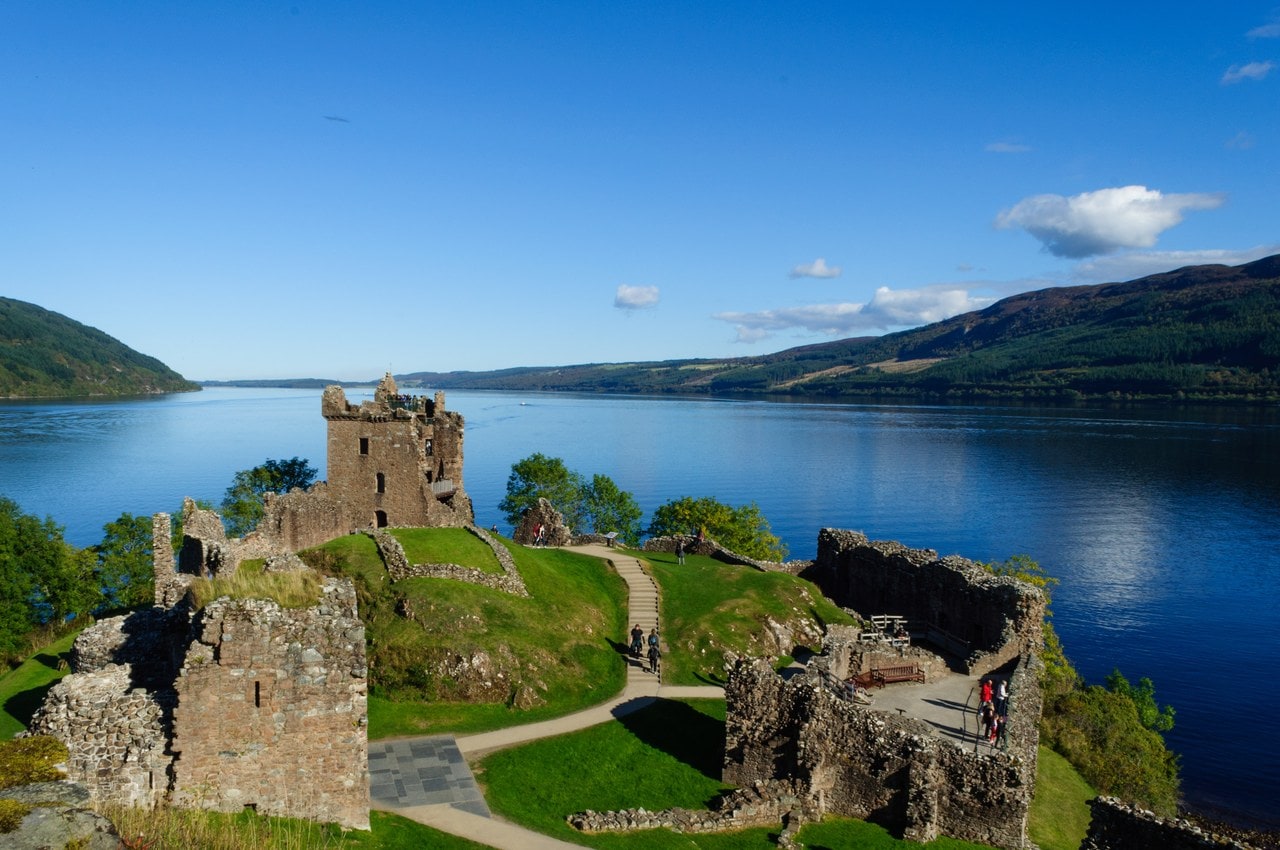
On a rocky promontory on the western shore of Loch Ness, Urquhart Castle is a ruin with an open outlook up and down the loch. It stands just off the A82, about two miles from Drumnadrochit, near Inverness. Its Grant Tower is a five-story tower house that the Grants built at some point during the 1500s, and part of it crashed to the ground in a violent storm in 1715. It has been in state care since 1913.
The film starts from a famous photograph and asks what the castle has to do with the story. To get there it works through three pieces of evidence and a road: a local newspaper report from the 1930s, the photograph itself, a Life of Saint Columba written by his biographer Adomnán, and last of all the road that runs past the castle.
Read: the Urquhart Castle guide; at the castle, climb the Grant Tower for the view over the loch and down the Great Glen.
Dunnottar Castle: The Crown Cromwell Never Found
About a mile and a half south of Stonehaven, Dunnottar Castle is a cliff-top ruin on the Aberdeenshire coast with the North Sea on three sides. Its rock is a conglomerate known as pudding stone: large rocks and pebbles set in an immensely strong natural cement, like raisins in a fruitcake, as the castle’s own history puts it. A steep path climbs to a gatehouse defended by three tiers of splayed gun-loops, where the arched entrance is the only opening in a solid wall of masonry set into a cleft in the rock.
Cromwell’s army came for the crown, the sword and the scepter of Scotland. The film follows where they went and asks who got them out. Its evidence is on paper: the surrender terms of the siege, a minister’s own written declaration, and the accounts written down after the Restoration. It closes on two later stories the rock kept.
Read: the Dunnottar Castle guide; walk out to the castle from Stonehaven along the coastal path.
Eilean Donan Castle: The Year Spain Invaded Scotland
Eilean Donan Castle stands on a small island where three sea lochs meet on Scotland’s west coast, by the village of Dornie on the road to Skye, about eight miles from the Skye bridge at Kyle of Lochalsh. Visitors walk out to it across a three-arched bridge with small refuges for pedestrians. Most of what stands today was rebuilt between 1912 and 1932, in what Historic Environment Scotland describes as a free interpretation of the former castle, incorporating some remains of the keep and enclosing walls.
The film opens in May 1719, as Royal Navy warships come up the loch to the castle, and asks what Spanish soldiers were doing inside it. It works out what “Spain invaded Scotland” amounted to, why the Navy did what it did next, and who built the castle back two centuries later. Its evidence is a letter dated from the castle that spring, the Navy captain’s own dispatch, a modern study of the ships’ logs, and the heritage listing of the castle that stands there now.
Read: the Eilean Donan Castle guide; on site, look from the castle up Loch Duich toward the Five Sisters of Kintail, across Loch Alsh toward Skye, and over to Dornie at the mouth of Loch Long.
Beyond the Scottish Films
For a visit rather than a viewing, start with our guide to Scotland’s castles, which places these films’ castles among the others the site covers across the country. Two of these castles also share a drive from Inverness toward Skye: the A82 passes Urquhart beside Loch Ness, and the A887 leads west from it to the A87, the trunk road past Eilean Donan. For films from the rest of the series, country by country, go to the castle documentaries index, which explains how the films are made and where to begin.
Principal Sources
- Aberdeenshire Council. “Dunnottar Castle” (Historic Environment Record MAB42414). her.aberdeenshire.gov.uk.
- Dickson, William Kirk, ed. The Jacobite Attempt of 1719: Letters of James Butler, Second Duke of Ormonde. Scottish History Society, 1895. archive.org.
- Dunnottar Castle. “Find us.” dunnottarcastle.co.uk.
- Dunnottar Castle. “History.” dunnottarcastle.co.uk.
- Dunnottar Castle. “Home.” dunnottarcastle.co.uk.
- Edinburgh Castle. “Getting here.” edinburghcastle.scot.
- Edinburgh Castle. “Half Moon Battery.” edinburghcastle.scot.
- Eilean Donan Castle. “Access Statement.” eileandonancastle.com.
- Eilean Donan Castle. “How to find us.” eileandonancastle.com.
- Eilean Donan Castle. “Timeline.” eileandonancastle.com.
- Historic Environment Scotland. “Eilean Donan Castle” (Listed Building LB7209). portal.historicenvironment.scot.
- Historic Environment Scotland. “Eilean Donnan, remains associated with Castle Donnan” (Scheduled Monument SM7575). portal.historicenvironment.scot.
- Historic Environment Scotland. “History and stories” (Edinburgh Castle). historicenvironment.scot.
- Historic Environment Scotland. “History and stories” (Urquhart Castle). historicenvironment.scot.
- Historic Environment Scotland. “Plan your visit” (Urquhart Castle). historicenvironment.scot.
- Historic Environment Scotland. Statement of Significance: Edinburgh Castle, David’s Tower. HES publications.
- Historic Environment Scotland. Statement of Significance: Edinburgh Castle, Gatehouse, Inner Barrier and Old Guardhouse. HES publications.
- Historic Environment Scotland. Statement of Significance: Honours of Scotland. HES publications.
- Historic Environment Scotland. “Urquhart Castle.” historicenvironment.scot.
Image credits. Hero, Urquhart Castle on its promontory over Loch Ness: Photo: MG Photography / Adobe Stock; Locator map: own work, StoneKeep Atlas, CC BY 4.0; outlines from Natural Earth, public domain. Freely licensed images are resized to fit; any other change, such as a crop, is named in the credit.