
Dunnottar Castle
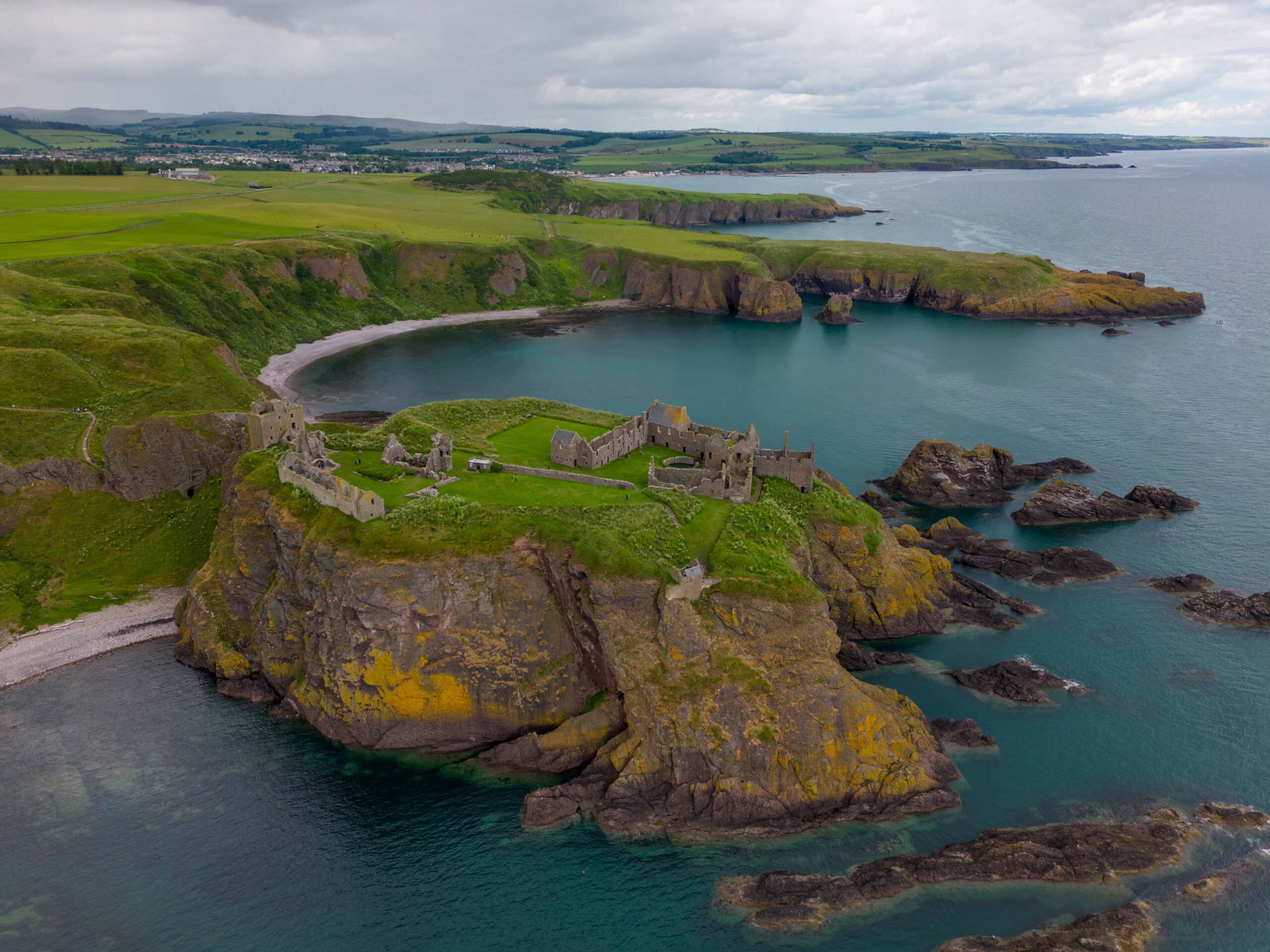
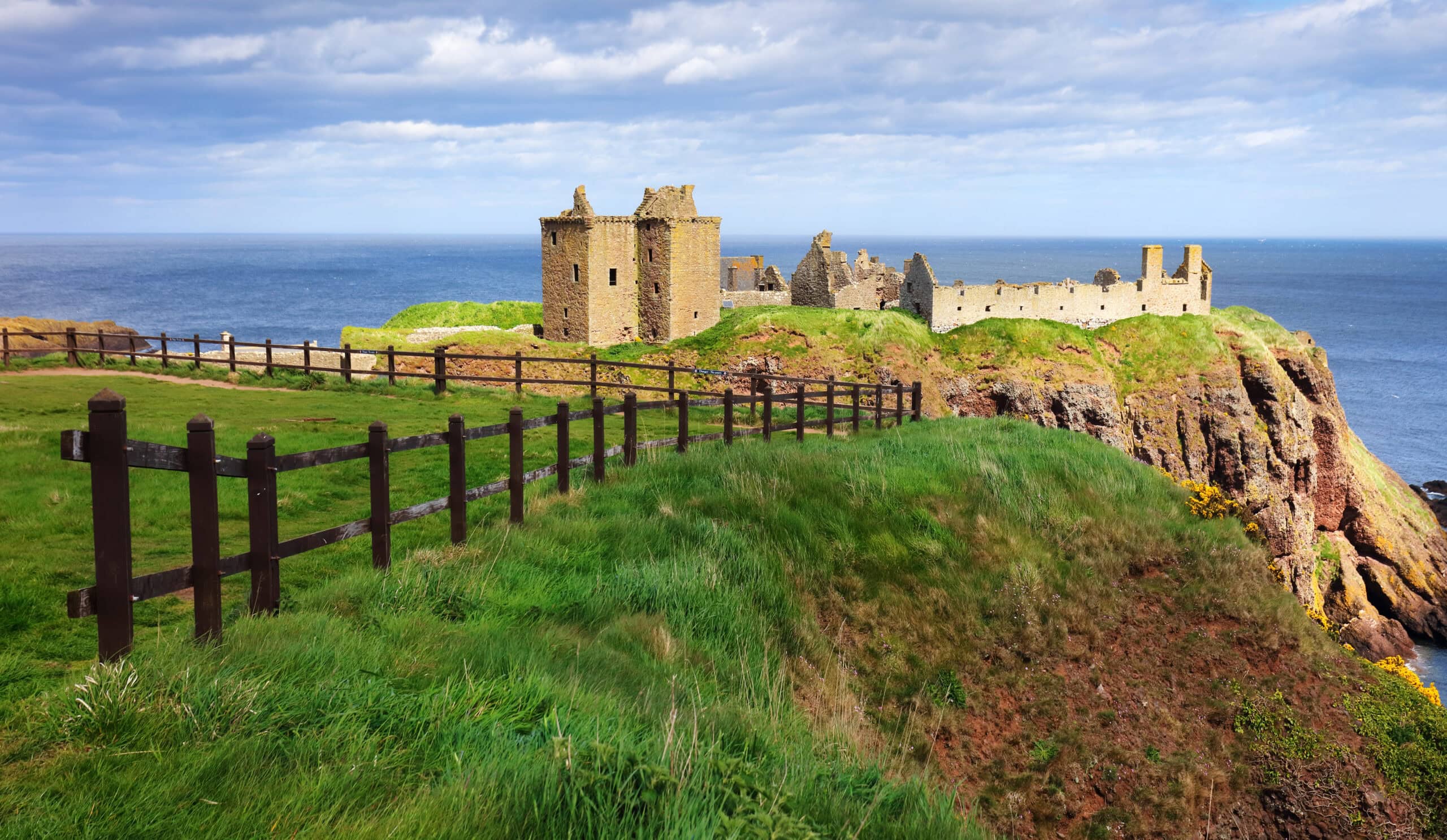
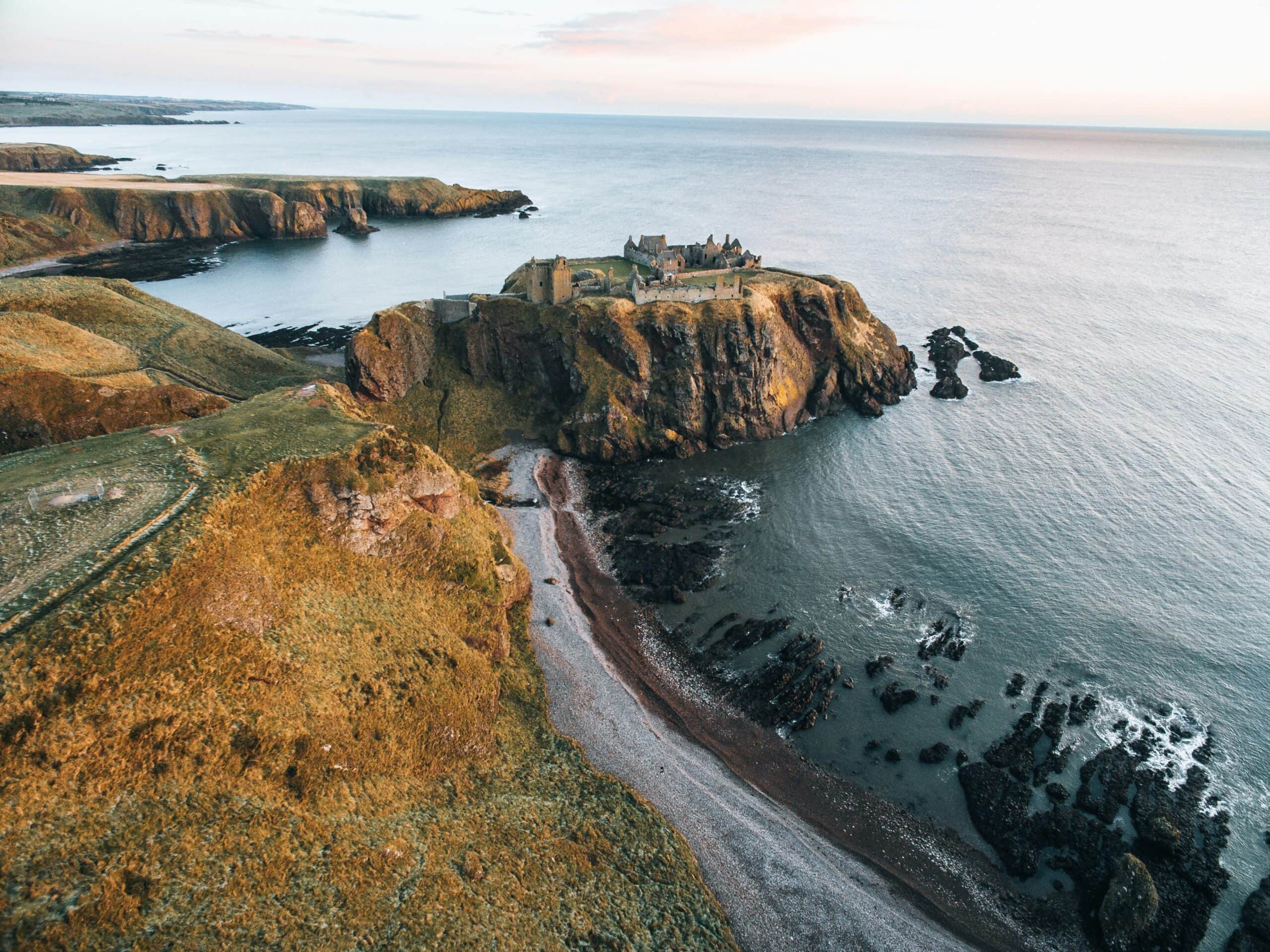
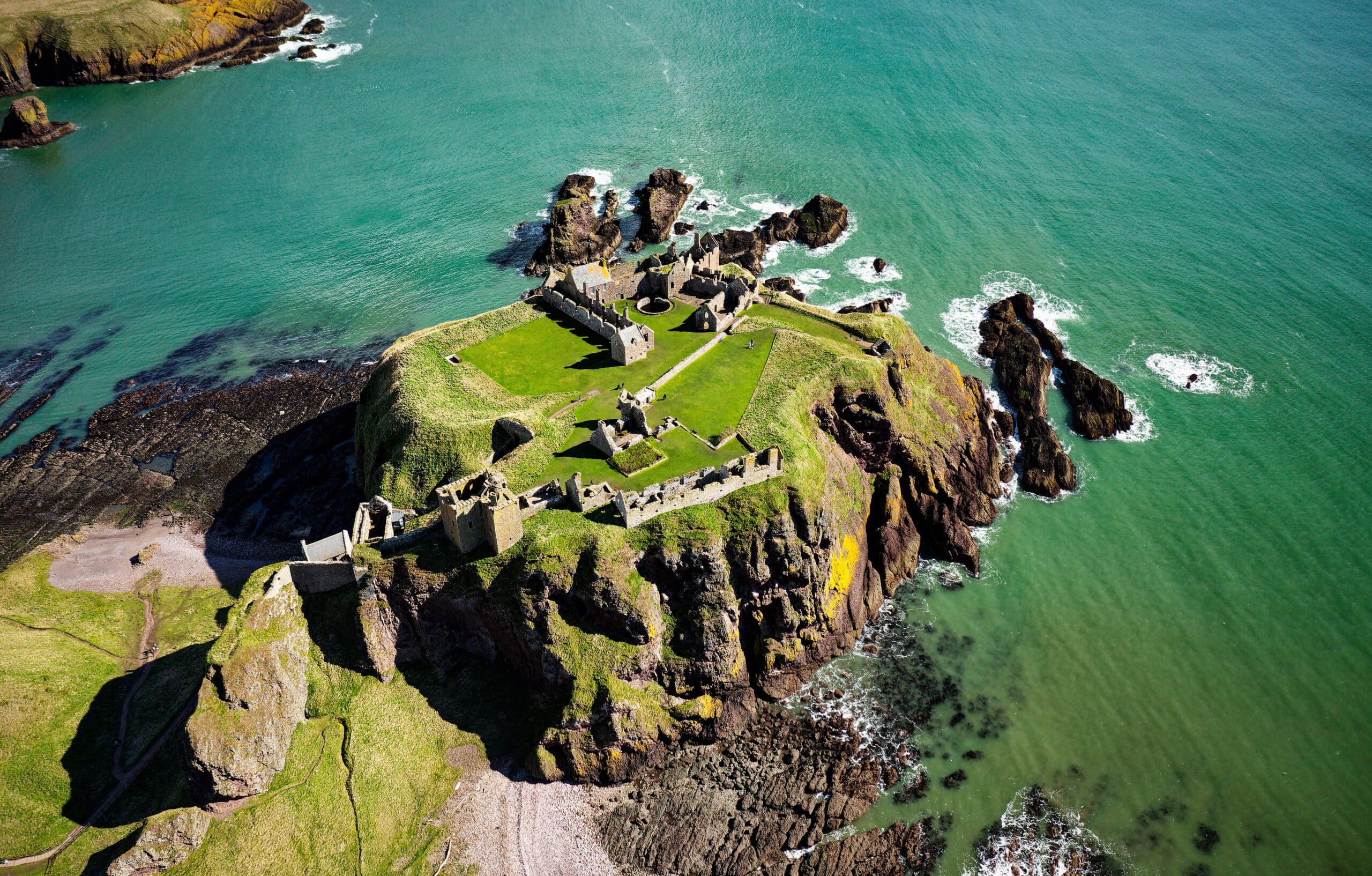
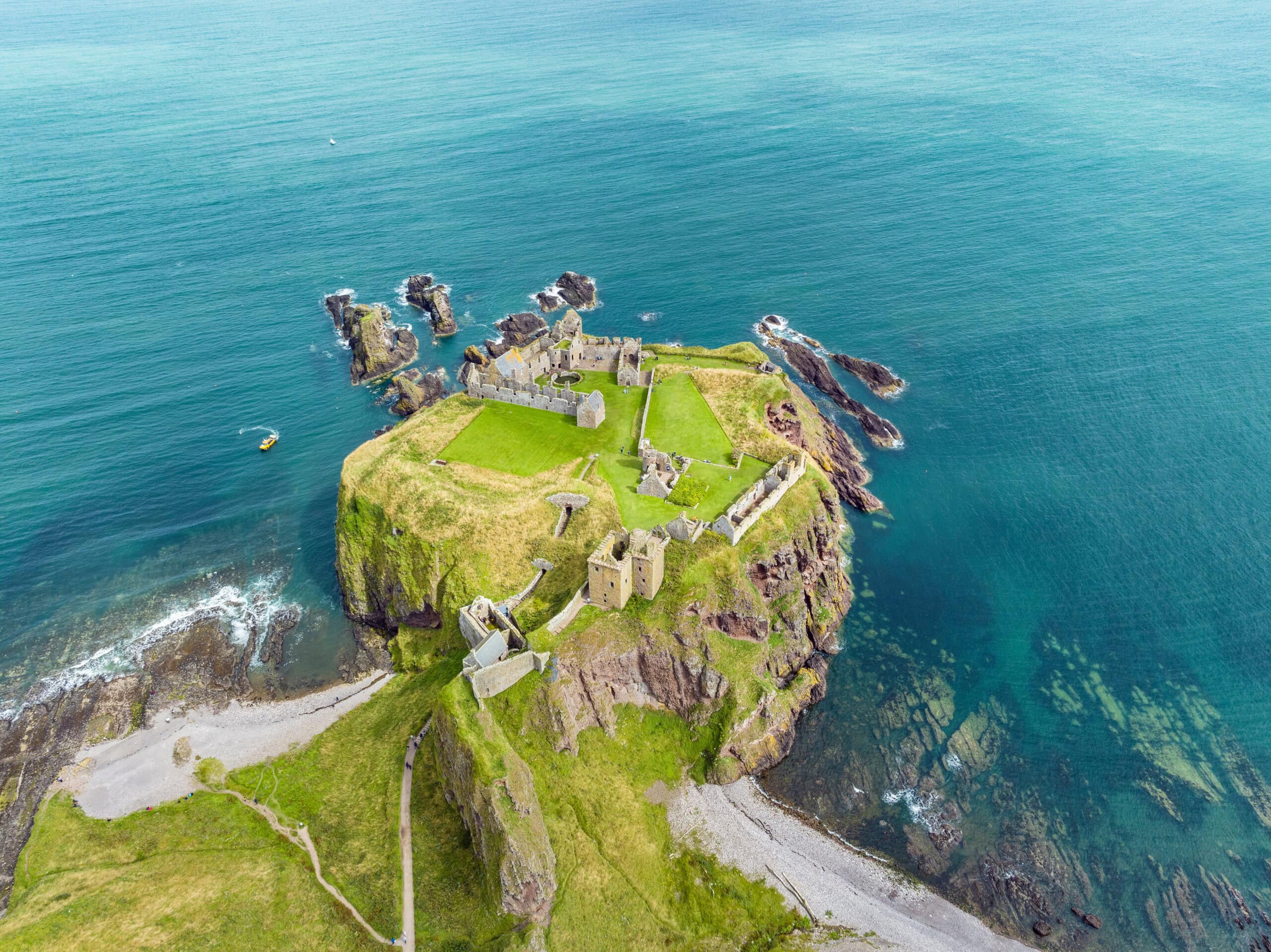
Dunnottar Castle stands on a flat-topped sea stack of conglomerate rock on the Aberdeenshire coast, roughly a mile and a half south of Stonehaven, and no first sight of it is ever quite forgotten. Cliffs fall about fifty meters to the North Sea on almost every side, and a single narrow neck of land ties the ruin to the mainland. That geography is the whole story of the place. It made Dunnottar one of the strongest positions in medieval Scotland, the vault where the Scottish crown jewels rode out a Cromwellian siege, and the prison where more than a hundred and sixty Covenanters were shut into one cellar. What survives today is a spread of roofless halls, a squat medieval keep, and a Renaissance palace range, laid across about three and a half acres of clifftop that you reach only on foot, down a steep path and back up again. Few ruins in Britain wear their history so openly, and fewer still sit in a setting that explains at a glance why the history happened at all.
Quick Facts
| Location | Stonehaven, Aberdeenshire, Scotland (AB39 2TL) |
|---|---|
| Built | Keep late 14th century; palace late 16th-early 17th century |
| Founder | The Keiths, Earls Marischal |
| Condition | Ruin, conserved from 1919 |
| Owner | Privately owned (Pearson family / Dunecht Estates) |
| Designation | Scheduled Monument (Historic Environment Scotland) |
| Admission | Adult GBP 13.50; child (5-15) GBP 6.25; concession GBP 12.00 (2026 season) |
| Official website | dunnottarcastle.co.uk |
A Fortress on the Cliff: Setting and Early History
Long before any stone was laid, the rock at Dunnottar was a coastal stronghold. Its name comes from the Gaelic Dun Fhoithir, built on the Pictish word dun, a fort or place of strength; the operator glosses the whole as a fort on the low-lying ground beneath the cliffs. A promontory this defensible, with fresh water on the summit and a commanding view of the sea lanes, drew occupants for centuries before the Keiths raised the buildings visitors climb through now. Early medieval Scotland fought its wars along coasts and rivers, and a headland that could be reached by only one narrow path was worth more than acres of open ground. Occupation here reaches back into the Dark Ages: the Annals of Ulster record a siege of Dun Foither in 681, most likely this rock, and another in 694, glimpses of a Pictish stronghold that the kings of Fortriu fought over long before the Keiths reached the edge of the Mearns.
The site enters recorded national history during the Wars of Independence. In 1297 William Wallace took Dunnottar back from an English garrison, one episode in the long struggle that followed Edward I’s attempt to bring Scotland under his control. Later tradition, drawn from Blind Harry’s fifteenth-century poem rather than any contemporary record, has the defeated English soldiers taking refuge in the castle chapel and perishing there when Wallace’s men set it alight. That grim scene belongs to legend more than to documented fact, and it deserves to be told as legend. What is not in doubt is the strategic logic beneath it. Whoever held this headland held one of the hardest places on the east coast to take by force, and every power in the region wanted it. Control of Dunnottar meant control of a stretch of coast that armies and supply ships had to pass, which is why the rock keeps reappearing at the sharp points of Scottish history.
The Keiths and the Earls Marischal
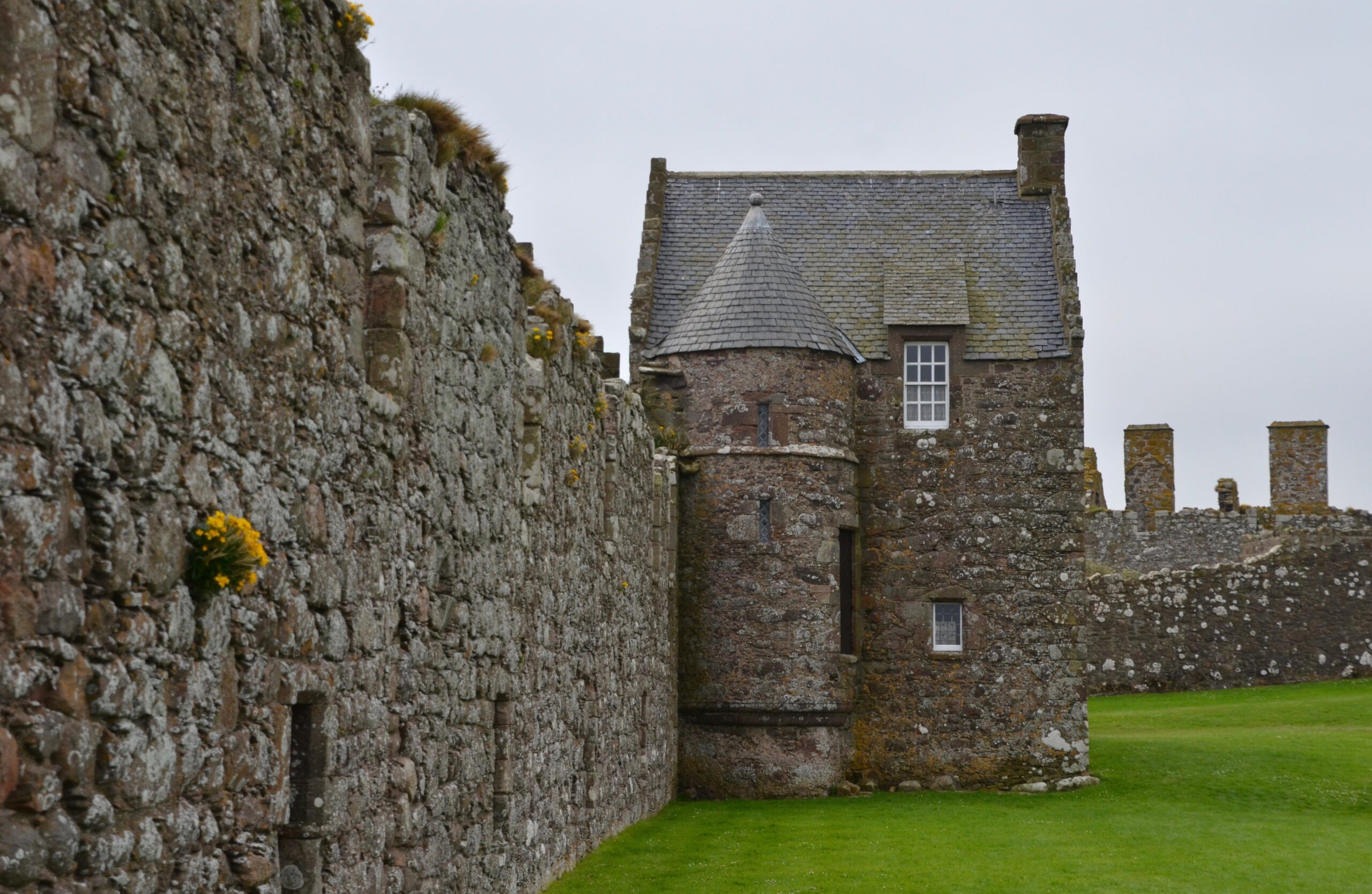
Around 1359 William Keith, Marischal of Scotland, married Margaret Fraser, a niece of Robert the Bruce through the king’s sister, and with her came the barony of Dunnottar. His family would hold the rock for the better part of four centuries, and their rise and fall is very nearly the story of the castle itself. Late in the fourteenth century Keith built the stone tower house still known as the Keep, a blunt rectangular block about twelve meters by eleven, rising some fifteen meters to its gable, with a vaulted basement carrying three storeys and a garret above. It is the oldest standing building on the site and the anchor of everything that grew around it, a piece of hard medieval engineering meant to be lived in and defended at once.
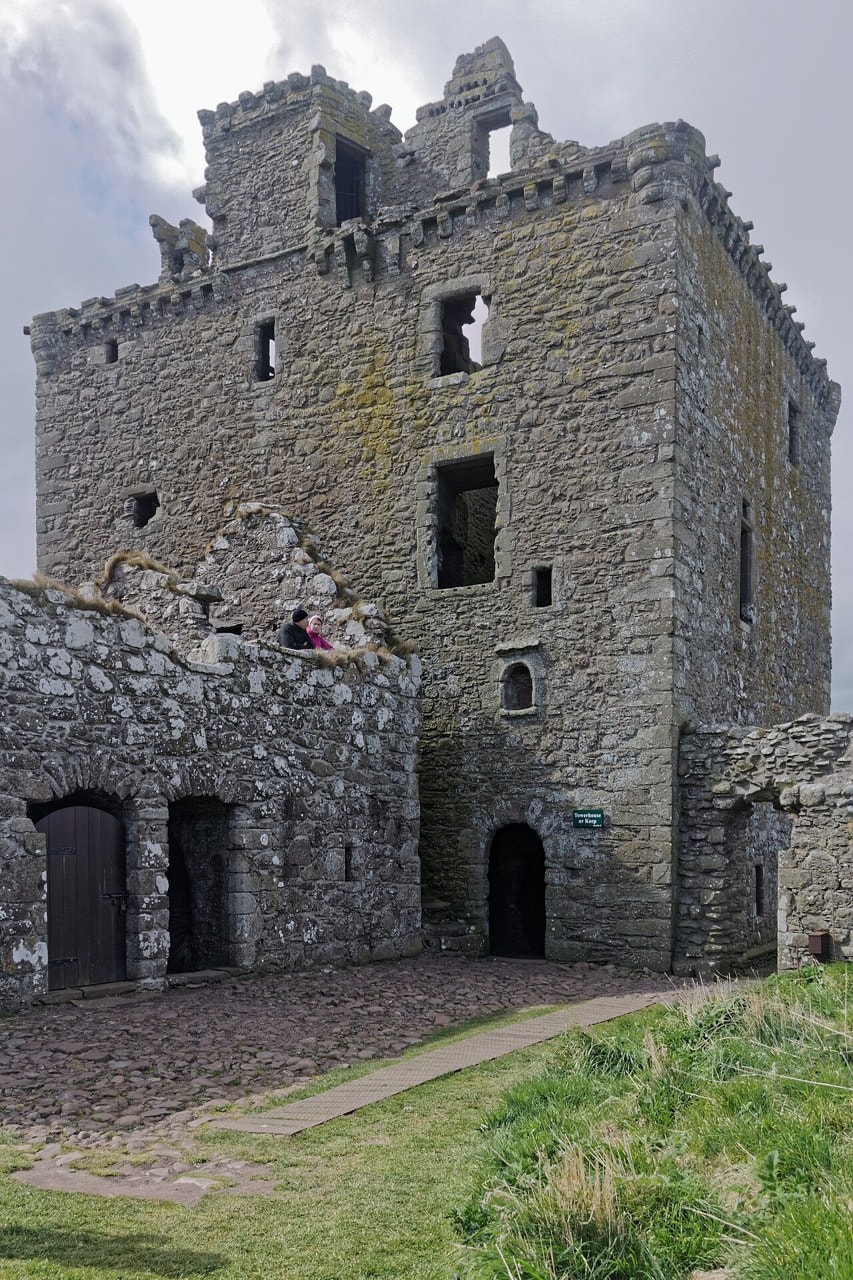
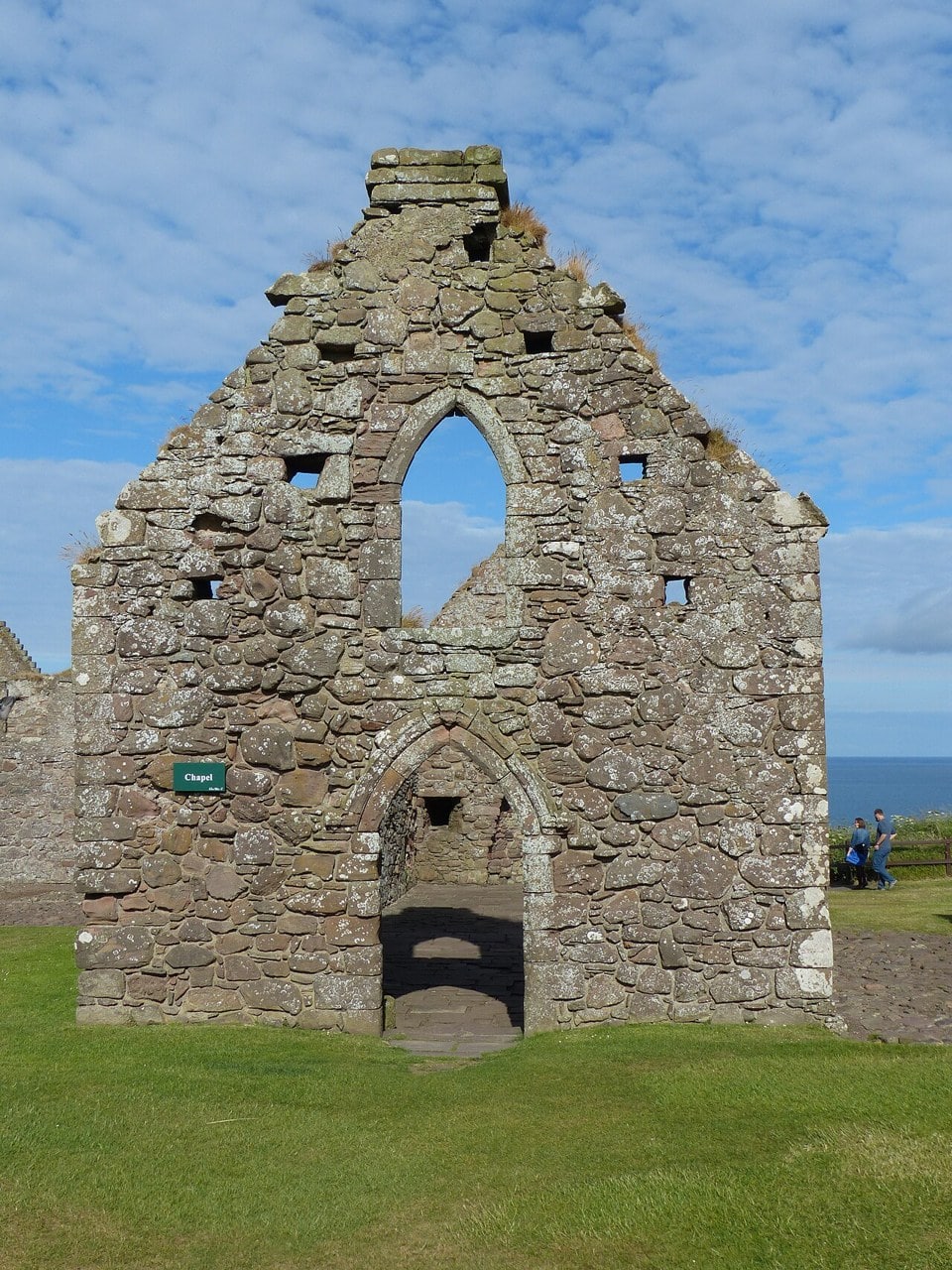
Building it cost Keith a quarrel with the Church. He had raised his tower on ground that held a consecrated chapel, and for that he was excommunicated. A papal bull in the 1390s lifted the sentence once he agreed to make amends, a reminder that even a great magnate on a private rock answered to Rome. The chapel was rebuilt, and its ruin still stands on the plateau among the later buildings. In 1458 James II raised the family to Earl Marischal, a title that placed the Keiths among the highest magnates of the realm, hereditary keepers of the royal regalia and marshals of the king’s ceremonies. A seat to match that rank was expected, and over the next century and a half the Keiths turned a fortified rock into a small courtly town.
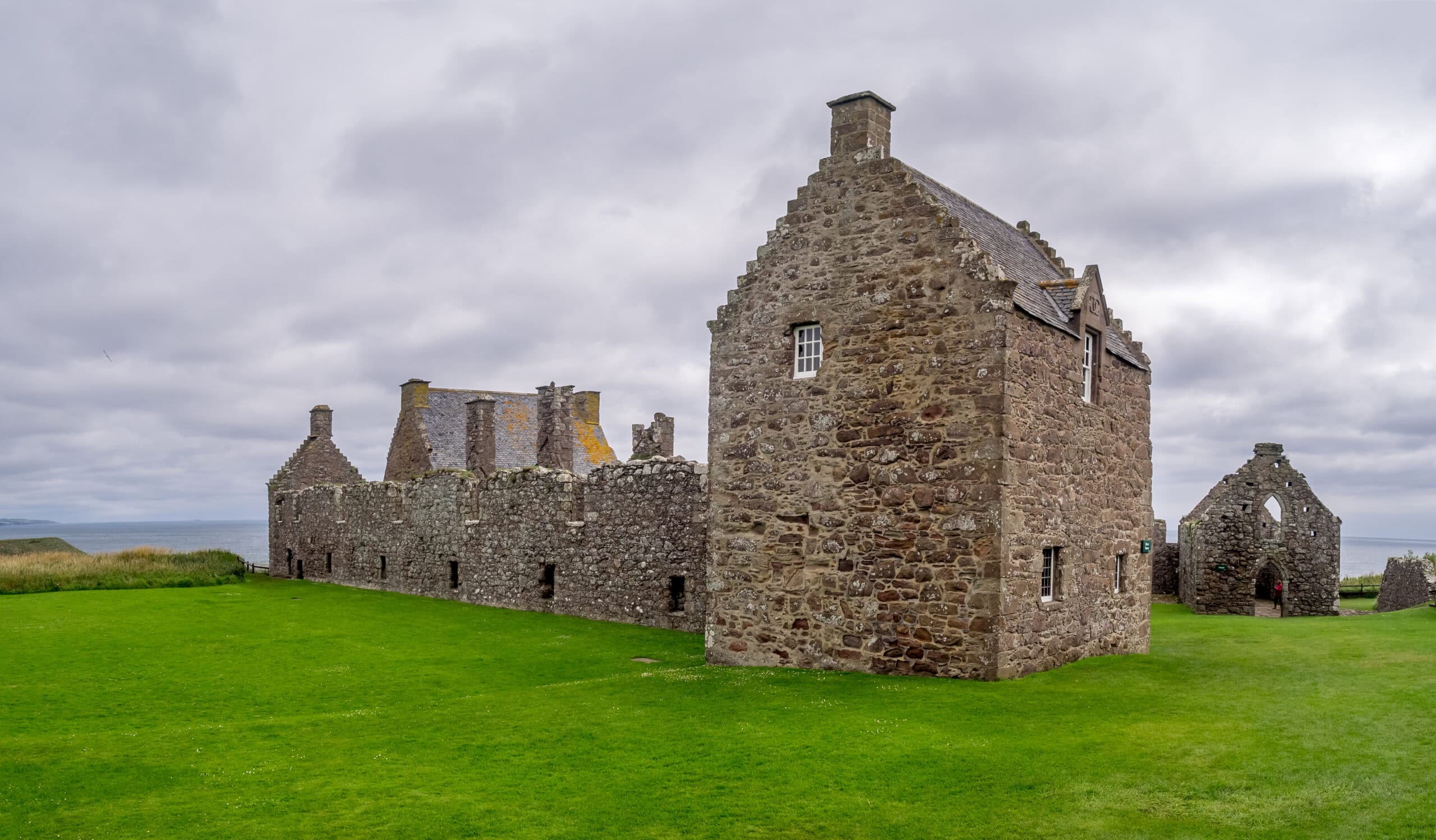
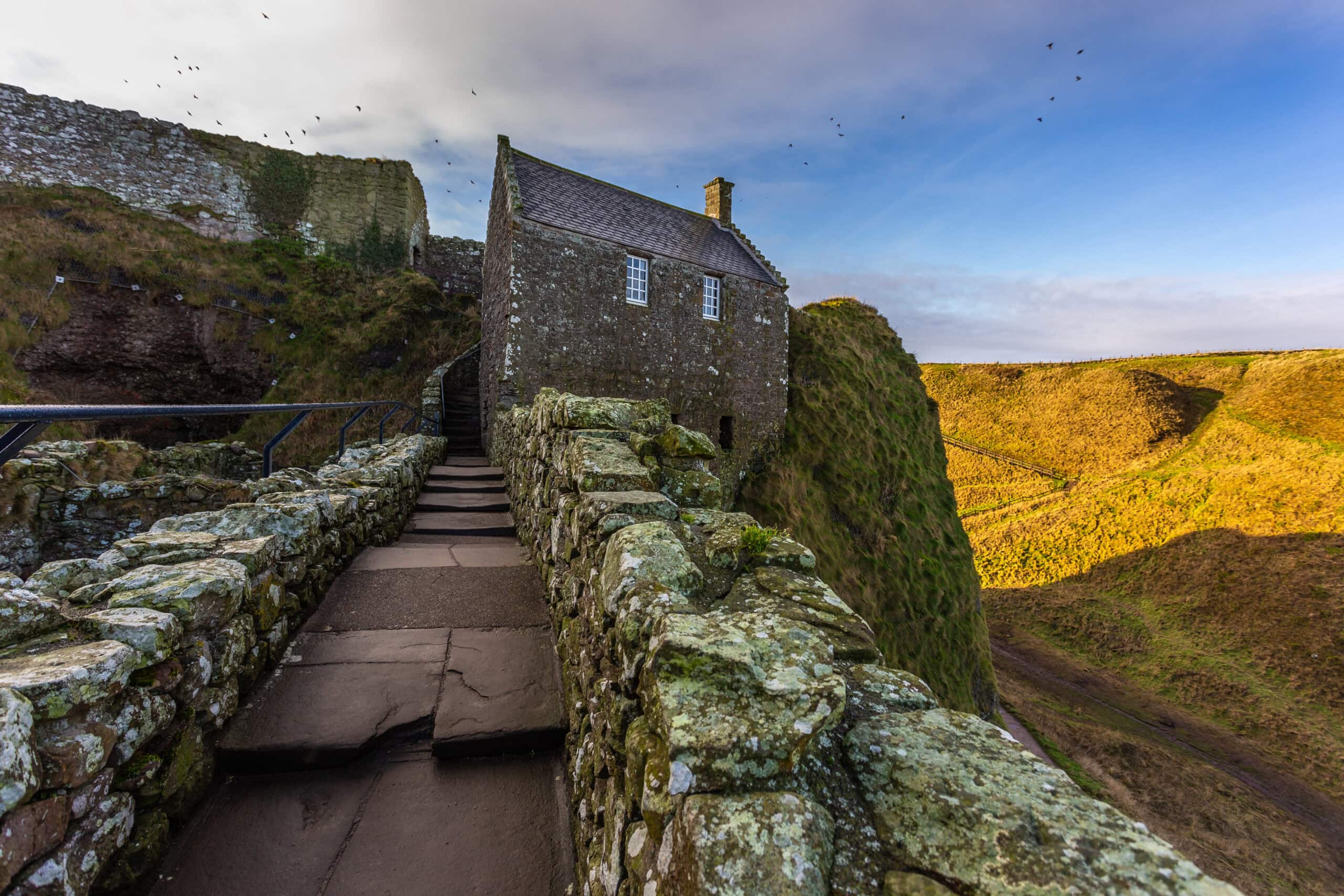
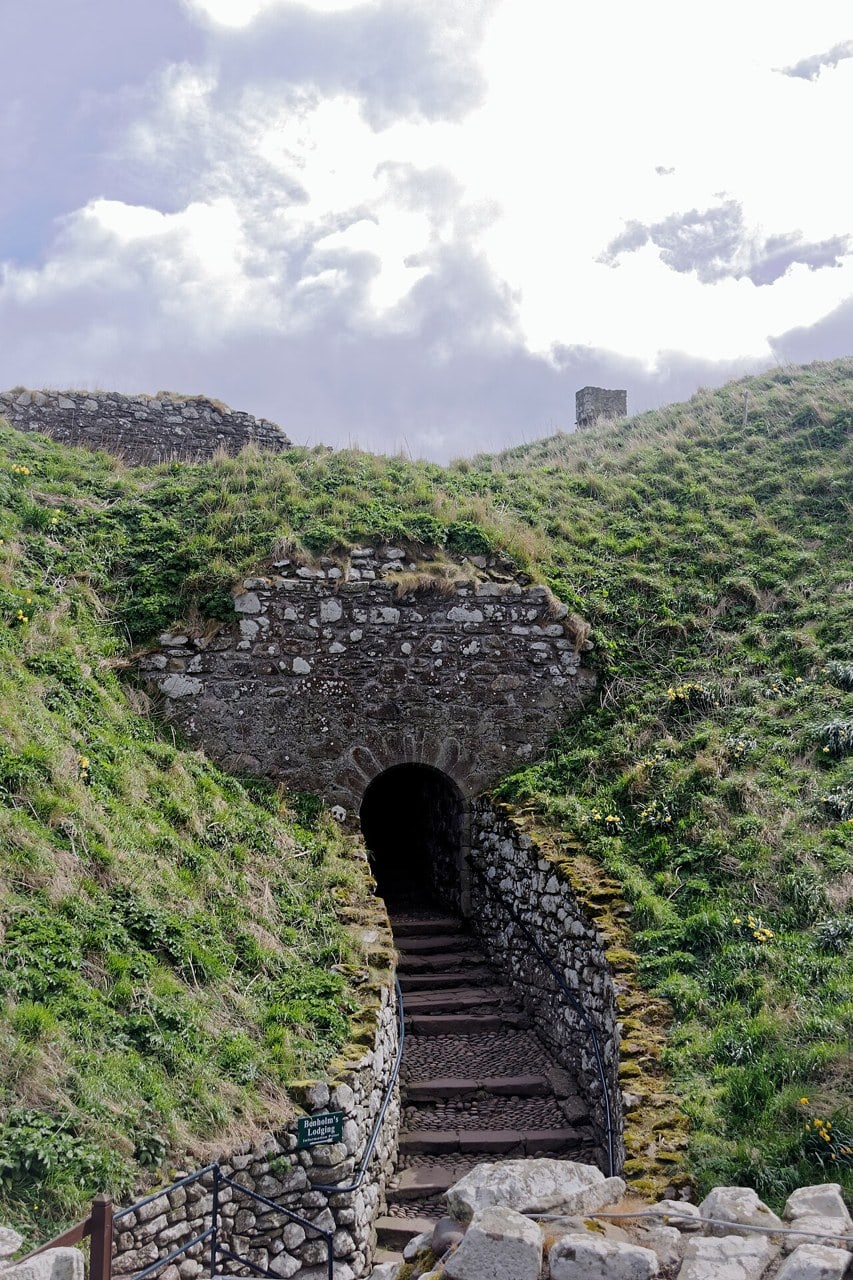
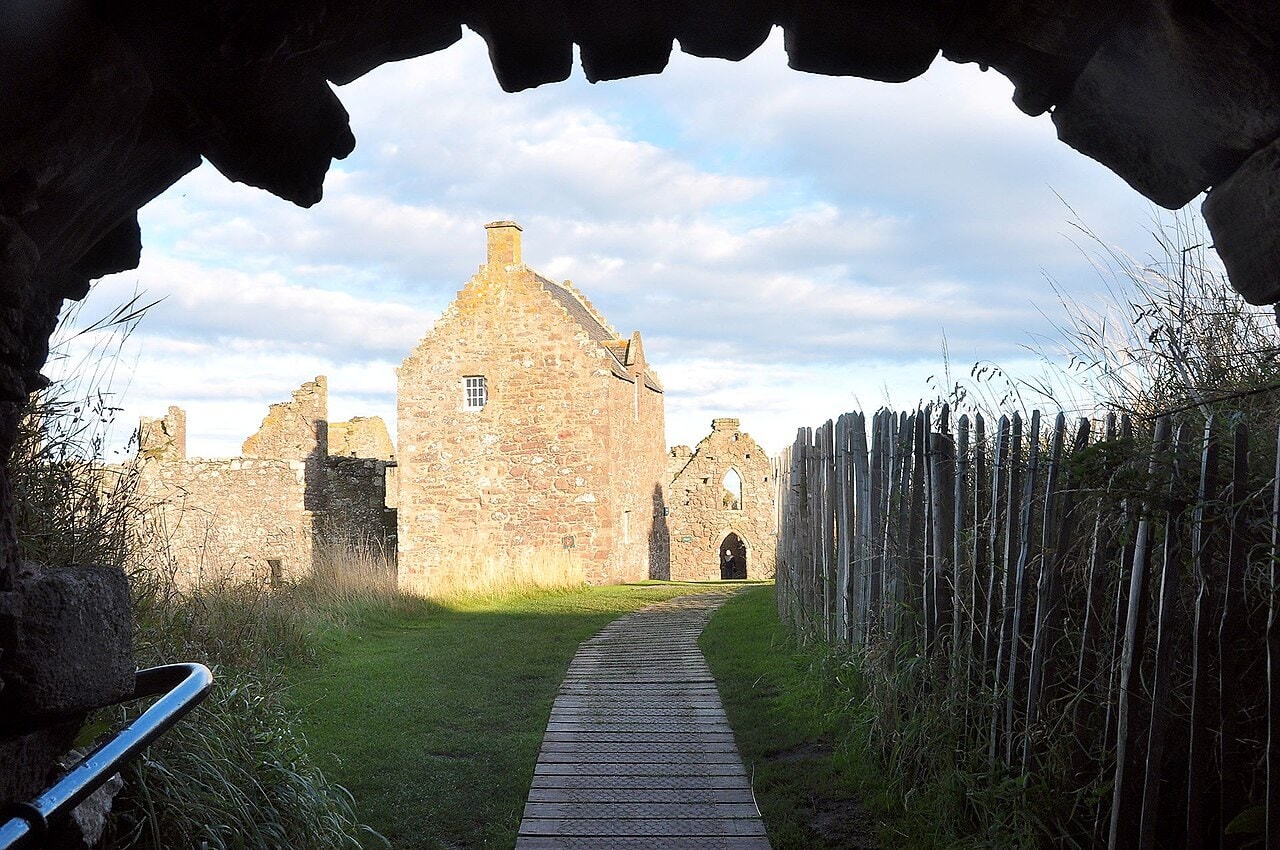
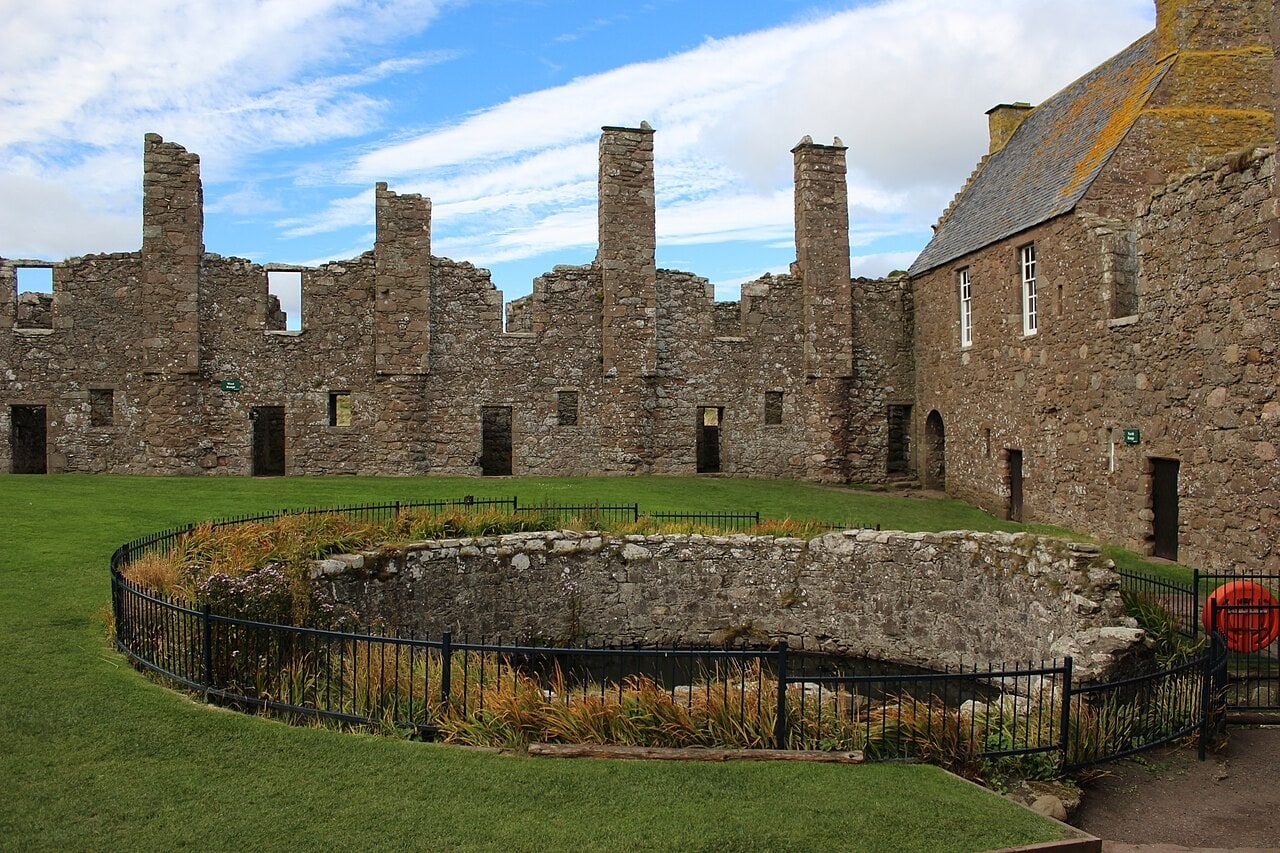
That ambition shows most in the palace. George Keith, fifth Earl Marischal, who succeeded in 1581 and founded Marischal College in Aberdeen in 1593, built the long domestic range set around a quadrangle on the northern part of the plateau. Its rooms run to a gallery some thirty-seven meters in length, a drawing room, private lodgings, a suite of stores, stables, and a brewery, arranged for comfort rather than defense and lit by generous windows that face inward, away from the sea wind. Walking the quadrangle now, you can still read the plan of a self-sufficient household: bedchambers over cellars, a great gallery for display, service rooms placed to keep a large establishment fed and warm. A sixteenth-century gatehouse guards the only approach, its entrance passage covered by three tiers of splayed gun loops, and beside it Benholm’s Lodging drops five storeys into the rock, a prison at the bottom with apartments stacked above it. Together the Keep and the palace read as two Scotlands in one enclosure, the fortified medieval world and the confident Renaissance one, separated only by the width of a courtyard.
The Honours of Scotland
Dunnottar’s most famous chapter came in the winter and spring of 1651 and 1652, and it turned on the castle’s greatest asset, its sheer difficulty of capture. After the Scottish coronation of Charles II at Scone on New Year’s Day 1651, the country slid into open war with Cromwell’s Commonwealth. As the English armies advanced and Edinburgh Castle itself came under threat, the Honours of Scotland, the crown, the sceptre, and the sword of state, needed a refuge. They were carried north and lodged at Dunnottar, by then almost the last royalist ground left in the kingdom. Nowhere else combined the same remoteness with the same natural strength.
Sir George Ogilvy of Barras held the castle with a garrison of about sixty-nine men while an English force under Colonel Thomas Morgan closed in and settled for a siege. Through the winter the small garrison held out on a rock that could be blockaded but not easily stormed. By May 1652 Dunnottar was the only place in all of Scotland where the royal standard still flew, a distinction that made its reduction a matter of Commonwealth prestige as much as strategy. The English brought up heavy siege guns capable of battering the walls in time, and Ogilvy, with supplies failing and no prospect of relief, surrendered on 24 May. When the Cromwellians took possession, they made a discovery that turned the whole siege into a defeat: the Honours were already gone.
How they left is one of the good stories of Scottish history, and it is best told plainly, since the surviving accounts disagree over the details. The regalia had been smuggled out before the surrender, and the credit is generally given to Christian Fletcher, wife of James Grainger, the minister of the nearby parish of Kinneff. In the traditional account she carried the crown, sceptre, and sword out past the besieging lines a little at a time, wrapped and disguised, and brought them home to Kinneff. Ogilvy’s own family later claimed a larger share in the plan, and the two versions have never been fully reconciled; what holds across all of them is the outcome. The Honours were hidden beneath the floor of Kinneff church, close by the pulpit, where they lay for some eight or nine years. From time to time Fletcher and the minister lifted the flagstones at night to air the regalia and keep the damp from ruining them, then sealed them away again. There they stayed until the monarchy was restored in 1660, when they were recovered and returned to the crown. Parliament later voted Fletcher two thousand merks in acknowledgment, a reward that was never actually paid. The crown, sceptre, and sword she saved are the same objects on display today at Edinburgh Castle, the oldest surviving crown jewels in the British Isles, and a visitor who has stood on the Dunnottar rock reads that Edinburgh display very differently afterward.
The Whigs’ Vault
A generation later the same walls that had sheltered a crown became a place of suffering. In the summer of 1685, during the period of persecution that later Presbyterian memory named the Killing Time, a large group of Covenanters was marched north to Dunnottar and shut into a single vaulted cellar. These were men and women who refused to accept the religious settlement imposed under the restored monarchy and the new king, James VII, and who would not swear the oaths demanded of them. One hundred and sixty-seven were confined in all, one hundred and twenty-two men and forty-five women, packed into a space about sixteen meters by four and a half that is still called the Whigs’ Vault. Through a summer with little air, foul water, and no sanitation, the prisoners endured conditions that quickly turned lethal.
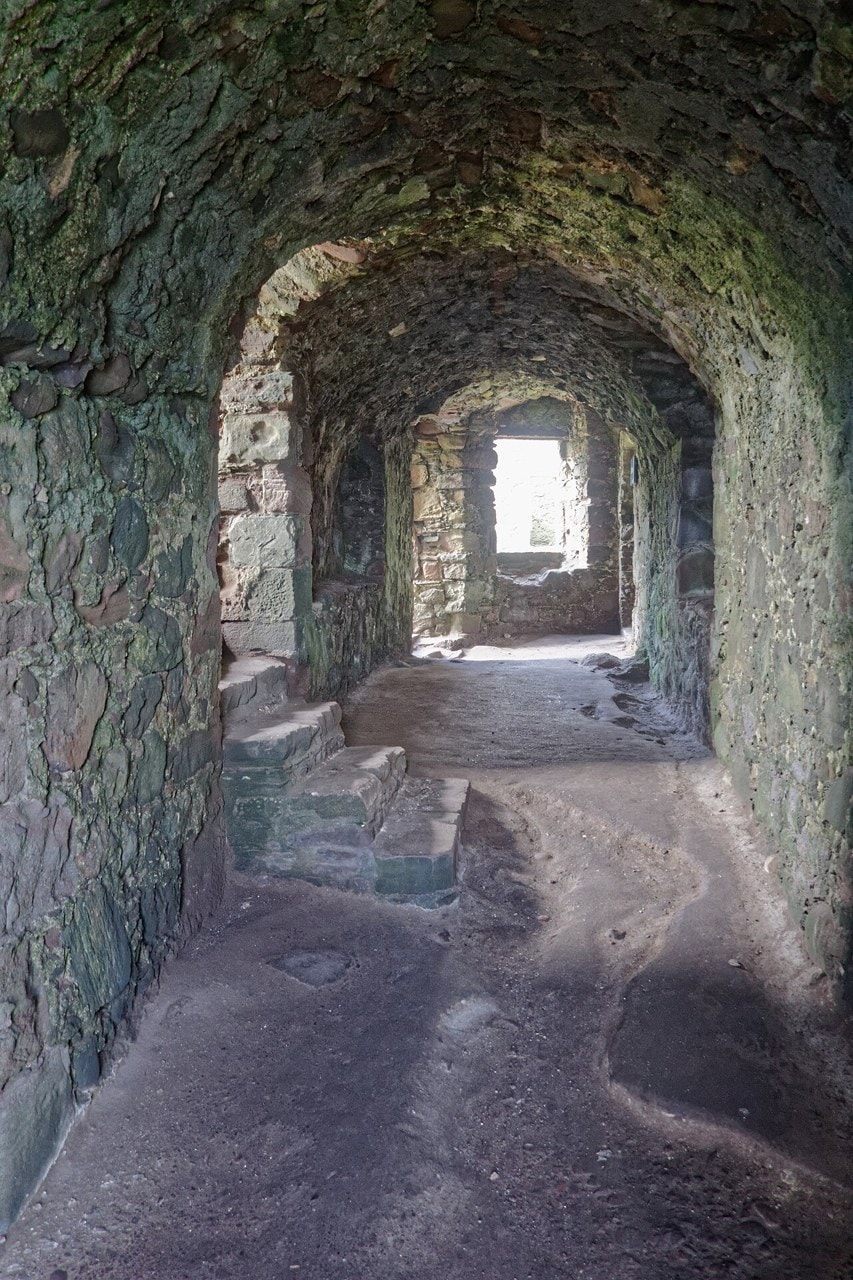
Five of them died in the vault. A group of twenty-five made a desperate escape, climbing out and down the cliff face toward the shore; two fell to their deaths on the rocks below, fifteen were recaptured, and the remainder got clean away. Of those who stayed, some were eventually released, others were made to swear the oath, and a number were transported overseas. The episode fixed Dunnottar in the Covenanter martyrology, and the memorials around Stonehaven and at nearby Kinneff keep that memory local as well as national. Standing in the low, damp vault today, with the sea loud beyond the single window slit and the exit blocked by nothing more than a modern rail, the arithmetic of that summer is very hard to shake off. It is the counterweight to the castle’s grander legends, a reminder that a fortress this strong served whoever held it, for rescue or for cruelty alike.
Decline, Forfeiture, and Rescue
The castle’s fall, when it came, was political rather than military. George Keith, tenth Earl Marischal, threw in his lot with the Jacobite rising of 1715, raising the standard of the exiled Stuarts against the new Hanoverian dynasty. When the rising collapsed, his titles and estates were forfeited to the crown in 1716, and four centuries of Keith tenure on the rock came to an abrupt end. Dunnottar passed to the York Buildings Company, a speculative London concern that had bought up forfeited Jacobite estates and set about extracting whatever value it could. Roofs were stripped, timber and lead and fittings sold off, and through the eighteenth century the buildings were left open to the Aberdeenshire weather. By the nineteenth century the great palace of the Earls Marischal had become an empty shell, admired by Romantic travelers precisely for its desolation.
Rescue arrived in 1919. Weetman Pearson, first Viscount Cowdray, and Lady Cowdray bought the castle that year and began a long, patient program of consolidation, clearing rubble, stabilizing walls, and making the site safe to walk. That work has continued under the family in the decades since, and Dunnottar today is neither a rebuild nor a fake. It is a carefully held ruin, presented honestly as what it is, and the restraint of that approach is a large part of its power. You are not shown a reconstructed medieval hall with mannequins in it; you are shown the real, weathered stone and left to fill the roofs and fires back in yourself. For a place whose entire meaning rests on endurance, that honesty feels exactly right.
Visiting Dunnottar Castle
List the 8 castles on this map
- Dunnottar Castle — Aberdeenshire, Scotland
- Edinburgh Castle — City of Edinburgh, Scotland
- Stirling Castle — Stirling, Scotland
- Eilean Donan Castle — Highland, Scotland
- Urquhart Castle — Highland, Scotland
- Doune Castle — Stirling, Scotland
- Kilchurn Castle — Argyll and Bute, Scotland
- Dunrobin Castle — Highland, Scotland
Dunnottar sits about a mile and a half south of Stonehaven, roughly twenty miles down the coast from Aberdeen, and the approach is half the experience. You park in the cliff-top car park above the bay, walk out along the coastal path with the ruin rising ahead of you, and then drop down a steep flight of steps to the neck of the rock before climbing back up through the gatehouse. Reaching Dunnottar without a car is easy: Stonehaven lies on the ScotRail Aberdeen line, and the walk out from the town, about a mile and a half by the shore and cliff path, is the most atmospheric way to arrive. Buses help too, with Stagecoach’s X7 and 107 from Aberdeen stopping on the A92 a short walk from the car park. It is emphatically not a step-free site, and the operator is candid about the access considerations that the setting imposes; good footwear and a tolerance for wind and gradient go a long way. Allow a couple of hours to take in the Keep, the palace quadrangle, the chapel, and the Whigs’ Vault at a proper pace, and more if the light is worth waiting for, because this is one of the great photographers’ castles in Scotland and the sea mood changes by the minute.
Admission in the current season runs to about £13.50 for adults, £6.25 for children aged five to fifteen, and £12.00 concession, with family tickets available and children under five free of the main charge; the castle takes card payment only, and prices are always worth confirming on the official website before you travel, since they are reviewed each year. Opening hours are seasonal, longest across the summer and short in the depth of winter, so check the day you plan to go and note that last entry is an hour before closing. Weather shapes a visit as much as the calendar: summer brings long low light and the occasional haar, the cold sea-fog that can swallow the rock whole, while short winter days trade daylight for a low sun that rakes the ruined ranges. Many visitors reach Dunnottar as part of a guided day out from Aberdeen or Edinburgh, which takes the driving off your hands and threads the castle together with other stops along the coast; a range of small-group tours and prebooked entry options can be arranged through GetYourGuide. If you would rather build a weekend around it, Stonehaven has harbor inns and guesthouses a short drive away, and a wide choice of places to stay around the town can be compared on Booking.com.
Some links on this page are affiliate links, which means StoneKeep Atlas may earn a small commission, at no extra cost to you, if you book through them.
More Views of Dunnottar Castle
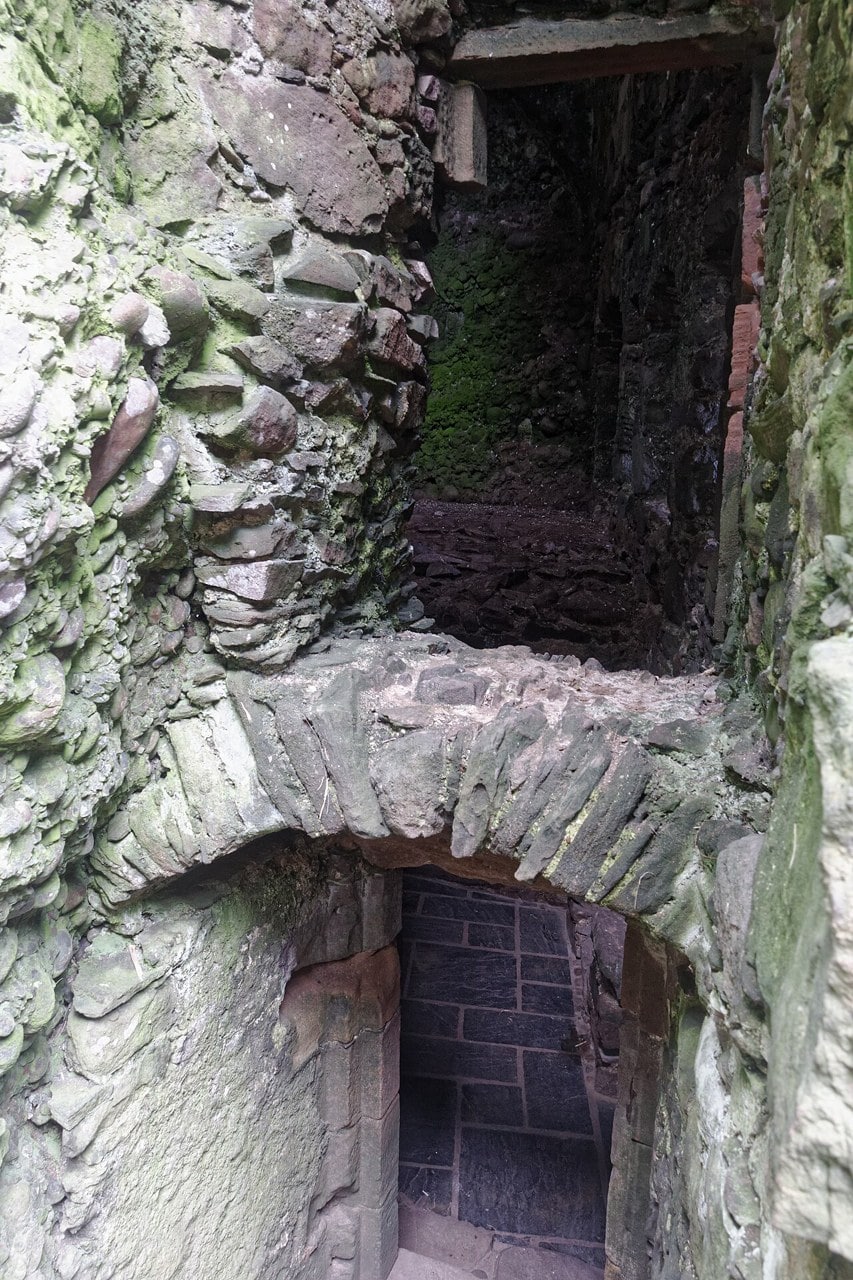
Beyond Dunnottar Castle
If Dunnottar has caught you, the rest of Scotland’s great strongholds reward the same attention. The Honours of Scotland that this rock once hid are kept now at Edinburgh Castle, whose own long history of siege, royalty, and regalia makes it the natural next stop for anyone who has followed the crown jewels out of Kinneff church. For another dramatic ruin on a fiercely defensive site, Urquhart Castle broods over the shore of Loch Ness with a comparable sense of a fortress worn down by centuries of contest and changing hands. And for a sense of what royal Scotland looked like when its palaces were still roofed and occupied, Stirling Castle, set high on its own volcanic crag, completes the picture that Dunnottar leaves as a shell. Each lies within an easy reach of the others on any touring route through the country. Reaching Kilchurn Castle in Argyll takes the same kind of effort that Dunnottar does, with no parking at the castle, no sign for it from the main road, and a walk of about two kilometers there and back across farmland that floods. These Scottish castles are gathered in our guide to the castles of Scotland.
Conclusion
Dunnottar Castle earns its fame honestly. The cliffs that make it one of the most photographed ruins in Scotland are the same cliffs that made it a fortress worth fighting over, a vault worth trusting with a nation’s crown, and a prison grim enough to enter the Covenanter martyrology. Walk its roofless halls and the layers sort themselves out: a medieval keep, a Renaissance palace, a ruined chapel, and that infamous cellar, all held together by the rock beneath them. The Keiths are four centuries gone and their roofs with them, yet the place still does exactly what it was built to do, which is to command the eye and refuse to be ignored. Between the crown jewels it saved and the prisoners it held, Dunnottar carries both the pride and the shame of Scottish history on one small headland, and it hands them to you without a word of spin. Few castles anywhere fuse setting and story so completely.
Principal Sources
- Dunnottar Castle. Official visitor and history pages. dunnottarcastle.co.uk.
- Geddes, Jane. Deeside and the Mearns: An Illustrated Architectural Guide. Rutland Press, 2001.
- Historic Environment Scotland. Scheduled Monument SM986, Dunnottar Castle. portal.historicenvironment.scot.
- Kinneff Old Church Preservation Trust. “Reverend and Mrs Grainger.” kinneffoldchurch.co.uk.
- Simpson, W. Douglas. Dunnottar Castle, Historical and Descriptive. Aberdeen, 1966.
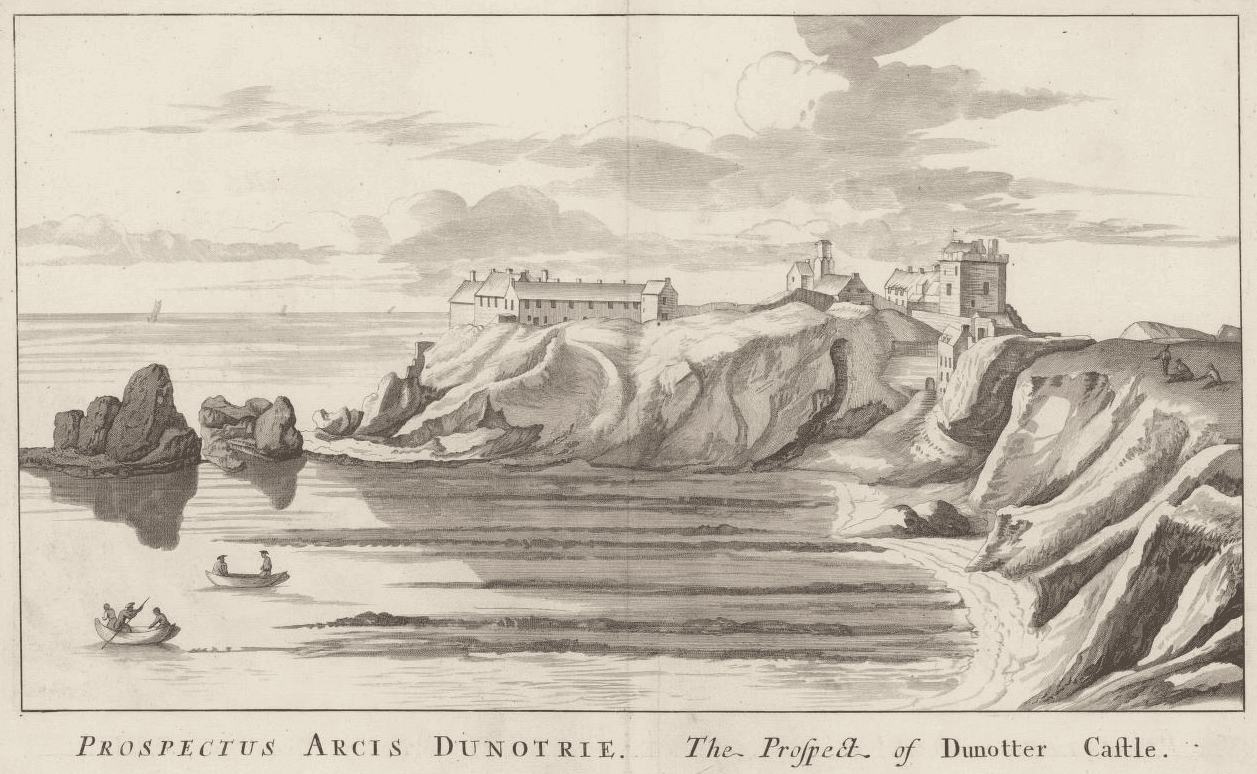
- Slezer, John. Theatrum Scotiae. 1693 (National Library of Scotland, Slezer collection).
- Trove (formerly Canmore) / RCAHMS. Site record 36992, Dunnottar Castle. trove.scot.
Image credits. Adobe Stock: Robin, TTstudio, Jeff Whyte, Tomasz Wozniak, David Matthew Lyons, Markus Keller, A Shot of Bliss. Unsplash: Connor Mollison. Wikimedia Commons (CC BY / CC BY-SA): Dirtsc, Bewahrerderwerte, Herbert Frank, Mariusz Matuszewski. Public domain: John Slezer (Theatrum Scotiae, 1693). Freely licensed images are resized to fit; otherwise unaltered.