
French Castle Documentaries
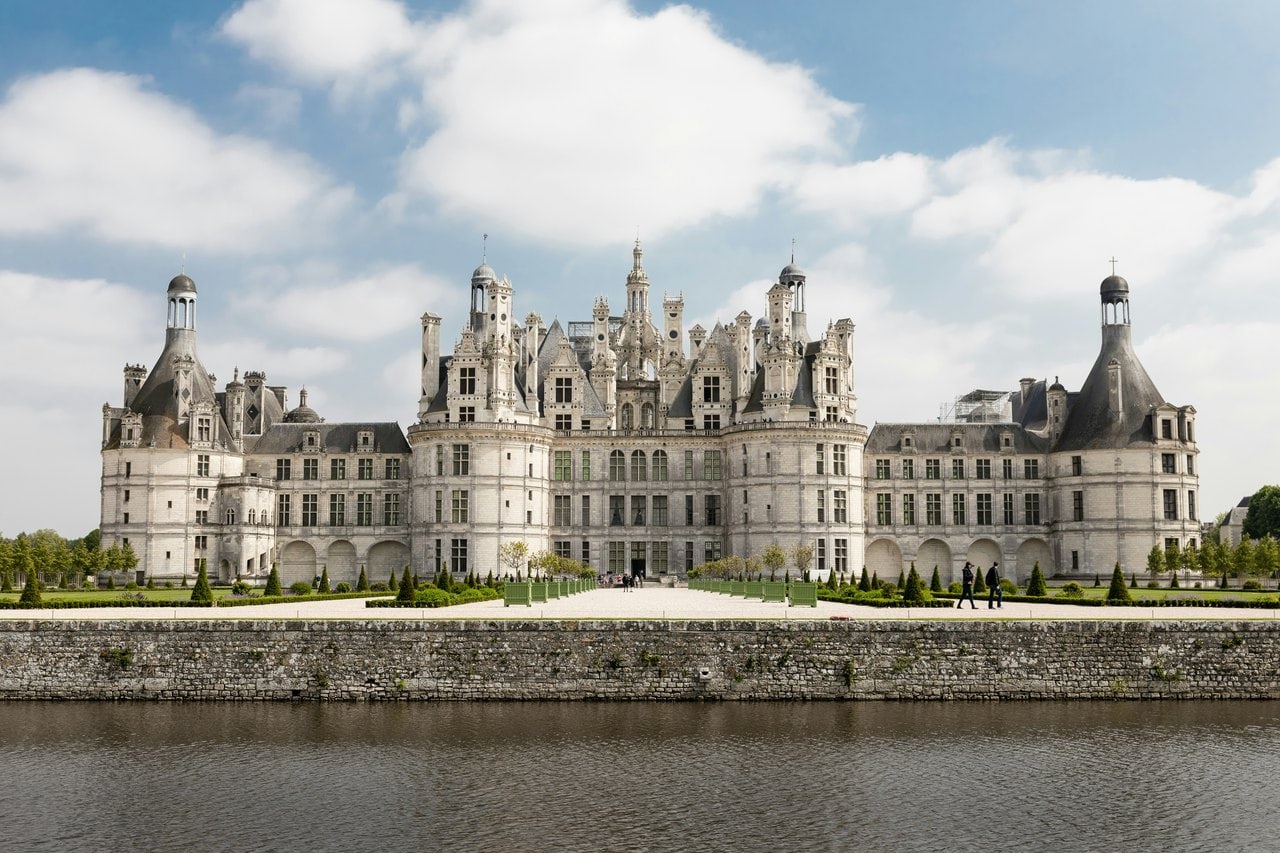
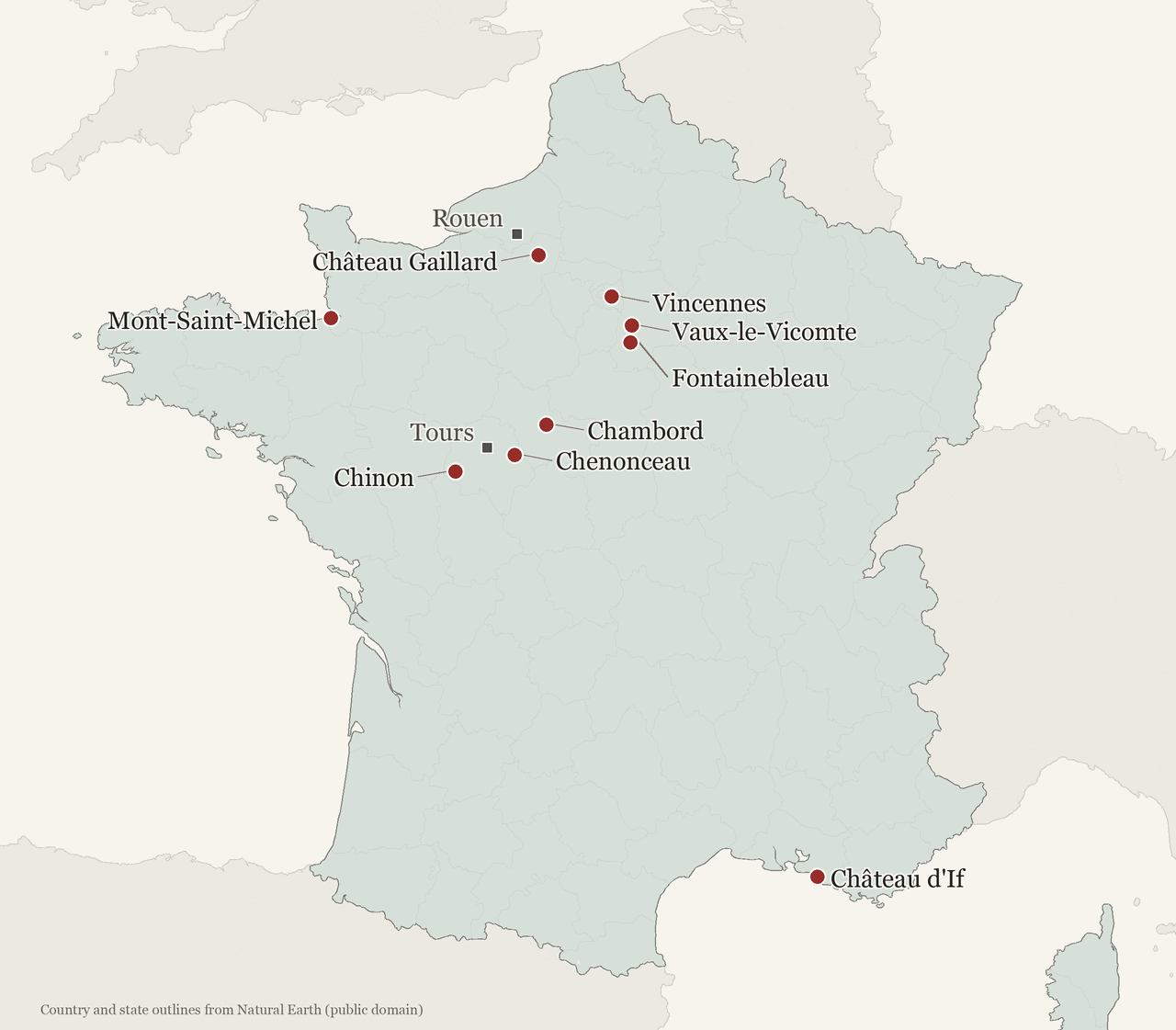
These French castle documentaries are the films our series has made in France, each built on a place that already has a fully cited guide on this site. They travel from the Loire valley and the Paris region to Normandy and an island in the bay of Marseille, taking in castles, palaces and an abbey, and each runs about fifteen to nineteen minutes. For the whole series, country by country, start from our castle documentaries page.
Each block below sets the scene, poses the question its film takes on and names the kind of evidence it goes looking for, then stops. Answers belong to the films. Every film’s YouTube description links a written guide on this site, and the Read line under each film points to the guide that holds the full record, with one thing to look for when you visit. The films are narrated in English by synthetic voices; the research, the script, the sourcing and the edit are human.
The Films
Chenonceau: The Castle Two Queens Fought Over
Chenonceau stands on the Cher in Touraine, 34 kilometers from Tours, and it still reads as three distinct parts. A house of a ground floor and two upper floors, with corner turrets, rises on the foundations of a medieval mill. A gallery sixty meters long, lit by eighteen windows, rests on five arches that carry it across the river; Jean Bullant built it in 1576 from drawings by Philibert de l’Orme. And the Tour des Marques, the old keep, survives from the fortified castle that stood here first.
The film starts from the story most visitors arrive with, of Diane de Poitiers and Catherine de’ Medici fighting over this house, and asks what each woman did here and what she left behind in its stone. For that it turns to the evidence the house keeps about itself: an inscription its builders carved, a king’s deed of gift, a philosopher’s memoir and the château’s own records from the First World War.
Read: the Château de Chenonceau guide; when you visit, go down to the kitchens, set in the two great piers that stand in the bed of the Cher.
Château d’If: The Real Prison Behind Monte Cristo
Reached by boat from the Vieux-Port, the Château d’If holds a small island in the bay of Marseille. The island is about 300 meters long and 180 wide at most, and it has lain inside the Calanques National Park since the park was created in 2012. François I decided to build the fort in 1516 and it was finished in 1531; the people of Marseille resented it and called it la Malvoisine, the bad neighbor.
Many who make the crossing come for Edmond Dantès, the hero of Dumas’s The Count of Monte Cristo. The film asks who was actually held on this rock in the centuries it served as a prison, and why the boats fill for a prisoner out of a novel. It reads a roll of the fortress’s real prisoners, a sign on a wall, the closing lines of the novel itself, and an American writer who made the crossing in 1867.
Read: the Château d’If guide; on the island, look for the graffiti prisoners left in the stone, the largest group of it by workers jailed in 1848 after the riots over the closure of the National Workshops.
Vaux-le-Vicomte: The Castle That Built Versailles
Outside Melun, southeast of Paris, the house at Vaux-le-Vicomte looks two ways at once. Its builders kept two features already out of date: high roofs on the corner pavilions, and a surrounding moat with drawbridges, once essential for defense. For the center, by contrast, they chose a mansard roof, a form French architecture later adopted widely. Below stairs, the visit takes in the servants’ hall, the kitchens and a vaulted wine cellar. In the garden the water still runs on gravity alone, as it did in the seventeenth century.
Nicolas Fouquet, the superintendent of finances who built it, gave a fête here in honor of the king on August 17, 1661, and was arrested at Nantes three weeks later. Did one evening ruin him, and what did the king take from Vaux afterward? The film puts both questions to its evidence, which includes a squirrel on a coat of arms, a garden built to fool the eye, and one ceiling inside the house.
Read: the Château de Vaux-le-Vicomte guide; in the garden, walk the main axis until the ground drops away and the canal, invisible from the terrace, opens in front of you.
Joan of Arc Found a King Hiding in Chinon Castle
The royal fortress of Chinon runs along its ridge above the Vienne, forty minutes’ drive from Tours. Philip Augustus built the Coudray Tower, the most imposing on the site, after the siege of 1205, and the graffiti inside it are attributed to the Templars imprisoned there in 1308. Of the royal lodgings, once three ranges around a courtyard, the west and north ranges are gone and the south wing survives as a museum. From the terrace of the Treasury Tower you look out over the Vienne and the bridge of Chinon.
Joan of Arc came to this rock in February 1429 to meet Charles VII, and the scene that followed is generally told the same way: a crowded hall, a king hidden among his courtiers, a girl who picks him out. The film puts that scene to the record: what happened when she came, and who saw it? Its witnesses are the fortress’s own account and testimony given years later at the trial that cleared her name.
Read: the Château de Chinon guide; while you are there, listen for Marie-Javelle, the bell in the Clock Tower that has rung the hours over Chinon since the end of the fourteenth century.
Everyone Says Leonardo Built Chambord Castle. The Truth Is Stranger.
Fifteen kilometers from Blois and less than two hours’ drive south of Paris, Chambord stands in a walled park the estate calls the largest in Europe, about the size of Paris itself. Its keep is laid out on a Greek cross, with four great rooms, each nine meters by eighteen, meeting at the center. There the double staircase rises: two spiral flights winding one above the other around a hollow, partly open core, so that two people climbing at once can see each other through the openings and never meet.
Visitors are often told who designed the château, and the name they hear is Leonardo da Vinci. The film puts that name to the evidence: his notebooks, a wooden model of the keep that survives only as a later drawing, a building account from 1524, and what an emperor said when he was shown around in 1539.
Read: the Château de Chambord guide; on your visit, climb the double staircase all the way to the roof terraces beneath the lantern tower.
Château de Vincennes: The Moat That Kept Killing
The Château de Vincennes stands on the edge of Paris, at the Château de Vincennes stop on Metro line 1. Its donjon, or keep, rises five stories and fifty meters, with walls more than three meters thick and a turret at each corner. Around the whole site runs an enclosure with a circuit of about a kilometer, built between 1373 and 1380 with nine towers, most of them since cut down. Inside it, the Sainte-Chapelle that Charles V founded in 1379 is built on a single level, unlike its model in Paris.
Vincennes was chosen as the site of a new royal manor house at the end of the twelfth century, close to the capital. The film asks what every regime that came after the kings found to do with it, and follows the fortress through the deaths tied to its name. It draws on a dedication verse written for the tower’s builder, a famous one-liner, and the military archive housed at the château today.
Read: the Château de Vincennes guide; inside, look up at the Apocalypse windows in the choir of the Sainte-Chapelle, given by Henri II between 1556 and 1559 and made by the master glazier Nicolas Beaurain.
Mont-Saint-Michel Abbey: Who Wrote “Never Captured”
Mont-Saint-Michel rises from its rock in the bay where Normandy meets Brittany. Visitors reach it by train to Rennes and a bus, or from the nearest station at Pontorson. The abbey church crowns the summit and rests partly on four crypts built out on the slope below it. Pilgrims were once welcomed at the abbey’s fortified entrance, which became a guard room when a garrison was stationed there during the Hundred Years’ War. From the west terrace the view runs out to the islet of Tombelaine and, offshore, to the Chausey islands, where the abbey’s granite was quarried.
The film starts from two words that, it says, come back every time you search for this place: “never captured.” Who wrote them first? To find out, the film follows the phrase back, book by book, to the first hand that set it down, and stops along the way at the record of a real siege.
Read: the Mont-Saint-Michel guide; on the visit route, go down to the Crypt of the Great Pillars, one of the crypts that carry the abbey church over the slope of the rock.
Fontainebleau: The Palace Napoleon Had to Leave
A train ride south from Paris Gare de Lyon, the Château de Fontainebleau stands in the town of the same name. By the palace’s own count, thirty-four kings and two emperors followed one another here between the twelfth and nineteenth centuries, and Ingres called its ballroom the “French Vatican.” Its horseshoe staircase, built for Louis XIII between 1632 and 1634 and attributed to Jean Androuet du Cerceau, leads up to the Galerie François Ier and the Grand Apartments. At its foot lies the Cour du Cheval Blanc, also called the Cour des Adieux since Napoleon’s farewell to his Old Guard on April 20, 1814.
That farewell supplies the film’s question, the one its own description poses: how did Napoleon’s imperial residence become the setting for his farewell? It looks for the answer in the building itself, taking the palace layer by layer, from the older palace and the Renaissance rooms to the horseshoe staircase, the gardens and the imperial palace, with the château’s own research and its World Heritage record as its guides.
Read: the Château de Fontainebleau guide; inside, find the Galerie François Ier, one of the rooms where painters such as Rosso Fiorentino and Primaticcio made the château the home of the School of Fontainebleau.
Château Gaillard: Richard the Lionheart’s Doomed Castle
Château Gaillard stands on a rocky spur above a loop of the Seine at Les Andelys, between Paris and Rouen, and the tourist office’s page for the site warns that its access paths are rough going. What survives is a ruin, recorded in the national heritage register as remains, and at its heart the donjon still stands inside its chemise, the close wall wrapped around it. The register records that only the donjon and its chemise belong to the French state, with the rest held by the commune and private owners, and notes that the land boundaries do not follow that division.
Anyone who has read about Château Gaillard has probably heard how it fell. The film asks two questions: how was Richard the Lionheart’s castle taken, and what turned it into the ruin a visitor climbs today? It goes to the chronicle of the one writer who was at the siege, Philip Augustus’s chaplain, to the English chroniclers who were not, and to Richard’s own building accounts, printed from the exchequer rolls.
Read: the Château Gaillard guide; on site, walk out to the outer bailey for the view over the Seine valley.
Beyond the Films
To plan a visit rather than watch one, start with our guide to the châteaux of France. The regional guides group these places the way a trip would: Chenonceau and Chambord in the Loire Valley guide; Vaux-le-Vicomte, Vincennes and Fontainebleau in the Île-de-France guide; Mont-Saint-Michel and Château Gaillard in the Normandy guide; and the Château d’If in the Provence guide. For the films from other countries, go back to the castle documentaries index.
Principal Sources
- Centre des monuments nationaux. “A royal fortress”. chateau-de-vincennes.fr.
- Centre des monuments nationaux. “An island in the heart of the Calanques National Park”. chateau-if.fr.
- Centre des monuments nationaux. Château de Vincennes. monuments-nationaux.fr.
- Centre des monuments nationaux. “Finding your way around the monument”. abbaye-mont-saint-michel.fr.
- Centre des monuments nationaux. “Graffiti”. chateau-if.fr.
- Centre des monuments nationaux. “History of the château d’If”. chateau-if.fr.
- Centre des monuments nationaux. “Practical information”. abbaye-mont-saint-michel.fr.
- Centre des monuments nationaux. “Practical information”. chateau-de-vincennes.fr.
- Centre des monuments nationaux. “Practical information”. chateau-if.fr.
- Centre des monuments nationaux. “The Sainte-Chapelle, a Gothic jewel”. chateau-de-vincennes.fr.
- Château de Chambord. “Architecture”. chambord.org.
- Château de Chambord. “Comment venir”. chambord.org.
- Château de Chambord. “The natural environment”. chambord.org.
- Château de Chambord. “Visit the château”. chambord.org.
- Château de Chenonceau. Visit Guide. chenonceau.com.
- Château de Chenonceau. “Les pièces”. chenonceau.com.
- Château de Chenonceau. “Plan d’accès”. chenonceau.com.
- Château de Fontainebleau. “10 raisons de venir au château de Fontainebleau”. chateaudefontainebleau.fr.
- Château de Fontainebleau. “130 hectares de parc et de jardins”. chateaudefontainebleau.fr.
- Château de Fontainebleau. “L’escalier en Fer-à-Cheval”. chateaudefontainebleau.fr.
- Château de Fontainebleau. “Se rendre au château de Fontainebleau pour les reconstitutions historiques”. chateaudefontainebleau.fr.
- Château de Vaux-le-Vicomte. “Famous figures”. vaux-le-vicomte.com.
- Château de Vaux-le-Vicomte. “The Château”. vaux-le-vicomte.com.
- Château de Vaux-le-Vicomte. “The Garden”. vaux-le-vicomte.com.
- Château de Vaux-le-Vicomte. “Visitor Information”. vaux-le-vicomte.com.
- Forteresse royale de Chinon. “1429”. forteressechinon.fr.
- Forteresse royale de Chinon. “Access / How to get to the Fortress”. forteressechinon.fr.
- Forteresse royale de Chinon. “The Clock Tower”. forteressechinon.fr.
- Forteresse royale de Chinon. “The Coudray Tower”. forteressechinon.fr.
- Forteresse royale de Chinon. “The Royal Dwellings”. forteressechinon.fr.
- Forteresse royale de Chinon. “The Vienne River in Chinon”. forteressechinon.fr.
- Foundation for Landscape Studies. “Vaux-le-Vicomte”. foundationforlandscapestudies.org.
- Ministère de la Culture. “Château-Gaillard.” Mérimée PA00099304, POP. pop.culture.gouv.fr.
- Office de Tourisme Nouvelle Normandie. “Château Gaillard”. nouvelle-normandie-tourisme.com.
Image credits. Hero, The Château de Chambord north front: Photo: Dorian Mongel via Unsplash; Locator map: own work; country and state outlines from Natural Earth, public domain. Freely licensed images are resized to fit; otherwise unaltered.