
Château de Chenonceau
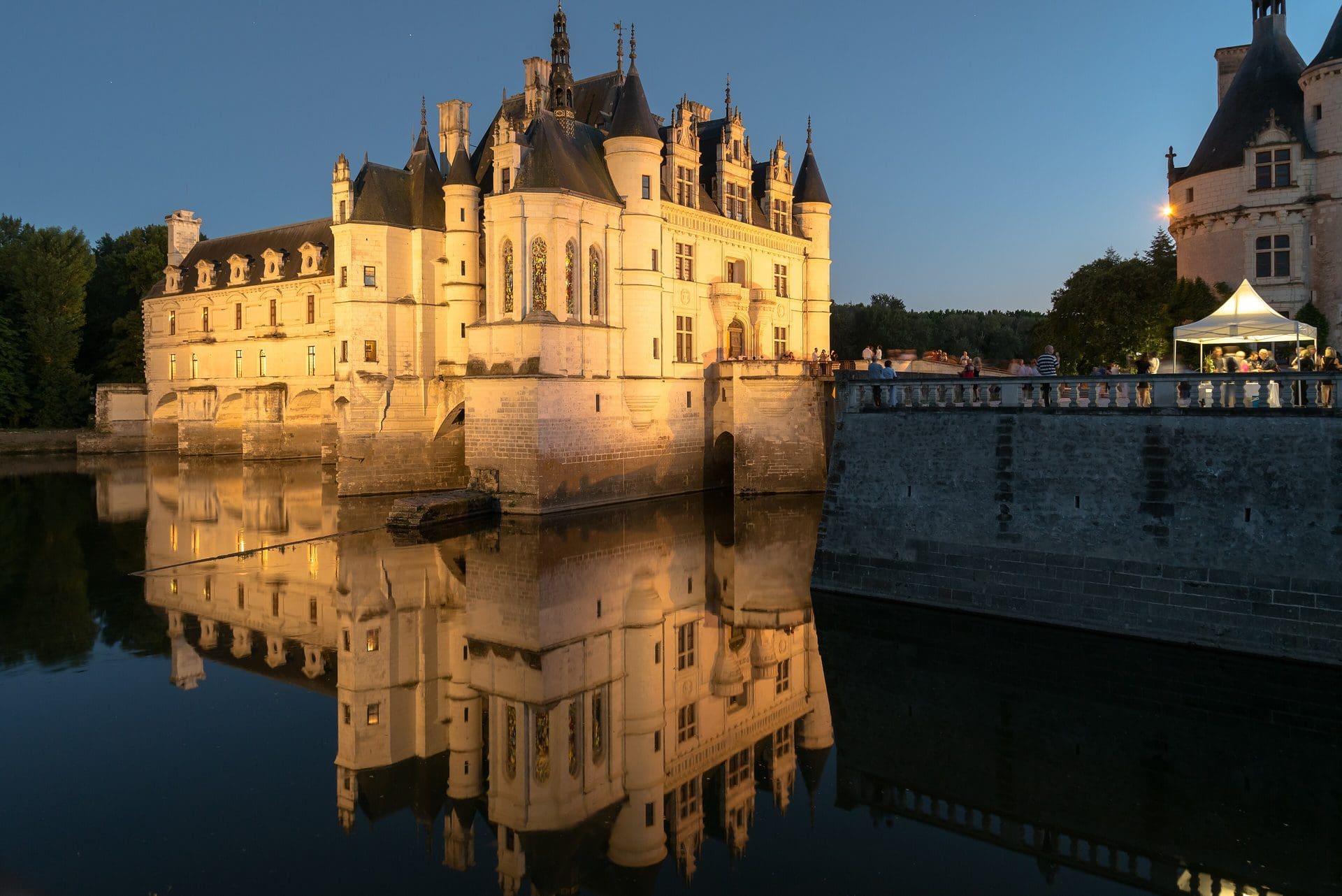
Few buildings in France carry their name as lightly as the Château de Chenonceau, which does not so much sit beside the river Cher as stride across it on five piers of pale tufa stone. Visitors arriving down its long avenue of plane trees see a Renaissance house that seems to float, its great gallery doubled in slow green water. That effect is deliberate, and it is largely the work of women. Built for the royal official Thomas Bohier and his wife Katherine Briçonnet and completed in 1521, embellished by Diane de Poitiers, transformed by Catherine de’ Medici, and saved more than once by the women who followed them, Chenonceau earned the nickname it still answers to: the Château des Dames, the ladies’ château.
That nickname is not romantic shorthand. It is the most accurate one-line history the place has. For five centuries the great decisions at Chenonceau, what to build, what to plant, whom to shelter, were taken by women acting with unusual independence at moments when power rarely rested in their hands. And the river that made the château beautiful also made it useful, which is why a house famous for its grace twice found itself, in the twentieth century, doing work that mattered far more than beauty.
Quick Facts
| Location | Chenonceaux, Indre-et-Loire, Centre-Val de Loire, France |
| Built | Renaissance château completed 1521; medieval keep retained |
| Built for | Thomas Bohier and Katherine Briçonnet |
| Style | French Renaissance |
| Setting | Spanning the river Cher |
| Famous for | The two-story gallery built over the river; the “Château des Dames” |
| Key figures | Diane de Poitiers, Catherine de’ Medici, Louise de Lorraine, Louise Dupin |
| Owner | The Menier family, since 1913 |
| UNESCO | Within the Loire Valley World Heritage Site (property 933; incorporated by boundary change in 2017) |
| Open | Every day, year-round |
| Official site | chenonceau.com |
From a fortress to a Renaissance house
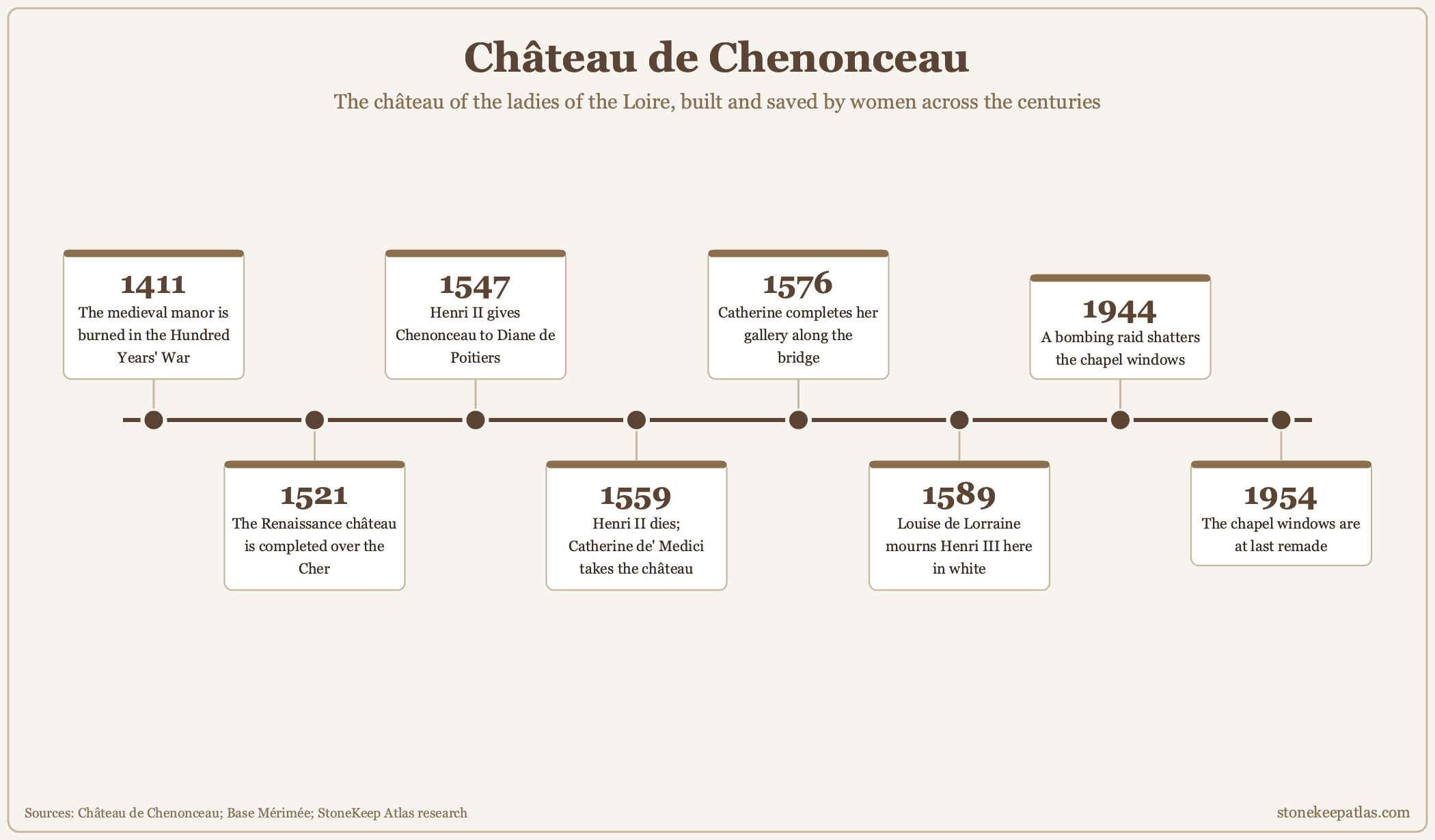
Before the floating gallery there was a mill and a fortified manor, and before those a quarrel. The medieval estate belonged to the Marques family, whose stronghold watched over a crossing of the Cher. During the Hundred Years’ War one of the Marques lords handed the place to the English, and in reprisal it was burned around 1411. A later Marques won permission to rebuild in the 1430s, but the family never recovered its fortunes, and by the early sixteenth century the indebted heir was selling the property off piece by piece.
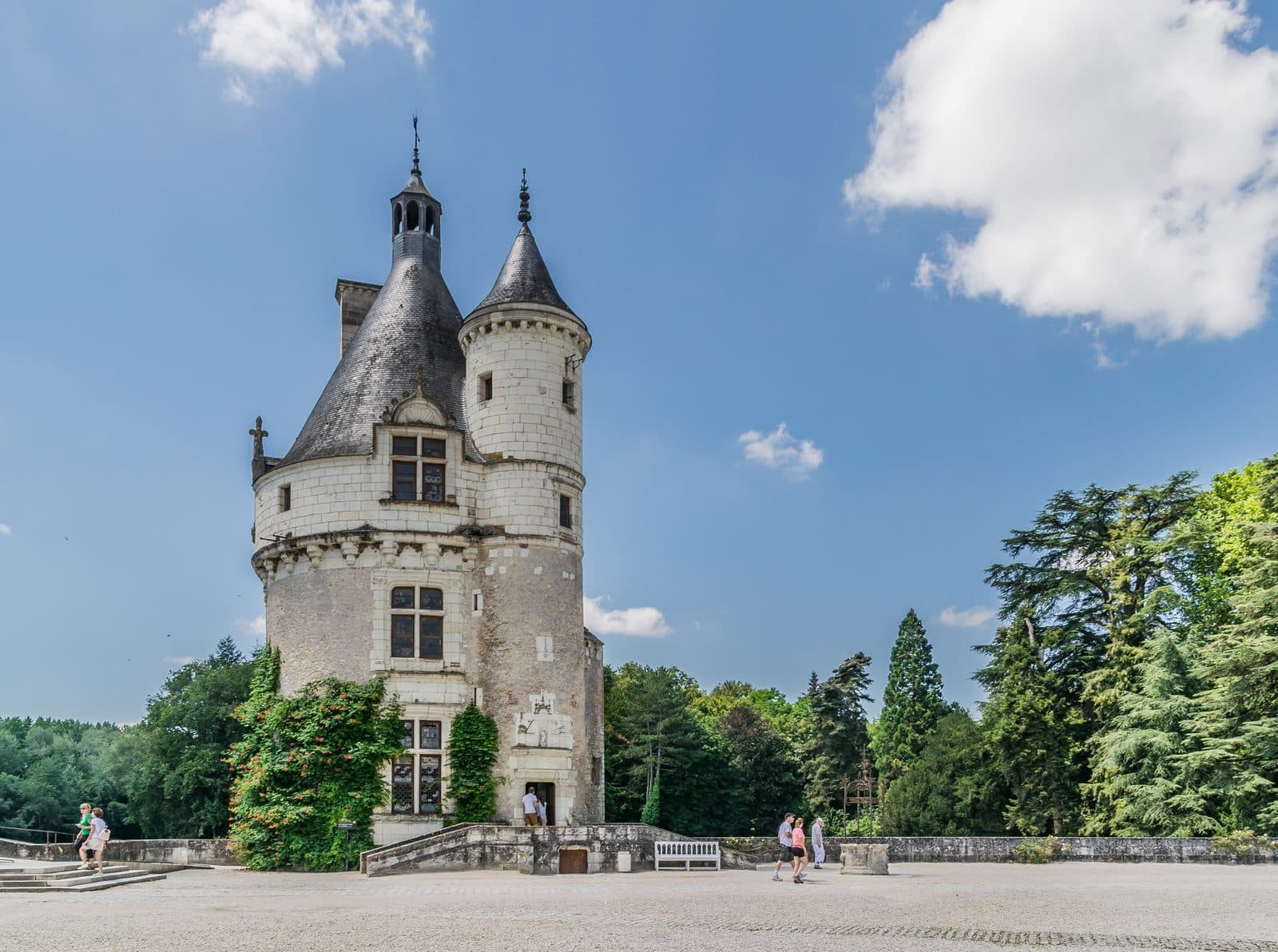
His buyer was Thomas Bohier, a royal tax receiver with court connections and money to spend. Bohier acquired the estate in 1512, cleared away the old fortress, and kept only its round keep, the Tour des Marques, which still stands at the entrance like a stone footnote to everything that came after. On the foundations of the mill, planted directly in the river, he raised a new house in the fashionable Italian manner. Because Bohier was so often away on the king’s wars in Italy, the building rose under the eye of his wife, Katherine Briçonnet, who managed the masons, the money, and much of the design herself. Work was finished in 1521. The estate’s own historians date the main campaign to 1513 through 1517; the official monument record gives 1521 for completion. That gap of a few years reflects finishing work, not any dispute over who built the house.
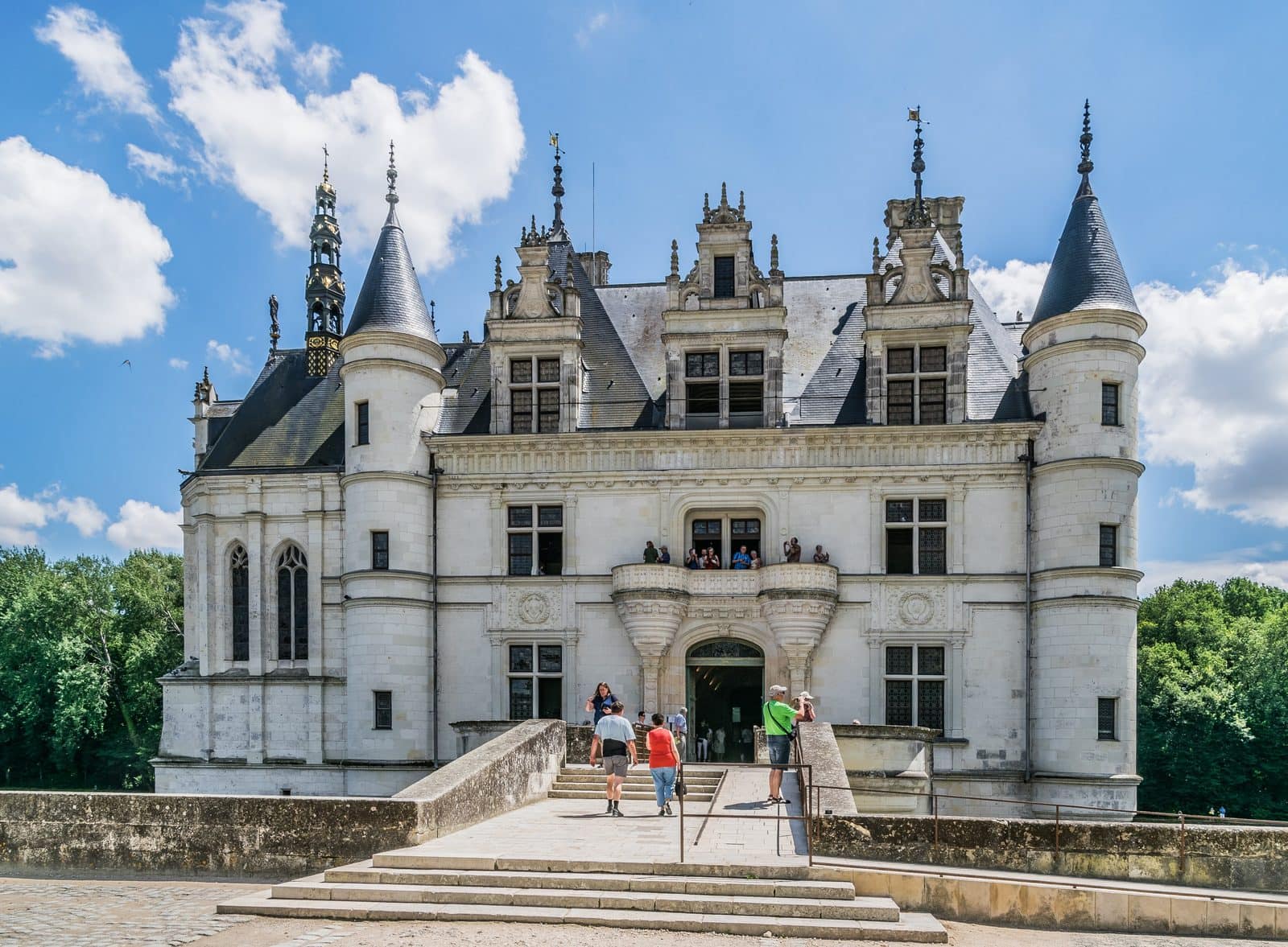
Briçonnet’s château already carried the qualities that would define Chenonceau for good: symmetry, lightness, and a straight ceremonial staircase climbing through a rib-vaulted vestibule rather than the cramped spiral stair of medieval custom. It was among the first such staircases built in France, and it set a register the later women would respect. High on the walls the builders left their signature in stone, the linked initials T and B for Thomas Bohier beside the K of Katherine, and a wry family motto, “S’il vient à point, me souviendra,” roughly “if it is finished, I shall be remembered.” It was finished, and they are remembered. Chenonceau would grow far larger over the following century, but it would never become loud. Even at its grandest, the house keeps the human scale a private residence asks for, which is part of why it still feels lived in rather than displayed.
The king’s gift and Diane de Poitiers
Bohier died deep in royal debt, and in 1535 King Francis I took Chenonceau into the Crown to settle the accounts; his fellow Tours financier Gilles Berthelot had already lost the Château d’Azay-le-Rideau to the same reckoning. For a time it served as a royal hunting retreat among the king’s other Loire properties. Then, on Francis’s death in 1547, his son Henri II made a gift that set the court talking. Rather than offer the château to his wife, Catherine de’ Medici, he gave it outright to his mistress, Diane de Poitiers.
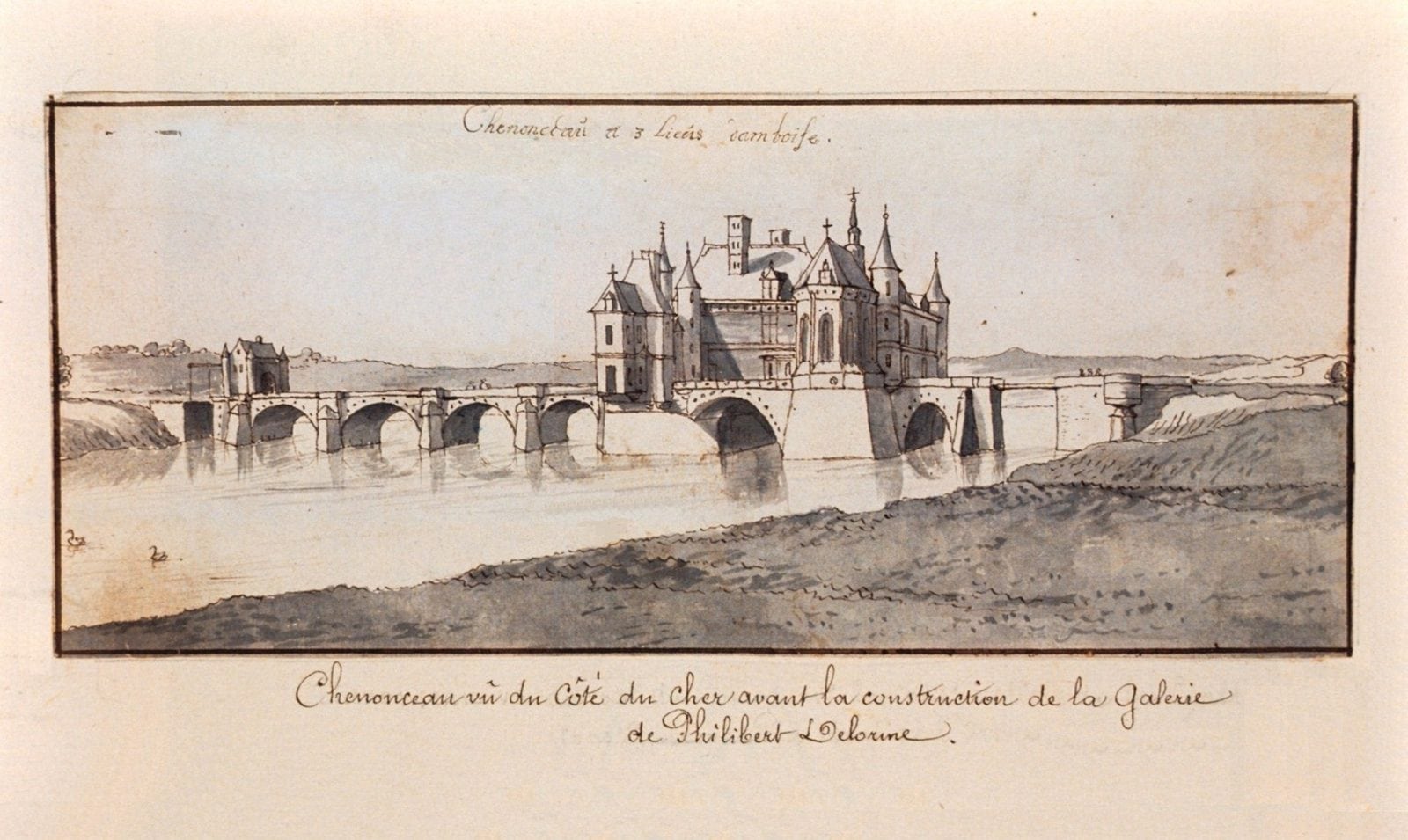
Diane was nineteen years older than the king and, by every contemporary account, the steadiest influence of his reign. At Chenonceau she behaved less like a guest than an owner. Around 1551 she laid out a vast walled garden on the right bank of the Cher, a parterre of flowers, fruit, and vegetables raised on terraces that lifted it clear of the river’s floods. Her presence is still legible in the fabric: the interlaced royal monogram of Henri and Catherine, whose crowned H and C read as Diane’s D, appears in the older rooms, a public stamp on a private arrangement the whole court understood. More consequentially, in 1555 she secured full legal title to the château through a careful series of maneuvers that routed ownership back out of the Crown, and she commissioned the architect Philibert de l’Orme to throw a bridge across the Cher. De l’Orme’s bridge, built in the late 1550s, was the hinge on which Chenonceau’s whole future would turn. It linked the house to the far bank, and, more important still, it opened the possibility of building over open water.
Diane never lived to use that possibility. On June 30, 1559, at a tournament held to celebrate a royal wedding and the Peace of Cateau-Cambrésis, Henri II rode against the captain of his Scottish guard, Gabriel de Montgomery. A lance shattered against the king’s helmet, and a long splinter drove through his eye and into his brain. He lingered in agony for ten days and died on July 10. Power passed at a stroke to the wife Diane had so long overshadowed, and Catherine de’ Medici lost no time in collecting what she regarded as hers.
Catherine de’ Medici and the gallery over the Cher
Catherine forced Diane into an exchange: Chenonceau for the Château de Chaumont, upriver. It was a calculated humiliation, and Diane took Chaumont and withdrew from court. Catherine then turned Chenonceau into the stage for her own authority. As the power behind three of her sons’ reigns in turn, she governed from its rooms, mounted famous court festivals in its grounds, including one of the earliest recorded fireworks displays in France, and laid out a second great parterre, smaller and more intimate than Diane’s, beside the forecourt.
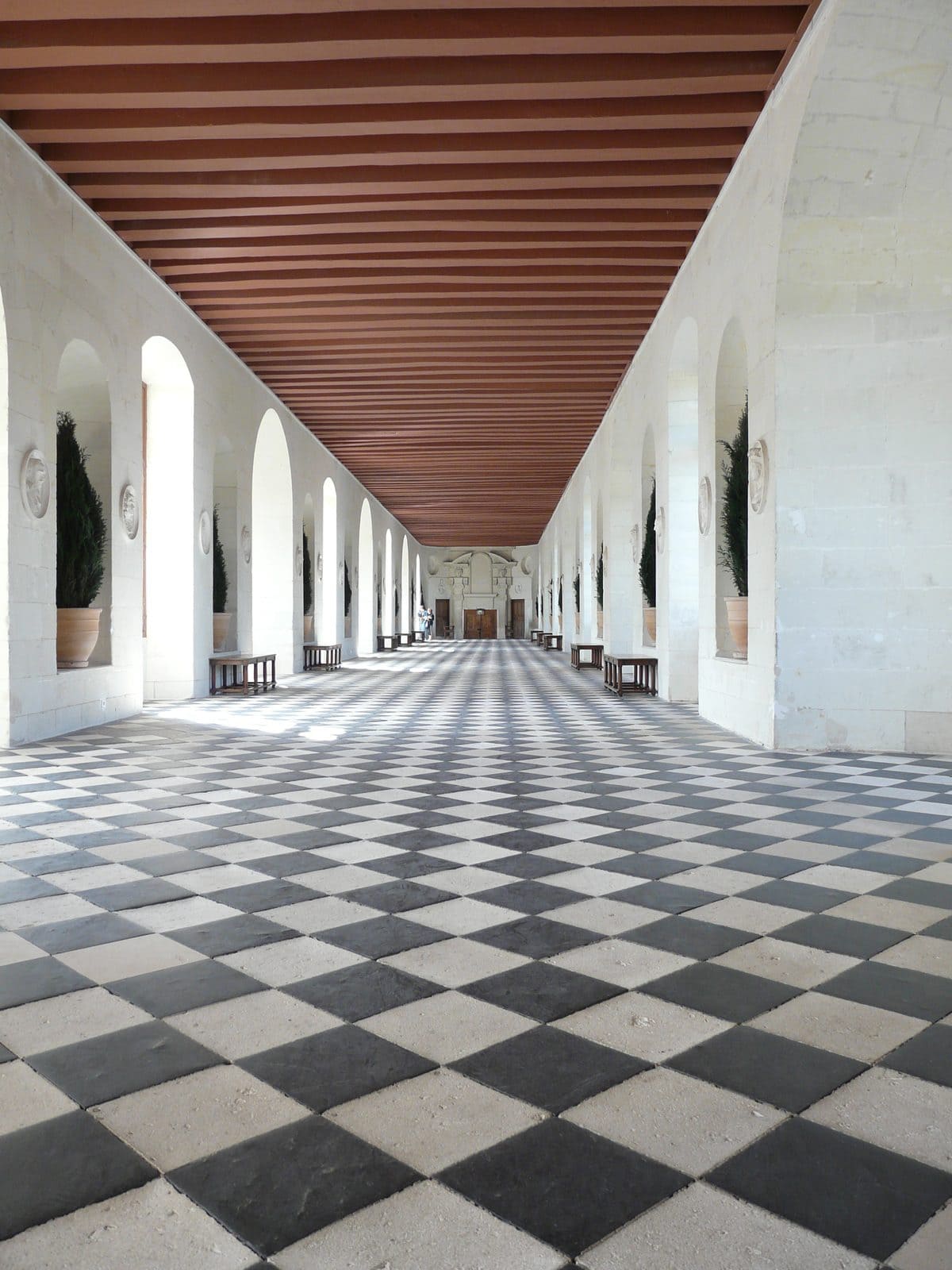
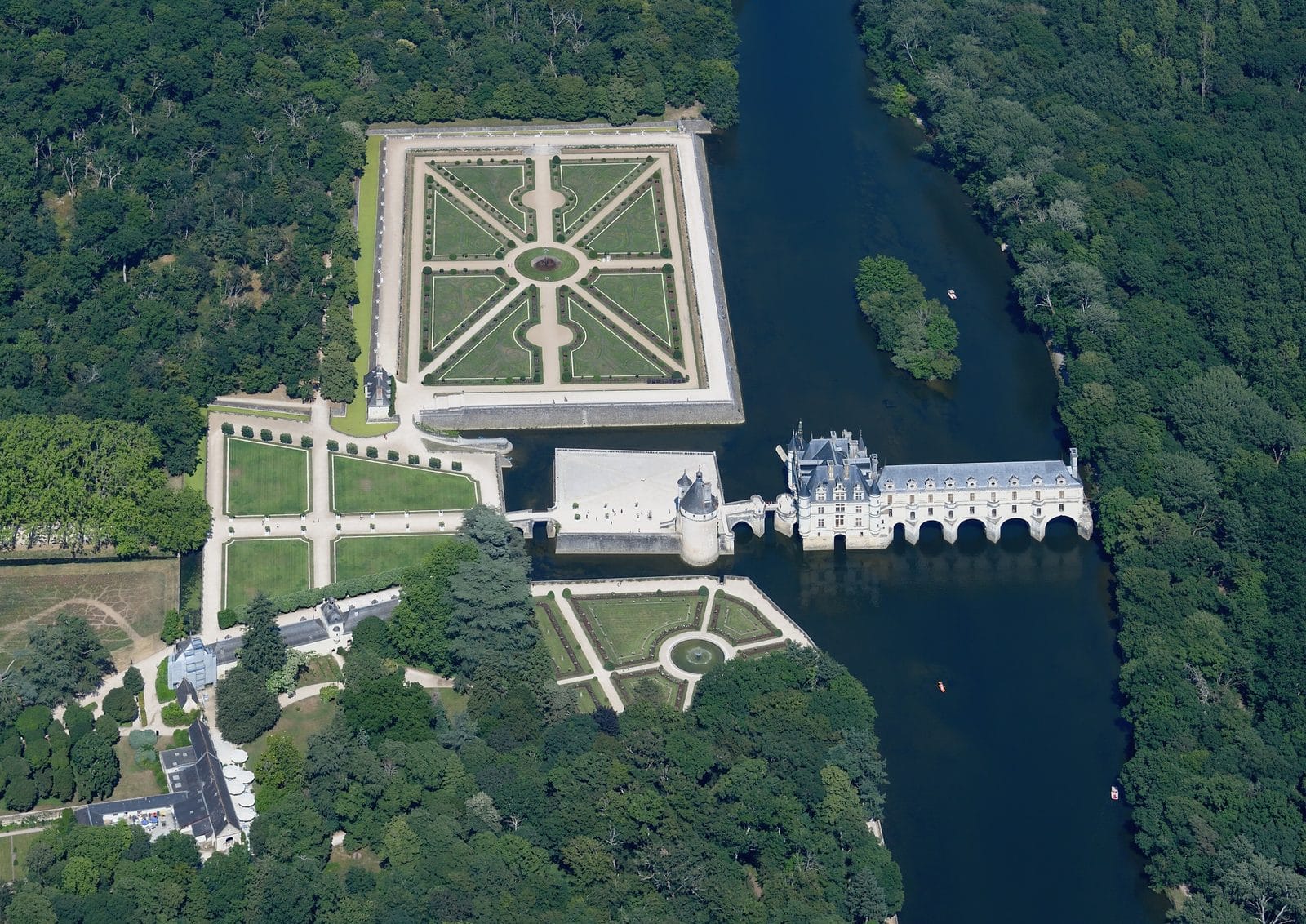
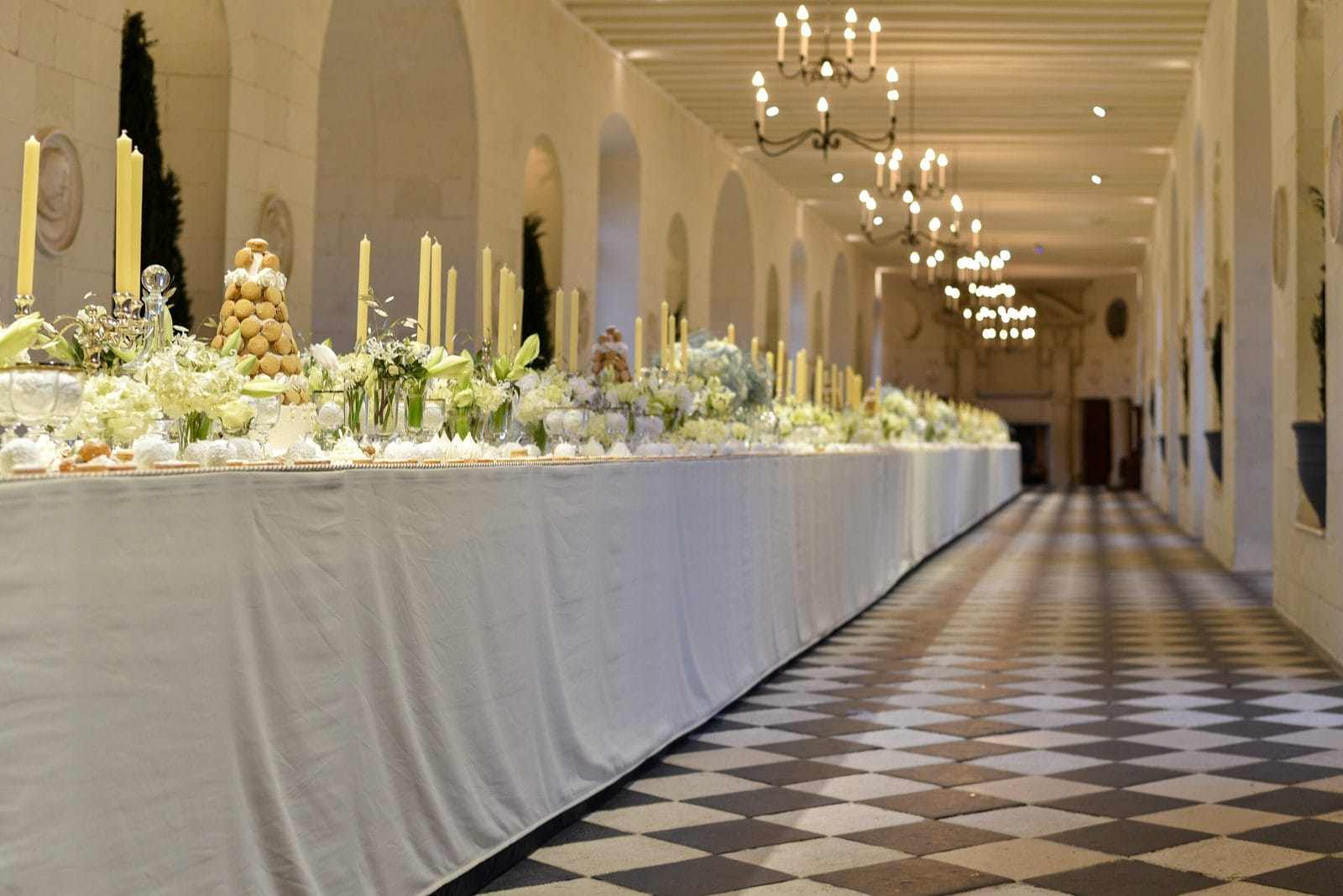
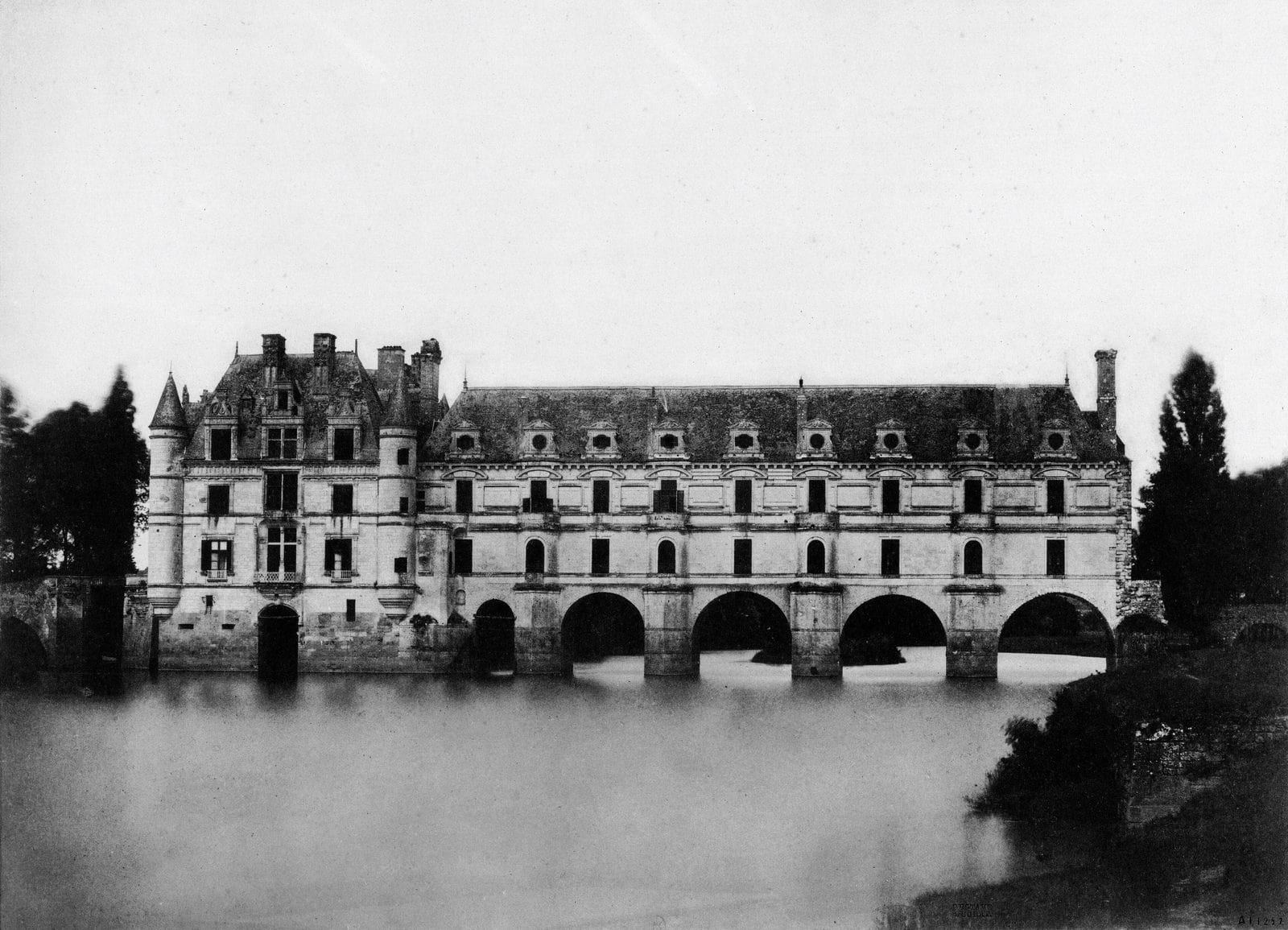
Her boldest stroke was to build on Diane’s bridge. Working from plans associated with Philibert de l’Orme and executed by the architect Jean Bullant, Catherine raised a two-story gallery along the full length of the span. Completed in 1576 and inaugurated the next year with lavish entertainments for her son Henri III, the gallery runs sixty meters across the river, six meters wide, lit along its flanks by eighteen windows that throw the shifting light of the Cher onto a black-and-white checkerboard floor. To stand inside it is to stand on a bridge and within a ballroom at the same moment. No other château in France attempted anything like it, and the image of that long gallery hovering above its own reflection became, and remains, the single picture by which the whole Loire valley is known.
Catherine’s Chenonceau was a political instrument as much as a pleasure house. From here she balanced factions, married off children to bind alliances, and projected the magnificence of a dynasty under constant threat from the Wars of Religion. The festivals were not frivolity; they were statecraft, designed to overawe rivals and remind France who held the reins during her sons’ uncertain reigns. When she died in 1589 she left the château richer, larger, and far more famous than she had found it.
Louise de Lorraine and the white mourning
The next lady of Chenonceau inherited it in grief. Louise de Lorraine, wife of Catherine’s son Henri III, was at the château in 1589 when word arrived that the king had been assassinated by a friar’s knife. She withdrew into a mourning she never truly set aside. Following the old custom by which queens of France mourned in white rather than black, she became known as the White Queen, and she had a new ground-floor chamber hung and painted in black, strewn with painted silver tears, crowns of thorns, and widow’s cords. There she spent eleven years in prayer and seclusion, leaving for Moulins in 1600 and dying there on January 29, 1601, tending the memory of a murdered husband while the dynasty her mother-in-law had fought to preserve guttered out around her; with Henri III died the last of the Valois kings. The black mourning room can still be seen, reconstituted upstairs around its original ceiling, a startling note of private sorrow folded inside a house built for display, and a reminder that the ladies’ château held quiet lives as well as glittering ones.
An Enlightenment salon, and a revolution survived
After a long quiet stretch, the château found another remarkable mistress. Louise Dupin came to Chenonceau in 1733, when her husband, the fermier général Claude Dupin, bought it, and filled it with the sharpest minds of the age. Voltaire and Montesquieu came through its doors; so did the young Jean-Jacques Rousseau, who served as her secretary, tutored her son, and later wrote that on the good living at Chenonceau he became, in his own words, “as fat as a monk.” Her salon made the château a center of Enlightenment talk far from the capital, and her own unfinished work on the rights of women drew directly on that company.
That standing also saved the building. When the Revolution swept France and noble châteaux were being sacked and burned, Chenonceau came through largely untouched. Part of the reason was Louise Dupin’s genuine popularity with the people of the surrounding villages. Part of it was a piece of plain practical argument that has since passed into legend: the gallery, she pointed out, was the only bridge across the Cher for many miles, and a bridge is useful to everyone, whatever the politics of the moment. The château was spared. Its long habit of being useful as well as beautiful had quietly begun to pay dividends.
The Menier century
Through the nineteenth century Chenonceau changed hands several times. Marguerite Pelouze, daughter of the Scottish-born financier Daniel Wilson, who had made a fortune lighting the streets of Paris with gas, bought the château in 1864 and poured money into a romantic restoration until her own finances collapsed. The estate then passed to a Cuban millionaire, José-Emilio Terry, in 1891, moved within the Terry family a few years later, and in 1913 was bought by Henri Menier, of the great chocolate-making dynasty. The Menier family owns Chenonceau to this day, which makes it one of the most visited privately held monuments in France.
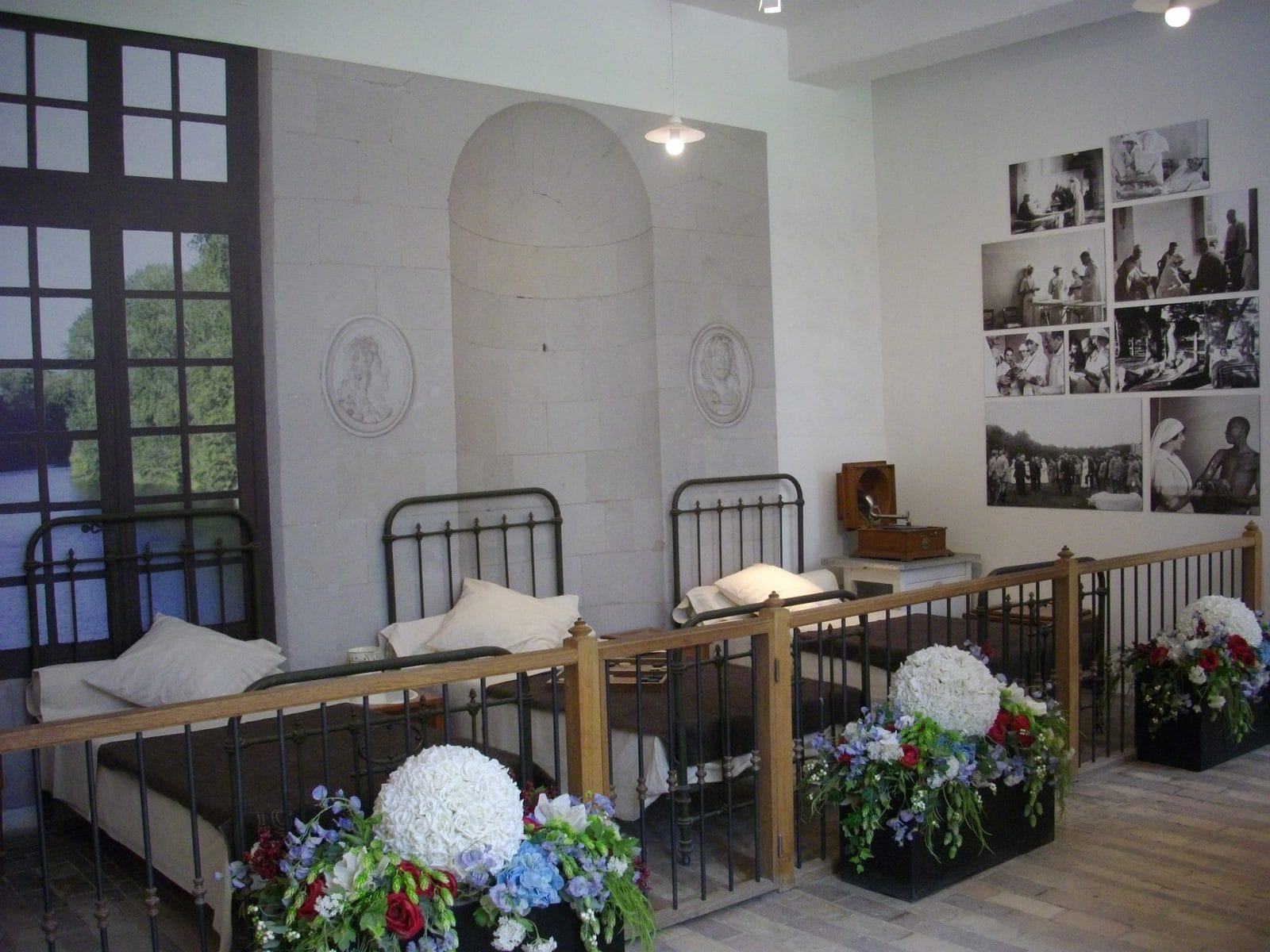
Their stewardship coincided with the century’s worst wars, and the river that had always made Chenonceau useful made it useful once again. When the First World War broke out, Gaston Menier turned the gallery into a military hospital at the family’s own expense, installing some 120 beds in the two long rooms suspended over the Cher. His daughter-in-law Simone Menier ran it as matron. By the time the hospital closed at the end of 1918, more than 2,250 wounded soldiers had been treated there, carried up into the light and clean air above the moving water, far from the mud of the front.
A bridge between two Frances
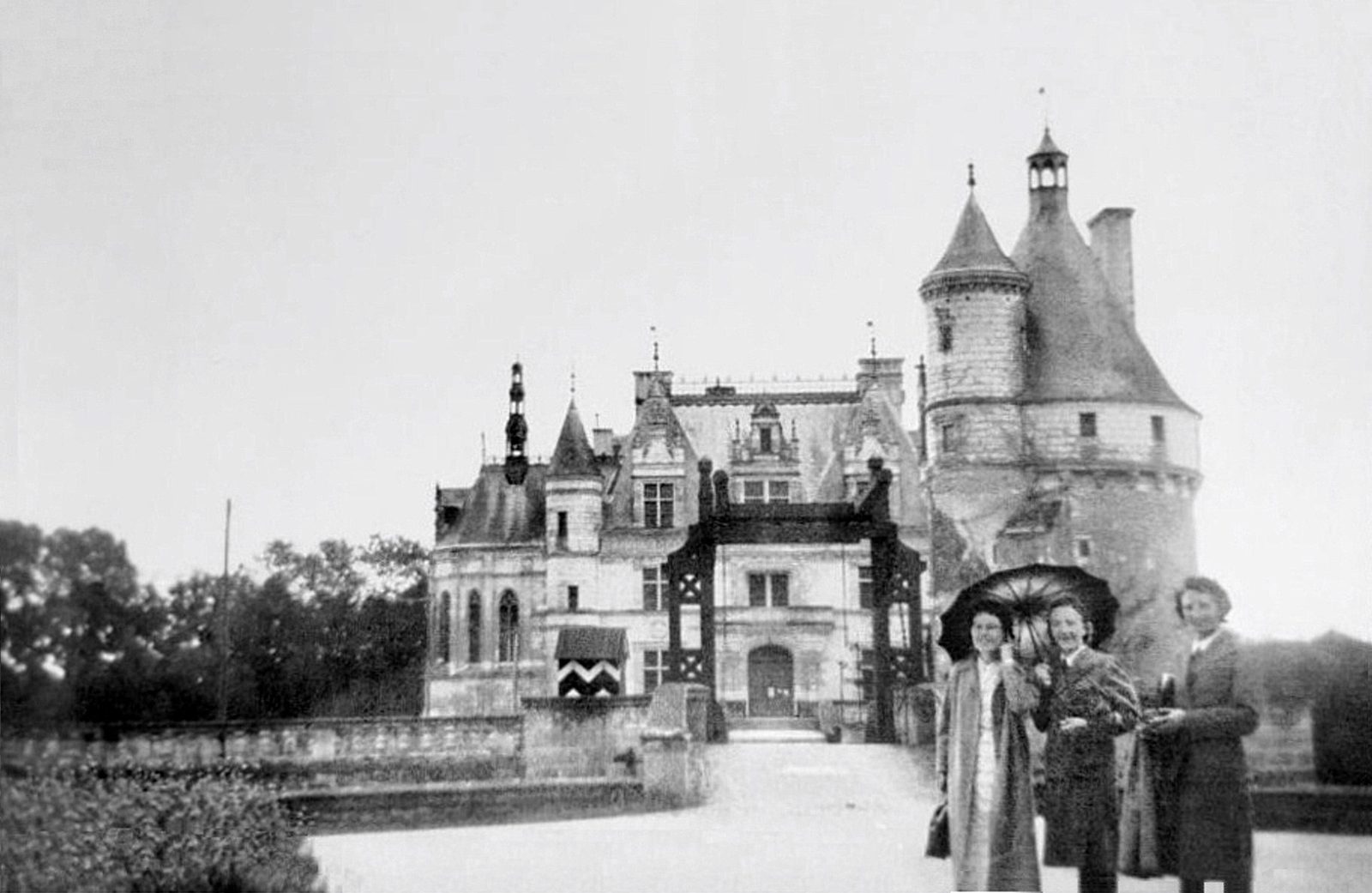
The Second World War turned the château’s geography into a matter of life and death. After France fell in 1940, the armistice cut the country in two, and along this reach of the valley the demarcation line between German-occupied France and the Vichy “free zone” ran straight down the middle of the Cher. Chenonceau straddled it. The main entrance and forecourt lay in the occupied north; the gallery’s far door opened onto the free south bank. For more than two years, from the summer of 1940 until the Germans seized the whole country in November 1942, that gallery served as a quiet crossing point, a way for people to slip from one France into the other across a floor laid four hundred years earlier for dancing. The risk was real on both sides of the door, and the Menier household, with Simone Menier again at the center, took it knowingly. A château that had once hosted royal festivals now ran a more dangerous kind of hospitality.
War left its mark in stone as well. In June 1944 a bombing raid struck the château’s chapel and shattered its windows, which were not replaced until 1954. By the estate’s own account, the American president Harry Truman came after the war to see the château that had bridged the line. It was a fitting visitor for a building whose whole history is the story of usefulness surviving where mere grandeur would have been torn down.
Architecture, gardens, and the collection
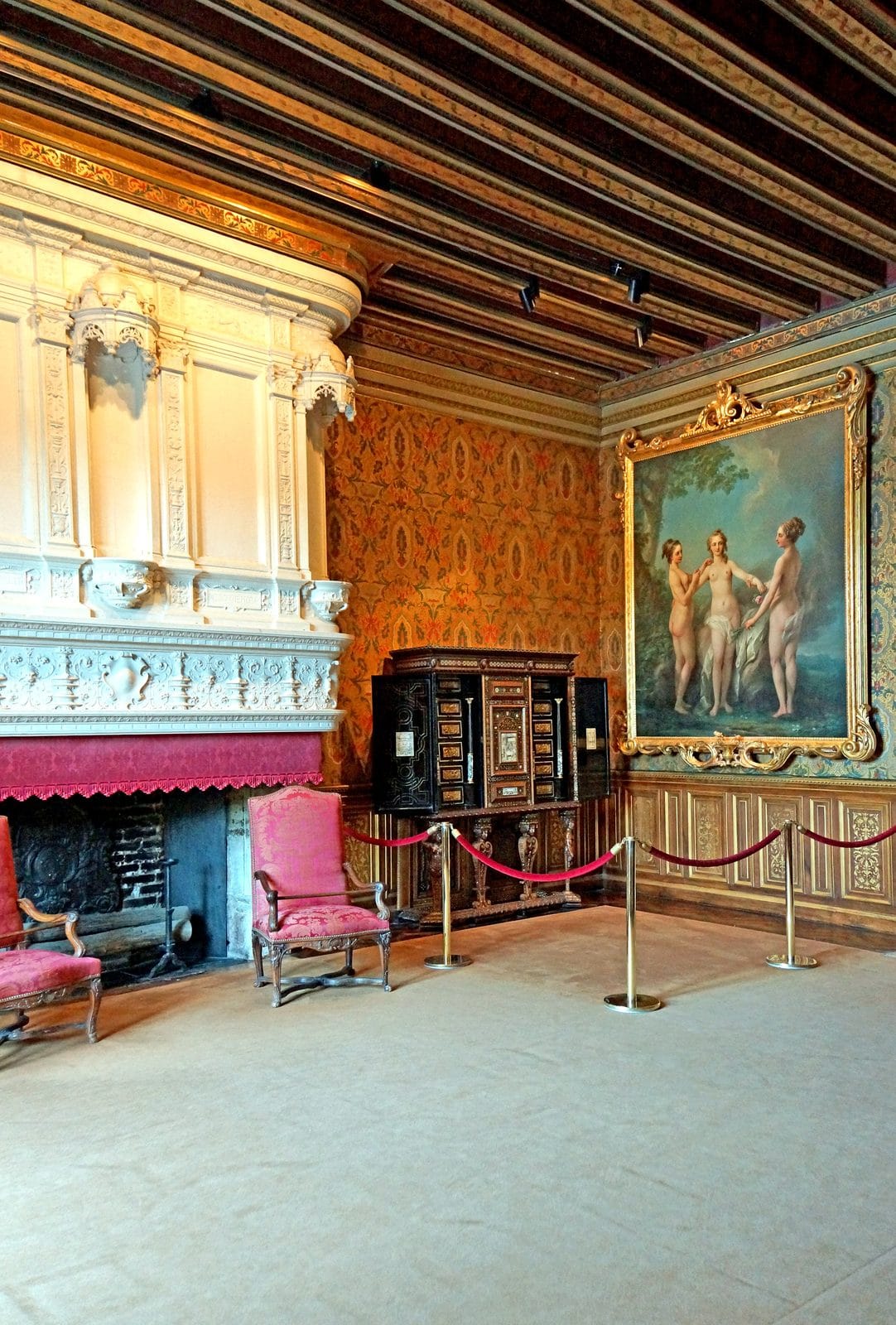
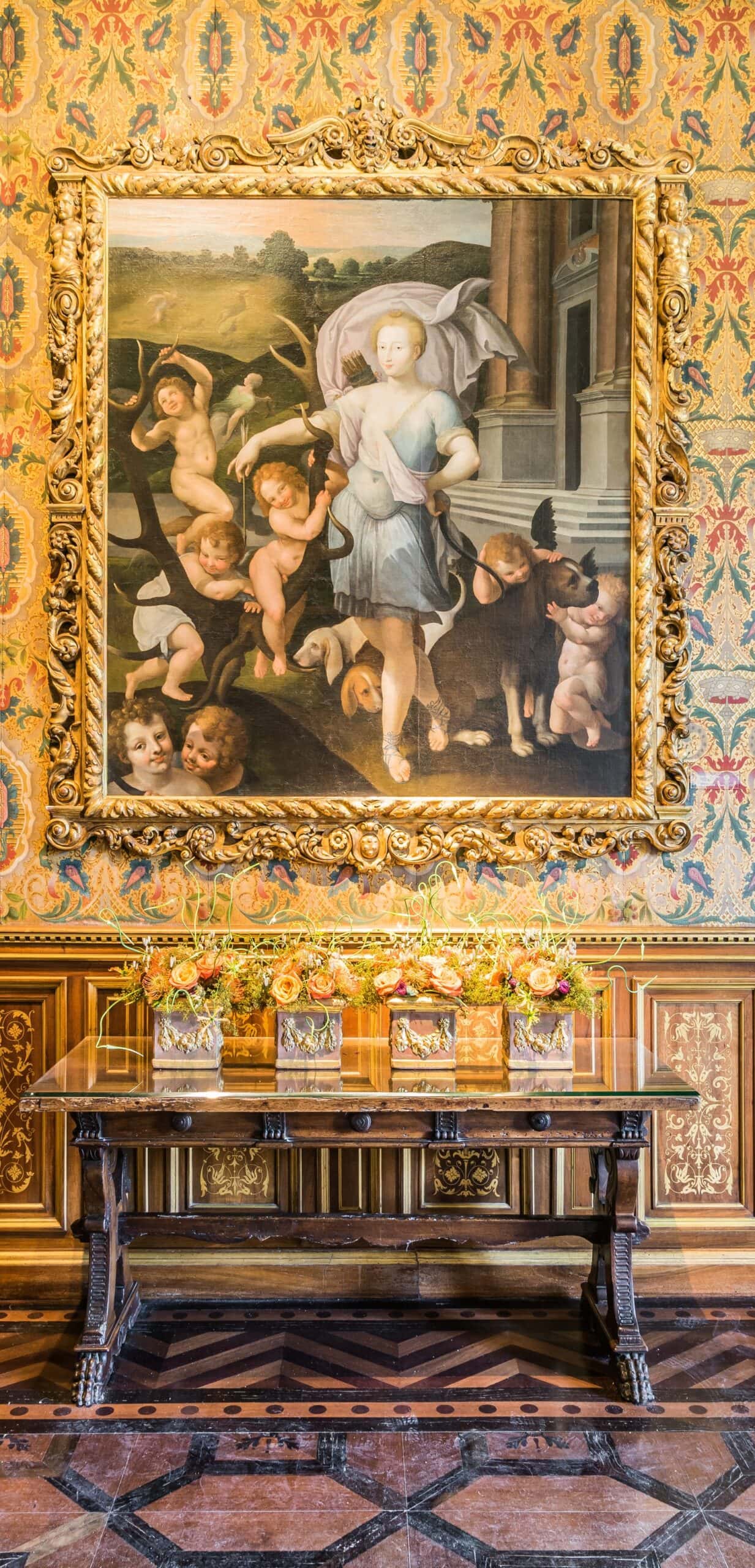
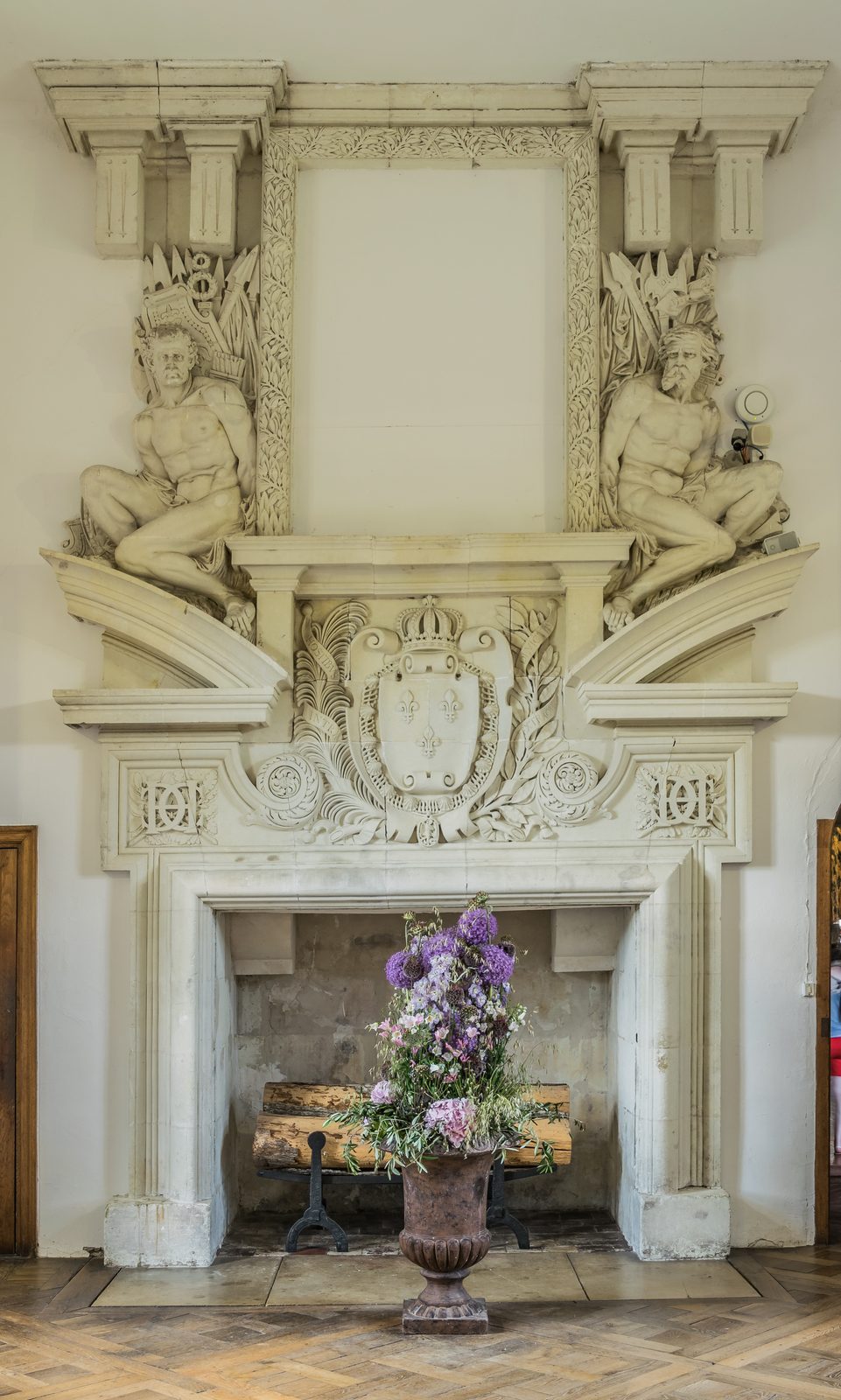
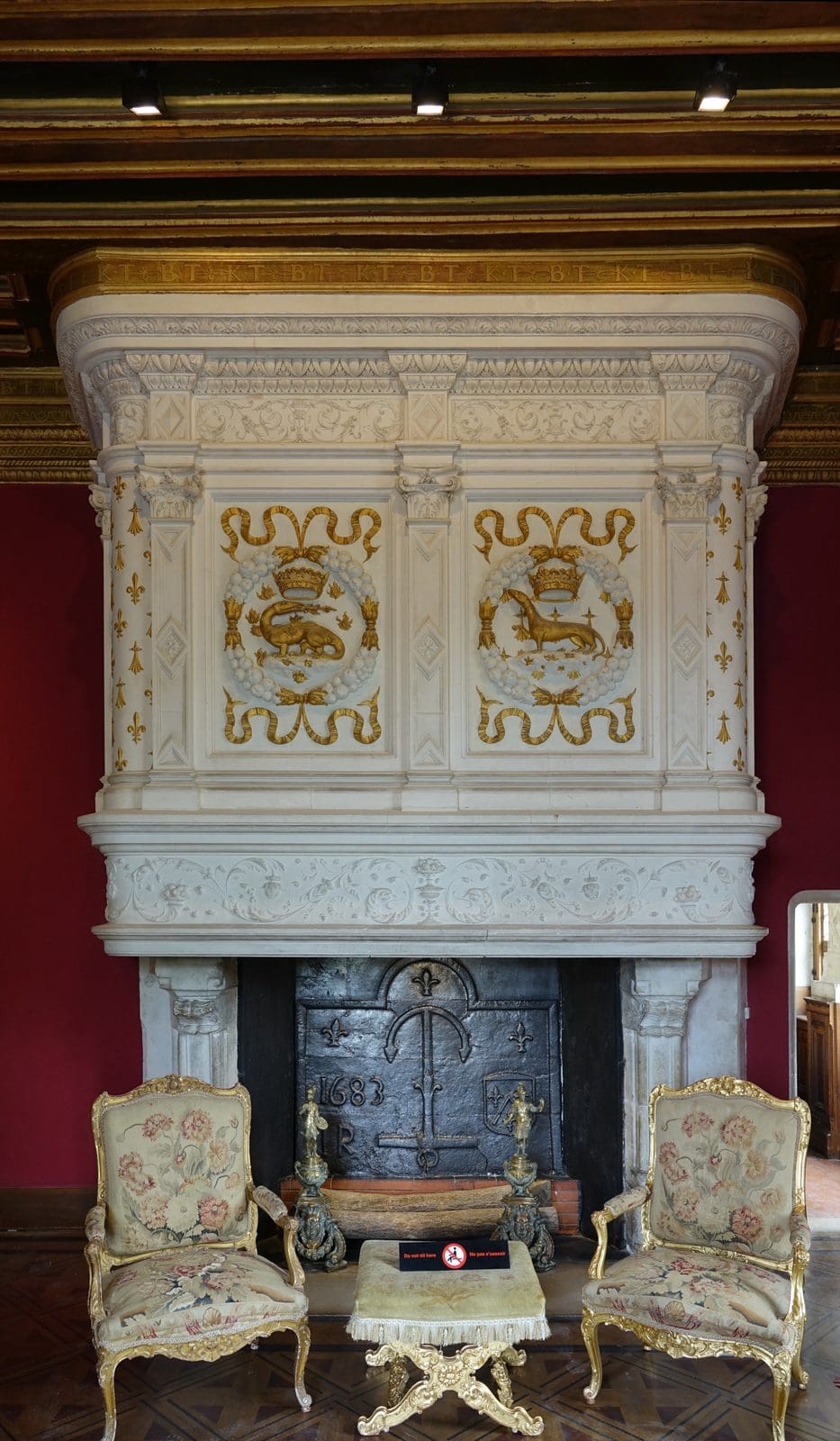
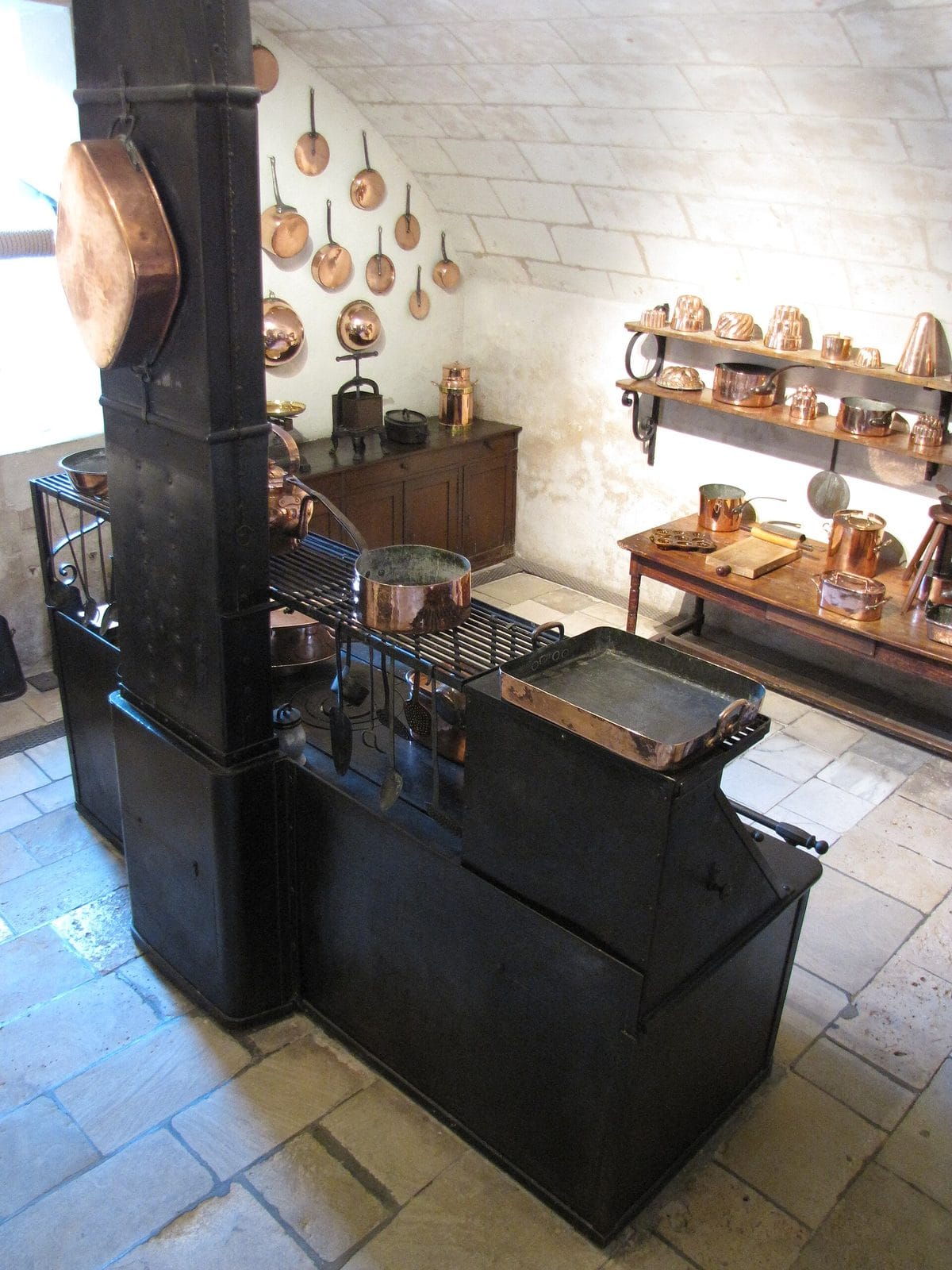
Seen whole, Chenonceau is two buildings joined by Catherine’s gallery: the compact Briçonnet house on its square base in the river, anchored by the medieval Tour des Marques, and the long bridge-gallery reaching across to the south bank. Inside, the rooms are kept as a lived-in residence rather than a roped-off museum, with fresh flowers cut from the estate’s own flower garden arranged in every chamber, a tradition the household still maintains daily. The art collection is genuinely distinguished. The estate hangs paintings it attributes to Primaticcio, Rubens, Tintoretto, and Murillo, among others, set among sixteenth-century Flemish tapestries, carved chimneypieces, and coffered Renaissance ceilings. Down in the great piers of the old mill, reached by a stair from the vestibule, lie the kitchens, among the most complete to survive in any French château, where the household once cooked, in effect, over the river itself.
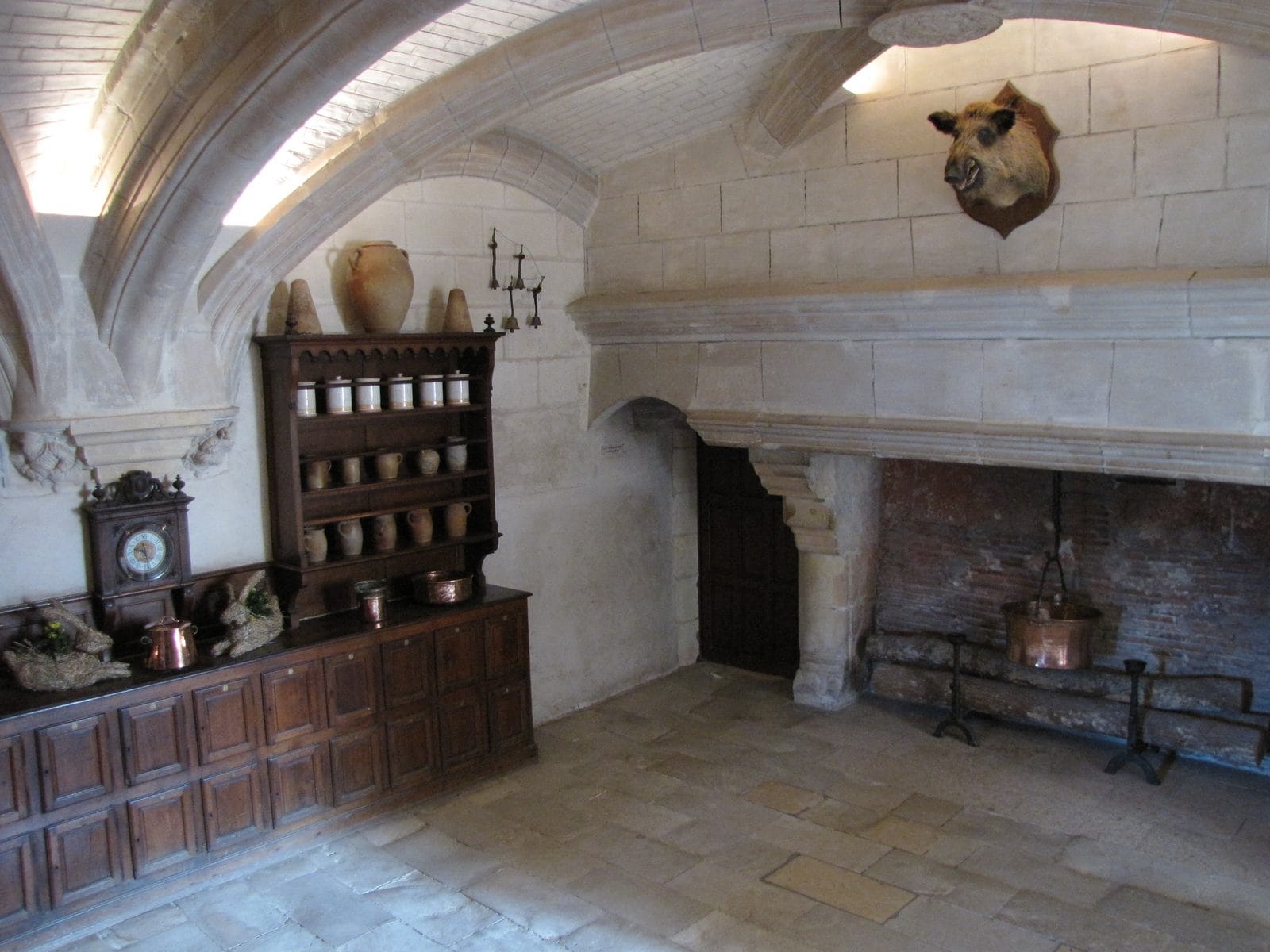
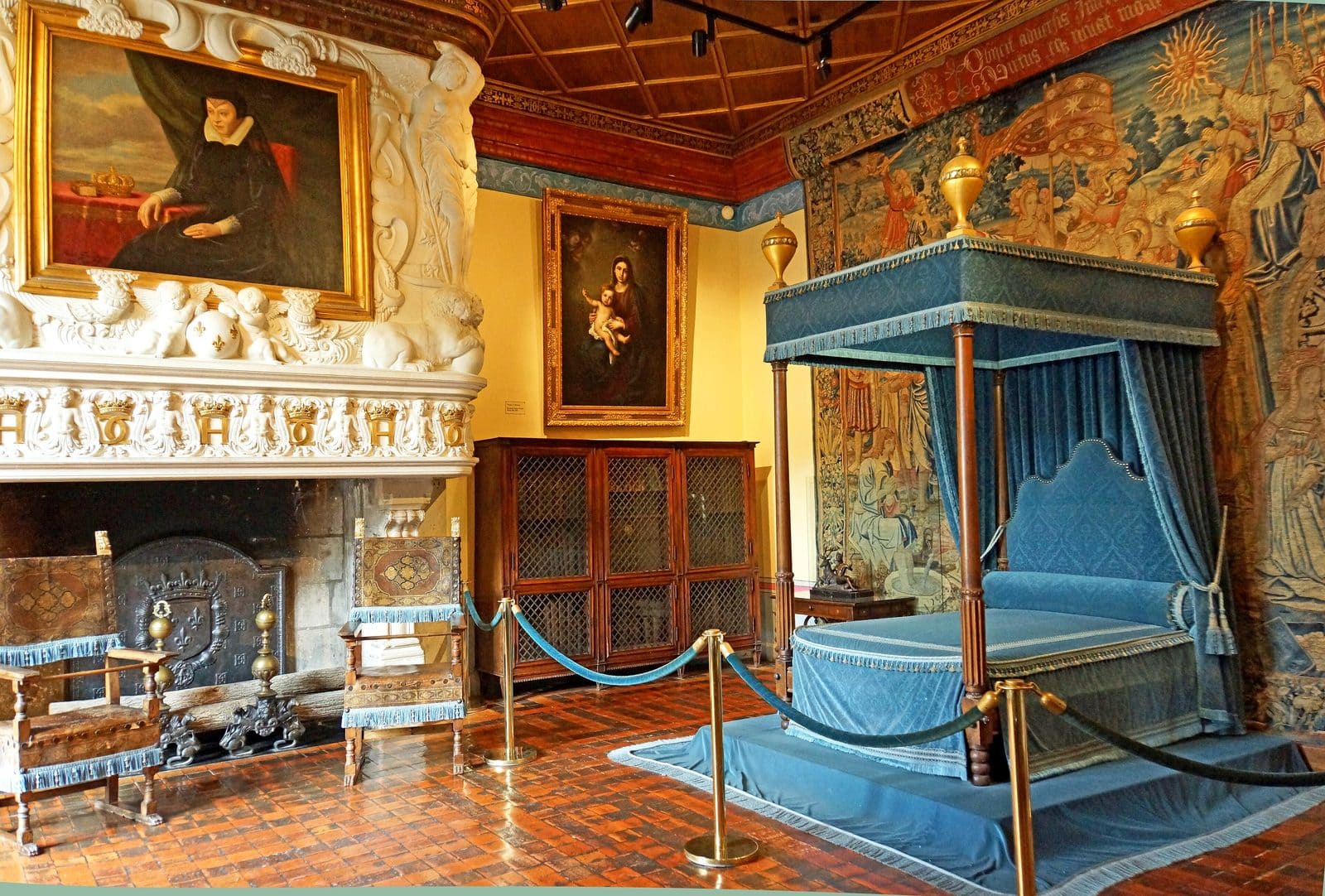
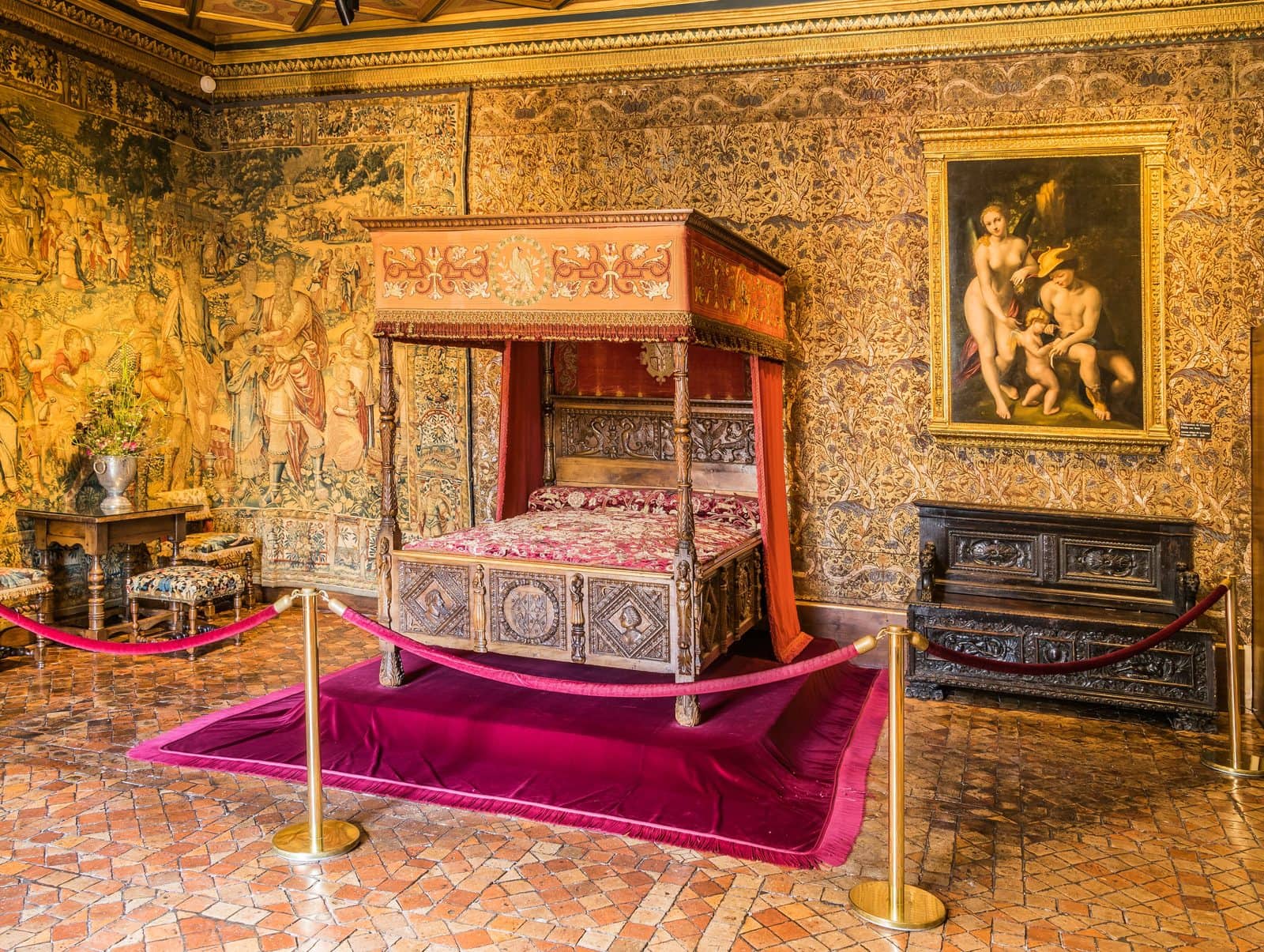
The rooms themselves trace the women who held the house. Diane de Poitiers’ bedchamber keeps its sixteenth-century Flemish tapestries; close by, the chamber of Catherine de’ Medici and the stark black room of Louise de Lorraine stand for sharply different reigns. A small Renaissance chapel, its windows lost to the 1944 bombing and remade in 1954, opens off the main vestibule. Across the forecourt the outbuildings hold their own pleasures: a carriage gallery in the domed service range and a sixteenth-century working farm. None of it overwhelms the house. Chenonceau wears five centuries of furniture and incident as lightly as it wears its name.
The gardens are part of the spectacle and repay slow walking. Diane de Poitiers’ parterre, the larger of the two at roughly 12,000 square meters, still occupies its raised terraces against the floods, a geometry of lawns, flowers, and water. Catherine de’ Medici’s garden, about 5,500 square meters, sits nearer the house and frames the most photographed view of the gallery. Beyond them stretch a green garden, a working flower farm that supplies the château’s daily bouquets, a sixteenth-century farm, and, within a wider park of some seventy hectares, a maze of two thousand yews planted in the Italian style Catherine favored. That the two great parterres still face each other across the house, Diane’s the grander and Catherine’s the nearer, keeps the old rivalry alive in boxwood and gravel. Together house and grounds make a single composition in which architecture and landscape, river and reflection, are impossible to pull apart.
Visiting Chenonceau in 2026
Chenonceau is among the most welcoming of the great Loire châteaux, open every day of the year, weekends and holidays included. Hours move with the season. Gates open at 9:00 or 9:30 in the morning and close as early as 4:30 in the depths of winter or as late as 7:00 at the height of summer, so it pays to check the day’s hours before setting out. The château stands in the village of Chenonceaux, which keeps the final “x” the château itself dropped, about half an hour east of Tours and within easy reach of Amboise; the small Chenonceaux station sits a short walk from the gates, which makes the site unusually simple to reach without a car. Entry tickets and local tours can also be booked in advance through GetYourGuide.
Admission in 2026 is €19 for an adult with the printed guide leaflet, or €24 with an audioguide. Reduced rates of €16, or €21 with audioguide, apply to visitors over 65 and to students with a valid card; children aged 7 to 18 pay €15, or €20 with audioguide, and children under 7 enter free. Groups of twenty or more are charged €16 a head. The audioguide is the only paid upgrade, and a single ticket covers both the château and its gardens. Allow at least half a day to do justice to the house, the two parterres, and the kitchens; the gardens reward an unhurried wander, and the river views change hour by hour with the light. The estate also keeps a self-service café and a restaurant in the former orangery, a flower workshop, and, in the warm months, rowing boats for hire on the calm water beneath the arches. As with any operating monument, seasonal hours and prices are reviewed each year, so confirm both on the official site, chenonceau.com, before you travel. Anyone staying overnight can compare hotels in and around Chenonceaux.
Some links on this page are affiliate links, which means StoneKeep Atlas may earn a small commission, at no extra cost to you, if you book through them.
More Views of Château de Chenonceau
A closer look at the château through the seasons, from the gallery suspended over the Cher to the rival gardens of its two most famous mistresses.
Beyond Chenonceau
Chenonceau is best understood alongside its great rival in fame, the Château de Chambord, an hour to the east. Where Chambord is François I’s masculine monument, a hunting palace of hundreds of chimneys and a double-helix staircase built above all to impress, Chenonceau is the women’s reply: smaller, subtler, made not to command a forest but to converse with a river. Set side by side, the two châteaux frame the whole temper of the French Renaissance, its ambition and its grace at once, and they make the natural opening pair for any tour of the Loire.
Downstream toward Tours, Château de Villandry turns the same Renaissance inheritance into the most famous formal gardens in France, while upstream Château de Chaumont-sur-Loire crowns its bluff with a celebrated contemporary garden festival. Further upstream, the royal Château de Blois compresses four centuries of French architecture into a single courtyard. More Loire châteaux will join them on StoneKeep Atlas as the valley’s story is filled in. For now, an itinerary that takes in both Chambord and Chenonceau, with the riverside town of Amboise between them, is about as fine an introduction to Renaissance France as the country has to offer. Inland to the east, Cheverny remains the valley’s lived-in château, furnished from cellar to attic by the family that still calls it home. Seen across the next century, these Loire houses are the ancestors of the Palace of Versailles, where the wandering French court finally built itself a permanent home. For the whole valley at a glance, see our guide to the Châteaux of the Loire Valley. With its arches mirrored in the Cher, Chenonceau ranks among the fairytale castles in France, the châteaux we gather for their storybook looks.
Chenonceau is the subject of one of our documentaries, gathered with the films we have made.
Common Questions
How much is admission to Chenonceau?
Admission in 2026 is 19 euros for an adult with the printed guide leaflet, or 24 euros with an audioguide. Reduced rates of 16, or 21 with audioguide, apply to visitors over 65 and to students; children aged 7 to 18 pay 15, or 20 with audioguide, and children under 7 enter free. The audioguide is the only paid upgrade, and a single ticket covers the chateau and its gardens.
When is Chenonceau open?
Chenonceau is open every day of the year, weekends and holidays included. Hours move with the season: the gates open at 9:00 or 9:30 and close as early as 4:30 in the depths of winter or as late as 7:00 at the height of summer, so it pays to check the day’s hours before setting out.
How do I get to Chenonceau?
The chateau stands in the village of Chenonceaux, which keeps the final x the chateau itself dropped, about half an hour east of Tours and within easy reach of Amboise. The small Chenonceaux station sits a short walk from the gates, which makes the site unusually simple to reach without a car.
Conclusion
Chenonceau has come through sieges, debts, a revolution, and two world wars, and the same quality has carried it through all of them: it was always loved, and it was always useful. The women who shaped it grasped a truth that outlasted every one of them, that a beautiful thing with a purpose is far harder to destroy than a beautiful thing alone. Five centuries on, the gallery still reaches across the Cher, the river still doubles the house in its surface, and the Château des Dames remains exactly what its builders intended: a Renaissance house that seems to float.
Principal Sources
- Ministère de la Culture (France), base Mérimée / POP, notice PA00097654, monument historique listing for the Château de Chenonceau (acquisition by Bohier in 1512; completion in 1521; de l’Orme bridge commission of 1555; retention of the round keep).
- Domaine de Chenonceau, official site, chenonceau.com, history, gardens, collection, and 2026 visitor information (ticket prices and seasonal hours fetched June 2026; gallery dimensions and inauguration; Menier ownership from 1913).
- UNESCO World Heritage Centre, “The Loire Valley between Sully-sur-Loire and Chalonnes,” property 933 (inscribed 2000 under criteria i, ii and iv; minor boundary modification incorporating the Château de Chenonceau and its surrounding landscape adopted at the 41st session of the World Heritage Committee, Kraków, July 9, 2017).
- World History Encyclopedia, “Château de Chenonceau” (medieval Marques estate; the lineage of the Château des Dames; nineteenth- and twentieth-century ownership).
Image credits. Hero photograph of the east façade reflected in the Cher by Ant°AM (CC BY-SA 4.0). Interiors and exteriors by Krzysztof Golik — the Tour des Marques, the entrance façade, the Diana painting, the Renaissance fireplace, and Catherine de’ Medici’s bedchamber (all CC BY-SA 4.0); by Dennis G. Jarvis — Diane de Poitiers’ bedchamber and the François I salon (CC BY-SA 2.0); the grand gallery by Sébastien HOSY (CC BY-SA 3.0); the First World War hospital by Fab5669 (CC BY-SA 4.0); the aerial view by Carsten Steger (CC BY-SA 4.0); the kitchens and copper batterie by Shadowgate (CC BY 2.0); the Louis XIV chimneypiece by Gzen92 (CC BY-SA 4.0); and the gallery banquet by Antoine Montulé (CC BY-SA 4.0). Historical images in the public domain: the anonymous sixteenth-century view held by the Bibliothèque nationale de France, the 1851 photograph by Gustave Le Gray, and the Second World War photograph. All Creative Commons and Wikimedia images are used under their respective licenses. Freely licensed images are resized to fit; otherwise unaltered.