
English Castle Documentaries
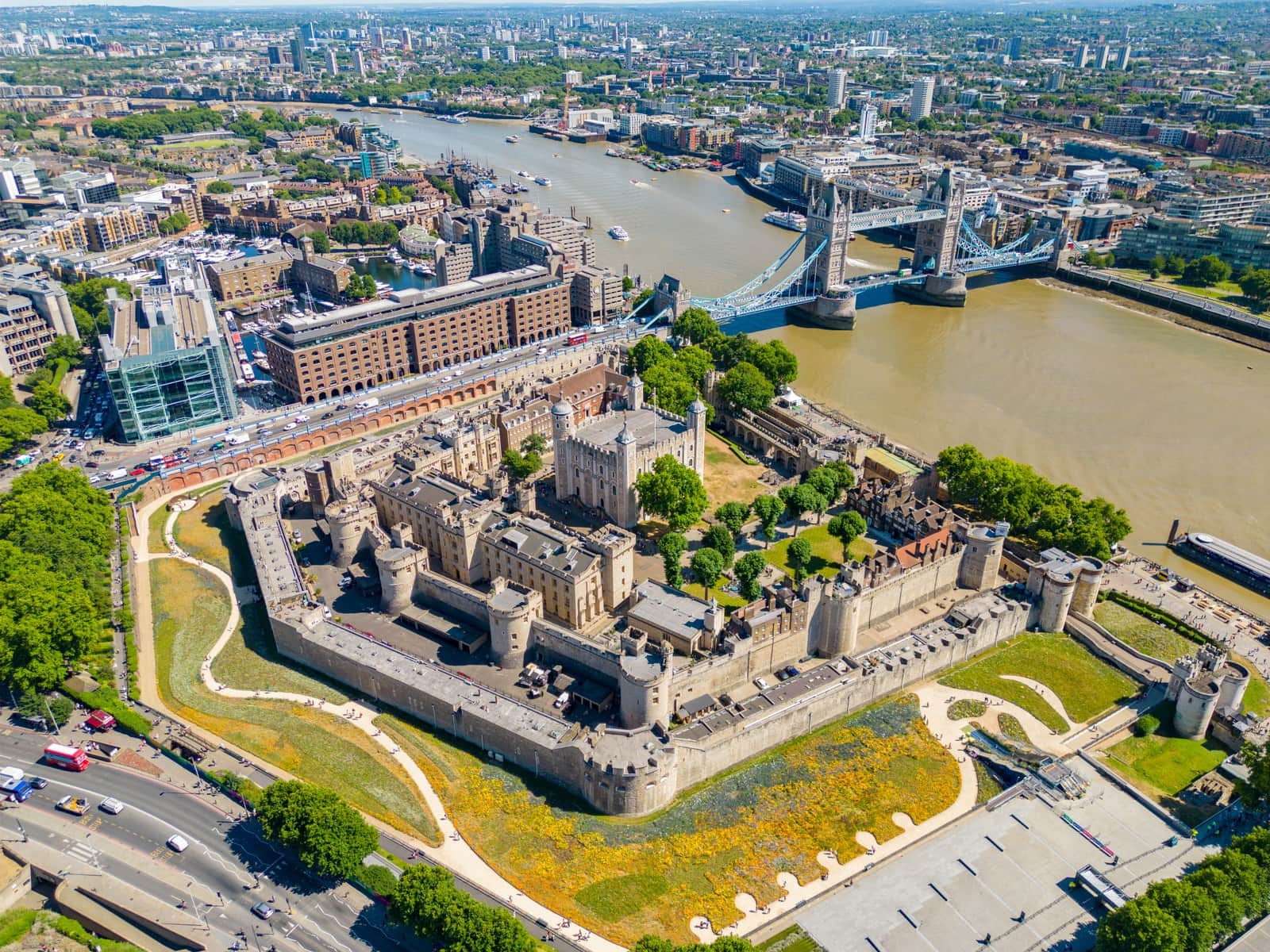
These English castle documentaries take one castle at a time and set the story it is known for against the written record. They run from the capital to the Channel coast. At the Tower of London, Dover and Bodiam, the centerpieces come from three different centuries: the Tower’s Norman keep, begun in the 1070s; Henry II’s Great Tower at Dover, of the 1180s; and Bodiam itself, a moated square of the fourteenth century.
Each block below sets the scene and poses the question its film asks, then stops: the answers belong to the films, and the settled record belongs to the cited guide linked under each one. The films are narrated in English by synthetic voices; the research, the script, the sourcing and the edit are human.
The English Films
Dover Castle: England’s Forgotten French Invasion
Dover Castle stands on the white cliffs above the Channel in Kent, commanding the shortest sea crossing between England and the continent, about a mile’s walk uphill from Dover Priory station. At its heart rises Henry II’s Great Tower of the 1180s, built under his engineer Maurice as both fortress and palatial residence, and French and Spanish prisoners of the wars of 1688 to 1714 left graffiti that can still be seen on the Great Tower’s walls.
The film opens in the summer of 1216. Louis, heir to the French throne, has been proclaimed king in London by England’s rebel barons, and King John’s justiciar and principal minister, Hubert de Burgh, commands Dover. It follows the siege that came next through a surviving account by an eyewitness whose name is lost, and through what archaeologists later found at the gate. Then John dies, and the garrison is holding a castle for a dead king. The film asks what happens at Dover when everything on the far shore is lost, carries that question to 1940 and the rooms in the cliff where the Dunkirk evacuation was controlled, then ends with a blacksmith.
Read: the Dover Castle guide; on site, find the Roman lighthouse beside the church of St Mary in Castro, which took it over as a bell tower.
Bodiam Castle: Why England’s Perfect Castle Is Empty
Built in the fourteenth century for Sir Edward Dallingridge, Bodiam Castle stands in the Rother valley of East Sussex, on an island in a broad moat fed by natural springs. Without a car, the bus from Hastings station stops at the castle; the mainline station at Robertsbridge, five miles away, has no bus to the castle. Four round towers mark the corners of its square, and the twin-towered gatehouse on the north side keeps part of its medieval oak portcullis. Historic England’s record of the site sets out the contrast every visitor meets: the outer walls survive almost to their full height, while most of the interior is in a ruined state.
The film starts from that contrast and from a question scholars have argued over in print: was Bodiam built to fight, or to be seen? It reads the castle from three places: the north bank, an eight-sided platform out in the moat, and the courtyard, where the film’s title asks why the castle is empty. Its evidence includes excavations in the moat in 1919-20 and 1970 and a Victorian antiquary’s history of the castle.
Read: the Bodiam Castle guide; on site, stop on the eight-sided platform in the moat on your way to the gate and look back across the water.
Tower of London: Which of Its Legends Are True?
The Tower of London stands on the edge of the River Thames, about five minutes’ walk from Tower Hill Underground station, and river boats call at Tower Pier beside its entrance. Inside its two rings of walls rises the White Tower, the great Norman keep, where the eleventh-century Chapel of St John the Evangelist is still used as a working chapel. Ravens keep their own territories within those walls.
The film walks the route the Chief Yeoman Warder takes each night from the Byward Tower, with a candle lantern and the King’s Keys, to lock the outer gates and then the inner ones. On the way it takes up the stories the Tower is famous for: of dungeons and torture, of executions on Tower Green, of the two princes who disappeared in 1483, of the Crown Jewels, and of the ravens said to keep the kingdom from falling. It also goes back to the documents, from a white bear the King of Norway gave Henry III in 1252 to Thomas More’s account of the princes and the bones found under a staircase in 1674.
Read: the Tower of London guide; on site, stand on Tower Green, the lawn before the Chapel Royal of St Peter ad Vincula, west of the White Tower.
Beyond the English Films
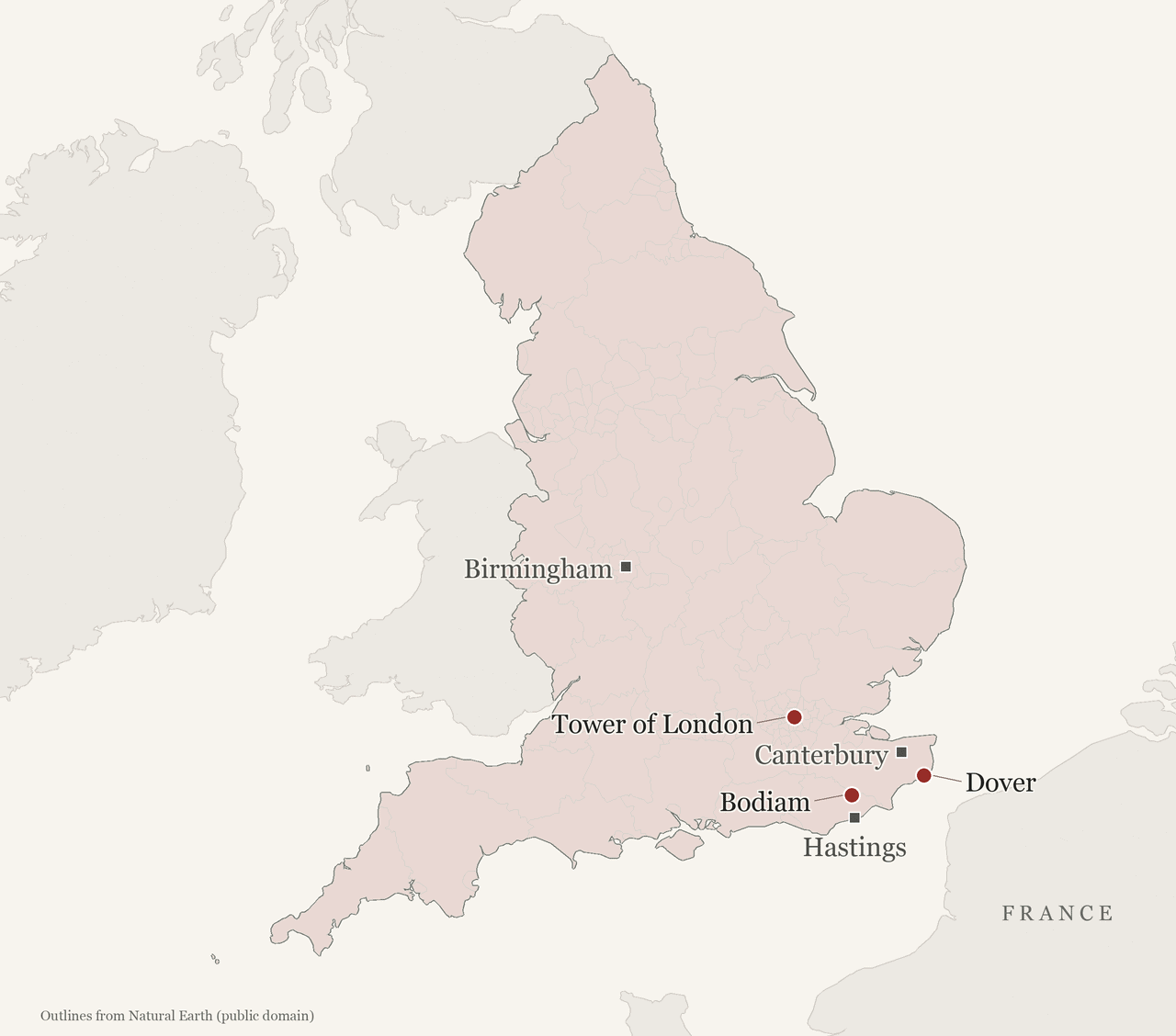
For a visit rather than a viewing, each film’s written guide carries the practical detail, and our guide to castles in England pairs Dover and Bodiam in Kent and East Sussex and places all three among the other castles the site covers. For films from the rest of the series, country by country, go to the castle documentaries index, which explains how the films are made and where to begin.
Principal Sources
- Coulson, Charles. “Some Analysis of the Castle of Bodiam, East Sussex.” In Medieval Knighthood IV, ed. C. Harper-Bill and R. Harvey. Woodbridge: Boydell, 1992, 51-107.
- English Heritage. “Dover Castle.” english-heritage.org.uk.
- English Heritage. “Dover Castle: History and Stories.” english-heritage.org.uk.
- English Heritage. “Facts and FAQs about Dover Castle.” english-heritage.org.uk.
- English Heritage. “Dover Castle Things to See and Do.” english-heritage.org.uk.
- Historic England. “Dover Castle” (List Entry 1019075). historicengland.org.uk.
- Historic England. “A quadrangular castle and its landscaped setting, an associated millpond, medieval crofts and cultivation earthworks, and a World War II pillbox at Bodiam” (List Entry 1013554). historicengland.org.uk.
- Historic England. “Tower of London” (List Entry 1002061). historicengland.org.uk.
- Historic Royal Palaces. “Getting here.” hrp.org.uk.
- Historic Royal Palaces. “The Ceremony of the Keys.” hrp.org.uk.
- Historic Royal Palaces. “The Princes in the Tower.” hrp.org.uk.
- Historic Royal Palaces. “The Ravens.” hrp.org.uk.
- Historic Royal Palaces. “The Story of the Tower of London.” hrp.org.uk.
- Historic Royal Palaces. “The Tower of London Menagerie.” hrp.org.uk.
- Historic Royal Palaces. “Tower Green and Scaffold Site.” hrp.org.uk.
- Historic Royal Palaces. “White Tower.” hrp.org.uk.
- Kightly, Charles. “How Dover Castle became the Key of England – the Great Siege of 1216.” English Heritage, 2016. english-heritage.org.uk.
- Lower, Mark Antony. Bodiam and Its Lords. New edition. London: John Russell Smith, 1871; first printed in Sussex Archaeological Collections 9 (1857), 275-302. archive.org.
- National Trust. “Bodiam Castle.” nationaltrust.org.uk.
- Pattison, Paul. “History of Dover Castle.” English Heritage. english-heritage.org.uk.
- Pattison, Paul. “The Sieges of Dover Castle 1216-17.” English Heritage. english-heritage.org.uk.
- Turner, D. J. “Bodiam, Sussex: True Castle or Old Soldier’s Dream House?” In England in the Fourteenth Century: Proceedings of the 1985 Harlaxton Symposium (1986), 267-77.
- UNESCO World Heritage Centre. “Tower of London.” whc.unesco.org.
Image credits. Hero, the Tower of London from the air, with Tower Bridge beyond: Photo: Felix Mizioznikov / Adobe Stock; Locator map: own work; outlines from Natural Earth, public domain. Freely licensed images are resized to fit; any other change, such as a crop, is named in the credit.