
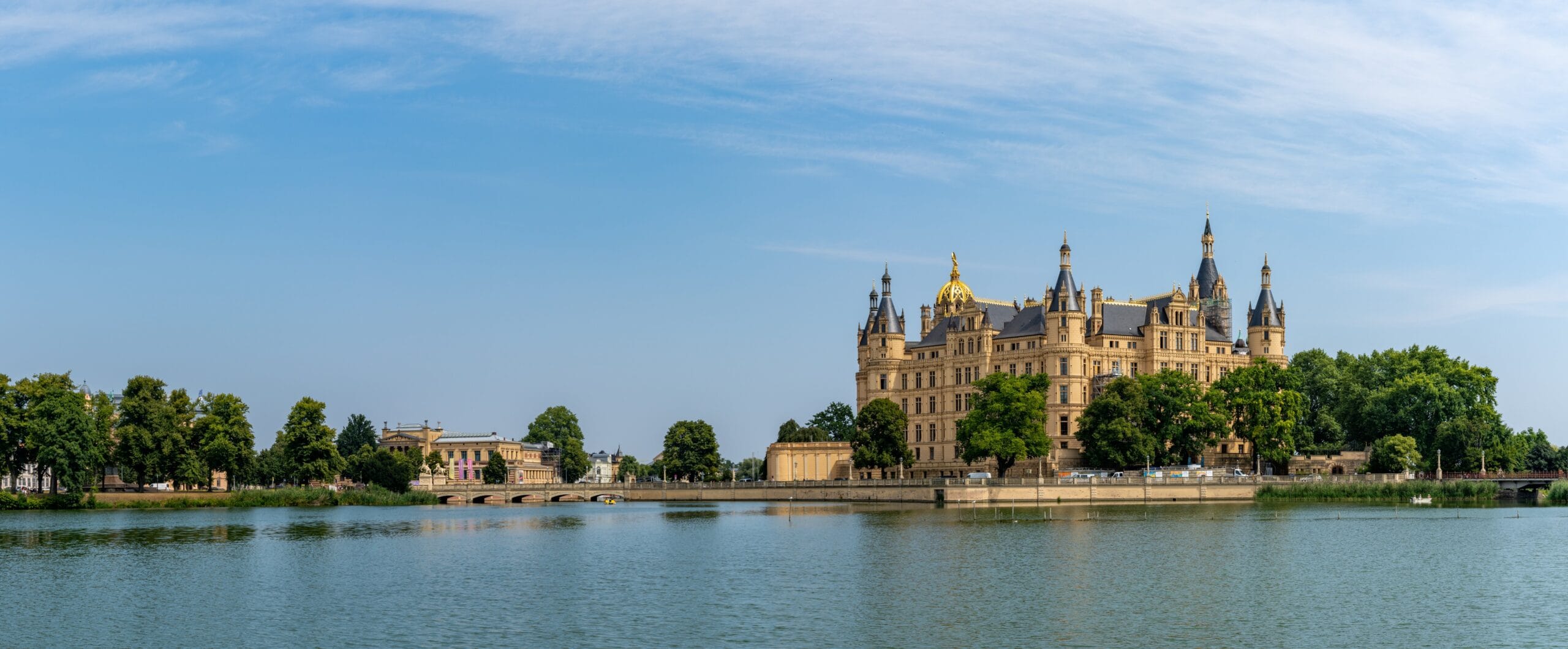
Schwerin Castle
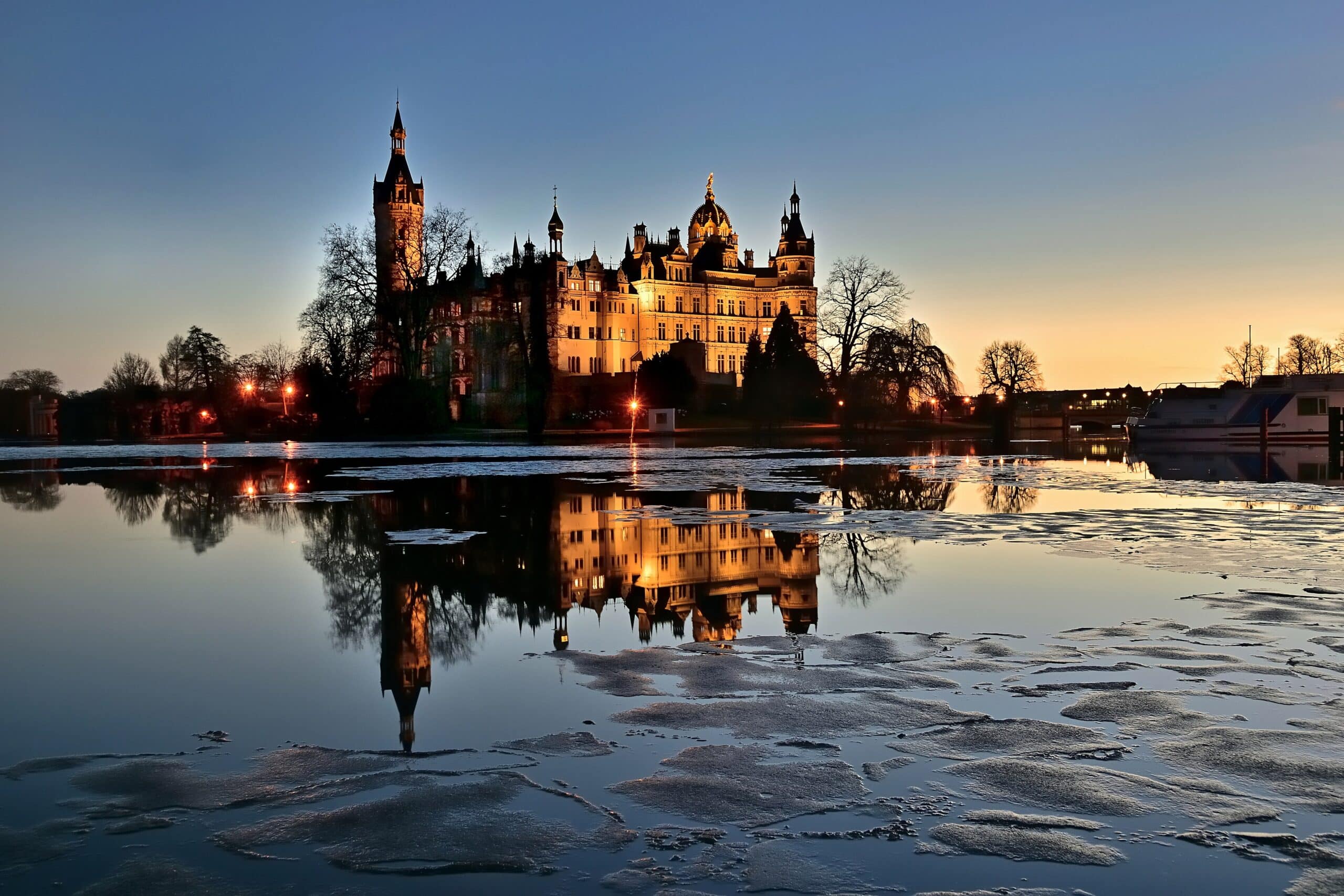
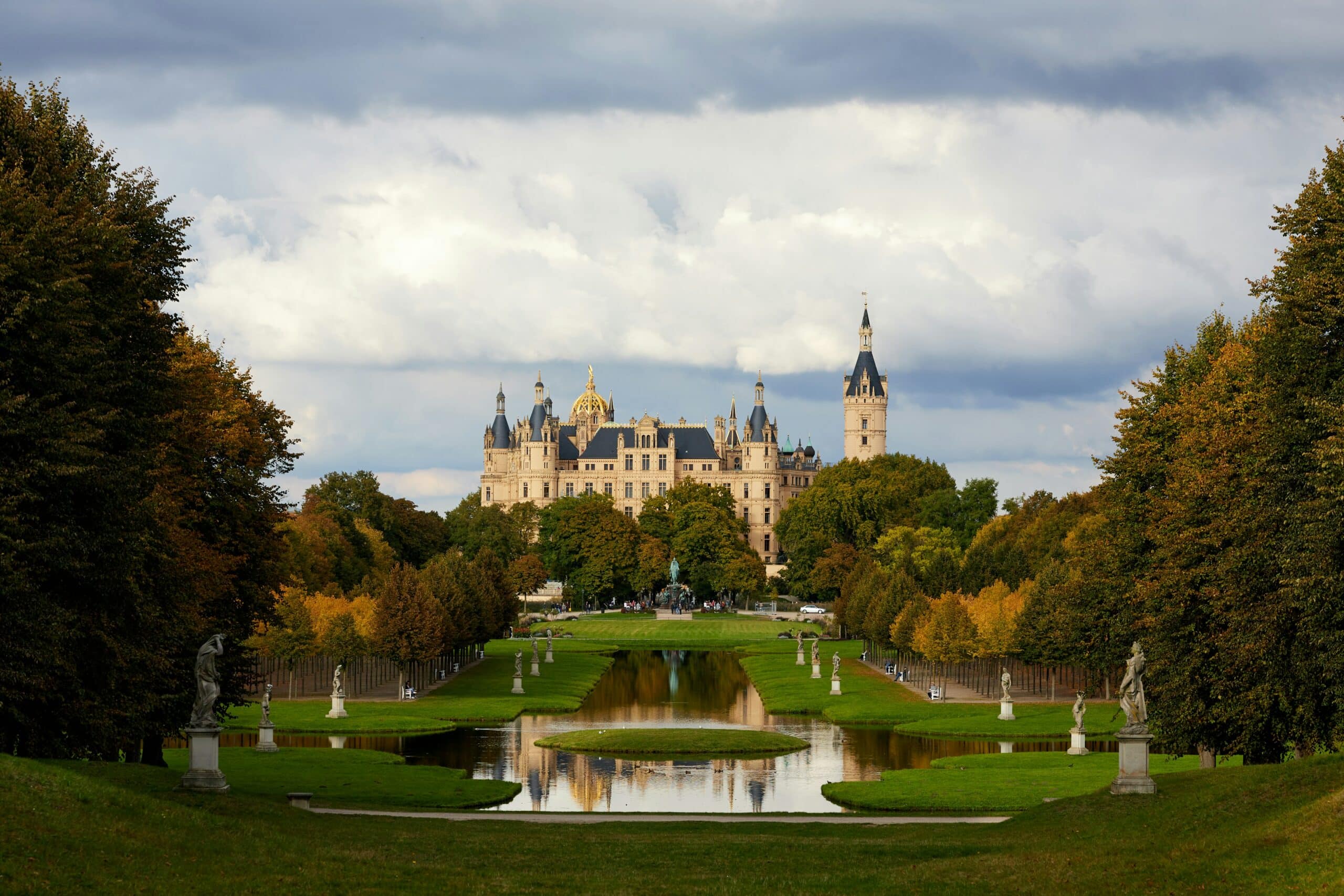
On a small island in the Schweriner See, the seat of political authority in Mecklenburg has held the same patch of ground for more than a thousand years. From a Slavic Obotrite stronghold first mentioned by name in the eleventh century, through the long arc of the House of Mecklenburg, to today’s Landtag of Mecklenburg-Vorpommern, governance at Schwerin Castle has rarely strayed from this hilltop above the water. On July 27, 2024, UNESCO formally recognized that continuity, inscribing the Schwerin Residence Ensemble (thirty-eight buildings and gardens with the castle at their heart) onto the World Heritage List. What today’s visitors see is largely the work of two architects, Georg Adolf Demmler and Friedrich August Stüler, who between 1843 and 1857 reimagined an exhausted Renaissance complex as a Loire-French dream of fifteen towers and a gilded dome that catches the morning light off the Burgsee.
Quick Facts
| Country | Germany |
| Region / State | Mecklenburg-Vorpommern |
| Nearest Town | Schwerin (capital of Mecklenburg-Vorpommern) |
| Construction Period | Slavic timber rampart winter 941/942, renewed 963/965; Renaissance phases 1553–1648; Romantic-Historicist rebuild 1843–1857 (major construction 1845–1857) |
| Founder | Slavic Obotrites (10th c.); House of Mecklenburg from 1167; the present palace commissioned 1843 by Grand Duke Friedrich Franz II (architects Georg Adolf Demmler, Friedrich August Stüler, Heinrich Strack, Hermann Willebrand) |
| Architectural Style | Romantic Historicism with French Renaissance Loire references (Chambord, Blois, Chenonceau); medieval and Renaissance fabric retained, including the Bischofshaus tower and the 1563 Schlosskirche |
| Building Type | Schloss — former grand-ducal residence of Mecklenburg-Schwerin; seat of the Landtag of Mecklenburg-Vorpommern since 1990 |
| Current Condition | Restored; post-1913-fire reconstruction completed 1926–1931; Rote Marmortreppe by Paul Ehmig; new Landtag plenary chamber completed 2017 (Dannheimer & Joos) |
| Open to Visitors | Yes — Schlossmuseum Tue–Sun, with seasonal hours (April 15–October 14 10:00–18:00; October 15–April 14 10:00–17:00); some areas closed during Landtag plenary sessions |
| UNESCO Status | Inscribed July 27, 2024 as the Schwerin Residence Ensemble (Criterion (iv); 38 components; 2,275.77 ha + 2,691.95 ha buffer) |
| Official Website | mv-schloesser.de |
From Obotrite fortress to Mecklenburg dynastic seed (c. 942–1358)
Lake-island anchoring today’s castle was a defensive site long before German feudal authority arrived in Mecklenburg. Defended on every side by water and accessible only by causeway, the position combined the security of an island with proximity to the mainland’s resources: a geography prized by every successive group that occupied it. The Landesarchäologie of Mecklenburg-Vorpommern, which excavated the island from 2014, dates the timber rampart on the Schlossinsel to the winter of 941/942 “or shortly after,” with a new and stronger rampart raised over the collapsed first one in 963/965 or shortly after. These are the construction phases of an Obotrite stronghold whose Slavic-speaking inhabitants called the place Zuarin, a name probably meaning “place of game” or “wild place,” and from which the modern Schwerin descends. Earliest external description comes from Ibrahim ibn Yaqub, an Arab-Jewish traveler from al-Andalus, who passed through the region around 973 and described a fortified Slavic seat consistent with what archaeologists have recovered from the island itself. First secure written reference, however, comes from a chronicler further south: Bishop Thietmar of Merseburg, whose Chronicon, completed in 1018, names Schwerin as a fortified place of regional significance under the Obotrite confederation.
For more than a century, Zuarin remained a Slavic and pagan place. That changed with the campaigns of Henry the Lion, Duke of Saxony, who in 1160 launched a decisive war against the Obotrite leader Niklot. Niklot died defending his territories that same year. Confederation collapsed, the lands passed under Saxon-feudal control, and German colonization, Christianization, and new ecclesiastical structures reshaped the region within a single generation. Schwerin Cathedral, founded in 1171 just across the water from the castle island, embodies that transformation in stone.
What might have ended the Slavic dynasty entirely instead seeded a new one. Niklot’s son Pribislaw was reconciled with Henry the Lion and in 1167 restored as a vassal, Christian now, and tied to the new feudal order. Pribislaw is conventionally regarded as the founder of the House of Mecklenburg, which would hold the lake-island seat in continuous succession until the abdication of Friedrich Franz IV in 1918. That continuity (seven and a half centuries of a single ruling house anchored to a single hilltop) has few parallels in European dynastic history.
Dynasty grew, partitioned, and reunified across the next two hundred years. Schwerin’s primacy among the various Mecklenburg residences was not always absolute; younger branches occasionally based themselves elsewhere within the duchy. In 1358 the matter was settled, when the Mecklenburg dukes acquired the County of Schwerin from the extinct comital line that had shared the toponym, and consolidated the lake-island unambiguously as the principal residence. From this point forward, Schwerin is the dynastic capital, and the building campaigns that produced the Renaissance castle of the sixteenth and seventeenth centuries follow directly.
Renaissance terracotta and the chapel that turned Lutheran (1358–1648)
By the middle of the sixteenth century, the medieval Burg had grown obsolete. Duke Johann Albrecht I (a humanist prince of strong Protestant conviction) initiated a comprehensive rebuild beginning in 1553, hiring Italian masters to wrap the older structures in the Renaissance idiom then traveling north from Mantua and Brescia. Work fell principally to the Parr family of north-Italian builders: Giovanni Battista Parr, his brother Christoph, and their associates introduced glazed terracotta panels supplied from the workshop of Statius von Düren in Lübeck, along with pilasters and ornamental window surrounds that gave Schwerin a distinctly Mediterranean character on its windswept Mecklenburg lake. The medieval Bischofshaus (the round tower at the southwest corner of today’s complex, named after the sixteenth-century Bishop Magnus) survived the rebuild and remains the oldest surviving fabric on the island, a stone anchor through every subsequent reinvention.
Most consequential intervention of the period was religious. A new Schlosskirche, built between 1560 and 1563 under Johann Baptista Parr’s supervision and modeled architecturally on the Hartenfels Castle chapel at Torgau, was consecrated in 1563 as the first Protestant church in Mecklenburg. Its interior was laid out in accordance with a program developed by Martin Luther himself for Lutheran preaching services, making it one of the most architecturally significant Reformation buildings of its century. The pulpit, by the Torgau sculptor Georg Schröter, and the sandstone portal with its relief of Christ carrying the cross, by the Dresden master Hans Walther, are still in place. The chapel’s consecration tied the Mecklenburg dukes formally to the Protestant cause at a moment when confessional alignment carried sharp political consequences.
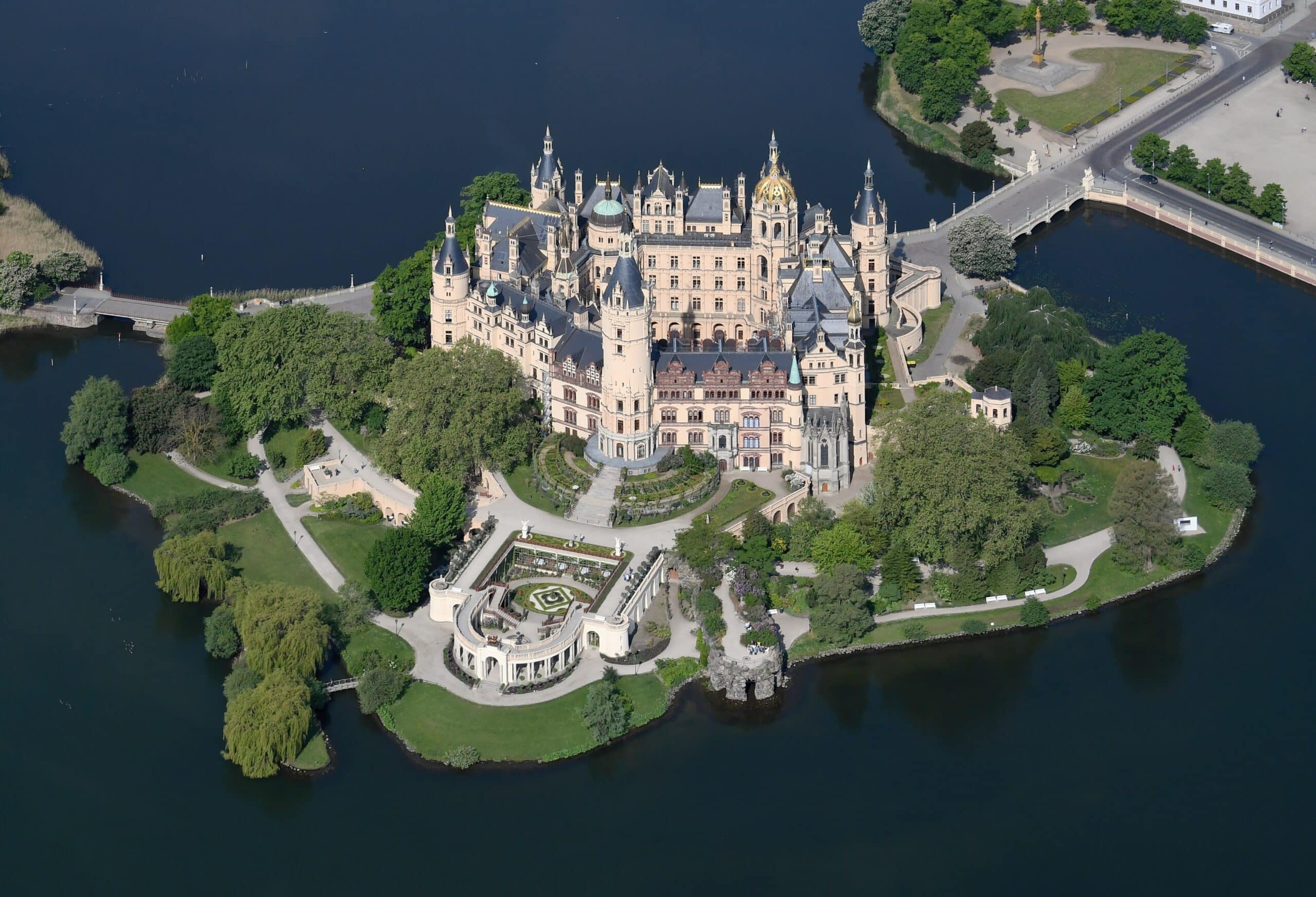
Those consequences arrived during the Thirty Years’ War. Schwerin was occupied successively by Imperial forces under Wallenstein and then by the Swedes under Gustavus Adolphus and his successors, both of whom found the lake-island useful for the same defensive reasons the Obotrites had centuries earlier. By the Peace of Westphalia in 1648, the dynasty had survived, but the building was tired. Terracotta façades had weathered, the Schlosskirche needed repair, and the duchy was financially exhausted. The Renaissance Schwerin Castle that emerges from Matthäus Merian’s 1653 engraving (its four wings, its towers, the Bischofshaus visibly anchoring the southwest) would scarcely change for the next century and a half.
Ludwigslust exile and the return to Schwerin (1648–1842)
For most of a century, the Mecklenburg-Schwerin court was not at Schwerin. Duke Friedrich II (known to his subjects and historians alike as “the Pious” for his austere Lutheran convictions) formally relocated the residence to Ludwigslust, some forty kilometers to the south, where his predecessor had begun developing a French-inspired Baroque country seat in the 1730s. Sources differ on the exact year of relocation, with 1756 and 1764 both appearing in scholarly literature; the practical effect was the same. By the mid-1760s, Ludwigslust was the active capital of the duchy, and Schwerin had ceased to be the daily life of the dynasty. Schwerin was not abandoned; it remained an administrative center and continued to host the duchy’s archives, but the buildings on the lake-island slowly weathered into a dignified obsolescence.
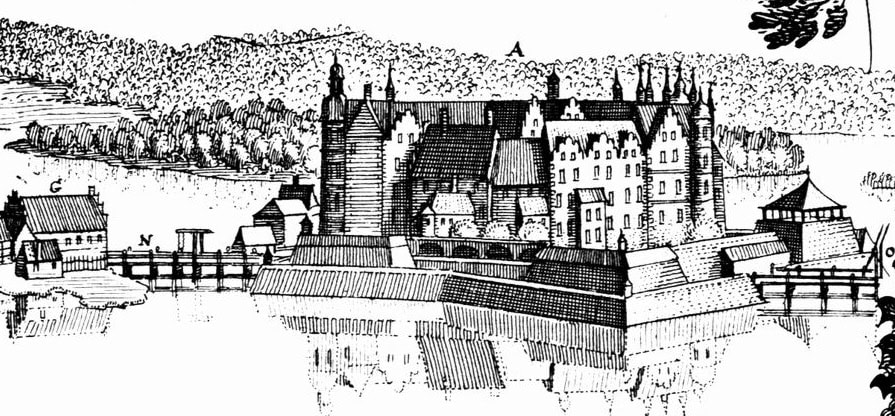
In 1837 the court returned to Schwerin, in a decision driven less by nostalgia than by political pragmatism. Duke Paul Friedrich, who had succeeded his uncle that year, judged that a duchy aspiring to nineteenth-century relevance required a residence in its historic capital and on its principal lake. Ludwigslust was beautiful but provincial; Schwerin had a cathedral, a growing town, and the symbolic weight of seven centuries of dynastic continuity. The court relocated, and the Renaissance buildings (by then nearly three centuries old in their Italianate form, and far older in their medieval cores) were pressed back into use.
They proved inadequate. Paul Friedrich died in 1842, leaving his nineteen-year-old son Friedrich Franz II to inherit both the throne and the architectural problem. Court architect Georg Adolf Demmler had by that point completed a comprehensive structural survey of the existing fabric. His conclusion was unsentimental: the medieval and Renaissance buildings could not be patched into a residence fit for nineteenth-century princely life. They had to be replaced, or at least so thoroughly rebuilt that the result would be functionally and visually new. Young Friedrich Franz II accepted the recommendation. Demolition began in 1843, and major reconstruction work proceeded between 1845 and 1857.
Demmler’s Loire dream and Stüler’s golden dome (1843–1913)
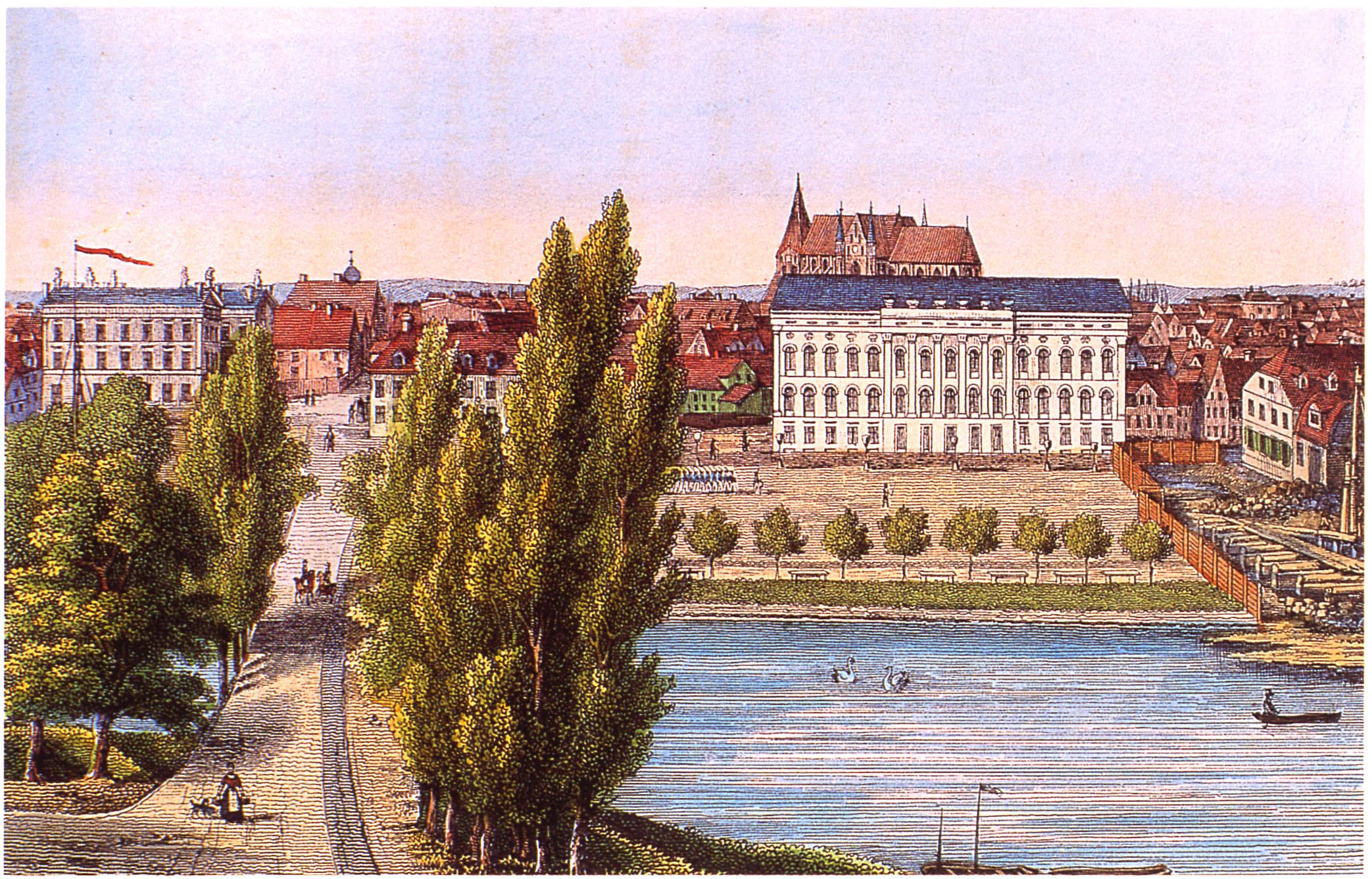
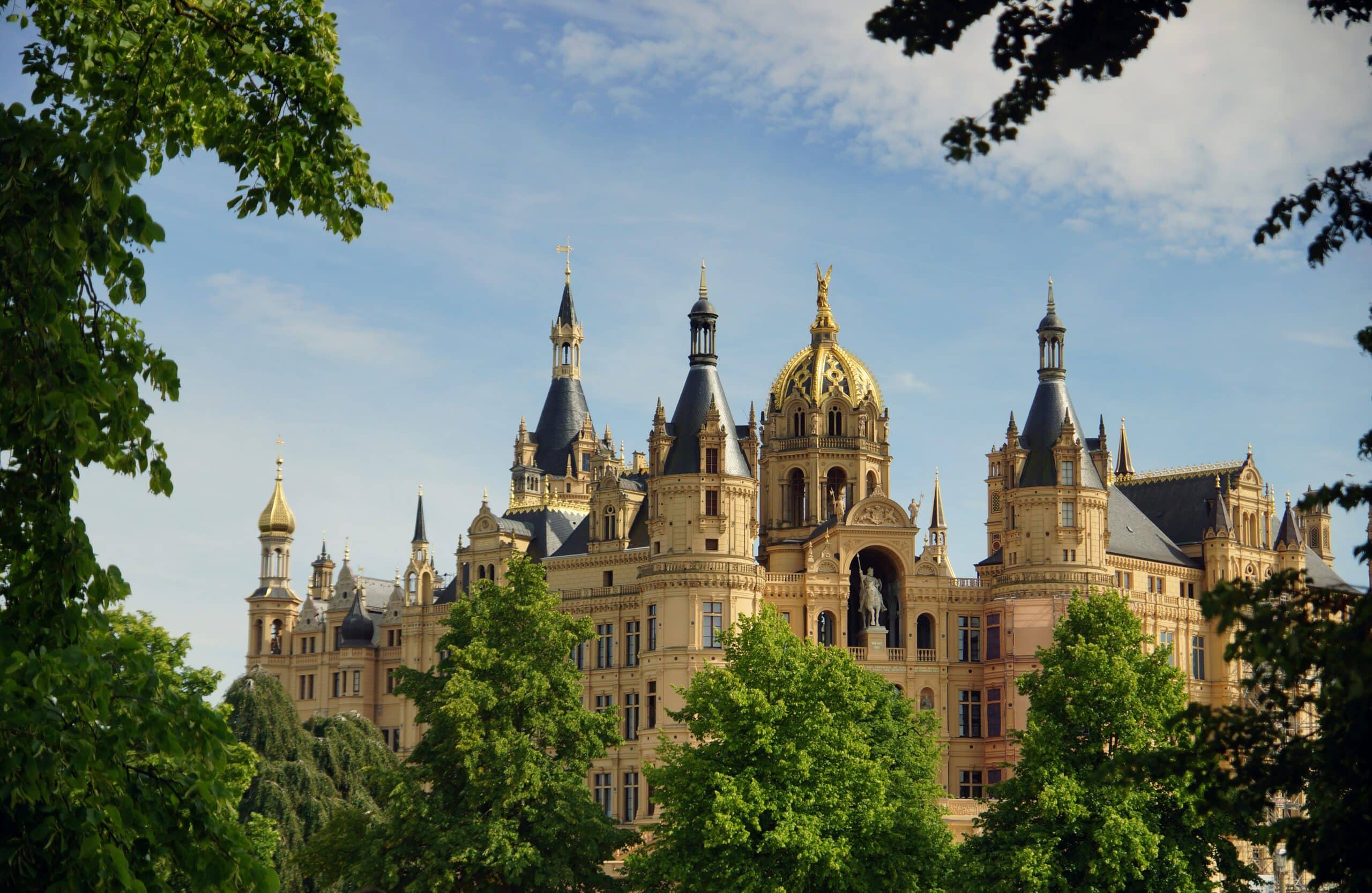
Georg Adolf Demmler’s designs reimagined Schwerin not as a Mecklenburg fortress modernized, but as a French Renaissance château transposed onto a Pomeranian lake. His direct references were to the Loire châteaux of the early sixteenth century: Chambord above all, but also Blois, Chenonceau, and Amboise. Brief was for a residence that would assert the Mecklenburg dynasty’s place among the great European houses, and the Valois Loire was the visual language Demmler chose to make that claim. Friedrich Franz II had also received alternative designs from the Dresden architect Gottfried Semper and from Friedrich August Stüler in Berlin, but Demmler’s third and definitive scheme (incorporating elements drawn from those alternatives) won the commission. The result is a building of fifteen towers (Demmler counted them carefully, and the count has not changed), with steeply pitched slate roofs, dormered attics, fretwork balustrades, and a riot of carved stone ornament drawn from the early-Renaissance French repertoire.
Schwerin was not the first German princely seat to adopt the Romantic Historicist mode. Burg Rheinstein on the Middle Rhine had been Romantically rebuilt from 1829, Hohenschwangau from 1832 to 1837, Stolzenfels from 1836 to 1842, and the Wartburg’s nineteenth-century interventions began in 1838. What Schwerin offered (and what would make it canonical) was completeness and scale. It was the largest Romantic-Historicist princely residence yet attempted in Germany, and its example would shape both Schloss Hohenzollern (begun 1867) and Neuschwanstein (begun 1869) within the decade after its completion.
Completion took longer than planned, and by a different architect. In 1851, Demmler was dismissed from court service for his sympathies with the 1848 revolutionary movements, which had unsettled the Mecklenburg court no less than the larger German states. Friedrich August Stüler (Schinkel’s pupil and principal architect of Friedrich Wilhelm IV of Prussia) was brought in to complete the project. Stüler made the most consequential single change, redesigning the central dome with the gilded copper-and-iron structure that gives Schwerin its profile today. Dome was completed in 1855, crowned by a gilded zinc figure of an angel (variously identified in the sources as the Archangel Michael or a personification of Victory) that was carefully restored in 2024 ahead of the UNESCO inscription.
In the same year, the bronze equestrian statue of Niklot (the Slavic Obotrite leader who had died defending these lands against Henry the Lion in 1160) was installed in the niche above the main entrance. Sculptor was the Rostock-born Christian Friedrich Genschow (1814–1891), and the equestrian Niklot would remain his major life’s work. The commission came through the intercession of Georg Christian Friedrich Lisch, the historian and director of the Grand Ducal Collections, whom Friedrich Franz II had entrusted in 1846 with supervising the entire iconographic program of the new castle. Lisch had also designed the genealogical scheme for the Ahnengalerie family-portrait gallery and selected the historical figures depicted in the windows of the Hofdornitz. That choice to place Niklot above the front portal was deliberate. The Mecklenburg dynasty, descended from Niklot’s son Pribislaw and seven centuries removed from the founder’s death, placed the pagan Slavic chief at the threshold of their reimagined French-Renaissance residence. He is the dynasty’s pre-Christian, pre-feudal, pre-German point of origin, claimed openly: a founding ancestor honored at the threshold of a building designed to assert dynastic legitimacy. Visitors entering the Schloss in 2026 still pass beneath him.
For interiors, Stüler brought in Heinrich Strack, the Berlin architect and another Schinkel pupil who had become a major figure in Prussian state architecture. Strack designed much of the ornamental sculptural program for the throne and ceremonial apartments, drawing on Berlin and Schwerin workshops, with sculptors Christian Genschow, Gustav Willgohs, Heinrich Petters, Georg Wiese, and Albert Wolff contributing to the figural decoration. Stüler died in 1865 before the interiors were complete; the Mecklenburg-Schwerin court architect Hermann Willebrand oversaw the completion through the 1860s and 1870s after Stüler’s death in 1865. Final stone-carving and decorative work continued in scattered campaigns into the early twentieth century; the building Schwerin presents today is, in detail, the product of seventy years of layered intervention, even if the spine is unmistakably Demmler-and-Stüler.
Fire, abdication, and the long parliamentary century (1913–1990)
On the night of December 14–15, 1913, fire broke out in the lake wing of the castle and spread quickly through the upper stories. The Goldener Saal (the principal state room, with its decorative gilt ceiling) and the main staircase were severely damaged before firefighters from Rostock and Hamburg, summoned by special train, brought the flames under control. Reconstruction began almost immediately, but the First World War interrupted everything within a year, and the work was not completed until well into the Weimar period. Most striking interior result of the post-fire campaign is the Rote Marmortreppe, the red marble staircase rising through the rebuilt central wing, designed by the architect Paul Ehmig and completed between 1926 and 1931.
Politics intervened before the building could be finished. In November 1918, the German revolution forced the abdication of Friedrich Franz IV, the last reigning Grand Duke of Mecklenburg-Schwerin. With his abdication, seven hundred and fifty-eight years of continuous Mecklenburg dynastic rule on the lake-island ended. The new Free State of Mecklenburg-Schwerin assumed control of the residence, and in 1921, barely three years after the abdication, in a striking act of public-facing democratization, the Schlossmuseum first opened its doors to the public. Visitors could now walk through state rooms that had been closed to all but court society four years earlier. During the Weimar Republic, the castle also served as the seat of the provincial Landtag, beginning the parliamentary use of the building that would resume, intermittently, across the twentieth century.
Harder passages followed. Under National Socialism, the castle was given over to administrative and ceremonial uses; during the war it served as a military hospital and refugee shelter. World War II inflicted relatively limited direct damage compared to the destruction visited on many other German residences. Schwerin fell to United States forces on May 2, 1945, was transferred to British control on June 1, and on July 1 passed to the Soviet zone of occupation. From 1948 to 1952, parts of the castle housed the parliament of the briefly-restored State of Mecklenburg, before the German Democratic Republic abolished the Länder and reorganized them into administrative districts. From 1952 until 1981, parts of the complex served as the Pädagogische Schule “Olga Benario,” a teacher-training institution named after the German-Brazilian Communist resistance figure executed by the Nazis in 1942. The Schlossmuseum continued to operate alongside these uses, and from 1974 onward, restoration of the historic interiors began in earnest.
Reunification on October 3, 1990 returned Schwerin Castle to a recognizably parliamentary purpose. First state election of the newly reconstituted state of Mecklenburg-Vorpommern was held on October 14, 1990, and the new Landtag held its constitutive sitting at Schwerin Castle on October 26, 1990, formally restoring the building to the role it had played, intermittently and partially, for most of the previous century. From that day forward, the lake-island has hosted the kind of formal political function (now elected, democratic, and constitutionally anchored) for which its lake-island predecessors had been fortified more than a thousand years before.
Visiting in 2026
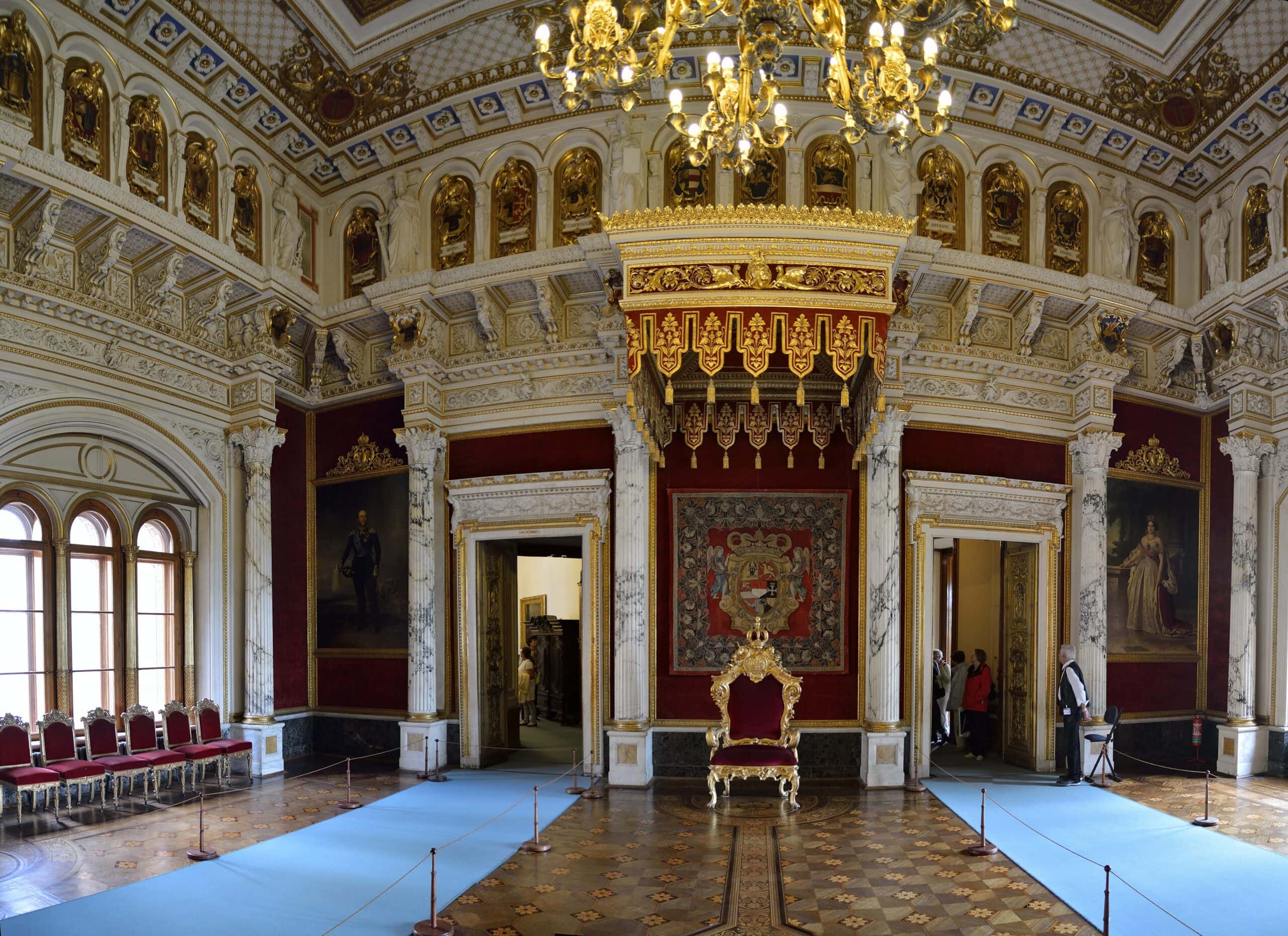
The Schlossmuseum’s permanent route in 2026 leads visitors through three principal spaces. First is the Thronsaal, the throne room rebuilt as part of the Demmler-Stüler program and unmistakably the room most visitors come to see, its walls clad in white-and-gold neo-Renaissance ornament, the gilded throne set beneath a red canopy, the upper gallery encircled by carved coats of arms representing the Mecklenburg-Schwerin towns and territories. Second is the Ahnengalerie, the Ancestor Gallery, hung with portraits of the grand-ducal line according to the genealogical scheme designed by Lisch in the 1840s. Third is the Schlosskirche, the Renaissance chapel of 1563 with its later Neo-Gothic choir added by Ernst Friedrich Zwirner during the nineteenth-century rebuild. The former Goldener Saal (gutted in the 1913 fire and rebuilt over the following decades) now serves as the Landtag’s plenary chamber, completed in its current form in 2017 by the Munich architectural firm Dannheimer & Joos. Entry tickets and local tours can also be booked in advance through GetYourGuide.
Grounds are open in two distinct experiences. The Burggarten, the small walled terrace garden on the castle island itself, is intimate and formal and best appreciated slowly; the Grotte, an artificial grotto built in 1852 from Raben Steinfeld granite, is its most photographed feature. The Schlossgarten, the larger Baroque park reached across the southern bridge, is a different proposition entirely: Jean Laurent Legeay’s mid-eighteenth-century reorganization of an older formal layout, with the Kreuzkanal at its center and Lenné’s nineteenth-century interventions adding pergola walks and the Schlossgartenpavillon. Allow two hours for the Schlossgarten alone.
The Schlossmuseum is open Tuesday through Sunday, 10 a.m. to 6 p.m. from April 15 through October 14, and 10 a.m. to 5 p.m. from October 15 through April 14; last admission is thirty minutes before closing, and the museum is closed Mondays. The Schlossgarten remains open year-round and the Burggarten until dusk. Schwerin Hauptbahnhof is a twenty-minute walk from the castle through the old town. Direct trains run from Hamburg in just over an hour and from Berlin in two hours. Confirm holiday-period adjustments and current ticket pricing at mv-schloesser.de before traveling. Anyone staying overnight can compare hotels in and around Schwerin.
Some links on this page are affiliate links, which means StoneKeep Atlas may earn a small commission, at no extra cost to you, if you book through them.
Beyond Schwerin — the World Heritage Ensemble
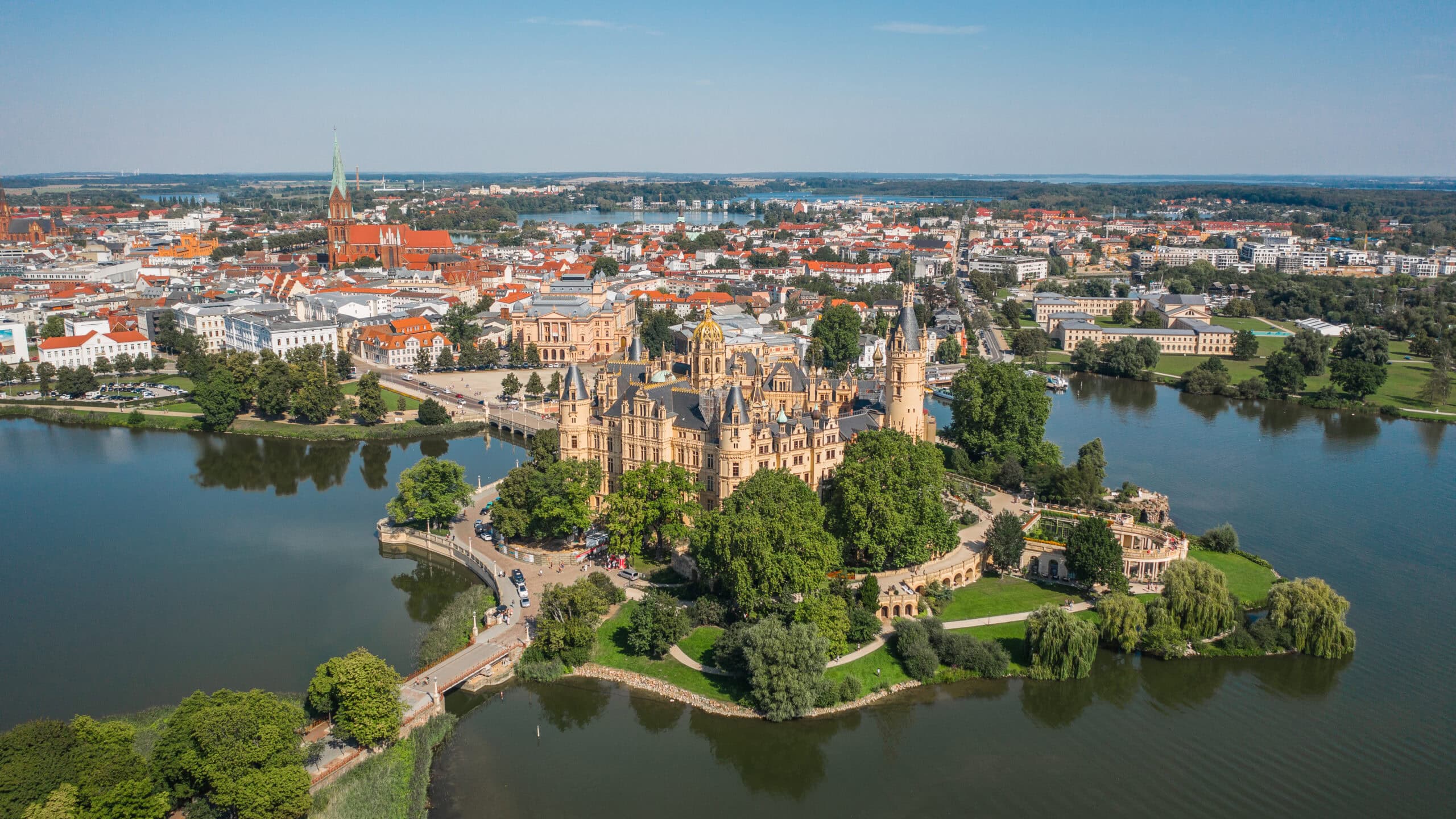
What UNESCO inscribed in July 2024 was not the castle alone but the Schwerin Residence Ensemble: thirty-eight buildings and gardens covering the historic core of the city, with a buffer zone of nearly twenty-seven square kilometers extending into the surrounding lake landscape. The inscription was made under Criterion (iv): the ensemble represents an outstanding example of an architectural and landscape composition illustrating a significant stage in human history. The significant stage in question is the planned nineteenth-century princely capital: a coordinated program of court, civic, and cultural architecture conceived as a single composition.
Four buildings and one landscape define the ensemble beyond the castle itself. The Mecklenburgisches Staatstheater, completed in 1886 in a confident neo-Renaissance idiom, faces the castle across the Alter Garten and was conceived as part of the same residential program rather than as a separate civic project. The Marstall (the grand-ducal stables, now home to the Mecklenburg State Library) closes the western flank of the same square. The Alter Garten itself, the formal plaza linking these buildings, is the ceremonial heart of the ensemble. The Schlossgarten and Burggarten, with their nested formal-and-Romantic landscape design, anchor the south. And the Schweriner Dom (the Cathedral) anchors the north.
Cathedral merits more than a passing reference. Founded in 1171 by Henry the Lion in the same wave of Christian institutional consolidation that ended Niklot’s resistance, with the foundation stone of the stone Romanesque structure laid in 1172, the present brick-Gothic cathedral was begun in 1270 and completed across a 146-year construction campaign that ended in 1416. The west tower is later still: at 117.5 meters, it is the tallest church spire in Mecklenburg-Vorpommern, built between 1889 and 1893 to designs by the master builder Georg Daniel as a Neo-Gothic addition replacing an earlier modest structure. Inside, the Cathedral preserves an extraordinary bronze baptismal font of 1325, a fifteenth-century carved high altar, the triumphal cross of 1420, the funerary monuments of the Mecklenburg dukes who built the place, and, installed in recent years, the deep blue stained-glass windows designed by Günther Uecker (1930–2025), one of the artist’s last completed works. The relationship between Cathedral and Castle (across the water, across nine hundred years, the spiritual and the temporal seats of Mecklenburg authority answering each other across the Burgsee) is the ensemble’s deepest and most revealing axis. To stand in the Cathedral nave and then walk to the Castle’s Thronsaal is to traverse the full arc of how Mecklenburg understood itself as a polity: founded in the violence of 1160, legitimized through the Cathedral’s twelfth-century consecration, ennobled through the dynasty’s centuries of presence, and finally recognized by UNESCO in 2024 as a single coherent architectural-political testament.
The Schwerin inscription places the castle and its ensemble in the company of other German princely-residence sites recognized by UNESCO: the Würzburg Residence (inscribed 1981), Wartburg Castle (1999), and the Palaces and Parks of Potsdam and Berlin (inscribed 1990). Each illustrates a different model of European princely culture; Schwerin’s particular contribution is the integration of Romantic-Historicist architecture into a coherent and intact urban-landscape composition. Visitors to the ensemble can experience all of it on foot. A full day is the right minimum. For travelers building a wider German-castle itinerary, Schwerin sits naturally alongside the country’s other great heritage castles and within the broader landscape of northern German residences.
Schwerin’s 1845–1857 Loire-French rebuild is one of the canonical case studies in The 19th-Century Romantic Revival of German Castles, which treats Georg Adolf Demmler’s Schinkel-pupil pedagogy and the program’s stylistic breadth (from the Burgenromantik Gothic of Stolzenfels and Hohenzollern to Schwerin’s French Renaissance) as the defining accomplishment of the era.
Conclusion
What UNESCO recognized in 2024 was not a single building but a thousand-year continuity: political authority anchored to one lake-island, transmitted from Slavic Obotrite to Mecklenburg duke to grand-ducal heir to elected parliament without ever crossing a horizon. Few European castles can claim that particular kind of permanence. Schwerin’s gilded dome catches the same morning light over the Burgsee that Pribislaw’s timber palisade caught more than eight centuries ago, and the Landtag of Mecklenburg-Vorpommern still meets here, in the rebuilt rooms of a French-Renaissance dream, to govern the descendants of everyone who ever held the island. Most striking about Schwerin Castle is not what was preserved but what was never interrupted. Schwerin also closes, fittingly, our south-to-north tour of the fairytale castles in Germany.
Schwerin’s survival of the Thirty Years’ War with its sixteenth-century Renaissance core intact (the Neues Langes Haus of 1553–55 and Mecklenburg’s formal adoption of the Reformation in 1549) is set within the confessional century in The Reformation and the Castle: Wartburg, Luther, and the Protestant Princes, where the residence anchors the Lutheran case.
Principal Sources
- Erste Schweriner Welterbetagung. Tagungsband: Erste Schweriner Welterbetagung 22.–23. Oktober 2015. Schwerin: Landeshauptstadt Schwerin, 2016.
- Frost, Andreas. Sammler, Forscher, Kitakinder: Die Nutzung des Schweriner Schlosses seit 1913. 2nd ed. Schwerin: Landtag Mecklenburg-Vorpommern, 2023.
- Holtzmann, Robert, ed. Die Chronik des Bischofs Thietmar von Merseburg und ihre Korveier Überarbeitung. Monumenta Germaniae Historica, Scriptores rerum Germanicarum, Nova Series 9. Berlin: Weidmann, 1935.
- Landesamt für Kultur und Denkmalpflege Mecklenburg-Vorpommern, Landesarchäologie. “Slawischer Burgwall unter dem Schweriner Schloss.” kulturwerte-mv.de.
- Landtag Mecklenburg-Vorpommern. “Schloss.” landtag-mv.de.
- Lisch, Georg Christian Friedrich. Geschichte der fürstlichen Residenz-Schlösser zu Wismar, Schwerin und Gadebusch. Schwerin: mid-nineteenth century.
- Lisch, Georg Christian Friedrich, ed. Jahrbücher des Vereins für mecklenburgische Geschichte und Alterthumskunde. Schwerin: Verein für mecklenburgische Geschichte und Altertumskunde, 1836–1883.
- Staatliche Schlösser, Gärten und Kunstsammlungen Mecklenburg-Vorpommern. “Schloss Schwerin.” mv-schloesser.de.
- Stüler, Friedrich August. Das Schloss zu Schwerin. Berlin: Ernst & Korn, 1869.
- UNESCO World Heritage Centre. “Schwerin Residence Ensemble.” Inscription documentation, July 27, 2024. whc.unesco.org.
- Warner, David A., trans. Ottonian Germany: The Chronicon of Thietmar of Merseburg. Manchester: Manchester University Press, 2001.
- Welterbe Schwerin. “Residenzensemble Schwerin.” schwerinworldheritage.de.
Schwerin Castle is operated by the Staatliche Schlösser, Gärten und Kunstsammlungen Mecklenburg-Vorpommern; the parliamentary spaces are administered by the Landtag Mecklenburg-Vorpommern.
Image credits. Featured image: Adobe Stock. Aerial view of Schwerin Castle from the east: Carsten Steger, CC BY-SA 4.0, via Wikimedia Commons. Schwerin Castle in 1653 (engraving): Matthäus Merian, public domain, via Wikimedia Commons. Schwerin from the castle, 1842 (lithograph): J. G. Tiedemann’sche Hof-Steindruckerei, public domain, via Wikimedia Commons. Castle dome detail: Photo by Martti Salmi on Unsplash. Schwerin Castle and the frozen Burgsee: Matthias Bethke, CC BY-SA 4.0, via Wikimedia Commons. The Throne Room: HasBS, CC BY-SA 4.0, via Wikimedia Commons. Aerial view of the Schwerin Residence Ensemble: Envato Elements. Schlossgarten in autumn: Photo by Oleksandr Parfeniuk on Unsplash. Freely licensed images are resized to fit; otherwise unaltered.