
Château de Caen
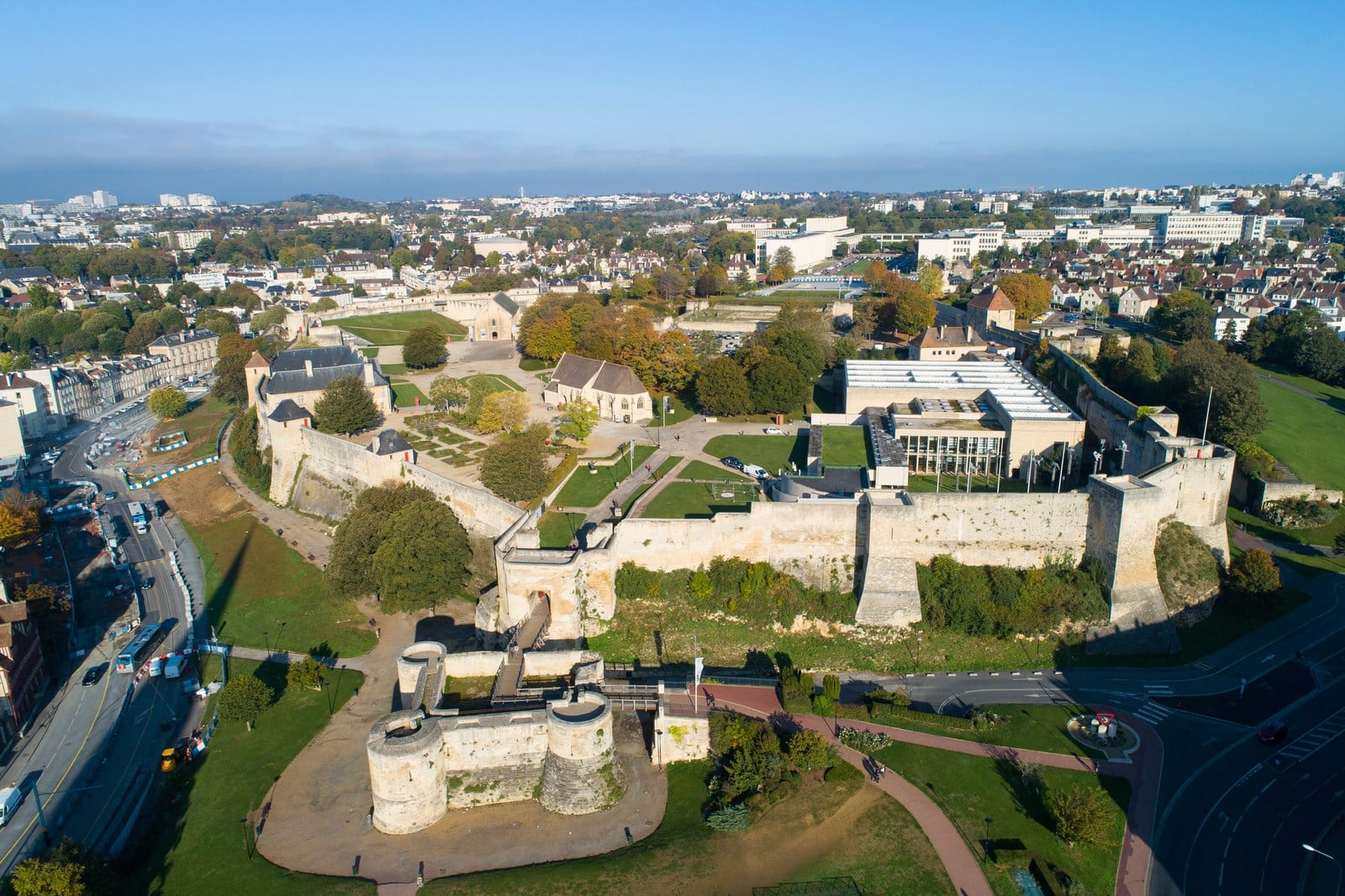
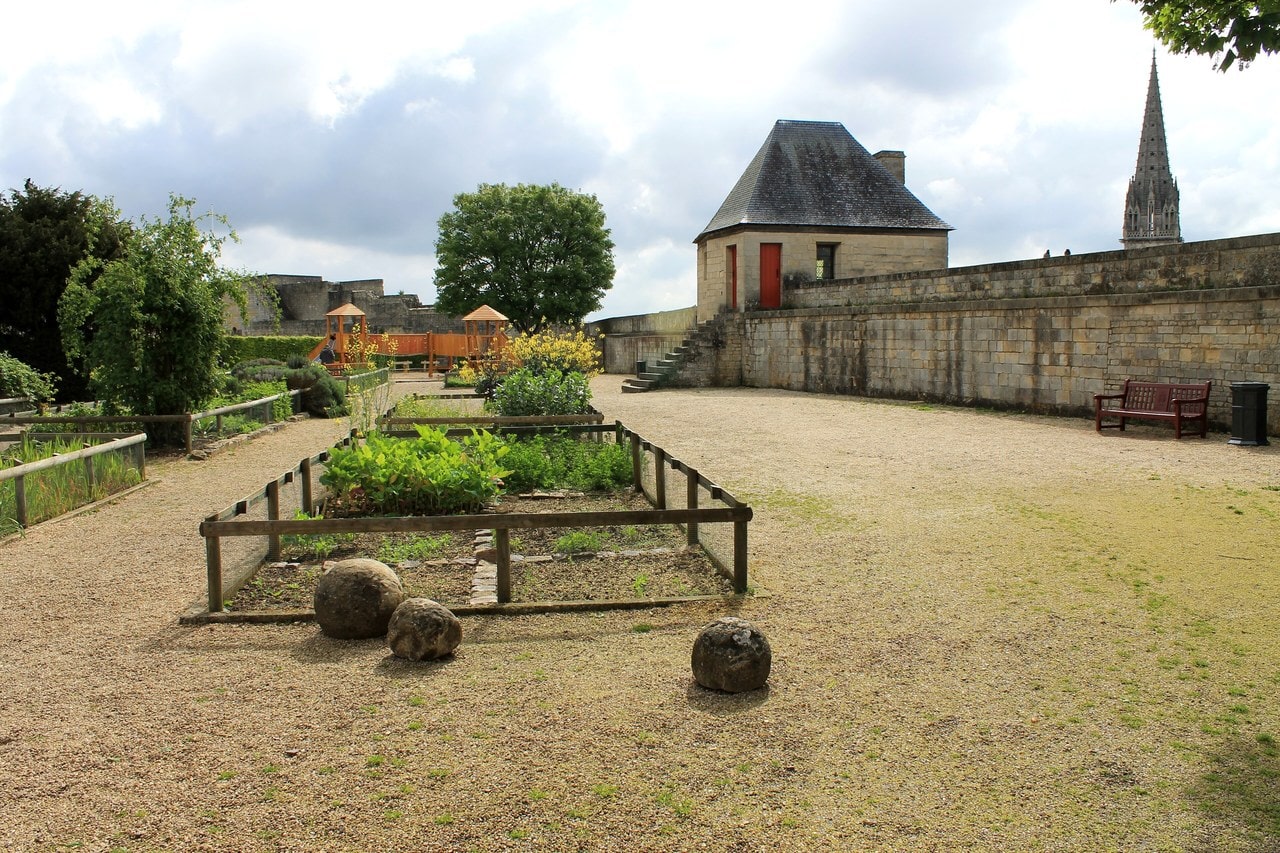
The Château de Caen is one of the few great fortresses of northern France you can walk into without paying anything, and the scale of what is inside is the first surprise. More than eight hundred meters of rampart enclose roughly five hectares in the middle of the city, most of it open ground. Inside that circuit sit two museums, a parish church with a Romanesque core, a garden of medicinal plants, the excavated footprint of a great tower, and a Romanesque hall that has been called by the wrong name since 1840.
William, Duke of Normandy, founded the castle about 1060, six years before he sailed for England. Most of what a visitor walks past came later. His son Henry I raised the great tower; Philip Augustus wrapped it in a stone jacket after the duchy fell to France in 1204; an English garrison that did not trust the town built the barbicans; and a nineteenth-century army turned the governor’s lodging into offices before the bombing of 1944 took much of it away again.
That layering is the reason the castle rewards an hour more than its guidebook line suggests. It is also why the museum that runs the site keeps saying, in four separate places, what it does not know.
Quick Facts
| Location | Caen, Calvados, Normandy, France |
|---|---|
| Built | About 1060 |
| Built for | William, Duke of Normandy, later William the Conqueror |
| Architectural style | Romanesque, with later medieval, artillery-period and modern work |
| Castle type | Walled urban enclosure castle (enceinte) |
| Condition | Standing ramparts and gates; the great tower survives as excavated footings |
| Owner / managed by | Ville de Caen; the Musée de Normandie runs the site |
| Protection | Classé monument historique, 10 April 1997 |
| Nearest town & station | Caen; Caen station, five tram stops (T1 or T3 to Château Quatrans) |
| Open to public | Yes, all year. The enclosure is free |
| Official website | musee-de-normandie.caen.fr |
History
A ducal castle, about 1060
Three authorities date the foundation, and all three hedge it. The museum, the French national monuments record and a reviewer in the Bulletin Monumental all write vers 1060, and none of them names a founding document. What is clear is the moment: William was Duke of Normandy, not yet king of anything, and Caen was a town he was building up rather than one he had inherited as a capital. He founded the two great abbeys here in the same period, and he was buried in one of them in 1087.
The castle went up on a rocky spur above the Orne, which is why the enclosure has the shape it has. Rampart follows rock.
What William built was plainer than the circuit a visitor walks today. On the Darnetal spur, excavation found a single stone enclosure with no flanking towers on its wall, entered from the north through a rectangular gate-tower. Towers, barbicans and gun-ports all belong to people who came later, which is worth holding onto: almost nothing you can touch here was standing when the duke who founded it was alive.
What the Anglo-Norman kings made of it
The extent that impresses a modern visitor is not William’s. The museum credits it to his successors, and dates them: the dukes of Normandy who were also kings of England, 1066 to 1204. It calls the result one of the largest fortified enclosures in Europe. That is the museum’s own English wording, and it should be repeated carefully, because the museum never says what it is comparing against. A reviewer in the Bulletin Monumental did state a scope: writing in 1979, Jean Mesqui placed Caen among the largest fortified sites surviving in France.
Henry I raised the great tower about 1120. Nothing of it stands.
1204, and the end of ducal Normandy
Caen surrendered in May 1204 to Philip Augustus, king of France. No siege, no assault. The city’s own account of the year gives the month and not the day, and it does not connect the surrender to the fall of Château Gaillard earlier the same year.
Both things are true and they sit side by side: Château Gaillard, upriver, fell in March after a siege of months; Caen gave up in May without one.
Five years later the city lost its commune, and the king installed a bailli to run Caen for him.
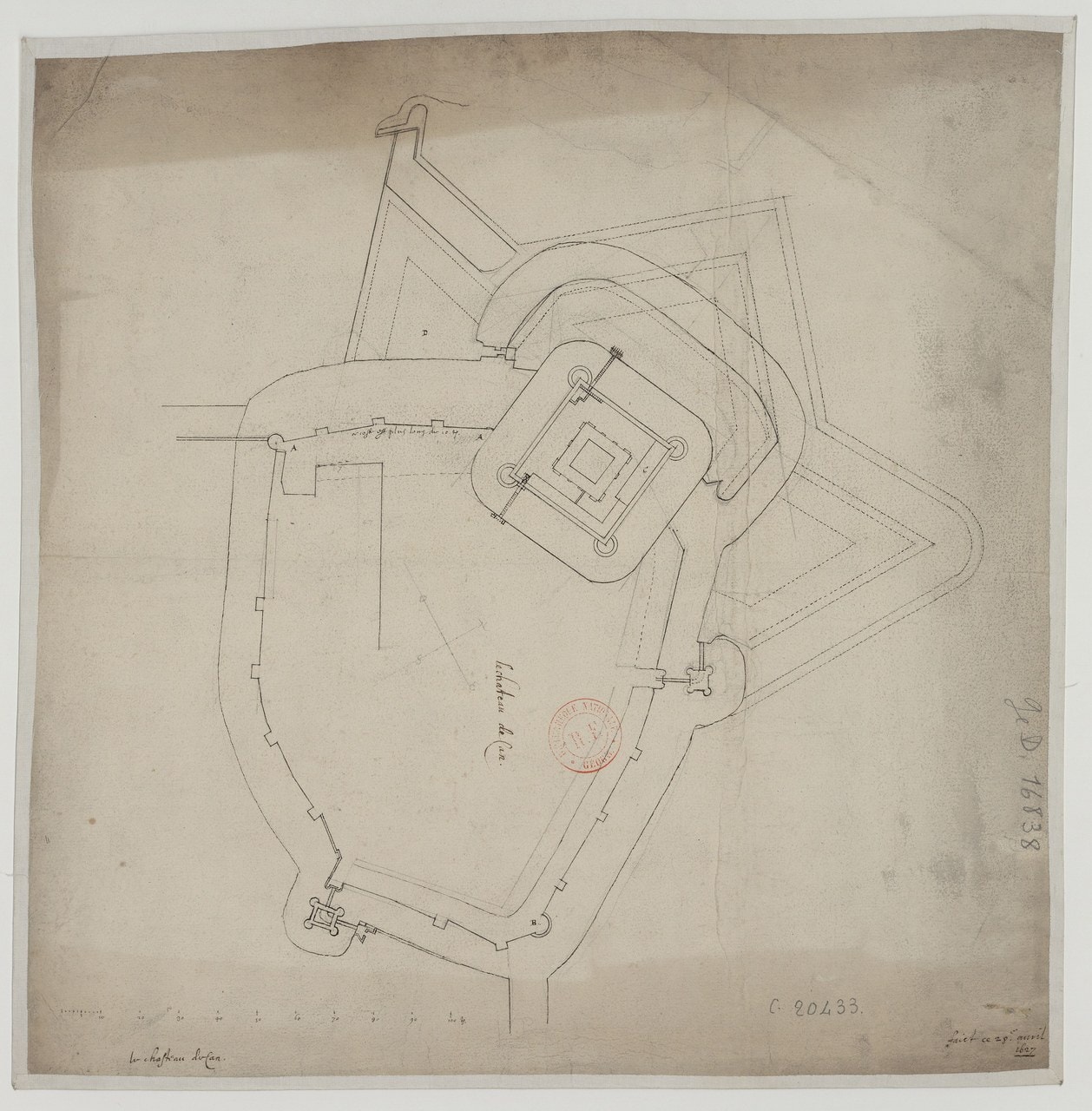
Philip Augustus also did something that survives. He wrapped Henry’s tower in a chemise, a lower stone jacket flanked by four round corner towers and edged with ditches. That jacket is the outline you look down into today.
1346: the town, not the castle
Edward III’s chevauchée reached Caen in 1346, and the town was besieged, burned and sacked. What happened at the castle is a different question, and the honest answer is that we could not source it. The date returns nothing across ninety-two operator and city documents, and the accounts in circulation of a castle holding out under a named commander trace back to fan wikis rather than to a chronicle. Silence in those documents is not evidence that the castle held. It is an absence of evidence either way.
1417 to 1450: the garrison that watched its own town
Here the record is dense, consistent and mostly ignored. On 19 September 1417 the keys of the castle were handed to Henry V, king of England, and an English garrison held Caen for thirty-three years. More of what a visitor walks past belongs to that garrison than to anyone else.
They built the barbican at the Porte Saint-Pierre, and the museum is unusually direct about why: to protect the fortress from a population they mistrusted. A barbican normally faces an enemy approaching from outside. This one faces the town.
About 1440 they raised a gun tower at the north-west, with six firing chambers cut for artillery. It picked up the name Tour de la Reine Mathilde long afterward, and that name is a tradition rather than a description: Matilda died in 1083, three and a half centuries before the masons arrived.
A university was founded in 1432, during the occupation and in the city rather than in the castle. Charles VII besieged Caen in 1450 and took the castle back after his victory at Formigny, in that order.
Barracks, decree and demolition
From the sixteenth century the castle was a governor’s seat and then, increasingly, a garrison. The Silly family held it from 1491, and their arms still date the choir vaults and the governor’s chapel at Saint-Georges.
On 2 August 1793 the Convention decreed the destruction of the whole castle. In practice only the great tower and the Porte Saint-Pierre were damaged. Demolition of the tower was finished much later: the last of it was blown up early in the nineteenth century, about 1815, to clear ground for a powder magazine.
The nineteenth century turned the governor’s lodging into military offices, and two infantry regiments arrived in 1875. A war memorial stands in the enclosure today, unveiled in the 1960s and associated with Général Pierre Koenig, who lived from 1898 to 1970.
1944, and what came after
Allied bombing in 1944 struck the castle hard. The hall was badly damaged, the governor’s lodging was wrecked, and the destruction of the surrounding quarter exposed the castle in a way no earlier century had.
Here is the part that turns a war story into an argument about the castle. Nineteenth-century barracks and a dense quarter of houses had buried the medieval site for generations. Bombing removed them, and what it uncovered was excavated rather than rebuilt over: the decision to make the enclosure a precinct of museums was taken in 1947, Michel de Boüard dug the castle from the 1950s, and the Musée de Normandie opened in the governor’s lodging in 1963. The excavators of 1956 had to locate the keep first, because every trace of it at the surface had gone.
So the medieval castle is visible today largely because of the destruction of 1944. A visitor walking the open enclosure is walking through a clearance, not through a survival.
The Salle de l’Échiquier, and the Name It Was Given in 1840
One building here carries more unresolved argument than the rest of the castle together, and it is the one every visitor photographs.
The name is a nineteenth-century mistake
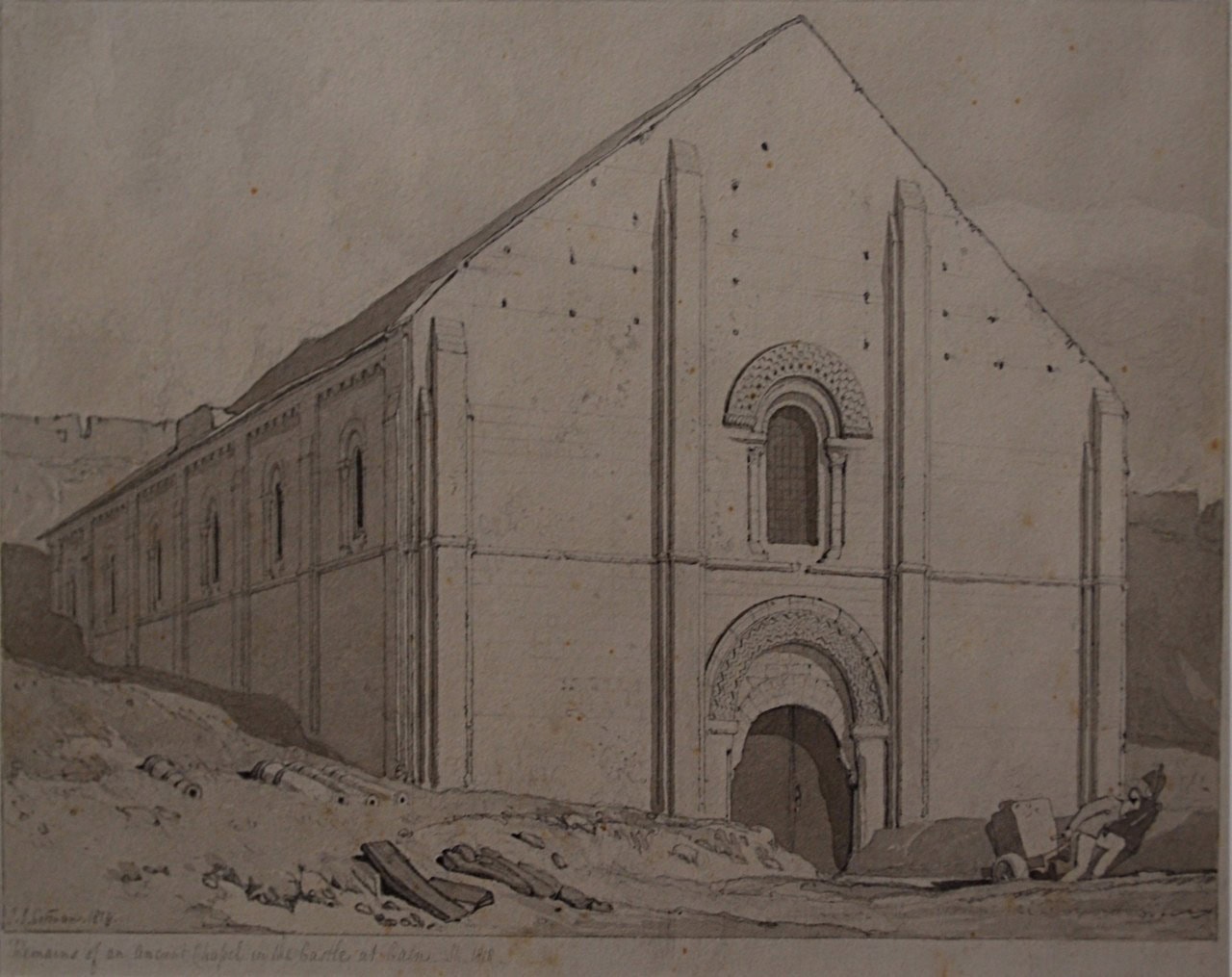
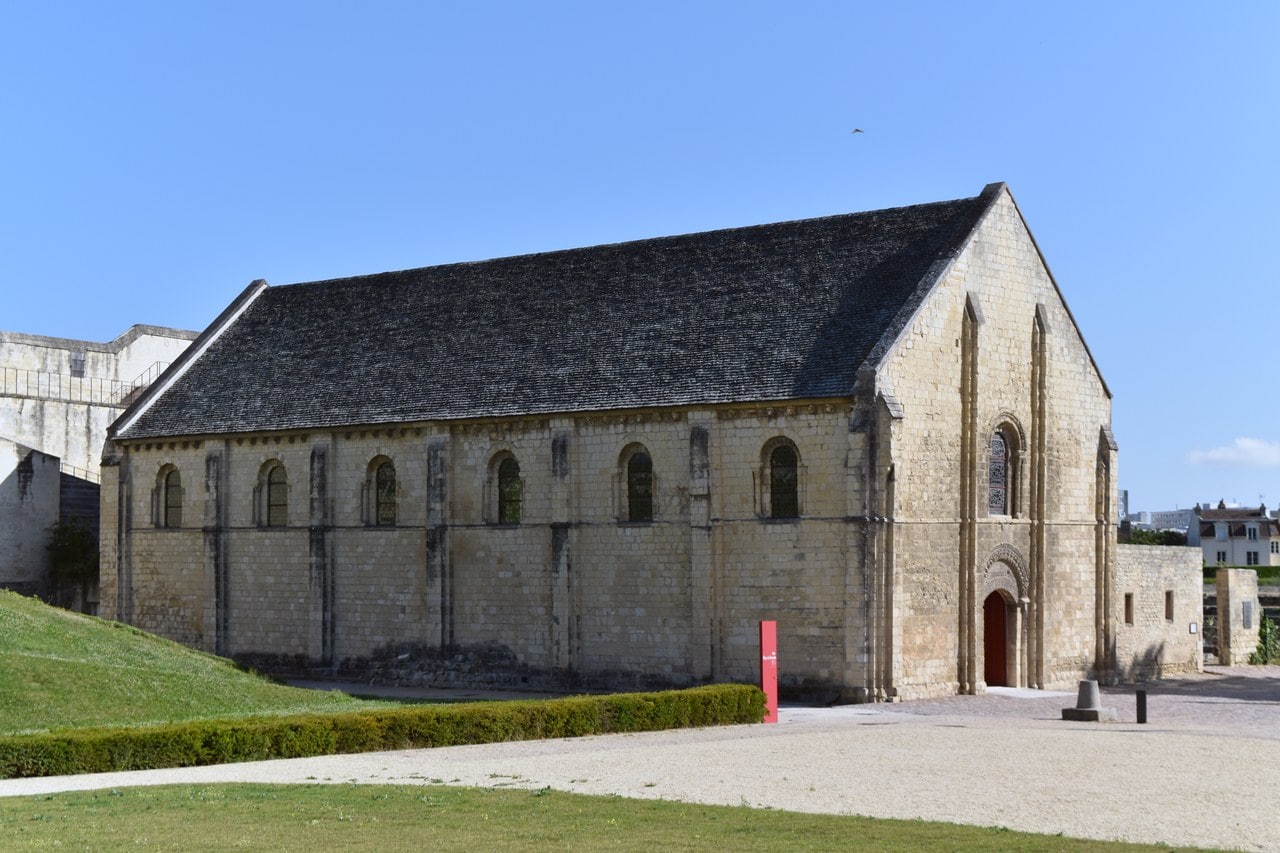
The hall has been called the Salle de l’Échiquier only since 1840. Writing in the Bulletin Monumental in 1967, Francis Salet called the name wrong even then. Ville de Caen’s own scholarly account agrees independently: the building received the name in the nineteenth century, in reference to the duke-king’s judicial and financial assemblies.
Salet’s own reason for calling the name wrong is that in the twelfth century, when the hall was built, the Exchequer of Normandy had no fixed seat: it met most often in a chapel of Saint George inside the castle, and only sometimes in the hall that now carries its name.
Which chapel of Saint George is a question the source does not answer. Caen’s castle has two dedications to the saint: a palatine chapel with a flat east end, now foundations in the archaeological garden of the Vieux Palais, and the parish church with a semicircular Romanesque apse that still stands and is free to enter. Salet does not say which he means, and the church’s own operator page does not mention the Exchequer at all.
Earlier documents call the building the salle du tynel in the fourteenth century and simply le Palais in the fifteenth. By the eighteenth it was the Arsenal, an artillery store.
When it was built is still argued
The hall’s date is unsettled, and the split is lopsided: the museum stands alone on about 1098, while the national record, the city’s scholarly site and the review literature all point to Henry I in the early twelfth century.
The museum that runs the castle puts the hall at about 1098 and connects it with the court of William Rufus, king of England. The French national monuments record dates it about 1120, with the keep, to his brother Henry I. And Michel de Boüard, who dug the site, argued for the first half of the twelfth century under Henry I, on the grounds that the excavation found no substructure of William the Conqueror’s time beneath it.
Salet put that dating as a judgment rather than a determination: there is every reason to think, he wrote, that the hall went up in the first half of the twelfth century.
The room you walk into is a 1962 restoration
The museum describes it as a unique example of a Romanesque reception hall and great lord’s residence, and makes no geographical comparison in doing so.
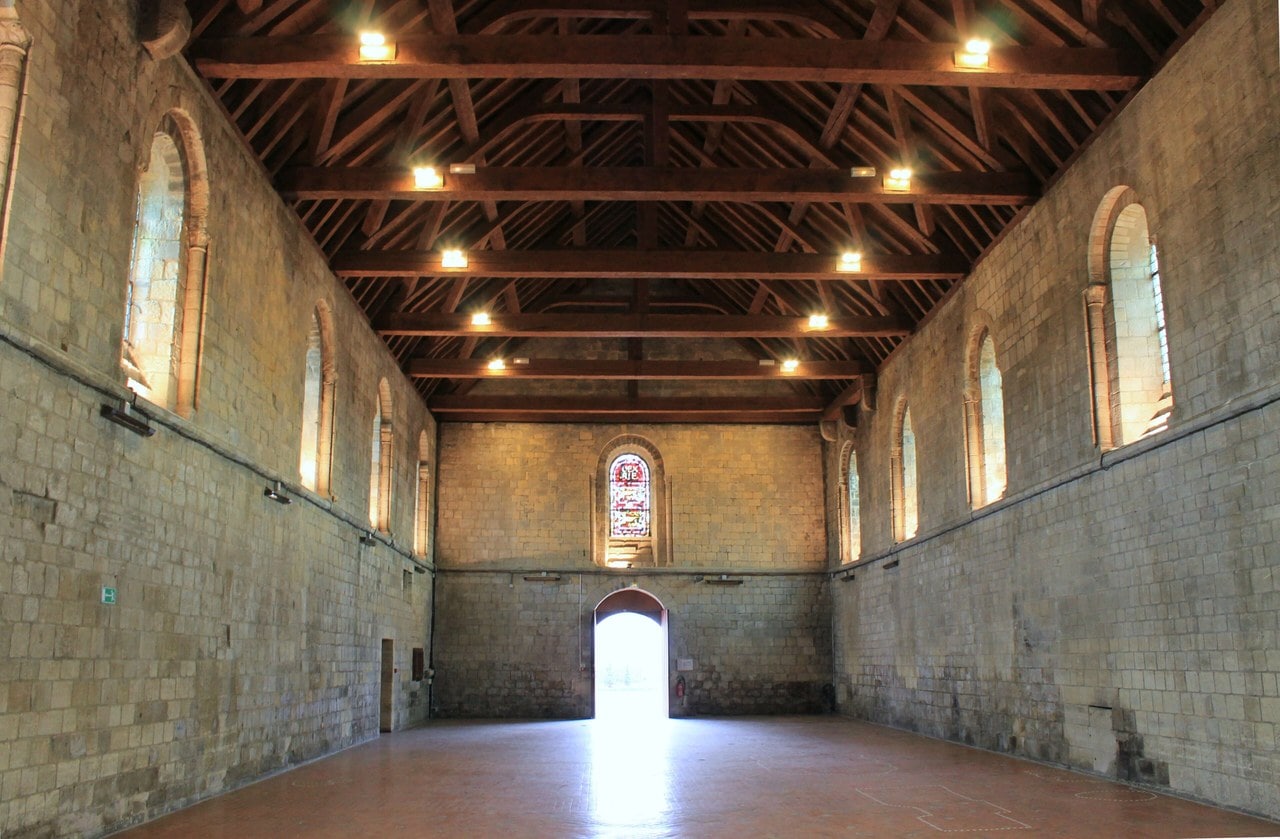
What survives of the hall is roughly 30.7 meters by 11. What you stand in was restored in 1962 to present a single open volume, lit by Romanesque windows at first-floor level that were reconstituted from the surviving wall fragments. The roof and its frame follow archaeological observation. The tiled floor is an interpretation of a late state of a floor that was beaten earth in the twelfth century.
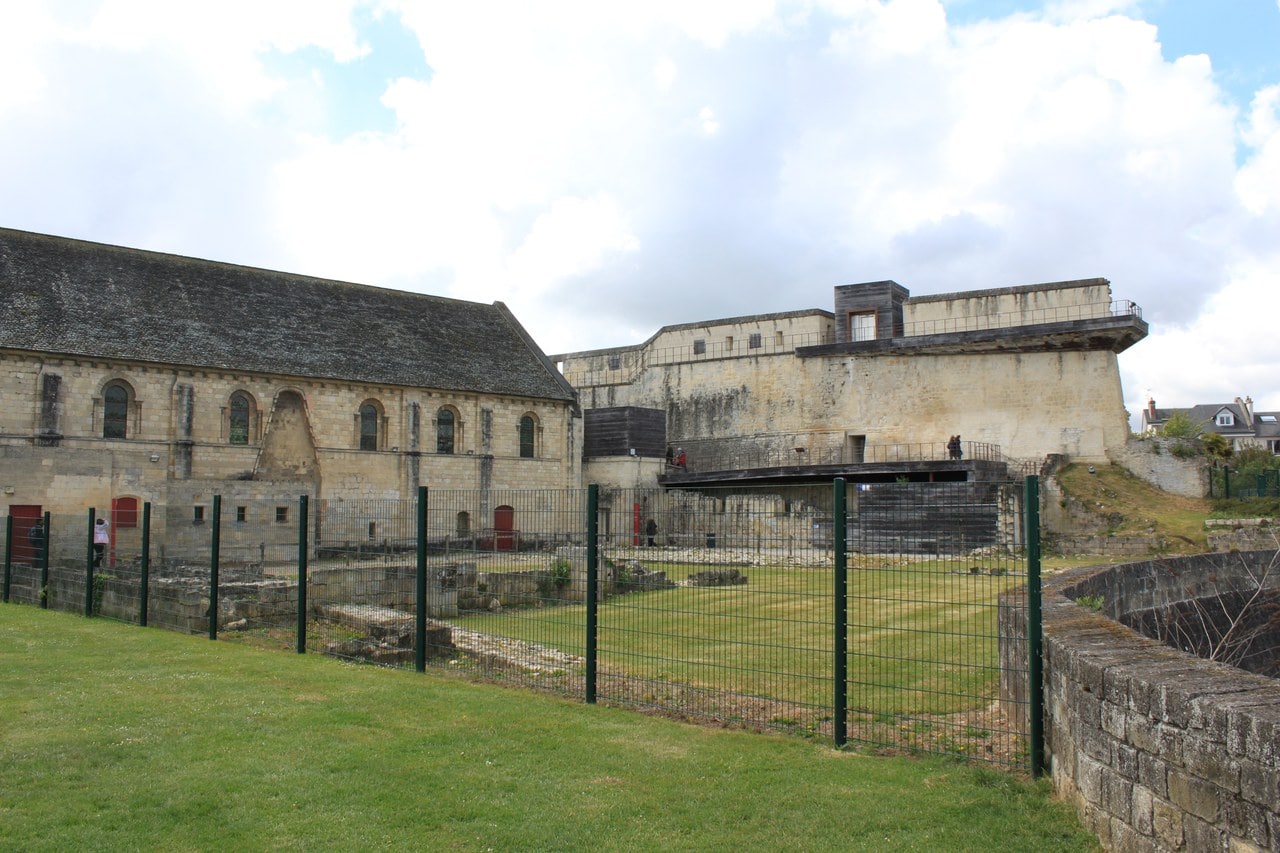
And the restoration takes a side. How the hall was arranged inside is still argued: de Boüard read the building as two levels, Salet disputed that in print in 1967, Ville de Caen’s scholarly site still prints the two-level reading as fact, and the room as rebuilt presents a single one. A visitor standing in it is standing inside somebody’s answer. For an English reader the obvious comparison is Westminster Hall.
Ville de Caen’s account calls it the oldest and best-preserved hall of its kind on the Continent, and says so precisely because surviving examples of the type are known mainly from England.
Architecture
Read the castle as a circuit with buildings inside it rather than as a building. What follows works around the operator’s own numbered plan, and separates what survives from what does not.
The great tower: what is actually there
Henry I Beauclerc raised a stone donjon about 1120, roughly 27 meters square in plan.
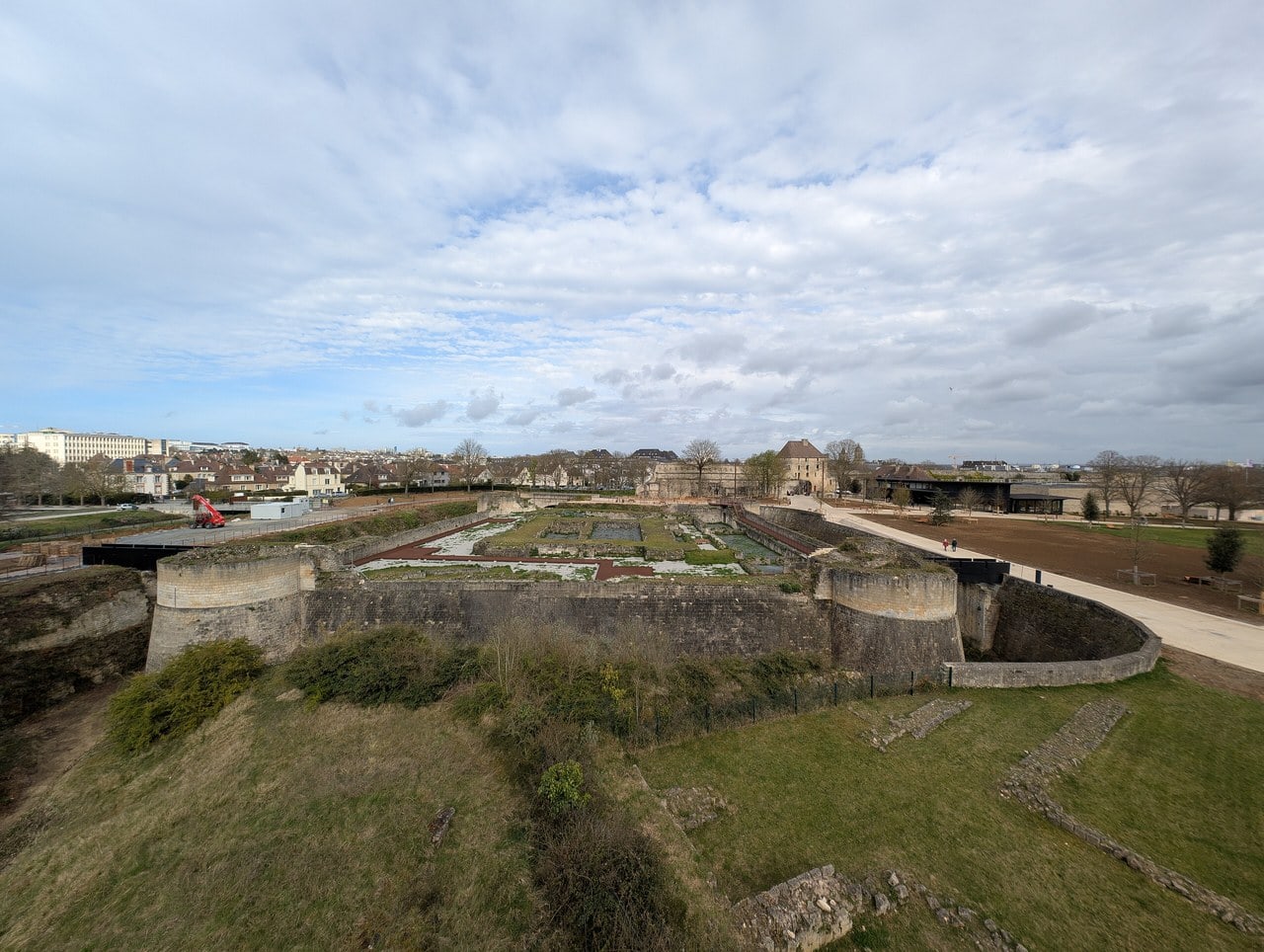
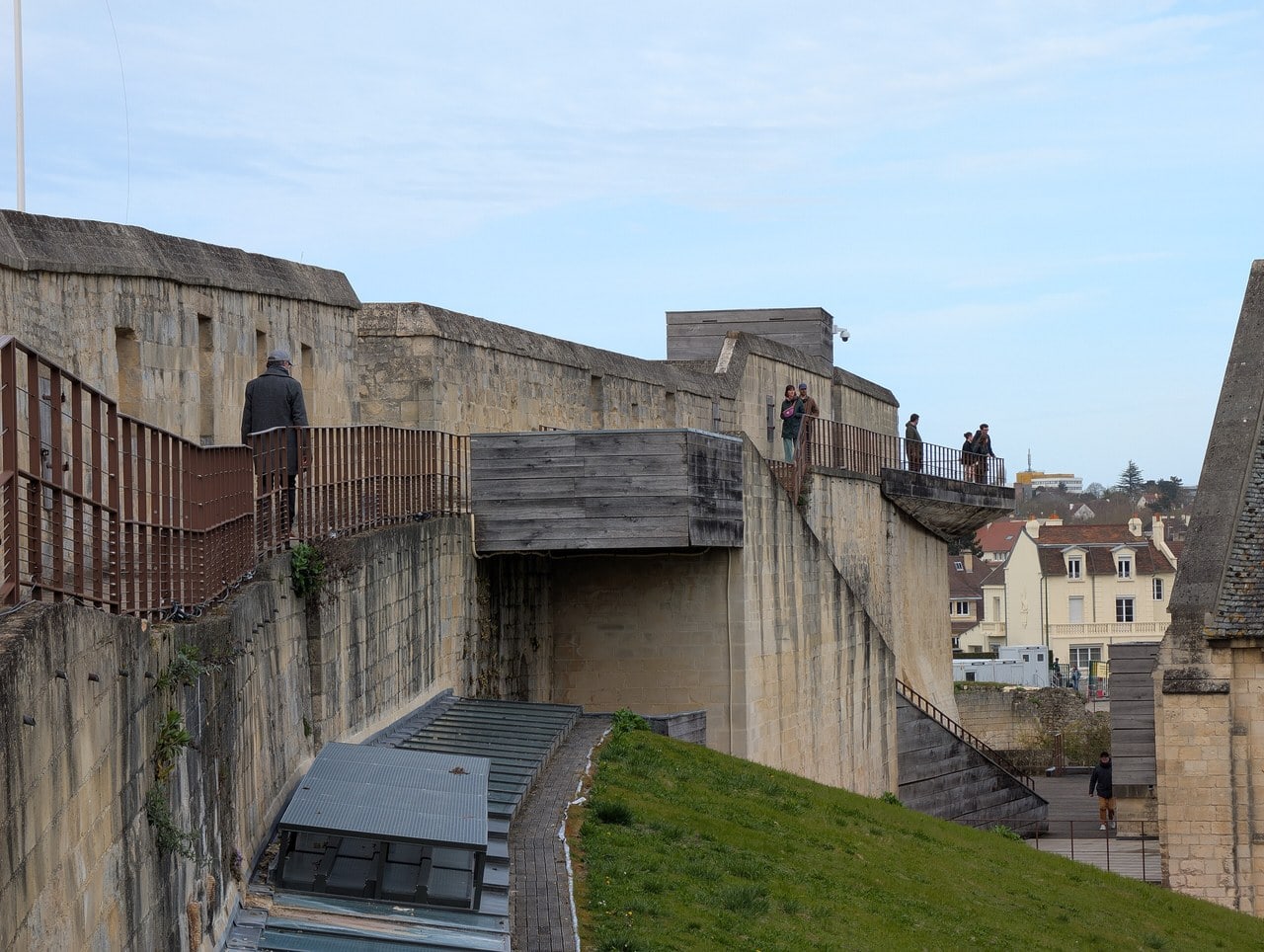
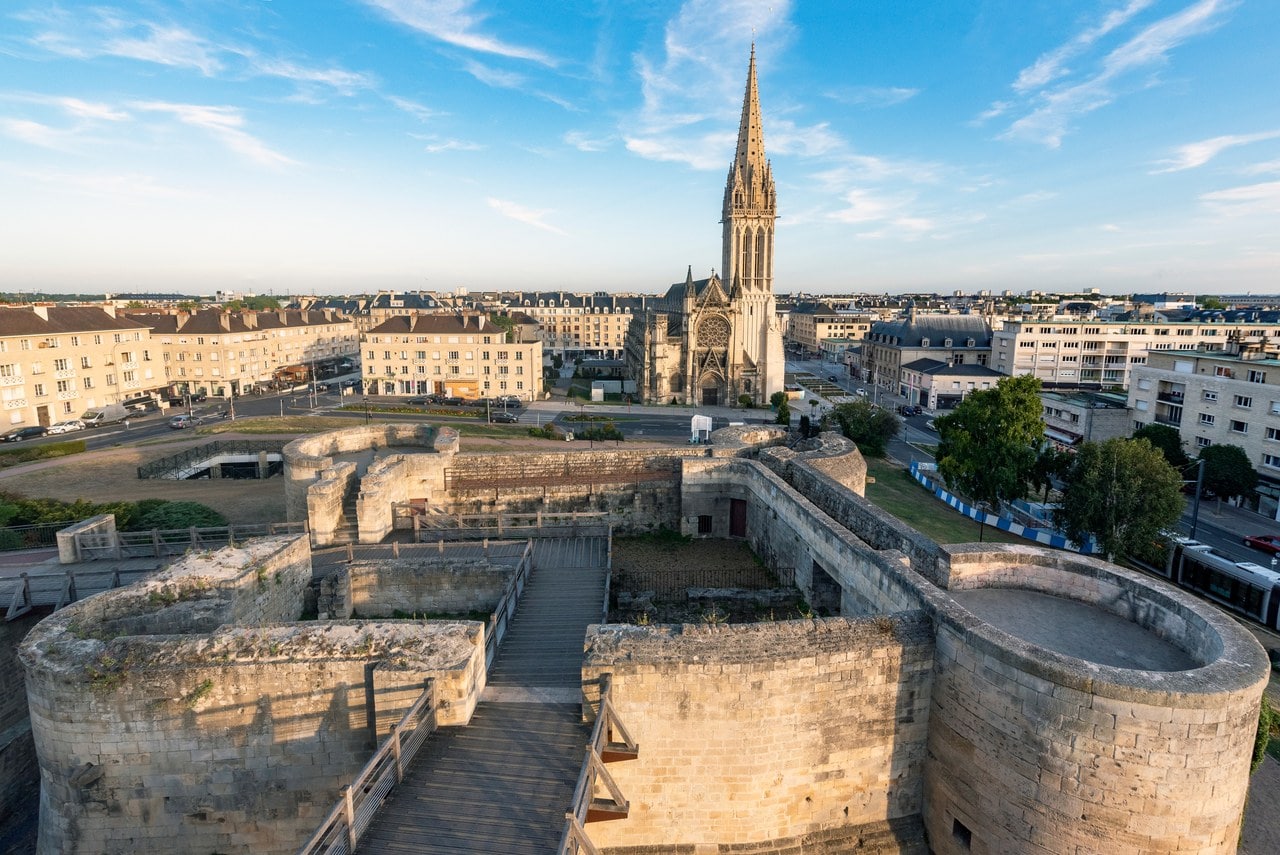
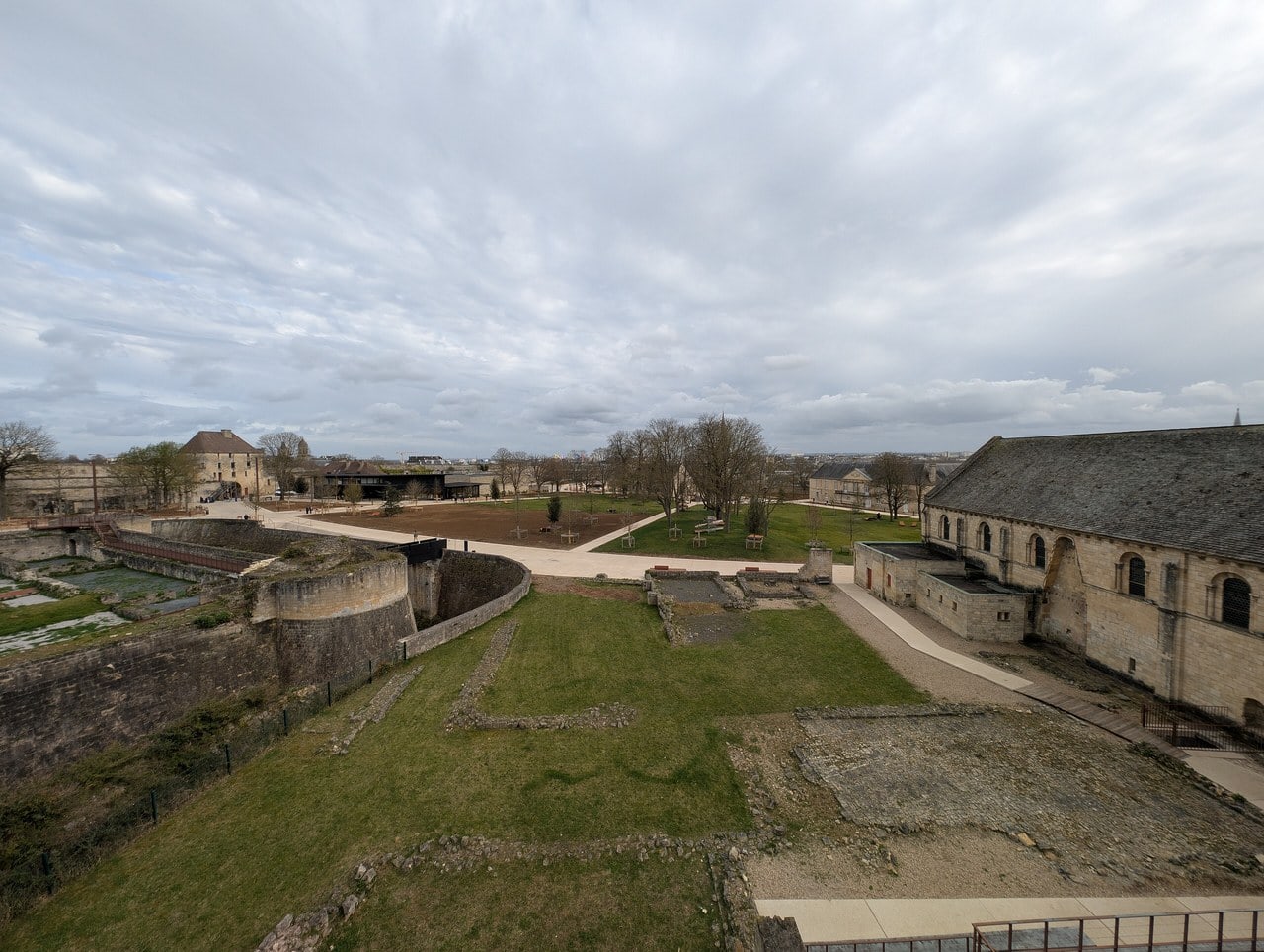
Nothing of it stands above ground. The national record’s word for what happened to it is arasé, levelled. What you see from the belvedere on the restored rampart is a plan on the ground: the footings of the tower, and around them the four round corner towers of Philip Augustus’s chemise, the stone jacket he built after 1204.
The museum is explicit about the limit of its own knowledge here: the historical documentation and the archaeology do not allow a reconstruction of the destroyed building to be proposed. There is no drawing on the panel showing you what it looked like, because nobody can honestly make one.
The circuit
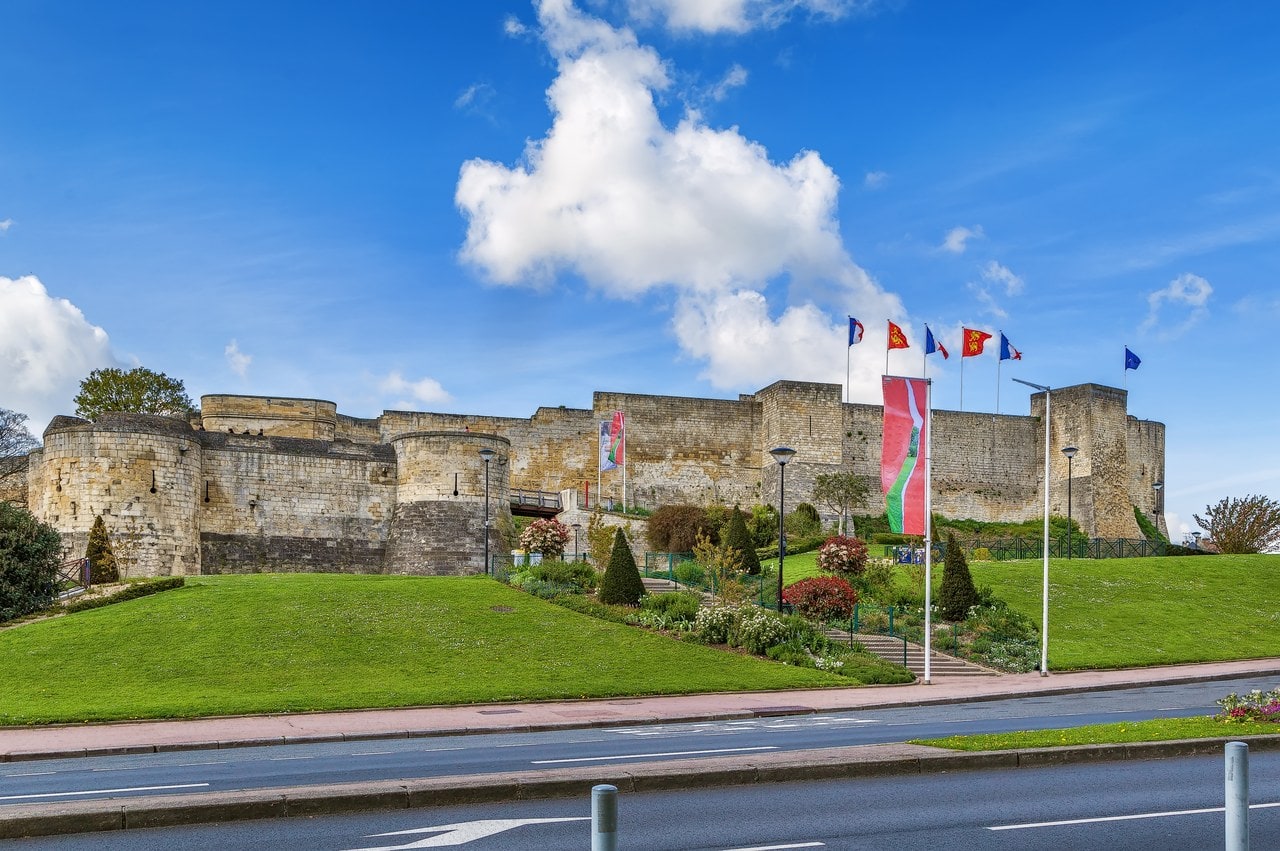
More than eight hundred meters of rampart enclose roughly five hectares. The museum calls that one of the largest fortified enclosures in Europe, crediting the extent to the Anglo-Norman kings rather than to William. Jean Mesqui, reviewing in the Bulletin Monumental in 1979, gave the comparison a stated scope and placed Caen among the largest fortified sites surviving in France, alongside Gisors, Château Gaillard and Falaise.
Both statements are quoted rather than adopted, and the museum has not counted.
The two gates, and why one of them is not medieval
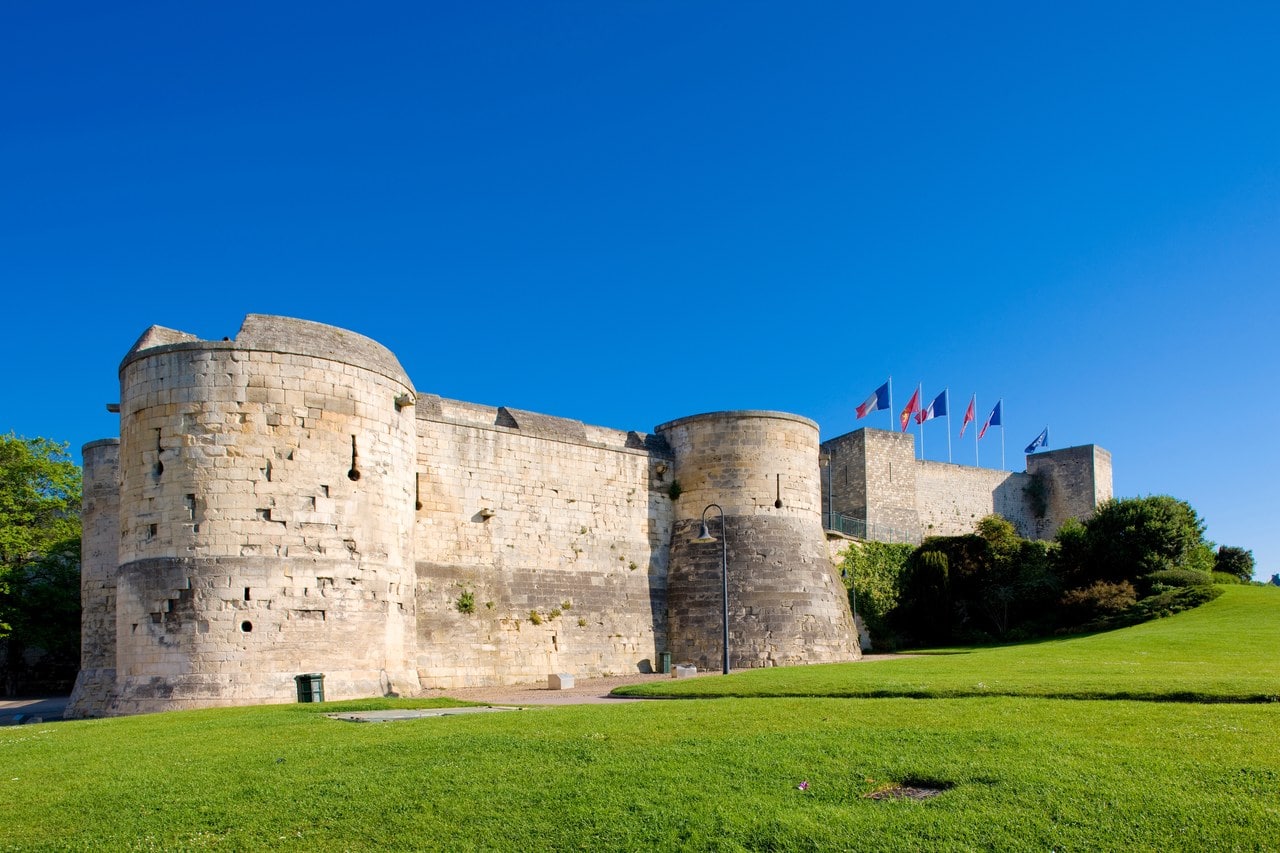
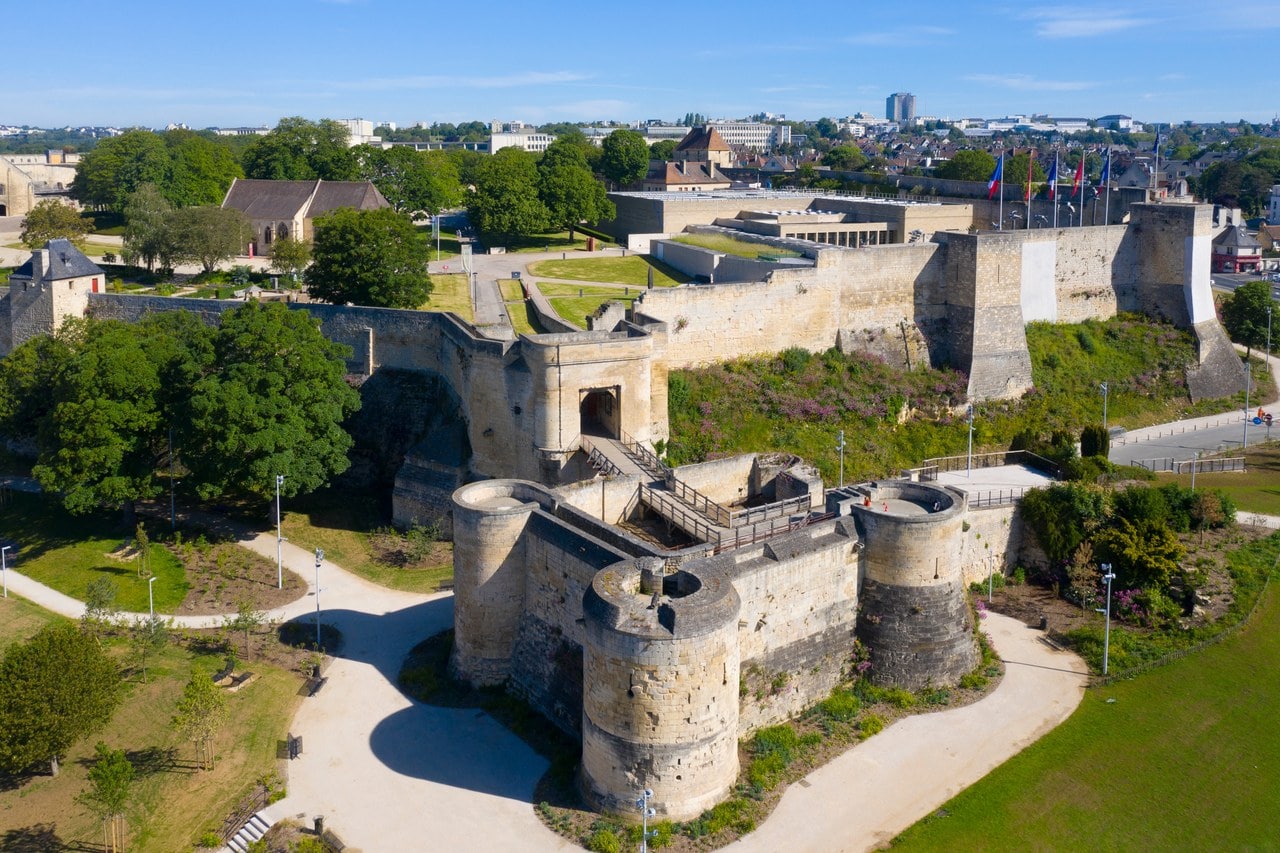
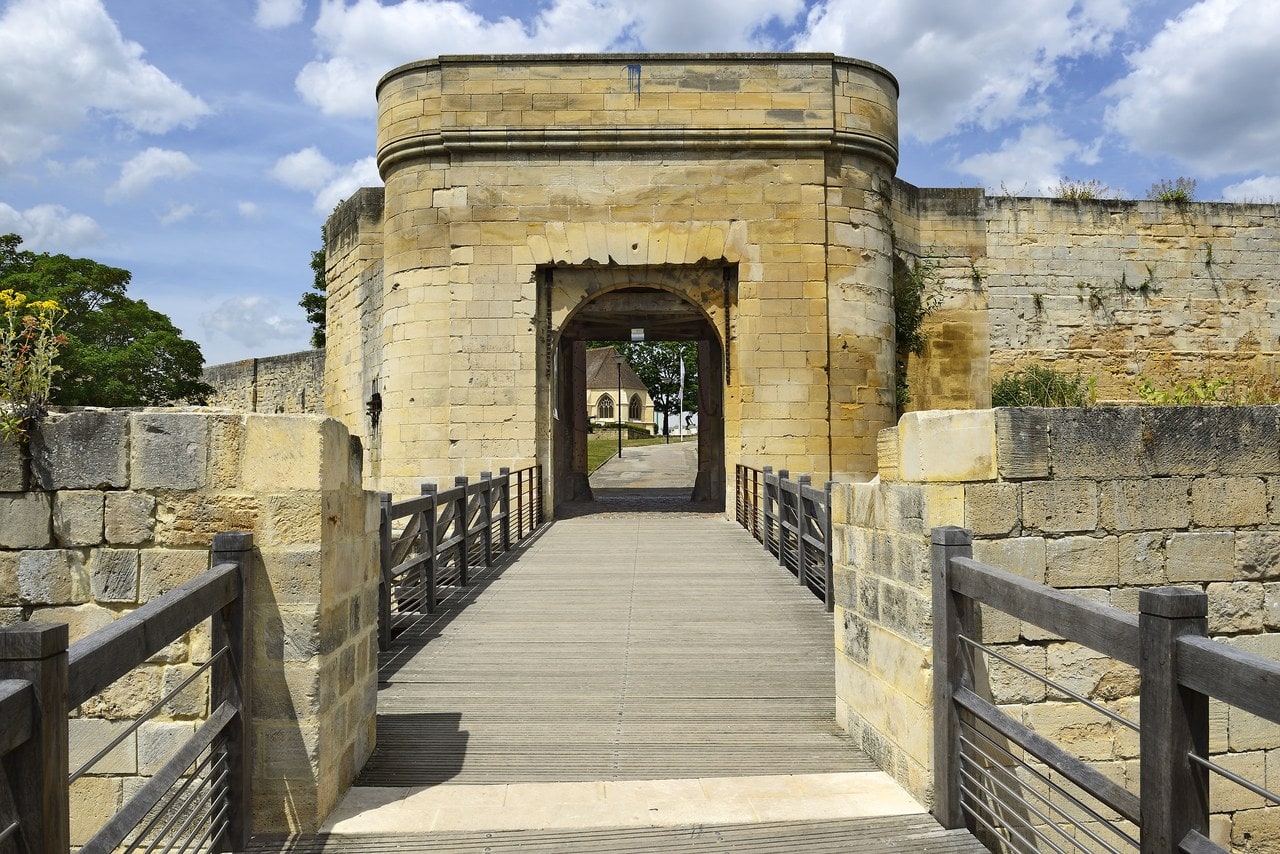
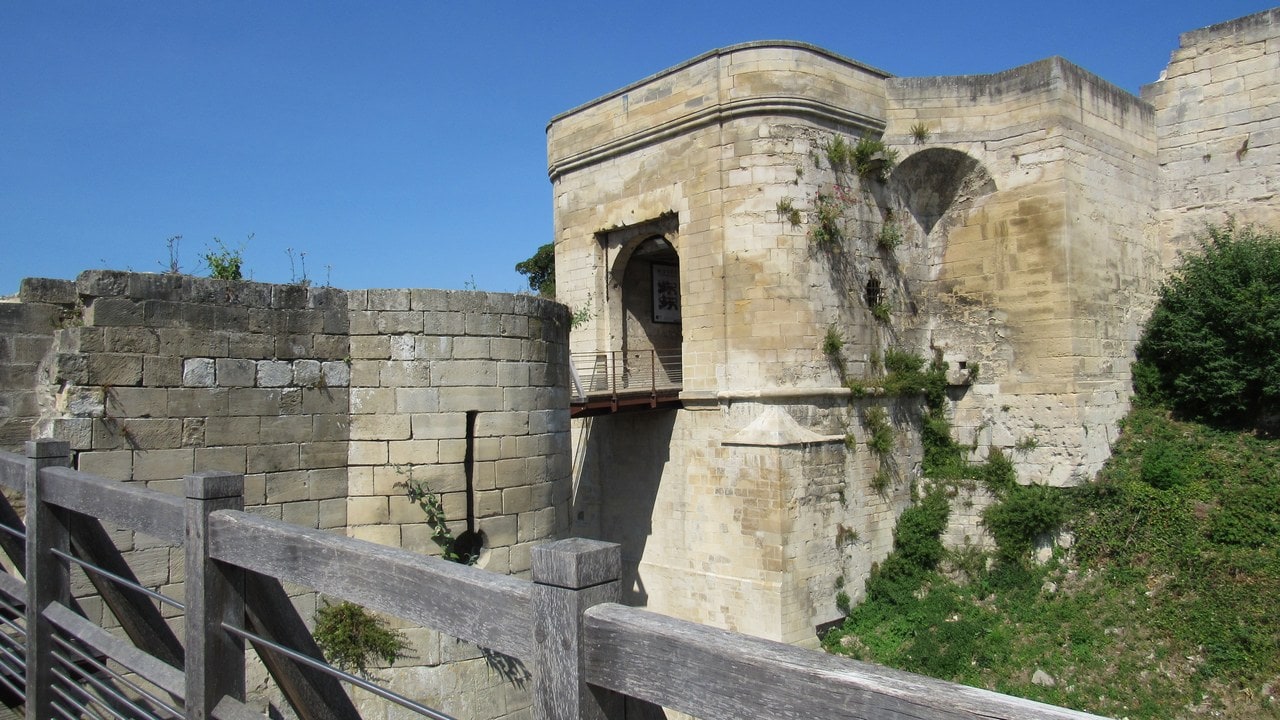
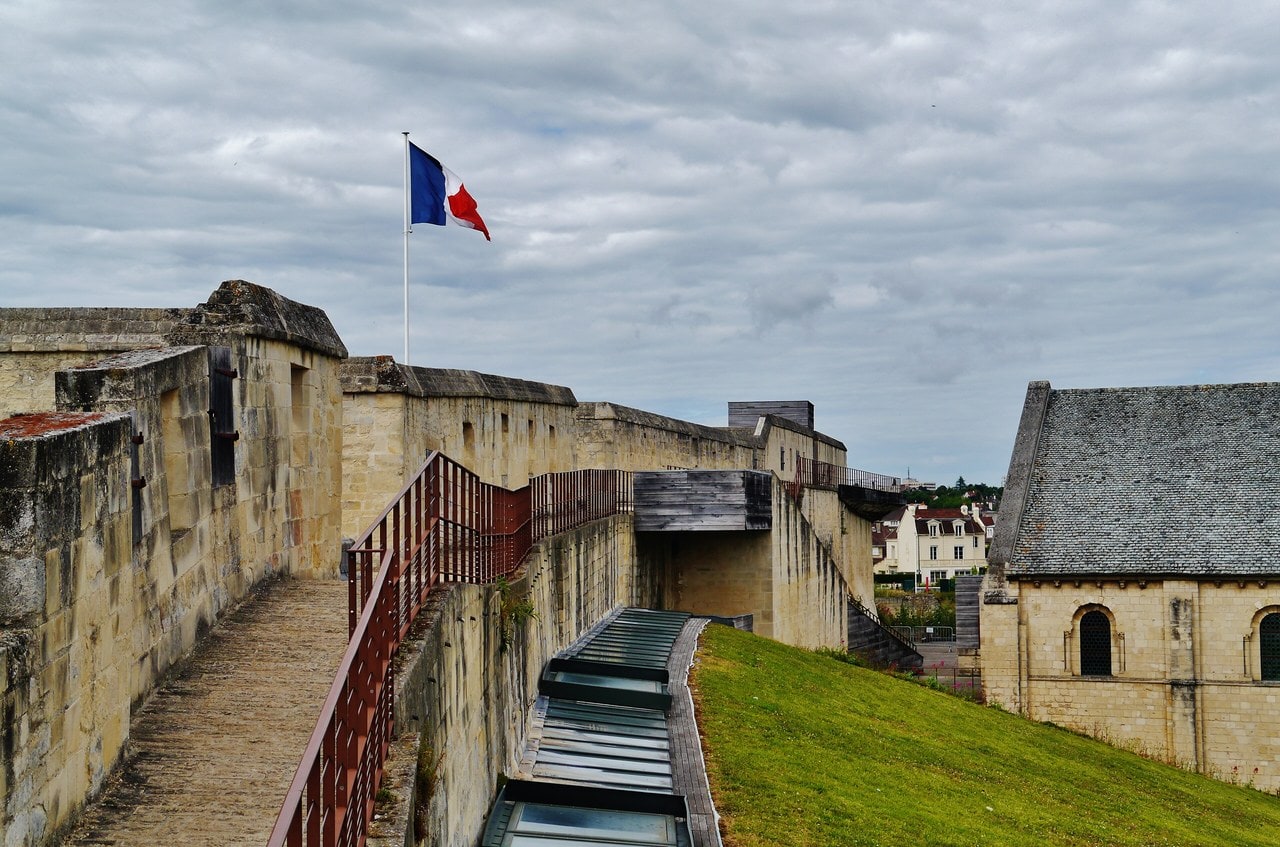
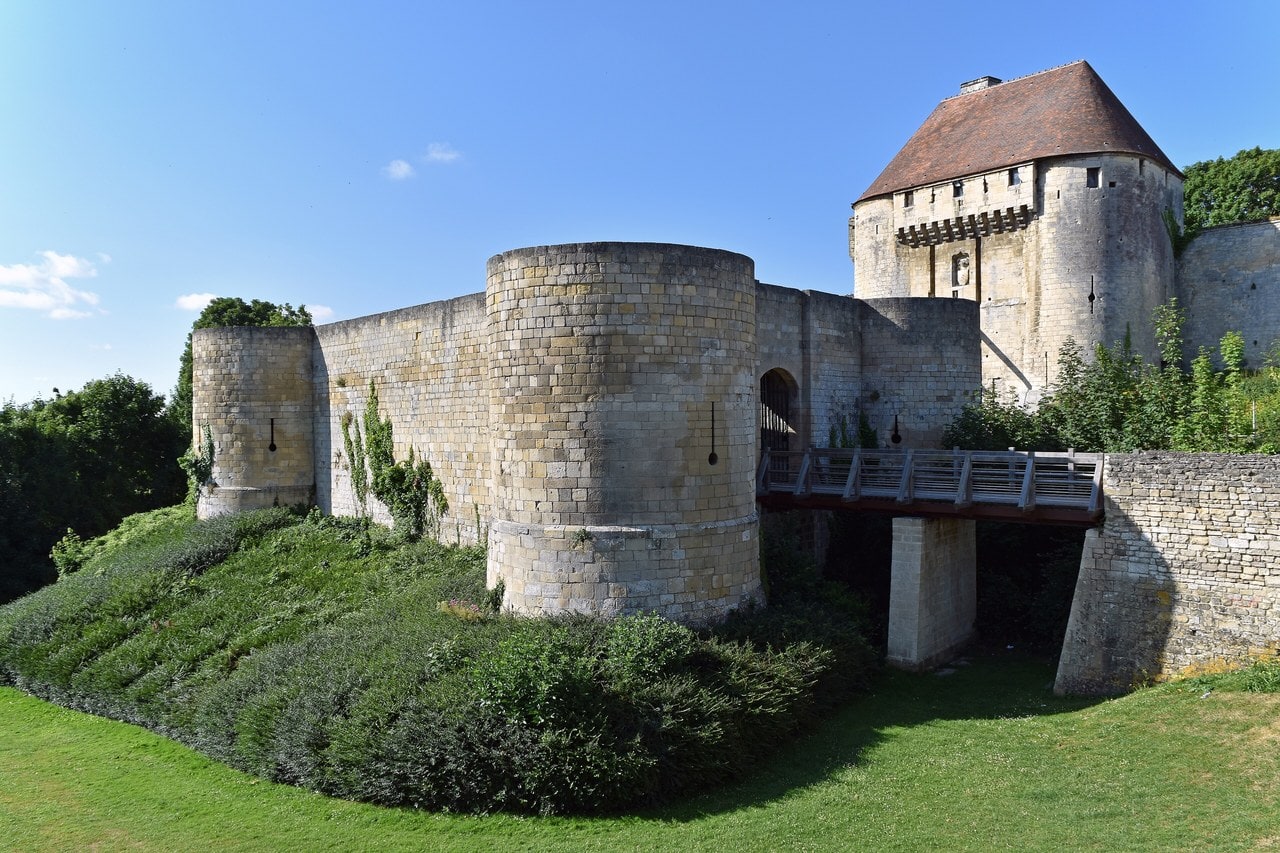
The Porte des Champs is the gate to walk out of. Its châtelet and the ditch below it read as a medieval approach, crossed now by a footbridge installed in 2013. Look up at the heraldic cartouche over the arch and you will find it sitting off-center, because the eighteenth century widened the cart passage beneath it.
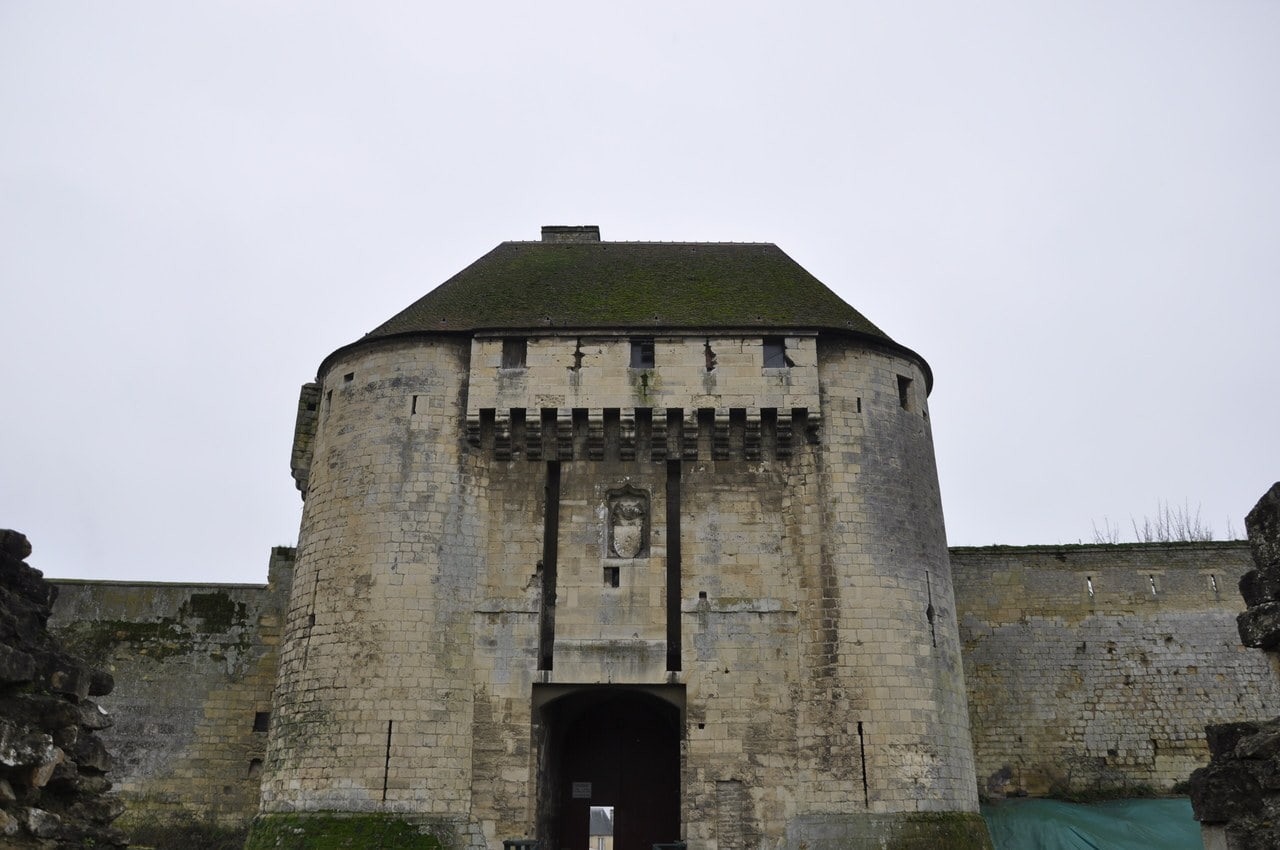
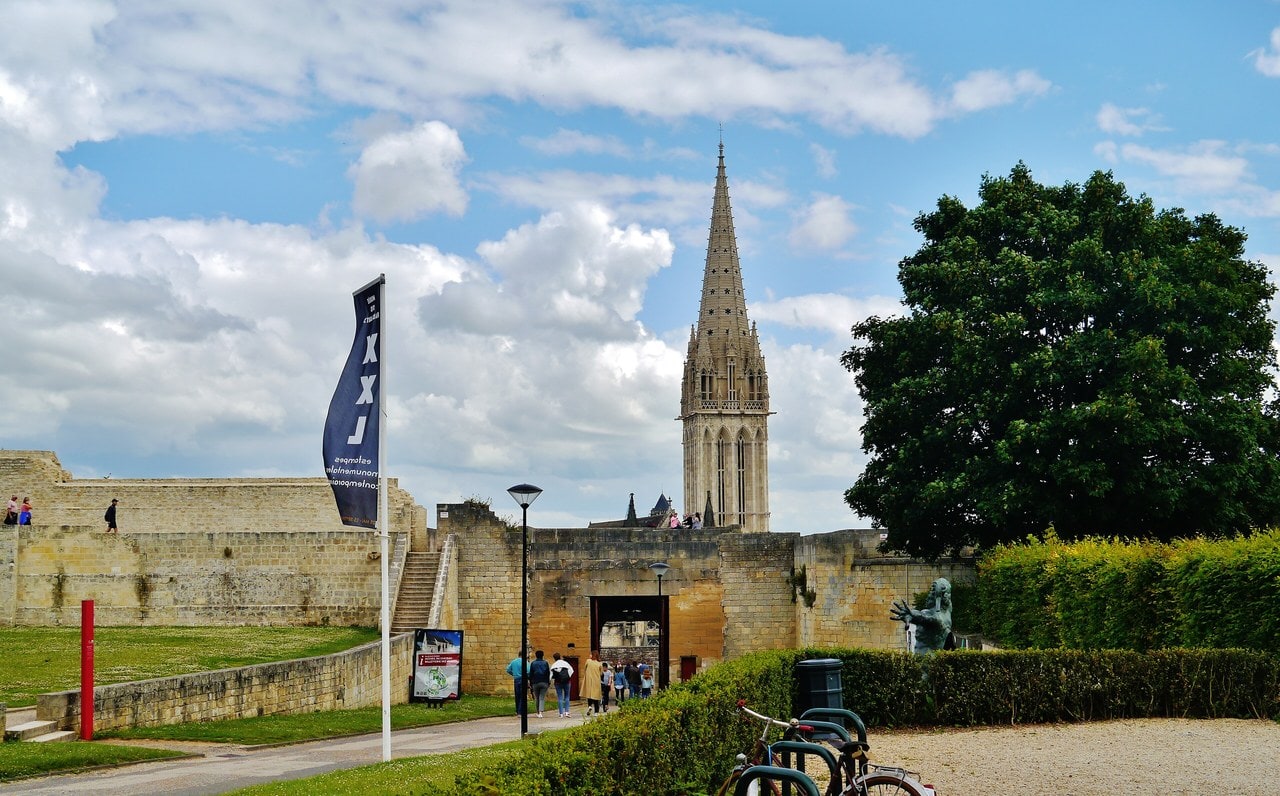
The Porte Saint-Pierre is the gate most visitors walk in through, and it is the least medieval thing on the site. The museum states it flatly: its medieval predecessor was entirely rebuilt in 1804. After 1944 it was restored to what was taken to be its late eighteenth-century form, without reinstating the columns and pediment of 1804. The museum’s own word for what that work set out to do is restituer, to give an appearance back rather than to preserve one. So the gate you photograph on the way in is a post-war restoration of a supposed pre-1804 state of a Napoleonic rebuild.
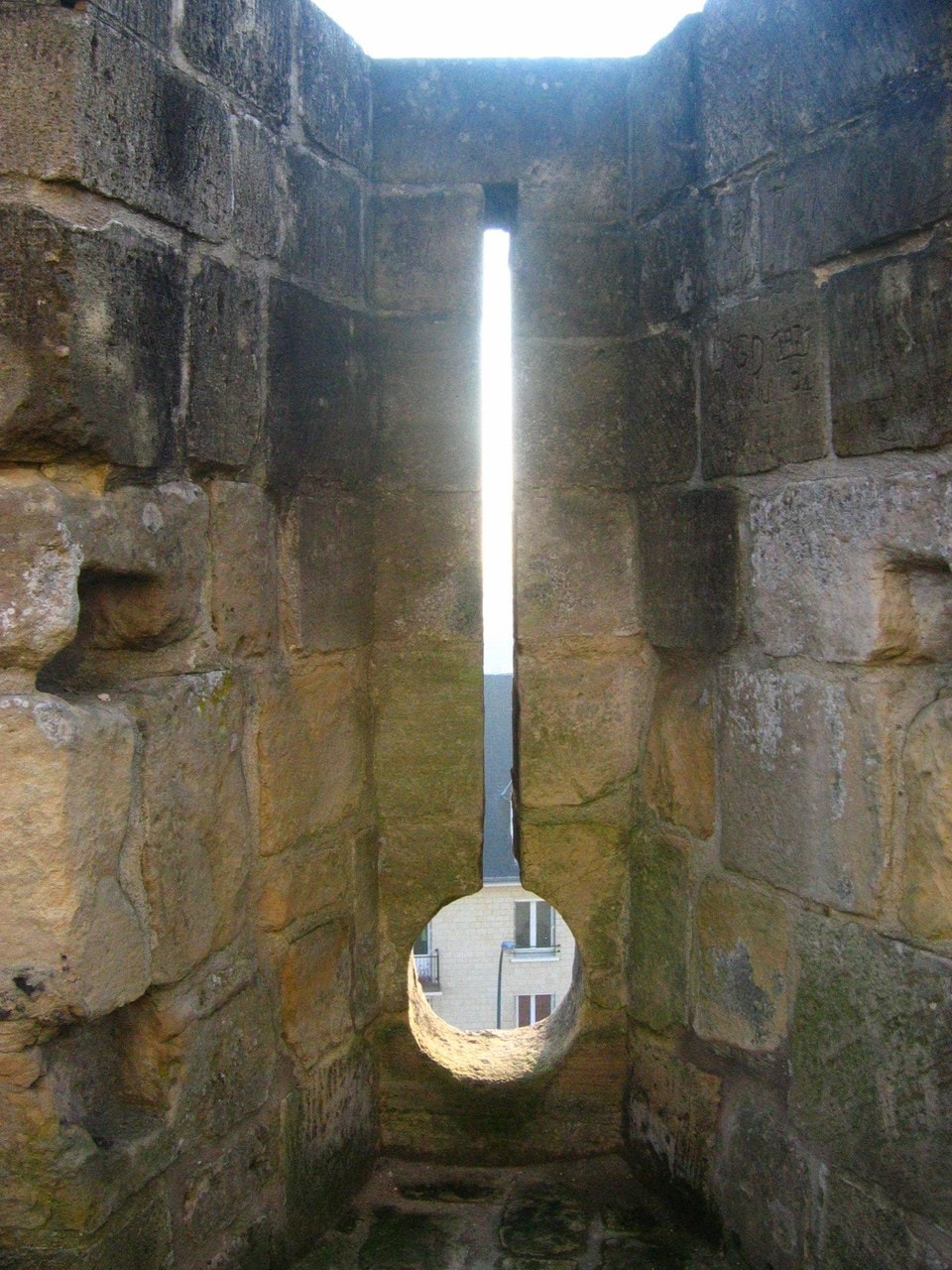
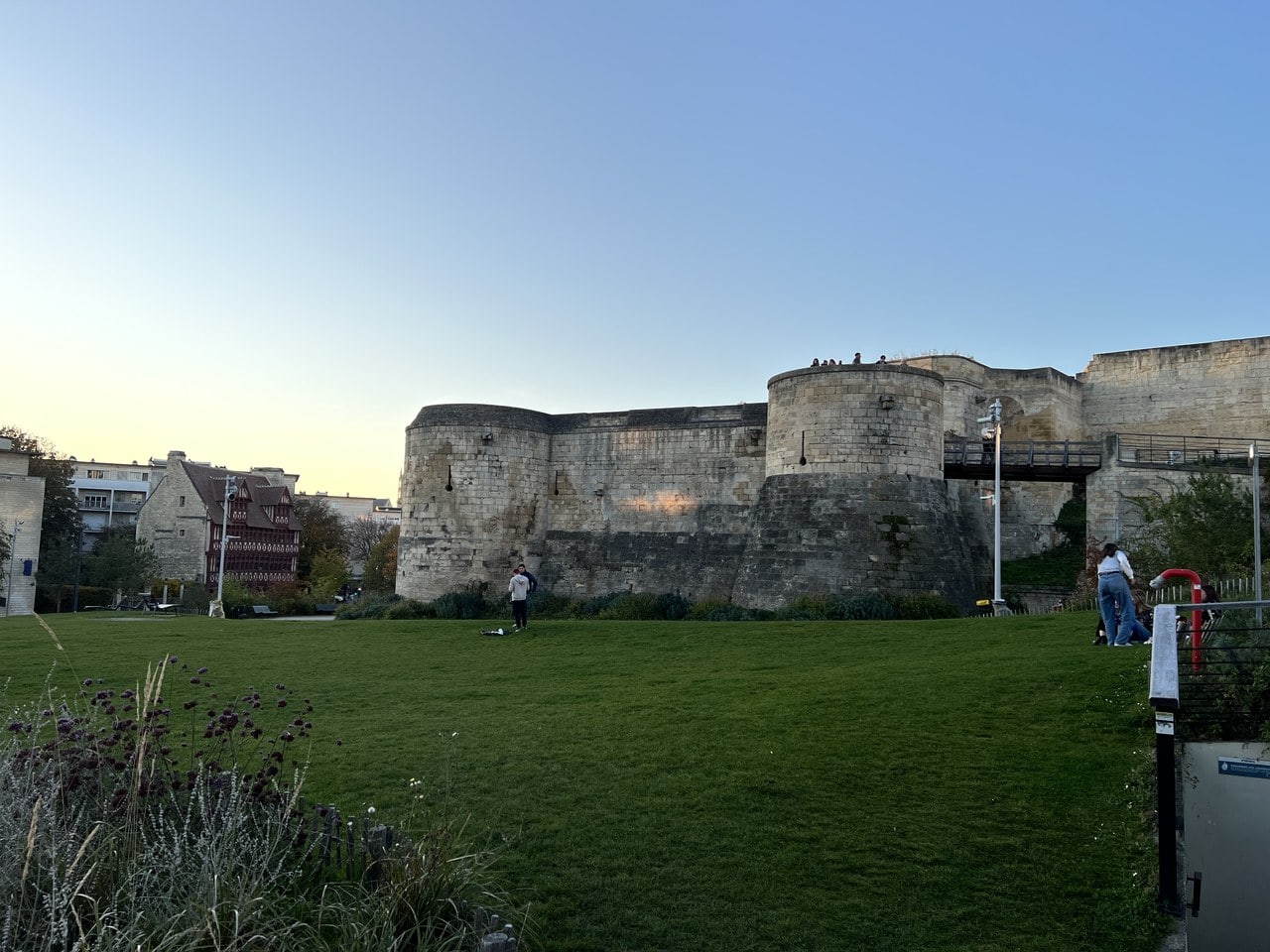
Both gates keep their barbicans, and the one at the Porte Saint-Pierre is the English garrison’s, built facing the town.
Artillery, and a modern building inside the wall
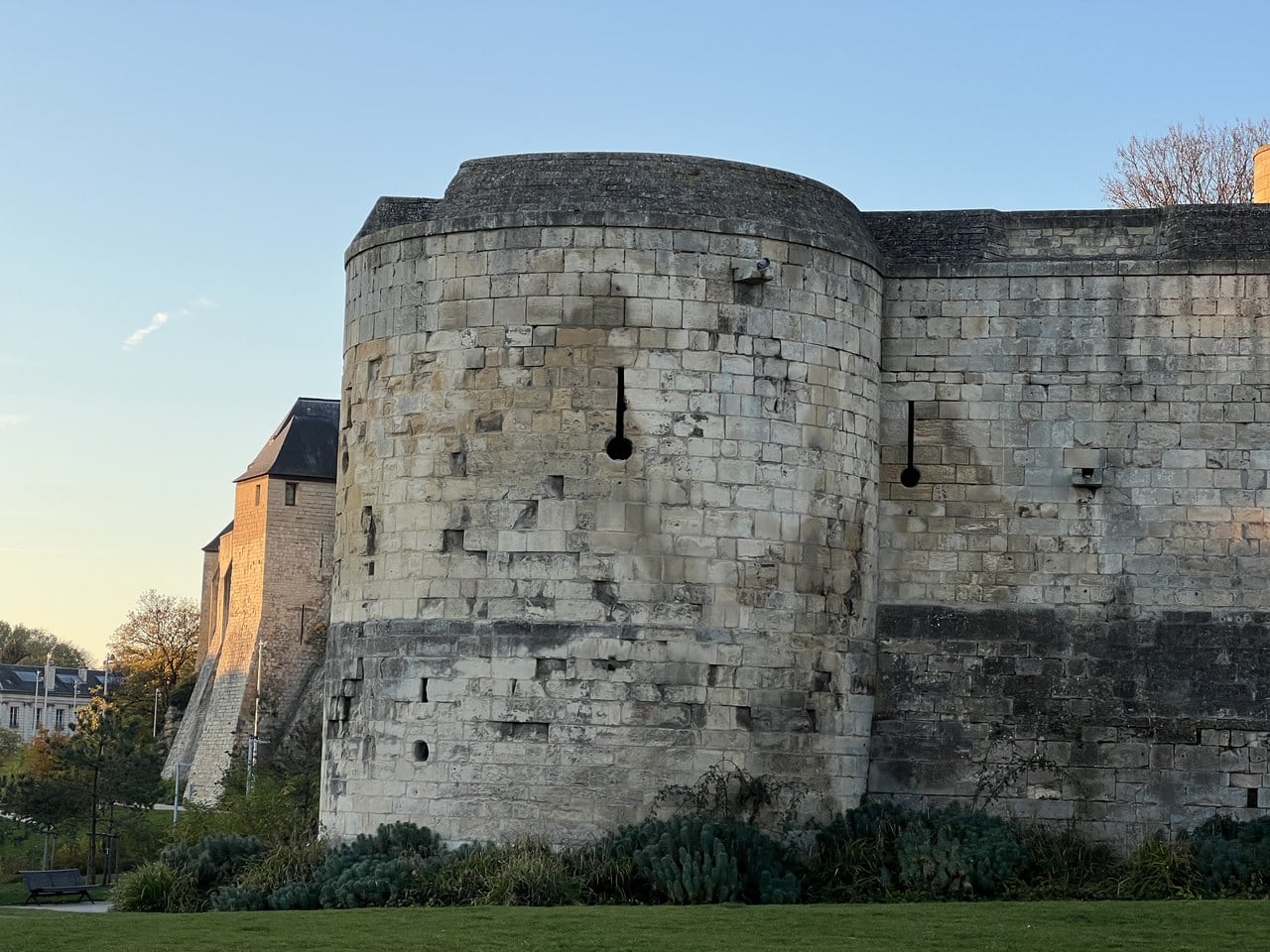
The English garrison’s gun tower of about 1440 carries six firing chambers, and the artillery terrace at the north-west angle is the later answer to the same problem.
Below the terrace, the Salles du Rempart are not what the name suggests. They are a building of concrete and steel put up between 2004 and 2008 to hold temporary exhibitions.
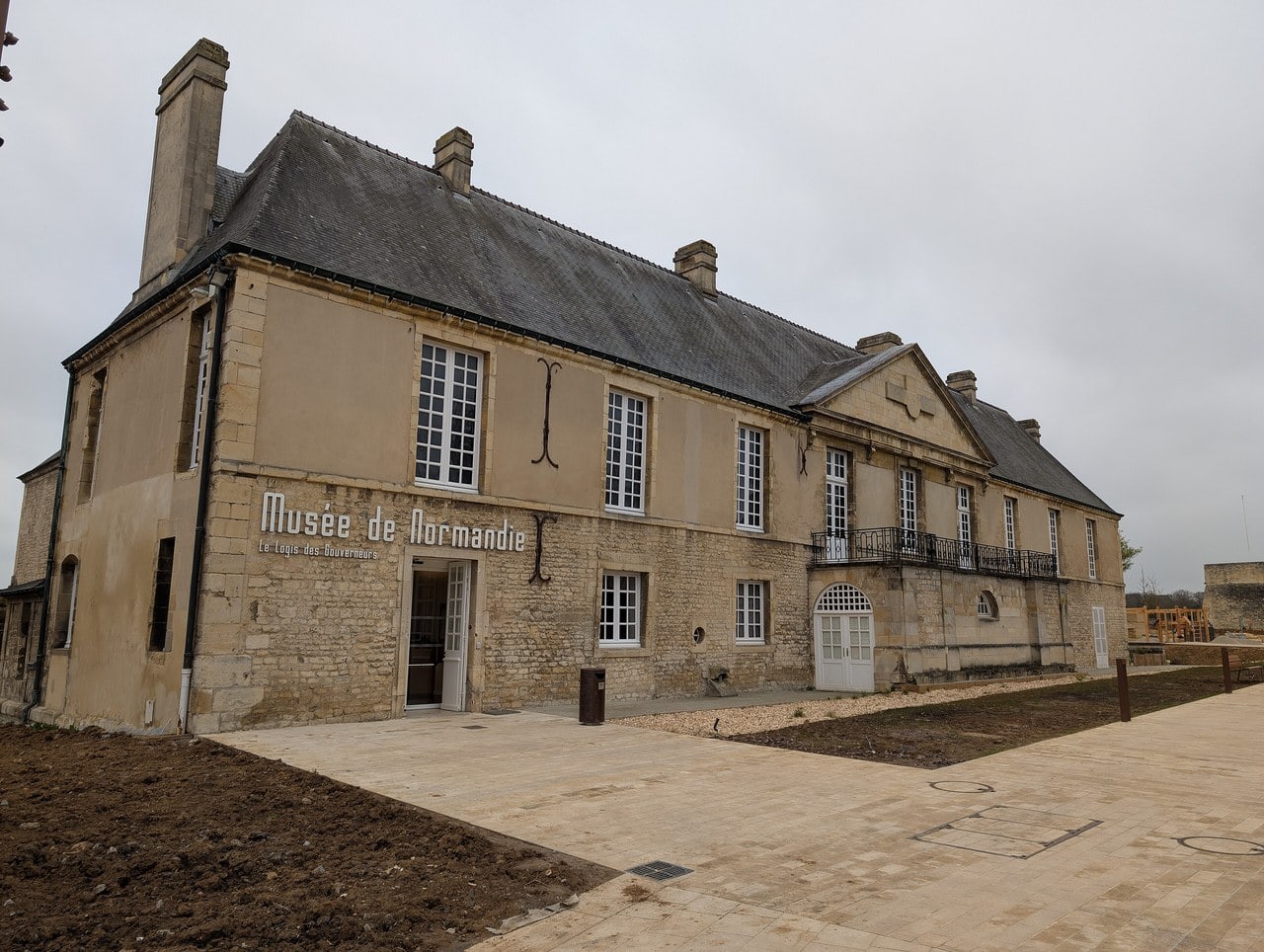
The governor’s lodging
A lodging for the service of the bailli is mentioned from 1338, and the archaeology has recently confirmed that date.
Very little of it is medieval. One sixteenth-century wing survives, with mullioned windows and its stair turret. The long classical front with the pediment was built in 1682 by the architect Pierre Cottard for the comte de Coigny, governor of the castle and bailli of Caen.
Its grand external staircase was taken down in 1952, after war damage, and not rebuilt. The Musée de Normandie has occupied the building since 1963.
The church of Saint-Georges
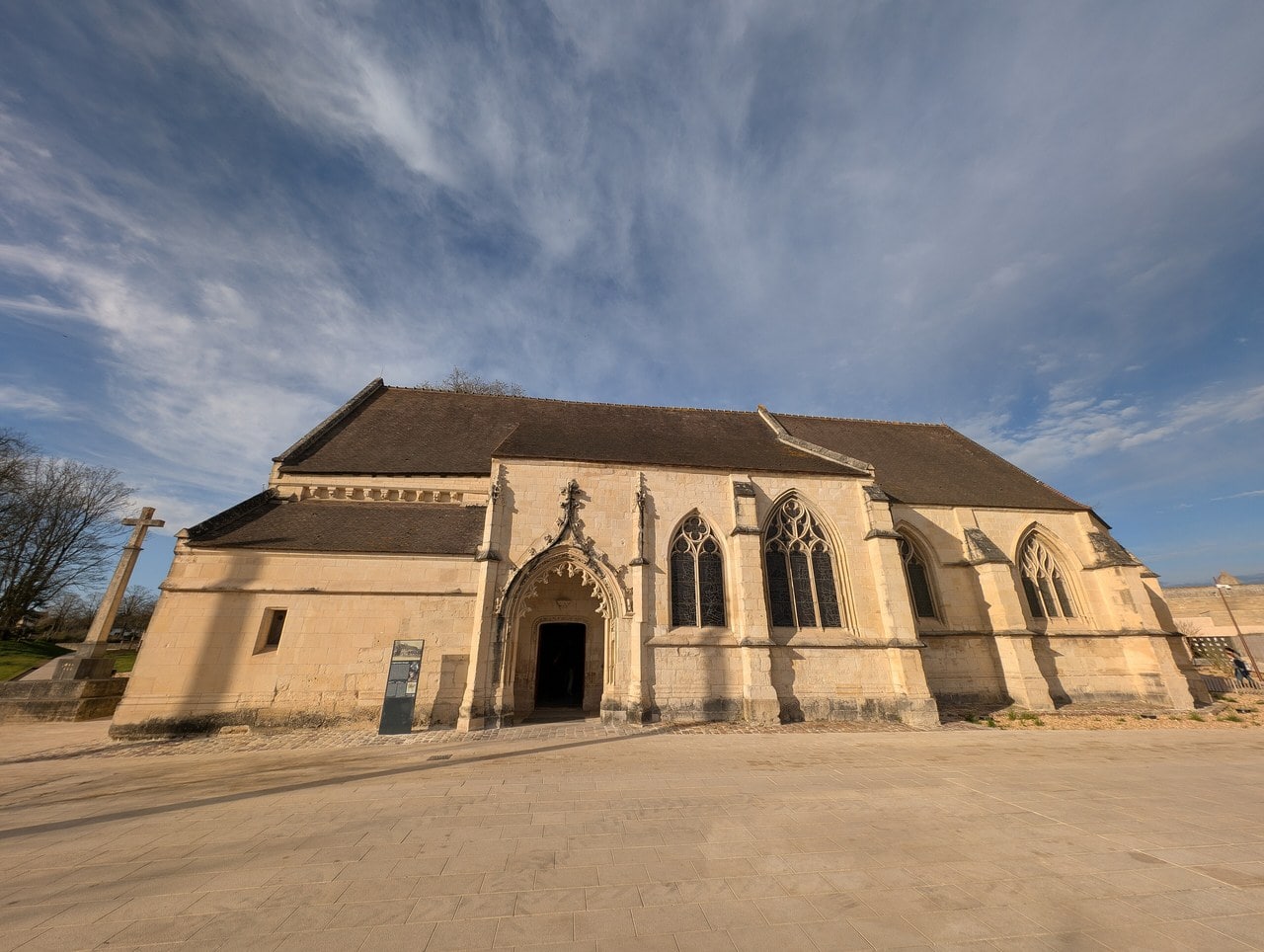
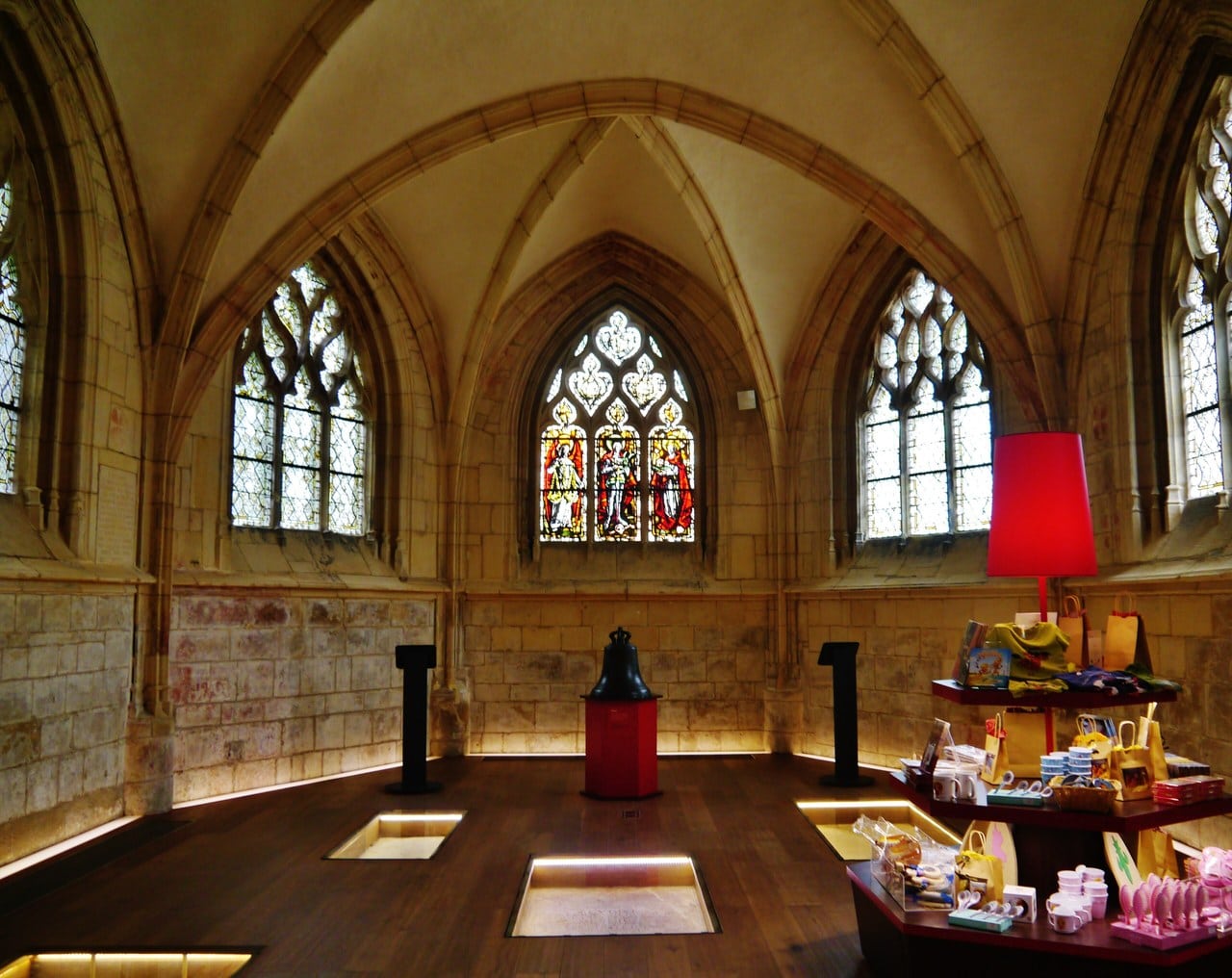
A parish of Saint-Georges du château appears in a text of 1082. The church’s semicircular Romanesque apse was found by Joseph Decaëns in a dig of 1964 and survives with its outline marked out on the ground, and choir vaults whose arms belong to the Silly family, governors from 1491. It is deconsecrated, restored, and free to walk into. Until March 2025 it served as the site’s visitor center; that function has moved to the welcome pavilion.
Caen stone
The limestone that built the castle is the same stone Caen exported, and a quarry of the eleventh and twelfth centuries has been excavated inside the enclosure itself.
It crossed the Channel in quantity. Canterbury Cathedral’s own account of Lanfranc’s rebuilding says the stone came by sea from Normandy and then up the River Stour, and its masons order Caen stone still. That the castle’s own fabric was cut on the spot is an inference rather than a finding. No other English building is named here, because the sources that would carry those claims could not be reached.
What the protection covers
Caen’s castle was classified a monument historique on 10 April 1997. That order superseded five earlier instruments, every one of them annulled: classifications of 1886 and 1913, and listings of 1927 and two separate ones in 1946. So the protection dates from 1997 and not from the nineteenth century.
Visiting the Château de Caen
List the 5 castles on this map
- Mont-Saint-Michel — Normandy, France
- Château Gaillard — Normandy, France
- Château de Caen — Normandy, France
- Château de Falaise — Normandy, France
- Château de Gisors — Normandy, France
Walking into the castle costs nothing. The enclosure, the church of Saint-Georges and the Salle de l’Échiquier are all free to enter. Tickets buy the museums, and only the museums.
Getting there
The tram stop is called Château Quatrans, and all three of Caen’s tram lines serve it. From the railway station, take T1 or T3 in the direction of the center: five stops, seven minutes, no change.
Two details save trouble on arrival. T3 terminates at Château Quatrans, so on that line the castle is simply the end of the journey. And T2 does not call at Gare SNCF at all: its station stop is Gare – Rives de l’Orne, a separate stop a few hundred meters north of the station building, so take T1 or T3.
Coming up from the station the stops run Saint-Pierre, then Château Quatrans, then Place de la Mare and Université, so the tram puts a stop at each end of the castle and one on its western flank. Trams run every ten minutes between 7am and 7pm on the September 2026 to 2027 timetable, and less often on Sunday mornings.
A Navette Centre-Ville bus also starts and finishes at Château Quatrans and calls at the station on its loop. Drivers are pointed to the Indigo underground parking garage signed Château, on avenue de la Libération.
Admission
| Ticket | Price |
|---|---|
| The castle enclosure, the church of Saint-Georges and the Salle de l’Échiquier | Free |
| One museum, permanent collections (valid one day) | 5 € / 4 € reduced |
| One museum, permanent collections plus one temporary exhibition (one day) | 7 € / 5 € reduced |
| One museum, permanent collections plus two exhibitions (one day) | 9 € / 7 € reduced |
| Pass Museo, both museums, permanent collections, valid three days | 8 € / 6 € reduced |
| Pass Museo, both museums, permanent collections plus exhibitions, three days | 10 € / 8 € reduced |
| Pass’Murailles, annual, the holder plus one guest | 30 € |
| Guided visit inside the castle, admission included | 8 € |
| Audioguide supplement | 6 € |
| Workshops, sketching visits and other cultural activities, admission included | 6 to 20 € |
| Enclosure hours | Daily 07h30 to 22h30; closed 14 July |
| Museum and Salle de l’Échiquier hours | Tuesday to Friday 09h30 to 12h30 and 13h30 to 18h; Saturday, Sunday and public holidays 11h to 18h; Monday closed except in July and August and on Easter and Whit Monday |
| Last tickets sold / last entry to the museum | 17h15 / 17h30 |
| Salle de l’Échiquier, free unguided visit | 09h30 to 10h45; Wednesday only from Tuesday to Friday, every day at weekends and on public holidays |
| Immersive show in the Salle de l’Échiquier, free but booked online | 11h to 17h Wednesday, weekends and public holidays; 14h to 17h Tuesday, Thursday and Friday |
| Museum closures | 1 January, 1 May, 14 July, 1 November and 25 December; closing at 16h on 24 and 31 December |
Prices verified 17 August 2026.
Entry to the museums is free for visitors aged up to and including 26, free on the first weekend of every month, and free during the Nuit européenne des musées. A carte famille nombreuse reduced rate is also published by the operator.
The immersive show in the Salle de l’Échiquier is free, though it must be booked online first.
The excavated keep and the gun tower are a separate case: their remains are visible from the belvedere for nothing, and they can be entered only on one of the operator’s own tours. There are two different tours and it is worth knowing which is which. The operator’s guided visit inside the castle is priced in the mayoral tariff decision at eight euros with admission included. The free short guided visits are the other thing, and they run on a published series of dates rather than all year.
Hours, and there are three sets of them. The enclosure itself is open daily from 07h30 to 22h30, that is 7:30am to 10:30pm, and closes one day a year, on 14 July. Not so the Salle de l’Échiquier and the church, which both keep the museum’s calendar: they are shut on five public holidays as well, and the hall’s free unguided window runs for the first hour and a quarter of the day, on Wednesday only from Tuesday to Friday. The welcome pavilion keeps shorter hours, and the museums keep shorter hours still and close on more days. Read whichever clock applies to the thing you came for; they are not the same clock.
How long you need
Two hours covers the circuit, the church and the hall without hurrying. Add an hour for the Musée de Normandie and another for the Beaux-Arts if you intend to look rather than pass through. Half a day is generous without being excessive.
The two museums
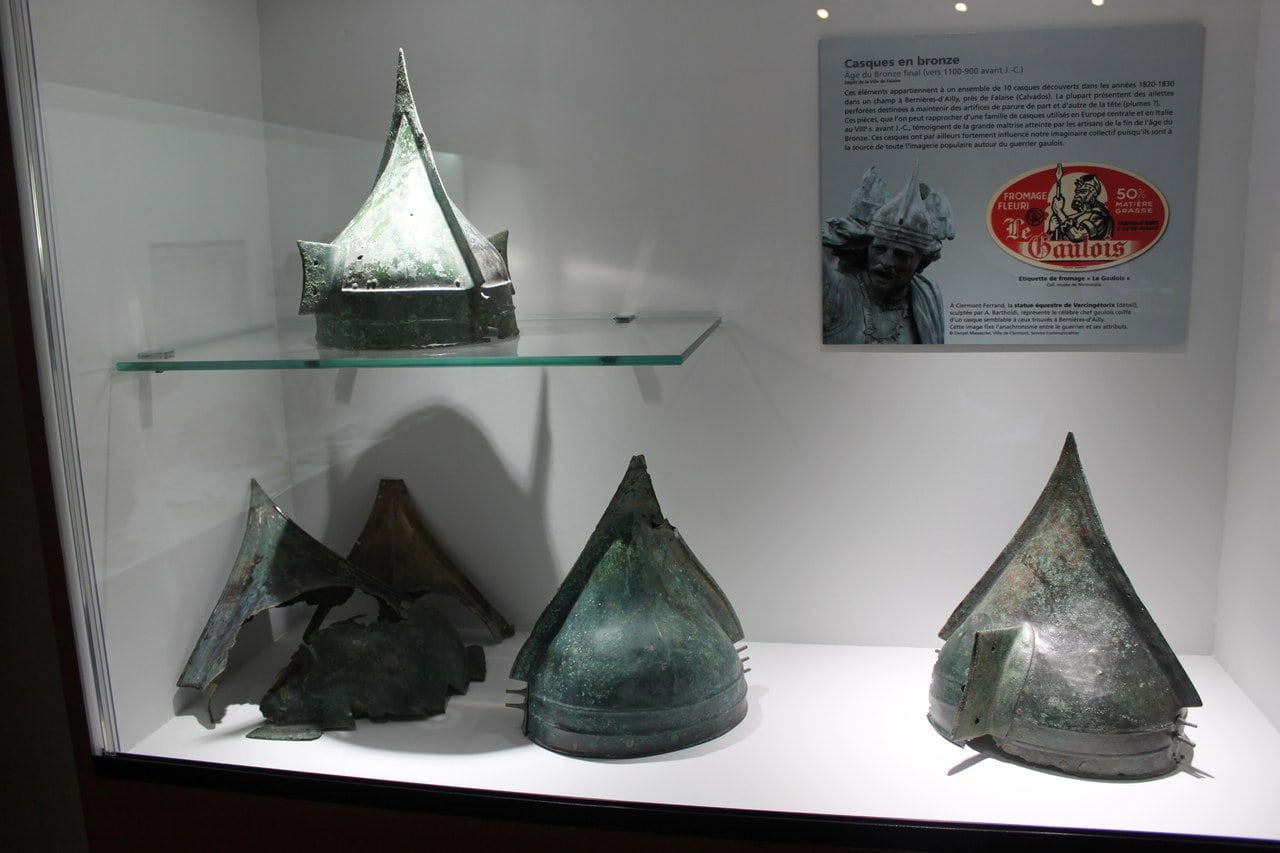
The Musée de Normandie occupies the governor’s lodging and reads the region rather than the castle: archaeology, rural life and the material history of Normandy, including Bronze Age metalwork.
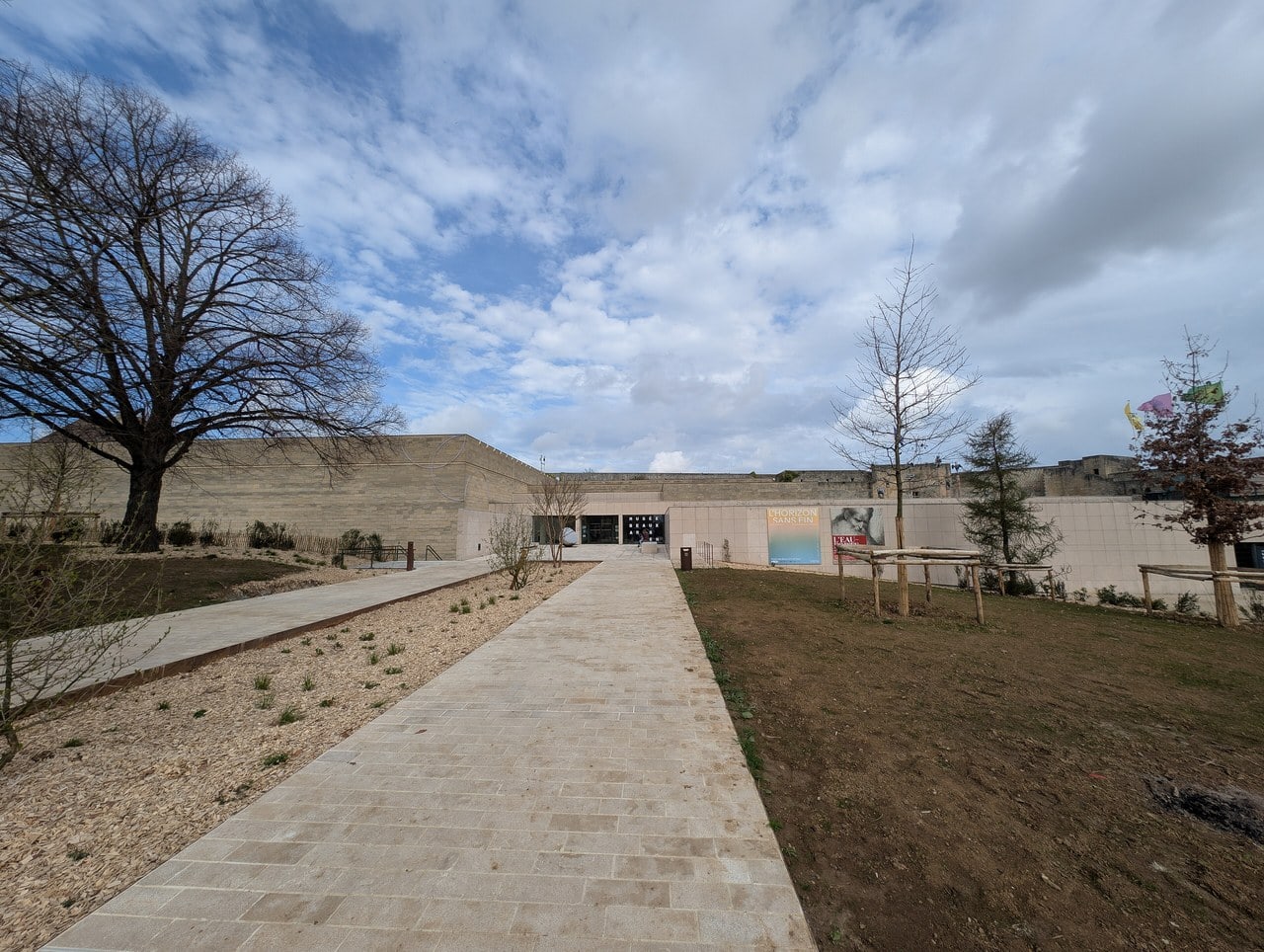
The Musée des Beaux-Arts is the older institution, founded under Chaptal in 1801 and opened to the public on 2 December 1809, and it is a stronger collection than a castle courtyard leads you to expect. There is a restaurant inside the walls as well, Le Mancel, beside the Musée de Normandie; check its hours with the operator rather than with us.
Best time to visit
Early is the answer, for a reason particular to this site: the enclosure opens well before either museum, so the rampart walk, the belvedere over the great tower and the church can all be done before the ticketed parts of the castle open at all.
Beyond that, the operator publishes no crowd or seasonal guidance that we could source, and this guide will not invent any. The one thing that genuinely varies with the calendar is the program of free short guided visits, which runs in the warmer half of the year on a published series of dates rather than as a standing offer, so check the current dates before planning around one.
Photography
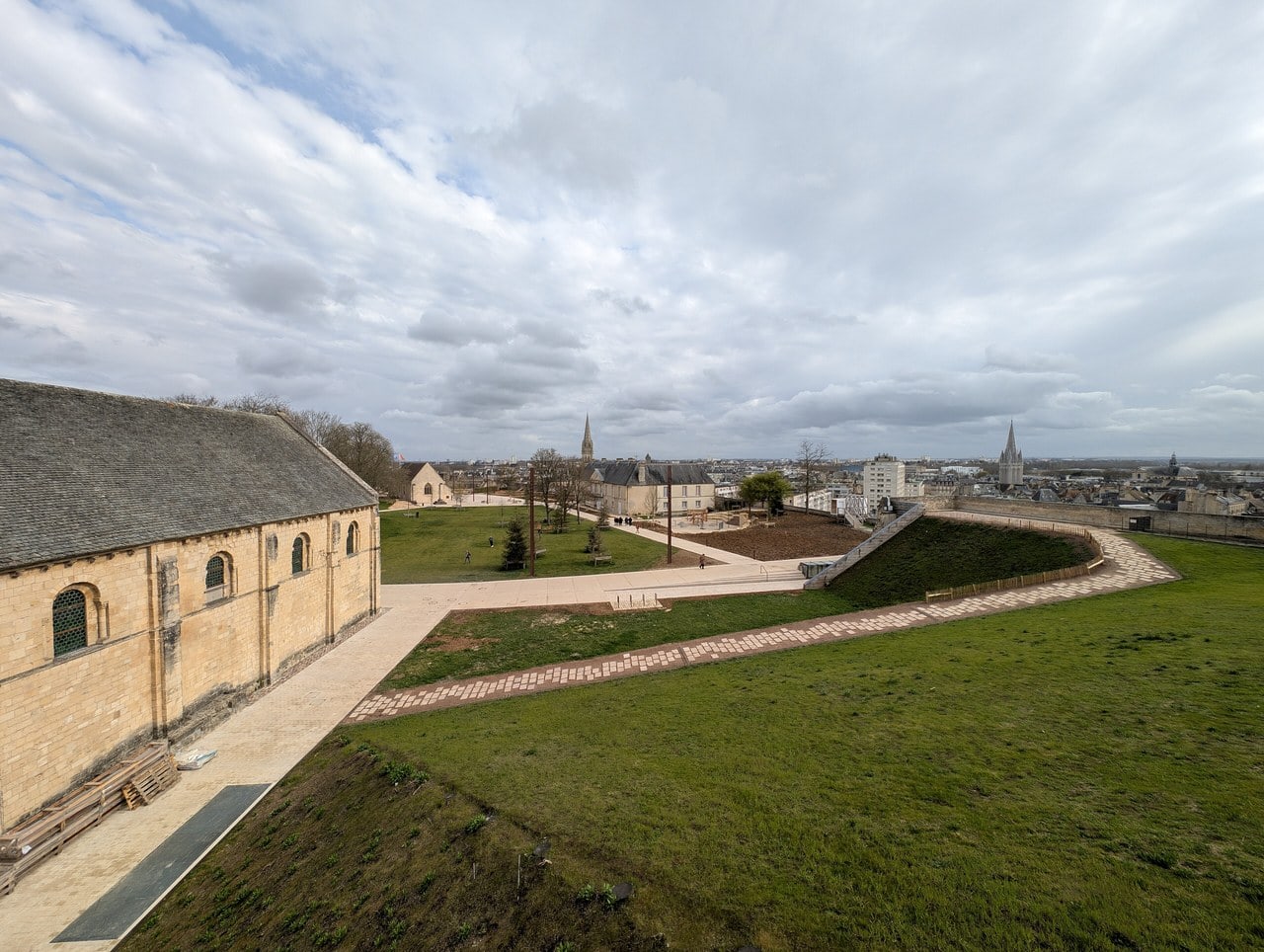
The restored rampart carries a belvedere placed to look down into the great tower’s footings, and the operator marks viewpoints on its own site plan. The artillery terrace at the north-west angle gives the wide view over the enclosure. Professional photography outdoors needs permission under the site by-law, and the same by-law forbids sitting on the ramparts because of the risk of a fall.
The castle was first photographed in 1861.
Accessibility
The operator publishes an accessibility page, lends one wheelchair and seat sticks, subject to availability, at the welcome pavilion, and produces a tactile and large-print visit booklet as well as a program for groups of disabled visitors. That is a stronger provision than most sites of this size offer.
What is not published is the thing a wheelchair user most needs: gradients, surfaces and step counts across a walled enclosure on a rise. The Registre public d’accessibilité is the document that would answer it, and we could not reach it. Ask at the pavilion before committing to the rampart walk.
Where to stay
Caen is a city rather than a village at the foot of a castle, and the enclosure sits in the middle of it, so almost anywhere central puts you within a short walk of a gate. That matters more here than it usually does, because the enclosure opens long before either museum and you can use the early hour. Rooms across the city can be compared on Booking.com.
Some links on this page are affiliate links, which means StoneKeep Atlas may earn a small commission, at no extra cost to you, if you book through them.
More Views of the Château de Caen
Common Questions
Is William the Conqueror buried in Caen?
He is buried in Caen, but not at the castle. William died at Rouen on 9 September 1087, and his tomb is at the abbey church of Saint-Étienne, the Abbaye aux Hommes, which he founded and which stands about a kilometer southwest of the castle. Orderic Vitalis, writing decades afterward, describes a funeral that went badly wrong; his account is a moralist’s set piece as much as a report, and it should be read that way. The tombs of William and Matilda were themselves destroyed when the two abbeys were sacked in the riots of 1562, though a tomb slab still marks the place in the choir of Saint-Étienne.
Was William the Conqueror born at the Château de Caen?
No. He was born at Falaise, some thirty kilometers to the south, where the French national monuments record calls the castle his château natal. Caen is where he chose to build, not where he started. He founded the castle here about 1060, as duke, and the town became his by choice rather than by inheritance.
One fact disappoints people at both places: neither castle shows a visitor a building William actually knew. Falaise’s great tower is Henry I’s, and at Caen William’s palace survives as excavated foundations, so at neither site does a building he raised still stand to its full height.
How do you pronounce Caen?
It is one syllable, not two. Two published dictionaries transcribe the name and both give the French nasal vowel: the Random House Unabridged Dictionary respells it kahn for American readers, while Collins English Dictionary gives a British form closer to kong. They agree on the French and differ on the anglicization. What both settle is the thing that helps most: neither prints a two-syllable form.
What can you see inside the walls today?
More than the ticketed part. The enclosure holds the standing church of Saint-Georges, the Salle de l’Échiquier, the footings of the great tower read from a belvedere, a rampart walk, the archaeological garden of the Vieux Palais, a garden of medicinal plants and a sculpture park, along with the two museums. One thing to know is that the 1997 classification covers less than the site does: the ditches, the Musée des Beaux-Arts and the north return wing of the Musée de Normandie are all excluded from it.
If I only have an hour, what should I do?
Come in by the Porte Saint-Pierre, whose barbican is the one the English garrison built facing its own town, and cross first to the belvedere over the great tower. Walk the rampart from there to the north-west angle for the wide view, and leave by the Porte des Champs so you cross its ditch on the footbridge and see the barbican and the gate tower from outside. Saint-Georges is a five-minute stop on the way and costs nothing. Leave the museums for a second visit rather than rushing one, and note that the interiors of the great tower and the gun tower open only on guided visits, so an hour will not include them.
What happened to the castle in 1944?
Allied bombing during the battle for Normandy badly damaged the castle and destroyed much of the quarter around it. The governor’s lodging lost its grand staircase, taken down in 1952 and never rebuilt, and the Salle de l’Échiquier was left a shell that was not restored until 1962. Clearing the ruined streets is also why the ramparts are so visible today.
Beyond the Château de Caen
Caen makes most sense read against the other Norman fortresses, and the duchy’s story is easier to follow across several of them than in any one. Richard I’s Château Gaillard above the Seine is the frontier answer to Caen’s role as a seat, thrown up in under two years to hold a border that Caen sat comfortably behind; and Mont-Saint-Michel shows what happened where the sea did the defending instead of a curtain wall.
Two of William’s own foundations stand within walking distance in Caen itself, the Abbaye aux Hommes and the Abbaye aux Dames, and his tomb is in the first of them. Neither is a castle and neither has a guide here yet.
For the building types, the excavated tower at Caen is best read beside our piece on castle keeps, the barbicans beside the castle gatehouse, and the hall beside great halls and medieval castle life. The claim that Caen is among the largest fortified enclosures in Europe is exactly the kind examined in our piece on the largest castles in the world, which is about what happens when a superlative travels without its comparison class. For a route that works Caen into a longer drive through the region’s castles, see our Normandy castles itinerary.
Conclusion
Caen rewards a visitor who is willing to read absence. The great tower is a plan on the ground rather than a building; the gate most people walk through is a Napoleonic rebuild restored after a war; the famous hall carries a name a scholar called wrong in 1967, and the room inside it is a 1962 answer to a question still being argued. What holds all of it together is an enclosure ringed by more than eight hundred meters of rampart, which you can walk into for nothing, at half past seven in the morning if you like, and cross in any direction. Few castles of this size ask so little of a visitor, and few are as honest about the limits of what is known.
Our regional guide to the castles in Normandy reads Caen with the duchy’s other fortresses in one sequence and settles the order to drive them in.
Principal Sources
- Canterbury Cathedral. “Lanfranc.” A Walk Through Time. learning.canterbury-cathedral.org.
- HarperCollins. “Caen.” Collins English Dictionary, Complete & Unabridged. dictionary.com.
- Mesqui, Jean. Review notice, Bulletin Monumental 137-3 (1979). persee.fr.
- Ministère de la Culture. “Château, actuellement musées de Caen.” Base Mérimée, notice PA00111127. pop.culture.gouv.fr.
- Ministère de la Culture. “Château de Falaise.” Base Mérimée, notice PA00111309. pop.culture.gouv.fr.
- Musée de Normandie / Ville de Caen. “Accès, horaires et tarifs.” musee-de-normandie.caen.fr.
- Musée de Normandie / Ville de Caen. Caen Castle Teacher’s File. musee-de-normandie.caen.fr.
- Musée de Normandie / Ville de Caen. Grille tarifaire 2025-2031. musee-de-normandie.caen.fr.
- Musée de Normandie / Ville de Caen. “Le château de Caen,” and its per-structure pages for the donjon, the Salle de l’Échiquier, the two gates, the artillery terrace, the Tour de la Reine Mathilde and the Logis des Gouverneurs. musee-de-normandie.caen.fr.
- Musée des Beaux-Arts de Caen. “Histoire du musée” and “Informations pratiques.” mba.caen.fr.
- Random House. “Caen.” Random House Unabridged Dictionary. dictionary.com.
- Salet, Francis. Review of Michel de Boüard on the Salle de l’Échiquier, Bulletin Monumental 125-1 (1967). persee.fr.
- Twisto. Dépliants horaires, réseau de Caen la mer, lignes de tramway T1, T2 et T3. twisto.fr.
- Ville de Caen. “La salle de l’Échiquier.” Mondes normands. mondes-normands.caen.fr.
- Ville de Caen. “Les dates clés de l’histoire de Caen.” caen.fr.
- Ville de Caen. Règlement intérieur du château ducal, arrêté A-2025-144, 31 March 2025. musee-de-normandie.caen.fr.
- Ville de Caen. “Visiter l’abbaye aux Hommes.” caen.fr.
Image credits. Hero, the enclosure from the air: Photo: s4svisuals, Adobe Stock; two mural towers on the curtain wall: Photo: Richard Semik, Adobe Stock; the 1627 survey plan of the castle: Photo: Unknown engraver, Public domain; the donjon site and its chemise: Photo: Andy Li, CC0; Cotman’s drawing of the Échiquier: Photo: John Sell Cotman, Public domain; hall, palace footings and artillery terrace in one view: Photo: Christophe.Finot, CC BY-SA 3.0; the Salle de l’Échiquier from outside: Photo: Pline, CC BY-SA 4.0; inside the Salle de l’Échiquier: Photo: Roi.dagobert, CC BY-SA 3.0; the gate tower of the Porte des Champs: Photo: Benoit-caen, CC BY-SA 3.0; the Porte des Champs barbican from above: Photo: s4svisuals, Adobe Stock; keyhole gun-loops in the barbican: Photo: Chabe01, CC BY-SA 4.0; the underground passage beneath the rampart: Photo: Chatsam, CC BY-SA 4.0; the Logis des Gouverneurs: Photo: Andy Li, CC0; the church of Saint-Georges: Photo: Andy Li, CC0; the chancel of Saint-Georges: Photo: Zairon, CC BY-SA 4.0; through the Porte Saint-Pierre to Saint-Georges: Photo: Pecold, Adobe Stock; the wall walk along the curtain: Photo: Andy Li, CC0; Bronze Age helmets in the Musée de Normandie: Photo: Christophe.Finot, CC BY-SA 3.0; the Musée des Beaux-Arts inside the walls: Photo: Andy Li, CC0; the jardin des Simples: Photo: Roi.dagobert, CC BY-SA 3.0; the Porte Saint-Pierre barbican and the town: Photo: satur73, Adobe Stock; the south curtain from the boulevard: Photo: borisb17, Adobe Stock; the Porte Saint-Pierre above its ditch: Photo: elophotos, Adobe Stock; a modern entrance cut into the rampart bank: Photo: Christophe.Finot, CC BY-SA 3.0. Source: Caen - Chateau de Caen 14, Wikimedia Commons; the northwest wall walk: Photo: Zairon, CC BY-SA 4.0. Source: Caen Château de Caen Nordwestmauer 6, Wikimedia Commons; the Porte des Champs barbican in low sun: Photo: Pline, CC BY-SA 4.0. Source: Barbacane-de-la-porte-des-Champs-du-chateau-de-Caen-DSC0-1257, Wikimedia Commons; across the bailey from the artillery terrace: Photo: Andy Li, CC0. Source: Above the artillery terrace - Castle of Caen 2025-03-28, Wikimedia Commons; the footings of the ducal palace: Photo: Andy Li, CC0. Source: The Old Palace - Castle of Caen 2025-03-28, Wikimedia Commons; a loop from inside its embrasure: Photo: Urban, CC BY-SA 3.0. Source: Caen chato meurtrière, Wikimedia Commons; the Porte Saint-Pierre barbican at dusk: Photo: Chabe01, CC BY-SA 4.0. Source: Barbacane Porte Saint Pierre Château Caen - Caen (FR14) - 2021-11-11 - 3, Wikimedia Commons; the Porte Saint-Pierre from within the walls: Photo: Zairon, CC BY-SA 4.0. Source: Caen Château de Caen Innenhof 01, Wikimedia Commons. Freely licensed images are resized to fit; otherwise unaltered.