
Normandy Castles Itinerary
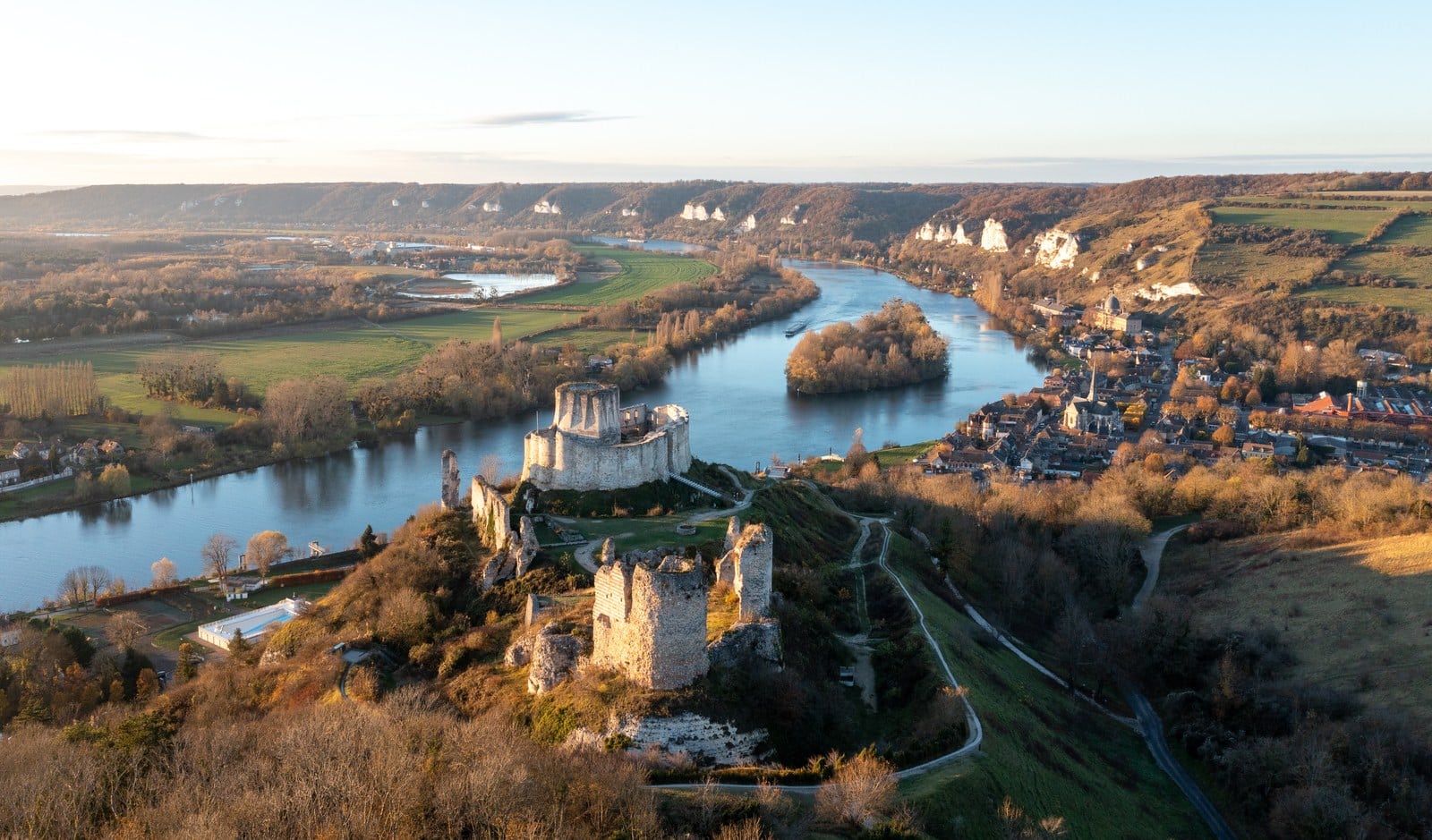
A Normandy castles itinerary is easy to draw on a map and surprisingly easy to get wrong on a calendar. Five castles stand in a rough line across the province, from the bay in the southwest to the Vexin in the east, and a car covers it end to end in under five hours of driving, a figure our Normandy castles guide gives alongside what the five have in common. What decides whether the trip works is not the distance. It is the day of the week you start on, because one of the five shuts its ticketed part for two consecutive weekdays, and that closure lands on the last day of the sequence. This page does the other job: the order, the legs, the dwell budgets, where the nights go, and the arithmetic that tells you which start days work.
List the 5 castles on this map
- Mont-Saint-Michel — Normandy, France
- Château de Falaise — Normandy, France
- Château de Caen — Normandy, France
- Château Gaillard — Normandy, France
- Château de Gisors — Normandy, France
Five pins, west to east. The map plots the stops; it does not draw the road between them.
What This Route Is
Three days, five castles, four driving legs, one direction. Mont-Saint-Michel first, then Falaise, then Caen, then Château Gaillard, then Gisors. Run that way the route is a straight west-to-east line, each leg shorter than the sum of the detours you would make from a fixed base, and it ends at the Paris end of the province rather than the far side of it.
The leg figures below are our own measurement, computed with openrouteservice across every pair of the five and read off in route order. They are bare driving time on a clear road, with no stops, no parking, and no approach on foot.
| Leg | Drive | Distance |
|---|---|---|
| Mont-Saint-Michel to Falaise | 110 minutes | 161.7 km |
| Falaise to Caen | 34 minutes | 38.0 km |
| Caen to Château Gaillard | 106 minutes | 157.4 km |
| Château Gaillard to Gisors | 37 minutes | 31.0 km |
| Four legs | 287 minutes, or 4 h 47 | 388.1 km |
The route’s two ends sit on the same instrument. Rennes to Mont-Saint-Michel is 80 minutes and 86.0 km, Saint-Malo to the Mount 59 minutes and 52.5 km, and Gisors to central Paris 79 minutes and 72.6 km. Those are the legs that decide whether you are booking three days or five, and they carry the same caveat as the table: bare driving, nothing else in them.
Two of the four legs in the table are short enough to pair their stops into a single day. Falaise to Caen is 34 minutes; Château Gaillard to Gisors is 37 minutes. Neither pair needs a night between its two stops. That leaves Mont-Saint-Michel as a day of its own: an operator visit of well under two hours, wrapped in the longest approach on the route. Three days, and the two long legs of 110 and 106 minutes fall between days rather than inside them.
Reverse the direction if you are coming from Paris rather than from Brittany or Rennes. The stops stay in the same order on the road; only the calendar changes, and it changes more than you would expect.
Before You Fix the Dates
This is the part the map cannot tell you. Each of the five publishes its own opening pattern, and none of them tells you what the five patterns do when you lay them end to end. Put them side by side and the whole thing collapses to a single rule.
All five ticketed interiors are open on the same day only from mid-April to the end of October, and only Wednesday to Sunday. Gisors sets both ends of the season: it opens latest in spring and closes earliest in autumn. Those bounds are the two eastern operators’ own published season dates, and they shift by a few days from one year to the next, so confirm the current ones on their pages before you fix a date near either end. Château Gaillard alone sets the weekday bound, and it is the only one of the five shut on a Tuesday.
Here is what each stop actually does.
Mont-Saint-Michel. The abbey has no closed weekday and no season, only a change of clock between summer and winter and three fixed dates on which it does not open at all, one of them 1 May. The village below it is a commune, so you walk into it without a ticket or a closing time.
Falaise. This one cannot be resolved in advance. Falaise says it opens every day and then closes on some Mondays without saying which, and it tells you to check its site before you come. Treat Monday as unavailable and put Falaise on another day.
Caen. The walled enclosure is free and open every day, closing only on 14 July. What happens inside it on a Monday is stricter, and it is the fact most likely to trip a visitor up. The two museums close on Mondays outside July and August, except the two spring public-holiday Mondays. So do the Exchequer hall and the church of Saint-Georges, which keep the same hours as the museums. The reception pavilion follows the museums too, so on a Monday out of season there is no ticket desk either. A Monday at Caen is a walk around the enclosure, not a visit to the halls.
Château Gaillard. In season the ticketed upper court is shut on Mondays and Tuesdays, while below it the free basse cour and the advanced work stay open all year, so the rock is never a wasted drive; the keep and the inner court are what you lose. The upper court does open on public holidays. It closes over the middle of the day too, which matters on a day that starts with a 106-minute drive from Caen.
Gisors. Interiors here open only on a guided tour in French, every day in season, with no self-guided option at all. Miss a departure and you see the park.
Which start days work
Take the route in order and the two eastern stops share Day 3. Because the eastern ticketed stop is the one shut two consecutive weekdays, everything reduces to this: Day 3 must fall Wednesday to Sunday, so the trip must not start on a Saturday or a Sunday.
| Start | Day 1, Mont-Saint-Michel | Day 2, Falaise and Caen | Day 3, Gaillard and Gisors | Verdict |
|---|---|---|---|---|
| Monday | Monday | Tuesday | Wednesday | Works |
| Tuesday | Tuesday | Wednesday | Thursday | Works |
| Wednesday | Wednesday | Thursday | Friday | Works |
| Thursday | Thursday | Friday | Saturday | Works |
| Friday | Friday | Saturday | Sunday | Works |
| Saturday | Saturday | Sunday | Monday, upper court shut | Breaks |
| Sunday | Sunday | Monday, museums shut and Falaise at risk | Tuesday, upper court shut | Breaks worst |
That table is weekday arithmetic, and it assumes none of the fixed-date closures falls inside your three days. They do not move: the abbey at Mont-Saint-Michel shuts on 1 January, 1 May and 25 December, Caen’s enclosure shuts on 14 July, and Caen’s museums and the Exchequer hall add 1 January, 1 May, 1 November and 25 December. A Friday start reads as workable above and is not one if that Friday is 1 May. Check your actual dates against those before you trust the weekday.
Two things in that table run against instinct. A Monday start works, and it works precisely because Monday is the Mont-Saint-Michel day, the one stop with no weekday closure to worry about. Avoiding Mondays is good advice about castles and bad advice about this sequence. And a weekend start is the trap in this direction, which is the opposite of how most trips get planned. Sunday is the worst available start, because it damages two days rather than one.
If you can only start on a Saturday, run the route the other way instead of abandoning it: with Gisors and Château Gaillard on the Saturday, Caen and Falaise on the Sunday and Mont-Saint-Michel on the Monday, every closure on this page is cleared. A Sunday start is the one the arithmetic cannot rescue in either direction.
In July and August Caen’s museums open on Mondays, which softens a Sunday start without rescuing it: Falaise’s occasional Monday and Gaillard’s fixed Monday and Tuesday are unchanged.
This page publishes no prices and no clock times, because those change and a route article is the wrong place to keep them current. Each castle’s own guide carries an Admission table that is maintained for exactly that purpose: Mont-Saint-Michel, Falaise, Caen, Château Gaillard and Gisors.
Day One: Mont-Saint-Michel
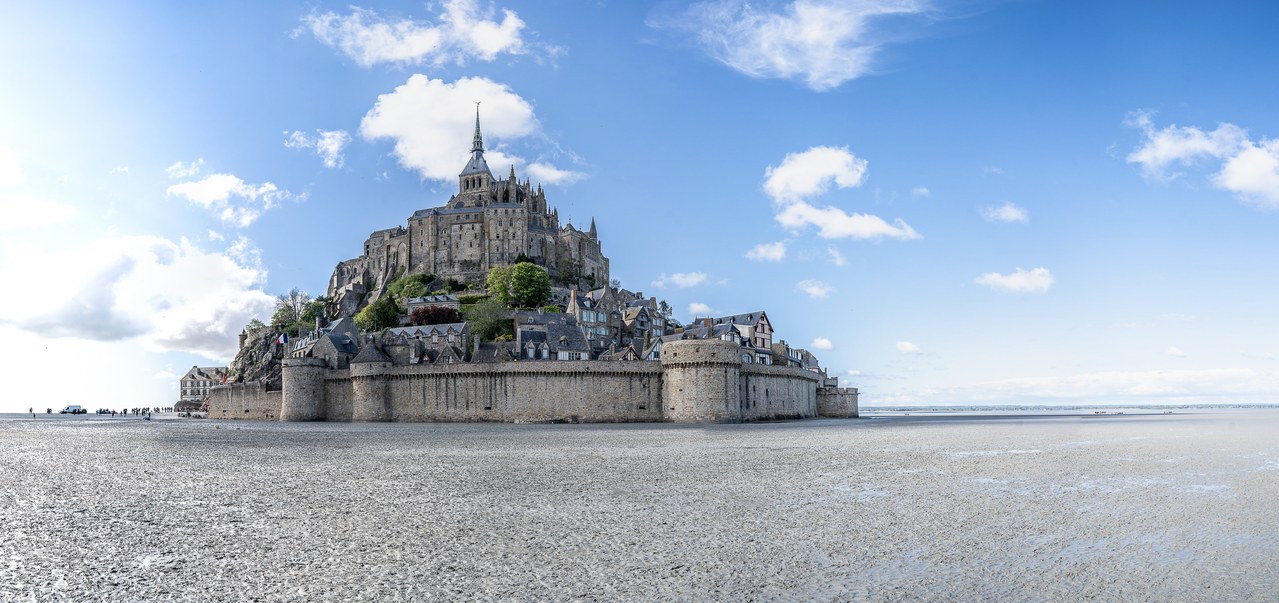
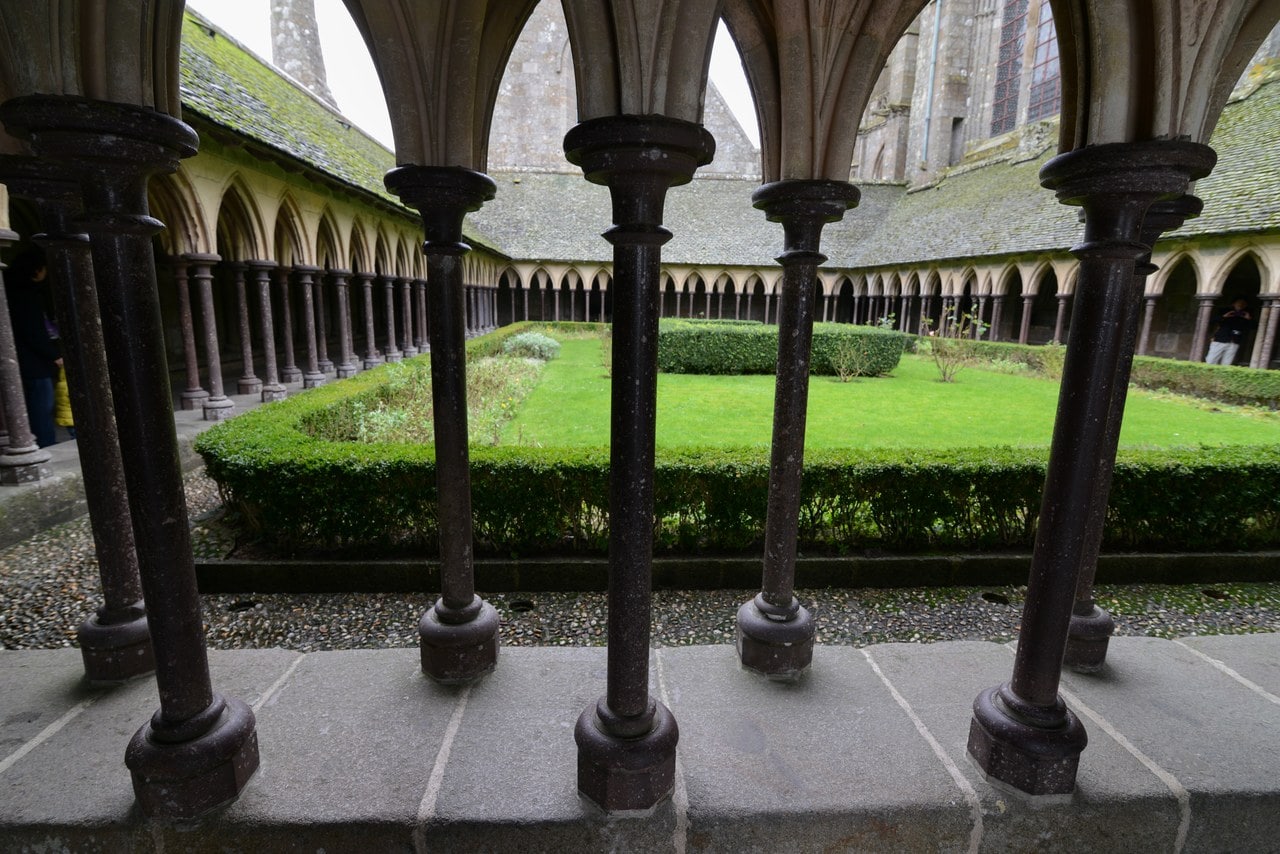
Give this one a full day and do not try to bolt anything onto it. The reason is the approach rather than the monument. Car parks sit 2.5 km from the rock, and the abbey’s operator budgets 45 minutes to an hour on foot between the parking and the abbey door, a range it attributes to how many people are on the causeway rather than to how fast you walk. A free shuttle covers most of that distance. Double the walk for the return, add the abbey itself, and half a day is gone before you have decided where to eat.
What you get for it is the most elastic stop on the route, and our full guide to the abbey on the rock covers the interiors this page only budgets for. Because the village needs no ticket and keeps no hours, an early arrival and a late finish both work here in a way they work nowhere else. The abbey is the only part with a gate, and it is the part to fix your timing around: last entry falls an hour before closing.
The Benedictine house on the rock goes back, by the operator’s own framing, to a legend. In it, the archangel Michael appeared three times to Aubert, bishop of Avranches, in 708. What is firmly dated is 966, when Duke Richard I of Normandy installed Benedictines on the Mount. The Centre des monuments nationaux describes the abbey as a strategic point in the middle of the bay and a fortress of the duchy of Normandy during the Middle Ages, and that matters for what your ticket buys: the abbey and the town walls are two separate protections in the national register, and the ticket is for the abbey.
On the tide, the useful version is narrower than the folklore. A 2.2 km footbridge reaches the rock all year, except at high tidal coefficients, when the Mount becomes an island again for about an hour. A visitor caught by that waits an hour to an hour and a half before the footbridge is walkable again. That is a possible hole in the middle of your day and worth checking against the published tables; it is not a reason the trip might fail.
Access is hard, and the operator says so plainly: the climb and the number of steps mean the abbey asks for reasonable health, and it is difficult for visitors with reduced mobility. Pushchairs are admitted but must be folded. The shuttle has ramps and dedicated spaces, and the visitor center lends wheelchairs free.
Sleep near the Mount. Night one belongs here because the evening on the rock costs nothing and the morning drive is long.
Day Two: Falaise and Caen
A 110-minute run east brings you to Falaise, and 34 minutes more takes you on into Caen. Day two is the easiest of the three and the one with the most room in it.
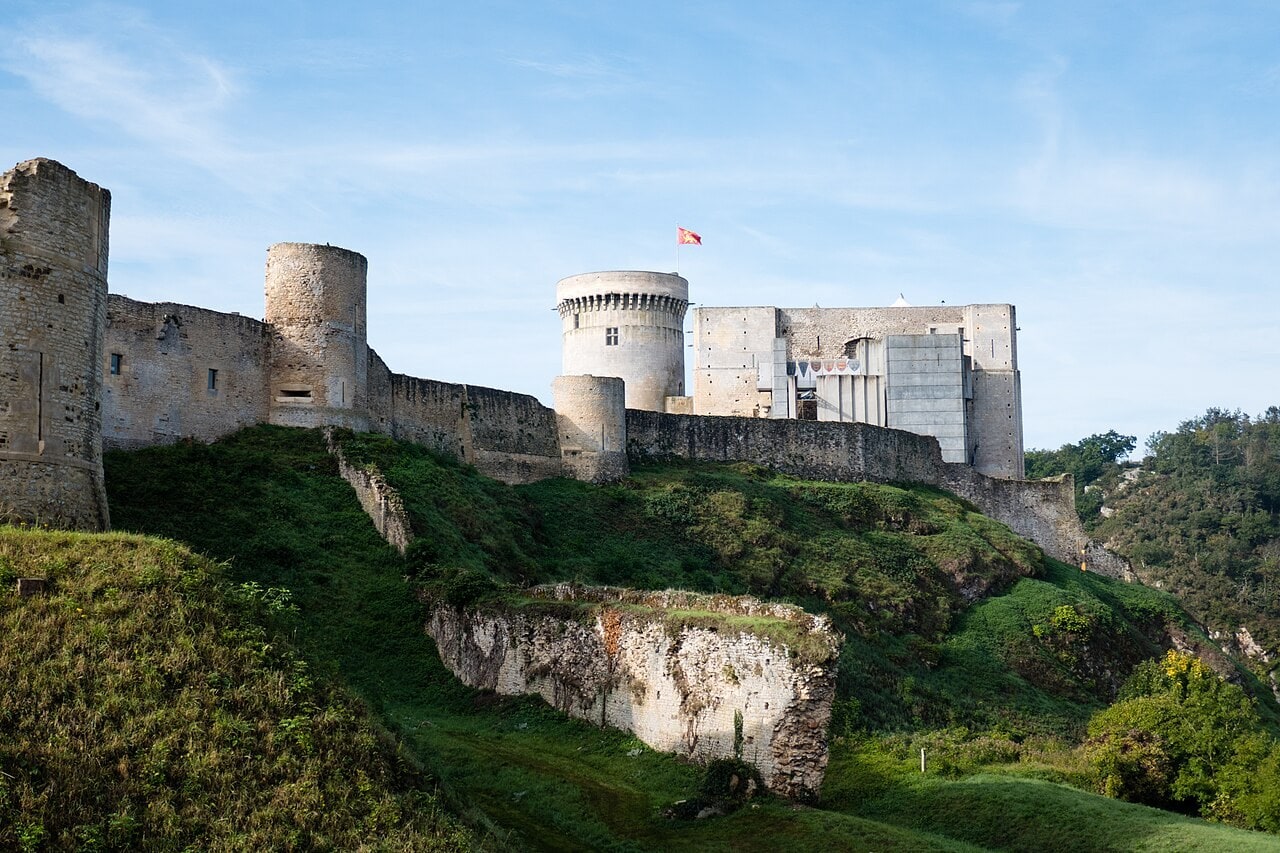
Château de Falaise is where William the Conqueror was born, and a visitor who comes only for that will be looking at the wrong building. Only faint traces of William’s keep survive. The oldest standing building in the high court is his youngest son’s: Henry I Beauclerc, king of England and duke of Normandy, raised it in 1123. What stands today is an irregular enceinte of 15 towers, dominated by three keeps, and it survives because it was rebuilt. That rebuild was designed to be seen as one: the operator’s stated principle is to keep the public from confusing the medieval work with the modern, so you enter through a concrete forebuilding of 1996 and cross the high court on a suspended steel footbridge. The medieval interiors are gone, in the operator’s own word, and they are supplied on a touch tablet as you walk. The tablets are issued only to visitors over ten, so a younger child walks the keeps without the reconstruction the ticket is largely for. Knowing that before a 110-minute drive is better than discovering it after one. The ditches here are dry and rock-cut, whatever a tourist board may tell you.
Time it properly: the operator budgets an hour and a half for the self-guided route through the keeps with its tablets, a figure it publishes for adult groups walking the same circuit an individual walks. Guided tours are a separate product and a separate length, and the English-language ones run only in high summer. In July and August the operator advises coming in the morning to limit the wait. The keeps also carry a hard limit, which is worth knowing on a hot August afternoon.
The basse cour is free and outside the ticket, which makes Falaise workable for anyone in the party who cannot manage the keeps: wheelchairs and pushchairs cannot do the keep circuit at all, though the visitor center itself is accessible.
Château de Caen in the afternoon is a different kind of stop. You walk in through one of three named gates into a very large walled enclosure that holds two museums, an archaeological garden where the ducal palace stood, and the excavated footings of a keep levelled after the Revolution. The national register’s own title for the site is “castle, now the museums of Caen,” which is as honest a description of what is there now as any heritage authority gives. The ducal castle here was raised about 1060 by Duke William of Normandy, the future William the Conqueror, and enlarged by his descendants, who held England as well as Normandy.
Two things to plan around. The Exchequer hall, restored in 1962, is free but not always open, on the Monday pattern set out above. And the keep is not a walk-in: the excavated footings and the tower of Queen Matilda are reached only on the guided visit, which is ticketed separately and does not run every day. The guided castle visit runs an hour and a half. If climbing into the keep is the point of your visit to Caen, that tour is the only published way in, and it needs a day when the ticket desk is open.
Night two belongs in Caen. It sits between Falaise and the eastern pair, it has the route’s only mainline station, and the enclosure itself is open from early to late.
Day Three: Château Gaillard and Gisors
The hardest day, and the one the whole start-day rule protects. It opens with a 106-minute drive east from Caen and closes with a 37-minute hop north from the Seine to the Epte.
Start early, and begin with the castle on the rock above Les Andelys, because the ticketed upper court closes over the middle of the day. Arriving from Caen at midday is the single worst piece of timing available on this route.
Richard the Lionheart, king of England and duke of Normandy, raised it in the late 1190s to protect the Seine and the town of Rouen. It fell to Philip Augustus on 6 March 1204, and in that year mainland Normandy was annexed to the kingdom of France. How long the siege had run before that is disputed in the sources themselves, which is a question for the castle’s own guide rather than for a route. What you climb to today is a ruin, and the Ministry of Culture uses that word: unroofed, consolidated masonry on a chalk spur. The ruin is not the siege’s work. The castle was quarried for building stone from 1603, and the dismantling finished in 1611. Approaching it is rough going, up uneven paths on the rock, and the site is not accessible to visitors with reduced mobility or to pushchairs. Guided tours in English run here on Saturdays from May to November.
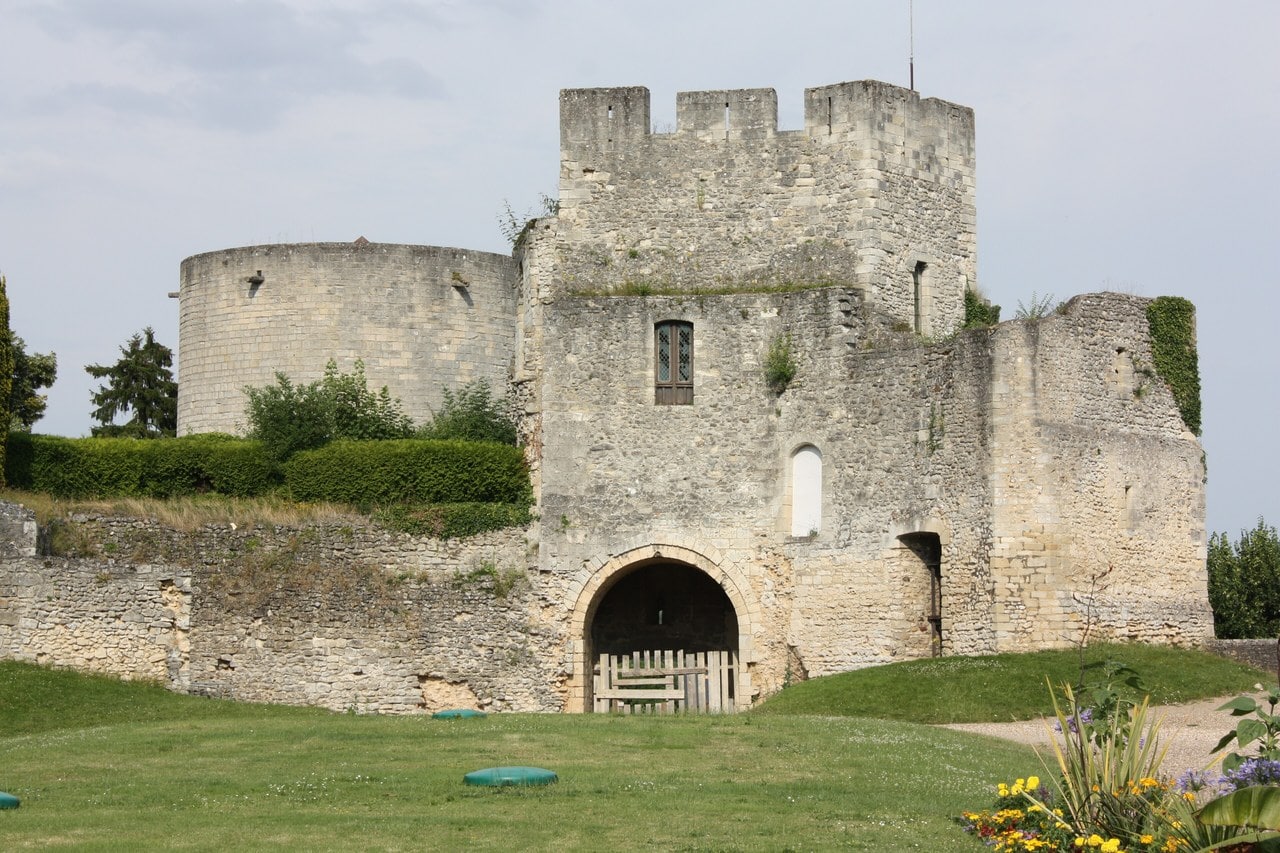
Thirty-seven minutes north, Château de Gisors is the tightest stop on the route and the one to book. Its interiors open only on a guided tour in French, and the number of visitors admitted at any one time is limited to 18, on that tour and on the shorter discovery visit alike. Three departures a day against 18 places is the whole daily capacity of the interiors, so an unbooked party arriving on a busy afternoon may not get in. The tour runs an hour and a half, you are asked to arrive 15 minutes before it leaves, and the route takes in 233 steps. It enters the Prisoner’s Tower, the motte and the tower the commune calls the tour Saint-Thomas. One seasonal rule to carry: when the department is placed under an orange heatwave warning the afternoon tours are cancelled, and the morning tours that do run go without the terrace.
The castle sits inside a free public park that a nineteenth-century mayor laid out over the enclosure, and the register’s own title for what survives is “remains of the castle.” A motte carries a stone ring wall around its keep, and Philip Augustus’s round great tower stands beside it. The motte was raised in the 1090s under William Rufus, king of England, and at Gisors the Epte divided the duchy from the lands of the king of France, which is why so much fortification ended up in one small town.
Night three, if you take one, belongs at the eastern end rather than back in Caen.
If You Only Have Two Days
Two days does not mean three days compressed. It means dropping a stop, and the honest cut is Mont-Saint-Michel.
That reads backwards until you look at the clock. Mont-Saint-Michel is a half-day minimum before you add the 110-minute leg to Falaise, and it is the one stop on this route that people routinely give a trip of its own with the bay, the tides and Pontorson around it. Cut it and the remaining four fall into two tidy pairs: Falaise and Caen on one day, 34 minutes apart, then Château Gaillard and Gisors on the next, 37 minutes apart, with the 106-minute transfer taken on the first evening or the second morning. Total driving falls to about three hours.
The weekday rule survives the cut and tightens slightly. Day 2 still carries Gaillard, so it must fall Wednesday to Sunday; Day 1 carries both Caen’s Monday problem and Falaise’s, so it must not be a Monday. A two-day version must start Tuesday to Saturday.
If you would rather keep Mont-Saint-Michel than the eastern pair, that is a different trip and not a shorter version of this one: Mont-Saint-Michel and Caen are 93 minutes apart and make a comfortable two-day pairing on their own, with Falaise as an easy addition.
Doing It Without a Car
A car-free version of this trip loses a stop, and you should know which one before you start pricing tickets.
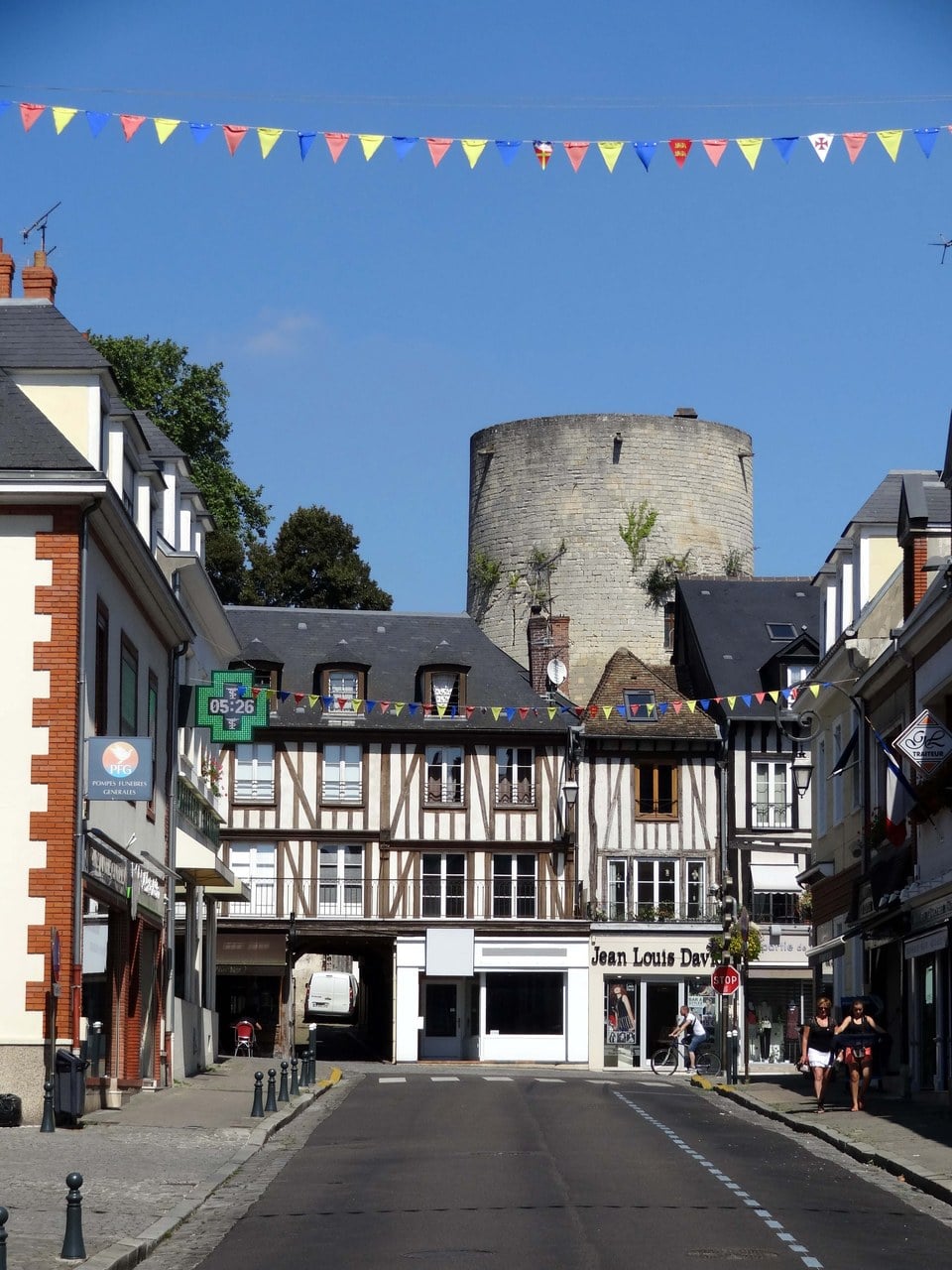
Three of the five are reachable on scheduled services, two of them effectively to the gate. For Mont-Saint-Michel the station is Pontorson – Mont-Saint-Michel, about 9 km short of the bay, with a bus line that covers the gap in about 27 minutes and runs every day; there are also coach connections from Rennes, Saint-Malo, Granville and Avranches published by the site’s own public establishment, and a direct Paris service, all of them with days of operation that vary by period. Caen is the strongest link on the route: the mainline station is ten minutes from the castle by tram, at the Château-Quatrans stop, and the enclosure has pedestrian gates on three sides. Gisors has a station in the town and a castle you can see from the street.
The two that break the chain are Falaise and Château Gaillard. Falaise has no station in the commune at all; the nearest stations actually carrying passengers are Argentan and Mézidon-Canon, both roughly 21 to 22 km away in a straight line, which is not the same measure as the road distances used elsewhere on this page. A coach does run it. Line 118 links Caen’s gare routiere to Boulevard de la Liberation in Falaise, and the region’s own published timetable data gives a median of 57 minutes for the journey. One thing about it inverts what a visitor expects and is worth carrying: line 118 runs less often in the school holidays than in term time, and thinnest of all on a Sunday. We do not print its timetable here, and a summer traveler in particular should read it on the operator’s site before planning a day around it. Château Gaillard’s station is Gaillon – Aubevoye, and there is a road leg left over from the station to the rock that no town service covers; the only document giving its length contradicts itself between its French and English columns, so no distance for that leg is given here.
Practically, then: a rail-and-coach traveler does Mont-Saint-Michel, Caen and Gisors comfortably, adds Château Gaillard with a taxi from Gaillon – Aubevoye, and reaches Falaise on line 118 from Caen, with the timetable checked first.
Where to Sleep Along the Route
The overnight decision is where a three-day plan is won or lost, and the arithmetic is unambiguous. Run from a single base in Caen as three out-and-back days and the driving comes to 8 h 50. Run the same five stops linearly, moving your bed twice, and it comes to 4 h 47. A single base roughly doubles the driving. Both figures are our own measurement on the same matrix as the leg table above.
Caen is still the natural single base if you want one: it is the only stop with a mainline station, a tram to the castle gate, and lodging at scale. That convenience costs about four extra hours in the car across three days.
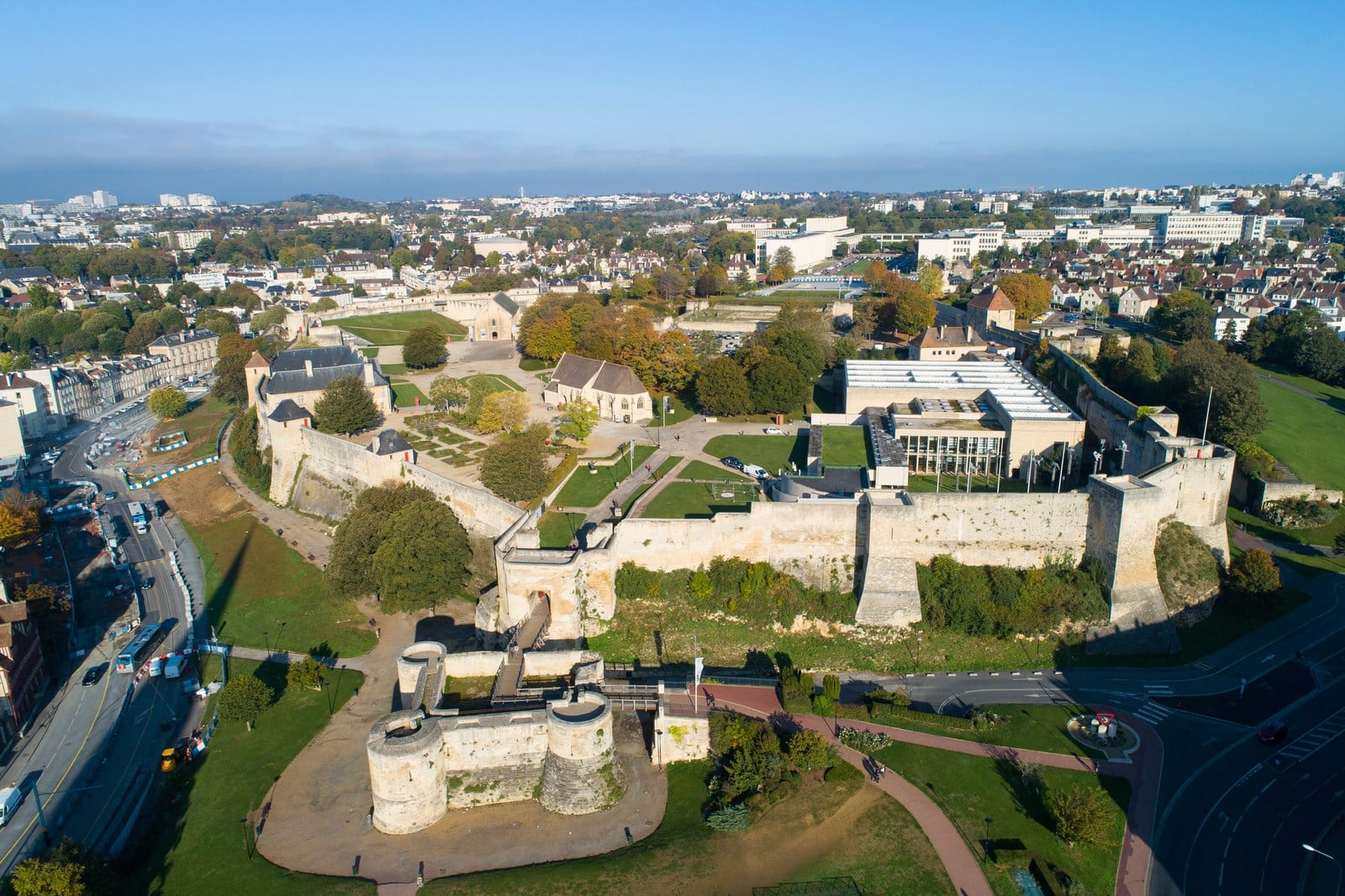
Moving twice, the nights fall in obvious places. Night one near Mont-Saint-Michel, night two in Caen, and night three, if the trip runs to one, at the eastern end, so that Day 3 does not begin with a long drive into a midday closure.
Supply is uneven along the line. Counted by commune in the national classification register, which lists classified establishments only and so understates the real total, Caen holds around 1,280 classified rooms against roughly 694 for the other four stops put together. Le Mont-Saint-Michel and Pontorson together carry a few hundred. At the eastern end the numbers are small: Les Andelys is in the low forties and Gisors in the low thirties. Unclassified hotels, chambres d’hôtes and rentals do not appear in those figures at all, so this is the shape of the supply rather than the whole of it. Book the eastern end early in summer.
For the eastern nights and for Caen, Booking.com lists rooms in the towns along this line, and GetYourGuide lists guided visits and day tours reaching the stops a car-free traveler finds hardest.
Some links on this page are affiliate links, which means StoneKeep Atlas may earn a small commission, at no extra cost to you, if you book through them.
Common Questions
Which months can you drive the whole route?
Mid-April to the end of October, if you want every ticketed interior open on the same day. Gisors binds both ends of that window. Outside it the route still runs and is worth running: Mont-Saint-Michel’s abbey and Caen’s museums stay open all year, Falaise closes only for a few winter weeks, and the two eastern stops keep their free ground open even when their ticketed parts are shut. A November traveler gets three ticketed interiors and two free enclosures, on a route with nobody on it.
Which castle should you start at if you arrive from Paris?
Gisors, and then run the line westward. Gisors and Château Gaillard are the Paris-side pair, 37 minutes apart. Reversing the direction changes the calendar as well as the driving: with Gaillard now on Day 1 instead of Day 3, the first day is the one that has to clear the upper court’s Monday and Tuesday closure. A reversed route must not start on a Monday or a Tuesday, and it must not start on a Sunday either, because that puts Caen and Falaise on the Monday. So the reversed direction rules out three start days where the west-to-east version rules out two.
How long do you actually spend at each castle?
Longer than the published figures suggest, because most of them describe a product rather than a visit. Mont-Saint-Michel’s abbey is quoted at 45 minutes to an hour and a half self-guided, before the approach. Falaise publishes an hour and a half for its self-guided circuit, and Gisors’ guided tour the same. Caen’s only published duration covers its guided tour, not the site. Château Gaillard publishes none at all, and the figures circulating for it come from tour operators rather than from the site.
Can you do this route with young children?
Partly, and the constraints differ at every stop. Gisors is the hard one: for safety reasons a child under six cannot join the guided tour, and since that tour is the only way into the interiors, an under-six sees the park. Pushchairs are treated three different ways along the route, so check each: they must be folded for the abbey at Mont-Saint-Michel, they are barred from the keeps at Falaise, and Château Gaillard refuses them outright. Caen is the one stop where a pushchair is not an issue.
Which stop is the easiest for a visitor with limited mobility?
Caen, and by a wide margin. Its reception spaces are accessible, a large lift serves the upper floor of the Logis des Gouverneurs, both reception desks have induction loops, and wheelchairs are lent free. The castle’s own by-law even permits motor vehicles inside the enclosure for reduced-mobility visitors to drop off or park. Of the others, the abbey and Château Gaillard both publish refusals in their own words, and at Gisors it is the gardens that are described as accessible rather than the monument.
What should you book before you leave?
Gisors, without hesitation, for the reason given above. Elsewhere the mechanism is different: at Falaise the keeps carry an instantaneous limit of 100 people, and when that limit is reached ticket sales and access are suspended until it drops again, which is a queue rather than a closure. Caen’s guided castle tour is separately ticketed and does not run daily. Mont-Saint-Michel and Château Gaillard can be walked up to, though the access operator at the Mount publishes a list of peak days and restricts coach arrivals on them.
Beyond This Route
This route is the practical companion to a longer argument. If you want the case for why these five belong together, what each was originally for, and how their tickets, stations and access compare as a set rather than as a sequence, that is the job of our guide to the castles of Normandy. If Normandy is one leg of a longer French trip, our survey of the chateaux of France sets the five in the national picture and points at the Loire, Provence and the Rhone valley.
Conclusion
Five castles, three days, 388 km and 4 h 47 of driving in a straight west-to-east line. The distances are the easy part. The calendar is not. Run west to east and your third day carries the eastern pair, whose ticketed stop is shut on Mondays and Tuesdays, so a Saturday or Sunday start breaks the sequence. A Saturday is still workable if you run the route the other way; a Sunday is not, in either direction. Then check your actual dates against the fixed closures, because the weekday is necessary and not sufficient. Monday is a perfectly good start, because Monday is the Mont-Saint-Michel day. Beyond that, book Gisors before you leave, start Day 3 early enough to beat a midday closure, and let each castle’s own guide carry the prices and the hours, which change more often than the road does.
Principal Sources
- Abbaye du Mont-Saint-Michel, Centre des monuments nationaux. “Informations pratiques.” abbaye-mont-saint-michel.fr.
- Atout France. “Hébergements classés.” Classification register, via data.gouv.fr.
- Château Guillaume-le-Conquérant, Falaise. “Visite du château : groupe adulte.” chateau-guillaume-leconquerant.fr.
- Château Guillaume-le-Conquérant, Falaise. “Son histoire.” chateau-guillaume-leconquerant.fr.
- Établissement public national du Mont-Saint-Michel. “Venir au Mont-Saint-Michel.” montsaintmichel.gouv.fr.
- Ministère de la Culture, base Mérimée. “Château, actuellement musées de Caen, notice PA00111127.” pop.culture.gouv.fr.
- Ministère de la Culture, DRAC Normandie. “Le Château-Gaillard aux Andelys.” culture.gouv.fr.
- Musée de Normandie, Ville de Caen. “Accès, horaires et tarifs.” musee-de-normandie.caen.fr.
- Office de tourisme Nouvelle Normandie. “Château Gaillard.” nouvelle-normandie-tourisme.com.
- Powicke, F. M. The Loss of Normandy (1189-1204). Manchester University Press, 1913.
- Région Normandie. Réseau interurbain Nomad Car, GTFS timetable data. transport.data.gouv.fr.
- SNCF Open Data. “Liste des gares.” ressources.data.sncf.com.
- Vexin Normand Tourisme. “Gisors, the legendary fortress.” en.vexin-normand-tourisme.com.
- Ville de Gisors. “Le château.” ville-gisors.fr.
- Ville de Gisors. “Préparer votre visite.” ville-gisors.fr.
- Ville des Andelys. “Château Gaillard.” ville-andelys.fr.
Image credits. Hero, Château Gaillard above the Seine at Les Andelys: Photo: Nicolas, Adobe Stock (owner subscription). Source: Adobe Stock 989048264, the source page; The route’s first stop, Mont-Saint-Michel from the strand: Photo: Nico -La boite bleue / Adobe Stock; Day one, the cloister at Mont-Saint-Michel: Photo: Jorge Láscar, CC BY 2.0; Day two, Château de Falaise from the north: Photo: Brady Brenot, CC BY-SA 4.0; Day three, the gatehouse at Château de Gisors: Photo: Antoine Garnier, CC BY-SA 4.0; Without a car, the castle seen from a street in Gisors: Photo: Pierre Poschadel, CC BY-SA 4.0; Where to sleep, the Château de Caen inside the city: Photo: s4svisuals, Adobe Stock. Freely licensed images are resized to fit; otherwise unaltered.