
Three Castles of Eguisheim
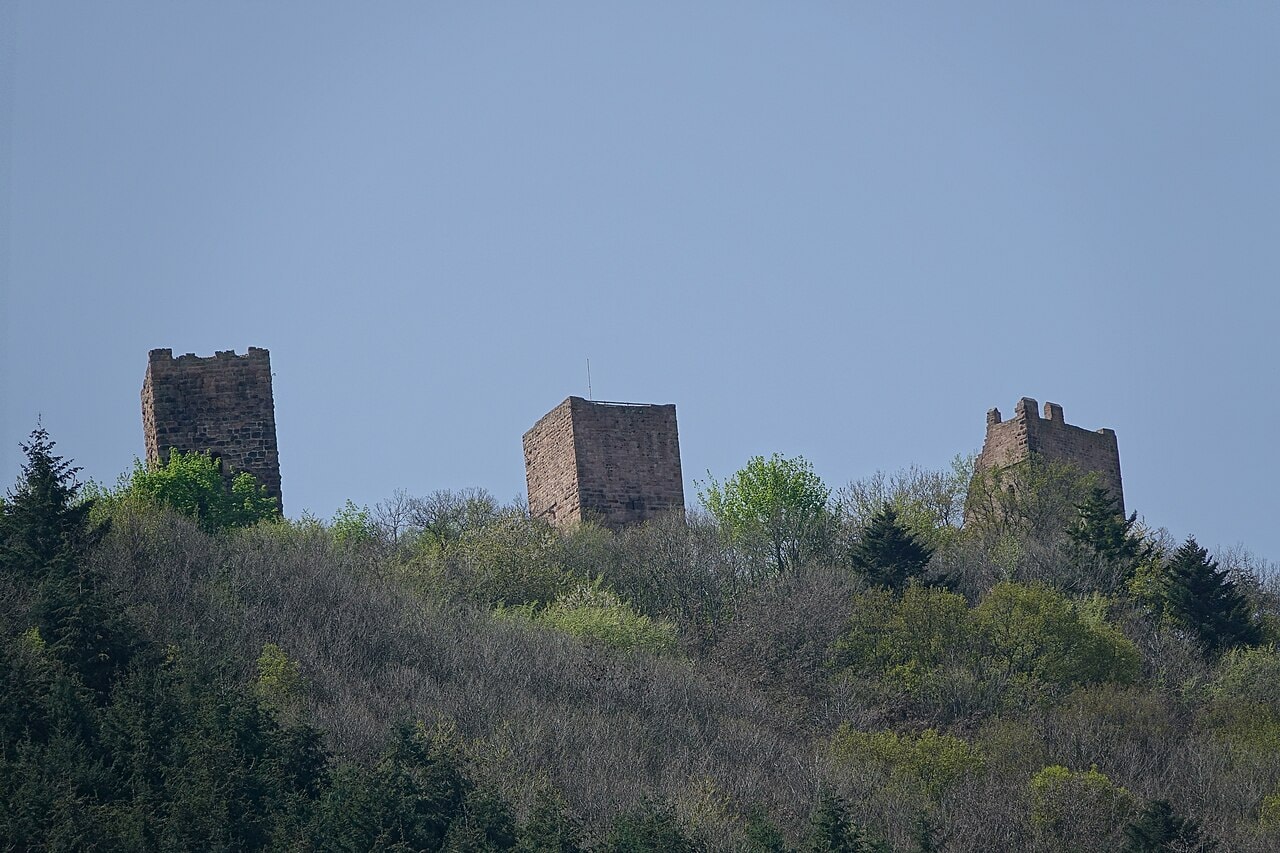
The Three Castles of Eguisheim are one of the strangest sights in Alsace: three ruined keeps standing shoulder to shoulder on a single wooded ridge above the Wine Route. Known in French as the Trois Châteaux d’Eguisheim and in the Alsatian dialect as the Drei Exen, the towers of Dagsbourg, Wahlenbourg and Weckmund began as one great fortress, the cradle of a pope, before family quarrels split it into three rival castles glaring at each other across their own ditches.
Burned in a single day in 1466 and never rebuilt, the trio now watches over the vineyards between Eguisheim and Husseren-les-Châteaux, free to visit for anyone willing to walk a forest path. This guide covers the dynasty that built them, the war that destroyed them, and everything you need to plan the climb.
Quick Facts
| Name | Three Castles of Eguisheim (Trois Châteaux d’Eguisheim; site of Haut-Eguisheim; Alsatian: Drei Exen) |
| Location | Schlossberg ridge above Eguisheim and Husseren-les-Châteaux, Haut-Rhin, Alsace, France |
| The three castles | Dagsbourg (north), Wahlenbourg (middle), Weckmund (south) |
| First recorded | Early 11th century, in the life of Pope Leo IX |
| Built by | Counts of Eguisheim and their heirs, 11th to 13th centuries |
| Destroyed | 1466, in the Six Deniers War; never rebuilt |
| Status | Classé Monument Historique on the first list of 1840 |
| Setting | Hilltop, about 500 m above sea level |
| Access | Free, open ruins reached on foot; access road closed to cars November 15 to March 15 |
| Official information | tourisme-eguisheim-rouffach.com |
Three keeps on one ridge
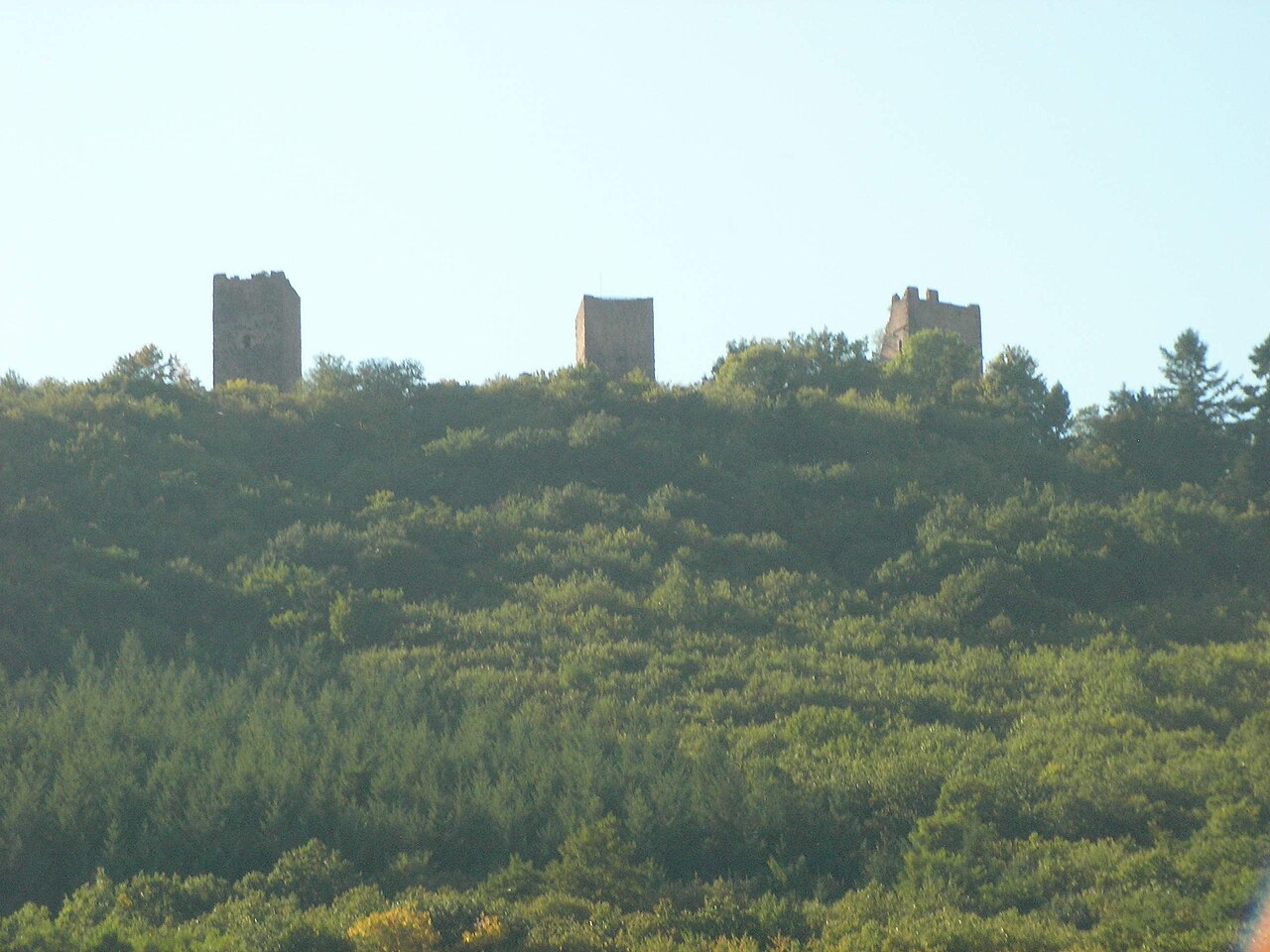
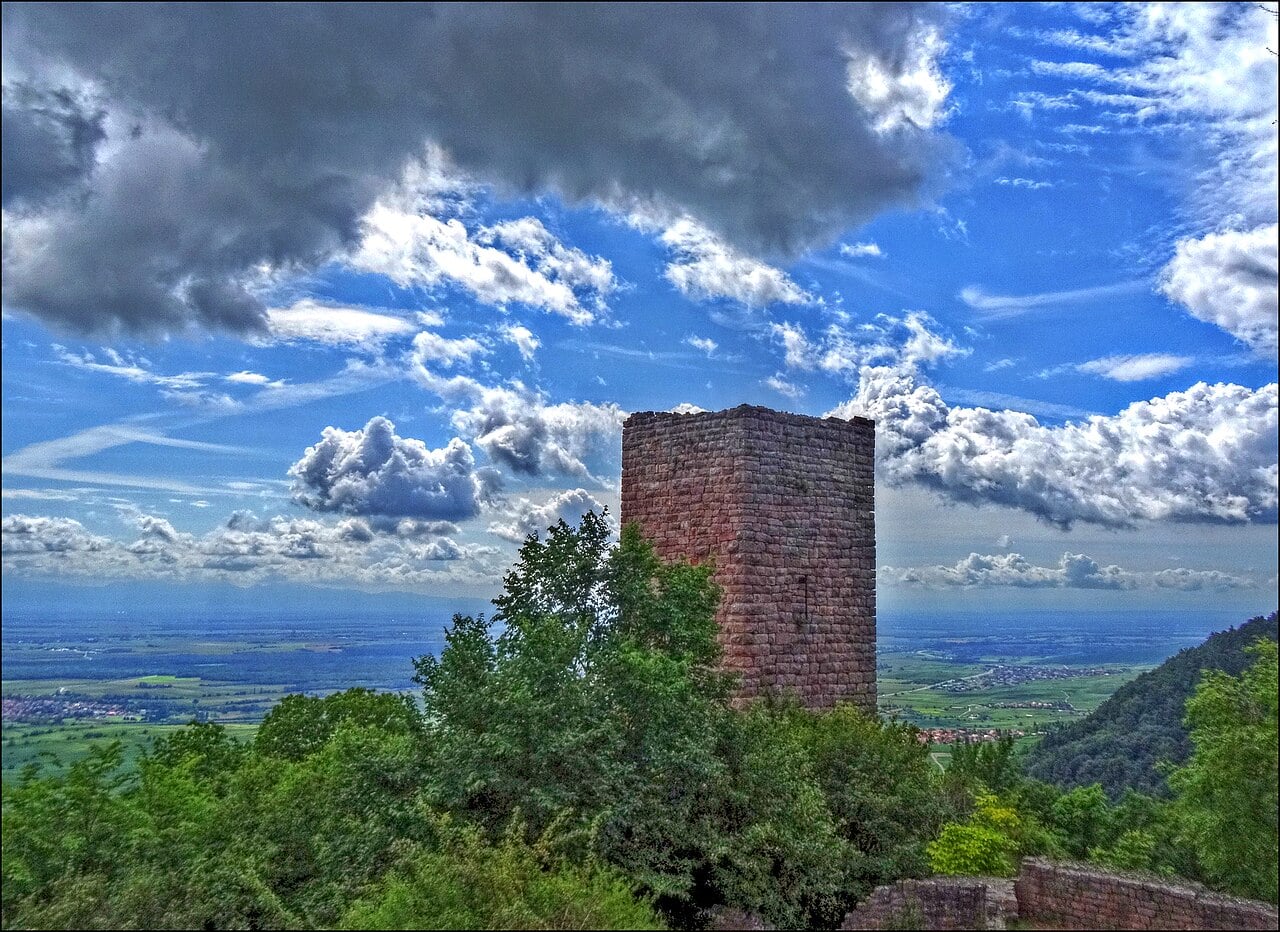
Seen from the vineyards, the Three Castles of Eguisheim read as a single silhouette: three square towers of pink Vosges sandstone spaced along the crest of the Schlossberg, a wooded spur that pushes east out of the mountains toward the Alsace plain. The castles stand on a sandstone platform about 500 meters up, high enough that the view runs across Colmar and the Rhine to the Black Forest on a clear day. Local lore even gave the towers a job: workers in the vineyards below are said to have read the time from them, the hill’s shadow covering the Dagsbourg at eleven, the Wahlenbourg at noon and the Weckmund at one o’clock.
The ridge itself is split down the middle by an invisible line. The northern castle, the Dagsbourg, stands on the commune of Eguisheim, while the Wahlenbourg and the Weckmund belong to Husseren-les-Châteaux, the wine village directly below. That odd arrangement dates to the French Revolution, when the two communes each bought their share of the old ruin. Even the village names carry the castles’ story: Husseren grew from the huts of the workmen who built the towers, and its full name simply means the houses by the castles.
From north to south the three are the Dagsbourg, the largest and youngest of the keeps; the Wahlenbourg, the middle castle on the site of the original fortress, known in old documents as the Mittelburg; and the Weckmund, whose name is a German rendering of Vaudémont, the Lorraine family that once held it. Alsatians call the group the Drei Exen, and the trio has become the emblem of Eguisheim itself, stamped on wine labels and signposts across the region.
The cradle of a pope
The castle enters written history through an unusually grand doorway: the biography of a pope. The life of Leo IX describes events at the fortress of Eguisheim around 1016, when it was the seat of Hugues IV, count of Nordgau and head of the powerful Eguisheim-Dabo dynasty. Archaeology shows people had used the hilltop since at least the Middle Bronze Age, and the first castle may well be older than its first mention; by the early eleventh century it was already a great fortress covering the whole summit, a pear-shaped enclosure that archaeologists believe was larger than all three later castles combined. The same papal biography records that the family founded the convent of Woffenheim on lands belonging to the castle, a reminder that this hilltop was the administrative heart of a county. Antiquarians long pointed to a stretch of masonry in the Dagsbourg curtain wall as Roman work, though recent study has cast serious doubt on that romantic idea, dating the technique no earlier than the ninth century.
Hugues’s son Bruno, born in 1002, grew up inside these walls. Elected pope in 1049 as Leo IX, he became one of the great reforming popes of the Middle Ages and the only one raised in an Alsatian castle. The family’s chapel of Saint Pancras stood within the castle enclosure from the early eleventh century, and tradition holds that Leo consecrated it himself when he returned to Alsace as pope. His shadow still lies over the whole hill: Eguisheim below celebrates him as its favorite son, with a chapel and a castle square named in his honor. The fortress saw trouble early. Local historians record an assault as early as 1026, when Duke Ernest II of Swabia rose against Emperor Conrad II and carried his revolt into the lands of the emperor’s Alsatian allies.
One castle becomes three
The Three Castles were not built as three castles. They are the fossil of a family feud, a single fortress carved up by inheritance until each heir crouched behind his own walls. The first cut came around 1080, when Helwige of Eguisheim, great-granddaughter of Hugues IV, married Gerard of Vaudémont: the southern half of the hill went to the Vaudémont-Eguisheim line, while the north stayed with the Eguisheim-Dabo counts.
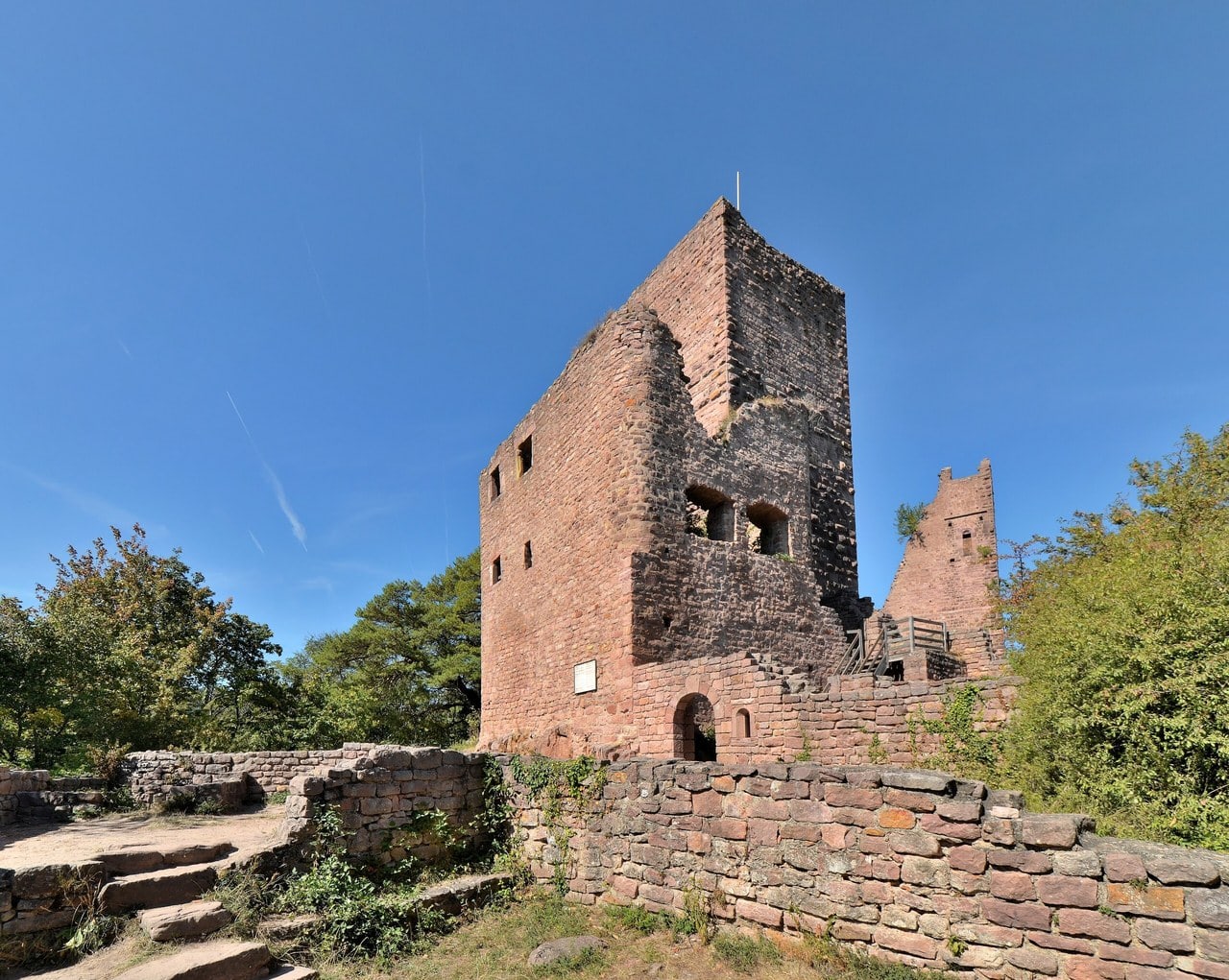
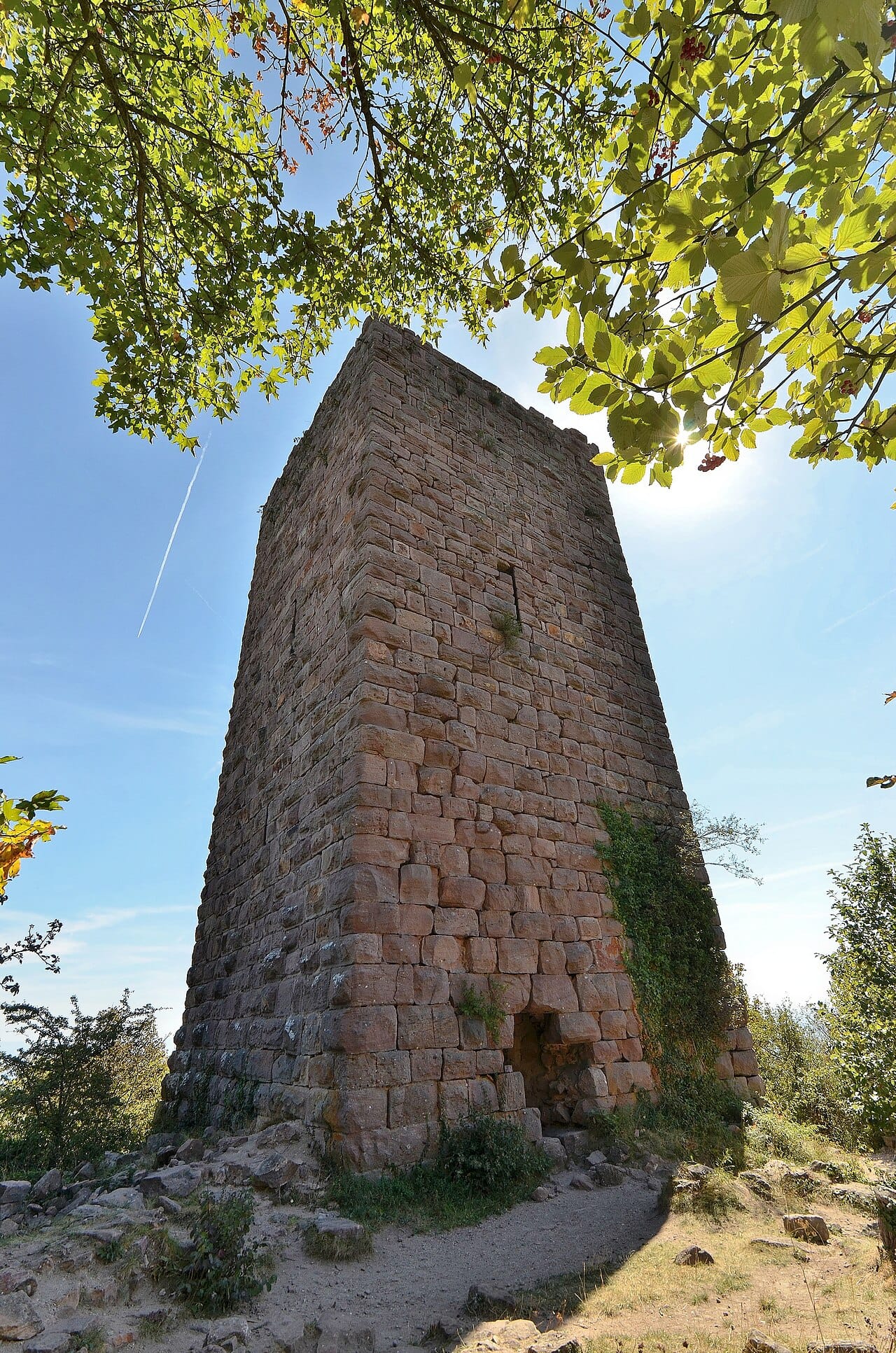
When the Vaudémont line died out around the middle of the twelfth century, their southern share passed by marriage to the counts of Ferrette, ambitious newcomers from the Sundgau. The Dabo counts apparently read the arrival of their new neighbors as a threat, because it was in these decades that they raised the great square keep of the Dagsbourg, the most imposing tower on the hill. The Ferrette answered in kind, building a keep of their own on the southern half. Around the start of the thirteenth century that southern share was itself divided, and a third castle rose at the tip of the spur: the Weckmund, with the Wahlenbourg squeezed between the two as the middle castle. Each court dug its own ditch, and the Weckmund’s keep, entered by a door at second-floor level, carries cross-shaped arrow slits that point not at the plain but at the Wahlenbourg next door. On this hill, the enemy was family. Archaeologists now read the site in three clean phases: the single great castle of the eleventh century, its division by the building of the Wahlenbourg, and the final split that created the Weckmund.
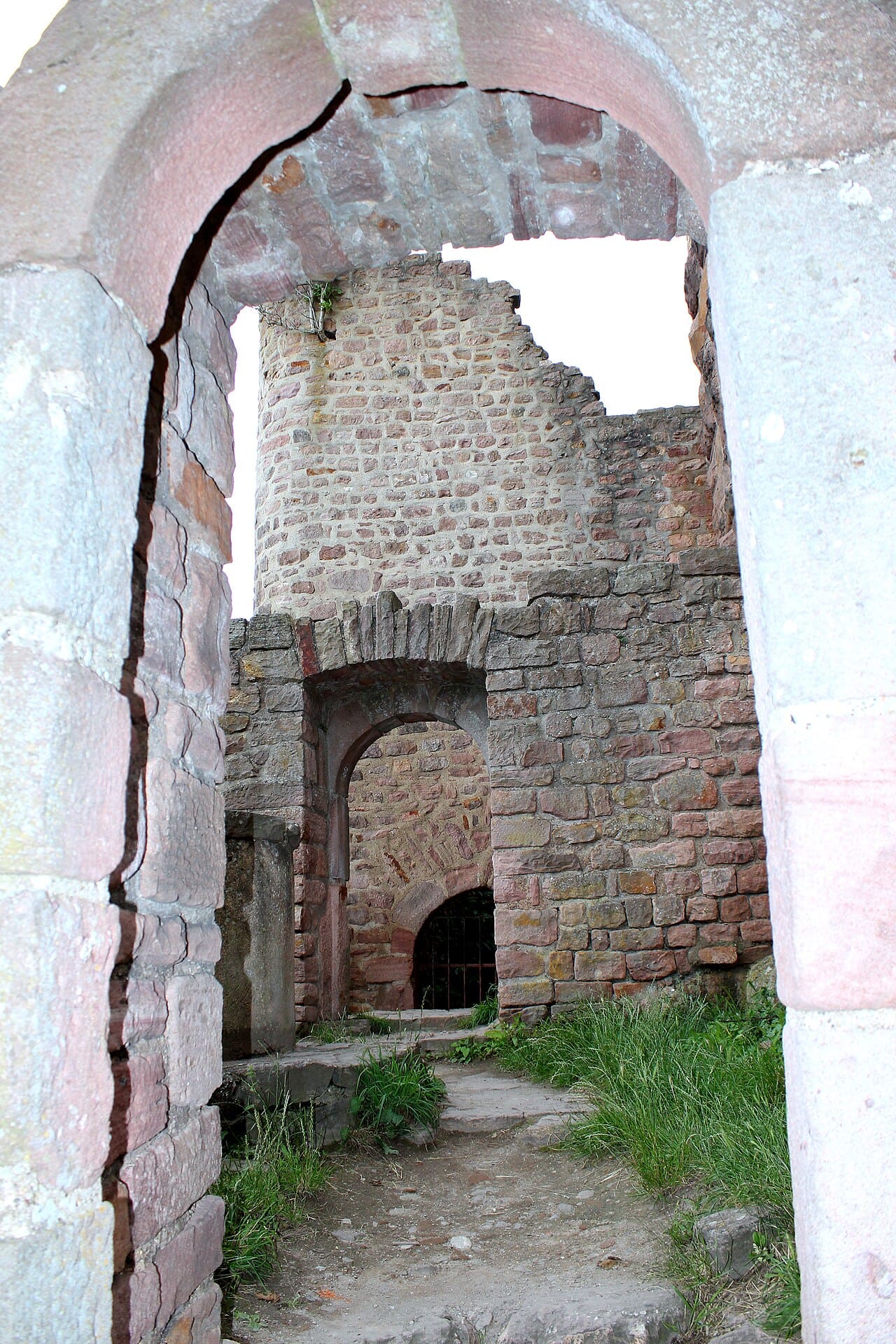
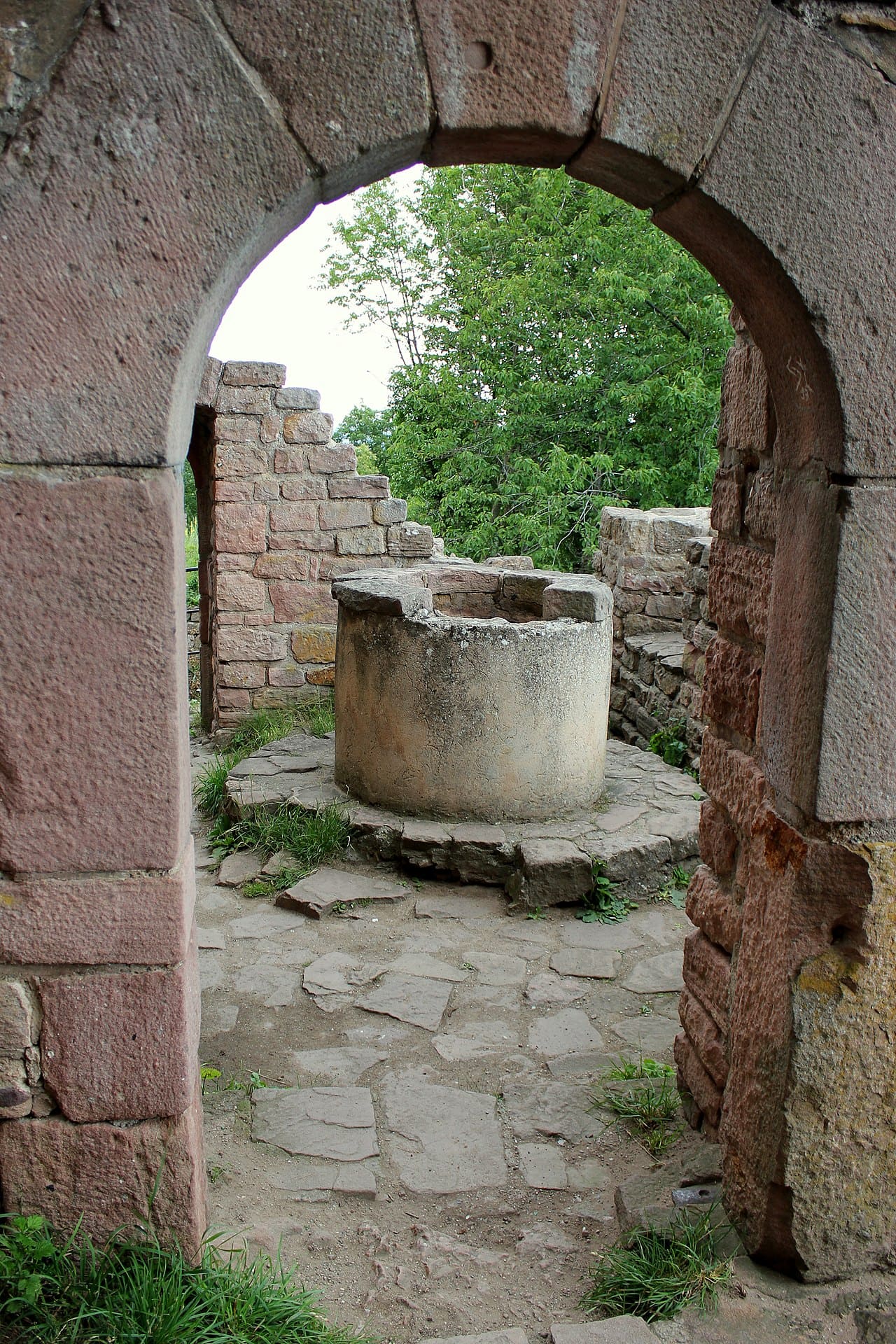
Each castle developed its own character. The Dagsbourg, partly destroyed and rebuilt at the end of the twelfth century, had a keep large enough to live in, with a palace and stables beside it. The Wahlenbourg kept the old comital residence, built around 1150 and remodeled into the fourteenth century, with a well in its courtyard and a round corner tower added late in its life; its own keep was a pure refuge, never meant for daily living. The feud reached its bloody climax after 1225, when Gertrude of Dabo, last of her line, died without children. Count Frederick II of Ferrette and Bishop Berthold de Teck of Strasbourg both claimed the inheritance, and their war scarred Alsace for years until the bishop’s victory at the battle of Blodelsheim in 1228 secured the Dagsbourg in episcopal hands. In 1251 his successor, Bishop Henri de Stahleck, gathered in the two southern castles as well. After two centuries of partition the hilltop was one lordship again, held by the bishops of Strasbourg and granted out in fief, its castles passing through the hands of nearly every power in Upper Alsace, the counts of Ferrette and their Habsburg heirs among them.
The Six Deniers War and five centuries of silence
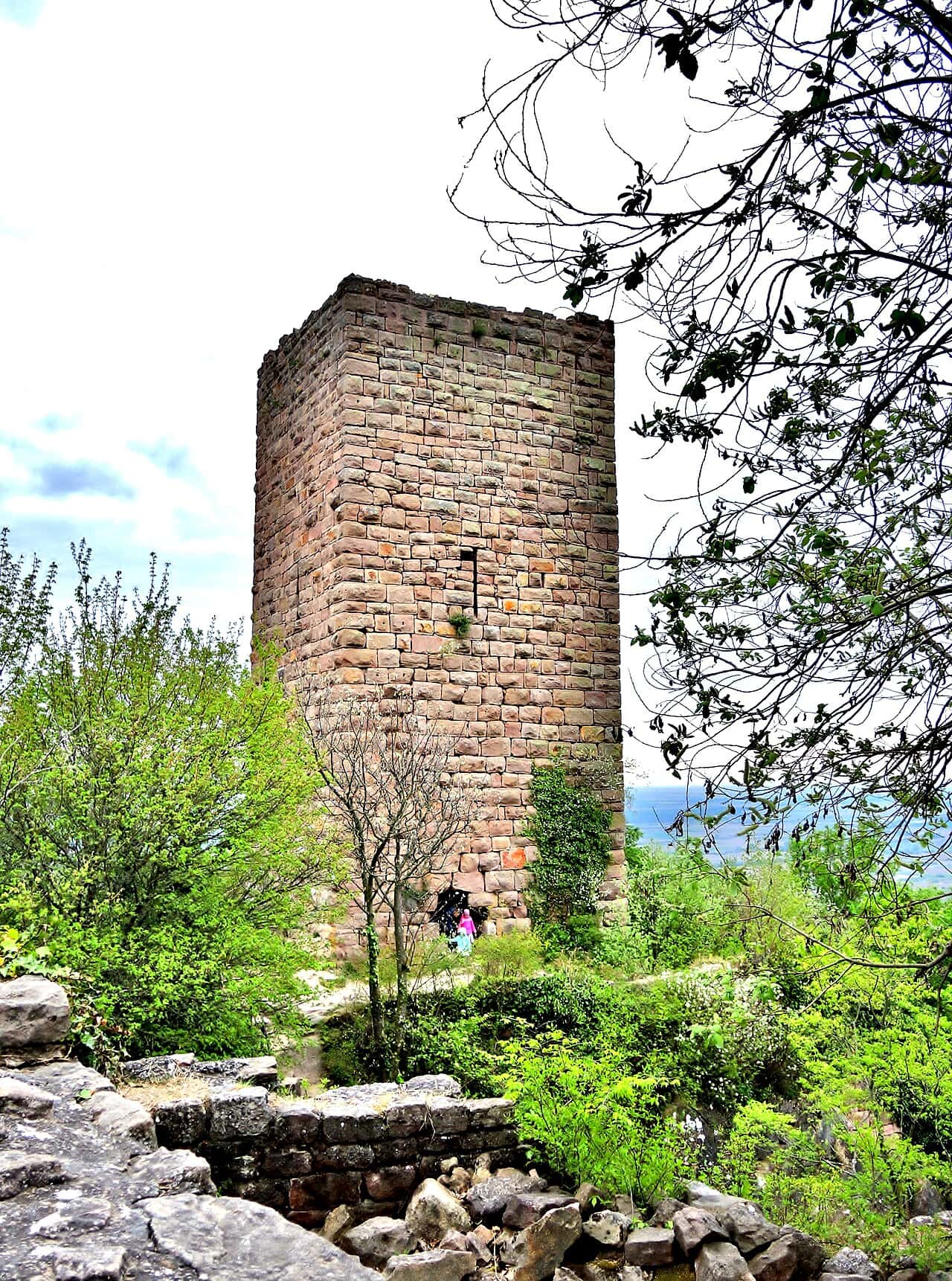
The end came suddenly, and over almost nothing. In 1466 a dispute involving a miller named Hermann Klee and a debt of six deniers, small change even then, escalated into open war between the free city of Mulhouse and a league of hostile Alsatian nobles. Mulhouse struck back hard. Its militias, joined by allied towns of the Alsatian Decapole including Colmar, Sélestat, Kaysersberg, Turckheim and Munster, stormed the hill and put all three castles to the torch. Visitors can still read the disaster in the stones: the north face of the Weckmund keep shows blocks shattered and reddened by the heat of the fire, scars of the burning rather than of any bombardment. Look closely at the same tower and you can also spot the lifting holes the medieval masons cut to hoist each bossed block into place, the marks of the builders beside the marks of the destroyers.
Only the little chapel of Saint Pancras was spared, standing alone among the blackened towers; it has since vanished so completely that no trace of it remains on the hill. The castles were never rebuilt. For more than three centuries the towers simply stood and crumbled, quarried by time rather than by men, until the Revolution sorted their bones between the two communes below. Silence bred stories. Villagers came to say that one tower hid a spring of fire, another a spring of water, and the third a mine of gold, three fates for three broken brothers.
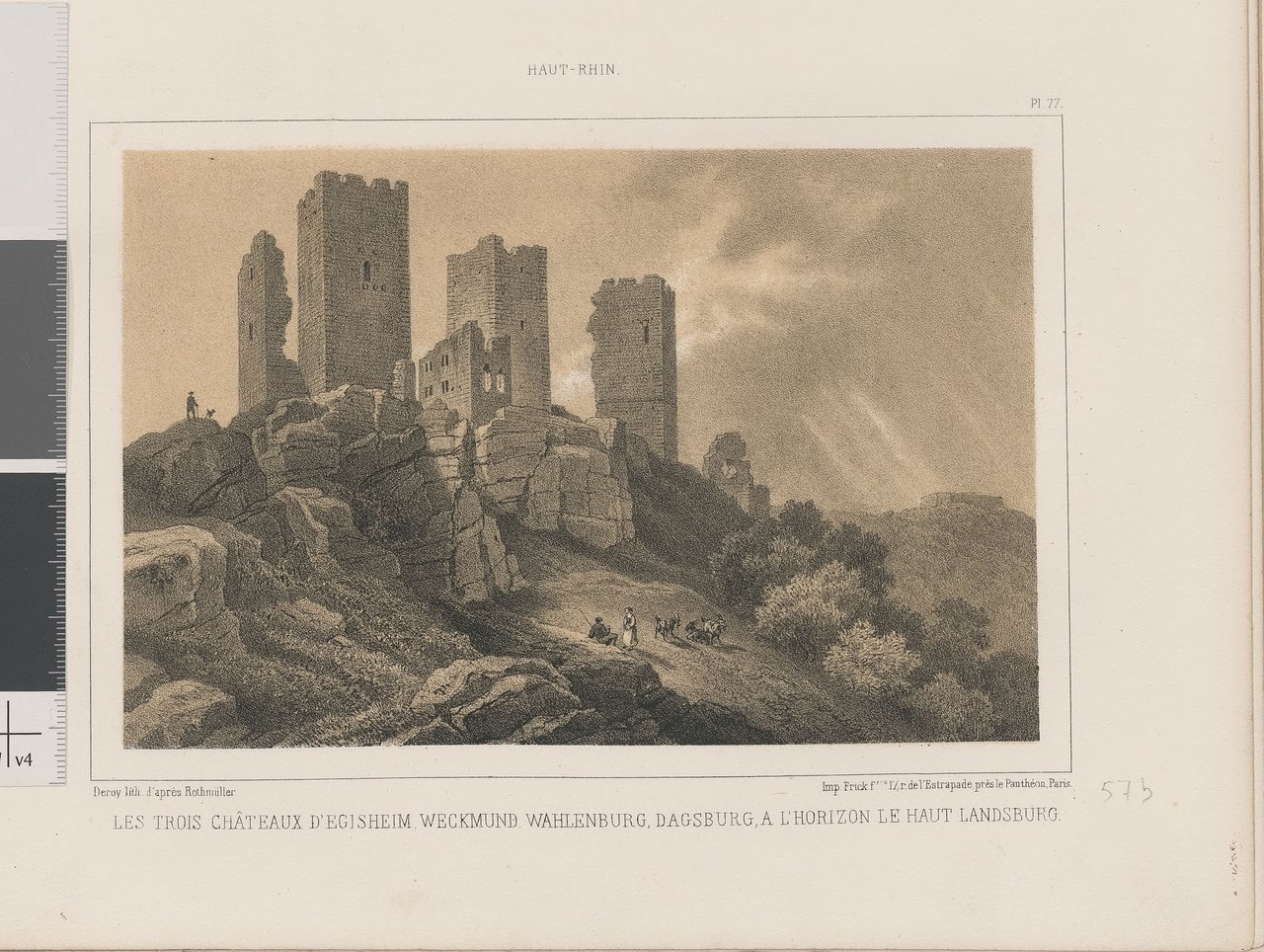
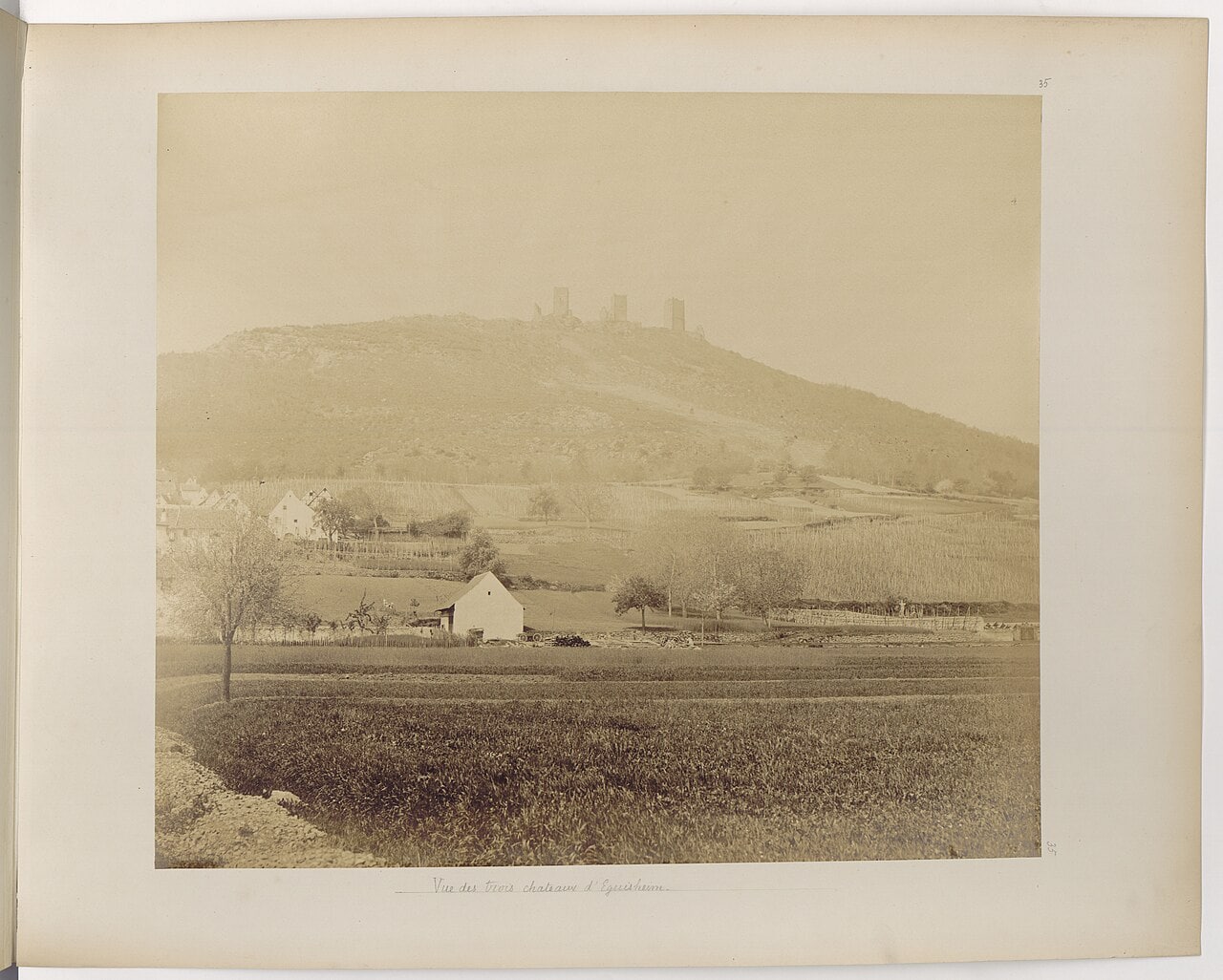
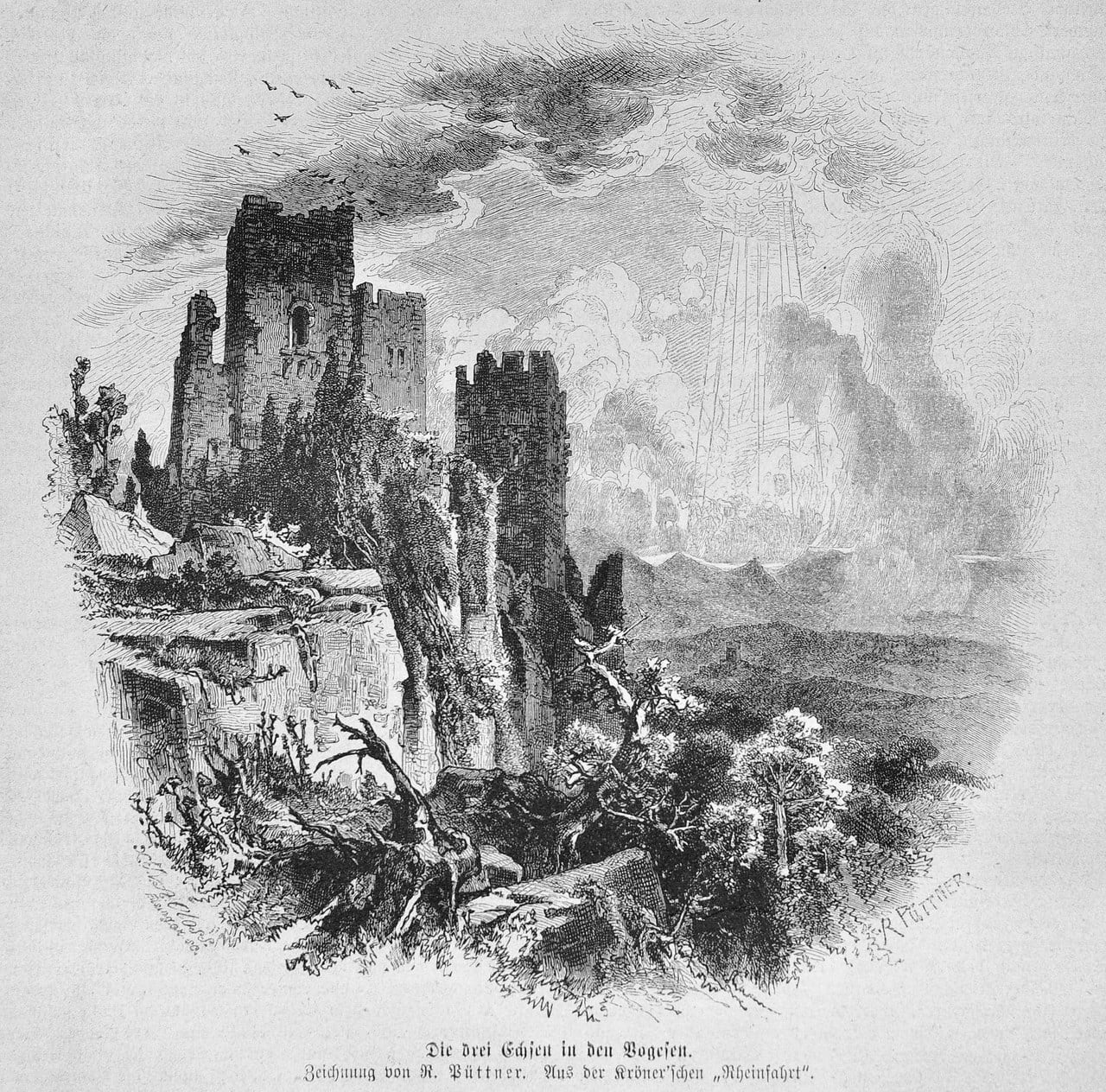
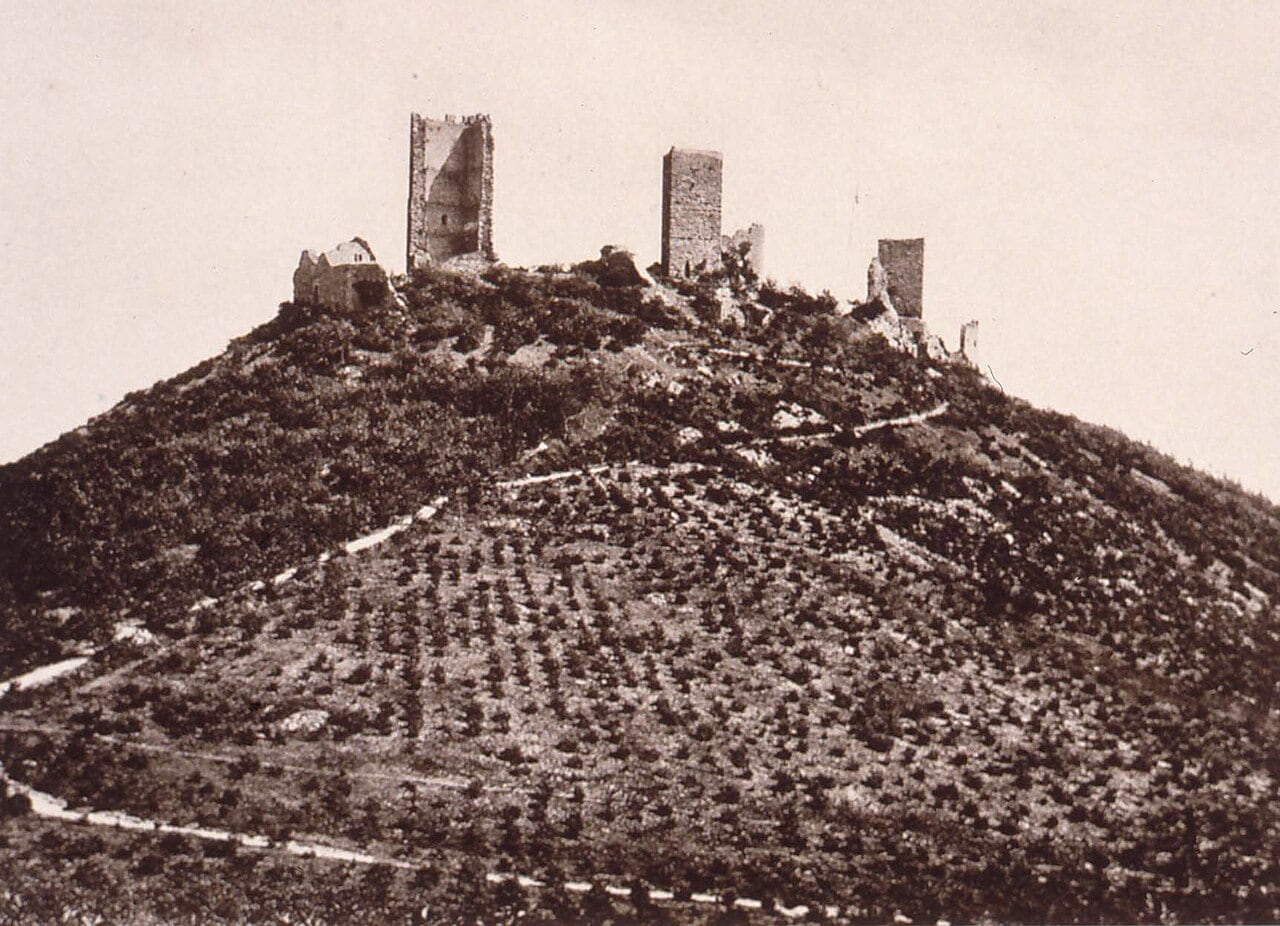
The nineteenth century rediscovered the hill. Romantic printmakers climbed it, and in 1840 the ruins were classés on France’s very first list of Monuments Historiques, the founding inventory that also included the Pont du Gard and the Palais des Papes: recognition of the first rank for three broken towers in the vines. The pioneering Alsatian photographer Adolphe Braun fixed them on glass around 1859 for his great survey of the province. Serious care came in the twentieth century, above all the restoration and excavation campaign of the mid 1960s, remembered as Opération Taupe, with consolidation work continuing regularly since 1973. The ruins visitors walk through today are stabilized but unreconstructed, honest survivors of 1466.
Visiting the Three Castles of Eguisheim
The Three Castles are free, open ruins, reachable only on foot and worth the short effort. The usual approach is the Route des Cinq Châteaux, the forest road that climbs from the top of Husseren-les-Châteaux toward Wintzenheim; a signed parking area below the site leaves a walk of about ten minutes to the towers. Note the season: the road is closed to vehicles by prefectural order every year from November 15 to March 15, when the castles can only be reached on foot. Despite its name, the road actually serves six castles, since little Hagueneck hides in a side valley beyond Hohlandsbourg and Pflixbourg, and the long-distance castle trail of Alsace threads past all of them. Walkers can climb from the church square in Husseren in about twenty minutes, or make the longer, lovelier ascent from Eguisheim itself through the vineyards, a good hour uphill.
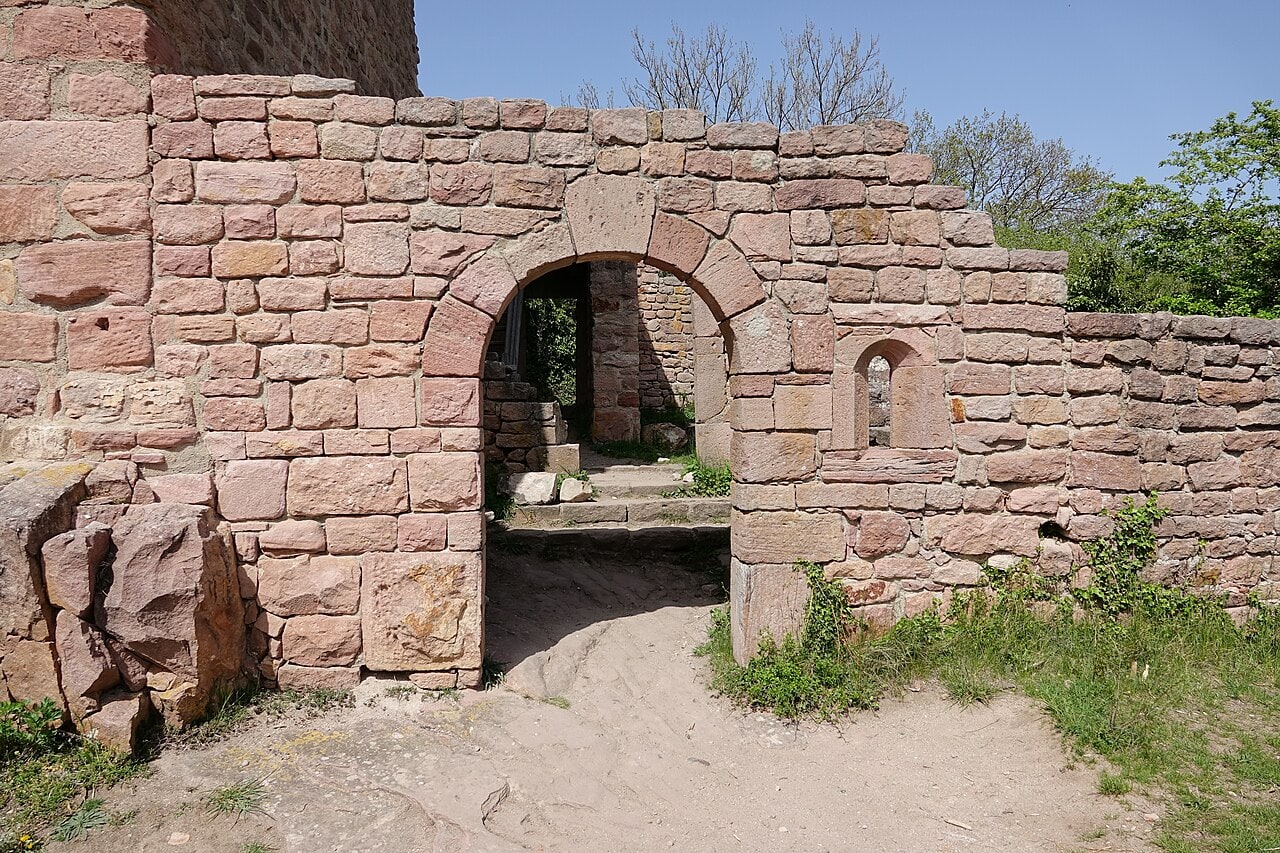
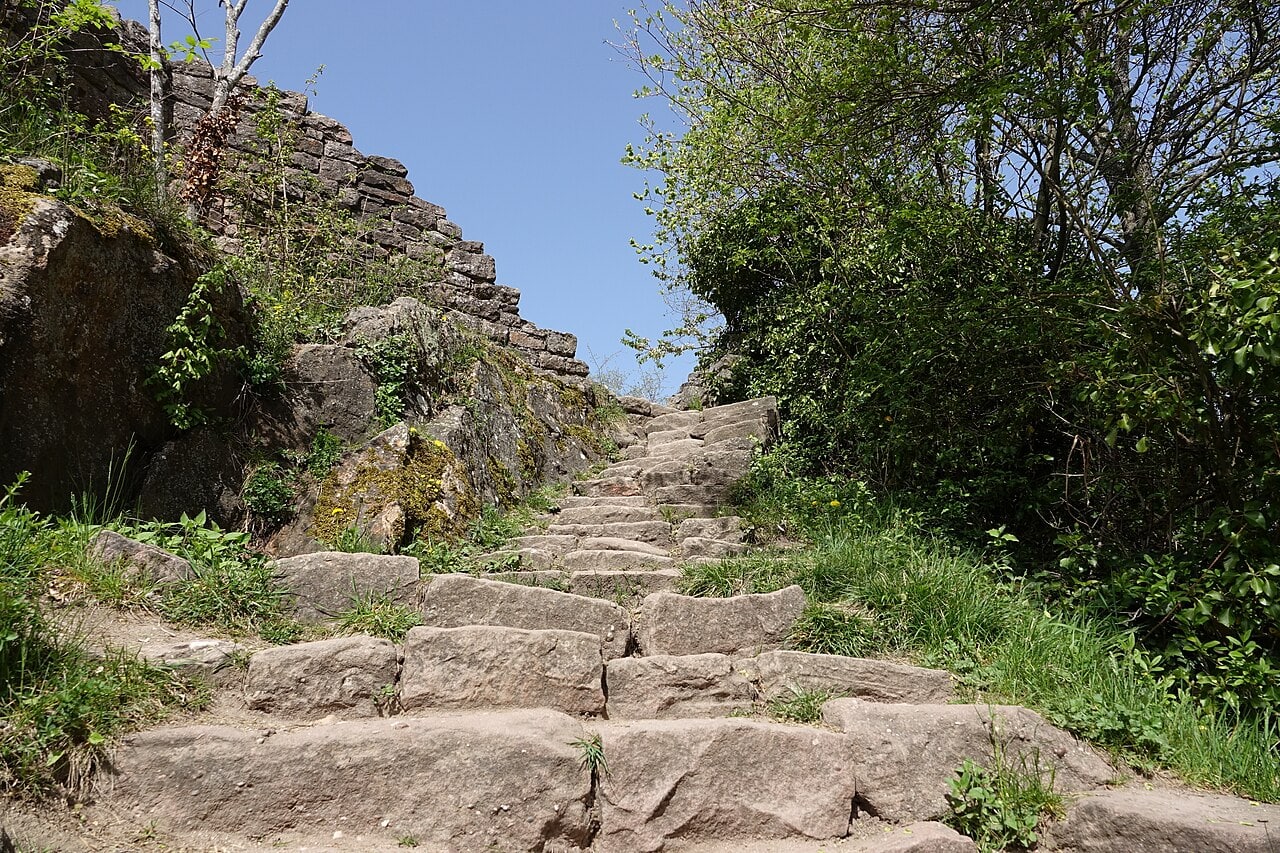
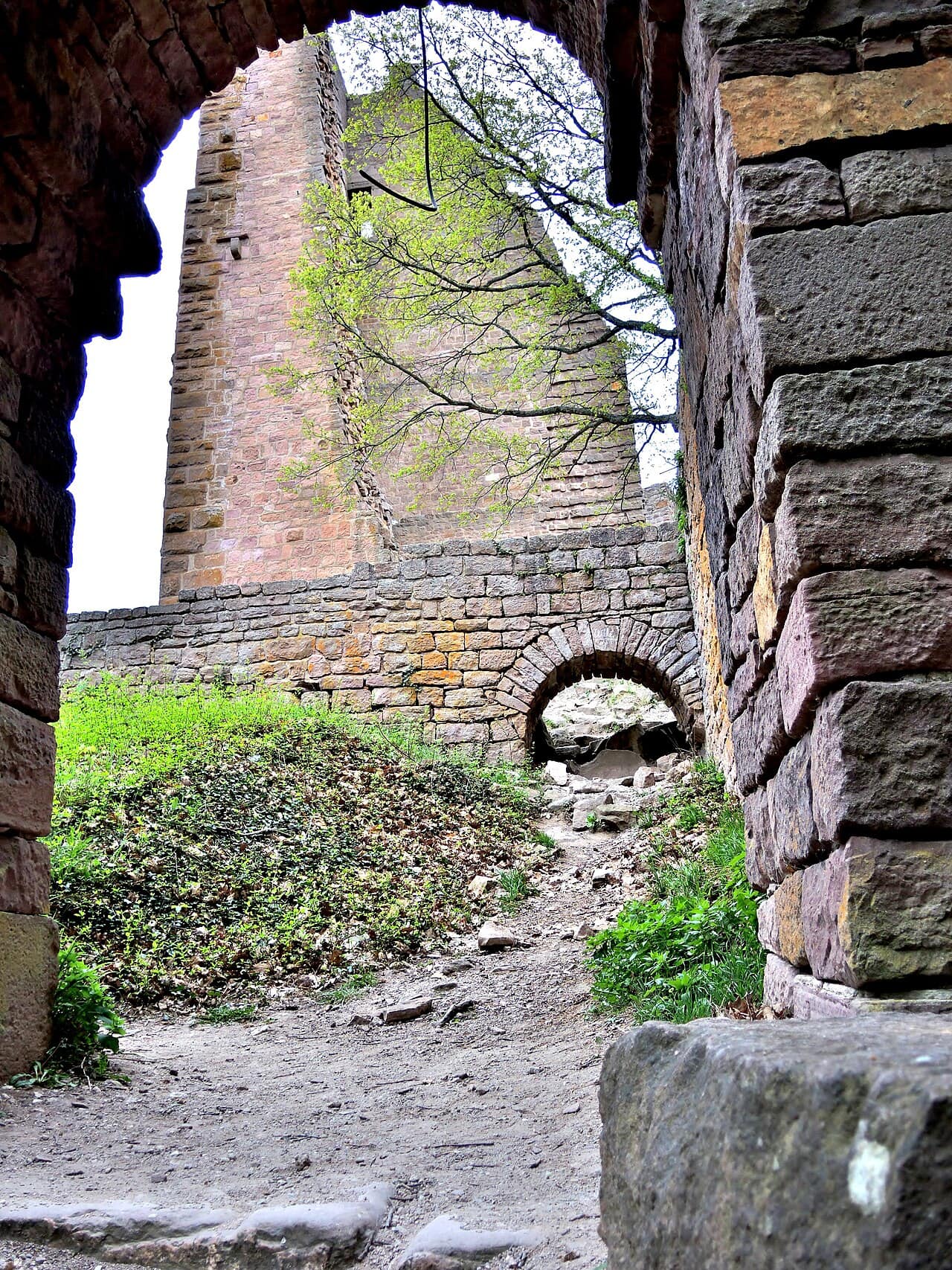
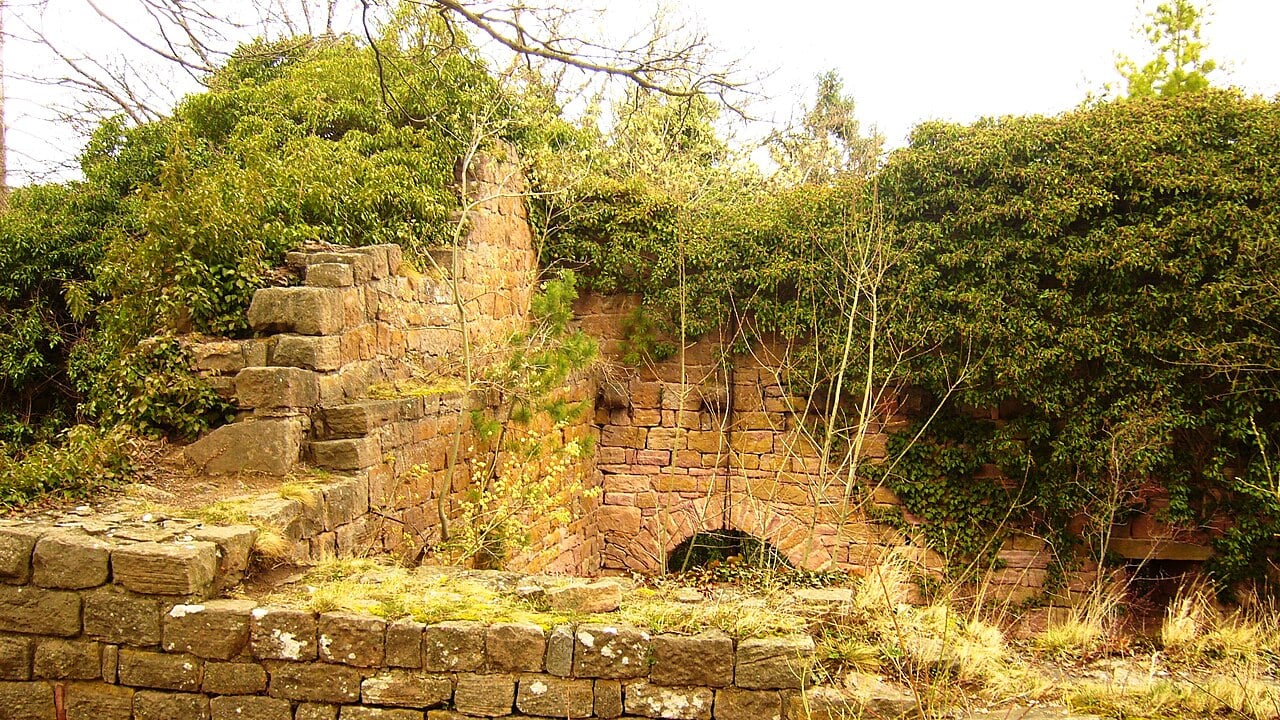
On the ridge, take the three castles in a row: the Weckmund with its fire-scarred keep nearest the parking, then the Wahlenbourg with its entrance portal, courtyard well and rock-cut stair, then the Dagsbourg with its towering broken keep and the remains of a palace, where a fireplace with slender columns still clings to the wall. The site is unstaffed and the ruins are fragile, so keep off the walls and watch your footing, particularly with children. There is no fee, no gate and no closing time, just the wind and the view over the plain.
Questions before you go: the Office de Tourisme du Pays d’Eguisheim et de Rouffach, 22A Grand’Rue, 68420 Eguisheim, answers questions about the site, trail conditions and the seasonal road closure at +33 3 89 23 40 33, and its website tourisme-eguisheim-rouffach.com is the official source for visitor information.
Eguisheim, one of the Plus Beaux Villages de France and voted the country’s favorite village in 2013, is the natural base, with Colmar and its train station just fifteen minutes away. You can browse places to stay in Eguisheim on Booking.com, and find Alsace castle tours, wine experiences and day trips from Colmar on GetYourGuide.
Some links on this page are affiliate links, which means StoneKeep Atlas may earn a small commission, at no extra cost to you, if you book through them.
More Views of the Three Castles of Eguisheim
A closer look at the three keeps and the details that survived 1466.
Beyond the Three Castles of Eguisheim
The Three Castles anchor one end of the Route des Cinq Châteaux, and the obvious next stop is Château du Hohlandsbourg, the great Habsburg fortress on the neighboring summit, rebuilt as Upper Alsace’s regional stronghold in the era when the three towers already stood in ruins. Further north, Château du Haut-Kœnigsbourg shows what a complete restoration of a ruined Alsatian castle looks like, the counterpoint to Haut-Eguisheim’s honest decay, while Château de Fleckenstein in the far north of Alsace offers another family of red sandstone ruins, carved this time into the living rock. For a different flavor of episcopal power, Château du Haut-Barr above Saverne was the Strasbourg bishops’ own eyrie, cousin to the castles they won here in 1251. All four are gathered, together with the Three Castles themselves, in our guide to the castles of Alsace.
Conclusion
Most castles tell a story about defense against the outside world. The Three Castles of Eguisheim tell a stranger and more human one: a single family fortress, seat of a great dynasty and childhood home of a pope, slowly dismembered by its own heirs until brothers-in-arms became neighbors under arms. The keeps they raised against each other, and the city militias’ fire of 1466 that silenced all three in a day, left Alsace one of its most distinctive silhouettes. Walk up from the vines, put a hand on the fire-split stones of the Weckmund, and the whole quarrelsome, extraordinary story is right there under your fingers.
Principal Sources
- Base Mérimée, French Ministry of Culture: notices PA00085413 (Ruines du château de Dagsbourg, Eguisheim), PA00085464 (Ruines des châteaux de Weckmund et de Wahlenbourg, Husseren-les-Châteaux) and IA68003582 (Château de Haut-Eguisheim)
- Nicolas Mengus and Jean-Michel Rudrauf, Châteaux forts et fortifications médiévales d’Alsace, La Nuée Bleue, 2013
- Jacky Koch, L’art de bâtir dans les châteaux forts en Alsace (Xe-XIIIe siècles), Éditions universitaires de Lorraine, 2015
- Thomas Biller and Bernhard Metz, Die Burgen des Elsass, Band I, Deutscher Kunstverlag, 2018
- Charles-Laurent Salch, Haut-Eguisheim. Les trois châteaux revisités, 2023
- Châteaux Forts Alsace (chateauxfortsalsace.com), Les châteaux de Haut-Eguisheim
- Société d’Histoire et d’Archéologie d’Eguisheim (eguisheim-histoire.fr), Les Trois Châteaux du Haut-Eguisheim
- Office de Tourisme du Pays d’Eguisheim et de Rouffach (tourisme-eguisheim-rouffach.com) and Visit Alsace (visit.alsace), visitor information
Image credits. Hero, the three keeps: Gzen92, CC BY-SA 4.0, via Wikimedia Commons; Husseren below the towers: Gzen92, CC BY-SA 4.0, via Wikimedia Commons; Wahlenbourg keep and courtyard: Patrick, CC BY-SA 2.0, via Wikimedia Commons; Dagsbourg keep: ernst andre, CC BY-SA 3.0, via Wikimedia Commons; Weckmund keep: Patrick, CC BY-SA 2.0, via Wikimedia Commons; Rothmuller lithograph: Deroy after Jacques Rothmuller, Bibliothèque nationale de France, Public domain, via Wikimedia Commons; Braun photograph: Braun, Adolphe (1812-1877). Photographe, Public domain, via Wikimedia Commons; View over the plain: More pics than views…, CC BY 3.0, via Wikimedia Commons; Wahlenbourg portal: Gzen92, CC BY-SA 4.0, via Wikimedia Commons; Courtyard well: ernst andre, CC BY-SA 3.0, via Wikimedia Commons; Wahlenbourg stair: Gzen92, CC BY-SA 4.0, via Wikimedia Commons; Dagsbourg postern: Espirat, CC BY-SA 4.0, via Wikimedia Commons; Weckmund from the Wahlenbourg: Espirat, CC BY-SA 4.0, via Wikimedia Commons; Two keeps on the path: Bernard Chenal, CC BY-SA 3.0, via Wikimedia Commons; Gartenlaube engraving: R. Püttner, Die Gartenlaube 1875, Public domain, via Wikimedia Commons; Wagner 1900 plate: Emile Wagner (1850-1922), Public domain, via Wikimedia Commons. Freely licensed images are resized to fit; otherwise unaltered.