
Château du Clos Lucé
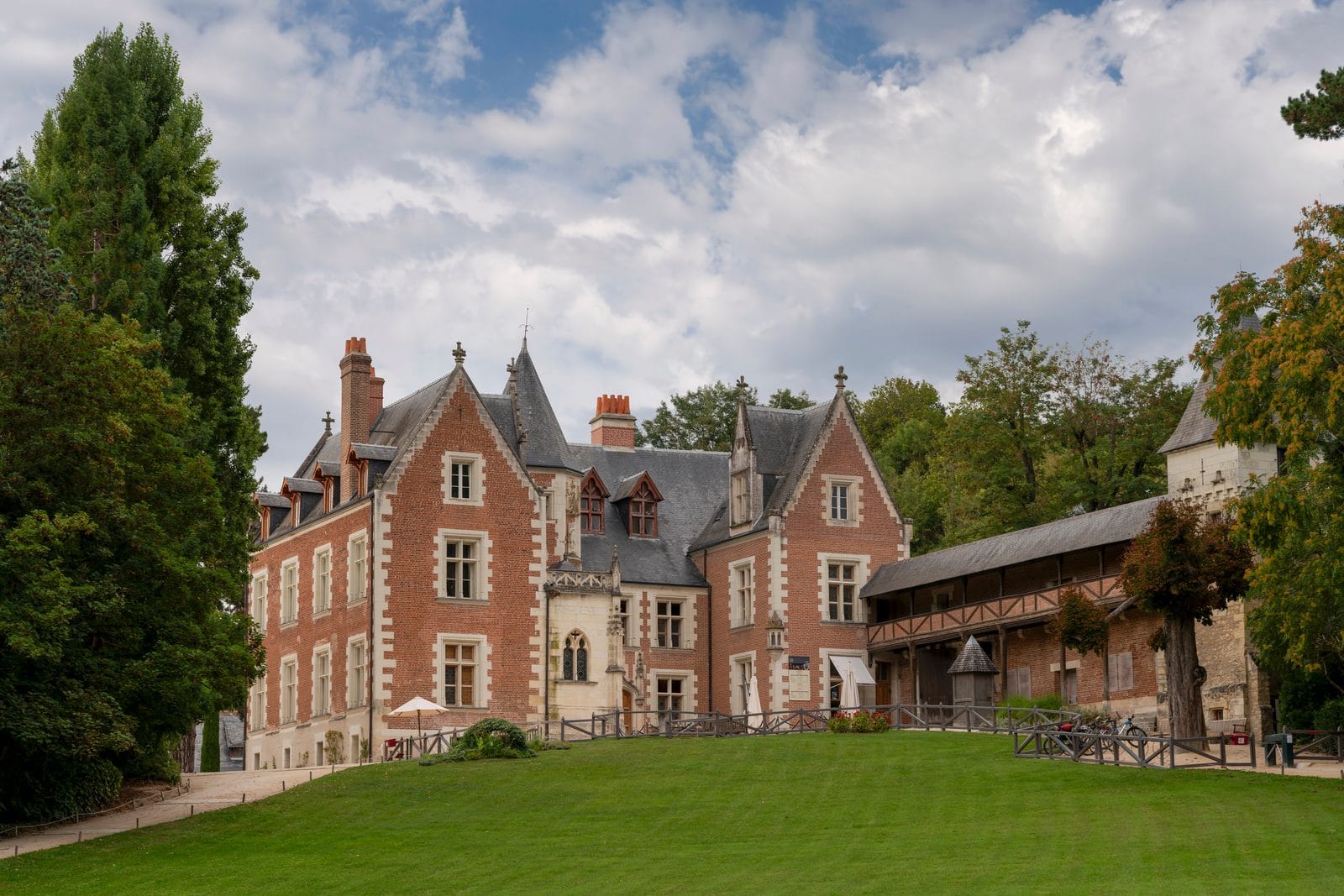
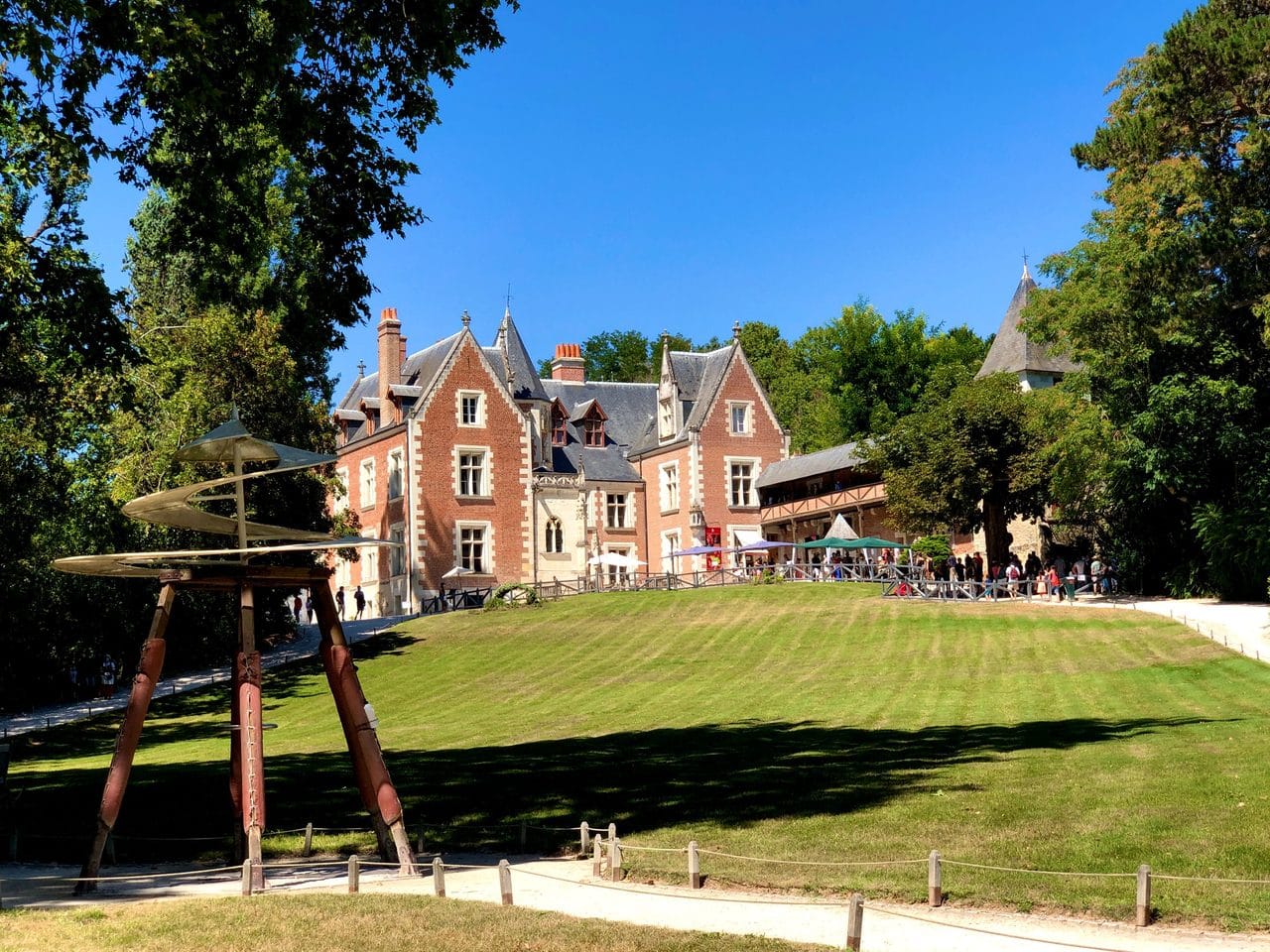
Château du Clos Lucé sits on a quiet street at the edge of Amboise’s old town, 400 meters from the royal château whose fief it once was. Built around 1471 for Étienne le Loup, a counselor of Louis XI, and bought by Charles VIII in 1490 as a summer house for the kings of France, the manor of pink brick and white tuffeau would rate a pleasant footnote among the residences of the Loire Valley if not for the guest who moved in during the autumn of 1516.
Leonardo da Vinci, sixty-four years old, crossed the Alps at the invitation of François I with three paintings in his baggage, the Mona Lisa among them, and spent the last three years of his life in this house. In its rooms he drew, designed, and staged festivals for a court; in one of them he died on May 2, 1519. Clos Lucé is where the Renaissance arrived in France in person, and it has passed the years since 1854 under a single family learning how to tell that story. What survives is less a palace than a home: a workshop, a kitchen, a bedroom with a view of the king’s château, and a park filled with machines lifted from its most famous resident’s notebooks.
Quick Facts
| Location | Amboise, Indre-et-Loire, Loire Valley, France |
| Coordinates | 47.4102 N, 0.9920 E |
| Built | c. 1471 (rebuilt by Étienne le Loup on an older fief); chapel added in the 1490s |
| Architectural style | Flamboyant Gothic in brick and tuffeau, with Renaissance interiors |
| Builders | Étienne le Loup; Charles VIII (chapel) |
| Condition | Well preserved |
| Current use | Museum: Leonardo da Vinci’s last residence, with a 7-hectare park |
| Heritage status | Monument historique, classified on the 1862 list; within the inscribed Val de Loire World Heritage landscape |
| Open to the public | Yes, daily except December 25 and January 1 |
| Official website | vinci-closluce.com |
A Manor Below the Royal Château
Long before anyone called it a château, the Cloux was a dependency of the fortress on the spur above it. Records trace a fief held from the château d’Amboise, with the neighboring land of Lucé annexed in the fourteenth century, and a deed of October 26, 1460, passing the property from Pierre du Perche to Marc Rabouin. From Rabouin it went to the Cistercian nuns of the priory of Moncé, and on May 26, 1471, the nuns sold it to Étienne le Loup, a man whose career says a great deal about the France of Louis XI.
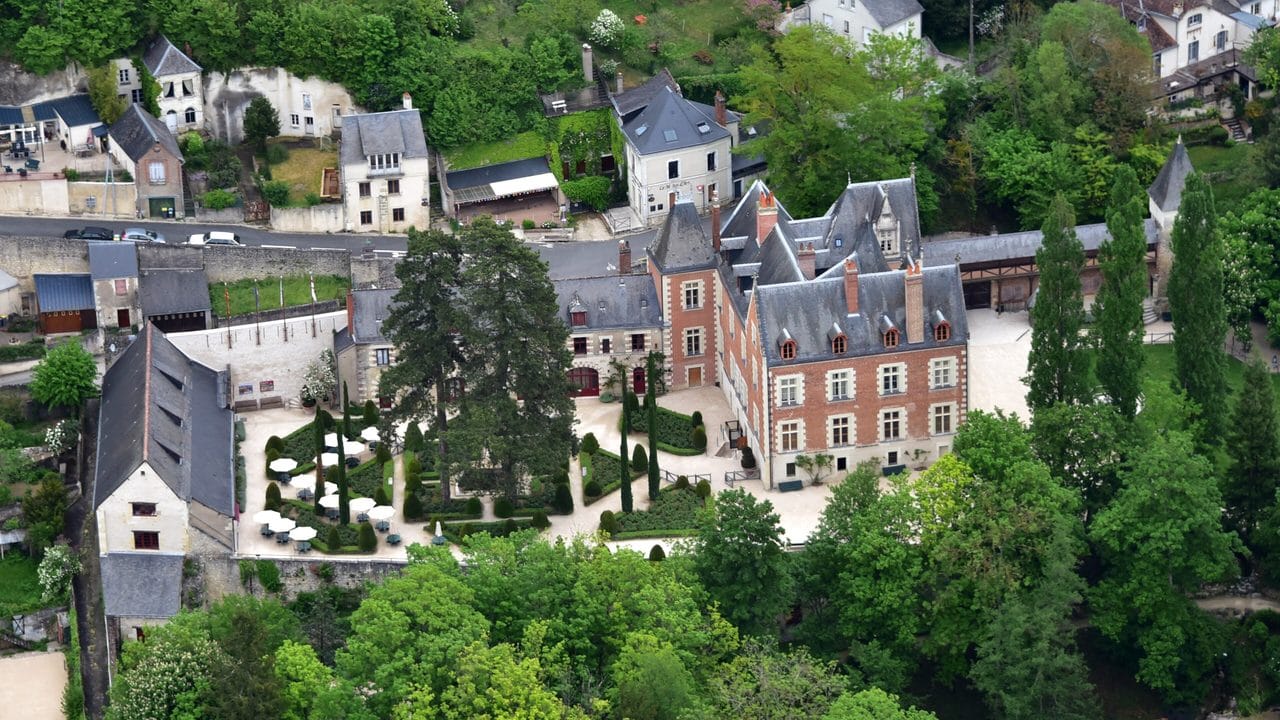
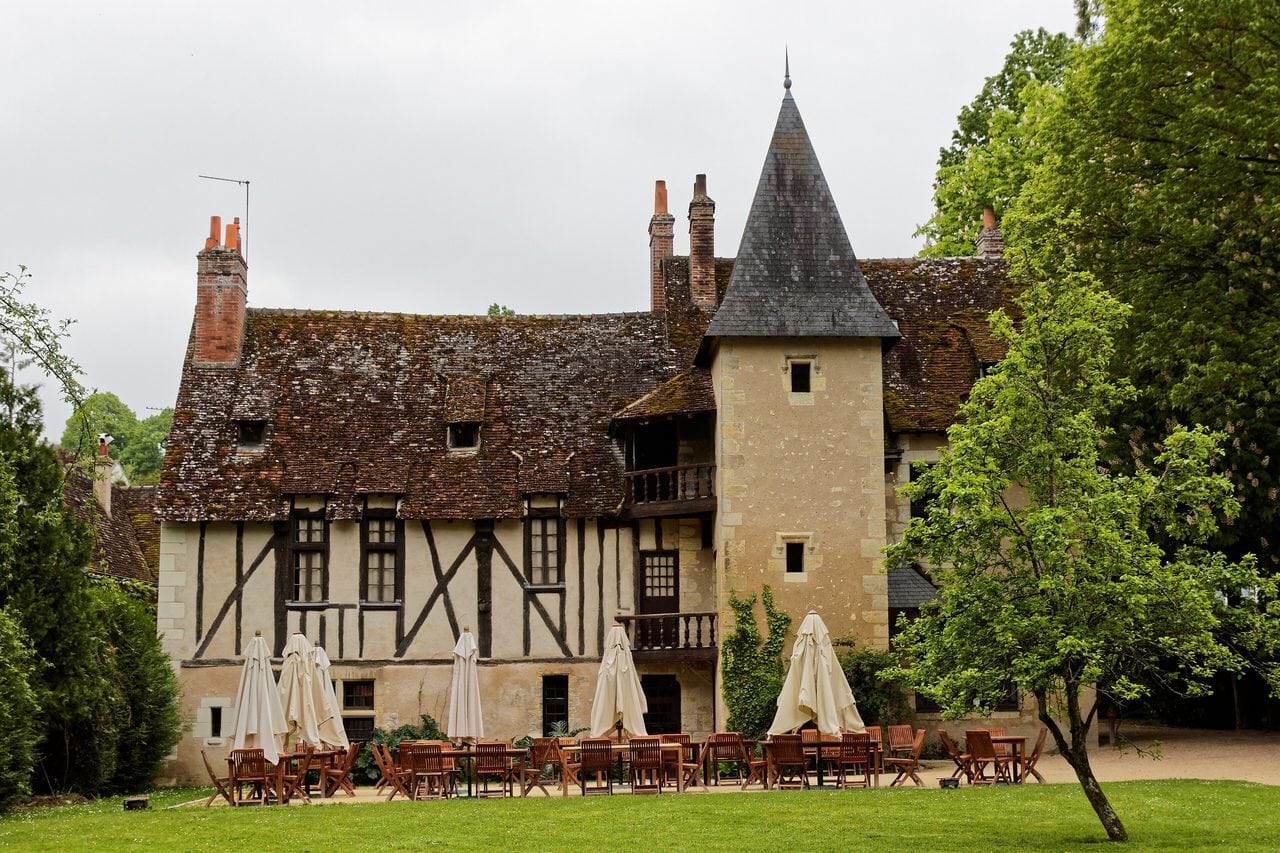
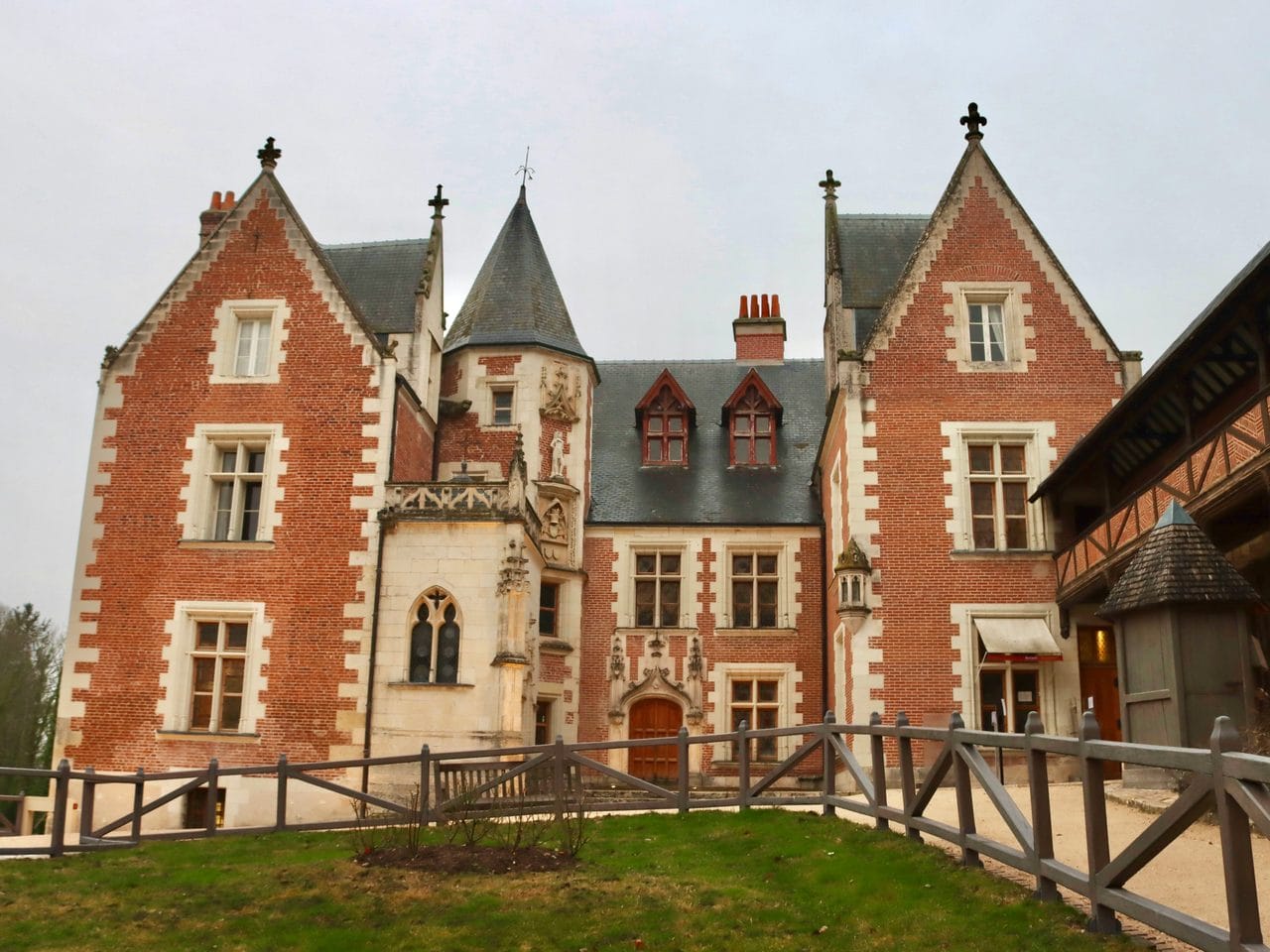
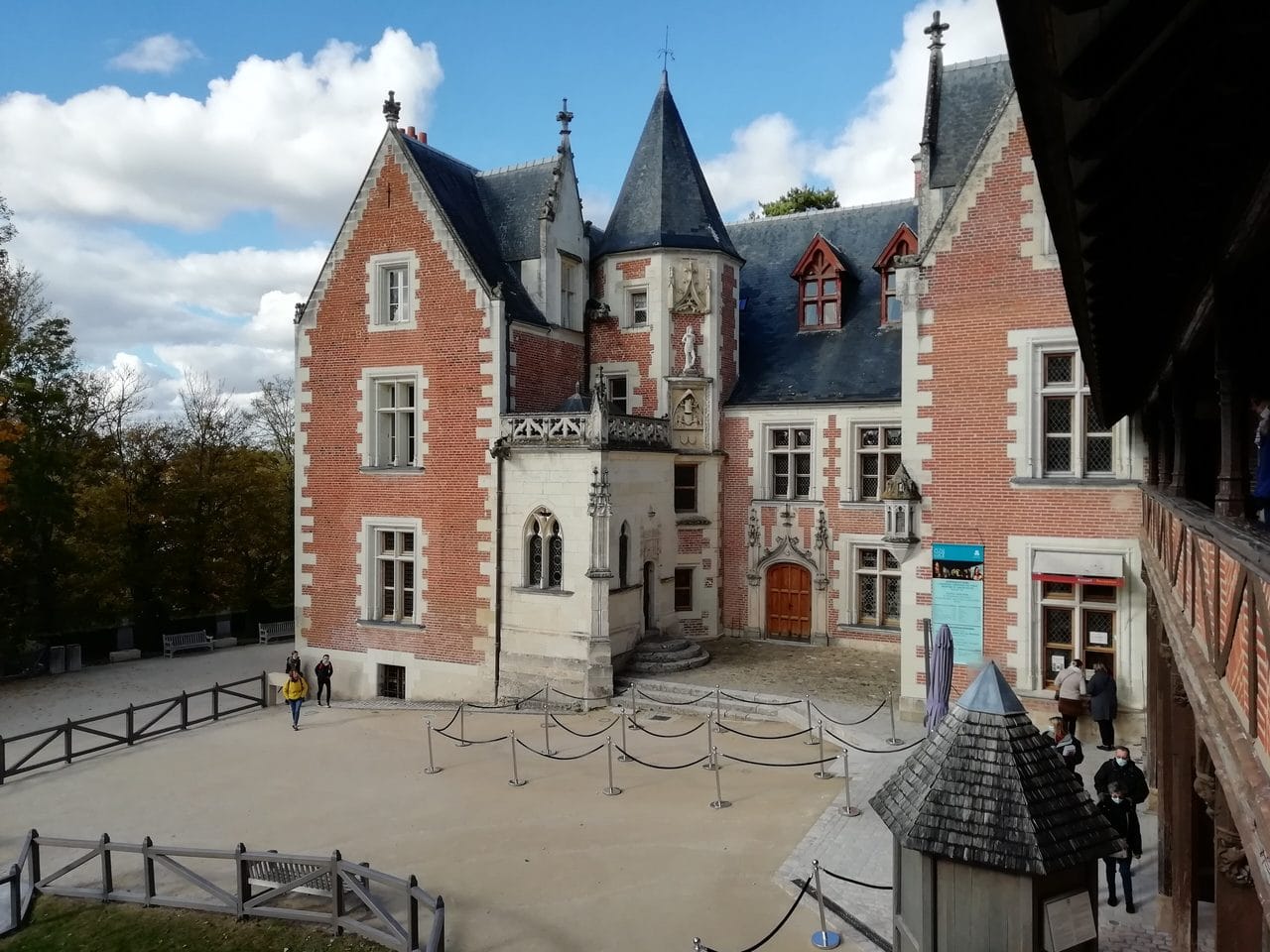
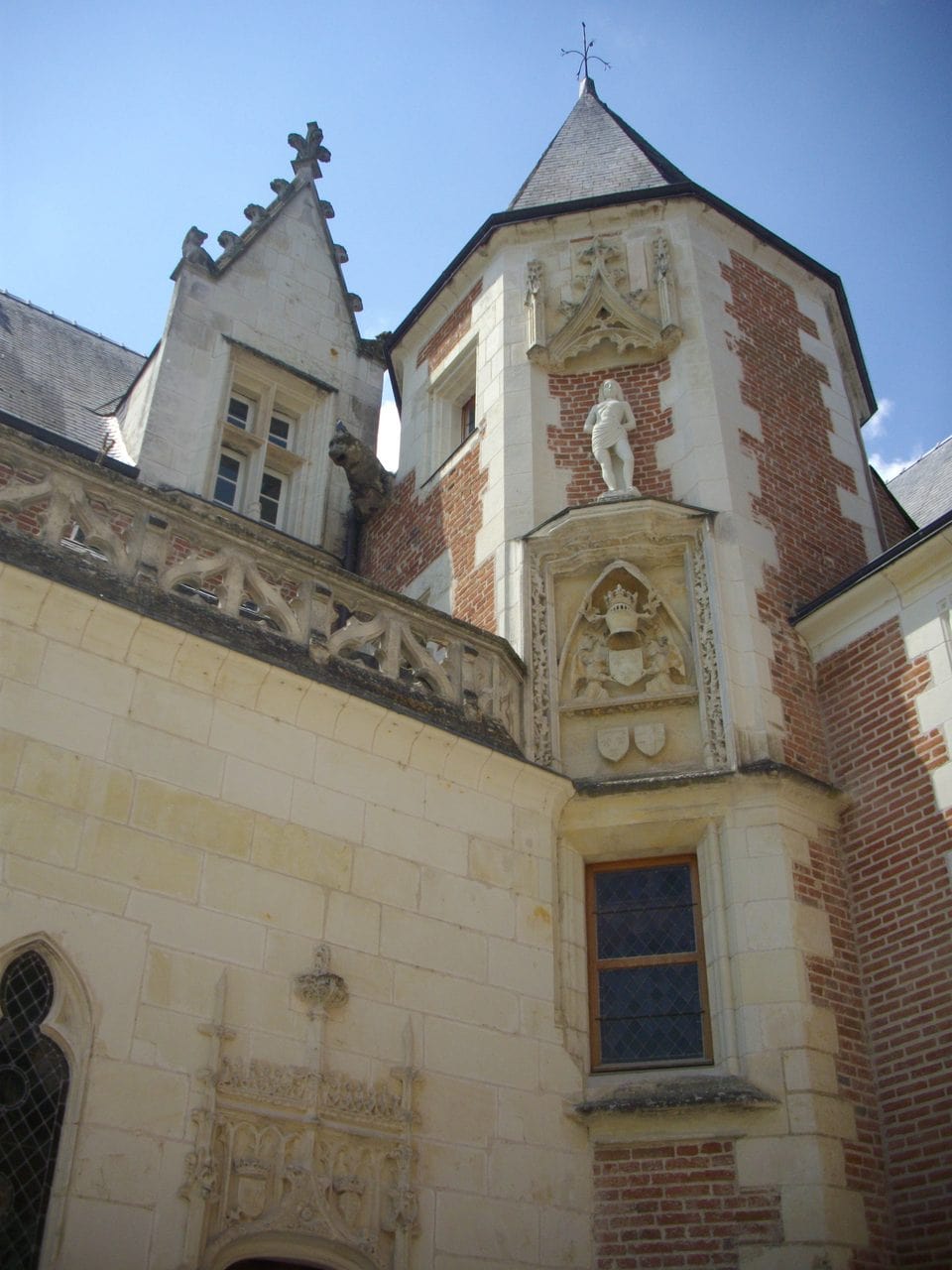
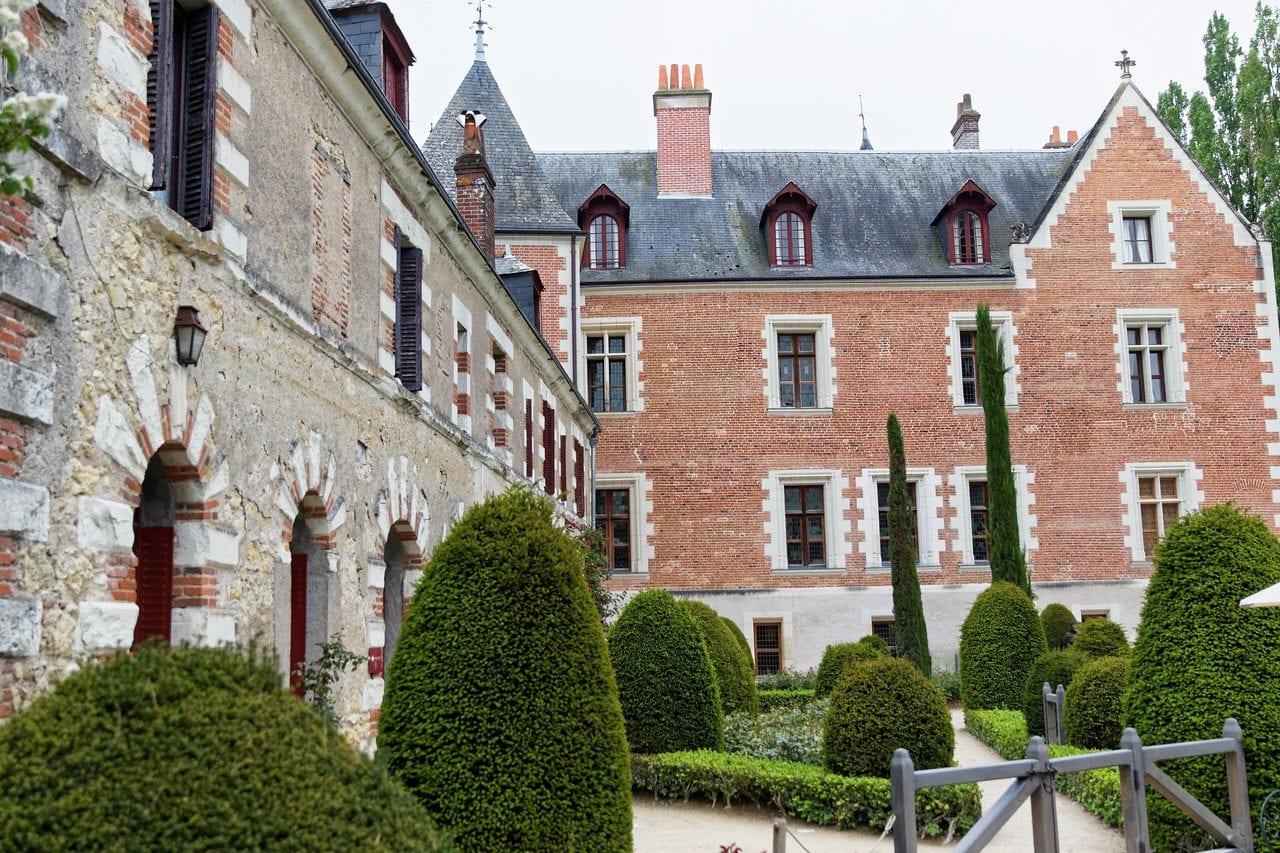
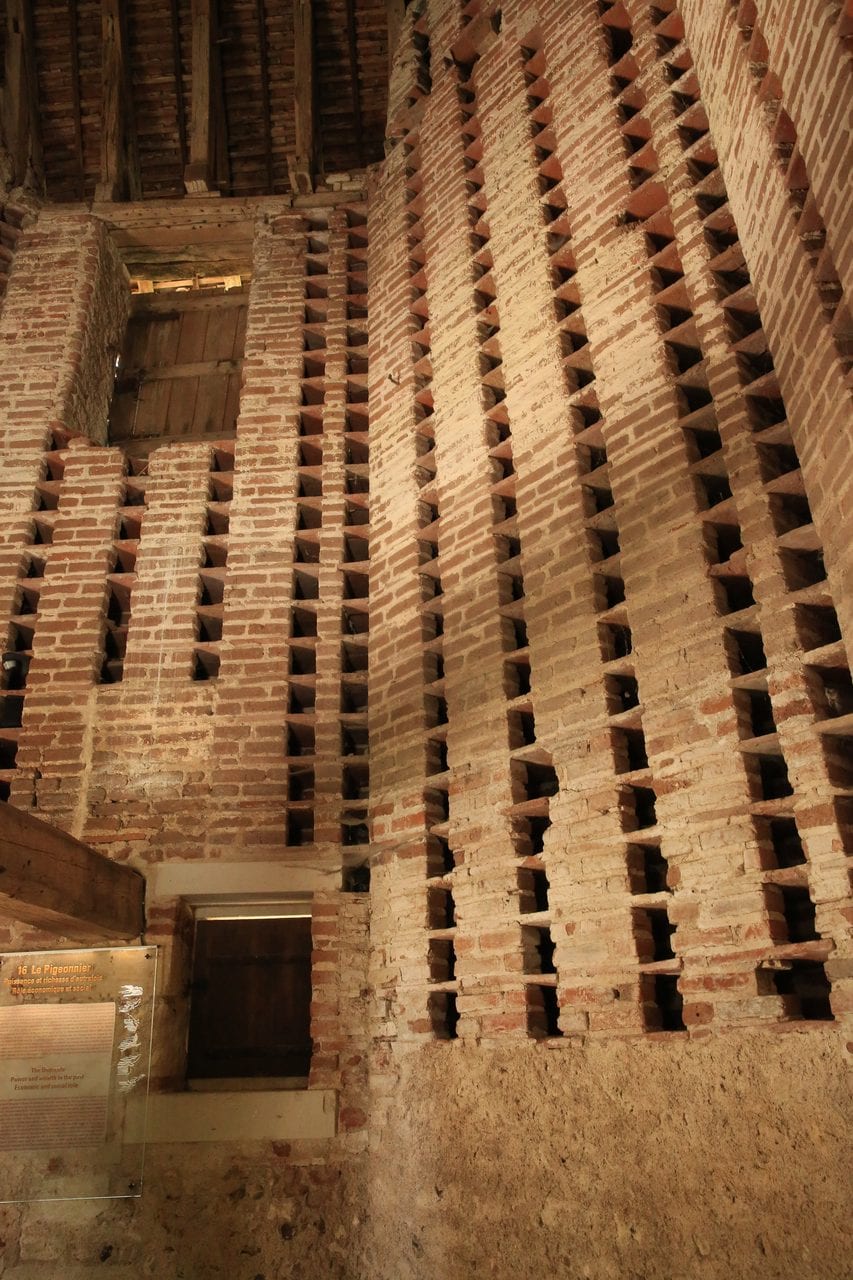
Le Loup had entered royal service in the kitchens and risen, improbably, to maître d’hôtel, first usher of arms, counselor to the king, and bailli of Amboise. Ennobled and enriched, he wanted a seat near the court, and the run-down buildings he bought from the nuns gave him one. His rebuilding created the house that stands today: walls of rose-colored brick dressed with white tuffeau stone, a square watchtower joined to the main wing by a covered gallery, an octagonal stair tower, and windows in the flamboyant Gothic style noted in the monument’s official record. He also raised a great dovecote, its interior honeycombed with roughly a thousand nesting holes by the operator’s count, a blunt advertisement of seigneurial privilege.
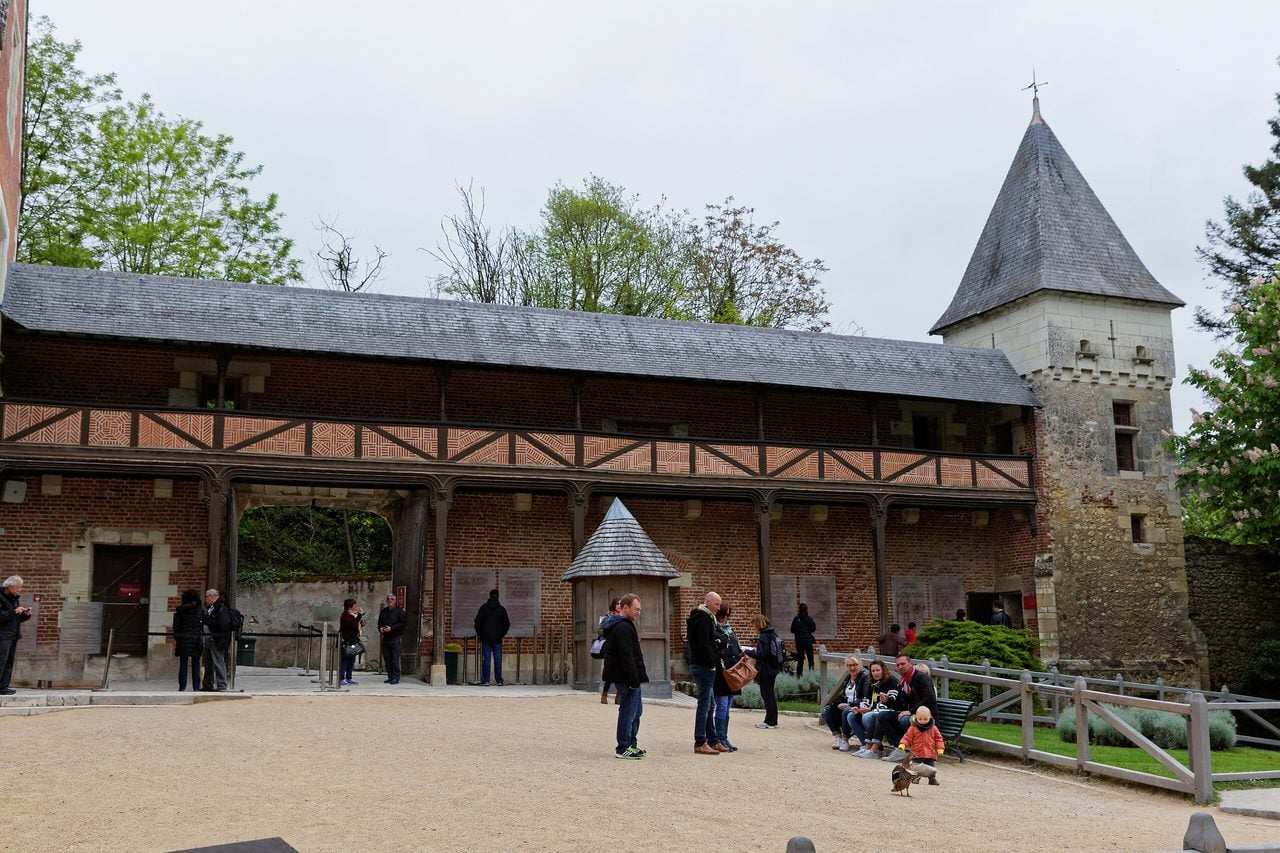
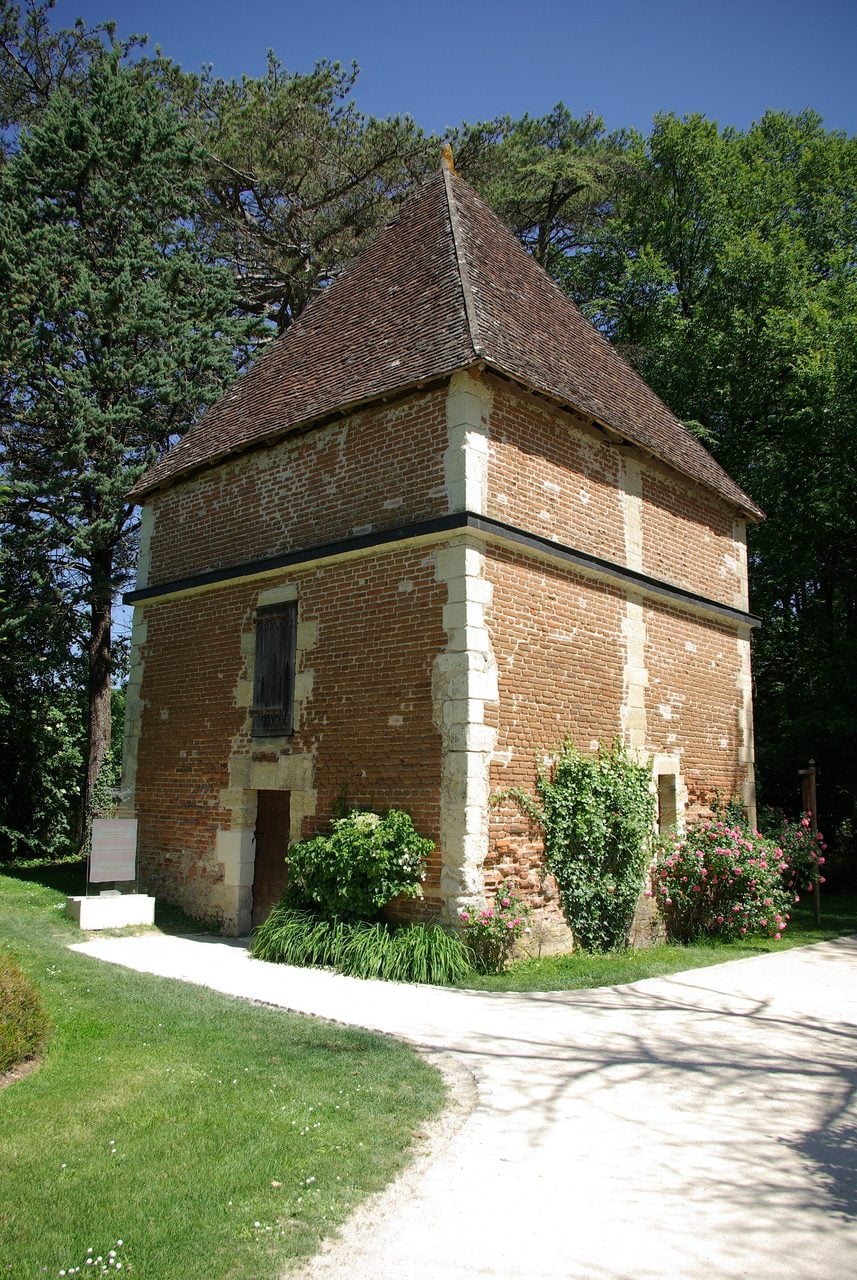
That palette is worth pausing over. Brick was the warm, domestic material of the late fifteenth century, and it makes the Clos Lucé read as the visual opposite of the white-stone royal châteaux of the Loire. Visitors who arrive from the great terraces of the château above often remark that the manor feels like a private house, because that is what it was built to be.
The Summer House of Kings
Charles VIII grew up in the château on the spur, and he knew the manor at its foot. On July 2, 1490, he bought the Cloux from Étienne le Loup for 3,500 gold écus; a framed copy of the sale deed hangs in the house today. Under Charles the manor became what the operator calls the summer house of the kings of France, an escape within walking distance of the court.
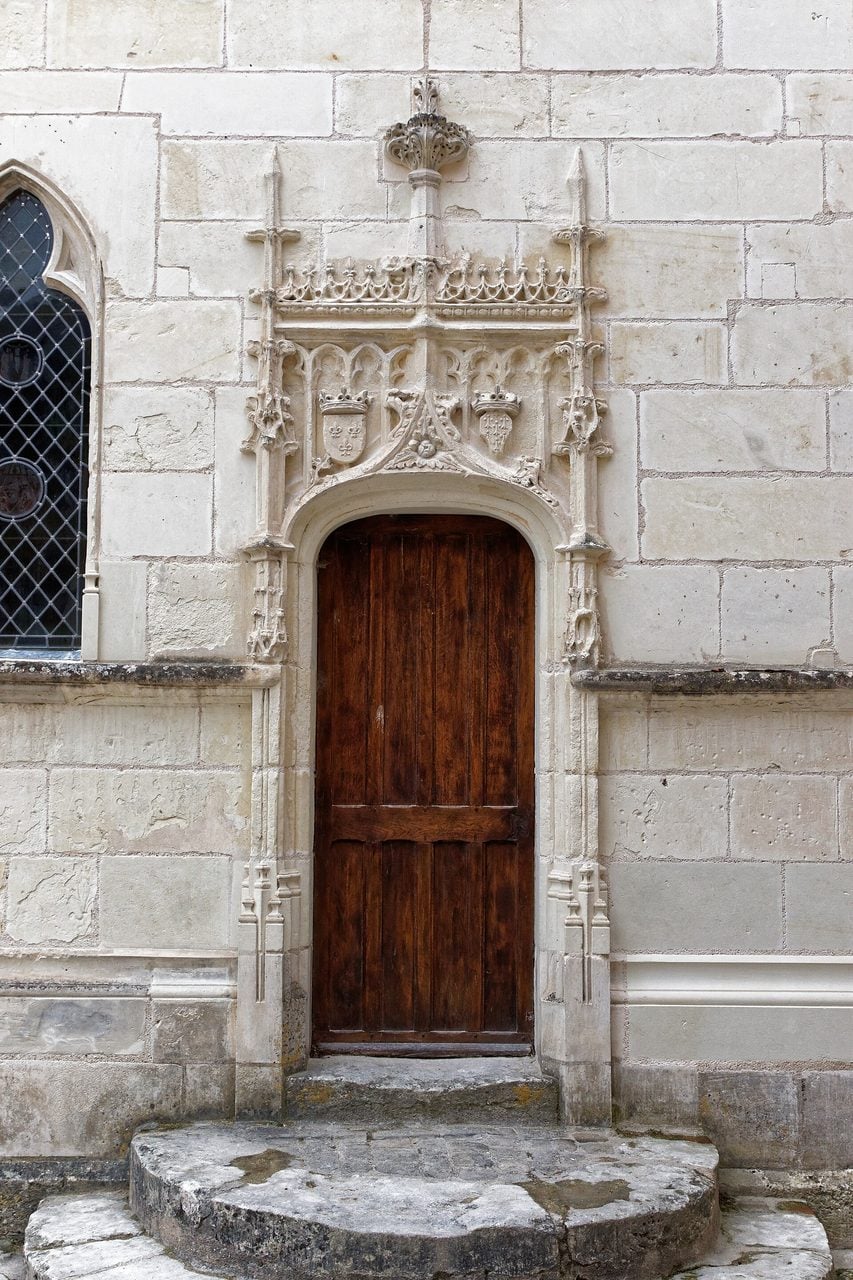
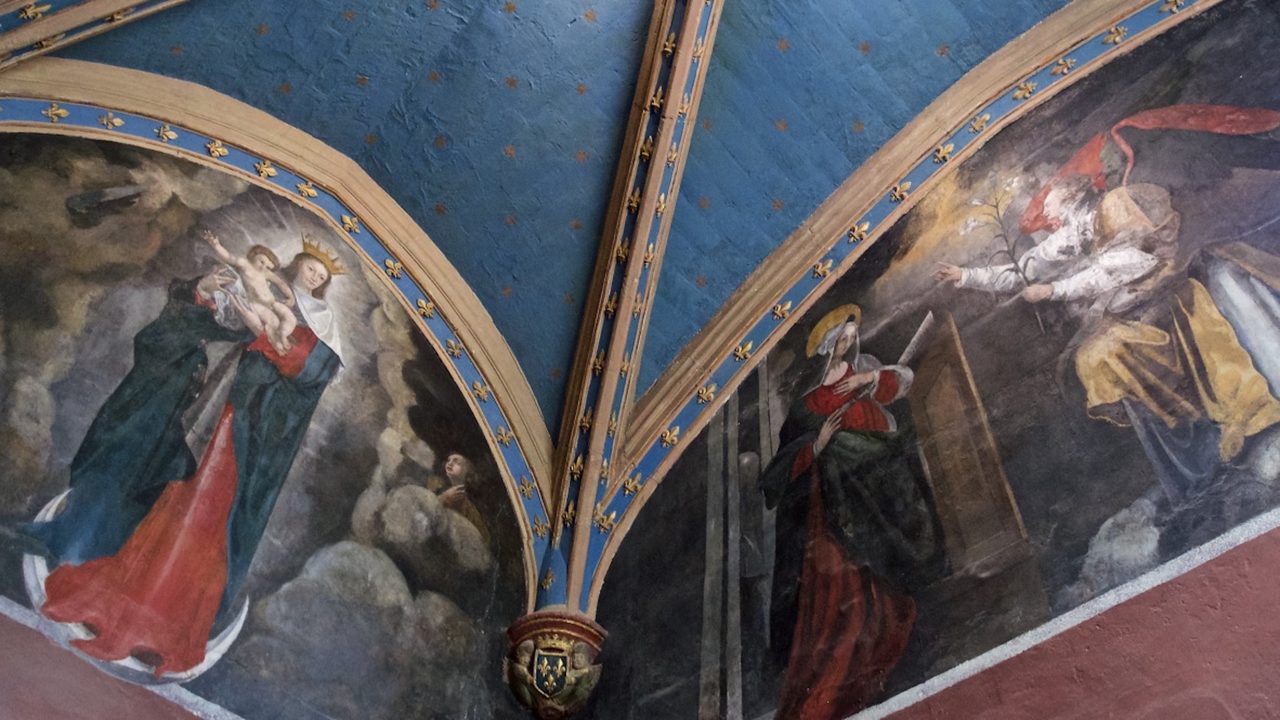
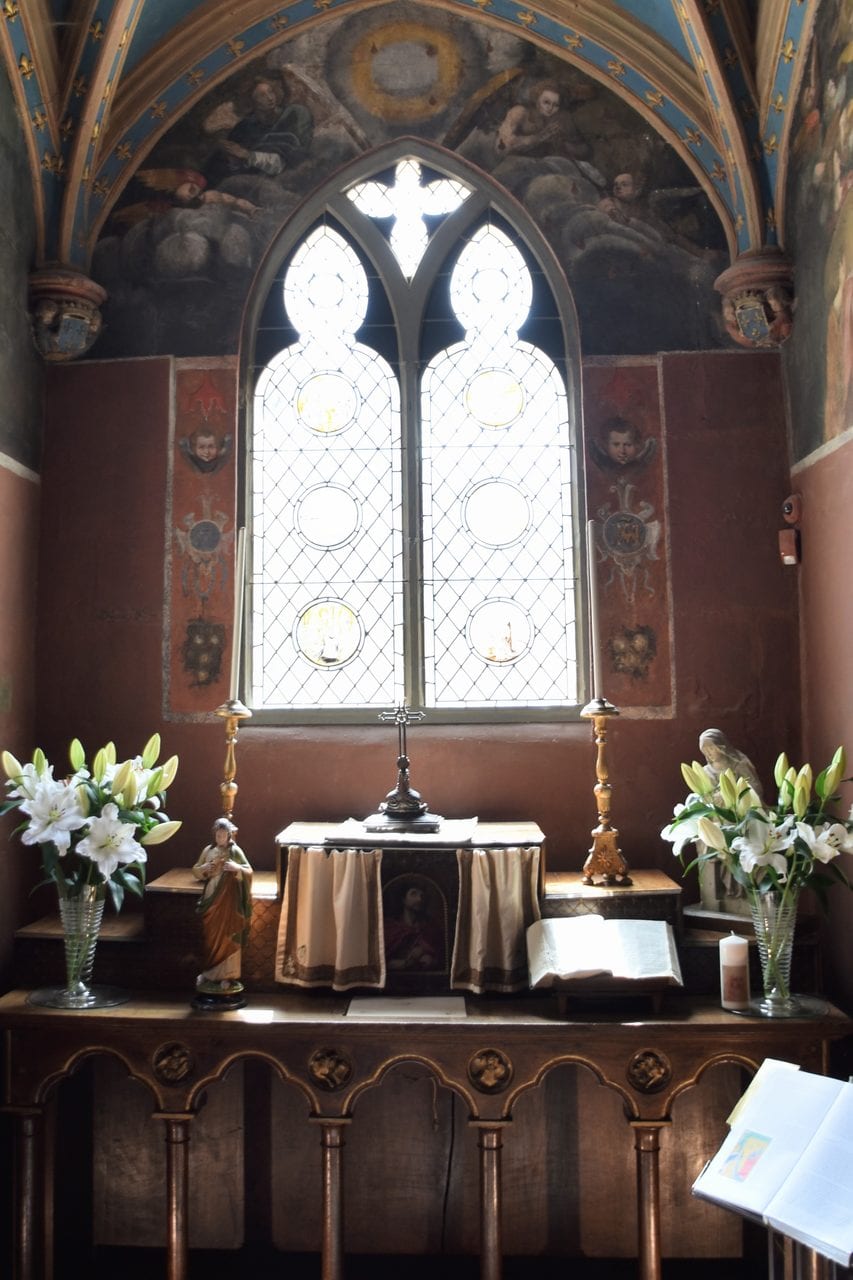
His most lasting addition was the small chapel in the garden, built in flamboyant Gothic for his queen, Anne de Bretagne. Tradition holds that she came here to mourn the children she lost in infancy, a grief that shadowed the marriage and, through it, the succession of France; none of her sons with Charles VIII lived past early childhood, and the crown would pass twice sideways, to Louis XII and then to François I. Inside, the frescoes, an Annunciation among them, are attributed to the pupils of Leonardo da Vinci, painted a generation after the chapel rose.
Royal use did not end with Charles VIII. Louise of Savoy raised her children at Amboise, and the manor sat within the orbit of her household; her son, the future François I, knew the Cloux as a boy, and her daughter Marguerite lived there in the years before 1515. By the time François took the throne, three kings of France had passed through the little brick manor below the castle. None of that would matter much to history, except that the new king was about to find a use for the house that no one could have predicted.
The Invitation of 1516
In September 1515 the young François I won the battle of Marignano and took Milan, and with it a claim on the attention of every artist in Italy. Leonardo da Vinci was then in Rome, aging in the service of Giuliano de’ Medici while younger rivals, Raphael and Michelangelo among them, absorbed the great commissions. When Giuliano died on March 17, 1516, Leonardo was left without a protector, and the French king’s invitation offered what Italy no longer did: security, rank, and an admirer on a throne.
He left Rome in the second half of 1516; one recent reconstruction of the journey has him departing on August 12 and reaching Amboise on October 29. Legend puts him on the back of a mule for the Alpine crossing. With him traveled his pupils Francesco Melzi and Salai, his Milanese servant Battista de Villanis, and three paintings: the Mona Lisa, Saint John the Baptist, and the Virgin and Child with Saint Anne. All three hang in the Louvre today, which means the most famous painting in the world spent its first French years in a brick manor in Amboise.
François installed him at the Cloux and gave him the grand title of first painter, engineer and architect to the king. A payment record preserved in the Archives nationales fixes the terms: 2,000 écus soleil for two years of pension to “maistre Lyenard de Vince, paintre ytalien,” with 800 écus over the same period for Melzi and a single payment of 100 écus for Salai. What the king wanted for his money was not paintings. By most accounts he wanted the man: conversation, invention, and the glamour of keeping the most celebrated mind in Europe a short walk from his door.
The Workshop Years
An eyewitness reached the manor on October 10, 1517, when Cardinal Luigi d’Aragona visited and his secretary, Antonio de Beatis, wrote the encounter down. De Beatis saw three pictures, describing one as a portrait of a certain Florentine lady, done from life at the instance of the late Giuliano de’ Medici. He also recorded that a paralysis had crippled the master’s right hand, adding that Leonardo could no longer paint with his old sweetness but could still draw and instruct others. It is the only surviving outsider’s account of the household at the Cloux, and it reads exactly like what the place had become: a studio winding down, run by a teacher.
Instruction, in the broadest sense, was the work of those years. For the king Leonardo drafted plans for an ideal city and palace at Romorantin, intended for Louise of Savoy, and he worked on the scheme into January 1518 before an epidemic in the area and his own failing health helped end it; royal energy shifted instead to a hunting palace in the marshes, the future Château de Chambord. Its celebrated double-helix staircase has long been attributed to him on the strength of his sketches, though construction began in September 1519, months after his death, and no document ties the design to his hand. He surveyed the Sologne for drainage and sketched canal schemes to bind the rivers of the kingdom together, including a waterway to link Romorantin to the wider river network; folios from these French years show locks, dredgers, and current studies, the working notes of an engineer who never stopped treating water as a solvable problem. And he designed the spectacles the court adored.
Spectacle is the best-documented part. In the spring of 1518 Amboise celebrated the baptism of the dauphin and the wedding of Lorenzo de’ Medici, and on June 19 of that year Leonardo staged the Festa del Paradiso in the gardens of the Cloux, restaging a festival he had mounted in Milan nearly thirty years earlier. A letter from Galeazzo Visconti describes four hundred candelabra throwing so much light that night seemed banished, in a place he called the Cloux, a very beautiful and large palace. Vasari and Lomazzo preserve an earlier marvel in the same vein: a mechanical lion, built for the king, that walked forward and opened its chest to spill fleurs-de-lis. Accounts differ on whether it performed at Lyon in 1515 or at Argentan two years later, and the original is lost, but a working reconstruction built in 2009 now prowls the Clos Lucé’s displays.
The Death of Leonardo
On April 23, 1519, sensing the end, Leonardo dictated his will before Guillaume Boureau, royal notary at Amboise. Melzi was named executor and principal heir, receiving the manuscripts, the instruments, and the works of the painter’s art; the vineyard outside Milan was divided between Salai and Battista de Villanis; money went to his half-brothers in Florence, to the churches of Amboise, and to the poor of the town’s hospital. Even Mathurine, his cook, was remembered with a good coat. He asked for a funeral cortège of sixty paupers carrying torches, a Florentine’s exit staged in the Touraine.
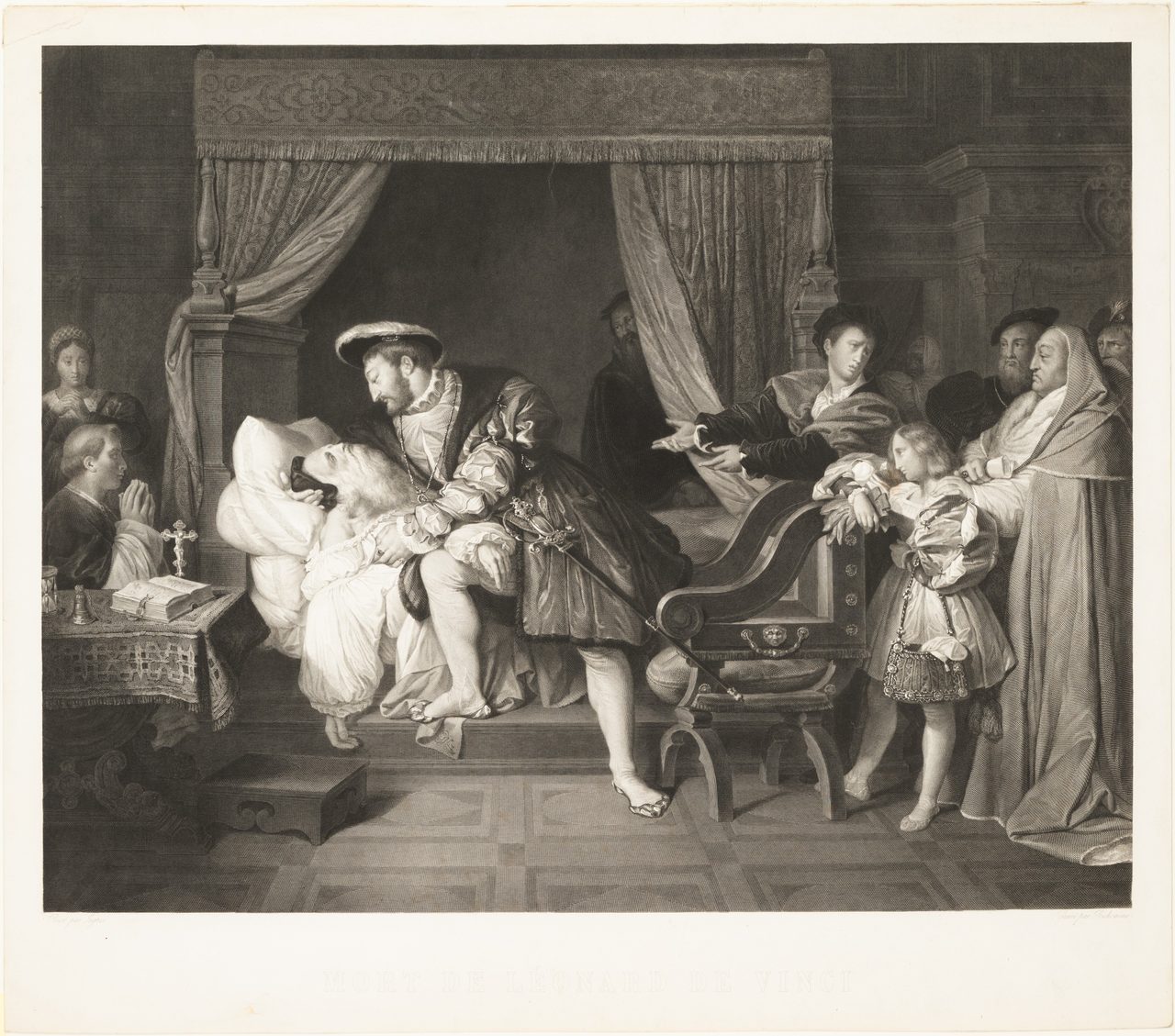
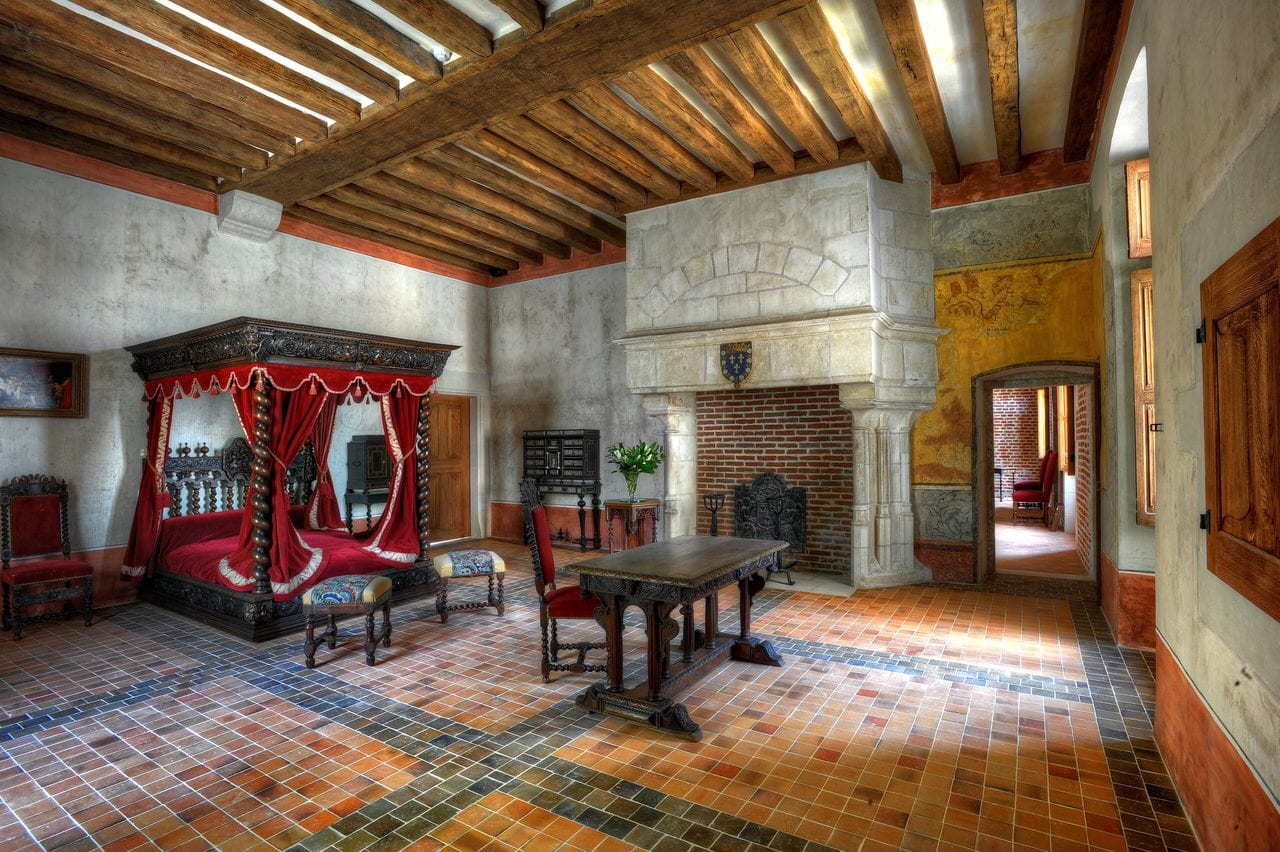
He died in his bedroom at the Cloux on May 2, 1519, at sixty-seven. Vasari, writing three decades later, supplied the scene the world remembers: the old master expiring in the arms of François I. Painters made it canon, first François-Guillaume Ménageot in 1781, then Jean-Auguste-Dominique Ingres in 1818, whose canvas of the king cradling the dying Leonardo hangs in the Petit Palais in Paris, with a copy displayed in the bedroom at Clos Lucé where the event did or did not happen. Against the story stands a royal order issued from Saint-Germain-en-Laye, near Paris, around May 1, where the court awaited the baptism of the king’s newborn second son. Defenders of the legend note that such documents could be issued in a king’s absence. Most historians side with the paperwork, and Britannica calls the deathbed scene ahistorical, but the legend has outlived every correction, which is itself a fact about how much France wanted to own this death.
Leonardo was buried on August 12, 1519, in the collegiate church of Saint-Florentin, inside the precinct of the royal château. The afterlife of that grave, lost when the church was demolished and refound, perhaps, by an excavation in 1863, belongs to the story of the Château d’Amboise, where a tomb in the chapel of Saint-Hubert now receives his pilgrims.
After Leonardo
Melzi carried the notebooks back to Italy and guarded them for half a century; after his death they were sold, split, and rebound into the codices that libraries from Milan to Windsor guard today, so that the paper trail of Leonardo’s mind leads away from Amboise almost as soon as he was in the ground. The manor returned to royal hands through Louise of Savoy, then began a long descent through private ones: Philibert Babou de La Bourdaisière, treasurer of François I, from 1523; and from 1583 Michel de Gast, captain of Henri III’s guards, who took part in the assassination of the Duke of Guise at the Château de Blois in 1588. A house that had sheltered the gentlest mind of the Renaissance now belonged to one of the killers in its most notorious political murder.
By the marriage of de Gast’s granddaughter the property passed in the seventeenth century to the d’Amboise family, and around the century’s end the old name of Cloux gave way to Clos Lucé. The family’s standing carried the house intact through the Revolution, when Henri-Michel d’Amboise kept the manor from pillage even as the great church holding Leonardo’s grave went down for salvage stone. Of the two buildings that bracketed Leonardo’s French life, the modest one survived.
The Saint Bris Century
In 1854 the d’Amboise family sold the manor to the Saint Bris family, ironmasters from the Haut-Agenais who had taken over a local foundry and wanted a home. The purchase opened what is now more than 170 years of continuous ownership, among the longest private custodianships of any major Loire monument. Georges Saint Bris inherited in 1866 and began the first restorations; his wife laid out the English-style park and had the pond dug.
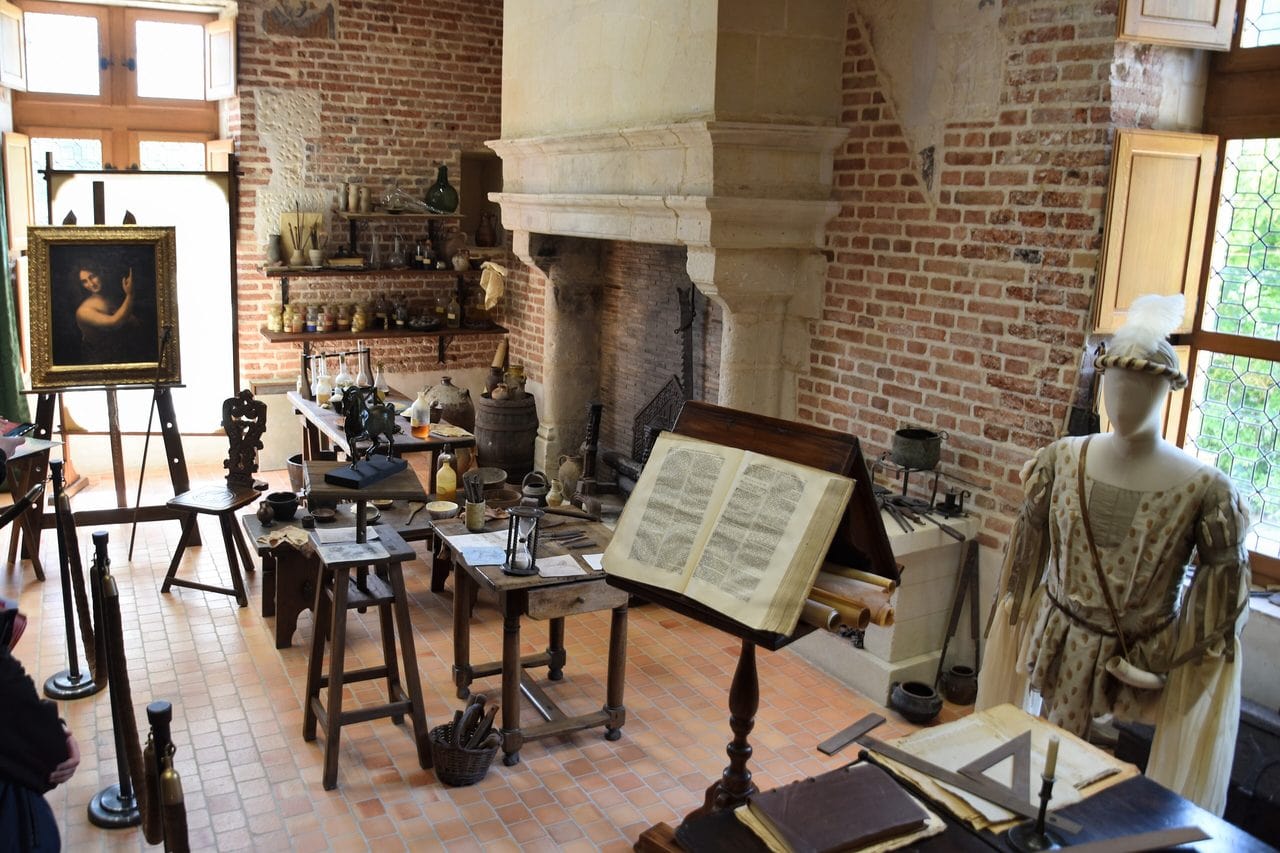
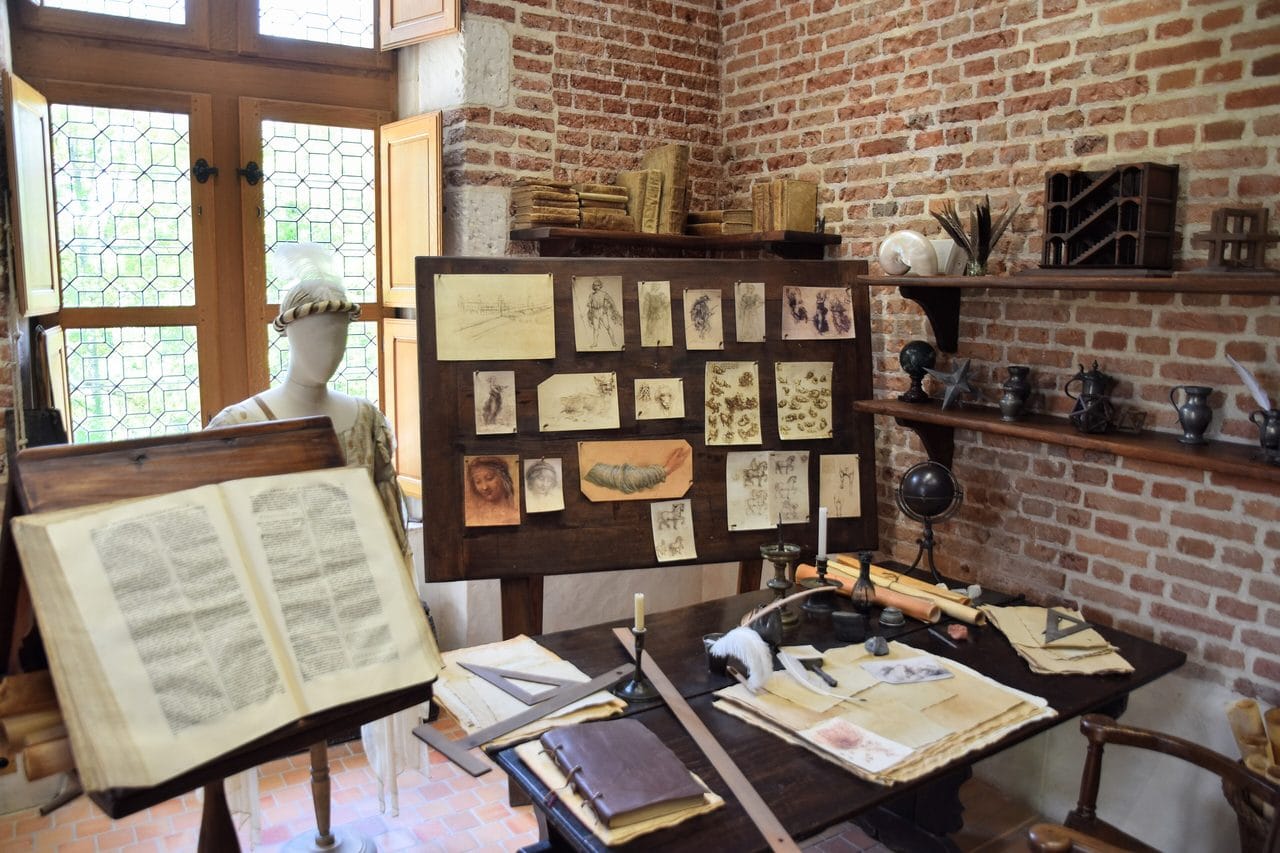
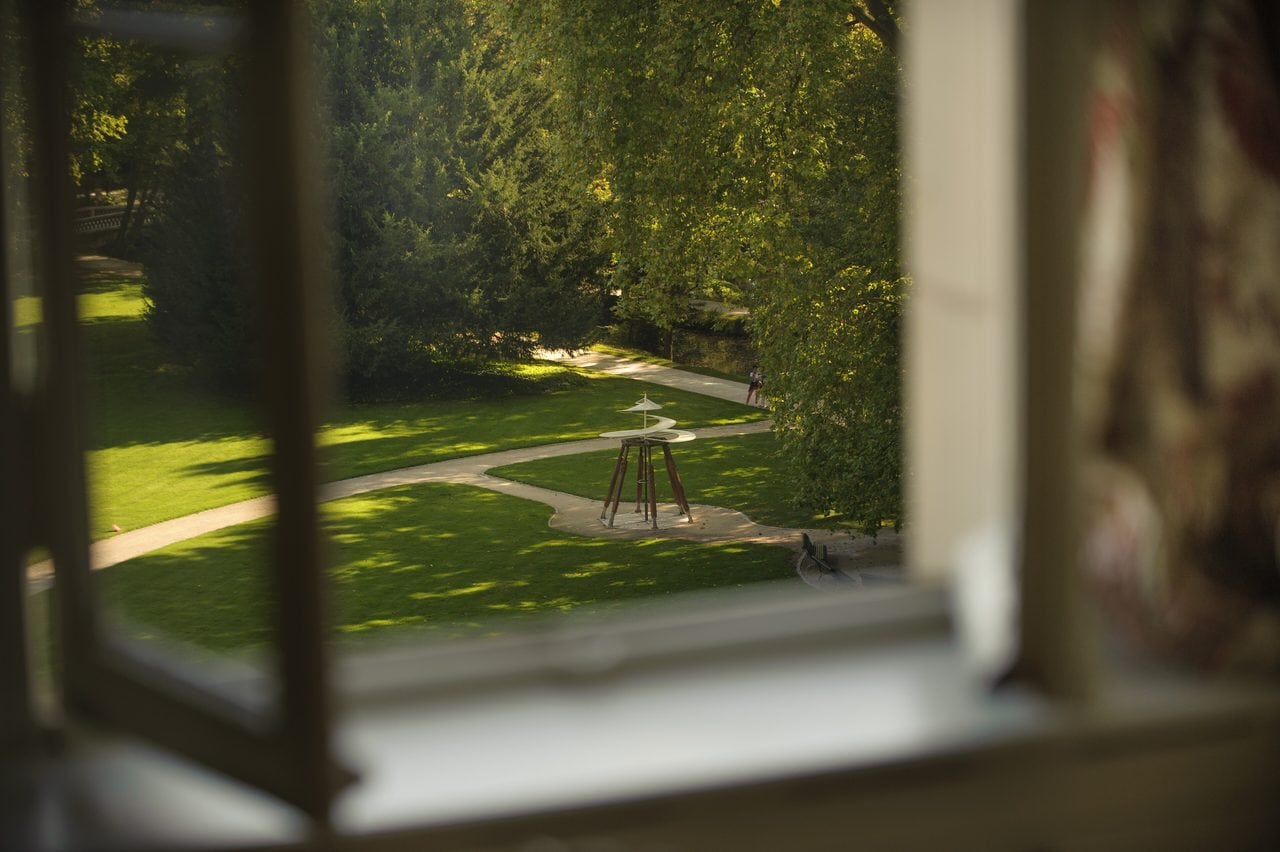
The decisive turn came in 1954, when Hubert and Agnès Saint Bris opened their home to visitors with the stated ambition of making it a place of humanism around Leonardo’s memory. The basement filled with forty machine models built by IBM from the master’s drawings, a mid-century vision of Leonardo as patron saint of engineering. Their son Jean Saint Bris carried the work forward from 1979 and in 2003 turned the grounds into a cultural park, with twenty full-scale machines and translucent canvases scattered along the paths. In June 2016 the family inaugurated a restored suite of three ground-floor rooms presented as Leonardo’s workshops.
That restoration carries an asterisk. Creating the suite removed eighteenth-century paneling and a period fireplace from rooms protected as part of the classified monument, and after a complaint by the regional heritage authority a Tours court fined the company’s president and its architect in December 2019 for unauthorized works. A reference site owes its readers that footnote, and it makes a fair point about the house: every era here, from le Loup’s brick to the present museography, has rebuilt the Cloux in the image of the story it wanted to tell. The galleries devoted to Leonardo as painter and architect followed in 2021 in a rehabilitated building in the park, and in 2019, the five-hundredth anniversary of the death, the site welcomed a record 520,000 visitors. François Saint Bris presides over the estate today.
The Château Today
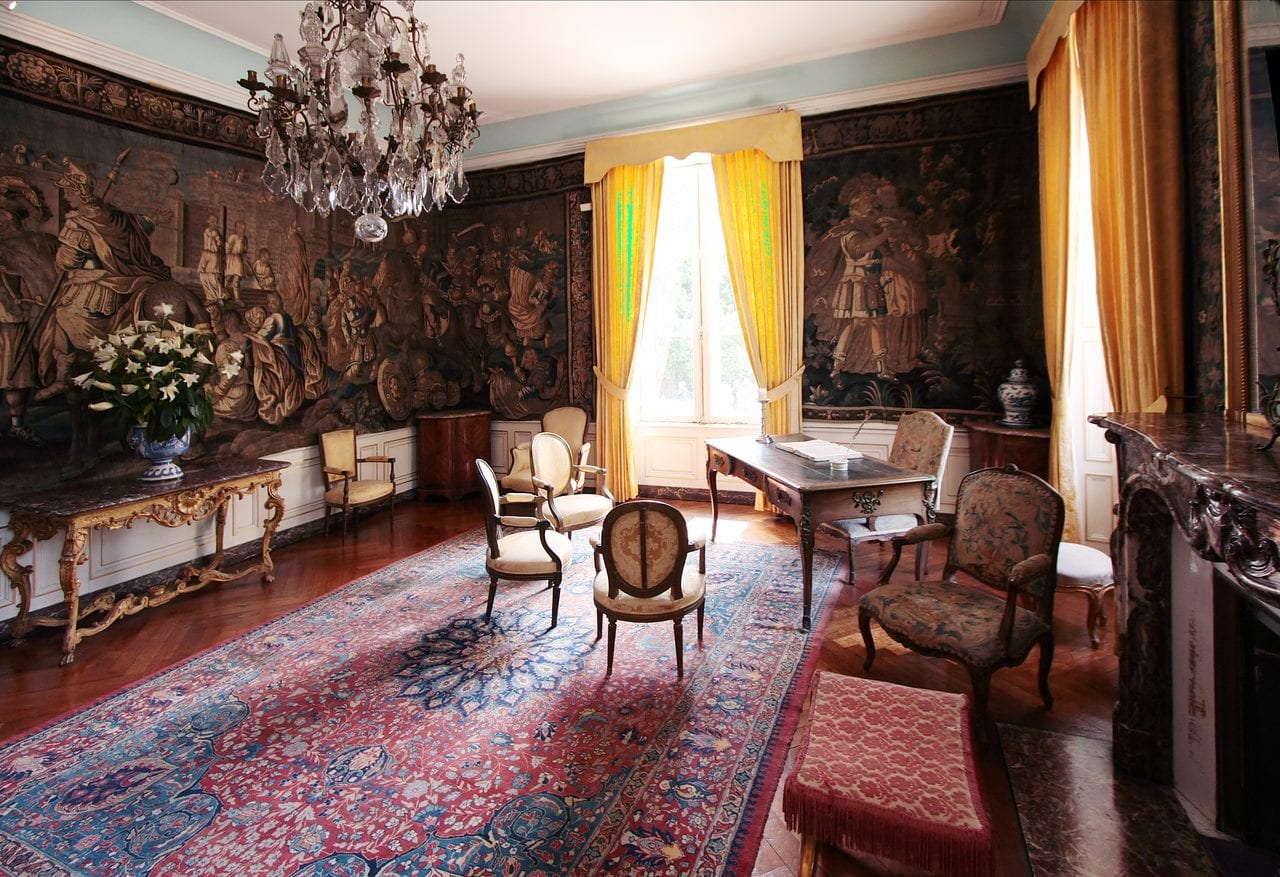
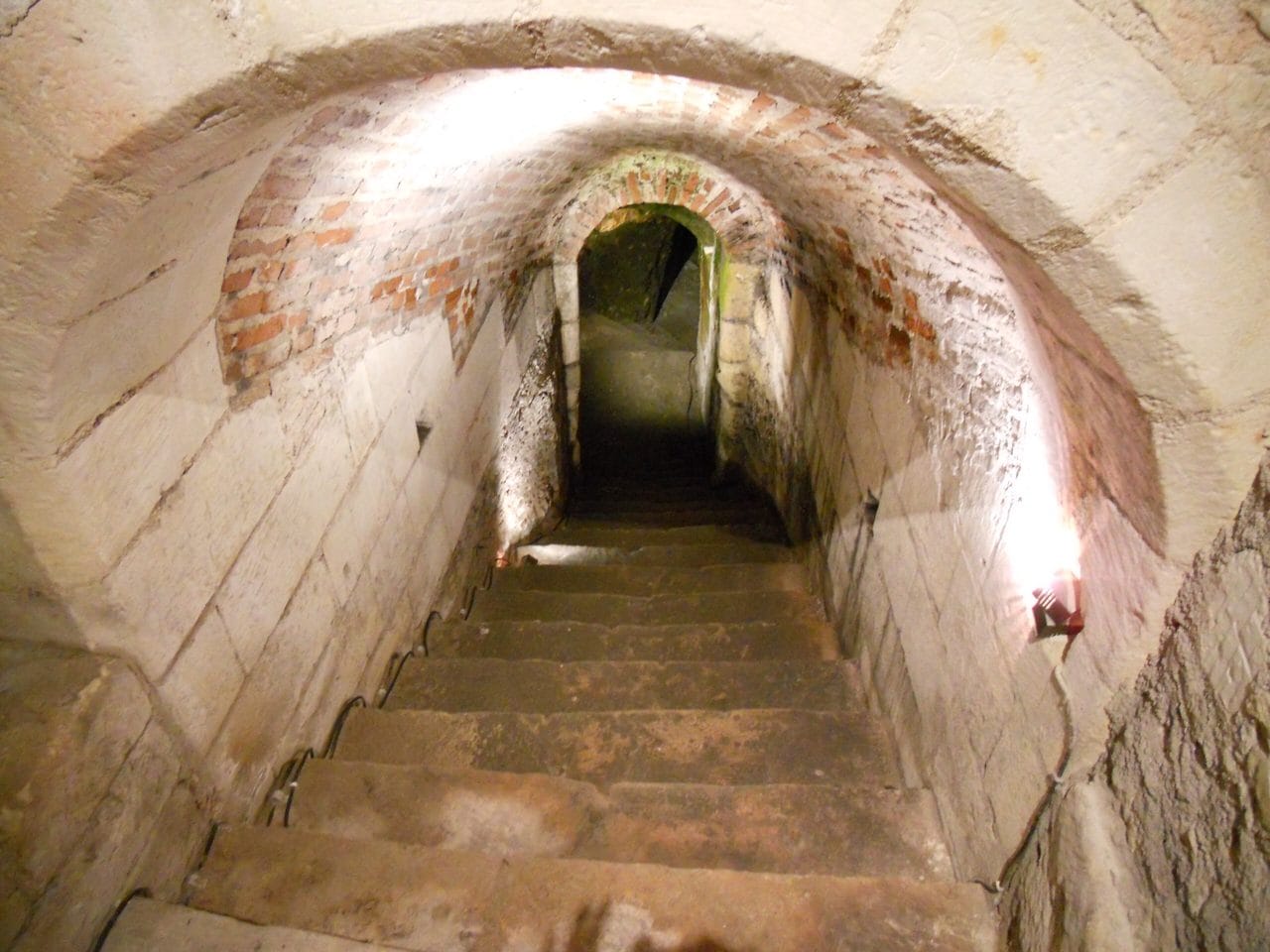
A visit moves room by room through a reconstructed intimacy. Leonardo’s bedroom looks out toward the royal château, the Ingres copy on its wall; the council chamber and the Renaissance kitchen evoke the household, with the cook Mathurine as its presiding spirit; the restored lower rooms present the atelier, study, and library of a working master. In the basement, the IBM models still stand beside the entrance to the famous underground passage. Tradition says a tunnel ran the 400 meters to the château so that the king could visit his philosopher discreetly; only its first few meters are visible, and the rest is a story the house tells with a straight face and historians decline to confirm.
Between house and park stand the two oldest witnesses: Anne de Bretagne’s little chapel, its attributed frescoes dim and devotional, and le Loup’s great dovecote, still honeycombed floor to roof. Outside, the seven-hectare park works as an open-air museum of the notebooks: full-scale machines to climb on, sound installations, translucent canvases of the drawings strung between trees, and a garden planted in 2008 from Leonardo’s botanical studies. The Halle muséographique hosts the annual exhibitions, and in 2026 it holds “Léonard de Vinci, maître de l’eau” (June 6 to September 13), built around two original Codex Atlanticus folios on loan from the Biblioteca Ambrosiana in Milan and curated by the historians Pascal Brioist and Andrea Bernardoni. Two original drawings by Leonardo, shown in the town where he died: the house has waited five centuries to display its resident’s own hand.
Visiting Château du Clos Lucé in 2026
Clos Lucé is open every day of the year except December 25 and January 1. Hours run 10:00 to 18:00 in January, 9:00 to 19:00 from February through June, 9:00 to 20:00 in July and August, 9:00 to 19:00 in September and October, and 9:00 to 18:00 from November through December, with the château and ticket office closing one hour before the park. Plan on two and a half to three hours for the house, park, and galleries, and more if the exhibition hall tempts you. Entry tickets and local tours can also be booked in advance through GetYourGuide.
| Ticket (2026) | Price |
|---|---|
| Adult | €20.00 |
| Child (7 to 18) / student | €15.00 |
| Child (under 7) | Free |
| Guided historical tour | +€4.80 |
| Museographic Hall exhibition | +€5.00 adult / +€3.00 reduced / +€1.00 ages 7 to 18 and students |
Family packages discount the entry for households with two or more paying children, and combined tickets reward a longer stay: a two-site pass pairs Clos Lucé with the royal château of Amboise, while the Pass Léonard de Vinci adds Chambord and saves up to about a fifth on the separate fares. Prices are reviewed annually, so confirm current rates on the operator’s site before traveling.
Getting there is simple. Amboise station has regular TER connections, about twenty minutes from Tours or Blois, and the manor stands 300 meters on foot from the town center, up the rue Victor Hugo past troglodyte houses cut into the cliff. Parking sits a similar distance from the entrance. The ground floor, basement galleries, and the whole park are accessible to visitors with reduced mobility, though the upper floors are not. From April 4 to September 27 the Auberge du Prieuré in the park serves Renaissance-inspired cooking from a costumed kitchen, an indulgence that suits the setting. Anyone staying overnight can compare hotels in and around Amboise.
Some links on this page are affiliate links, which means StoneKeep Atlas may earn a small commission, at no extra cost to you, if you book through them.
More Views of Château du Clos Lucé
A gallery of further views follows, from the brick facades and the chapel to the workshop rooms and the machines in the park.
Beyond Château du Clos Lucé
The royal château whose towers fill the bedroom window is the natural pairing, and the two houses tell one story in two registers: power on the spur, thought at its foot. Wider Loire itineraries radiate from Amboise in every direction. The river road runs upstream past the Château de Chaumont-sur-Loire toward Blois, while a short drive south through the Cher valley reaches the arches of the Château de Chenonceau. Chambord, the king’s marshland colossus that may carry Leonardo’s staircase, lies an hour east. Farther upstream, the Château de Cheverny makes the natural second stop for anyone drawn to the family-owned houses, the only other château in this series still run by the people who live with it. West of Tours, the gardens of the Château de Villandry answer Leonardo’s botanical beds at the scale of a kingdom, and the Château d’Azay-le-Rideau floats its Renaissance perfection on the Indre. Each is grander than Clos Lucé; none is more personal. All three, and six more besides, are drawn together in our guide to the Châteaux of the Loire Valley.
Conclusion
Castles usually earn their place in history by size, siege, or dynasty. Clos Lucé earned its place with a guest. For three years a brick manor in a Loire town held the most famous mind in Europe, and for five centuries since it has been learning what to do with that fact, through royal summers, an assassin’s tenure, a Revolution survived, and 170 years of one family’s stewardship. Visit Amboise for the ramparts and the tombs, and walk the 400 meters for something rarer: the rooms where the Renaissance came home from work, hung up its coat, and finished its days looking out at a king’s castle from a comfortable bed.
Where to stay nearby: the château hotels around Amboise, including Château de Pray and Château de Nazelles, are a few minutes away. See them in our guide to Castle Hotels in the Loire Valley.
Principal Sources
- Operator (Tier 1): Château du Clos Lucé official site, vinci-closluce.com, for the house history, the Saint Bris chronology, the Archives nationales pension attestation as quoted, and 2026 hours, tariffs, and exhibitions.
- Heritage and institutional (Tier 2): Ministère de la Culture, base Mérimée / Plateforme Ouverte du Patrimoine, ref. PA00097504 (classé 1862 and 1914); UNESCO World Heritage Centre, property 933bis, “The Loire Valley between Sully-sur-Loire and Chalonnes” (inscribed 2000); Antonio de Beatis, travel diary of the journey of Cardinal Luigi d’Aragona, entry of October 10, 1517, in published editions; Museo Galileo, Florence, Leonardo da Vinci chronology.
- Reference (Tier 3): Encyclopædia Britannica, “How Did Leonardo da Vinci Die?”; Office de Tourisme du Val d’Amboise; reporting by La Tribune de l’Art and France Bleu on the December 2019 Tours court ruling.
Image credits. Hero: Adobe Stock (licensed). Watchtower and gallery, royal arms doorway, Renaissance garden, and Auberge du Prieuré: Thesupermat, CC BY-SA 4.0. Dovecote: Duch, CC BY-SA 4.0. Chapel frescoes: Costes Bertrand, CC BY-SA 4.0. Aerial view: Wolkenkratzer, CC BY-SA 4.0. Workshop and atelier views and chapel interior: Pieter van Everdingen, CC BY-SA 4.0. Death of Leonardo engraving: The Metropolitan Museum of Art, public domain (CC0). Grand salon: Manfred Heyde, CC BY-SA 3.0. Leonardo’s bedroom: Château du Clos Lucé / Léonard de Serres, CC BY-SA 4.0. Underground passage: Selmoval, CC BY-SA 4.0. Front facade: Hongbin, Unsplash. Courtyard: ManoSolo13241324, CC BY-SA 4.0. Watchtower niche: Fab5669, CC BY-SA 4.0. Park machine: Catherine Kozdoba, Pexels. Flying screw: Château du Clos Lucé, CC BY-SA 4.0. Dovecote interior: Als33120, CC BY-SA 4.0. Freely licensed images are resized to fit; otherwise unaltered.